Category: Romantic comedy

A Touch of Class (1973)

A Touch of Class (1973)

A decent farce gets buried in a film that tries to make a profound point about relationships

Director: Melvin Frank

Cast: George Segal (Steve Blackburn), Glenda Jackson (Vickie Allessio), Hildegard Neil (Gloria Blackburn), Paul Sorvino (Walter Menkes), K Callan (Patty Menkes), Cec Linder (Wendell Thompson), Nadim Sawalha (Hotel manager), David de Keyser (Doctor Alvarez), Eve Kampf (Miss Ramos)

London-based American banker Steve Blackburn (George Segal) and divorced fashion designer Vickie Allessio (Glenda Jackson) feel an instant spark when they literally bump into each other while he’s playing baseball in the park. She loves the idea of some no-strings sex; he’s got more than a little experience of cheating on his wife. They head to Málaga for a dirty weekend, only to find a string of circumstances keep getting in their way of a relaxing (dirty) weekend.

A Touch of Class seems an odd choice as Best Picture nominee – just as Glenda Jackson seems an unlikely Oscar winner for a fairly straight-forward role of comic exasperation. (Surely part of Oscar was the voters surprise that the fiercely serious Jackson even had a sense of humour). But this film has its moments of entertaining farce, particularly in its opening half covering the disastrous trip to Málaga where literally nothing seems to go right. It works less well when A Touch of Class segues later into something trying to be more serious, not least since the film’s attempt to explore genuine feelings works best when it embraces the fact its lead characters realise that, beyond a sexual charge, they pretty much can’t stand each other.

There is something very British about this farce of manners. The first hour chronicles a series of embarrassments, nearly all of them revolving around a constant sense of social obligation and clumsy propriety, much of it coming from Steve’s desperation not to be caught out as an unfaithful husband. From booking tickets for their flight – an arch travel advisor (a very funny Eve Kampf) responding with mocking po-faced seriousness to attempts by Steve to pass Vickie off as his ‘mother’ – to the two awkwardly pretending not to know each other when Steve bumps into film producer friend Walter (Paul Sorvino) – who you suspect wouldn’t care less –  it quickly goes from bad to worse.

Like any classic farce, they end up trading their winning pre-booked car for a juddering mini with a faulty clutch (so Steven can escape Sorvino’s character without having to explain why he can’t give him a lift), arrive at their hotel to be shunted from room-to-toom, Steve putting his back out after a bizarre argument about which side of the bed each will sleep on and eventually both being invited separately to dinner with Walter and his wife (who, unknowingly to them, are awkwardly shadowing part of their holiday). The comedy of this social awkwardness, the terror of saying something that might shock or embarrass someone, genuinely generates some decent comic mileage.

A Touch of Class also generates an entertaining sense that the two have very little in common. George Segal’s Steve is an overgrown, spoilt schoolboy, obsessed with winning who celebrates like he’s scooped The Open when he beats the child (as talented as a young Seve) he’s hired to play golf with him. (Vickie’s look of scornful disgust throughout this match is great.) When it comes to sex, you get the sense he’s demanding and in constant need of praise. Their first major argument kicks off when he responds very poorly to her review of their first tumble as ‘very nice’. Segal mixes this with a frantic desire to constantly be seen as a nice guy by everyone, from his wife to his friends while making minimal sacrifices for a relationship with Vickie.

In fact, the film would work best if it just focused on the disastrous holiday and two people discovering an initial spark disguised feelings clearly closer to mutual loathing. A more nimble film would have allowed more peaks and troughs where strong sexual desire mix with growing dislike outside of the tumbles in the sheet, leading to the affair beginning and ending in Málaga. Instead, A Touch of Class suddenly shifts in its final third to exploring the two attempting a long-term adulterous affair, a beat of seriousness it’s not adept enough to pull off. It’s not helped by the fact it repeats points already made (Steve is interested in booty calls with minimal concentration, Vickie is torn between having some fun and wanting something serious). It becomes a different – and to be honest, not that good, movie (not helped by an in-movie screening of Brief Encounter which really points up how much weaker this films depiction of infidelity is).

Part of the problem is it’s really hard to see what Glenda Jackson’s Vicki could find to respect in this guy once she got to know him. Jackson is a much better comic performer than you might expect – she landed the role after Frank saw her royally take the piss out of her impossibly-serious image on TV’s Morecambe and Wise – but her comedy is one of dry, arch exasperation not flat-out farce. She’s at her most relaxed in the moments where she can barely hide her contempt for Steve, or when laying into his selfishness and immaturity with arch sarcastic monologues. But this strength of character makes it all the more unlikely Vicki would consider continuing the affair in London – or that she would ever tolerate being used as essentially a sex toy by a selfish lover.

A sudden pivot to wider ambitions the film can undermining what could have been a decent comic farce. Expanding the film’s first two thirds and embracing showing the life cycle of a relationship starting as a fling and disintegrating under the pressure of actually spending time together gets lost under a clumsy attempt to say something profound about infidelity. A strange desire to suggest there is in fact real emotion between these two clashes constantly with the comic drive of the film suggesting the exact opposite. As the humour drains awkwardly out the film, so does its purpose and success. It’s as if Frank and team were as embarrassed as Steve to be caught out in a sex farce and felt they needed to add a clumsy social message and character study to make it feel legit. This never meshes with the film’s most successful moments and never rings true.

Mr Deeds Goes to Town (1936)

Mr Deeds Goes to Town (1936)

Capra’s brilliant comedy lays out his world version – and is extremely entertaining to boot

Director: Frank Capra

Cast: Gary Cooper (Longfellow Deeds), Jean Arthur (Babe Bennett), George Bancroft (McWade), Lionel Stander (Cornelius Cobb), Douglass Dumbrille (John Cedar), Raymond Walburn (Walter), HB Warner (Judge May), Ruth Donnelly (Mabel Dawson), Walter Catlett (Morrow), John Wray (Farmer)

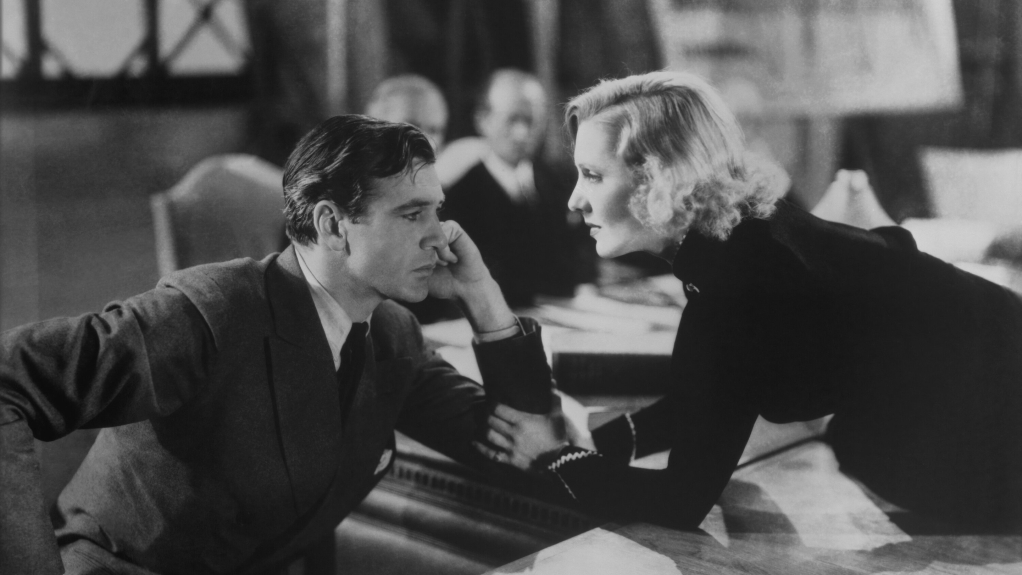
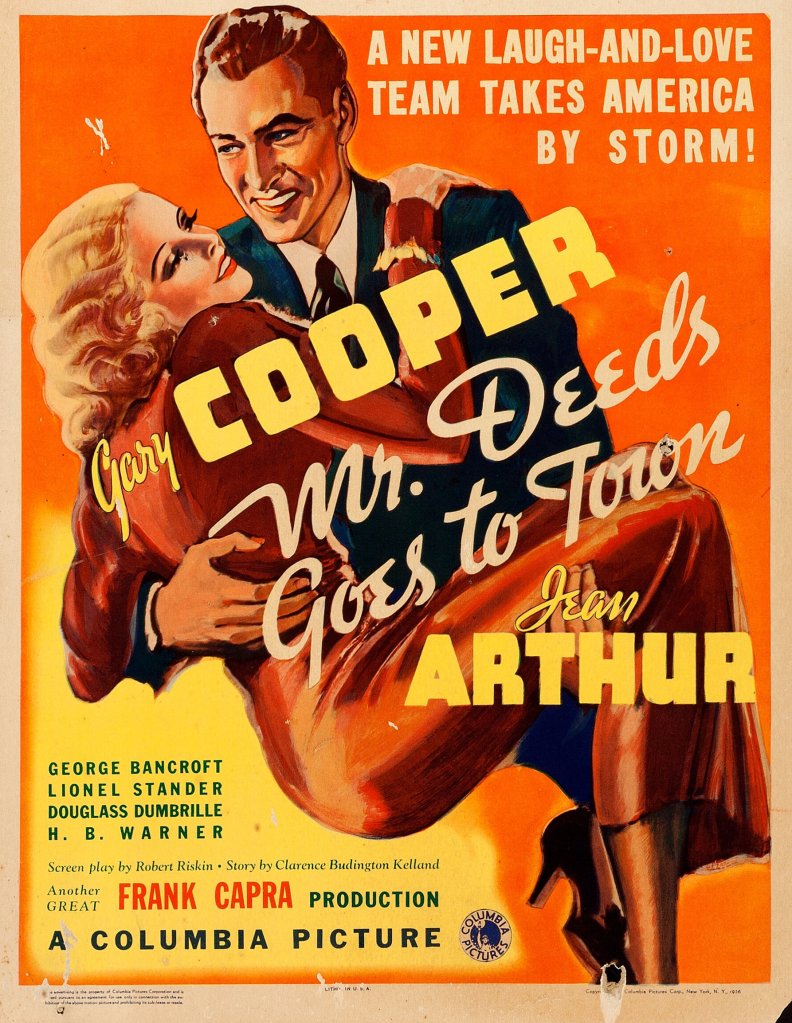
If any film first set out what we think of today as ‘Capraesque’ it might well be Mr Deeds Goes to Town. This was the film where so many of the elements we associate Capra – the honest little guy and his small-town, homespun American values against the selfish, two-faced, disingenuousness of the elites – really came into focus. Mr Deeds Goes to Town develops these ideas with a crisp, sharp comic wit, with Capra’s reassuringly liberal-conservative message delivered to perfect, audience-winning effect. It led to the even-better Mr Smith Goes to Washington and the template for every film which celebrates the little guy asking ‘why’ things have to be done this way.

Longfellow Deeds (Gary Cooper) is just your-average-Joe from small-town Mandrake Falls in Vermont who suddenly finds that he has inherited the unheard-of sum of $20million from a recently deceased uncle. His uncle’s assorted lawyers, led by suavely corrupt John Cedar (Douglass Drumbille) expect the naïve Deeds will happily allow them to continue riding the gravy train they’ve enjoyed for years. However, Deeds proves to have a mind of his own, refusing to kowtow to opportunists.

However, Deeds has an Achilles heel: he’s fallen hard for Babe Bennett (Jean Arthur), who he believes to be an out-of-work office girl but is in fact a star reporter, spinning the stories she picks up from their dates into articles about Deed that make him a laughing stock (the ‘Cinderella Man’). When Deeds discovers the truth – and is simultaneously threatened by Cedar with institutionalisation over his plans to give away his fortune to help the poor – he’s flung into a desperate court case to establish his sanity. Will a heart-broken Deeds defend himself?

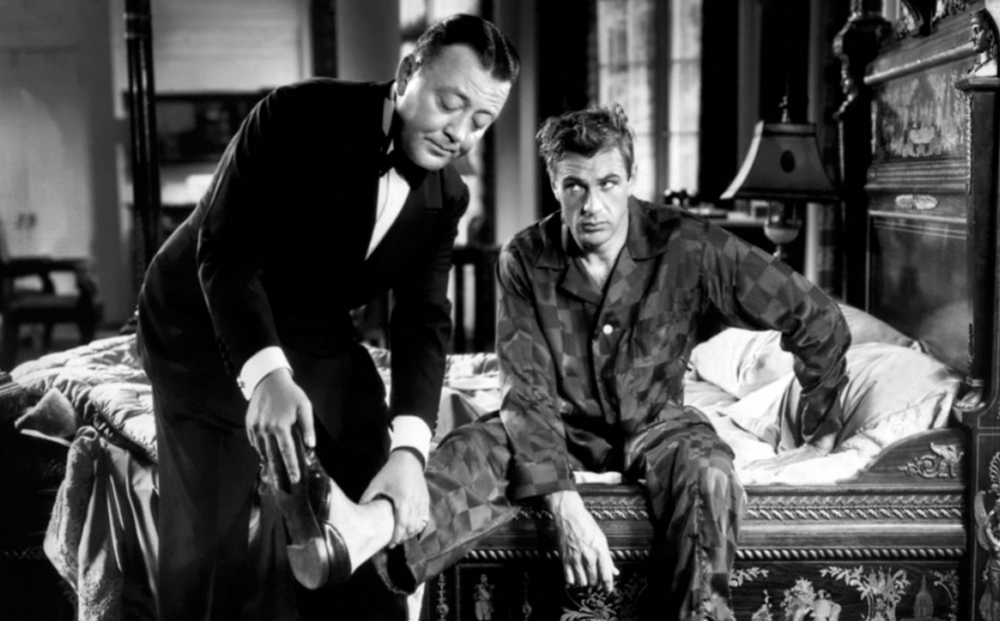
Mr Deeds, with a sparkling script from Riskin, captures Capra’s idea of true American values. Deeds is a softly-spoken, unfailingly honest, no-nonsense type who won’t waste a minute on flattery and forlock-tugging and respects hard-work and plain, simple decency. He’s an independent spirit: be that playing the tuba, sliding down the banisters of his grand home, jumping on board fire trucks to help out or sweetly scribbling limericks, he’s as endearingly enthusiastic as he is lacking in patience for pretension.

He also proves an honest man is no fool, but a shrewd judge of character – expertly recognising a lawyer who turns up pushing for his uncle’s ‘common law wife’ to take a share of his fortune is an ambulance-chasing crook – and he’s no push-over or empty suit (made the chair of his uncle’s Opera board, he shocks the rest by actually proceeding to chair the meeting and make decisions). He’s the sort of humble-stock, common-roots, middle-class hero without any sense of snobbery or self-importance, just like his hero President Grant, judging people on their merits not their finery.

It is, in short, a near perfect role for Gary Cooper, at the absolute top-of-his game here: funny, charming and hugely endearing. Cooper can also convincingly back-up Deeds’ affability with a (literal) fist when pushed too far. Cooper is an expert at preventing an otherwise almost-too-good-to-be-true character from becoming grating or irritating. He’s also extremely touching when called upon – his giddy, bed-rolling phone call to Jean Arthur’s Babe is as sweet as his broken edge-of-tears sadness when he discovers she’s been lying to him (I can think of very few 30s actors who would have been comfortable looking as emotionally vulnerable as Cooper does here).

But Capra’s world view was always more complex though than we think. It’s easy to see Mr Deeds as arguing we should re-direct our efforts to helping the poor and needy, and the greed and hypocrisy of the rich (the sort of snobs who mock Deeds to his face at the dinner table). That might be closer to screenwriter Robert Riskin’s views: but actually, Capra’s vision has more of an Edwardian paternalism to it. He sees Deeds’s destiny – once he renounces the wild living of suddenly being loaded – not be a Tony Benn style-radical but the sort of paternalistic benefactor of the deserving poor you might see in a cosy Downton Abbey-style costume-drama.

Because the people Deeds ends up helping share his view of the world, as one where hard-work and having the right attitude should lead to rewards (with the implicit message, that if you can’t succeed then, it’s your fault). Deeds is tugged out of his slowly forming playboy lifestyle by John Wray’s desperate farmer. Wray is at the heart of a genuinely affecting sequence, determined to cause Deeds harm (believing stories of him frittering away money on eccentric trifles) and ending it in shameful tears, accepting Deeds unasked-for help. Like this man, those Deeds helps have lost farms and land due to the depression, screwed by the games of the financial elites.

But Mr Deeds Goes to Town never once tries to suggest there is anything fundamentally wrong with this system – only some of the people who have risen to the top. And even then, it’s their personal greed and inverted snobbery that’s their crime, not the fundamentally unbalanced financial system. The main strawman for elite’s financial frippery is the Opera house committee Deeds chairs for: he can’t see the point of taking a loss on an art institution, essentially arguing it should focus more on commerce to earn its way – the sort of art view that it’s only good if loads of people pay for it (on that basis Avengers Endgame is the greatest film ever made).

It’s part of a criticism of snobbery that the homely, common-man, Deeds can’t abide: captured in the idea that enjoying the plays and books ordinary people don’t want to read is somehow proof of an elitist coldness that doesnt value ordinary people. There’s an inverted Conservative snobbery here.

Now, don’t get me wrong: there’s still a decent world-view in Capra at valuing hard working people who want to help themselves. In the big city where life is a “crazy competition for nothing”, it’s refreshing to have someone who doesn’t care about societies ins and outs society, but does care that hungry farmers have a sandwich to eat. But it’s also a more conservative, and safe message than people remember.

Saying all that, Mr Deeds is a hugely entertaining film. The romance between Cooper and Jean Arthur (absolutely in her element as the screwball femme fatale with a heart-of-gold) expertly mixes genuine sweetness with spark. The film’s Act Five trial scene is perfectly executed, a brilliant parade of snobs and slander leading to an inevitable final reel rebuttal from Cooper that the actor knocks out of the park. (It works so well, the whole structure would be largely repeated in Mr Smith with the twist that here Deeds doesn’t speak at all) There are a host of superb performances: Stander is perfect as the cynical hack who finds himself surprised at his own conscience, perfectly balanced by Drumbrille as the suave lawyer who has no conscience at all.

All of these elements come together to sublime effect in a film that is rich, entertaining and genuinely sweet – with a possibly career-best performance from Cooper (Again, it’s refreshing to see an alpha-male actor so willing to be vulnerable). Capra’s direction is sublime: dynamic, witty and providing constant visual and emotional interest. Its politics are more conservative and simplistic than at first appears, but as a setting-out of Capra’s mission statement for warmer, kinder, small-town American values of simplicity, plainness, honesty and decency it entertainingly puts forward as brilliant a case as Deeds does.

Materialists (2025)

Materialists (2025)

Smug, contrived and misguided romantic comedy with a self important air

Director: Celine Song

Cast: Dakota Johnson (Lucy Mason), Chris Evans (John P), Pedro Pascal (Harry Castillo), Zoë Winters (Sophie), Marin Ireland (Violet)

In the modern world, what do we look for most in a partner? To professional matchmaker Lucy Mason (Dakota Johnson) “the math is simple” (strap in folks, that’s a phrase you’ll hear a lot): we want someone who ticks plenty of our boxes, offers financial and social security as well as being the right height with the right level of charm. Love, you’ll notice, doesn’t play a role in that. So, what’s Lucy to do when she starts a relationship with ‘unicorn’ Harry (Pedro Pascal), exactly the sort of charming, super-wealthy and tall guy women dream of, just when her ex-boyfriend John (Chris Evans), part-time-actor-and-waiter, suddenly resurfaces in her life. How strong will her principles to make the best deal possible be?

It sounds like the set-up for a romantic comedy. And honestly, it would have made a perfectly good one. Our heroine would be warm and charming even as she professed her cynicism, and the plot focussed on the whimsically old-fashioned concept of matchmaking would have gradually led her to embrace love (along with, inevitably, the poor but adorable love interest.) But Celine Song’s follow-up to Past Lives is a scrupulously dry character study, that wants you to think it’s got a deep and meaningful message about relationships in the world today, but eventually pedals the same rom-com message you imagine it would call trite.

But in a rom-com, the audience knows they’re watching a candyfloss fantasy – Song tries to staple the same “abandon realism here” kind of ending onto her ponderously, pretentious story, despite it contradicting the heroine’s entire personality and the characters’ painstakingly spelled out obstacles, and doesn’t seem to have noticed it makes the whole thing a complete dog’s dinner.   

Putting it simply: I didn’t particularly like Materialists, found its smugly superior attitude irritating, its final message deeply confusing, and felt it eventually chickened out of making a real point about modern dating. It’s an art-house film, dressed as a rom-com, trying to fool you into thinking it’s a state-of-the-nation film while letting its lead end up in a reassuring fantasy that only happens in the movies.

Partly based on Song’s experience as a match-maker, the most interesting content in Materialists is its exploration of what makes people choose who to date. I think this is a very interesting topic: at a time when people find it harder to meet (and the financial demands of the modern world harder to cope with), hundreds of thousands of people will be making relationship decisions based on cold hard financial and social facts. And yeah, some of them probably do feel guilty about that, much as Materialists suggests.

But exploring the loneliness of modern life isn’t Song’s goal. Lucy’s clients (bar one) are deliberately awful caricatures – who cares why someone like that would be looking for love, right? The film is solely here for Lucy’s Great Dilemma: How far will she go in a relationship with a box-ticking man she likes, but whom she doesn’t love. (A more challenging version of Materialists might have left out Evans’ unbelievably-handsome-and-decent penniless actor, and just really explored this dilemma for Lucy.)

But instead, the love triangle offers an easy get-out card for Lucy. Because, unlike her clients, Lucy has already met her perfect match. In fact, while her desperate and deluded clients just want to meet someone who can stand to be at the same table sa them, Lucy has two gorgeous, considerate, tall, charming men begging her to let them commit their lives to her. (And who, by the way, can believe a charming, six-foot multi-millionaire who looks like Pedro freaking Pascal can’t get a date?) She’s got the lovely Harry, whose stunning Manhattan penthouse she gazes at awe-struck, like Lizzy Bennett at Pemberly. And there is literally nothing wrong with John, aside from his lack of income (he’s the only actor in the world who doesn’t have an agent and doesn’t want commercial work) – he’s kind and decent  and trying to follow a dream. It makes her conundrum a false fantasy.

That’s one of the worst things about Materialists which, in many ways, is even less risky and daring than flipping Pretty Woman. It talks a big game about dating and relationships being economic and social decisions. It bangs on endlessly about this topic but, deep down, clearly doesn’t believe in it at all. Because even an astute analyst of people’s personalities (as Song can be) isn’t brave enough to make a film that commits to its initial proposition. Instead, Song sets up a parade of straw-man arguments that Lucy’s experiences can knock down to reach the ‘correct’ decision.

Ah Lucy. This mystifyingly motivated character who Dakota Johnson struggles to make coherent sense from. It’s not helped by Johnson’s breathy, evenly paced delivery that makes it very hard sometimes to work out what her character is meant to be thinking or feeling. Her air of dead-eyed professional monotone makes sense for her interactions with clients, but her colourless delivery of nearly all her lines made it almost impossible for me to work out when her character’s views change.

It’s not completely Johnson’s fault that Lucy is a deeply irritating character, but it would take a significantly more charismatic actor to make you overlook what a self-pitying, self-loathing waif she is, whose fundamental selfishness isn’t softened by constantly telling us she knows how selfish she is. Are we supposed to be rooting for her, when she essentially treats John (Evans, very likeable, sweet and witty) as an emotional-comfort-blanket, who can be dropped when she gets bored with him? Even when John calls her out on this, by the next sentence he’s absolving her for it.

Then in order to provoke her epiphany, the film clumsily introduces a sexual assault plotline for a supporting character, which exists solely to give Lucy the equivalent of “man-pain” – honestly, if the same plot was put in a film with a male lead, the socials would be burning up with cries of foul. This plotline is ludicrous from start to finish, while simultaneously treating a genuinely serious issue in dating like a ‘problem-of-the-week’ that can be solved with a hug. No male writer could have gotten away with the shallow, clumsy, plot-contrived development – and I don’t think Song should either.

Materialists takes place in a crazy world, where a dating firm has offices across the world, where the Manhattan police don’t respond to harassment call-outs from rapists, where everyone is paying tens of thousands of dollars to hook-up and John seems to be the only poor person. It’s dripping with smug assurance at its own cleverness, while offering a sort of moral message identical to a Sanda Bullock 90s romcom (but with fewer gags and chemistry). It’s frequently ponderous, stuffed with overly mannered dialogue and goes on forever. Having a Michael Haneke inspired closing shot, doesn’t change the fact the scene itself could have come straight out of The Runaway Bride. Materialists was not good.

The Taming of the Shrew (1967)

The Taming of the Shrew (1967)

Burton and Taylor are perfect casting in this rollicking adaptation of Shakespeare’s most difficult comedy

Director: Franco Zeffirelli

Cast: Elizabeth Taylor (Kate), Richard Burton (Petruchio), Cyril Cusack (Grumio), Michael Hordern (Baptista Minola), Alfred Lynch (Tranio), Alan Webb (Gremio), Michael York (Lucentio), Natasha Pyne (Bianca), Victor Spinetti (Hortensio), Roy Holder (Biondello), Mark Dignam (Vincentio), Vernon Dobtcheff (Pedant), Bice Valori (Widow)

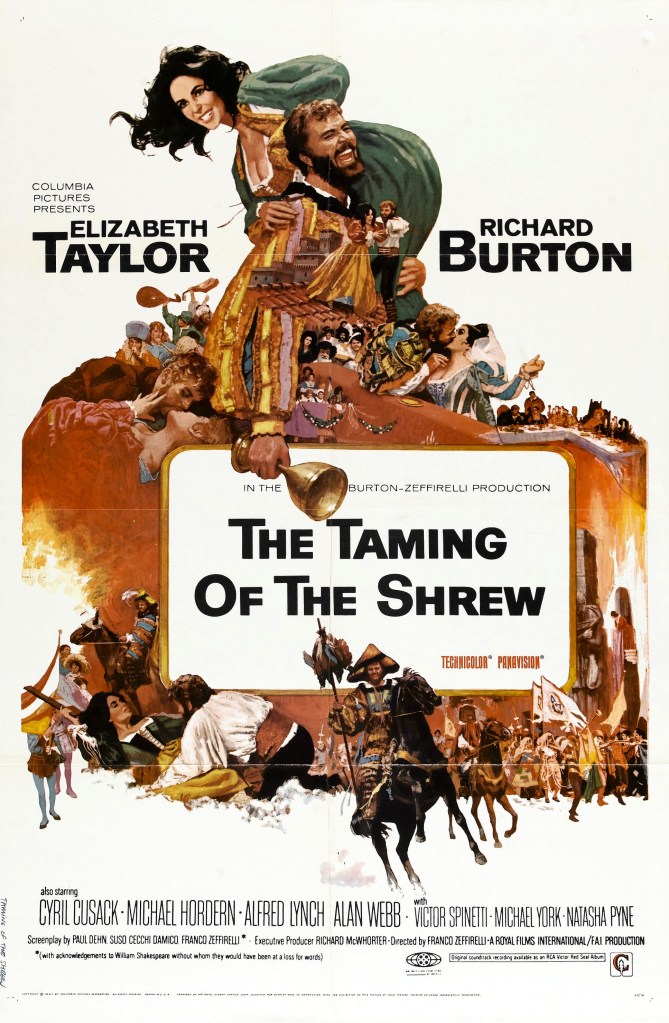
There’s a reason why the poster screamed “The motion picture they were made for!” Who else could play literature’s most tempestuous couple, than the world’s most tempestuous couple? After all, they rolled into this straight off the success of Who’s Afraid of Virginia Woolf? and, say what you like, a knock-about piece of Shakespearean farce is certainly more fun than two hours of Edward Albee. So, Burton and Taylor turned up in Italy, entourage in hand, to bring The Taming of the Shrew to life in a gorgeous explosion of grand sets and wonderfully detailed costumes.

The Taming of the Shrew actually translates well to the screen – and Zeffirelli’s high-octane style. Odd to think now, for a film soaked in elaborate period setting, that in the 60s Zeffirelli’s style was seen as border-line sacrilegious to the Bard. He actually escaped with less opprobrium from the critics than he faced for cutting two-thirds of Romeo and Juliet a year later, since most seemed to think Shrew was less of a holy text. Not that it stopped a lot of critics reckoning Zeffirelli should focus more on executing every pentameter to perfection and less on gags and visual story-telling.

But actually, that’s perfect for a story that was always a raucous farce at heart – so much so, even the original play presents it as a play-within-a-play told to a drunken Christopher Sly (cut here). The bawdiness feels fresh out of Chaucer and Boccaccio, a parade of people in period costumes slapping thighs, roaring with laughter, double taking and enjoying a series of cheeky jokes (did Pasolini watch this before making his lusty adaptations?). Padua is a city of sin, with prostitutes openly advertising their wares (and later, clearly, invited to Bianca’s wedding) and a wife-stealer is in the stocks.

Zeffirelli’s Shrew is full of rowdy wildness – in a nod to the cut Sly framing device, Padua is in the midst of a feast of fools, students turning a choral sing-along into a drunken celebration. Kate and Petruchio’s high-octane gunning for each other, feels fitting for a location where everyone is careering wildly towards the target of their immediate emotions, either horny beyond belief, desperate to marry off daughters or furious at supposed crimes or betrayals.

The age-old question you have when staging Shrew is what to do about its fundamental misogyny (and it’s hard not to argue, much as the bard’s defenders have tried, not to see it as a play deeply rooted in the patriarchy). Zeffirelli’s solution is an intriguing one: his Shrew is enigmatic, with Kate’s motivations, feelings and reasonings often left cleverly open to interpretation. It’s also helped, of course, by the natural chemistry between the two leads. If there is one thing we all know, it’s that Burton and Taylor were really into each other and drove each other up the wall. What Shrew does here is take that sexual force and exuberance of its leads and balances that with a subtle unreadable quality to Kate that leaves the relationship’s power-balance just open enough to interpretation.

In addition, the film makes clear Kate’s behaviour is unacceptable, introduced screaming abuse from a window and smashing up all the furniture in a room in a fit of furious pique. There’s a lovely touch where Petruchio stares into his own reflection, while planning his campaign – a nice suggestion that he will mirror her behaviour to show its unacceptability (indeed, on returning to their marriage home, he’ll also twice smash up a room’s contents in a pointless display of adolescent petulance). Kate has, to put it bluntly, anger management issues and if Petruchio’s methods are extreme you can see the twisted logic.

Their first meeting sets a pacey tone that will run through the whole film. It’s a wild chase through the Baptista home, through a connected wool barn, over a roof and back again. One in which they will bellow at each other, Kate will rip up planks and bannisters to throw at him, they’ll roll in the wool (hard not to see a sexual charge here) and eventually collapse through the roof to land back in the wool. Petruchio will then announce her consent to marry with an arm twisted round her back, just as he will cut off her refusal at the altar with a kiss (the wedding scene is a neat interpolation, showing something the Bard only reports). They are in a constant pursuit of sorts from here, from the back-and-forth at Petruchio’s house, to the journey to Padua and then finally through a crowd of women at the film’s end. But where does the power lie: pursued or pursuer?

At first, of course, with the pursuer. Burton’s Petruchio is a wild-eyed force-of-nature, permanently partly sozzled (Burton spends most of the film with a pale, damp drinking sweat that was probably not acting), his tights full of holes, his manners rude (he’s basically Christopher Sly in the lead role), focused on the money he’ll get from wooing Kate. But, while he’s a powerful alpha male, it’s remarkable how the balance slowly shifts to Kate. After their arrival at his home (she, soaking wet after falling in a puddle to Petruchio’s laughter), she puts her drunken husband to bed, has the house redecorated, the servants redressed and everything arranged to her liking.

Taylor’s performance here adds to the effect. It’s an intelligent, camera-wise performance which uses looks to convey Kate’s loneliness and pain. Locked in a room before the wedding, she glances out of a window with aching sadness. She looks with gentle envy at warm friendship in others. Taylor gives a wonderfully calm, genuine delivery of the famous closing speech of wifely piety. But it’s words are undermined in two ways: firstly by the suspicion it’s partly done to show-up the jokes against her throughout the wedding, and then by Taylor’s immediate departure after kissing a finally flabbergasted Petruchio, leaving our macho hero wading through a pile of laughing women in a desperate attempt to catch-up. Who might just rule here, long term?

Zeffirelli’s film moves the Lucentio (a wide-eyed Michael York) sub-plot even further to the margins – in a neat invention, Petruchio during the first chase, keeps barging in on rooms where different sub-plot scenes are all going on at the same time. As a result, this does mean a number of first-rate actors get very little to do: Cyril Cusack’s Grumio becomes a grinning observer of the chaos, Alfred Lynch’s Tranio (after some initial fourth-wall breaking) fades into the background, Michael Hordern has little to do but look aghast as a desperate Minola, Alan Webb barely registers as a rejected suitor while after an initial sight gag (his minstrel player disguise making him look like the fifth Beatle) Victor Spinetti gets similarly fades away.

But then audiences were here for the Burton-Taylor show, and they get that in spades: framed within a medieval setting inspired by classical painting (and which features an obviously fake backdrop for its countryside exteriors). And The Taming of the Shrew is rollicking good fun, which manages to work an interesting line on the play’s troublesome sexual politics, suggesting that all but not always be as it seems. And it nails the atmosphere of rollicking fun in this ribald Shakespeare yarn.

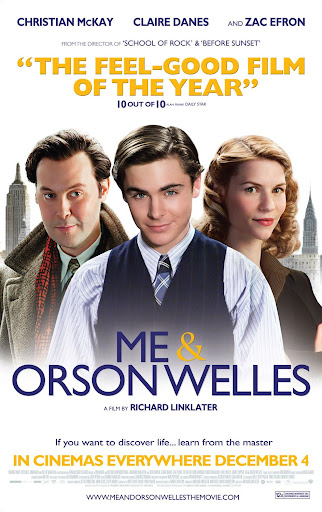
Me and Orson Welles (2008)

Me and Orson Welles (2008)

A star-turn from McKay and a brilliant theatrical reconstruction makes a charming comedy

Director: Richard Linklater

Cast: Zac Efron (Richard Samuels), Claire Danes (Sonja Jones), Christian McKay (Orson Welles), Ben Chaplin (George Coulouris), James Tupper (Joseph Cotton), Eddie Marsan (John Houseman), Leo Bill (Norman Lloyd), Kelly Reilly (Muriel Brassler), Patrick Kennedy (Grover Burgess), Travis Oliver (John Hoyt), Zoe Kazan (Gretta Adler)

In the 1930s Orson Welles was the Great Man of American theatre, a genius blessed with Midas’ skill to turn everything he touched to Gold. He had conquered the stage and his success on radio transmitted his fame into households across America. All this and he was not even thirty. On top of his boundless charisma, creativity and magnetic leadership qualities, he was also vain, selfish, boundlessly ambitious and self-obsessed, seeing other people as little more than extras in his drama. It’s an exploration of the man central to Linklater’s Me and Orson Welles, combined with the film’s wonderfully fond exploration of that magical world behind the curtain in the theatre.

Me and Orson Welles charts Welles’ landmark Broadway production of Julius Caesar: a modern-dress marvel (‘the fascist Caesar’) that reimagined a sharply cut, pacey production set in a world of jackboots, black shirts and Nuremberg-esque beams of light. Welles (Christian McKay) was, of course, front-and-centre as Brutus with his Mercury theatre players (nearly all of whom followed him to Hollywood for Citizen Kane) all around him. Newest to the cast is 17-year-old Richard Samuels (Zac Efron), away from school, dreaming of being an actor and falling in love with older production manager Sonja Jones (Claire Danes). As the production stumbles towards the stage under Welles’ mercurial hand, Richard worships Welles and loves Sonja – but will his hero-worship survive sustained contact with Welles?

Linklater’s film is set in a gorgeous recreation of 1930s Broadway theatre, full of love for the greasepaint, backstage gossip and theatrical tricks that create a world on stage. It also features an astonishingly accurate recreation of this seminal production, staged and lit to perfection, which gets as close as we can to capturing some sense of the astonishing experience the first night audience had watching the sort of Shakespeare production they had never seen before (Dick Pope, harnessing his experience of recreation Gilbert and Sullivan in Topsy-Turvy deserves major credit for his cinematography here, perfectly capturing Welles’ pioneering use of light).

Welles’ flaws are slowly discovered by Richard Samuels – a charming, deceptively light and winning performance by Zac Efron. Samuels is at first bowled over by Welles charisma – and Welles enjoys the ego-trip of taking a star-struck young man under his wing, who he can tutor and mould (who, after all, doesn’t love having a disciple). What Me and Orson Welles interestingly does is to have its young lead slowly work out that Welles may be a genius – but he’s also a fundamentally, principle-free shit who never means what he says, doesn’t think twice about dropping people when they have served their purpose and largely sees conversation as a one-way street where Welles monologues and the other person listens (and certainly never, ever, contradicts – Welles never forgives correction).

But Welles dominates the film, like he dominated life. He’s brilliantly portrayed by Christian McKay in his first major film role. McKay, an unknown, was selected after Linklater was wowed by his one-man show about the Great Man. (Linklater refused calls from the producers to replace him with a more famous actor). McKay dominates the film in what is not only a superb capturing of Welles vocal and physical mannerisms, but also a capturing of his mix of utter charisma, God-given talent and overwhelmingly selfish egotism. McKay roars through every scene with the same force-of-character you imagine Welles had, bowling over everyone around him and shaping the world into what he wishes it to be. Problems of money, timing and people are waved away (or left to be fixed by Eddie Marsan’s put-upon version of John Houseman) and McKay’s Welles uses sheer force of will to turn every event, outcome and single moment into an intended triumph (whether it is or not). Me and Orson Welles brilliantly captures Welles ability to shape his world.

We see the way he overwhelms the personalities of those around him. People like Joseph Cotton (a superbly captured performance by James Tupper) both love him and know that’s he’s a selfish, arrogant git who doesn’t seem to care about anyone but himself. Others, like Ben Chaplin’s tortured George Coulouris, allow themselves to be mothered by Welles, even though they know his motivations are more for the show itself (and the glory that shall be Welles’). Welles is the guy who gives the same heartfelt pep-talk to multiple actors, and writes identical jovial thank-you cards to all on opening night. The guy who uses nicknames for those around him because it’s a way to subtly assert control. Linklater’s film recognises his genius, makes him overwhelmingly attractive in his gung-ho confidence, but – and this is the brilliant thing about McKay’s stunning performance – also exposes his deep character flaws.

It superbly captures his vanity, selfishness and self-occupation. Welles cares little for anyone, assuming he can brow-beat or overwhelm them to fulfil his wishes. That could be a set designer, furious at Welles hogging credit for his work in the programme (Welles promises this will be amended, forgets about it and then later – when it’s too late to do anything about it – bluntly says he has no intention of not taking credit). It could be the radio show he turns up to record, clearly having not read the script, walking in seconds before live broadcast and promptly improvising a superb monologue (based on The Magnificent Ambersons) which at first puzzles, frustrates and then stuns into fawning admiration his fellow actors. What’s clear is that this is the sort of behaviour you can only get away with when you are flying high and all is perfect – Welles after all would self-destruct like few others in the next few years, never again able to yield such charismatic power again.

Me and Orson Welles uses a familiar structure – a love triangle of sorts – to bring this to life. Claire Danes gives a marvellously winning performance as an ambitious and super-confident woman, trying to make her way in a male world, perhaps drawn towards young Richard because he’s more thoughtful than the rest of the men around her. (Me and Orson Welles makes clear we live in a world where the actors of the company feel comfortable taking bets on who can bed Sonja, while she is also accepts that Welles can use the women of the company like a room-service menu). Both she and Richard are perhaps the forerunners of those who will finally be pushed too far by Welles, that would leave him a perpetual outsider.

This is a fun musing on the personality of one of the greatest film-makers of all time, brilliantly set in a luxurious recreation of classic Broadway. Directed with pace and wit by Linklater, with a fine cast giving it their all (and a career-defining turn from McKay), Me and Orson Welles is light, frothy but fascinating work.

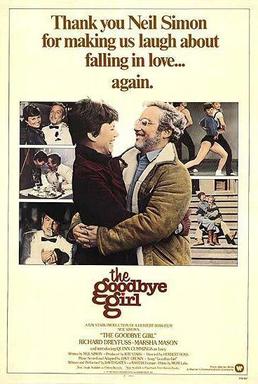
The Goodbye Girl (1977)

The Goodbye Girl (1977)

Some funny lines isn’t quite enough for this romantic comedy to work as well as it should

Director: Herbert Ross

Cast: Richard Dreyfuss (Elliot Garfield), Marsha Mason (Paula McFadden), Quinn Cummings (Lucy McFadden), Paul Benedict (Mark Bodine), Barbara Rhoades (Donna Douglas), Nicol Williamson (Oliver Fry)

Working as a performer sucks. There’s no money and who knows when the next job is round the corner? It’s even tougher when you are forever unlucky in love. That’s the case for semi-retired dancer Paula McFadden (Marsha Mason). She’s been jilted twice by actors who disappear for a big break somewhere else, leaving only a cursory apology behind. It makes being a single mother to precocious-but-vulnerable ten-year-old Lucy (Quinn Cummings) even harder. Harder again is that her recent awful boyfriend, as a parting gift, sublet their apartment without her knowledge to Elliot Garfield (Richard Dreyfuss), an actor as neurotic as Paula, arriving in New York for his big break. Paula refuses to leave her home and the two kick off a territorial feud, which settles into a truce and a flat share. But could it lead to anything else?

It probably won’t be a surprise to say yes it does, in this sharply written film from Neil Simon, crammed with fast-paced, theatrical, gag-filled dialogue which keeps the film’s pace up without really converting it into something real. The main problem with The Goodbye Girl is that it’s hard to believe in, or really care for, either of its two lead character. I don’t think it’s an exaggeration to say both of them would be incredibly hard work to live with. After all, they can frequently be rather trying just to watch. Simon makes them both brittle, neurotic, high-strung and prone to performative bursts of euphoria and rage. Both can swing on a six-pence between these. It’s probably meant to make them the perfect match, like a feuding Bogart (who Garfield impersonates at one point) and Bacall, but after a while just starts to wear you down. You want to give both of them a bit of a shake and say “pull yourself together!”

The ability to stick with the film revolves around how charming you find both performers. Here, Richard Dreyfuss has the definite advantage. Coming off a hot-streak that had seen almost every film he had made turn into a smash hit, Dreyfuss’ performance made him (at 29) the youngest winner of the Best Actor Oscar. A late replacement for a fired Robert De Niro (can you even begin to imagine De Niro’s deadpan intensity working here?), the part is a perfect match for Dreyfuss’ youthful, madcap energy. He seizes on the rat-a-tat dialogue, embraces Garfield’s zany love for New Agey thinking (yoga, guitar and sleeping “buffo”) and bounces around the film as likely to make monkey noises while euphorically chinning up on a door frame as he is to play sweet imagination games with young Lucy. He brings a lot of charm to a highly strung, difficult man, uncovering a lot of his essential decency and kindness.

He actually settles more into the difficult balance than Marsha Mason, the person (Simon’s wife) who the film was written for. Mason never really manages to find the softness and likability in this role. It’s not entirely her fault: while the point is that Paula is a woman with serious trust issues, the film never gives her a moment of calmness or reflection to open up about this. Instead, it takes a lazier route of having this turn her into an abrasive comic character, the sort of person who responds to a “morning after” with a furious expectation of betrayal. Mason never quite manages to find a softness or likeability under this prickly defensiveness. Interestingly, for all the project was written for her, she has few of the truly funny lines and is effectively the obstacle that must be fixed rather than having the more engaging role of charming disrupter.

To be honest there is not a lot of chemistry between the two. Simon so enjoys the competitive dialogue feuding over territory, bills and who will have what room and when, that he rather forgets to  show them actually falling in love. In fact, he ends up relying on the age-old formula of a precocious, New York Times reading child being the bridge to bring them together. Quinn Cummings is rather good as the sort of kid who only exists in the movies, as adept with the witty retort as the adults. But between Elliot and Paula, the romance always feels a bit too inevitable rather than natural, the eventual thawing occurring swiftly rather than feeling it has developed naturally and gently.

It’s part of the slightly formulaic nature of The Goodbye Girl. It’s a highly safe film, with a very conventional romantic storyline, that bubbles along to a happy ending. You can feel the box-ticking from scene-after-scene, just as you can feel the inevitability of its happy ending. It’s also overly theatrical, feels constrained by its location and never quite light enough on its feet. There are a few too many stand-up rows around the apartment block (their poor neighbours) and Herbert Ross’ direction struggles as much as Simon’s script to give us a reason to really root for this couple.

There are though some decent digs at the working life in the arts. Paula, trying to get back into the dancing game, is hideously off-the-pace and takes a job as an enthusiastic glamour-girl flogging Japanese cars at trade show. Elliot is forced to fall back a doorman gig at a strip club. It’s a tough old trade, especially as Elliot’s big break in New York falls apart after he is forced by a pretentious, talentless director to perform Richard III as a limp-wristed, 1970s stereotype of a gay man, mincing around and lisping his lines to the ridicule and disgust of audiences and critics. This comic highlight feels a little awkward now (the joke is the stereotyped gay behaviour, rather than the appalling idea, making it’s a little uncomfortable to watch at times, rather as if Elliot was being made to play it in black face).

The Goodbye Girl just isn’t quite charming or likeable enough and its characters are never people we really end up warming to or rooting for. Its sharp dialogue ends up making them feel less like real people and more like theatrical characters, bouncing off each other for effect. Dreyfuss comes off best here, but Ross’ direction is uninspired, its romantic coupling never really convincing and it tends to rather overstay its welcome.

La Ronde (1950)

La Ronde (1950)

Ophüls masterful film is a cheeky end-of-pier comedy in smart clothes and subtle musing on filmmaking

Director: Max Ophüls

Cast: Anton Walbrook (Master of Ceremonies), Simone Signoret (Léocadie, the Prostitute), Serge Reggiani (Franz, the Soldier), Simone Simon (Marie, the Chambermaid), Daniel Gélin (Alfred, the Young Man), Danielle Darrieux (Emma Breitkopf, the Married Woman), Fernand Gravey (Charles Breitkopf, the Husband), Odette Joyeux (Anna, the Young Woman), Jean-Louis Barrault (Robert Kuhlenkampf, the Poet), Isa Miranda (Charlotte, the Actress), Gérard Philipe (the Count)

La Ronde is the sort of film many would describe as elegant and sophisticated, with its Edwardian Viennese setting, gorgeously expansive costumes and luxuriant sets. Which is perhaps part of Max Ophüls’ joke: because, in many ways, La Ronde is a sublimely naughty end-of-the-pier show where a suave Master of Ceremies (a gloriously arch Anton Walbrook, standing in for Ophüls himself), manipulates events and people to present a chain of sexual encounters that eventually loop back round through the partners to the prostitute (Simeone Signoret) who started it all. Only of course she didn’t start it, since Walbrook’s MC instructed her exactly which soldier she was to invite for a romantic knee-trembler. La Ronde is a sex comedy of manners – but it’s also an intriguing commentary on the act of film-making.

Walbrook’s MC is essentially the film’s director. He all but tells us this, as Ophüls camera (in one of the director’s signature long, roving camera moves) tracks him walking in evening garb in front of what looks suspiciously like a painted backdrop… and then is immediately revealed to indeed be one as Walbrook guides us past a film camera onto another set, changes his clothes and begins handing out instruction to actors. Over the course of the film, Walbrook will guide characters between sets (through a blatant back-stage area), take on a series of small roles to directly intercede in the action and even snip out the film of La Ronde’s most smutty part. He’ll even cue the sun to rise. Walbrook’s archly artificial performance is crammed with assurance, charm and a supremely entertaining streak of naughtiness: for what is a film director but a sort of enthusiastic child who enjoys playing out his stories for us.

It makes sense that La Ronde takes place in a curiously artificial world, that often seems to be only populated by whichever pair of lovers Walbrook happens to have introduced. Its design echoes the circular narrative of the piece. Ophüls camera frequently moves through circular tracking shots, while the frame is stuffed with circles. From the merry-go-round the MC rides on, circles are everywhere: courtyards and rooms are circular, stair-cases and walkways roll round on themselves, characters are framed through chandeliers or circular gaps in ormolu clocks. The set seems to loop around as much as the story does, characters being forced into rotation, as if they were constantly riding the merry-go-round (which indeed we see, at one point, kitted out with a whole dinner service) not in control of their own fate but driven forward by endless momentum.

It’s an endless momentum that crashes only once, the MC’s roundabout breaking down when a young lover suffers from a bout of impotence. It’s telling that, during this sequence, we get the closest we get to an adult conversation between two lovers, Daniel Gélin’s eager-to-please young man and the relaxed worldliness of Danielle Darrieux’s married woman. Just as it’s telling that the only encounter not punctuated by sex, but instead by an earnest conversation that there are more important things in a marriage than the buzz of passion, is between Darrieux and Fernand Gravey’s fusty but strangely vulnerable Husband. Aside from that, these encounters have a constant frission of desire beneath them, only rarely punctuated by more complex emotions.

In fact, there is something very stereotypically French about a film that essentially says a constant parade of sexual encounters between willing partners is perfectly harmless, so long as eyes are open and honesty prevails. It’s also striking how, from encounter-to-encounter, characters switch from seduced to seducer.  Simone Simon’s Chambermaid goes from the arms of Serge Reggiani’s enthusiastic soldier (whose interest in her declines almost immediately after the deed), to shamelessly provoking the lust of Gélin’s young man who then immediately, enthusiastically, courts Darrieux. Odette Joyeux coquettishly plays along with Gravey’s extra-marital tumble and then finds herself swept up with Barrault’s poet who is putty in the hands of Miranda’s actress.

It all eventually loops us back round to Simone Signoret’s prostitute: and if there is anything in La Ronde about the cost of love, it seems fitting it should be connected to the loneliness of the only person to whom this is a professional obligation rather than a choice. Signoret makes the woman surprisingly melancholy and regretful, more desperate perhaps than anyone else for a taste of genuine connection: be it from Reggiani’s soldier (to whom she offers a free romantic encounter, which he only accepts so long as it doesn’t involve a ten minute walk to her apartment) or later from Philipe’s count, where she seems not even surprised that he awakens claiming to not remember a thing about the night before. La Ronde bookends a frequently light, sexy, cheeky film with its most tragic character (another sign of Signoret’s skill at pained neglect).

Aside from this, it’s a surprisingly light, playful and cheeky confection – one which relies on its impact from the masterfully graceful filming it receives from Ophüls, at the top of his game here. No point is made too forcefully, every scene smoothly but relentlessly builds towards a comic highlight, each shot is framed to perfection, from the gliding tracking shots to the Dutch angles and circulatory framing. This is a director’s film like few others: so, its immensely fitting it should, with Walbrook’s character, effectively make the director the key character, delightedly telling us every part of his design, guiding our eyes where to look and manipulating and positioning the other characters so they add to our enjoyment. There are few films quite like La Ronde in that all this is done with an astonishing lightness of touch. Nothing here is to be taken too seriously, or to be hammered home too hard. Instead, it’s a whimsical naughty story intended to leave you with a grin on your face when you recount it to friends.

Hold Back the Dawn (1941)

Hold Back the Dawn (1941)

A potentially cynical drama becomes a sweet romance, with three excellent lead performances

Director: Mitchell Leisen

Cast: Charles Boyer (Georges Iscovescu), Olivia de Havilland (Emmy Brown), Paulette Goddard (Antia Dixon), Victor Francen (Professor van der Luecken), Walter Abel (Inspector Hummock), Curt Bois (Bonbois), Rosemary DeCamp (Berta Kurz), Eric Feldary (Josef Kurz), Nestor Paiva (Fred Flores)

Refugees flock at the USA-Mexican border, desperate to squeeze into the Land of the Free, only to meet with a stringent border control and tight rules on immigration quotas. No, it’s not a story from today – it’s from the 1940s, with Mexico awash with refugees from Europe, fleeing Hitler. But the USA only has a certain quota of refugees it will accept from each country – and Romanian Georges Iscovescu (Charles Boyer) finds he’s got no less than a five to eight year wait before his quota number will come up. His ex-flame Anita (Paulette Goddard) suggests there might be a way around this: if Georges can get married to an American citizen, he will fly through the border on a green card. Georges sets his eye on spinsterish teacher Emmy Brown (Olivia de Havilland) marrying her in a whirlwind romance – only to find feelings of guilt and growing affection for Emmy making his plan more difficult.

Hold Back the Dawn is well-assembled, well-paced mix of romance and black-comedy which pulls its jet-black punches in favour of a more conventional happy ending. Perhaps that’s why it was the last Billy Wilder script (working with regular collaborator Charles Brackett) he didn’t direct himself. You can imagine a director as prone to the cynical as Wilder, may not have settled quite as happily for the more optimistic and reassuring film Hold Back the Dawn becomes. Wilder was also unhappy with how he felt the film pruned back the more cutting political criticism of America’s immigration policy. As a refugee from Hitler himself, Wilder knew of what he was talking about.

However, that’s not to say Hold Back the Dawn isn’t awash with Wilder and Brackett’s patented mix of waspish character comedy and sharp dialogue tinted with more than a touch of arch cynicism. Mitchell Leisen’s success here, is to smooth the wheels to allow enough of this mix of black and absurdist humour to carry through a film you feel the studio has attempted to shoe-horn into being a conventional ‘love conquers all’ narrative (not least with its ending, which has the look and feel of a mix of hurried re-shoots and re-purposed footage to create a late upbeat ending, filmed after de Havilland was no longer available from her loan from Warner Brothers).

Hold Back the Dawn doesn’t shirk on the vicious, oppressive cycle of being stuck in a holding pattern waiting to be allowed into the US. Georges only gains his room in the overstuffed hotel because the previous tenant hangs himself (the manager matter-of-factly says he’ll have the room ready shortly). There is quite a lot of both dark humour (from Georges and Anita’s nakedly opportunist cadism) to little touches of high farce (a pregnant woman gaming the system to give birth on US soil) and the faintly surreal (a would-be refugee who might just be a descendant of honorary US citizen Lafayette). Throughout most of Hold Back the Dawn this never feels out of keeping with the slow-burning romance between Georges and Emmy.

A lot of this is also due to Charles Boyer’s highly successful performance in the lead role. Few actors were as skilled at mixing suave European class and louche rotter-ness than Boyer, and Georges is a gift of a part. A playboy stuck in a boring, dead-end purgatory of a town (one he aimlessly walks around time and time again to kill the hours), Boyer makes Georges believable charm personified – certainly enough to back the film’s implication he keeps himself afloat as a gigolo for tourists. Boyer’s arch voiceover relays every-step of the nakedly self-centred plan he initiates to squirm his way over the border. His performance is full of charm, tender shyness and love-struck adoration to Emmy, punctured throughout by Boyer’s canny side-eye to check on the effect of his shameless lies (there is a glorious moment when Boyer checks himself and cocks an eye when walking down a street, to make sure Emmy is following him).

The character works though because Boyer is a master at balancing this ruthless, self-serving charm with a general decency just below the surface that, no matter how hard he tries, he can never quite dampen down. It excels in the film’s middle act as the couple’s ‘spontaneous’ (so Georges can escape the notice of Walter Abel’s excellently shrewd immigration inspector) honeymoon in Mexico. Boyer brilliantly demonstrates through the slightest of vocal inflections and subtle shifts in body language (there is a point during a village fiesta where his face lights up with a genuine smile the like of which we have never seen before) that make us totally believe this is a man who, much to his surprise, is actually falling in love.

It helps with this that he shares scenes with such a winning presence as Olivia de Havilland as Emmy. Oscar-nominated, de Havilland takes a role (a spinsterish frump, who has never been loved) that could be ridiculous and makes it utterly and completely real. Throughout Georges initially cynical courting, there is a little sense of doubt throughout in de Havilland’s manner (she knows instant love is too good to be true), but such is her loneliness we can see and feel her willing herself into belief. As she does so, de Havilland lets the shy Emmy flourish into a woman of greater confidence, wit and burgeoning sexual desire (hilariously, the increasingly shamed Georges begins to event injuries to put off the consummation of this marriage). De Havilland makes Emmy a living, breathing person, someone miles away from the joke she is set up as initially: instead she is a genuine, true-hearted, increasingly brave woman whose decency and sense of warmth we grow to love as much as Georges does.

She makes an excellent contrast with Paulette Goddard’s ruthlessly amoral Anita. In one of her finest performances outside of her work with Chaplin, Goddard makes Anita utterly ruthless in seeking out what she wants and full of a hilariously honesty about her willingness to use anyone and anything to get it. She’s Georges even darker reflection, Goddard’s dialogue awash with brutal firecracker one-liners. But even she is capable at points of depth, a late act of petty cruelty awakening in her underlying feelings of sympathy and empathy that seem to surprise even her. It’s a lovely performance of darkly comedic ruthlessness.

These three leads all elevate a film that at times compromises on its vision of the harshness of the system these people are all stuck in. Hold Back the Dawn doesn’t want to make a statement as such – it wants to offer a more reassuring vision of hope and decency. This it does well: the film is even built around Georges pitching it as a possible film project to the actual Mitchell Leisen (effectively playing himself, on set shooting a real film with the real Veronica Lake and Brian Donlevy). After a start that suggests something darker and more dangerous, it ends as a comforting and safe picture – but one that works extremely well.

Moonstruck (1987)

Moonstruck (1987)

Charmingly romantic comedy with little touches of Shakespeare in its celebration of family love

Director: Norman Jewison

Cast: Cher (Loretta Castorini), Nicolas Cage (Ronny Cammareri), Olympia Dukakis (Rose Castorini), Vincent Gardenia (Cosmo Castorini), Danny Aiello (Johnny Cammareri), Julie Bovasso (Rita Cappomagi), Louis Goss (Raymond Cappomagi), John Mahoney (Perry), Feodor Chaliapin (Old man), Antia Gilette (Mona)

People do strange things all the time. We don’t always understand why, so why not say it’s a midsummer madness caused by the moon. Moonstruck seizes that old superstition of blaming the position of our nearest celestial neighbour for sending us all a bit barmy, and weaves it into a film that’s both a playfully eccentric romantic comedy and a sweet tribute to the power of a family’s loving bonds. John Patrick Shanley’s (Oscar-winning) script pulls these strings together so well, it’s not a surprise it’s the sort of a film that frequently ends up on people’s ‘favourite film’ lists.

Loretta Castorini (Cher) is an Italian-American widow, living with her parents, who is starting to wonder if she is cursed with spinsterhood. As the moon reaches its bright zenith, she agrees to marry her terminally dull, utterly unromantic boyfriend Johnny (Danny Aiello), because anything’s better than nothing (despite the fact he seems to see her as much a substitute for his mother as a romantic partner). She agrees to mend the bad blood between him and his younger brother Ronny (Nicolas Cage). Ronny is a picture-postcard of an eccentric, a one-handed baker (blaming his brother for that) prone to melodramatic fits of rage and outbursts of Operatic passion. Loretta and Ronny – blame that moon – are instantly smitten with each other. Who is going to sort that out?

It all pulls together into a sort of modern fairy tale, where everything has an air of gently heightened reality. It’s also the sort of thing that wouldn’t seem out-of-place in Shakespeare’s lightest comedies: people fall in love on a sixpence, feuds are fixed in minutes, cheating spouses instantly return to their wives and jilted suitors smile and join in the celebratory drinks. In this world of theatrical, fairy-tale comedy, it’s quite easy to buy that an exceptionally bright moon is sending everyone a little bit crazy (like Shakespeare’s Dream lovers in the forests outside Athens, going through one crazy doped-up night before settling suddenly into two loving couples) and eventually you just run with it in Jewison’s charming film.

With a script full of witty lines and theatrical bits of bombast (which Cage in particular, inevitably, rips through), Moonstruck is also one of those endlessly charming, relaxing and pleasant films where fundamentally everyone is at-heart decent. Sure, mistakes are made throughout; harsh words and truths are spoken, but within a film where everyone cares for each other. Ronny may (rather unjustly) blame his brother for briefly distracting him at work into losing his hand, but deep down he’s just waiting for an excuse to forgive his brother. Loretta may have a prickly relationship with her mother, but it’s roots are really firm and based around both protecting the other from knowledge of the knee-jerk philandering of her father. It takes the influence of the moon to suddenly spark these people into a few days of crazy behavior that changes their lives and leads them to re-address their relationships with each other.

It also makes Loretta, in an Oscar-winning comedic turn from Cher, face up to the fears about where her life is going. In a performance that is remarkably unglamourous – Cher plays every inch of the reliable window settling into spinsterhood and the film never falsely ‘transforms’ her – Cher invests Loretta with a deep fear and resignation below her surface of reliability and unflappability. Loretta is so used to being practical and dependable, organising the lives of everyone (even patiently instructing the confused Johnny on how to propose marriage), part of her romantic relief with Ronny is being able to let rip a more sensual and vulnerable part of herself. Cher lets the mask slip, as if having had love potion dripped into her eyes, letting her express her deeper feelings.

It makes sense then that she should fall in love with someone as self-willed and resistant to being mothered as Ronny. In an early role that straight away captures Nicolas Cage’s willingness to rip into a scene (what other actor would feel like such a natural fit for a lovably blow-hard, one-handed, baker melodramatically prone to threatening no end of harm on himself?), Ronny has all the sort of wildness and uncontrolled energy and excitement the rest of Loretta’s life doesn’t have. And he doesn’t want her to fill a surrogate role for another family member – he wants her to be part of an equal relationship on her own terms with him.

It’s probably the sort of relationship Loretta’s parents had at one point. Before her mother Rose (another Oscar-winner, Olympia Dukakis) become cynical and shut-off from her husband Cosmo (Vincent Gardenia). Cosmo has let his decency get squashed under a fear of growing old, clinging to a younger girlfriend (Anita Gillette) who he conducts an affair more out of habit more anything. No wonder Rose considers flirting with John Mahoney’s constantly-jilted professor (in a touch that hasn’t aged well, he keeps trying to date his students), but not going the whole hog, while Cosmo tries to feel young again by doubling-down on his quietly dying affair.

What’s surprising then is that Moonstruck bubbles all this romantic back-and-forth into a warm celebration of familial love. While romantic bonds are firey, they are transient – the bonds of family last. Moonstruck culminates in the family putting the sort of romantic divisions that have kept them apart aside to come together in a warm celebration: like Shakespeare’s lovers they have woken up and found out everything is in fact fine. There’s something really reassuring and hopeful about this – that our feuds and divisions can bring us together as much as they can tear us apart.

It’s another reason as well why this is a popular film. It’s helped of course by John Patrick Shanley’s well-crafted script, and the terrific playing of the actors. Cher and Cage both have great chemistry and get the tone of the eccentric but touchingly tender unlikely romance just right. Dukakis and Gardenia are both funny and sweet as their parents, Aiello gives a very generous performance as a dutiful-boy-who-never-grew-up and there’s a scene-stealing cameo from Feodor Chalipin as Loretta’s eccentric grandfather. Above all, Moonstruck is a playful, feel-good film that doesn’t take itself too seriously and lives you feeling hopeful that everything can work itself out – even when the magic of the moon sends us a little crazy.

On the Town (1949)

On the Town (1949)

Hugely enjoyable musical, fast-paced, funny and crammed with excellent song-and-dance routines

Director: Stanley Donen, Gene Kelly

Cast: Gene Kelly (Gabey), Frank Sinatra (Chip), Betty Garrett (Hildy Esterhazy), Ann Miller (Claire Huddesen), Jules Munshin (Ozzie), Vera-Ellen (Ivy Smith), Florence Bates (Madame Dilyovska), Alice Pearce (Lucy Shmeeler)

I assume Freed, Donen and Kelly re-watched Anchors Aweigh and said ‘There’s a good idea in here… but we can do better’. They certainly did with On the Town – and it surely helped that they seized on Leonard Bernstein’s hit Broadway musical with its book by Betty Comden and Adolph Green, for a pacier, funnier, more focused version of a very similar story. Once again, Gene Kelly and Frank Sinatra (now accompanied by third banana Jules Munshin) are sailors enjoying leave (this time in New York) and looking for romance. And they find it, with Gabey (Kelly) star-struck by Vera-Ellen’s Ivy Smith (who he mistakes for a celebrity), Chip (Sinatra) falling for flirtatiously voracious taxi-driver Hildy (Betty Garrett) and Ozzie (Menshin) inexplicably charming glamourous anthropologist Claire (Ann Miller). These three couples spend a fab 24 hours, getting in-and-out of scrapes and falling in love.

It’s all gloriously entertaining, zipping by in 90 pacey minutes with assured, dynamic and engaging direction by Stanley Donen that crams the film with zip and an enormous sense of fun. Donen’s first credit saw him handling much of the visuals and camerawork, while co-director Kelly took on the choreography. It made for a fantastic teaming, and it’s striking how much energy and visual panache Donen bought to the musical (again, compared to the more staid direction and visual compositions of Anchors Aweigh). Donen cuts the film tightly, never lets scenes out-stay their welcome, cuts tightly to the beat (the opening song New York, New York shifts excitingly from location to location during its performance) and crafting visual set-pieces that were exciting to watch (crane shots, tracking shots) while never compromising the view of the dancing.

On the Town also had the advantage of some fabulous source material. Interestingly, Freed and musical director Roger Edens were sceptical about whether Bernstein’s original score (with its artful repeated refrains) was accessible enough to appeal to audiences (not to mention many of the numbers in the musical were not a good fit for their cast). It was decided to junk a huge portion of Bernstein’s score (only four songs remain), a decision that led to him boycotting the film – but meant they could combine the best of his work with the sort of song-and-dance material that played to its star’s strengths.

And the film has several stand-out sequences, most notably of course that ‘New York, New York’ opening. Kelly and Donen pitched heavily to be allowed to shoot on location in New York and were granted ten days of location footage. It makes a huge impact to the number, allowing Donen to give it a grounded and vibrant mood. On the Town helped set the template for future films for fast-paced location shooting in bustling locations: driven by the fact Sinatra’s fame meant inconspicuous camera set-ups for quick shots was essential to avoid attracting crowds. (The only scene that shows the problems the film had with longer set-ups was the shot of the gang dancing in front of the Rockefeller centre, the balcony above the statue packed with rubber-necking fans).

There are also great song-and-dance scenes which utilise the strength of all the film’s performers. ‘Prehistoric man’ is suitably zany, ‘You’re awful’ a lovely song-showcase for Sinatra and Garrett, ‘On the Town’ and ‘You Can Count on Me’ fantastic toe-tapping showcases. It’s a parade of hugely engaging, dynamic musical numbers which are immensely fun to watch. It’s more than enough to make you forgive Kelly’s continued desire to prove himself a ballet dancer (On the Town shoves in a day-dream, silent ballet set-piece ‘A Day in New York’ which is an impressive showpiece for Kelly, even if it’s the only number that slows the film down rather than keeping the comic and narrative pace up).

On the Town also has a punchy series of funny lines, clever comic set-pieces and jokes from Comden and Green (it’s Dinosaur/Dinah Shaw mishearing gag is a real stand-out). Of course, narratively On the Town is completely barmy, much of the drama revolving around Ozzie’s accidental destruction of a Brontosaurus skeleton in the Natural History Museum and a resulting on-and-off again Keystone Kops style series of chases. The film zips along with such pace and wit that you happily swallow bizarre ideas (such as Ozzie, in a surprisingly vertigo inducing moment, hanging off the side of the top of the Empire State Building) and shameless coincidences.

But it’s knock-about fun and zany, nonsense plotting actually makes it all the more entertaining to watch. The film’s constant reminders of how far we into this strange 24-hour leave period works very well to give a sense of momentum to events and there is a more than a bit of Hays Code baiting naughtiness, not least in the clear implication that Chip and Hildy (in particular) and Ozzie and Claire spend most of the afternoon going at it great guns while claiming to Gabey that of course they spent the time searching the libraries and museums of New York for Ivy.

On the Town has its cast of musical stars nearly at their peak. Kelly’s dancing and choreography is energetically perfect as always and he fully embraces the charismatic romantic naivety of this would-be player Gabey. Sinatra is much more assured and comfortably witty than in many other musical roles. He also has excellent chemistry with Betty Garrett’s hilariously eager Betty. Ann Miller is wonderfully endearing and funny as Claire. Alice Pearce is surprisingly affecting in a role that initially suggests it might be a one-joke loser, as Ivy’s blousy single flatmate. Vera-Ellen may not have the charisma the role needs but is very sweet. Only Jules Munshin is trying too hard with some aggressively enthusiastic gurning.

Kelly later said On the Town might not have been the best musical they ever made, but it was the one when pretty much everyone involved was at the peak of their powers. He might well be right. On the Town is a slick, sleek and highly enjoyable confection that makes for perfectly entertaining Sunday afternoon viewing.