Category: Social issue films

Barbie (2023)

Barbie (2023)

Fabulously pink comedy with serious – and very earnest – things to say on sexism and gender

Director: Greta Gerwig

Cast: Margot Robbie (Barbie), Ryan Gosling (Ken), America Ferrera (Gloria), Will Ferrell (Mattel CEO), Ariana Greenblatt (Sasha), Kate McKinnon (Weird Barbie), Issa Rae (President Barbie), Alexandria Shipp (Writer Barbie), Emma Mackey (Physicist Barbie), Hari Nef (Dr Barbie), Sharon Rooney (Lawyer Barbie), Kingsley Ben-Adir (Basketball Ken), Simu Liu (Tourist Ken), Ncuti Gatwa (Artist Ken), Michael Cera (Alan), Rhea Pearlman (Ruth Handler), Helen Mirren (Narrator)

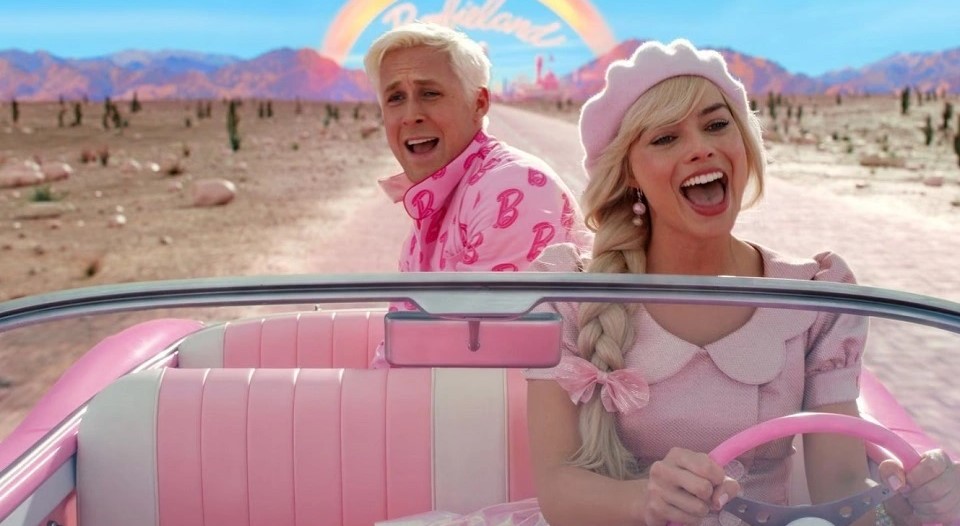
Who knew that the film which sparked the most conversation in 2023 about the roles of men and women would be one launched by a toy company, with the goal of selling toys? Barbie feels a little like a project happily hijacked. In another world this could have been a straight-forward, Adventures of Barbie flick, designed only to get kids crying out for that Margot Robbie Barbie to be appearing under the Christmas tree. Instead, thanks to the team of Gerwig and Robbie, this is a self-reverential, witty, smart and highly engaging look at gender politics which also manages to be a fun, gag-filled evening out at the cinema.

Stereotypical Barbie (Margot Robbie) leads a blissful life in Barbie-Land, where every day is the best day ever. Every Barbie knows they’ve inspired change for the better for women in the Real World. Everything is perfect until one day Barbie starts thinking about Death. Before she knows it, she has flat feet, cellulite and a crisis of confidence. The only way to fix this? A journey to that Real World to meet with the child who’s playing with her. But Barbie and Ken (Ryan Gosling) find the Real World very different from what they expected: all women’s problems are not solved and Ken discovers The Patriarchy, a wonder he is determined to bring back with him to Barbie-Land. Can Barbie save Barbie-Land and help rebuild a relationship between moody teenager Sasha (Ariana Greenblatt) and her mother Gloria (America Ferrera) in the real world?

Barbie’s sharp playfulness mixes heartfelt messages on gender politics with the sort of joyful fish-out-of-water stuff beloved of family films where a naïve figure from our childhoods finds the real world a much harsher, more cynical place than they expected. Barbie’s expects our world to reflect of the female-dominated  Barbie-Land is immediately exploded. Arriving in California, the reaction to an attractive woman roller-skating along a beach is remarkably different to what she’s used to. Wolf whistles, a parade of sexualised comments from construction workers (not a woman among them, to her shock) and a world where nearly all the top jobs are held by men.

Barbie addresses head-on whether a doll can really be an aspirational figure. In a surprisingly complex manner, Gerwig’s film looks at the pros and cons. Teenage Sasha doesn’t think Barbie has shown her world of possibilities, but instead sees her as a puppet of corporate America presenting a veneer of opportunity to women, while pushing them back into a box marked “pretty woman”. (This deadpan tirade provokes one the film’s many laugh-out loud lines as Barbie bemoans she can’t be a fascist as “I don’t control the railways!”.) Barbie may be able to do any job under the sun but this encourages attainment and also piles expectations on young women. If you can be almost anything at all, doesn’t that make it even the obligation to be something even more of a burden?

The real world is also a revelation – in a different way – to Ken. In our world, Ken discovers men (and possibly horses, Ken isn’t sure) rule though a marvellous thing called “the patriarchy”. Watching the Kens become infected by toxic masculinity, becoming high-fiveing bros who down beers, mansplain and call all the shots, is both funny and also a continuation of the film’s earnest exploration of gender politics. You can see, unpleasant as he becomes, that Ken might well want a piece of that action, coming from a world where men are so marginal they don’t even have homes (after all Mattel never made “Ken’s Dream House”). It’s also a neat gag that the other Barbies are easily brain-washed into accepting demeaning Stepfordish roles (dressed almost uniformly as French maids or in bikinis) because the confidence with which the Kens express their rightful place as masters-of-the-universe is literally mesmerising.

It’s also a neat part of Gerwig’s commentary here that the crucial factor to breaking out of this state is all about embracing the pressures of being expected to do it all: of being clever but not a know-it-all, ambitious but not a monster, raising a family but also having a career etc. If Barbie-Land in its beginning is a sort of vision of utopian feminism, then its salvation lies in accepting and embracing the struggle of marrying together a raft of contradictions and expectations. Sure, this isn’t exactly reimagining the wheel and its fairly easily digestible stuff – but it also rings true and you can’t argue with the connection its made with people.

All of which might make you think ­Barbie might be a po-faced political lecture. Fortunately, not the case when every point is filled with laugh-out-loud, irreverent humour expertly delivered by a cast clearly having the time of their lives. They are led by Margot Robbie, sensational in bringing to life a character who begins the film feeling like a doll made flesh and ends it as a three-dimensional character who embraces the contradictions of life. Robbie, who produced and set out much of the film’s agenda, is fabulous – funny, endearing, heartbreakingly vulnerable and extraordinarily sweet, mixing light comedy with genuine moments of pathos.

Equally good is Gosling playing the almost preternaturally stupid Ken with a winning sense of self-mockery, walking a brilliant line presenting a character who is (at times) the nominal villain but also a lost soul. Barbie also employs him and Robbie in some outstanding song-and-dance routines, deliciously performed and exquisitely funny. The other Barbies and Kens are uniformly excellent in their winning mix of initial shallowness and growing emotional depth while America Ferrera and Ariana Greenblatt are immensely winning as a mother and daughter overcoming a divide.

Barbie is also an explosion of delightful design and superb eye-for-detail, in its pitch-perfect recreation of a host of Barbie toys and props in real-life size, all thrown together with the perfect level of pink presentationalism. Drily narrated by an unseen Helen Mirren, every scene has a winning gag or laugh-inducing piece of business, especially when poking fun at the naïve optimism and artificiality of the Barbie world. Saying that, the film stumbles when it blurs the lines in the real world, which is half presented straight, half as a weirdly Wes-Andersonish oddity, particularly in the Mattel building and its corporate board, who are played as even more cartoonish than the actual toys populating Barbie-Land.

Barbie though generally works because it successfully mixes a heartfelt, earnest look at gender politics and the pressures on women with great gags, winning performances and a bouncy sense of off-the-wall fun that ensures nothing gets too serious. From its 2001 style opening, through its pink-led-primary colour settings, to its song-and-dance and larger-than-life-but-grounded performances, it’s a treat and in particular a triumph for its originator, producer and star Margot Robbie.

Modern Times (1936)

Modern Times (1936)

Chaplin’s silent swansong, is a funny but quietly impassioned attack on corporate greed

Director: Charles Chaplin

Cast: Charles Chaplin (The factory worker aka The Tramp), Paulette Goddard (The Gamin), Henry Bergman (Café owner), Stanley “Tiny” Sandford (Big Bill), Chester Conklin (Mechanic), Al Ernest Garcia (President of Electro Steel), Stanley Blystone (Gamin’s father), Richard Alexander (Cell mate)

As cinema entered Modern Times of its own, Chaplin had a profound sense that he needed to move with those times. The legendary comedian, whose Tramp persona had made him (possibly) the most famous man in the world, was a silent comedian starting to be left behind by sound. There is a rich relish in the fact that Modern Times, a joke-packed criticism of the coldness of modern industry, is both Chaplin’s last silent and first sound movie, a dipping of the toe in modern times and a valedictory swansong for the past. It’s a film that bridges the ‘modern’ and classic of cinema.

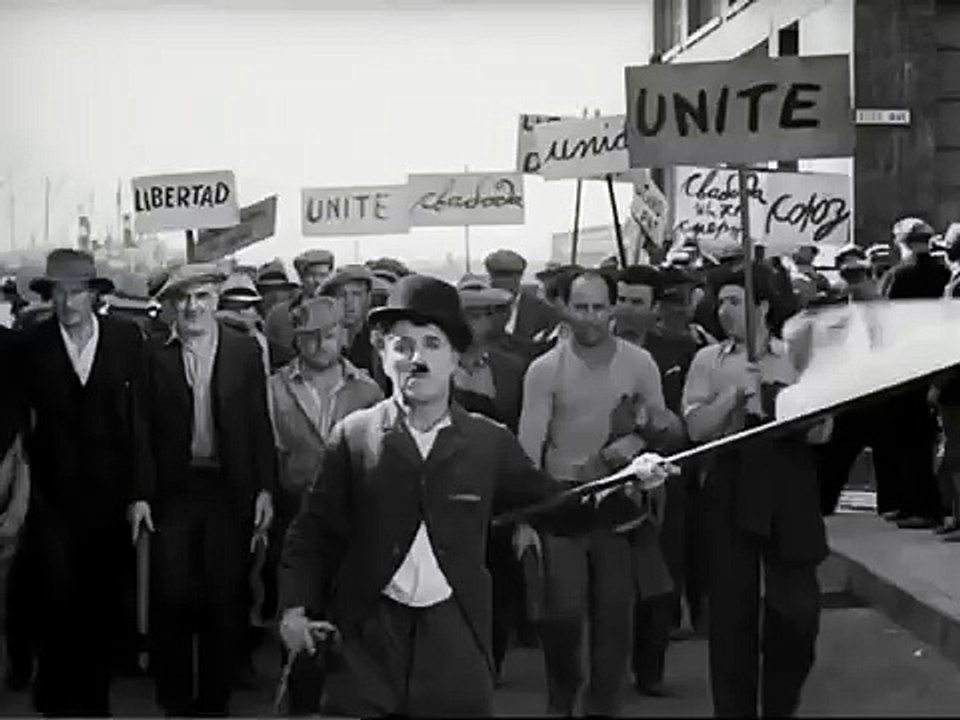
Chaplin is an assembly line-worker eventually driven to a nervous breakdown by the relentless, fast-paced monotony of his work (not to mention a death-defying encounter with the internal workings of the factory machines). Sent to recover in a hospital, he emerges into to find there is little in the world that a dreamer and romantic like him can understand. Again and again, things go wrong. He’s arrested for picking up a red flag in a union march, fired as a night watchman in a department store for helping starving thieves, hopeless as a factory repair man and struggles with tongue-tied silence as a singing waiter. But he and a young ‘Gamin’ (Paulette Goddard), both hope for a better life.

Modern Times has a deceptive structure. It’s easy, at first glance, to see is as four two-reelers thrown together: mini-films in the factory, prison, department store and café. But what Chaplin has created here is a picaresque fable, with the Tramp in the middle. (Only one sequence, with the Tramp as a repairman in a factory, feels superfluous repeating some jokes from the opening act). A morality tale of the modern era, where the big bosses and machines are indifferent to those on the bottom rungs, continually punctuated by the police riding up to bear away the innocent on the slightest pretext. It’s a masterclass of subtle repetition, with moments of contentment forever snatched away.

Chaplin’s most subtly political work became his most controversial. In a way few other films of the 1930s did, Modern Times engages with the conditions and politics of the Great Depression. Housing for the poor is ramshackle, with walls literally held up by mops. The factory alternates exploiting its workers at ever dizzying production speeds with ruthlessly laying them off the moment a slight economic downtown takes place. Union movements are ruthlessly stamped out: when the Tramp accidentally joins a march, he is arrested while the Gamin’s father is shot by police crushing another march. Poverty is ever-present – the Gamin ‘steals’ unwanted food to feed others, laid off factory-workers rob stores for food and when the factories are re-opened there is an almighty struggle from the desperate to get through the gates and claim a few hours of work.

Unsurprisingly Modern Times was condemned as possibly communist and suspiciously anti-American: Chaplin, turning a mirror on conditions in America started to be seen more-and-more by many as a suspicious alien (after all, he’d never taken on American citizenship). Nobody wanted to hear the funnyman turn prophet and many were suspicious of the comedian who used jokes to sweeten the bitter pill (even if, as per many of Chaplin’s messages, it was a rather naïve and simplistic one). It didn’t matter that Modern Times boils down to a plea for a universal love and understanding, it was somehow a creeping sign of the political dangers in ‘modern times’.

Today, distanced from the Red Scare, Modern Times looks far more like what it actually is: a pathos-filled, liberal eye on the working classes that champions the dreamers and the little guys over the corporations and the system. And who better as a hero for that than The Tramp? After all, this was a figure who had struggled against the odds for decades. Modern Times would see that struggle on multiple fronts: against the system, against the machines (literally so, as they swallow him up) and against a way of life that seems to be betting against him.

Even cinema was betting against the Tramp. Chaplin knew he couldn’t put off converting to sound forever. But he also knew the Tramp was a universal figure – and a large part of that was his silence. He never speaks in Modern Times – and when he sings, it’s in garbled, funny-voiced nonsense that effectively keeps him as a universal mute. It’s The Tramp’s final victory lap.

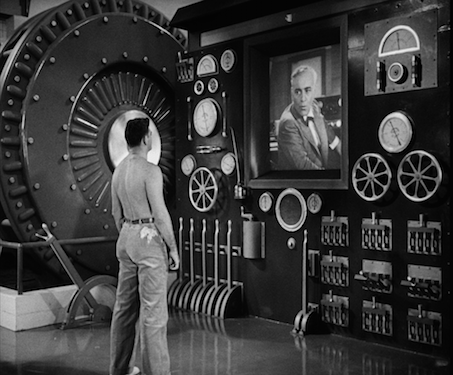
Chaplin’s comic timing remains masterful, and Modern Times is awash with marvellous, balletic set-pieces. Most famous is the opening factory sequence (which owes more than a debt to Fritz Lang’s Metropolis and feels remarkably prescient of Orwell’s 1984 with its Big Brotherish boss), a crazed ballet of repetitive, fast-paced movement on the production line – culminating in the legendary sequence of him being sucked into the very gears of the machine. The factory cares so little about the men there, that a machine designed to feed them as they work is dismissed as impractical rather than inhumane – though it gives us a great set piece of Chaplin assaulted by this machine with soup, custard pies and morsels rammed into his face by a mechanical arm.

The comic invention continues through the prison sequence. It’s a sign of the sting under the surface of Modern Times that the highlights of this sequence come about due to the Tramp (accidentally) being high on a mountain of cocaine. Foiling a jail break through coked-up bravado – another wonderfully done sequence, timed to perfection and filmed in one-shot – the Tramp’s reward is not being allowed to stay (and get the roof and food he needs) but early release. (Modern Times finds time, before he goes, for a final pop at ineffectual, superior middle-class do-gooders, lampooning a crusading priest’s wife as coldly distant and the subject of a cheeky gaseous gag).

Modern Times develops into a sweet fairy-tale romance with the introduction of the Gamin. Paulette Goddard gives a radiant performance, full of confidence and comic vibrancy – she becomes the first female lead given near-equal treatment by Chaplin. The department store sequence is grounded with their relationship, from the Gamin taking the opportunity to sleep in a beautifully prepared bed. Their time in the shop at night is full of wonder at the comfort and luxury – that they never see in their own homes – and culminates in a beautifully shot roller-skating sequence, with Chaplin circling balletically on the floors of the shop. (Tellingly though, he does so on the edge of precipice marked danger – Modern Times never forgets that danger lies just round the corner).

It’s the Gamin who lands them a job at a bustling café – awash with spoiled, rich customers – via her dancing ability (there is a fabulously simple transition that sees her pirouetting on the streets to ending the dance in glamourous clothes in the café). Even this moment of happiness is foiled by the law – illogically chasing the Gamin for past vagary offences rather than leaving her to work. But it’s made clear that they are a partnership: fitting the humane message of Modern Times that our best chance of being saved is sticking together.

Modern Times is shot by Chaplin with a striking, sprightly inventiveness. There are signs throughout of Chaplin’s overlooked visual and editorial skill, transitions that are hugely cinematic, storylines that are communicated with maximum efficiency and clarity. As well as the influences of Lang, Chaplin shows a debt to Eisenstein with a striking early visual cut that sees a crowd of sheep (with one black sheep in the middle) cut to a crowd of workers emerging from a subway into the factory. Modern Times pushes its humane message with a gentle persistency, but never lets it dominate the comic and emotional force of the film. Chaplin is an entertainer with a social conscience – but he is an entertainer first of all – and Modern Times is never anything less than charming and funny, even when it is spikey.

1900 (1976)

1900 (1976)

Bertolucci’s bloated, self-indulgent and simplistic film is a complete mess

Director: Bernardo Bertolucci

Cast: Robert De Niro (Alfredo Berlinghieri), Gerard Depardieu (Olmo Dalco), Dominique Sanda (Ada Fiastri Paulhan), Donald Sutherland (Attila Mellanchini), Laura Betti (Regina), Burt Lancaster (Alfredo Berlinghieri the Elder), Stefania Sandrelli (Anita Foschi), Werner Bruhns (Ottavio Berlinghieri), Stefania Casini (Neve), Sterling Hayden (Leo Dalco), Francesca Bertini (Sister Desolato), Anna Henkel (Anita the Younger), Ellen Schwiers (Amelia), Alida Valli (Signora Pappi)

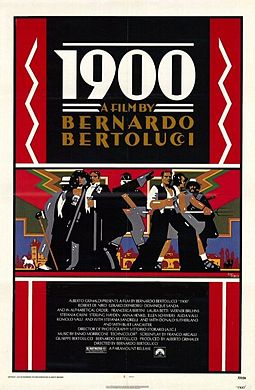
After The Conformist and Last Tango in Paradise, Bertolucci could do anything he wanted. Unfortunately, he did. Perhaps the saddest thing about 1900 is that you could watch The Conformist twice with a decent break in-between during the time it would take you to watch it– and get a much richer handle on everything 1900 tries to do. Bertolucci went through a struggle to get his 315-minute cut released: perhaps the best thing that could have happened would have been if he had lost. Not only would the film be shorter, but it would be remembered as a lost masterpiece ruined by producers, rather than the interminable, self-indulgent mess we ended up with.

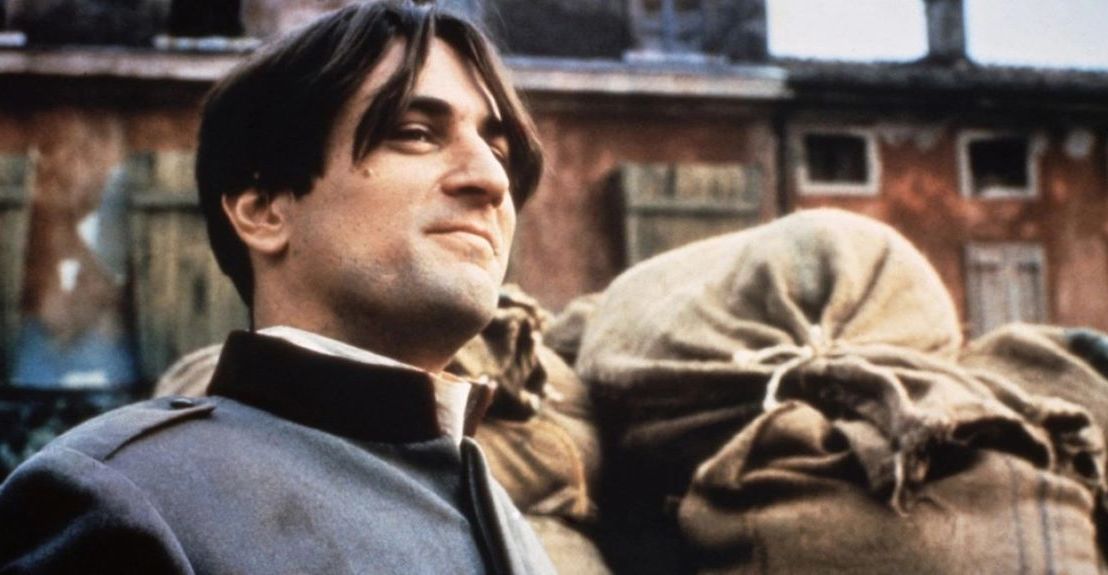
1900 – or Twentieth Century to literally translate its title Novecento – follows the lives of two very different men. Born minutes apart in 1901, Alfredo (Robert De Niro) is the grandson of the lord of the manor (Burt Lancaster), while Olmo (Gerard Depardieu) is the grandson of Leo (Sterling Hayden), scion of a sprawling dynasty of peasants. They grow up as friends, Olmo becomes a socialist and Alfredo an indolent landlord and absent-minded collaborator with the fascists, embodied by his psychopathic land agent Attila (Donald Sutherland). Their small community becomes a symbol of the wider battle between left and right in Italy.

In many ways 1900 is an epic only because it is extremely long and beautifully shot in the Bologna countryside by Vittorio Storaro. In almost every sense it fails. It offers nominal scale in its timeline, but its attempt to become a sweeping metaphor for Italy in the twentieth century falls flat and it focuses on a small community of simple characters, many of whom are ciphers rather than people. All of Bertolocci’s communist sympathies come rushing to the fore in a film striking for its political simplicity. It never convinces in its attempt to capture in microcosm the forces that divided Italy between the two world wars, nor invests any of its characters with an epic sense of universality.

Instead Bertolucci presents a world of obvious questions and easy answers. Every worker is an honest, noble salt-of-the-earth type, working together in perfect harmony to fight for rights. Every single upper-class character is an arrogant, selfish layabout, caring only about their back-pockets and the easy life. Bertolucci suggests fascism only arose in Italy as a means for the rich to control the poor, and never allows for one moment the possibility that any working-class person was ever tempted to take their side. It never rings true. (Bertolucci skips a huge chunk of the fascist 30s and 40s, possibly because this fantasy would be impossible to sustain if he actually focused on the history of that era.)

Bertolucci uses his two protagonists to make painfully on-the-nose comparisons between working class and rich with De Niro’s weak-willed Alfredo always found wanting compared to Depardieu’s Olmo. Even as children, Olmo is braver, stronger and smarter. Olmo has the guts to lie under the moving trains (Alfredo runs), Olmo stands up for what he believes in (Alfredo looks away), Olmo puts others first Alfredo whines about his own needs. Hell, Olmo even has a bigger cock than Alfredo (something they discover comparing penises as children and re-enforced when as young men they share an epileptic prostitute and she ‘tests’ them both).

The upper classes hold all the power but can do nothing without the working class. During the 1910s, a strike by the workers on the Berlinghieri leaves the clueless rich unable to even milk their moaning cows (they buy milk instead). Sterling Hayden’s peasant patriarch is a manly inspiration to all, while Lancaster’s increasingly shambling noble is literally and metaphorically impotent (Lancaster’s role is like a crude commentary on his subtle work in The Leopard). At one point he even pads around barefoot in horseshit to hammer home his corruption. (Incidentally this is the only film where you’ll ever see a horse’s anus being massaged on camera to produce fresh shit to be thrown at a fascist.)

For the rich, fascism is the answer. Continuing to shoot fish in a barrel, Bertolucci scores more easy hits by presenting our prominent fascist as an out-and-out psychopath. Played with a scary relish by Sutherland – in the film’s most compelling performance – no act of degradation is too far for Attila. Along with his demonic partner-in-crime Regina (a terrifyingly loathsome Laura Betti), he routinely carries out acts of violence, horrific murder and child-abuse, even literally headbutting a cat to death while ranting about the evils of socialism.

The poor meanwhile are all good socialists. Olmo, decently played by Depardieu, and his wife Anita (an affecting Stefania Sandrelli) rally the workers to stand against charging cavalry and protect their rights. Bertolucci even has Depardieu flat-out break the fourth wall for a closing speech, spouting simplistic platitudes direct to camera about the inherent wickedness of the landowner. Depardieu at least seems more comfortable than De Niro among this Euro-pudding (every actor comes from a different country and the soundtrack is a mismatch of accents and dubbing, not least Depardieu himself). Rarely has De Niro looked more uncomfortable than as the empty Alfredo, a role he fails to find any interest in, like the rest of the actors never making him feel like more than a device.

Bertolucci, stretching the run-time out, also embraces numerous tiresome excesses. Rarely does more than 20 minutes go by without a sex scene or a sight of someone’s breasts or sexual organs. From children comparing penises, to Depardieu performing oral sex on Sandrelli (just outside a socialist meeting), to De Niro and Depardieu getting hand-jobs from a prostitute, to Sanda dancing naked and high on cocaine or the revolting exploits of Attila and Regina, nothing is left to the imagination. As each goes on and on Bertolucci ends up feeling more like a naughty boy than an artist, so praised for his sexual licence in Last Tango that he feels more is always more. The excess doesn’t stop with sex either: at one point a worker silently cuts his ear off in front of a landowner to make a point about his stoic nobility.

1900 eventually feels like you’ve stumbled into a student debating club, where a privileged student drones on at great length about the evils of the rich, while quaffing another glass of champagne. It has moments of cinematic skill – some of its time jump transitions, in particular a train passing through a tunnel in one time and emerging at another, are masterful – but it’s all crushed under its self-indulgence. From its length to its sexual and violence excess, to its crude and simplistic politics delivered like a tedious lecture, everything is crushed by its never-ending self-importance.

Aparajito (1956)

Aparajito (1956)

Generational clashes lie at the heart of Ray’s heartbreaking second entry in his Apu trilogy

Director: Satyajit Ray

Cast: Kanu Banerjee (Harihar), Karuna Banerjee (Sarbajaya), Smaran Ghosal (Adolescent Apu), Pinaki Sengupta (Young Apu), Ramani Sengupta (Uncle Bhabataran), Charuprakash Ghosh (Nanda-babu), Subodh Ganguli (Headmaster), Moni Srimani (School inspector), Ajay Mitra (Shibnath), Kalicharan Roy (Akhil)

Satyajit Ray initially saw Pather Panchali as a one-off, a story from the works of Bibhutibhushan Bandyopadhyay, not the start of a multi-film fable on the life of its young protagonist. But, such was the impact of Ray’s debut, it almost demanded a continuation of the story. Ray then adapted parts of two Bandyopadhyay novels, re-shaping them into a tale of Apu’s late childhood and adolescence, that difficult crossing point between childhood and adulthood. In doing so, he created a film full of life but also profoundly moving and quietly devastating. Rich, confident and powerful, Aparajito may just be even more affecting than its forbear.

Beginning a few years after the conclusion of Pather Panchali Apu (played as child by Pinaki Sengupta and later as an adolescent by Smaran Ghosal) lives in the holy city of Varanasi with his dreaming father Harihar (Kanu Banerjee) and tireless mother Sarbajaya (Karuna Banerjee). Apu is still the same inquisitive, observant, fascinated child he ever was and when his father’s death leads to mother and son returning to the country, he excels at the local school. Winning a scholarship to college at Calcutta, Apu he finds Sarbajaya’s love for him smothering, just as she is heart-broken by his growing distance and reluctance to write or return to visit her.

This universal story of children struggling to outgrow their parents and their parents longing to help them grow but desire to keep them close, a situation causing pain on both sides, that gives Aparajito it’s huge emotional force. We can totally understand why Apu, swept up in the excitement of Calcutta and forging of his own life (one that has the promise of being so much more dynamic than his parents), begins to feel the ties of duty to his mother (almost alone in the world without him) constraining. At the same time, having witnessed the never-ending sacrifice, patience and quiet devotion of Sarbajaya to her son, we want to slap him for his selfishness and lack of thought.

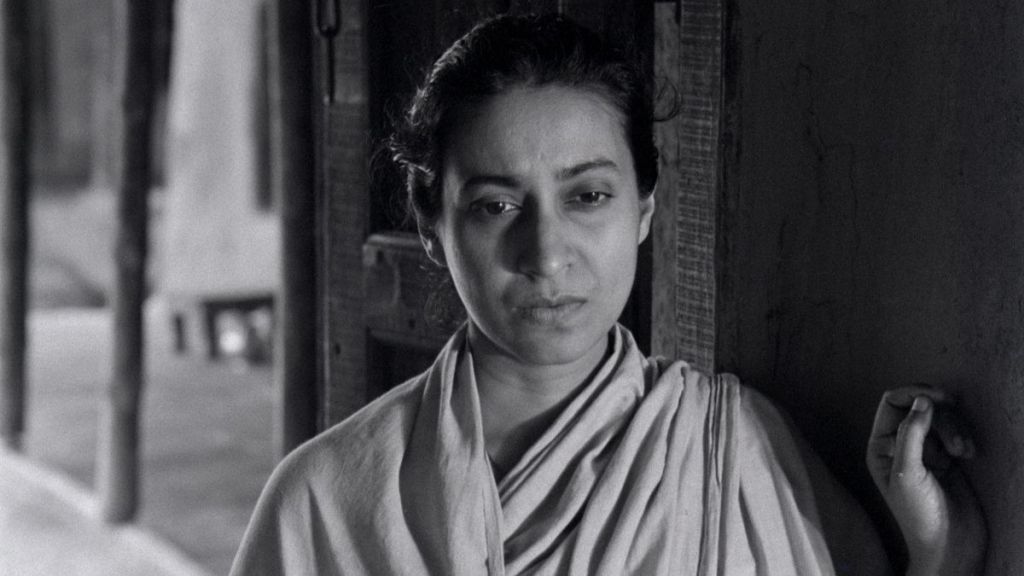
Ray’s film is superb at making us understand the impossible burdens Sarbajaya has taken on herself to raise her son. Ray constantly frames Sarbajaya in the act of waiting: in Varanasi we never see her outside of the courtyard of their shared tenement block, constantly preoccupied with household tasks. Ray frames Sarbajaya frequently in doorways, visually presenting her as someone constantly waiting on the outskirts, shadows cast across her – someone vital for ensuring order, but easy to forget on the outskirts of rooms. It also serves to make her look constantly trapped and overburdened with duty, shadows constantly cast across her.

These burdens magnify for Sarbajaya after the death of Harihar. Apu’s decent father is still a dreamer who lacks the dedication and drive to make something of himself. Do memories of his father’s desire to become a writer ending in a fever in a tenement block, subconsciously drive Apu later? Harihar collapses near the holy river, ill from the damp of the city that he trudges through barefoot night and day, hitting the ground in a shadow lit passageway – much like his wife, as if the city has crushed him with its burdens.

The city seems very different to the young Apu. Ray’s camerawork is gentle, full of leisurely sideways pans, which serve to make the city appear to us as it does to Apu: a never-ending stream of visual wonders. Pans across the riverbanks of the Ganges, full of beautiful temples and river vistas look as magical to us as they do to the young boy. Similarly, the Dickensian hustle and bustle of the city itself, full of streets and alleyways that Apu and his friends rundown with glee feel like treasure-troves of adventure, rather than the never-ending streets trudge they look like when we see them from Harihar’s perspective.

Ray’s camera frequently brings us back to the searching, questioning, fascinated eyes of young Apu, always expanding his horizons. Education and the wonders that books bring him, far beyond the horizons of his mother who can only think about how to bring about tomorrow, offer a similar excitement. Young Apu excels at school and delights in trying to share the wonders he has learned – about science, astronomy and geography – with his mother. Ray shows a mastery of simple montage as years fly by in minutes as we see each of Apu’s passions before a masterful transition with a slow zoom in and out on a lit candle carries across years from Apu as a child to an adolescent.

An adolescent who feels the pull of a world away from what he increasingly sees as the smothering pull of his mother. It is, of course, impossible to watch this without feeling how unfair – but also how natural – this is. Your heart breaks as Apu heads off to Calcutta with only a single cursory glance back to his devoted mother. The mother who still packs his bag, gives him her savings – and asks him to come home as often as he can. You can understand why a young man finds this constraining, even as you want to tell him how sharp his regrets will be as Sarbajaya’s health begins to fail (naturally, the boy falls asleep as his mother timidly confesses her fear of old age and sickness to him).

Apu loves his mother, there is no doubt about that. One vacation, arriving at the train station to return to Calcutta, he decides to turn back (claiming he missed the train) to spend one more day with his mother. He still relies on her wisdom and unreserved love and he thinks often of her in the city. But he’s a teenager and wants his freedom. Sarbajaya even understands this, just as her heart breaks for the loss of and loneliness his departure brings. Is there a sadder shot in the movies as Ray focuses on Sarbajaya slowly sinking down as Apu walks away to his future?

The impact is only increased by the gloriously moving, hollow-eyed performance of Karuna Banerjee, exhausted but untiring in her work to protect family and home. It’s a performance of quiet, bubbling grief and loss tightly packed under optimism and support for her son – a grief that only the audience sees. Smaran Ghosal is also very fine as the adolescent Apu, a boy we can never dislike for very naturally wanting to forge his own path, in a performance that feels extraordinarily real.

The humanity shines out again in Ray’s follow-up to his debut. Moving confidently from location to location, in a novelistic structure translated perfectly to the screen, Aparajito is rich, beautifully told and carries real, unbearable emotional punch for anyone who has ever been a parent or child. Another masterwork in a mighty trilogy.

Pather Panchali (1955)

Pather Panchali (1955)

Satyajit Ray’s first film in his glorious Apu trilogy is one of the finest neo-realist films about childhood ever made

Director: Satyajit Ray

Cast: Kanu Banerjee (Harihar), Karuna Banerjee (Sarbajaya), Subir Banerjeee (Apu), Uma Das Gupta (Durga), Chunibala Devi (“Auntie” Indir Thakrun), Shampa Banerjee (Young Durga), Reba Devi (Sejo Thakrun), Aparna Devi (Nilmoni’s wife), Tulsi Chakraborty (Schoolteacher), Binoy Mukherjee (Baidyanath Majumdar)

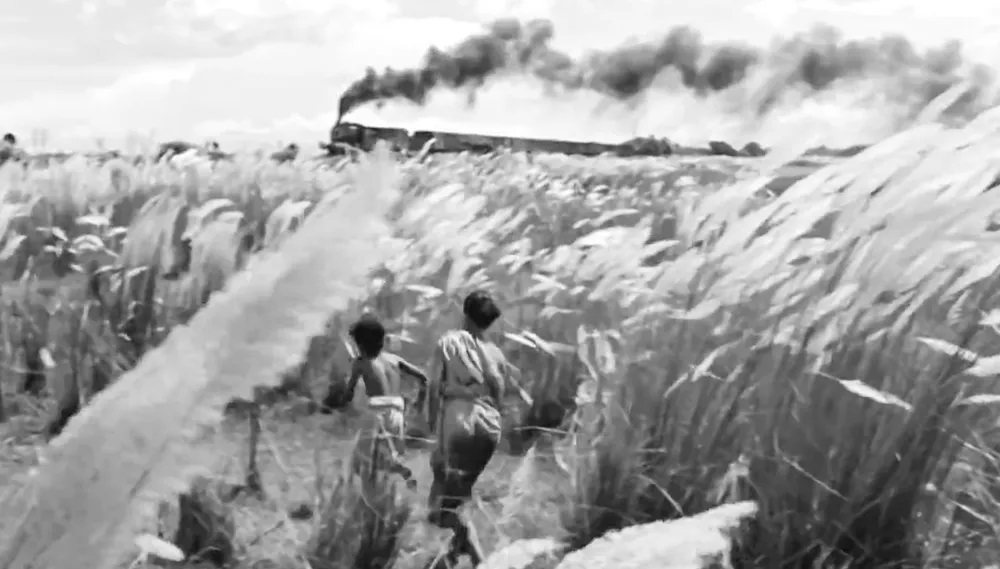
The filming of Panther Panchali is almost as famous as the film itself. Ray set up on the first day of shooting having never made a film before, working with a cinematographer who had never shot a roll of film before and two inexperienced child actors he had not auditioned. He shot the sequence of quiet, observant young Apu (Subir Banerjeee) and his rebellious older sister Durga (Uma Das Gupta) walk in awed wonder through a field to discover a train whooshing by. Ray later wrote he learned more that day “than from a hundred books”. You can tell: so majestical, magical and mesmerising is the sequence (admittedly the one we see in the film was a reshoot) you can’t believe it was made by a novice. It was the centre-piece of Ray scrapping together funding for the rest.

Pather Panchali was adapted from the novel Bibhutibhushan Bandyopadhyay – in a stunning act of loyalty, Bandyopadhyay’s widow turned down a large sum from a production company for the rights because she had promised them to Ray. Ray turned it into a masterful slice of life, that expressed everything he had worshipped from the neo-realism of Rossellini and De Sica (The Bicycle Thieves, which Ray adored, is surely Pather Panchali’s father) and the detailed, masterful camerawork of Jean Renior (who Ray and photographer Subrata Mitra had witnessed at work on The River). It became Ray’s calling card, and a pivotal moment in Indian cinema, a masterpiece that helped redefine the artistic boundaries of the country’s film industry as well as an award-winning international hit.

It’s a sedate, gentle, un-bombastic but quietly moving and engrossing drama focused on the nitty-gritty of life. Set in a small Indian village in the 1910s, we follow the lives of pre-teen Apu, a dreamer who takes after his Micawberish father Harihar (Kanu Banerjee) and his close relationship with his sister Durga, whose penchant for rebellion and stealing causes no end of strive with their harassed mother Sarbajaya (Karuna Banerjee). The family lives in poverty and Sarbajaya carries the burden, driven to quiet, repressed despair at the stress of constantly making ends meet and increasingly resentful of Harihar’s elderly relative “Auntie” Indir (Chunibala Devi) who she sees as taking but offering nothing. Despite, this we follow the childish delight Apu and Durga see in the world around them, a world in which darkness eventually (inevitably) intrudes.

Some have argued Ray’s film – and the subsequent films that followed in this landmark trilogy – had such international impact because it fit naturally into international perceptions of India as a rural, poverty-stricken nation. But that’s to do a disservice to the emotional humanism of Ray’s work and the universal themes of childhood, family and the fears of not being able to provide for it.

Pather Panchali, for all the lyrical beauty which Ray shoots it with, is cold-eyed and serious about poverty. There is nothing noble and sentimental about having no money to afford food. The strain of it is carving lines into the face of Sarbajaya, reduced to quietly pawning what possessions they have and frustratingly berating the dreaming Harihar who believes a career as a writer is just round the corner. The shame of poverty is a major theme: Sarbajaya cares nothing if Harihar’s employers are made aware of the family’s desperate need to for the money they owe him, but she will not countenance the shame of accepting charity from neighbours. Debts are repaid as a priority, at several points a relative’s offering of a few rupees is adamantly refused and Sarbajaya is appalled and shocked by Durga’s habit of stealing fruit from a local orchard owned by the village elders.

That orchard was once the property of Harihar – and its more than implied he was conned out of it by the villagers over imaginary debts. Its where we first encounter the young Durga, a delightful, playful and inquisitive child, running free and unashamedly stealing fruit and bringing it home for herself and “Auntie”. Its just another reason for Sarbajaya to resent the presence of this old woman in her household, as well as the close bond “Auntie” has with both her children, with Sarbajaya constantly playing the role of harsh authority figure.

The constant refrain of the train whistle at crucial points from the distant train tracks serves as a reminder of the possibility of change and escape. But it also means to the children a wider world of excitement and opportunity. Pather Panchali is about a child’s eye view of the world – we are literally introduced to the child Apu with a close-up shot of his eye has Durga wakes him for school. Ray’s film carefully follows their experiences and innocence, where every day presents the possibility of adventure and wonder. The struggles of the adults are unknown for them.

Pather Panchali is a great film about childhood. Apu and Durga run through fields, play and fight, share a deep and caring bond. They follow sweet sellers, wonder at the arrival of theatre troupes and brass bands, stare in awe at projected images of Indian landmarks. The entire village and its countryside is a wonderland to them, and the problems of life are something that they don’t need to concern themselves with. Ray shoots the film with a realism tinged with a pre-Tarvoksky love for the beauty of nature: lingering shots follow raindrops on lakes, the willowy blowing of plants in the fields and the movements of nature.

Through it all he draws superb performances from the children, frequently cutting to reaction shots that ground us in a children’s-eye-view of the world. It’s all there in the magic of that pursuit of the train. The freedom of the fields, the joy of running, the mystery of distant sounds and then the impactful glory of the train itself. Alongside this, there is a beautifully judged score by Ravi Shankar that captures both the mood of this humble village life, but also the exurberance of childhood.

It can’t last though. Mortality and tragedy intrude on this life. And just as Ray shot joy with a simplicity that carried a magical pull, so he calmly and unobtrusively observes pain and suffering in a way that will tear your heart out. The film’s episodic look at life becomes darker and more painful, rewarding the patient viewer (and you do need patience for Ray’s leisurely pace) with a powerful connection with the characters – and a final shot that leaves you longing to know what will happen to them.

Beautifully paced, atmospheric and immersed in a world that feels very real, Pather Panchali feels like the work of a master, not the plucky work of debutante. Perhaps that was a result of the nearly two years Ray took to make the film (he couldn’t believe his luck that the children did not noticeably age), allowed him the time few film-makers have to find every single moment of beauty in his story. Or perhaps he was simply that good to begin with. Either way, it became a landmark film – and led to a swiftly answered call for the story of Apu to be continued.

The Grapes of Wrath (1940)

The Grapes of Wrath (1940)

Steinbeck’s masterpiece is transformed into a richly humanitarian and heartfelt film

Director: John Ford

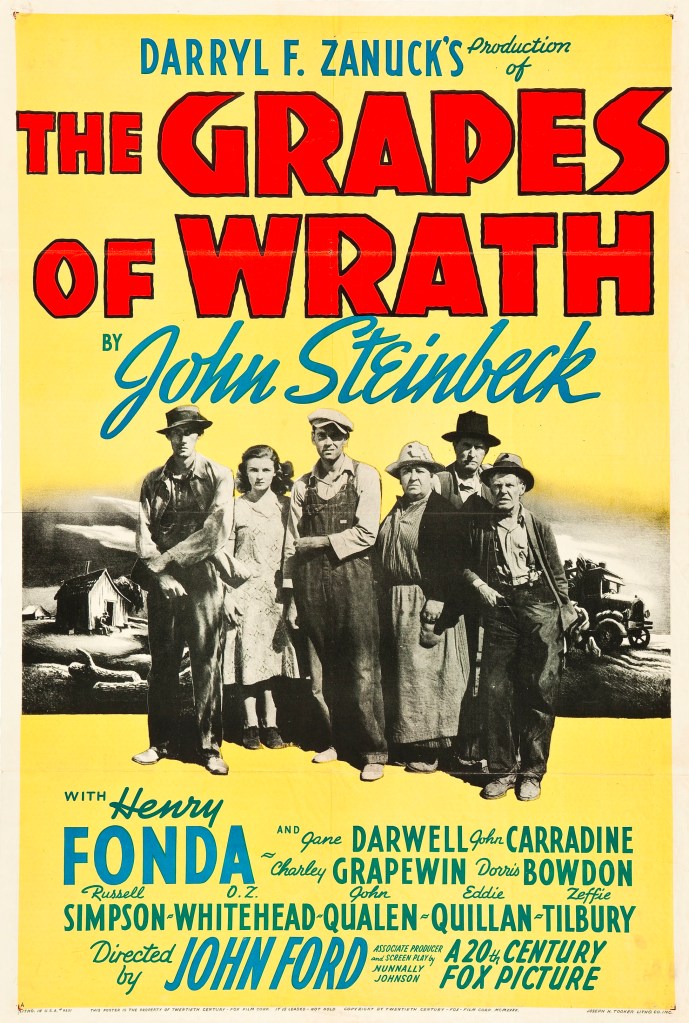
Cast: Henry Fonda (Tom Joad), Jane Darwell (Ma Joad), John Carradine (Jim Casy), Charley Grapewin (Grandpa Joad), Dorris Bowdon (“Rosasharn” Joad), Russell Simpson (Pa Joad), OZ Whitehead (Al Joad), John Qualen (Muley Graves), Eddie Quillan (Connie Rivers), Zeffie Tilbury (Grandma Joad), Frank Sully (Noah Joad), Frank Darien (Uncle John), Darryl Hickman (Winfield Joad)

If you can be certain of one thing, it’s that times of economic hardship rise and fall like waves on the shore. John Steinbeck’s novel The Grapes of Wrath was a searing, powerful exploration of the impact of the Dust Bowl, the Great Depression and new farming technologies on Oklahoma tenant farmers. It was almost immediately cemented as a Great American Novel. Just as Ford’s moody, heartfelt, humanitarian film of it was immediately hailed as a Great American Film.

In Oklahoma, Tom Joad (Henry Fonda) is released from prison (after killing a man in a bar fight) to find his farming community has been devastated. The Depression has shattered the market and the landowners now farm their land with tractors rather than people. Tom and his family have no choice but to load up a beaten-up van and migrate to California where they have hopes of work picking fruit for meagre wages. What they find on the way, among small acts of kindness, is exploitation, brutal policing determined to crush any protest from migrants and migrant camps in terrible conditions. Misery, death and the endless grind of fading hopes seems to be all they have to look forward to.

The Grapes of Wrath moved to the screen faster than almost any other novel in history. Published in April 1939, in months Nunnally Johnson had completed a script and shooting began in October for release in 1940. The unprecedented speed spoke to the book’s enormous impact, which has remained eternally relevant in its depiction of the hostility faced by migrants. Producer Darryl F Zanuck, despite his passion for the novel, worried it would be seen as pro-Communist propaganda – thankfully basic research showed Steinbeck had, if anything, played down the labour conditions. Zanuck was convinced he could defend any accusation of anti-Americanism – perhaps, as well, he decided recruiting the film poet of romantic Americana, John Ford, as director would lay any change The Grapes of Wrath could be seen as an attack on the US to rest.

Ford was in fact a near perfect choice as director. A man who held his Irish migrant roots close to his heart, he felt a powerful bond with these victims of changed circumstances. As a man with a romantic view of America’s Golden Age, he was equally critical of sharp technology changes (he shoots the tractors who plough through the Oklahoma farmland as monstrous tanks, crushing hope below their ominous caterpillar tracks). Working closely with cinematographer Gregg Toland, he shot a film with one foot in realism, the other in low-lit, moody impressionistic shadow, a rich visual treat that marries both methods to enforce the appalling economic situation it depicts.

From its opening shot, which frames Tom Joad walking across Oklahoma desert land framed with telegraph poles, the idea of ordinary people left behind by technological change rings out. Tom’s farmstead Tom is derelict with one tenant recounting his eviction in a cramped room lit by a single candle. The Joad’s leave for California in a truck so beat up, it only just starts and appears to be partially made of wood. The California shanty town they are herded into is contrasted with the sleek automobile of the landowner offering work for a pittance. In the government run camp, we see running taps and modern bathrooms that seem space-age compared to the squalor we’ve seen.

The Grapes of Wrath doesn’t shirk in its anger at the ill-treatment of these sons of the soil. In California, the bosses are cruel, uncaring and greedy. The flyers the Joad family clutch hoping for work, is one of thousands recruiting for only hundreds of jobs. Salaries are constantly undercut – at their second camp, the Joads work exhaustingly for just about enough to feed them for the day. The sheriffs are little more than heavies for the bosses, breaking up protests at pay, arresting and beating ‘trouble makers’ and turning a blind eye to any threats or danger to the migrants.

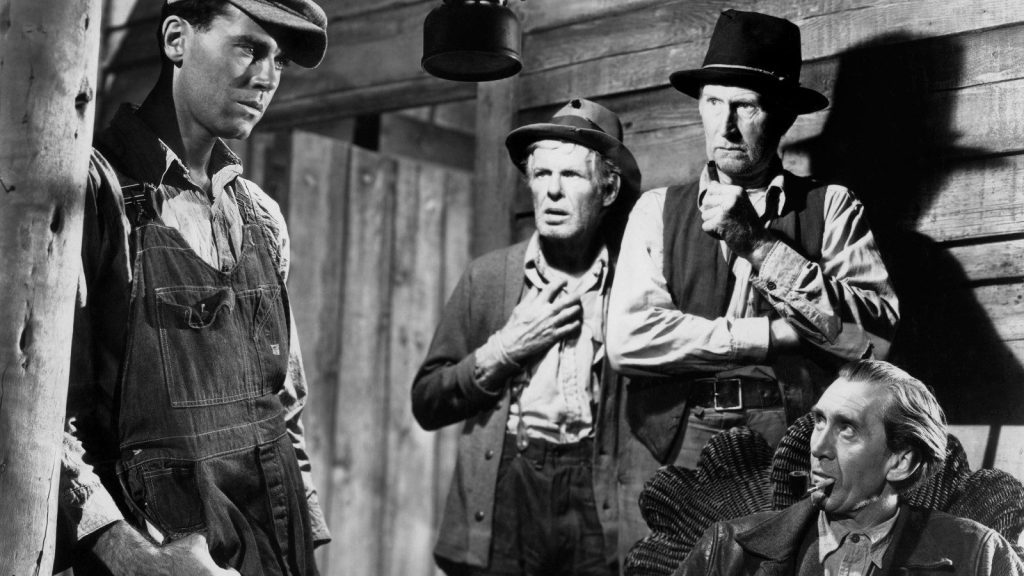
The injustice of it is captured in a superb speech by John Carradine’s Jim Casy, a former preacher whose faith has been replaced by a burning passion to protect the rights of the little guy. Shot by Toland in a shadow-drenched, candle-lit tent, Carradine delivers with impassioned brilliance an inarticulate but moving speech on the need for the workers to stick together to combat exploitation. He follows in the footsteps of an earlier ‘rabble rouser’, whose denunciation of a fat-cat businessman is met with gunfire from a sheriff (a woman being near-fatally shot in the aimless fire).

It’s feelings that will inspire Henry Fonda’s Tom Joad. Fonda is marvellous as this plain-speaking man with a streak of self-destruction, who learns to focus his anger aware from his own needs to fighting for others. With his father – well-played by Russell Simpson – increasingly ineffective, Tom transforms himself slowly into a leader. His lolloping stance doesn’t detract from his everyman nobility. Fonda even manages to make some heavy-handed, speechifying really work as a profound statement of human rights.

He’s joined in this with the film’s third stand-out, the Oscar-winning Jane Darwell as the indefatigable “Ma”. Darwell becomes the family lodestone and an epitome of resilient spirit, her pained but patient face returned to again and again. Darwell as at the heart of many of the most moving moments, perhaps the most one of its simplest: Ma quietly, with sad smiles, burning old mementoes and holding up a pair of earrings to study her reflection in the flickering candlelight. Ma holds the family together, from cradling the dying Grandma on the floor of the truck to desperately hiding Tom from the vindictiveness of the police. Ford closes the film with a powerful speech of hope and resilience from Ma, again wonderfully delivered by Darwell in simple, unflashy close-up.

Despite that delivery though, the end film’s final act doesn’t ring true with what has gone before. The film reshuffles the novel’s plot. That culminated in a bleak miscarriage in a windswept hut. The well-built government-run migrant town is a stopping off point, a moment of hope, in a grim journey towards desolation. Here it is the final destination – and the community dances, organised by benevolent caretakers, feels like a cheat of reality. Perhaps Zanuck felt a relatively hopeful ending was needed to balance those fears of Anti-Americanism. Either way, it never feels like a ‘real’ ending: this economic catastrophe didn’t end like this for many, so it shouldn’t for our everymen.

It is perhaps, though, the only major flaw in Ford’s superb film. It’s a film sprinkled with as many small moments of peace and hope as it is injustice. The Joads enjoying a swim in the lake, or the kindly garage staff who let Pa buy bread and sweets for the kids at a price far below their value warms the heart. The shanty towns are given a real sense of community by Ford. It makes the stark cruelty of those in charge stand-out all the more.

The film doesn’t shirk on the grim surroundings. The detail of the squalor is magnificently delivered, while the foreboding, shadow filled lighting of Toland’s photography is exceptional. With a host of excellent performances, Grapes of Wrath is the finest statement of Ford’s overlooked humanitarianism. He was a director with a warm regard for the common man, who believed in their righteousness and right to just treatment. This streak runs strong throughout The Grapes of Wrath and makes a film that is never sentimental, but arouses huge sentiment in anyone who watches it.

Winter Light (1963)

Winter Light (1963)

Faith is thoughtfully questioned in Ingmar Bergman’s spare, bleak and striking masterpiece

Director: Ingmar Bergman

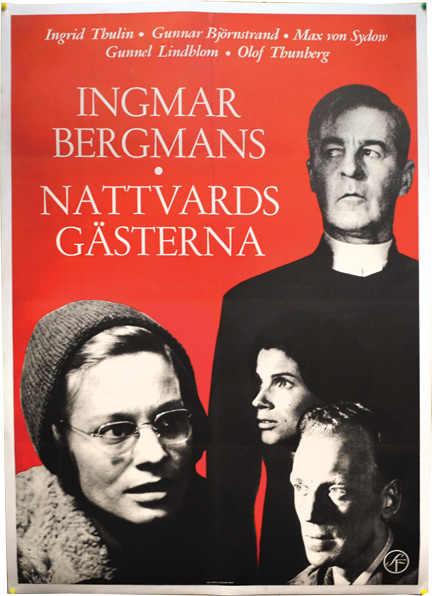
Cast: Gunnar Björnstrand (Pastor Tomas Ericsson), Ingrid Thulin (Märta Lundberg), Gunnel Lindblom (Karin Persson), Max von Sydow (Jonas Persson), Allan Edwall (Algot Frövik), Kolbjörn Knudsen (Knut Aronsson), Olof Thunberg (Fredrik Blom), Elsa Ebbesen (Magdalena Ledfors)

It would surprise many to hear Bergman held Winter Light in the highest regard among his films. An austere chamber piece, largely set in a cold, naturally lit church, it’s the middle chapter of his thematic trilogy on faith and it serves to correct any sense of hope left remaining from in Through a Glass Darkly. Winter Light – with its lead character a semi-biographical combination of Bergman’s father (himself a Lutheran Pastor) and Bergman himself – begins with a robotic preaching in a Church and ends firing up another such sermon to an empty Church. This is a world where, if there ever was a God, he has long since gone silent and disappeared over the horizon.

You could argue Tomas Ericsson is the most ill-suited priest in the history of cinema. He’s played with a peevish, grumpy lack of hope, inspiration or joy, self-loathing seeping from every pore by Gunnar Björnstrand in what might just be his finest hour. Björnstrand, more comfortable with comedy, struggled with this counter-casting (and his cold, which was written into the script), the bottled-up pressure of the role almost shattering his friendship with Bergman. Following a single afternoon in Ericsson’s life, Winter Light charts his complete disillusionment with his faith, his utter failure to provide spiritual comfort to parishioners and his mix of dependence, indifference and contempt for schoolteacher and some-time lover Märta (Ingrid Thulin), herself a needy, unhappy woman content to play second-fiddle to Tomas’ deceased wife.

Tomas’ faith in God has long since vanished. Winter Light is his own Gethsemane, a parade of painful events and conversations where he waits desperately for some sort of sign or word from the Almighty and is left instead wondering, like Christ, why God has forsaken him. Tomas has become bitter, self-obsessed and self-loathing, going through the motions with a dwindling congregation and unable to muster even the faintest bit of belief in the words that pass his lips.

Winter Light follows up ideas of Through a Glass Darkly (Tomas even talks of a “Spider God”, a destructive force at the centre of a world made of pain). There is an echo throughout of the idea that, if God is love, then letting love into your life (or acknowledging the existence of Love in the world) is proof enough that there is a God, even if he is now silent. If so, Tomas’ rejection of any form of love goes hand-in-hand with his rejection of faith. If he felt love, it was for his late wife – and her death matches the decease of his faith in God. Now he angrily slaps away offers of affection with the same contempt he addresses towards questions of faith.

That offer of love comes from Märta, a mousey teacher trapped under an unflattering hat, the bags under her eyes and spinsterish clothes. She’s played in a performance of sustained, emotive brilliance by Ingrid Thulin. Märta captures her feelings for Tomas – right down to her acknowledgement that she knows he does not love her – in a sprawling, stream-of-consciousness letter (which Tomas has delayed reading – and when he does, he scrunches it into a frustrated ball).

That letter is conveyed to us in a stunning, almost interrupted, seven-minute take where Bergman focuses the camera on Thulin in close-up who delivers the contents of the letter straight to camera. This is a tour-de-force from Thulin, by terms unblinking, honest, self-denying, pained, resigned, hopeful and frustratingly simpering, a masterclass that marks one of Winter Light’s most striking moments of directorial and actorly technique. Few actors could pull this scene off with the grace and emotional commitment Thulin brings to it – and still leave us understanding why Tomas later, with anger frustration, cruelly tells her he has simply had enough of her all-forgiving love.

There is no place for that sort of saintly, Christ-like, love in Tomas’ life. His focus remains his own self-loathing. When meeting with Jonas (Max von Sydow – even more carved from granite than normal, his fixed stillness contrasted with Björnstrand’s twitchy unease), who has come to Tomas for spiritual reassurance to help overcome suicidal thoughts, Tomas can only complain of his own lack of faith. Tomas fails utterly to offer any solace to Jonas, a further mark of his own failure as both a priest and human. Jonas’ suicidal misery at the dread of oncoming Armageddon in the nuclear age, becomes grist to Tomas’ own misery and our priest in turn feels no shame in turning to Märta immediately for reassurance and comfort.

The only person who seems to have considered the nature of faith is disabled sexton Algot (a marvellous performance by Allan Edwall). Algot reflects that the suffering on the cross was not Christ’s true sacrifice – after all that was over in hours. The real suffering was hearing God’s silence on that cross, of the horror of suddenly thinking your life’s work may have been a waste of time, that he evangelised for someone silent or indifferent or worse. It would tie in directly with Tomas’ own doubts – except it’s pretty certain Tomas isn’t listening to him.

Maybe that’s partly the problem. We don’t listen to God, because we no longer expect him to talk. At one point, Tomas asks why God has fallen silent while behind him light suddenly pours through the Church window. Is that a sign of a sort? If it is Tomas doesn’t look and when he does, he doesn’t think. Instead, he contributes to the silence of God – as the closest thing to his vessel he fails to listen, fails to help and focuses only on his own pain.

Winter Light is a gorgeous film, full of striking light and shade by cinematographer Sven Nykvist. It’s also a bleak, grim, hopeless film, the best hope it can offer being God might have been real but he’s long since turned his back on us, just as we’ve turned out back on him. It’s magnified when we reject the thing he might have left for us, love itself. Winter Light is intensely thought-provoking, but rivetingly intelligent in the way the best of Bergman is. Björnstrand is superb and Thulin is extraordinary, in a film that carries worlds of meanings in its spare 80 minute runtime.

Coming Home (1978)

Coming Home (1978)

Emotional but a little too worthy Vietnam message movie, well-directed with great performances

Director: Hal Ashby

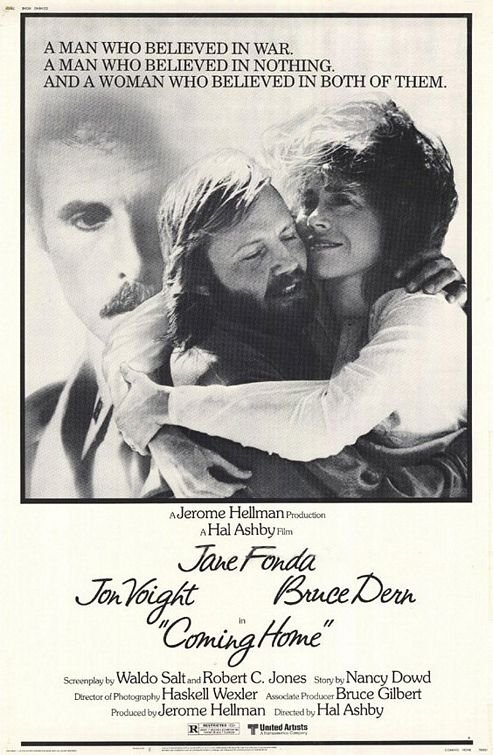
Cast: Jane Fonda (Sally Hyde), Jon Voight (Luke Martin), Bruce Dern (Captain Bob Hyde), Penelope Milford (Vi Munson), Robert Carradine (Robert Munson), Robert Gintu (Sgt Dink Mobley), Mary Gregory (Martha Vickery), Kathleen Miller (Kathy Delise)

Vietnam is a jagged scar on the soul of America but, more than that, it’s been a literal scar for the veterans. Luke Martin (Jon Voight) was a college athletic star, now returned from the frontlines as an angry paraplegic, struggling with post-traumatic stress. Helping him – eventually – is old school-friend Sally Hyde (Jane Fonda), married to a Marine captain Bob (Bruce Dern) who has himself shipped out to Vietnam. Sally and Luke find themselves growing closer and closer emotionally, as their hostility towards the brutal war grows. But how will Bob – still loved by Sally and himself ever more scarred by trauma – react when he returns from the front?

Coming Home was released in the same year as The Deer Hunter and makes for an interesting comparison. While Cimino’s film is a horrific plunge into the grisly horrors of war, combined with a sort of mesmeric epic poetry, Ashby’s Coming Home is a quieter, more domestic piece, an earnest attempt to explore trauma. There is no doubting the passion of all those involved: but Coming Home is at times a little too earnest. Despite its moments of undeniable emotional impact, its sometimes feels a little too pointedly like a “message” film, worn a little too heavily on its sleeve.

But, saying that, there are many positives. It’s shot with a skilful casualness by Ashby, whose unobtrusive camera makes us a witness to events (at one crucial point it is even half obstructed by a door). Ashby has a poetic sensibility that flies in the face of what could have been its soapy roots. He lets scenes unfold with such ease and gentleness of touch that you only slowly notice how extremely well assembled the film is. There is a whimsical, lyrical sadness about the whole thing – matched with a striking lack of condemnation of people, only for a system that bends and twists human beings into killing machines.

It uses a parade of hit songs, but the songs play not as snippets but as full performances, playing out over several scenes, scenes which at first seem to be directly counter to the lyrics and tone of the song itself. Then you notice the skill with which the film has been edited to the beat of the music, and how much The Rolling Stones, The Beatles, Hendrix, Simon & Garfunkel, Bob Dylan and many others set the tone for a whole era. Coming Home captures this tone, an era of optimism crushed by brutal contact with the cold, dark realities of the world. The songs weave themselves in and out of scenes, capturing an overwhelming sense of a nation lost and confused.

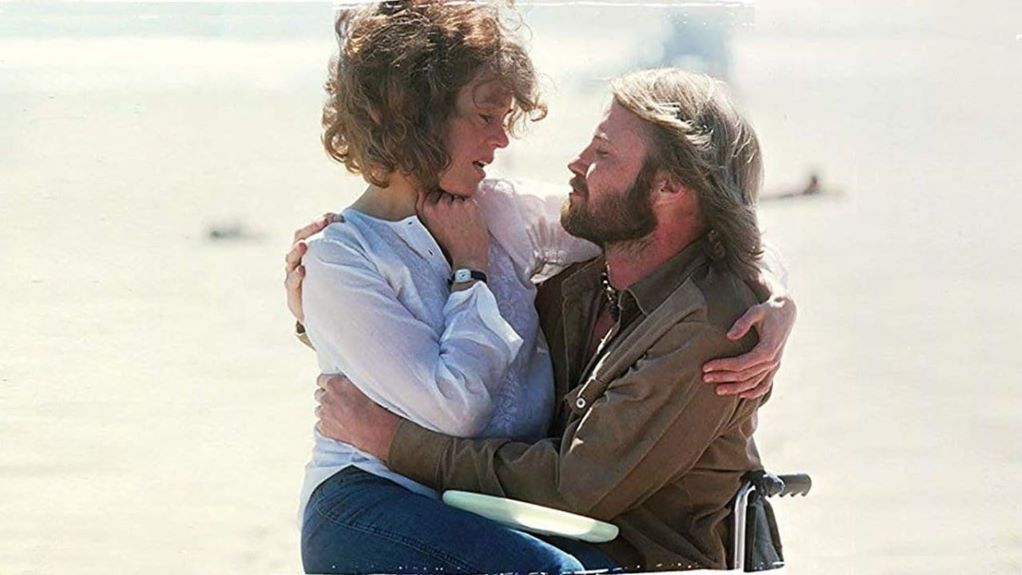
It’s in this framework the relationship between Luke and Sally flourishes as Luke begins finding purpose in his life. Heavily based on the life of Ron Kovic, Jon Voight won an Oscar for his extraordinarily committed performance. From early outbursts of naked fury and pain, wheeling himself around on a hospital bed, his outbursts seemingly only prevented by medication, Voight charts the development of Luke as a humanitarian and compassionate man, committed to helping others overcome their pain and loss.

He also develops an attachment to Sally that transcends physical attraction: the two are kindred spirits. Fonda (effectively the film’s producer), generously takes on the film’s least interesting role as the disengaged, homespun Sally, increasingly horrified by the war’s impact on veterans – and the lack of interest from others (capturing the whole sweep-it-under-the-carpet attitude of the armed services, her military wives’ club refuses to include a report from Luke’s hospital in their newsletter because it’s too depressing). This translates into a deep attraction for Luke, the only other person who truly shares her growing resentment for the war.

Coming Home gained much attention at the time for its frank depiction of sex, with Luke and Sally tenderly overcoming the barriers of his disability. (Although today, their coupling – with Fonda replaced by a body double – culminating in Sally’s first ever orgasm feels a little too obvious in its comparisons with her passionless flings with Bob). But sex is less important than sharing their feelings, from Luke’s talk of dreams where he can still walk to Sally’s doubts about her life choices.

If there is a problem with Coming Home, it’s that the film doesn’t really know what to do with these characters other than showcase their pain. It tends to make sharp jumps – Luke’s recovery from initial rage to tender, thoughtful man feels very swift. And although Penelope Milford is good value as Sally’s best friend, struggling to deal with her veteran brother’s collapsing mental health, her plotline and performance is a little too obviously designed to contrast with Sally’s.

The basic problem with Coming Home is that in its rush to establish the fundamental decency of its characters – and the appalling horror of the war they are wrapped up in – it often avoids drama of struggle. It makes an interesting contrast with Zinnemann’s The Men which turned Brando’s paraplegic veteran’s psychological recovery into an entire movie: here Luke’s finding of a new purpose is as swift as his mood shift is.

The film’s most interesting plotline actually follows Dern’s Bob Hyde. Dern gives the film’s most complex performance as a dedicated solider, struggling with deep denial about his growing disaffection and unacknowledged PTSD, confronting his wife’s infidelity with a mix of anger and desperation to receive a comforting hug from her. Hyde’s discovery of the affair is its most melodramatic moment, but also strangely its most unpredictable – and a film exploring this character’s switch in perspective might just have been a little more challenging.

But Coming Home has plenty to recommend it. Voight has never been better, warm, tender and throbbing with emotion, his closing speech to a roomful of students exhorting them not to fight and choking back tears that taking another life is never worth it, is worth the price of admission alone. Ashby’s film has a poetic sensibility to it and if it sometimes feels a little too self-righteously earnest about its anti-war credentials, and a little too aware of its status as a “message movie”, at least it is a message that needs to be heard.

Hardcore (1979)

Hardcore (1979)

Familiar ideas from better films are mixed together in this revenge thriller

Director: Paul Schrader

Cast: George C Scott (Jake van Dorn), Peter Boyle (Andy Mast), Season Hubley (Niki), Dick Sargent (Wes De Jong), Leonard Gaines (Bill Ramada), Dave Nichols (Kurt), Gary Graham (Tod), Larry Block (Detective Burrows), Ilah Davies (Kristen van Dorn), Marc Alaimo (Rattan)

A man prowls the urban streets, his face fixed with disgust at their degeneration, looking for a soul to save, the whiff of potential violence strong on him. He hunts for a lost family member, in an obsessive quest where it’s not even sure he will want to take her back even if he finds her. If that makes Hardcore sound like a remix of Taxi Driver and The Searchers… well that’s because it is. Schrader’s film is a well-made, initially well-executed riff on familiar themes that eventually tries to settle for something far easier to digest, with an ending that stinks of a shallow Chinatown.

Jake van Dorn (George C Scott) is a devoutly Calvinist businessman in Michigan. A single father, whose wife has left him, his beloved daughter Kristen (Ilah Davies) disappears one day after a church-sponsored visit to California. Van Dorn leaves no stone unturned to investigate, eventually hiring sleazy PI Andy Mast (Peter Boyle), who discovers an 8mm porno film starring Kristen. Was she kidnapped? Is she in danger? Van Dorn will find her, throwing himself into the seedy world of porn in an obsessive quest where no line will be uncrossed until he brings his daughter home.

There are many things to admire in Hardcore. Shot by Taxi Driver veteran Michael Chapman, it’s immersive seedy view of the underbelly of California is extremely striking. Schrader also quite neatly counterpoints this with the picket-fence conservatism of van Dorn’s stomping grounds at home. Van Dorn starts as a man who expresses hesitation that a shade of blue in his office might be too garish, and ends donning fake wig and moustache alongside loud shirt to pass as a porn baron.

What’s interesting about Hardcore is that, even though its actually Schrader’s second film, it feels like an over-anxious debut. It’s blatant stylistic and thematic call-backs to Taxi Driver­ – hammered home as we watch van Dorn cruise the streets of California, the porn shops and theatres neon signs reflected in his windows – makes you feel Schrader wished he had held on to the rights to direct that film himself. It’s extremely on-the-nose pinching of most of the structure of The Searchers feels like a loving tribute from a director yet to find his own voice.

Schrader however does an excellent job with much of the film’s first half. The oppressive tension build-up from the moment Mast arrives (Boyle’s casting, of course, being another eerie reminder of Taxi Driver) really grips. Scott’s stunned, shattered and increasingly appalled, primal reaction to watching his daughter in a porno is delivered with the sort of gusto and commitment that only a great actor can pull off. His increasingly-obsessive, won’t-take-no-for-an-answer delve into the world of porn – from knocking shops to porn film sets – has just the right sense of van Dorn slowly developing into a time bomb that could go off, while never losing our sympathy.

Hardcore is contemptuous of porn. Sharing van Dorn’s perspective of the industry, the film cements the industry as being based in a Danteish circle of hell, with violence, exploitation and misery round every corner. Schrader also enjoys poking fun at the porn industry and the film industry (a flashy porn director trained at UCLA, much like Schrader’s contemporaries). Searching for witnesses, van Dorn sets up fake auditions for a new porn movie, attended by a series of optimistic, hopeful guys with show reels and CVs. The money-first producers look and sound like any other Hollywood executive – it’s just they openly trade in skin.

The problem is Hardcore can’t settle for this: as if worried that poking some fun at the seedy industry might get in the way of us relating to the gut-punch horror van Dorn feels. In the second half, Schrader sets up (out of the blue) a snuff film premise, with an anonymous big bad behind it all (a figure so undeveloped that the most interesting thing about him is he’s played by Marc Alaimo who played Deep Space Nine’s villain Gul Dukat) just so we can have someone so obviously unspeakable that we have no mixed feelings at all when the violence kicks off.

Which is a shame because Hardcore looks, for a moment, like it is about to go somewhere more interesting. Van Dorn is broken from his obsessive focus only by meeting with Niki (played with just enough ballsy cuteness by Season Hubley), a girl on the margins of the industry dreaming of an escape. The two of them are drawn together in unexpected ways: she respects his religion in a way no-one else does, while van Dorn becomes the only man who doesn’t see her as a sex object, treating her with a fatherly gentleness you suspect he never showed his actual daughter. The film’s ruthless jettisoning of this plotline strives for hard-nosed reality, but ends up feeling like a too obvious attempt at pathos.

Despite all this Hardcore has its moments, not least thanks to George C Scott’s fire-cracker performance in the lead. Scott may have hated Schrader (allegedly begging him to never direct a film again), but he breathes life into this Ethan Edwards-Travis Bickle clone, making van Dorn just the right mix of pained, aggrieved and dangerous. Unfortunately, the film settles for something far more conventional, a revenge thriller with an obvious and inarguably horrible character created solely to make us feel good when he is dispatched.

Babel (2006)

Babel (2006)

Iñárritu’s grandiose film aims for a big statement about humanity, but settles for something simpler

Director: Alejandro González Iñárritu

Cast: Brad Pitt (Richard Jones), Cate Blanchett (Susan Jones), Gael Garcia Bernal (Santiago), Rinko Kikuchi (Chieko Wataya), Adriana Barraza (Amelia Hernandez), Kōji Yakusho (Yasujio Wataya), Boubker Ait El Caid (Yussef), Said Tarchani (Ahmed), Mustapha Rachidi (Abdullah), Elle Fanning (Debbie Jones), Nathan Gamble (Mike Jones), Clifton Collins Jnr (Border police officer), Peter Wight (Tom), Harriet Walter (Lily), Michael Maloney (James), Satoshi Nikaido (Detective Kenji Mamiya)

“Only connect” was the epigraph of Forster’s Howards End. It’s an idea Alejandro González Iñárritu attempts to bring to the screen in Babel. Across three countries, he shows how small events in one plotline have drastic impacts in others. It makes for an undeniably beautiful film-making experience – but also a film straining for import, that hectors and belabours obvious points and relies far more on random events occurring due to foolishness and stupidity than the vagaries of fate or humanity.

In Morocco, Abdullah (Mustapha Rachidi) buys a rifle from a neighbour to protect his goats. His young sons practice with it by taking pot-shots at a tourist bus. They hit Susan (Cate Blanchett), whose husband Richard (Brad Pitt) is left desperately trying to get her medical help in a remote Moroccan village. The incident means their nanny, Amelia (Adriana Barraza) with whom they have left with their children in the US, has to take them with her to Mexico for her son’s wedding, where events at the border spiral out of control. Meanwhile, in Tokyo, the original owner of the rifle Yasujio Wataya (Kōji Yakusho) struggles as a single father with his deaf teenage daughter Chieko (Rinko Kikuchi), who is dealing with grief and her burgeoning, frustrated sexuality.

I often find Iñárritu’s films a mixed bag. Babel is no different. There is a lot to admire here. There’s also just as much to be frustrated about. First the good. Iñárritu does an excellent job intercutting a film which moves from location to location and (it becomes clear) timeline to timeline, without ever confusing the audience or revealing plot details in one timeline until it becomes vital in another. We discover one entire storyline of the film takes place not in tandem but after the events of another plotline (which concludes where the other begins). The film is beautifully shot by Rodrigo Prieto, with Morocco unexpectantly filmed with a perfectly fitting dusty blue hue, Mexico in warmer tints that become oppressive and Tokyo with a sort of neon-noir.

The film’s first half does an excellent job of world and relationship building. Abdullah’s two young sons are head-strong, rash children entrusted with a weapon they lack the maturity to handle. The family’s desperation to hide their responsibility for the tragedy they have inflicted on Richard and Susan becomes terrifyingly engrossing – not least when we see the slap-and-trigger happy casual-brutality of the investigating forces. Similarly, Brad Pitt does a sterling job as a husband driven to ever-increasing desperation, impotent rage and grief as a husband powerless to help his dying wife in a remote village with poor communication and innumerable cultural barriers.

Iñárritu turns an intriguing eye on Mexico as a land met with looks of both wonder and terror by the Amelia two young charges. Young Mike is enthralled by the sights and sounds then sickened into tears when a game of ‘catch the chicken’ ends in a brutal decapitation. Amelia’s family is warm, friendly but also prone to thoughtless impulsiveness, made worse by a justifiable feeling of persecution from their wealthy neighbours across the border. The wedding though, for all the flashes of cultural confusion, is a vibrant and joyful event shot with a lyrical beauty.

The same poetic beauty extends to the Tokyo plotline, which is a sort of pilgrim’s progress for Chieko (excellently played in a superb mix of vulnerable and resentful by an Oscar-nominated Rinko Kikuchi) through a long few days in Tokyo. From feuding, aggressively, with referees at a volleyball, to clumsy attempts to seduce boys (alienated by her deafness) and, in one staggeringly awkward scene, a very much-older (and horrified) dentist, Iñárritu follow’s Chieko stumbling attempt to discover herself, leaving the revelation of the causes of her ennui for a final, near wordless sequence. Iñárritu experiments with sound, putting us into Chieko’s deaf isolation by draining sound in and out (noticeably in a late-night disco).

Communication and language are barriers for all the characters – hence the film’s grandiose title. Grandiose feels the word, as Babel makes a big swing making a relatively simplistic statement: the world would be a better place if we all listened to each other. Unfortunately, the script repeatedly falls back on tropes and narrative contrivances to make this message work. Two of the storylines – Mexico and the Moroccan family – hinge on aggressive, macho cops as disrupters. In a series of character developments I just don’t buy, Richard’s bleeding-out wife is treated as a tedious inconvenience by a busload of Brit tourists who essentially demand Richard leaves his wife to die so they can back to their hotel for dinner (I literally cannot imagine an entire busload of people behaving like this – god knows how the world responds to them when Susan’s bleeding out in a Moroccan village inexplicably becomes a major world news story).

There is also a half-hearted attempt to suggest guns are destructive forces. While it’s true a rifle purchase is the instigating factor – and Iñárritu makes a lot of one of the kids smashing up the rifle in a scene of heavy-handed import – it doesn’t really fly. Honestly, the main message I started to take out was that immature or stressed people make stupid, impulsive decisions in stressful situations. The kids shooting live ammunition at a tourist bus is an appalling act of immaturity. Santiago – a character set up as a time bomb from the start in an edgy performance by Gael Garcia Bernal – has a disastrous, impulsive meltdown bred out of booze and bravado at the Mexican border, that ruins the lives of everyone around him. Stranded in the desert, Amelia will make an equally disastrously poor decision with terrible consequences she can never turn back.

Eventually, Babel starts to feel like a film full of contrivances that mistakes ambitious range and variety of locations for actual depth. Essentially it has very little to say about the human condition other than looking for a little love or understanding. The four plot lines are fairly tenuously linked together, and impact each other only in the sense of each instigates the events of another. The film fails to create a tapestry of cause and effect and fails to weave its events back together for a conclusion. For all there are moments of effective tension and drama, and great deal of visual and visceral beauty, everything feels a little too forced, a little too on-the-nose.

That’s not to say there aren’t great performances or moments of great flair from Iñárritu. Adriana Barraza is fabulous as a proud mother and caring nanny, driven to her absolute limits. But it’s not as complex, revelatory or revealing as it thinks it is. It makes for a film that looks and feels like epic but carries only a simple and reassuring message.