Category: Spy thriller

Decision Before Dawn (1951)

Decision Before Dawn (1951)

Tense war drama finds sympathy for the enemy, in an over-looked war film

Director: Anatole Litvak

Cast: Richard Basehart (Lt Dick Rennick), Gary Merrill (Colonel Devlin), Oskar Werner (Corporal Karl Maurer “Happy”), Hans Christian Blech (Sgt Rudolf Barth “Tiger”), Hildegard Knef (Hilde), Wilfried Seyferth (Henitz Scholtz), Dominique Blanchar (Monique), OE Hasse (Oberst von Ecker), Helene Thimig (Paula Scheider)
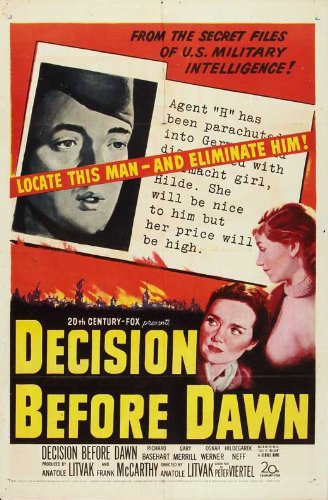
Decision Before Dawn tends to be remembered – if it is remembered – as an aberration in Hollywood history, one of the few films to receive only one nomination other than its Best Picture nod – with that nod generally put down to excessive Fox executive lobbying. I’d heard it described as a ‘fairly standard World War II film’ and expected it to be pretty disposable. But I guess I should have looked into things more: no less a director than Stanley Kubrick called it a hidden gem, claiming to have seen it five times. After a viewing, it’s hard not to think he might be right.

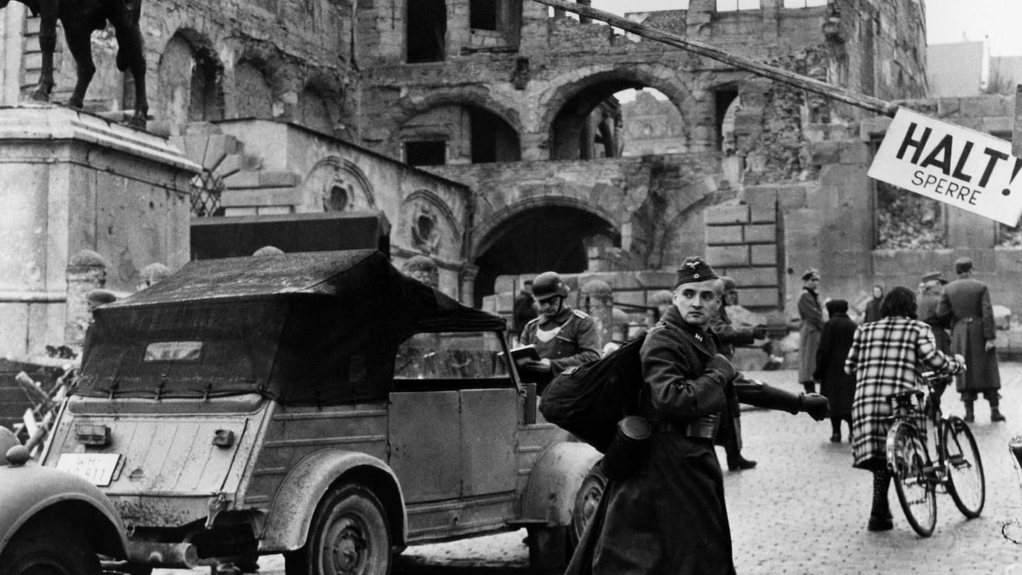
It’s a real, peeled-from-the-headlines tale. Shot entirely on location in Germany, in the very cities its characters are travelling through, still the bombed-out wreckage sites they were in 1944. With the assistance of (what was still then) the Occupying Powers, Fox and Anatole Litvak (himself a one-time refugee from the Nazis) recreated, to an astonishingly convincing degree, war-torn Germany six months before the death of Hitler, on locations littered with Germany military equipment. Everything in Decision Before Dawn feels astonishingly real because it largely is. When “Happy” tumbles through a bombed-out theatre or walks through bedraggled factories and grand houses converted to military bases, that’s the real thing.

Alongside this visceral sense of realism, is a surprisingly mature message. Helped by the presence of several German ex-pats, Decision Before Dawn casts a sympathetic eye over the Germans at a time when most of viewers would probably echo the initial sentiments of Richard Basehart’s scornful Lt Rennick: ‘they’re all just Krauts’. Rennick’s is part of an intelligence unit, tasked with ‘flipping’ German POWs and sending them back into Germany. Their two latest recruits couldn’t be more different: cynical Sgt Barth aka Tiger (Hans Christian Blech) motivated by earning a quick buck and thoughtful Corporal Maurer aka Happy (Oskar Werner) who believes Germany can only be saved when the madness of Nazism is defeated.

It’s Happy we follow when, after his recruitment, he is parachuted back into Germany and instructed to find the location of the XXth Panzer corp, while Rennick and Barth land further West to locate, and arrange the surrender of, a Wehrmacht Army Unit. Decision Before Dawn has already spent its opening act humanising erstwhile opponents via Happy. Happy is honest and principled with a strong sense of morality. He won’t lie to please his captors but he also won’t countenance the blind loyalty or bitter cynicism of his fellow prisoners. He is brave enough to save his country by ‘betraying’ it.

And it’s through Happy’s eyes we also see Germany. Many of his fellow POWs have no real love for Nazism; far from slathering fanatics, they are just guys knuckling down, wanting to stay alive. Behind-the-lines in Germany, the people Happy meets on his journey are striking in their everyday ordinariness. Decision Before Dawn’s most compelling sequences follow this ‘Pilgrim’s Progress’ through the Reich, where episodic encounters mix with moments of panic and terror as a Gestapo net draws tighter.

The only two true believers he encounters are a glasses-wearing (it still loves some of the cliches) relentless Gestapo officer, and a Hitler Youth kid who still swallows true loyalty to the Fuhrer because he doesn’t know anything else. The others, by and large, are ordinary people trapped in a nightmare, trying to carry on. From a senior officer who reluctantly executes a deserter days before he knows the army will surrender to a depressed widow trying to make a living turning tricks. They are among a parade of regular citizens who, other than that fact they are commuting through a war zone, could be no different from Americans in their everyday concerns.

This places much of the film’s success on the shoulders of Oskar Werner, making his English-language debut. Werner, himself a deserter opposed to Nazism, brings the role a quiet, deeply affecting sincerity, expertly breathing life into a man who lives by his own firm moral code. ‘Happy’ deplores the taking of life but will do so if there is a reason: that won’t involve poisoning a colonel or standing by during the lynching of a POW by his fellow prisoners, but he will turn a gun on a direct threat. Werner makes him a thoughtful, compassionate man while giving him a strong streak (a Werner speciality) of in-built martyrdom, that a feeling he is too strait-laced and honourable for this world.

By making our hero a German – and the character we follow for almost the whole movie (despite Basehart’s top billing) – Decision Before Dawn is invites it’s American audience to emphasise with the enemy. To learn, alongside Rennick, that they are not ‘all Krauts’ so that we and Rennick can both be appalled by the unfairness when a Corporal mutters this at the film’s. That’s quite a thing for an American film, a few years after the war. By giving us handsomely staged spectacle centred around a man most of the audience were primed to expect to turn traitor, rogue or coward is no mean feat.

Of course, not every German can be good. The other potential recruits (one of them a young Klaus Kinski) are not a promising bunch and ‘Tiger’ (a fine, weasily performance by Hans Christian Blech) is betrayed as selfish, cowardly and perfectly happy to sacrifice anyone and everyone around him to ensure his safety. Litvak’s film does acknowledge it’s easier for the Americans to relax their feelings for the Germans than many of the other nations of Europe. Dominique Blanchar’s OSS officer makes it perfectly clear that, while she likes ‘Happy’, she’s still a long way from every imagining a relationship with a German of any sort.

Decision Before Dawn is well-directed, Litvak easing expert tension behind-the-lines and wonderfully shot among the ruins of Germany. Its final resolution may seem a little pat and obvious – and Basehart’s Rennick is such a terminally dull character I can only assume a host of more famous actors turned it down – but there is a lot of rich, fascinating tension and excitement here. Putting it frankly, Decision Before Dawn is a very pleasant surprise: a unique and mature war film that deserves far more recognition.

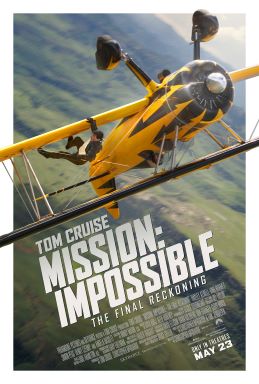
Mission: Impossible: The Final Reckoning (2025)

Mission: Impossible: The Final Reckoning (2025)

Cruise’s final mission is really a tribute to the star himself and his never-ending force of will

Director: Christopher McQuarrie

Cast: Tom Cruise (Ethan Hunt), Hayley Atwell (Grace), Ving Rhames (Luther Stickell), Simon Pegg (Benji Dunn), Esai Morales (Gabriel), Pom Klementieff (Paris), Henry Czerny (Eugene Kittridge), Angela Bassett (President Erika Sloane), Holt McCallany (Serling Bernstein), Janet McTeer (Secretary Walters), Nick Offerman (General Sidney), Hannah Waddingham (Rear Admiral Neely), Tramell Tillman (Captain Bledsoe), Shea Whigham (Briggs), Greg Tarzan Davies (Theo Degas), Charles Parnell (Richards), Mark Gatiss (Angstrom), Rolf Saxon (William Donloe), Lucy Tulugarjuk (Tapeesa)

Almost thirty years after the first film trotted into the cinema, Tom Cruise signs off (he claims) his franchise of death-defying stunts with a final entry that dials the global threat up so far you can almost hear the desperate whirring as the doomsday clock tries to keep up. Mission: Impossible: The Final Reckoning is big in every single way, packed with set-pieces, dense procedural plot mechanics that require reams of exposition, global annihilation round every corner and at the centre the towering, chosen-one aura of Ethan Hunt himself, the only man who can save the world.

The Final Reckoning takes off a few weeks after the now-rechristened Dead Reckoning (after it under-performed they didn’t want to scare people off with a Part 2 subtitle). AI demigod The Entity is hellbent on gaining control of the world’s nuclear arsenals so that, having presumably binged Terminator, it can SkyNet-like wipe out humanity. Ethan (Tom Cruise) is on the run, but he has a plan. Dig out the sunken Russian sub where the Entity was ‘born’, fish out its source code, hook it up to an Entity-killing virus and trap the AI would-be-overlord in what’s essentially a glowing USB drive. This mission will involve lots of running, fighting, defusing of nukes, diving to the bottom of the ocean, jumping between bi-planes mid-flight… he might as well chuck the kitchen sink as well.

Mission: Impossible: Final Reckoning has plenty of fun, even if it is hellishly overlong. It’s the sort of crowd-pleaser that gets people clapping at the end (as several people in my packed-out screening did). When the stunts come, they’re hugely well-staged. As always the Tom Cruise USP is front-and-centre: if you see him do it, he did it. Yes, Tom really did jump out of a naval helicopter into the raging Atlantic. Yes, that really is Tom, climbing over a speeding bi-plane thousands of feet-up with only a pair of goggles to keep him safe. It’s no-coincidence the villain is an AI who creates an artificial digital reality. The Mission: Impossible films are all about it keeping it solidly real.

But, once the initial adrenaline rush subsides, I’m wondering if its pumped-up thrills are going to be a bit more wearing second-time around. What struck me about The Final Reckoning is, that for all the huge amount of stuff going on, there is precious little heart in it. More than any other M:I film since the little-loved M:I:2 (practically the only film in the franchise not to get a shout-out here), the act of saving-the-world here is a job for one never-wrong superhuman. Cruise does almost everything, his team’s main role being getting into the right place to send him a message or wire up a computer. On top of that, the best of the series set-pieces had flashes of Ethan’s stress, fear and sense of ‘I cant believe I have to do this’ humour – all of that is mostly missing here.

The Final Reckoning loses a lot of the heart of what made the earlier films so rewarding. It loses the moments of friendship or sparky interplay between the team. Cruise and Pegg, the series main comic relief, share almost no scenes together. Klementoff and Davies do virtually nothing as new team members, other than shoot guns and get captured. Cruise shares more time with Atwell, but the bizarre is-it-a-romance-or-not between them is as oddly undefined as Ethan’s relationship with Rebecca Ferguson’s Elsa was (in fact it makes you realise the most sexual thing Ethan has done since film three is hold someone’s hand). Cruise is so often on solo missions, that the film could probably have dispensed with the team altogether with only a small plot impact.

The film only affords to slow down to give Ving Rhames (the only other guy to appear in every film) a moment of genuine emotion – though special mention must go to Rolf Saxon and Lucy Tulugarjuk who from small moments craft characters I genuinely grew attached to and worried about. Otherwise, the bonds of friendship that powered the franchises most successful non-stunt moments are absent. In fact, also missing are the heist caper set-pieces – even the famous face-masks are only employed very briefly.

The Final Reckoning dials the stakes up so much, they are effectively meaningless. In previous films, high-stakes were mixed with personal ones: we were always more invested in whether Ethan save his friends rather than the word. The film also struggles without a real antagonist. Its nominal human opponent, Esai Morales’ Gabriel, little more than a smirk and an obstacle. Shorn of the most-interesting element of his character – his fanatical loyalty to his AI master – Gabriel is neither particularly interesting or a threat. In its vast runtime, Final Reckoning has no time to actually explore what the personal link between Ethan and Gabriel actually was, making you wonder why on earth they bothered to put it in both films in the first place.

It’s not helped by the fact that the film is so constantly in motion, that virtually every single scene of dialogue is about communicating what’s going to happen next. There are constantly (admittedly skilfully batted around) conversations explaining why Ethan has to go there, get this, bring it here, do this to it, put it in that all within a ridiculously small window of time. Sometimes, to shake it up, we cut across to the US bunker where a gang of over-qualified actors (Bassett, Offerman, McCallany, McTeer and Gatiss) similarly explain what the Entity is doing to each other. (Although, like Rhames, Bassett gets the most interesting stuff to actually act as a President facing a Fail Safe like terrible choice).

What you realise is that The Final Reckoning is pretty confident that what really pulls the audience in is Tom Cruise doing crazy stunts, so that’s what it gives us. In fact, rather than a tribute to the series (despite closing plot points from Missions 1 and 3) what the film really feels like is a tribute to Cruise, the last man-standing among the old-fashioned superstars. Most of the dialogue puffs up Cruise’s Ethan into Godlike status (it’s not quite “living manifestation of destiny” like Rogue Nation put it, but close). Cruise carries out two extended fight scenes in his pants (though if I looked like that at 61 so would I). No other actors intrude on his stunts or messianic sense of purpose.

Which is amazingly done of course. Literally no-one does it better than Cruise. The fact that the movie feels like Cruise effectively shot most of it alone with just the crew, means it almost doesn’t matter that its plot is merely to link together set-pieces. And if someone deserves a victory lap – which is what this is – then that guy is Cruise. I’d have wanted more of the fun, humour and warmth that made most of the other films such massively rewarding hits. But The Final Reckoning gives more of what the series does that no other series does. And I guess that’s a fitting finale.

Five Graves to Cairo (1943)

Five Graves to Cairo (1943)

Exciting and witty war-time spy thriller, an overlooked work from a master director

Director: Billy Wilder

Cast: Franchot Tone (Corporal John Bramble), Anne Baxter (Mouche), Akim Tamiroff (Farid), Erich von Stroheim (Field Marshall Erwin Rommel), Peter van Eyck (Lieutenant Schwegler), Fortunio Bonanova (General Sebastiano), Miles Mander (Colonel Fitzhume)

It’s 1942 and the war is not going well for the British. The Germans are on the move in Africa under their ace commander Field Marshal Rommel. A tank drifts through the desert, bumping up and down sand dunes. Inside its crew slump, one dangling from his gun turret, another thrown on-and-off the gearsticks with each dune. It’s hauntingly Wilderish – a ghost tank charging through a never-ending desert – that Corporal John Bramble (Franchot Tone) wakes into, escaping across into the bombed-out Empress of Britain hotel run by panicked Farid (Akim Tamiroff), assisted by British-loathing Frenchwoman Mouche (Anne Baxter). Bramble’s hopes that he might lay low for a few days are thrown into danger when the hotel is requisitioned moments after his arrival by the German army with Rommel (Erich von Stroheim) himself setting up command there. Bramble passes himself off as recently deceased club-footed waiter Davos – only to discover Davos was a German spy and Rommel expects him to help delivery on his masterplan to crush the British.

Five Graves to Cairo is a magisterial juggling game of move and counter-move in which everyone holds tightly their own very specific parts of a greater mystery while trying to learn everyone else’s. Wilder does all this with wit and more than a little tension. Can Bramble keep up his pretence about being Davos while hiding his complete ignorance of Rommel’s masterplan? Will Rommel’s constantly alert, note-taking aide Lt Schwegler (Peter van Eyck) rumble him? The whole film is captured in one of its earliest sequences, as Farid carefully shepherds and blocks the view of Schwegler’s inspection of the foyer of his hotel, to prevent him seeing Bramble hiding behind the desk.

The whole film builds from there as Bramble constantly thinks on his feet, crafting obscure but convincing answers as he improvises wildly. All while limping around in a club-foot shoe and providing the sort of night-and-day waiting service the Germans expect. His improvisation is endless, from distracting a blowhard Italian general to steal his gun, to identifying himself quietly to a captured British officer being wined and dined by the smug Rommel by switching a whisky name chain on a bottle with his dog-tag (then smoothly passing off ‘Bramble’ as a rare spirit to the Italian general). His plans switch fast too, from a vague assassination attempt to being instructed by Miles Mander’s Montgomery-ish officer to uncover the Field Marshal’s schemes.

The Field Marshal himself is the epitome of Prussian arrogance. Played with a preening, puffed-up, Teutonic self-importance by an excellent Erich von Stroheim, Rommel never moves without his feathered swagger stick, pompously cavorting around the hotel, prissily demanding the finest sheets and best room. Far from the later ‘Good German’ image of the General, this Rommel is as snobbishly self-satisfied as a Bond villain, overwhelmingly pleased with his elaborate scheme (which he shrewdly set-up years earlier) and teasingly playing twenty questions with his British prisoners to see if they can work-out his intentions, while manipulating the game so his opponents can’t win. He’s an arrogant, hissable villain we are desperate to see taken down a peg or two.

Equally dislikeable is his whipper-smart aide, played with a thin-politeness by Peter van Eyck that hides his comfort with deception. With these villains as the face of the relentless German military machine, Wilder builds real tension around the importance of Bramble foiling Rommel’s scheme – and makes very clear to us that these ruthless sticklers for rules, certain of their own genius and superiority, will definitely not treat this accidental spy kindly if they catch him.

As Bramble, Franchot Tone does a decent job – although his Transatlantic vowels sound particularly odd when the similarly American Anne Baxter immerses herself in a French accent – even if Bramble himself is less interesting than his situation. A more charismatic actor might perhaps have helped lift Five Graves to Cairo to a higher level – after all it shares more than a few stands of DNA with Casablanca but Tone and Baxter aren’t quite Bogie and Bergman. What Tone does do well is morph swiftly from persona-to-persona, switching from heat-stroke confused soldier to would-be-assassin, to fast-thinking spy with a surprisingly natural ease.

He also builds a rapport with Mouche – Edith Head’s costumes for these two, with their contrasting blacks and stripes, quickly visually link them together – who discovers she hates the German more than she resents the British for abandoning her brother at Dunkirk. Baxter is very good as the real emotional heart of this film, a harsh woman hardened by loss, desperate to do what she can to save her POW brother but who finds a new cause to believe in. Baxter carefully lets her character build in statue from obstacle to reluctant aide to true believer, with real naturalness.

Her development reflects a whole film that uses its single claustrophobic location – nearly the whole film takes place over little more than a day or two in the hotel – to excellent effect, with potentially dangerous reveals lurking around every corner. Not least that the real Davos lies buried under rubble in the basement – not quite fully buried, Wilder’s focus early on Bramble’s orthopaedic show hinting at the vital ‘tell’ later on. Everyone – except perhaps the supremely self-satisfied Rommel – suspects there is more going on than they realise, and Wilder expertly ratchets up the tension through Hitchcockian time-bombs and carefully structured dialogue sequences to keep the audience firmly on the edge of their seats.

It’s makes for a fine caper, a careful riff on then current history that suggests Bramble might just have provided the vital clues to prevent the nefarious Rommel from claiming victory at El Alamein. While Five Graves to Cairo has a high entertainment factor, it’s not quite in the first league of war spy stories. But with entertaining performances – Tamiroff’s sweaty, stammering Farid and Fortunio Bonanova’s hyper-Italian Opera-singing general are also treats – and a real wit balanced with a well-developed tension, it’s a strong early film from a director who would go from strength-to-strength.

Skyfall (2012)

Skyfall (2012)

Bold, beautiful and brilliant Skyfall is probably my favourite Bond film ever – sorry folks!

Director: Sam Mendes

Cast: Daniel Craig (James Bond), Judi Dench (M), Javier Bardem (Raoul Silva), Ralph Fiennes (Gareth Mallory), Naomie Harris (Eve), Bérénice Marlohe (Sévérine), Albert Finney (Kincade), Ben Whishaw (Q), Rory Kinnear (Bill Tanner), Ola Rapace (Patrice), Helen McCrory (Clair Dowar MP)

As I watched Skyfall for the umpteenth time it suddenly occurred to me. I know I should say Goldfinger but I think this might just be both my favourite and the best James Bond film ever made. Released to coincide with the fifth anniversary of Doctor No, Skyfall manages to be an anniversary treat the celebrates Bond not with an ocean of call-backs but by telling a gripping story which plays to the star’s strengths and riffs imaginatively in both a literal and a metaphorical sense with our understanding of the legacy of the world’s best-known secret agent.

After a mission gone wrong leaves a list of undercover agents out in the open and Bond (Daniel Craig) presumed dead, MI6 comes under fire from a secret assailant seemingly determined to destroy the reputation of M (Judi Dench). With M already hanging on by a thread after that disastrous mission – Chairman of the JIC Gareth Mallory (Ralph Fiennes) is threatening her with removal – she has no choice but to lure Bond out of hiding and back into the spy game. But is the slightly out-of-shape, wounded spy ready for the challenge? The trial to find their mysterious enemy leads to Shanghai, Macau and the secretive island home of Raoul Silva (Javier Bardem), a Bond-like former British agent with a vendetta against M. Cure a battle of wits and wills between ‘these two last rats standing’.

Skyfall pretty much does everything right. Directed with verve, energy, intelligence and wit by Sam Mendes at the top of his game (Skyfall restored him to the front rank of British film directors), it mixes sensational action with well-acted, equally exciting character beats. It gets the balance exactly right – in the way that Quantum of Solace failed – between giving you the thrills but also really investing you in the drama. And it builds towards a final face-off that is, almost uniquely in the series, small-scale, intimate and personal (admittedly via a conflagration that consumes an ancestral Scottish castle and most of the Highlands). There is so much to enjoy here that you’d have to have a heart of stone not to be entertained. No wonder it’s the franchises biggest hit.

Mendes was brought on board at the suggestion (and persuasion) of Craig, eager to work with directors who would be recognise character was at least as important as fast cars and explosions, but also had the skill to deliver both. Skyfall is perfectly constructed to play to Craig’s strengths. His Bond reaches its zenith, a world-weary cynic with a strong vein of sarcasm, covering up deeply repressed unreconciled trauma. Craig is wonderful at conveying this under a naughty-boy grin.

Skyfall dials down the romance, Craig’s weakest string – it’s the only film in the franchise with no Bond girl (after QoS where, for the first time, Bond didn’t sleep with the Bond girl). Aside from a brief fling (with a character who is, perhaps a little tastelessly, all to dispensable – the fate of Sévérine being fudged with an uncomfortable flippancy) it’s Judi Dench who is the really ‘Bond Girl’ here. Judi Dench is fabulous in her swan-song, from taking the tough calls, voicing small regrets and quoting Tennyson. Skyfall acknowledges the surrogate parent relationship between M and Bond, something that was there from the day of Connery – every M has always inspired a filial loyalty from their 007. It’s a loyalty Skyfall reveals M ruthlessly exploits, extracting personal dedication from a host of agents, including both Bond and Silva – a man who (only half-jokingly) repeatedly calls her “Mummy” and has redefined his life around taking revenge on her.

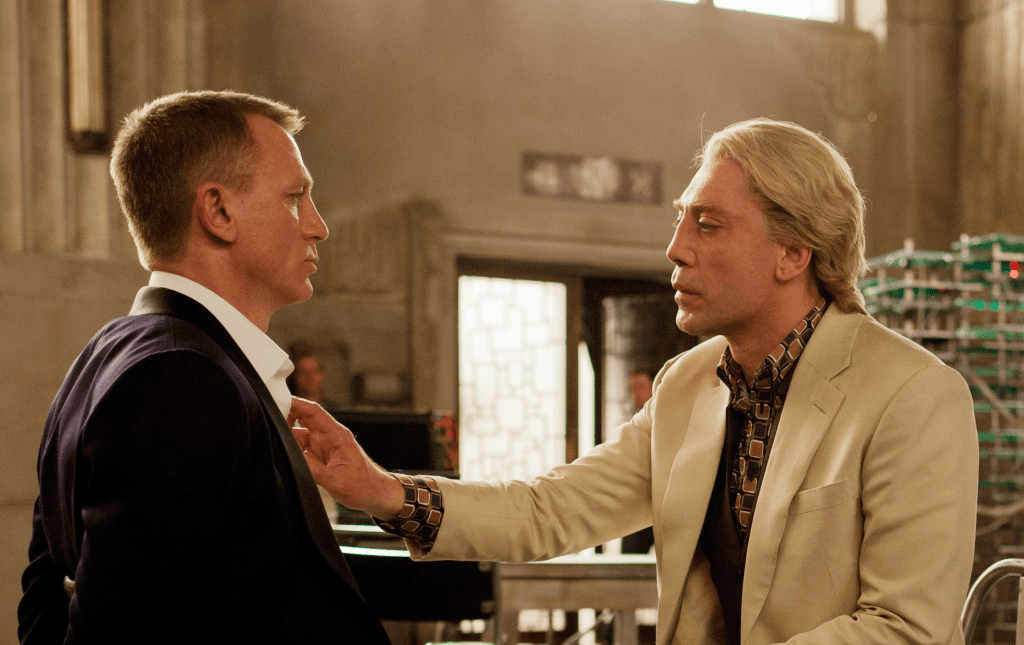
It makes a gift of a part for Javier Bardem, channelling his eccentricity into a character who often yings when he should yang. When he’s angry he laughs, when he’s overjoyed he gets quieter. Softly-spoken, almost effeminate, he’s also a ruthless killer – his studied manner of unpredictability a superb reflection of Bond’s own tightly constructed personality. Even their first meeting together is unusual and different – far from threatening Bond, Silva seems intent on seducing him, batting his eyes, stroking his bare chest with a finger and all but inviting him for a quickie (Bond’s classic response – “What makes you think this is my first time?” surely launched a thousand slash fictions).

There is a fabulously, just-below-the-line meta slice of fun going on in Skyfall. It brings Bond back from the dead (after its pulsating opening scene ends with him falling lifelessly to a watery grave), but burdens him with a host of scars. In a series of MI6 tests he completely misses a target, collapses to the floor after a workout, blows a psychological test and is repeatedly told he’s a borderline alcoholic. (In case we miss the point, Q meets him in front of Turner’s Fighting Temeraire and pointedly comments on the over-the-hill wreck being dragged back to port). Back in the field, his gunshot wounded shoulder gives out while holding onto the underside of a rising lift and Silva asks the question we’ve all asked at time or another: Mr Bond hasn’t it all gone on long enough?

While it can seem odd that two films ago Craig was introduced as a fresh-faced youngster and now embodies all fifty years of franchise ‘mileage’, it doesn’t really matter since he so triumphantly (of course!) reasserts his relevance. It’s a lovely, not too heavy-handed, piece of meta-commentary I think is both funny and human. It also means most of the call-backs to the gloried past of the franchise are metaphorical rather than literal – making a huge change from the Easter Egg stuffed nonsense you get from other franchises. It also means the one major piece of fanservice – the return of the Goldfinger car (the film is hilariously vague on whether this means Craig’s Bond and Connery’s Bond are one-and-the-same, a thing that really annoys some people who should really get a life) – really lands with a punch-the-air delight.

Skyfall is similarly astute with its characters. When Ralph Fiennes’ Gareth Mallory is introduced, we take him for an obstructive bureaucrat, flying his desk. Each scene in Fiennes’ perfectly pitched performance peels away layers to reveal a hardened professional (a decorated Army Colonel no less) and ally. It’s hard not to cheer when he takes up arms during Silva’s attack on a Parliamentary committee (with a gunshot wound no less) just as it’s hilarious to see Bond teasingly wink at Mallory before shooting out a fire extinguisher right next to him. Q returns, embodied by a perfectly cast Ben Whishaw, as a computer genius (in another gag at the franchise he’s scornful of ‘exploding pens’ and such like gadgets). Naomi Harris is very good as (it’s probably not a surprise any more to say) a Miss Moneypenny who’s a field agent in her own right. Skyfall even cheekily serves as a sort of back-door ‘origins’ story, leaving us with a very Fleming-Universal-Exports set-up.

It throws this all together with some sensational action scenes. The opening sequence is one of the best in the series, a manic chase through Istanbul that starts on foot in a darkened room (a nice reminder of M’s ruthlessness that she orders Bond to abandon to his certain death an injured agent) cars, bikes on rooftops, trains, diggers on trains and train rooftops (via a witty cufflink adjustment). There is a gorgeously shot fight-scene in a Shanghai rooftop (Roger Deakins pretty much makes Skyfall the most beautiful looking Bond film there has ever been) and a pulsating (and very witty) chase through the London Underground before that gripping Parliamentary committee gunfight. Mendes mixes excitement with plenty of neat jokes throughout and it works a treat – and the film plummets along at such speed you can forgive the little nits you can pick (like how does Silva know where to plant a bomb on the underground eh? And why did that train have no passengers?).

It culminates in a Home Alone inspired booby-trap rigged house in Scotland (wisely a Sean Connery cameo idea was nixed, with the legendary Albert Finney cast instead) and an Oedipal confrontation in a tiny Highlands church. At the end, it gave us thrills while bringing Bond home (in every sense) and was brave enough to focus on excellent actors play in a human story of regret, loss and betrayal. It’s a film which positively delighted me in the cinema and hasn’t stopped thrilling me the innumerable times I’ve seen it since then. And I can’t imagine it won’t continue to do so!

The Lives of Others (2006)

The Lives of Others (2006)

Breathtaking, heartfelt and in-the-end deeply moving film which leaves you with a profound sense of hope for humanity

Director: Florian Henckel von Donnersmarck

Cast: Ulrich Mühe (Hauptmann Gerd Wiesler), Sebastian Koch (Georg Dreyman), Martina Gedeck (Christa-Maria Sieland), Ulrich Tukur (Oberstleutnant Anton Grubitz), Thomas Thieme (Minister Bruno Hempf), Hans-Uwe Bauer (Paul Hauser), Volkmar Kleinert (Albert Jerska), Matthias Brenner (Karl Wallner), Herbert Knaup (Gregor Hessenstein), Charly Hübner (Udo Leveh)

For almost half the twentieth century, Germany was a country divided. West Germany was a world we might recognise today. East Germany was one George Orwell would have found eerily familiar, a surveillance state, where neighbour reported on neighbour, conversations and opinions were monitored and controlled, and the Stasi had ultimate power. Everything was designed to undermine personal loyalty, introduce mistrust into every relationship and keep in power apparatchiks who enjoyed privileges beyond the imagination of others. But what happens when humanity comes up against this system? Can the lives of others affect what the system’s agents think and feel?

1985, East Berlin. Gerd Wiesler (Ulrich Mühe) is the perfect cog in the Stasi machine. Emotion isn’t an issue when he interrogates dissidents for hours at a time, or sits overnight listening to every word spoken in a suspect’s bugged house. All that starts to change when Wiesler is ordered to carry out an operation against noted playwright Georg Dreyman (Sebastian Koch). Dreyman appears to be the perfect citizen, but is suspected of dissident sympathies. More dangerously for him, he’s having a relationship with famed actor Christa-Maria Sieland (Martina Gedeck) who has attracted the lascivious attentions of the corpulent and corrupt Minister Hempf (Thomas Thieme). As Wiesler listens to Dreyman and Sieland’s lives, he finds himself deeply affected by exposure to art he has never experienced and begin to question the certainties of his world-view.

The Lives of Others is a moving, humane debut from von Donnersmarck, offering a rich and chilling insight into the horror of living in a country where thoughts are not free and words are strictly monitored. It carries such emotional impact because it gives us hope that, no matter the strictures of the world around us, common humanity and decency can break through and change us – even the most mechanical servants of a regime. The Lives of Others does this with realism and a lack of sentiment, showing life and the after-effects of our decisions in non-romantic detail, while also giving us hope that goodness can shine through no matter the cost.

Shot in a series of cold colours reflecting the featureless surroundings of East Germany, The Lives of Others exposes the beige hopelessness of Soviet life. It opens with Weisler’s long interrogation of “Prisoner 227”, cutting between it and a lecture hall, where Weisler plays tapes of it to teach a class. He shows no emotion of any type in either setting for the distressed, exhausted prisoner he’s talking to, and matter-of-factly marks down the name of a student who questions the ethics of what he’s doing. Weisler’s life is one of quiet exactitude: his apartment is featureless, his meals are bland pasta with ketchup, he has no friends and barely seems able to smile.

He contrasts totally with Geog Dreymon. Played with an ebullient innocence by Sebastian Koch, Dreymon has accommodated himself with the regime’s requirements. Does he believe in socialism? It’s one of the film’s mysteries – Dreymon may have an intellectual romanticism but he’s averse to making pointless protests or stands that will only lead to him being silenced. He is willing to accept the shelving of his director friend, for his works to be pushed into a realist factory-setting by plodding directors. His charm sees him befriend the high and mighty (“it was a gift from Frau Honecker” he tells a Stasi officer who questions his possession of a Western book) and he has boyish innocence, like someone who has never known the Orwellian horrors he lives amidst.

His friends however have. His director friend Jerska (Volkmar Kleinert) is an ‘unperson’ whose presence is an embarrassment at parties. Another is a closet radical who feels he should take a stance. Above all, Christa-Marie (a marvellous Martina Gedeck) lives with the abuse of Minister Thieme. This corrupt man – who orders Stasi investigations against people he doesn’t like and is the only character who looks overfed and well-dressed – fondles Christa-Marie at parties and forces her into sexual encounters in his chauffeured car. Corrupt men run this state – similarly Wiesler’s Stasi superior Grubitz (a wonderfully smug Ulrich Tukur), is interested only in promotion.

The system is propped up by men like Wiesler. But all that changes as listening to Dreymon’s life pulls something out of Wiesler he has never thought about before. What pivots this? Perhaps Wiesler truly listening to the warmth and vibrancy of Dreymon’s home life? Perhaps exposure to art? Von Donnersmarck masterfully shows (with complimentary camera moves between two locations) Wiesler teary, spellbound listening to Dreymon’s playing of a piano sonata. It opens up a new world of artistic and cultural understanding to Wiesler, who is drawn to the books in Dreymon’s apartment and begins turning more than a blind eye to Dreymon’s flirtation with dissidents.

In fact, Wiesler morphs from Dreymon’s dark shadow to his protective guardian angel. He awakens in himself a care for people around him, from the son of a neighbour to Dreymon and Christa-Maria. He conceals Dreymon’s involvement in a scheme to smuggle someone across the border (tragically the plan is a fake, designed to test if Dreymon’s apartment is bugged). He does his best to reassure Christa-Maria, “bumping into her” anonymously to provide her a moment of solace with a stranger and subtle counselling on her relationship with Dreymon. As Dreymon carefully writes an article, to be smuggled to the West, critical of the regime, Wiesler fills his reports with imagined plot details and quotes for the Lenin play Dreymon claims to be writing.

Dreymon is actually writing an article about the suicide rate in East Germany. Suicide becomes a heart-wrenching central theme. An oppressive, domineering regime like East Germany offers only one real escape: death. A state designed to make its own people suspect and turn on each other is designed to grind you into a choice between blank conformism or taking your own life. And we see the effects of this on multiple characters, as people are separated from the things that give their life meaning, stripped of their own identity, or made to betray those they love. For some, this is more than they can bear.

In this world, just displaying humanity is the victory. Ulrich Mühe’s breath-taking performance slowly fills with growing doubts, longings and passions under the surface of an impassive, quiet man who suddenly realises the world is larger and more magical than he ever imagined. Like a butterfly emerging from a chrysalis, he starts burrowing in the bowels of Stasi HQ, his eyes fixed only on what is in front of him. The film’s victory is turning this man into one who makes huge, unrewarded, sacrifices to protect another, the very attitude he quietly deconstructed in the film’s opening. Mühe is superb, the film constantly exploring his face for unspoken depths.

von Donnersmarck’s film ends with an extended coda of life after reunification. Some things are not as triumphant as hoped: Wiesler lives in poverty, the streets are lined with graffiti and tramps, cockroaches like Thieme remain in authority. But it is also a place where hope and friendship are possible, where things can be spoken rather than suppressed. It culminates in the sort of free-publishing Dreymon could never dream of and a tribute that could never have been spoken before.

After the crushing misery and suicidal pressures of the East, a world of possibility and freedom is one where we all could change our stars like Wiesler, to find an inner contentment from doing the right thing for no reward. Brilliantly filmed and deeply moving, The Lives of Others is a masterpiece.

Heart of Stone (2023)

Heart of Stone (2023)

Dull franchise-starter shamelessly rips off every other successful action franchise it can think of

Director: Tom Harper

Cast: Gal Gadot (Rachel Stone “Nine of Hearts”), Jamie Dornan (Parker), Sophie Okonedo (Nomad “King of Hearts”), Matthias Schweighofer (Jack of Hearts), Paul Ready (Bailey), Jing Lusi (Yang), BD Wong (King of Clubs), Alia Bhatt (Keya Dhawan), Archie Madekwe (Ivo), Enzo Cilenti (Mulvaney), Jon Kortajarena (The Blond), Glenn Close (King of Diamonds), Mark Ivanir (King of Spades)

Heart of Stone is the first in a planned Mission: Impossible/James Bond style super-franchise for Netflix. You can’t miss this, as the entire film plays out like it’s been assembled from scenes salvaged from the cutting room floor of those series. Pretty much every single idea in Heart of Stone has been played out before (often more than once) and every single action scene has been performed, shot and edited elsewhere and better. Heart of Stone is really prime Netflix filler, the sort of brainless eye-candy that can play in the corner of a room while you scroll through your phone. Worryingly, one day, all films might be like this.

Gadot plays Rachel Stone. She’s a strictly “stay-in-the-van” tech expert for a MI6 team. Apparently set in a world where the security services aren’t predominantly made up of bland white guys from the same universities, the team consists of Parker (Jamie Dornan), Bailey (Paul Ready) and Yang (Jing Lisu). But she’s also “Nine of Hearts”, a super-agent of The Charter, a group of secret agents who use a super-computer (the Heart) to predict all outcomes and prevent disaster. When the Heart is under threat, Rachel has no choice but to reveal her identity – via a kick-ass fight scene naturally – to try and protect this super-computer which could destroy the world from falling into the wrong hands.

I’ll say one thing for Heart of Stone – it does a neat reveal of a surprise (but guessable) villain. Other than that? You’ve seen it all before. Many, many, many times – usually done better. When a battle atop a zeppelin makes you think “Hey, didn’t The Rocketeer do this a lot better almost 30 years ago?” you know your film is in trouble. Heart of Stone is like a gruesome Frankenstein’s monster, where every single stitch can be clearly seen. A Bondish opening credits sequence is stitched to a series of M:I risky stunts, with fights and car chases from Bourne and more than a dash of better TV shows like Alias and Person of Interest. It’s put together with a perfunctory box-ticking which only reminds you how many years of care goes into the franchises it’s ripping off.

Everything unfolds in Heart of Stone pretty much as you would expect it. When a character pulls out a photo of the doll’s house he’s planning to buy for his niece’s birthday, you know he’s doomed. When the Charter sends agents to infiltrate a base, but leave Gadot behind, you know you’re about to watch a “wrong door” routine. Inevitably we get a “you’re off the case” dressing down for Stone from her boss. A secondary villain is clearly an ally in waiting. Characters are defined with thinly sketched traits. Glenn Close ticks the box of “inexplicable big-name cameo”, popping up to lean on a fireplace.  It’s all drearily, depressingly unimaginative and predictable.

I ended up letting my mind wander aimlessly around the nonsense of this world. How does the Charter fund itself? How secret is it – everyone seems to know about it and after the early distress about Gadot blowing her cover it then charges about with barely a token effort at subterfuge. Why would an organisation called the Charter name some (but not all) of its agents after cards? Are there four separate branches in different places for the four “decks”? Are the numbers randomly assigned – since “Jack” seems to work for “Nine”. Why choose a codename system that takes three words to spit out (it even slows Stone down at a vital point trying to explain who she is)? Are Aces all low?

The fact I spent so much time thinking about this sort of thing kind of says it all. I would feel sorry for Gal Gadot at the centre of this except, as a producer, she must have had a say in how this derivative mess was put together. She’s woefully miscast in a role that exposes all her limitations rather than playing to her strengths. Gadot simply hasn’t got the charisma and comic timing to play a wise-cracking maverick: she’s at her best as earnest and well-meaning (see Wonder Woman where she plays a sweet innocent), but here as a sort of would-be Ethan Hunt she’s a washout. Every second she’s on screen only reminds you how good Tom Cruise is at this sort of thing.

She can do a stunt or two, to be fair. It’s unfair perhaps to say that all the big, risky stunts are all too clearly performed in front of a greenscreen or by a double, but Gadot can throw a punch. But Stone is a bland, aimless, patchwork character, whose every reaction seems like it’s guided more by what the script needs at that moment rather than any consistent logic. The entire cast more-or-less falls into the same uninspired bucket, either going through the motions (Sophie Okonedo) or not given enough to do (Paul Ready is probably best-in-show here, making a lot of a some fairly duff lines and predictable plot arcs). Perhaps, since the audience has a decent chance of finishing every line before the characters do, the actors were as disheartened as we are watching it.

The most depressing thing about Heart of Stone is it looks like a grim look into the future. As Hollywood writers strike against the threat of AI, is it possible that all films will one day be put together with the robotic predictability of Heart of Stone? Even the title sounds like a ChatBot came up with it.

Mission: Impossible: Dead Reckoning Part 1 (2023)

Mission: Impossible: Dead Reckoning Part 1 (2023)

Action and impossible stunts continue to deliver entertainment in Cruise’s running and jumping franchise

Director: Christopher McQuarrie

Cast: Tom Cruise (Ethan Hunt), Hayley Atwell (Grace), Ving Rhames (Luther Stickell), Simon Pegg (Benji Dunn), Rebecca Ferguson (Ilsa Faust), Vanessa Kirby (Alanna Mitsopolis), Esai Morales (Gabriel), Pom Klementieff (Paris), Henry Czerny (Eugene Kittridge), Shea Whigham (Jasper Briggs), Cary Elwes (Director Denlinger), Greg Tarzen Davies (Degas), Frederick Schmidt (Zola Mitsopolis), Charles Parnell (NRO Director), Mark Gatiss (NSA Director), Indira Varma (NRO Director)

When they promote Mission: Impossible films, the stunts are front-and-centre. So much so that the film’s life-risking (what else?) stunt of the Cruiser driving a motorbike off a cliff and parachuting to safety was not only in every trailer but they even released a social medial film showing how it was done. Mission: Impossible films are thrill rides – and knowing what you are going to get doesn’t reduce the excitement of getting it. There’s plenty of excitement in Dead Reckoning Part 1 but that desire to entertain doesn’t always work when the film tries to tackle more emotional content.

Dead Reckoning starts, Hunt for Red October-like, with the sinking of a radar-invisible Russian sub (there is even a neat twist on that film’s switch from Russian to English). The disaster is caused by its AI supercomputer, known as The Entity. While intelligence agencies compete to control it, the Entity uses its ability to predict every outcome to plot world domination. The only threat it predicts? Ethan Hunt (Tom Cruise) of course. Ethan will stop at nothing to destroy this threat, in a country-hopping adventure with his regular team (Ving Rhames, Simon Pegg and Rebecca Ferguson) that rotates around mysterious thief Grace (Hayley Atwell) and a ruthless old enemy of Ethan’s, Gabriel (Esai Morales).

Dead Reckoning is, of course, huge fun. Shot over years, due to Covid (responsible for its budget ballooning to an eye watering $300 million) it never lets events go on too long without throwing in a twist and turn filled set-piece which plays off its lead characters’ skill under pressure. Despite the vast numbers of set-pieces, you rarely shift in your seat, because each is paced to perfection with just the right balance between tension and wit. That long shooting process also means its villainous AI plotline (clearly the makers binged on AI drama Person of Interest beforehand) seems zeitgeist rather than something from science fiction.

The film is a masterclass in shooting action. The recent Indiana Jones film threw in a seemingly never-ending three-way car chase. Dead Reckoning probably dedicates more time to its jaunt through the streets of Rome, but it’s always clever enough to keep shifting gears. We go from shoot-out, to Cruise and Atwell handcuffed together and awkwardly sharing the driving, to switching of cars (a ludicrous yellow mini which even Ethan can’t work out, impotently turning the windscreen wipers on and off), pratfall spins down the Spanish steps, all with a free-wheeling sense of improvisational fun that only comes from months of careful storyboarding and determination to never settle for “things move fast until they stop”.

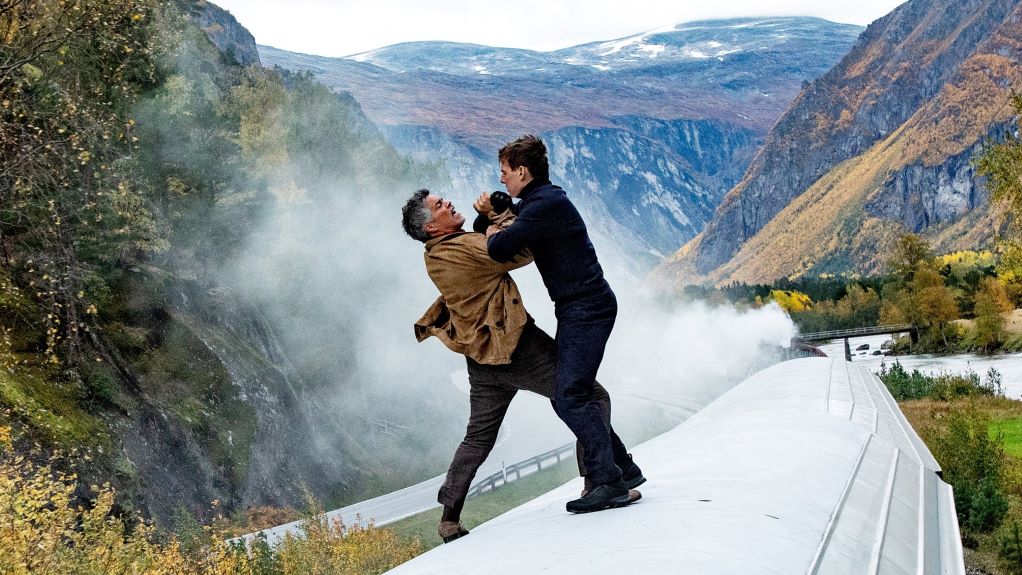
Dead Reckoning is a reminder that no-one since Buster Keaton puts themselves through as much as Cruise does (it seems fitting the finale builds towards the biggest train crash since The General). It’s Cruise’s USP: he does it for real. Even at 60 he pushes himself in the way few actors have ever done. Run full-pelt through the streets of Venice? Climb along the roof of a speeding train? Fight two actors half his age in a cramped corridor? You can sort of understand why the film doesn’t shirk on dialogue paying tribute to Cruise/Ethan’s superhuman determination and endurance (and the film is a further reminder Ethan’s only flaw is caring too damn much).

Let’s not forget also Cruise pretty much produces and co-directs these missions. Dead Reckoning is a triumph of the producer’s art – McQuarrie and Cruise are practised experts at pulling together locations, resources and expertise. They are equally ace at assembling tense sequences that don’t involve death-defying stunts. A first act cat-and-mouse chase around a huge Dubai airport sees Cruise tracking Atwell, while dodging a US government team sent to capture him, while Pegg hunts for a suspicious bag, while Cruise is also tracked by Morales. None of this involves stunt work (although Cruise and Atwell both learned how to perform sleight-of-hand tricks in camera) just timing and an ability to constantly present events in a dynamic way. This is consummate box-office ride assembly, marshalled to perfection with all the skill of expert showmen.

The set pieces are so gripping, it sometimes draws your attention a little bit too much to how perfunctory all the joins can be. A host of British actors (Gatiss, Varma and rent-a-villain Cary Elwes) gather in a room to throw plot statements at each other. The conversations between the team are often dominated by the narrative need to establish who will go where and why. The script has a tendency to demonstrate how people feel by having them bluntly state it (“My friends matter more to me than anyone!”). When trying to be human, rather than a thrill ride, it can stumble.

It’s perhaps why the moments that aim for tragedy feel like they land slightly awkwardly, as if you aren’t quite sure how sad you should be feeling. Dead Reckoning throws in an emotional mid-act that strains for a depth a film primarily designed to entertain popcorn munchers, isn’t quite able to deliver on. Put simply, the film can’t afford to have Ethan get caught up in grief when ten minutes later we need an exasperated Cruise to jump off a mountain. This ride don’t stop for anyone.

The film also suffers from the characters spending the entire runtime chasing a mysterious key which they have no idea the purpose of, but the audience has had explained to us in that opening Russian prologue. This is a series that thrives best on carefully concealing things from us, on the characters having a card or two up their sleeves. It somehow doesn’t quite work that we are more aware of the bigger picture than the characters. It makes Dead Reckoning feel like an extended opening act.

But this ride is fun enough for now. Atwell is charming, funny and has superb chemistry with Cruise; Morales is a chillingly arrogant villain, Klementieff enigmatically vicious as a near-wordless henchman. Whigam and Davies are good fun as contrasting agents vainly chasing the uncatchable Ethan. And above them all is Cruise: jumping, running, diving, punching and generally putting life-and-limb on the line, all to entertain us. Maybe he is a bit mad, but it’s impossible not to applaud him.

Tinker, Tailor, Solider, Spy (2011)

Tinker, Tailor, Solider, Spy (2011)

We’re going on a Mole Hunt: Le Carré’s finest book is boiled down into an atmospheric and masterful spy thriller

Director: Tomas Alfredson

Cast: Gary Oldman (George Smiley), Colin Firth (Bill Haydon), Tom Hardy (Ricki Tarr), Mark Strong (Jim Prideaux), Ciaran Hinds (Roy Bland), Benedict Cumberbatch (Peter Guillam), David Dencik (Toby Esterhase), Toby Jones (Percy Alleline), John Hurt (Control), Kathy Burke (Connie Sachs), Roger Lloyd-Pack (Mendel), Svetlana Khodchenkove (Irina), Konstantin Khabensky (Polyakov)

Anyone taking on this, Le Carré’s finest novel faced a tough challenge. After all, arguably the definitive version already exists: the masterful, slow-burn, 1979 TV adaptation (one of my favourite films ever) starring an Alec Guinness so perfect as the rotund, inscrutable spy-master George Smiley that Le Carré stated he could no longer write the character without thinking of him. I’ve long been nuts for Tinker, Tailor: I rushed to the cinema to see this with an equally keen-friend about five days before my wedding (on my wife-to-be’s birthday!) because I was looking forward to it so much. (Despite this the wedding went ahead). It can’t match that Guinness version – but it runs it close.

It’s the height of the Cold War, and the respected head of the British Intelligence Services (‘the Circus’) Control (John Hurt) is forced out, along with his deputy George Smiley (Gary Oldman) after a rogue mission in Hungary goes disastrously wrong. Over a year later, Smiley is secretly recalled to lead a mole hunt. Someone at the top of the service is a Russian agent – but who? New head Percy Alleline (Toby Jones)? Or one of the deputies – Bill Haydon (Colin Firth), Roy Bland (Ciaran Hinds) or Toby Esterhase (David Dencik)?

The first inspiration here is the screenplay. When I heard the film was two hours long I was stunned: the TV series unfolded over nearly seven hours! But the script, by Peter Straughan and the late Bridget O’Connor (who tragically died of cancer during it’s making) is a masterpiece. It brilliantly and skilfully compresses and restructures the novel, boiling down scenes to their core. But yet, it never feels rushed. The script creates composite scenes – most brilliantly a flashback to a Circus Christmas party – which allows a vast range of sub-plots and characters to simultaneously unfold.

Alongside this, the film is superbly, atmospherically directed by Tomas Alfredson. Alfredson brings a sharp, outsider’s view to this public-school nightmare turned espionage hub. These are posh boys, running an exclusive club, which plays by punishing rules. Everyone constantly spies one everyone else and there is no moment of privacy. Alfredsen brilliantly explores the social and emotional impact of spying, trapped within a grim and oppressive 70s mileu of dirt, beige, fear and loneliness.

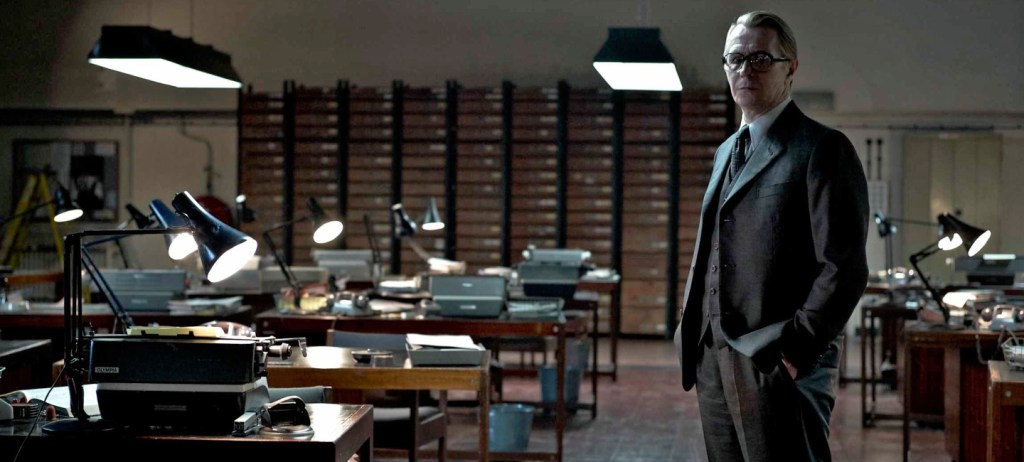
The film is brilliantly designed, capturing a vast array of 70s designs and shades. The Circus is an industrial office – with its centre piece an orange lined, sound-proof room. Streets are lined with political graffiti – at one point we see “The Future is Female” a nifty comment on the all-male institution we are watching. Communist Hungary is a post-industrial slum, hotel rooms crowded with papers, cigarette smoke and overflowing ash trays.

At the centre is Gary Oldman, simply brilliant as Smiley. Controlled, measured and deploying only as much energy is needed, Smiley adds a hint of Guinness to his voice and always seems in control. But this lugubrious Smiley bubbles with tension, driven by twin demons. The first is Karla, the Russian spy-master Smiley let slip through his fingers years ago, the subject of a maudlin late-night recollection to his assistant Guillam. Even more important is his wife Ann, the betrayer Smiley still loves to distraction, a half-sight of her enough to make him stumble and lose breath. We never see either of these clearly in the film, reflecting their status as the only characters Smiley never understands and can’t make cool, calm, passion-free decisions about.

Cold-eyed reason guides everything else he does. Oldman’s Smiley may be grandfatherly, softly-spoken and controlled, but he’s as ruthless (if not more so) than everyone else. Smiley is precise and patient. There is a beautiful character establishing moment: Smiley, Mendel and Guillam are in a car bothered by a wasp. Guillam and Mendel flap with futile energy: Smiley waits and then lowers the window slightly at the perfect moment to let the wasp fly out. It captures in microcosm Smiley’s investigation. But he’s not afraid to use force: quietly threatening Dencik’s trembling Esterhase with deportation (not even flinching as a plane lands behind him), ruthlessly mining witnesses for evidence and verbally lashing out bitterly at the mole.

Alfredson’s film zeroes in on much of the emotional impact on spying. Smiley is a man slightly lost in the world outside of spying: retired, he seems adrift walking the streets, swims alone, sits at home in his suit. He’s so deactivated he doesn’t even speak for the first 18 minutes of the film, when he is recalled to life. Smiley has suppressed his emotions so completely only the shadow of his wife can move him. His home is a strange shrine, so much so he even keeps the gifts her lover gives her.

Each of the characters suffers under their burdens, and the demands on them for secrecy and isolation. Mark Strong’s Jim Prideaux buries himself in guilt in a caravan and forms a friendship with a young boy he later realises he is crafting into the same secretive man he is. Guillam is quietly ordered by Smiley to end his relationship with his boyfriend and acquiesces in private tears. Connie Sachs lives in retirement like a mad woman in an attic, cradling her memories. Control dies alone in a hospital bed. Later the Mole clings to having “made his mark” to supress his guilt, while a man whose career is ruined walks into oblivion blank faced not even noticing the rain around him.

Tinker, Tailor, Soldier, Spy is full of moments like this, the high-price of dogged, dedicated work like spying. Alfredson’s coolly, beautifully shot film (by Hoyte van Hoytema) with its lyrical score by Alfredo Iglesias is a masterpiece of tone. This is a dark, dangerous world and we are constantly reminded of it, in between the muttered meetings in board rooms and dark corriders. Tom Hardy’s (wonderful) Ricki Tarr and Mark Strong’s deeply emotional Prideaux are spies-on-the-ground, face-to-face with dangers. Theirs is a world of brutal throat-cuts, eviscerations in a bath and sudden executions. The decisions played out in rooms like that orange-lined sound-proof office with its methodical, intricate ship’s clock, lead to death and violence.

The film is stuffed with beautifully composed shots and brilliantly edited (Dino Jonsäter’s cuts frequently carry us over brilliantly over transitions and segues that streamline the narrative perfectly). Despite cutting back and forth over multiple timelines, it’s always clear when we are (an ingenious device sees Smiley change his glasses in retirement, instantly grounding us in the timeline based on the pair he is wearing). The Christmas party scene – exactly the sort of bizarre public-school irreverent piss-up (where spies who fight night and day to destroy the USSR raucously sing communist songs with a Lenin-dressed Santa) is a superb distillation of character and plot beats and becomes, in many ways the emotional pivot of the movie. It’s a very inventive addition.

The film assembles a superb cast. Oldman, of course, leads from the front but there is not a weak turn in the cast. Hardy is gritty, bitter and jumped-up, Cumberbatch holding his tension down under professionalism, Strong drips quiet grief, Firth swaggers with superb, assured insouciance, Hurt is the book’s arch-spy-master come to life, Jones is full of preening pride, Burke lost in memories. If I’d like the film to be longer for any reason, it would be to see more of these actors.

Full of moody, seventies beauty and creeping paranoia, it’s also crammed with beautifully judged lines and incidental moments from the book. Alfredson’s atmospheric film has a profound emotional understanding of the cost of this life of isolation and paranoia. It took a couple of viewings, but this emerges from the shadow of my favourite TV series.

Hell and High Water (1954)

Hell and High Water (1954)

Action below the waves in this dutiful, for-the-money thriller from Samuel Fuller that lacks imagination or freshness

Director: Samuel Fuller

Cast: Richard Widmark (Captain Adam Jones), Bella Darvi (Professor Denise Gerard), Victor Francen (Professor Montel), Cameron Mitchell (“Ski” Brodski), Gene Evans (Chief Holter), David Wayne (Tugboat Walker), Stephen Bekassy (Neumann), Richard Loo (Hakada Fujimori), Wong Artarne (Chin Lee), Henry Kulky (Gunner McCrossin)

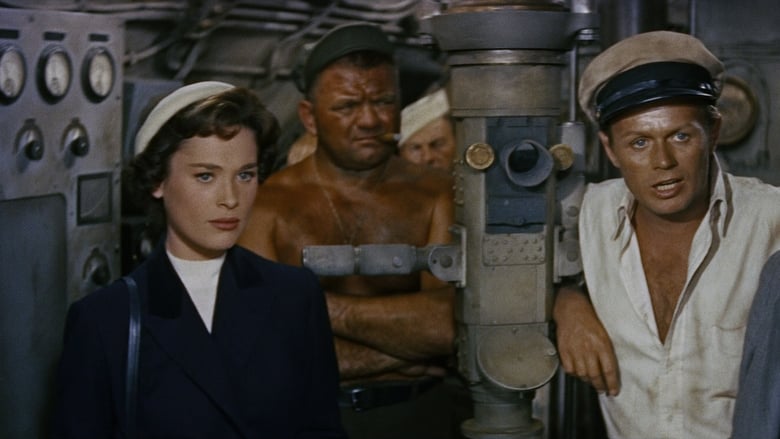
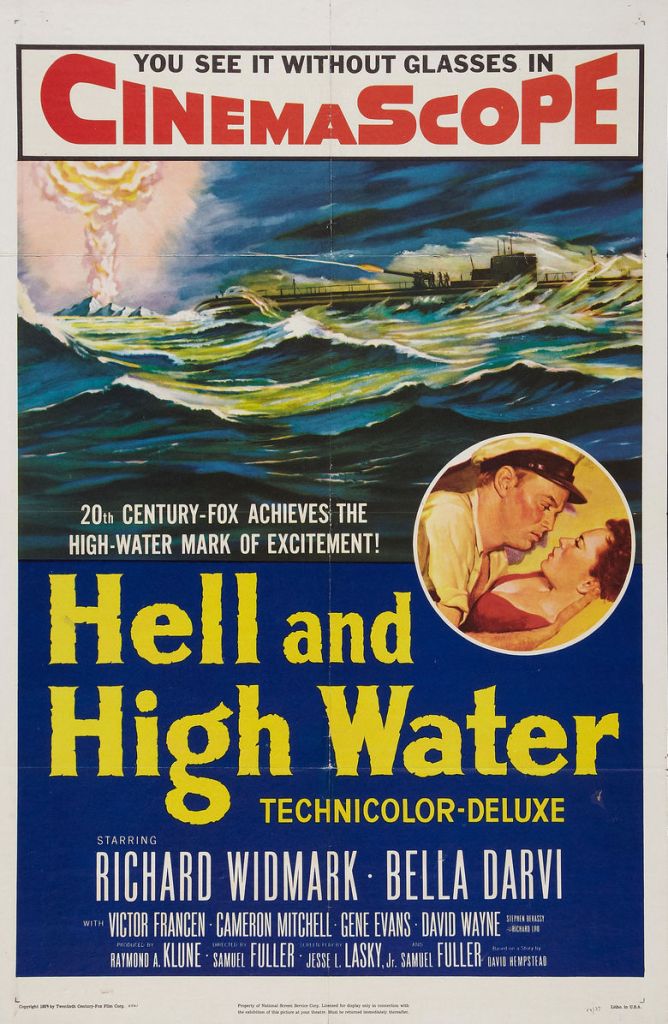
Few films start with a bigger bang than Hell and High Water: a nuclear explosion. What caused it? The film winds back to tell us. Retired submarine captain Adam Jones (Richard Widmark) is hired by a cabal of intellectuals and scientists working to maintain world peace. Somewhere on an island off Japan, the Commies are working on a secret nuclear bomb. Jones – in return for a fee – will shuttle Professors Montel (Victor Francen) and Denise Gerard (Bella Darvi) to investigate. Cue submarine duels, personality clashes, romance and shoot-outs.

To be honest, nothing in Hell and High Water lives up to that bang at the start. Samuel Fuller took on the film as a favour to producer Darryl F Zanuck, but had a low-opinion of the result (labelling it his worst film). Fuller rewrote the script, added a lot of his compulsive drive to the direction and handled it well – but it feels like a “gun for hire” film. Goodness only knows what Fuller made of Spielberg telling him in 1979 he loved it so much he carried a print of it in his car (perhaps “Have you not seen Pickup on South Street?”)

Hell and High Water is a serviceable men-on-a-mission film that sneaks in a few interesting beats, but otherwise goes for well-shot action and predictable events over invention and insight. It’s anchored by a grumpy Richard Widmark (who thought the script was crap and co-star Darvi couldn’t act) as a hard-to-like hero. Never-the-less Jones’ ruthless mercenaryism is the film’s most interesting beat – even if it is a repeat of the same actor’s attitude in Pickup on South Street, right done to mouthing almost the same contemptuous line about ostentatious flag wavers. Jones does his job professionally – and he’s got no truck with his country being dishonoured or attacked by Commies – but his main concern is always the $50,000 fee he’s been promised.

Also paid off are the whole crew who, in the film’s other interesting beat, are a regular united nations all of whom treat each other with equality and respect (the only people not represented here are Black people). We’ve got a German, a Japanese, a Frenchman, several Americans – considering only nine years previously all these nations had been working over-time to kill each other, it’s great to see the team on the ship working as a tension free-unit. We even have a Chinese sailor – who entertains his fellow crew with improvised ditties – becoming a crucial hero.

Fuller also shoots the sub action – a mix of models and trick photography – very well. The angles he uses of the subs underwater, in particular their turns, and the sweaty look of those underwater (and the increasing tensions) influenced several future films. All the submarine lingo you’d expect is trotted out with real commitment (“Right full rudder!”) and every box is carefully ticked, from sinking the bottom, to the costly rush to close a bulkhead. The torpedo fights are well-staged and whenever the film dives it’s at its best.

Where it is less so is whenever the film dwells on its characters. It tries to push the envelope a bit by introducing a female professor who is assured, competent, super-smart and gets stuck in with helping out when things go pear-shaped. She’s played by Bella Darvi, a protégé (and more) of Zanuck, who he was determined to elevate to stardom. Despite Widmark’s criticism, she’s fine here, even if she struggles to convey the charisma the role needs, often falling back on slightly grating over-earnest, head-girl smartness. What fails is the complete lack of chemistry between her and Widmark, their half-hearted, dutiful romance (probably mostly Widmark’s fault).

You’ll feel sorry for her though as the crew – and Jones – eye her up like a piece of meat when she arrives. Of course, this dated sexual leering is par for the course, but is still more than a little uncomfortable. But this is still the era when a sailor taking his top off to push his tattoos into a woman’s face was funny rather than a crime. The film does gives Darvi’s Professor a lot of proactivity and does generally take her side – even if she, inevitably, needs to learn our hero knows best.

Hell and High Water charges through to a decent ending, with just the right mix of self-sacrifice, tension and pay off. Victor Francen gives the films best performance as an illustrious, brave French scientist. But it never feels like anything more than a dutiful, for-the-money film. There is none of Fuller’s fire or feeling here, no real imagination or freshness in the ideas or concepts. It hits all the beats, ties things up with a bow and sends you home – but its very hard to really remember anything distinctive about it when the credits roll.

The Ghost Writer (2010)

The Ghost Writer (2010)

Conspiracies, lies and dirty politics surround a politician who definitely isn’t Blair in Polanski’s superb thriller

Director: Roman Polanski

Cast: Ewan McGregor (The Ghost), Pierce Brosnan (Adam Lang), Kim Cattrall (Amelia Bly), Olivia Williams (Ruth Lang), Tom Wilkinson (Professor Paul Emmett), Timothy Hutton (Sidney Kroll), Jon Bernthal (Rick Ricardelli), Tim Preece (Roy), Robert Pugh (Richard Rycart), David Rintoul (Stranger), Eli Wallach (Old Man), James Belushi (John Maddox)

An American publishing company is in dire straits. They’ve paid a fortune for the autobiography of former British Prime Minister Adam Lang (Pierce Brosnan), once seen as a visionary liberal idol but now blamed for a deeply controversial war in Iraq (sound familiar?). Problem is his trusted aide Mike McCara – who is actually writing the book – has been found drowned on Martha’s Vineyard where Lang, his wife Ruth (Olivia Williams) and staff are staying. The book needs to be finished in a month – but it’s in an unpublishable mess. Who ya gonna call? A Ghost writer (Ewan McGregor) of celebrity memoirs to finish the job of course. But will the Ghost resist trying to investigate whatever McCara uncovered in Lang’s life that may have led to his suspicious death?

Adapted from a novel by Robert Harris – who turned from a strong supporter of Blair, to terminally disenchanted – The Ghost Writer comes to the screen as a superbly controlled, perfectly placed piece of tight-wound tension from Roman Polanski, that mixes wonderful elements of Hitchcockian menace and Seventies conspiracy thriller, not to mention lashings of his own Chinatownbut here switched to the doom-laden drizzle of New York, rather than the sunkissed glory of California.

Set on a grim, grey and foreboding Martha’s Vineyard (although, for obvious legal reasons, actually filmed in Potsdam), Polanski lets every scene grow in unsettling tension. Very little explicit is every said, but danger from unknown, unseen forces is a constant presence. Accompanied by a Herrmann-esque score from Alexandre Desplat (also with a hint of a twist on Jerry Goldsmith’s work on Chinatown), this is film made with such calm, patient authority that its exudes engrossing tension. Polanski employs some beautiful touches, worthy of Hitchcock: from the Ghost, uncertain if he is being followed when boarding a car ferry, making a desperate run for freedom; to a wonderful tracking shot at a book launch that follows a note containing a vital reveal, passed from hand to hand through a crowd to the guilty speaker.

The Ghost Writer also has neat moments of dark comedy which also feels reminiscent of Hitchcock’s ability to mix dark chuckles with oppressive tension. The Ghost’s recruitment as a writer – and his hilariously frank suggestion that political memoirs are boring beyond belief – is a lovely lightly comic entrée that completely fails to prepare us for the conspiracy thriller that follows in all the right ways. Stuck in Lang’s house on Martha’s Vineyard, the Ghost tries to secretly download a copy of the memoir he is only allowed to read under supervision: his attempt coincides, to his terror, with what turns out to be a test of the alarm system. In the background of a shot during a monologue from Lang, a worker struggles with wearied patience to clean the wind-filled grounds of leaves, constantly, dutifully, collecting them back up as they blow away.

These moments of lightness make the dark even blacker. We are constantly left guessing as to who knows what. Was McCara murdered? What mysteries lie in Lang’s university past that McCara considered so important? Lang and his wife oscillate from welcoming to coldly distant. Particularly so with Ruth Lang, a superb performance from Olivia Williams. Ruth has, quite possibly, been the power behind the Lang throne, but now seems less sure of where she stands. She’s tense, without making clear why and at times painfully blunt. Suffering no fools, brittle, sharply intelligent, coldly determined, her surprisingly vulnerability draws the Ghost in, despite him knowing its “a bad idea”.

But then The Ghost makes more than a few bad ones. Perhaps because he gets fed up with people thinking he’s stupid and is too keen to prove them wrong. Ewan McGregor is wonderful as a man who spends most of his time wearily ignoring digs at the fact he’s best known for ghosting the autobiography of a celebrity chef. The Ghost – as in Harris’ book he remains un-named, suitable for a man whose job is to pretend to be his client – seems to be a disconnected observer, but emerges as a dogged detective – even if he is painfully out of his depth and acting way beyond his expertise. He becomes increasingly panicked at the terrifying world of international politics and espionage, like a beginner swimmer dropped in the deep end, while unable to stop himself digging further, like picking at a scab.

The film picks at its own scab with the legacy of Blair. Brosnan’s confident, charismatic performance captures an impression of Blair while never trying to be an impersonation. He perfectly conveys the easy charm and casual but shallow warmth of the professional politician, but the slightest scratch of the surface reveals a man who feels hard-done-by and undervalued and sick of being judged for making the tough calls. Polanski allows him moments of sympathy: it’s hard not to see his point when he makes the case for what many would call intrusive security and the self-righteousness of his persecutor, former foreign secretary Ryecart (Robert Pugh, channelling Robin Cook) hardly warms the viewer (or the Ghost) to him.

The Ghost Writer manages to make its political parallels – especially about Iraq – pointed but not too heavy handed. (There is a lovely performance from David Rintoul as a calmly spoken former-army type who turns out to be a rabid anti-war protester). It imaginatively fictionalises a version of history, humanising characters who could otherwise be crude caricatures. The cast are wonderful and this is an intelligent, gripping, classic conspiracy thriller. Mastered by Polanski, who assembles the film with such control that it takes a cold grasp of your heart without ever seeming to overwork itself. As the credits roll, Polanski having left us with a poetically tragic image of pages blowing emptily in the wind on a London street, you’ll realise how the quiet doom so expertly built could only have led to one thing. The Ghost shoulda forgot about it: its Chinatown.