Category: Theatre Adaptation

Hello Dolly! (1969)

Hello Dolly! (1969)

Bloated, miscast and over-produced musical that nearly sank the genre and studio

Director: Gene Kelly

Cast: Barbra Streisand (Dolly Levi), Walter Matthau (Horace Vandergelder), Michael Crawford (Cornelius Hackl), Marianne McAndrew (Irene Molloy), EJ Peaker (Minnie Fay), Danny Lockin (Barnaby Tucker), Joyce Ames (Ermengarde Vandergelder), Tommy Tune (Ambrose Kemper), Judy Knaiz (Gussie Grander), David Hurst (Rudolph Reisenweber), Louis Armstrong (Band leader)

The old-fashioned musical had always been a winner for Hollywood. So, I guess it made perfect sense to pump $25 million (just over $200 million in today’s money) into Hello Dolly!. Reality didn’t agree though. Hello Dolly! was a massive box-office bomb which, despite its seven Oscar nominations (including Best Picture, due to intense studio lobbying) pretty much killed the traditional, Freed-style musical stone-dead. After this, musicals would have drama at their heart (like Fiddler on the Roof or Cabaret) and scale down the production numbers.

It also didn’t help that the mega-budget, colossal production values across its bum-numbing two-and-a-half hour run time ruthlessly exposed Hello Dolly! as a perilously slight story, in a way its years playing on Broadway hadn’t. Dolly Levi (Barbra Streisand) is a widowed matchmaker, hired by grumpy “half-a-millionaire” Horace Vandergelder (Walter Matthau) to find him a wife. However, Dolly rather fancies getting back into the game with Horace herself. Around them other parties flirt, such as Horace’s niece Ermengarde (Joyce Ames) with artist Ambrose Kemper (Tommy Tune) and his clerks Corenlius Hackl (Michael Crawford) and Barnaby Tucker (Danny Luckin) with fashion store owner Irene Molloy (Marianne McAndrew) and her assistant Minnie Fay (EJ Peaker).

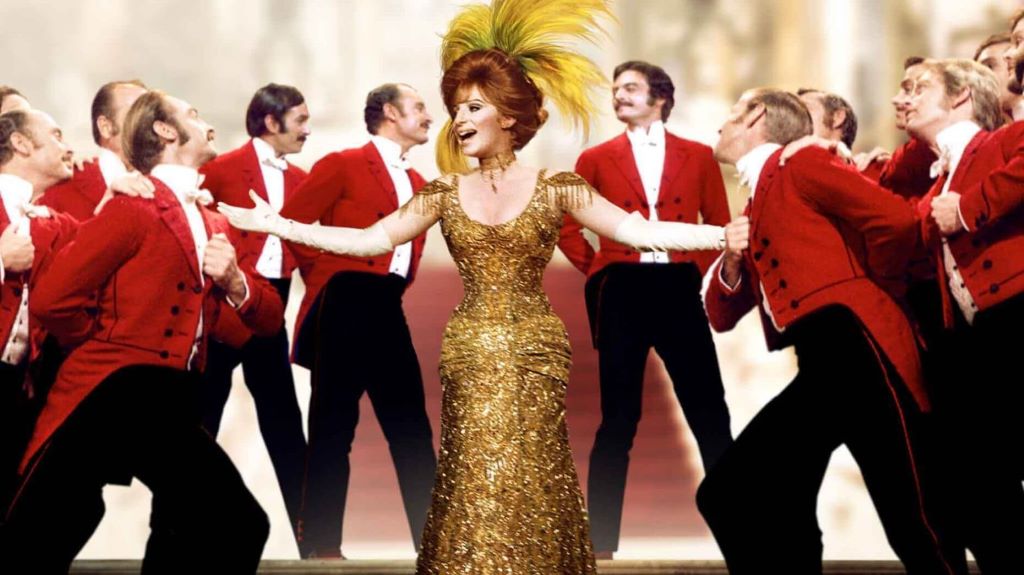
I’ll grant the scale and sets are impressive. Whole streets and parks were built. Grand, elaborate costumes (some of Streisand’s costumes cost thousands and thousands of dollars by themselves) add wow factor. If you believe “more is more” Hello Dolly! is for you, it’s Oscar for set design well deserved. But as you watch Streisand hit a high note in long shot while an entire parade of thousands takes place around her, you start to realise you’ve not formed a bond with the characters. When we finally get them all in one place (a crowded restaurant in New York) the best part of thirty minutes is taken up with three massive numbers (Dancing waiters! Streisand’s entrance number! Comedy foot-tapping from Crawford! Louis Armstrong cameo!) that piles so much stuff on, that you almost forget what the scene was meant to be about in the first place.

What this probably needed to be is a tighter, American in Paris style romantic comedy, the sort of stuff Arthur Freed would have run out in 100 minutes with a few set pieces. Instead, it’s a bloated mega-production with colossal sets, 12,000 extras, widescreen soaking up the action and vast, never-ending dance numbers that fail to progress either story or emotion. After being bludgeoned by balletic leaps, you suddenly realise not only has nothing much happened, but you are being asked to invest in the future happiness of characters you barely know and often hardly even like.

It’s not helped by the chronic miscasting of the leads. Barbra Streisand was the hottest star in town – the studio was (correctly) convinced mega-stardom was inevitable after watching the rushes of Funny Girl – but she is wrong on almost every level for Dolly Levi. A part intended for a slightly-over-the-hill widower in her late 40s, was barely retrofitted for a glamourous diva aged 26. Streisand, clearly painfully aware she was wrong for the part, struggles to work out how to play it. Sometimes she’s coquetteish, other times she goes for a mother-in-law largeness, most of the time she ends up channelling Mae West sauciness. While her singing is (of course) outstanding, she never looks comfortable. Equally out-of-place is Walter Matthau, whose grouchy comedy style never meshes with the tone of the film (although he has a great bit of business with a walking stick which he hammers down onto a table with such irritated force it almost rebounds and hits him in the face).

It also doesn’t help that Matthau and Streisand all-too-clearly can’t stand each other (their closing kiss is hilariously awkward – try replicating their physical positions to see how unnatural and unromantic it is). On set Matthau felt Streisand was too big for her newcomer boots while Streisand saw him as envious of her star quality. The two frequently fell into heated rows: this at least meant they fitted in naturally on a set where almost no-one got on. Streisand and Kelly’s working styles (both being demanding perfectionists) proved incompatible, Kelly stopped speaking to the official choreographer who also stopped speaking to the costume designer.

With the leads struggling, most of the film’s charm actually relies on its secondary leads. Hello Dolly! is, actually, an effective showcase for Michael Crawford’s physical dexterity (some would say recklessness) and his sweet romance with Marianne McAndrew’s charming Irene Molloy is the film’s emotional heart. It’s a shame both their film careers effectively ended here (though Crawford would go on to greater things on stage). Their dance number Elegance is one of the film’s most engaging while their duet It Only Takes a Moment is the simplest filmed and most moving moment in the film.

Bloat and bombast overwhelms the rest. Although Kelly knows how to shoot dancing – effective camera moves and having the dancers move towards the camera, increasing their dynamism is very well done – he’s far less suited to the character moments which Stanley Donen and Vincente Minnelli excelled at. The gags very rarely land, either because the timing is off or the camera is so focused on getting the mammoth sets in that the bits of business look like minor irrelevances.

Fundamentally, Hello Dolly! bet the house on throwing all the budget on the screen to wow audiences the way something like The Great Ziegfeld had over thirty years ago. But audiences needed an emotional connection with what they were watching. Hello Dolly spectacularly fails to deliver on this. What we were left with is a very slight story about matchmaking, basically a chamber piece with about six characters, transposed onto the sort of epic backdrop that makes Gone with the Wind look humble. The mismatch never works and the entire enterprise eventually collapses under its own gravitational pull. A box office dud that nearly sank the studio, the musical would never be the same again.

Separate Tables (1958)

Separate Tables (1958)

Guilt and shame under the politeness in this stagy and almost-very-brave Rattigan adaptation

Director: Delbert Mann

Cast: Rita Hayworth (Anne Shankland), Deborah Kerr (Sibyl Railton-Bell), David Niven (Major David Angus Pollock), Burt Lancaster (John Malcolm), Wendy Hiller (Pat Cooper), Gladys Cooper (Mrs Maud Railton-Bell), Cathleen Nesbitt (Lady Gladys Matheson), Felix Aylmer (Mr Fowler), Rod Taylor (Charles), Audrey Dalton (Jean), May Hallett (Miss Meacham), Priscilla Morgan (Doreen)

Bournemouth’s Hotel Beauregard offers comfortable rooms and separate tables for dining. No wonder it’s popular with a host of regulars and out-of-town guests. But at each of those separate tables, drama lurks. Unflappable Pat Cooper (Wendy Hiller) manages the hotel and is secretly engaged to John Malcolm (Burt Lancaster), a down-on-his luck writer a little too fond of a pint in The Feathers. Their secret relationship is thrown into jeopardy when John’s ex-wife Anne (Rita Hayworth) arrives from New York, keen to get John back. Meanwhile, Major Pollock (David Niven) hides a secret behind his “hail-fellow-well-met” exterior, one which will threaten his place in the hotel and friendship with mousey Sibyl (Deborah Kerr) – a woman firmly under the thumb of her domineering mother (and resident bully) Mrs Railton-Bell (Gladys Cooper).

Delbert Mann’s film merges two Terence Rattigan one-act plays into a single, respectable piece of middle-brow Masterpiece Theatre viewing, which Mann subsequently effectively disowned (even after its seven Oscar nominations) after losing control of both editing and scoring to producer Lancaster. (Mann, quite rightly, loathed the hilariously out-of-place Vic Damone crooner number “Separate Tables” that opened the film.) Mann had already replaced Laurence Olivier, who dropped out after Lancaster’s company felt the film needed two American stars to make it box-office (handily they chose Lancaster himself and his business partner’s fiancée Rita Hayworth).

Lancaster and Hayworth are incidentally the weak points in the cast, their Americanness hopelessly out of step with Rattigan’s extremely English style and setting. Both actors are all too clearly straining to “stretch themselves” in unlikely roles, giving the film a slight air of self-indulgence. (Hillier later archly stated her best scene from the original was handed to Hayworth, while Lancaster recut the film to move up his first entrance.) The will-they-won’t-they tug-of-war between the two of them is Separate Tables’ least interesting beat and it’s to the film’s detriment that it, and these two awkwardly miscast actors, dominate so much of the film’s middle section.

They were already playing the dullest half of Rattigan’s double bill. Rattigan’s passion, and by far the film’s most electric moments – even if they only really constitute just under a half the runtime – revolve around the scandal of Major Pollock. Pollock, it is swiftly revealed, is not only prone to exaggerate his class, schooling and military career (his knowledge of alleged alma mata Sandhurst and the classics is revealed to be sketchy at best) but also carries a secret criminal conviction for harassing young women in a cinema.

While such harassment is of course recognised as beyond the pale today, it’s very clear in Separate Tables that Pollock’s misdeeds are standing in for a crime that literally “dare not speak its name”. Rattigan was one of Britain’s most prominent closeted homosexuals and his original intention had been for the Major’s crime to be fumbled cottaging. In the 50s it was unspeakable for the lead to be a sympathetic frightened homosexual so, in what looks bizarre today, it was far more acceptable to make him a timid sexual molester. However, the subtext is very clear, unspoken but obvious. One only has to hear the tragic Major sadly say “I’m made in a certain way and I can’t change it” and talk about his shame and loneliness to hear all too clearly what’s really being talked about here. Isn’t the Major’s pretence about being “the Major” just another expression of the double life a gay man had to lead in 1950s Britain?

This sensitive and daring plot is blessed with a wonderfully judged, Oscar-winning performance by David Niven (dominating the film, despite being on screen for a little over 20 minutes – the shortest Best Actor winning performance on record). Niven had made a career of playing the sort of suave, debonair military-types Pollock dreams of being – so there might not have been an actor alive more ready to puncture that persona. Recognising a role tailor-made for him, Niven peels away the Major’s layers to reveal a shy, sensitive, frightened man, desperate for friendship and acceptance. His heart-breaking confession scene (clearly a coded coming out) is beautifully played, while the closing scene with its hope of acceptance gains hugely from Niven’s stiff-upper-lip trembling with concealed emotion.

Niven’s performance – (Oscar-in-hand he rarely felt the need to stretch himself as an actor again) – centres the film’s most dramatic and engaging content. The campaign against the Major is led by Mrs Railton-Bell, superbly played by Gladys Cooper as the sort of moral-crusader who needs to cast out others to maintain her own ram-rod self-perception of virtue. Cooper uses icy contempt and overwhelming moral conviction to browbeat the rest of the guests in a sort of kangaroo court into blackballing the Major, a neat encapsulation not only of the power of the loudest voice but how readily decent people reluctantly acquiesce to it to avoid trouble.

Her control has also crushed her daughter’s spirit. Deborah Kerr’s performance is a little mannered: Kerr works very hard to embody a mousey, dumpy, frumpy spinster and make sure we can see she’s doing it. But she works beautifully with Niven and her meekness means there is real impact when the mouse finally (inevitably) roars. The rest of the guests are a fine parade of reliable British character actors: Felix Aylmer reassuringly fair and May Hallett particularly delightful as a no-nonsense woman who doesn’t give a damn what people think and trusts her own judgement.

Linking all plots together, Wendy Hiller won the film’s other Oscar as the hotel manager. Hiller was born to play decent matrons, bastions of respectable fair play who reluctantly but stoically bear personal sacrifices as their own crosses. She’s a natural with Rattigan’s dialogue and brings the best out of Lancaster, as well as providing all the drama (and sympathy) in the film’s other plotline as a surprisingly noble “other woman”.

Separate Tables is a middle-brow slice of theatre filmed with assurance. But when it focuses on Major Pollock it touches on something far more daring and much more moving than anything else it reaches for. Here is true low-key, English tragedy: under a clear subtext, we see the horror of a man who pretends all his life to be something he is not and the terrible judgements from others when he is exposed. It’s that which gives Separate Tables its true impact.

Fiddler on the Roof (1971)

Fiddler on the Roof (1971)

Film adaptation successfully aims for drama and emotion over showbiz bells and whistles

Director: Norman Jewison

Cast: Topol (Tevye), Norma Crane (Golde), Rosalind Harris (Tzeitel), Michele Marsh (Hodel), Neva Small (Chava), Molly Picon (Yente), Paul Mann (Lazar Wolf), Leonard Frey (Motel Kamzoil), Paul Michael Glaser (Perchik), Ray Lovelock (Fyedka), Zvee Scooler (Rabbi), Louis Zorich (Constable), Alfie Scopp (Avram), Howard Goorney (Nachum), Barry Dennen (Mendel), Ruth Madoc (Fruma-Sarah)

Sometimes it’s a surprise to remember Fiddler on the Roof is one of the most successful musicals of all time. A sensation when it opened on Broadway in 1964, it became the first musical to pass 3,000 performances and was soon playing all over the world. Based on a series of stories by Sholem Aleichem about life in a Jewish village in turn-of-the-century Imperial Russia, it feels like odd material for a hit. But it’s universal themes of the struggles between generations, persecution of a community and finding a balance between tradition and change struck a universal chord. So, it shouldn’t be a surprise that Jewison’s film version became the biggest hit of 1971.

It’s 1905 and milkman Tevye (Topol) lives his life by the traditions of his faith and Jewish community, balancing a series of competing demands like a fiddler perched on a roof playing his fiddle (it’s a tortured metaphor but it’s the title…). He has three daughters – sensible Tzeitel (Rosalind Harris), romantic Hodel (Michele Marsh) and kind Chava (Neva Small) – all of whom need marrying off, ideally to suitable husbands. But can life continue for ever when you live in a country rife with antisemitism, with pogroms as regular as clockwork?

Fiddler on the Roof was perfect material for a director as passionate about social issues as Norman Jewison. It balances comedy and theatricality very effectively with gritty realism and a sense of generational trauma at the suffering inflicted on innocent people for no reason other than their heritage. Although the film is undoubtedly too long (at nearly three hours), this does make the mood transition from gentle comedy to loss and bleakness something slow but relentless, helping it carry even more impact.

Jewison effectively translates stage musical to screen reality. Fiddler on the Roof is neatly edited, it’s opening number Tradition showing a montage of everyday-activities in the village (meat chopped, clothes sewn, pray books opened) with every action cut to mirror the song’s beat. It avoids glossy choreography in favour of something either more cinematically literate like this or more intimate, with many songs delivered in medium-shot, the camera zeroing in on the thought process and allowing the actors to give intense, emotional renditions.

Not that Jewison isn’t averse to a big theatrical number. Matchmaker, Matchmaker is the first number that could be on the Broadway stage but gets away with its moments of classical beats of choreographed movement because of the playfully-natural delivery of Harris, Marsh and Small. Jewison saves his real fire for Tevye’s Dream, liberated from the film’s realistic approach by happening in a dream. This number is pure theatre, with a chorus of dancing ghosts and a diva-ish spectre (played by Hi-de-Hi’s Ruth Madoc of all people) giving it everything they’ve got.

But Fiddler on the Roof’s main beat is realism. Oswald Morris’ Oscar-winning cinematography – its slightly sepia tone captured by stretching a pair of tights over the lens, its gauze clearly visible at points – displays a world that is, for all the vibrancy of the people living in it, frequently cold, unhospitable and difficult. That matches the attitudes of their Russian rulers, prejudiced bullies whose local representative stutters the sort of excuses about “just following orders” that are even more chilling with our knowledge of the horrors to come forty years later.

What makes the village flourish is its community. Run by tradition and faith, where (for better or worse) everyone understands their roles, duties and expectations. Fiddler on the Roof is about how far these can be pushed in changing times, structured around a man’s choice of his daughter’s husbands. Can Tevye accept a daughter choosing for herself? How about a daughter marrying a firebrand radical who wants to leave the village? How about another wanting to marry a gentile?

They are ideas initially beyond the ken of Tevye, a firm traditionalist with passing dreams of riches but who wants a world where nothing changes. To make this dyed-in-the-wool conservative a warm and entertaining figure, requires the right casting. In America, the role was associated with its originator Zero Mostel (desperate to play it on film). But Jewison felt Mostel’s personality was too large for cinema, that Mostel’s theatricality would work against the realist film he wanted. Instead, he cast the Israeli actor playing the role in London’s West End, Chaim Topol.

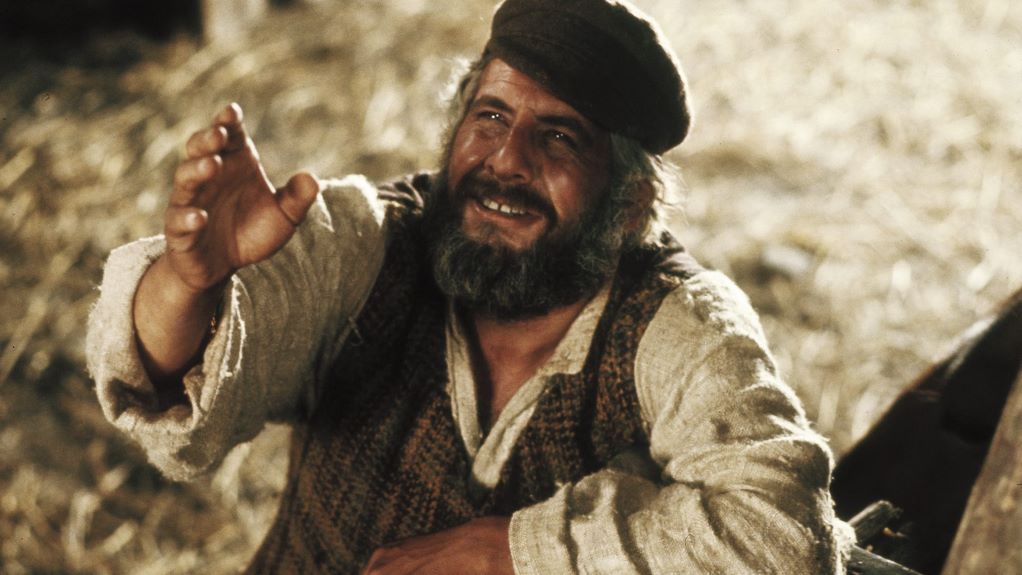
It was a masterstroke (much as it crushed Mostel and outraged fans). Topol, like Yul Brynner in The King and I, would define his career with the role, playing it over 3000 times on stage in a series of productions over almost forty years (eventually Harris would graduate from playing his daughter to his wife!). Astonishingly he was only 35 in 1971 – a brilliant combination of make-up and Topol’s gift for physical acting makes him feel 25 years older – and Fiddler, for a large part, relies on his charisma and charm. Topol is as comfortable with the conversational address to the camera – which dominates much of the film’s opening – as he is with the world-weary sadness and frustrated anger Tevye responds to the changing world around him with.

Topol’s performance works in perfect tandem with Jewison’s aim to ground and avoid flights of whimsy or vaudeville comedy. The harsh conditions don’t dampen the warmth in the community – wonderfully captured in the marvel that greets the arrival of tailor Mostel’s (an endearing, Oscar-nominated, Leonard Frey) sewing machine – and means the Tsarist repression and gangs of Cossacks who ride in, torches in hand, to burn and pillage carry real impact.

Jewison’s film carries foreknowledge of the Holocaust throughout, not dodging the knowledge that communities like this would be destroyed under Nazism. The film’s closing exodus may bring hope for Tevye and family (bound for New York) but also brings death to those who speak of heading to Krakow. It’s part of understands why tradition is so important to Tevye: as the imaginary fiddler follows Tevye’s family on the road, we understand the link to a shared cultural past is what gives identity and hope to a people facing persecution at every turn for thousands of years.

Fiddler on the Roof mines it’s material for emotion and character over showbiz bells and whistles. While it undoubtedly takes too long to explore in depth its slight plot, its length does conversely add even more impact to its closing look to the future. A fine musical adaptation.

Othello (1952)

Othello (1952)

Welles distinctive Shakespeare epic is a masterpiece of turning the Bard into film

Director: Orson Welles

Cast: Orson Welles (Othello), Michéal Mac Liammóir (Iago), Robert Coote (Roderigo), Suzanne Cloultier (Desdemona), Hilton Edwards (Brabantio), Nicholas Bruce (Ludovico), Michael Laurence (Cassio), Fay Compton (Emilia)

In the early 1950s Orson Welles was in the wilderness. After the implosion of his career in Hollywood, he was grifting a living in Europe, juggling multiple ventures and paying for things (or not) with cheques from quick film cameos. But the fire was still there. Welles wanted a project which he would have complete control over. Shakespeare was the ideal collaborator: both free and dead, here was a man who offered an ocean of ideas and not a word of criticism, who would make no demands he re-cut the picture. A marriage of convenience but it led to cinematic triumph.

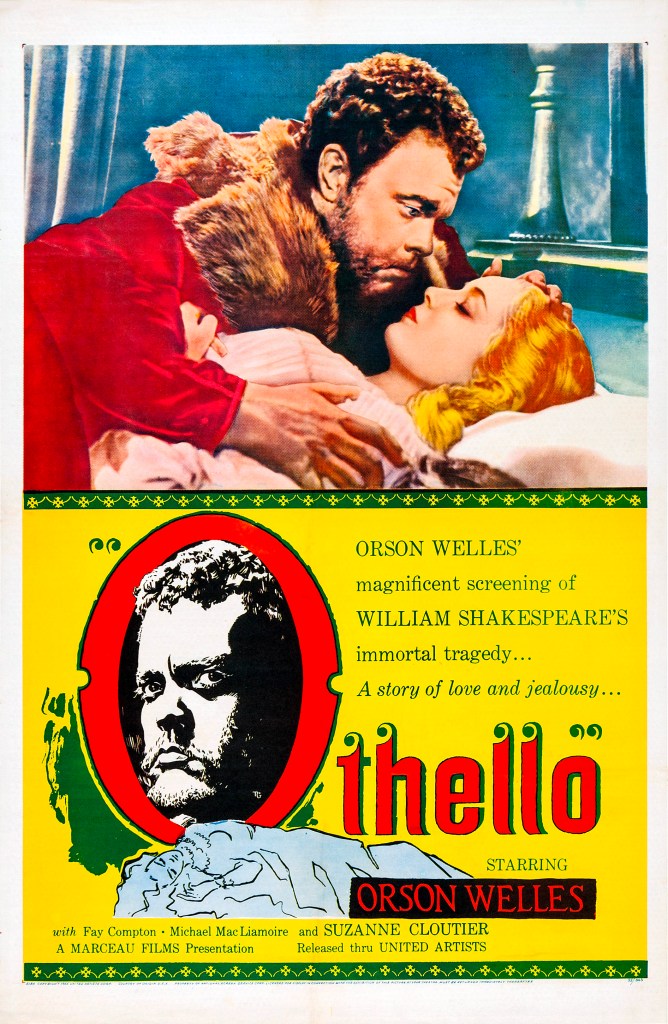
Othello would be an Welles production from top-to-bottom. Largely self-funded, a few investors chucked in liras for a share of profits (you can imagine Welles as Shakespeare in Love’s Fennyman grinning that was fine because “there never are any”) it became a labour of love over years. Welles begged, borrowed and flat-out stole film stock and camera equipment from assorted productions, kept costumes from for-the-money roles he did to keep the operation flowing (famously his Othello coat was a costume which he’d requested a fur-lining added to, that went unseen in the film it was made for but came rolling out in Othello). Actors were summoned, sometimes months apart, to shoot. Scenes would start filming in one location and finish filming months later somewhere completely different. Welles sat in the middle holding the entire film in his head.

It’s extraordinary that Othello is even coherent. The fact that it’s also a masterpiece of film Shakespeare is a miracle. But, cut loose from the bonds of Hollywood studio execs and not giving a damn about the bills (he had the cheek of genius so never picked up a tab) allowed Welles the scope to experiment and do things “his way”. Othello is the most purely “Welles film” since Citizen Kane, and a tour-de-force of cinematic inventiveness with poverty and lack of resources drawing the best out of a director who marshalled all his gifts of editing and lighting to make resourceful use of limited resources. It’s guerrilla film-making that looks like an epic.

What you could argue Othello is not is a truly original look at Shakespeare’s play – or really an actor’s piece. Welles’ passions for Shakespeare always felt as much about having a grand canvas of poetic language to impose his own vision on, cutting and changing as needed. Thematically, Othello is pretty much what you would expect. Welles’ Othello is the noble Moor pushed into a spiral of jealousy. Michéal Mac Liammóir’s (the finest performance) Iago is a dastardly liar, with faint hints of sexually motived envy. Desdemona is as pure as the driven snow, Emilia a faithful servant, Rodrigo a simpering idiot, Cassio a pretty boy. Our sympathies lie firmly where Shakespeare would expect.

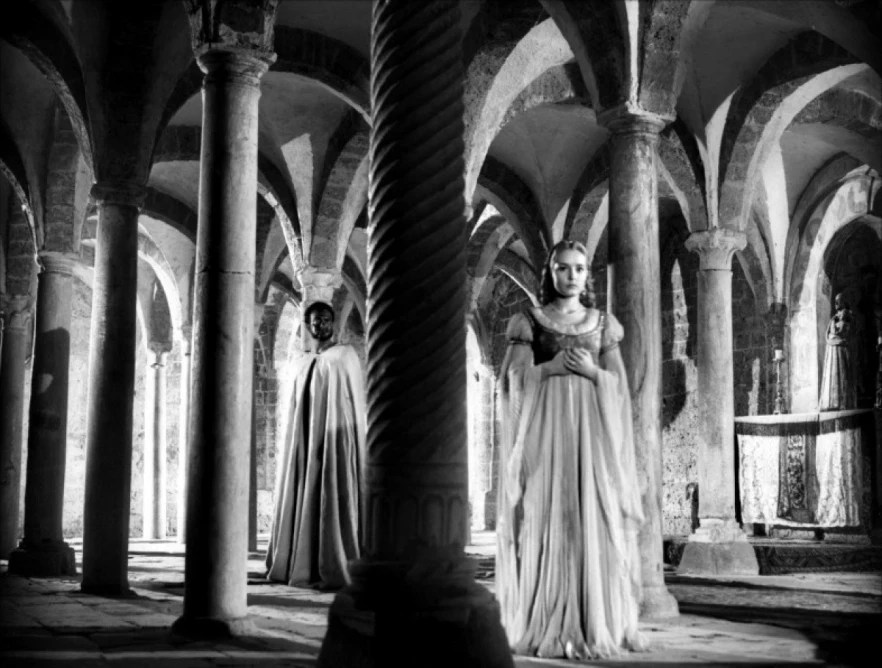
Everything that is unique about the film lies in its telling. Othello is a breath-takingly beautiful film, which uses its locations to astonishing effect. Column lined castle rooms and towering walls create caverns of light and shadow. Welles uses the fixed points of columns to add a dizzying level of speed to camera movements that see these columns whip past the frame. The shadows of grills are frequently cast across faces and light creates looming shadows across the floor. Welles plays into this with the creation of light pools, concentrating it on single fixed points, often faces, with the surroundings bathed in black. The film presents real locations in defiantly expressionistic ways, giving each of them an elemental power that heightens the tragedy.

It’s a film made up of stunning set-pieces. It’s opening funeral cortege – like Citizen Kane, Othello starts at the end with Othello and Desdemona dead and Iago in chains – follows a march over city walls, playing out in striking shadow against the brightness of the sun, with booming, Gothic music giving the sequence an imposing sense of inevitability. Iago is paraded by a mob and placed in a cage, lifted above the city wall (this same cage frequently appears throughout the movie – including, once, having Iago walk nonchalantly under it – as a grim reminder of where this is heading). It’s a perfect marriage of sound and music, disguising the small scale with cinematic force.

Taking advantage of limitations time-and-again makes Othello great. Another striking sequence was born from necessity. With most of the costumes impounded for non-payment of shipping bills, the attempted murder of Cassio is re-staged in a Turkish bath (who needs costumes when we have towels!) a decision that turns the sequence into a masterpiece of light through steam, increased by the frenetic energy Welles shoots the sequence with culminating in its Lang-inspired super-imposing as Iago thrusts his sword down into the floorboards to dispatch Rodrigo.

Othello is frequently filled with imaginative camera angles. Often characters observe others from great heights – twice through sky lights, starring down at conflicts, murders and suicides. Iago and Rodrigo spy on Othello’s gondola romance with Desdemona from a distant bridge. The ramparts of Cyprus provide towering angles, over soldiers or wave-crashed rocks below. The camera also takes a number of low-angle positions, making characters (often Othello) tower over us. Clever angles and perspective work create whole ships out of sheets of fabric and basic models.

It’s also a triumph of editing. Welles assembled the film from a never-ending supply of fragments. Frequently actors appear with their backs to the camera while we hear them speak – as Welles said, a sure sign the actual actor wasn’t there. Like few other films, Othello feels like a film excavated from its shooting. It’s a film almost constantly in motion, rarely stopping to focus on an actor delivering a line (Othello’s first speech, parts of Iago’s speeches and Emilia’s speech to Desdemona being the main moments the film focuses on actor’s delivery – no doubt connected to those three actors being the ones Welles trusted).

Away from that, the camera often fast cuts and delivers scenes in motion, with actors speaking off camera as we focus on the events around them. This means the dialogue is repeatedly chopped, changed and trimmed to meet the needs of the scene. It helps make the film even more pacey and frighteningly interior – conversations become snatched and fast, words flung from angles we cannot see, ramping up the paranoia. Large chunks of it is redubbed by Welles himself – a light version of his distinctive tones clearly emerges from Robert Coote’s mouth and Michael Laurence’s Cassio has a familiar cadence. In some cuts, Welles also replaced Suzanne Cloultier’s voice with Gudron Ure (with whom he played the role on stage).

If there is a major flaw in Othello it’s probably the acting, frequently looking under rehearsed, with Welles himself a leading culprit. His Othello is underpowered and feels under-defined. There is little sense of an interior to his mind and Welles’ surprisingly somnolent delivery tends to crush much of the emotion. It’s hard not to think Welles was so focused on juggling every other factor, that he compromised on his acting. Only Mac Liammóir, Compton and Edwards look truly comfortable with their roles – and even they offer traditional readings.

But Othello is about turning Shakespeare to cinema and if Shakespeare himself is slightly sacrificed in the push, it doesn’t detract from the stunning theatrical beauty we get instead. Othello becomes a lean, pacey thriller, crammed with stunning imagery and imaginative flourishes (Rodrigo’s faithful dog, following sadly after his master, is a gorgeously little playful touch). It’s a film where light and shadow are major plays, where footsteps in subterranean water pools create ripples of motion and echoes of noise, that shows the greatness that can be born from necessity. It’s one of the greatest Shakespeare films.

The King and I (1956)

The King and I (1956)

Deliberately artificial adaptation, powered by star performers and sumptuous set-design

Director: Walter Lang

Cast: Deborah Kerr (Anna Leonowens), Yul Brynner (King Mongkut), Rita Moreno (Tuptim), Terry Saunders (Lady Thiang), Martin Benson (Kralahome), Rex Thompson (Louis Leonowens), Patrick Adiarte (Prince Chulalongkom), Carlos Rivas (Lun Tha), Alan Mowbray (Sir John Hay), Geoffrey Toone (Sir Edward Ramsey)

In its glistening, stagy exactness The King and I is the most traditional adaptation of Rodger and Hammerstein to hit the screen. A (questionably accurate) memoir by Anna Leonowens (Deborah Kerr) about her experiences as a tutor to the children of King Mongkut of Siam (Yul Brynner) in the 1860s, was repackaged by the musical hit-machine duo into a charming culture clash, with a garland of unspoken romance across the top. Anna wants to help the king improve and develop his kingdom – but also clashes with his ideas about his antiquated ideas and (above all) his treatment of concubine Tuptim (Rita Moreno), who is in love with servant Lun Tha (Carlos Rivas). Can the King and Anna reach an understanding?

The King and I is one of the grandest, most artificial looking films you will see. No attempt has been made by anyone to even pretend we are not watching events play out on a series of massive, elaborately decorated soundstages. It all looks gorgeous of course, brightly coloured sets filling the frame. Even the scenes ‘outside’ – on Anna’s ship or the palace grounds – drip with ostentatious artificiality.

This impression is only increased by the mediocre direction of Walter Lang. A reliable studio B-movie hack, Lang sets the camera up in the equivalent of the front row of the stalls. While he can frame a scene efficiently (his centring in the final shot of the king’s hand is neatly done), Lang provides no originality, flair or real visual interest, all that supplied solely by the sets. He either misses beats or misunderstands jokes (the accidental flashing of the English ambassador is crying out for a beat of titillation from the old guy). It’s quintessential widescreen hackwork of the 50s, where the focus is on wowing the people with the money, bright colours and massive sets they couldn’t get from the little box in the corner. On that basis, a director who sets the camera up to get as much of that seen as possible all the time, fits the bill.

Besides, the film’s two most distinctive features didn’t really rely on Lang anyway. The King and I’s grand Thai-style ballet based on Uncle Tom’s Cabin was visualised and choreographed by Jerome Robbins (with Lang setting the camera stationary in mid-shot to capture it all). This ballet is, by the way, a masterclass of expressive visual originality (with its swirling use of masks, sheets and banners) that sticks out like a sore thumb in a film as visually flat as this one.

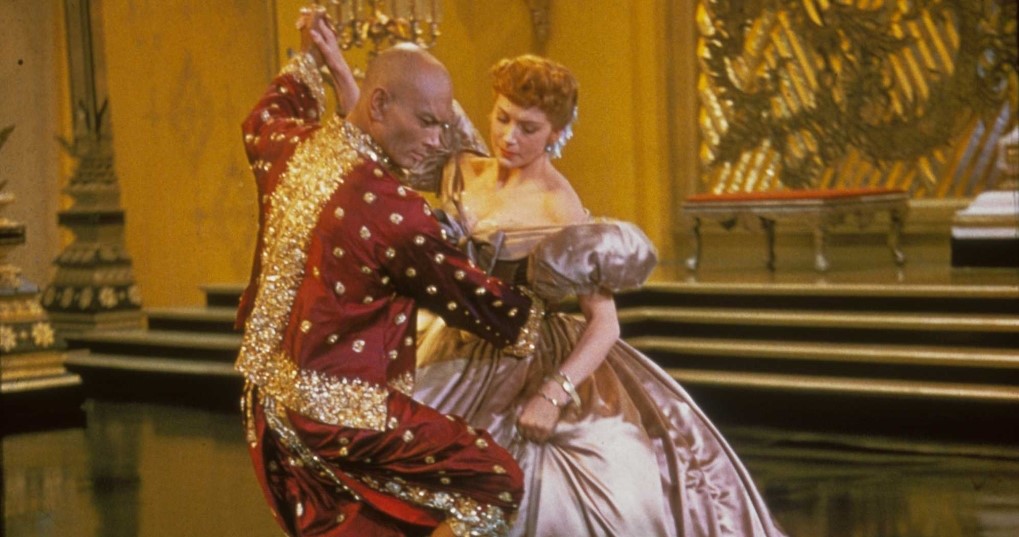
The other was of course Yul Brynner’s star-turn as the King. Brynner’s performance of the role on Broadway had transformed his career and years of honing it on stage meant he was the master of every beat of its eccentric energy. Brynner is magnificent, bombastic, proud, grand but also subtly playful, surprisingly timid and strangely shy. Brynner’s performance with its theatrical touches (the striking pose and the “et ceteras”) could be seen as overplaying, but actually fits perfectly with a man constantly, deliberately, putting on a show.

Brynner really shows the more thoughtful, quiet man under the surface, worried about his kingdom’s future. The earnest autodidact, who lies on the floor reading books. The eager-to-impress man who swots up on topics of conversation to impress the English ambassadors and hands a prompt sheet to Anna to work them into conversation. The careful flirt who only allows flashes of his romantic interest in Anna show. It’s a clever, grand but very human performance. Brynner had wanted to direct (and, rumour has it, partially did so) but settled for a Best Actor Oscar instead.

He also sparks extremely well off Deborah Kerr, buried under some truly might dresses (so heavy, that Kerr allegedly lost twelve pounds over the course of filming). Kerr turns a potentially stodgy part into a woman who is independent but not judgemental, forward-looking but diplomatic and very careful about allowing any expression for romantic feelings. Although her singing is dubbed by Marnie Nixon, it’s Kerr’s engaging sprightliness that carries a lot of the drama. She and Brynner’s chemistry also ensures the scenes between the two of them are by far the film’s highlights.

Most of the faults of The King and I can be traced to the musical itself. There isn’t much in the way of plot. The quiet will-they-won’t-they bond between Anna and the King is partly because that’s the nature of these things, but partly because the musical doesn’t really give them much material to work with. Virtually every character other than these two feels like either a sketch, a plot function or a stereotype, with the actors given almost nothing to work with. Impressive as the ballet is, it essentially takes up almost 15 minutes of screentime without advancing the plot or the themes of the film at all. Thematically the film explores very little, either on social progress in Siam or its place in the world. The film rushes towards a conclusion that feels like it comes out of the blue.

But then people aren’t watching The King and I for its social commentary or thematic depth. They are watching it for some hit songs, impressive production values and charismatic performers. You certainly get that and if the overall shape of the film feels rather loosely plotted and doesn’t go anywhere, that’s neither here or there. And of course, it’s a triumph for Brynner (who, late in life, dedicated his final years to performing the role, racking up over 4,600 performances), whose confidence and star-quality carries thing. Pretty, fun, not deep but pleasant – but then that’s Rodgers and Hammerstein for you and if that’s for you, this is the film for you.

Richard III (1955)

Richard III (1955)

Olivier stamps his claim to Shakespeare’s greatest villain in this gorgeous theatrical epic

Director: Laurence Olivier

Cast: Laurence Olivier (Richard III), Cedric Hardwicke (Edward IV), John Gielgud (Clarence), Ralph Richardson (Buckingham), Claire Bloom (Lady Anne), Helen Haye (Duchess of York), Pamela Brown (Mistress Shore), Alec Clunes (Lord Hastings), Laurence Naismith (Lord Stanley), Norman Wooland (Catesby), Clive Morton (Lord Rivers), Douglas Wilmer (Dorset), Stanley Baker (Richmond), Mary Kerridge (Queen Elizabeth), Esmond Knight (Ratcliffe), John Laurie (Lovell), Patrick Troughton (Sir James Tyrell), Michael Gough (Murderer)

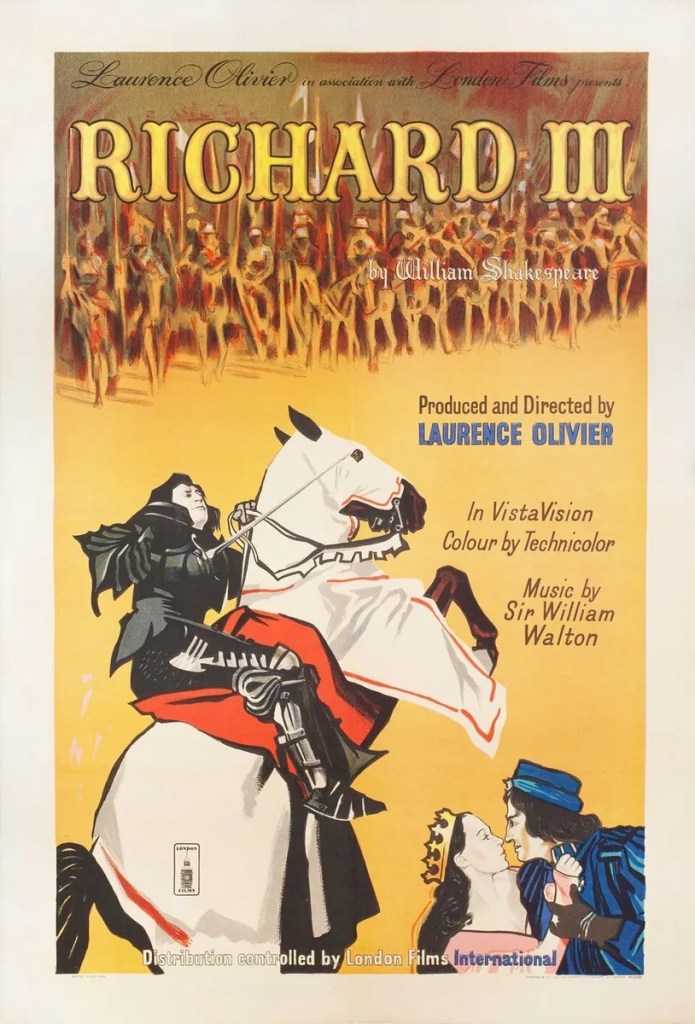
Olivier had played the greatest Shakespeare hero in Henry V and made Hamlet the most romantic princes of film. Having scaled those heights, did he also want to set the benchmark for Shakespearean villainy? Perhaps, with his vaulting ambition and competitiveness, he knew his clipped, precise tones and physical suppleness was perhaps best suited to playing the villain. What better role to prove it than the “poisonous, bunch-backed toad” himself, Richard III. Olivier bought to the screen a performance that would be as influential as his Hamlet (perhaps even more so), an embodiment of the role that all future Richards would be compared to.

I like to think of Richard IIII as a twisted inversion of Henry V. Like that film, the action is shot in lusciously beautiful technicolour, with beautiful costumes and a marvellously stirring, magnetic score by William Walton. It has courtly intrigues, a charismatic lead, the seduction of a young princess, many of the same actors and caps itself in a bravura battle shot on location. The only difference being that, instead of “the mirror of all Christian kings”, our lead is a twisted, remorseless killer who acts as his own Chorus to bring us on-side with his Machiavellian schemes. (There is a fun little opening message, stressing that this is a legend not the truth, that almost feels like an apology in advance to the Ricardian societies of today).

Olivier’s performance is the heart and soul of this film, and it’s possibly his finest cinematic (and certainly his finest screen Shakespeare) role. This Richard is openly – almost proudly – cruel and hypocritical, sociopathic in his amoral ease with the death and slaughter of his nearest and dearest (including his beloved wife, brother and nephews to whom he is sweetness and charm), overwhelmingly impressed with his own cunning and eagerly inviting us to share in his villainy. Olivier practically caresses the camera in his readiness to get close to us, forever turning towards it with a smile, quick aside or delighted breakdown of schemes to come. Olivier inverts his matinee idol looks into a stooped smugness (his costume, with its dangling sleeves, frequently makes him look like a spider) and his clipped vocal precision is dialled up to stress his heartless self-confidence.

Stare into Richard’s eyes and all we see is an uncaring blankness, the chill of a man who cares for nobody except himself. His sigil maybe a boar, but he resembles a wolf, devouring the Lords around him. Much of the first two thirds sees him keep a steady illusion of outward good fellowship. He comforts Gielgud’s Clarence with genuine care, greets Hastings like an old friend, is mortified and hurt by the suspicions cast on him by the Queen and her family, smiles with affection at his cousins. It means the moments where Olivier lets the mask slip even more shocking: the matter-of-fact abruptness he urges murderers not to take pity on Clarence, the whipped glare of pure loathing he shoots at the princes after an ill-advised joke about his hunched back or the imperious hand he shoots at Buckingham to kiss after being acclaimed by the crowds, harshly establishing the hierarchical nature of their ‘friendship’.

While the charisma of course is natural to a performer as magnetically assuring as Olivier – and this Richard is truly, outrageously, wicked in his charm – he also nails the moments of weakness. Having achieved the crown, Olivier allows not a moment of enjoyment of his feat, but his brow furrows into barely suppressed concern and anxiety that he may be removed by schemes exactly like his own. The threat of armies marching on him sees him first lose his temper publicly and then leap to cradle the throne in his arms like a possessive child. The morning of Bosworth, he even seems quietly shocked at the very idea that he could feel fear.

Richard III, despite its length, makes substantial cuts to the original play, including throwing in elements from Henry VI. Several characters – most notably Queen Margaret, whose major confrontation scene with Richard is lost altogether – are cut or removed all together. Olivier reshuffles the order of events, most notably shifting the arrest of Clarence to split up the seduction of Lady Anne. Richard’s late speech of remorse before the battle of Bosworth hits the cutting-room floor (Olivier’s Richard never seems like a man even remotely capable of being sorry for his deeds). Several small additions from the 18th century by Colley Cibber and David Garrick are kept in (most noticeably his whisper to his horse on the eve of battle that “Richard’s himself again”).

The film is deliberately shot with a sense of theatrical realism to it, Olivier favouring long takes so as to showcase the Shakespearean ease of the cast (much was made of the cast containing all four of the Great Theatrical Knights of the time in Olivier, Richardson, Gielgud and Hardwicke). The camera frequently roams and moves, most strikingly during the film’s first monologue from Olivier, where it flows from the coronation retinue outside the throne room, through a door, to find Richard himself waiting for us in the hall. It’s set is similarly theatrical, a sprawling interconnected building (with some very obvious painted backdrops) where the Palace of Westminster, the Tower of London and Westminster Abbey seem to be one massively interconnected building.

The film makes superb use of shadows, the camera frequently panning from our characters (especially Richard) to see their shadows stretch across floors and up walls. The claustrophobia of the interconnected set also helps here, making events seem incredibly telescoped (it feels like the film takes place in just a few days at most). It makes the court feel like a nightmare world completely under the control of Richard, who knows every corner to turn and can seemingly be in several different places at once. In that sense, filming Bosworth outside on location in Spain seems like a neat metaphor for Richard’s lack of control of events: suddenly he’s in a sprawling open field, where it’s possible to get lost and it takes genuine time to get from A to B.

Olivier may dominate the film with a performance of stunningly charismatic vileness, but he has assembled a superb cast. Ralph Richardson is superb as a supple, sly Buckingham, a medieval spin doctor whose ambitious amorality only goes so far. While I find Gielgud’s delivery of Clarence’s dream speech a little too poetic, there are strong performances from reliable players like Laurence Naismith’s uncomfortable Stanley and Norman Wooland’s arrogant Catesby while Stanley Baker makes a highly effective debut as a matinee idol Richmond. Claire Bloom superbly plays both Lady Anne’s fragility but also a dark sexual attraction she barely understands for this monster. Perhaps most striking though is Pamela Brown’s wordless performance as Mistress Shore (mistress first to Edward IV then Hastings), a character referred to in the play but here turned into a sultry, seductive figure who moves as easily (and untraceably) around the locations as Richard does.

Fittingly for a film obsessed with the quest for power, we return again and again to the image of the crown. It fills the first real shot of the film, bookmarking its beginning and end and frequently returns to fill the frame at key moments. With the films gorgeous cinematography, it’s a tour-de-force for its director-star and a strikingly influential landmark in ‘traditional’ Shakespeare film-making.

Agnes of God (1985)

Agnes of God (1985)

A chamber piece play is expanded into something less enigmatic or satisfying

Director: Norman Jewison

Cast: Jane Fonda (Dr Martha Livingston), Anne Bancroft (Mother Miriam Ruth), Meg Tilly (Sister Agnes Devereaux), Anne Pitoniak (Mrs Livingston), Winston Rekert (Detective Langevin), Guy Hoffman (Justice Joseph Leveau)

In a Montreal convent a naïve, other-worldly young novice, Sister Agnes Devereaux (Meg Tilly), has given bloody birth to a baby, that now lies strangled in a waste paper bin. The courts must decide if Sister Agnes is fit and capable of standing trial. That decision will be based on the recommendation of hard-smoking psychiatrist and atheist Dr Martha Livingston (Jane Fonda). Spending time with the devout young woman, Dr Livingston finds herself drawn to her and determined to discover why this girl who knows nothing of sex became pregnant. But she also butts heads with Mother Miriam (Anne Bancroft), the stern head of the convent, equally determined to protect Sister Agnes.

Jewison’s film – adapted by original playwright John Pielmeier – is a not entirely successful transfer of a three-hander chamber piece into cinema. The play, at its best as a series of monologues and duologues, deliberately left events open to interpretation: we have only their words and recollections to base conclusions on, all within an increasingly claustrophobic single-room set. Much of that pressure is lost in this film version, exposing instead the play’s flaws.

The “opening out” of the play focuses on introducing new characters and scenes. Unfortunately, these tend to stick out like sore thumbs. They invariably involve Dr Livingston talking to thinly sketched characters outside of the convent, who deliver stilted and dull dialogue that feels like clumsy padding. Members of the Canadian court take her on and off the case. A priest suggests she has an anti-Church bias. A brief visit to her Alzheimer’s suffering mother. A detective boyfriend passes her the odd file. All of these encounters feel exactly like what they are: scenes introduced solely so that we can see people other than the three principals.

They contrast greatly with the weightier and more engaging scenes between the three women, the meat of which is carried across from the stage play. Played with a high-pitched, breathless naivety by Meg Tilly (Oscar-nominated), Agnes is almost child-like in her interpretation of what the Lord demands of her and seems barely capable of understanding the adult world she finds herself in. She is enthralled by the ringing of bells and the sound of birds. She wants to make herself the perfect image of what she believes God wants.

It demands every inch of Dr Livingston’s professional expertise and ability to draw confidences and make psychological leaps to begin to understand this godly young woman’s psyche. Fonda is very good in a part that demands hard work with none of the flashy histrionics the other two roles have. Fonda makes Livingston a consummate professional, with a touch (not least in her constant parade of cigarettes) of the maverick to her, someone who never takes no for an answer and constantly drills deeper and deeper.

In many ways this makes her a kindred spirit for Anne Bancroft’s (also Oscar-nominated) Mother Miriam. Late to her calling, Bancroft brilliantly embraces a big, chewy part as a seemingly stern, slightly exasperated stereotypical head nun who reveals reservoirs of humanity and a strong sense of duty of care for her charges. It’s a standard twist on the grouchy older character who hides an affectionate smile, but Bancroft performs it with gusto and cements her clashes with Livingston in genuine resentment at the doctor’s initially glib assumptions about life in the convent.

The debates and confrontations between Miriam and Martha – and their attempts to both protect and draw truths from Sister Agnes – are the dramatic meat of the film and by far its most engaging moments. The problem is, the film’s attempt to expand these points with flashbacks and the grim reality of the camera undermines the suggestiveness of the original play,.

Like Equus – which demonstrated how real horses and a graphic horse-blinding scene can make a thoughtful play crude and clumsy on filmAgnes of God falls back into a POV flashback of choral singing, flying doves and undefined shadows to try and picture how Sister Agnes became pregnant. The implication seems clear that this was therefore something supernatural in this. (The film’s unsubtle love of stigmata blood smeared on various white clothes and walls hammer this home further.) What on earth does the film want us to take from that?

Especially as it ends with a confused up-beat ending, with an idyllic looking Sister Agnes (very different from the play’s bleak final monologue for Dr Livingston). If, as Sister Agnes (and maybe a part of Mother Miriam) believes, this child was conceived by God, what on earth does the film want us to make of Sister Agnes murdering (presumably) the second coming? When Sister Agnes, under hypnosis, rants and raves about her hatred for God, is she talking literally – or are we meant to think it is because the Lord has let a bad thing happen to her?

It ends up feeling incredibly unsatisfying, raising questions around faith and divinity, but pointedly running away from them and any implications they might raise. A braver film would have either kept the original’s inscrutability, or it would have dived into a truly critical look at religion and a world where God (at the very least) allows suffering. Agnes of God does neither. Despite good performances, it substitutes unsubtle bluntness for suggestion and insinuation.

The Whale (2022)

The Whale (2022)

Manipulative and sentimental, Aronofsky’s tear-jerker is dishonest and disingenuous

Director: Darren Aronofsky

Cast: Brendan Fraser (Charlie), Sadie Sink (Ellie Sarsfield), Hong Chau (Liz), Ty Simpkins (Thomas), Samantha Morton (Mary), Sathya Sridharan (Dan)

The Whale is the sort of film that is either going to bring you out in tears or hives. Me? Let’s just say I felt incredibly itchy as I sat through this naïve, sentimental and manipulative film. I hated its dishonesty and its disingenuousness. The only thing I felt move was my stomach.

Charlie (Brendan Fraser) is a morbidly obese, reclusive English professor who teaches online courses with the camera turned off. Nursed by Liz (Hong Chau), the sister of his deceased partner, Charlie has never processed his depression and guilt at his partner’s suicide. Now, facing death from congestive heart failure, his last wish is to finally bond with his daughter Ellie (Sadie Sink) whom he has not seen in the eight years since he left her and her mother (Samantha Morton). Ellie is now an angry, high-school drop-out teenager. But Charlie is sure he can see the good in her.

So much has been made about the morbid obesity of the film’s lead. The prosthetics coating Fraser in layers of fat are impressive. An opening montage shows Charlie struggling to move around the house. Picking something up off the floor is impossible and he has to lever himself out of the bed or into the shower. But the film is hugely pleased with itself that it dares to see a fat person as “one of us”. Aronofsky initially films him like a freak show monster – already patting himself on the back about how “humanising” it will be when we learn that obese people are just as capable of being at the heart of maudlin, self-pitying films as thin ones.

The Whale is adapted from a stage play. Not only does it really feel like it (it’s all set within Charlie’s apartment, with characters announcing their arrival in a neat four-act structure), it also sounds like it. The dialogue is forced, artificial and clumsy, making on-the-nose emotional points. Characters feel like narrative constructs. Sadie Sink’s Ellie is the sort of precocious-but-angry tear-away genius brat you never find in real life. Ty Simpkins’ hipster-turned-missionary is more a collection of quirks than a person. The script leans heavily on clumsy metaphors – a walk on the beach, bible quotes, Ellie’s childhood essay on Moby Dick – milked for all they are worth.

Worst of all, a film that prides itself on being about the power of honesty feels like a big, walloping lie. It lies about its characters and it lies about the real issues that drive them. Firstly, it never once touches on issues of mental health and addiction that have led Charlie to this state. Sure, we get a scene of him compulsively eating. But Liz, his “caring” nurse, brings him medicine and huge piles of food (a massive bucket of fried chicken, enormous sub sandwiches…). It’s like caring for an alcoholic by bringing him chicken soup and a huge bottle of whisky. How is this helping someone recognise and deal with an addiction? Which is what this level of over-eating is.

Worst of all the film treats this as a “charming friendship between two eccentrics”. It eventually touches on the fact they are both hurting from the suicide of Charlie’s partner Alan. But never once is the film brave enough to link their behaviour now to this act. Charlie failed to get Alan help, keeping him away from the world and others, believing that the isolated love of a single person would solve his depression. Liz repeats the same mistakes. She isolates Charlie, encourages him to eat, never challenges him to seek help or process his grief, and creates a safe environment for him to destroy himself. If he was a drug addict, what would we say about a carer who draws the curtains and encourages him to shoot up? We’d be calling her the villain of the piece.

That’s before we even dive into the film’s lack of honesty about Charlie. It’s sad to think of a character being so depressed he’s eaten himself to death. That’s awful – even if the film never wants to reflect on the emotional and psychological reasons for this (because that would be depressing in a film as desperate to be upbeat as this one). But by showing us Charlie at the end, full of regret and self-pity, the film white-washes his mistakes and selfishness. There are clear flaws in Charlie that contributed to this state – however much the film wants to present it as a terrible accident.

Charlie abandoned his family and made no contact with his daughter for years (he complains it was too difficult and tries to blame her mother), leaving her traumatised. The film loves its sentimental device of Charlie reading to himself Ellie’s childhood essay (which he knows by heart). But this is, basically, a selfish fantasy: an idea for Charlie to cling to that he was a good Dad and Ellie a kid with a future, radically different from the actual reality. Just like he never addresses why guilt and depression drove him to destroy himself, so he refuses to deal with the issues Ellie is facing now by simply not acknowledging that she has changed from his idealised version of her as the sweet, sensitive girl who knew Moby Dick was really about Melville’s unhappiness.

Instead, the film suggests her mother is the one who really failed. Charlie – who has spent about an hour in her company in eight years – would have donebetter. Just like Liz passing him chicken buckets, Charlie’s solution to solving his daughter’s problems is to smother her with love rather than get her to ask herself why she does and says the cruel things she does. How can the film not see he is repeating the same ghastly cycle again, encouraging a depressed, vulnerable person to stick her head in the sand and hope for the best? Well, he’s wrong. And the fact that the film doesn’t see this means it’s lying to itself as much as he is.

By the end you’ll be stuffed by sentiment, greased by the insistent score. Every single frame is like being walloped over the head while Aronofsky shouts “cry damn you”. The dreadful script is well acted, even if no-one ever makes these device-like characters feel like real people (except maybe Morton). Fraser is committed, a lovely chap and I’m very pleased he’s having “a moment”. But this is a simplistic character, that requires little of him other than to wear a fat suit and cry. He never once really delves into any complexity. It’s also true of Hong Chau, a collection of quirk and tears.

The Whale is a dreadful film, manipulative, artificial and full of naïve and dishonest emotions that avoids dealing with any complex or meaningful issues. Instead, it thinks it’s achieved something by making you see a fat person as a real person. There is almost nothing I can recommend about it.

Funny Girl (1968)

Funny Girl (1968)

A star-turn is the main interest in this grand-scale but so-so musical

Director: William Wyler

Cast: Barbra Streisand (Fanny Brice), Omar Sharif (Nicky Arnstein), Kay Medford (Rose Brice), Anne Francis (Georgia James), Walter Pidgeon (Florenz Ziegfeld), Lee Allen (Eddie Ryan), Mae Questel (Mrs Strakosh), Gerald Mohr (Branca), Frank Faylen (Keeney)

Fanny Brice was the major pre-war star of Broadway, the leading lights of the Ziegfeld Follies, the sort of all-singing, all-dancing spectaculars they just don’t make any more. A fictionalised version of her life became a Broadway smash, produced by her son-in-law Ray Stark. Hollywood came knocking, leading to this film version. Shepherded to the screen by William Wyler (his first ever musical, a genre he’s avoided due to being deaf in one ear) it would tell of Brice’s early success, her relationship with Ziegfeld (Walter Pidgeon) and her marriage to dodgy gambler Nicky Arnstein (Omar Sharif). And to play Brice? It could only be the woman who created the role, a young sensation called Barbra Streisand.

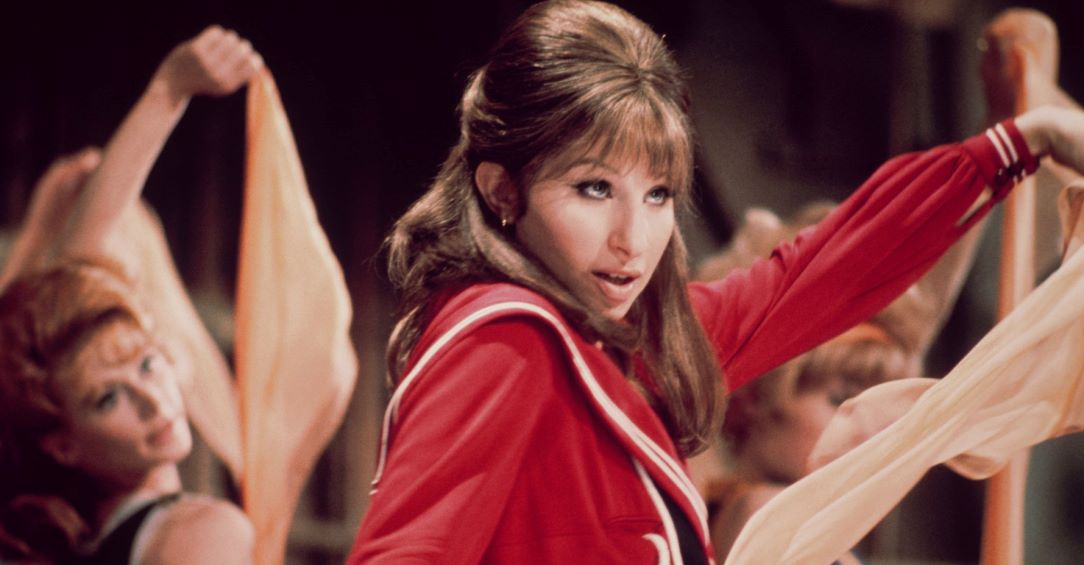
Funny Girl begins, ends and is exclusively about Barbra Streisand. Making her film debut, Streisand is, not to put too fine a point on it, absolutely sensational. This is charismatic, star-making stuff from an actress who knew exactly how to tailor the part (already basically written for her) to her strengths. Streisand is funny, kooky, witty but also vulnerable, shy, preoccupied with her low-opinion on her looks. She totally convinces as a charismatic figure who can dominate the room with cheek, won’t think twice at bluffing she can roller-skate to land a role or pigeon-hole Zeigfeld and argue against being asked to do something in performance. But she equally easily embodies a vulnerable woman, worried she is an unlovable ugly duckling, so certain she is destined to be alone she zeroes in on the first man who shows interest in her.

That’s not even mentioning the magnetism of Streisand. A truly confident, unique performer you couldn’t imagine anyone else so brilliantly mixing power-ballad notes with this sort of quirky character comedy. She can belt out Don’t Rain on My Parade or I’m the Greatest Stars with an awe-inspiring voice. She can add layers of pathos and tragedy to songs like People and Funny Girl. But few other performers could be both a diva and a pratfall artist on roller-stakes or mix arch-wit with low-comedy by stuffing a pillow up her dress in performance to turn her bride character pregnant in His Love Makes Me Beautiful, the Ziegfeld number she desperately doesn’t want to perform (because she can’t see herself as a beautiful bride).

Streisand is so central to Funny Girl’s success that I’m not sure that so much as three minutes go by without her appearing. It’s not a surprise as, subtract her from the mix, and Funny Girl is a fairly bland, unoriginal and at times slightly flat musical that struggles to do or say anything interesting. It’s had millions poured into its elaborate sets, it’s grandiose costumes and its vintage, sepia-tinged photography. But it’s an overlong, overblown, poorly paced film blessed with a star turn.

Wyler’s main strength as a director on mega-budget spectaculars like this was his professionalism and control, the gifts a producer likes. Visually though, Funny Girl frequently looks lost in widescreen, sets shot in a way that magnifies their emptiness and lacking the sort of affinity for timing and musicality that something like Minnelli, Donen and Kelly made look so natural (Most of the larger musical numbers were worked on by Herbert Ross). There is the odd strong shot – a showy helicopter shot pans down to Fanny on a tug steaming past the Statue of Liberty during Don’t Rain on my Parade or a sunset that pops up between the faces of Sharif and Streisand during a dockside embrace. But too many shots favour getting the money on the screen or struggle to frame two people interestingly in widescreen.

Mind you the story is a bit of a struggle. Fanny’s ascent to success is fast-paced and untroubled by conflict. Every gamble she takes pays-off, every cheeky trick goes unpunished. She can’t roller-skate when hired to do so? She sabotages the closing number of Ziegfeld’s show with her pregnancy flourish? Doesn’t matter – everyone loves it. She teeters for a few minutes on being fired, then jumps to promotion and glory. Ziegfeld – the sort of elite, New England aristocratic role perfect for Walter Pidgeon – just sighs and acknowledges talent gonna talent.

There are a few more clashes in her personal life. Her marriage to Nicky is the core emotional plotline of the film, but Nicky’s rough edges (in real life he was a conman and a swindler) are shaved off. Instead, he is played as a charming rogue, a professional gambler who bamboozles Fanny’s manager into giving her a stonking payrise and plays with honour and grace at the card table. When his business dealings go south, it’s never really his fault and he’s so noble he works to save Fanny’s honour by taking the rap for a collapsed business and arguing she should divorce him forthwith.

It doesn’t help that Nicky is played by Omar Sharif. Sharif, while a striking screen presence, had an acting range pretty much restricted to playing Sherif Ali. He’s unable to give the role any depth or interest, he can’t sing (thankfully he only tries once) and he’s overly reliant on his expressive eyes. He’s no match for Streisand, with whom he has less chemistry than rumour suggests was the case.

Streisand though was one-in-a-million here. Rumours abound she was a difficult and demanding presence, who fought tooth-and-nail with Wyler. She requested endless retakes to get her performance just right and “contributed” to script cuts (Anne Francis, playing a blousy Ziegfeld singer, was furious that her role effectively ended on the cutting room floor). Her perfectionism made her a controversial figure in Hollywood – but it’s also the brilliant fine-tuning of her own skill that won her the Oscar she shared with Katherine Hepburn. On a side note, Streisand had been controversially invited to join the Academy before she made a film, meaning the vote I assume she cast for herself was the one that guaranteed her the Oscar.

Funny Girl is large, overlong, largely visually and narratively uninteresting film that has a bright, shining, tour-de-force superstar in the lead who is in absolute, total control of her talent. Without Streisand it would be a tedious turkey – with her, it’s a strange landmark.

The Heiress (1949)

The Heiress (1949)

Is it love or is it avarice? Wyler’s sumptuous costume drama is a brilliant translation of Henry James to the screen

Director: William Wyler

Cast: Olivia de Havilland (Catherine Sloper), Montgomery Clift (Morris Townsend), Ralph Richardson (Dr Austin Sloper), Miriam Hopkins (Lavinia Penniman), Vanessa Brown (Maria), Betty Linley (Mrs Montgomery), Ray Collins (Jefferson Almond), Mona Freeman (Marian Almond), Selena Royle (Elizabeth Almond), Paul Lees (Arthur Townsend)

Pity poor Catherine Sloper (Olivia de Havilland). She’s seems destined forever to be the spinster, the last person anyone glances at during a party. Her father Dr Sloper (Ralph Richardson) can’t so much as walk into a room without gently telling how infinitely inferior she is to her mother. And when a man finally seems keen to court her, her father tells her that of course handsome Morris Townsend (Montgomery Clift) will only be interested in her inheritance. After all, there is nothing a young man could love in a forgettable, dull, second-rate woman like Catherine. He’s cruel, but is he right – is Morris a mercenary?

The Heiress was adapted from a play itself a version of Henry James’ Washington Square. It’s bought magnificently to the screen in a lush, sensational costume drama that comes closer than anyone else at capturing those uniquely Jamesian qualities of ambiguity and contradictory motives among the New American elites. Magnificently directed by William Wyler, it brilliantly turns a theatrical character piece into something that feels intensely cinematic, without once resorting to clumsy ‘opening up the play’ techniques. And it marshals brilliant performances at its heart.

Sumptuously costumed by Edith Head, whose costumes subtly change and develop along with its central character’s emotional state throughout the story, it’s largely set in a magnificently detailed Upper New York household, shot in deep focus perfection by Leo Tover, which soaks up both the reaction of every character and the rich, detailed perfection of decoration which may just be motivating some of the characters. Not that we can be sure about that, since the motives of Morris Townsend and his pursuit of Catherine remain cunningly unreadable: just as you convince yourself he’s genuine, he’ll show a flash of avarice – then he’ll seem so genuinely warm and loving, you’ll be sure he must be telling the truth or be the world’s greatest liar.

Catherine certainly wants it to be true – and believes it with a passion. The project was also a passion piece for de Havilland, and this is an extraordinary, Oscar-winning performance that delves deeply into the psyche of someone who has been (inadvertently perhaps) humiliated and belittled all her life and eventually reacts in ways you could not predict. Catherine is clumsy, naïve and lacking in any finesse. With her light, breathless voice and inability to find the right words, she’s a doormat for anyone. She even offers to carry the fishmonger’s wares into the house for him. At social functions, her empty dance card is studiously checked and her only skill seems to be cross-stitch.

She is an eternal disappointment to her father, who meets her every action and utterance with a weary smile and a throwaway, unthinking comment that cuts her to the quick. Richardson, funnelling his eccentric energy into tight control and casual cruelty, is magnificent here. In some ways he might be one of the biggest monsters in the movies. This is a man who has grown so accustomed to weighing his daughter against his deceased wife (and finding her wanting) that the implications of the impact of this on his daughter never crosses his mind.

Catherine is never allowed to forget that she is a dumpy dullard and a complete inadequate compared to the perfection of her mother. Richardson’s eyes glaze over with undying devotion when remembering this perfection of a woman, and mementoes of her around the house or places she visited (even a Parisian café table later in the film) are treated as Holy Relics. In case we are in any doubts, his words when she tries on a dress for a cousin’s engagement party sum it up. It’s red, her mother’s colour, and looks rather good on her although he sighs “your mother was fair: she dominated the colour”. Like Rebecca this paragon can never be lived up to.

So, it’s a life-changing event when handsome Morris Townsend enters her life. There was criticism at the time that Clift may have been too nice and too handsome to play a (possible) scoundrel. Quite the opposite: Clift’s earnestness, handsomeness and charm are perfect for the role, while his relaxed modernism as an actor translates neatly in this period setting into what could-be arrogant self-entitlement. Nevertheless, his attention and flirtation with Catherine at a party is a blast from the blue for this woman, caught mumbling her words, dropping her bag and fiddling nervously with her dance card (pretending its fuller than of course it is).

Her father, who sees no value in her, assumes it is not his tedious child Morris has his eyes on, but the $30k a year she stands to inherit. And maybe he knows because these two men have tastes in common, Morris even commenting “we like the same things” while starring round a house he all too clearly can imagine himself living in – by implication, they also have dislikes in common. (And who does Sloper dislike more, in a way, than Catherine?) Morris protests his affections so vehemently (and Sloper lays out his case with such matter-of-fact bluntness) that we want to believe him, even while we think someone who makes himself so at home in Sloper’s absence (helping himself to brandy and cigars) can’t be as genuine as he wants us to think.

As does Catherine. Part of the brilliance of de Havilland’s performance is how her performance physically alters and her mentality changes as events buffet her. A woman who starts the film mousey and barely able to look at herself in the mirror, ends it firm-backed and cold-eyed, her voice changing from a light, embarrassed breathlessness into something hard, deep and sharp. De Havilland in fact swallows Richardson’s characteristics, Sloper’s precision and inflexibility becoming her core characteristics. The wide-eyed woman at the ball is a memory by the film’s conclusion, Catherine becoming tough but making her own choices. As she says to her father, she has lived all her life with a man who doesn’t love her. If she spends the rest of it with another, at least that will be her choice.

Wyler assembles this superbly, with careful camera placement helping to draw out some gorgeous performances from the three leads – not to forgetting Miriam Hopkins as a spinster aunt, who seems as infatuated with Morris as Catherine is. The film is shaped, at key moments, around the house’s dominant staircase. Catherine runs up it in glee at the film’s start with her new dress, later sits on it watching eagerly as Morris asks (disastrously) for her hand. Later again, she will trudge up it in defeated misery and will end the film ascending it with unreadable certainty.

The Heiress is a magnificent family drama, faultlessly acted by the cast under pitch-perfect direction, that captures something subtly unreadable. We can believe that motives change, grow and even alter over time – and maybe that someone can love somebody and their money at the same time (perhaps). But we also understand the trauma of constant emotional pain and the hardening a lifetime of disappointment can have. It’s the best James adaption you’ll ever see.