Category: Time travel films

Terminator 2: Judgment Day (1991)

Terminator 2: Judgment Day (1991)

Cameron’s action masterpiece, a film Arnie possibly owes his whole life too

Director: James Cameron

Cast: Arnold Schwarzenegger (T-800), Edward Furlong (John Connor), Linda Hamilton (Sarah Connor), Robert Patrick (T-1000), Joe Morton (Miles Bennett Dyson). Earl Boen (Dr Silberman), S Epatha Merkerson (Tarissa Dyson), Jenette Goldstein (Janelle Voight), Xander Berkeley (Todd Voight)
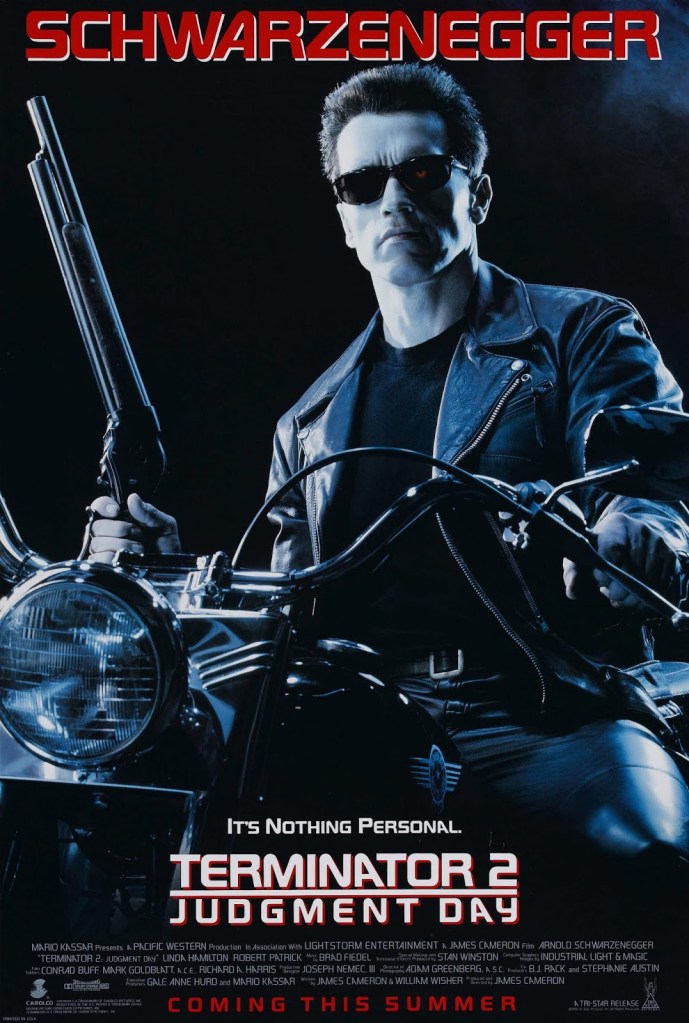
Schwarzenegger always said he’d be back. And if there’s one film that perhaps explains the, otherwise fairly inexplicable, success of this former body-builder who can’t really act as one of the greatest film stars of the early 1990s, it’s Terminator 2. And this film makes quite the calling card, as it can make a strong claim to being one of the greatest action films and one of the greatest science fiction films of all time. Its influence permeated Western culture – quotes from it are recognised all over the world – and its brilliant mixture of Armageddon-tinged high-brow time thinking with truck chases and lots of shooting has led to increasingly feeble attempts to recapture the magic with innumerable crappy sequels.

After the events of the first film, John Connor (Edward Furlong) is now a tearaway teenager while his mother Sarah (Linda Hamilton) is in an institution. So: perfect time for Skynet to send back another Terminator to take out the future leader of the resistance. The resistance sends back its own champion. But, handy-dandy, which is which? Is Arnie playing the baddie once more? Or is Robert Patrick’s unnaturally still non-descript looking fella really an evil Terminator? The answer is only a shock to anyone who has been living under a rock since 1991 (even the film’s original publicity gave the answer away). Soon Arnie’s reprogrammed good Terminator and the two Connors are on the run from Patrick’s liquid metal shape-shifter – and hatching a plan to prevent original Skynet inventor Miles Dyson (Joe Morton) from finishing his life’s work.

Terminator 2 hasn’t dated a bit. It’s still one of the very best rip-roaring, balls to the wall, action films ever made. It is essentially set piece after set piece – but with the set pieces strung together with intelligently written scenes that juggle interesting themes with sharply drawn, realistic characters. Cameron’s direction is, I might almost say, faultless. The film balances bangs and shoot-outs with such impressive zeal and imagination that you will wear out the edge of your seat. But the main reason these sequences work so well is because you care so deeply for the characters in the film, you invest so much in the story of the movie.

I think it’s possible no one does this sort of thing better than James Cameron. Certainly no-one ever gets more out of Schwarzenegger than his directing Svengali. Perhaps because only someone as dementedly determined as Cameron would never feel intimidated by an ego as large as Arnie’s. Cameron gets here, hands down, Arnie’s greatest ever performance. No wonder Arnie has tried to re-launch the franchise so many times, he’s never been able to recapture the magic from this film. Gifted with the ability to learn, here the Terminator becomes (within its robotic programming, perfect for the stiffness of Arnie’s skill with dialogue) a surrogate father figure for John, a creature increasingly capable of caring for and emulating human behaviour. And Cameron draws out of Schwarzenegger a performance striking for its growing mellowness and gentleness, its slowly developing emotional openness and humanity. 

It should, by rights, be corny as hell – the saga of a drifting boy given some shape and purpose in life by a father figure who showers him with love and attention. But it really works. Cameron understands perfectly when to throttle back on any possible schmaltz, and instead keep the characters strikingly real. Connor is a surly teenager, but also someone looking for love. The Terminator understands humanity more and more, but is still a machine. The barriers make the moments when emotions force their way through genuinely moving. And it also means that you deeply invest in this rag tag group of people staying together and saving each other.

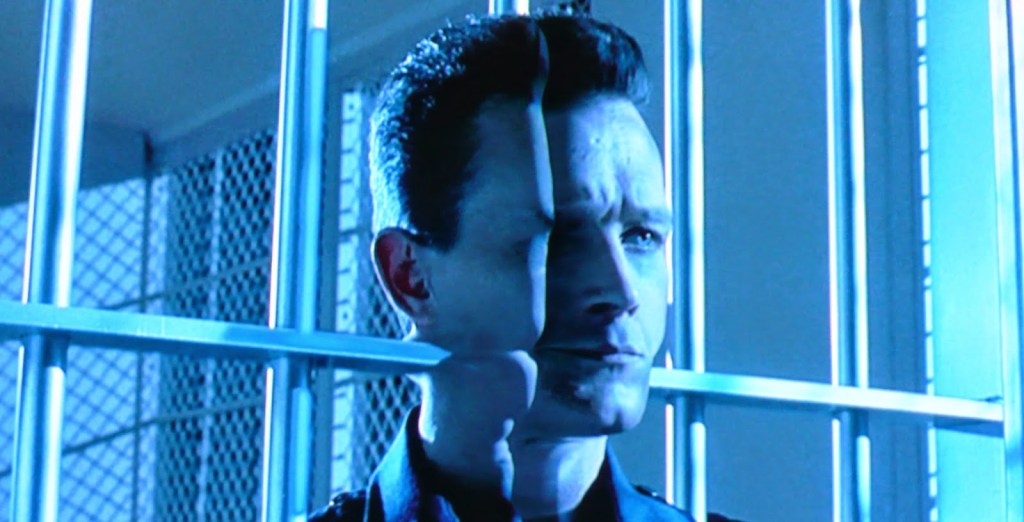
And the stakes are against them when they are up against an opponent as fearsome as Robert Patrick’s shape shifting T-1000. Cameron’s initial concept for the Terminators – before the studio suits pushed the fortunate casting of Schwarzenegger on him – had been for them to be non-descript looking, average types. Patrick, with all due respect, fits that exactly – and has the additional dark sting of being disguised as a cop almost throughout. He gives the part a cold, mechanical chill, a total lack of empathy or any emotion that contrasts with the growth of those abilities in our hero Terminator.

The special effects used to create the liquid, shape shifting T-1000 were ground breaking at the time (and contributed to this being the most expensive film ever made) and they are still bloody impressive today. The T-1000 effortlessly shifts between states and skilfully reforms its body to become new people. When under attack, it convincingly has holes blasted into it from shot guns, becoming strange Thing-like abominations before restoring its original shape. It looks extraordinary – helped as well by the steel-like chill of the film’s cinematography that covers every shot in the cities and much of the film’s second half in an icy blue.

Cameron’s film has that icy feel to it, as we never allowed to lose the dread of the future apocalypse. In fact, Sarah Connor is herself a constant physical reminder of it. Played by Linda Hamilton with the sort of fire and determination that turned her into a cult figure, Sarah Connor has pumped herself up to the Nth degree for the wars to come. However, she is a damaged, tragic figure, lost in grief, whose every dream is haunted by visions of dreadful nuclear Armageddon. How could you forget what is at stake, when it’s in every shot of Linda Hamilton’s eyes?

That’s even before the high-stakes action Cameron throws at the screen. The film is built structurally around four, equally different, action sequences and, while each of them has dim echoes of events we saw in the previous Terminator film, they are delivered with such panache and aplomb that it doesn’t really matter. Cameron of course manifestly understands that these sort of sequences mean nothing at all anyway unless we care about the characters involved, so the narrative focus of the film is tightly concentrated on no more than five characters, each of whom we see learn, grow and develop as the film progresses (even the evil T-1000 excels himself by becoming more smarmy, vile and even sadistic as the film progresses).
Because, much as you might want to mock some of the comedic buddy play between John and the Terminator, it adds an emotional heart and heft to the film. It’s two characters who have no real emotional connections at the start of the film, learning over the course of the film to love each other. Yes it allows for some wonky, dorky comedy from Schwarzenegger – a well the series would drain dry in future films – but it works an absolute treat here. Throw in Linda Hamilton as the archetypal cold warrior (wisely she passed on most of the future sequels that were to follow) and you had a pretty much perfect family unit to invest in.

Cameron also manages to give the film a gloomy but not domineering sense of dread, but punctures it with hope. It’s a film that is all about the future impacting the past – but also keen for us to understand that the future is not written, that our fates are not set, that both can be what we make of them. The film’s conclusion (changed from the original ending) of an empty road, heading we know not where, is a neat visual metaphor for our unknown futures. It may be a dark, forbidding, road – but we don’t know where it’s going for sure.

Terminator 2 is one of those cast iron classics that never gets old. It’s also the last Terminator film you ever need to see. All other entries are little more than superfluous retreads after this. It’s a pitch perfect balance of action and emotion and it’s always a treat and never a chore to watch it.

Time Bandits (1981)


Time travelling roguery in Time Bandits 

Director: Terry Gilliam

Cast: Craig Warnock (Kevin), David Rappaport (Randall), Kenny Baker (Fidgit), Malcolm Dixon (Strutter), Mike Edmonds (Og), Jack Purvis (Wally), Tiny Ross (Vermin), John Cleese (Robin Hood), Sean Connery (Agamemnon), Shelley Duvall (Pansy), Katherine Helmond (Mrs Ogre), Ian Holm (Napoleon), Michael Palin (Vincent), Ralph Richardson (Supreme Being), Peter Vaughan (Winston), David Warner (Evil), Jim Broadbent (Compere)

After leaving Monty Python, each Python went their own way. Terry Gilliam had been the slightly odd one, the eccentric animator who played the weirdos at the edge of the frame. Time Bandits would be pivotal in repositioning him as an ambitious, visionary director with a striking visual sense. It would also allow him (and co-writer Michael Palin) to create a fairytale fable with something for all ages, a film about a child’s view of the world which adults could embrace.

Kevin (Craig Warnock) is a dreamer, a young kid adrift in his parent’s materialistic world. Until one night a gang of dwarves calling themselves “Time Bandits” emerge out of his bedroom cupboard. They have a map that allows them to travel through time and use it to commit crimes and then escape to different centuries. Kevin joins them in their adventures, but none of them know they have attracted the attention of the Evil Genius (David Warner) who wants to use the map to escape his prison and recreate the world in his own image.

I still remember watching this film when I was younger and really enjoying (I must have watched it dozens of times). I have to say it holds up extremely well. Sure Craig Warnock isn’t the most inspired child actor of all time, but he has a wide eyed innocence and enthusiasm that anchors the film really well. Gilliam’s direction is brilliantly good – wild and inventive, like a punk-rock fairytale. The dwarfs make an inspired grouping, each embracing the once-in-a-lifetime chance of playing leading roles.

The main reason for the film’s success is Gilliam. His work is extraordinarily detailed and imaginative, while his visual sense makes shots that cost hundreds of pounds look like millions. Huge swathes of the film are shot with a low-angle lens that allows us to see everything from the perspective of our heroes, and also makes each of these larger-than-life events seem even more awe-inspiring. The design of the film is extraordinary, with striking images confronting you at every turn, either a recreation of events or the bizarre visuals of the “time of wonder”.

And those visuals are outstanding. Can you think of any other film where a knight on horseback bursts out of a bedroom cupboard, charges around the room in medium shot, and then gallops off through a field that has suddenly replaced the bedroom wall? How about an ogre who lives on a ship that is then revealed to be a hat for a giant who lives underwater? Evil’s Fortress is a swaggeringly brilliant triumph of production design, while his goat skulled, tall, hooded monsters must surely have been playing in JK Rowling’s mind when she came up with the Dementors.

The design also echoes the possibility that this is all a child’s fantasy. A careful look at Kevin’s bedroom shows pictures of everything we encounter. The final confrontation with Evil takes place on a set clearly inspired by the Lego bricks, chess board and toys that litter Kevin’s bedroom. 

The playful tone is also reflected in its lampooning of the “adult” world of technology for its dull materialism: Kevin’s parents watch a bullying gameshow (compered by a demonic Jim Broadbent) while sitting on armchairs still in their plastic wrapping. Evil’s obsessions all revolve around lasers and the microchip.

Away from all this, the film has a simple structure. It’s basically a series of really rather fun historical sketches, linked together by an engaging fantasy narrative. These scenes attracted guest star performers, all of whom excel (though it is odd to see them get top billing – Cleese is on screen for about three minutes, but gets top-billing!). 

The guest stars are terrific – Holm is hilarious as a chippy, height-obsessed Napoleon; Cleese very funny as a visiting-Royal-inspired Robin Hood, treating all around him with condescension; Ralph Richardson brings an absent-minded imperiousness and dry wit to his role as God; Connery sprinkles a touch of movie-star bravado as a kindly, gentle Agamemnon (the uncommented on joke being the movie’s ideal father figure is most famous for sacrificing his daughter…). 

If any performer high-jacks the film it’s David Warner as a dry-witted, viciously ego-maniacal Evil Being, getting most of the best lines. A sequence where he obliterates several underlings for minor transgressions hums with dark humour (and punchlines with the accidental obliteration of another minion off screen, met with a sheepish “Sorry”). On top of that, Warner brings just the right level of sinister child’s-nightmareish quality to the role, helped by a striking costume design that makes him look the love-child of a crocodile and a car engine.

The leads of the film (Kevin and the bandits) are extremely well drawn by Palin’s script, each of them with sharply distinctive personalities. David Rappaport (allegedly incredibly unpopular with the others due to his haughty disregard for them) is perfect as the arrogant self-appointed leader, but Jack Purvis is a stand-out as the warmly brave Wally. More than a few commentators have pointed out that the Bandits all serve as representatives of the members of the Monty Python troop, which adds another level of fun watching the film.

Time Bandits is electric good fun. I have no doubt I might find more to criticise without the memory of enjoying it so much when I was younger. Some of the sketches work less well than others – the scene with the ogre doesn’t quite work, and the ending, twistedly funny as it is, does feel slightly abrupt is. But the film never outstays its welcome, and it’s put together with such glee and accomplishment that there is always a line or an image that sticks with you. It’s a dark fairytale for children of all ages – and making something the whole family can enjoy is really quite a feat. Palin and Gilliam would have put together a sensational series of Doctor Who.

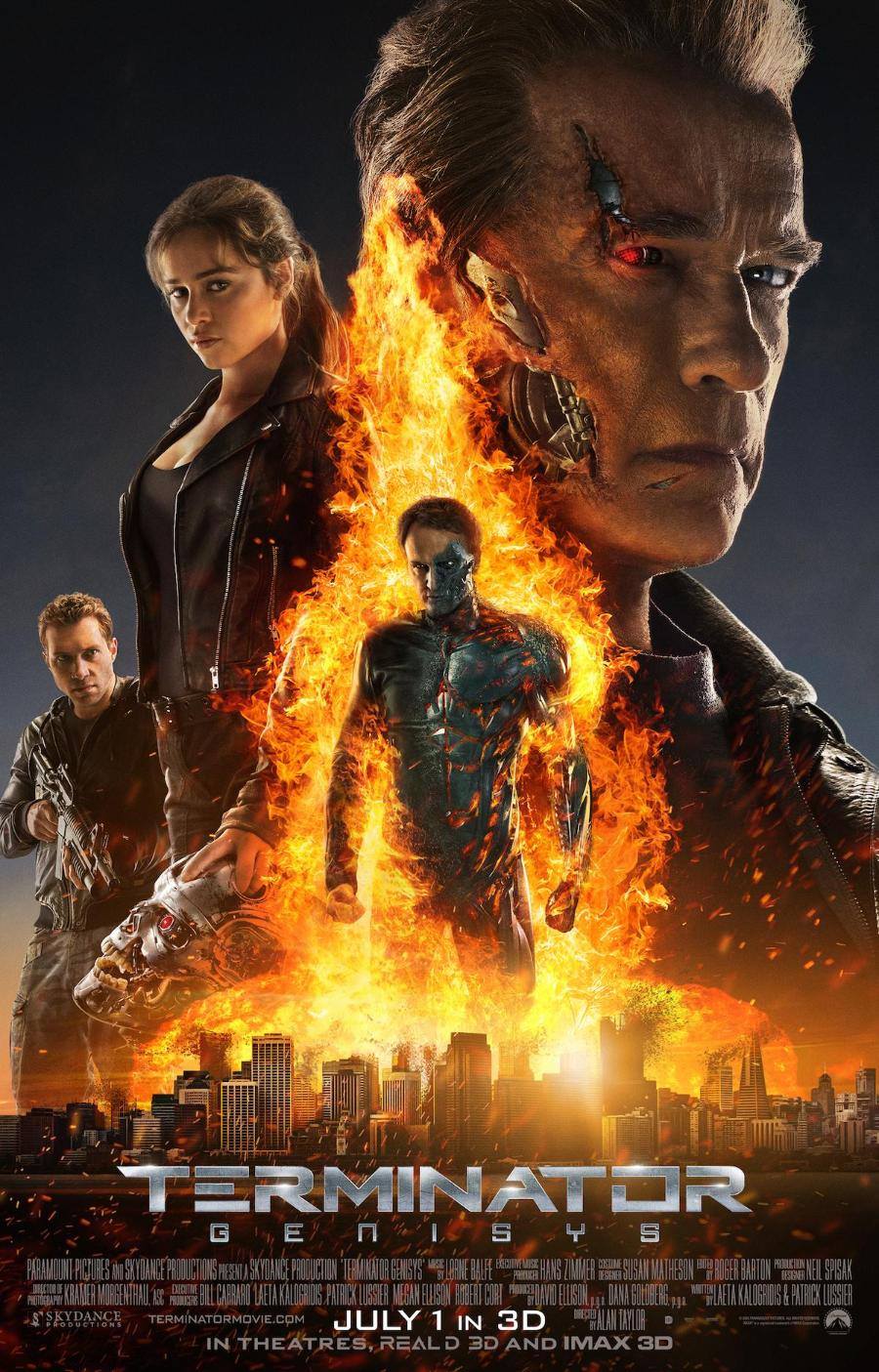
Terminator Genisys (2015)


Arnie saddles up (again) as The Terminator, this time with Emilia Clarke in tow. Reboot or remake?

Director: Alan Taylor

Cast: Arnold Schwarzenegger (Pops), Jai Courtenay (Kyle Reese), Emilia Clarke (Sarah Connor), Jason Clarke (John Connor), JK Simmons (O’Brien), Dayo Okeniyi (Danny Dyson), Matt Smith (Alex/Skynet), Courtenay B Vance (Miles Dyson), Byung Hun Lee (T-1000)

Every few years, Hollywood convinces itself the Terminator franchise is a licence to print money just waiting for exploitation. Since the late 90s, three movies and one TV series have attempted to relaunch the franchise. Each has underperformed, and left plans for sequels abandoned. Terminator: Genisys is the latest in this trend, the first in a planned trilogy that will never be made. As such, it’s a type of curiosity, a film that sets up a new timeline and introduces mysteries never to be answered.

Once again, the film starts with John Connor (Jason Clarke) sending Kyle Reece (Jai Courtenay) back in time to save his mother Sarah (Emilia Clarke) from deadly Terminators sent to destroy her and prevent Connor from being born. But when Reece arrives, he finds the past he was expecting altered and that Sarah was already saved years before from a first Terminator, by a re-programmed one nicknamed Pops (Arnold Schwarzenegger). Our heroes find themselves adrift in a timeline dramatically altered from the one they expected, and transport themselves to 2017 to combat Skynet once more.

It says a lot that the most original and daring thing about this movie is that no-one at any point says “Hasta La Vista, Baby”. Aside from that, the film is a Frankenstein’s monster, assembled from the off-cuts of previous franchise entries. The familiar lines are trotted out once more: I’ll Be Back, Come With Me if You Want to Live, Get Out and many more. The structure of the film limply settles into the same basic set-up we’ve seen since Terminator 2, while the big set pieces have an air of inevitability about them. This is a lazy, half-baked claim to re-invent the franchise that essentially copies and repeats everything from previous films with only a few small changes of angle. You can admire briefly the skill that has re-created moments from the original film, and be impressed by the effects that show a newly-young Schwarzenegger fighting his grizzled future self – but it will largely just make you want to watch the first film again.

This stench of familiarity is despite the huge, seemingly-inventive loopholes that the film, Bourne Legacy like, jumps through in order to try and justify its existence. The Terminator franchise has become so scrambled with alternative timelines, paths not taken, and film series cancelled that it spends almost the first hour carefully recreating events from previous movies, with some major tweaks and changes to allow a new “timeline” to burst up and act as a jumping off point for this movie. By the time the complex timeline politics has been put in place, the film has barely an hour of its run time left – at which point it needs to introduce its two antagonists and give our heroes a mission. The timeline is truncated, the villain is under-developed and the mission the dullest retread of the plot of Terminator 2 possible: a race to get to a building to blow it up. Yawn.

Is it any wonder that people shrugged at this movie? Even it can’t imagine a world outside the confines of its franchise rules. It reminds you what a small world the Terminator universe is. There’s little more than 3-4 characters, Skynet is always the adversary, time travel always seems to involve variations on the same people, the future is always the same blasted wasteland. The films always degenerate into long chases, compromised by our heroes’ attempts to change the future. So many Arnie Terminators have been reprogrammed by the resistance now, you wonder if any of them are left fighting for Skynet. What seemed fresh and daring in the first two films, now feels constrained and predictable. To find life in this franchise, it needs to do something genuinely different, not go over the same old ground over and over again.

The tragedy of this film is that the one unique thing it had – the identity of its main villain – was blown in the trailer of the film. Taylor was apparently furious at this undermining of a twist his film takes time building up. It ought to have been a shock for audiences to find out the franchise’s saviour-figure, John Connor, was instead the film’s villain – instead anyone who’d seen a trailer knew all about it before the opening credits even rolled. They even put it on the flipping poster! On top of which, the trailer carefully checks off all the major set pieces up to the final  30 minutes. Is it any wonder so many people gave it a miss at the cinema? Shocks left unspoiled, such as Matt Smith (strangely billed as Matthew Smith) revealed to be the embodiment of Skynet, are so dull and predictable they hardly counted as twists.

There is little in there to bolster the plot. The action is shot with a dull efficiency. The film is edited together with a plodding mundanity. Schwarzenegger once again goes through the familiar motions, but surely we have now seen enough of this character, which could in fact be holding the franchise back. Emilia Clarke looks bored, Jai Courtenay (an actor who came to prominence with a warm and intelligent performance in Spartacus: Blood and Sand) is again cast as a charisma free lunkhead, with attempts to add shading to his character only adding dullness. Jason Clarke lacks the charisma for the cursed role of John Connor (every film has seen a new actor take on the role).

Reviews claimed the plot was too complex for the audience: not the case. The plot is clear enough – it’s just dull and engaging. It never gives the viewer a reason to invest in the story. Terminator: Genysis is a ploddingly safe, predictable and routine piece of film-making, from a franchise that desperately needed reinvention. But so long as average and uninventive filmmakers – Jonathan Mostow, McG, Alan Taylor – are entrusted with its future, it will always be a franchise with no future. It’s time it was terminated. Hasta La Vista, Baby.