Category: Time travel films

Star Trek IV: The Voyage Home (1986)

Star Trek IV: The Voyage Home (1986)

The gentlest and least action-filled of all the Star Trek films is one of its most successful outings

Director: Leonard Nimoy

Cast: William Shatner (Admiral James T Kirk), Leonard Nimoy (Spock), DeForest Kelley (Dr McCoy), James Doohan (Montgomery Scott), George Takei (Hikaru Sulu), Walter Koenig (Pavel Chekov), Nichelle Nichols (Uhura), Catherine Hicks (Dr Gillian Taylor), Mark Lenard (Sarek), Jane Wyatt (Amanda), Robin Curtis (Saavik), Brock Peters (Admiral Cartwright), John Schuck (Klingon Ambassador), Robert Ellenstein (Federation President)

Most people’s Bingo cards probably didn’t have “biggest Star Trek hit film is about saving Whales”. In fact, when I told my wife this was the plot of Star Trek IV (which she had, resignedly, agreed to watch on a Saturday night) she immediately assumed I was pulling her leg. I guess this might also be what Paramount thought when Nimoy and Nicholas Meyer pitched this: time-travel with comedy for the crew, no villain, no battles and not a single photon torpedo fired in anger. There wouldn’t even be a proper love interest. But the formula was such a surprise hit, Paramount tried to repeat the trick again with Star Trek V and promptly fell flat on their faces.

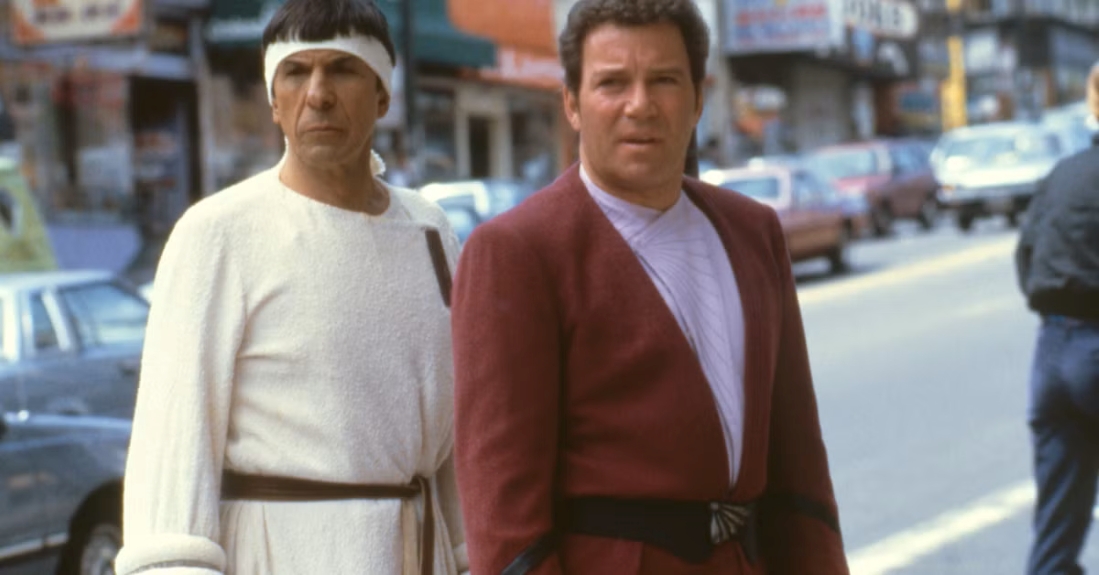
After the events of Star Trek III, Spock is back from the dead and the crew are heading home to face the music after their riot of breaking orders, sabotage, theft and blowing up the Enterprise from the last film. (Since they’ve also not changed clothes since the start of that film, they must also be a bit whiffy). Before they arrive back though, Earth is thrown into chaos by a mysterious probe whose powerful signal is draining the planet’s power. Turns out the probe is trying to contact Humpback whales – which mankind hunted to extinction in the late twentieth century. Kirk, Spock and the crew take their stolen Klingon bird of prey on a perilous time-travel slingshot round the sun back to 1986, to grab a pair of whales and bring them back to their present. But of course, it’s not that easy.

There is something very refreshing about Star Trek IV, one of the entries in the series that really attempted to go its own way. It manages to pull this off pretty well, the crew settling into the fish-out-of-water comedy of being stranded in modern San Francisco without inducing eat-your-fist levels of embarrassment in the viewer (not a trick the franchise managed in other lighter entries, such as Insurrection and of course Star Trek V). Perhaps it’s because, by and large, the cast don’t overplay or force the comedy too much and the mix of both apocalyptic dread in the future and horror of the butchery of whales in the present counterbalances the comedy rather well.

In fact, Nimoy proofs to have a deft touch (he went straight from this to directing Three Men and a Little Lady and he was pretty much button-holed as a comedy director from hereon). He latches onto the rare chance for a Star Trek film to go fully on location – surely a nice change from the blatantly papier-mache sets of the Genesis planet in Star Trek III – neatly capturing the slightly dazed characters, dodging traffic in busy San Francisco streets, grabbling with the complexity of using money and struggling with the parade of “colourful metaphors” that pepper Twentieth century speech.

There is a pleasingly family-friendly quality to all this, continued with the missions Star Trek IV splits the crew up to achieve. Each of these is well-tailored to cater to the strengths of characters and actors. Naturally, Russian-accented Chekov winds up hunting for “nuclear wessels” to re-power the ship, including a desperate chase across decks of the real battleship USS Enterprise. Nimoy also captures some neat observational comedy with Chekov and Uhura plaintively asking non-plussed passers-by for directions to a Naval base (including a blank faced cop, and a flustered extra who parrots back the naval base name in her confused directions – Koenig nailing the polite exasperation of Chekov’s bemused response).

In addition, we get a Scotty struggling to understand why he can’t talk to computer and then not caring when he hands over future technology secrets in return for free plexiglass for a whale case (timelines be damned!). Or an increasingly grouchy McCoy railing against medieval medicine in a cutting-edge hospital, subtly handing over kidney restoring medicine to an ailing granny. And, of course, Kirk and Spock chasing down whales, shouting down road hogs (“double damn ass on you!”) or neck-pinching rude punks on buses and struggling to work out when to tell the truth and when to lie.

The whale part of the Star Trek IV works rather well. Shots of the butchery of whales is quite chillingly graphic, Spock’s mind-meld with whales George and Gracie (during an unauthorised swim in the aquarium pool they live in – met with slack jawed despairing shock by Kirk) stresses the animals intelligence and empathy (these whales are not just tools to do with as our heroes please). It’s easy to see why the film helped the cause of Greenpeace no end, especially since George and Gracie’s near-fatal encounter with a ship of scruffy whalers is genuinely tense as we dread seeing a harpoon in the side of an animal we’ve grown fond of. Catherine Hicks also gives a nicely judged performance as a passionate whale expert, who also manages to see through the crew’s (not particularly well disguised) bullshit.

That’s not to forget the destructive impact of the probe in the future, as its distinctively intimidating “froom-froom” boils oceans, scorches skies and leaves starships (crewed by an ahead-of-its-time diverse series of officers) drifting in space. It’s a neat metaphor for the results of mankind’s thoughtless impact on the planet. But also, its genuinely quite exciting, just as is the crew’s risky flash back in time to the past, Takei sonorously reporting their ever-increasing speed as the ship shakes. A final attempt to save the whales from a sinking Klingon bird-of-prey does feel like it’s been chucked in to give Shatner some final act heroics. But you can cut it some slack, considering that its genuinely tense.

Above all, Star Trek IV shows that you can make a successful Star Trek film without trying to make it as much like Star Wars as possible. This is the sort of conundrum the show used to deal with all the time, cleaning up our own mess and learning lessons along the way. It also allows the cast to relax and to be genuinely engaging, without drowning us in cringe-worthy comedy. Star Trek IV is what it needs to be: a really accessible way to get into the show, that riffs on things you’re likely to be familiar with, without needing a PhD in the show’s canon. Mix that in with a well-judged (Oscar-nominated) score by Leonard Rosenman that gets the tone just right between playful and epic and the fact that all that location shooting means the limited special effects budget could be used to ace effect, and you’ve got one of the best of the franchise.

The Terminator (1984)

The Terminator (1984)

Schwarzenegger becomes an icon in Cameron’s masterpiece, a darkly gripping sci-fi chase-thriller

Director: James Cameron

Cast: Arnold Schwarzenegger (The Terminator), Michael Biehn (Kyle Reese), Linda Hamilton (Sarah Connor), Paul Winfield (Ed Traxler), Lance Henriksen (Hal Vukovich), Bess Motta (Ginger), Rick Rossovich (Matt), Eal Boen (Dr Peter Silberman), Bill Paxton (Punk)

“It can’t be bargained with. It can’t be reasoned with. It doesn’t feel pity, or remorse, or fear. And it absolutely will not stop… ever, until you are dead!”

If that description doesn’t grab your attention, I don’t know what will. James Cameron cemented his place in cult-film history with The Terminator, such a pure shot-to-the-heart of filmic adrenalin, its hard to think it’s been bettered since. Cameron takes a fairly simple story – essentially a long, relentless chase – and fills it with energy, black humour and a genuine sense of unstoppable menace, in a film that barely draws breath until it’s over an hour in and then promptly throws you straight into a final action set-piece. It uses its low budget effectively to create a world of mystery and dark suggestion and leaves you gagging for more. So much so, they’ve tried to recapture the thrill ride six times since (and only Cameron did it right, with Terminator 2).

It’s 1984 and two naked people arrive in Los Angeles in a ball of light. They’re both from 2029, time-travellers looking for the same woman. One of them nicks a tramp’s piss-stained trousers and runs from the police. The other is a stoic, impassive mountain of muscle who offs a few violent punks after they refuse his blunt instruction to hand over their clothes. Which one do you wish you were eh? Unfortunately, the second one is a Terminator (Arnold Schwarzenegger), a machine in the skin of a man sent to eliminate Sarah Connor (Linda Hamilton), mother of the future leader of the post-apocalyptic human resistance to the machines. The first is Kyle Reese (Michael Biehn), the man sent to save her. Tough gig, since the Terminator is relentless, almost invulnerable and holds all the cards.

The Terminator is pulpy, dirty, punchy film-making – and its huge success became James Cameron’s calling card for a lifetime of success. Set in a neon-lit, dingy Los Angeles (it never seems to be daytime in The Terminator), it taps into the core of a million nightmares, the fear of being chased and nothing you do ever sees to get you further away. It’s a really elemental fear which The Terminator brilliantly exploits, as impassive and impossible to negotiate with as your deepest, darkest dreads. Throw into that Cameron’s gift for tension and you’ve got the almost perfect thrill-ride.

It’s also a film that gives us the perfect level of information we need. Unlike the cops (and Sarah Connor) who can’t believe this story Reese is peddling them that they are up against an unstoppable metal killing machine, we know from the start the whole story. It’s enough for us to feel a cheeky frustration as they bend over backwards to fit logical explanations to the things they’ve seen and for us to feel the sneaking dread that storing Sarah away in a police precinct crammed full of heavily armed cops isn’t going to make a jot of difference. He won’t let anything stop him.

Is it any wonder quite a few people came out of the film sympathising with Sarah and Kyle – but feeling a sort of guilty admiration for the Terminator? This is the foundation stone of the Schwarzenegger cult, his role as the monosyllabic machine sending him into the upper echelons of Hollywood stardom. Cameron’s original idea was the Terminator should be a perfect infiltration unit, the sort of guy who wouldn’t stand out in a crowd (the original choice was Lance Henriksen, relegated instead to the second-banana cop behind Paul Winfield’s folksily doomed decent guy, fundamentally out of his depth). That went out of the window when Schwarzenegger came on board: say what you like about the Austrian Oak, but he stands out in a crowd.

Why is the Terminator darkly cool? (After all literally no one ever pretended to be Kyle Reese, but everyone has put on a pair of shades and said “I’ll be BACH”.) Because he embodies all the qualities we’ve been taught by films to respect. He’s strong and silent, calm and confident, never complains, doesn’t need help and never gives up. He’s exactly the sort of guy Hollywood has cast admiring eyes at since film spooled through a camera. We can’t help ourselves.

The film becomes about Schwarzenegger (even if he’s not in the last set piece, replaced by a budget-busting CGI android). Cameron knew how to get the best out him, his tiny number of lines (17 in total) delivered in his emotionless, euro-accent make him seem mysterious, different and cool, frequently responding with either deadpan seriousness or sudden violence. His under-statement lines are funny because we anticipate already the bloodbath that will follow. And, unlike despicable villains, he’s not motivated by greed, jealousy or wickedness: he’s almost the quintessential American hero, taking care of business – it just so happens his business is killing people.

Reese should be someone we admire more: he’s a plucky, resourceful underdog. But, unlike the actions-rather-than-words Terminator, he’s got to speak all the time – while the Terminator is a killing machine, Reese is the exposition machine. Biehn does a terrific job with a difficult role, a decoy protagonist who spends much of the movie alternating between gunplay and spitting out reams and reams of exposition explaining to anyone and everyone the future and terminators. On top of that, while his opponent gets on with, Reese’s constant refrain of how scared he is and everyone else should be (who wants to hear a hero say how terrified he is eh?) and his frustrated whining at no-one listening to his fantastic story marks him as weak. Charismatic heroes persuade their audiences: no one believes Reese until they are literally watching Arnie shrug off a whole clip of ammo.

Reese is, in any case, a decoy protagonist of sorts. His romantic longing for Sarah (having fallen in love with her photo in the future) and nurturing personality actually mark him out as the more conventional ‘female lead’. In the first of several films where Cameron would show-case heroic female characters, the actual ideal rival for the machine is Sarah. One of the most interesting things about The Terminator is watching Linda Hamilton skilfully develop this character from ordinary young woman into the sort of archetypal Western hero the film ends with her as (she even gets the sort of badass kiss-off line “You’re terminated FUCKER” you can’t imagine the less imaginative Reese saying).

On top of this The Terminator is a triumph of atmosphere. With its synth-score, it has an unsettling quality from the off helping to build the sense of grim inevitability that is its stock-in-trade. Just like the Terminator’s never-ending pursuit, the whole film is a well-judged, inevitable, time-loop. Sending people back in time turns out to be the very thing that guarantees that future will happen. Throughout, Cameron’s little titbits about the future (partly constrained by budget) are perfect in giving us just enough information to understand the stakes but leave enough mystery for us to be so desperate to know more, we fill in the gaps from our imagination.

But the reason The Terminator works best is that it’s an undeniably tense thrill ride, an extended chase sequence that rarely eases off and never loses its sense of menace. You never feel relaxed or safe while watching The Terminator and never for a moment that its heroes are on a level playing field with their opponent. Atmospheric, tense and terrifying, it walks a brilliantly fine line (so much so, the Terminator methodically massacring a precinct full of cops is both unnerving and the most popular scene in the film) and never once let’s go of your gut. It’s not only possibly the best, most perfect, Terminator film made also still one of Cameron’s finest hours.

Back to the Future Part III (1990)

Back to the Future Part III (1990)

The franchise closes on a high with a fun, romantic and exciting finale, tonnes better than Part II

Director: Robert Zemeckis

Cast: Michael J. Fox (Marty McFly/Seamus McFly), Christopher Lloyd (Emmett “Doc” Brown), Mary Steenburgen (Clara Clayton), Thomas F. Wilson (Biff Tannen/Buford “Mad Dog” Tannen), Lea Thompson (Lorraine McFly/Maggie McFly), James Tolkan (Marshal James Strickland), Elizabeth Shue (Jennifer), Matt Clark (Chester), Richard Dysart (Salesman), Flea (Needles)

And we’re back. After the frankly awful Back to the Future Part II – an onslaught of bad gags, terrible performances, clumsy call-backs and a lot of sound and fury – the trilogy ended on a high with Back to the Future Part III which, by going back to the past, managed to find more heart and originality than Part II ever had. Strangely, by looking backwards in time, the series managed to look forward to new ideas. Part III is, by many degrees, a huge improvement.

We left Part II with Doc Brown (Christopher Lloyd) stranded in 1885 and Marty McFly (Michael J Fox) equally stranded in1855. How are they going to get back to 1985? Well Doc is happy where he is, and has left the Delorean buried in 1885 for Marty to dig it up in 1955 and get back to the future with the help of the 1955 Doc. But, digging the Delorean up, Marty discovers Doc’s 1885 grave: turns out he will be murdered by gunslinger Buford “Mad Dog” Tannen (Thomas F Wilson). So, Marty travels back to 1885 to save him. But with the Delorean damaged on the way, how will they get back to 1985? Will Doc or Marty be killed in a fatal gunfight with Tannen? And what about the Doc and schoolteacher Clara Clayton (Mary Steenburgen) falling in love?

Back to the Future Part III juggles all these plot themes with real expertise, all based in a hugely affectionate portrait of the Old West that drips with Zemeckis and Gale’s childhood love for the genre. I’m going to guess that Part III is inexplicably not held in the same regard as Part II because my generation and onward simply has far less of a connection to the Western than they do crudely cheesy views of an 80s tinged future.

But the sense of fun here is on point. Galloping horses, street fights, open air dances, trains, cameos from old-school Western supporting actors, the majestic score… it’s all an on-point reconstruction of the tone and style of Ford. (In particular, the entire film feels like a fun recreation of many elements of My Darling Clementine). The film also has fun with later perceptions. Marty is dressed up for his journey back to 1885 in the sort of brightly coloured, skin-tight costumes 1950s TV and B-movie western stars wore. He adopts the alias “Clint Eastwood” (and doesn’t the film have fun with that). He even (eventually) dresses not dissimilarly from the Man with No Name himself.

It doesn’t stop with the Western re-build. Back to the Future Part III has the inevitable call-back gags to events we have seen throughout the last two movies. But here they are delivered with a far more freshness. Not least because Doc and Marty largely reverse roles here (leaning into this, they even swop their catchphrases at one point). While in the previous films Marty was the impulsive one, flying by the seat of his pants with instant decisions and being assisted by the eccentric Doc, here they settle into new roles.

Because Doc here is the one being rescued and the one tempted by an impulsive decision. Namely, staying in the past because he has fallen in love. Christopher Lloyd, a much better actor than he gets credit for, is allowed to broaden out and enrich his eccentric performance as Doc with a real emotional depth in a very sweetly drawn romance. Mary Steenburgen is equally good as the kindred spirit he falls in love with. Both actors play the romance dead straight and it allows Lloyd to show an emotional depth and shade his performance has lacked elsewhere. Steenburgen’s casting is also a nice tip-of-the-hat to Time After Time (where she also played a woman who inadvertently falls in love with a time traveller). Clara is also a neatly written character, integrated far more into the plot than poor Jennifer in Part II and another welcome shake-up the buddy formula.

As Doc takes on the romantic and paradox creating role, Marty becomes the driver, urging Doc to stop getting mixed up in influencing past events and focus instead on fixing the Delorean and getting back home. Fox embraces playing (largely) the secondary role in the film. He still gets moments of fun as an actor (not least playing Marty’s Irish great-grandfather – a performance immeasurably better than all his latex covered efforts in Part II) but he’s largely the voice of sense here.

Except of course concerning his fatal character flaw: don’t call him chicken. There is nowhere more dangerous to allow someone to pick a fight with you than the Wild West. And Marty swiftly inherits the clash with Tannen (played with gruff comic gusto and impenetrably density by Thomas F Wilson). This culminates – but of course – in a face-off in a dustbowl street, with a solution to the gunfight inspired by the real Eastwood and nicely signposted in Part II.

That leads into a genuinely edge-of-the-seat exciting race to hijack a train to push the Delorean up to the desired 88 miles an hour. Zemeckis shoots and cuts this sequence to perfection – and Alan Silvestri’s score does a lot of build and sustain the tension and excitement – and it seems appropriate that the only real opponent Marty, Doc and Clara have to deal with in this sequence is time itself. Crammed with sight gags, orchestrated to perfection and perfectly paced it’s a great way to cap the series.

Much as the film itself is a perfect ending to the franchise. Its imaginative and playful, riffing on the previous events without slavishly imitating them, approaching both its characters from new angles that helps us discover new things about them and crammed with great jokes, exciting set-pieces and genuine emotion. It’s easily the second-best film in the franchise. If you want to revisit a sequel for Back to the Future do yourself a favour and pick the one in the past.
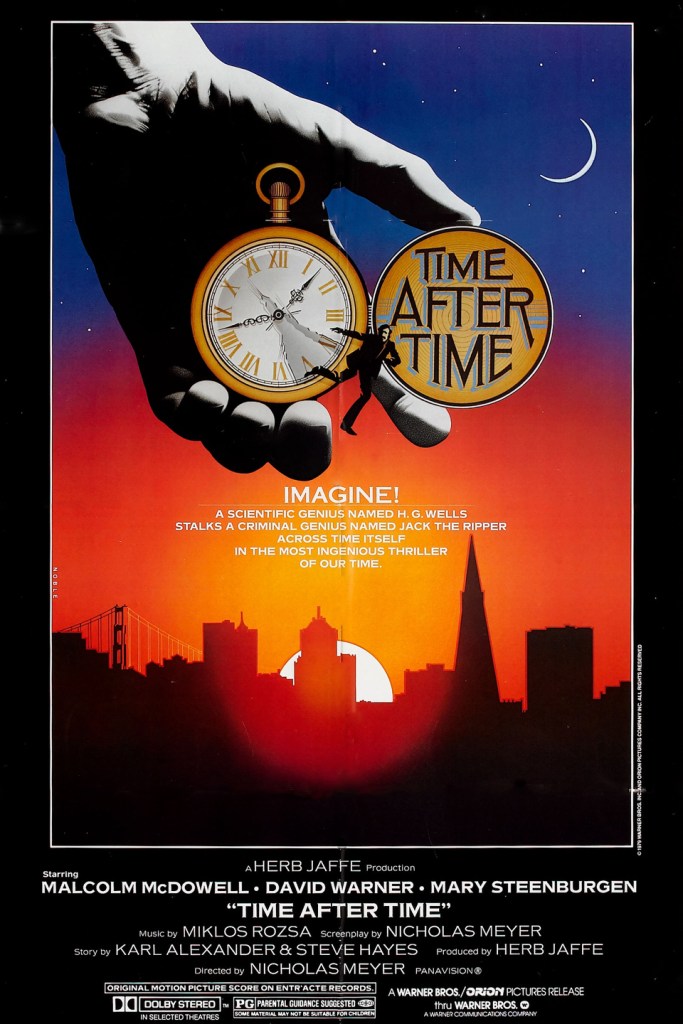
Time After Time (1979)

Time After Time (1979)

HG Wells zooms through time on the trail of Jack the Ripper in this surprisingly charming time travel romantic thriller

Director: Nicholas Meyer

Cast: Malcolm McDowell (HG Wells), David Warner (Dr John Leslie Stevenson), Mary Steenburgen (Amy Robbins), Charles Cioffi (Lt Mitchell), Kent Williams (Assistant), Patti d’Arbanville (Shirley), Joseph Maher (Adams)

1979 was clearly the Year of the Ripper. New conspiracy theories abounded on his mysterious identity. In Murder By Decree, Sherlock Holmes took on the investigation. And in Nicholas Meyer’s Time Travel fish-out-of-water drama, he pops up in 1970s San Francisco, still up to his wicked ways. How did he get there? Well, imagine instead of just writing The Time Machine, HG Wells had actually built it: and that, during a dinner with a doctor friend, he not only discovers his friend is the infamous killer, but watches him pinch his time machine to escape the long arm of the law.

HG Wells is played by Malcolm McDowell – who surely when he was sent the script assumed he was being asked to take a look at the role of the Ripper – who uses his machine to follow the Ripper to the 1970s to find him. The Ripper is played by David Warner (one of the few actors even more demonic than McDowell), and he’s rather more at home in the 1970s than Wells, who expected to find a utopia. Wells is helped by Amy Robbins (Mary Steenburgen), who is drawn to this charming Englishman, who she believes is a Scotland Yard detective on the hunt for a serial killer.

Meyer’s first film is a little raw – you can see he’s still learning his craft, a few shots are a little rough around the edges in their framing and some plot points and transitions are not easy to follow – but rather charming, for all it’s about the hunt for a serial killer. Meyer gets a lot of affectionate comic mileage from Wells – the quintessential gentle Englishman, timid but determined when riled – working out the social rules of the 1970s. From crossing the road, to hailing a taxi, from consuming a McDonalds (“Fries are pomme frites!” – some silver presumably crossed Meyer’s hands to show the novelist chomping down thrilled on the fast food chain’s merchandise) to working out the rate of exchange for his fifteen Victorian pounds doesn’t translate to many dollars, it’s got a fish-out-of-water delight and a shrewd comic energy.

It’s helped a great deal by McDowell’s gentle, playful and thoroughly engaging performance – Time After Time leaves you sad he doesn’t get to play more roles like this. Wells is optimistic, polite, gentlemanly and admirably brave: even more so, because he’s so hesitant about risk. He travels around the 1970s with a wide-eyed wonder and has a humanitarian streak a mile wide. He’s one of the nicest guys you could meet.

No wonder Amy falls for him so swiftly. There is an electric chemistry between Mary Steenburgen – full of Southern sweetness but with a very modern (but never grating) feminism – and McDowell (and clearly off screen as well, as they married almost immediately after). Meyer plays this romance like a classic rom-com, with meet-cutes at the bank and McDowell’s playing of this shy Victorian gentleman’s courtly manners (he touchingly stops a kiss to make absolutely sure he has full consent – which Amy makes clear he more than does!) works like a charm.

The jokes are genuinely well-thought out and keep the film brisk. I love the alias Well’s plucks out of the air when pretending to the police to be a Scotland Yard detective: he seizes upon what he guesses will be a long forgotten popular fiction character of his day and calls himself Sherlock Holmes. McDowell and Steenburgen have an affinity for physical comedy – watch McDowell hail a taxi with a jaunty wave or Steenburgen sitting frustratedly on a sofa waiting for Wells to make a move. The fish-out-of-water elements work a treat (you can see the clear groundwork for gags Meyer would take even further in his next time-travel hit Star Trek IV: The Voyage Home).

Time After Time sits this comedy next to a genuine Ripper-flick. The film opens with a long POV shot as the Ripper strikes in the streets of London. David Warner gives a very good performance as a world-weary psychopathic, who can hide his depravity but not control his urges. Unlike Wells, the Ripper adjusts very naturally to the modern world – probably because he’s more used to pretence than the honest Wells – dressing in progressively more relaxed 70s garb. His murders are shot with discretion – mostly off screen with the inevitable splash of scarlet on a surface or face from off camera. The actual historical elements of the Ripper are bunkum, but the handling is well done.

The time travel elements are rather laboriously explained, with much talk of keys, return-prevention locks and stabilisers. Wells points out the various features of the machine with a bluntness that all but has Meyer tapping you on the shoulder and saying “remember that it will be important later” – you can utterly (correctly) guess the eventual ending purely from this lecture. But the time travel effects use a mixture of 2001-ish camera tricks rather effectively and the film plays a little bit with paradox and timeline tweaking (although without any depth).

Meyer’s film is an enjoyable ride, even if some plot developments gear shift swiftly (the Ripper seems to have had a sudden emotional breakdown at some point between his penultimate and final scene and the reasons for the time machines physical shift to San Francisco are barely explained) and it at times loses its drive (the Ripper is all-too-obviously presumed dead at one point and his determination to grab a key that controls the time machine oscillates with urgency from act to act). But as a debut, it’s an enjoyable piece of pulp. And it’s got a hugely likeable performance from McDowell and very assured support from Steenburgen and Warner. It’s a very enjoyable romp.

12 Monkeys (1995)

12 Monkeys (1995)

A world-ending-virus can only be cured through the power of time-travel in Gilliam’s twisty, paradox time loop

Director: Terry Gilliam

Cast: Bruce Willis (James Cole), Madeleine Stowe (Dr Kathryn Railly), Brad Pitt (Jeffrey Goines), Christopher Plummer (Dr Leland Goines), David Morse (Dr Peters), Jon Seda (Jose), Christopher Meloni (Lt Halperin), Frank Gorshin (Dr Fletcher), Bob Adrian (Geologist), Simon Jones (Zoologist), Carol Florence (Astrophysicist), Bill Raymon (Microbiologist)

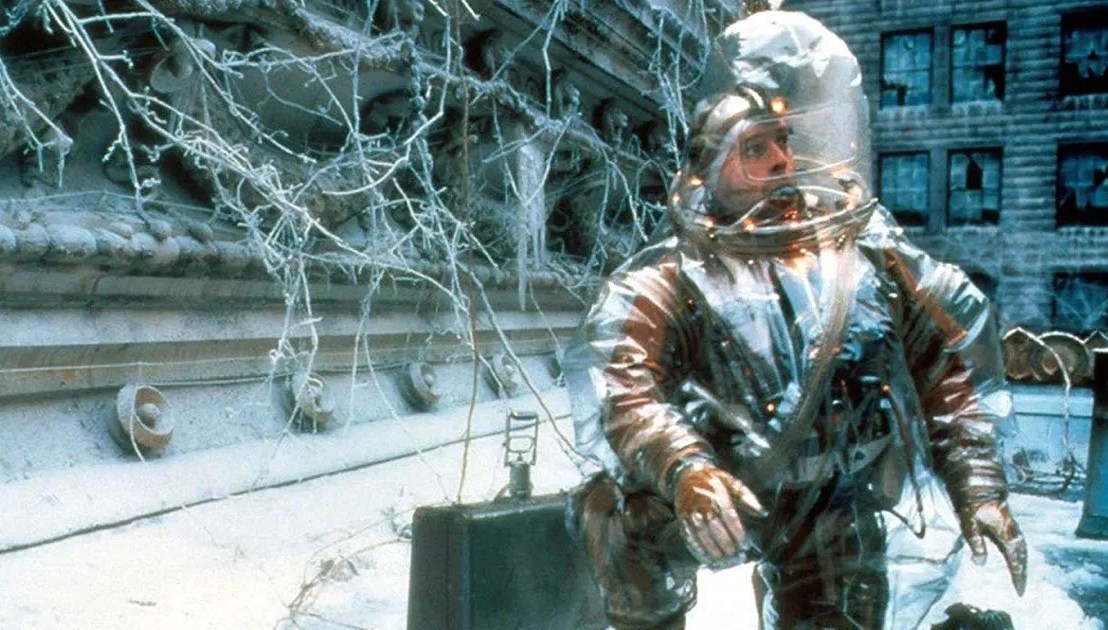
2035 and the world is a plastic-coated hell, where what remains of mankind huddle below the Earth in rudimentary, environmentally controlled, airtight refuges. The surface is a dream, now home to a deadly virus that wiped out 99% of the population. That virus was unleashed in Philadelphia in 1996: nothing can stop that. But time travel can help the scientists of 2035 gain a sample of the original pre-mutation virus. They believe it was unleashed by an organisation called “The 12 Monkeys”. Track the organisation in the past and find an original sample of the virus. Easy right?

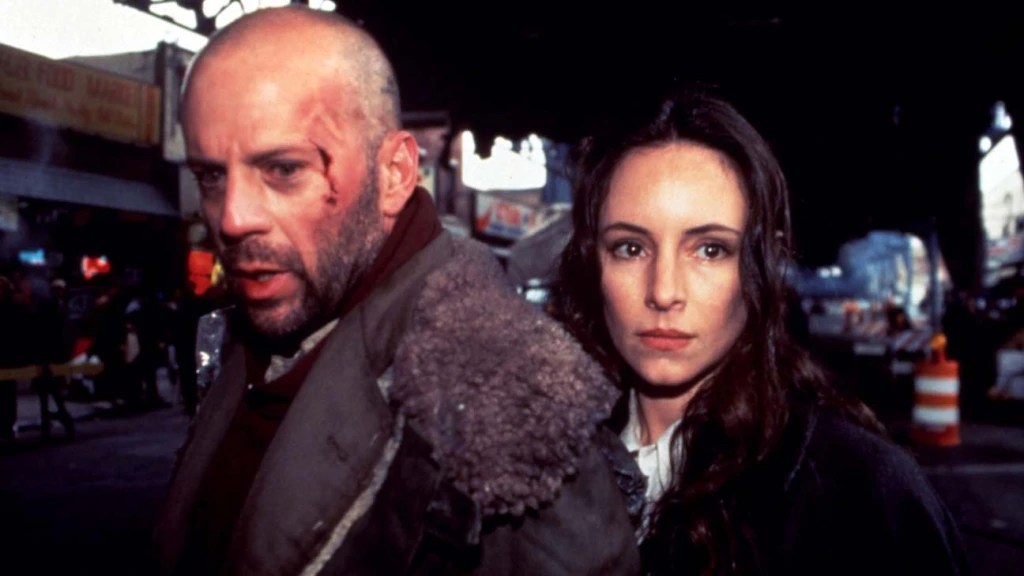
Wrong. Time travel messes with your mind, making it hard to tell what’s real and what’s not. The travellers are penal “volunteers”. James Cole (Bruce Willis) is selected as he has a photographic memory and a strong memory from 1996 of witnessing a Philadelphia airport shooting, that will help send him back. However, he’s flung back to 1990 and thrown into an asylum, treated by Dr Kathryn Railly (Madeleine Stowe) and sharing a room with environmentalist Jeffrey Goines (Brad Pitt). Rescued and correctly sent to 1996, can Cole convince Railly he’s telling the truth and track Goines who has become the leader of the 12 Monkeys?

12 Monkeys is one of the most intriguing time-travel films ever made – and its future, ripped apart with plague, seems chillingly closer today. It puts a vulnerable, scared person at its centre – and makes him a dangerous, inarticulate Cassandra who reacts with violence when no-one listens him (which they never do). It repeatedly tells us things cannot end well, but still gets us hoping they might anyway. It presents puzzles that provoke debate and stretch the imagination.

Gilliam’s most main-stream film is an eccentric, unsettling, tricksy film that juggles time travel and paradoxes, as well as mental health and the nature of reality. Shot with a Dutch-angle infused oddness – reflecting its hero’s mental unbalance – and scored with a French-inflected whirly-gig musical theme that is reminiscent of the demented street people that pepper the film (and may, or may not, be other unbalanced time travellers), it constantly puts you on edge and unsettles.

This extends to its casting, which takes two Hollywood superstars – Willis and Pitt – and deglamorises them to a shocking degree. As Cole, Willis is shambling, vulnerable, scared and struggling to distinguish between reality and fantasy. An 8-year-old boy when the virus destroyed the world, in a way he’s never grown up. He looks around the world of the past with a wide-eyed wonder (he adores the sun and the feel of the soil beneath his feet) but has the stroppy impulsiveness of a maladjusted teenager. He’s so twitchy and insecure, you start wondering if he is the mentally disturbed man who imagines he’s from the future, that his doctors think he is. It’s Willis’ least-Willis performance ever and one of his finest.

Similarly, Pitt pushes himself as the disturbed, aggressive Goines. Prone to obsessive rambling, that stretches Pitt’s languorous vocal register (he trained for months to improve his vocal range), Pitt’s performance is wide-eyed, unpredictable and unsettlingly dangerous. With a single eye swollen and askew, it’s a performance that plays with being OTT but manages to work because he mostly avoids actorly showing off. Madeline Stowe, by contrast, has the most difficult role as the ‘normal person’, a sceptical psychiatrist becoming more and more convinced Cole is telling the truth.

Of course, despite the film’s efforts to play with reality, the audience are always pretty certain he isn’t wrong about the future. But, with the sight of fellow deranged time travellers, not to mention Willis’ vulnerable performance, that Cole could still be crazy. Even if you are right, doesn’t mean you are sane.

Gilliam’s surrealist future helps with this. Every time Cole is pulled back to 2035, the world becomes ever more deranged. Is his grip on reality eroding, as he is feared it is. Design wise the future is a triumph – but it also seems eerily similar to the 1990 asylum Cole is in. Has the building, and the things in it, been repurposed in 2035? Or, as the scientists of 2035 become ever more surreal (including serenading Cole at one point in a Dennis-Potteresque fantasy), questioning Cole via a circular floating series of TV screens while he sits in a suspended chair, is Cole’s grip on reality gone?

It keeps the tension up in the ‘past’ plotline, even as the things Cole has seen in the future – strange messages on walls, photos, voicemail messages – accumulate. 12 Monkeys is a fascinating time-travel movie, that establishes from the very first moment it is impossible to change the past (something the audience, like the characters, get sucked into forgetting). After all, if the plague was stopped, then time travel would never be invented in the first place. All Cole, and the other travellers, can do is collect information.

But that doesn’t stop the future influencing the past. Goines decides to form the 12 Monkeys based on a conversation with Cole in 1990. Dr Railly becomes fascinated with apocalyptic predictions – writing a book that will influence the man planning viral annihilation in 1996 – only because she meets Cole. And, above all, 2035 Cole’s presence in 1996 leads to that strong childhood memory happening in the first placce. The final reveal of the meaning behind Cole’s recurring memory-dream is the perfect example of a time-loop closing (so much so the scientists in the future bend over backwards, giving Cole a doomed mission, to ensure it happens).

It also explains why he is drawn towards Stowe’s Railly, who resembles (with the exception of her lack of Hitchcock Blonde hair) the woman in his dream. The relationship between Cole and Railly develops into a slightly forced romance (it feels like a script requirement, for all Gilliam’s taking the characters to watch Vertigo to hammer home the obvious contrasts). But when it focuses on two people drawn together for reasons they can’t quite understand (and there are hints of predestination) it just about works. That and the commitment of both actors to the roles.

12 Monkeys is about 15 minutes too long (it’s 1990 section outstays its welcome), especially as the audience is never in doubt that the plague is real (after all this is a movie). But Gilliam keeps us on our toes with how confident we feel in Cole: we’re repeatedly shown he’s violent, inarticulate and impulsive. The final half of the film, where the origins behind events we have been shown or heard in the first half, is fascinating. The tragic turns of the film’s paradoxical temporal loop is brilliantly executed and haunting. Gilliam’s film is quirky, unsettling and a design triumph: but it also tells a fascinating story. It’s his most accessible and crowd-pleasing film.

Tenet (2020)

John David Washington has to save the world in the tricksy Tenet

Director: Christopher Nolan

Cast: John David Washington (The Protagonist), Robert Pattinson (Neil), Elizabeth Debicki (Katherine Barton), Kenneth Branagh (Andrei Sator), Dimple Kapadia (Priya), Himesh Patel (Mahir), Aaron Taylor-Johnson (Ives), Michael Caine (Sir Michael Crosby), Clémence Poésy (Barbara), Martin Donovan (Fay), Fiona Dourif (Wheeler), Yuri Kolokolnikov (Volkov)

SPOILERS: I’ll be discussing Nolan’s film, which was kept so secretive, that even revealing what it is about might be considered a spoiler. So if you want to experience the film as intended, watch it first!

Tenet, at this rate the only blockbuster that is going to be released in 2020, was given the mission to save cinema from coronovirus. Match that with the near religious regard Christopher Nolan is held in by fans of cinema, and you had a major cinematic event on your hand. Is Tenet the second coming of cinema? Well of course not. But it is an enjoyable, if frustratingly tricksy, film shot on a jaw-dropping scale. If you ever had any doubt about whether Nolan grew up watching Kubrick intermixed with James Bond, this film dispels it.

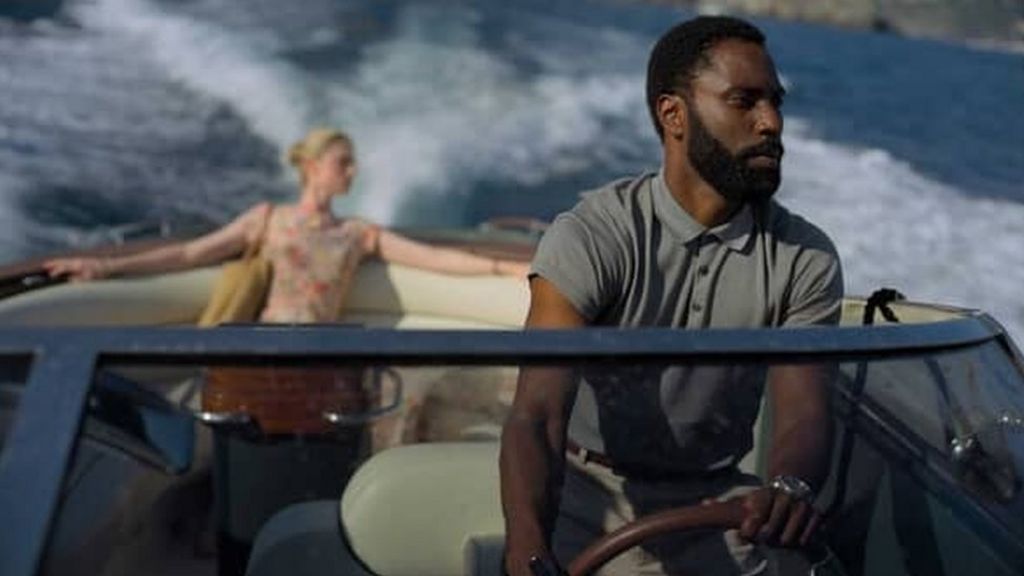
Our entry point in the story is an unnamed character – he calls himself The Protagonist of the operation – played by John David Washington. A CIA agent, left critically injured after an operation at the Kiev Opera, is recruited to work for a mysterious organisation, Tenet. He discovers that Tenet is dedicated to preserving mankind in a war that is taking place across time. The tools of this war are “inverted” bullets and other materials. These bullets both backwards through time – explosions reform and bullets return to the guns that fired them. The Protagonist discovers that the inversion bullets are being funnelled through arms dealer Andrei Sator (Kenneth Branagh). Sator is working with a faction from the future, planning to invert time in order to save their world from destruction. Sator also has access to machines that can invert people, allowing them to move physically backwards through time giving him huge advantages in forging his empire and in collecting the components of a time-inverting super weapon that will destroy all life in our present and past.

Confused? Well as characters frequently say throughout the film – don’t think about it too much. I’ve seen Nolan’s epic twice. It’s a film that revolves around Temporal Pincer Movements – military tactics that use normal and inverted people moving backwards through time. The “forward” team lives through the events. The “Inverted” team move backwards, seeing events from the end backwards, supplying real-time information to the forward team. Those carrying out a Temporal Pincer Movement know the exact timeline of what is to happen and are therefore almost unbeatable.

Watching the film twice, I realise it places the viewer in the same position. First time I was lost in the maze of the film’s rushed explanations, hand-waved time mechanics and confused by working out who was inverted and who wasn’t at any one time. Watching the film a second time, knowing the plot, I did a Temporal Pincer Movement on it myself – my “past self” who knew basically how the film ended, helped my second viewing self to understand what was happening.

So you’ve kinda got to watch it twice to understand it properly. Or at least to begin to. Second time around you also know which details are important and which to ignore, which explanations are crucial to its understanding and which are not. Second time around I noticed a lot more how characters, such as Clémence Poésy’s scientist, who introduces inversion, stress “don’t think about it too much”. The science of it all is basically a red-herring. There is talk of various predestination and grandfather paradoxes (as you might expect in a world where the future is plotting to destroy the past). Again, second time around I realised: don’t worry about it too much. 

So the question is, will people rush to see the film a second time around to understand it better? I’m not entirely sure they will. And I think that’s because, unlike Nolan’s other films, Tenet lacks heart. Here’s a man who has been praised for the ingenuity of his films going a little too far. Look back at Nolan’s other films and underneath the trickery and “timey-wimey” there is a core of a beating human heart. Inception and Interstellar, at heart, are about a man trying to reunite with his children. Memento, a man mourning the loss of his wife. Dunkirk, frightened young men trying to get home. In Tenet, there is none of this. It’s literally a film about time-scheneanigans with a huge Macguffin at the middle that will wipe out the world. The Protagonist is just what who he seems, a character who (engagingly played as he is by John David Washington, very good) we feel so little connection with that you could easily not notice we don’t learn his name.

It’s this lack of heart that really weighs the film down. How much can we really care in the end about a world-ending Macguffin so briefly explained, we just take it on trust that it’s bad? Tenet is burdened by Nolan’s slightly-too-pleased-with-itself cleverness, as events are played and replayed from multiple angles throughout the film, in a way that demands repeat viewings rather than giving the first-time viewer more knowledge in each scene. If you fall for this sort of thing, then you will fall hard. But, Nolan’s other mega-hits charmed viewers because they cared about the characters at its heart, not the elaborate tricks about time and memory. We wanted to see DiCaprio find his kids, we wanted those boys on the beach to get home – and people were happy to let other things wash over them slightly, because the emotion was how they interpreted the story. Without that heart, the film is a massive, showy trick – and a bit empty as a result.

Which isn’t to say that Nolan doesn’t shoot the hell out of it, or that the scope of it isn’t incredible. It’s where his Bond influence comes in. Because while half the time, he’s paying homage to Kubrick’s mastery and precision – or wonderfully, with its early scene of objects moving backwards and thick rubber gloves, Cocteau’s Orphée – the other half is straight out of Roger Moore. Massive bases. Huge car chases. Big shoot-outs. A Russian villain who could have walked out of Spectre and straight into the film. Flemingesque touches with the hero infiltrating the villain’s world, taking part in a sport with him. A woman at the middle who has a foot in the camps of both hero and villain. This is all Moore-era Bond, repackaged with a sprinkling of PhD Physics.

If there is a heart in the film, its Elizabeth Debicki’s abused wife of Kenneth Branagh’s lip-smacking villain. The film’s most effective character scenes revolve around this pair, and the destructive, possessive ‘love’ of Branagh’s Sator, a man must possess or destroy a person. The film captures neatly the perverted “love” Sator claims to have for a woman he abuses, beats and terrifies – and Debicki beautifully captures the mix of shame, hate and fear people in such situations often feel. Nolan must have enjoyed BBC’s The Night Manager, as Debicki repackages her role from that film almost exactly, but given the most emotional and heartfelt plotline in the film, she becomes the one character you really care about and invest in. A better film might have put her even more front and centre.

Instead though, the action around time dominates, with Nolan’s brilliantly mounted action scenes that mix forward and backward motion with staggering (and seamless) effect. It’s yet another reason to see the movie twice. The film is big, loud and demanding – often too loud, with dialogue frequently drowned out (a problem you notice less second time around when you have a much better idea about when to concentrate and when to look away). The cast do terrific work. Washington is very assured as the lead, playing with wit and grace. Debicki is a stand-out. Robert Pattinson brings a quirk and originality to a role that has very little to it on paper. Branagh has been more controversial for his Bond-tinged Russian baddie, but I found a chilling horror in his domestic abuse and selfishness that works extremely well (again particularly second time around). Pattinson brings a playfulness to an underwritten role.

Tenet may not rework cinema – and I doubt it would make a top five list of Nolan’s best films – it’s bold and challenging, if a little cold and heartless. While demanding a double viewing, it’s not quite clear if it will make you long to see it again too quickly. But if you take the effort to do so, you will find a film that grows on you more with repeated viewing – and reveals its deliberately impenetrable mysteries much better.

Back to the Future Part II (1989)

Marty and Doc head to the Future at last – alas – in the weak middle chapter Back to the Future II

Director: Robert Zemeckis

Cast: Michael J Fox (Marty McFly/Marty McFly Jnr/Marlene McFly), Christopher Lloyd (Emmett Brown), Lea Thompson (Lorraine McFly), Thomas F. Wilson (Biff Tannen/Griff Tannen), Elisabeth Shue (Jennifer Parker), James Tolkan (Strickland), Jeffrey Weissman (George McFly), Flea (Needles)

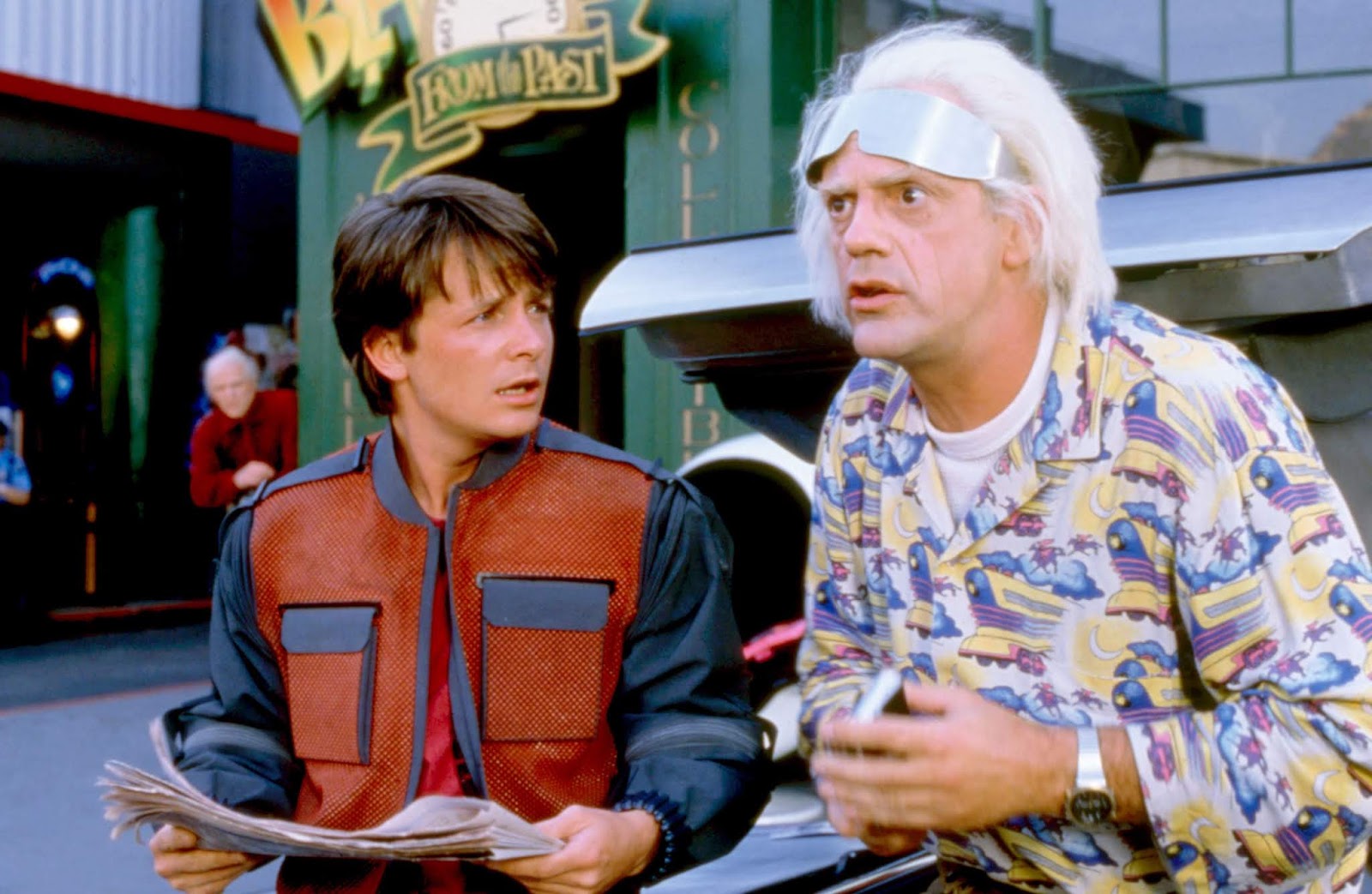
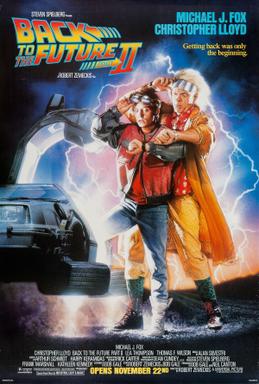
After the smash hit of Back to the Future a sequel was inevitable – particularly with that hook ending with our heroes zooming off into the future to fix Marty and Jennifer’s kids. Back to the Future Part II is often fondly remembered for its journey into 2015, a typically 1980s view of what the future might be like, but this is journey is mostly a slightly embarrassing mess that the film has to spend quite a bit of time getting over before the plot can start in full.

The journey into the future is largely a narrative cul-de-sac, which is mostly there to introduce a Sports Almanac covering 1950-2000 which Marty (Michael J Fox) picks up in an antiques store with an eye on placing some bets in the future. He’s firmly told by Doc (Christopher Lloyd) not to mess with the timeline, but that’s never here nor there to Old Biff (Thomas F. Wilson), who pinches both Almanac and DeLorean to head back in time to 1955 and handover the Almanac to his younger self. Which means when Marty and Doc return to 1985 from 2015, having not noticed the theft and return of the time machine, they find 1985 has been transformed into a nightmare dystopian world where Los Angeles is ruled by multi-billionaire Griff. So it’s back to 1955 to repair the timeline again – and this time dodge round their younger selves who are still going through the events of the first film. 

Zemeckis and Gale, it’s pretty clear, actually wrote themselves into a bit of a corner with their visit to the future. Firstly, the problem with the kids turns out to be fairly quick and easy to solve. Secondly, they are stuck with Jennifer (Elizabeth Shue replacing the unavailable Claudia Wells) who is instantly unceremoniously knocked out not once but twice in order for her not to be a third wheel on the boys adventures. Thirdly, the real interest and delight of these time travel films is seeing the past through the perspective of the present, and we lose that completely in a silly painfully of its time vision of the future. Gale himself had ruled out visiting the future in the first film, because all visions of the future date quickly on film – so it’s a shame he didn’t listen to himself.

The future sequence of the film is honestly pretty awful, in the midst of a film that takes a long time to get going and then relies very, very heavily on recreating the first film either spiritually (several set pieces in the future echo the first film, from feuds in a diner to the skateboard chase here done with a hoverboard) or literally (the third act of the film is a point-by-point recreation of the first film from different angles). The future sequence lacks any real point or drive, other than to establish two plot points: the sporting almanac and how Marty’s character flaw of pride leads him to take stupid, self-destructive risks. 

Other than that it’s an increasingly embarrassing look at what a 1980s person thinks the future might be like – flying cars, hovering skateboards, strange futuristic clothes, cybernetic implants, loud, bright colours – it’s all there. Sure there are some things correctly predicted – principally the idea of something approaching the internet and video calls – but the attempts at presenting a humourous view of the 2010s falls flat. This isn’t helped by the desperate mugging of several of the actors – none worse than Fox sadly, who plays his whiny Grandson, a latex covered middle aged version of Marty and (worst of all) his granddaughter – straining for laughs, but missing completely. It’s a cheesy, awkward sequence that says more about the hang-ups of the 1980s than anything else.

The film only starts to pick-up when we head back to the hellish Mad Max version of 1985 caused by Biff’s meddling. Sure it’s also an excuse for retreading some other elements of the previous film – and conveniently means that George McFly can be killed off, resolving the problem of working around a second recasting after the difficult to work with Crispin Glover turned down the film – but at least it kicks a bit of a plot going, away from the more feeble moments and overacting in the future section.

Which it brings us to the final act as the film reworks, reimagines and represents the events of the first film once again. I’m split on this between it being a fun, fresh idea of looking again at a beloved film (as well as opening up some comedy opportunities to play on the viewer’s expectations) or a sign of the well running dry. Either way it works a lot better than the future sections of the film, even if again the narrative structure is an almost exact re-tread of the first film, once again showing Marty trying to juggle events to get the outcome he needs and a race against time ending that culminates in a bolt of lightning and a cliffhanger.

There are some fun moments in the film, but Back to the Future II generally falls between two stools, trying to tell a new story while also setting up Part III. I appreciated more watching it again the way it carefully sets up themes and ideas for Part III – from Eastwood avoiding death in a shootout on a TV screen (the same way as Marty will) to establishing Marty’s character flaws that the third film shows him struggling to overcome. But it’s a slightly cheesy, slapdash film – short as well, as the opening 5 minutes are a reshoot of the first film and the last five are a trailer for Part III and the credits. It feels like Gale and Zemeckis felt forced to deliver the future against their will, and then spend the rest of the film course correcting to bring us back to the Past.

Back to the Future (1985)

Michael J Fox and Christopher Lloyd head to the past and back in the ever beloved Back to the Future

Director: Robert Zemeckis

Cast: Michael J Fox (Marty McFly), Christopher Lloyd (Dr Emmett “Doc” Brown), Lea Thompson (Lorraine Baines-McFly), Crispin Glover (George McFly), Thomas F. Wilson (Biff Tannen), Claudia Wells (Jennifer Parker), James Tolkan (Gerard Strickland)

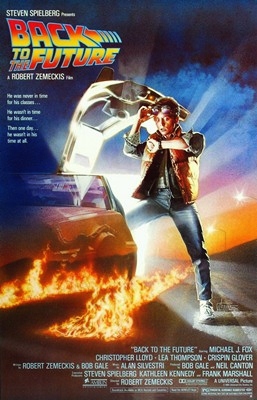
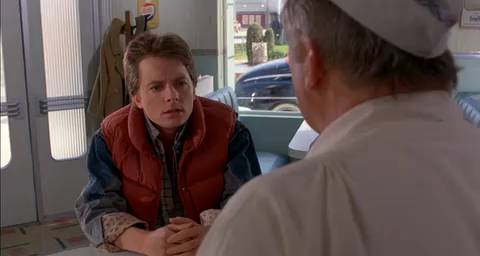
In the tentpole 1980s film icons, few films are as beloved as Back to the Future. With the highest of high-concepts, it could easily have alienated people – or felt a little bit silly – but instead it’s a perfectly structured entertainment, a wonderfully assured combination of light comedy, drama, science fiction, farce and adventure. It’s one of those rare films that doesn’t have a wrong beat in it.

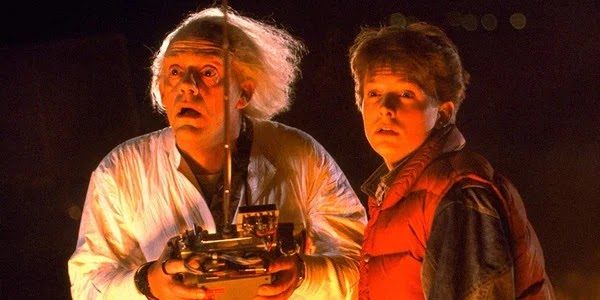
Set in 1985, Marty McFly (Michael J Fox) is a your typical teenager, cool, loves rock music, has a great girlfriend Jennifer (Claudia Wells) – and is worried he’s going to turn out like his parents, his weak father George (Crispin Glover) bullied by his supervisor Biff (Thomas F. Wilson) who never amounted to anything and his depressed mother Lorraine (Lea Thompson). His friend, eccentric scientist Emmett “Doc” Brown (Christopher Lloyd) ropes Marty into tests of his latest invention – a time travel machine built into a DeLorean car. When the first test is interrupted by angry Libyan terrorists – furious that Doc used their investment and stolen plutonium to build a time machine rather than a bomb – Doc is killed and Marty escapes in the DeLorean, accelerating to 88mph and accidentally throwing himself thirty years into the past. There he meets his parents, disrupts their first meeting and finds his mother falling in love with him and his father a weakling who he has to teach how to become a man and win his mother’s love – all while finding the help of the younger Doc to return him to 1985. 

Back to the Future has a tricky concept but a remarkably simple story which revolves around completely relatable ideas and questions. Who hasn’t wondered what your parents were like when they were young? Would you get on with them? How different would they be from the adults you know? These ideas are all caught – and told with maximum comic and dramatic impact – in Robert Zemeckis and Bob Gale’s superbly constructed script.

The secret really is in the cooking of that script – nearly five years in the making – where every single scene serves a clear purpose, and all the plot points sprinkled through the first twenty or so minutes or brilliantly pulled into effect in the rest of the film. With skilfully swift and economic story telling us all the information we need to know about Marty, his interests and skills, his parents – not to mention all the hundred and one other things happening in the film – so that as each careful plot point sprinkled through the film comes into effect it’s instantly satisfying and convincing. As director Zemeckis also gets a perfect conveying of the film’s tone of light comedy, even more surprising since it frequently touches on darker themes (murder, incest and rape for starters!) but never once feels like it’s tone is falling all over the place.

The film has a brilliant Frank Capraesque film of the strength of how one person can make a difference – both for good and bad. By arriving in the past – and with his confidence, bravery and shy decency – Marty at first ruins his parents meeting and then (almost without realising it) builds up both of them to head-off the mistakes they will make in their lives. Most obviously in his coaching of the timid and frightened George into someone who will have the confidence to make his own choices and go after the things he wants. The grooming of luckless loser George into someone who will stand up (eventually) against the brutality of Biff (a swaggeringly vile Thomas F Wilson) is particularly affecting, Crispin Glover to be commended for making a character who is wimpish and frustrating but not unlikeable. Lea Thompson also does great work as a sweet young girl, who’s more daring than she appears.

The film’s real success though is tied directly into the casting of Michael J Fox in the lead. Fox was born to play this role, the film effectively a showcase for his timing, ability to throw just enough shade and emotion onto scenes to keep them real, and above all his almost unparalleled skills as a light comedian. Originally unable to play the role due to a scheduling clash with his sitcom Family Ties, Fox was only bought on board after three weeks when backup choice Eric Stoltz proved unsuitable for the role (by his own admission). The entire film was shot either at night or the weekend to allow Fox to shoot after this 9-5 commitment to Family Ties was finished. And thank goodness because Fox makes the film.

He also has superb chemistry with Christopher Lloyd (graciously stooping for the whole film so he could fit in the same frame as the famously diminutive Fox). Lloyd, another great comedian with the instincts of a natural actor, channelled Einstein and conductor Leopold Stokowski as Brown, making him a larger than life eccentric who still feels like a real person. These two actors spark off each perfectly, adding a huge amount of comic and dramatic force to their rat-a-tat dialogue. Fox’s skill in understanding the light drama tone – and making what was already a very strong script comedy gold – as well as his ability to be immediately relatable to viewers is what makes the film an eternal success. 

That and it’s simple themes. The joke of travelling back in time and having your mum accidentally fall in love with you is perfectly judged, being just the right amount of icky (Fox’s horrified discomfort is hilarious) without being unsettlingly disturbing. The reconstruction of the tone and vibe of the 1950s is perfect – with Marty’s more hip 1980s style juddering up against the picket fence Americana of the past. There is plenty of humour from watching Marty “invent” everything from the skateboard (in a hilarious but gripping chase sequence) to rock and roll music. But it all works because the film is very heartfelt and genuine and very sweet.

Not only that but when it wants to be it’s also exciting and dramatic. The final resolution of George’s rise to manhood carries a real sense of threat as well as a cathartic moment of violence. The film’s final sequence as Doc and Marty race against time to channel a lightning strike to get the Delorean back to 1985 is truly exciting, helped as well by Alan Silvestre’s perfectly judged musical score (and thank goodness for executive meddling that nixed Zemeckis original idea of a Nevada test site and the time machine being built into a fridge). It all works as such an entertaining package you don’t even think about the fact that, as Marty returns to a radically altered family life in 1985, he won’t share any memories with his parents and siblings.

With a star actor taking on the role he was born for – and Fox was never better again, perfectly charming, endearingly sweet, cocksure and cool – Back to the Future has been entertaining audiences for almost 35 years – and it will carry on entertaining them the more we head into the future.

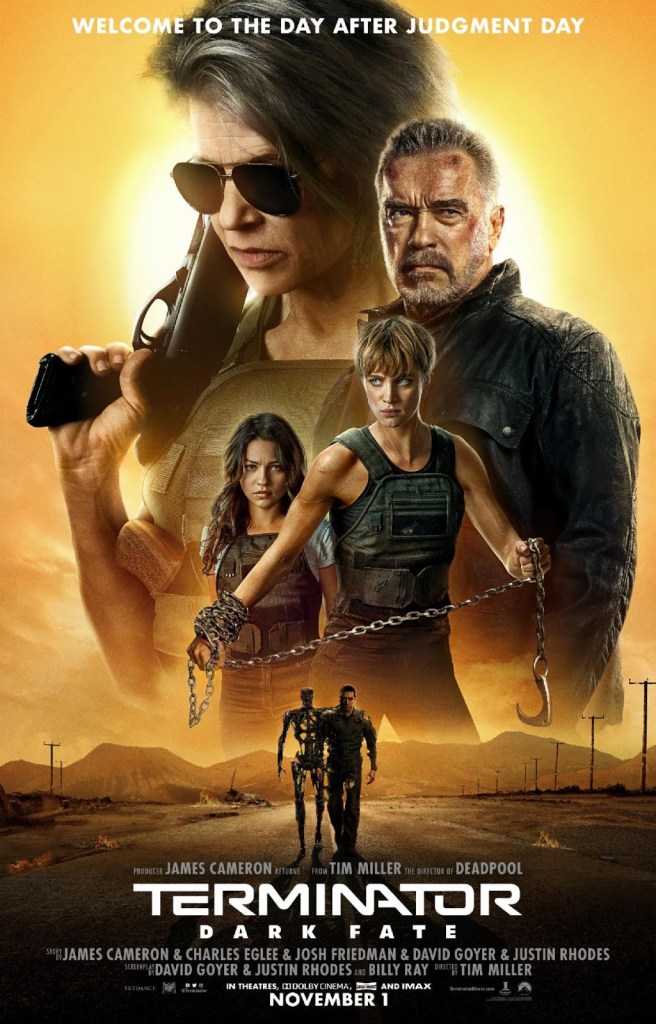
Terminator: Dark Fate (2019)

Terminator: Dark Fate (2019)

Even re-uniting Hamilton and Arnie couldn’t save this from an (undeserved) Dark Fate

Director: Tim Miller

Cast: Linda Hamilton (Sarah Connor), Arnold Schwarzenegger (Carl), Mackenzie Davis (Grace), Natalia Reyes (Dani Ramos), Gabriel Luna (Rev-9), Diego Boneta (Diego Ramos), Tristan Ulloa (Felipe Gandal)

It should have been a hit. The third attempt in the last ten years to restart the Terminator franchise, after no less than two cancelled planned trilogies, this one bought back James Cameron in a producing and story capacity, pulled in Linda Hamilton to return as Sarah Connor for the first time in nearly thirty years and finally seemed to be the “true” Terminator 3. But it bombed anyway, worse than either Salvation or Genysis and finally put paid (probably) once and all for the franchise. How did it come to this?

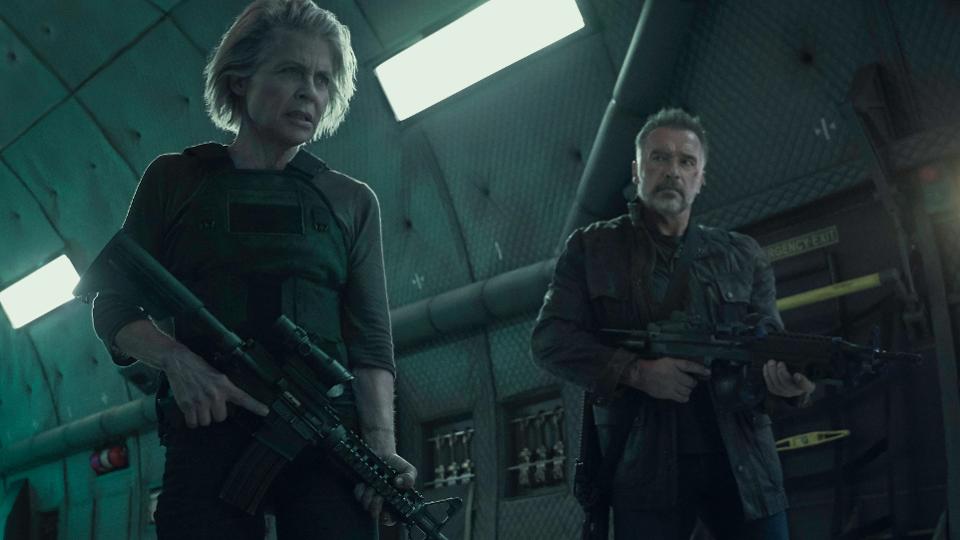
In 1998 a T-800 Terminator (Arnold Schwarzenegger) – one of a number sent back in time by Skynet before erased from history by our heroes in Terminator 2 – finally succeeds in killing John Connor (a CGI recreation of Edward Furlong from T2), leaving Sarah Connor (Linda Hamilton) distraught. Twenty-two years later and a new artificial intelligence from the future, Legion, has sent back a Terminator (Gabriel Luna) to wipe out a pivotal future figure for the human resistance Dani Ramos (Natalia Reyes), with the resistance once again sending back its own champion Grace (Mackenzie Davis), an artificially enhanced human. The inevitable combat between man and machine is on again, with Grace and Dani joining forces with Sarah Connor, as well as other unexpected allies.

That paragraph probably gives you a sense of what’s good and what’s bad about the film. Starting with a twist that seems to finally try and send the franchise off in a new direction – the eradication of John Connor, the person every film has been about protecting – is a brave decision. The confirmation that eternal enemy Skynet has indeed been erased from history finally changes the enemy. Arnie’s T-800 is confirmed as literally the last in existence – a killer sent from a future that now no longer exists. It looks like we are set for something entirely different.

And then of course we aren’t. Because it seems man’s reach will inevitably exceed his grasp, just as would-be Terminator film producers will always overreach themselves. Even with Skynet gone, there must always be some artificial intelligence super-computer that destroys the future, there must always be some sort of special one who must be protected at all costs, always a hero sent from the future who knows more than they can say and always an Arnie Terminator on hand for good or bad. Just as Genysis tried to re-set the table, but only reminded us what a small world is, this film tries to shake up the pieces but then replaces most of them with like-for-like and throws us into a film that has effectively exactly the same structure as the first two films.

So, after that opening scene twist, we get the arrival and meet up of the two future warriors, a scrap at an everyday setting for her hero, a series of shocked reveals about the future, some gonzo chases (this one does at least up the anti – literally – by setting one of them in a plane), a lull in proceedings while our on-the-run heroes work out whether they can trust each other, then a final smackdown in a factory where self-sacrifice is all the rage. For a film that tries to do something new, it is remarkably conservative and shows that for all the time-travel inspired gymnastics of the universe it operates in, the series is strictly tied to a set number of rules and plot mechanics.

But it’s all really confidently told. That’s almost the tragedy. This is a pretty good film. Easily the third best Terminator film made. I actually pretty enjoyed it. It has a simple narrative drive to it, an old-fashioned world where the characters throw each other about and punch each other really hard into things rather than engage in balletic, choreographed fight scenes. Tim Miller directs the whole thing with a pace and drive and if Cameron feels like he may have only really been happy to attach his name to the whole thing in return for a few story ideas and a paycheque, at least it can boast it has his definite seal of approval.

The acting is also pretty good. Linda Hamilton is a welcome return, getting some fascinating beats of intense drive mixed with deep grief. It’s a great to see an action film like this front-and-centre female characters so much. It’s a shame that this is such a franchise with such a masculine reputation, as this realignment has probably not had the impact it could have had in bringing new people in. Mackenzie Davis is impressive as Grace, Natalie Reyes growing in confidence and strength as the new messiah. Even Arnie gets to do something very different with his T-800 characterisation (after 22 years of living as human, the robot has changed beyond all recognition from the remorseless killer), not least seeing him successfully terminate a target for the first time in the franchise. 

It’s just a shame that this energetic re-telling of an old story probably suffered above all from franchise exhaustion. After reboots and restarts from Salvation to Genysis have seen their plotlines, developments and future sequels sent to the scrap heap (certainly the last two) it really seems a case that once bitten, twice bitten makes us not just shy, but running scared. At the end of the day any interest and affection the franchise had from the first two films has been burned up beyond all recognition – and this film, in the end, doesn’t reinvent the wheel enough to encourage you to come back and see what’s different. It’s a shame that this sprightly entertaining film has been terminated not by its future, but by its weary, error-strewn, past.

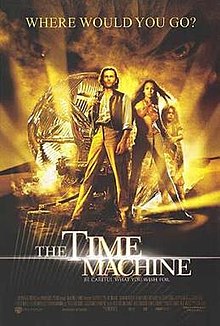
The Time Machine (2002)

Guy Pearce wastes his time in The Time Machine

Director: Simon Wells (Gore Verbinski)

Cast: Guy Pearce (Dr Alexander Hartdegen), Samantha Mumba (Mara), Orlando Jones (Vox 114), Mark Addy (David Philby), Jeremy Irons (Über-Morlock), Sienna Guillory (Emma), Phyllida Law (Mrs Watchit)

Every so often during this hysterical travesty of poor film-making, it’s worth remembering that it was was directed by HG Wells great-Grandson. If that’s not a reason for HG Wells to invent a time machine and travel into the future, in order to give his descendant a slap, I don’t know what is.

Anyway, with a plot vaguely reminiscent of some elements of the original novel, but just as inspired by a strange mixture of Hollywood blockbusters and Colin-Baker-era Doctor Who, The Time Machine stars Guy Pearce as Dr Alexander Hartdegen. In New York in 1899, Hartdegen is exactly the sort of naïve, floppy haired, genius eccentric so beloved of Hollywood movies, fascinated by time. When his fiancée Emma (Sienna Guillory) is killed in a mugging gone-wrong, obsession to prevent this leads him to invent a time machine – but he finds himself unable to prevent Emma’s death. Travelling forward into the future to find out why he eventually finds himself 800,000 years in the future where the Earth is occupied by the peace-loving Eloi and their brutal hunters, the subterranean Morlocks.

It’s hard to know where to begin with this film, but let’s try. It’s very poorly written. The dialogue clunks to the ground in a way reminiscent of the lumps of the moon that fall to the Earth in the future Hartdegen sees. There is scarcely any logic in the events we see, from the mechanisms of time travel to computers lasting hundreds of thousands of years with no identifiable power source. Characters tend to do things because the plot needs them to do it, rather than for any actual logical reason. Character development occurs with a randomness: Hartdegen starts the film as a buck toothed, shaggy haired “eccentric” and ends it as a ripped, action-hero haired heartthrob. No idea how that progression is meant to work, but you certainly won’t find the answer in the script.

It’s also poorly directed. Wells, working for the first (and only) time with live action actors has no idea at all about how to set a film’s tone or pace. The tone veers wildly from lowbrow comedy to highblown tension from tragedy to farce. Scenes that are meant to pluck the heartstrings will bring out tears of laughter. The actual comic bits will only bring out groans. Action scenes late in the film are shot with a ham-fisted bluntness that reduces them to laughable, cheesy crapness. Bright lights and wide angles frequently make a film that cost over $100 million to make, look like one that cost a tenth of that. I will cut Simon Wells some slack, as he had to stand down from the production, meaning it’s final moments were put together by Hollywood Hack Gore Verbinski, who probably just wanted to be out of there as soon as possible.

Also the whole design is so stupid. It’s a sort of steam-punk cool, but with no logic applied. The time machine never moves from its fixed geographical point, so it’s just as well no one tried to build a house on it or that the moon collapse didn’t drop a pile of moon rock on top of it. The time machine itself is a wonky contraption, full of spinning metal things and odd surfaces but of course Hartgeden doesn’t even consider installing a seat belt or any head protection. The Morlock design is equally bad, bright lighting making them look more like the bastard spawn of the Orcs from Lord of the Rings and Oscar the Grouch from Seasame Street.

At the middle of it all you have the sort of bizarre cast that could only have been assembled by some sort committee asking first “who’s cool?” and second “who needs money?”. Cool is surely the only reason Samantha Mumba (yes that Samantha Mumba) ended up in this film, as a sexy Elio lady who might just make Hartgeden forget all about that fiancée he’s spent four years obsessing about. At the other end, in one of his finest performance of cash-grabbing ham, we have Jeremy Irons. I have to admire his pluck, going through a laborious (Oscar-nominated!) make-up job (albino with a brain growing down his back), but the sort of sub-Scar speechifying the Über-Morlock delivers at the film’s climax (not to mention a bizarrely wonky final fight scene) is the work of a man already mentally spending the money on restoring his new castle in Ireland.

At the centre, Guy Pearce. I think at this time Pearce was going through some sort of career crisis. He’s handsome enough to play rugged, leading-man, action heroes like the type Hartgeden becomes. But in his heart, he’s more at home playing weirdos, outsiders and oddball (witness the happiness with which he embraces the buck-toothed oddness of early Hartgeden). So God knows what he made of this, but you can sort of tell he thinks the whole thing is crap, but doesn’t know what to do other than play it with a straight-jawed commitment (he’d soon learn, as Irons has, to meet crap with ham). Copper-bottomed crap at that, the sort of crap that would normally have you running for the hills. So Pearce sort of gets his head down and just gets through it and clearly hopes to still have a career when he comes out the other side. Which I suppose is more than Samantha Mumba managed.

Events sort of happen at this film, which seems to have some sort of confused message about moving on (“Your fiancée is dead? Man up and get over it!”) and wants us to live a life of individualism even while Hartgeden sets about giving the poor Eloi the sort of post-Victorian education that eventually led to their ancestors cracking the moon in half and wrecking the world. It’s the sort of film that ends things (literally) with a bang, Hartgeden creating some sort of time bomb out of his time machine and then running super-fast away (fortunately much faster than the allegedly super-fast Morlocks. Also the shockwave decides to stop once it’s killed all the Morlocks meaning Hartgeden is only guilty of mass genocide rather than wiping out the world). 

It’s all so far away from HG Wells cautionary tale of scientific progress gone awry that you wonder if his grandson even read his book. Did HG envision one day that a film would be made where a Morlock does a head turn double take, like some sort of Seasame Street reject, a few seconds before he blows up? That Jeremy Irons would pale up to play a character who might as well be called Gruber-Morlock? That Sienna Guillory would be saved from a mugger only to be hilariously killed off camera by a horse? That the future would be the singer of Gotta Tell Ya repopulating the planet with a bored Australian actor? If HG did make that time machine, we better tell him 2002 is a year to miss.

“Where would you go?” The poster asks. “To another film” replied the cinema audience.