
Extremely bleak anti-nuclear drama, that today also serves as a rather neat climate parable
Director: Stanley Kramer
Cast: Gregory Peck (Com. Dwight Towers), Ava Gardner (Moira Davidson), Fred Astaire (Julian Osborn), Anthony Perkins (Lt Peter Holmes), Donna Anderson (Mary Holmes), John Tate (Admiral Bridie), Harp McGuire (Lt Sunderstrom), Lola Brooks (Lt Hosgood)
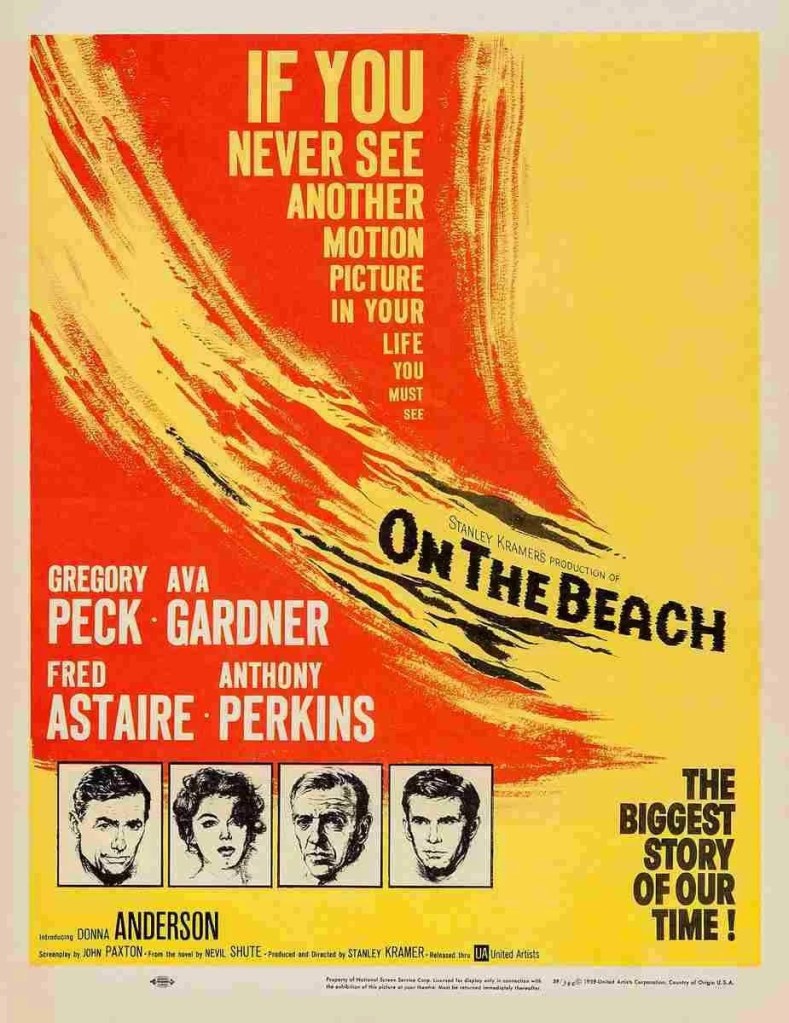
If there was a prize for the bleakest, most depressing mainstream Hollywood film ever made, surely On the Beach would be in the running. Based on Nevil Shute’s novel, it’s a grim, hope-free recounting of the aftermath of nuclear war. One that has irradiated all life on Earth, bar Australia. Which is, in any case, doomed to death by an approaching fall-out cloud of lethal doses of radiation. Not exactly a laugh a minute.
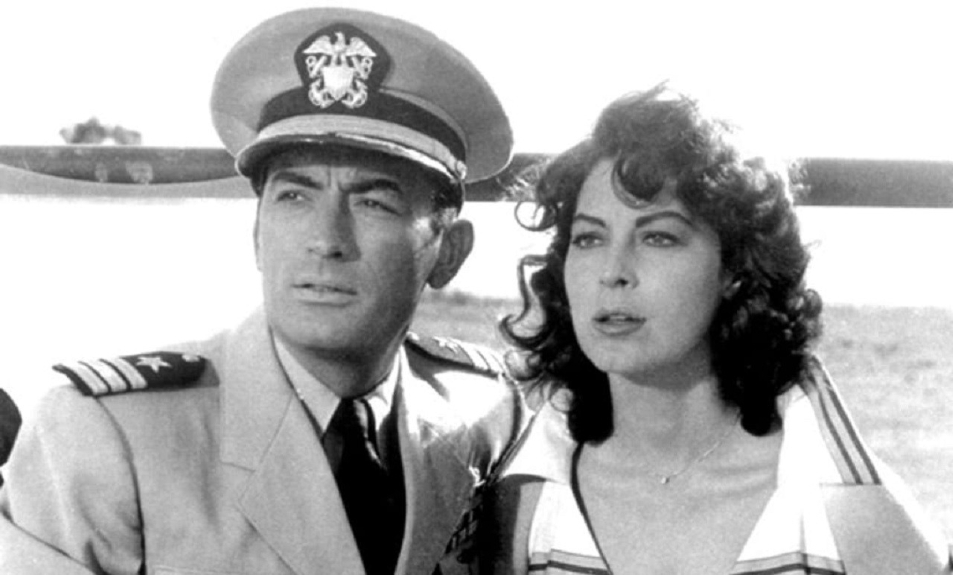
Among those spending the last few months in Melbourne, before the extermination of the human race are the crew of an American submarine captained by Commander Dwight Towers (Gregory Peck). He’s living in denial about the death of his wife and therefore can’t commit to a final-days romance with hard-drinking (and who wouldn’t be in this situation) socialite Moira Davidson (Ava Gardner). Towers is tasked with investigating two last hopes for mankind: a possible drop in fatal radiation in the Arctic and a strange morse code signal from San Francisco. Joining his crew is Australian liaison officer, Lt Peter Holmes (Anthony Perkins) worried about ensuring he and his family end things before the radiation becomes unbearable, and guilt-ridden nuclear scientist Julian Osborn (Fred Astaire) who blames himself for this mess.
On the Beach is another Kramer message movie. The message this time being that, frankly, all the official gumpf about a nuclear exchange being a sort of rougher version of the Blitz, was a pile of bunkum. On the Beach plainly shows that, no matter who starts a nuclear war (and the film avoids saying who did) we all lose. The idea that cooler heads would prevail, or America’s technological genius would stave off destruction is shown as the nonsense it is. Radiation doesn’t care who are you and when the equivalent of ten thousand suns have detonated across the world, no amount of duck and cover is going to save you.
This is lies behind On the Beach where, as the Eliot poem it takes its title from says, “this is the way the world ends/Not with a bang but a whimper”. The last days of mankind aren’t a fiery conflagration. It’s a host of ordinary people and regular joes, sitting around waiting to die. Ordinary life in Melbourne continues as much as possible. People still go to work – although, due to petrol shortages, some do so on horseback. People fuss about running out of real coffee. A few old bores in a gentleman’s club bemoan there are too few days left to get through the stock of port in the cellar.
The film itself is really a long, gentle musing on suicide. How do people decide to go? With the end nigh, the government lays on suicide pills, offering a sleep no one can wake up from. It’s the preferred option for Anthony Perkins’ sensitive naval lieutenant, struggling to get his horrified, shell-shocked wife (Donna Anderson, the only actor in the film allowed to truly submit to stunned terror) to understand the kindest thing they can do for their baby daughter is feed her some drugged milk before they end their own lives. Banners flutter in the breeze in the final days of Melbourne telling people it’s not too late to find the Lord. Others throw caution to the wind, not least the drivers in the world’s last ever F1 race who hurtle around the track with such reckless abandon, several of them meet fiery deaths with surprisingly little reaction from the crowd.
If there is something quite dated about On the Beach it’s how stoically the world faces imminent death. Perhaps not a surprise considering Shute’s background, every character straps on their best stiff-upper-lip and knuckles down to their duty. Personally, I can’t imagine I’d still be giving up most of my remaining time on Earth to the 9-5 grind. But if there is a spot of hope in On the Beach it’s that mankind can face the end of things without people turning on each other and without a hint of societal collapse (it’s hard to imagine an equivalent film today not featuring this – and On the Beach looks tame in its vision of post-apocalyptic life compared to the hell hole Peter Watkins The War Game presented a few years later).
There is a dryness to this side of On the Beach, captured you could argue by that most stoic of classical Hollywood stars, Gregory Peck. But that’s unfair to Peck, who in his best work was always more vulnerable and filled with doubt than you’d think. Dwight Towers is living in comprehensive denial, still buying presents for his wife and talking about his kid’s future (despite the certainty of their deaths) – but still eager for some form of consolation. It comes in the form of Moira, bought to life in a vibrant but subtly damaged performance by Ava Gardner. Their tentative romance is beautifully paced – and little moments, such as Towers absent-mindedly calling Moira by his wife’s name after some beachside horseplay carry real emotional impact. Peck and Gardner – close friends in real life – have superb chemistry, and their tentative, awkward end-of-days romance is both the brightest and, in some ways, saddest spot in On the Beach.
Plenty of the rest of this well assembled and well-shot film however continually reminds you of the bleak despair of the end times. This is not Kramer’s most subtle or dramatically vibrant work, but it certainly carries a bleak impact. Shots of an abandoned San Francisco, or the empty streets of Melbourne that close the film, are haunting. There are striking moments like the crewman who swims ashore to certain radioactive death in San Francisco, because he’d rather die ‘at home’ (you think the film could do with more of those moments). Kramer also gives an excellent showpiece to Fred Astaire, who still has just enough spots of twinkle behind his sad-eyed self-disgust.
But is On the Beach a little too grim, depressing and on-the-nose to work? Well yes and no. It’s easy to write off its insistence, its relentless reminder of stupidity of mankind. But then you remember how it feels we are currently sleep-walking not to nuclear death, but climate change disaster. How different are the heat waves of today, to a deadly cloud of radiation drifting over to kill us all in the future? And, just like Astaire bemoans, we all knew the danger and did nothing. Perhaps, the dangers change but the despairing relevance of On the Beach doesn’t.

