The gentlest and least action-filled of all the Star Trek films is one of its most successful outings
Director: Leonard Nimoy
Cast: William Shatner (Admiral James T Kirk), Leonard Nimoy (Spock), DeForest Kelley (Dr McCoy), James Doohan (Montgomery Scott), George Takei (Hikaru Sulu), Walter Koenig (Pavel Chekov), Nichelle Nichols (Uhura), Catherine Hicks (Dr Gillian Taylor), Mark Lenard (Sarek), Jane Wyatt (Amanda), Robin Curtis (Saavik), Brock Peters (Admiral Cartwright), John Schuck (Klingon Ambassador), Robert Ellenstein (Federation President)

Most people’s Bingo cards probably didn’t have “biggest Star Trek hit film is about saving Whales”. In fact, when I told my wife this was the plot of Star Trek IV (which she had, resignedly, agreed to watch on a Saturday night) she immediately assumed I was pulling her leg. I guess this might also be what Paramount thought when Nimoy and Nicholas Meyer pitched this: time-travel with comedy for the crew, no villain, no battles and not a single photon torpedo fired in anger. There wouldn’t even be a proper love interest. But the formula was such a surprise hit, Paramount tried to repeat the trick again with Star Trek V and promptly fell flat on their faces.
After the events of Star Trek III, Spock is back from the dead and the crew are heading home to face the music after their riot of breaking orders, sabotage, theft and blowing up the Enterprise from the last film. (Since they’ve also not changed clothes since the start of that film, they must also be a bit whiffy). Before they arrive back though, Earth is thrown into chaos by a mysterious probe whose powerful signal is draining the planet’s power. Turns out the probe is trying to contact Humpback whales – which mankind hunted to extinction in the late twentieth century. Kirk, Spock and the crew take their stolen Klingon bird of prey on a perilous time-travel slingshot round the sun back to 1986, to grab a pair of whales and bring them back to their present. But of course, it’s not that easy.
There is something very refreshing about Star Trek IV, one of the entries in the series that really attempted to go its own way. It manages to pull this off pretty well, the crew settling into the fish-out-of-water comedy of being stranded in modern San Francisco without inducing eat-your-fist levels of embarrassment in the viewer (not a trick the franchise managed in other lighter entries, such as Insurrection and of course Star Trek V). Perhaps it’s because, by and large, the cast don’t overplay or force the comedy too much and the mix of both apocalyptic dread in the future and horror of the butchery of whales in the present counterbalances the comedy rather well.
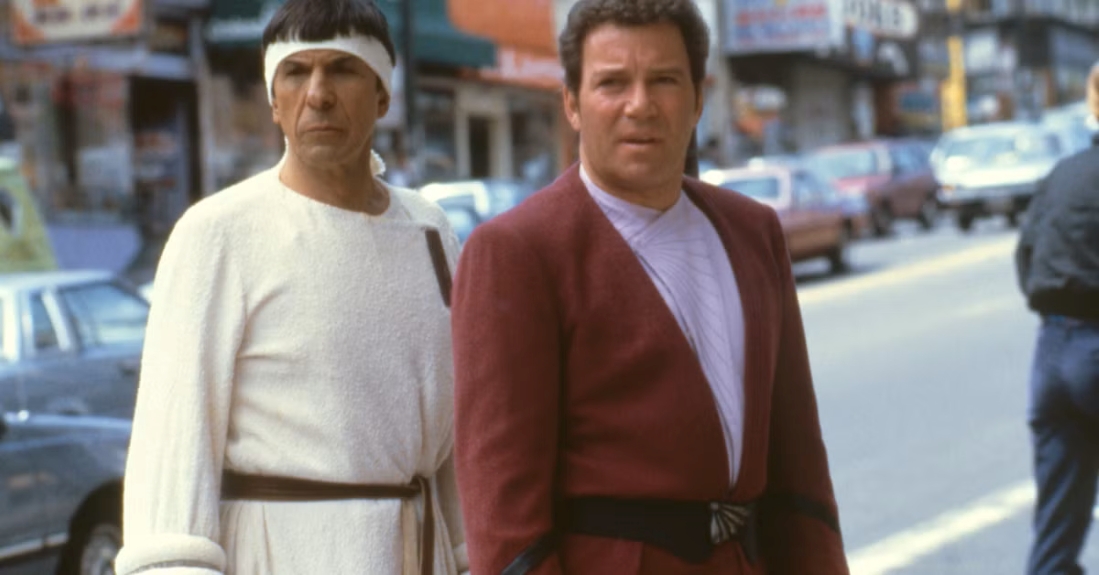
In fact, Nimoy proofs to have a deft touch (he went straight from this to directing Three Men and a Little Lady and he was pretty much button-holed as a comedy director from hereon). He latches onto the rare chance for a Star Trek film to go fully on location – surely a nice change from the blatantly papier-mache sets of the Genesis planet in Star Trek III – neatly capturing the slightly dazed characters, dodging traffic in busy San Francisco streets, grabbling with the complexity of using money and struggling with the parade of “colourful metaphors” that pepper Twentieth century speech.
There is a pleasingly family-friendly quality to all this, continued with the missions Star Trek IV splits the crew up to achieve. Each of these is well-tailored to cater to the strengths of characters and actors. Naturally, Russian-accented Chekov winds up hunting for “nuclear wessels” to re-power the ship, including a desperate chase across decks of the real battleship USS Enterprise. Nimoy also captures some neat observational comedy with Chekov and Uhura plaintively asking non-plussed passers-by for directions to a Naval base (including a blank faced cop, and a flustered extra who parrots back the naval base name in her confused directions – Koenig nailing the polite exasperation of Chekov’s bemused response).
In addition, we get a Scotty struggling to understand why he can’t talk to computer and then not caring when he hands over future technology secrets in return for free plexiglass for a whale case (timelines be damned!). Or an increasingly grouchy McCoy railing against medieval medicine in a cutting-edge hospital, subtly handing over kidney restoring medicine to an ailing granny. And, of course, Kirk and Spock chasing down whales, shouting down road hogs (“double damn ass on you!”) or neck-pinching rude punks on buses and struggling to work out when to tell the truth and when to lie.
The whale part of the Star Trek IV works rather well. Shots of the butchery of whales is quite chillingly graphic, Spock’s mind-meld with whales George and Gracie (during an unauthorised swim in the aquarium pool they live in – met with slack jawed despairing shock by Kirk) stresses the animals intelligence and empathy (these whales are not just tools to do with as our heroes please). It’s easy to see why the film helped the cause of Greenpeace no end, especially since George and Gracie’s near-fatal encounter with a ship of scruffy whalers is genuinely tense as we dread seeing a harpoon in the side of an animal we’ve grown fond of. Catherine Hicks also gives a nicely judged performance as a passionate whale expert, who also manages to see through the crew’s (not particularly well disguised) bullshit.
That’s not to forget the destructive impact of the probe in the future, as its distinctively intimidating “froom-froom” boils oceans, scorches skies and leaves starships (crewed by an ahead-of-its-time diverse series of officers) drifting in space. It’s a neat metaphor for the results of mankind’s thoughtless impact on the planet. But also, its genuinely quite exciting, just as is the crew’s risky flash back in time to the past, Takei sonorously reporting their ever-increasing speed as the ship shakes. A final attempt to save the whales from a sinking Klingon bird-of-prey does feel like it’s been chucked in to give Shatner some final act heroics. But you can cut it some slack, considering that its genuinely tense.
Above all, Star Trek IV shows that you can make a successful Star Trek film without trying to make it as much like Star Wars as possible. This is the sort of conundrum the show used to deal with all the time, cleaning up our own mess and learning lessons along the way. It also allows the cast to relax and to be genuinely engaging, without drowning us in cringe-worthy comedy. Star Trek IV is what it needs to be: a really accessible way to get into the show, that riffs on things you’re likely to be familiar with, without needing a PhD in the show’s canon. Mix that in with a well-judged (Oscar-nominated) score by Leonard Rosenman that gets the tone just right between playful and epic and the fact that all that location shooting means the limited special effects budget could be used to ace effect, and you’ve got one of the best of the franchise.