Category: War film

Kingdom of Heaven (2005)

Kingdom of Heaven (2005)

Scott’s crusader epic is a much better, more thoughtful film than you’ve been led to believe

Director: Ridley Scott

Cast: Orlando Bloom (Balian of Ibelin), Eva Green (Sibylla of Jerusalem), Jeremy Irons (Lord Tiberias), David Thewlis (Hospitaller), Liam Neeson (Godfrey of Ibelin), Brendan Gleeson (Raynald of Chatillon), Marton Csokas (Guy de Lusignan), Edward Norton (King Baldwin IV), Ghassan Massoud (Saladin), Michael Sheen (Priest), Velibor Topić (Almaric), Alexander Siddig (Imad ad-Din al-Isfahani), Kevin McKidd (Sergeant), Jon Finch (Patriarch Heraclius), Ulrich Thomsen (Gerard de Ridefort), Nikolaj Coster-Waldau (Godfrey’s nephew), Iain Glen (Richard I)

Version control: This review cover the Director’s cut of Kingdom of Heaven, a three-hour film that is much better than the original theatrical version.

For hundreds of years the Middle East has been the site of wars over land and religion: the more things change, the more they stay the same. Ridley Scott’s Kingdom of Heaven is a grand, melancholic epic about the crusades, a period of history that seems to become even more divisive and controversial if every passing year. During the First Crusade (1096-99), a European Christian army had bloodily seized control of Jerusalem (massacring its Muslim population). The Crusaders built a state that lived through fragile truces, in a constant state of cold war with the Muslim states that opposed their conquest. Scott’s film picks up the final years of that ‘kingdom of Heaven’.

He does so through fictionalised version of the events. Balian (Orlando Bloom), a former military engineer, is now a widowed blacksmith in Northern France – until Godfrey of Ibelin (Liam Neeson), a crusader lord, returns to claim him as his illegitimate son. Fleeing his home after murdering his bullying priest brother (Michael Sheen), Balian arrives in the Holy Land as the new Lord of Ibelin. But he not a paradise, but a kingdom full of ambitious lords and zealots, surrounded by the armies of Saladin (Ghassan Massoud) with the whole thing only just held together by the wise leper king Baldwin IV (Edward Norton). There is already a power struggle for who will control Baldwin’s heir, the child of his sister Sibylla (Eva Green). Will it be the moderates led by Tiberias (Jeremy Irons) or the zealot Templars led by Sibylla’s husband Guy de Lusignan (Marton Csorkas)?

I’ve always been interested in this period of history, and I’m a sucker for a grand historical epics. So I’m pretty much the target for this ambitious, luscious, flawed but engaging film. It helps when it’s assembled by a director as full of visual flair as Ridley Scott. Kingdom of Heaven is an extraordinarily beautiful film – one of those where you really could snip out every frame and hang it up on your wall. Gorgeously lensed by John Mathieson, it moves from a chilly, blue-filtered North France (a land of artistic snow fall and permafreeze) to a David Leanesque desert land, of rolling sand dunes and skies tinged with deepest blue. It’s a film of breathtaking scale, as medieval armies converge, legions of siege weapons roll up to never-ending city walls and the desert stretches as far as the eye can see.

It makes a fantastic backdrop for a film that’s tries really, really hard to take a measured, reasonable view on human nature and religion. It’s fair to say that this makes Kingdom of Heaven a very serious film (there is barely a few minutes of humour in its entire three hour runtime – a joke about Neeson once fighting three days with an arrow in his testicle is about all you’re gonna get), but it’s also nice to have a film celebrating compromise and moderation. Really, Kingdom of Heaven isn’t a true representation of the Crusader period at all – the real Balian and Baldwin would scarcely recognise the humanist liberals they become here – but as a sort of fantasia on balancing conflicting demands in a place that seems to make men mad, it’s hard not to be respect that it’s trying as hard as it is.

To achieve it’s aims, Kingdom of Heaven divides both sides of the argument into goodies and baddies. For the goodies, Baldwin and Saladin are reasonable, just men willing to strive for a world where all can worship freely. Edward Norton – unbilled under a silver mask and English accent – brings a great deal of strength and wisdom to Baldwin, matched by Ghassan Massoud’s superbly patient Saladin. On the other side, we have the “God wills it!” brigade. Admittedly on the Muslim side, they are embodied by one of Saladin’s advisors, whereas the crusaders are awash in angry, Holy War bloodlust types who believe any killing is justified if it’s in God’s name.

Kingdom of Heaven has a respect for faith, particularly when filtered through the words of characters who don’t believe painting a cross on their chest allows them to kill anyone who disagrees with them. Several times, Balian argues doing sensible, reasonable things technically against the word of the Biblewill be understood by God (if he’s worthy of the name). It playfully suggests David Thewlis’ (in an excellent performance) reasonable Hospitaler might actually be an angel, with his power to appear undetected and prodding of Balian towards doing the right thing (Thewlis even disappears into a burning bush at one point).

But, if I’m honest, much of the rest makes its points rather forcefully, showing a world where fine words are corrupted by ambition and anger. Many of those preaching faith are really motivated by a constant hunger for more –power, land, you name it. The closer a character is to the Church, the more likely they are to be either a pantomime, mustachio-twirling villain (like Marton Csorkas imperious Guy or Brendan Gleeson’s playfully-psychotic Raynald) or snivelling hypocrites like Jon Finch’s Patriach (who counsels converting to Islam and repenting later when the shit hits the fan).

Kingdom of Heaven lays out this earnest, well-meaning political viewpoint of how moderation should trump fanaticism, while filling its wonderful visuals with gorgeous costumes, stupendous sets, a brilliant score and some stunning battle sequences. But there is always a fascinating lack of hope in Kingdom of Heaven. When Balian troops up Gethsemane on his arrival in Jerusalem, he only hears the wind not the word of God. When offered the chance to save the kingdom from itself, it comes with such a morally compromised price-tag a straight-shooter like Balian is always going to say no. While his father (one of Neeson’s patented performances of weary, maverick nobility) clings to ideals, the film is perhaps best summed up by Jeremy Irons’ wonderfully world-weary performance as the cynical Tiberias: mournful, depressed and wondering what the hell it’s all been for.

It’s no wonder it’s such a savage world. Kingdom of Heaven doesn’t shirk on the medieval violence. Bodies are hacked to pieces with fountains of blood. It opens by introducing us to a regular Dirty Dozen of toughened Crusader veterans – only to slaughter nearly all of them in the first act. Death is only seconds away in this dangerous world: even sailing to the Holy Land is to risk near certain shipwreck. It’s fascinating that the film’s amazing reconstruction of the Siege of Jerusalem sees Balian fighting to make the siege so difficult that Saladin will be forced to offer terms rather than slaughter the city’s population as the First Crusaders did hundreds of years ago.

Sadly, the film’s main weakness is Orlando Bloom. Surfing the peak of his post LOTR popularity, Bloom’s limitations are ruthlessly exposed by carrying this historical epic. His delivery lacks shade and depth, he doesn’t have the charisma for the big speeches and he never convinces as either a man consumed with grief or a battle-hardened veteran (he doesn’t even remotely look like Michael Sheen’s older brother). It’s a part that needs a role of commanding presence, but Bloom doesn’t have it. It’s unlucky he also has to play off Eva Green giving a complex, well-judged performance as a Queen who learns humility the hard way (the director’s cut restores an entire plot-line for her, which adds hugely to the film’s quiet air of inevitable tragedy).

Kingdom of Heaven has a lot going for it: it looks amazing, it’s crammed with stunning scenes on a truly epic scale and gives excellent opportunities to a host of great actors. It’s an interesting, surprisingly glum exploration of the struggle to find peace. Sure, it’s view of the Crusades has very little link to do with the actual crusades and it’s a little one-sided in its views. But it’s also a thoughtful film that’s really trying to say something that’s worth hearing about moderation, all with some truly breath-taking epic film-making. It’s not a lost masterpiece, but it’s a much more impressive film than its reputation suggests.

Letters From Iwo Jima (2006)

Letters From Iwo Jima (2006)

Thoughtful, sensitive, respectful and insightful war-movie – one of Eastwood’s best

Director: Clint Eastwood

Cast: Ken Watanabe (General Tadamichi Kuribayashi), Kazunari Ninomiya Private Saigo), Tsuyoshi Ihara (Lt Colonel Baron Takeichi Nishi), Ryō Kase (Private Shimizu), Shidō Nakamura (Lt Ito), Hiroshi Watanabe (Lt Fujita), Takumi Bando (Captain Tanida), Yuki Matsuzaki (Private Nozaki), Takashi Yamaguchi (Private Kashiwara), Eijiro Ozaki (Lt Okubo)

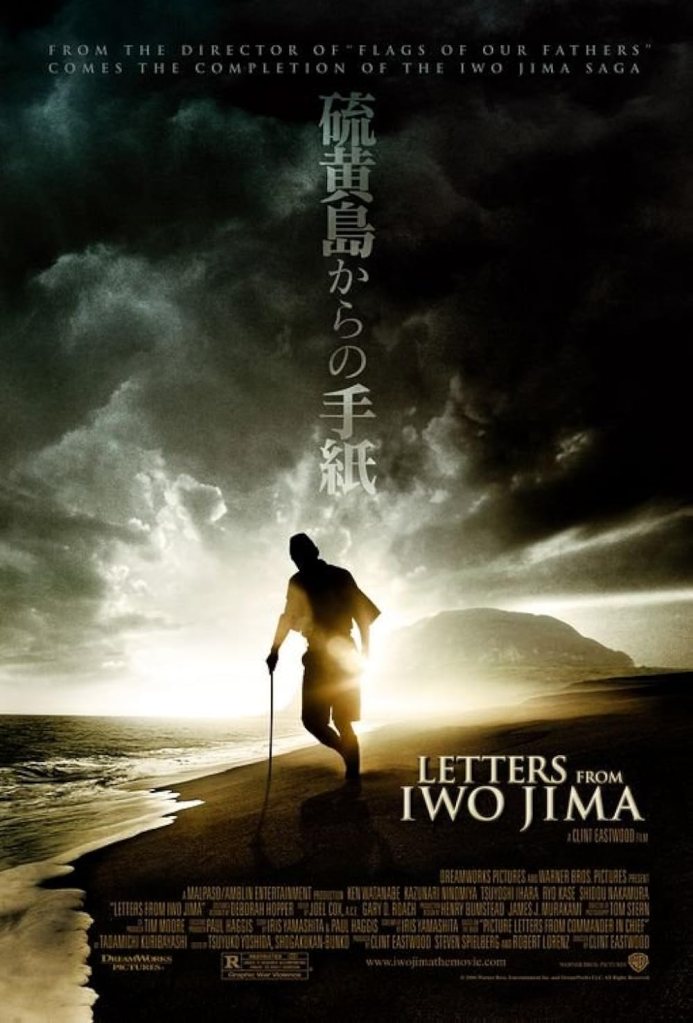
Eastwood’s original plan for his Iwo Jima epic was to tell the story from both perspectives, like a sort of Tora, Tora, Tora on the beaches. But, as the amount of story expanded and expanded, he decided to make two films (it helps being a Hollywood Legend when you change your mind like this). The American story would be covered in the melancholic-but-traditional Flags of Our Fathers, focusing on the soldiers who rose that famous flag on the peak of Mount Suribachi. For the Japanese story, Eastwood would do something more daring: tell the story in Japanese, entirely from their perspective presenting their military culture not as wicked or misguided but as a legitimate mantra as prone to extremes as the American one.

Letters From Iwo Jima is equally melancholic as its partner film, helped by its elegiac music score from Michael Stevens and Kyle Eastwood. It’s shot in a coldly austere, sepia-toned monochrome – there is barely any colour in it – and large chunks of it play out in gloomy subterranean quietness where the only sound of war is the artillery ground-pounding above the entrenched Japanese soldiers. This is the apogee of Eastwood’s moody, restrained style – perhaps he recognised and admired the reserve and formality in Japanese culture. Letters From Iwo Jima seems at first unfussy and objective so it’s a surprise how affecting and humane it becomes, all while seeing the virtues and deep flaws in a military system where the individual mattered a lot less than the whole.

Iwo Jima was a brutal fight to the death over an island less than 12 mi2, a grey rock in the Pacific that’s only value was as an air strip for launching bombing raids on mainland Japan. Over 110,000 American soldiers took on 20,000 Japanese defenders in a campaign expected to last just a few days, but dragged out over a punishing 36. The relentless Japanese defence resulted in over 25,000 American casualties and c. 90% fatalities for the Japanese. Letters From Iwo Jima explores the mentality of an army that almost completely accepted (from commanding officers down to junior privates) their destiny, no their duty, was to not survive the island’s defence.

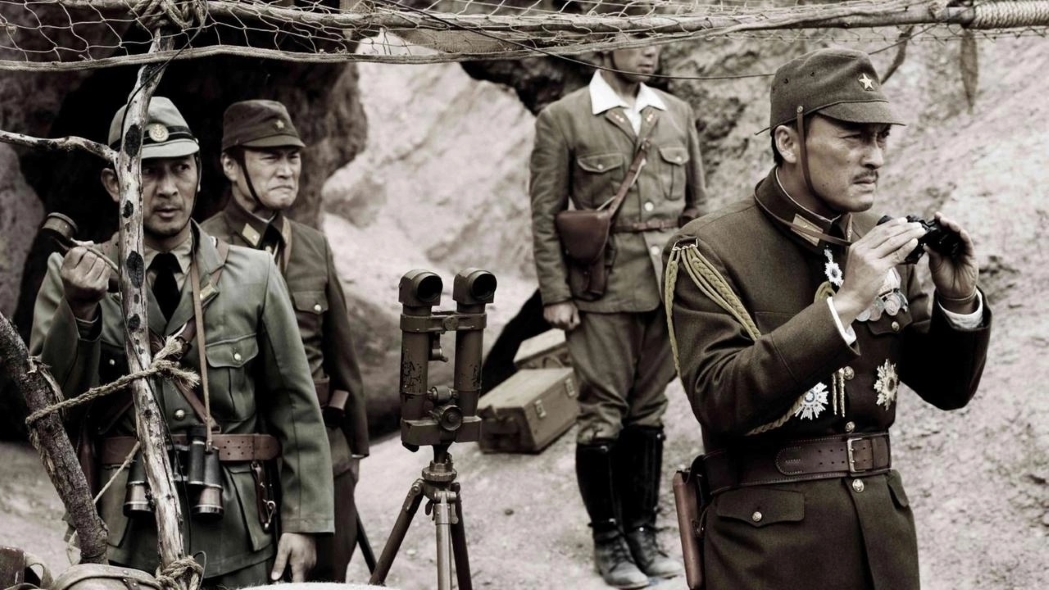
The defence’s success is due to the skilled command of General Tadamichi Kuribayashi, a remarkable, restrained performance of relentless determination mixed with deep humanity from Ken Watanabe (unfairly snubbed at the Oscars). Kuribayashi over-rules his senior officers desire for a bayonet charge against the overwhelming American landing forces on the beaches. He knows this traditional attack would lead to suicidal instant defeat for the out-numbered, out-gunned Japanese. Instead Kuribayashi orders a tunnel network built across the island, to allow hit-and-run attacks designed to inflict maximum casualties. Rather than committing suicide at their posts on defeat, soldiers were ordered to withdraw from indefensible positions to continue the fight for as long as possible.

This strategic defence-in-depth strategy is denounced by several of his senior officers as either defeatism or American-sympathy. Kuribayashi knows victory is impossible – he arrives on the island writing a letter to his wife stating he will not live to see her again. But he also knows his tactic is the only way to slow down the American juggernaut. In his opinion, protecting Japan from air attack for a few more weeks is worth sacrificing his and all the lives of the 20,000 men under his command.

Kuribayashi respects Americans – flashbacks show his happiness in the 30s as a military liaison in California, his easy friendships with American officers and desire for co-operation with the USA. But in the same scene he unquestioningly (though with a warm smile) says he will serve his country no matter what. He’s a man of principle and honour, and even if he doesn’t agree with the war, he is for Japan right-or-wrong and will not think twice about giving his life in its service. This attitude soaks through the Japanese soldiers, and Letters From Iwo Jima presents it largely without moral judgement. There are shocking moments where defeated soldiers in Suribachi, weep as they looks at photos of their loved ones while clasping live grenades to their chest so that they may die at their post rather than live with the shame of failing their country. But, the film subtly asks, how different is this from the self-sacrifice countless American war films have (rightly) praised in their soldiers?

The difference is cultural. Very few American soldiers would choose suicide in a cave rather than the thought of confronting their families as defeated men. For Japanese soldiers, this is the ultimate strength, a view shared not just by incompetent, trigger-happy bullies like Captain Ito but right up to Kuribayashi himself who never considers for a moment surrender and living, choosing a suicidal night attack with his last soldiers and suicide on the last piece of earth on Iwo Jima that could still be just about considered Japanese. That’s an institutional expectation of total self-sacrifice, even when the sacrifice is completely symbolic, that has no real comparison in Western militaries.

The soldiers – as we hear in their letters, read to us in voiceover – love their families and they relate to a wounded GI from Oklahoma who talks about his mother (a slightly twee moment in another wise subtle film), but they also believe that the whole (Japan) is far more important than the individual (themselves). Trees should always be sacrificed to slow the fire and protect the forest. Letters From Iwo Jima may show the dangerous excesses this produces in the most fanatical, but doesn’t denounce this extreme penchant for sacrifice or give a clumsy moment of realisation that it is inherently ‘wrong’. Neither does it present Western, individual ideals as superior (indeed the few American soldiers seen are a mixed bag, as much prone to vengeful violence as their opponents).

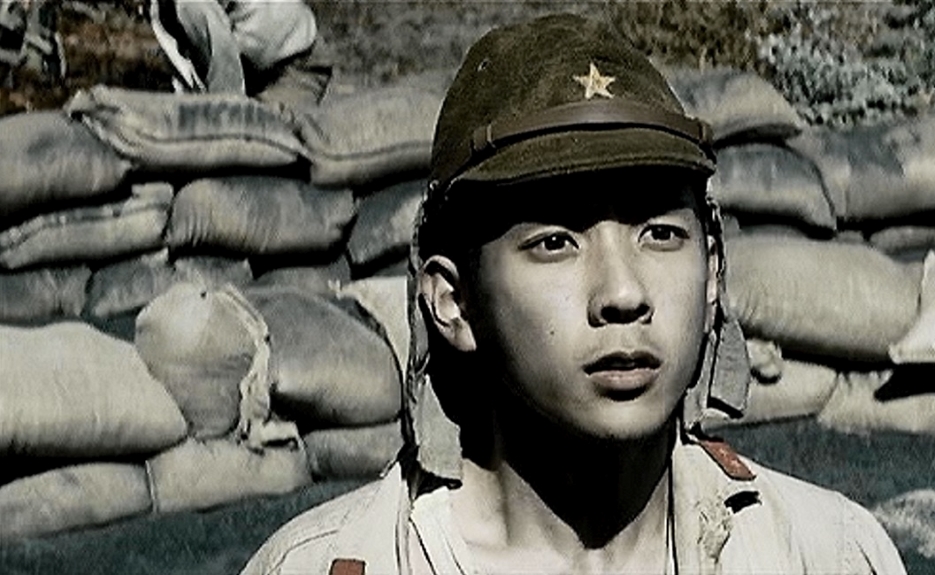
Letters From Iwo Jima follows Private Saigo (very well played with a bewildered sense of fear and growing desire to live by Kazunari Ninomiya), the character closest to acting as a criticism of the Japanese mindset. A baker, who wants to see his wife and new-born child, he doesn’t really want to die on the island, but never questions it is his duty to do so. And his objections to suicidal orders or kamikaze attacks isn’t grounded in their senselessness but that they run contrary to Kuribayashi’s wider orders. Even our most relatable (to Western eyes) character, one who eventually accepts the idea of surrender when all is lost, is still part of the same culture where placing your own needs and desires before the whole is considered deeply shameful.

Perhaps this thoughtful, non-judgemental exploration of Japanese culture is why Letters From Iwo Jima (unusually for American war films) did very strong business in Japan. Unlike the eventual death cult of Nazism (see the exceptional Downfall), where suicide came from bitter pride and fear, here it’s the ultimate, terrible-but-logical outcome for a mentality that turned a small island into a respected world power. It’s not presented as a freakish aberration or some sort of national genetic character flaw: it’s in many ways a sort of perverse nobility which has, like all noble systems, advocates who are broad-minded and empathetic and those who are prejudiced and fanatical. Letters From Iwo Jima’s strength is it never presents it as inherently evil, rather a choice with good and bad outcomes.

Eastwood’s superbly directed film, perhaps one of his finest, is full of such thoughtful, unjudgmental reflections on duty and service and what loyalties to something larger than ourselves drive us to do. Shot with an austere, haunting chill and superbly played by a faultless cast, Letters From Iwo Jima is an earnest, mature piece of work and a quite extraordinarily unique war film.

War and Peace (1967)

War and Peace (1967)

Legendary Soviet Tolstoy adaptation, awe-inspiring in its scale and creative amibition

Director: Sergei Bondarchuk

Cast: Sergei Bondarchuk (Pierre Bezukhov), Ludmila Savelyeva (Natasha Rostova), Vyacheslav Tikhonov (Andrei Bolkonsky), Boris Zakhava (Mikhail Kutuzov), Anatoly Ktorov (Nikolai Bolkonsky), Antonina Shuranova (Maria Bolkonskaya), Oleg Tabakov (Nikolai Rostov), Viktor Stanitsyn (Ilya Rostov), Kira Golovko (Natalya Rostova), Irina Skobtseva (Hélène Kuragina), Vasily Lanovoy (Anatole Kuragin), Irina Gubanova (Sonya Rostova), Oleg Yefremov (Fyodor Dolokhov), Eduard Martsevich (Boris Drubetskoy), Aleksandr Borisov (Uncle Rostov), Nikolai Rybnikov (Vasily Denisov)

During the Cold War, the superpowers had to fight with things other than nukes. They raced to space. They were gripped by chess matches. And they made rival film productions of Tolstoy’s epic novel. War and Peace, a gargantuan production (it’s really four films and took literally years to make) was the Soviet answer to King Vidor’s War and Peace. If Hollywood thought it could own the greatest Russian novel ever written by making it an Audrey Hepburn vehicle, Mosfilm would take it back. The Soviet War and Peace would treat Tolstoy with the respect it deserved, honouring its literary richness, and putting it on a scale no film had ever seen before.

War and Peace was made with the state’s full backing. Its director would have anything he needed. Rebuild Moscow on the backlot (then burn it down)? Sure. Have historical artifacts from dozens of museums shipped to the film set? Boxed up and ready. Use tens of thousands of troops – and three war-hero Generals as assistant directors – to restage the battles of Austerlitz and Borodino? Thousands of horses were shipped to the set, while seamstresses worked on over ten thousand costumes. Moscow even created an arsenal of functioning cannons which shot 23 tons of gunpowder for the recreated battles. It’s no exaggeration that no film before or since could match this for scale. Avengers: Endgame eat your heart out.

To direct this gargantuan operation, Mosfilm and the Ministry of Cuture selected Sergei Bondarchuk, relatively young in his early 40s, over the seasoned veterans who expected the gig. Bondarchuk was by all accounts a hard taskmaster, who fought, bickered and bullied practically everyone on set (burning through three cinematographers), but also had a gift for marshalling effectively a small nation for years (though not without at least two heart attacks, one of which left him clinically dead for five minutes). He also had the chutzpah to audition nearly every actor in Russia before deciding the best man for the leading role of Pierre Bezukhov was none other than… Bondarchuk himself (for good measure, Bezukhov’s seductive screen wife would be played by his own wife Irena Skobtseva).

War and Peace could have gone two ways: its scale could have flattened a lesser director or led to the sort of middle-brow, stale traditionalist fare Hollywood hacks churned out for years. Instead, Bondarchuk was fascinated by the possibility of the medium and swept up in playing with the cinematic tricks explored by his heroes and contemporaries. War and Peace is a strikingly unique, often discordant, meditative film, full of visual invention that pushes the boundaries in the most inventive ways to present its colossal scale.

You can see traces of Abel Gance’s Napoleon in its evocative use of double exposure images (showing ghost like echoes of people appear in frame, most notably the near-death experience of Andrei Bolkonsky) and its extreme close-ups, not to mention the more obvious triptych homages for key moments (such as Napoleon and Alexander III’s meeting at Tilsit). Bondarchuk’s influences went wider than that: there is a social realist immediacy in several scenes, with their jittery camera-work, throwing us into confusing battles, that wouldn’t look out-of-the-ordinary among the Italian Neorealists. There are patches of Welles and Lang in the sweeping camerawork that stress the scale and geography of the sets. Panoramic aerial shots dial up the most ambitious work of Murnau and Gone with the Wind. Bondarchuk’s decision at key emotional moments to fade out all sound except for ambient noises, such as drips, breathing or birdsong feels like he’s been studying Tarkovksy – as does the beautiful, lingering shots of nature. Bondarchuk wasn’t just going to make a stately coffee-table book: he fused distinctive flourishes from the great film-makers, to wonderful effect.

In addition, Bondarchuk (also the co-screenwriter – did his chutzpah influence that similar wunderkind Kenneth Branagh, both obsessed with tricksy, inventive camerawork) wanted to pay tribute to Tolstoy. What’s remarkable about War and Peace is how much of Tolstoy’s meditation on the meaning of life is in the film. Sure, there are cuts – Nikolai Rostov, Sonya and Maria Bolkonskaya are reduced to the bare bones – but this film finds a great deal of time for its characters to muse (either in sometimes portentous voiceover, or a deep-voiced omniscient narrator) over the meaning of life, the quest of happiness and the nature of decency and nobility.

In fact, this is a particular surprise since this version War and Peace had its roots as a patriotic demonstration of Soviet film-making might. It’s particularly striking then that it ends with a sequence that stresses how ordinary soldiers (French and Russian) have more in common than not and how much links mankind together than drives them about. This is not pro-Soviet propaganda.

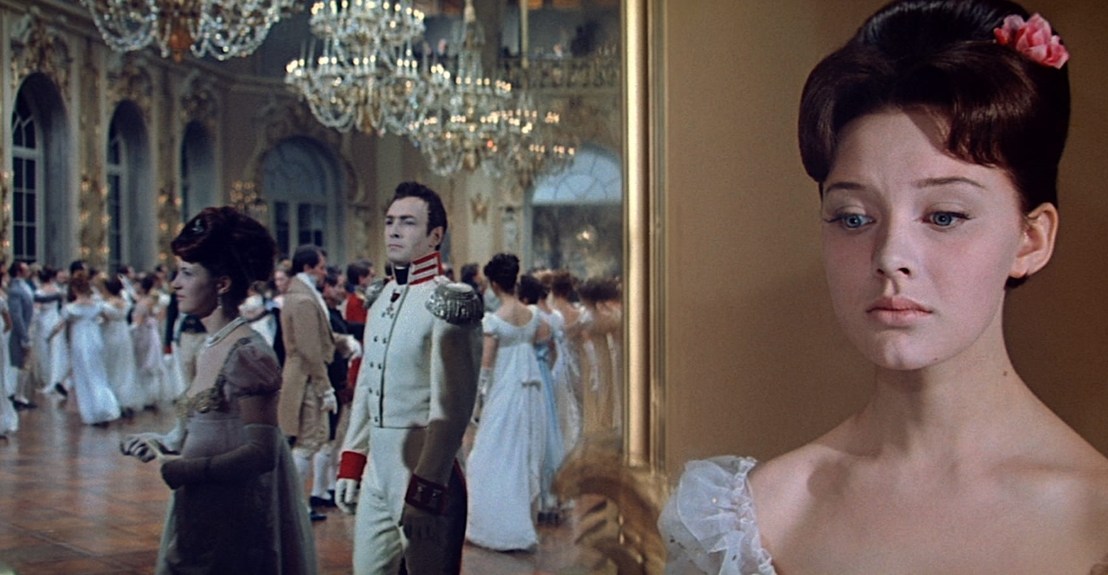
Not that War and Peace doesn’t take a few potshots at the effete, selfish rich, sitting in comfort while soldiers fight at the front. But it also finds time for the Rostov’s decency and self-sacrifice for and it doesn’t stint on the grandiosity of Tsarist Russia. A ballroom scene, site of Natasha’s meeting with Andrei Bolkonsky, is stunningly staged. In a huge mirror-laden ballroom, Bolkonsky’s camera bobs and weaves between dancers. Cinematographer Anatoly Petritsky suggested he filmed it while roller-skating, a genius innovation which creates a visual dancing effect as well as allowing us to be right among the literally hundreds of grandly costumed dancers (Bolkonsky skated alongside Petritsky, at times holding a fan slightly before the camera, to add to the effect).

The magnificence of this often gets forgotten in the awe-inspiring spectacle of the Russian military backed battles. Bondarchuk enlisted the Soviet Air Force for stunning, wide-angled aerial shots that revealed the stunning dimensions of the recreation. Petritsky also introduced a series of diving crane shots – like the camera has been set on a zip wire – that fly down from the heights into the battle’s chaotic maelstrom. (The battles are, as per Tolstoy, confusing messes where no one knows what’s going on but everyone pretends to be in charge). These battle images virtually redefine epic, mind-blowing in their scale – and the managerial and artistic force that must have been needed to organise and capture them all on screen as exquisitely as they are.

The same goes for the burning of Moscow, a dizzying outburst of flame, co-ordinated tracking shots (following Pierre through the burning wreckage) while crowds of extras run and panic. War and Peace also follows Tolstoy in being perhaps one of the grandest scale, anti-war films ever made. There are no real moments of heroism in the battle, soldiers march into injury and death and Bondarchuk frequently pans the camera across mounds of bodies or soldiers left mauled and dying on the ground. The retreat from Moscow sees Hellish suffering for the French, but that is balanced by the horrifying executions of civilians they carry out in Moscow, terrified men and boys led to stakes and gunned down in hard-hitting slow-motion. War and Peace doesn’t shy away from the suffering, pain and death that war brings, with very little glory or pride to show for it.

It’s also a film that’s often strikingly well-acted. Bondarchuk may be too old for Pierre, but his thick-set frame is perfect and his soulful eyes beautifully capture the character of a would-be-philosopher with no purpose. Vyacheslav Tikhonov makes Bolkonsky an imposingly distant man hiding his fragility. Perhaps most strikingly, ballet dancer Ludmila Savelyeva is a radiant Natasha, waif-like but bursting with energy and life, who tackles better than almost anyone else an impossibly difficult character. Bondarchuk frames her perfectly, back-lit to focus on her expressive eyes.

At times there is almost too much to everything in War and Peace. Bondarchuk is at times almost constitutionally incapable of shooting a simple scene, a relentless inventive energy that is perfect for the war but sometimes exhausting for the peace. The all-consuming screentime given to the scale of the battles and balls does eat into the time allowed to character and plot. But this is like complaining about being uncomfortably full after a generous rich meal. There is so much in War and Peace Bondarchuk gets right: from its respect to Tolstoy, but as an intellectual not as heritage figure to its stunning visuals, in every minute of its great length there is something to admire, thrill and strike you with awe. In this instance, the Soviets proved they could do Tolstoy better than the Yanks.

Das Boot (1982)

Das Boot (1982)

Perhaps the definitive submarine film, a terrifying masterpiece of claustrophobia and suspense

Director: Wolfgang Petersen

Cast: Jürgen Prochnow (Kapitänleutnant), Herbert Grönemeyer (Leutnant Werner), Klaus Wennemann (Chief engineer), Hubertus Bengsch (First watch officer), Martin Semmelrogge (Second watch officer), Bernd Tauber (Chief HelmsmanKriechbaum), Erwin Leder (Chief Mechanic Johann), Martin May (Ullmann), Heinz Hoenig (Hinrich), Uwe Ochsenknecht (Boatswain Lamprecht), Claude-Oliver Rudolph (Ario), Jan Fedder (Pilgrim), Ralf Richter (Frenssen)

In the annals of submarine movies, few have taken such a hold of the imagination than Das Boot. This is particularly remarkable since it follows the struggles not of Allied sailors but members of the German Kriegsmarine, the U-Boats who patrolled the Atlantic to sink as many merchant ships as they could, all in the service of aiding the Nazi war effort. But the sea knows no flags and holds no allegiances: to the watery deep, men are just men, and a small, rusty metal box is fragile at 280 metres no matter who sails in it. And the men sailing U-96 are just ordinary, regular men, with wives, girlfriends and regrets back home who above all just want to survive to see them again.

Wolfgang Petersen’s is a masterclass in immersing us in a claustrophobic world. The crew of U-96­ are led by the captain (Jürgen Prochnow), a hardened, cynical veteran is out here to do a job, not fight for radical cause he has little time for. Instead, his concern is to preserve the lives of his men, all younger (in most cases almost twenty years so) than him, during their time at sea where days (and even weeks) of bored inaction are interspersed with interludes of sheer terror as the submarine desperately runs from depth charges and dodges Allied destroyers.

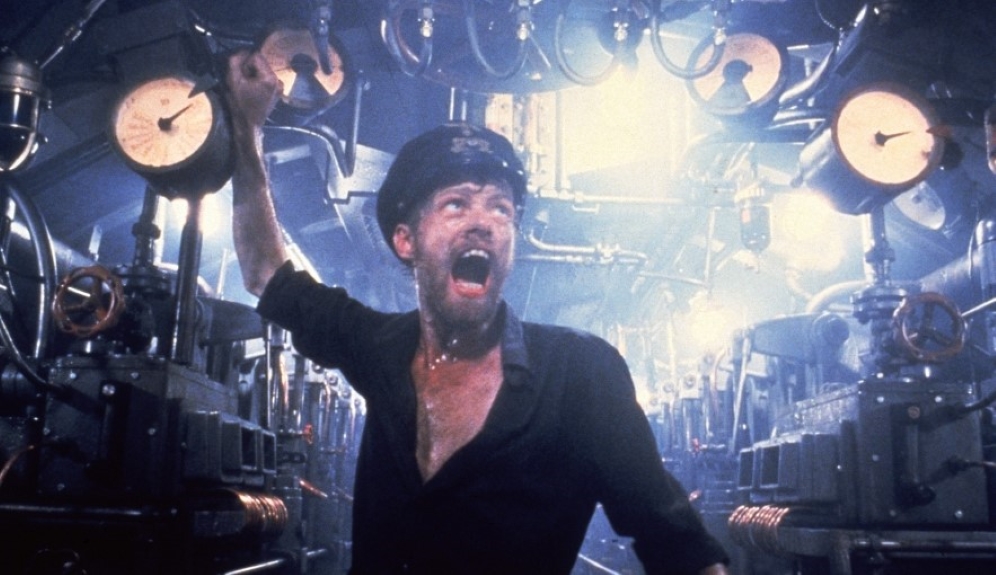
Das Boot was filmed over almost a year, in chronological order. The actors practically lived in their confined set (deafened by the sound of its mechanics), their hair growing out to match their characters and their skin taking on a pallor from not enough time in the sun. For hours at a time we never leave the confines of the submarine – if you don’t count the odd trip to the ship’s bridge, where those lucky enough to venture up-top are lashed with salty sea water from near constant Atlantic storms. Aside from that, they are in what is effectively a 60m metal corridor, a specially designed camera operated by cinematographer Jost Vacano, tracking swiftly behind the frenetic pace of the sailors as they dive through hatches and pound along dripping quarters.

It’s a film where you cannot escape the tight confines of this boat, the sound track filled with groans and shudders as the boat cracks under the weight of water or buckles from high-pressure depth charges. When under attack, bolts burst out of pipes like machine gun bullets and water (which is obviously freezing) gushes through opened valves. It mixes with the sweat in the characters tension-filled faces. There is no comfort and no privacy under the water, bunks positioned on the edges of the ship’s corridor. The only food is whatever was taken aboard last time the ship was at shore – and if that means cutting layers of green mould off weeks-old bread, so be it.

Petersen’s capturing of this sense of a tiny, pressure-filled world is superb and he succeeds masterfully in getting the audience to feel the character’ stress and fear. When the film opened in America, crowds cheered an opening caption which details the losses the Kriegsmarine suffered during the war: at the end, the same audiences were reported stunned into sympathetic silence. None of these men are detestable Nazis. One man writes never-ending letters to his French fiancée. Another is a devout Christian. The Chief Engineer clasps tight photos of a skiing holiday with the wife he has not seen in months. Another is frustrated at radio reports of his football team losing a key match. All of them are haggard, unshaven and scruffy. None of them feel safe for a moment.

Only the first watch officer utters anything approaching true believe in the Nazi regime (he is also the only man to try and maintain some semblance of military smartness – at an encounter with a German merchant ship, he is inevitably mistaken for the captain). But his belief comes from naïve optimism: he has no wider idea of the world around him and his statements of trust in the regime noticeably dry up over time. For the rest: who has the time for ideology when you could be crushed by a mountain of water at any time? Captain Thomson (Otto Sander) opens the film by making a drunken speech at the launch of U-96, lambasting Hitler – a speech that is met with shocked silence because its being said rather than because of the content.

The sea also builds subconscious bonds for those who share its dangers, even with enemies. After returning later at night to the scene of a sinking ship (their only successful operation throughout the whole film), the Captain and his officers are horrified to find the Allied ship has not had its crew evacuated – a fact they notice too late, having already sent two more torpedoes into the water to finish the ship off. Haunted, the Captain orders U-96 to back off: after all, he knows (as we do) it will be impossible to take any survivors aboard his tiny boat. Even this successful mission is tinged with horror: the rest of their encounters mostly feature desperate attempts to dodge British destroyers.

It’s relentless. Life under water is dull, but inescapable but could be broken at any moment by life-threatening terror, perhaps hours of shaking and leaking under depth charges explode around them. Even the most experienced can crack – Johann, the ship’s chief mechanic, at one-point breaking under the pressure, his wide-eyes desperately searching for some escape as he ignores orders. War correspondent Lt Werner (Herbert Grönemeyer) goes through the same experiences we do: his assumptions about brave soldiers and ice-cold professionals, breaking down as he and we realise these are ordinary people just trying to stay alive.

Their lives are the principle concern of the Captain, superbly played by a stoic Jürgen Prochnow, as a man who keeps his emotions on a tight leash because letting them slip may see them never getting under his control again. The Captain is a default father to his men, concerned above all with preserving their lives, over and above the war he is bitter and cynical about. Now of course, you can argue Petersen is stacking the deck by presenting a German crew with not a (determined) advocate for Nazism among them: but so superbly does the film bring-to-life the pressures, risks and terror of U-96, you fail to be surprised that they would come to focus overwhelmingly on their own survival rather than the gnomic ideology of the murderous dictator who started the whole thing.

By the time the film has send U-96 to the near bottom of the ocean, forcing the crew to battle against the odds to restore power and save it from sinking (it’s the golden rule of all submarine films, that the recommended depth should be exceeded and for the ship to sink like a stone), you will be rooting for these pressured-but-capable professionals to save themselves. The overall feeling you take from Das Boot is the futile, pointlessness of it all: months at sea almost for nothing, acts of extreme bravery rendered moot by flashes of ill luck and chance, the utter lack of having any to show for it when the boat returns to port. Das Boot understands the futile horror, the grim pressure and punishing impact of war, placing people into terrible situations for no real purpose. It’s that which helps make it one of the defining war films – and the great submarine film.

Five Graves to Cairo (1943)

Five Graves to Cairo (1943)

Exciting and witty war-time spy thriller, an overlooked work from a master director

Director: Billy Wilder

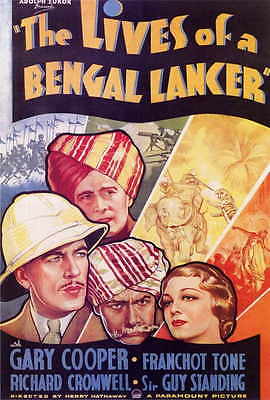
Cast: Franchot Tone (Corporal John Bramble), Anne Baxter (Mouche), Akim Tamiroff (Farid), Erich von Stroheim (Field Marshall Erwin Rommel), Peter van Eyck (Lieutenant Schwegler), Fortunio Bonanova (General Sebastiano), Miles Mander (Colonel Fitzhume)

It’s 1942 and the war is not going well for the British. The Germans are on the move in Africa under their ace commander Field Marshal Rommel. A tank drifts through the desert, bumping up and down sand dunes. Inside its crew slump, one dangling from his gun turret, another thrown on-and-off the gearsticks with each dune. It’s hauntingly Wilderish – a ghost tank charging through a never-ending desert – that Corporal John Bramble (Franchot Tone) wakes into, escaping across into the bombed-out Empress of Britain hotel run by panicked Farid (Akim Tamiroff), assisted by British-loathing Frenchwoman Mouche (Anne Baxter). Bramble’s hopes that he might lay low for a few days are thrown into danger when the hotel is requisitioned moments after his arrival by the German army with Rommel (Erich von Stroheim) himself setting up command there. Bramble passes himself off as recently deceased club-footed waiter Davos – only to discover Davos was a German spy and Rommel expects him to help delivery on his masterplan to crush the British.

Five Graves to Cairo is a magisterial juggling game of move and counter-move in which everyone holds tightly their own very specific parts of a greater mystery while trying to learn everyone else’s. Wilder does all this with wit and more than a little tension. Can Bramble keep up his pretence about being Davos while hiding his complete ignorance of Rommel’s masterplan? Will Rommel’s constantly alert, note-taking aide Lt Schwegler (Peter van Eyck) rumble him? The whole film is captured in one of its earliest sequences, as Farid carefully shepherds and blocks the view of Schwegler’s inspection of the foyer of his hotel, to prevent him seeing Bramble hiding behind the desk.

The whole film builds from there as Bramble constantly thinks on his feet, crafting obscure but convincing answers as he improvises wildly. All while limping around in a club-foot shoe and providing the sort of night-and-day waiting service the Germans expect. His improvisation is endless, from distracting a blowhard Italian general to steal his gun, to identifying himself quietly to a captured British officer being wined and dined by the smug Rommel by switching a whisky name chain on a bottle with his dog-tag (then smoothly passing off ‘Bramble’ as a rare spirit to the Italian general). His plans switch fast too, from a vague assassination attempt to being instructed by Miles Mander’s Montgomery-ish officer to uncover the Field Marshal’s schemes.

The Field Marshal himself is the epitome of Prussian arrogance. Played with a preening, puffed-up, Teutonic self-importance by an excellent Erich von Stroheim, Rommel never moves without his feathered swagger stick, pompously cavorting around the hotel, prissily demanding the finest sheets and best room. Far from the later ‘Good German’ image of the General, this Rommel is as snobbishly self-satisfied as a Bond villain, overwhelmingly pleased with his elaborate scheme (which he shrewdly set-up years earlier) and teasingly playing twenty questions with his British prisoners to see if they can work-out his intentions, while manipulating the game so his opponents can’t win. He’s an arrogant, hissable villain we are desperate to see taken down a peg or two.

Equally dislikeable is his whipper-smart aide, played with a thin-politeness by Peter van Eyck that hides his comfort with deception. With these villains as the face of the relentless German military machine, Wilder builds real tension around the importance of Bramble foiling Rommel’s scheme – and makes very clear to us that these ruthless sticklers for rules, certain of their own genius and superiority, will definitely not treat this accidental spy kindly if they catch him.

As Bramble, Franchot Tone does a decent job – although his Transatlantic vowels sound particularly odd when the similarly American Anne Baxter immerses herself in a French accent – even if Bramble himself is less interesting than his situation. A more charismatic actor might perhaps have helped lift Five Graves to Cairo to a higher level – after all it shares more than a few stands of DNA with Casablanca but Tone and Baxter aren’t quite Bogie and Bergman. What Tone does do well is morph swiftly from persona-to-persona, switching from heat-stroke confused soldier to would-be-assassin, to fast-thinking spy with a surprisingly natural ease.

He also builds a rapport with Mouche – Edith Head’s costumes for these two, with their contrasting blacks and stripes, quickly visually link them together – who discovers she hates the German more than she resents the British for abandoning her brother at Dunkirk. Baxter is very good as the real emotional heart of this film, a harsh woman hardened by loss, desperate to do what she can to save her POW brother but who finds a new cause to believe in. Baxter carefully lets her character build in statue from obstacle to reluctant aide to true believer, with real naturalness.

Her development reflects a whole film that uses its single claustrophobic location – nearly the whole film takes place over little more than a day or two in the hotel – to excellent effect, with potentially dangerous reveals lurking around every corner. Not least that the real Davos lies buried under rubble in the basement – not quite fully buried, Wilder’s focus early on Bramble’s orthopaedic show hinting at the vital ‘tell’ later on. Everyone – except perhaps the supremely self-satisfied Rommel – suspects there is more going on than they realise, and Wilder expertly ratchets up the tension through Hitchcockian time-bombs and carefully structured dialogue sequences to keep the audience firmly on the edge of their seats.

It’s makes for a fine caper, a careful riff on then current history that suggests Bramble might just have provided the vital clues to prevent the nefarious Rommel from claiming victory at El Alamein. While Five Graves to Cairo has a high entertainment factor, it’s not quite in the first league of war spy stories. But with entertaining performances – Tamiroff’s sweaty, stammering Farid and Fortunio Bonanova’s hyper-Italian Opera-singing general are also treats – and a real wit balanced with a well-developed tension, it’s a strong early film from a director who would go from strength-to-strength.

The Wooden Horse (1950)

The Wooden Horse (1950)

One of the first POW films, setting a template for stiff-upper-lip derring-do

Director: Jack Lee

Cast: Leo Genn (Peter Howard), David Tomlinson (Philip Rowe), Anthony Steel (John Clinton), David Greene (Bennett), Peter Burton (Nigel), Patrick Waddington (Senior British Officer), Michael Goodliffe (Robbie), Anthony Dawson (Pomfret), Bryan Forbes (Paul), Dan Cunningham (David)

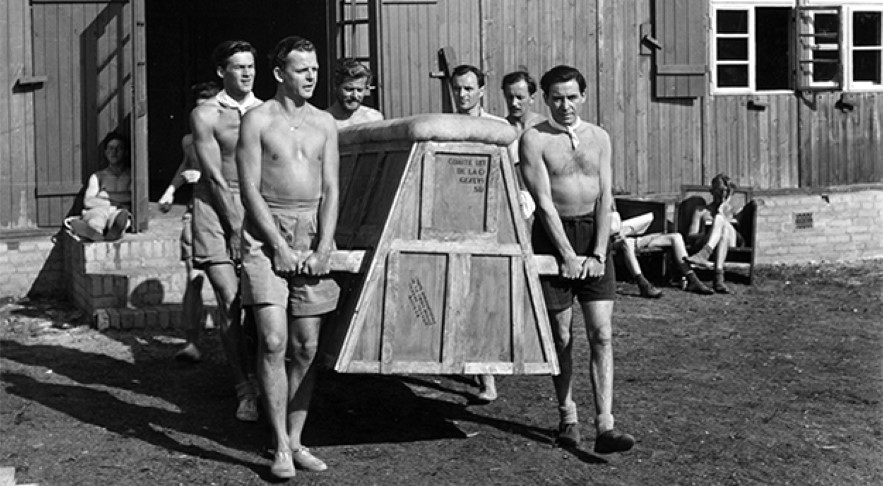
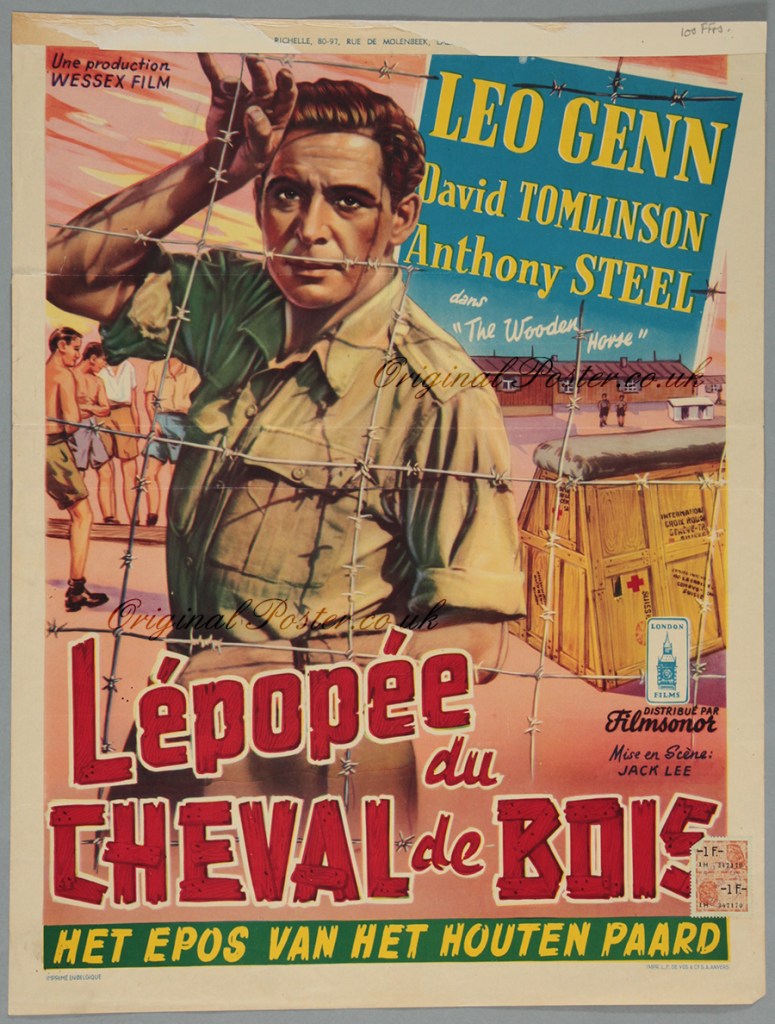
One of the most popular of WW2 movies sub-genres is the POW escape movie. The Wooden Horse was one of the first of these, showcasing the sort of barmy, off-the-wall scheme that British POWs spent their tedious years dreaming up. Based on an autobiographical novel by former POW Eric Williams – here fictionalised as Peter Howard (Leo Genn) – inmates of Stalag Luft III built a pommel horse to aid their escape. The scheme? Hide a man underneath the horse to dig a tunnel, while the guards are distracted by a never-ending stream of men jumping over it for hours and hours on end.

The Wooden Horse dramatizes this with a stiff-upper-lip ‘well done Old Chap’ Britishness, shot with a low-key documentary realism (the film blew a huge portion of its budget on location shooting). It’s almost defiantly low-key, about a world away from Steve McQueen jumping over a fence on a motorbike or the sort of emotive struggles with war pressure in The Cruel Sea. Even the escape itself is a grinding, repetitive task taking place over months moving an infinitesimal distance every day as the parade ground tunnel edges closer and closer to the fence. This low-key attitude extends to the cast, led by Leo Genn, who eschew dynamics for calm, quiet unflappability. (Ironically, despite its documentary realism, Peter Butterworth – one of the original members of the escape attempt – was told on auditioning he wasn’t believable as a POW.)

The film is split neatly into two halves. The first covers the escape plan itself and lays out a structure that became familiar from countless POW films that followed: the plan is carefully detailed, senior officers humph and finally flick the thumbs up, a parade of fellow inmates chip in expertise (from forgery to ingenious distractions), a staged accident of flipping the horse over tricks the Germans into thinking nothing is going on, the tunnel caves in, a man is left stranded in the tunnel longer than is safe… It’s all in here, while our heroes bluffly and bravely work out the logistics of smuggling soil away and mastering various French identities to make their escape.

The second half follows two of our heroes – Leo Genn’s stoic Howard and Anthony Steele’s matinee idol Clinton – as they shred their nerves moving through Europe aiming for the port of Lübeck and a ship to Norway. This is the marginally less interesting part of the film, although it conversely does feature the film’s most interesting moment as a visibly sickened Clinton is forced to kill an ordinary German guard, very different from the usual boys-own adventure attitudes you expect.

However, most of the rest of the second half is just a little too dry and documentary, despite the best efforts to play up the paranoia and tension of a life on the run in occupied territory. Lee directs with a methodical, unflashy style, while ongoing clashes with producers on the budget, which eventually saw the film completed months later by the producer and a hurriedly put-together rather abrupt (and incongruous) ending in a Swedish restaurant, which seems to lean into the beginnings of an anti-Soviet Cold-War era consensus. Some of the dramatic tension drains out of a film which actually might have benefited from a little more melodrama, among the muttered, patient conversations in alleyways and the almost-agitated debates about which resistance groups to trust.

The camp-escape half works best, probably because the ingenuity of seeing the prisoners work out the logistics of converting their pommel horse into the perfect escape weapon and overcoming the minutia of camp life remains very entertaining. There is even a certain amount of wit in the bonhomie and cheek of the escape, which the film doesn’t shy away from, from the plan depending on the willingness of hungry POWs hurling themselves over a wooden horse for hours at a time to the boarding school air of bored over-familiarity that permeates the sleeping quarters. Lee also mines some tension out of a late-night inspection of the sleeping quarters, which only just misses discovering the mountains of soil that has been hidden precariously in the ceiling.

The Germans themselves are presented fairly sportingly – The Wooden Horse doesn’t give us an obvious villain and, as noted, presents its only slain German as a tragic figure. The Germans are even fairly sporting, solemnly carrying away the offending horse with a hurt dignity after the escape – presumably the poor War Horse is to be confined to solitary – while the POWs give this hero a rousing cheer. The Wooden Horse avoids the set-up of many similar films, which often presents both a token ‘Worthy Opponent’ and a token ‘Unrepentant Nazi’ among the Germans. Instead, they are exclusively presented as straight-forward professionals – again perhaps with an eye on the emerging 1950s anti-Soviet consensus that was starting to form in Europe.

The mood of sporting endeavour around the whole film – as well as the stiff-upper-lip pluck of the imprisoned Brits – helped guide the POW film towards its natural development as a Boy’s-Own adventure story with a sense escape as the ultimate sporting adventure (though even The Great Escape throws in more than enough tragedy). The Wooden Horse sometimes lacks in drama, so swept up is it in a sort of documentary realism (it’s hard not to argue with the producers that the put-upon forbearance of John Mills might have been a better choice for the lead than the rather too smooth Leo Genn), but as an early example of a much-loved genre it offers more than enough entertainment.

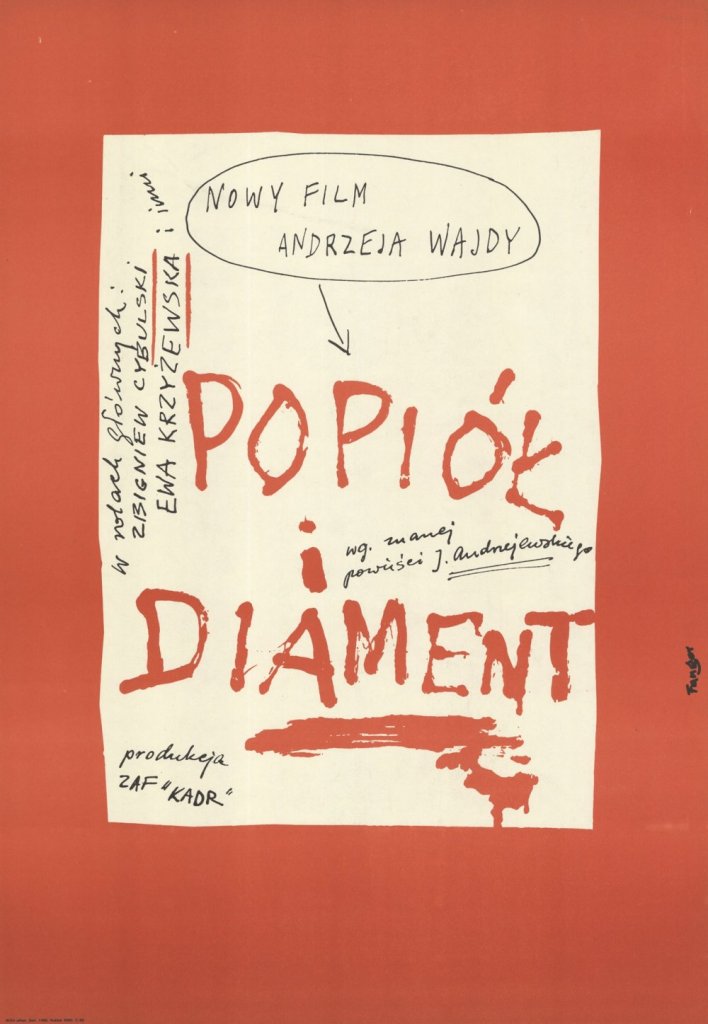
Ashes and Diamonds (1958)

Ashes and Diamonds (1958)

Wajda’s masterpiece of subtle but stinging Soviet criticism and one of the great European films

Director: Andrjez Wajda

Cast: Zbigniew Cybulski (Maciek Chełmicki), Ewa Krzyżewska (Krystyna), Wacław Zastrzeżyński (Szczuka), Adam Pawlikowski (Andrzej), Bogumił Kobiela (Drewnowski), Stanisław Milski (Pieniążek). Ignacy Machowski (Waga)

When the dust settles from the chaos of uncertain, terrible times what will we it leave behind: ashes or a diamond? It’s a question Poland is asking on the final day of the war, 8th May 1945 –what fate will come under Soviet rule? Wajda’s War Trilogy comes to its end and, even considering the quality of the first two films in the series, Ashes and Diamonds is a quantum leap in filmmaking, an extraordinary mix of realism and poetic ambiguity. Wajda captures this turning point in Polish history with a series of encounters between a group of characters in a single location on one night. Ashes and Diamonds can lay claim to being one of the greatest films from Eastern Europe in the twentieth century, a breathtakingly rewarding mix of subtle messaging and tragedy.

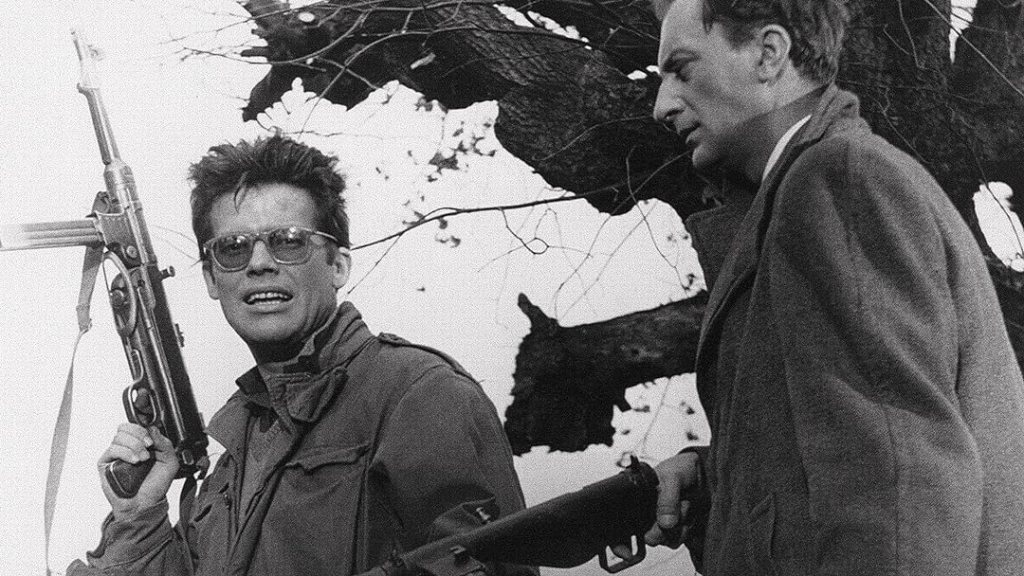
Home Army fighters – those paying attention to Wajda’s earlier work will be well aware the Polish government strongly disapproved of these forces loyal to a democratic Polish government – Maciek (Zbigniew Cybulski) and Andrzej (Adam Pawlikowski) attempt to assassinate communist leader Szczuka (Wacław Zastrzeżyński). Instead, they accidentally murder two regular workers. They are ordered to take a second attempt on their target after he attends a celebration with a host of Polish and Soviet dignitaries at a local hotel. But triggerman Maciek is torn, trapped in a cycle of war that has killed his friends, uncertain about whether to continue in the crusade that has consumed his youth or explore a life he glances at with barmaid Krystna (Ewa Krzyżewska). Will Maciek complete his mission or accept Poland’s future lies not with the ‘liberating’ Soviets?

Wajda’s restructuring of Jerzy Andrzejewski’s novel is the culmination of the entire War Trilogy’s style: a careful criticism of Stalinism, buried behind ambiguous characters and images that provide enough of an interpretative fig-leaf that the Polish authorities could convince themselves his work was politically acceptable.  Nearly everything in Ashes and Diamonds is subtly open to interpretation, carefully hiding its message in plain sight: the war is bringing ashes to Poland, not diamonds. Certainly, today, that’s the only interpretation you could take from Wajda’s extraordinary ending: our assassin writhing in painful, fearful death-throws on a rubbish heap while the hotel guests dance slowly and hypnotically into a doorway bathed in light. The beautiful ambiguity though is clear: look, Wajda could say to his political masters, they’re heading into the light while the Home Army soldier literally dies in a pile of rubbish. How more pro-Soviet can you get?

The entire film is a sad poem to a lost Poland with Wajda carefully guiding our sympathy towards Maciek. On paper, there’s plenty to admire in Szczuka, clearly an honest, competent politician – but he’s also uncharismatic and dull, who we may respect but never love. All our sympathies are captured by Zbigniew Cybulski’s extraordinary performance as Maciek. Inspired by James Dean and Marlon Brando (having binged their films while studying in Paris), Cybulski effectively wears his own clothes and gives Maciek the sort of anti-authority cool Dean made his own. Our sympathies lie immediately with this young man turned reluctant warrior, angry and scared.

Cybulski’s performance isn’t just attitude. He makes clear Maciek is deeply traumatised by the things he’s seen and done. Those dark glasses he wears – which make him look both older, cooler and more cocksure (he looks noticeably younger and more vulnerable without them) – are a legacy of damage to his eyesight from the sewers of the Warsaw Uprising. There’s an odd childish vulnerability to him – he’s spooked by ants crawling across his machine gun during their opening botched assassination – along with a surly resentment at the never-ending demands of this war. But he’s also iconoclastic and passionate about the vision he’s been fighting for. All of this is beautifully captured by Cybulski.

Maciek is at the centre of this pained reflection on all that has been lost in the war. Wajda presents this lingering sense with a series of strikingly unforgettable images. Maciek and Andrzej toast their fallen comrades with burning shots of vodka, each lit like a candle as they remember another name. Flames mark death and loss throughout: the innocent man accidentally machine-gunned by Maciek falls with his jacket burning from point-blank gunfire, fireworks fill the sky when Maciek carries out his assassination.

And where is the Church in all this? Ashes and Diamonds come back time and again to the great spiritual guide in Polish lives (before Socialism). The early assassination takes place outside a countryside Church, its locked door failing to save the victims. It’s an ominous sign for a world where God may have fallen silent, or perhaps never spoke at all. In another brilliant touch of Wajda ambiguity, Maciek and Krystyna walk through a bombed-out church, encountering a giant crucifix hanging upside down. This is not only an extraordinary image – the thorns from Jesus’ head either seeming to visually skewer the lovers or pull them in – but also a confirmation or lament for how little God can help Poland. Maciek clearly doesn’t care, since he happily uses altar decorations to fix Krystyna’s shoe. Faith doesn’t matter in this world.

All people have to belief in is what they can muster in themselves. Perhaps that’s why Maciek has filled his life with the longing to keep the good old cause going. He’s lost so much, he can’t actually believe there is anything else he could really do. For all his flirting at the bar, brimming with cocksure cool, does he ever really believe he has any choice but to continue with what he has committed to do? Wajda frames Maciek in his final moments of choice, huddling under stairs, shadows seeming to box and cage him in.

He’s as trapped as the rest of Poland is. Szczuka is a decent man, but he’s also a Socialist fanatic horrified to hear his son fought for the ‘reactionary’ Home Army. Meanwhile, his Soviet paymasters carefully nuzzle themselves into control over the Polish authorities, Wajda presenting them always with a careful political neutrality. Cunningly, all criticism of them is placed in the mouth of a journalist who speaks nothing but the truth about the freedom-crushing Soviets – but he’s made a drunkard sleazeball (more than enough for the censors to dismiss his words).

Ashes and Diamonds is also a beautiful piece of filmmaking, crammed with Wellesian light and shadow. Despite mostly being a film about waiting and decision making, it’s also full of pace, energy and a sense of a world steamrolled out of existence. It has one of the legendary endings, not only the long, lonely death of our hero but also the hypnotic, slow dance of the Polish authorities, disappearing into the sunlight, unknowingly marching into a future that will extinguish them.

Wajda manages to communicate all this in a film which, thanks to its need to slip everything past the censors, is extraordinarily supple and subtle, never over-playing its hand and spreading its humanity. There are no real villains here, only a series of people at a turning point of history, presented with careful even-handedness, but in way that never intrudes on the obvious sympathies of the film. With extraordinary direction and a superb, era-defining performance from Cybulski, it’s a masterpiece of World Cinema.

Civil War (2024)

Civil War (2024)

An eye-catching concept disguises a film more about journalistic ethics than politics

Director: Alex Garland

Cast: Kirsten Dunst (Lee Smith), Wagner Moura (Joel), Cailee Spaeny (Jessie Cullen), Stephen McKinley Henderson (Sammy), Nick Offerman (President of the United States), Sonoya Mizuno (Anya), Jefferson White (Dave), Nelson Lee (Tony), Evan Lai (Bohai), Jesse Plemons (Militant)

A third-term President (Nick Offerman) speaks to an America torn apart by Civil War. It’s an attention-grabbing opening but actually, in many ways, politics is not the primary focus of Civil War. Rather than a state-of-the-nation piece, Garland’s punchy work is a study of journalism ethics. Should journalists have any moral restraint around the news they report? Civil War covers the final days of its fictional civil war, as four journalists – celebrated photo-journalist Lee Smith (Kirsten Dunst) and her reporter colleague Joel (Wagner Moura), veteran correspondent Sammy (Stephen McKinley Henderson) and would-be war photography who idealises Lee, Jessie (Cailee Spaeny) – travel to Washington in the hopes of capturing the photo (and interview) with the President before his defeat.

Perhaps worried about accusations of political bias, Civil War keeps the causes of its war – and, often, even which sides we are interacting with at any given moment – deliberately vague. There is a throwaway reference to Lee having gained fame for a photo of “the Antifa massacre”, phrasing which doesn’t tell us if Antifa were victims or perpetrators. California and Texas – unlikely bedfellows to say the least – have allied to form the Western Federation. We learn nothing about the President, other than casual name-checks comparing him to Gaddafi (he does vaguely resemble vocally, in his brief appearances, Trump). But so universal are the politics of Civil War it could, without changing a thing (other than wifi access) be as easily set in the time of Clinton or Reagan as Trump and Biden.

Instead, Garland’s point seems to be more if there was a civil war in the Land of the Free, the chaos we could expect to see would be no different than the chaos that has occurred in any number of other locations. On their journey, the journalists encounter UN-run refugee camps, lynch mobs, summary executions, street-by-street fighting, mass graves of civilians and a collapse of anything resembling normal life. We’ve seen the same sort of images countless times on TV, and it matters not a jot that the backdrop now are the streets of DC rather than, say, Mogadishu.

Instead, Civil War becomes the sort of ethical discussion you could imagine in a journalism school seminar. Lee is plagued with troubling memories of conflicts passed, where we see her photographing at intimate range, war crimes, atrocities and shootings without a flicker of emotion. It doesn’t take long for the viewer to find this passive observation of death uncomfortable. It’s something I already felt, watching Lee in the film’s opening photograph a riot over a water truck, camera clicking mere centimetres from civilians laid low by truncheons. When an explosion occurs, her first instinct (after pushing Jessie down to avoid the blast) is to reach for her camera, not to help.

Although showing journalists as brave – putting themselves in harm’s way to bring the readers and viewers at home the truth – Civil War subtly questions the profession of war reporter, people often excitedly pounding the streets alongside killers. Lee’s mentoring of Jessie seems focused less on camera skills, and more on drilling into her the need to disconnect with the world around her. To see herself an observer, whose duty is to record events not to intercede. This boils down to a central idea that Civil War will repeat: if I was killed, Jessie asks, would Lee take the photo? This question becomes the dark heart of Civil War.

We increasingly realise many of the journalists are adrenalin junkies, hooked on the buzz from following in soldier immediate footsteps. “What a rush!” screams Joel after they drive away from a battle that ended with a series of summary executions. Many of the journalists don’t consider they hold any moral connection at all for what happens in front of them. It never occurs to them to attempt to prevent an act of violence or argue against something they see. You start to get the chilling feeling that some of them would as unprotestingly followed the Wehrmacht through the Eastern Front and recorded mass executions with the same emotional disconnection.

The journalists also have a cast-iron belief in their own inviolability, believing the simple waving of their press badge will be guarantee them safety. This delusion is seriously shaken by an encounter with a terrifying, mass-grave filling soldier played by a dead-eyed chill by Jesse Plemons. Even in the tragic aftermath of this, Joel’s grief at the loss of friends and colleagues is also tinged with regret that their potential missing of a crucial story means it was also all for nothing.

Only Lee – an excellently subtle performance by Kirsten Dunst, with the flowering of doubt and regret behind her eyes growing in every scene – shows any growing sense of the ghastly moral compromises (and even collaboration with the grisly things they witness) the journalists have made. It makes an excellent contrast with the increasingly gung-ho and risk-taking Jessie (an equally fine Cailee Spaeny), who becomes as hooked on the adrenalin rush of combat as Joel is.

Garland explores all this rather well under his flashy eye-catching concept. The film is shot with a grimy, visceral intensity – punctuated frequently with black-and-white freeze frames showing Lee and Jessie’s photos, which reaches a heart-wrenching climax for one pivotal scene. Interestingly it’s the dialogue and plotting that sometimes lets Civil War down: its character arcs verge on the predictable and the characters have a tendency to fill themselves in on events with on-the-nose journalism speak.

Civil War culminates in a well-staged gun battle towards the White House in Washington that, like much of Civil War’s America-based concept is about the shock of seeing these things “happening here” rather than in a land far away “of which we know nothing”. But this teasing of a political comment disguises the film’s real intent, a careful study of the moral complexities of reporting horrors rather than stopping them, of becoming so deadened to violence a friend’s death becomes a photo op. Civil War might be one of the most subtle questioning of journalistic ethics ever made, presenting it not as an unquestionably noble profession but one of moral compromise and dark excitement-by-proxy at death and slaughter.

Die Nibelungen (1924)

Die Nibelungen (1924)

Wagnerian epic is crammed with gorgeous, dramatic imagery and relentless pace

Director: Fritz Lang

Cast: Paul Richter (King Siegfried of Xanten), Margarete Schön (Kriemhild of Burgund), Hans Adalbert Schlettow (Hagen of Tronje), Theodor Loos (King Gunther of Burgund), Hanna Ralph (Queen Brunhild of Isenland), Rudolf Klein-Rogge (King Attila), Bernhard Goetzke (Volker of Alzey), Rudolf Rittner (Margrave Rüdiger of Bechlarn), Georg John (Mime the Goldsmith/Alberich the Dwarf/Blaodel)

Fritz Lang wanted to create a film that would help a shell-shocked Weimar Germany start to feel proud of its heritage and culture. He would do this with a film of the legend of Siegfried. It’s not really Lang’s fault that this Aryan feel-good stuff, coupled with Lang’s flawless visual compositions dripping with power and authority, would turn into the wet dreams of the Nazi party Lang fled Germany to escape. Die Nibelungen has unfortunate associations, but it stands as a towering pinnacle of Lang’s visual artistry. An adaptation of the legend, not the Wagner operas, Lang created something both mystic but also subtly questioning the idealistic figures it celebrates.

He would do all this in two (epic of course) films, totalling almost five hours. In the first Siegfried, the hero (Paul Richter) overcomes dragons and murderous dwarves to gain powers of almost (that almost is key) total invulnerability, strength and invisibility. Powers he puts to the test to win the weak King Gunther of Burgundy (Theodor Loos) the hand of Brunhild (Hanna Ralph) by invisibly aiding Gunther best this Valkyrie at a series of challenges. He even takes on Gunther’s form to help lead Brunhild to the bridal bed. Brunhild however discovers the truth from the loose lips of Siegfried’s wife (and Gunther’s sister) Kriemhild (Margarete Schön). Brunhild’s tricks Gunther and his loyal heavy Hagen (Hans Adalbert Schlettow) to murder Siegfried via a spear in his one weak spot. In Kriemheld’s Rache, Kriemheld plots the destruction of everyone who conspired in the death of her husband, via a marriage with the warlord Attlia the Hun (Rudolf Klein-Rogge).

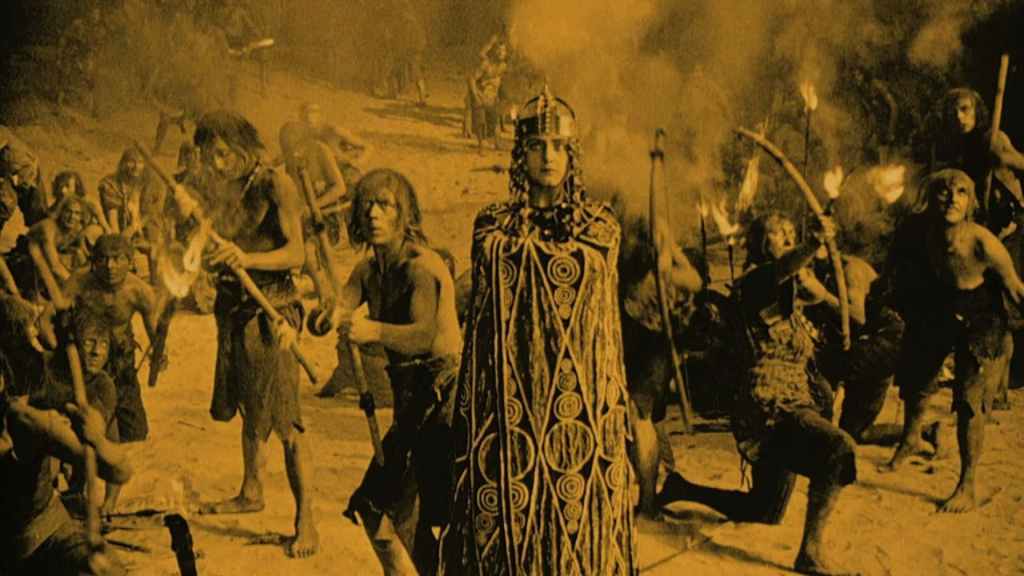
The first thing that strikes you about Die Nibelungen – aside from its surprisingly electric pace – is the powerful, undeniable beauty of nearly every single frame. Lang composed each image as if it was a painting, from Siegfried introduced in steaming smoke at the forge, to the formalist imperialism of the castle of Burgandy and the rigid order and symmetry of its soldiers. Locations, from grand castles to mystic forests, underground caverns full of scheming, wicked creatures are superbly bought to life. There is a martial power Lang’s composition of so many of these images, their perfect angles and symmetrical blocking: parts of Die Nibelungen are some of the greatest pageantry displays in movies.

There is a wonderful sense of overblown, geometric, artificiality in all this – Lang deliberately creates a world larger than life and full of the unworldly and impossible. Buildings tower over crowds, courts that hold thousands to view events of grand importance, sieges of burning halls that fill the frame, staircases up impossibly high buildings. The sort of world of medieval excess where Gunther and Kriemheld disembark from a boat by walking across a bridge of shields created by half-submerged knights. Power and magnificence come from every frame.

It’s matched with an impressive creation of the bizarre and magical. Of course Siegfried kills a giant, animatronic dragon (strangely it’s obvious – even then surely – fakeness works in a film where everything is a heightened, from the emotions to the buildings to the costumes). Siegfried trains in something not far off from Vulcan’s forge and the forest feels like a sort of fairy-tale wonderland. Lang pioneered cross-fades and double exposures to make extraordinary effects, as Siegfried disappears under a veil of invisibility and jumps impossible distances. There is an extraordinary shot where Brunhild, still in the midst of her Valkyrie-like super-powers, seems to jump straight into the camera lens at full force. A beautiful edit sees a tree seem to reform itself into a skill in front of the eyes of the grieving Krimhild.

But Die Nibelungen places its world of power and magical forces in an increasingly costly human world of realpolitik and conspiracy, where its mystical but naïve and simple hero is out of step. Even before then, Siegfried’s status as a hero is subtly questioned. The dragon he kills seems a peaceful, inoffensive creature for all is scale, sitting placidly when Siegfried attacks and stabs it in the eye. Lang introduces a lovely touch where it’s dying tail flick will send the leaf that shields a crucial spot of Siegfried’s back from the torrent of invulnerability-granting dragon’s blood he bathes in. Siegfried is easily manipulated by the dwarf Albereich (a Gollum-like, uncomfortably antisemitic in appearance) before a large dose of luck allows him to defeat his opponent and gain the treasure of Nibelungen.

At the court of Burgundy, for all his courage and blunt honesty, Siegfried is at sea among the subtle power dynamics. The kingdom is ruled by chronically indecisive weakling Gunther (a snivelling Theodor Loos), easily manipulated by Wagnerian-costumed Hagen (an imposingly arrogant and faintly psychotic Hans Adalbert Schlettow). Siegfried’s main acts are to trick and then break the resistance of Brunhild (a dynamic Hanna Ralph) while impersonating the weakling – hardly acts to brag about, which doesn’t stop Siegfried doing exactly that to his wife who then blurts it out to Brunhild in a fit of pique. This isn’t a hero covering himself with glory, just as even the formally idealistic Brunhild (much to her later self-disgust) is reduced to scheming and plotting revenge, a far cry from the noble actionee she prided herself on being.

It’s not a surprise to find Part 2 heads into a Götterdämmerung as Kriemhild’s obsessive, destructive desire for revenge against Hagen (her husband’s murderer) meets with Gunther’s own stubborn-short-sighted protection of his controlling vassal. Nearly half of Part 2 is dedicated to the prolonged siege of the King and his followers by the massed armies of Kriemheld’s new husband Attila the Hun, her manipulations of him helped a great deal by Hagen’s arrogant, impulsive violence against Attila’s people. This extended battle sequence is astounding in its scale, violence and excitement – you can see the influence it had on The Two Tower’s Helm’s Deep – and is shot with the same visual mastery as the more stately first half, even as it seeks into bloody desperation.

It must be stated that Die Nibelungen does feature more than its share of clumsily presented racism. As mentioned, the hook-nosed, gold-obsessed, murderous dwarf Albereich is a painful antisemitic stereotype. Rudulf Klein-Rogge is caked under layers of make-up as the ugly, Slavic Attila while his Hun army resemble crouching Orc like figures, frequently ripe for the sword edge of the relentless German soldiers. It’s the uncomfortable flip side of the Aryanism idealism and romantic framing given to Siegfried, that these un-German figures are painted so monstrously.

But Die Nibelungen’s subtle criticism of the flaws in its German leads – it would go some to call them heroes – balances this out. From the flawed, empty-headed, foolishness of Siegfried to the increasingly sadistic, unrelenting cruelty of Kriemheld (Margarete Schön’s performance is excellent, going from sweetly retiring to unblinking fanaticism over the course of the film) the Germanic characters are compromised, weak and cruel: Hagen and Gunther are no one’s ideas of admirable figures. Compared to them, for all his clumsy racist appearance, Atilla feels like a reasonable figure, loving his family, caring for his people and refreshingly free of vindictiveness and cruelty.

It makes for an intriguing complex undercurrent in a film which, of course, the Nazis interpretated entirely on surface-appearance as a celebration of Aryan super-might. Or at least they did for Part 1 – even they couldn’t kid themselves that Part 2 didn’t quite fit that bill. Today Die Nibelungen provokes the same interesting thoughts. But above all it’s a visual marvel from a gifted film director, a truly painterly masterpiece that, for all its great length, never flags and offers a new marvel, camera trick or miraculous composition with every frame. This is silent cinema at its best.

A Generation (1955)

A Generation (1955)

Wajda’s striking debut is full of politically-enforced lies but is masterful film-making

Director: Andrzej Wajda

Cast: Tadeusz Łomnicki (Stach Mazur), Urszula Modrzyńska (Dorota), Tadeusz Janczar (Jasio Krone), Janusz Paluszkiewicz (Sekuła), Ryszard Kotys (Jacek), Roman Polanski (Mundek)

Few European countries felt the brunt of the Second World War more than Poland. Invaded by the Nazis and the USSR (it’s often forgot Britain and France went to war in 1939 to defend Polish, something even we seem to have forgotten by 1945 when we allowed the country to be smothered in the Soviet embrace), it faced atrocities from both dictatorships which left lasting scars on the nation. It’s events (and legacy) was the subject of the first three films by legendary Polish director Andrzej Wajda, the title A Generation capturing the impact it had on the entire country.

A Generation follows a group of young men drawn into the resistance movement against the German occupying forces. They include the increasingly political Stach (Tadeusz Łomnicki) and the hesitant, anxious Jasio (Tadeusz Janczar), both of whom are inducted into a resistance cell by the impassioned Dorota (Urszula Modrzyńska). As Warsaw burns during the Jewish Ghetto Uprising of 1943, the newly minted fighters take to the streets in solidarity – and at cost.

It’s a simple summary, but that only tells half the story. There are subtleties to A Generation that can be hard to pick-up on for those not born Polish. When Wajda made A Generation, Poland was in the grip of Stalinism. It’s a film not made under artistic freedom, but by an artist pushing against the boundaries of what censorship would allow him to say. Among a great deal of truth in A Generation there are also thumping great lies. Lies that surely must have hurt Wajda, whose father was murdered (along with thousands others) by the Soviets at Katyn (a war crime A Generation, by necessity, pins on the Germans).

Stalinist thinking dictated very clear lines. The resistance heroes in the film are The People’s Guard. This was a pro-Soviet force, that believed only the Soviet Union could save Poland from the Germans. The Home Army (the largest resistance group, loyal to the Polish government-in-exile in Britain) are portrayed as bourgeoisie, reactionary, scared to fight and only marginally better than collaborators. (In real life, Stalin allowed the Home Army to be massacred by the Germans in the Warsaw Uprising of 1944 – Soviet tanks effectively sat outside the city and watched – then shipped thousands of survivors to death in the gulags).

Stalinist thinking also permeates the films characterisation and opinions. Many of the characters frequently feel functional and under-developed, quietly placing the movement ahead of themselves – classic Stalinist thinking, where the individual only serves as a cog in a greater machine. Stach’s work-place mentor waxes lyrical about a wise, kind old man with a beard – Karl Marx of course – while outlining how their Home Army supporting factory boss is ruthlessly exploiting the working classes for profit. Comments about the holocaust are kept to a minimum – Stalin hardly being known for his tolerance either – with Wajda going as far as he can by praising the Jews bravery as fighters. Arguably the most developed character in the film – Tadeusz Janczar’s twitchy Jasio – is only allowed to be a more complex hero because, all his doubts, fears, bravado and individual pride, eventually lead him to the ultimate sacrifice (in the film’s most iconic moment).

If A Generation is so politically compromised, why watch it today? Because it is also a superbly striking debut from a master film-maker – and it’s important to remember, that even with its lies and political obfuscations, the Polish authorities were hardly happy with it at the time anyway. Inspired by Italian neo-realism, Wajda gives the film a lived-in, on-the-streets quality that helped revolutionise Polish cinema. Quite simply, no Polish film had ever looked like this before – it was the first to break free from its hermetically sealed studio bubble. From its opening tracking shot through the poverty-stricken streets of Warsaw’s Wola district, to its extensive location shooting in run-down factories and cobble-lined streets, A Generation embraces realism, employing several non-actors.

Mud, rain and ill-lit locations fill out the frame in a grim, sharply realist view of war. Wajda frequently shows bodies hanging from lamp-posts, while gun battles between Germans and partisans have a frighteningly random intensity to them (perhaps helped by the fact that budgetary issues meant it was cheaper to fire real ammunition on set). The film pioneered the use of squibs for gunshots (condoms filled with fake blood, then burst). Warsaw burns in the background of shots that foreground everyday life, such as fun-fares and solidly proletarian workers working happily.

The partisans huddle in sewers, drink in shanty late-night bars and work in dirty, noisy factories. Wajda’s film fully embraces the style de Sica and others introduced (and fascinatingly was doing this in parallel with Satyajit Ray’s Pather Panchali and Aparajito thousands of miles away). A Generation might keep many of its characters lightly sketched – Stach and Dorota are invested with youthful fire by Tadeusz Łomnicki and Urszula Modrzyńska which goes a long way to round-out their essentially blandly communist personalities, Donata in particular fervent and stoic in her socialism – but it makes the stakes for their struggle with Fascism grippingly real and dangerously immediate.

Wajda also, successfully, gambled that if he made the two leads reasonably acceptable symbols of Stalinist thinking he would be allowed greater scope with the third. Tadeusz Janczar’s performance as Jasio is fabulous – a fighter disgusted by killing, who kills a German with a panicked firing of an entire clip then brags how much he let him have it, whose escape from the Germans during the Uprising could be interpreted either as a noble distraction to allow others to escape or a blind panic that ends fatally. Either way, Jasio is a fascinatingly rich, contradictory character.

Wajda’s film is a powerful mission statement of his dynamism with the camera and his ability to walk a fine-line between political demands and genuine drama (though his later films would be made under a marginally more liberal government). While it must never be forgotten while watching it that it presents a slanted, false version of history, it still captures an essential truth of its haphazard chaos and savage violence. When Stach weeps when seeing teenagers not much younger than him preparing to join the People’s Guard, it hits a deeper truth about the horrors of the twentieth century on Poland that blasts through any political compromise Wajda was forced to make.