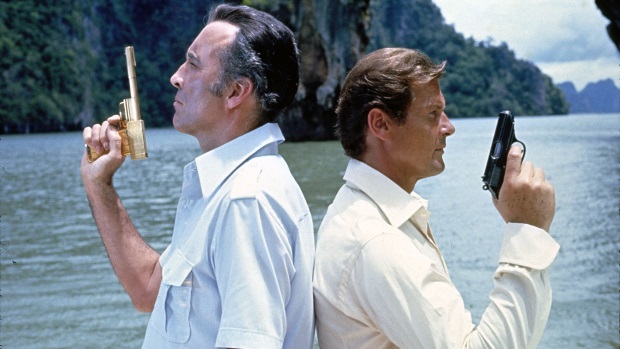
Dr. No (1962)


Bond sets out his stall in series opener Dr No.

Director: Terence Young

Cast:  Sean Connery (James Bond), Ursula Andress (Honey Ryder), Joseph Wiseman (Dr. No), Jack Lord (Felix Leiter), Bernard Lee (M), Anthony Dawson (Professor Dent), John Kitzmiller (Quarrel), Zena Marshall (Miss Taro), Eunice Grayson (Sylvia Trench), Lois Maxwell (Miss Moneypenny)

It’s hard to believe now, but there was a time when the launch of James Bond novel was nothing more than a little B-picture event – rather than the major cultural landmark it has now become. But James Bond started off as a slightly higher budget B-movie of a character largely unknown to those who don’t read spy fiction.

After the murder of a British agent in Jamaica, James Bond (Sean Connery) is sent to investigate. Arriving in Jamaica, Bond quickly finds himself the target of a series of increasingly outlandish attempts to take his life: from a fake embassy driver to a series of assassins pretending to be blind and a sinister geology professor. Eventually, Bond detects the hands (forgive the pun) of Dr No (Joseph Wiseman), who is experimenting with radioactivity on a nearby island. 

What is striking is how much of the Bond-movie formula is in place here right from the start – or rather, how much the style and tone established here fitted so naturally with the source material and character, meaning it would be used repeatedly throughout the rest of the series. Most striking of course are the music cues, all perfect and immediately cool. Is it any wonder that no-one has felt the need to change the James Bond Theme since? But it’s not just that: Bond’s flirtation with Moneypenny and cheeky-protégé exchanges with M? Check. Exotic locales, car chases, shoot ups and wise cracks over dead bodies? Check. The villain being a suavely charming wannabe upper-class type with a creepy deformity, a vague plan and a ridiculously overblown layer? Check. Wave after wave of heavies attempting to bump Bond off with overblown schemes? Check. The villain monologing rather than killing Bond? Check. It’s all there – the formula was in place, and would remain for the next 60 years.

Of course, it probably wouldn’t have worked without getting the casting of Bond himself right – which they certainly did with Connery. Not exactly a conventional choice for a character Fleming imagined as a mixture of Noel Coward, Cary Grant, David Niven and Christopher Lee, Connery brought to it the earthy violence, the roughness and sense of danger that made you believe he could not only merrily kill a room full of goons, but that he would hardly break a sweat doing it. The film’s writers downplayed the self-doubt, anxiety and fear that Fleming’s book-Bond often displayed, repositioning the character as a serenely cool and charismatic superspy, with Connery granting him an additional charm and sex appeal all rooted in his charisma as a performer. He’s magnetic here – whippet thin, dryly deadpan and ruthlessly violent. He established completely the template the character would follow through the next five actors.

What’s interesting watching this film is how close it is to being a one-man movie cum character study. Bond’s principle love interest, Honey Ryder, doesn’t appear until half way through the film and Dr No himself doesn’t pop up until the final act. Felix Leiter has just a few bare scenes. Instead, the focus is front and centre on Bond himself, and Connery’s perfect mix of suave sophisticate and brutal remorseless brawler. The character’s comfort with sex and violence (often close together) is in every scene – Bond sleeps with at least four women, flirts with a couple more, ruthlessly offs a wave of heavies sent by No, and cold bloodedly guns down defenceless doofus Professor Dent. Perhaps fitting for a film that promoted itself as “the FIRST James Bond film”, it wants us to understand (and above all, enjoy the company of) this guy, with the hope that we will sign up for multiple movies to come (which of course we did).

As a standalone film, Doctor No makes a pretty good fist of things. Its plot avoids a clumsy “Bond: Origins” story, instead throwing us straight into events (despite being the first Bond film, it could basically be watched in any order with Connery’s other Bonds – only his first discovery of SPECTRE has any bearing on the timeline). Its plot is certainly a lot more stodgy and wordy than later films would be – but the balance is Bond actually gets to do quite a bit of investigating. The pace is kept up, even if (as noted) most of the film’s principle characters don’t appear until late in the film.

The rather low budget is clear in the rather rudimentary car chases (back screen projection ahoy!) and fights, which rely heavily on sped-up film to get their impact across. I suspect most of the money went on the glamourous Jamaican location, but that does look fantastic under Ted Moore’s photography. 

The film does though have a certain mastery in its direction, not least in the introduction of its leading characters. The introduction of Bond himself (held off for the best part of 10 minutes) is a lovely example: a camera tracks into a casino, settling on a table before craning up to reveal the lady Bond is playing against. A medium shot of the same table: Bond’s hands can be seen but nothing else. The camera focuses on the lady again and tracks back over Bond’s shoulders – we see the outline of his neck. Several shots of his hands follow flipping over cards – finally he speaks (“I admire your courage Miss uh –“ being the character’s immortal first onscreen words). She retorts and then the camera finally jump cuts to Connery nonchantly lighting a cigarette with practised cool – while the Bond theme gently underplays, swelling throughout the rest of the scene. From here now we cut to Connery’s face every few seconds. It’s a masterful building of tension and aura. Similar skill is also of course shown in the later entrance of Ursula Andress’ Honey Ryder.

Dr No is an extremely enjoyable B-movie, which successfully sets up the tropes that would play out so well in future Bond movies. Ken Adams’ imposing set design for Dr No’s secret base set the tone for the sort of futuristic locations Bond would find himself in, and would only grow in imagination as the film series expanded. It’s not just the visuals – the tone of the series is pretty much there straight away, and if the plot is not always the most gripping and the action not always the most compelling, that would only develop as the series got more and more money pumped its way. Indeed the follow-up, From Russia with Love, would build perfectly on many of the concepts and ideas introduced in this film. Dr No is not in the top 10 best Bond films, but it continues to reward and entertain – and for starting such a huge ball rolling so confidently, it deserves plenty of praise.

Dredd (2012)


Dredd. He is THE LAW!

Director: Pete Travis

Cast: Karl Urban (Judge Dredd), Olivia Thirlby (Judge Cassandra Anderson), Lena Headey (Ma-Ma), Wood Harris (Kay), Domhnall Gleeson (Computer expert), Warrick Grier (Caleb), Deobia Oparei (TJ), Rakia Ayole (Chief Judge)

Dredd is the second attempt to bring the brutal post-apocalyptic lawman to the screen, after a disastrous 1990s version starring Sylvester Stallone. Famously, that film gained the undying enmity of the comic book fans by having Dredd remove his signature helmet (and show his face) at every opportunity. Here, Karl Urban dutifully keeps the helmet on at all times.

In a future USA, Mega-City One is a sprawling metropolis of 800 million residents and 17,000 crimes a day. To combat crimes, the Judges are a police force with the powers to sentence and execute criminals on the spot. Judge Dredd (Karl Urban) is the most feared and experienced Judge on their books, a man of rigid rules who sees the world in black and white. Given a new psychic recruit, Anderson (Olivia Thirlby), Dredd makes an arrest at Peach Trees, a 200-storey slum building ruled by brutal crime lord Ma-Ma (Lena Headey). After Dredd and Anderson arrest one of Ma-Ma’s key lieutenants, she locks down the building, isolates the Judges, and demands their execution by the residents.

Dredd is a super violent but entertaining siege movie, with the twist being that the siege involves the heroes being locked in with their opponents – the heroes trying first to get out, then to stop their enemies getting in. Now I know very little at all about the source material, but, unlike the Stallone film, this film succeeds as a Dredd movie by simply treating its events as a “regular episode” rather than a ground-shifting, world-at-stake mega-movie. As such, it can focus on the events that are relevant to the immediate, simple story and loosely sketch out the other elements of the future (enough to keep us interested and to understand the context). It focuses on a fast-paced, exciting story and enough character detail and interest to keep you involved. 

The film is snappily directed by Travis with a decent, stripped down script from Alex Garland, and has a good performance at its centre from Karl Urban, who has the collaborative lack of ego to make Dredd, rather than his own performance, the centre of the story, . Urban also manages to make a character who is an imposing and lethal killing machine into someone we also respect for his adherence to a firm moral code. And he adds enough texture to the part to suggest a certain softening in his attitudes towards Anderson (a very effective Thrilby) across the course of the movie. Headey also makes a great enemy, a sort of Cersei Lannister on heroin and acid, a totally remorseless megalomanic.

The film packs a great deal of punch and its design is very impressive. The Peach Trees setting is an imposing vision of a crap-sack future, while also having a very clear navigation for the deadly game of cat-and-mouse Dredd and Anderson play throughout the film. The film doesn’t have much in the way of wit to it – the source material is apparently more satirical, not something that comes across here to be honest – but it does understand the rigidity and certainty of its lead character and it doesn’t flinch from the dark consequences of its hero’s actions. 

I’m no expert on the original but this is rather a lot of simple, unchallenging fun that manages to swiftly establish characters – through neat writing and good acting – that make sense, are complex and feel very true to the tone of the source material. It’s violent and bloody, and yes it has many beats in it that are slightly predictable or twists on many similar “one man against an army” movies we’ve seen, but it has more than enough merit to be worth your time.

Blood Diamond (2006)


Leonardo DiCaprio and Djimon Hounsou excel in this self important Hollywood message film

Director: Edward Zwick

Cast: Leonardo DiCaprio (Danny Archer), Djimon Hounsou (Solomon Vandy), Jennifer Connelly (Maddy Bowen), Arnold Vosloo (Colonel Coetzee), Michael Sheen (Rupert Simmons), David Harewood (Captain Poison), Basil Wallace (Benjamin Kapanay), Jimi Mistry (Nabil), Kagiso Kuypers (Dia Vandy)

Hollywood films set in Africa often have a difficult conundrum – they want to tell a story about that often troubled continent, but struggle to do so without feeling impossibly worthy – and often need to filter the story through the experience of white westerners in the region. Blood Diamond tries to avoid these traps very hard – but largely ends up falling into them.

In 1999, Sierra Leone is ravaged by Civil War. Fisherman Solomon Vandy’s (Djimon Hounsou) village is attacked by rebels, led by Captain Poison (David Harewood), and his son is taken as a child soldier. Captured Vandy is forced to work at the diamond mines, where he discovers a priceless “Blood Diamond”. After concealing it, Vandy is captured by government troops. Overhearing of the diamond’s existence from a confrontation between Vandy and Poison in prison, Rhodesian arms trader Danny Archer (Leonardo DiCaprio) enlists Vandy to claim the diamond – promising to help find Vandy’s lost family with the help of journalist Maddy Bowen (Jennifer Connolly).

The only thing that elevates this rather shallow film is the excellence of its two lead performers. Both DiCaprio and Hounsou give committed, energised and emotional performances way beyond the clichés and mundane predictability of the rest of the film. DiCaprio has a fairly standard redemption cycle, but invests Archer with an inner pain, a supressed sense of honour and a bitter anger at the world that acts as a shield against opening himself up to affection and friendship. Hounsou takes on the difficult task of effectively representing Africa, but makes Solomon a living, breathing man, a loving father but also a rash man, defensive but burning with emotions.

It’s a shame the rest of the actors aren’t given the time to build these sort of real human portraits out of this stodgy script. Jennifer Connolly in particular is cursed with a lousy part – every third line is either a plot device or a method of communicating facts and figures from the writer’s research. The film is bookended by tedious “G8” meeting scenes where (mostly white) politicians effectively sanctimoniously read the contents of Wikipedia’s Sierra Leone pages at each other. 

The film manages to tick most of the expected boxes of African-set Hollywood films, with poverty, violence, blood diamonds, war lords and child soldiers all mixed in. It’s very clear all involved were of the opinion they were making an “important” film. It’s this “on the nose” seriousness that prevents the film from being a really effective piece of message-film making, not helped by Zwick’s careful but uninspired direction. It’s not a bad film by any stretch, but it is only a competently well-made, average one.

Throughout, messages are heavily delivered and metaphors hammered home (a metaphor about the blood in the soil is whacked over our head at a crucial dénouement). The film overeggs the pudding for its emotional moments – the final scene certainly goes too far. Many of these problems come back to the script, which is so wedded to its research and earnestness, that it keeps getting in the way of the moments when the film tries to come to life. We never really feel we are actually sharing the experience of those most affected by events (even Vandy is really a supporting actor in his what should be his own movie, his experience filtered through the impact it has on Archer).

So this is a flawed film, but it still sort of works – and most of that praise needs to go to the leads, who deserved a far better film. It’s predictable and sanctimonious, keen to be a landmark piece of cinema, but really it’s just another Hollywood “message” piece. DiCaprio and Hounsou sell the hell out of the predictable story and stodgy script, and make it one that keeps your interest throughout, even if it never really hits you with the impact it desired.

Kagemusha (1980)


Identity, honour and duty all combine in Kurosawa’s samurai epic

Director: Akira Kurosawa

Cast: Tatsuya Nakadai (Takeda Shingen/The Kagemusha), Tsutomu Yamazaki (Takeda Nobukado), Kenichi Hagiwara (Takeda Katsuyori), Jinpachi Nezu (Tsuchiya Sohachiro), Hideji Ōtaki (Yamagata Masakage), Daisuke Ryu (Oda Nobunaga), Masayuki Yui (Tokugawa Ieyasu)

In his late career, Kurosawa made two epic “samurai” films, both sweeping broad canvas stories, crammed with epic visuals and tackling big themes. Kagemusha was the first of these – and Kurosawa himself claimed that the film was a dry run for his real aim: to make an epic Japan-set version of King Lear, which would become Ran. How does it hold up as film in itself?

Kagemusha means Shadow Warrior, and the film follows the life of a convicted criminal (Nakada) saved from crucifixion because of his uncanny resemblance to warlord Shingen (also Nadada). When Shingen is mortally wounded on campaign, the Kagemusha is recruited to pretend to be the warlord, to guarantee the peace and security of the Takeda tribe – whose enemies are kept in check by their fear of Shingen’s reputation. The Kagemusha struggles at first to fill the role, but gradually becomes more and more consumed by the identity of the warlord.

Kagemusha is a beautiful film to look at. It’s totally visually stunning. Kurosawa had spent years planning the film, struggling to raise the cash, he had even attempted suicide when it looked like he would never make another film again. Kurosawa had painted many of the scenes in advance, and his film captures this effect brilliantly in a swirling, breathtaking display of colour and imagery.

Battle scenes take place against blood red or pitch black skies. Armies march in silhouette past a burning sun. The colours of the sects of the Takeda army contrast and dance together. Foliage and bodies intermingle on deserted battlefields, with the camera taking in the destruction of battles with a cool, imposing stillness. A marvellous tracking shot early in the film follows a soldier running through a sleeping army in a castle, each group of soldiers waking and rising behind him as he proceed. Even the still (one shot held for seven minutes) opening shot is brilliantly framed and strangely compelling.

The final battle sequences have a strange, dream-like quality. Kurosawa films charging horses and men, gunshots, but no coming together of these things – we see waves of men going forward, see the guns firing, cut to the shocked reactions of the Takeda generals – we never see men mown down. The imagination alone presents what the generals are seeing – and makes us share their helpless horror. The final image of a body floating past Shingen’s personal banner, abandoned in a blood-stained lake, as the camera pans up and away is brilliant – hammering home the tragic loss of lives for the hubris and pride of a clan leader.

Of course, the most extraordinary use of colour is the Kagemusha’s dream, where he sees himself chased by the embalmed corpse of Shingen. The dream takes place in an explosion of painterly colours, a huge backdrop completely unrelated to anything real. This really ties into your unworldly memory of dreams – while Shingen’s relentless movement forward and his meaningless, unclear emotions (is he angry? Is he looking to take possession of the Kagemusha?) have the terror of a nightmare. The scene ends with the Kagemusha trapped in a pool of water, the motions of the waves breaking his reflection, a neat commentary on his own lack of identity. You’ve not really seen anything like it before.

The Kagemusha’s dream – the colours are beyond striking

In terms of storytelling, Kurosawa also uses some interesting techniques. I was surprised how many key events happen off-screen. Along with the two major battles (the one described above and the one fought under the Kagemusha’s “leadership”, which occurs mostly at night in confusion a distance away) we never see the Kagemusha’s training, Shingen being wounded (instead we see a sniper tell his master how he did it), never see the Kagemusha’s ill-fated attempt to ride a horse. Time seems to slide unclearly throughout the film – years seem to go by in minutes. The whole structure of the film flows in slight fits and starts – it feels rather like (guess what!) a dream, where the logic of events and time never quite holds together. Perhaps fitting in with Kurosawa’s love of visual language, it’s like looking at a series of canvasses by a master-painter – a series of snapshots or moments, or comments on moments, with the viewer left to fill in the gaps.

The film’s visuals are its real strength, but it touches on questions of identity and of leadership. As the Kagemusha, Nakada’s acting style has much of the expressionistic wildness of many of Kurosawa’s leading men, but married with a subtler quietness, making the Kagemusha a lost, gentler soul struggling to define himself within the role of Shingen. Nakada’s Kagemusha is a conflicted contrast to the ramrod certainty of his Shingen – a humanist, who grows to love his position – who perhaps even grows to believe he is Shingen – but has an ease with Shingen’s grandson the warlord never had (“He’s not so scary now!” the boy exclaims – and he is the only character who suspects a change). Is he a better man than the warlord but a worse leader? When unmasked, does he haunt the court because he has grown to care or because he can’t let go of the illusion of being Shingen? 

Kurosawa also explores the Kagemusha’s success as Shingen – expressly linked to his ability to voice key slogans with commitment (“The mountain does not move!”) and sit calmly during battle. Kurosawa seems to be criticising implicitly the deference inherent in much of Japan’s past. These soldiers are devoted to the Kagemusha, but he says and does nothing. When revealed, they reject the same man totally and instead follow with the same dedication the orders of Shingen’s inadequate son (many even while believing it will doom them). Identity is a theme we cling to in the West, but I think for Kurosawa it’s the blankness of our leaders that interests him – the idea that we follow people because of what they represent, rather than what they necessarily are. It’s an idea that feels subservient to the mood of the film, but it’s there.

Kagemusha is a film of wonderful visual style and accomplished cinematic grace. However, the main blockage to calling it a masterpiece (as opposed to just a very, very good movie) is the slight sense of intellectual emptiness at its core. Despite touching some of the monumental themes I’ve mentioned, I’m not sure the film really has that much to say about any of them in. Questions of personal identity and the function of leaders in our society are skirted around but never truly tackled. Considering the epic runtime of the film, its story and ideas are surprisingly simple and transparent, its focus split between those and the inspired visuals. To be fair, Kurosawa never lectures us, which is a comforting change from many mundane filmmakers, but he also doesn’t strike me as having much original to say on his themes – or that he aspires to do so.

That’s always the clash of priorities with Kurosawa: he is at heart a painter and a visualist rather than an analyst, a director telling large stories in broad, beautiful brushstrokes. The Kagemusha always remains a cipher: of course this is part of the point, but the character’s internal struggle and clash still seem rather glossed over, as if mentioning them was the same as actually exploring them. Some of this is intentional, and I suppose could say the film is inviting us to reach our own conclusions without prompting, but it’s hard to shake the feeling that this is a film that hangs out with ideas rather than really getting to grips with them.

Kagemusha, like Rashomon, is a film I’ve have been hard on – and Kurosawa is a director I expect so much from, because he is so overwhelmingly talented. Visually he is up there with Lean, but I feel Lean gets a better balance of depth and images. Kurosawa’s visual language is sublime, but this film is also strangely empty in places, a mighty epic and beautiful piece of cinema that saysthings but isn’t really about things. I don’t feel it truly explores its points, or gives us anything to really think about after.

Saying that, this is a vital and impressive piece of cinema and one of the most beautiful films you are going to see. Kurosawa is not the most profound film maker, but he is more than thoughtful enough compared to most and while he doesn’t claim the potential of some of his ideas, what he offers us is a true artist’s vision, a graceful mastery of the camera and enough feeling to immerse you in the story. He also – and I feel sorry for not dwelling on this earlier – brings out some wonderful performances from his actors: Nakada is superb and there is wonderful work from Yamazaki, Hagiwara, and in particular Ōtaki who is marvellously genial but imposing as Shingen’s closest general. Kagemusha isn’t his masterpiece, but for the vast majority of film-makers it would be.

Quo Vadis (1951)


Peter Ustinov revels in the Status Quo (Vadis) of Imperial Rome

Director: Mervyn LeRoy

Cast: Robert Taylor (Marcus Vinicius), Deborah Kerr (Lygia), Leo Genn (Petronius), Peter Ustinov (Nero), Patricia Laffan (Poppaea), Finlay Currie (St. Peter), Abraham Sofaer (St. Paul), Marina Berti (Eunice), Buddy Baer (Ursus), Felix Aylmer (Plautius), Ralph Truman (Tigellinus), Rosalie Crutchley (Acte), Nicholas Hannen (Seneca)

In the 1950s, epic films were the way for the movie studios to defeat the onslaught of television. What better way to best the creeping presence of the small screen in every home than offering more action, sets, crowds and colour than could ever be squeezed into that small box in the corner of the room? Quo Vadis was the first film that started a wave.

Returning to Rome after years on campaign, Marcus Vinicius (Robert Taylor) falls in love with a Christian hostage, Lygia (Deborah Kerr). Gifted Lygia as a reward by the decadent Emperor Nero (Peter Ustinov), Marcus slowly becomes fascinated by her religion – and more aware of the insanity of Nero. Petronius (Leo Genn), Marcus’ uncle and Nero’s cynical retainer who hides his barbs under double-edged flattery, unwittingly plants in the Emperor’s mind the plan for a Great Fire in Rome. After the mob reacts with fury, Nero kicks off a persecution of Christians that will end in slaughter in the arena…

There is a charming stiffness to some of this film which actually makes it rather endearing. Like many films that followed it, this balances a po-faced reverence for Christian history with a lascivious delight in sex, destruction and violence. This means the audience can be thrilled by Rome burning, entertained by Nero’s decadence, watch Christians mauled by Lions and burned alive – while also being comforted by the triumph of good-old fashioned Christian values and persuaded the film has some sort of higher purpose because it ties everything up with a nice faith-shaped bow.

Of course this all looks rather dated today, but back in 1951 this was the studio’s most successful film since Gone with the Wind and the biggest hit of the year: it started a nearly 15-year cycle of similarly themed religious epics. The money has clearly been chucked at the screen – the sets are huge, the casts sweeping, the staging of the Roman fires and Christian sacrifices very ambitiously put together. Perhaps the only surprise is that the lush, attractive cinematography isn’t in wide-screen – this was the last film of this kind to not be filmed in the widest lens available. 

Despite its nearly three-hour run time, this is quite an entertaining story, laced with enough real history to make it all convincing (even if it telescopes the last few years of Nero’s reign into what seems like a week or so). Despite this, the storytelling does feel dated at times as we get bogged down in back and forth about Christianity (told with an intense seriousness by the actors, mixed with long-distance-stares type performances), and the homespun simplicity of its message lacks the shades of grey we’d expect today (as well as being a little dull) but it just about holds together.

The main problem is the lead performers. Robert Taylor is an actor almost totally forgotten today – and it’s not difficult to see why here. Not only does he speak with the flattened mid-Atlantic vowels recognisible from American leads in historical films from this era (the jarring mixture of accents in the film is odd to hear) but he is an uncharismatic, wooden performer sorely lacking the power a Charlton Heston would have brought to this. Marry that up with his character being a dull chauvinist and you’ve got a bad lead to root for. The relationship between him and Deborah Kerr’s (equally dull) Christian hostage is based on a terminally dated, borderline abusive, set-up: he kidnaps her from her home and wants her to change her faith, she won’t but never mind she loves him anyway without condition and surely her love will make him a good man, right!

Despite the efforts of the leads and some decent supporting actors (Finlay Currie in particular makes a very worthy Peter) the Christian story never really picks up. There are some nice visual flourishes – the recreation of some Renaissance paintings is well-done, and the stark image of Peter crucified is striking – but the Christian story isn’t what anyone will remember from this film. It’s all about the corrupt Romans.

Not only do they have the best lines and all the best scenes, but in Leo Genn and Peter Ustinov they also have the only actors who perhaps seem to realise they are not in a work of art, but a campy popcorn epic. Both actors give wonderfully complementary performances. Genn’s dry wit as the cynical Petronius (whose every line has a cutting double meaning) underpins his wry social commentator to fantastic effect, delivering many of the films laugh-out loud moments. He elevates many of the best lines in a dry but educated script.

Genn’s low-key performance also brilliantly contrasts with Ustinov’s extravagance as Nero, making the emperor a sort-of sadistic Frankie Howerd. Ustinov has enormous fun in the role, cheerfully going up and over the top with Nero’s man-child depravity, bordering on vulnerability and a needy desire to be liked and respected by the people and his underlings. Depictions of his singing are hilarious, his petulant sulking extremely funny. Yes, it’s an absurd performance – more a comic sketch almost – but it somehow works because (a) everything else in the film is so serious and (b) Genn’s world-weary cynicism anchors the character for the first two-thirds of the film, giving Ustinov much freer reign to go over the top. 

So it’s all about the baddies – as was often the way with films of this era. You’ll remember the scenes of Nero holding court, and the archly written dialogue between Petronius and Nero. Ustinov and Genn are, in very different ways, terrifically entertaining (both received Oscar nominations). The Christian message of the film is on-the-nose (to say the least), and the lead actors are more like kindling for the Great Fire than actual characters. It’s a strange film, at times a bloated far-too-serious religious epic, at others a campy tragi-comedy with a dry wit. Yes it’s dated and far from perfect, but it’s also strangely entertaining and even a little compelling.

Moana (2016)


Maui and Moana conquer the seas in this wonderfully fun Disney yarn

Director: Ron Clements, John Musker

Cast: Auli’i Cravalho (Moana), Dwayne Johnson (Maui), Rachel House (Tala), Temuera Morrison (Tui), Jermaine Clement (Tamatoa), Nichole Scherzinger (Sina), Alan Tudyk (Hei-Hei)

Once upon a time, the demi-God Maui (Dwayne Johnson) stole the heart of the island goddess Te Fiti, in order to give it to humanity. But he was attacked by the lava demon Te Kā and lost the heart and his magical fishhook. A thousand years later, Moana (Auli’I Cravalho), the daughter of the chief of her small island, grows to be a teenager who dreams of exploring beyond the reef. When her island’s crops start to fail, the Ocean chooses her to leave the island to find Maui and restore Te Fiti’s heart, in order to restore health to the world.

Moana is a charming, engaging and witty Disney movie, with strong, well-drawn characters, that immerses itself in its Polynesian mythology setting. What works about it – and what always puts Disney above its competitors – is that the film is interested in telling a story about characters who have real concerns and depth. Compare it to other, more stunted, “joke”-focused animations, produced by companies like Dreamworks, to see how far above those films it is. There are very few jokes here that will date (perhaps one about tweeting) – instead it’s a film that recognises its content for the adults doesn’t need to be sly film references or cheeky gags: a strong plot and engaging characters will entertain all generations.

One of the reasons the movie works so well is because Moana herself is a sympathetic, engaging heroine with dreams and aspirations, but who is still deeply respectful of her background. She’s not a rebellious teen, but someone who wants to improve the world around her, and is beautifully voiced by Cravalho. As such, she’s not only a great role model (take note parents!), but someone you end up totally rooting for. It also helps that she has a wonderful chemistry with Maui (very well voiced by a charmingly sparkling Johnson) – the film quietly subverts the expected Mentor/Pupil relationship between the two, as each teaches the other lessons both practical and spiritual.

Moana learns many of the lessons Disney picked up from Frozen. Like that film, it follows a free-spirited, independent-minded young woman not defined by a romantic interest. Its focus is on the lead overcoming a task to save her world. And it is built around an extremely catchy, very good song. How Far I’ll Go, Moana’s signature song (refrains of which are built into many of the other songs), is a sensational, powerful and tear-prickling power ballad about being yourself and following your own heart. It is remarkably easy to sing along with and carries a great message. It’s also got a brilliant popular appeal – I was stunned to see the YouTube video of it has over 141 millionhits (would that this site had so many). Many of the other songs are similarly excellent, especially the extremely hummable You’re Welcome (the songs are brilliantly composed by Lin-Manuel Miranda, Opetaia Foa’I and Mark Mancina).

Its visuals are outstanding, the animation terrific. I also really liked the way Clements and Musker embraced the strengths of silent characters, and the expressiveness animation can bring to characters. The Ocean, a clear character here who influences events, is nothing more than a shaped concentrated wave with no features, but has an expressiveness that makes it one of the wittiest characters in the film (memories of the carpet from Aladdin spring to mind). Similarly, the silent, dim-witted chicken Hei-Hei supplies many of the film’s laugh-out-loud moments. Maui’s body tattoos (wonderfully illustrated), moving and communicating silently with Maui throughout the movie, are terrifically innovative and feel unique.

Moana has a looseness and coolness to it that makes it an enjoyable, perfect viewing for a Saturday night. The storytelling is brilliantly done and the final confrontations are shot with a daring vibrancy that betters many action films. Clements and Musker have a mastery of the material that creates a gripping and involving story and characters. In many ways, it doesn’t do anything too unique or different from past Disney movies, but it tells the story with such charm and imagination that you’ll get totally wrapped up in it.

Annie Hall (1977)


Diane Keaton and Woody Allen on the quest for love and romance. How much of this is autobiographical eh?

Director: Woody Allen

Cast: Woody Allen (Alvy Singer), Diane Keaton (Annie Hall), Tony Roberts (Rob), Carol Kane (Allison Portchnik), Paul Simon (Tony Lacey), Janet Margolin (Robin), Shelley Duvall (Pam), Christopher Walken (Duane Hall), Colleen Dewhurst (Mrs. Hall), Donald Symington (Mr. Hall)

Why is love so damned difficult? And, as it is, why do we keep setting ourselves up for a fall with it? Why are we all such relationship addicts? These are questions that Woody Allen tackles in Annie Hall, the film that elevated him from comedian to Oscar-winning cinematic super scribe (he won three Oscars for the film – Picture, Director and Writer). Does it deserve its reputation? You betcha.

Alvy Singer (Woody Allen) is a neurotic New York comedian (is it any wonder he was seen as synonymous with Allen himself?), twice divorced and incapable of maintaining a relationship. He meets Annie Hall (Diane Keaton, Allen’s ex-girlfriend playing Allen’s character’s eventual ex-girlfriend, using Keaton’s real name as a character name – confused?) over a game of mixed doubles tennis, and their immediate chemistry and shared sense of humour leads to a romantic relationship. Their only problem? Their innate neurotic self-analysis that stands forever in the way of maintaining a relationship.

Annie Hall is a deliriously funny film – I actually think it might be one of the funniest I have ever seen – with an astounding gag-per-minute hit rate. Allen uses multiple techniques to deliver gags: commentary, voiceover, celebrity cameos, an animated interlude, “what they are really saying” subtitles, flashback, direct to camera address – and the blistering parade of delivery styles never seems jarring, but ties together perfectly. Large chunks of the film are inspired high-wire dances where a punch-line is a few beats away, and the film never settles into a style or becomes predictable. So many of the jokes have become so familiar due to their excellence that it’s almost a shock to see them minted freshly here – and the fact they all land so effectively is a tribute to the performers. 

In many ways, Annie Hall is a series of sketches loosely tied together with an overarching plot line. In fact Alvy’s constant commentary on events (a brilliant playing with conventional cinematic storytelling form), add to the feeling this is in some ways an illustrated stand-up routine by a gifted self-deprecating comedian. The material seems so synonymous with Allen’s personae (and the characters of Alvy and Annie so close to what we know about the actors who play them) it’s very easy to see the whole film as auto-biographical. Not that there’s anything wrong with that – particularly as the hit rate of the gags here is so phenomenally high. 

But what makes this film such a classic is that it is more than a collection of excellent jokes. Allen is also telling a story about romance – or rather or need for romantic connection, and how easily we can sabotage or undermine this through our own mistakes, errors and (above all) neuroses. Alvy Singer is almost chronically incapable of embracing happiness and contentment, with every good thing merely an interlude between crises. Annie is the most promising opportunity he has had for long-term contentment – and still his neurotic self analysis gets in the way. As such the film is about the quest for love – and the title Annie Hall(not the character) is a metaphor for this – to Alvy Annie Hall represents the perfect relationship, something he (and indeed she as well) will never accomplish. 

The film perfectly captures the dance of first meeting – the shy, stumbling early conversations of people who are attracted to each other but are both trying too hard (the subtitles here are a brilliantly funny choice – we’ve all thought to ourselves “what am I saying?” in that situation!). There is a wonderfully playful scene where Alvy panics over the cooking of lobsters – clearly playing up for Annie’s delighted engagement in it, as she photographs his distress. These photos appear in the background, framed on their wall, as their relationship breaks up relatively amicably later. At another point, Alvy attempts to recreate the same moment (same location, lobsters again) with a new girlfriend – only to be met with unamused, annoyed confusion. It’s a perfect little vignette that captures the magic of chemistry – and the difficulty of finding it or holding onto it.

Because what is striking is that Allen allows the relationship to break apart surprisingly early. Roger Ebert has written about Annie almost “creeping into” the film – and this is true. She is only briefly seen in the first 25 minutes (the first third of the film almost!) as the focus is on Alvy’s discussion of his background and childhood, and his past romantic failings and sense of disconnection from people. Then very swiftly after its establishment, the relationship is past its prime, with both parties finding it hard to keep the interest going. The second half of the film follows them amicably drifting apart – meaning this is probably the most romantic film about a long break-up ever made.

The film has a beautiful little wistful coda of Alvy and Annie meeting outside a cinema, each with new partners. In long shot we see them engage in an animated and engaged conversation while their new partners look on, nervously smiling. The magic link between them hasn’t faded away, and their importance to each other, and natural chemistry, hasn’t changed – but, the film seems to be saying, their natures work against them. It’s one of several touching moments in the film that demonstrate the heart that underpins the jokes. After their first break up, Annie calls Alvy round to get rid of a spider in the bath. He does so with comic incompetence, then in a still medium shot he comes to Annie in the corner of the frame sitting on the bed. They reconcile and then embrace tenderly – it’s a beautiful, moving, gag-free moment, all the more effective as its reality is contrasted with the humour throughout the rest of the film.

The film is a full of tender and real moments like these in between the jokes: it’s a nearly perfect balance between them. The parts are perfectly written for the actors: Allen is so brilliantly good here as Alvy that the character has essentially become the public persona of Allen (and allegedly his desire to never make a sequel was linked to his unease with the association between Alvy and himself). Diane Keaton (her real surname being Hall and her nickname Annie) also had this part perceived as a loose self portrait (her past relationship with Allen not helping). Truth told, it’s a very simple part and Keaton actually has to do very little in the picture beyond react (the focus is so strongly on Alvy) and deliver the role with charm – but she captures the sense of an era shift, a woman stuck between transitioning from the hedonistic 60s to the ambitious 80s, an ambitious free-spirit. The Oscar for the role was generous, but not undeserved.

For all the film’s emotional understanding and complexity, it’s the jokes though that you will remember, and they are glorious: Alvy’s schoolfriends telling us what they are doing now as adults; Alvy’s description of masturbation; the accident at the cocaine party; Christopher Walken’s monologue on driving; the puncturing of the pretention of a loud-mouth know-it-all in a cinema queue – it’s a blistering array of comic genius and it will have you coming back for more and more. It’s Allen’s most garlanded movie and it’s certainly the best balance he ever made between “the early funny ones” and his “later serious ones”. It’s simply shot, but told with heart, feeling and emotional intelligence and with dynamic, comic wit – it’s one of Allen’s greatest movies.

Arrival (2016)


Amy Adams tries to build an understanding with Earth’s visitors in this thinking man’s sci-fi film

Director: Denis Villeneuve

Cast: Amy Adams (Louise Banks), Jeremy Renner (Ian Donnelly), Forest Whitaker (Colonel Weber), Michael Stuhlberg (David Halpern), Tzi Ma (General Shang), Mark O’Brien (Captain Marks)

Aliens in Hollywood movies don’t often seem to mean well. For every ET you’ve got a dozen Independence Day city destroyers. But few films have really dealt directly with the complexities that might be involved in engaging with a species for the first time. How would we talk to them? How could we find out what they want?

Those are the questions that Dr Louise Banks (Amy Adams), the world’s leading linguist, has to juggle with after she is called in by Colonel Weber (Forest Whitaker) to establish communication with the inhabitants of an alien ship, one of 12 that have appeared across the globe. Working with physicist Ian Donnelly (Jeremy Renner), Banks strives to build trust and a basis for common language with the aliens. Throughout, she must deal with her military superiors’ lack of understanding of the painstaking nature of her work, the paranoia and fear of the nations of the world, and her own increasingly intrusive dreams and memories.

This is grown-up sci-fi, directed intelligently by Denis Villeneuve, whose confidence and artistry behind the camera oozes out of every shot. It’s a film that wants us to think, and urges us to consider the nature of humanity. Communication between humans and the “heptapods” is the film’s obvious focus, but it is equally interested in demonstrating how distrust and paranoia undermine how we talk to each other. Not only is this in the clashes between nations, but on a smaller scale by the communication between military and science, the uniforms in charge largely failing to grasp the slow and painstaking nature of Banks’ work. On a personal and emotional level, we see the slow growth of understanding between Banks and Donnelly, their increasing ease with each other as they break down the barriers between them, and between humanity and the aliens. 

Far from the bangs and leaps of inspiration that science normally sees itself represented by onscreen, this film attempts to follow the methodical process of building an understanding of a concept from nothing, and the careful hours of work that underpin sudden revelations. The film is very strong on the complexities of linguistics and the difficulty of conveying exact translations, including intent, context and meaning, from one language to another. In fact it’s a wonderful primer on the work of linguistics experts, offering a fascinating breakdown of how language is understood, translated and defined between two groups without a common tongue. 

This is also helped by making the aliens truly alien: I can’t remember a set of Hollywood aliens as otherworldly as these are. Not only is their language completely different (based on symbols and strange echoes like whale song), but physically they bear no resemblance to humans at all (I confess that I was momentarily distracted here, as their tentacles and residence in a gas-filled box rather reminded me of The 465 in Torchwood: Children of Earth). They lack clear arms, legs or even faces. Their technology is advanced and immediately unsettling. Jóhann Jóhannsson’s wonderfully eerie and imposing score brilliantly helps to capture this otherworldly sense, as does the crisp photography and unique production design of the alien ship. The film walks a brilliantly fine line between wonder at the aliens and a sense of unsettling dread that means we (like the characters) are never comfortable in making assumptions about their motives.

Much of the film’s success as a viewing experience also depends on knowing very little about it. For me this film delivered one of the most effective late-plot re-evaluations I’ve seen: I had no inkling of this gear shift, or how a late piece of information demands that we adjust our understanding of everything we have seen so far in the film. This is actually one of the best done examples I’ve seen of a twist (calling it a twist seems somehow a little demeaning, as if this was a Shyamalan thriller, but a twist it is) – I in no way saw it coming, but it suddenly makes the film about something completely different than you originally believed it would be. I won’t go into huge details, but the film raises a number of fascinating questions around pre-determination and fate that challenge our perceptions of how we might change our lives if we knew more about them. To say more would be to reveal too much, but this twist not only alters your perceptions of the films but deeply enriches its hinterland.

I would say the film needs this enrichment as, brilliant and intellectual as it is, it’s also a strangely cold film that never quite balances the “thinking sci-fi” with the “emotional human drama” in the way it’s aiming for. Part of this is the aesthetic of the film, which has a distancing, medical correctness to it – from sound design to crisp cinematography – and which, brilliant as it is, does serve to distance the viewer emotionally from the film. Despite the excellence of much of the work involved, I never quite found myself as moved by the plights of the characters, or as completely wrapped up empathetically with Adams’ character, as the film wanted me to be. While the ideas in the film are handled superbly, it doesn’t have quite as much heart as the plot perhaps needs to strike a perfect balance.

What emotional force the film does have comes from Amy Adams. It’s a performance that you grow to appreciate more, the longer you think about it. It’s a subtle understated performance, soulful and mourning, that speaks of a character with a deep, almost undefinable sense of loss and sadness at her core. You feel a life dedicated to communication and language has only led to her being distanced from the world. Adams is the driving force of the film – though very good support is offered from Renner as a charming scientist who also convinces as a passionate expert – and the film’s story is delivered largely through her eyes, just as the aliens’ perception of humanity becomes linked to her own growing bond with them. I will also say that Adams also has to shoulder much of the twist of the film – and it is a huge tribute to her that she not only makes this twist coherent but also never hints at the reveal until the film chooses to. 

Arrival is a film that in many ways is possibly easier to respect than it is to love: but I find that I respect it the more I think about it. It does put you in mind of other films – the aliens have more than a touch of 2001’s monolith to them and Villeneuve’s work is clearly inspired by a mixture of that film and Close Encounters. But this is a challenging, thought-provoking piece of work in its own right and one that I think demands repeat viewings in order to engage the more with its complexity and the emotional story it is attempting to tell. It may well be that on second viewing, removed from puzzling about the mystery in the centre, I will find myself more drawn towards it on an emotional rather than just intellectual level. That is something I am more than willing to try and find out from a film that I think could become a landmark piece of intelligent sci-fi.

Brief Encounter (1945)


Love and life at a crossroads: Celia Johnson and Trevor Howard in one of cinema’s greatest love stories

Director: David Lean

Cast: Celia Johnson (Laura Jesson), Trevor Howard (Dr Alec Harvey), Stanley Holloway (Albert Godby), Joyce Carey (Myrtle Bagot), Cyril Raymond (Fred Jesson), Everley Gregg (Dolly Messiter)

Brief Encounter is often hailed as one of the most romantic films ever made. This is astonishing really, as it’s actually a film about an affair where two married people with young families toy seriously with the idea of walking out on these families to run off together. Put like that, you can imagine thinking, how could I sympathise with this situation? The film’s magic is that you do.

Laura Jesson (Celia Johnson) is a middle-class woman, married to loving but dull husband Fred (Cyril Raymond) with two young children. Every Thursday, Laura travels to Milford for the day for shopping and a trip to the cinema. One day she meets Alec Harvey (Trevor Howard), a married doctor who works one day a week at the Milford hospital. Enjoying each other’s company they agree to meet again, but quickly find their ease and comfort with each other developing into a deeper relationship – with infidelity on the cards.

Brief Encounter in many ways gets close to a perfect film. Its impact on people seems to be pretty near to universal. Perhaps because the film speaks to a certain universal truth: who hasn’t, at some point in their life, found themselves attracted to someone they shouldn’t be, and who hasn’t been tempted at some point to throw their life up in the air and embrace something new and exciting? The film carefully presents these temptations in a totally non-judgemental and empathetic way, and acknowledges the romance and enticement of the forbidden.

The film also perfectly captures the magical discovery of falling in love, the tingling excitement of every second spent in the company of that new found love-interest. It’s there throughout Johnson and Howard’s interactions: their smiling eagerness, the way their eyes light up and body language opens out when they speak to each other (compare to how closed off they are when speaking to anyone else). There is a relaxed pleasure about it – an innocence and spring-time joy that makes you forget that this is a couple toying with shattering their families in a passionate affair. There is a reason the film is set in a train station – it has a transient, chance-meeting sense about it, with the station being a “neutral” ground far away from both characters’ homes where it is easier for them to pretend to be “other people” – it removes many of the possibilities for the film’s would-be affair to be perceived as sordid or wrong.

The plot also hinges effectively on fleeting moments of chance that cause either joy or pain (usually the latter). Most obviously we have Doll’s interruption of their final moments – enough to make any of us scream at the screen – but their very first meeting is caused by the random chance of a piece of grit flying up at the right place at the right time. The relationship is only unconsummated due to Alec’s friend returning to a flat early (and his sneering contempt for Harvey’s planned adultery is the only scene where a third party shatters the illusion of a perfect romance that could cause no harm to anyone). The lovers encounter friends and have to concoct unconvincing spur-of-the-moment reasons for why they’re together. It’s this constant feeling of chance and chaos around the edges of the drama that provides the sense of danger that keeps this relationship alive and empathetic.

Laura and Alec are grown-up and intelligent adults, aware of the consequences of their actions, and the film keeps this constantly at the forefront. Part of the reason we can “relax” into this would-be affair is that we have already seen at the start that the relationship will end, meaning we can simultaneously root for this meeting of hearts and minds, while knowing that no one (other than the couple themselves) will be hurt. Imagine if the film had opened with Fred’s tear-stained face? Would all the romantic boat rides and illicit kisses on a country bridge still have made us feel warmly towards Laura and Alec?

Watching this film again, I actually started to think about how Lean developed as a director from these smaller scale, script-led Coward films to the sweeping, grandiose epics that he is best remembered for today. In Brief Encounter his command of mise-en-scene is so complete – and in Celia Johnson he has such an expressive actor – that the dialogue in voiceover (for all of Johnson’s excellent delivery) often feels superfluous; it tells us nothing that simply looking at the picture hasn’t already communicated. 

Look at the scene after Laura flees Alec’s borrowed apartment: Johnson’s stunned, panicked, guilty face is the camera’s focus, as we follow her, head down, moving fast through the streets without aim or direction, the score swelling behind her. Later she sits smoking on a park bench. Her conflicted emotions of guilt, shame and shock that she should do such a thing are clear, not just from the acting, but also the construction of the scene. Although the score helps, you could watch the scene silent and know exactly what was happening and what Laura was thinking about. But the film continues with Laura’s voiceover as she details everything her face is telling us. Take a look at the sequence here (64minutes and 42 seconds in):

Was it at points like this that Lean started to move towards his later films, where the language of cinema took the place of the language of speech? Later he would place so little information about the real Laurence of Arabia in that film’s script that nearly everything is interpreted from O’Toole’s expressive face. I think you can see the roots of it here – brilliant visual touches that capture the immediate intimacy between Alec and Laura, or the way the camera holds itself steadily on Laura while she prepares her evening make-up and calmly lies for the first time in her life to her husband. In the entire construction of this film, its detailed and perfectly paced building of a sense of Greek tragedy around a slim story, you see a master film-maker, a genius of visuals and compositions. You don’t need the extra explanation, it’s all there on the screen for us. 

Camera choices are sublime: look at the staging of Alec/Laura’s final meeting: first time round, the camera moves lightly past them, focused on Holloway and Carey’s characters. Despite that, we get an overwhelming sense that something important is happening just out of shot – reinforced when Dolly interprets them. Flash forward to the end of the film, as the scene is restaged – now Dolly practically forces herself into the frame (in one great shot, the camera watches Alec leave through the door before Dolly literally walks in front of the shot to sit down at the table). The careful, comfortable composition of Alec and Laura sharing the frame together – and the way she never does so with her husband (until the very end of the film) alone tells us visually as much about the relationships as any dialogue could.

What is fascinating is that this is remembered by so many people as being about the control of emotions. Watching it again, I remembered how far this was from the truth. Alec and Laura speak their feelings for each other with an almost wild abandon once the floodgates are open – Alec’s expression of devotion while they dry off in the boat house is as frank and heartfelt a declaration of love as you are likely to hear. Laura’s emotions – her joy and her pain – are not only written across her face, but spilled out across the screen in voiceover. The characters button this up when with others, but alone they are as high on love as a pair of first-date teenagers. Throughout, the writing of their dialogue is spot-on – from their initial slight shyness to the way their lines interlock and complement each other. Again, compare how Laura talks with Alec – naturally, freely, each line developing smoothly from the other – with how she communicates with everyone else in the film (haltingly, distant, talking at cross purposes, subject matter changing from line to line). I could do without chunks of the voiceover, but the dialogue is sublime, both in its style and its construction.

You can’t go far wrong either when you have actors as good as this, with such chemistry. Celia Johnson gives one of the most perfect, iconic performances in the history of cinema. Does she strike a wrong note once? I’ve already waxed lyrical about her expressiveness – but watch her in every scene, you always know what she is thinking. Her understanding of Laura is complete, and she brilliantly shows throughout the torn loyalties between the life she has and the one she could have – between making herself happy and doing “the right thing”. The film is really her story and Johnson creates a character I can’t imagine someone not relating too. Her voice is in a way ripe for parody with its crisp 1940s tones, but along with her beautifully expressive eyes under the surface of that stiff-upper lip sharpness, there are wonderful beats of emotion and desperation.

Trevor Howard is equally good as Alec Harvey – it’s amazing to think this was only his second film role. Harvey is a character we are slightly distanced from in comparison with Laura – it’s arguable that, since the film is delivered through Laura’s voiceover, we only see him (except in the opening moments) as Laura perceives him. Howard has a charm, a gentleness and an honour about him that make him a man we can relate to, but the actor also brings an edge of danger to him that make him a plausible would-be adulterer. Early in the film it’s Alec who makes the running, pushing for dinners and bunking off work for cinema trips. It’s he who sets up the possibility of consummating the relationship, and makes the first formal declaration of affection. In fact you can see, in that slight edge that Howard gives it, why some have plausibly argued that Harvey could be a serial seducer. But that’s subtext – like Johnson, Howard is perfect.

Brief Encounter is one of those films that rewards constant reviewing. It’s a brilliantly told, tightly structured and beautifully shot story that is also deeply moving and emotional, because it feels so real. It’s possibly one of the best expressions on film of falling in love, and all the excitement and danger that it brings. Perhaps that is why it moves us, and continues to have such appeal – all of us have had that excitement of spending every moment you can with someone else, of sharing everything with them. It’s an addictive and exciting feeling, and this film captures it perfectly. It also moves us because, deep down, we like sad tragic endings – they have real impact when we have related so strongly to the characters, and they stick with us. Because, you always remember when you have been heartbroken – and seeing it so vividly brought to life by Celia Johnson in a truly great performance helps to make this film permanently rewarding.

Elysium (2013)


Matt Damon takes aim. He’s wearing as well a mechanical suit that makes him look like a building under construction.

Director: Neill Blomkamp

Cast: Matt Damon (Max Da Costa), Jodie Foster (Defence Secretary Delacourt), Alice Braga (Frey Santiago), Sharlto Copley (Agent Kruger), Diego Luna (Julio), Wagner Moura (Spider), William Fichtner (John Carlyle)

In a dystopian future, the world has become polluted and overpopulated. The rich and privileged live on Elysium, a massive orbital space station with an Earth-like atmosphere where medical equipment can cure anything. The masses on Earth yearn to join Elysium, many resorting to black market routes. Max da Costa (Matt Damon) is an ex-thief who contracts a lethal radiation infection at work. With little choice, he agrees to take part in a dangerous data heist (wearing a suit that enhances his physical abilities) in return for a black market trip to Elysium. But his heist crosses the plans of Elysium’s ambitious Defence Secretary (Jodie Foster) and her ruthless black ops operative Kruger (Sharlto Copley).

The design of this world, as per District 9 (to which this feels almost like a spiritual sequel), is impressive and really captures the visual clash between third world poverty on Earth and the paradise in the sky of Elysium. The sense of a society firmly divided into the haves and have nots is (at first) very well sketched out. There is the potential for a compelling us-against-them narrative ready to burst out, and Damon’s character seems positioned as “our champion” to bring down the system. 

This is actually a really neat concept for a movie. What it’s crying out for, though, is more than the by-the-numbers execution it gets here. I suspect there were struggles between Blomkamp’s interest in putting social issues side-by-side with sci-fi action, and the demands of “the money” to get more Damon Bourne-inspired chaos on the screen. Either way, after the initial set-up the movie goes nowhere in particular. A lot of world establishment is needed here (I’ve just struggled to explain it in one paragraph) and the film doesn’t get the balance right between setting this up and then getting into the story – it’s a good 45 minutes before the story starts and 40 minutes later the film is more or less over. I’ll give it credit that the short runtime does mean it goes nowhere fast, but it’s still a pointless destination.

Anyway, the problem that cuts to the core is you don’t really care about anything. Copley brings charisma to his heavy role, but the character is a formless one who engages in any act of villainy the film needs him to do. Foster’s cold (English accented?) bureaucrat similarly never fully comes to life, despite her best efforts. Braga is a thinly sketched bit of human interest. The film is crammed with decent actors who were obviously attracted to some sort of idea behind the script – it’s just a shame that whatever got them worked up about the material never made it to the screen.

Damon’s character is key to this: he should be someone who finds his feet as the champion of the oppressed, who makes decisions and sacrifices that initially at first seem to be out the scope of his understanding of the world. The script pushes him towards this but it never feels real – we never get to know him (either before or after the event that changes his life) and we never get a sense of him being driven by anything beyond his original narrow aims until the film suddenly calls on him to make a series of huge sacrifices. It just doesn’t feel true: the film doesn’t take us on a journey with him, meaning the end lacks satisfaction. I’ll also mention in passing that, among the poor, downtrodden, entirely-Latino urban classes, the lead is the only white character – and yet he too has a Latino name, which to me suggests a certain level of white-washing for box office.

Instead this is a poorly sketched out bit of faux-thinking sci-fi, that sketches out a dystopia that never really makes any sense (it seems easy to cure the population of the world, but the inhabitants of Elysium never do – surely some sort of reason other than apathy might have added a bit more believability to this? Perhaps if more had been made of the need to depopulate the Earth?). Instead it’s a crapsack world for the sake of it, and the characters move through a series of events that happen but never engage us. 

It’s sad, as this could have been quite a little B-movie classic. Perhaps the best review of the film comes from Blomkamp himself: “I feel like I fucked it up, I feel like ultimately the story is not the right story. I still think the satirical idea of a ring, filled with rich people, hovering above the impoverished Earth, is an awesome idea. I love it so much, I almost want to go back and do it correctly. But I just think the script wasn’t… I just didn’t make a good enough film is ultimately what it is. I feel like I executed all of the stuff that could be executed, like costume and set design and special effects very well. But, ultimately, it was all resting on a somewhat not totally formed skeletal system, so the script just wasn’t there; the story wasn’t fully there.”

Couldn’t put it better myself.