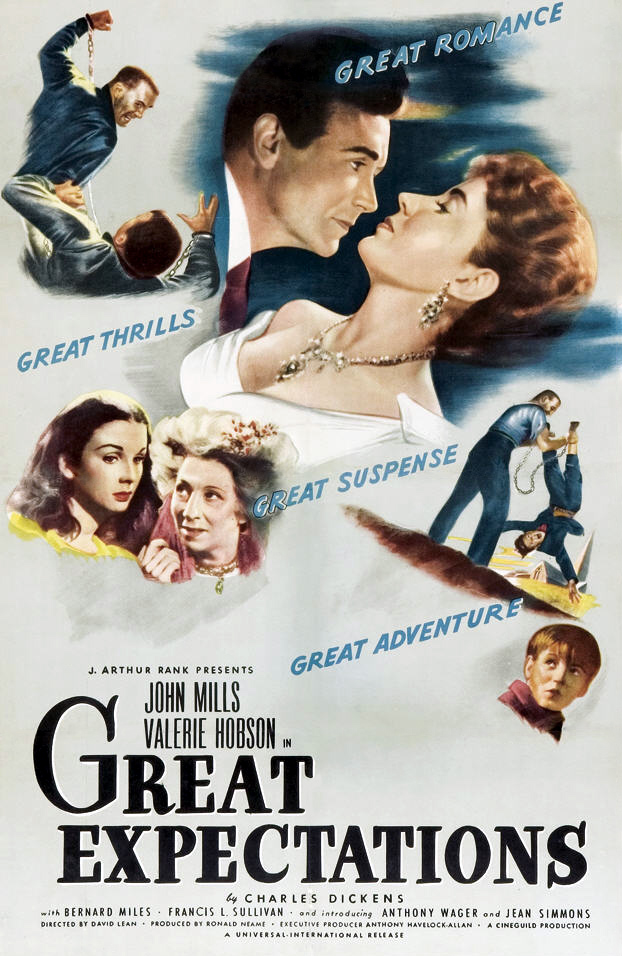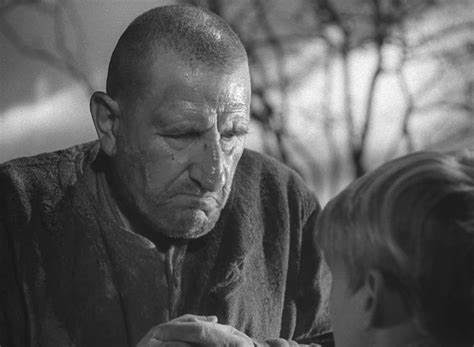
The Life of Emile Zola (1937)

The Life of Emile Zola (1937)

Oscar-winning biopic that laid down many of the conventions we expect

Director: William Dieterle

Cast: Paul Muni (Emile Zola), Gloria Holden (Alexandrine Zola), Gale Sondergaard (Lucie Dreyfus), Joseph Schildkraut (Captain Alfred Dreyfus), Donald Crisp (Maitre Labori), Erin O’Brien-Moore (Nana), John Litel (Charpentier), Henry O’Neill (Colonel Picquart), Morris Carnovsky (Anatole France), Louis Calhern (Major Dort), Ralph Morgan (Commander of Paris), Harry Davenport (Chief of Staff), Vladimir Sokoloff (Paul Cezanne)

One of the lesser-known Best Picture winners, The Life of Emile Zola is a prime example of the 1930s trend for “Great Man” pictures, setting the template for a whole genre of biographical movies. A whistle-stop tour of how the Great Man came to be, before a tight focus on what made him great – ideally ending in either triumph or disaster (or, as is the case here, with both). It’s from a time when the viewing public didn’t expect a rigid adherence to the fact – and when films were very open with their flexibility with the truth (the film opens with an on-screen caption which happily states most of what happens in it is made up.) Actually, I think being told from the start you are watching a heavily fictionalised version of the truth covers a multitude of sins: and that The Life of Emile Zola is pretty entertaining when you get past that.

Emile Zole (Paul Muni) is of course one of the most famous French authors. But he was also at least as famous for his campaigning and presence as he was for his volumes and volumes of best sellers. The film follows Zola, for its first forty minutes or so, from poverty-stricken writer, struggling to make ends meet in the draughty hovel he shares with similar future-genius Cezanne, to success (although in real life by the time he wrote Nana, the book that makes him a sensation here, he was already hugely famous). Zola becomes increasingly aimless. What worlds are there left to be conquered? That all changes when Lucie (Gale Sondergaard) the wife of army officer Alfred Dreyfus (Joseph Schildkraut) asks for his help to save his life from unjust imprisonment and exile on Devil’s Island. Because the army are convinced Dreyfus is a spy – and won’t let inconvenient things like evidence that someone else did it get in the way.

The film is called The Life of Emile Zola but really it might as well have been called The Dreyfus Affair. This infamous miscarriage of justice drives the entire second half of the movie – with Zola himself disappearing from focus for stretches as the film covers the conspiracies that led to Dreyfuss spending the best part of a decade imprisoned for something he didn’t do. What seems strange today is that the film makes no mention of the most famous angle of the case: Dreyfus was almost solely suspected because he was Jewish, and the case became one of the most infamous antisemitic persecutions in history. But the studio heads – Jewish themselves and nervous of being accused of making a film that criticised Nazi Germany – removed all reference to Dreyfus’ Jewishness from the script. It’s a curious omission, but by and large doesn’t affect the film’s final impact.

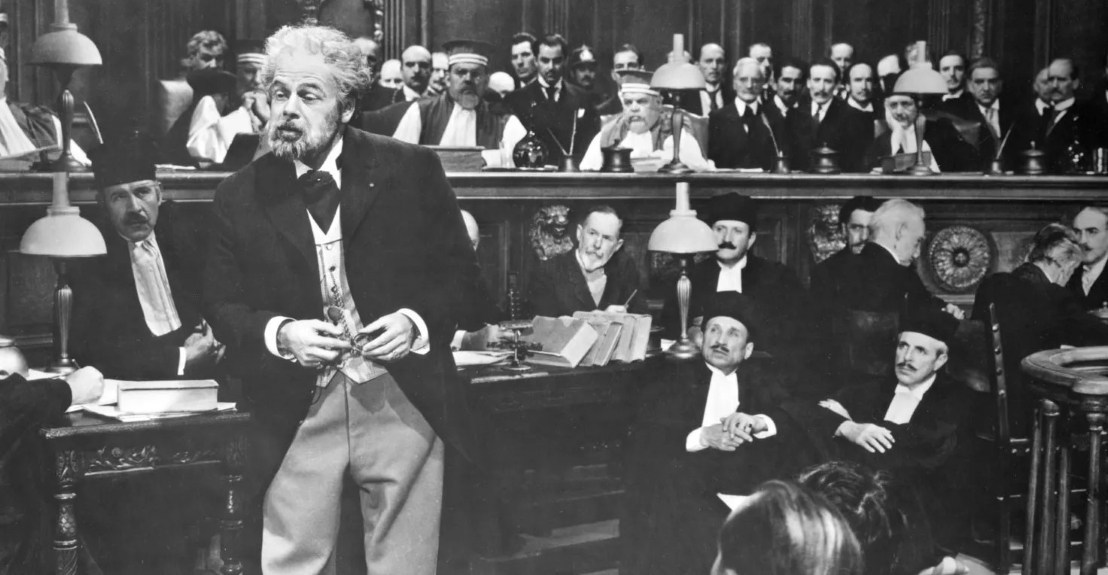
Dieterle’s movie is also one of the first courtroom dramas. A large chunk of the final third is given over to Zola’s trial for libel (after his famous J’Accuse article, denouncing the army’s persecution of Dreyfus). In a crowded courtroom, the film carefully follows the intricacies of the court case, from calling to witnesses to final speeches (all fairly accurate, even if Zola is given a larger role with a final speech). As in the trial itself, the blatant unfairness (witnesses shouted down, defence questions vetoed, evidence withheld and even invented) is hammered home with shocking regularity. Donald Crisp does fine work as the liberal lawyer, hamstrung by a crooked system.

The Dreyfus affair element is really what makes the film come to life. The French army officers are almost to a man a group of corrupt bullies, who have pre-decided the outcome of their investigation and are determined that every single element of it should support that decision. By contrast Joseph Schildkraut (winning an Oscar that feels more for Dreyfus than him, delivering an effective if rather one-note performance) is the soul of decency and nobility as a Dreyfus who is at first bewildered then fighting a manful struggle against despair. Even better is Gale Sondergaard, who gets an ahistorical impassioned speech to win Zola to the cause and carries a core of quiet anger under her shock.

The Dreyfus Affair was the struggle of Zola’s life, the crusade that would win him a place in history, perhaps even more than his books. It’s also the sort of campaigning material that gives rich rewards to actors. Paul Muni seizes the opportunity. The film was shot in reverse so Muni would need to spend less and less time in make-up as shooting went on: the old-age make-up and wigs are very effective, matched by Muni’s physicality and voice which subtly changes as the character ages.

Muni is an actor who seized any chance for a bit of grandstanding. The film gives him its best one with a five-minute monologue closing the trial, during which Zola argues with passionate but quiet reasonableness that Dreyfus is an innocent victim. It’s even more effective since Dieterle has kept Muni silently off-centre for much of the court case. Muni sometimes carries the whiff of stagey ham, but in several moments he brings both a charming cheek and strong morality to Zola. It’s a very strong performance from one of the leading actors of the 1930s.

The film itself is also a good mixture of the twee and the compelling. Most of the Dreyfuss material falls into the latter category. It’s the early days of Zola that falls into twee: Zola scrippling ideas, bantering with Cezanne on the purpose of art, playfully mining prostitute Nana for the material he will make into a hit book. There is a nice foreshadowing through the film with Zola’s obsession with blocking draughts – an obsession that will later cost him his life to a misfunctioning heater.

It’s a well directed film. Dieterle mixes in nice touches of humour (a husband and wife using subterfuge to disguise from each other that they are both buying Nana) and also effective details that speak of Dreyfus’ isolation (the letter that has been redacated into nothingness, the effective transition of several years at Devil’s Island that stresses how little has changed, Dreyfus’ giddy joy when finally allowed to walk unheeded in and out of his prison cell).

The Life of Emile Zola looks today like a surprising winner of Best Picture. But the patterns for both courtroom drama and many biographical dramas were laid down here. By the end, as the survivors pay tribute to Zola with high-blown speeches, the audience should be convinced that this was a man deserving of being honoured by a whole movie. It’s setting of a template copied many times over can make it look a little twee today, but its’ still well done, with some powerful flashes of effective film-making and great acting.

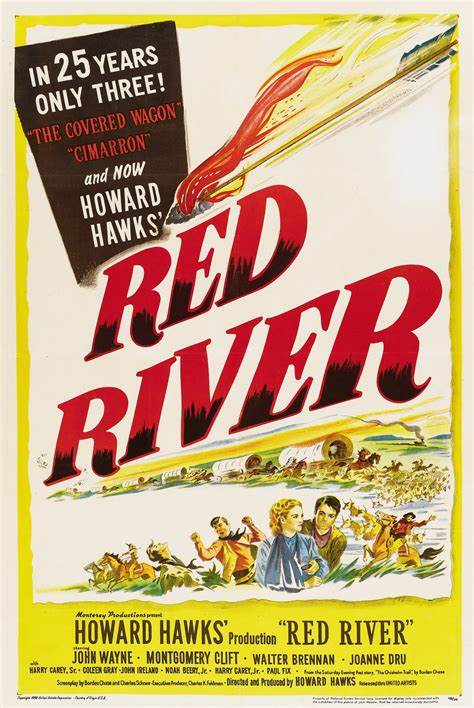
Red River (1948)

John Wayne and Montgomery Clift as duelling surrogate father and son in Red River

Director: Howard Hawks

Cast: John Wayne (Thomas Dunson), Montgomery Clift (Matt Garth), Joanna Dru (Tess Millay), Walter Brennan (Groot), Coleen Gray (Fen), Harry Carey (Melville), John Ireland (Cherry Valance), Noah Beery Jnr (Buster McGee), Harry Carey Jnr (Dan Latimer), Chief Yowlachie (Quo)

Some say Red River is, even more than Citizen Kane, the masterpiece in American film. That’s pushing it. But Red Rivercertainly is a prime slice of beefy entertainment. Hawks’ first Western (and how odd a director so associated with them didn’t turn his hand to them until late in his career – and then only made six), there is no greater compliment to make than to say you could mistake it for John Ford.

In fact, Ford was beyond impressed, famously observing of Wayne “I didn’t know the big son of a bitch could act”. Act he certainly does here as monolithic obsessive Thomas Dunson (surely a forerunner to the equally troubled – and troubling – Ethan Edwards in The Searchers). Dunson has spent almost two decades building his Texan cattle empire. Unfortunately, the Civil War means the bottom has dropped out of the Texas beef market. To make good his investment, Dunson needs to take the cattle (all 9,000 of them!) up north to Missouri (over a thousand miles) to sell at a good price. Along the way, Dunson’s ruthlessly focused ambition tips into tyranny, with Dunson (literally) judge, jury and executioner among his team. Can his more liberal adopted son, Matt Garth (Montgomery Clift), stop Dunson from destroying everything around him?

Red River covers the movement of cattle up the Chisholm Trail, a huge economic migration that saw millions of cattle moved from Texas to where their price was increased by a factor of ten. But the film has only a passing interest in the history – and the romantic, nostalgic look at it here, as a sort of boys-own adventure that goes wrong, is far more about the movies than social history. What the film is really focused on is the personal clash between two generations of men: one a relic of the first years of the new frontier, the other younger, more modern in his thinking, with a streak of humanity the other has beaten down.

Hawks’ film mixes this up with some terrific location footage. How did they wrangle all those cattle? The film is very strong in capturing the sense of excitement in the Frontier – the setting off on the trail, with its quick shot cacophony of horse-backed men whooping with joy, is full of a sense of adventure. The film is a triumph of quick-quick-slow story-telling. The 15 years of Dunson’s empire-building passes by with montage and Wayne voiceover which begins and ends with Wayne in the same position, but the actor considerably aged. Context is skilfully and swiftly given to us, but the tensions between Dunson and Matt are grow and develop naturally, simmering for a good hour-plus before erupting. Transition text between sequences bridges us from scene to scene, and is especially effective in charting Dunson’s descent into tyranny.

Tyranny is what it is all about. This is one of Wayne’s darkest – but also greatest – roles. Hawks taps into the despotic rigidity in this slab of Americana. Dunson is a man utterly and completely convinced not only of his invulnerability, but his rightness, embodying American manifest destiny. Claiming swathes of land as his own, Dunson is a man on the move, constantly striding forward (Hawks often shoots him in progressive, shark-like motion). He’ll leave behind him everything from the woman he loves (with a shocking toughness, as he looks back on the burning remains of the wagon train he left her in) to the land he claimed, to anyone who lets him down.

Dunson is also a ruthless embodiment of a time before law. No one seems to question the way he executes those who cross him. Practically the first thing he does on arrival in Texas is out-draw and kill the man sent to question his arrival. His farmstead has a full graveyard. A dark comic touch is added with his insistence in “reading the words” over graves of men he’s killed. On the trail he has those who back out, run away or question his leadership whipped or shot. Wayne’s certainty as an actor tips into a (literally) black-hatted despotism. His manly focus and ability to outdraw anyone turns him in the end into a nightmare avenger, a Western Terminator.

Opposite him is Clift (equally superb) as a more modern minded kid. Matt is the sort of man who knows that at times a bit of bend and a sympathetic ear gets better results than a beating. Hawks brilliantly builds the love-hate relationship between these two men who have very little in common, other than mutual affection. (Clift and Wayne themselves were polar opposites in acting style, social views and personalities.) There is a real love there – which makes it all the more inevitable Dunson will view Matt’s questioning of him as a betrayal nothing less than blood will redeem. The two of them, and their clash (like the clash between two sides of America) dominate the film, not letting too many other characters have a look-in.

Of the rest, Walter Brennan is a very good as Dunson’s loyal number 2, who may not always agree with the chief but largely (if reluctantly) sticks by him (for all he mutters to him “You’re wrong Mr Dunson”). John Ireland’s cocky gunslinger, who joins the trail because he admires Dunson’s no bullshit attitude, promises much at first but fails to deliver on much-hyped clashes. (Possibly because Ireland fell out with Hawks over a competition for the affections of his future wife Joanna Dru, his role later cut to ribbons in revenge.) There is however a strange, almost homoerotic, link between Clift and Ireland – mutual respect leading to an admiration love-in and much fondling of each other’s firearms during competitive rock shootings.

Red River’s ending has gained some criticism – largely because the film builds its sense of violence between the two leads so well that it feels a bit of a disappointment that they are effectively told to pull themselves together (by a woman of all things!). But, for all the film mines the clashes between two different outlooks, it never loses track of their very real affection. Sure Dunson may talk about killing Matt – but he certainly won’t in cold blood (even if he happily guns down anyone who gets in the way) and at the end of the day, he’s still the closest thing he’ll ever know as a son. Matt is emotionally mature enough to know Dunson is to-all-intents-and-purposes his father, even if he’s not above throwing a few punches at him. The clash is effectively a narrative dead-end – for all it would be exciting to see them take shots at each other, this is a family. And most families fight and make-up, not plug each other with bullets.

And it distracts from the grand entertainment of Red River, its excited love for the open country (the late act scenes inside are as disconcerting for us as they are the characters). This is a western of psychological depth successfully mixed with grand adventure. It’s hugely entertaining but also feels very true. It has two wonderful performances from Wayne and Clift. It’s not the Great American Film, but it’s directed by a superb understander of cinematic narrative and a hard film not to love.

Apollo 13 (1995)

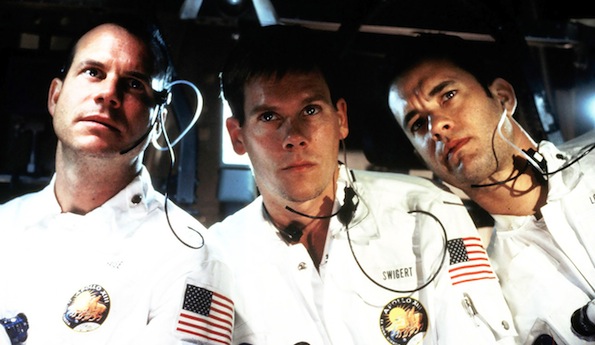
Bill Paxon, Kevin Bacon and Tom Hanks are stranded in space in Apollo 13

Director: Ron Howard

Cast: Tom Hanks (Jim Lovell), Kevin Bacon (Jack Swigert), Bill Paxton (Fred Haise), Gary Sinise (Ken Mattingly), Ed Harris (Gene Kranz), Kathleen Quinlan (Marilyn Lovell), Chris Ellis (Deke Slayton), Joe Spano (NASA Director) Xander Berkeley (Henry Hunt), Marc McClure (Glenn Lunney), Clint Howard (Sy Libergot), Ray McKinnon (Jerry Bostwick), David Andrews (Pete Conrad), Christian Clemenson (Dr Charles Berry), Brett Cullen (CAPCOM1)

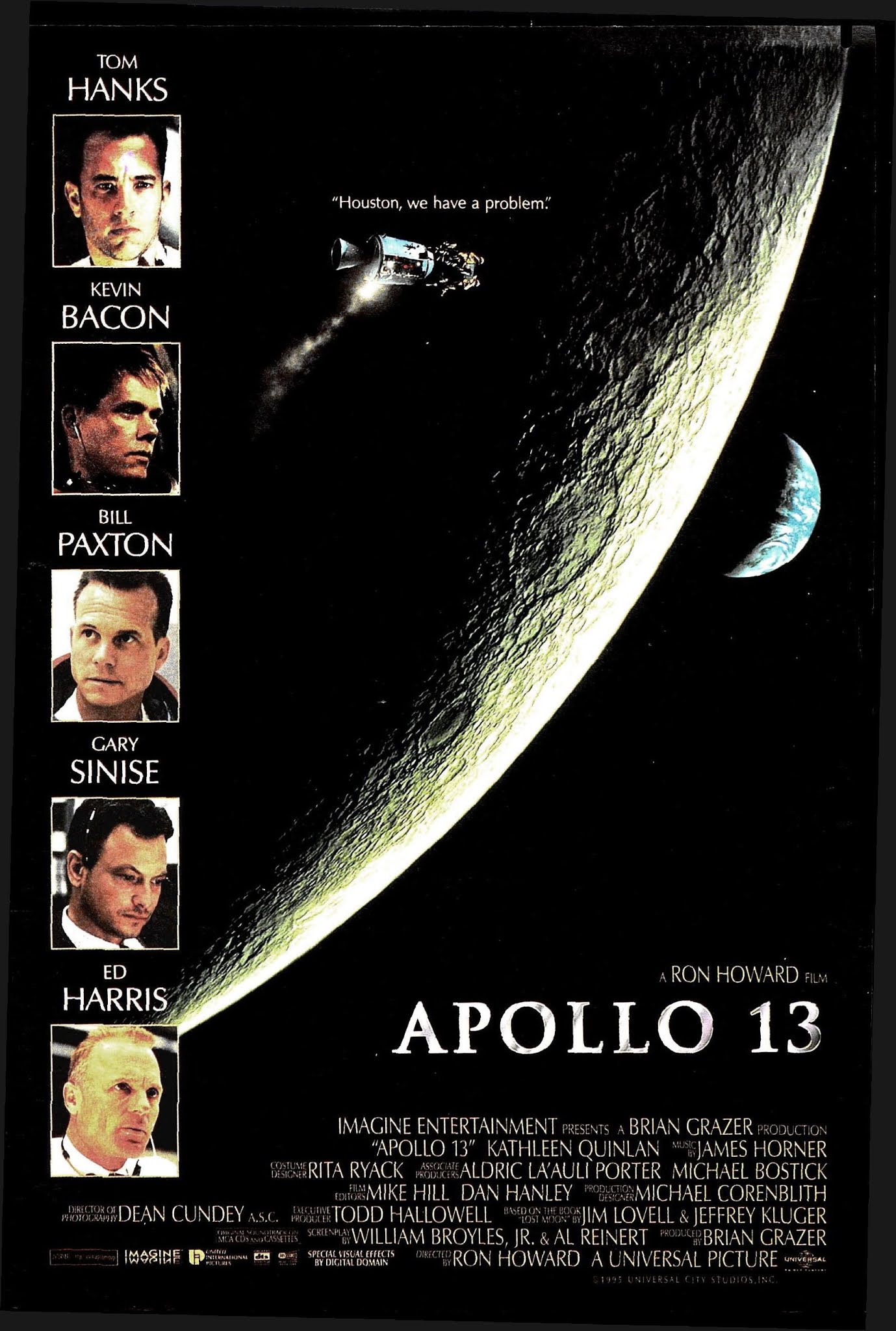
“Houston we have a problem”. Those calmly spoken words coat an ocean of disaster in Ron Howard’s brilliant reconstruction of the disaster-that-very-nearly-was, Apollo 13. Without a shadow of a doubt Howard’s finest film, this is brilliantly tense and hugely engaging that builds an edge-of-the-seat tension around a true story. You can’t watch it without being filled with breathless admiration for the ingenuity of those in mission control and the courage of those in space as they worked together to bring the mission home. Truly “Failure is not an option”.

On a mission to the moon, Mission Commander Jim Lovell (Tom Hanks) and crew Fred Haize (Bill Paxton) and late replacement Jack Swigert (Kevin Bacon) are left desperately trying to salvage their ship after an accident strikes. Meanwhile back in Houston, Flight Director Gene Kranz (Ed Harris) and replaced crewman Ken Mattingley (Gary Sinise) lead a dedicated team juggling every inch of mathematical, scientific and practical knowledge they have to bring the ship home.

Apollo 13 is a masterpiece of reconstruction. Every inch of the NASA space programme is reassembled in perfect detail. Every nut and bolt, from procedures to the interplay between the astronauts and Ground Control. There isn’t a single false note, and every single element of the production, photography and editing is carefully placed to support this total immersion in period. Howard’s technical direction is brilliantly done, intercutting with a fabulous sense of pacing between the crew in space and Ground Control back here on Earth. It becomes one of the most engrossing and involving true-life stories you can imagine.

I love this film. I love every second of it. Every single time I see it – and I must have watched it at least once a year since 1996 – I get wrapped up in the tension and, perhaps even more than that, the inventiveness needed to solve problems in space. The film throws conundrums at us time and time again. The command module needs to be restarted to land the ship – but only has enough power to keep a coffee machine running for a few hours. A vital course correction, that a computer could calculate and perform, needs to be carried out by hand. The weight of moon rocks needs to be replicated in the landing module. And, most brilliant of all, the NASA boffins need to work out literallyhow to fit a round peg into a square hole in order to replace a CO2 filter – using nothing but the pile of equipment on the spaceship.

These problems all need to be solved by people low on sleep, high on stress and – in three obvious cases – stranded, cold and alone in space, and each one is carefully explained by the film’s very natural but highly detailed script and then relayed into nail-biting efforts to solve them. (James Horner’s score also works wonders here, communicating the awe of space and our vulnerability in that black void expertly.) In no other film can the tearing of a plastic bag have you gasping at the impact it could have on life or death.

Added to the impact of this, is the engrossing excitement of watching brilliantly trained professionals tackle the sort of situations that would reduce you or I to sweaty panic. Other than a brief moment of recrimination between Haise and Swigert (authoritatively quashed by Lovell’s “Gentlemen, we are not doing this”), everyone stays more cool, calm and collected than you could possibly expect. This also means that flashes of urgency or emotion carry huge impact in communicating stress: when Libergot stresses powering down the ship is the only way for the crew to survive or Lovell is caught on radio ranting he is “well aware of the Goddamn gimbels” while trying to pilot a ship leaking oxygen through a barrage of debris to a soundtrack of alarms, the pressures they are trying to cope with come thundering home to us.

The extraordinary work of the actors also goes a long way towards the film’s success. If any film cemented Tom Hanks’ everyman quality, it was this one. His Jim Lovell is calm, controlled and extremely grounded, a professional with a realistic outlet, a devoted family man and overwhelmingly ordinary for all the extraordinary things he’s done. Hanks brings the role a huge authority and acres of empathy and relatability. He seems both vulnerable, human and professionally assured. I’d trade both his Oscar-winning performances for this one.

The whole cast follows his lead. Bacon and Paxton are very good as the rest of the crew, juggling moments of fear, frustration and black humour. Ed Harris became a star character actor overnight with his brilliant performance as Kranz, another committed professional who refuses to countenance failure and guides the ground team through super-human efforts, while keeping his own emotions carefully under control. Kathleen Quinlan is impressive as Lovell’s wife, keeping the morale of those left behind as high as she can while barely controlling her own fear. Gary Sinise’s Ken Mattingley channels his resentment at being benched from the mission into a Herculean commitment to bringing them home.

It’s that commitment on the ground that Howard’s film so brilliantly understands. A lesser film would have focused overwhelmingly on the courage of the astronauts alone, and heightened their struggles to pilot the spacecraft and survive. Apollo 13 understands above all that this was a team effort – and the casting and scripting feeds brilliantly into this. No one is the “hero”, no one “saves the day”. Every character focuses on their own small piece of the puzzle and has to trust all the others worked out. The film gives huge amounts of time over to the boffins and geniuses of Mission Control – all brilliantly played by a host of character actors – and its respect for these unsung heroes is as great as it is for Lovell and his crew.

Howard also understands exactly when to up the music, editing and effects and when to slow the film down and let events quietly play out. Moments in space where the actors have to quietly reflect, or when we check in on the fears and concerns of the families back home, contrast perfectly (and carry even more impact) when they sit alongside the scenes of failures and rushes to save lives. As for that re-entry scene… is there any more tense scene in a true story film than that long, long wait to see if Apollo 13 will return from space? There are certainly fewer moments that will get those specks of dust irritating your eyes – I get a lump in my throat just thinking about it.

Everything in Apollo 13 is spot on. I would go further and say I’m not sure there is a single wrong beat in it. It’s Howard’s masterpiece – his infamous snubbing for an Oscar nomination is inexplicable, his direction here is vastly superior to winner Mel Gibson’s work on Braveheart. It turns a true-life story into an impossibly tense, deeply involving, hugely emotional story. The actors – some of whom shot for weeks in a “vomit comet” plane to replicate weightlessness, an effect that works superbly – are outstanding. Every single technical aspect of the film is spot on. Its emotional impact is as absolute as the admiration and respect you’ll feel for the real NASA crews that guided this mission home. Apollo 13 is a classic. I can’t imagine anyone not finding something in it to like – not many films you can say that about.

Fail Safe (1964)

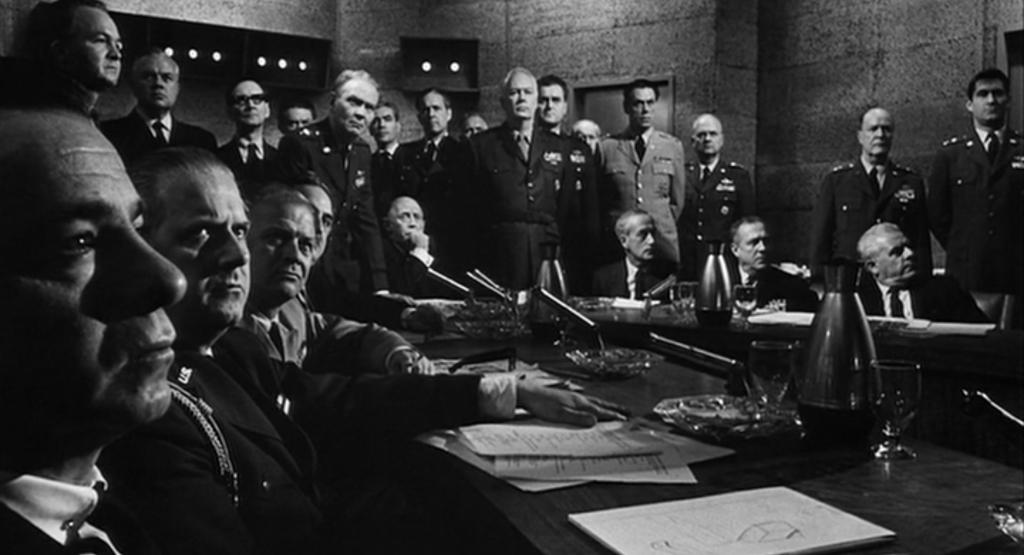
Henry Fonda desperately tries to avert nuclear war in Fail Safe

Director: Sidney Lumet

Cast: Henry Fonda (The President), Dan O’Herlihy (Brigadier General Warren Black), Walter Matthau (Professor Groeteschele), Frank Overton (General Bogan), Fritz Weaver (Colonel Cascio), Edward Binns (Colonel Jack Grady), Larry Hagman (Buck), William Hansen (Defence Secretary Swenson)

In 1964 the classic film on nuclear conflict was released and became a landmark in Hollywood history. Also released was Fail Safe. Dr Strangelove has dragged Fail Safe through history like a sort of phantom limb. It’s reputation – if you’ve heard about it at all – is “Dr Strangelove but with no jokes”. That’s hugely harsh on a well-made, tense and fascinating film that sees nuclear war as less the blackly comedic theatre of MAD (Mutually Assured Destruction, the buzzword of the day), and more as a dark human tragedy where mistakes, suspicions and paranoia lead to disaster.

During a routine manoeuvre, a mechanical power surge at USAAF leads to a mistaken but correctly authenticated order being sent to a wing of bombers to drop their nukes on Moscow. Due to Russian jamming, USAAF has no idea this has happened until after the five minute recall window. After the five-minute window has passed, the pilots follow their training and ignore all subsequent orders no matter who gives them – even if it’s directly from the President (Henry Fonda) himself. Desperately the President works with the Soviet Union to stop the bombers (and prevent the inevitable full scale nuclear war they would provoke). Problem is national pride, mutual suspicion, subordinates who can’t stomach co-operation between enemies and those that an accidental first strike is the perfect way to start a nuclear war one side could win, keep getting in the way.

While Dr Strangelove saw the insanity of MAD – the willingness of the leaders of both sides to promote a type of war that could only lead to the destruction of all life on earth – as so darkly absurd it could only be a subject for jet-dark-satire, Fail Safe takes a more humane if equally chilling route. Shot mostly with a low-key documentary realism by Sidney Lumet, the action is restricted to no more than four main locations. Once the crisis starts we never go outside. We never even see the Russians, represented only by photos and their words given life by Presidential translator Larry Hagman. Bar from the odd piece of stock footage, we are in the bunkers with the characters. And we feel as powerless as they do, as events spin out of control.

The film could be seen as an attack on the replacement of humans from the system by machines. Sure, the strike is triggered by a faulty piece of equipment. But everything after that is the result of good old-fashioned human error. The US debate about shooting down the bombers that goes on for so long, the bombers get out of range. The Russian refusal to accept US help to shoot the bombers down, leading them to taking pot shots at radar ghosts. The attempted coups on both sides in the command room, as junior officers refuse to co-operate with the enemy. The mistrust between both sides that leads the Russians chasing a decoy attack run rather the real bombing plane, despite the pleading of the American General that it’s a decoy.

And above all, the crushing arrogant insanity of introducing a system like this in the first place. A system so regimented and drilled into its soldiers – removing any chance of independent logical thought – that the pilot of the bombers will even ignore his own wife pleading down the line that the first strike he believes he is retaliating against hasn’t even happened. A system where leading American advisors suggest that, because it’s so difficult to call back an attack like this, why not just launch everything else after it as well and claim victory. This system can destroy the world but has no leeway for human error and forbids any independent thought from anyone. Now that’s MAD.

It takes a while for the film to get going, laying its groundwork slowly. Much of the first half hour introduces the characters – such as the family life of anti-Nuclear but loyal soldier General Black (a very good Dan O’Herlihy) and the chilling pragmatism of war theorist Professor Groeteschele (Walter Matthau) to whom nuclear war is just a matter of working out what the acceptable casualty rates are (he would agree with Stalin that one death is a tragedy, a million is a statistic). We tour the USAAF base where level-headed General Brogan (an excellent Frank Overton) and his twitchy number two Colonel Cascio (a slightly too fidgety Fritz Weaver) demonstrate just how fool-proof their systems are to a couple of congressmen – just as those systems fail.

From there the film plays out almost in real time, as the planes fly the two-hour journey to drop their bombs. Two hours when everyone tries to desperately tell themselves that this disaster can be prevented (or in some cases, can be turned into victory). Lumet’s film captures wonderfully the claustrophobic intensity of this. The Russians – despite never being seen – are skilfully humanised with snatches of conversation and photographs. The pilots are brave, resourceful, brilliantly trained – making their rigid determination to destroy the world for no reason (because their training doesn’t allow them to consider any other alternative) all the more tragic.

It all culminates in an impossibly bleak ending, the President’s only alternative to all-out nuclear war is one of terrifying magnitude. The inevitable build to this sacrifice is also executed with a low-key intensity. Fonda is perfect in the lead role – his tortured gravitas and decency pushing him towards ever more distasteful and finally appallingly bleak decisions.

Lumet’s film isn’t perfect – an overly impressionistic opening of General Black’s recurring dream of a matador smacks of someone who has watched way too many Bunuel films – and its slow start probably takes five minutes too long. But with its chillingly cold glaze on the flaws in the nuclear deterrent and the people who operate it, it deserves to be remembered as something more than Dr Strangelove Without the Jokes.

The Social Network (2010)

Andrew Garfield and Jesse Eisenberg bring the making of Facebook to life in Fincher’s modern American classic

Director: David Fincher

Cast: Jesse Eisenberg (Mark Zuckerberg), Andrew Garfield (Eduardo Saverin), Justin Timberlake (Sean Parker), Armie Hammer (Cameron Winklevoss/Tyler Winklevoss), Max Minghella (Divya Narendra), Brenda Song (Christy Lee), Rashida Jones (Marilyn Delpy), Joseph Mazzello (Dustin Moskovitz), Rooney Mara (Erica Albright), John Getz (Sy), David Selby (Gage)

Nothing has changed our interaction with the world faster than the internet. And nothing on the internet has changed how we interact as much as social media. As it drives changes in the way we relate to other people, it’s a brave film that tries to capture this zeitgeist and turn it into an effective movie. The Social Network is a brave movie – and also a brilliant one, a defiantly modern and far-sighted movie that avoids being the sanctimonious message movie it could have become, by concentrating on personal relationships, drama and, above all, a strong and compelling story.

Its October 2003 and a 19-year old Harvard student Mark Zuckerberg (Jesse Eisenberg) gets dumped by his girlfriend Erica (Rooney Mara). So, he responds like many people today would – but not in 2003 – by writing a series of rude and angry blogs about her. And at the same time, he does something you and I wouldn’t be able to do – he builds overnight a campus website called Facemash that allows users to rate the attractiveness of female students. It’s a sensation – and a scandal.

Off the back of it, Zuckerberg is approached by the Winklevoss brothers (in a skilled double performance by Armie Hammer) to see if he’d be interested in building an elite social network, Harvard Connection, for them. Zuckerberg agrees – but did he independently already have the idea for Thefacebook, an elite social network for Ivy League students? Either way, with funds from friend Eduardo Saverin (Andrew Garfield) he builds the platform which is to become Facebook. Does it all end well? Since the story is framed around Zuckerberg in 2009, sitting in depositions while being sued by both the Winkelvoss brothers (“the Winklevi”) and Saverin, you can guess not.

Fincher’s film reflects its central character in many ways – cool, efficient, tightly wound, juggling intellectualism with simmering tension. It’s vibrant, fresh, razor-sharp, perfectly paced and superbly dramatic. It turns what could have been a terrifically dull story of very clever people typing lines of code into a whipper-sharp story of jealousies, rivalries and suspicions. It also brilliantly veers away from being a polemic. It could easily have made points – as many films have – about the “evils and dangers of that creepy thing the internet” or constantly reminded us how morally superior film-makers are to social media kingpins. It does nothing of the sort. Instead it’s a brilliantly insightful look at the birth of a phenomenon that also makes subtle, intelligent points about some of the behaviours that phenomenon led to. All while keeping us gloriously entertained.

A big part of the film’s success is in Sorkin’s superb script. The material is perfect for him. The character’s intellectualism fits with his pithy turn of phrase, while their perceptions of themselves as victims or on a moral crusade fits with his ability to write morality with empathy. It also helps that he is the master of crackling dialogue. The idea to structure the film around the depositions is also a master-stroke. Not just a reminder of what’s to come, it adds an air of artificiality to everything we see (perfect as well for Sorkin’s smarter-than-life dialogue) – after all, each scene is based on the filtered remembrances of people in the depositions. And all of them remember a subtly different story.

Sorkin and Fincher also manage to avoid having villains in play. It would be easy to make Zuckerberg a villain: many films would have done. But Zuckerberg here isn’t bad – it’s more that he’s tunnel-visioned, selfish and socially inept. Erica (a marvellous turn by Rooney Mara as the first victim of social media bullying) has a point when she says she dumping him not because he’s a geek but because he’s not really a nice person. But Zuckerberg’s actions – his betrayals as some read them – come not from vindictiveness but a shark-like moving forward that leaves people behind him. And he’s also, as the film is keen to show repeatedly, lonely. He has one friend – whom he sacrifices on the altar of his creation – and is ruthless at cutting people out of his life when they fail to meet the standards he has set them.

The film channels the skills of Eisenberg – whose range is not huge – perfectly here, in a role he was surely born to play. Eisenberg crafts his physicality in something hunched, oppressed and sullen while his flat voice is perfect for a man who expresses himself through his creation not his personality. He gives Zuckerberg both a ruthlessness, but also a strange lack of knowledge – constantly surprised that his actions have consequences that leave him alone. He makes him a true lonely god of the internet – the man who invented the biggest social networking centre in the world, but who doesn’t have a friend himself.

But it also makes clear that Zuckerberg lacks the usual flaws of his kind: he’s not interested, it seems, in money, riches, fame or drugs. To him, the prize is to do not to be seen to do. He makes a rich contrast with Sean Parker (a brilliantly charismatic Justin Timberlake), the creator of Napster, who briefly influences him but is primarily interested in the flash and bang that the retiring Zuckerberg isn’t. What he does have is the drive and ruthlessness that his friend Eduardo Saverin (a wonderful performance from Andrew Garfield as a marvellously sweet, but clearly naïve and out-of-his-depth man completely lacking the vision a project like Facebook needs) doesn’t have – and which makes Saverin unsuitable for thinking in the global terms Zuckerberg is.

And the film has little time for the Winklevoss twins. Played with chutzpah in a double role by Armie Hammer (who skilfully distinguishes both of them), Zuckerberg is right when he describes them as rich kids who had everything they ever wanted in life – and seem outraged that they can’t be given the rights to Facebook as well. As he points out they intended to do nothing other than come up with a concept. These rowers – in a witty touch their boat is sponsored by that dinosaur Polaroid – also represent the old elite under siege from new media. The entitled rich, who can’t comprehend that the world is being handed to them on a plate.

The film also makes for an intriguing meta-commentary on the growth of social media. From the trolling of Erica, through the bitter feuds and arguments, the he-said-she-said fighting of the depositions, and the quick shifts between friendship and rivalry, it also manages to capture the world of social media in a nutshell. The atmosphere where actions can explode in people’s perception, where statements you made years ago come back to bite you, where judgement and criticism are constant and the ability to communicate more easily also makes fights easier to start, seem more and more prescient.

Fincher’s film does this marvellously, with a wit and sense of dramatic flair that reminds me of a more grounded Network. Sure the scene at Henley-on-Thames is hand-in-the-mouth agonising for any British person to watch (it is littered with major errors from turn-of-phrase to its understanding of life in Britain), but when every other scene in it is perfectly done it doesn’t matter. Like any victory, Facebook has many people claiming to be its father. You could say the film about this film: superbly directed, a brilliant script and perfectly cast, it’s a triumph.

A Passage to India (1984)

A Passage to India (1984)

Lean’s final film is a visually sumptious, if not always completely successful, Forster adaptation

Director: David Lean

Cast: Victor Bannerjee (Dr Azizi), Judy Davis (Adela Quested), Peggy Ashcroft (Mrs Moore), James Fox (Richard Fielding), Alec Guinness (Professor Narayan Godbole), Nigel Havers (Ronny Heaslop), Richard Wilson (Collector Turton), Antonia Pemberton (Mrs Turton), Michael Culver (Major McBryde), Clive Swift (Major Callendar), Art Malik (Ali), Saeed Jaffrey (Hamidullah), Ann Firbank (Mrs Callendar), Roshan Seth (Amit Rao)

David Lean’s final film came after a 14 year hiatus after the overwhelmingly negative reaction to Ryan’s Daughter. (During a disastrous two-hour lunchtime with several prominent US film critics, Lean was asked outright how the director of Brief Encounter could have made “such a piece of bullshit” – the experience shattered his confidence for years). When he returned, it was with this handsome literary adaptation of EM Forster’s classic novel on the tensions in the British Raj. A Passage to India is a wonderful fusion between Lean’s later films that fill the largest canvas, and the carefully judged Dickensian adaptations of his early years.

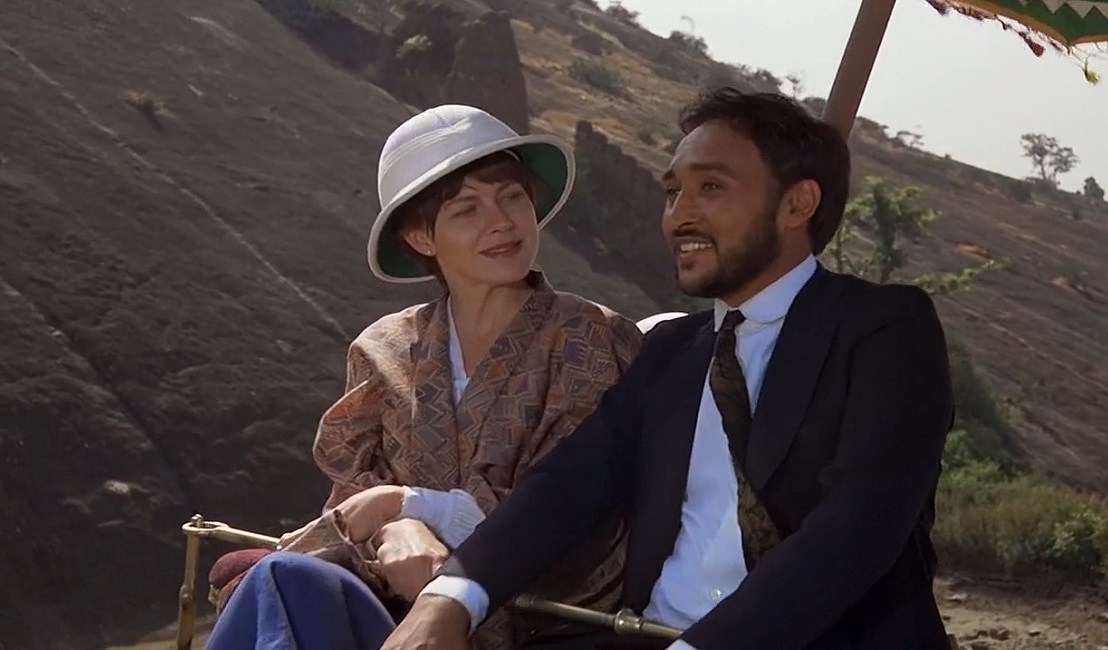
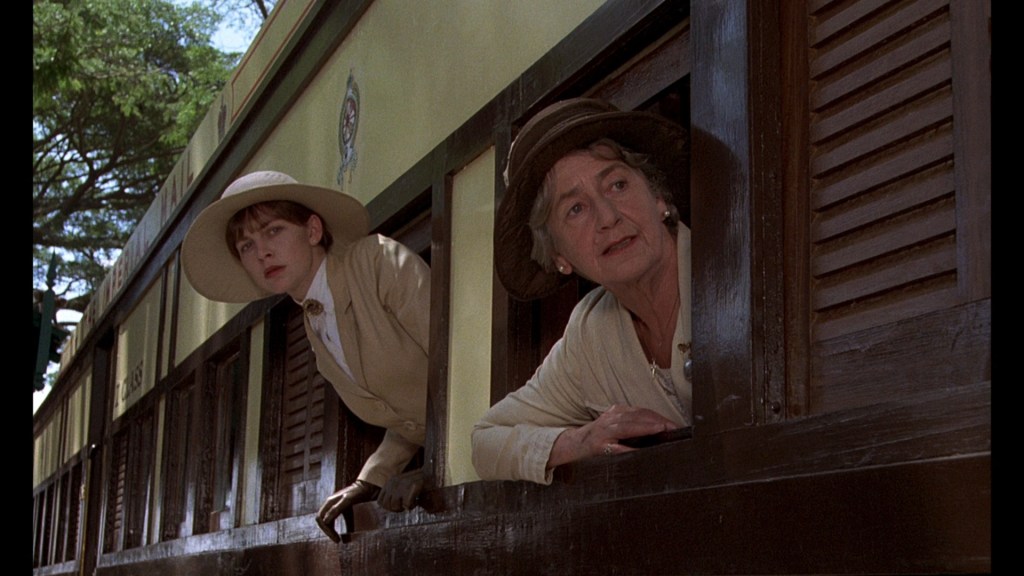
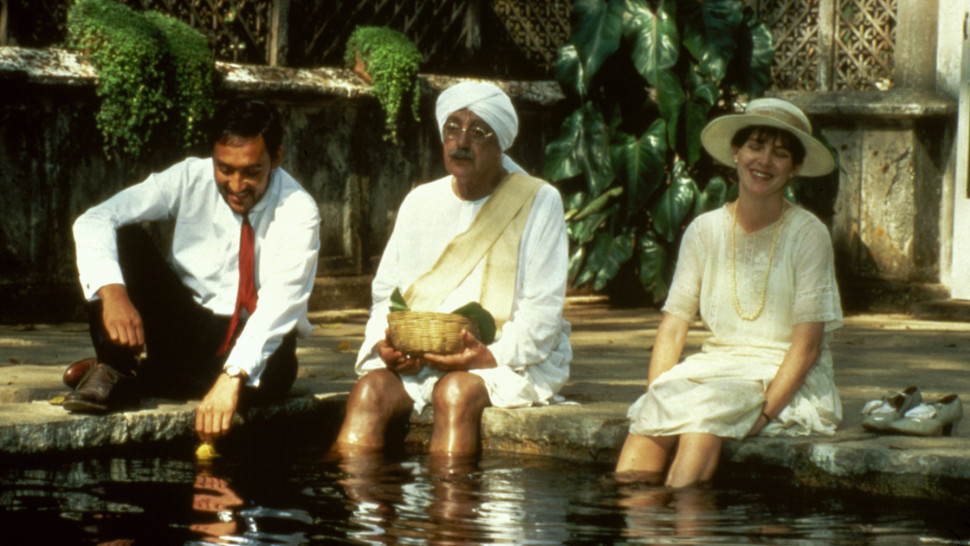
In 1920s Chandrapore, Adela Quested (Judy Davis) has arrived from England with her prospective mother-in-law Mrs Moore (Peggy Ashcroft) to marry the local magistrate Ronny Heaslop (Nigel Havers). The two women are fascinated by India and its culture – and quickly bored with the parts of it the ex-pat community will show them (basically a sort of little-England alcove). When they befriend local Muslim doctor Aziz (Victor Bannerjee) and liberal pro-Indian school superintendent Richard Fielding (James Fox), Aziz invites them on a trip to the local Marabar Caves. During the trip, Miss Quested flees and accuses Aziz of attempted rape. Aziz pleas his innocence – Fielding and Mrs Moore believe him, Miss Quested seems confused – but the case becomes a cause celebre that will explode the tensions between the rulers and the colonised.

Lean’s production of the book (as well as directing, he also wrote the screenplay and edited the film) is a delicate and handsome adaptation, carefully capturing the events of the book and making a manful effort to bring to life its textures and complexities. Forster had worked in India for several years as the secretary to a Maharajah and for many years was in love with an Indian called Masood. He had a unique perspective of Indian/English relations (much of it filtered into the character of Fielding) which he believed was underpinned not only by misunderstanding but also unpassable barriers that Empire throws up between East and West.

A Passage to India doesn’t always quite manage to capture this – perhaps largely because the book’s third act (which focuses in particular on the strains on the friendship between Aziz and Fielding) is truncated down to about 12 minutes of the film’s 2 and half hour run time. This does mean the film’s final impact feels rushed and unclear – and that the final parting of these characters doesn’t carry the impact it should. I can see why this has been done – that section of the book is less interesting, and also shows Aziz, at times, in a less sympathetic light – but it does mean the film misses something of the book’s engagement with moral and intellectual issues in favour of delivering the cold, hard plot of the Caves and the trial.

But these sections are well-judged, carefully structured and expertly executed. Lean’s film is very good on observing the kneejerk racism (some paternal, some outright unpleasant) from the British community. The incongruity of British clubs, garden parties and middle-class homes and lawns in a foreign land. How Indians are only welcome into these settings as silent servants or repurposed into British icons, such as brass bands. The total detachment of the rulers from the ruled: the tour of India arranged by Ronny features the British barracks, court-room and culminates in some ghastly amateur theatricals. Indians exist only to be told what to do and to applaud their rulers.

This is counterpointed with the rich, vibrant, dynamic culture of the Indians. If the film sometimes tips into displaying this as a sort of Oriental mysticism, that can be partly because our experience of it is often filtered through Adela and Mrs Moore who are bewitched and intrigued by a country of colours, emotions and passions unheard of in Britain.

Lean’s film never overlooks the Indians though. Our introduction to Aziz is to see him nearly mowed down on his bike by a speeding government car. His home is kept in good condition, but cannot compare to the wealth of the British. He and his friends talk passionately of the possibility for independence. There is a natural expectation of rudeness and dismissal from the British, that is taken in their stride.

Well played – if the role is a little passive – by Victor Bannerjee, Aziz is the victim we witness events through. Proud to befriend the British women, friendly and over-eager, Aziz is a highly unlikely would-be rapist. Put-upon and dismissed by his British superiors, he’s a lonely widower whose children are living hundreds of miles away, who suggests the trip in a moment of social awkwardness and goes to absurd ends to make the trip a success.

Sadly, its doomed. Leans film does a good job of maintaining much of the book’s mystery of what happens in the caves. Lean also finds a visual way of representing much that lies implied in the book. In an invented scene before  the trip, Adela cycles into the Indian countryside eventually finding a ruined temple filled with sexually explicit statues and hordes of monkeys in heat. Its clear the exposure to sexuality both shocks and unnerves her – but also fascinates her. Later she dreams of the statues she has seen. The same overwhelming feels seem to consume her in the caves – a heightened sense bought on by claustrophobia and a fear of a moment of personal intimacy between her and Aziz, perhaps spinning off into a temporary nervous collapse.

The film doesn’t state it for sure, but the implication is carefully put there. It leads perfectly into the well-staged trial scenes. Lean’s film focuses largely on delivering the plot of the novel, rather than the depths, but in delivering this crucial encounter he finds a marvellous way to use the language of film (music, editing and photography all interplay effectively in the sequences to add to their unsettling eeriness) to dramatise a literary sequence.

It’s not a perfect film. At times languid, it could no doubt have done with a bit more tightening and pace (it takes nearly half the film to reach the caves). While the film benefits from the build of the atmosphere and the tensions between both cultures, if Lean can do Great Expectations in less than two hours you feel he could have done this book more tightly. The unfortunate decision to cast a brown-face Alec Guinness as Brahmin scholar Professor Godbole looks more uncomfortable with each passing year – not least as all other Indian roles are played by Indian actors.

The film does however have a very strong cast. Judy Davis is both fragile, uncertain and at times even deeply frustrating (in the intended way!) as Miss Quested. Peggy Ashcroft won an Oscar (part of a late boom in her screen career – she also won a BAFTA the same year for The Jewel in the Crown) as the very grounded and worldly-wise Mrs Moore. James Fox gives his finest performance as the sympathetic Fielding caught between two worlds and eventually rejected by both.

A Passage to India has a lot of Lean’s visual mastery, but it’s less a sweeping pictorial epic and more of a careful and well-judged literary adaptation. While it does focus more on the plot and less on the meaning of the novel, and it overlong and at times lacking in energy, it also has some fine performances and brings many parts of the novel triumphantly to life. His final film does not disgrace his CV.

The Great Escape (1963)

Steve McQueen is the Cooler King (King of Cool?) in The Great Escape

Director: John Sturges

Cast: Steve McQueen (Captain Virgil Hilts), James Garner (Flight Lt Bob Hendley), Richard Attenborough (Sqd Leader Roger Bartlett), James Donald (Group Captain Ramsey), Charles Bronson (Ft Lt Danny Welinski), Donald Pleasance (Flt Lt Colin Blythe), James Coburn (FO Sedgwick), Hannes Messemer (Oberst von Luger), David McCallum (Lt-Commander Eric Ashley-Pitt), Gordon Jackson (Ft Lt Andy MacDonald), John Leyton (Ft Lt Willie Dickes), Angus Lennie (FO Archie Ives), Nigel Stock (Ft Lt Dennis Cavendish), Robert Graf (Werner)

Is there a film in Britain more associated with holidays than The Great Escape? While I was growing up it felt like a day-off wasn’t complete unless the BBC screened it as part of their afternoon schedule. In Britain is has a status as a sort of cosy uncle, a part of the furniture of many people’s filmic lives. There is always something comforting and reassuring about The Great Escape. So much so, people forget it ends with a large bodycount and the majority of our heroes further away from freedom than when they started.

But it doesn’t really matter, because The Great Escape is one of the last hurrahs of effective, nostalgic war-films. The sort of hugely enjoyable caper that recognises the cost of war, but also celebrates the pluck, ingenuity and guts of Allied servicemen, running rings around those dastardly cheating Nazis. Where we would all like to look back and remember those days when men-were-men and worked together towards a common goal. Sturges has created a marvellous tapestry of a movie, that pulls together several striking scenes, characters and snippets of dialogue into a true ensemble piece that reflects the camaraderie and unity that exists between the prisoners as they work towards their escape.

In some ways, The Great Escape is such good fun, such well-packaged entertainment and telling such an exciting, uplifting and (in the end) moving story that it’s almost immune to criticism. You’d have to have a pretty hard heart not to enjoy it. And you’d have to be pretty cynical not to enjoy the way it presents a series of obstacles and then carefully demonstrates the fascinating and rewarding ways the prisoners resolve these. It’s also notable that, aside from the shadowy Gestapo types, the film doesn’t really have an antagonist. The enemy is that fence. Most of the Germans are just regular soldiers doing a job – it’s only the brutal final-act Gestapo who are aren’t playing this eccentric game. But this helps us sit back and enjoy the film as a caper – just as it makes the burst of machine-gun fire that (nearly) ends the film even more impactful and shocking.

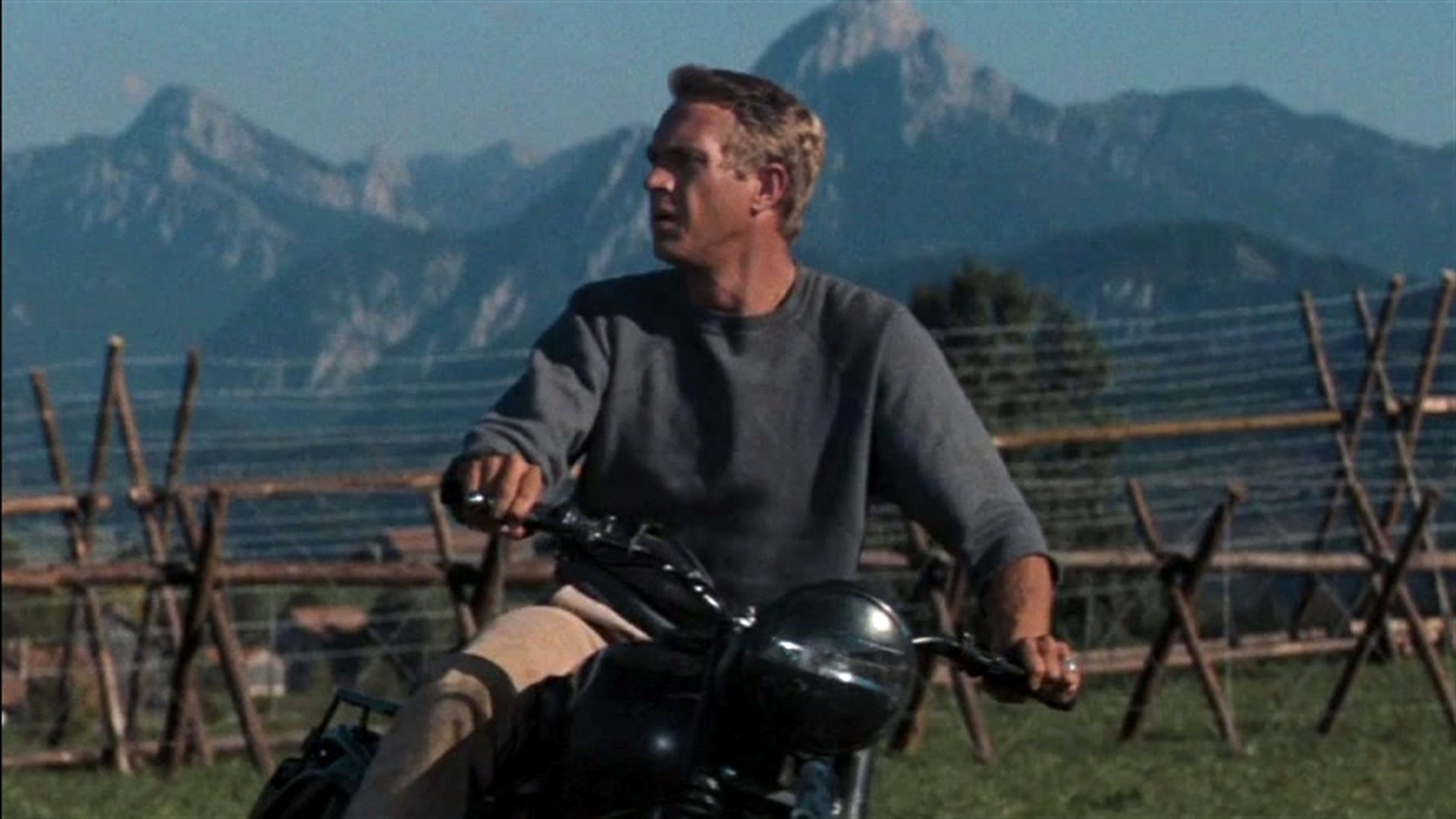
Sturges’ gets the tone of the film spot-on, and also draws a series of perfectly balanced performances from his all-star cast. I think it’s fair to say a lot of the film’s success was connected to Steve McQueen’s casting in the crucial role of Hilts. McQueen channels a sense of 1960s anti-establishment cool into the film (unlike the rest of the POWs, he seems to be wearing basically his own clothes in t-shirt, chinos and bomber jacket). Iconically bouncing his ball against the wall in a cooler, a natural loner (who of course still does his bit), with a cocky sense of defiance and some exceptional motor-bike skills, Hilts is undeniably cool. He’s the face of the film – and the one you walk away wanting to be.

He also gets the film’s definitive claim to fame, with a series of daring motorbike stunts as he races across Germany to escape. Mostly performed by McQueen himself (although not the most famous fence jump, done by a stuntman) this last act chase is a gripping, action counter-point to the more cagey, paranoid runs of the other escapees. It’s so exciting and feel-good, it’s a surprise to remember that Hilts actually gets caught. But then, if he hadn’t, we’d have lost McQueen’s cool, wry shrug of acceptance as he and his mitt were sent back to the cooler in the camp for another 20 days.

The film tees up plenty of sub-plots for the rest of the cast, with Sturges’ spreading the love very effectively. Charles Bronson gets perhaps the best plot as “tunnel king” Danny Welinski who holds back his crippling claustrophobia almost long enough. I think this might be Bronson’s finest hour, giving a real vulnerability to Danny, with genuinely quite affecting whimpers and fear at confronting the tunnel – making his struggle all the more moving. Bronson makes a wonderful double-act with John Leyton as fellow tunneller Willie Dickes, the two of them forging an affecting bond of loyalty.

A similar bond also forms between James Garner’s suave and playful scrounger Jack Hedley and Donald Pleasance’s professorial forger Colin Blythe (has there ever been a more “Colin” Colin on film than Pleasance?). The final moments between this pair carry perhaps the biggest gut-punch of a film that has a surprising large number of them. Pleasance’s sad attempts to hide and combat growing blindness are genuinely affecting, while Garner is a master at conveying depth beneath a light surface. Sturges’ film taps into the nostalgic memories most of us have (or have picked up) of this war being one where life-long friendships were formed against horror and adversity.

Attenborough does most of the thankless heavy-lifting as Big X, but the film uses his Blimpish authority well. Gordon Jackson has a memorial role as the number #2 famously caught out by his own vocal trap (the sort of irony films like this love). Fans of the TV show Colditz can enjoy seeing David McCallum in a very similar role as a daring young escapee. James Donald channels British reserve as the senior officer. The film’s single truly bizarre performance is from James Coburn, with an Australian accent from the Dick van-Dyke school of ineptitude, so terrible even Sturges surely noticed it when cutting the film.

The Great Escape marshals all these cards extremely well. Any combination of any of these actors produces fireworks. It’s one of the best boys own adventure you can imagine. It in fact gets the perfect balance: you can spend a large chunk of the film thinking that being locked up in a German POW camp looks like the best time ever – and then it chillingly reminds you with its sad coda of the terrible cost of war. But it’s that first hour and half and its celebration of grit, guts, determination and ingenuity that really works – and it’s so entertaining that it solves immediately any mystery as to why any public holiday you’re 10-1 to find this popping up on your afternoon TV listings.

Armageddon (1998)

Bruce Willis leads a group of Big Damn Heroes in Michael Bay’s abysmal Armageddon

Director: Michael Bay

Cast: Bruce Willis (Harry Stamper), Billy Bob Thornton (Dan Truman), Ben Affleck (AJ Frost), Liv Tyler (Grace Stamper), Will Patton (Chick Chapple), Steve Buscemi (Rockhound), William Fichtner (Colonel Sharp), Owen Wilson (Oscar Choice), Michael Clarke Duncan (Bear), Peter Stormare (Lev Andropov)

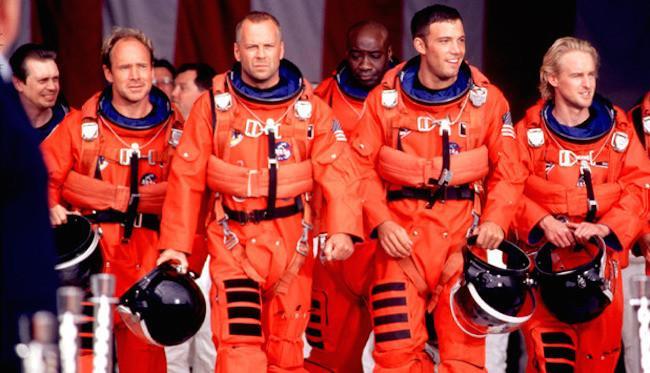
In Michael Bay’s space, no-one can hear you scream. But that’s only because it’s so damn loud up there. It’s 1998’s other “asteroid is going to wipe out humanity” film, the one that came out after Deep Impact but grossed more. NASA recruits ace driller Harry Stamper (Bruce Willis) and his team (including Will Patton, Steve Buscemi, Michael Clarke Duncan and Owen Wilson) to fly up to an asteroid the size of Texas, drill a hole in it, drop a massive nuke in and blow it into two bits that will bypass the Earth. Will humanity be saved? And will the tensions ever be resolved between Harry, his protégé AJ (Ben Affleck), and Harry’s daughter Grace (Liv Tyler) who, much against her dad’s will, wants to marry AJ? Houston, we have a problem.

Armageddon is the ultimate expression of Michael Bay’s style. With the camera swooping and rotating wildly around characters on the move, the fast-editing, the assault on the ears, the green-yellow-blue hue, every shot and line of dialogue in Armageddon feels like it was made to be inserted into a trailer. It’s an overlong onslaught (nearly two and a half hours) which rarely goes ten minutes without a sequence that features explosions, furious shouting and frantic camera movements. Most of the action in Armageddon is incoherent and the film rather neatly replicates the experience of being actually hit by a meteor.

For many people this is a guilty pleasure. But there is very little pleasure to be had here. By trying so hard to top Deep Impact – a film he hadn’t even seen at this point – Bay dials everything beyond 11. So much so it becomes exhausting. Half the action sequences (of which there are many) are impossible to understand, such is the fast editing and the way all the dialogue is screamed by the actors at each other, all at once, drowned out by bangs and crashes. The only dialogue you can actually make out in the film is of the “The United States government asked us to save the world. Anybody wanna say no?” variety, built for slotting into a trailer before some more bangs.

In fact the whole film is basically a massive trailer for itself. It’s unrelenting and after a while not a lot of fun. I guess if you catch it in the right mood it might just work. Bay gives it everything he has in his arsenal. But even he can’t overcome performances from his actors that range from bored and unengaged (Willis and Buscemi both fall into this category) to over-played grasping at epic-status (Affleck and Tyler fall into this one). Billy Bob Thornton comes out best with a wry shrug, knowing the whole film is bonkers but going with the ride.

Anyway, it all charges about a great deal, even while it never knows when to stop. In every situation one crisis is never enough – it’s best to have three at once. Not only does someone need to stay behind, but the asteroid is breaking up and the shuttle won’t take off! What a to-do! The film is desperate to excite you, like a 7 year old who wants to share the BEST-THING-EVER with you and doesn’t draw breath while telling you every single detail.

Of course, scientifically the film is nonsense, but that hardly matters. How NASA can know the comet being blown in two will create two bits that will miss the Earth (rather than two impacts or a whole load of debris) is unclear. Timeline wise – particularly early on – the film makes no sense. But then who goes to Bay looking for a science lecture? It even opens with a ponderous Charlton Heston voiceover, all part of the straining for grandeur.

It’s not even the best Bay film (that would surely be the far more enjoyable but equally overblown The Rock closely followed by the first Transformers film, the only one that doesn’t make you feel soiled after watching it). Armageddon could be a guilty pleasure. But really it’s terrible. You should just feel guilty.

Great Expectations (1946)

Great Expectations (1946)

Lean’s masterful adaptation is still one of the finest examples of Dickens on screen

Director: David Lean

Cast: John Mills (Pip), Valerie Hobson (Estella), Bernard Miles (Joe Gargery), Francis L Sullivan (Jaggers), Finlay Currie (Abel Magwich), Martita Hunt (Miss Havisham), Alec Guinness (Herbert Pocket), Jean Simmons (Young Estella), Anthony Wagner (Young Pip), Ivor Barnard (Wemmick), Freda Jackson (Mrs Joe Gargery), Eileen Erskine (Biddy), Torin Thatcher (Bentley Drummle)

Of all Dicken’s books there is perhaps none so popular as Great Expectations – and no Dickens adaptations are more highly regarded than David Lean’s 1946 film. Of course, just under two hours is only time to tell a simplified version of Dicken’s original. But no-one’s taking the book away. What Lean’s film did triumphantly was turn Dicken’s prose into a clear cinematic language and style, without losing the uniqueness of the author’s voice. Lean’s visual mastery is perfectly matched with his experience as an editor of telling a story to produce an endlessly entertaining film.

As a young boy Pip (Anthony Wagner) encounters an escaped convict (Finlay Currie) in a graveyard. Intimidated, Pip brings the convict food and tools to escape his chains – acts which the convict clears him of when he is caught later that day. Weeks later, Pip is invited to the home of rich spinster Miss Havisham (Martita Hunt) to provide her and her adopted daughter Estella (Jean Simmons) with company. The visits continue until Pip’s apprenticeship as a blacksmith to his brother-in-law Joe (Bernard Miles) begins. Imagine Pip’s (now John Mills) surprise six years later when he is informed by lawyer Jaggers (Francis L. Sullivan) that he has come into money – that he has become a gentlemen of “great expectations”. Assuming it is the work of Miss Havisham – and that he is destined to marry Estella (now Valerie Hobson) – he is horrified to discover his life is more complex than he believed.

The film repackages Great Expectations a bit more into a romance. While the relationship between Pip and Estella, and the bond between them, is clear in the novel – and a large part of its plot – its but one thread masterfully woven together into the final storyline. Here this thread is given prominence, at the cost of several others. It’s not a complaint as such, but it makes Great Expectations into a more traditional story: a feeling added to by the film’s more conventional “feel-good” ending (very different from the much more uncertain ending of the novel, that Dicken’s edited back and forth in different editions to increase or decrease its hopefulness). However, it works for creating a film story, even if it loses some of the depth of the novel.

Its also more than balanced by how much the film gets right. Lean brilliantly captures the novel’s atmosphere, its gothic sense of impending dread, the burden of the past and the paranoia of persecution. For decades the opening scenes of the film, with its masterfully shot and edited mist covered graveyard (simultaneously a place of peace and a place of unsettling unknowability ) bursting into life through the grasping hands of Magwich, were practically used as a textbook example of cinematic language. Lean’s work is intensely cinematic. The mis en scene of Expectations is masterful – everything from casting, to camera angles to score comes together to bring Dickens world to life. This is exactly his London as he wrote it. It’s a wonderful expression of a particular author’s style, told using a mastery of cinematic language – from camera angles to editing cuts.

The characters have that perfect sense of eccentricity laced with menace that Dickens invests them with. Francis L Sullivan’s Jaggers is an unknowable legal machine who is part man of business, part fearsome fixer. Alec Guinness (in his film debut) is good-natured kindness to a T as Pip’s faithful friend Herbert (in one lovely scene he politely and gently corrects Pip’s primitive table manners). Finlay Currie’s Magwich captures the sense of danger and threat in the book’s opening that will become a fatherly meekness in the story’s later acts.

Largest of all, Martita Hunt’s gothic Miss Havisham sits like a giant spider at the centre of a decaying web. The design of Satis House – with its rotting wedding cake, sprawling cobwebbed dinner service, the heavy curtains and lack of light – is just one of the many perfect touches in the film. Hunt herself is superb as this outwardly eccentric aunt, who in fact has been nursing a core of bile and hatred that ends up only hurting those closest to her. There is something hugely dreamlike about Miss Havisham’s home – you suspect Lean may have watched some Cocteau – with its strangely angled table and mix of intimate framing and wide-angle crane shots.

Perhaps because we only see, not read, Pip’s actions in this film it’s impossible not notice what an arrogant snob he becomes. John Mills does decent work in the part, but (much as in the book) Pip ends up feeling like a slightly colourless figure. The film doesn’t always explore in detail the negative sides of his character meaning moments like his patronising dismissal of the kindly Joe (a perfectly judged Bernard Miles), don’t do the character much favours. Mills does however make a larger impression than Valerie Hobson, left slightly adrift as Estella. She’s not helped by how outstanding Jean Simmons is as the young and preciously flirtatious Estella, the perfect picture of the little cruelties teenagers inflict on each other. (A braver film might have had her play the role throughout – but then Mills would look even older than he does!)

The film is very strong on the pain caused to these two characters – and that they cause for each other. More than any other version, we get a sense here of how Miss Havisham’s misguided aim to use Estella as a weapon of revenge on all men only manages to hurt Estella herself and Pip (her one true love as presented here). Just as a Pip’s snobbish dismissal of Joe stings. And Lean’s brilliant sense of pace and rhythm means that this plays hand-in-hand with Pip’s ever more desperate attempts in the second half to save Magwich from doom.

Many of the complexities of the plot (from Estella’s parents to Herbert’s marriage to several key characters) are cut out, but it’s striking how the film still manages to feel so faithful to the book. Lean’s understanding of Dickens mix of eccentricity and darkness is communicated in every frame. The major moments and characters from the book are beautifully bought to life, from that opening scene to Satis House. But also because small moments, like Wemmick’s “Aged P” remain in the film. Sure, the canvas has been reduced – and refocused into a love story of sorts – but the picture that emerges is still very much in the style of Dickens.

That’s what makes it one of the greatest adaptations of all time: it’s both an interpretation of the original and a beautifully judged capturing of its spirit and tone. An adaptation twice the length may have caught more plot, but would not have been such a fine movie. Because so much of this film’s imagery and drama sticks in the mind long after it is finished. Lean’s masterstroke here was to understand completely the heart of the book, and to focus the film on that. Brilliantly assembled, designed, shot and acted, it’s still one of the best literary adaptations ever made.

Fatal Attraction (1987)

Glenn Close and Michael Douglas embark on a disastrous affair in Fatal Attraction

Director: Adrian Lyne

Cast: Michael Douglas (Dan Gallagher), Glenn Close (Alex Forrest), Anne Archer (Beth Gallagher), Ellen Hamilton Layzen (Ellen Gallagher), Stuart Pankin (Jimmy), Ellen Foley (Hildy), Fred Gwynne (Arthur), Mug Mundy (Joan Rogerson), Tom Brennan (Howard Rogerson), Lois Smith (Martha)

It was one of the biggest hits of the 1980s and was said to bring to life every man’s worst nightmare – which as David Thomson rather astutely put it, probably meant “too many men in the 1980s were worrying about the wrong thing”. Dan Gallagher (Michael Douglas) is a successful, middle-ranking lawyer representing a publishing company. He flirts with editor Alex Forrest (Glenn Close). Then one weekend, when his wife Beth (Anne Archer) is away with their daughter, he spends his time sleeping with her. Problem is, Alex won’t accept it was just a brief fling. Soon she’s calling his office, visiting his wife, claiming to be pregnant as part of a swift descent into furious obsession, demanding Dan leave his family for her. It won’t end well.

Fatal Attraction is a film that is going to struggle the more we move into the #metoo era. While in the 1980s audiences could be expected to be reasonably sympathetic to a man who just wants a bit on the side – and then feels oppressed by the moral consequences that follow – today it’s a bit tricky to feel the same. Put bluntly, Dan is a selfish man who is desperate to be seen to be doing the right thing. And while he realises he’s probably made a mistake after his first one-night stand, he still throws himself into a second day of flirting and sex with Alex (out of a sense of social obligation).

But then Fatal Attraction is a deeply conservative film that plays into feelings of fear and anxiety at the idea of the perfect domestic life being assaulted by an outsider. It portrays the damaging impact on Dan and his family as entirely the responsibility of Alex, instead of admitting that clearly both Dan and Alex are to blame for what happens. Sure, Alex becomes a (literal) bunny-boiler (this film is the origin of the phrase) and later a knife-wielding psychopath. But all this spins out of Dan’s selfishness and his fundamental lack of regard for the feelings of either his wife or Alex (both of whom he wants to think of him as being a good guy – which he probably isn’t).

Dan’s “have his cake and eat it” attitude is the real villain here – and while he is, of course, unlucky to hook up with someone as unbalanced as Alex, any perfectly rounded person would be expected to at least match some of Alex’s reactions. She’s right to say that he is shirking his responsibility, right to say that its wrong for him to use her for a bit of fun and discard her, and she’s right to be disgusted at his automatic offer to pay for the abortion he assumes she will agree to.

A more modern version of Fatal Attraction would probably play out a bit more like the TV multi-perspective drama The Affair (where Dominic West and Ruth Wilson’s characters split the narrative between their very different perspectives on a life-shattering love-affair). It would show more sympathy for Alex’s desperation, loneliness and sadness – and really explore what it is that happened in her past that made her react as extremely to rejection and betrayal as this. And it would have greater criticism for Dan’s cavalier attitude to other people’s feelings.

But then a film like that wouldn’t have been a hit. Glenn Close may not have liked the reshot ending – which came out of test screenings that showed audiences really wanted Douglas to kill that bitch – with Alex entering the Gallagher country home with murder in mind. But the final desperate battle between Dan/Ruth and Alex – and the nuclear family being re-cemented in the shedding of Alex’s blood – was what made the film such a hit. Because who wants the complexity of shared responsibility when “The Other Woman” can literally rise from the dead to strike one final blow before being gunned down?

The film also worked of course due to Glenn Close’s fabulous performance in the lead role. Close worked hard to not position Alex – for all the film aims to do this – as a creepy stalker. Instead she invests her with a righteous fury of a woman who feels she has been terribly wronged, whose every attempt at peace-making has been slapped away and responds with justified anger. There is a real fragility in Close – who consulted psychiatrists to understand Alex’s fragile mindset – and she never lets us forget the pain motivating her actions, even as the film becomes ever more melodramatic and turns her character into more and more of a horror film staple.

Opposite her, Michael Douglas is equally good. This was Douglas’ first in a run of roles where he seemed to embody something in the everyday American-man that lived in terror of female independence and sexuality (he would be terrified on screen by Sharon Stone, Kathleen Turner and Demi Moore over the next seven years). Douglas is great though because while he looks the American dream, he conveys this sense of weakness and compromise. He convinces completely as a rather weak-willed man, terrified of being made to face the consequences of his actions. Archer is also first-rate in a surprisingly low-key role as the wronged wife.

Fatal Attraction starts out as a fascinating look at morality and morals in modern America and ends as a slasher film. A more complex film might have lasted better – even if it wasn’t such a hit – but it throws just about enough depth in there, before the madness descends.