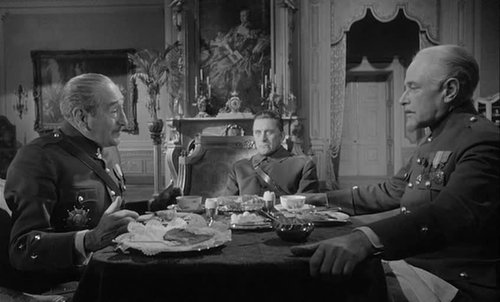
My Darling Clementine (1946)

Henry Fonda is here to enforce justice in My Darling Clementine

Director: John Ford

Cast: Henry Fonda (Wyatt Earp), Linda Darnell (Chihuahua), Victor Mature (“Doc” Holliday), Cathy Downs (Clementine Carter), Walter Brennan (Newman Haynes Clanton), Tim Holt (Virgil Earp), Ward Bond (Morgan Earp), Don Garner (James Earp), Grant Withers (Ike Claton), John Ireland (Billy Clanton), Alan Mowbray (Granville Thorndyke), Roy Roberts (Mayor), Jane Darwell (Kate Nelson)

In John Ford’s The Man Who Shot Liberty Valance, a journalist says “When legend becomes fact, print the legend”. It could almost be a commentary on My Darling Clementine, a lusciously romantic retelling of the story of Wyatt Earp and his Gunfight at the OK Corrall between the Earps and local cowboy gang the Clantons. John Ford’s film is a perfect slice of Americana, in which the West is seen at its glorious best, and almost no fact in it is true.

In 1882 retired Marshal turned ranger Wyatt Earp’s (Henry Fonda) brother James is killed outside the town of Tombstone, shortly after Earp had turned down an offer to buy his cattle from Old Man Clanton (Walter Brennan), the family patriarch. Earp suspects foul play, but decides to stay in Tombstone as its new Marshal, with his brothers Virgil (Tim Holt) and Morgan (Ward Bond) as his deputies to reinforce the law. In town he meets local gambling man “Doc” Holliday (Victor Mature) and falls for Holliday’s former girlfriend Clementine (Cathy Downs), in town searching for Doc. Will Wyatt find out who killed his brother and find contentment?

My Darling Clementine is almost entirely invented. Virtually nothing in it is true, from the year it’s set (the actual gunfight happened in 1881) to what happens in the actual gun battle. The fates of nearly all the characters have been changed (James, whose death kicks the film off, actually died in 1926) and a host of characters have been invented, not least Clementine herself. The action has been moved to Monument valley from Arizona. Its comprehensive myth-making on screen, with Earp himself changed from an unhappily married man probably “carrying on” with an Irish actress into the pillar of moral decency that is Henry Fonda. 

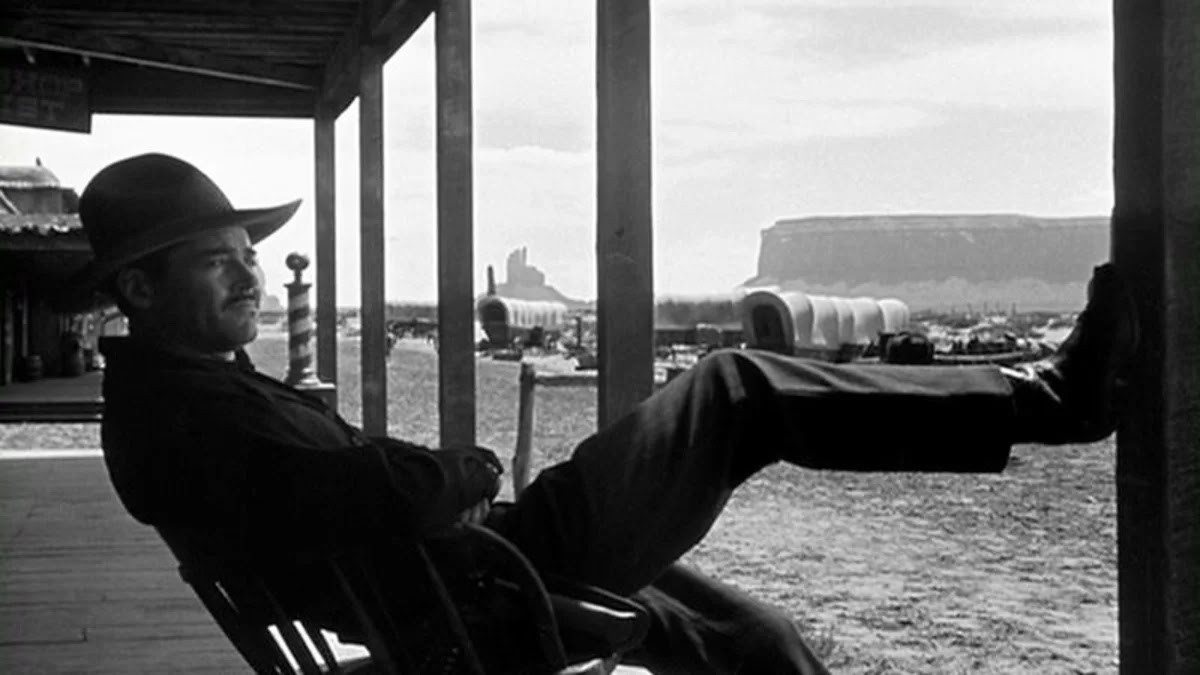
But does it really matter? Not really. If you run with the film has being part of Ford’s tradition of reworking the past of America into a grand origins myth for the United States, the film works perfectly. It’s directed with great visual skill by John Ford, who creates some luscious shots of Monument valley and some glorious skylines that dwarf the actors into the machinery of myth. His visual storytelling is perfect at communicating character, from the boyish leaning back on his chair from the boy scoutish Earp to carefully building the tentative, ]barrier filled relationship between Earp and Clementine. 

My Darling Clementine features a romance plot line, but it’s played in parallel with a story of feuding that leaves large numbers of the cast dead. Aside from Earp and Holliday there is virtually no overlap between the romance plot and the events leading to the gunfire. Clementine never refers to it, and you can almost imagine this as two films skilfully and gracefully cut together. Perhaps this is Ford’s intent: this is a film about community in the West, about the building and creation of a town and the shaping of relationships and friendships around it – that just happens to have as well a gang of murderers that Fonda needs to take down.
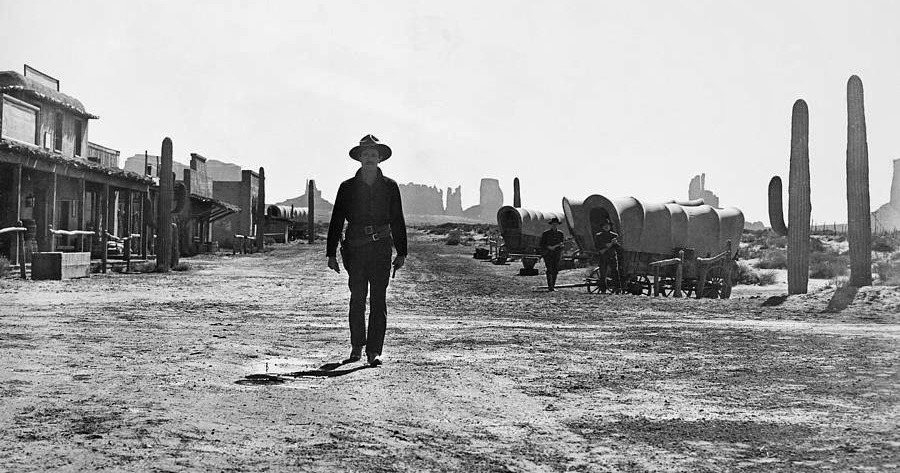
Tombstone is emerging from the Wild West – at a key moment half way through the film, Earp and Clementine dance (Earp with a surprising grace) at an outside ball to celebrate the opening of a church. It’s just one sign of civilisation arriving in the town, with theatre on the way and even Holliday’s gambling den slowly becoming something a little bit less violent. Earp himself is a reluctant but honest lawman, repeatedly asking at the start “what kind of town is this?” and seemingly deciding to stay to sort the place out as well as find out who killed his brother. 

It’s telling in any case that Earp’s reaction to his brother being killed is to pick up a badge not a gun, but then you would expect nothing less from Henry Fonda. Fonda is at his most decent, and bashful, his most just and moral, the embodiment of law and justice. Fonda pitches the performance perfectly, a shy man who knows what’s right, but has the guts to go the extra mile to get it. Fonda also gets some wonderful chemistry from his interactions with Cathy Downs’ Clementine, each scene between them dripping with longing but a sad knowledge that nothing can come of it.

There are a whole host of reasons for that, not least her past relationship with Doc. If there is a second heart to the film, it’s the uneasy semi-friendship that grows between Holliday and Earp. It’s a beautifully judged, wordlessly expressed mixture of regard, respect and suspicion, of two men who have taken very different paths in life but recognise in each other a common world view, a yearning for peace and poetry under the guns. Holliday – dying although you wouldn’t think it considering the hale and hearty look of Victor Mature – is a dangerous man but a fair one, not like the arrogant destructiveness of the Clantons. He’s even able to juggle respectful relations, not least with Linda Darnell’s showgirl. Mature gives a decent performance, hampered by his essential earnest woodenness from really exploring the depths of a TB suffering physician turned gunslinger, but able to express a basic decency and touch of poetry.

It’s a film about small moments between these characters that culminates in parallel with a gun fight that burns out of the clash between the Earps and Clantons. The Earps are of course all thoroughly decent, upright sorts while the Clantons are unclean, unshaven (first thing Wyatt does in the film is get shaved!) types, led by a bullying Walter Brennan. The gunfight is spectacular, but it’s part of one of two films, followed as it is with Earp’s sad departure from the town and the culmination of the unspoken love between him and Clementine. But isn’t that part of the myth? And with its romance, its heroic stand against injustice and its epic sweep and brilliance, My Darling Clementine is a celebration of the myth and power of the West.
One Flew Over the Cuckoo's Nest (1975)

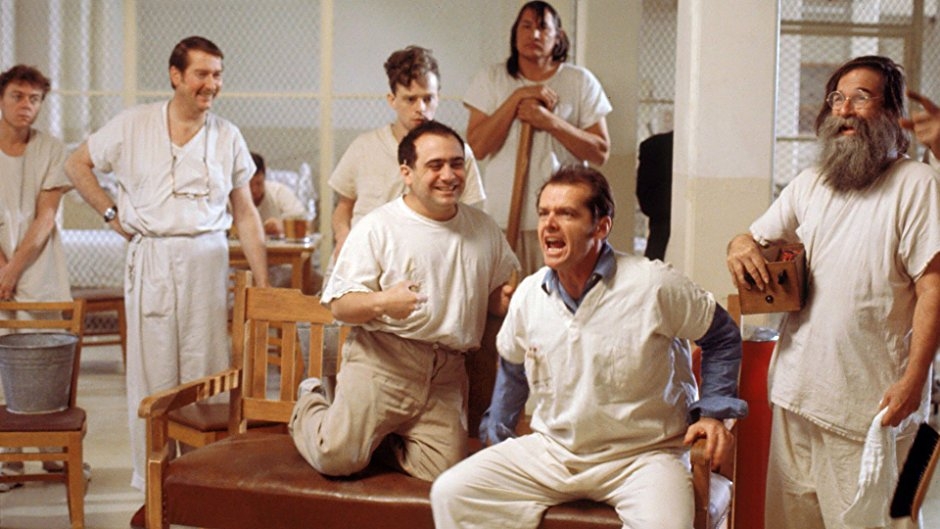
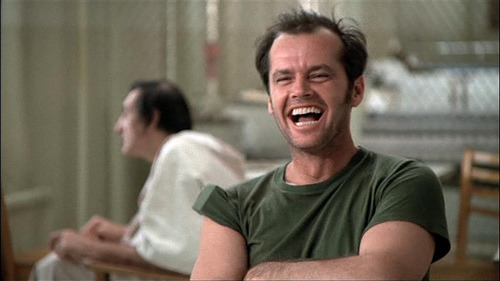
Jack Nicholson is superb as McMurphy in One Flew Over the Cuckoo’s Nest

Director: Milos Forman

Cast: Jack Nicholson (Randle P McMurphy), Louise Fletcher (Nurse Ratched), Will Sampson (“Chief” Bromden), William Redfield (Dale Harding), Brad Dourif (Billy Bibbit), Sydney Lassick (Charlie Cheswick), Christopher Lloyd (Max Taber), Danny DeVito (Martini), Vincent Schiavelli (Bruce Frederickson), Dean Brooks (Dr John Spivey), William Duell (Jim Sefelt), Scatman Crothers (Turkle)

One Flew Over the Cuckoo’s Nest is one of the landmark films of the 1970s, one of those films that’s on everyone’s list for great masterpieces. It lifted all five of the Big Oscars (Picture, Director, Actor, Actress and Screenplay), one of only three to do so. It’s widely loved for its celebration of rebelliousness and individualism, but there is more to the film than that. It’s as interesting for the things it doesn’t explore as much as the things it does.

Randle McMurphy (Jack Nicholson) has himself sent to a mental institution rather than a prison farm, under the belief that serving his time in the institution will be far easier than doing hard labour. However, he finds the ward he is locked into is under the authoritarian control of Nurse Ratched (Louise Fletcher), a passive-aggressive bully with a strict interest in the rules at the cost of all humanity. The inmates are cowed, but McMurphy encourages them to express themselves and seize their freedoms – little realising that his freedom is dependent on being signed off by the doctors, not the length of his original short sentence, and he has made no friends in the hospital authorities – or that Ratched is determined to break his influence over the other patients.

Forman was a perfect choice for directing a film that directly echoes his own iron-curtain upbringing. OFOTCN is a film that celebrates the freedom of the individual – but also recognises that authority and the state always wins out in the end. The hospital ward is cold, oppressive, a white-lined world where Ratched observes and quietly controls everything from her booth, softly issuing directives that carry a quiet menace. The film rotates around clashes between McMurphy wanting to do his own thing and Ratched stridently reinforcing a fixed hospital agenda. At one point Forman’s camera tracks from McMurphy on the basketball court, up to Ratched watching behind a full length window like an imposing Stasi officer. Forman totally understands the struggle of expression and free will in oppressive regimes, and it’s this that has given the film such a rich life – who doesn’t want to land on the side of freedom?

It helps as well that representing freedom we have possibly Jack Nicholson’s finest performance as McMurphy. A roaring, bubbling, manic, burst of nature, an impish anti-authority figure who rips through every scene with intense energy. It’s a marvellous, inspiring performance. And it makes McMurphy exactly the sort of rebel without a cause we would like to be, the guy who can inspire and lead through force of will alone, who refuses to be cowed or crushed. 

Nicholson’s performance however is a perfect mixture of larger-than-life drama and moments of reflection. The film splices in a few conversations between Nicholson and the doctors that, over the course of the film, change more and more from spry defiance and mockery towards a quieter, more despairing resignation as he slowly begins to realise how trapped he is. Not that he wants to show any of that to his fellow inmates, or to Ratched with whom he keenly engages in a battle of wills.

Ratched herself is exactly the sort of cold, rules-bound, inflexible authority figure we are naturally placed to hate. Louise Fletcher is wonderful, with her softly spoken iciness matched with certainty about her moral position. Is she even interested in curing the patients? Her focus seems to be completely on controlling and running the patients’ lives rather than changing the status quo. 

This battle of wills drives the film, but it’s interesting as well for what it tells us about McMurphy. He seems to have no understanding of the fact that, while his fellow inmates are cowed, they are all to some degree mentally ill and certainly all frightened and unpredictable. McMurphy sees them as people who need to be encouraged to seize their own destinies, but these are people who are incapable of really understanding what McMurphy is trying to do or have any interest in it. He shakes up their world, but has little real impact on them in the long term.

It’s not a film that engages in any great understanding of mental illness, but suggests that perhaps McMurphy and Ratched are in their own ways as insane as the people they are fighting over in the asylum. McMurphy is a self-destructive force who pushes for small things with huge passion, but then drifts through the major things. He acts without thinking and doesn’t try to understand the people around him. Ratched meanwhile is so obsessed with controlling her own small universe, she has defined her entire life around her governance of the ward.

The film has a slightly troubling relationship with women – which is not necessarily a criticism, but an observation since the film’s only prominent female character is Ratched and all the inmates are men. The things that Ratched stops the men from doing are the sort of typically “male” activities that McMurphy delights in – gambling, sports, girls – while McMurphy himself is (in what is the only truly dated moment in the film) in the slammer partly for having under-age sex with a girl, which he eagerly describes to his doctor. McMurphy pushes all the inmates to become more like the sort of man he understands men should be, and while it is a freedom of expression, it’s also one that has little place for women in it, other than as sex objects.

But that’s not the real aim of the film, so you can forgive it. McMurphy is not an intellectual or a man on a mission, he’s an unthinking burst of energy that burns up the world around him and demands the freedom to not be told what to do. That’s what gives the film its real emotional impact and why it spoke so much to Vietnam era America, and continues to speak to us today. And of course it’s linked to the fact that the film is a massive tragedy.

Because in the end the forces of oppression do win and McMurphy’s spirit is crushed. Sure McMurphy more than contributes to his own failures – he allows his own to drift away, and his pushing of his own agenda of what he feels men should want dooms poor Billy Babbit (a stuttering slice of timidity played by Brad Dourif). The film has a Pyrrhic victory in his inspiring the “Chief” (William Sampson), a giant native American flying under the radar by pretending to be deaf and dumb, into carrying out McMurphy’s dreams.

But for our hero it’s a bust. Forman’s film is a brilliant celebration of the energy and futility of lords of misrule like McMurphy, with a commanding performance from Jack Nicholson that’s one for the ages. A wonderful piece of ensemble playing in a set that becomes a metaphor for oppressive regimes, it’s remained remarkably undated and a force to be reckoned with on any top ten list.

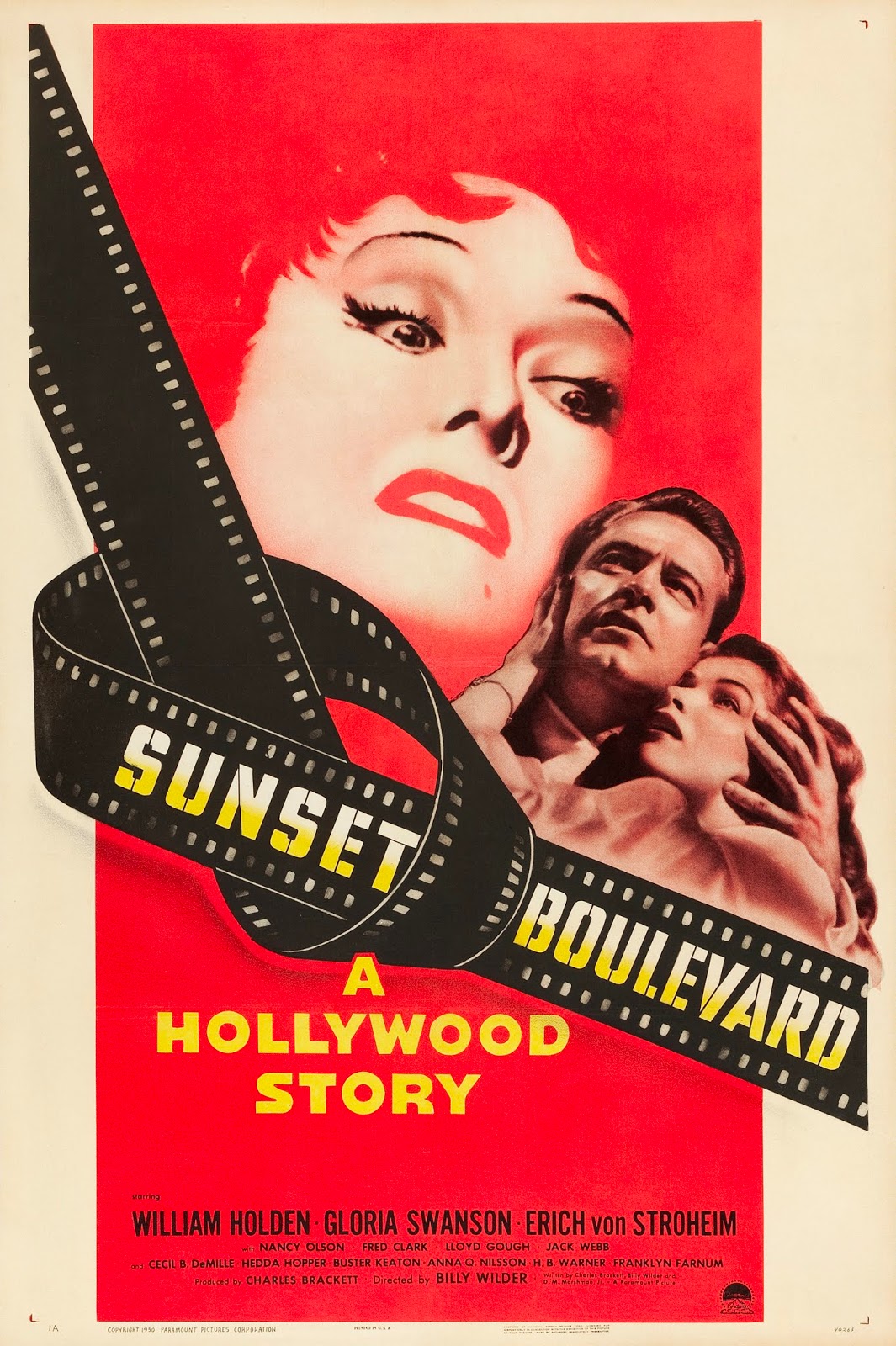
Sunset Boulevard (1950)

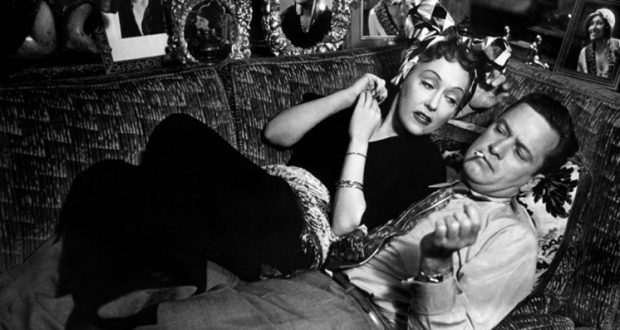
William Holden falls under Gloria Swanson’s spell in Billy Wilder’s superb Hollywood satire Sunset Boulevard

Director: Billy Wilder

Cast: William Holden (Joe Gillis), Gloria Swanson (Norma Desmond), Erich von Stroheim (Max von Mayerling), Nancy Olson (Betty Schaefer), Jack Webb (Artie Green), Fred Clark (Sheldrake), Robert Emmett O’Connor (Jonesy), Lloyd Gough (Morino); as themselves: Cecil B. DeMille, Hedda Hopper, Buster Keaton, Anna Q. Nilsson, HB Warner

Imagine if Charles Dickens had been born a hundred years later. He would surely have headed to Hollywood – and if he had, surely would have written something like Sunset Boulevard. Because who is Joe Gillis but another shallow Pip, dreaming of fortune and wasting his brains, who turns up at Satis House but stays on to become Miss Havisham’s live-in lover? Sure Wilder is more cynical and bitter than Dickens, but I guess even optimist Dickens killed off Little Nell so maybe he too would have had Joe Gillis end (and start) the film face-down in a swimming pool with three bullets in his back?

The cops arrive to find Joe (William Holden) exactly like that, while we hear Joe’s acidic commentary outlining exactly how this state of affairs came about. Joe is a screenwriter in Hollywood (he’s in the second tier of a second tier profession in the movies) who can’t get his latest script made for love nor money. Dodging the debt collectors set on reclaiming his car, he pulls into the drive of a mysterious house. It’s the home of Norma Desmond (Gloria Swanson), a forgotten silent film star who now lives out her days in her mansion, dreaming of her past glories and planning for a return to stardom that will never come, tended to by her loyal butler Max (Erich von Stroheim). Joe is roped in first to rewrite the (terrible) script she has been working on for her comeback, and then to become her live-in lover. But can such a situation survive Hollywood’s cold heart and Joe’s own self-loathing and desires to restart his screenwriting career in partnership with ambitious young studio script reader Betty Schaefer (Nancy Olson)?

Billy Wilder’s poison-pen love letter to Hollywood skewers the coldness at its heart. It does this with a triumphant mix of the grotesque and the heartfelt, the surreal and the coldly realistic, an insider’s guide to the world behind the magic of film-making and a story about those shut out of that very world. Hollywood is a shallow, bitter town where you’re either top of the bill or no-one at all. Would people from any other profession write such a bitter denunciation of their job that is also laced with affection and love? Maybe it has something to do with this being a unique profession which you have to love to enter, but once there you work with people who see it as a business.

The smell of desperation is there from the start, with Joe peddling his dreadful sounding baseball movie The Base Is Loaded to a polite but uninterested producer. Dropping a host of names and accepting any number of changes to the story (including changing it into an all-female sporting musical), Joe might once have had a talent but, as he says, “that was last year, this year I need money”.  William Holden was a late choice for Joe, but he is perfect in the part, capturing the air of the self-loathing cynic, a man bright enough to understand he’s shallow, a hack and desperate for any touch of the fame and fortune Hollywood can bring him.

Just like Pip, Joe is a young man who feels he is entitled to a life he scarcely seems to be qualified for. No wonder he settles into a life as Norma Desmond’s gigolo – it may well damage his sense of masculine pride to be an emasculated house-boy, but my God the suits are nice. And what talent does Joe even really have anyway? The script he is peddling barely seems to have any merit at all, and his extensive polish of Norma’s vehicle is still so alarmingly bad it never even gets the slightest consideration from Cecil B. DeMille. But Joe can’t let it go because he’s like a moth drawn towards those bright Hollywood lights.

And those bright Hollywood lights have consumed forever Norma Desmond. Wilder pulled Gloria Swanson out of an enforced semi-retirement to play the silent screen siren, whose career her own so closely parallels. It’s easy to remember Norma as a sort of Psycho-ish grotesque, a demented Miss Havisham living in her own crazy patchwork world of memory and delusion. Swanson certainly channels brilliantly the expression and body language of silent cinema into the part, and Desmond’s use of the sort of exaggerated gestures from that era in everyday life hammers home how her life hasn’t moved on from her glory days. 

But that would be to overlook the immense skill in Swanson’s performance. Norma may be sad, desperate, probably more than a little unhinged – a larger than life Miss Havisham to whom the “the pictures got small”, but she’s also a real person. Swanson makes it clear she genuinely loves Joe, she’s generous when she wants to be, devoted in her own way and immensely fragile. She takes a delighted pleasure in entertaining – a sequence of her reliving her glory days for Joe’s amusement (he couldn’t give a toss, making it all the more painful), capped with a charmingly delightful Chaplin impersonation shows a Norma who loves entertaining, loves putting a smile on people’s faces. Sure she’s obsessed with fame and desperate to reclaim it, but she’s also deep-down a real person.

But then that’s part also of Wilder’s romantic look at cinema. He can totally understand the bitter, destructive “business” part of it, but he still loves the show. His insiderish film is full of loving tributes to old Hollywood. Norma sits and watches real film footage of the real Gloria Swanson. The visit to Paramount Studios delights not only with its “backstage pass” feel, but also in the excitement with which the ageing extras and stage hands greet Norma. Norma’s weekly card games are staffed with genuine silent movie stars like Buster Keaton. Cecil B DeMille even pops up as himself (on the set of his film Samson and Delilah), kindly trying to guide Norma out of the studio even as he lacks the guts to tell her that her dream of a comeback is stillborn.

So how can you not feel sorry for Norma, who is clearly locked up in her haunted house on the outskirts of town, a million miles from reality, surrounded by endless reminders of her past glories. It’s so all-encompassing it traps Joe as well – at one point Wilder shows him trying to storm out, only for his pocket watch to literally get caught on the door. This place of dreams is staffed by the butler Max, a beautifully judged performance of Germanic chill mixed with doe-eyed devotion from Erich von Stroheim, also playing a dark version of himself as Norma’s pioneering former director (and husband) now reduced to protective butler. The entire house is a mausoleum without any escape.

The only character who seems truly positive is Nancy Olson’s wonderfully sweet Betty Schaefer, passionate about crafting a career for herself in the cinema. But even she is ruthlessly ambitious, a woman quite happy to consider jilting her fiancée for Joe’s attentions and has her eye on the price of success. She may have the talent, but she’s also got the sharpness.

Billy Wilder’s film brilliantly explores all these divides and contradictions in Hollywood and its history. Because what is Hollywood but a town that pays lip service to the past, but only has eyes for the future? Particularly with women. Female stars have a short shelf life and then they are dispatched. Poor Norma is still glamourous, still clearly has star quality – but as far as Hollywood is concerned she may as well be a million years old. No wonder Joe, used to these attitudes, is so ashamed to be kept by her – a woman he constantly refers to as a middle-aged friend. 

The dialogue, as you would expect from Brackett and Wilder, is superb from top to bottom with zingers and well-constructed dialogue exchanges so well placed they will survive for as long as there are movies. The film is beautifully shot by John F Seitz – part gothic horror, part dark romance, part neo-realist. Its pacing is perfect, its four act construction perfectly put together. All four of the principals (all Oscar nominated, none winning) are pitch perfect, sketching out characters that feel real and mixed with tragedy and loss as much as they are larger-than-life otherworldliness.

It’s the mixture of the freak show and the heart, in the massive Havishamesque estate, that marks this out as Hollywood does Dickens. The astute understanding of central characters, with enough depth to understand their shallowness, the grotesques that revolve around them but still have their humanity, it’s all there. Wilder mixes it with his own Hollywood emotions and his dry wit and cynicism to create a damn near perfect movie.

Tom Jones (1963)

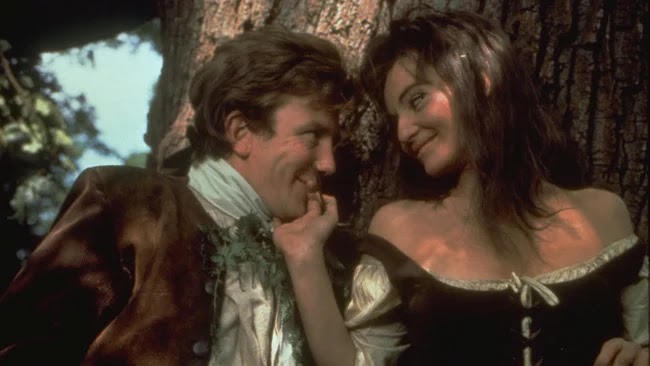
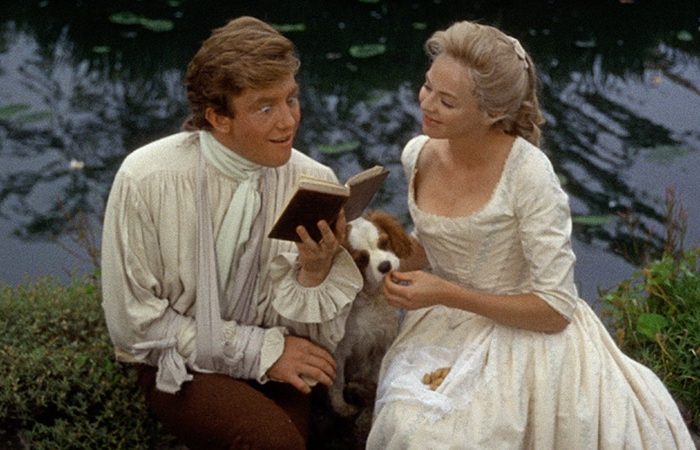
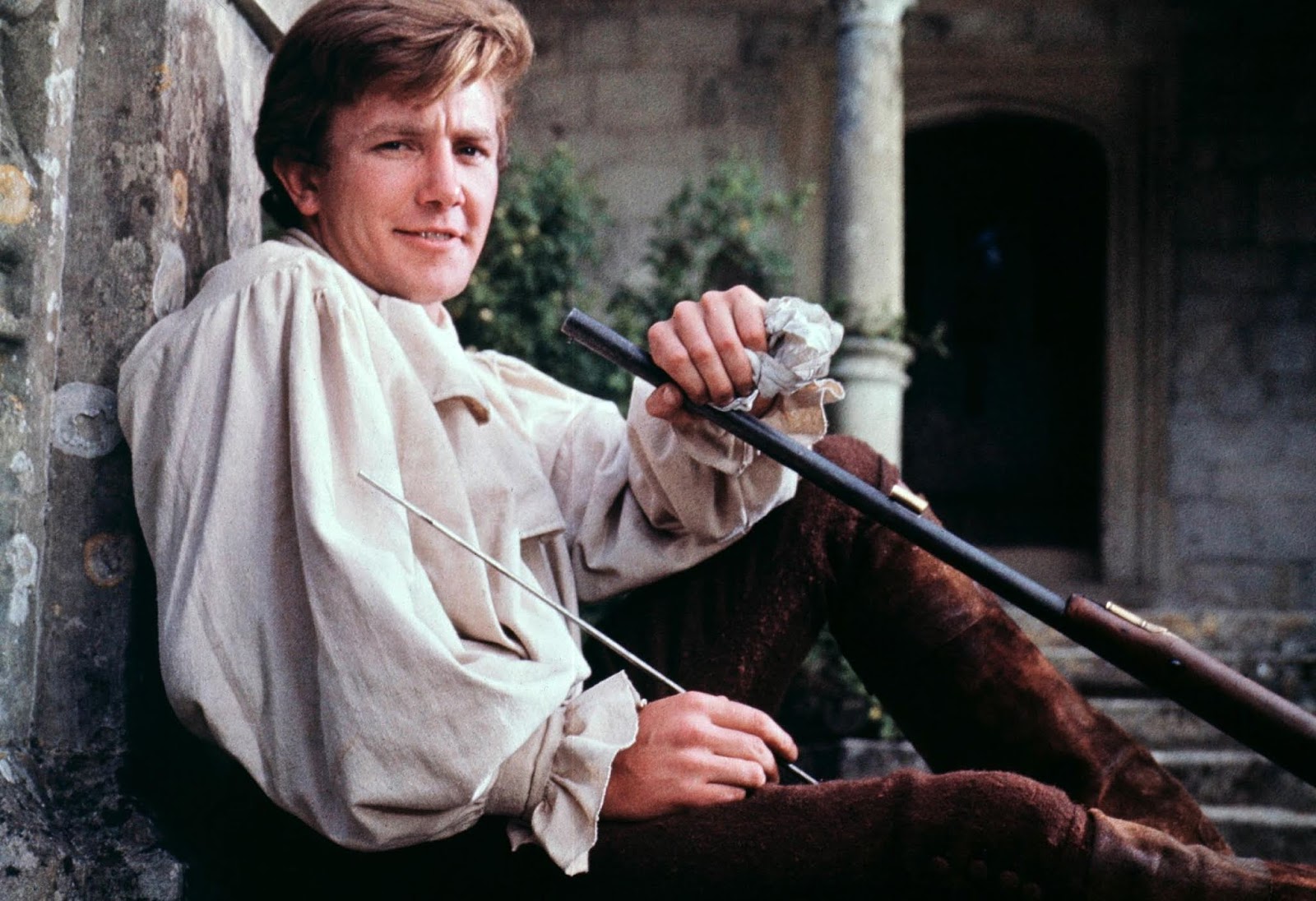
Albert Finney flirts with Diane Cilento (among many, many others) in Oscar winner Tom Jones

Director: Tony Richardson

Cast: Albert Finney (Tom Jones), Susannah York (Sophie Western), Hugh Griffith (Squire Western), Edith Evans (Miss Western), Joan Greenwood (Lady Bellaston), Diane Cilento (Molly Seagrim), George Devine (Squire Allworthy), David Tomlinson (Lord Fellamer), Rosalind Atkinson (Mrs Millar), Wilfrid Lawson (Black George), Rosalind Knight (Mrs Fitzpatrick), Jack Macgowan (Patridge), Freda Jackson (Mrs Seagrim), David Warner (Blifil), Joyce Redman (Mrs Waters/Jenny Jones), Rachel Kempson (Bridget Allworthy), Peter Bull (Thwackum), Angela Baddeley (Mrs Wilkins), Julian Glover (Northerton)

In early 1964, America was at the height of Beatlemania. Everything about Swinging Sixties London was the height of cool, so what better way to reflect that at the Oscars than naming Best Film of the previous year as being Tom Jones, the film that turned Henry Fielding’s work into the epitome of the era’s vibe. Watching Tom Jones today is a cruel reminder that generally nothing dates as hard or as fast as cutting-edge film techniques, and that time is often not kind to comedy. But Tom Jones was the first truly British film to lift Best Picture since Olivier’s Hamlet in 1948, so it was a sign of the short-lived all-conquering cool of British culture.

Adapted with a frenetic style from Henry Fielding’s novel, the film follows the trials and tribulations of Tom Jones (Albert Finney), adopted by Squire Allworthy (George Devine) after he is found abandoned on Allworthy’s bed as a baby. Growing up, Tom is a roisterer and rodgerer (especially keen on rodgering) but fundamentally decent, in love with Sophia Western (Susannah York) and the target of jealous rumours from his cousin Blifil (David Warner, looking a bit lost in his film debut). Banished as a result of Blifil’s schemes, he journeys to London encountering adventures along the way, not least a night of bliss with a Mrs Waters (Joyce Redman) who may (or may not) be his mother. Will Tom be able to prove his innocence, win the love of Sophia and escape his destiny of being “born to hang”?

Tony Richardson came to Tom Jones fresh from directing several searching, morally complex kitchen-sink dramas – and basically seemed determined to cut loose with this film by having fun. What he comes up with is an explosion of multiple different styles, from silent film to sped-up Benny Hill chases. Not a single editing or camera trick is unused, with the film stuffed to the gills with fades, wipes and freeze frames. Richardson basically used every single trick in the book. He was also lucky to have a perfectly judged score from John Addison (winning an Oscar).

It makes for a frenetic and fast-paced film, in love with its own 60s cool of anarchic comedy, sexual liberation and tongue-in-cheek lack of reverence all washed down with a bucket load of thigh-slapping bawdiness. It’s a film that’s inordinately pleased with itself, using Fielding’s interventionist narration style as the licence to break the fourth wall frequently and introduce a dryly hammy voiceover from Michael MacLiammóir. All of this was seen as the height of daring film-making back in the day – especially since Hollywood expected literary adaptations to be treated with reverence rather than as a high-brow Carry-On. But it’s dated badly.

Its smug, overbearing sense of zeitgeist cool comes across terrifyingly passé today, and the film’s daring use of every single cinema style makes it tonally feel like a complete mess. Richardson will segue from farce straight to an immersive hunting sequence where we are invited to feel every moment of the blood lust and violence, straight to a pastoral sequence showing the courtship of Tom and Sophia in glorious countryside.

Richardson himself – despite winning Best Director for his very self-consciously flashy work – also had mixed feelings about the film, recutting it shortly after its Oscar win into a shorter version which remains the version most people have seen today. He said of it that it “felt incomplete…and botched in much of its execution…whenever someone gushes to me about Tom Jones, I always cringe little inside”.

It’s a fair assessment of a film that is all flash – and way too much of it – and so little substance that it frequently becomes trite, smug and unpleasant to watch. John Osborne’s script (which apparently he submitted than refused to redraft) is in all honesty a mess (much of it was rewritten on set while the narration was a post-production addition to make it all make sense), with barely any quotable lines, and whatever skill the film has is all in the telling and the editing. 

Did Richardson take the whole thing as a lark and then work out later on that comedy is harder than it looks? The entire film was a complete mess on set – several errors were in fact left in the film (such as Western falling off his horse due to Griffith’s drunkenness) and then turned into jokes through the voiceover. There is a slight air from all involved that this isn’t proper film-making, that this is just one to flog for a bit of cash. Its Oscar win is inexplicable, but can be chalked up to a horrendously weak year at the Oscars.

Albert Finney goes through the entire film on autopilot – little matter than it made him a star – and he seems a curious choice for a young lover, throughout the film he channels instead a sort of horny Arthur Seaton. Finney thought the entire thing bosh and a waste of his talents – an attitude that does come across on the screen. Lightness is not always Finney’s strength, and his distant disengagement with the film becomes more striking with every viewing. 

Many of the rest of the cast mug shamelessly. Hugh Griffith bizarrely landed an Oscar nomination for a performance of gurning over-the-top mania. The film had three nominations for Best Supporting Actress: Edith Evans emerges best, although she could play this domineering Mrs Western standing on her head; Diane Cilento brings an attractive lightness to buxom Molly while Joyce Redman is good value and gets the film’s most famous sequence, a slobbery eating sequence with Finney where food is consumed in a very suggestive way as foreplay. Arguably the best supporting roles come from Joan Greenwood as the sexual but cruel Lady Bellaston and George Devine as the decent Squire Allworthy (the only character who isn’t some sort of caricature).

Tom Jones is most of all a memento of a particular brand of fast-paced, technique heavy, manic sixties comedy. It made a lot of money and won a lot of awards, so led to a torrent of similar films from bawdy Hogarthian costume dramas to sex comedies in modern London with naïve but well-endowed young men. Richardson and co. should have credit for catching this vibe first – but it makes for an odd experience today, like a slightly uncomfortable museum piece.

The Train (1964)

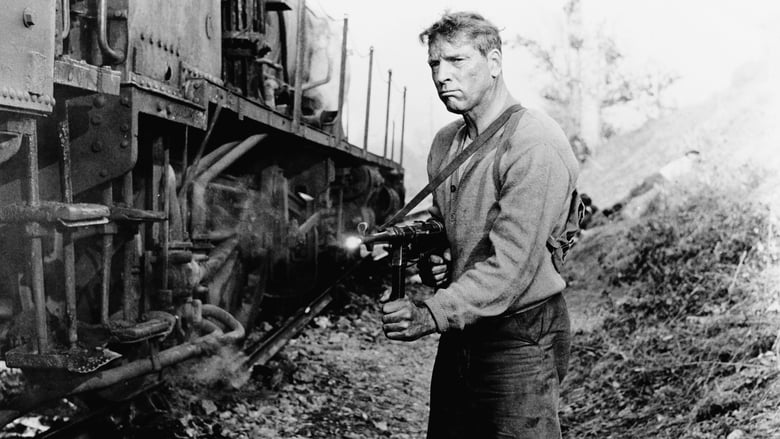
Burt Lancaster takes on the Nazis and the schedule in The Train

Director: John Frankenheimer

Cast: Burt Lancaster (Labiche), Paul Scofield (Colonel von Waldheim), Jeanne Moreau (Christine), Suzanne Flon (Miss Villard), Michel Simon (Pape Boule), Wolfgang Priess (Major Herren), Albert Rémy (Didont), Charles Millot (Presquet)

The German occupation of France draws to its close. Paris will fall in days to the Allies. As the Germans evacuate, Colonel von Waldheim (Paul Scofield) has other plans. All that fabulous modern art – all that stuff the Nazis call degenerate, the likes of Cezanne, Renoir and Monet –  that he has kept jealously guarded and locked up for years would be worth a tidy packet if he can get it back to Germany. Or is it that von Waldheim just loves the paintings so much he can’t let them go? Either way, he’s determined to load these priceless masterpieces onto a train and take them back into Germany – with rail network manager (and secret resistance fighter) Labiche (Burt Lancaster) bought in to lay on and then run the train. But will Labiche be willing to risk resistance and railway lives to prevent this looting of France’s cultural heritage?

John Frankenheimer’s rollicking, dark-edged war film mixes in serious questions amongst its compelling explosions and train wrecks. Namely – is any human life worth the cost of protecting a nation’s artistic heritage? Or in other words, what are we fighting for when we protect the nation – the people who live in it, or the ideas that underpin what a nation is? Because what von Waldheim is pinching here is a large chunk of France’s heritage – and it would be irreplaceable – and for many in the resistance it’s risks are acceptable to stop that. Even as the bodies start to pile up.

The Train is a slightly nihilistic war film, in which the vast majority of the cast wind up dead, leaving the survivors to wonder if those paintings were worth the dozens of lives lost to protect them. Frankenheimer even hammers it home in the conclusion by cross cutting between the bodies of the victims with the packing crates (each carefully labelled with an artist’s name), making the paintings seem even more like chilling tombstones. The Germans, rarely thinking for more than a second before gunning down resistance fighters or anyone caught working with them.

In this they take their lead from von Waldheim. Played with glacial chilliness by Paul Scofield, von Waldheim at first appears a reasonable, even decent man. But it becomes clear that this well-spoken, polite man has a mono-mania for art that trumps all considerations of human life. Von Waldheim believes art should belong only to those who can understand it, and clearly cares nothing for human lives around him, all of whom are disposable should he choose. Under his gaze, civilians are put against the wall without a second thought and soldiers instructed to meet all attempts at slowing the train with lethal force. Frankenheimer carefully builds over the course of the film von Waldheim’s unhinged amorality, culminating in a series of Dutch angles as he finally goes further than even his own soldiers will follow.

As his counterpoints we have the muscular humanity of Burt Lancaster. Focusing all his experience as an acrobat and circus performer in his youth, the film is a tribute to Lancaster’s athleticism. With Frankenheimer using a series of tracking shots and uninterrupted long shots, we are shown that without doubt it’s Lancaster jumping from moving trains, rolling down hills, jumping walls and bounding across roofs. Lancaster’s commitment also stretched to mastering many train engineering tasks with such success that he was able to perform them (uncut!) on film. 

Performance-wise the part falls carefully into Lancaster’s strengths as a tough-guy with a heart. And while at times he feels like what he is – a Hollywood star parachuted into the French countryside to do battle with the Germans – he nevertheless carries the film with a charismatic ease. His emoting – particularly in several speeches decrying the human cost of the operation – verges on the overly emphatic, but few other actors could have carried the near wordless final half an hour with such aplomb. Lancaster’s moral certainty and enraged humanity also makes a perfect contrast with Scofield’s distant amorality and coldness.

The action then takes place on a series of trains that have even greater impact because you know, unlike today, everything was done for real. Each of the crashes, explosions, de-railings and train-based stunt has the freshness and excitement of reality behind it. The real events that inspired the film saw the French Resistance prevent the art train leaving Paris through drowning it in red tape. But that’s a lot less exciting than an ingenious “wrong stations” routine or a desperate chase across the French countryside (and very few Hollywood directors shot France as well as Frankenheimer).

It all makes for an exciting cocktail, even if the central ideas of art vs. life are not explored as well as they could be. It captures that 1960s feeling of “war is hell” as bodies pile up, and Jeanne Moreau’s hotel owner gets a speech on the emptiness of men killing each other. Sometimes you feel The Train wants to delve deeper into the psychology and cost of its events – but then it slaps another train into a collision  and decides to be as much a “man on a mission” film. Either way, it adds enough depth to make it a rewarding watch. 

Paths of Glory (1957)

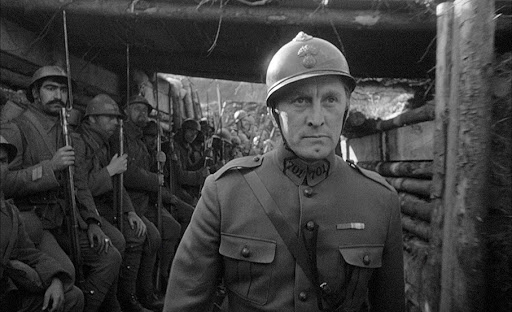
Kirk Douglas leads men into pointless battle in Kubrick’s Paths of Glory

Director: Stanley Kubrick

Cast: Kirk Douglas (Colonel Dax), Ralph Meeker (Cpl Philippe Paris), Adolphe Menjou (Major General Georges Broulard), George Macready (Brigadier General Paul Mireau), Wayne Morris (Lt Roget), Richard Anderson (Major Saint-Auban), Joe Turkel (Pvt Pierre Arnaud), Timothy Carey (Pvt  Maurice Ferol), Emile Meyer (Father Duprée), Bert Freed (Sgt Boulanger), Susanne Christian (German singer)

Kubrick’s fourth film is one that often gets overlooked when running over his CV – and it’s had less cultural impact than, say, A Clockwork Orange, 2001 or The Shining – but out of all of his films (except maybe The Shining) it’s the one I’ve come back to the most often, and is certainly his first stone-cold classic. This Word War One tragedy simmers with anti-war sentiment, and it’s so beautifully made and assembled you can see its influence in films right up to 1917.

In 1916 the war is bogged down into trench warfare. Command wants results, an action they can point to, so General Broulard (Adolphe Menjou) is sent by the General Staff to instruct General Mireau (George Macready) to launch an attack on a well defended German position called “the Anthill”. Mireau says any attack would be suicide – until the prospect of his promotion being directly linked to it is mentioned, at which point he becomes the attack’s most passionate advocate. Mireau passes the order onto regiment commander Colonel Dax (Kirk Douglas), who protests that the attack is pointless, but is ordered to lead it or be relieved of his command. The attack is a costly farce, and the humiliated Mireau (with Broulard’s tacit agreement) demands a blood sacrifice – one man from each company will be placed on trial for cowardice and shot as an example for the whole French army. Dax deplores this injustice – but with the administrative meat-grinder as deadly as the one on the front, what hope does he have?

Kubrick believed passionately in the project but also needed a commercial hit in order to bolster his career. So he recruited Kirk Douglas to get the funding – Douglas took a third of the film’s budget as his salary, so it wasn’t all charity – and he rewrote the ending of the book to allow Dax to come up with a last minute solution to get the soldiers off. Douglas, to his credit, was having none of that and demanded a rewrite that restored the book’s original bleak ending. 

So it’s largely thanks to Douglas we get the shape of the film that we end up with – but it’s clear that it’s Kubrick’s genius that makes it the film it is. Actor and director were a perfect combination here, so much so that Douglas got Kubrick on board to direct Spartacus (an unhappy experience for them both). But Paths of Glory was where both actor and director were working in perfect partnership, both pushing the other to give of their very best. Dax is the perfect Douglas role – decent, intelligent, well-spoken, passionate, a natural leader, but the film undermines all this with his ineffectiveness. Each of his crusades goes wrong, and he fails at every goal he sets himself. Douglas brilliantly captures both sides of this in his generously low-key but committed performance.

He has a great framework of a film around him from Kubrick. The director uses several longs shots, extended takes and tracking shots to throw us into the world. The opening sequences at the military HQ, taking in the palatial setting of Mireau’s campaign office, have a stately construction and technical formality which then contrasts superbly with the lower angle, tracking shot-laden, POV sequences set in the trenches. Kubrick’s camera glides through these trenches, low angles seeming to make them tower over the viewer, the mud and filth only worse in the body-strewn no-man’s land that stands between the French and the Germans.

It culminates in the attack sequence, one of the greatest battle sequences ever placed on film. Following the doomed advance at a methodical pace, matching the speed of the soldiers, the camera tracks over no man’s land as explosions rend the ground and bodies are thrown to the mud under a hail of bullets. At the front is Dax, vainly blowing on his whistle and encouraging the men forward, while all around him devastation and slaughter win out. Any thought that this wasn’t a pointless enterprise from start to finish is completely dispelled, and our sympathies are completely with Dax and the soldiers, whose lives are superfluous to the ambitions of the generals.

Both generals cut appalling figures for different reasons. Mireau, played with a trumpeting, vain bombast by Macready, is a “blood and guts” soldier who never places his own blood and guts anywhere near the line. Proudly bragging about the skills of his soldiers, then furiously denouncing their cowardice, one telling shot has him in the trenches staring through binoculars at the German positions, oblivious to the wounded men filing past him. Later he orders the shelling of these very trenches in fury at their failure to advance far enough. Broulard is hardly better, Menjou’s “hail well met” bluster hiding a chilling lack of empathy.

The Germans are never seen, because the real enemies here are war itself (and we are kidding ourselves if the same thing wasn’t happening on the other side) and the authorities who push us into it. The film is almost like some sort of black satire, with the generals confidently telling their soldiers they are right behind them, before retreating several miles to the rear to watch the battle unfold. Dax is middle-management, caught between trying his best to deliver orders he knows are impossible, and protecting men he knows are doomed, and failing at both tasks.

The system demands blood sacrifices from the lowest possible rungs, so the hierarchy can reassure themselves they are not blamed (Dax’s offer to take all the blame is promptly rejected by Broulard – no question of any of the officers being at fault!), so the men are chosen by their company commanders. One is chosen by lottery (he of course is a decorated war hero, but that cuts no ice), one because he’s an “undesirable” and the third because he has witnessed his own commanding officer’s cowardice. None of them deserve it, but their guilt is “proved” in a kangaroo court that lasts less than 15 minutes, and in which Dax is barely allowed to put a defence case.

Kubrick’s film becomes a surprisingly fast (it’s less than 90 minutes) but inexorable march towards those three stakes in the ground and the firing squad. Questions of justice and courage are completely pointless – any brave acts in the film are pointless, two of the victims are cited for their courage and the most cowardly character in the film, Wayne Morris’ snivelling Lt Rouget, ends up commanding the firing squad – and the message we are left with is that the institution of war and man are the real villains here.

War has no heroes, only survivors. Victories are important to the generals only in the sense of being tools to jockey for position, and the common soldier is an expendable puppet who can be killed on a whim to fill any political reason. It’s a harsh and chilling view of the military – and leaves very little hope – but it’s superbly made and controlled by Kubrick, in a film surprisingly with more heart in it than any film he ever made before or since. It’s a film that leaks with sorrow and disgust at the victims of the military machine, a film with emotion as well as a technical marvel. It might be Kubrick’s most complete film.

Gigi (1958)

Louis Jourdan forms an unusual romance with Leslie Caron’s Gigi

Director: Vincente Minnelli

Cast: Leslie Caron (Gigi), Louis Jourdan (Gaston Lachaille), Maurice Chevalier (Honoré), Hermione Gingold (Madame Alvarez “Mamita”), Eva Gabor (Liane d’Exelmans), Jacques Bergerac (Sandomir), Isabel Jeans (Aunt Alicia), John Abbott (Manuel)

In 1958 Gigi was littered with Oscars, winning all nine of its nominations to become one of the most successful films at the ceremony ever. It’s bizarre considering this is a run-of-the-mill musical with all the production values you would expect from an Arthur Freed production, but not really anything special compared to several other films from the same stable. It’s one of those moments when you remember Singin’ in the Rain didn’t even get nominated for Best Picture

Anyway, based on a book by Collette, Gigi deserved some sort of award for sneaking under the Hays code a story about a young girl training to be a courtesan, and the heartless playboy her family want her to seduce. Leslie Caron is Gigi, while the man who she has a sisterly affection for is Gaston (Louis Jourdan), the man around town bored with all the artificiality around him. Both Gigi and Gaston are heavily guided by their mentors: in Gigi’s case her grandmother, famed former courtesan Madame Alvarez (Hermione Gingold), in Gaston’s his uncle Honoré (Maurice Chevalier) a charming old rake. Everyone wants the two of them to become lovers, but do Gigi and Gaston want the sort of relationship of convenience their mentors expect?

That the film exists at all is a triumph of careful negotiation between Freed and the Hays Code, not usually open to films about high-class prostitutes and their marks. It does make for an occasional bit of confusion from the viewer – and a truncated plot as key ideas are circuited around (or over) – but also marvellous scenes, well written by Alan Jay Lerner, where Madame Alvarez and her sister (and courtesan trainer) Aunt Alicia (Isabel Jeans) discuss Gigi having “matured” to the correct age to become Gaston’s mistress by using unfinished sentences and raised eyebrows.

It makes for a slightly odd viewing experience today, especially with our far more enlightened views of the role women can have in society. The film mines comic material out of Gaston’s jilting of an unfaithful mistress (including Honoré toasting him for having driven the poor girl to attempted suicide after her public humiliation), while the comedic training sequences as Alicia attempts to turn Gigi into every man’s dream of the perfect mistress carries more than a whiff of exploitation today. But the film comes from a different r time, where such matters wouldn’t have occurred to either audiences or film makers.

Theres is a similar vibe in the film’s now most notorious sequence (and its opening) as Maurice Chevalier’s Honoré introduces the film and its world by crooning “Thank Heaven For Little Girls”. It’s a great catchy song (wonderfully delivered by Chevalier) but its lyrics thankful that “little girls get/Bigger every day”, matched with the septuagenarian Chevalier leering at a group of schoolgirls playing in the park, carry more than a whiff of the paedophile today. 

While you could say that this is all part of Minelli and Lerner’s intentions – that under the elaborate design of the film, there runs an undercurrent of selfish men carelessly using women for their own entertainment and many women enabling and encouraging this – it’s presented with such lightness, froth and charm that any potential darkness underneath it gets lost all together. Instead, its charming outer confection tends to obscure the difficult morals under the surface and prevents the viewer from engaging with them.

And the film’s design is what it’s really about. The first major musical to be shot largely on location – compare to An American in Paris which recreated the city of romance on a sound stage – its camera work is fairly reserved and focused on admiring the sets and locations more than providing a bit more to really engage the eye with. The design is impressive, mixing art nouveau and Cecil Beaton’s elaborate style, and the sets and costume (all Oscar-winning of course) really impress, even if the opulence ends up becoming overwhelming, not least with the overpowering reds that fill Gigi’s rooms. Minelli’s love of opulence and art ends up crushing the film.

That design also overwhelms the character. It’s telling that among its nine nominations, not a single one was for acting. Leslie Caron and Louis Jourdan do perfectly acceptable jobs, but their characters are not particularly interesting. Surprisingly for a musical – one starring Leslie Caron! – there is no dancing either. The film really misses the presence of people like Gene Kelly, the kind of leading man or woman who could carry a film on charisma. The real charisma comes from Chevalier (the one surprise to miss an Oscar nomination), who is so perfect as Honoré, so charming and dry (and who delivers his songs so well) that the film flags dramatically when he is absent (which he is for much of the final act). But the film misses a real heart.

It makes for a film that looks good, but is more a triumph of style and ingenious storytelling than it is storytelling with impact. Its Oscar win is perhaps a tribute to its faultless opulence and big budget spectacle. Because, boiled down to it, it’s a film with a story that hinges slightly on things that aren’t exactly tasteful revolving around people who aren’t very interesting. It has some good songs and moments from the Alan Jay Lerner script, but there is a reason this Best Picture winner has stuck in the collective memory so little, despite its record-breaking haul.

Who’s Afraid of Virginia Woolf? (1966)

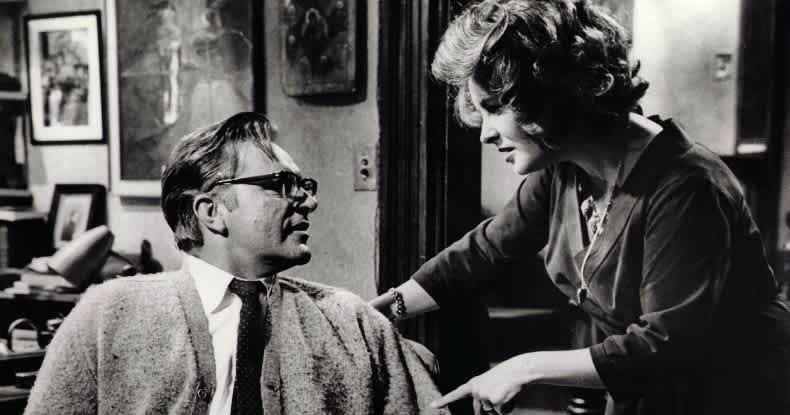
Burton and Taylor play a feuding couple in Who’s Afraid of Virginia Woolf?

Director: Mike Nichols

Cast: Elizabeth Taylor (Martha), Richard Burton (George), George Segal (Nick), Sandy Dennis (Honey)

In 1966, Hollywood was only just emerging from the strict rules of the Hays Code. These governed everything from the themes a film could explore to the language you could use while doing it. But in the permissive 60s, it was finally beginning to crack – and Who’s Afraid of Virginia Woolf? was one of the first films to really push it over the edge. This film helped usher in 70s Hollywood, where filmmakers finally felt empowered to explore darker themes and to do so with sex, violence and bad language. Five years after this film came out, something like A Clockwork Orange could become a box-office smash and a Best Picture nominee. Talk about the changing of the guard.

Mike Nichols’ film debut is a faithful adaptation of Edward Albee’s Broadway smash, which had been controversial enough on stage for its full and frank exploration of a marriage consumed with bitterness, feuding and pain. Not to mention its open acknowledgement of extra marital sex, abortion and alcoholism all delivered with a literal “screw you!”. Elizabeth Taylor is Martha, daughter of the president of a small New England college, whose husband George (Richard Burton) is a failed associate history professor. The couple are locked into a dysfunctional marriage that mixes recrimination and a perverse, shared sense of humour. Drunkenly returning home after a party, they welcome a new professor (George Segal) and his wife (Sandy Dennis) to their home for a nightcap. There they quickly rope the couple into a series of increasingly personal “games” with an edge of cruelty and lashings of verbal abuse.

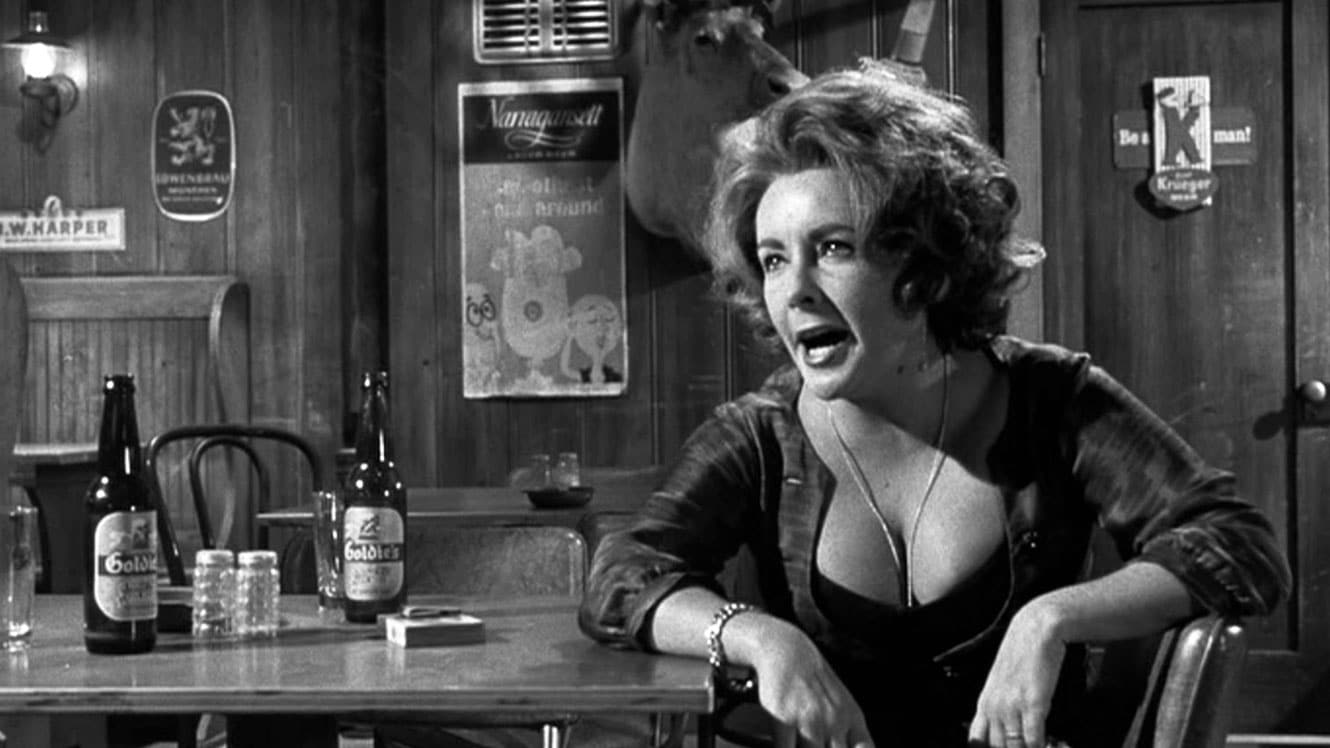
Today, Who’s Afraid of Virginia Woolf? has not always aged well, coming across at times as rather forced and overbearing, as is often the way with films that pushed the boundaries so effectively back in the day. Nichols has the confidence to avoid “opening up” the play too much – its single setting on stage is augmented here only with a brief drunken excursion out to a late night bar – and instead focuses on drawing out four superb performances from its actors (all Oscar nominated) and letting the camera move intricately around the confined rooms where the action takes place.

What Nichols really draws superbly from this film is the control of the film’s continual pattern of simmer, tension and release. The play is effectively a series of psychological games that George and Martha play between themselves. The film is like a drunken, truly mean-spirited version of Noel Coward’s Hay Fever, where the self-absorbed hosts similarly play elaborate ”games” with their confused guests. Most games involves Martha and George turning on each other, viciously attacking the other for everything from failure to drunkenness, with their guests used as the jury, mixed with “get the guests” interludes as the couple turn on the sexual and marital issues in their guests’ lives.

It makes for a series of compellingly delivered sequences – even if the constant thrum of tension and heightened half-mock, half-real fury Martha and George keep up for most of the film finally starts to bear down on the viewer. The film starts banging its points with a transgressive pride, which looks like increasingly like a lot of sound and fury over quite minor issues. But then that’s always the way with convention defying films – so many following films have buried these conventions, that the attention grabbing way this film does it looks quite tired and overworked today.

As Martha and George, Nichols was able to cast the most famous married couple on the planet at the time, in Elizabeth Taylor and Richard Burton. With these titanic personalities working – for perhaps the only time – with a director who had the skill and authority to tame them, the two of them delivered probably their finest performances on film. It also adds to the illicit sense for the audience – like Nick and Honey – that we are trapped into seeing a series of personal and intense conversations and arguments. 

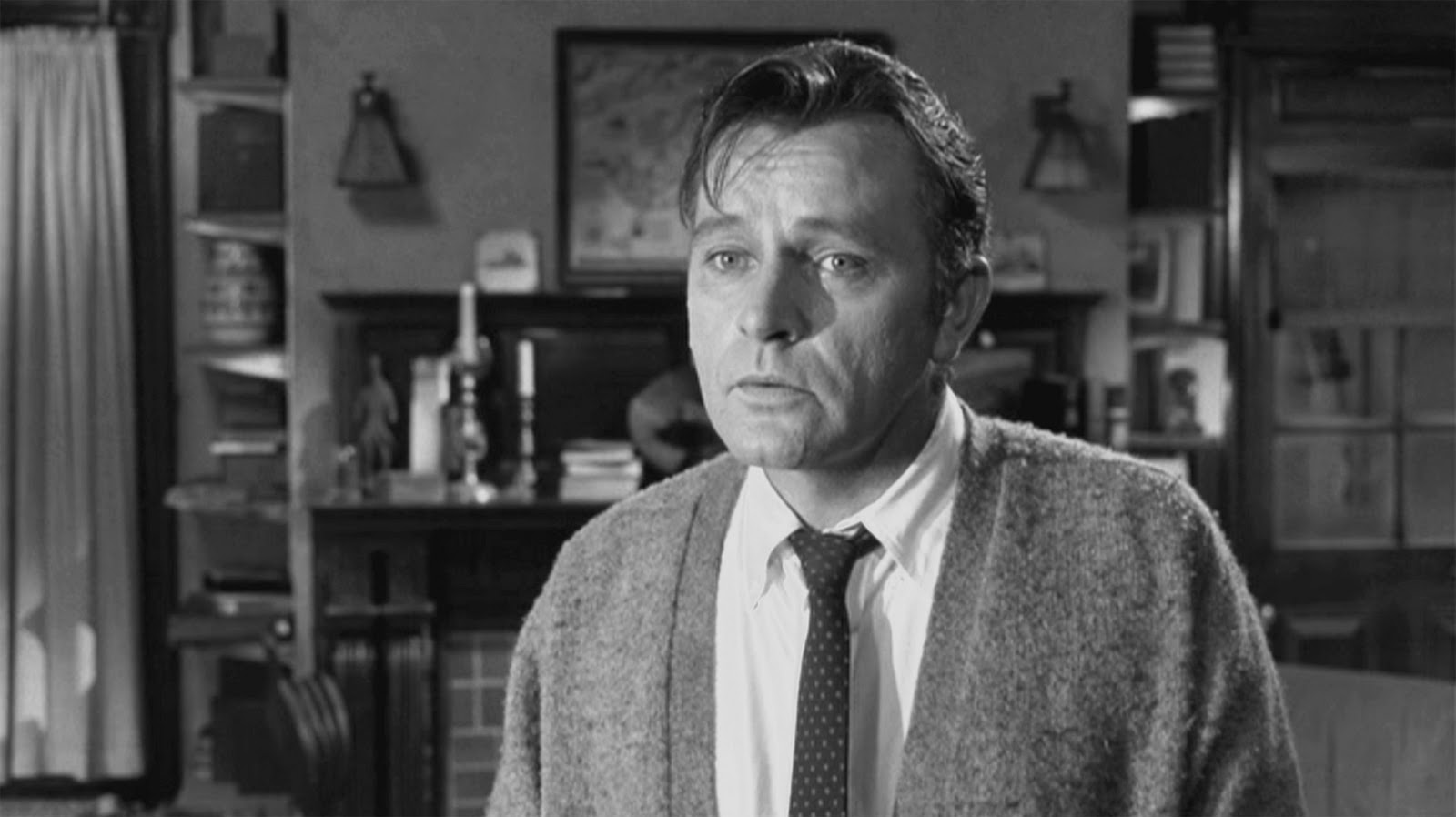
Finally accepting the sort of intense and challenging material he often overlooked for well-paid gigs, Burton is superb as George: a mass of passive aggression, condescending to everyone around him, capable of great cruelty but also a crushed, disappointed and vulnerable man, desperate for affection.

Elizabeth Taylor was similarly sensational – and Oscar-winning: puffy faced, blowsy and domineering as Martha, who similarly has buried her pain and loneliness under a never ending onslaught of aggression, mockery, tartiness and loudness. Brassy and bold, Martha at first seems the controlling, even abusive force in the relationship, but she is also isolated, scared and overwhelmed with pain. 

What’s brilliant about the relationship between the couple is at first it seems like George and Martha are a deeply unhappy couple, fuelled by hate. However, it becomes clear their feuding and contempt for each other is in fact part of a relationship grounded on mutual love and need (the final shot is their hands joined together), revolving around their mutual shared pain on their failure to have children. The couple’s primary “game” is a private one – a fictional child, invented to compensate for their mutual infertility – discussion of whom early on by Martha opens the door to the fury that follows. But it gives an insight into their relationship, actually kept fresh by their feuding.

By contrast, it’s the seemingly happier young couple who have serious problems. Nick, very well played by George Segal, is a dashing young buck who is actually selfish and, with a dream of sleeping his way to the top (despite his possible impotence), whose lack of depth is routinely savaged by both Martha and George. Despite this, Nick doesn’t seem to realise that this he’s in the middle of a series of games. He’s married his wife out of obligation for her pregnancy. Honey – an Oscar-winning turn by Sandy Dennis – on the other hand seems to be aware she’s out of his depth here, and reverts into an almost childish passiveness, mixed with awkward horror which slowly peels away to reveal her misery and depression. Slowly we realise Nick and Honey have nothing in common.

It’s a complex and intriguing play, brilliantly bought to the screen by Nichols whose camera (in stark black and white) bobs and weaves through the action, involving each actor in every scene (the camera often focuses on reactions as much as dialogue delivery). All four of the actors are great, but Burton and Taylor are nothing less than sensational (ironically their careers never seemed to recover from the amount they put out there, with more than a few speculating that their own marriage was but a few degrees different from George and Martha) and the film itself, while overbearing, is also still compelling in its complexity and stark insight into human relationships.

The Third Man (1949)

Orson Welles is the dark heart of The Third Man

Director: Carol Reed

Cast: Joseph Cotton (Holly Martins), Alida Valli (Anna Schmidt), Orson Welles (Harry Lime), Trevor Howard (Major Calloway), Paul Hörbiger (Karl the porter), Ernst Deustch (“Baron” Kurtz), Erich Ponto (Dr Winkel), Siegried Breuer (Anna), Bernard Lee (Sergeant Paine),Wilfrid Hyde-White (Crabbin)

It’s regularly held up as one of the cornerstones of classic 1940s film-making – and it has frequently won polls of the Greatest British Films of all time. Does The Third Man live up to expectations? No it excels them. I doubt there has been a film more perfectly assembled than this, one where all the component parts click together to make one perfect whole. No matter how many times you see The Third Man, it weaves its spell every time.

In immediate post-war Vienna, the city is divided into four zones, each run by a different great power (the UK, US, France and USSR). The black market is rife between the zones. Into this city arrives pulp Western writer Holly Martins (Joseph Cotton), here to visit his old school friend Harry Lime (Orson Welles) – only to find on arriving that Lime died in a traffic accident, with British policeman Major Calloway (Trevor Howard) insisting that he was a black marketeer. Holly can’t believe Harry was a crook, and decides to investigate himself – on the way falling in love with Harry’s girlfriend Anna (Alida Valli) and finding that nobody’s story on what happened to Harry matches up. Could the accident actually be a murder?

Carol Reed’s atmospheric film is beautifully, perhaps flawlessly directed – so well made that for years there were fevered efforts to assign its brilliance to Welles himself. Which was studiously unfair to Reed, a director at the top of his game in the 40s.  The Third Man was the crowning glory of a run of superbly stylish thrillers that matched thought provoking themes with striking film-making. The film is soaked in the atmosphere of post-war Vienna, a city half shelled out of existence. The film was shot on location, and Reed’s camera captures the “bombed about a bit” shambles of the city, its long shadows, cobbled streets and mysterious alleys.

The Third Man’s filming style also plays into this truly distinctive look. Working with (Oscar-winning) cinematographer Robert Krasker, the film is shot with a luscious almost German impressionistic style, with murky shadows and noirish lighting. Reed uses huge numbers of Dutch Angles to constantly present both this shattered city, and it mysterious story, from disconcerting angles. This visually represents the uncertainty and mystery that drip from every scene, making Vienna look like some sort of sinking ship, disappearing into a mire of crime and guilt. Reed’s camera fills the edges of the frames with tramps, beggars, the dispossessed and the plain scared – a brilliant snapshot of post-war Europe unsure about the future and ripe for exploitation.

The film looks simply stunning, with Reed’s visuals throwing up images that have stuck in film heritage, from fingers poking through a sewer grill, to the iconic entrance of Harry Lime itself (possibly the most famous entry ever). Shadows loom with gigantic proportions over the streets. A final sewer chase seems to take place in a nightmare world of water, false turns and foreboding architecture. And that final shot! Sublime cinema, the stillest shot in the film, and also a superb capturing of the film’s themes of loyalty, duty and betrayal.

The film was scripted by Graham Greene, and occupies a wonderful corner of Greene-land. His original concept was for Holly (or Rollo in the original script) and Harry to be British public schoolboys – a plan rejected when Hollywood co-funding came to call – but it did allow Holly to be transformed into a naïve American, lost in the cold realities of post-war Europe. Holly believes in the world of black and white, and writes stories where good triumphs over evil in the Wild West. He’s adrift in a Europe where everyone lies habitually, morality is flexible, and nothing is as it seems.

Holly is bound by old chains of loyalty to Harry – but how far does that loyalty stretch? What price personal loyalty when confronted with the impact of what a person has done? Joseph Cotton’s performance is pitch perfect, a middle-ranker who has orbited his whole life around brighter stars like Harry. How one-way was the relationship? Can Holly ever think for himself? 

And is the right thing to do to walk away or try and correct the wrongs done by another?This divide is shown in the relationship between Cotton’s Holly and Alidi Valli’s sensational turn as Harry’s ex-girlfriend. A woman who has seen the harshness of the world, and been through a war-torn life that Holly would struggle to even comprehend, she’s a woman to whom personal loyalty trumps all things. Should you be loyal to the man you know, your experience of him – or do you have a higher loyalty that trumps that? Anna is firmly of the belief that she knows all that she needs to know of Harry and she needs to learn no more. It’s the sort of European post-war compromise that Holly can’t adapt to, the ideas of morality becoming mired in shades of grey.

It’s a world he struggles to adapt to, but is a cold hard reality for Trevor Howard’s Major Calloway – a superb performance of cool reserve that hides a strong sense of justice. Howard’s wry half-smile and control is perfect for the film, and his disgust at the actions of black marketeers is subtly and brilliantly conveyed by both the actor and Reed’s restrained direction – a visit to a children’s ward full of victims of Lime’s penicillin, is notable for leaving everything to our imagination and communicating another loss by showing a Teddy bear being dropped into a box.

And the cause of all this suffering? Why it’s none other than Harry Lime himself. No film ever captured Orson Welles’ impish charm as well as this, his shy grin and air of an enfant terrible turned terrible are brilliantly captured in the boyishly young but demonic Harry. A Mephistopheles placed on earth to tempt men like Holly, Lime argues what do a few people (or dots) here and there really matter in the long run? After all governments sacrifice them all the time – look at Vienna! – why shouldn’t we? What’s the problem? Lime grins and casually outlines a demonic view of the world, casually uses a cheap historical justification or two, and then saunters off never suspecting that he could lose the argument. Like Welles himself, he has all the glamour and magnetism that we could never have, and to live a few moments in his shadow, as Holly and Anna do, is to live a lifetime.

So Holly has to make a choice – the friend he knew, or the strangers he has seen harmed. The film charts the slow passage to making this hard choice, presenting us with a man who refuses to believe his friend could be anything other than the victim of persecution, to the man who is destined to turn him in. With the framework of Carol Reed’s superb filmmaking, it’s still an absolute treat.

And finally, The Third Man is blessed with perhaps the most perfect film score of all time. Recorded by Anton Karas – literally discovered playing the zither on the streets of Vienna – the score is jaunty, lyrical, schoolboyish even but can switch subtly to something quite disconcerting. It perfectly captures the schoolboy bravado of Holly and the childish lack of morals of Lime. As a match with the bombed out Vienna and its rundown, cynical citizens, it’s perfect. Like all things with The Third Man, it just works better than you could ever have hoped.

Adam's Rib (1949)

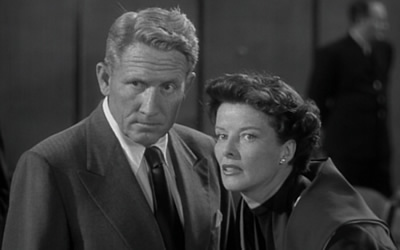
Spencer Tracy and Katharine Hepburn go toe-to-toe in court and marriage in Adam’s Rib

Director: George Cukor

Cast: Spencer Tracy (Adam Bonner), Katharine Hepburn (Amanda Bonner), Judy Holliday (Doris Attinger), Tom Ewell (Warren Attinger), David Wayne (Kip Lurie), Jean Hagen (Beryl Caighn), Hope Emerson (Olympia La Pere)

He’s a tough-on-crime DA. She’s a top liberal lawyer with a feminist agenda. So when Doris Attinger (Judy Holliday) is arrested for firing a gun at her philandering husband Warren (Tom Ewell) and his lover Beryl (Jean Hagen), naturally Adam (Spencer Tracy) and Amanda Bonner (Katharine Hepburn) end up on opposite sides of the court case in this witty “battle of the sexes” married life comedy.

Directed with unfussy calmness by George Cukor who, as he often does, hires the best actors, points the camera and lets them get on with it, Adam’s Rib is an enjoyable and fascinating watch, partly ahead of its time in its gender politics, partly relic of another era. It completely accepts the idea that a woman can be a successful, skilful lawyer – the idea isn’t even questioned – while still bemoaning the march of militant feminism. After all even the title is a humourous little reminder of where Eve came from.

The plot revolves around Amanda’s belief that a man firing a gun at a cheating wife would get very different treatment from a woman doing the same: that he would be seen as a man protecting his home, while the woman is a neurotic danger. Adam disagrees strongly with this – a crime is a crime – and to be honest he’s probably right (today Doris would almost certainly go down for actual bodily harm, if not attempted murder). But in the 1940s, this issue gets tied up with women starting to push against the idea that their role was just to follow the man’s lead and not threaten to shake up his existence. And that’s exactly contrary to what happens in this film.

Amanda is played by force-of-nature Katharine Hepburn at her most quick-witted and sharp, a lawyer more successful in many ways than her husband (and by being in private practice, probably the main bread winner as well, although that is never stated). Her place in the court is never questioned, which is interesting in itself in the post-war era where the idea of women in the professional world was just beginning to be seen as a possibility (although lord knows there was still decades to go until it was to be seen as completely normal).

It’s not a position that Adam questions. His main problems are more with the law being used as a tool for a very specific agenda, rather than a feeling that women are crowding into his realm. Played with brusque stuffiness and uncomfortable formality that tips over into moral outrage by Spencer Tracy (again showing his natural gift for both acting and reacting), Adam feels that his belief in the law is being damaged by Amanda’s use of Judy’s case as a political tool for women’s rights, rather than being judged on its actual merits. 

So this becomes the spring board for a series of extremely well-acted (and frequently funny) arguments between this tempestuous couple as the court case turns from a flirtatious rivalry into an increasingly bitter one. These ding-dong battles work so well on screen because of the immense chemistry between Tracy and Hepburn, a couple so devoted in real life that they convey this even when really going at each other on screen. 

Mix that in with an obvious sexual chemistry between them (and this film is remarkably open about sex, by my count the camera cuts to black to imply sex at least three times in this movie – and the couple have separate beds in their bedroom as per the Hays Code, but only one sees the sheets disturbed by sleeping!) and you’ve got an entertaining show. The courtroom antics are frequently both dynamic and entertaining, and the perspectives of both Adam and Amanda carry force – yes women are treated differently by the law, but you surely can’t deny that Doris broke that law.

There isn’t much room for the rest of the cast apart from the barnstorming Tracy-Hepburn show, with the two seasoned performers tearing through the screen. Judy Holliday comes off best in the second-string as the woman on trial, suggesting enough hypocrisy and two-facedness under the surface of her butter-wouldn’t-melt sweetness. Holliday was also helped by Hepburn’s generous insistence that she be made the focus of their scenes together – Hepburn being keen to help Holliday land the leading role in the film Born Yesterday, the play of which made Holliday’s name on Broadway (it worked and Holliday won the Oscar the next year). 

Of the rest, there is a neat, naughty little cameo from Jean Hagen as the other woman, though Tom Ewell mugs as the husband. David Wayne meanwhile plays the Bonners’ next door neighbour, a supremely irritating musician, smug and trying, but whom we’re meant to think of as a witty, eccentric “character”.

The latter half of the film starts to tip a little bit, as Adam has of course to end with the upper hand (he is after all the man!) which he does using underhand tactics and an actually rather unpleasant business with a fake gun (the sort of trick that you imagine if Tracy had pulled in real life, Hepburn would have walked out of the door and never come back). But this is still a film with plenty of top gags and a refreshing look at a marriage where both participants are professional equals and which goes quietly some way in arguing for greater rights for women, before retreating back to its more conservative resolution. Still great entertainment – and Tracy and Hepburn are both at the top of their games here.