The Good Liar (2019)

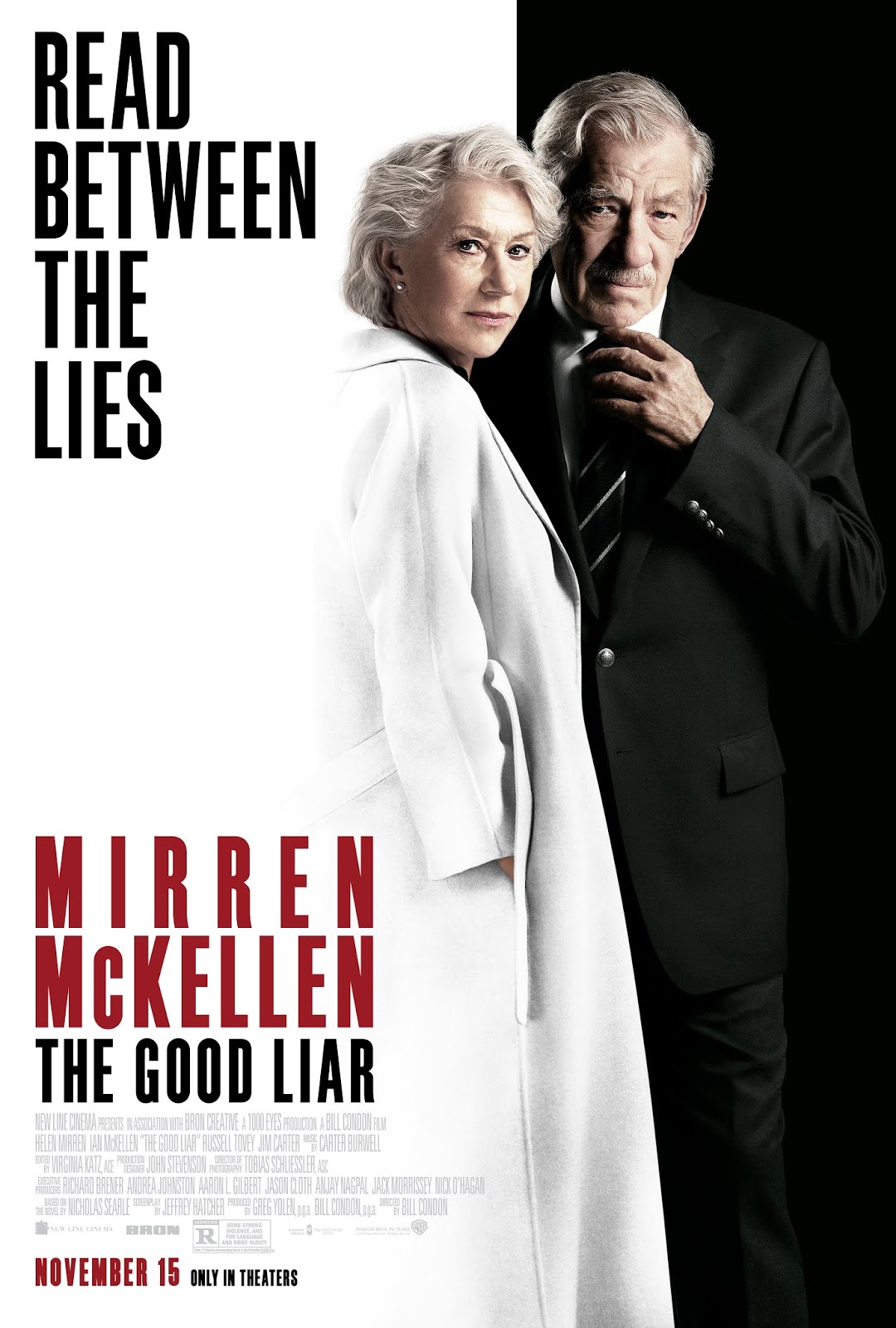
McKellen and Mirren excel in this enjoyable confidence trick caper The Good Liar

Director: Bill Condon

Cast: Ian McKellen (Roy Courtnay), Helen Mirren (Betty McLeish), Russell Tovey (Steven), Jim Carter (Vincent), Lucian Msamati (Beni), Mark Lewis Jones (Bryn), Jóhannes Haukur Jóhannesson (Vlad)

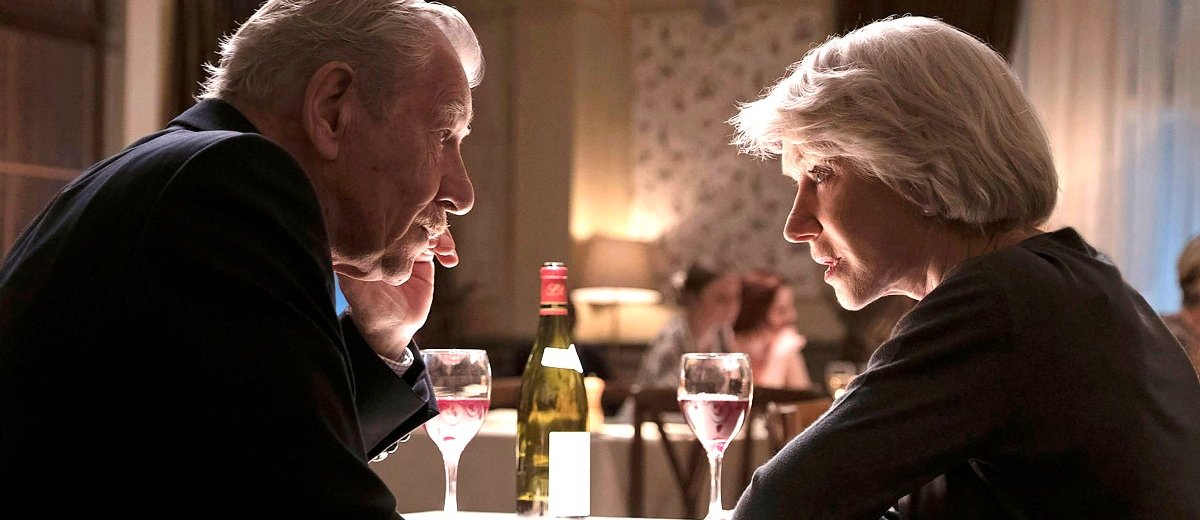
The truth can be a difficult thing to grasp. Particularly when so many people are skilled at twisting and turning it for their own purposes. Roy Courtnay (Ian McKellen) is one of the best in the business, a selfish and greedy con man who preys on the vulnerable and the arrogant unlike, ruthless in is business dealings and with anyone who tries to muscle in on his business. His latest mark is Betty McLeish (Helen Mirren), a lonely widow who has inherited a huge fortune from her late husband. Meeting Betty through a “lonely hearts” online dating agency, Roy skilfully inveigles his way into her life and her home. But is all as it seems to Roy?

The Good Liar is an entertaining and enjoyable con trick of a film, that sets up its stall very much like a number of other films in this genre. We are presented with a picture of the conman at work, and shown many of the tricks and hoodwinks that the film will practice on us, being worked out in practice by the conman early in the film. It’s possible to see how the joins work – and do find your expectations being carefully prepped – but the film is entertaining enough that you are happy for it to let you try and lead you down the deceptive garden path even as it points out a few trips along the way.

A large part of the success is down to the brilliance of the two leading performances. Ian McKellen is at possibly his very best as the genial, amusing, waspish Roy who we only slowly begin to realise is a thoroughly nasty piece of work, with a line in casual cruelty and violence. It takes a great actor like McKellen, to play so successfully a consummate actor (and liar) as Roy, and never seem either too forced or overplaying the hand. His Roy has several excellent lines, and also a brilliant ability to look and sound genuine and heartfelt at one moment and shift gears to ruthless coldness the next. It’s a superb performance, wonderfully entertaining in its delight in its own villainy. You almost want to forgive Roy his essential vileness, such is his surface charm and McKellen’s waspish delight in playing such an unrepentantly horrible man. McKellen has done his best film work working with Condon and this film might be his best yet.

Mirren matches him well as the mark, a considerate, intelligent and decent woman. Mirren has a difficult job here, for reasons that would perhaps be spoilers, although I think it is safe to say that most viewers going into a film like this would expect that it would have a few cards up its sleeves. Needless to say Mirren is perhaps not all she seems, but she handles the difficult balancing act of seeming one thing and suggesting enough of another, that the final reveals never come as a surprise or seem inconsistent with her characterisation throughout the film. 

Instead the film takes us on a delightful dance where we know that something is going on that we don’t know about or can’t see – and playfully the film effectively shows us the mechanisms of the con very early on as Roy and his business partner Vincent (an excellent Jim Carter) carry out another confidence game on some other victims. But Condon’s playful film lets us know enough that something is happening that Roy can’t even begin to guess at, while also allowing us to enjoy his confidence, arrogance and fast-thinking willingness to dance from lie to lie depending on the mood. 

The one problem the film might have is that the final reveal of what is going on is based on information that is not delivered early in the film, but instead dropped on us at the end in an info-dump. While it makes sense that the film wishes to play its cards close to its chest, it perhaps would have been more satisfying to have little bit more of the information sprinkled throughout the film, enough for us to have a bit of a chance of piecing together they why before we are told. On reflection the film gives us moments that point towards the big picture, even if never enough information is given.

But the film still works because it has a devilish charm and waspish wit, and a delightful performance of gleeful devilry from McKellen, in one of his best roles yet. Making a superb pairing with Mirren, Condon’s enjoyable film hinges on the success of its actors and its enjoyment of the tricky narrative sleight-of-hand that con films can do so well.

Malcolm X (1992)

Denzel Washington dominates in Spike Lee’s masterpiece Malcolm X

Director: Spike Lee

Cast: Denzel Washington (Malcolm X), Angela Bassett (Betty Shabazz), Albert Hall (Brother Baines), Al Freeman Jnr (Elijah Muhammad), Delroy Lindo (West Indian Archie), Spike Lee (Shorty), Roger Guenveur Smith (Rudy), Theresa Randal (Laura), Kate Vernon (Sophia), Lonette McKee (Louise Little), Tommy Hollis (Earl Little), James McDaniel (Brother Earl), Steve White (Brother Johnson), Ernest Lee Thomas (Sidney), Christopher Plummer (Prison Chaplin Gill), Peter Boyle (NYPD Captain Green)

In the early 1990s, Norman Jewison was attached to direct a biopic of Malcolm X, the powerful African-American activist, tragically assassinated in 1965. It was the project of Spike Lee’s dreams – and Jewison conceded he did not have the vision for the film that Lee clearly had. Lee stepped in – and thank goodness, as this is perhaps a film only he could have made. It splices together Lee’s customary political savvy and (accurate) sense of the injustice Black Americans have faced with a surprisingly adept use of the cinematic language of David Lean and other sweeping epics. In bringing these together, he created a superb biography, a great piece of epic cinema and a vital piece of American film-making.

The film covers the life of Malcolm X in three clear stages. Firstly his young days as a tearaway in Harlem, with drug addiction and crime, all with best friend Shorty (Spike Lee), a local gangster whom he admires (Delroy Lindo) and white girlfriend Sophia (Kate Vernon). The second act is his conversion to Islam under the guidance of (fictional) Brother Baines (Albert Hall) and his rise as an incendiary speaker with the Nation of Islam under the influence of its leader Elijah Muhammad (Al Freeman Jnr). The final act covers his disillusionment and departure from that organisation after a host of scandals and political disagreements, his pilgrimage to Mecca and his return looking to work with other civil rights movements before his assassination by former members of the Nation of Islam.

It’s hard to know whose film to call this, because Spike Lee and Denzel Washington both invest this film with so much passion, director and actor working in perfect synchronicity, that it’s impossible to imagine the film without one or other of them. Washington’s performance is quite simply extraordinary. He spent over a year of focused preparation on the film, and every pore of his body seems to have soaked in the mood, manners and attitudes of Malcolm X. It’s a transformative performance of purest emotional commitment: impassioned, empowering and enthralling, charismatic in the extreme. He never shies away from the anger and the faults of Malcolm X, but so engrossingly human is his work that he brings to life in a way few people had before Malcolm’s humanity, his generosity, his love, his decency. It’s a performance that seems to have transformed the actor into the man and the film works so well because Washington completely involves you in his story. 

Washington should have won the Oscar that year – it went instead to Al Pacino – and Malcolm X also should have been nominated for Best Picture and Best Director, far more so than Scent of a Woman nominated in both categories. It’s a film that builds its audience’s empathy so successfully with its lead character, and so clearly understands what Malcolm was trying to do, that you come away from it full of respect and admiration for the man. Even when the film was made, many people saw Malcolm X as a divisive, even dangerous figure – but watching the film you forget that and invest in him as a man.

It’s also inarguable – as n-words and racial bias from many whites in the film litter the screen – that it opened the eyes of many people as to exactly how harsh living in America was at the time if you were black. Put simply, it was a country labouring constantly under injustice, persecution and suffering where a black life was worth less than a white one. It’s a theme that Lee has returned to time and again in his work – and quite rightly – and it’s the sort of masterclass of simmering political anger that powers the best of his work. Would any other director under the sun have chosen to open this film with footage of the Rodney King beating? Would anyone else have thought of ending it with a coda in South Africa, as Nelson Mandela (yes the real Nelson Mandela) addresses a classroom full of children about the importance and power of Malcolm’s vision of black people taking pride in themselves and their heritage – a pride beaten out of them still today, as Lee’s Rodney King footage shows.

Lee’s direction is quite simply superb, a wonderful fusion of his own styles with a classical sweep of David Lean, spiced with the textual play of Oliver Stone. The photography from Ernest Dickerson is wonderful, the film is beautifully cut and assembled and the recreation of period detail from set to costume is remarkable. Lee’s style is sublime, from a riotously fun Harlem song and dance routine (really impressive) with Malcolm others dancing a superb Lindy Hop, to the harshness of prison, through to the intelligent and acute analysis of growing divisions in the Nation of Islam (Al Freeman Jnr is fabulous as Elijah Muhammed) and Malcolm’s developing political stance.

Lee’s film is even-handed on the whole – Malcolm’s real opponents are ideological disagreements, the film dramatizes a moment Malcolm considered a great regret where he rudely brushed aside a white college student keen to help his cause, and the film makes a lot of play over his controversial opinions on Kennedy’s assassination (essentially that he deserved it). But it also builds a superb sense of Malcolm’s personal life alongside, and the film is crammed with moments of quiet intimacy and a wonderfully developed performance of supportive love from Angela Bassett as Betty.

But the Lee touch is in that sense of anger. The politics and fury of Malcolm’s speeches and his message to black people today to save themselves and find pride in themselves carry through the whole film. Lee was sick and tired of the “white saviour” film and he triumphantly made here a film that was by black people, about black people but had something for all to hear. Malcolm X is a superb piece of biography cinema that leaves you with justifiable admiration for a man it’s easy to misjudge, engrosses you in a complex and disturbing era, angers you at racism and its impact, and also leaves you entertained. In many ways the most classical of Lee’s films – but a reminder that he is a unique and compelling voice. He thought he was the only one that could tell this story. He was right.

The Irishman (2019)

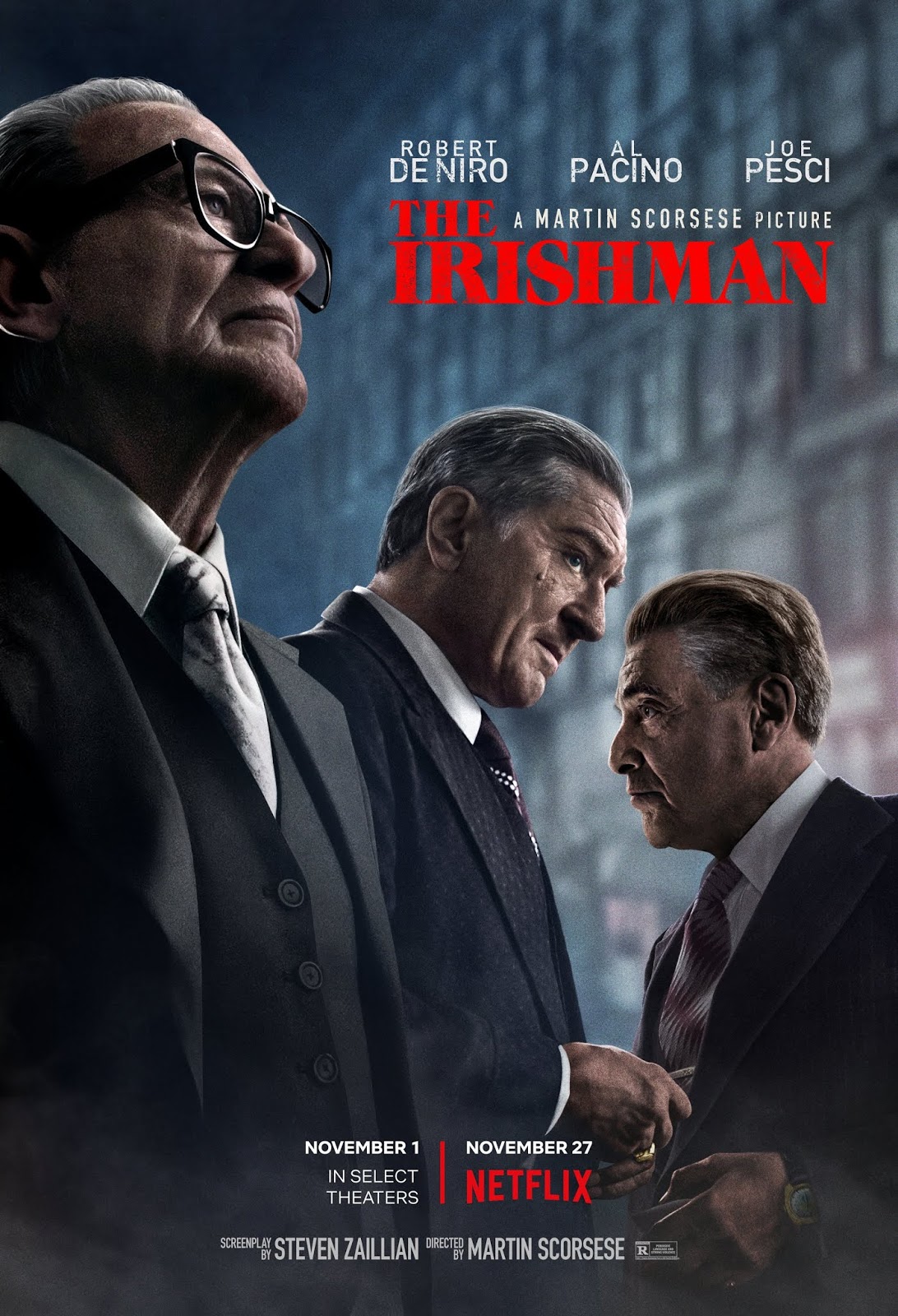
De Niro and Pacino under digital facelifts bring to life Scorsese’s meditative The Irishman

Director: Martin Scorsese

Cast: Robert De Niro (Frank Sheeran), Al Pacino (Jimmy Hoffa), Joe Pesci (Russell Bufalino), Ray Romano (Bill Bufalino), Bobby Cannavale (Felix “Skinny Razor” DiTullio), Anna Paquin (Peggy Sheeran), Stephen Graham (Anthony “Tony Pro” Provenzano), Stephanie Kurtzuba (Irene Sheeran), Jesse Plemons (Chuckie O’Brien), Harvey Keitel (Angelo Bruno)

Scorsese had wanted to make this film for almost 20 years but it took the mega bucks of Netflix (to the tune of over $150 million) to finally bring it to life. With complete creative control, we get Scorsese’s epic as he saw it, an over three-and-a-half hour long sad meditation on the life of the gangster. For the first time in almost 25 years, Scorsese is reunited with his muse Robert De Niro – appearing here under various digital facelifts to tell the story of Frank Sheeran, an Irish member of the Mafia, and his relationship with infamous Teamster union leader Jimmy Hoffa (Al Pacino). Was the film worth the effort to make it?

I first saw The Irishman in the cinema. I now feel that was a mistake. This is a film that needs to be soaked in like a warm bath. Like reading an involving novel, it needs to savoured and consumed at your own pace. In the cinema in one take – with no intermission – its runtime is punishing. It’s the worst form of criticism but in one take, the film can overstay its welcome. In fact it can become a little boring.

Re-watching the film a year later at home – where I could break it up into three chunks as (I feel) so many people have, it becomes a richer and more engrossing viewing experience. Because this is a totally different beast to Scorsese’s previous gangster movies, a quiet mood piece, contemplative, sad, a genuinely tragedy-tinged, doom-laden reflection on the emptiness and costly violence of the gangster life, and the empty shells it leaves of the people in it. And at its centre, a man so dehumanised by war, by obeying orders, so lacking of personality, so incapable of emotion it seems, that he ends the film as a blank, lonely, abandoned slate. It’s a real, and deliberate, counter-point to his electric gangster films of the past, from Mean Streets via Goodfellas to Casino and the cartoonish The Departed. Here the price of doing business is your soul – and when that final bullet comes (as it inevitably will) you have nothing to show for it.

It makes for a late Scorsese epic – nearly a TV mini-series – slow-paced, wintery and a perfect counterpoint to Goodfellas. There crime is ruthless but you can see it’s also fun. Here it’s hardwork, unrewarding and inevitably leads to a bloody demise. Time settles on the shoulders of its leads like deadweights and their is a weary sadness as they trudge from one feud to another, each of which can only be resolved by putting another body in the ground. And everyone knows that the next feud might well mean it’s their body that will end up six feet under.

Frank Sheeran is a drained automaton, a human being possibly in name only, who takes on violent acts without question, who can kill without remorse. This is the very picture of a second-tier career criminal, a man who takes orders and carries out missions. De Niro brilliantly creates an sociopathic monster, a man almost devoid of his own personality, with little to him but a taciturn killer. Sheeran is a tough character to relate to or understand – but that’s because he’s not really a character at all. Interestingly he doesn’t have the sort of flaws that undermine other Scorsese gangsters, like Henry Hill. His flaw is in fact his entire existence. His sociopathic acceptance of violence, his thoughtless carrying out of killing, his inability to relate to human beings. It’s what leaves him alone, unloved and isolated in a care-home. This is a man who can barely muster much emotion about killing his best friend, whose quiet, placid nature perhaps only hides his lack of capability of even experiencing emotion.

The Teamster union politics content of the film is often dense and hard-to-follow. At times it tips into being not that interesting. So it’s tough that it takes up almost two hours of the film’s run-time. It’s a sign of the films overindulgence. At the end of the day I’m not sure it adds much to your overall impression of the film. But reviewing the film perhaps that’s the point. The very shallowness and even pettiness of this feuding – not to mention the naked, unromantic greed – over how to distribute union pension money, explodes the myth of any romance to this crime. These are blue-collar conmen, using violence as a way to conclude a board meeting.

As Jimmy Hoffa, Al Pacino is the best he’s been in literally decades – the film uses his “hoo hah” shoutiness to great effect, but Pacino also makes Hoffa an unexpectedly vulnerable and lost figure amongst all the politics, a showman who overestimates his importance and invulnerability. The entire film is shaped (we discover) around a series of flashbacks from Sheeran on a road trip on what turns out to be the final days of Hoffa’s life (the film includes a solution to Hoffa’s famous disappearance). De Niro and Pacino spark beautifully off each other as a bond forms between them – the films lingering on their growing friendship (and at times strangely homoerotic intimacy) one of its strongest elements, as well as carefully demonstrating how disloyalty is a crucial survival skill in this world.

The film strongest elements are the doom-laden nihilism of the gangster life. Told by Scorsese deliberately without flash and excitement, with a score so sparse that long stretches of the film echo with silence, there seems to be no fun at all in the gangster world, instead a series of mundane men sitting in small restaurants, talking about admin and punching the clock. Many of the gangster characters are introduced with on-screen captions that detail the dates and natures of their violent deaths. It’s the exact opposite of what you might expect from a Scorsese film. It’s a director showing the dark flipside of his previous films, of the way the gangster life is a dwindle through a dull life marked with moments of danger, where death is a sudden violent explosion that ends a life too soon.

And it leaves families in a mess. Anna Paquin speaks very few words as Sheeran’s adult daughter, but only because her silent disapproval and disgust at her father’s life becomes the haunting of Sheeran’s whole life. His daughter’s silent disgust is a recurrent theme (even from childhood, she is repulsed by his capacity for violence and his heartlessness). Sheeran’s attempt to break through her silent disapproval, to get her to acknowledge him in some way becomes a large part of the sad coda of Sheeran’s life. It’s all part of Scorsese’s message: what is the point of a life like this that brings wealth and power, but also leaves you broken, lonely and despised by everyone around you?

And you can’t argue with the skill with which this quiet, meditative, grim and slow exploration of the gangster world is put together by Scorsese – or the artistry that every moment of the film has, or the control of the director. It’s beautifully shot and edited. It’s pace is at times glacial, but this is resolved by watching at your own pace on Netflix. It’s not a film to be binged (ironically Scorsese has made a television novel that he wants you to watch in one go) but instead one to be savoured and considered. That’s where it’s strengths are.

There are also excellent performances. Joe Pesci, lured from retirement, is outstanding. He’s a revelation as a sort of cool, calm, grandfatherly fixer a million miles from the lunatics he played in Casino or Goodfellas. Pesci quietly dominates several scenes, using stillness and quiet like a vicious badger who knows he only needs to swat once to remove his foes. This is a performance of beautifully judged grace and stability, a calm reflectiveness that carries a vicious coldness at its heart. Russell may prefer a peaceful solution – but he will order your death without thinking twice. Also excellent is Stephen Graham as the sort of dangerously impulsive bully Pesci played to such great effect in those earlier movies.

And those famous digital facelifts? Well they are fine technically. You ignore them after a while. But no matter of digital trickery can make De Niro move with the gait, physicality or certainty of a man more than 30 years younger than he is. As we watch De Niro (supposedly a killer in his prime) shamble forward, or gingerly give a rude grocer a kicking, you can’t forget that he’s really a much older man. To be honest the film would have been just as good – maybe better – with actors the correct age filling in for the younger roles. Watching it again, I’m never convinced that I am watching a De Niro the age he was in Mean Streets or even Goodfellas. To be honest, at times the facelifts don’t look a lot more convincing than hair dye and a little tape to stretch the skin back.

In fact the digital facelift at times is almost a metaphor for the film: it’s a film where age and time are a constant presence. Knowing the lead actors are old men, trying to look young kind of sits with that. These are not dynamic, triumphant young men. But then they never were. These are men who feel the burdens of the world on their shoulders every day. Who at the end of their lives will have nothing to show for it over than a satisfaction that they managed to live slightly longer than they expected. Whose friends and family will hate them and who find they sold their souls and gained nothing but dust in exchange. Long, slow, sometimes trying – but on a second rewatch, also compelling, thought-provoking, heartfelt, insightful and inspiring.

The Theory of Everything (2014)

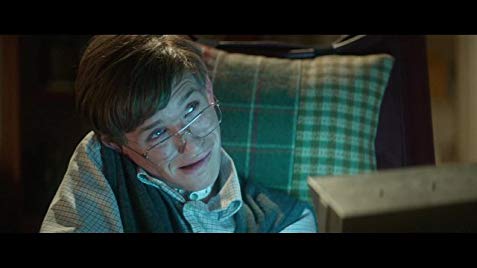
Felicity Jones and  Eddie Redmayne bring to the screen the life of Stephen Hawking

Director: James Marsh

Cast: Eddie Redmayne (Stephen Hawking), Felicity Jones (Jane Hawking), Charlie Cox (Jonathan Jones), David Thewlis (Dennis Sciama), Simon McBurney (Frank Hawking), Emily Watson (Beryl Wilde), Maxine Peake (Elaine Mason), Harry Lloyd (Brian), Guy Oliver-Watts (George Wilde), Abigail Cruttenden (Isobel Hawking), Christian McKay (Roger Penrose), Enzo Cilenti (Kip Thorne)

If you want a story of a triumph over adversity, there are few where adversity was faced off so successfully and publicly than the life of Stephen Hawking. Diagnosed with motor-neurone disease while still a postgraduate, Hawing defied the diagnosis that gave him little more than a few years to live, to shape a life and career that would have a profound impact on the world and make him probably the most famous scientist alive. Not bad for a man who spent a large part of his life confined to a wheelchair, only able to communicate through a synthesised computer voice.

But his life was not just a story where he was the only character. Many of his accomplishments came about because of the unflagging support of his wife Jane. This film takes as its source the book Jane wrote about their life together. And while it arguably sugar-coats or plays down some of the more uncomfortable or divisive elements of their marriage (a marriage that was eventually to end in divorce and several years where they did not speak), it also serves as a warm tribute to the many years they spent together where their support for each other was total and offered with no agenda or demands.

Here in James Marsh’s inventive and well-made film, which manages to more-or-less transcend its “movie of the week” roots, Hawking and Jane are played by Eddie Redmayne and Felicity Jones in performances that scooped an Oscar and a nomination respectively. Both are deserved, as these are rich, dedicated and empathetic performances, crammed with admiration for their subjects. It all fits perfectly well in Marsh’s moving if (at times) rather conventional film, which he directs with a lack of flash and plenty of heart. 

It’s a film that sometimes avoids delving too deeply into the emotional heartlands of its lead characters, and the frequently messy situations that life throws you into (the end of this relationship comes with a remarkably calm sadness, which contrasts heavily with the furious argument Jane describes in her book). It’s also a film that has a very clear agenda of framing Jane as a near saint in her devotion and patience, and Stephen as a brave soul with a superhuman perseverance and regard for his wife. So the introduction of choir leader Jonathan Jones (played with a sweet charm by Charlie Cox) into their domestic life as a surrogate father to the Hawking children and friend to Jane (very definitely not a lover, the film is eager to make clear) is very much something accepted by both without a hint of doubt or recrimination. Similarly, Hawking’s later divorce of Jane is set in a context of “setting her free” rather than the more (allegedly) definitive break it was in real life.

Real life, you suspect, was messier than this. The film does mine some excellent emotional honesty from Jane’s decision to marry Stephen being, at least partly, based on her belief that this man she loves only has a few years to live. From the start she doesn’t anticipate signing up for a lifetime of providing care and abandoning her own aspirations to support Stephen’s (the film makes no real mention of her own dreams of becoming a translator) – but Jane does so with a decided willingness and sense of duty. Similarly, Stephen does not anticipate a life essentially trapped in a wheelchair – finally speechless – and the film allows beats of frustration from him, alongside the determination to not let these problems prevent him from achieving his potential.

The film revolves around Eddie Redmayne’s performance as Hawking. Needless to say it’s a technical marvel, a stunning accomplishment not only in its physical mastery (especially as it was all shot out of sequence, so in each scene Redmayne needed to carefully map how far the symptoms had progressed) and commitment, but also in its searing emotionality. Hawking’s brightness, his bashful playfulness, his intelligence and sense of cheeky charm are all there – and they’re later married with a pained, just-controlled bitterness mixed with stern mouthed resentment and gutsy determination to deal with the hand he has been given. Redmayne’s performance is a superb capturing of the all-consuming feelings of being betrayed by your own body, of no longer being the master of your own frame and being forced to adjust your plans and expectations to meet the limits nature has put on you.

Felicity Jones is equally good in a superbly heartfelt performance as Jane, a woman who gifts Stephen the determination and will to see past the limits the disease places on him. But it’s also a performance that acknowledges the draining burden of having to support someone this ill, of having to constantly be the strong member of the marriage, the one who must always be as ready to save her husband from choking at dinner as she must be to drop everything and fly across Europe to take life-saving medical decisions about him. Jones’ performance never slips into self-pity, but mines a rich vein of willing sacrifice powered by love.

Marsh’s film is largely unflinching around the everyday miseries and sorrow of the terminally ill and restrictingly disabled. We are confronted in every scene with the limits that Hawking’s body places upon him, from deteriorating handwriting and clumsiness to the loss of all speech and movement. This progression is presented with a detail uncoloured by maudlin sentimentality. Doctors are sympathetic but bluntly clear about the dangers and risks of treatment, each adversity is met with a quiet determination to carry on.

The Theory of Everything is a heart-warming watch – and features two superb performances. The portrait of a marriage that works, for the most part of their lives together, despite all obstacles is inspiring. While the film glosses over well-publicised issues over the end of the relationship – and perhaps downplays the emotional strains on both towards its end – it still succeeds in making a largely unsentimental picture of a genius who overcame all, and the brave woman who gave him the dedication he needed to do it.
Being John Malkovich (1999)

A portal into the head of a famous actor? What better way to find out what it’s like Being John Malkovich

Director: Spike Jonze

Cast: John Cusack (Craig Schwartz), Cameron Diaz (Lotte Schwartz), Catherine Keener (Maxine Lund), John Malkovich (John Horatio Malkovich), Orson Bean (Dr Lester), Mary Kay Place (Floris), Charlie Sheen (Himself), W Earl Brown (JM Inc Customer)

Is there a more consciously eccentric film ever made than Being John Malkovich? Can you imagine the pitch to the Hollywood suits? 

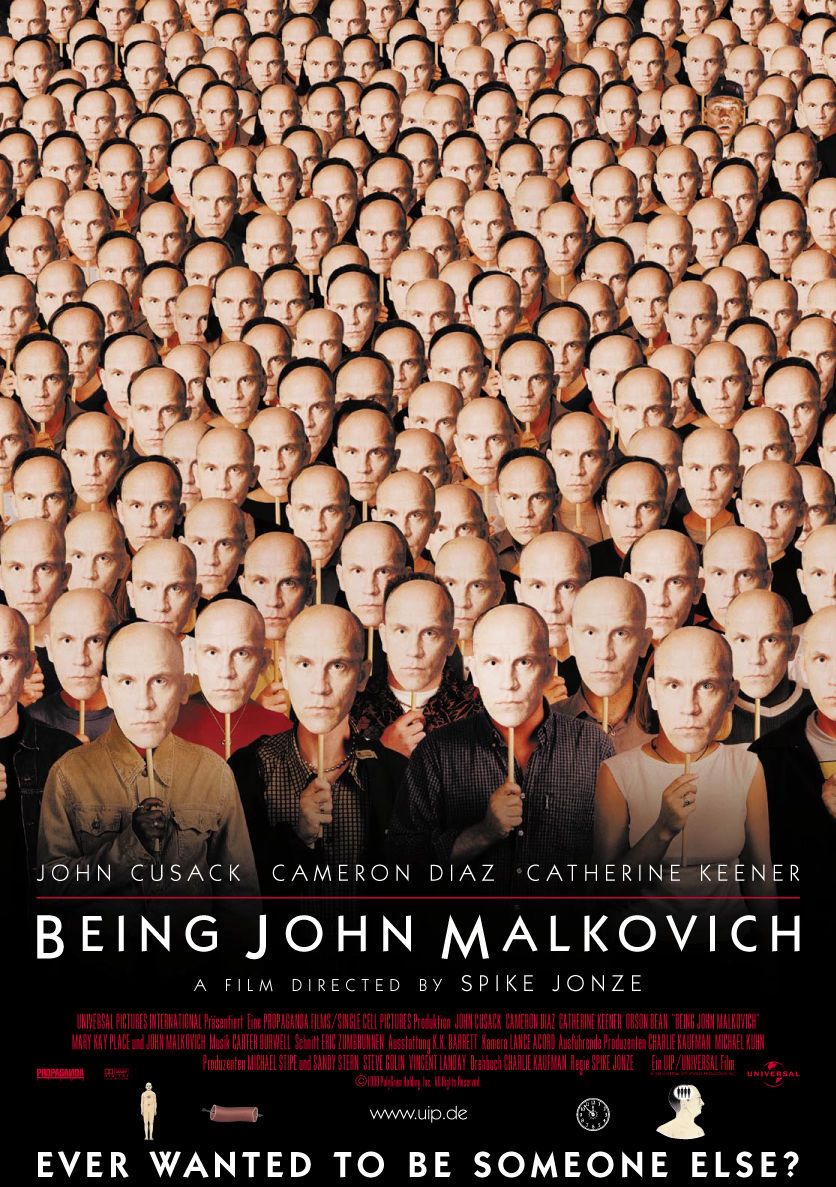
Our hero, Craig Schwartz (John Cusack) is a weedy, bitter puppeteer (as well as creep and potential stalker), whose wife Lotte (Cameron Diaz) fills their house with rescue animals, from talkative parrots to a chimp with PTSD. Needing to make ends meet, Schwartz takes a filing job at a company based on floor 7½ of an office block (it’s a low ceilinged floor built between the other two floors – it’s cheaper on the rent obviously) where he becomes obsessed with his sexy co-worker Maxine Lund (Catherine Keener), who is resolutely not interested. But all this changes one day when Schwartz finds a fleshy, dark tunnel behind a filming cabinet that takes someone into the mind of actor John Malkovich (John Malkovich) – for 15 minutes, before expelling you onto the New Jersey turnpike. Sounds like a business interest for Schwartz and Maxine (spend 15 minutes in someone else’s body!), but the experience of being in someone’s body slowly begins to change Schwartz, Lotte and Maxine – and having his brain invaded has a terrible impact on Malkovich himself.

If that’s not the oddest plot you’ve ever heard, then I don’t know what films you’ve been watching. The film was the brainchild of Charlie Kaufman, who developed from this into one of the most distinctively gifted screenwriters in Hollywood, a master of the quirky and weird, the off-the-wall and the science fiction tinged everyday fantasy, blessed with the ability to mix in genuine human emotion amongst the oddness. 

Being John Malkovich is an inspired idea and Kaufman’s script is ingenious in its structure and progression. Never once does the film settle for the expected narrative development or the conventional structure. It’s a livewire of a film that constantly leaves you guessing, switching tone and throwing logical but unexpected plot twists at every turn. There are plenty of moments where you could expect events to take a conventional turn, but the film never settles for the obvious.

Kaufman’s inspired script was lucky enough to find a quirky visual stylist who was willing to embrace it as much as Spike Jonze did. Jonze’s direction is a masterclass in small detail, slight twists and little touches of invention that never draw excessive attention to themselves but combine to make a thrillingly off-the-wall final picture. 

Jonze knows that the jokes and surrealism of Kaufman’s script are so effective that they don’t need a firm directorial hand to lean the humour on – they work absolutely fine presented almost as written, and make for terrific entertainment. He shoots the low ceiling of floor 7½ with such straightforward confidence that each scene becomes hilarious for its stooped actors and crammed rooms. Jonze can therefore concentrate the flourishes on core moments, from the puppetry that Schwartz and later a Schwartz-controlled Malkovich make their life’s work, to assorted training and educational videos that pepper the film at key moments.

Like Kaufman as well, Jonze’s storytelling works because he inherently understands human emotion and isn’t afraid to throw it into the film alongside the humour. Plenty of directors would have been happy to have all the principals settle into being comic stereotypes, or overplayed pantomime figures. Jonze encouraged the actors to find the depth – and sometimes the darkness – in their characters, to ground the film effectively with touches of real life tragedy and human flaws that give weight to the surreal sci-fi elements – so much so that they start to feel as real as the rest.

John Cusack’s Schwartz is a bitter, increasingly twisted fantasist and dreamer – the sort of guy who believes that his lack of willingness to compromise his art in any way is a strength (his puppetry shows are highly complex, sexualised, high-blown, poetry-inspired hilarious puffs of pretension). Schwartz could have become a joke or a guy with a big dream – but the film increasingly shows him to be a dark, obsessive, cruel even dangerous outsider, who has no problem with harming other people to get what he wants, his moral compass is driven by his self-assessment of himself as a man treated badly by others, so doing what he wants is somehow deserved. It’s an increasingly dark portrait of a man who has more than hint of danger to him.

Keener, as the focus of his obsession, also does extraordinary work as a woman the film is not afraid to present as unpleasant in her selfishness, casual cruelty and greed – but a woman who slowly allows herself to open up and reveal an emotional openness and romanticism someone watching the start of the film would never expect. Similarly Diaz’s downtrodden, sad wife at home flourishes and grows as a person, as she finds in herself a new comfort and ease with who she is, from inhabiting the mind of another person. Both are excellent.

The film explores fascinating ideas of identity – Lotte and Maxine find a freedom and an exciting otherness in being a passenger in another person’s body, and use it as voyages of self discovery for themselves. Schwartz on the other hand sees this body – just as he sees all human beings – as just another puppet for him to control, another way of adjusting the world to match his requirements, rather than change anything about himself. While some lose themselves in Malkovich’s body and find the experience rewarding, Schwartz can only find happiness when bending the body to his own will.

And what of Malkovich himself?  Well has there ever been a braver performance in film? Malkovich is superb as an arch portrait of himself as a rather self-important actor, with an unknowable coolness about him, an intellectualism that makes him a man easy to respect but strangely hard to relate to, a face that is distinctive but a strangely unrelatable style that makes him hard to remember (it’s really an extraordinarily funny and brave performance). As Malkovich realises what is happening to him, the film plays with real beats of tragedy and even horror – what would it be like to be forced into being a passenger in your own head? This is nothing compared to the horror Malkovich encounters when he enters the tunnel himself – to find himself in a world where everyone looks like Malkovich and can only speak using the word “Malkovich”.

Being John Malkovich uses its surreal ideas to explore profound – and even chilling – ideas of control, destiny, personality and identity. With several superb performances, a brilliant script and controlled and intelligent direction, it’s a film unlike any other – and continues to delight and surprise twenty years on from its release.

The Aeronauts (2019)

Redmayne and Jones go up, up and away in The Aeronauts

Director: Tom Harper

Cast: Felicity Jones (Amelia Rennes), Eddie Redmayne (James Glaisher), Himesh Patel (John Trew), Tom Courtenay (Arthur Glaisher), Phoebe Fox (Antonia), Vincent Perez (Pierre Wren), Anne Reid (Ethel Glaisher), Rebecca Front (Aunt Frances), Tim McInnerny (Sir George Airy), Robert Glenister (Ned Chambers), Thomas Arnold (Charles Green)

When you have found two actors with such natural and easy chemistry as Felicity Jones and Eddie Redmayne, it makes sense that you would seek other projects for them to star together in. Let’s try and recapture that Theory of Everything magic in the bottle! The Aeronauts brings these two actors back together, but the law of diminishing returns applies in this impressively mounted but rather uninvolving epic that has more in common with Gravity that it does Theory of Everything.

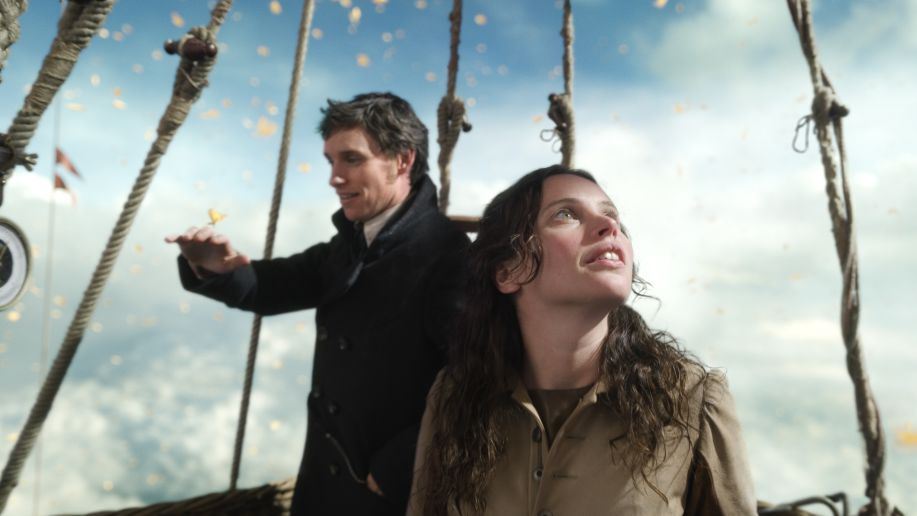
James Glaisher (Eddie Redmayne) is a scientist, one of the first meteorologists, determined to prove that man can predict the weather. While his theories are laughed at by fellow members of the Royal Society, Glaisher raises the cash for a private balloon trip to the heavens to take meteorological readings. But he needs a pilot: who better than Amelia Rennes (Felicity Jones) a famous balloonist and show-woman, the widow of a fellow balloonist (Vincent Perez) who fell to his death in an attempt to break the record ascent. Will the two mismatched aeronauts – the uptight scientist and the freespirit with tragedy at her core – reach an understanding amongst the clouds?

If you got the sense that the story of the film is rather predictable from that paragraph well… you’d be right. It’s the sort of film that has bookend scenes: an early one where our hero desperately tries to make himself heard during a speech at the Royal Society while his colleagues walk out in contemptuous laughter, and then another near the end with the same hero being applauded to the rafters by those same colleagues. Even his harshest critic claps politely – because it’s that sort of film. Meanwhile our other hero overcomes her survivor guilt by heading into the skies. Whenever the story, written by workaholic Jack Thorne, focuses on these personal stories, the film falters into cliché and dull predictability.

It’s told mostly in real time, following the just over 1 hour and 40 minutes of the pair’s ascent in the balloon, with flashbacks to their first meeting and their own backstories plugging the gaps in conversation. No major revelations happen in these flashback sequences, and a host of respected actors go through the motions, filling in the paint-by-numbers stories of bereavement, scientific isolation, an inspirational father with early onset dementia, and pressures to just conform to what women are expected to do. The two leads do their very best to animate these rather dull and tired plotlines but with very little success.

In fact, both actors are largely struggling the whole time to add breadth and depth to thinly sketched characters. Tom Harper leans heavily on their pre-existing chemistry and there is certainly very little in the characters to challenge them, particularly Redmayne who can play these stiff-necked, all-business, shy science types standing on his head. Felicity Jones has by far the better part as a natural adventuress who has locked herself in isolation and guilt (and in a dress) due to her guilt at her husband’s death. Jones gets the best material – and also the best vertigo inducing action sequences – in a film that is most successful when it is far away from the ground.

Harper’s film is by far at its most interesting when extreme altitudes, cold temperatures and reduced oxygen induce crisis in the balloon’s ascent. As Amelia has to go to extreme and dangerous lengths in order to force the balloon to begin its descent, the film finally comes to life. With several terrifying shots of the huge drop to the ground (they certainly made me squirm in my seat) and a compelling feat of bravery and physical endurance to force the balloon to start releasing gas (combined with some horrifyingly close slips and falls) the film works best from this moment of crisis, through to the hurried and panicked attempt of both aeronauts to control the descent of the balloon safely to the ground. The sense of two people struggling with the very outer reaches of mankind’s connection to the Earth – and their terrifying distance from the safety of the ground – really brings Gravity to mind far more than any other film.

It’s a shame then that I came away from the film to find most of it is not true. Glaisher did take to the skies – but with a male companion, Henry Coxwell. Amelia Rennes never existed (and most of the events in the sky never happened), although she is heavily based on a real female aeronaut and professional balloonist who had no connection with Glaisher or science. It shouldn’t really matter, but it kind of does as the film doubles down on Glaisher’s tribute to Rennes at the Roya Society and its general attitude of female pioneers in science. As one critic said: there were genuine pioneering women in science, why not make a film about one of them?

But it’s an only a minor problem really for a film that is impressively made when it is in the air, but dull and uninvolving when it is on the ground. At heart it’s an experience film – you can imagine as one of those immersive rides at Disney it would be amazing – but as a piece of storytelling it’s dull, predictable and uninvolving and largely fails to make the science that was supposed to be at the heart of it clear or significant. Jones and Redmayne do their best but this story never really takes flight (boom boom toosh).

Terminator: Dark Fate (2019)

Terminator: Dark Fate (2019)

Even re-uniting Hamilton and Arnie couldn’t save this from an (undeserved) Dark Fate

Director: Tim Miller

Cast: Linda Hamilton (Sarah Connor), Arnold Schwarzenegger (Carl), Mackenzie Davis (Grace), Natalia Reyes (Dani Ramos), Gabriel Luna (Rev-9), Diego Boneta (Diego Ramos), Tristan Ulloa (Felipe Gandal)

It should have been a hit. The third attempt in the last ten years to restart the Terminator franchise, after no less than two cancelled planned trilogies, this one bought back James Cameron in a producing and story capacity, pulled in Linda Hamilton to return as Sarah Connor for the first time in nearly thirty years and finally seemed to be the “true” Terminator 3. But it bombed anyway, worse than either Salvation or Genysis and finally put paid (probably) once and all for the franchise. How did it come to this?

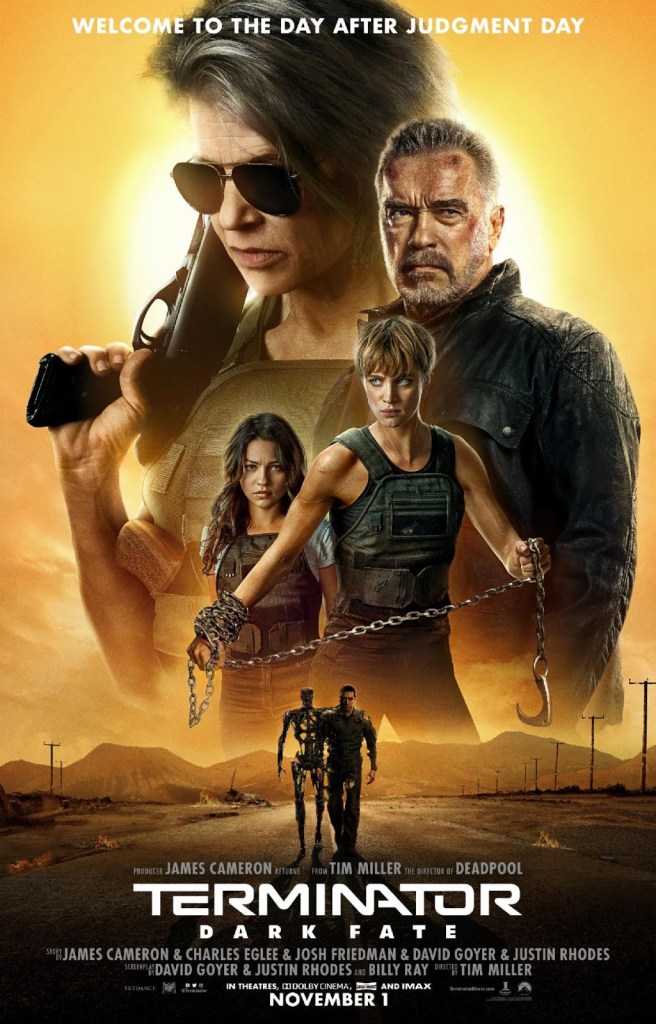
In 1998 a T-800 Terminator (Arnold Schwarzenegger) – one of a number sent back in time by Skynet before erased from history by our heroes in Terminator 2 – finally succeeds in killing John Connor (a CGI recreation of Edward Furlong from T2), leaving Sarah Connor (Linda Hamilton) distraught. Twenty-two years later and a new artificial intelligence from the future, Legion, has sent back a Terminator (Gabriel Luna) to wipe out a pivotal future figure for the human resistance Dani Ramos (Natalia Reyes), with the resistance once again sending back its own champion Grace (Mackenzie Davis), an artificially enhanced human. The inevitable combat between man and machine is on again, with Grace and Dani joining forces with Sarah Connor, as well as other unexpected allies.

That paragraph probably gives you a sense of what’s good and what’s bad about the film. Starting with a twist that seems to finally try and send the franchise off in a new direction – the eradication of John Connor, the person every film has been about protecting – is a brave decision. The confirmation that eternal enemy Skynet has indeed been erased from history finally changes the enemy. Arnie’s T-800 is confirmed as literally the last in existence – a killer sent from a future that now no longer exists. It looks like we are set for something entirely different.

And then of course we aren’t. Because it seems man’s reach will inevitably exceed his grasp, just as would-be Terminator film producers will always overreach themselves. Even with Skynet gone, there must always be some artificial intelligence super-computer that destroys the future, there must always be some sort of special one who must be protected at all costs, always a hero sent from the future who knows more than they can say and always an Arnie Terminator on hand for good or bad. Just as Genysis tried to re-set the table, but only reminded us what a small world is, this film tries to shake up the pieces but then replaces most of them with like-for-like and throws us into a film that has effectively exactly the same structure as the first two films.

So, after that opening scene twist, we get the arrival and meet up of the two future warriors, a scrap at an everyday setting for her hero, a series of shocked reveals about the future, some gonzo chases (this one does at least up the anti – literally – by setting one of them in a plane), a lull in proceedings while our on-the-run heroes work out whether they can trust each other, then a final smackdown in a factory where self-sacrifice is all the rage. For a film that tries to do something new, it is remarkably conservative and shows that for all the time-travel inspired gymnastics of the universe it operates in, the series is strictly tied to a set number of rules and plot mechanics.

But it’s all really confidently told. That’s almost the tragedy. This is a pretty good film. Easily the third best Terminator film made. I actually pretty enjoyed it. It has a simple narrative drive to it, an old-fashioned world where the characters throw each other about and punch each other really hard into things rather than engage in balletic, choreographed fight scenes. Tim Miller directs the whole thing with a pace and drive and if Cameron feels like he may have only really been happy to attach his name to the whole thing in return for a few story ideas and a paycheque, at least it can boast it has his definite seal of approval.

The acting is also pretty good. Linda Hamilton is a welcome return, getting some fascinating beats of intense drive mixed with deep grief. It’s a great to see an action film like this front-and-centre female characters so much. It’s a shame that this is such a franchise with such a masculine reputation, as this realignment has probably not had the impact it could have had in bringing new people in. Mackenzie Davis is impressive as Grace, Natalie Reyes growing in confidence and strength as the new messiah. Even Arnie gets to do something very different with his T-800 characterisation (after 22 years of living as human, the robot has changed beyond all recognition from the remorseless killer), not least seeing him successfully terminate a target for the first time in the franchise. 

It’s just a shame that this energetic re-telling of an old story probably suffered above all from franchise exhaustion. After reboots and restarts from Salvation to Genysis have seen their plotlines, developments and future sequels sent to the scrap heap (certainly the last two) it really seems a case that once bitten, twice bitten makes us not just shy, but running scared. At the end of the day any interest and affection the franchise had from the first two films has been burned up beyond all recognition – and this film, in the end, doesn’t reinvent the wheel enough to encourage you to come back and see what’s different. It’s a shame that this sprightly entertaining film has been terminated not by its future, but by its weary, error-strewn, past.

The Fisher King (1991)

Robin Williams and Jeff Bridges go on a quest in Terry Gilliam’s decent but overlong The Fisher King

Director: Terry Gilliam

Cast: Robin Williams (Parry), Jeff Bridges (Jack Lucas), Mercedes Ruehl (Anne Napolitano), Amanda Plummer (Lydia Sinclair), Michael Jeter (Homeless Cabaret Singer), David Hyde Pierce (Lou Rosen), Lara Harris (Sondra), Harry Shearer (Sitcom actor), John de Lancie (TV Executive), Tom Waits (Veteran)

In 1991 Terry Gilliam was seriously worried he might be unemployable. After the famous feud with his producers over the editing of Brazil, his follow-up The Adventures of Baron Munchausen had flown over budget and bombed at the box-office. For Hollywood Gilliam was the worst kind of maverick – trouble with no record of financial success to give him the licence to do what he wanted. So he was thrilled to be offered the chance to direct The Fisher King, his first ever “for hire” job, a sentimental but surreal romantic buddy movie. It’s financial and critical success almost certainly saved his career.

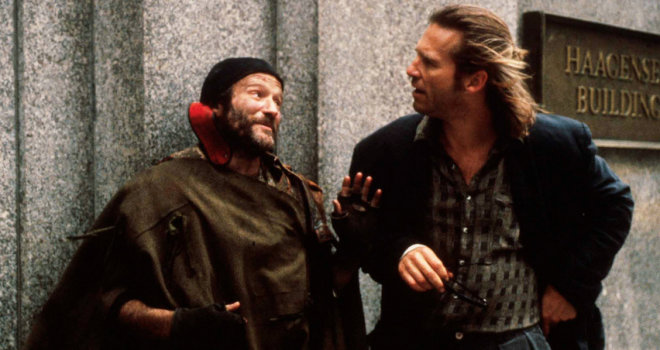
Jack Lucas (Jeff Bridges) is a New York radio shock jock, whose show accidentally provokes a lonely and confused man to massacre the customers at a late night bar. Three years later and Jack’s career is over and he is working as a co-owner of a video rental star (and live-in lover) with Anne Napolitano (Mercedes Ruehl). One day – drunken and suicidal – he is saved from a gang of young thugs by eccentric homeless man Parry (Robin Williams). Jack discovers three years ago that Parry was a respected professor of English literature, whose life fell apart after his wife was killed in the same bar massacre that ruined Jack’s career. The two men are drawn together – but can they save each other?

The film is based on the myth of the Fisher King, the king charged with finding the Holy Grail but could not find it for years – only for a fool to present it to the king full of water to drink, revealing it was there in the King’s possession the whole time. The fool helps because he is “purer” than those more worldly around him. The idea that Richard LaGravenese’s screenplay is leaning on is that these two characters – Jack and Parry – alternate between them the roles of Fisher King and Fool, both slowly doing things for each other that change their personalities and allow them to adjust back into the world and become comfortable with the people they are.

Reading that it should become clear that this is a sentimental film – and it certainly is. It’s also hellishly overlong for such a slight story of tragedy leading to overcoming personal crisis. We know watching the film from the start that Jack Lucas is a bad guy – and Gilliam shoots his opening scenes of Radio presenting with great skill, using high angles, extreme close-ups and shots that prevent us getting any real sight of Jack, making him as impersonal and contemptable as possible in his shallowness, pride and thoughtless cruelty. It’s not a mystery to expect that we are due to watch a triumph of the human spirit film, in which Jack becomes a better man. The film takes a very long time making this simplistic point.

The catalyst is Robin Williams, in a role tailor made for him as a hyper-active, manic personality mixed with tragedy and depression. To be honest Williams is frequently over indulged in the role – despite his Oscar nomination – heading over the top too often, and often over-egging the pudding both in Parry’s energetic enthusiasm and also in his moments of tragic depression. Parry is given a romantic sub plot with Amanda Plummer’s nervous office worker (a character who is little more than a collection of quirks than a personality, and it’s a shame it’s led to Plummer being typecast in such eccentric roles) that is almost insultingly slight and one-sided (he comes across a bit like a stalker) and lacks any of the charm needed for the story to work.

Parry is used to tie the film into further Arthurian flourishes with his obsessions with the legend. Parry visualises a sinister Red Knight – a mental expression of his grief and horror at his wife’s death, which takes the form of the appearance of his wife’s blood splattered face – which chases him through the city. Parry is also obsessed with the discovery of the Holy Grail, which he claims can be found in a millionaire’s faux medieval castle in the centre of Manhattan. This Arthurian stuff is often rather crow-barred in, but holds more interest than traditional plot-lines of people rediscovering their humanity and capability of bonding with others.

Jeff Bridges actually takes on the far harder role as Jack Lucas, a character who has to go on a firm development from start to finish. While Parry is a deliberately eccentric figure, Jack is the one who must journey from arrogance and pride to selflessness and humanity. Bridges does it very well, with a neat line in under playing and an ability to suggest the warmth, shame and self-disgust that Jack works hard to cover up. He’s also blessed to share scenes with Mercedes Ruehl who is outstanding (and Oscar winning) as his girlfriend, the most humane, engaging and real character in the film, a woman who seems at first blowsy and cheap (Jack clearly believes she is beneath him) but reveals more and more depths and capacity for honesty, love and generosity.

Gilliam has a sharp eye for the huge gap between wealth in poverty in 90’s New York, and how the two worlds are geographically only a width of a piece of paper, despite being worlds apart. His direction uses many of his flourishes with great effect. Fish eyed lens POV shots, low angles, stylistic dream sequences, a dream sequence where Grand Central station is full of dancing travellers like a mighty ballroom – many of the sort of things you see in his films are here. To be honest, I found some of the flourishes a bit overwhelming in a story that is so slight and so grounded in just four people’s interactions and quests for salvations. But it works, and Gilliam gets some moments of romantic and platonic love that really work. But it’s still a slight film that goes on far too long, and it eventually loses the viewer in its time-consuming journey towards expected heart-warming moments.

Missing (1982)

Jack Lemmon and Sissy Spacek are on a quest for the Missing

Director: Costa-Gravas

Cast: Jack Lemmon (Edmund Horman), Sissy Spacey (Beth Horman), John Shea (Charles Horman), Melanie Mayron (Terry Simon), Charles Cioffi (Captain Ray Tower), David Clennon (Consul Phil Putnam), Richard Venture (US Ambassador), Jerry Hardin (Colonel Sean Patrick), Janice Rule (Kate Newman), Richard Bradford (Andrew Babcock)

Politically motivated American films are few and far between, especially ones that take such a starkly critical view of American foreign policy. So it’s a testament to the respect given to Greek director Costa-Gravas that his first American film is an angry denunciation of America’s attitude towards Latin and South America and a criticism of the cosy assumption of so many of its citizens that the very fact of their being American will open all doors and make them invulnerable to harm. 

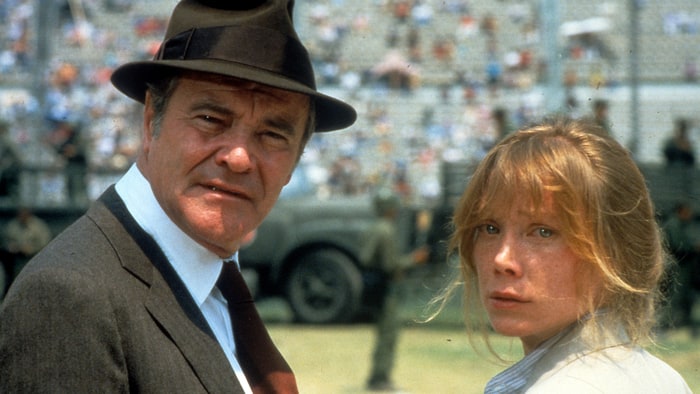
Set in the immediate aftermath of Pinochet’s military coup in Chile in 1973 (although for various legal reasons Chile itself is never named), young American journalist and filmmaker Charles Horman (John Shea) goes missing. His wife Beth (Sissy Spacek) is left alone in the increasingly dangerous city, while his father Ed Horman (Jack Lemmon) flies into the country. Ed assumes his government will swiftly work with him to solve the mystery, and that his son must have been wrapped up in some dodgy dealings to have gone missing. He is to be brutally disabused of both notions with a painful swiftness, as he finds he and his son are insignificant factors in America’s geopolitical interests.

Costa-Gravas’ film wisely avoids focusing too much on the details of Chilean politics, or the causes of the coup, or even really concentrating on the left-wing politics of many of the American citizens wrapped up in the coup. Instead it zeroes in on the human impact of loss and pain, and by focusing less on the politics of a coup but on the impact of it, it places the audience attention instead on the atrocities that military revolutions bring. Alongside this, Costa-Gravas places front-and-centre of the story not a firebrand liberal, or a left-wing polemicist, but a character who could not be more of a strait-laced conservative, a quintessential American who firmly believes his country is the greatest in the world and heads into a foreign land anticipating doors will be opened for him and his government is here to help. 

It’s vital for the film’s success that it’s the experience of Ed Horman that drives the film narrative. First appearing 25 minutes into the film, the rest of the narrative charts Ed’s growing shocked realisation that his government doesn’t give a damn about his son and, even worse, is more than happy to lie to his face about the level of their involvement. While Ed believes America to be the font of all goodness in the world, he is horrified to discover that it is at the centre of a far more shady world of realpolitik. And that his own complacent belief in the country, and unquestioning assumption that it can do no wrong, is part of what empowers its representatives to back murderous regimes. “If you hadn’t been personally involved in this unfortunate incident, you’d be sitting at home complacent and more or less oblivious to all of this” the Ambassador haughtily tells Ed, after the frantic father has angrily denounced America’s policies. And, from what we saw of Ed at the start, he’s right.

It’s a superb role of growing disillusionment and a stunned realisation that his own home-grown principles and believe in truth, justice and the American Way turn out to be just words. And Jack Lemmon is just about the perfect actor for it. This might be Lemmon’s finest performance, superb from start to finish, a perfect emobodiment of All-American principles that disintegrates into someone angry, bitter and disillusioned. But at its heart as well – and the films – is the very real grief of a father who has lost his son. Worse, a father who only feels he grows close to – and understanding of – his son after losing him. Lemmon’s performances mines every ounce of empathetic sympathy from the role, in a series of heartbreaking moments as Ed begins to realise just how much he has lost in a son he begins to feel he never gave a chance.

This very personal story is at the centre of the film, but Costa-Gravas never for one moment allows us to forget – or avert our eyes – from the horrors coups like this bring. By not naming Chile, it manages to make this the face of all brutal revolutions. As characters move through the streets, or squares, in controlled, carefully framed long-shots and takes we see all around, uncommented on by the camera, unfocused on by the director, the signs of brutality. Throughout the film the background action sees casual arrests, violence, assaults, book burnings, bodies being left in the street or thrown into trucks… All around ordinary people keep their heads down or run for terror. Curfews leave people trapped outside – Sissy Spacek (very impressive) as Beth is caught out and is forced to spend a night hiding in the porch of a hotel, while gun shots ring out around the city (a regular soundtrack for every scene).

The investigation into Charles’ disappearance is pushed forward not the embassy – which presents a series of acceptable faces of the new regime and a smiling reassurance that every thing is being done – but by harried and scared survivors and asylum seekers in European embassies, who tell snippets of the events they have seen, the deaths they have seen glimpses off, the horrors of detention centres. It’s finally dragged home to Ed and Beth as they are taken to an office block with every room containing executed corpses, some identified some not, the bodies piled on every floor of the building. 

In all this America – and shady military and industrial interests – are complicit, and the executions and deaths of citizens of this country (and a few Americans who unwisely mixed themselves up in it) are seen as acceptable collateral damage, the price of doing business to protect American financial interests. The Government is happy bed fellows with murderers and crooked officials, and the idea that the death of one American citizen is going to matter at all is nonsense. Costa-Gravas’ film has a firm point to make – but it makes it within the context of a very human and personal story. “They can’t hurt us, we’re Americans!” are Charlie’s final (on-screen) words: in this attitude he’s as naïve as his father, and he clearly believes just as much in the divine goodness and special status of his homeland. America has no special or outstanding moral character: it’s as mired in dirty world realities as anyone else. This rude awakening will cost the son his life and cause untold grief to his father as well as shattering all his cosy greatest generation idealism.

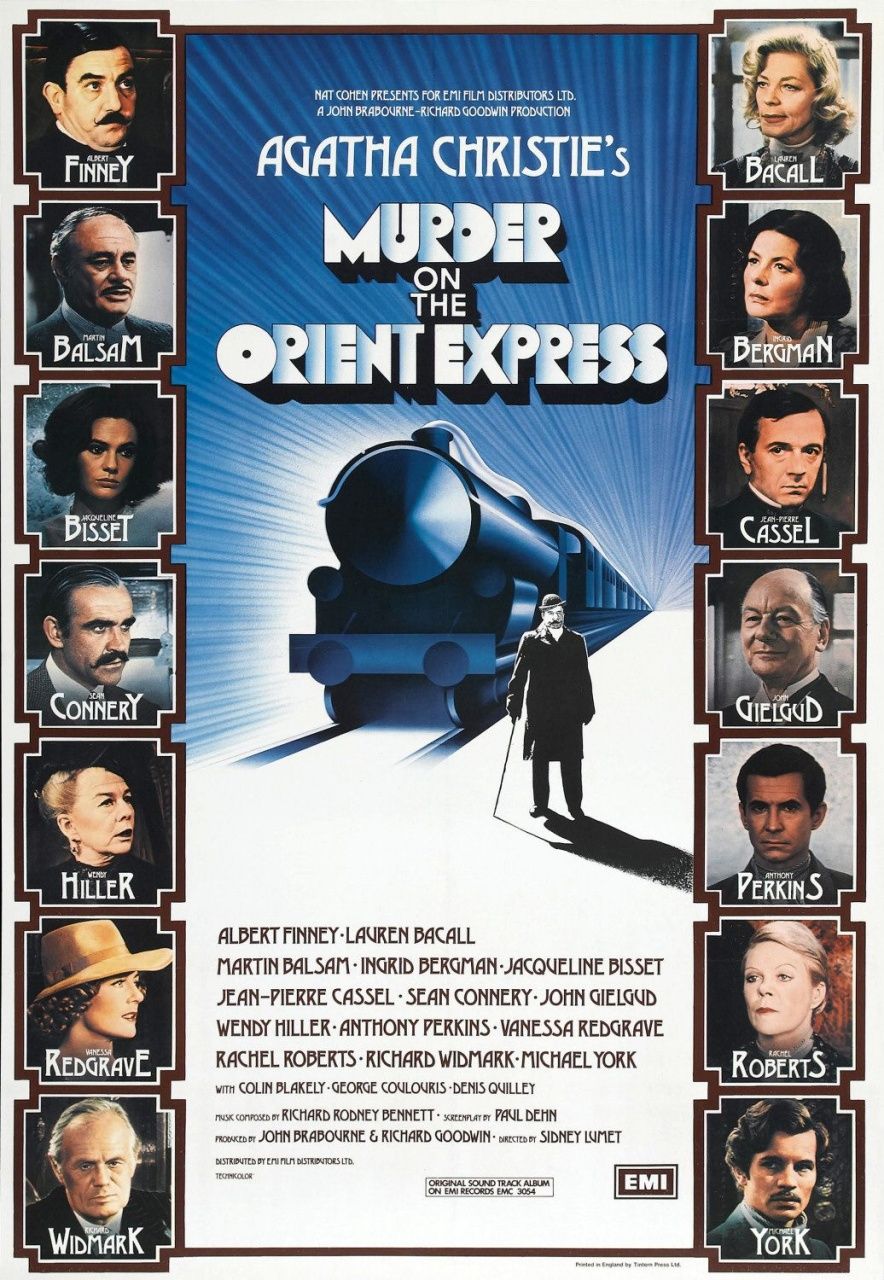
Murder on the Orient Express (1974)

Albert Finney interrogates an all-star cast in Murder on the Orient Express

Director: Sidney Lumet

Cast: Albert Finney (Hercule Poirot), Lauren Bacall (Linda Arden), Martin Balsam (Signor Bianchi), Ingrid Bergman (Greta Ohlsson), Jacqueline Bisset (Countess Helena Andrenyi), Jean-Pierre Cassel (Pierre Paul Michel), Sean Connery (Colonel John Arbuthnot), John Gielgud (Edward Beddoes), Wendy Hiller (Princess Natalia Dragomiroff), Anthony Perkins (Hector McQueen), Vanessa Redgrave (Mary Debenham), Rachel Roberts (Hildegarde Schmidt), Richard Widmark (Ratchett), Michael York (Count Rudolf Andrenyi), Colin Blakely (Cyrus Hardman), George Coulouris (Dr Constantine), Denis Quilley (Antonio Foscarelli)

If there was a film that set the template for our expectations for an Agatha Christie adaptation, it was probably this one. A big starry cast. Luscious period detail. An engrossing plot with clues and double meanings in every corner. A healthy mix of the OTT and the chilling. Marshalled by Sidney Lumet, almost certainly the best director to take on a Christie mystery ever, this film was a massive hit then and remains a hugely enjoyable, rewarding treat now, the sort of masterclass in quality film-making and bravura acting that is guaranteed to leave a smile on your face.

You surely must know the plot by now right? Hercule Poirot (Albert Finney) returning from a successful case in the East hitches a ride on the Orient Express on the way home. During the journey he is asked by American businessman Ratchett (Richard Widmark) if he would take up the role of his bodyguard after threats against his life. Poirot turns him down – and sure enough the next morning Ratchett turns up dead in his compartment, with no less than a dozen knife wounds in his chest. With the train stranded in a snow drift, the killer must be one of the other twelve passengers in the carriage. And so the case begins…

Sidney Lumet’s superb, classy piece of murder mystery is a triumph of design and style. The train looks superb, the period detail is perfect, the costumes are luscious. But what Lumet brings to it all underneath all this Sunday afternoon splendour is a genuine sense of chilling menace. Helped a great deal by Richard Rodney Bennett’s haunting musical cues, this film never lets the viewer forget that the heartless destruction of an entire family is at the root of the crime itself, or that the desires for revenge we find in ourselves can take us to dark places. 

Lumet’s film opens with a brilliantly constructed series of newspaper stills, establishing the horrors of the Daisy Armstrong case that underpins the mystery, the kidnapping and murder of a young child (based on the Lindbergh kidnapping) that led to tragic consequences for an entire family. This chillingly sad and tragic back story is echoed throughout the film, and immediately establishes the stakes for all involved.

So we spend the film then trying to work out how all the suspects might fit it into this story. Lumet’s concept of bringing together an all-star cast was a brilliant idea, not only giving each of the suspects a quickly established personality (partly inspired by the actor’s body of work), but also assembling a group of such talented actors that they can sketch out a character within a few moments. Lumet’s first recruit for the cast was his old collaborator Sean Connery – and the agreement of Connery to take on a supporting role brought a host of actors to follow. It all adds to the fun, an enjoyable star-spotting exercise, and also an amusing game of watching sometime wildly competing acting styles.

Connery plays Arbuthnot with a stiff-upper lip English reserve, but then you also have a wonderfully arch (and very funny) John Gielgud, a dementedly twitchy Anthony Perkins (McQueen seems to have been adapted into a junior brother of Norman Bates), a show-boatingly larger-than-life Lauren Bacall (great fun), a Germanic stern Rachel Roberts and an inscrutable Vanessa Redgrave. That’s just a few of a terrific collection of actors, and arguably only Wendy Hiller’s overly imperious Princess Dragamiroff is a bit of a miss.

Lumet’s strength in depth allowed him to push his actors into demanding places – complex set-ups and, most especially, a series of long takes in his often confined performance spaces. The highlight – in fact it won her an Oscar – is Ingrid Bergman’s five-minute (practically only) scene where the camera slowly rotates around her across five minutes as she tells her story. Bergman’s shy, nervy, gentle and timid missionary comes across as achingly vulnerable. Bergman had been offered the larger role taken by Wendy Hillier, but wisely turned it down for this show-stopping moment.

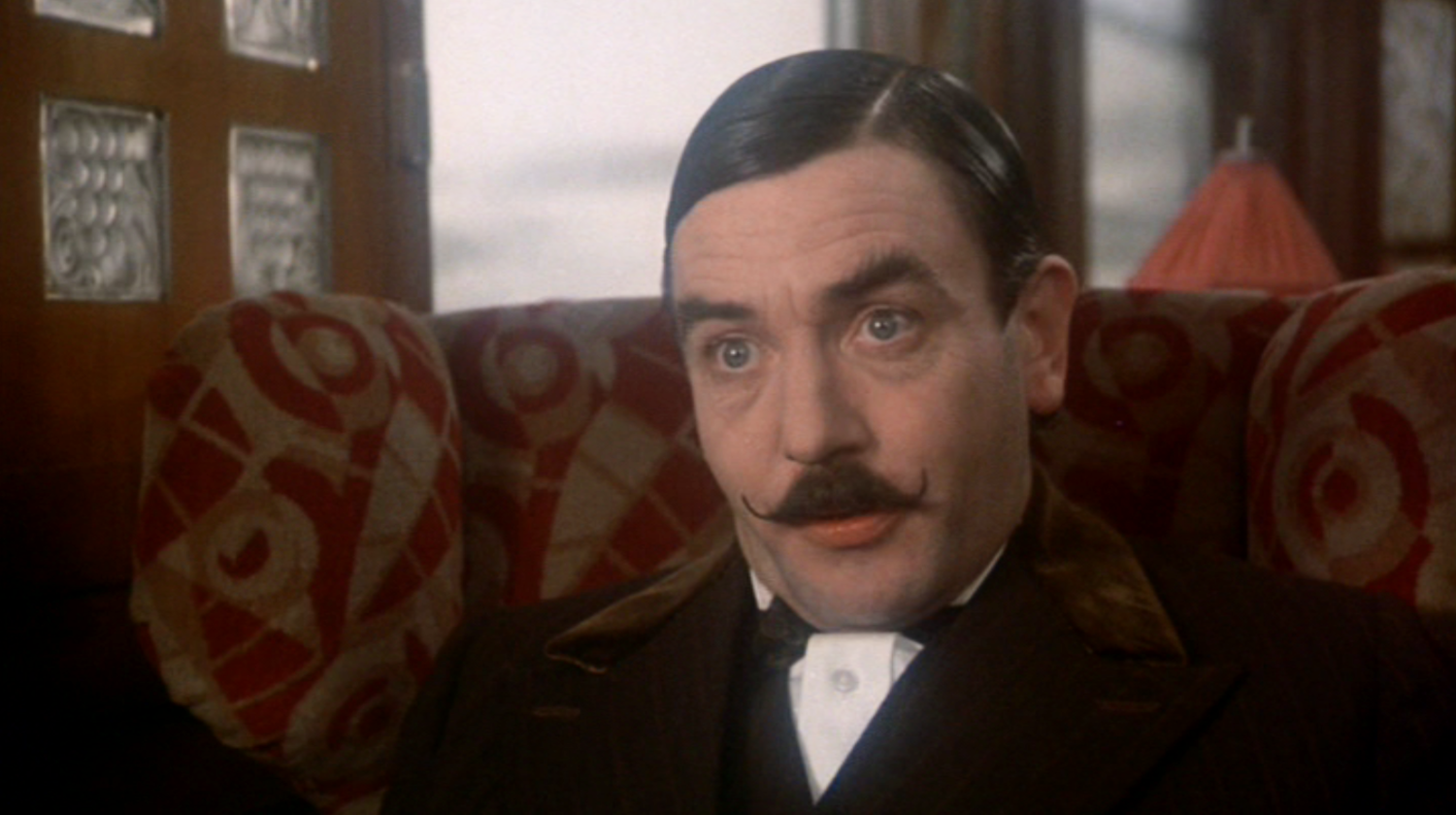
The advantage of having such accomplished actors was most clear in the burden placed on Finney as Poirot. Watching it now – familiar as we are with decades of David Suchet’s definitive performance – it’s easy to see Finney’s performance as a little too much. Covered with make-up and a fat-suit, his shoulders hunched around his neck, his hair plastered down with grease and his accent frequently heading way out over the top, Finney certainly leaves very little in the dressing room. His Poirot is an amiable showman, a man willing to adjust his personality and approach from suspect to suspect, but in the end a man with a well-being arrogance and a deep sense of personal morality as well as a profound sense of humanity.

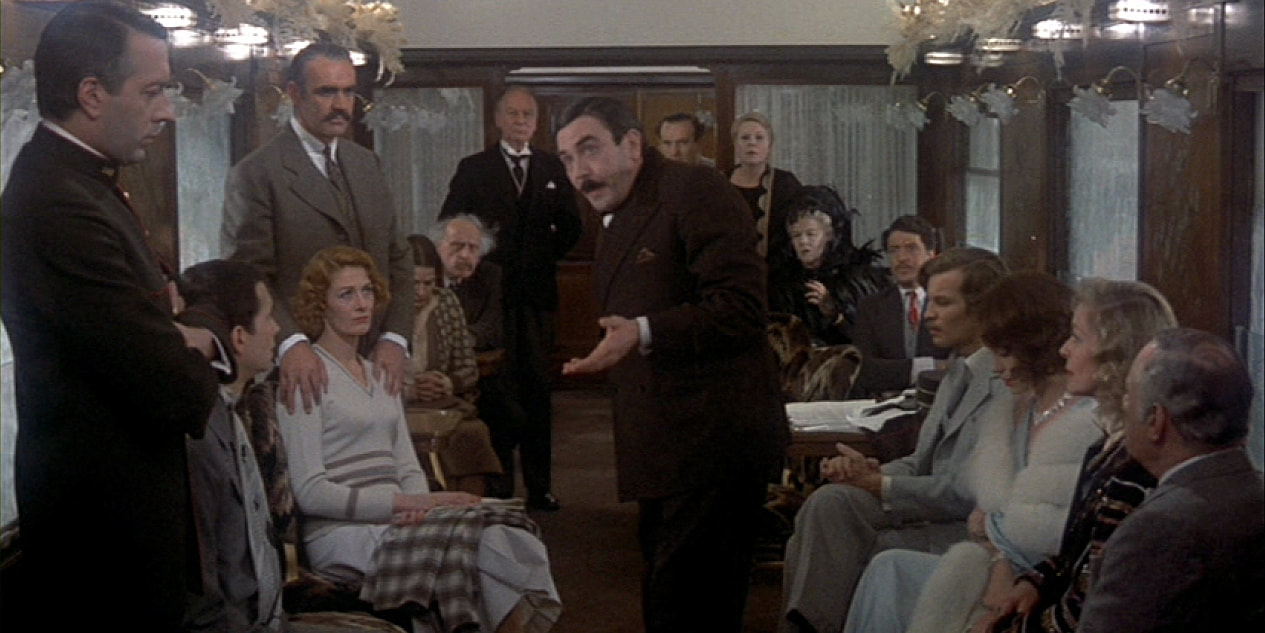
Finney was a surprising Oscar nominee for Best Actor, but he almost certainly owed this to his final speech, an almost thirty-minute tour-de-force. Lumet, operating in small confines, determined that the best way of getting the most dramatic energy from the speech was to use long takes, elegant camera moves, and the minimum of cutting – to let Poirot cast his spell over the audience as much as he does over the suspect. As such Finney – in a tiny, crowded, set – performed the complete monologue several times (each time apparently flawlessly) so that the camera could be positioned in each point in the confined set at a time. The result is seen in the final sequence, which uses dizzying long takes and careful camera moves to draw us brilliantly into the reveals that come thick and fast.

Finney’s performance is magnetic in its theatricality and commitment, and Lumet’s directing decisions throughout the sequence really help to make this sequence as effective as it is. Lumet’s peppers this sequence with a series of brief flashbacks to earlier in the film, which skilfully present snippets of the characters testimonies represented at different camera angles, which is both eerie and also throws a new light on the scenes we have already seen. For all that Finney is a bit much at times, you can’t help but enjoy this piece of showmanship.

The final resolution remains justly famous, and it largely owes a lot to this film. Agatha Christie even was favourable to the film (one of only two films of her work she liked, the other being Billy Wilder’s adaptation of Witness for the Prosecution) although (in words I presume heard by Kenneth Branagh) she bemoaned the smallness of Finney’s moustache. There have been several film and TV adaptations that have followed, but only David Suchet’s version has challenged it for the title of the best. With its gorgeous settings, imaginative direction and wonderful cast I never tire of watching it.