Tag: Akim Tamiroff

The Lives of a Bengal Lancer (1935)

The Lives of a Bengal Lancer (1935)

Old-school adventure mixes with some slightly dated Imperial attitudes in a film that’s still good fun

Director: Henry Hathaway

Cast: Gary Cooper (Lt McGregor), Franchot Tone (Lt Forsythe), Richard Cromwell (Lt Stone), Guy Standing (Colonel Stone), C. Aubrey Smith (Major Hamilton), Douglass Dumbrille (Mohammed Khan), Monte Blue (Hamzulla Khan), Kathleen Burke (Tania Volkanskaya), Colin Tapley (Lt Barrett), Akim Tamiroff (Emir), J Carroll Naish (Grand Vizier)
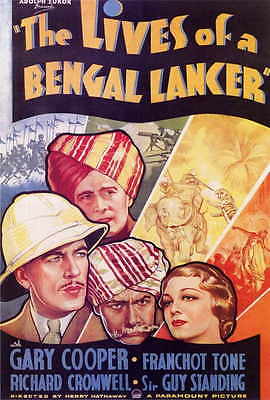
Tales of adventure and derring-do in the British Empire were meat and drink for generations of schoolboys. Few adventures were as well known as The Lives of a Bengal Lancer, a stirring tale of three lieutenants in the Bengal Lancers who become fast friends while defending Queen and country. We’ve got decent, impulsive but luckless McGregor (Gary Cooper), upper-class joker Forsythe (Franchot Tone) and eager-to-please Stone (Richard Cromwell), whose also the son of commanding officer Colonel Stone (Guy Standing). They go up against Oxford-educated Mohammed Khan (Douglass Drumbille), who schemes to seize an ammunition shipment. Can our heroes face down dastardly natives, exotic tortures and desperate escapes? All in a day’s work for a Bengal Lancer.

The Lives of a Bengal Lancer was a big hit on release, despite sharing nothing except the title, location and general theme with the semi-autobiographical novel from former-lancer Francis Yeats-Brown. It’s rollicking adventure and the boys-own mateyness of its leads, sparked a wave of spiritual follow-ups set everywhere from the Canadian mountains to the deserts of Africa. It scooped seven Oscar nominations and was celebrated as one of the greatest adventures on screen. Unfortunately, it’s not as fondly remembered now with its uncritical celebration of colonial India, spiritual links to Kipling’s White Man’s Burden and the fact Hitler of all people named it his one of his favourite film, loving its celebration of how a few white men could ‘protect’ (control) millions of natives.

It’s fair to say you have to close your eyes to some of this stuff when watching The Lives of a Bengal Lancer today. Otherwise you might flinch at our heroes threats to various squirming, cowardly Islamic rebels that if they don’t confess they’ll be sown inside a pig skin (even in 1935, outraged questions were raised about this in Parliament). You need to roll with Douglass Drumbille blacking-up as the well-spoken Mohammed Khan (not just him: nearly all the Indian characters are men-in-face-paint and for good measure our heroes also black-up to disguise themselves). There isn’t a second’s questioning about the morality of Empire and the implicit suggestion runs throughout that the Indian people should be grateful the British were there to run their country for them.

But put all that to one side, and The Lives of a Bengal Lancer is still rather fun. One of the factors making it easier to bench your misgivings is that, really, this film isn’t really interested in India or the themes of Empire anyway. For starters, all three of our heroes are played by Americans making no effort to hide their transatlantic accents (McGregor is suggested as being ‘Scotch Canadian’, but a few words of Cooper’s awful Scottish accent makes you relieved he didn’t bother to keep it up). Any insight into British-Indian relationships is extremely brief. The film is clearly shot in California, in locations identical to the sort of Westerns Hollywood was churning out. And a Western is what Bengal Lancer really is.

Our three heroes do feel more like cowboys shooting the breeze for large chunks of the film rather than army officers. Although there have been criticisms of the leads – Cooper in particular, probably because an actor so iconically American feels strange as an oddly accented Brit – all three of give entertaining, complementary, performances. Cooper is strongly charismatic, rather charming in his earnest attempts to do the right thing and his luckless incompetence at anything that isn’t soldiering (a running joke sees him building up increasing tab in a series of ill-considered bets with the good-at-everything Forsythe). But when action comes calling, McGregor is courageous, quick thinking and selfless. It’s immediately clear why Cooper essentially replayed versions of this relatable role several times. Franchot Tone is equally fine as the witty, smooth Forsythe who never takes anything seriously until things are really serious. Cromwell does sterling work as the naïve Stone.

Most of the film works because we end up liking these three characters – just as well since most of the first half is essentially watching them go about their daily tasks: riding, cleaning horses, heading out on patrol, shooting the breeze in the barracks. There is a small character-led crisis over whether the ram-rod Colonel Stone (a suitably dry Guy Standing) will accept his puppy of a son, but the biggest action drama in the first half is a wild boar hunt that nearly goes terribly wrong. If we didn’t enjoy Forsythe and McGregor deliberately rubbing each other up the wrong way, between teasing and taking a big-brother interest in Stone, we’d struggle to enjoy the rest of the film.

The second half is where the real action kicks in. During a dinner where our heroes dress up in native garb to make nice with a local Emir, Bengal Lancer throws in a bizarre Mata Hari figure, in the mysterious Russian Tania (Kathleen Burke). It’s not a remote surprise she ends up being no-good, or that the disillusioned Stone is swiftly honey-trapped into imprisonment by Dumbrille’s vaguely-motivated smooth-talking villain (it’s hilariously ironic that the villain is the most cut-glass Brit in the film). McGregor and Forsythe don Indian disguise – against orders naturally – to do what men do, which is stand by their friends.

A parade of exciting set-pieces follow thick-and fast, culminating in an impressively staged battle with towers toppling in explosives, machine gun fire spattering left-right-and-centre and our heroes literally coming to blows over who gets to make a heroic sacrifice. We get there via dastardly torture – Bengal Lancer coined the famous “We have ways of making men talk line” – as Mohammed Khan employs bamboo sticks under the fingernails (thankfully shown largely in shadow and Cooper’s stoic grimaces) to get information from our heroes. It’s all part of these men being forged by fire into exactly the sort of hardened men-of-combat we need to protect a frontier.

The Bengal Lancers ride in towards the end like the cavalry, and the air of a Western in Red Coats sticks with Lives of a Bengal Lancer throughout. Sure, it combines this with the stench of White Man’s Burden and an attitude of edgy distrust of foreigners, but The Lives of a Bengal Lancer is also riotous, old-fashioned fun, well shot and charismatically played. It might be a rather slight action-adventure fable, and sure its politics have not aged well, but it is still fun.

Queen Christina (1933)

Queen Christina (1933)

Garbo is at her best in this luscious, romantic, beautifully filmed historical epic

Director: Rouben Mamoulian

Cast: Greta Garbo (Queen Christina), John Gilbert (Antonio Pimental de Prado), Ian Keith (Count Magnus Gabriel De la Gardie), Lewis Stone (Axel Oxenstierna), Elizabeth Young (Countess Ebba Sparre), C. Aubrey Smith (Aage), Reginald Owen (Prince Charles Gustav), David Torrence (Archbishop), Gustav von Seyffertitz (General), Akim Tamiroff (Pedro)

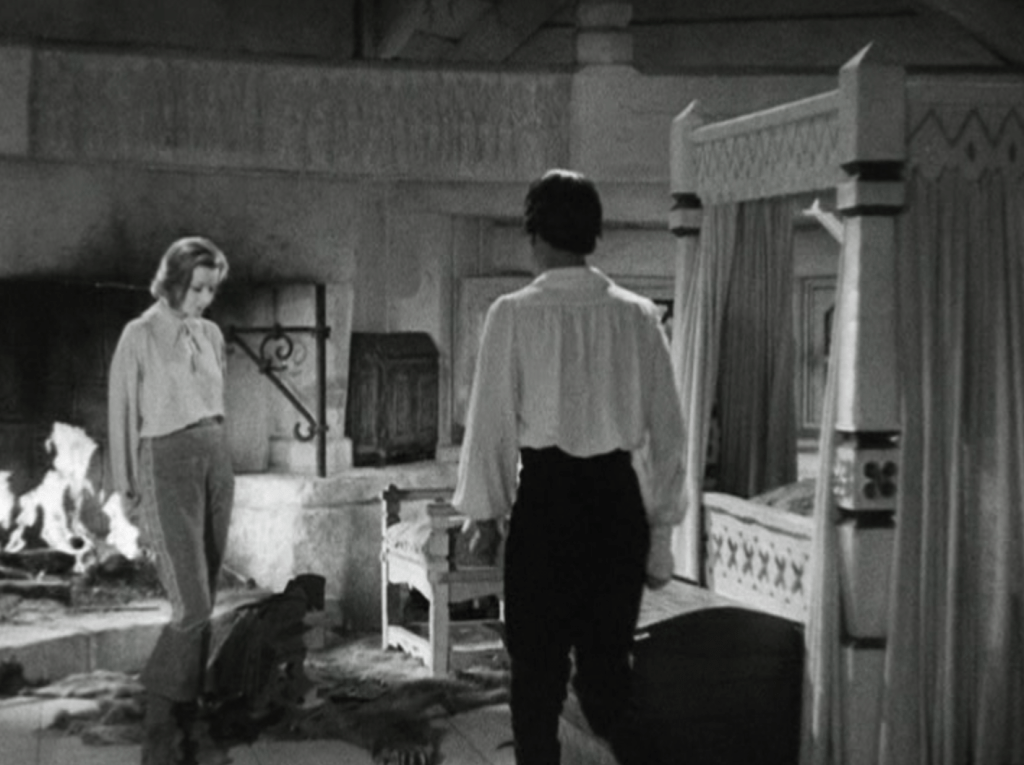
What could be more perfect casting than Garbo as Queen of Sweden? In Queen Christina she plays the eponymous queen, daughter of legendary martial monarch Gustavus Adolphus, killed in the never-ending European bloodbath that was the Thirty Years War. Coming to the throne as a child of six, almost twenty years later she’s ready for peace in Europe. But, after a lifetime of duty, she’s also ready for something approaching a regular life. But her lords need her to do something about providing an heir, ideally by marrying her heroic cousin Charles Gustav (Reginald Owen) despite the fact she’s conducting her latest secret affair with ambitious Count Magnus (Ian Keith). One day Christina sneaks out of town, dressed as a man and meets (and spends several nights with – the disguise doesn’t last long) Spaniard Antonio de Pradro (John Gilbert) in a snowbound inn. Returning to court she has a difficult decision: love, duty or a bit of both?

Queen Christina is a luscious period romance with Garbo in peak-form. It’s a masterful showpiece for a magnetic screen presence and charismatic performer. Queen Christina gives Garbo almost everything she could wish: grand speeches, coquettish romance, Twelfth Night style romantic farce, domineering regal control and little-girl lost vulnerability. Garbo brings all this together into one coherent whole, and is a dynamite presence at the heart of Queen Christina. Garbo nails the show-stopping speeches with regal magnetic assurance, but will be delightfully girlish when giggling with lovers. Her nervousness that her femineity could be unmasked in any moment with Antonio in the inn is played with a charming lightness that’s deeply funny, while the romantic shyness and honesty she displays with him is pitched just right. Garbo also manages to make the queen never feel selfish even as she is torn between desire and duty.

She’s at the centre of a beautifully assembled film, gorgeously shot by William H Daniels, with dynamic camera movements, soaking up the impressive sets and snow-strewn locations. Rouben Mamoulian’s direction is sharp, visually acute and balances the film’s shifts between drama and comedy extremely well – it’s a remarkable tribute that considering it shifts tone and genre so often, Queen Christina never feels like a disjointed film or jars when it shifts from Garbo holding court in Stockholm, to nervously hiding under her hat in a snowbound inn to keep up the pretence she’s just one of the guys. (How anyone could be fooled for even a moment into thinking Garbo was a boy is a mystery).

It’s a relief to Antonio to find she isn’t one of the guys, since he’s more than aware of the chemistry between the two of them when he thinks she is one. There more than a little bit of sexual fluidity in Queen Christina, with Garbo’s Queen clearly bisexual, sharing a kiss with Elizabeth Young’s countess in ‘a friendship’ that feels like a lot more. Even before escaping court, Christina’s clothes frequently blur the line between male and female, as does the way she talks about herself. She is after all, very much a woman in a man’s world. Garbo brilliantly communicates this tension, her face a careful mask that only rarely slips to reveal the strain and uncertainty below the surface. You can see it all released when she stands, abashed, nervous (and unequivocally not a boy) in front of Antonio, as if showing her true self to someone for the first time.

Seizing not being the figurehead of state but her own, real, individual is at the heart of one of Queen Christina’s most memorable sequences. After several nights of passionate, romantic love making with Antonio, Christina walks around the inn room where, for a brief time, she didn’t have to play a role. With metronomic precision, Mamoulian follows Garbo as she gently caresses surfaces and objects in the room, using touch to graft the room onto her memory, so that it can be a place she can return to in her day-dreams when burdened by monarchy. It’s very simply done, but surprisingly effective and deeply melancholic: as far as Christina knows, the last few days have been nothing but in an interim in a life where she must always be what other people require her to be, never truly herself.

But then if she never saw Antonio again, there wouldn’t be a movie would there? He inevitably turns up at court, presenting a proposal from the Spanish king – which he hilariously breaks off from in shock when he clocks he is more familiar with the Queen than he expected. John Gilbert as Antonio gives a decent performance – he took over at short notice from Laurence Olivier, who testing revealed had no chemistry with Garbo – full of carefully studied nobility. He and Garbo – not surprising considering they long personal history – have excellent chemistry and spark off each other beautifully. He also generously allows Garbo the space to relax as Christina in a way she consciously never truly does at any other point in the film.

The rumours of this romance leads to affront in Sweden, from various lords and peasants horrified at the thought of losing their beloved Queen – and to a Spaniard at that! (Queen Christina makes no mention of the issue of Catholicism, which is what would have really got their goat up – an Archbishop shouts something about pagans at one point, but he might as well be talking about the Visigoths for all the context the film gives it). The shit is promptly stirred by Ian Keith’s preening Count Magnus, making a nice counterpart to Gilbert’s restrained Antonio. It also allows another showcase for Garbo, talking down rioting peasants with iron-willed reasonableness only to release a nervous breath after resolving the problem.

Queen Christina concludes in a way that mixes history with a Mills-and-Boon high romance (there is more than a touch of campy romance throughout). Mamoulian caps the film with a truly striking shot, the sort of image that passes into cinematic history. Having abdicated into a suddenly uncertain future, Christina walks to the prow of the ship carrying her away from Switzerland. Mamoulian holds the focus on Garbo and slowly zooms in, while Garbo stands having become (once again) a literal flesh-and-blood figurehead, her eyes gloriously, searchingly impassive leaving the viewer to wonder what is going on in her head? Is she traumatised, hopeful, scared, regretful, determined? It’s all left entirely to your own impression – and is a beautiful ending to the film.

Queen Christina was a big hit – bizarrely overlooked entirely at the Academy Awards, which makes no sense to me. It’s beautifully filmed by Mamoulian who finds new, unique angles for a host of scenes and at its heart has a truly iconic performance by Garbo. If you had any doubts about whether she was a great actress, watch Queen Christina and see how thoughts and deep emotions pass briefly across her face before being replaced by a mask of cool certainty. It’s a great performance from Garbo and a lusciously conceived historical epic.

Five Graves to Cairo (1943)

Five Graves to Cairo (1943)

Exciting and witty war-time spy thriller, an overlooked work from a master director

Director: Billy Wilder

Cast: Franchot Tone (Corporal John Bramble), Anne Baxter (Mouche), Akim Tamiroff (Farid), Erich von Stroheim (Field Marshall Erwin Rommel), Peter van Eyck (Lieutenant Schwegler), Fortunio Bonanova (General Sebastiano), Miles Mander (Colonel Fitzhume)

It’s 1942 and the war is not going well for the British. The Germans are on the move in Africa under their ace commander Field Marshal Rommel. A tank drifts through the desert, bumping up and down sand dunes. Inside its crew slump, one dangling from his gun turret, another thrown on-and-off the gearsticks with each dune. It’s hauntingly Wilderish – a ghost tank charging through a never-ending desert – that Corporal John Bramble (Franchot Tone) wakes into, escaping across into the bombed-out Empress of Britain hotel run by panicked Farid (Akim Tamiroff), assisted by British-loathing Frenchwoman Mouche (Anne Baxter). Bramble’s hopes that he might lay low for a few days are thrown into danger when the hotel is requisitioned moments after his arrival by the German army with Rommel (Erich von Stroheim) himself setting up command there. Bramble passes himself off as recently deceased club-footed waiter Davos – only to discover Davos was a German spy and Rommel expects him to help delivery on his masterplan to crush the British.

Five Graves to Cairo is a magisterial juggling game of move and counter-move in which everyone holds tightly their own very specific parts of a greater mystery while trying to learn everyone else’s. Wilder does all this with wit and more than a little tension. Can Bramble keep up his pretence about being Davos while hiding his complete ignorance of Rommel’s masterplan? Will Rommel’s constantly alert, note-taking aide Lt Schwegler (Peter van Eyck) rumble him? The whole film is captured in one of its earliest sequences, as Farid carefully shepherds and blocks the view of Schwegler’s inspection of the foyer of his hotel, to prevent him seeing Bramble hiding behind the desk.

The whole film builds from there as Bramble constantly thinks on his feet, crafting obscure but convincing answers as he improvises wildly. All while limping around in a club-foot shoe and providing the sort of night-and-day waiting service the Germans expect. His improvisation is endless, from distracting a blowhard Italian general to steal his gun, to identifying himself quietly to a captured British officer being wined and dined by the smug Rommel by switching a whisky name chain on a bottle with his dog-tag (then smoothly passing off ‘Bramble’ as a rare spirit to the Italian general). His plans switch fast too, from a vague assassination attempt to being instructed by Miles Mander’s Montgomery-ish officer to uncover the Field Marshal’s schemes.

The Field Marshal himself is the epitome of Prussian arrogance. Played with a preening, puffed-up, Teutonic self-importance by an excellent Erich von Stroheim, Rommel never moves without his feathered swagger stick, pompously cavorting around the hotel, prissily demanding the finest sheets and best room. Far from the later ‘Good German’ image of the General, this Rommel is as snobbishly self-satisfied as a Bond villain, overwhelmingly pleased with his elaborate scheme (which he shrewdly set-up years earlier) and teasingly playing twenty questions with his British prisoners to see if they can work-out his intentions, while manipulating the game so his opponents can’t win. He’s an arrogant, hissable villain we are desperate to see taken down a peg or two.

Equally dislikeable is his whipper-smart aide, played with a thin-politeness by Peter van Eyck that hides his comfort with deception. With these villains as the face of the relentless German military machine, Wilder builds real tension around the importance of Bramble foiling Rommel’s scheme – and makes very clear to us that these ruthless sticklers for rules, certain of their own genius and superiority, will definitely not treat this accidental spy kindly if they catch him.

As Bramble, Franchot Tone does a decent job – although his Transatlantic vowels sound particularly odd when the similarly American Anne Baxter immerses herself in a French accent – even if Bramble himself is less interesting than his situation. A more charismatic actor might perhaps have helped lift Five Graves to Cairo to a higher level – after all it shares more than a few stands of DNA with Casablanca but Tone and Baxter aren’t quite Bogie and Bergman. What Tone does do well is morph swiftly from persona-to-persona, switching from heat-stroke confused soldier to would-be-assassin, to fast-thinking spy with a surprisingly natural ease.

He also builds a rapport with Mouche – Edith Head’s costumes for these two, with their contrasting blacks and stripes, quickly visually link them together – who discovers she hates the German more than she resents the British for abandoning her brother at Dunkirk. Baxter is very good as the real emotional heart of this film, a harsh woman hardened by loss, desperate to do what she can to save her POW brother but who finds a new cause to believe in. Baxter carefully lets her character build in statue from obstacle to reluctant aide to true believer, with real naturalness.

Her development reflects a whole film that uses its single claustrophobic location – nearly the whole film takes place over little more than a day or two in the hotel – to excellent effect, with potentially dangerous reveals lurking around every corner. Not least that the real Davos lies buried under rubble in the basement – not quite fully buried, Wilder’s focus early on Bramble’s orthopaedic show hinting at the vital ‘tell’ later on. Everyone – except perhaps the supremely self-satisfied Rommel – suspects there is more going on than they realise, and Wilder expertly ratchets up the tension through Hitchcockian time-bombs and carefully structured dialogue sequences to keep the audience firmly on the edge of their seats.

It’s makes for a fine caper, a careful riff on then current history that suggests Bramble might just have provided the vital clues to prevent the nefarious Rommel from claiming victory at El Alamein. While Five Graves to Cairo has a high entertainment factor, it’s not quite in the first league of war spy stories. But with entertaining performances – Tamiroff’s sweaty, stammering Farid and Fortunio Bonanova’s hyper-Italian Opera-singing general are also treats – and a real wit balanced with a well-developed tension, it’s a strong early film from a director who would go from strength-to-strength.

The Story of Louis Pasteur (1936)

The Story of Louis Pasteur (1936)

A visionary struggles against the blind in this genre-defining slightly cosy biopic

Director: William Dieterle

Cast: Paul Muni (Louis Pasteur), Josephine Hutchinson (Marie Pasteur), Anita Louise (Annette Pasteur), Donald Woods (Dr. Jean Martel), Fritz Leiber (Dr. Charbonnet), Henry O’Neill (Dr. Emile Roux), Porter Hall (Dr. Rossignol), Raymond Brown (Dr. Radisse), Akim Tamiroff (Dr. Zaranoff), Halliwell Hobbes (Dr. Joseph Lister), Frank Reicher (Dr. Pfeiffer)

Jack Warner was convinced no one would want to watch the life story of some crusty old scientist. But Paul Muni insisted they would – and he was a star – so with a threadbare budget and host of re-used costumes (many not from the correct period) and sets The Story of Louis Pasteur came to the screen – and much to Warner’s surprise was a hit. It can look like an oddly cliché-ridden affair today: until you realise many biopic tropes we’re used to were virtually coined here.

The Story of Louis Pasteur remixes huge portions of Pasteur’s life to make it more dramatic: the man who was the leading scientist in France for almost thirty years is repackaged as an outsider and laughing stock, constantly scorned by the medical establishment until (but of course!) he is triumphantly hailed as a genius by the same doctors who mocked him for years. Sound familiar? The film charts Pasteur’s efforts to discover vaccines, first for anthrax in sheep (leading to a famous test where 25 sheep were vaccinated and 25 were not, then all of them exposed to the disease, killing all the unvaccinated sheep) then rabies in dogs and treating those bitten by rabid dogs. Pasteur uses his unparalleled knowledge of microbes which (but of course!) every other doctor says cannot possibly have anything to do with infection.

There is a lot to enjoy in The Story of Louis Pasteur, an undeniably old-fashioned “Great Men” view of history that manages to turn bacteriology into effective entertainment. It recasts history into an easily digestible tale of visionaries and scoffers – but, crucially, no real baddies – crafting a series of small steps towards scientific discoveries into flashes of inspiration and triumphant revelations. Science is made simple, plain and understandable with Pasteur to talk us through a few shots of microbes under microscopes. At its centre we have a stubborn maverick determined that it is his way or the high-way and who won’t listen for a second to anyone questioning his theories.

There is something rather touching about the film’s admiration for science and celebration of an altruistic quest to make the world a better place. It carefully outlines the dangers of surgery and poor hygiene in medical practice – it opens with a doctor murdered for failing to save his killer’s wife, the reason for his failure pretty clear from the haphazard way he chucks medical equipment into a bag (dropping some of it on the floor en route). This lack of hygiene affects rich and poor (even Duchesses are not safe), in particular women in childbirth. Its truly the enemy of mankind, as a caption explaining the 1870 war stresses (European squabbles being a distant second). This is a problem that is truly noble to take on.

And it motivates Pasteur. Paul Muni is on Oscar-winning form as Pasteur, brilliantly precise and superbly conveying great intelligence mixed with an arrogant self-assurance. But Pasteur’s egotism comes not from vanity but from simply knowing more of which he speaks than anyone else. He’s also a man consumed by a sense of duty to the world: when his work can literally save lives (be they either animal or human) he will not let scorn stand in his way. Muni captures all this wonderfully, creating a prickly man with a playful streak determined to do the right thing the right way (Pasteur may disagree with his critics, but woe-betide their assistants disrespectfully doing the same).

Dieterle’s film crafts a series of excellent set-pieces to present Pasteur as a visionary ahead of his time. To make this really land, he’s therefore completely altered into being seen as a crank and pariah by everyone around him, rather than the influential scientific leader he actually was. This might be poor history, but it’s much better drama. From a furious encounter with Napoleon III (who won’t wear the idea his hand-picked doctors might be wrong about sterilization) to the Medical Academy publicly poo-poohing Pasteur’s outlandish ideas that vaccines might prevent anthrax. To give a face to this mocking of Pasteur (from an establishment we are told is totally wrong on every count) the film invents Dr Charbonnet (well played by Fritz Leiber), an honest but pig-headed critic who exists to be wrong (for noble reasons) on almost every single issue.

Noble as important: this film want to stress everyone acts for decent reasons, so that its final celebration of Pasteur is unblemished by deeply personal rivalry. Charbonnet and Pasteur are both framed as decent men and their relationship allows for plenty of fun melodrama, such as Charbonnet injecting himself with Pasteur’s (fortunately for him) weak rabies sample to ‘expose’ his ideas. When Pasteur’s daughter falls ill in childbirth, but of course Charbonnet is the only doctor available: he humours Pasteur’s sterilisation rules in exchange for a signed letter from Pasteur rubbishing his own theories (Muni’s shuffling flash of conflict that flows across his face at this moment is very well done). But of course, Charbonnet and Pasteur eventually reconcile in honour and decency.

This forms a fun thread throughout the movie, that’s never less than well-staged by Dieterle, with pace and energy. The anthrax test is very dynamic – all celebrating crowds and circus side-shows – and the dramatic appearance of a host of Russian peasants (led by Akim Tamiroff’s bombastic doctor) desperate for a cure for rabies-induced sickness is well-executed. Some beats work less well than others. Donald Woods gets dealt a rotten hand as the dull son-in-law of Pasteur. The women in Pasteur’s family get even worse, with most of Josephine Hutchinson’s lines being of the “stop trying to cure anthrax and come to bed Louis” variety. The costumes are bizarrely all-over-the-place (the women look more like Southern Belles) and there is a reassuring cosiness about everything.

But that’s also one of its most successful features. The Story of Louis Pasteur is a little twee – but it’s also effective. It’s why it laid down a template that worked for countless films that follow (A Beautiful Mind pretty much follows its model and won an Oscar for it 65 years later). That’s because there is also a feel-good factor to see someone who is, without doubt, in the right triumphing over the stubborn. With a great performance by Muni, it’s a rewardingly entertaining biopic.

The Trial (1962)

The Trial (1962)

Welles exploration of paranoia and guilt is an easier film to admire than like (or enjoy)

Director: Orson Welles

Cast: Anthony Perkins (Josef K), Jeanne Moreau (Marika Burstner), Romy Schneider (Leni), Elsa Martinelli (Hilda), Suzanne Flon (Miss Pittl), Orson Welles (The Advocate), Akim Tamiroff (Bloch), Madeline Robinson (Mrs Grubach), Paolo Mori (Court archivist), Michael Lonsdale (Priest), Arnoldo Foa (Inspector A), Fernard Ledoux (Chief Clerk of the Court)

It had never happened to Welles before: in 1960 producer Alexander Salkind shoved a series of literary works at him and said “make one of these into a film! Money no object and complete creative control!”. Welles wasn’t going to say no. It hardly mattered that he’d barely even let Kafka cross his mind before: he could see a way to do The Trial and, by God, he wasn’t going to pass up this chance. To purists, The Trial is one of the few “pure Welles” flicks – the one Welles shepherded from start to finish and more-or-less ended up with what he wanted at the end of it (no wonder he called it “his best picture” – although he said that about all his pictures at one time or another).

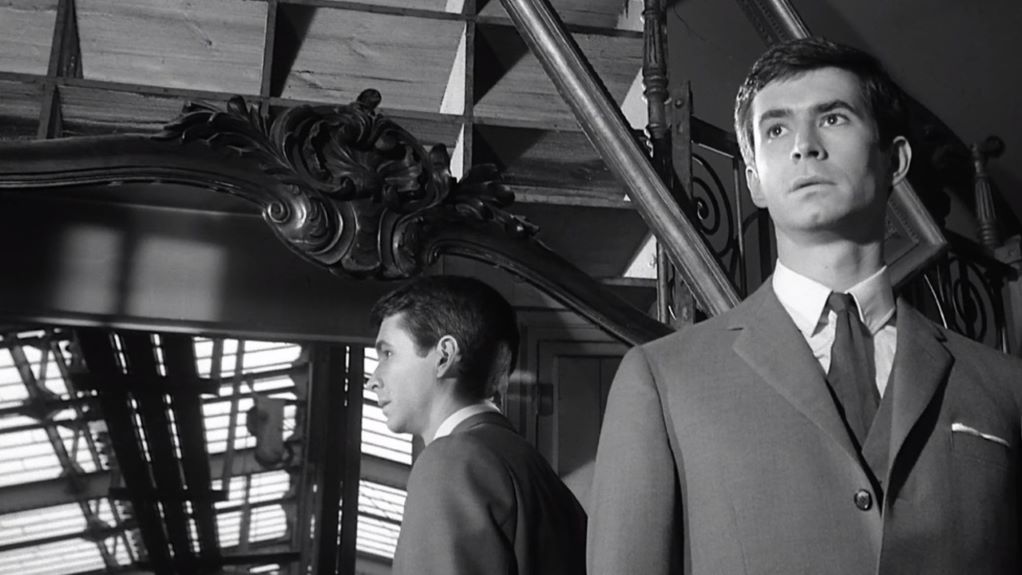
The Trial adapts, fairly faithfully, Kafka’s surrealist novel. Josef K (Anthony Perkins), a middle-management pen-pusher, is accused of a terrible crime without being told what it is. He stumbles from encounter to encounter, law court to law court, never given the ability to defend himself, spiralling down the rabbit hole with no sunlight. Welles’ The Trial captures this by turning Kafka’s work into a fever dream. Scenes link together with all the structural logic of a dream – locations seem randomly connected, with Josef turning corners and finding himself in courtrooms or opening cupboards to find surrealist sequences like his prosecutors being whipped by an angry functionary.

Welles shot much of the film on location in a single abandoned Parisian railway station, with the abandoned, decaying rooms redressed into a series of locations from the Advocate’s rooms, to a church to a law court. This was mixed with sequences shot in Zagreb industrial estates and a factory set made up of 850 extras banging typewriters in unison and all rising to end their working day at the same time. There is a horrible un-reality reality to The Trial, a deeply unsettling realisation you are watching something both set in a world real and impossible.

In fact, The Trial may be one of the most uncomfortable films to watch ever made in its innate understanding of the domineering terror of paranoia. Welles used a series of low angles and wide lenses to stress the oppressiveness nearness of walls and ceilings. Rooms always seem to loom in and crush the characters, with K himself frequently framed hemmed in by objects, walls and people. There is a sense of being “watched” in every scene – either from the oppressive bodies that surround K, or the prowling tracking cameras that follow him from location to location.

The Trial is a sort of paranoid’s wet-dream, a nightmare world where logic is gone, our lead character has no control over his movements or destiny and the entire world seems to be constantly bearing down on him and us. Who better to play the twitch-laden centre of this than Anthony Perkins. Awkward, uncomfortable and never anything-less than tense, Perkins features in almost every scene but always feels buffeted by events rather than controlling them. He makes K hugely uncomfortable with others – the many women who throw themselves at K he treats with suspicion mixed with terror. His self-loathing bubbles up whenever confronted with mirror images (such as Akim Tamiroff’s timorous Bloch), invariably reacting with barely disguised contempt.

What’s also interesting in The Trial is the possible insight into Welles’ character. The easy interpretation is to see K as Welles, the court standing in for the Hollywood machine that had shoved Welles from pillar to post and never given him a chance. But, if so, why did Welles urge Perkins to play the role as shiftily and uncomfortably as he does? There is an air of guilt around K throughout – as if The Trial was his nightmare about getting caught for whatever he did. Is this how Welles saw himself? How fascinating that this artistic behemoth read The Trial and seemed to see it as the paranoia of a guilty man. Did the film speak to a deep self-loathing in Welles himself? Did he, in the dark when the demons come, think he’d inflicted his destruction on himself?

It’s a fascinating idea and makes it even more interesting that Welles is all over the film. He plays the corpulent, arrogant advocate, meeting supplicants whole luxuriating in bed with his accustomed bombast. But he also speaks the film’s woodcut-illustrated opening parable (a story of a man waiting at a gate, that he moved from the books Priest to his faceless narrator). Welles’ tones are heard coming from a range of mouths as he overdubbed many of his Euro actors. He even speaks the credits. Everywhere you turn you see and hear Welles and it’s hard not to start to feel perhaps we are stumbling inside his own terrible fantasies. Perhaps The Trial is what Welles’ dreams (or nightmares) were like?

The feel of a nightmare often makes The Trial an uncomfortable and, if I’m honest, less than enjoyable watch for all the undoubted panache it’s made with. In fact, since the panache is partly designed to illicit that response, it’s almost a tribute to the film’s success. The Trial is masterful, but in its unsettling sense of paranoia also uncomfortable, although it’s fascinating to see Welles layering some (perhaps inner) guilt on top of Kafka’s tale of an innocent crushed in the system. Either way, there is plenty to admire if not love about The Trial.

Touch of Evil (1958)

Orson Welles investigates (though the real mystery is probably Charlton Heston’s Mexican heritage)

Director: Orson Welles
Cast: Charlton Heston (Ramon Miguel Vargas), Janet Leigh (Susan Vargas), Orson Welles (Police Captain Hank Quinlan), Joseph Calleia (Pete Menzies), Akim Tamiroff (Uncle Joe Grandi), Marlene Dietrich (Tanya), Joanna Cook Moore (Marcia Linnekar), Ray Collins (District Attorney Adair), Mort Mills (Al Schwartz), Dennis Weaver (Night Manager)

Has any director ever cast himself in such a physically unflattering role as Welles takes on here? Hank Quinlan is a grotesque, sweaty, grossly obese, lame, mumbling copper with a hinterland of loneliness in his past and a background of missed chances. Yet despite this, it’s Quinlan’s film and despite the terrible things he does in the film (kidnap, two murders, suspect framing) it’s very hard not to feel empathy and sorrow for him. Welles’ immense charisma as a performer is a large part of this, but I think he also recognises the sadness of being the genius who has surrounded himself with mediocrities, the man who knows he could have achieved more in life but for whatever reason never did. If that’s not Welles’ career, what is?

Of course Quinlan isn’t actually the lead. Charlton Heston, curry-coloured but otherwise actually pretty good, plays Vargas, a Mexican law agent (“He don’t look like a Mexican” Quinlan correctly observes) with a new American wife, caught up in an investigation into a bombing of an American citizen in a US-Mexico border-town. Quinlan investigates, finds his culprit quickly and produces evidence – evidence Vargas knows for a fact wasn’t there minutes ago. Accusations of corruption fly and, before you know it, Quinlan (a man flirting with corruption) is forced into alliance with a jumped-up Mexican gang leader to frame Vargas for corruption via implicating his wife in drugs and murder.

The plot, however, largely takes second place to Welles’ virtuoso film-making. The opening sequence of the film – an extended three and a half minute single take that tracks in and out of streets, from close-ups to crane shots – has an astonishing “how did they do that?” quality. But it’s matched by Welles’ brilliance with both actors and camera placement during the equally long continuous takes set in bomb suspect Sanchez’s apartment. He’s adept at jinglingly unsettling imagery, with the murder scene 2/3rd of the way through the film almost queasily twitchy in its fragmented shooting style. The final sequence of the film, as Vargas tracks Quinlan through a filthy oil yard, should be silly but is completely compelling.

Welles of course dominates the film as Quinlan. I love the half smile on his face as his praises are sung by besotted partner Menzies early in the film – the “aw shucks, are you talking about me?” non-modesty – but I also adore the unspoken sadness of his early scene with Dietrich, where he sadly attempts to flirt with this (presumably) lost love (we are never told for certain) only for her to literally not recognise him. Quinlan in many ways is a good copper – he frames the guilty, he doesn’t take bribes, he is reasonably loyal – but he’s also selfish, egotistical and needs the adoration of his position to fill the void in his life. He’s a man who’s corrupt almost without realising it, who sinks into bemused maudlin depression when accused without even recognising that he is in fact guilty.

There are some other equally strong performances in the film. Heston of course looks ridiculous – but look past that and this is one of his best performances, Vargas demonstrating the stand-up, straight-shooting honesty of many of Heston’s roles, combined with arrogant short sightedness and narrow minded determination. Janet Leigh is also absolutely terrific as his wife, despite being saddled with a bizarre subplot of being terrorised in a motel. A note for trivia fans – Leigh actually broke her arm before shooting and it’s in a cast throughout the movie bar one shot (where she doesn’t move her arm) – you can’t spot it until you know.

I was particularly enthralled by a beautiful performance of hero-worship from Joseph Calleia as Menzies, Quinlan’s adoring partner whose entire life has been one of loyal service to Quinlan. In many ways he is the moral centre of the film, and as the film shifts its focus to Quinlan, so it equally explores the changes in how Menzies views his boss. Akim Tamiroff gives a lovely performance of puffed up pomposity as a ridiculous small time gangster with a dodgy wig. Dennis Weaver’s hotel manager is an eccentric collection of manners that is more likely to split opinions, but he doesn’t half go for the oddness. Marlene Dietrich is marvellous in her few brief scenes.

Touch of Evil is one of those films that lingers with you and rewards constant reflection and rewatching. I re-watched large chunks of it again immediately the next morning. As a piece of film making it’s a master class, an immersive, tightly framed, wonderfully shot film that brilliantly uses its filthy, litter strewn locations. The acting is terrific and the final moments strangely moving. Welles was a terrible self-promoter and later he ballooned to the very Quinlan proportions that padding and make-up create here. But when he was on his game, and fully focused, he was terrific. As is the film, which is surely one of the greatest (and last) film noirs ever.

CODA: The coda to this? Of course Welles wasn’t fully focused. He cut the film once, then shot off to Mexico to explore a new film possibility. Studio hands recut the film again. Welles sent a famous 58 page memo suggesting changes. Most of them got ignored for the third cut. Three versions of the film now exist – the two studio recuts and a 1998 recut using the memo (Welles’ original was wiped). I watched the 1998 recut. But it’s always the problem with Welles – a man I always felt who largely lacked the focus to actually finish something. The film bombed on release. Welles never worked in Hollywood again.