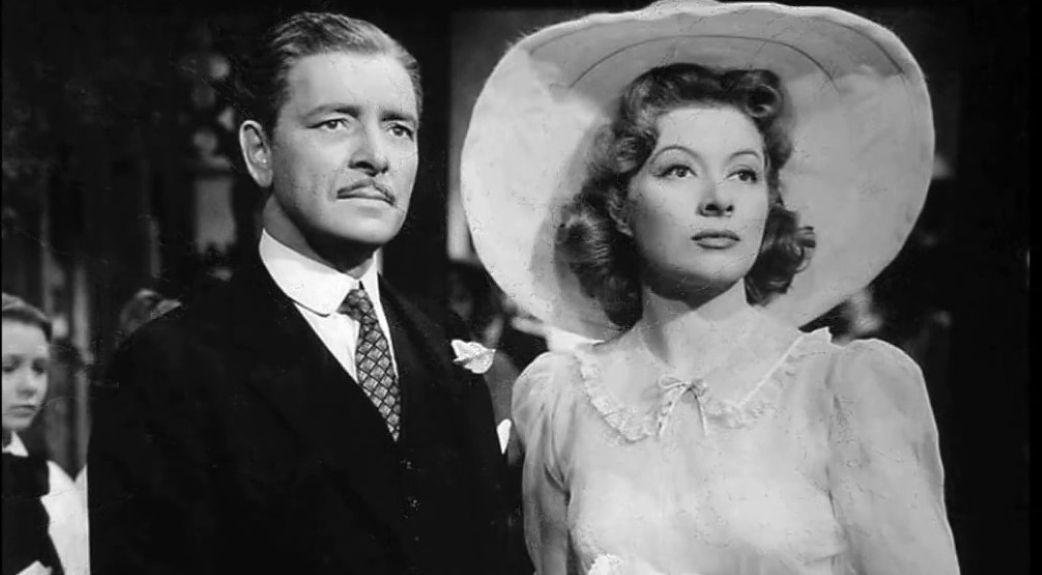
Tag: Alan Napier

Random Harvest (1942)

Random Harvest (1942)

Two superb leading performances hold together a romantic confection of a film

Director: Mervyn Le Roy

Cast: Ronald Colman (Charles Rainier/”Smithy”), Greer Garson (Paula Ridgeway/ “Margaret Hanson”), Philip Dorn (Dr. Jonathan Benet), Susan Peters (Kitty Chilcet), Henry Travers (Dr. Sims), Reginald Owen (Biffer), Bramwell Fletcher (Harrison), Rhys Williams (Sam), Una O’Connor (Tobacco Shopkeeper), Aubrey Mather (Sheldon), Margaret Wycherly (Mrs. Deventer), Arthur Margetson (Chetwynd Rainier), Melville Cooper (George Rainier), Alan Napier (Julian Rainier), Jill Esmond (Lydia Rainier)

Random Harvest is one of the most fondly remembered romances of Golden Age Hollywood – if you want yearning dedication bought to life, this is the film for you. It might also be one of the barmiest films ever made, stuffed with so many outlandish plot developments, hilarious logic gaps and hand-waved contrivances it would put a Netflix soap to shame. You can see why Syndey Pollack and Anthony Minghella eventually abandoned remakes: you can’t imagine a modern audience going with Random Harvest’s essential loopiness and not laughing somewhere along the line. Which is not to say it isn’t beautifully made and winningly bought to life at times.

It’s the final days of World War One, and amnesic soldier “John Smith” (Ronald Colman) can’t remember anything about his life. On the final day of the war, he sneaks out of the asylum and runs into music hall performer Paula (Greer Garson). She takes a shine to “Smithy” and decides to save him. They run away to the country, fall in love, get married, have a baby, he starts to write, goes to Liverpool to start a journalism career… and gets hit by a cab. The collision restores his original memory – but also causes him to forget everything about Paula and his life as Smithy. Instead, he restarts his original life as industrial heir Charles Rainier, presumed dead by his family. While he lives this life for years, Paula takes a job as his secretary “Margaret”. Will he remember who she is?

It says a lot that that summary only scratches the surface of a plot that throws in the kitchen sink in attempting to ring as many tear-soaked tissues out of you as possible. Smithy and Paula carry out their little memory dance over the course of over twenty years. It’s the sort of a film where millionaire Charles only thinks about investigating what might have happened to him in Liverpool when nudged to do so after over a decade. Where the couple enter a ‘marriage of convenience’ as the memory-free Charles and fake Margaret. Where Charles’ owns a major factory in the town where our lovers first met, but neither (a) stepped foot there in 15 years (since the moment he does his memory starts to return) and (b) the heir to the town’s major employer wasn’t recognised by anyone while living in an asylum five minutes walk down the road.

Take it on the merits of logic and conventional narrative and Random Harvest crashes and burns. But this isn’t a film about those things. This is a classic weepie that stole the hearts of a war-torn nation in 1942 (it was the biggest hit of the year). Powered by two committed and emotional performances, if it hits you in the right mood its probably irresistible. The sort of long-term adversity that makes Romeo and Juliet’s look like a casual dalliance (so full of tragedy, the death of their son is literally a throwaway moment). It’s framed with a great, sensual beauty by Mervyn LeRoy and powered by an emotionally throbbing score by Herbert Stothart that’s just the right side of sickly.

Ronald Colman’s performance is quiet, measured and vulnerable (especially in his “Smithy” performance). From the start, he has eyes of hesitant, unknown sorrow and stumbles into a relationship with Paula like a new-born discovering life. Threads of his gentleness and excitability work their way into his Charles persona, tinged this time with the natural confidence of wealth. Nevertheless, Colman makes Charles a man who has dealt with unnerving amnesia by actively not thinking about it, carrying on a watch-chain the key to his “Smithy” home as a subconscious reminder. It’s a fine performance – so much so you can overlook he’s twenty-five years too old (the restored Charles forgoes returning to university, something that looks long gone for Colman).

Just as fine is Greer Garson, fully embracing an emotional roller-coaster as Paula. Introduced as a good-natured music hall singer (and Garson sings a high-kicking She’s Ma Daisy number in possibly the shortest skirt the Hays Code ever allowed), Garson’s warm and playful Paula is drawn towards “Smithy” in ways she almost can’t understand. But it’s a wonderfully different side for an actress so often associated with self-sacrificing wives and mothers: Paula is vivacious, forward and seizes the things she wants from life. It’s the second half – the patient, yearning desperation of “Margaret” hoping her husband will remember her – that leans more into her Mrs Miniver wheelhouse, but Garson mixes this with a real lingering, desperate sadness tinged with just enough hope that her husband might just recognise her.

Both performers overwhelmingly lift this otherwise (frankly) slightly contrived film into something rather sweet and endearing. It is, however, a film that would be even more so if it was shorter: the general morass of missed opportunities, misunderstandings and wrong ends of sticks being grasped would be easier to sustain over 90 than 120 minutes. It’s a rare film that covers so much ground over so much time that it’s lead character is declared dead twice.

The second declaration is Paula gaining that status for “Smithy”, dissolving their marriage and removing (you suspect for Hay’s Code reasons) the risk that Charles might accidentally commit bigamy by marrying his young niece. This is a lovely performance of youthful idealism and earnest devotion from Susan Peters (a tragic accident shortly after curtailed her promising career), and if the whole years-long subplot of the possibility of Charles marrying his besotted niece is a narrative cul-de-sac the overall film would be better without, it does at least mean we get the pleasure of Peters, performance captured forever.

But Random Harvest remains a pure romance: where no less than two women spend decades of their life in selfless, one-sided devotion for the lead and he still comes across as the sort of saintly man cheered by his own factory workers for sorting out a strike. The whole confection is a very fragile thing, but LeRoy carries this fully-loaded glass ornament with pure skill and the performances of Colman and Garson set the bar for classic Hollywood tragic romance. Minghella and Pollack were right – our cynical age can’t believe the nonsense – but on its own terms it still works.

Macbeth (1948)

Macbeth (1948)

Welles first Shakespeare film is a bizarre mix of inspiration and amateurishness

Director: Orson Welles

Cast: Orson Welles (Macbeth), Jeanette Nolan (Lady Macbeth), Dan O’Herlihy (Macduff), Roddy McDowell (Malcolm), Edgar Barrier (Banquo), Alan Napier (Holy Father), Erskine Sanford (Duncan), John Dierkes (Ross), Keene Curtis (Lennox), Peggy Weber (Lady Macduff), Lionel Braham (Siward)

Macbeth was Welles’ last hurrah in Hollywood before decades of self-imposed banishment and exile. He arrived at Republic Pictures – proud creator of B-movie Westerns, although also the home of a few John Ford classics most notably The Quiet Man – who were delighted to sign up a deal for a literary classic directed by America’s leading man of the theatre. What they ended up with was a film that’s such a bizarre mish-mash of brilliance, originality and amateurishness nonsense, that they were basically befuddled.

Welles shot the film, as contracted, within 23 days on old Westerns sets, with a budget od spit and boot polish. Welles was focused, more than any other film he’d worked on to that point, on visual imagery and total control of sound and audio. So much so he wasn’t fussed about recording any sound on set. All the actors pre-recorded their dialogue, under Welles’ strict instructions, and then silently lip synched while shooting the scenes. This gave Welles the freedom for a host of expressionistic, shadow-filled shots where the actors faces and mouths were frequently unseen – or longer shots where it was impossible to clearly see lips moving. It also made some truly rigid, uncomfortable performances (Jeannette Nolan was granted permission to record her sleepwalking scene ‘live’ so she could perform it with some semblance of conviction).

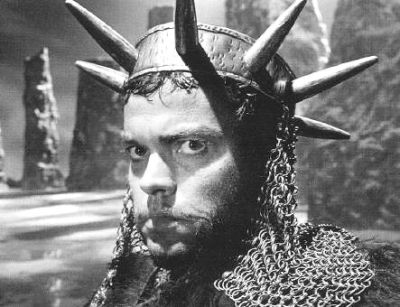
Macbeth was set in a Scotland somewhere between a fiercely traditional high-school production and a hodge-podge of influences from Celtic wizardry to Mongolian hordes. It’s shot on a dust-lined, cavern-filled panorama that frequently looks like a giant theatrical set or an empty multi-purpose wall-lined amphitheatre, with only a few scenes exchanging this for mist-filled heaths or low-ceilinged caves. The costuming and design is an eclectic mix: the murderers look like cavemen, some thanes wear kilts, Malcolm and his soldiers dress in medieval armour, Macbeth and Banquo look like fur-coated renegades from Genghis Khan. Welles himself would regret a bizarre crown which made him look like the Statue of Liberty.

There is a feeling that every idea was grabbed and thrown at the wall, in the expectation (hope?) that some of them would stick and lead to cinematic magic. There is a vague attempt to suggest Scotland is at war between Christianity and Paganism. A composite character, the ‘Holy Father’ parades around – chasing away witches, leading prayers for Duncan, taking dictation for Macbeth, warning Lady Macduff, rousing Malcolm – but with very little real sense that this ever adds up to anything logical or thematically clear. Welles merrily re-writes and transposes dialogue. Some works well – Banquo here seems far more of a potential partner than usual – others less so (Lady Macbeth turns up at the murder of the Macduffs for no clear reason).

But the stuff that works really works – and most of it is visual. The witches are shadowy figures, whose voices alter in cadence and pattern from scene to scenes (Welles had mixed male and female voices together to create an unsettling rhythm), their faces never seen. Inspired by his famous “Voodoo Macbeth” stage production, they craft muddy statues of Macbeth which they crown with a crude coronet. In one of the encounters with Macbeth, the camera pulls away to isolate Macbeth, lit in misty isolation. More Voodoo touches are seen in the hammering drum beats that greet Duncan to Macbeth’s castle.

Mist and expressionistic images dominate. Malcolm’s army urges from among the fog, carrying their branches from Birnam wood. The final battle is a series of isolated shots of characters, often the camera craning up to them or seeing them march towards it. Macbeth is frequently shot from below, to heighten his sense of being almost an ogre. When first seen as king, he sits, isolated and drunk at the top of a flight of stairs, making him seem less imposing and more weak from the start of his reign. He is haunted not only by Banquo’s ghost, but Duncan’s as well, Welles camera cutting to reveal his cavern dining room empty of everyone but the Macbeth and the ghosts of murdered friends, the camera tracking the shadow of his fingers along the wall to reveal the bleeding Banquo.

The entire production becomes like a drug-induced fantasy, something a near-catatonic Macbeth might just be imagining as his dreams are crushed by the cruel fate he feels destined to follow. Welles establishes a now popular idea of the play being a huge cycle: at this death, the witches announce “Peace, the charm’s wound up” the camera catching a sight of Fleance who seems destined to repeat the chaos. (“The charm’s wound up” not indicating an end, as often mis-interpretated, but a readiness to be enacted.)

The camera, freed of the need to capture dialogue on set, flies around roams around or moves with swiftness. Characters walk into shadows. Sequences – such as the murder of the Macduffs – are met with a parade of fast cuts and actors charging towards the camera. Music cues are carefully repeated, and lines carry across transitions. There are plenty of striking images, from a mass crowd praying for Duncan to a low-angle camera tracking a worried Macbeth in the aftermath of the murder.

But yet… this is also a curious dog’s dinner of a film. For every great idea, others (like the Holy Father) either don’t land or make no sense. Macbeth’s seduction of the murderers, interestingly shot over his shoulder at an imposing distance from his servants, is followed by a laughably badly acted and staged murder of Banquo. The actors all perform in, pretty much across the board, dreadful cliched Scottish accents. This accentuates the problem of lip synching on set, which renders nearly everyone in the film flat and strangely lifeless, stuck to replicating a performance from days ago.

This includes Welles himself. Macbeth is, by some distance, his least interesting film Shakespeare performance. His Thane is all surface and no depth and Welles’ decision to play him as a slave to destiny, frequently renders him catatonic, reading the lines with a Scottish lilt that travels by way of Dublin, with plenty of pace but no depth. Jeannette Nolan struggles slightly with Lady Macbeth, a decent match with Welles but lacking presence. There is barely a performance of merit among the rest of the cast: McDowell is dreadful, O’Herlihy all at sea, Barrier out of his depth. The bulk of the cast look and sound – in their traditional costumes and awkward, unconvincing accents – like high school students staging “the Scottish play” in the most “Scottish” way possible.

Welles, naturally, having shot the film promptly disappeared to Europe leaving notes and memos from a distance about how it should be assembled, some of which were promptly ignored by a supportive studio turn exasperated. Those in Europe were more respecting of the results, praising Welles for re-imagining the text and its expressionistic, fluid shooting style. In America, these elements were condemned a mess. Macbeth is a bit of both: good ideas sitting alongside amateurishness and nonsense. It’s most interesting by far as a silent film: there are images here that linger, from the witches mud statue to Lady Macbeth’s plumet to death. But as an overall package Welles would dwarf it with Othello and Chimes at Midnight, which combined good Shakespeare and good film-making. Macbeth is a struggle to marry expressionist film-making and literary grace that doesn’t always succeed.

Further reading:

Joan of Arc (1948)

Joan of Arc header
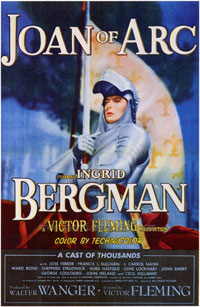
Ingrid Bergman shows France the way in po-faced epic Joan of Arc

Director: Victor Fleming

Cast: Ingrid Bergman (Joan of Arc), José Ferrer (Dauphin Charles), Francis L Sullivan (Bishop Cauchon), Roman Bohnen (Durand Laxart), Geoge Coulouris (Sir Robert de Baudricourt), George Zucco (Constable of Clervaux), Gene Lockhart (Georges de la Trémoille), John Emery (Duke d’Alençon), Richard Ney (Charles de Bourbon), Lief Erickson (Dunois of Orleans), John Ireland (Jan de la Boussac), Hurd Hatfield (Father Pasquerel), Ward Bond (La Hire), J. Carrol Naish (Count of Luxembourg), Frederick Worlock (Duke of Bedford), Shepperd Strudwick (Father Jean Massieu), Alan Napier (Earl of Warwick), Cecil Kellaway (Jean Le Maistre)

A light descends from heaven, and a young girl is seized with a sense of purpose. Joan of Arc (Ingrid Bergman) believes – as do her countrymen – that she received a message from heaven to help deliver fifteenth-century France back to the French, and out from under English occupation. For three years, this young woman strikes fear into the hearts of the English, inspiring the French into a series of victories (most of all at Orleans) and improving the French position such that the ambitious Dauphin (José Ferrer) is crowned Charles VII. But Joan is a target for the English, and she’s eventually  captured and burned for heresy after a trial notably free of justice at Rouen.

A huge investment at the time, with its colossal cast and loving recreation of medieval France, Joan of Arc is historically a luckless film. Despite its box-office winnings, it failed to cover its immense cost. It gained seven Oscar nominations (and four wins!) with no nomination for Best Picture. Its director, its cinematographer and actor Roman Bohnen (playing Joan’s uncle) all died prematurely after its release. Ingrid Bergman was caught up in scandal – and effectively exiled from Hollywood – shortly after when her affair with director Roberto Rossellini became public knowledge. Producer Walter Wagner was imprisoned three years later for shooting his wife’s lover. The film itself had 20 minutes sliced from it and, for decades, was only available in its truncated version.

Aside from these historic curiosities, Joan of Arc is a well-made, handsomely mounted but fundamentally rather dry and at points rather dull historical drama, mixed with more than enough touches of Biblical worthiness. Victor Fleming himself felt the film was a disappointment, that a trick had been missed – perhaps  aware that his own old-fashioned, rather flat direction fails to bring any inspiration out of the drama.

If drama is quite the right word for what, all too often, are too many scenes made up almost solely of a group of men sitting around a table in medieval garb talking at length of current affairs. Too many of these scenes lack in pace or urgency and many end up feeling forced, with too much of the dialogue reduced to recounting events rather than driving the story.

The structure of the story feels off as well: it can be split into three rough acts: Joan’s search for her purpose, Joan’s time as the inspiration of the French, and Joan’s imprisonment and trial. The trial, in particular, takes up almost the final 45 minutes of the film. The play the film is based on used a troupe of actors performing the life of Joan as a framing device for further insight into the life and impact of the saint. Without this framing device, the actual film becomes a rather dry history lesson.

It’s not helped by Bergman’s performance, which serves to capture in capsule the film’s po-faced piousness. It was a dream of Bergman’s to bring her Broadway performance of Joan to film. Sadly, the script’s lack of wit (or insight into the personality of Joan), means the majority of her scenes fall into a stock pattern: her lines are delivered with a breathless intensity with her hands are clasped across her chest. Aside from a few brief scenes where Joan questions why her voices have fallen silent, there are very few moments where either Bergman or the film seek to delve down into the motivations and inspirations of Joan. Like the film, her performance is bereft of any wit or warmth – instead it is almost devotional in its careful respect.

It’s part of the film’s seriousness. It makes some excellent points on the lasting impact of Joan, the horrific unfairness of her trial and the fact that, by burning her, the English merely cemented her hold on the French people rather than ending it. But too many other issues are pushed to the wayside, along with Joan’s character and motivations. No questions are raised around Joan’s interpretation of her visions. The conflict between faith and war is unexplored. The film sets its store out clearly: this is a devotional work and we should take it as that, and any questions around faith, legitimacy or what drove a fanatical teenager to embrace a life of military campaigning goes unexplored. In truth, we know as little about Joan at the end as we did at the beginning.

Which isn’t to say the film doesn’t have its plusses. As a piece of devotional film-making, it has a lovely score from Hugo Friedhofer, with just the right uses of heavenly choirs singing through the most devout sections. The design of the film is beautifully done, heavily inspired by medieval manuscripts, with the same striking primary colours and framing. It has in fact a beautifully old-fashioned look to it, a wonderfully designed artificiality. The siege of Orleans is a dramatically staged sequence, with a particularly striking orange-drenched sky. Visually you can imagine this as an incredibly stuffed-shirt Adventures of Robin Hood, but still glorious to look at.

Bergman is also wisely surrounded by a strong cast of character actors, all providing the sort of colour and corruption that Bergman’s stiffly written Joan can’t provide. José Ferrer landed an Oscar nomination for his film debut as the ambitious, weak-willed and envious Dauphin, more interested in realpolitik than doing the right thing. Francis L Sullivan connives and blusters wonderfully as corrupt Bishop Cauchon, fixing the trial. George Coulouris gives his usual hurried authority to de Baudricourt, while Cecil Kellaway inverts his Irish kindness as Joan’s Inquisitor. Off-the-wall casting choices like Ward Bond as a French captain surprisingly tend to pay-off. Shepperd Strudwick makes the biggest impression though as Joan’s sympathetic bailiff (he also speaks the prologue).

The overall film though is one more for history buffs than for movie goers. With its seriousness, odd pace (some events take forever, while others – such as Joan’s capture – either rush past in seconds of happen off-screen) and general lack of any humour or warmth, it’s not always an engrossing watch. Well-made as it is, it’s also directed with a certain flat professionalism rather than inspiration and Bergman seems constricted by the script and the part. A curiosity, but not a complete success.

Ministry of Fear (1944)

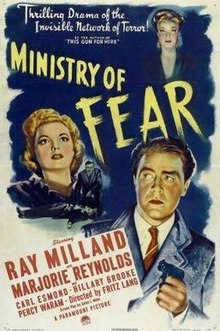
Ray Milland and Marjorie Reynolds take on Nazi agents in Ministry of Fear

Director: Fritz Lang

Cast: Ray Milland (Stephen Neale), Marjorie Reynolds (Carla Hilfe), Carl Esmond (Willi Hilfe), Hillary Brooke (Second Mrs Bellane), Percy Waram (Inspector Prentice), Dan Duryea (Cost/Travers), Alan Napier (Dr Forrester), Erskine Sanford (George Rennit)

Neither Fritz Lang nor Graham Greene (the author of the original book) cared much for Ministry of Fear. Both of them thought that the film they ended up with was only a shadow of the original novel, with both of them largely blaming the script by Seton I Miller and the producers for turning Greene’s novel into a more simplistic B-movie. And yes the film is at heart just a B-movie, that races through a conspiracy thriller – and you’d have no idea that it ever came from Greene-land unless you were told so – but it’s put together with such professionalism that you admire its skill, even while it’s no Third Man.

At the height of the Blitz Stephen Neale (Ray Milland) is released from an asylum only to find himself immediately embroiled in a load of shady goings-on with suspicious séances, hidden microfilm and Nazi sympathisers. Can the fragile Stephen get to the heart of it?

Ministry of Fear has a slightly dream like quality to it – probably because it’s a fragmented narrative that makes quick jumps from event to event, sometimes with very few links between them. Stephen emerges from an asylum straight into a charity fete, hence to a train, the centre of London and a séance, with all the speed of a logic-skipping dream. Everything is swift and somewhat low in logic. The plot of the film becomes sheer B-movie fluff, with the typical spy hijinks you might expect, lacking any of the complexity of the book. 

Greene was particularly disappointed by the deletion of the guilt Stephen feels around the death of his wife – and the film indeed skims over this very swiftly, leaving the reasons for Stephen’s being in an asylum in the first place largely unexplored and dispatched as swiftly from the film as possible. It’s not a film that has the time to explore the complexity of personalities of characters – instead it’s all about turning the content of the novel as much as possible into a high-flung spy thriller.

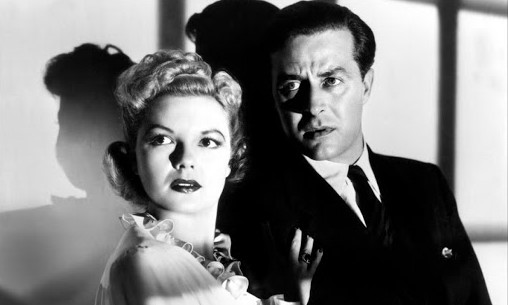
It’s why Lang was so disappointed with the script – and he became more and more dismissive of the film as he got older, claiming it to be bad film that he fell asleep in during a later showing – but he still bought to it a visual magic. The film is crammed with beautiful expressionistic images, present right at the start with Stephen watching a ticking pendulum through to some of its beautiful later images, in particular a shooting through a door that allows a beam of light to shine through a bullet hole in a door. Lang crams the film with striking images that help lift it above its B-movie roots.

Which is just as well because the general drift of the plot isn’t always that special, playing like the off-cuts from several Hitchcock films. Despite the artistry with which Lang presents it, he can’t hide the basically generic stuff that Greene’s book has been turned into. And its fast pace and logic jumps can perhaps find their root in the general contempt Lang had for the material he had to work with. Nothing in this feels particularly right – the England it presents is laughably wrong on several counts – while as always much of the mystery is reduced from the small cast list and tiny selection of possible suspects. 

There are some good sequences, don’t get me wrong. A séance is beautifully made and carries a fair degree of tension. The final confrontation with the architect of the misdeeds makes for a decent scene. It’s just a shame it’s counterbalanced with clumsy “this is what’s going on” scenes, such as Stephen’s briefing from British Intelligence. 

There are some good performances among the cast. Milland gives a well-judged performance of vulnerability, confusion and growing strength. He has just the right good-looking-but-not-drop-dead-handsome look to him to make him someone you can sympathise with but not completely trust (if the film hadn’t dropped some of the more interesting questions around Stephen’s guilt or innocence for past crimes this casting would have really worked to strengthen that). But he gives a fine performance. The array of suspicious characters around him are confidently performed, with Hillary Brooke a particular stand-out as a manipulative, seductive medium.

But Lang’s film is a covering of class and technique other soil that isn’t rich enough. The complexities of Greene has been lost and the film’s general plot and content doesn’t give much more than the sort of cheap thrills you could expect from a well-made B movie. With those involved this could have been more, but it never becomes a classic.