Tag: Alessandro Nivola

The Brutalist (2024)

The Brutalist (2024)

Stunningly filmed, ambitious epic brilliantly unpacks patronage, immigrant experience and the American dream

Director: Brady Corbet

Cast: Adrien Brody (László Tóth), Felicity Jones (Erzsébet Tóth), Guy Pearce (Harrison Van Buren), Joe Alwyn (Harry Lee Van Buren), Raffey Cassidy (Zsófia), Stacy Martin (Maggie Van Buren), Alessandro Nivola (Attila Miller), Emma Laird (Audrey Miller), Isaach de Bankolé (Gordon), Ariane Labed (Adult Zsófia), Michael Epp (Jim Simpson), Jonathan Hyde (Leslie Woodrow), Peter Polycarpou (Michael Hoffman), Maria Sand (Michelle Hoffman)

As long as there have been artists, there have been patrons: wealthy men who provide the finance for the artist to create. The relationship between them has quietly defined our cultural history, the legacies of famed artists whose work fills galleries and public spaces coming about due to the wealth and ego of those behind them. It’s one of many themes explored in Brady Corbet’s epic The Brutalist, the mix spiced by placing its powerless, traumatised artist as a friendless stranger in a strange land, escaping a lifetime of persecution: a Holocaust survivor making a new start in the Land of the Free.

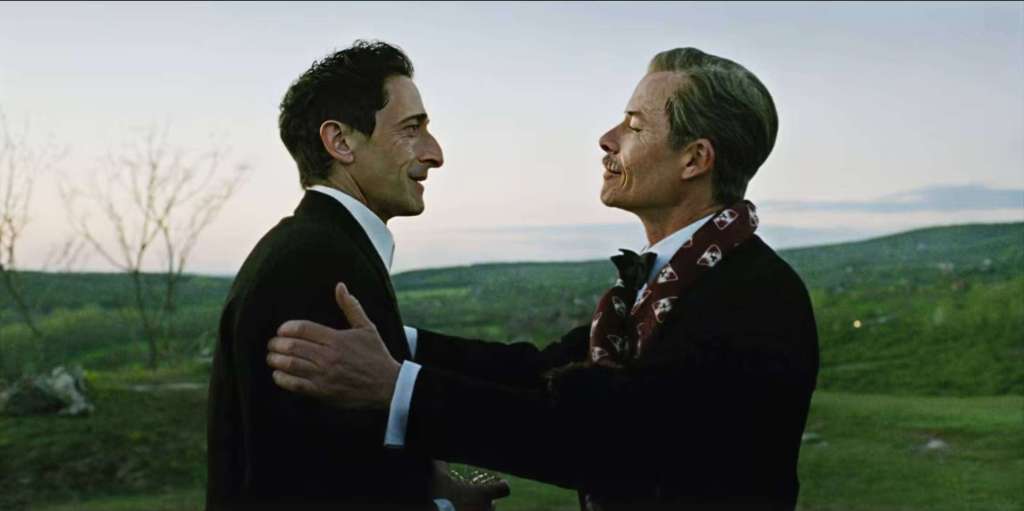
László Tóth (Adrien Brody), a famed Jewish Hungarian architect who narrowly survived the inhumanity of Buchenwald, arrives in America in 1947. Greeted with exploitative warmth by his wife Erzsébet’s (Felicity Jones) cousin Atilla (Alessandro Nivola), an Americanised furniture salesman, László’s skills are poorly exploited until Atilla is commissioned to build a library for billionaire Harrison van Buren (Guy Peace) by his son Harry (Joe Alwyn) as a surprise birthday present.

Van Buren, who loathes surprises, reacts with rage until, years later, an architectural magazine commends László’s library as a work of genius. László, thrown out by Atilla (who blamed him for losing the van Buren’s as clients) is hired by van Buren to build a gigantic community centre: a concrete cathedral on a hill. Van Buren helps arrange the immigration of Erzsébet in the country, but both Tóth’s discover van Buren’s darkly sinister passion is control, the two struggling against constant obstructions and László’s self-destructive qualities in a country where they are always strangers.

Corbet’s epic film partly becomes an exploration of the struggles of an outsider in a new land. It’s made abundantly clear that, far from a land of equality, America is a country of fierce hierarchies where those with money and power have almost complete autonomy to do whatever they want, and those at the bottom can be bought and sold. And few are as low and unwanted as the immigrant (it’s striking László’s closest friend is Gordon, a unemployed Black single father, another walking symbol of the underclass).

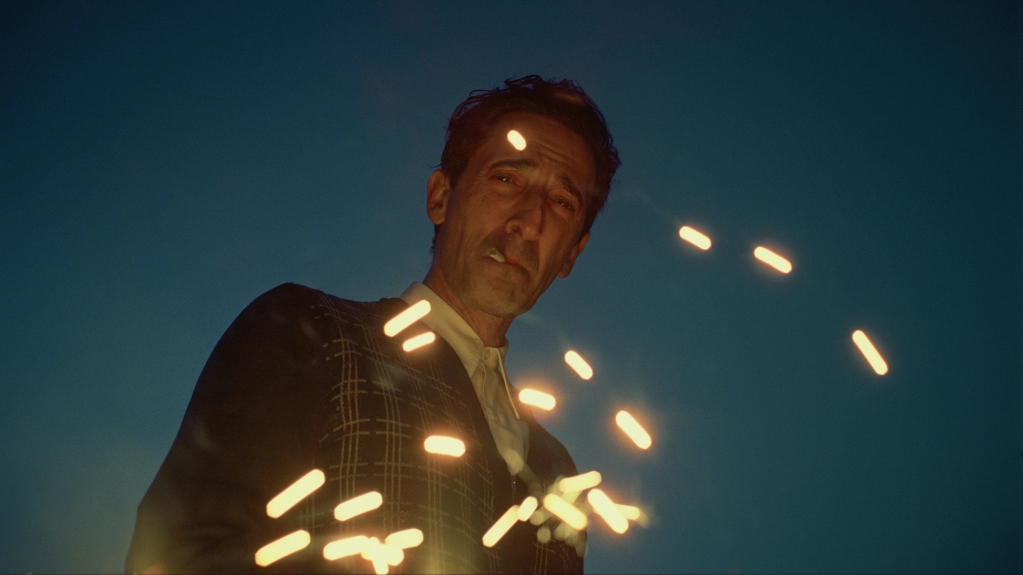
Corbet signals all in America will not be plain sailing on László’s arrival at New York – after a virtuoso tracking shot (one of many in this lusciously filmed epic) – László stumbles out to the deck of the boat and cranes upward, the camera following him to see an upside-down vision of the Empire State Building. This is not an image of hope and expectation. The immigrant, even the Holocaust survivor, is an unwelcome figure. Alessandro Nivola’s Attila has bent over backwards to hide his roots – changing his name and accent and pouring all his self-loathing into the thin charity he offers László (a poorly furnished room at the back of his shop, a blasé offer of an invite to the odd meal). Flashes of generosity don’t hide the fact László is first for any blame.

It’s just a warm-up though for László’s life as architect-in-residence for Harrison van Buren. Played with a smarmy grandiosity with a streak of reptilian cruelty, Guy Pearce makes Harrison a true monster, a Medici for the modern ages with László as a Michaelangelo, whose flourishes are tolerated only while his artistry reflects glory onto Harrison. Harrison, with his studied references to art, understands he has no legacy of his own (other than money) and demands one created for him by László. It’s his name that will be on the van Buren centre, his glory that will be embodied by it.
Van Buren, like many powerful businessmen, talks art but his real interests are control and power. Asserting his control over László, as if wanting to absorb his creativity into himself, is crucial to him. This sees him set up László in a poorly furnished house on his estate like a pet, interjecting tiny modifications and his own controlling placemen into the project, revelling in his control over every element of László’s life. He takes a sadistic pleasure in alternating praise (his constant refrain of the greatness of László feels incredibly self-aggrandising, as if László was just another one of his bottles of fine wine) and casually cruel jibes at his accent, dress sense and lack of drive.

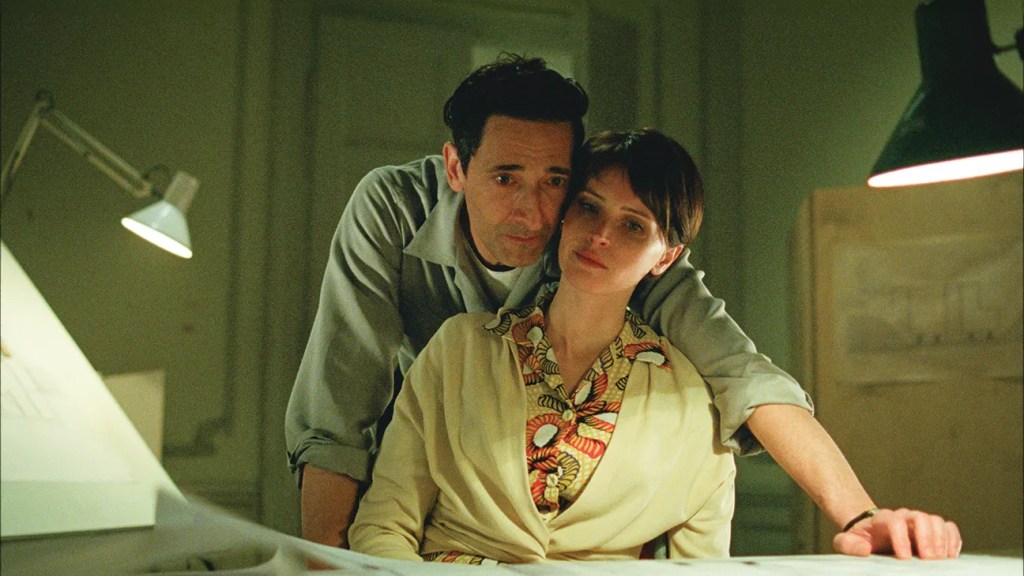
These are qualities instantly recognised by Erzsébet, played with a fiercely restrained passion by Felicity Jones. Open-eyed at the restrictive oppression of van Buren over her husband – after decades of first the camps and then the brutal oppression of Soviet Hungary – it is she who has more overt fight then the naturally quiet, oppressed László brings. But even she knows they are dependent on van Buren’s patronage to exist (especially after her husband’s offer to sacrifice his salary to maintain crucial elements of his design is gladly accepted), urging her husband that he must do everything possible to maintain van Buren’s passion and interest. She knows to the tasteless van Buren this cathedralic construction is little more than a kitchen renovation.

The building itself is an intriguing concrete monolith, that slowly takes shape over the course of the many years the film covers, like a medieval cathedral. Imposing pillars, and vast ceilinged rooms tower above the skyline. It’s hard to shake the feeling that, for all the passion and fire László pours into its building, it feels a dark, punishing place. Its structures reflect the concrete towers of death camps. This committed Jew might be pouring years of his life into a building crowned by a colossal cross. Its bowels fill like the water sewers so many of his people were forced to try and escape through. Its rooms feel less inviting and more like prisons with the hope of skylights and vast upward spaces. It feels at times that the building itself is a tribute to the psychological damage László has had inflicted on him by his experiences.

Experiences he cannot bring himself to speak about. His scars are less visibly clear than the wheelchair Erzsébet has been confined to, or the wordless dumbness his niece Zsófia, wonderfully played by Raffey Cassidy, suffers. But it’s there in every inch of Adrien Brody’s tortured face. Few actors are more perfectly suited to embody tortured, long-suffering perseverance than Brody (his famously broken nose is even worked into the script), and László is a tour-de-force, an austere, proud man who will not beg but also will not fight, who on some level accepts repression.
Brody’s Oscar-winning performance is a portrait of a mix of unacknowledged PTSD, self-destructive impulses (he remains a heroin addict for much of his life), survivor’s guilt and a quiet willingness to accept abuse that makes him a life-long victim. From the chaos of his own life, full of trauma, his art is all about clear, clean, ordered lines. His genius is also his curse, lifting him to the attention of monsters who exploit and take advantage of his talents for their own ends and offer him no loyalty in return. While The Brutalist could suggest László has his own secret intentions with his grand construction, the film could just as well close in its epilogue that László is trapped, wordlessly and powerlessly, within the giant edifices he has built, doomed to continuously relive in different ways the horrors of his experiences during the war.

László’s whole life feels like a quiet inversion of the American Dream. The idea that anyone can come to the country and make a future for themselves is for the birds. It’s all a roll of a dice and depends on entirely on chance and whim: without a magazine taking an interest in van Buren’s library, László could have just as easily died as an obscure docks worker. America is shown as no land of opportunity, but one where those in power control everything, get away with anything they please and pass their power and influence on to their children. Where László and his like are tolerated as exotic points of interest at the dinner table, but are never really equals. Van Buren exploits and uses László for as long as his interest holds and humiliates him (and much worse) at any point when the architect starts to forget that he is not just an extra in van Buren’s American dream.

These complex and fascinating ideas and interpretations line the walls of Corbet’s own grand edifice: The Brutalist is a film of powerful epic sweep, stunning VistaVision images and looming, ominous intensity. Stuffed with wonderful performances, it’s the sort of ambitious, epic film-making that the cinema sorely needs to hold its place as an art-form. And in its sweep and Hopper-esque artistry, it’s a superb advert for American film-making.

Amsterdam (2022)

Amsterdam (2022)

Lots of quirk, whimsy and smugness, not a lot of interest or dynamism in this satirical mis-fire

Director: David O. Russell

Cast: Christian Bale (Burt Berendsen), Margot Robbie (Valerie Voze), John David Washington (Harold Woodsman), Robert De Niro (General Gil Dillenbeck), Chris Rock (Milton King), Rami Malek (Tom Voze), Anya Taylor-Joy (Libby Voze), Zoe Saldana (Irma St Clair), Mike Myers (Paul Canterbury), Michael Shannon (Henry Norcross), Timothy Olyphant (Tarim Milfax), Andrea Riseborough (Beatrice Vandenheuvel), Taylor Swift (Elizabeth Meekins), Matthias Schoenaerts (Detective Lem Getwiller), Alessandro Nivola (Detective Hiltz), Ed Begley Jnr (General Bill Meekins)

David O Russell’s has made a niche for himself with his ensemble awards-bait films, filled with touches of quirk and offering rich opportunities for eccentric, showy performances from actors. Some of these have walked a fine line between charm and smugness: Amsterdam tips too far over that line. Like American Hustle it’s a twist on a real-life event (opening with a pleased with itself “A lot of this really happened” caption) but, unlike that film, it fails to insert any compelling storyline, settling for a whimsical shaggy-dog story that frequently grinds to a halt for infodumps or lectures.

Set in 1933, just as Roosevelt has taken office, it follows three friends who formed a friendship for life in post-war Amsterdam. They are: wounded veterans doctor Burt Berendsen (Christian Bale) and lawyer Harold Woodsman (John David Washington) and socialite-artist-turned-nurse Valerie Voze (Margot Robbie). Berendsen and Woodsman lost touch with Valerie in the 1920s, but now they are all bought together after the murder of their respected former commander as part of a plot from various nefarious types to overthrow the government in a fascist-inspired coup.

Sounds gripping right? Well, Amsterdam fails to find any urgency in this. In fact, details of this plot and the political context it’s happening in are sprinkled around the film as if Russell kept forgetting what the film was supposed to be about. It’s almost as if he stumbled on an unknown piece of American history – a rumoured coup attempt, thwarted by being denounced by the ex-Marine General approached to lead it (here represented by De Niro’s ramrod straight General Dillenbeck) – but got more and more bored with it the longer he spent on it.

Instead, his real interest is in the faint overtones of Jules et Jim style thruple between Berendsen, Woodsman and Voze (though this is American not French, so any trace of homoeroticism is dispatched, despite the obvious bond between the two men). The most engaging part of the film is the Act two flashback to these three healing, dancing and bonding in post-war Amsterdam, in a “our troubles are behind us” bliss. Even if it’s self-satisfied in its bohemianism.

To be honest, even then, they have an air of smugness behind them. They pass the time singing improvised nonsense songs based on words pulled out of a hat and playfully posing in Valerie’s modernist artwork. Valerie is played with almost enough charm by Robbie for you to overlook she is a standard Manic Pixie Dreamgirl, the sort of babe who pulls shrapnel from bodies to turn it into artistic tea-sets as a commentary on the madness of war. She and Woodsman form a relationship (with the married Berendsen as a sort of – well I’m not sure what, but definitely not a sexual third wheel) and these blissful Amsterdam days are the times of their life. Russell is so keen for us to know it, that all three pop up in short cutaways at key moments to whisper “Amsterdam” direct to the camera, an affectation that fails to deliver the spiritual impact its straining for.

It’s better than the shaggy dog story around the conspiracy that fills the 1930s part of the storyline. This remains so poorly defined, that Bale has to narrate a concluding slideshow of clips and fake newsreel and newspaper coverage to explain what on earth has just happened. The lack of clarity about the stakes – and the general lack of seriousness or urgency anyone treats them with –fails to provide any narrative oomph. Instead, it drifts along from casual meeting to casual meeting, every scene populated with a big-name actor showboating.

There is a lot of showboating in this film. Bale, an actor with an increasingly worrying tendency for funny voices and tics, fully embraces the facially scarred, glass-eye wearing Berendsen, perpetually stooped with a war wound and prone to fainting from pain-killer overuse. It’s a showy, actorly performance with a licence to go OTT. Bale does manage to invest it with an emotional depth and vulnerability, but there’s more than an air of indulgence here.

Most of the rest follow his lead. Malek and Taylor-Joy sink their teeth into a snobby socialite married couple. Rock essentially turns his role as a veteran into a less sweary extension of his stand-up act. Myers and Shannon seize with relish roles as ornithologist spies (is this meant to be a joke about the origins of the James Bond name from the author of a bird-spotting guidebook?) Poor John David Washington ends up feeling flat with his decision to underplay (like he’s in a different movie) and only De Niro really manages to feel like anything other than an actor on holiday.

Russell wants to make a point about the continual corruption of the rich and how their hunger for more power will never be sated. There are some half-hearted attempts at attacking racism, with the ill treatment of black veterans, but it lacks bite or edge. His attempts to draw parallels with Trump are all too clear, but the film largely fails to integrate these ideas into the film. In fact, it ends up relying on voiceover lectures from Bale about dangers to democracy. It ends up like being hectored by an angry socialist after a student revue night.

The film is shot with a series of low angle shots and medium and close ups that eventually made me feel like I was watching it from the bottom of a well. A vague sepia-ish tone is given by Emmanuel Lubezki, but the film looks flat and visually uninteresting (so much so I was stunned to see $80million had somehow been blown on it, despite most of the cast working for scale). It drifts towards a conclusion, without giving us anything human to invest in (as Russell managed so well in Silver Linings Playbook or The Fighter) or providing the sort of caper enjoyment he delivered in American Hustle. Instead, it’s oscillates between smug and dull.

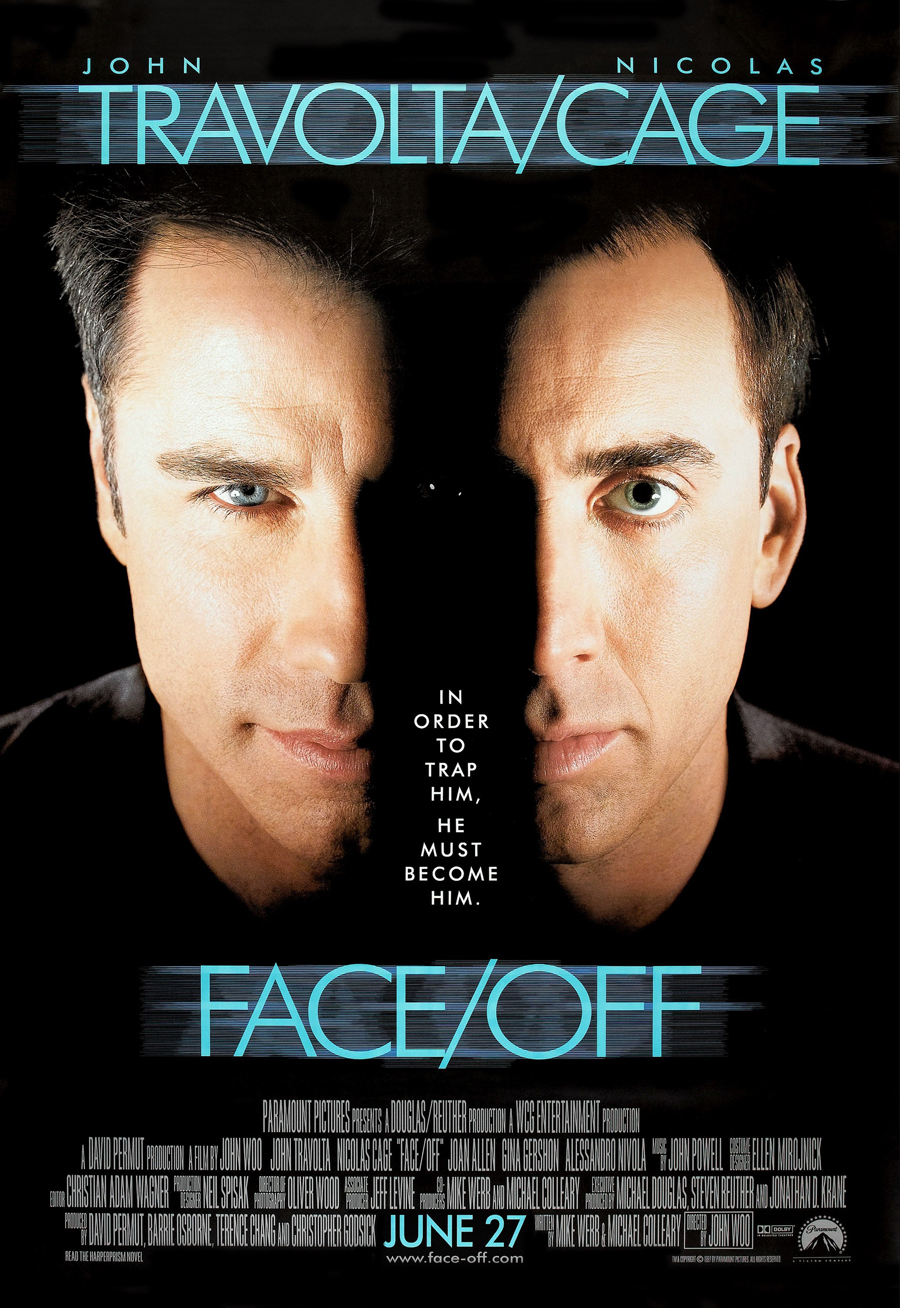
Face/Off (1997)

Nicolas Cage and John Travolta swop faces (yes really) in Face/Off

Director: John Woo

Cast: John Travolta (FBI Agent Sean Archer), Nicolas Cage (Castor Troy), Joan Allen (Eve Archer), Alessandro Nivola (Pollux Troy), Gina Gershon (Sasha Hassler), Dominique Swain (Jamie Archer), Nick Cassavetes (Dietrich Hassler), Harve Presnell (FBI Director Victor Lazarro), Colm Feore (Dr Malcolm Walsh), John Carroll Lynch (Guard Walton), CCH Pounder (Hollis Miller)

After five years, Sean Archer (John Travolta) has finally caught his nemesis, terrorist-for-hire Castor Troy (Nicolas Cage). But, with Castor in a coma, only his brother Pollux (Alessandro Nivola) – yup really – knows the location of the deadly bomb they planted in Los Angeles. With Pollux now in prison how can they get him to talk? Well obviously the easiest way is for Archer to undergo extensive, experimental surgery to alter his build, voice and (piece de resistance) have his face removed and replaced with Castor Troy’s. And of course, this should be top secret so no-one knows it happened. Because there is absolutely no chance Castor will wake up from his coma and have Archer’s face placed on his own head is there? But of course. Let the violent mayhem ensue, as Troy/Archer (Travolta) manipulates the FBI for his own ends and Archer/Troy (Cage) battles to reclaim his life and face.

Reading that, it won’t surprise you to hear that Face/Off is a hyper-reality film. Hailing from the 90s, when Hong Kong gun-fu director John Woo was seen as the auteur of action, every single thing is dialled up to eleven. Early in the film Archer is told that the voice-alterer attached to his vocal codes could be dislodged ‘by a violent cough’. Needless to say, it doesn’t shift once during the orgy of intense, balletic violence that follows, no matter how many times Archer/Troy flings himself through the air, guns blazing, or flips backwards to avoid bullets.

Face/Off it’s clear is a very silly film. It works, because it knows it is a very silly film. It dabbles only lightly in the psychological trauma of finding yourself in another body – and in Archer’s case not just any body, but the body of his son’s killer. But it’s less interested in that than in seeing the two actors have immense fun apeing each other’s intonations and mannerisms. Travolta in particular has a whale of a time as the id-like Troy/Archer, campily springing about the stage and good-naturedly mocking his own physique (“This ridiculous chin”), while prancing about with all the wide-eyed, giggling mania Cage has made his own.

In case you hadn’t worked it out in a film where faces can be swopped, nothing feels like it’s happening in the real world. Gun battles defy logic and physics. Archer’s obsessive pursuit of Troy in the film’s opening battle causes a jaw-dropping level of destruction, mayhem and death (in a real world, with his obvious psychological problems, he would have been off the case years ago). But then, he’s so reckless perhaps that’s why people don’t really notice when he’s replaced by Troy.

There are some interesting beats, many of them centred around Troy/Archer’s arrival in the Archer family home where he forms a superficial bond with Archer’s daughter (including saving her from assault from a creepy boyfriend) that, aside from his obvious insanity, perhaps things could be different (and there is a suggestion Troy/Archer plays with the idea of going straight – or at least a corrupt version of it). Joan Allen comes on board to add acting lustre as Archer’s doctor wife, so distant from her husband for years that she needs time to work out he’s been replaced.

But the film’s heart is in the violence. There are five or six action set-pieces that use every weapon in the Woo arsenal. Slow-mo? Check. Operatic grandness? Check. Walking with intent? Check. Diving forward while firing two guns? You betcha. Doves? But of course. Any real sense of logic is thrown out of the window, and really the film at heart is a comedy of two famous actors pretending to be each other, in between jumping at each other, screaming their heads off, practically making gun noises while they point their weapons, like maniac kids.

And, you know what? It works. Sure the entire enterprise feels very much of its time: and Face/Off captures Woo’s style so perfectly (with its huge body-count and reckless disregard for life and property) that he never topped it again. A director who basically could do one thing really well (future films would merely demonstrate his limitations), throwing himself into a film of intense silliness, with big-name stars having a whale of time and action set-pieces that make no real sense but are impressive to watch, he aces it here. Face/Off is an odd classic of its time, ludicrously silly but always choosing to double-down on its intense silliness – to gloriously entertaining effect.

Disobedience (2017)

Rachel Weisz and Rachel McAdams deal with love and faith in Disobedience

Director: Sebastian Lelio

Cast: Rachel Weisz (Ronit Krushka), Rachel McAdams (Esti Kuperman), Alessandro Nivola (Dovid Kuperman), Allan Corduner (Moshe Hartog), Bernice Stegers (Fruma Hartog), Anton Lesser (Rav Krushka), Nicholas Woodeson (Rabbi Goldfarb), Liza Sadoby (Rebbetzin Goldfarb)

After the death of her father, a highly respected member of a Jewish Orthodox community in London, photographer Ronit (Rachel Weisz) returns from New York for his funeral. Estranged from her father, due to her rejection of Orthodoxy, Ronit has been quietly forgotten by her community. She stays with old childhood friends, now married, Dovid (Alessandro Nivola) and Esti (Rachel McAdams) Kuperman. Dovid, her father’s chosen disciple, has been offered his place in the synagogue. Esti is a teacher at the local primary school. However, Ronit and Esti are more than just friends – their love for each other being the unspoken reason for Ronit’s departure.

Disobedience is a tender, thought-provoking exploration of the struggles between faith and love – or rather the longing to be a part of a community, that rejects a big part of who you are. While Ronit is our entry point into this world, the real tragedy here is Esti. Both a believer in Jewish Orthodoxy and a lesbian, Esti has struggled her whole life to find a balance between these two. While Ronit has, to a certain extent, chosen – deciding to leave her family life behind to allow some personal freedom for her bisexuality – Esti has remained and tried to reconcile the contradictions in her life.

What works really well about Disobedience is that it avoids moral judgements. The Orthodox community is never condemned or hold up backward or wicked. Those who live in it may be traditional, but they are not cruel. Ronit felt she had to leave, and there is an awkwardness around her return (and she is not mentioned in her father’s obituary), but apart from a few individuals, the community acknowledges her. This proves especially effectively as it allows the film to focus on a very tenderly drawn love-and-relationship triangle between the three leads, rather than scoring easier political or religious points.

It becomes a beautifully acted depiction of a three close childhood friends who are torn between affection, bitterness and longing for each other. In particular, the love between Ronit and Esti is immediately apparent, but also the tensions of confusion, missed opportunities and confused messages. These are two women deeply in love, but held apart by pressures of their community and conflicts in themselves. Between them falls Dovid, the loyal scholar of Orthodoxy, desperate to make his marriage to Esti work but also feeling a genuine affection to his adopted sister Ronit.

There is no easy answers to this mess – and the film looks carefully at questions of freedom, choice and free will. How can you reconcile your faith and the pressures of your community with the things you want in your heart? How do you compress the guilt when you feel you are forcing choices onto someone you love? How willing are we to sacrifice everything we have grown up with to make our own choices? You’d expect the answers to come down on the obvious sides, but instead Disobedience frequently operates in shades of grey and complex, messy realities. Its endings are open, its conclusions emotionally strong but not clear-cut. It reflects the ambiguity of life in its refusal to supply simple, reassuring endings.

The film is directed, in a muted palette, with great sensitivity and restraint by Sebastian Leilo. The camera has a wonderful eye for passing moments, for suppressed looks of affection. He uses long takes to allow his actors to relax into their performances, helping them create characters who feel extremely natural. The moment when Esti and Ronit finally surrender to their feelings to each other is shot with an urgency and intimacy – which then makes the restraint of much of the rest of the film all the more striking, as reality returns.

He also constantly surprises us, skilfully shifting perceptions from character to character. At first we feel that this is the story of the rebellious Ronit, but as the story progresses Esti emerges as a truly tragic figure, while Dovid is a man holding back huge waves of doubt and uncertainty about the rules that have defined his life.

The three lead actors are wonderful. Weisz is edgy, cagey and unapologetic about the air of rebelliousness she outwardly displays – but its clear that underneath she is full of regret, grief and a powerful sense of loss about the family and love she left behind. McAdams grows in statue from scene to scene as a woman who seems naïve but actually is all-too-aware of the compromises life demands – and has struggled all her life with sexual feelings alien to her culture. Nivola superbly turns a character who could have been an obstructive bore into a man who knows suffering deep down with the knowledge that his functional marriage based on duty will never bring him (or Esti) the happiness he desires.

Disobedience balances these three characters wonderfully. At times it luxuriates too much in its languid pace and stolen, lingering glances – a sense of urgency is often missing. But intelligent, sensitive, respectful and with a respect for faith that many other films would have avoided, it’s brilliantly played and sensitively directed.

American Hustle (2013)

Glamour and confidence tricks in David O. Russell’s flashy American Hustle

Director: David O. Russell

Cast: Christian Bale (Irving Rosenfeld), Amy Adams (Sydney Prosser), Bradley Cooper (Richie DiMaso), Jennifer Lawrence (Rosalyn Rosenfeld), Jeremy Renner (Mayor Carmine Polito), Louis CK (Stoddard Thorsen), Jack Huston (Pete Musane), Michael Peña (Paco Hernandez/Sheik), Elisabeth Röhm (Dolly Polito), Shea Whigham (Carl Elway), Alessandro Nivola (Anthony Amada), Robert De Niro (Victor Tellegio)

In 2013, American Hustle was nominated for ten Oscars and won none of them. Somehow, being invited to the big party but not receiving any prizes was strangely fitting for a film about small time grifters forced into a big game way beyond their control. Russell’s film is like a celebration of his strengths and weaknesses as a director: it’s stuffed with some very good (if rather mannered) performances, offers lots of dynamic film making, but is still basically a rather cold and arch film that’s hard to really invest in – rather like a con game in itself.

In 1978, Irving Rosenfeld (Christian Bale) is a small-time grafter, running scams with his partner and lover Sydney Prosser (Amy Adams), who uses the identity of a young English aristocrat “Lady Edith Greenslly”. Rosenfeld longs to leave his unstable, selfish wife Rosalyn (Jennifer Lawrence) for Sydney, but fears he will lose all his access to his adopted son. Rosenfeld and Prosser’s career of clever investment frauds is brought to an end when Prosser is caught red-handed by FBI agent Richie DiMaso (Bradley Cooper). DiMaso forces the pair into his entrapment operation, targeting New Jersey politicians with offers of bribes as part of a Fake Sheik investment. Initially it targets Mayor Carmine Polito (Jeremy Renner), but the operation quickly expands, as the ambitious and impulsive DiMaso constantly follows every connection and the operation expands to dangerous levels, taking in the mafia. Scared, Rosenfeld and Prosser desperately try to play both ends against the middle.

American Hustle is a decent film, which pulls together the sort of capers, turmoil and antics that you would expect from a film about a long con. It throws into the melting pot the vibes of several other films, from The Sting to Goodfellas, and asks us to admire the results. Russell encourages the actors to play it with an edgy verisimilitude that pretty much works as a metaphor for con men. Each performance is an effective display of high-wire character acting work laced with arch, studied tricks. But only rarely do you get a sense of something that’s real.

That’s part of a film that wants to have a cake and eat it as well. It’s striking in the entire story that the most sympathetic character is the initial target, Jeremy Renner’s well-meaning, passionate New Jersey politician, bamboozled into taking a bribe (money he mostly uses in the local community) because he is convinced it’s a crucial part of getting Arab investment. It’s even more striking that the most honest, subdued (and deadly) character is the Mafia kingpin Victor Tellegio, played with chilling menace by an unbilled Robert DeNiro. Nearly everyone else on the side of the entrapment operation is pretty much a selfish prick or verging on the unhinged.

But then that’s part of the point of the film, which throws two people who know what they are doing (Rosenfeld and Prosser) at the mercy of people playing with fire (Roselyn and in particular DiMaso, a permed, tightly-wound powderkeg). This is one hell of a performance from Bradley Cooper – and a sign again after Silver Linings Playbook that Russell and he have a natural understanding. Cooper is a force of nature, a bundle of terrible impulses combined with an utter lack of shame or self-control, who is quite happy to trample over everyone to get what he wants and has no regard whatsoever for the danger he puts himself and others into. Utterly unpredictable, he never sticks to a plan, veers between rage and hysterical laughter and, worst of all, is always convinced he’s right.

It’s DiMaso who spins the operation into dangerous waters with his vaulting ambition to land yet another big fish, recklessly peddling insubstantial, unprepared lies on top of each other – to the terror and horror of practised peddlar of bullshit Rosenfeld, whose whole successful schtick is based on saying “no” and having the mark do all the desperate work. DiMaso’s approach not only puts the operation at risk, it puts lives at risk – not that DiMaso cares, preoccupied as he is with his childish one-upmanship with his boss and a teenage sexual obsession with Prosser.

What chance do the (mostly) small-fish politicians and local figures have, whose lives are placed on the altar of DiMaso’s ambition? It’s no wonder that, late in the film, our conmen heroes start to feel guilt and remorse – none more so than Irving Rosenfeld. Played by Christian Bale with the sort of tricksy, Olivier-ish disguises that he so loves (in this case increased weight, a balding comb-over and a pair of tinged glasses he obsessively fiddles with), Rosenfeld is an operator happy with the level he is working at and incredibly wary of stepping up into the dangerous big leagues. Justifiably convinced of his own professionalism at fleecing money and winning trust, Rosenfeld has no problem with taking money from the selfish but every problem in the world with destroying the life of a fundamentally honest man. Bale’s performance, for all the tricks, manages to successfully build a picture of a selfish man who believes himself in his way to be honest in a way and is just trying to make his way.

That way also involves balancing between two very different women. Amy Adams does decent work as a blowsy fake-aristocrat, sporting a series of tops with neck lines that literally plunge down to her waist, although she is perhaps a little too “nice girl next door” to really convince as the love-em-to-manipulate-them Prosser. She’s not also helped by the script giving her an ill-defined arc of self-doubt linked to pretending to be someone else. Sweet as the genuine love can be her between her and Rosenfeld – and excellent as her chemistry is between Bale and Cooper – it’s the character who remains the least knowable in the film.

Also not helping is the fact that Jennifer Lawrence burns through the film as Rosalyn, the sort of electric, larger-than-life but still very real performance of arrogance, selfishness, dangerous stupidity and greed that marked her out as a major actress. Whether inadvertently putting Rosenfeld’s life at risk through blabbing details she’s half-overheard and half-understood, cleaning the kitchen while singing an aggressive rendition of Live and Let Die or nearly burning the house down because she won’t believe metal can’t go in “the science oven” (aka microwave), Lawrence is the film’s MVP.

Russell’s film showcases all these actors brilliantly, but his overall story remains a little cold and not as clever as it thinks. With a film about conmen you expect a final rugpull – and this film sort of manages one – but the story telling to take us there isn’t quite as articulate and clever as it needs to be in order to be really satisfying. Perhaps it’s the film’s ragged, hip, indie style of telling – or the air that the actors are making a lot of this stuff up as they go with edgy, semi-improvised performances – but the film never really engrosses or engages. For all that we see the inner worlds of Rosenfeld and Prosser, I can’t say I really, truly cared what happened to them. 

Instead Russell focuses on the marshalling of his resources, and cool, slick film-making. He uses expert camera work and editing, mixed with a superbly chosen soundtrack, overlaid with voiceover, sudden transitions, some narrative jumps and a vibrant sense of cool to make a story that finally feels a little too much like a style-over-substance trick – in fact a con game all of its very own, as enjoyable and entertaining as the rest of the film, but when it finishes you realise your pockets are empty.

Love's Labour's Lost (2000)


Shakespeare meets Musicals in Kenneth Branagh’s Love’s Labour’s Lost

Director: Kenneth Branagh

Cast: Alessandro Nivola (King Ferdinand of Navarre), Alicia Silverstone (Princess of France), Kenneth Branagh (Berowne), Natascha McElhone (Rosaline), Carmen Ejogo (Maria), Matthew Lillard (Longaville), Adrian Lester (Dumaine), Emily Mortimer (Katherine), Timothy Spall (Don Armado), Nathan Lane (Costard), Richard Briers (Nathaniel), Geraldine McEwan (Holofernia), Richard Clifford (Boyet), Jimmy Yuill (Constable Dull), Stefania Rocca (Jaquenetta)

Love’s Labour’s Lost is one of Shakespeare’s lesser-known comedies. There is a reason for that – it’s simply not that good (it’s certainly the weakest Shakespeare play Branagh has brought to the screen). I’ve sat through some turgid, and terminally unfunny, stage productions of the play in the past – but this movie version presented something different, as Branagh plays fast and loose with the script and turns it into an all-singing, all-dancing musical, with only the barest sprinkling of Shakespeare dialogue.

LLL isn’t really about anything. The King of Navarre (Alessandro Nivola), invites his three best friends (Kenneth Branagh, Adrian Lester and Matthew Lillard) to join him in three years of academic study, during the course of which they will forsake all female company. Of course, no sooner than the deal is made but the Princess of France (Alicia Silverstone) and her three companions (Natascha McElhone, Emily Mortimer and Carmen Ejogo) arrive in Navarre. Will love blossom to prevent the plans of the King? You betcha.

It’s slight stuff. The play always feels a little bit unfinished – it ends with the lovers separated (or as the play puts it “Jack hath not Jill”) but with hints of hope. It’s oddly structured – more like the first part of a series of plays than a standalone (the lovers don’t get together until almost Act 4, and the men and women spend very little time together). There is a series of dull sub plots revolving around the academics of Navarre, with whole scenes made up of obscure Latin jokes. As the icing on the top, a clown and a foppish Spaniard form a bizarre love triangle with a busty country wench. None of these plots is really resolved at the end. It’s a play that focuses a lot more on floral dialogue and intricate poetry rather than narrative.

Branagh addresses a lot of these problems by simply trimming the play to the absolute bone. I would guess at least 65% of the dialogue has been cut – probably more. Although this means some roles are now so small they feel like sketches (in particular many of the more working-class characters and academics), it does mean that this has a bit more narrative thrust and energy than most productions. Moving the setting to 1939 also gives a good context to the play, and places the political issues into an understandable context. It also gives a tension to underlie the lightness of the rest of the play. Branagh manages to remove most of the cumbersome exposition dialogue by replacing it with a series of 1930s-style cine-news reels (spryly voiced by Branagh himself). He even resolves the “cliffhanger” ending of the play with a similar device (reflecting the tonal shift at the end of the original play), which helps to ground the otherwise lightweight play in a very real world, where war carries a cost.

Of course, the main invention was to replace the intricacy (and obscurity!) of some of the dialogue with song and dance routines. The songs are carefully chosen from the great musical composers of the 1930s and 40s, and are delicately interwoven with the dialogue. Now for the purist this could of course be a source of fury, but when the material is one of the weaker plays, getting this “greatest hits” version of the text alongside some excellent songs works really well.

The song and dance numbers also have a certain charm about them. Most of the cast are not especially talented singers and dancers – only Nathan Lane and Adrian Lester have song and dance experience (and it certainly shows when Branagh allows them to let rip). The actors went through an extensive “musicals boot camp”, which certainly taught them the steps, but the musical numbers still retain a charming amateurishness about them. Sure it helps a truly gifted dancer like Adrian Lester stand out, but it’s also quite sweet to see actors like Richard Briers tripping the light fantastic. (Check Lester out at around 3:10 in the video below).

The real issue with some of the actors chosen is less with their song-and-dance strength, but that their acting strength doesn’t quite cut the mustard. Branagh’s delivery and comic timing is spot on, and McElhone is a worthy adversary cum love interest for him; but Nivola and Silverstone are a little too out-of-their-depth to bring much more than blandness to their key roles. Amongst the supporting roles, Nathan Lane stands out in making Costard actually quite funny, but Lillard mistakes gurning for wit. Mortimer and Ejogo are engaging but have precious little screentime.

The film is shot with Branagh’s usual ambition on a set that has a deliberate air of artificiality about it, evoking the classic 1930s studio musical. All exteriors deliberately feel like interiors, and there are homages aplenty, from Singin’ in the Rain to Ethel Merman. Each musical number has its own unique feel and the majority are shot with Branagh’s usual love of long-take. Some of the numbers stick in the head longer than others – but that’s just the nature of musicals. Particularly good are I Won’t Dance, I Get a Kick Out of You, I’ve Got a Crush on You, Cheek to Cheek and a steamy tango to Let’s Face the Music and Dance.

LLL doesn’t want to do anything more than entertain – and sometimes it probably tries a little too hard to be light and frothy, as if Branagh was consciously kicking back after the mammoth undertaking of his uncut Hamlet. Perhaps that is why LLL appealed to him – Shakespeare comedies don’t get less treasured or more inconsequential than this, so he had total creative freedom to do what he liked, in a way that a Twelfth Night or a Much Ado About Nothing wouldn’t allow him. It’s the sort of film you need to plug into the mindset of – and some aren’t going to be able to do that. It’s not a perfect film, but the lightness Branagh handles things with pretty much carries it through.

Perhaps that lightness however is slightly the problem: in Branagh’s previous films he found a perfect mixture between influential reimaginings (Henry V), wonderful crowd-pleasers (Much Ado) and reverential labours of love (Hamlet). People probably expected something else from him than a high-budget, lightly amateur musical with precious little Shakespeare in it. I think this partly explains the hesitant response this has received from the public and critics since: it’s just such an unlikely ideal that people didn’t seem to know how to respond to it.

Of course, as anyone who has sat through an average production of the play can tell them, they weren’t missing much from what has been cut – and this is still an infectiously funny, frothy concoction. It may have a slightly mixed acting bag – some of the leads are underpowered, while some strong actors like Timothy Spall are underused – but the actors do seem to be enjoying themselves, and this enjoyment basically communicates to the audience. It’s not a concept that could have worked with a long running time, but it sure works for the short term. It’s an odd concept – and it was a huge box office bomb – but it’s one that works.

Selma (2014)

Martin Luther King fights the good fight

Director: Ava DuVernay
Cast: David Oyelowo (Martin Luther King), Tom Wilkinson (President Lyndon B. Johnson), Carmen Ejogo (Coretta Scott King), Andre Holland (Andrew Young), Tessa Thompson (Diane Nash), Giovanni Ribisi (Lee C. White), Lorraine Toussaint (Amelia Boynton Robinson), Stephan James (John Lewis), Wendell Pierce (Hosea Williams), Common (James Bevel), Alessandro Nivola (John Doar), Tim Roth (George Wallace), Oprah Winfrey (Annie Lee Cooper)

Tragically, for a while this film seemed to be most famous for being the poster child for “Oscar-Gate” or hashtag oscarssowhite (sorry hashtags are not my thing). Selma was the film that should have been littered with nominations. Instead it got just two – one for Picture, one for Best Song. Of the many, many snubs the most shocking were Ava DuVernay and David Oyelowo, particularly as other contenders up for the awards had certainly done inferior work that year . This film, however, categorically demands to be remembered in its own right – it is a fine, very moving piece of work, a dynamic history lesson that avoids preaching from a pulpit.

A lot of this comes down to the breathtaking work from David Oyelowo, who delivers one of those performances where the actor seems to transcend his skin, not just imitating Martin Luther King but inhabiting him, exploring and expressing every depth and shade. It’s a performance that stands comparison with Daniel Day-Lewis’ Abraham Lincoln. Oyelowo’s King is a big hearted, patient man but also a shrewd political player, a family man who betrays his wife, a political campaigner who holds the big picture and the small in his mind. It’s a totally committed performance that is intensely respectful without ever feeling hagiographic.

Oyelowo’s performance also immeasurably helps the film’s structure, as this is a biography that focuses on one single key moment in its subject’s life, rather than attempting to cover the whole lot in one 2-3 hour sitting. I rather like this, as the important thing about these biopics is to understand the person at the centre, not just to tick off events in their life. Anyway this film focuses on three months in 1965: King is campaigning for equal voting rights, and planning a high-profile march across Alabama from Selma and Montgomery to pressure President Lyndon B Johnson to promote the Voting Rights Act.

This is a very powerful film, humming with a constant sense of the deep rooted injustice and oppression in America at this time. It makes no compromises in showing the violence meted out to Black Americans, but it’s the day-to-day injustice that DuVernay shows particularly well: in the opening scene, Annie Lee Cooper (played by producer Oprah Winfrey) has her carefully prepared application to vote cruelly dismissed by a smalltown clerk, gleefully and casually exploiting a succession of legal loopholes to thwart her. It’s a simple scene but amazingly powerful in its casual (unspoken) racism, and it brings to life in a few strokes the day-to-day experience of millions of people at this time.

It’s also a beautifully shot film, that uses the real-life location of the Selma bridge spectacularly. An assault on the first attempted march by mounted policeman, shrouded in tear gas, is deeply moving in its simplicity, the camera catching the brutal overreaction of the police with a journalistic eye (Wendell Pierce as Hosea Williams is particularly impressive in the build-up to, and aftermath of, this sequence). Other moments of violence are equally shocking, but DuVernay never over-eggs the moment, allowing the events and the story to speak for themselves. We know how terrible some of these events are, and how disgusting the treatment of Black Americans was – the film never uses music or editing to hammer it home to us.

The film ends on the kind of high note you can only feel when injustice has been overcome and decent people triumph (punctured, DuVernay acknowledges, by the fates of some of the characters,  revealed at the end of the film. More than one of these is a gut punch – not least the death of King himself three years later). But it’s never twee, preachy or a history lesson. Instead it’s a living, breathing expression of a moment in history that wraps you up in its story. Oyelowo is of course outstanding, but there is some excellent support, not least from Carmen Ejogo as his wife Coretta (overlooked at the time, but outstanding), Andre Holland, Stephen James, Lorraine Toussaint and Common as King’s fellow Civil Rights leaders. Tom Wilkinson adds a lot of depth to a sometimes thinly written Johnson, while Tim Roth translates his contempt for George Wallace in a performance of slappable vileness. A beautiful and marvellous film.