Tag: Amy Adams

The Fighter (2010)

The Fighter (2010)

A fighter has a title shot, in a surprisingly heartwarming film about the importance of family, no matter how messed up it is

Director: David O Russell

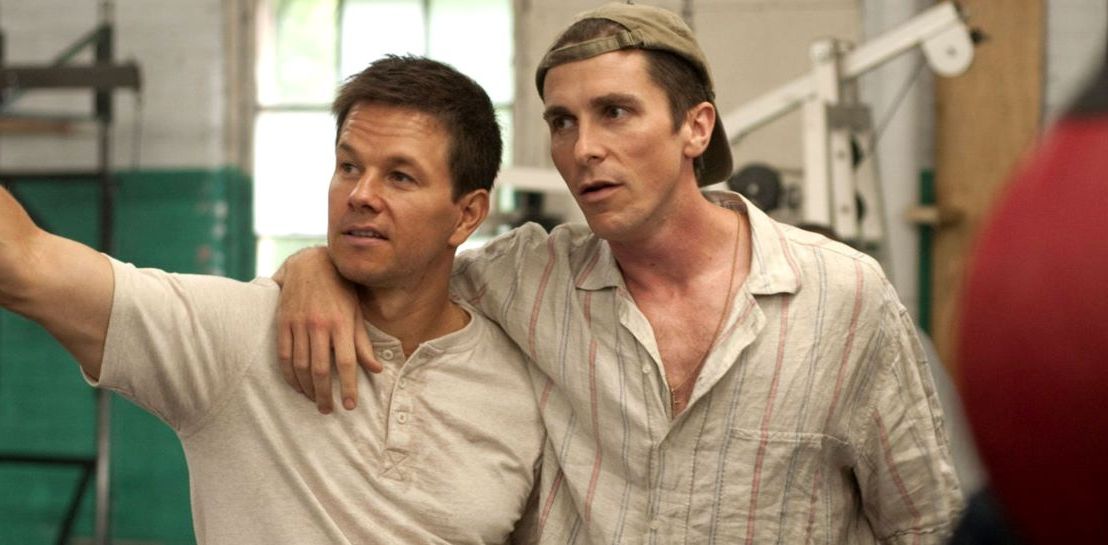
Cast: Mark Wahlberg (Micky Ward), Christian Bale (Dicky Eklund), Amy Adams (Charlene Fleming), Melissa Leo (Alice Eklund-Ward), Jack McGee (George Ward), Frank Renzulli (Sal Lanano), Mickey O’Keefe (Himself)

Everyone loves Rocky. We all want to that local-hero-turned-good, the guy who went the distance. Lowell, Massachusetts had that in Dicky Eklund. Eklund, a minor pro-boxer, once went the distance against Sugar Ray Leonard in 1978 (he argues he knocked him down, although many are convinced Leonard slipped). “The Pride of Lowell” then became… a crack addict, tumbling from disaster to let-down, helping and hindering the career of his brother, fellow boxer Micky Ward.

The story of the two brothers – leading up to Ward’s eventual title shot in 1997 – comes to the screen in Russell’s affectionate, if traditional, boxing drama, long a passion project of Mark Wahlberg who plays Micky. Wahlberg kept himself in boxer-condition for years as he dreamed of making the film, recruiting director and cast and producing the film. The fine, sensitive film we’ve ended up with is a tribute to his commitment and producing skills, while the fact that Wahlberg casts himself in the least dynamic part is a nice sign of his generosity.

Because it’s only really on the surface a Micky Ward film. Sure, the film follows the vital events in his life. It opens with him bashed up in a mis-match, filling his role as a “stepping stone” fighter, someone the future champs flex their muscles against. We follow his struggles to escape from under the thumb of his large brash family – above all his bombastic, domineering mother Alice (Melissa Leo). He forms a relationship with ambitious-but-caring Charlene (Amy Adams), moves up the ranking, lands that title shot, fights the big bout. But it never quite feels like Micky is the star.

Because, really, this feels like it’s about Dicky Eklund working out the first act of his life is over, and trying to find if he has what it takes to start a second, more humble, one. The film opens with Dicky followed by an HBO crew for a fly-on-the-wall documentary. Dicky’s convinced himself it’s to chart his boxing come-back. It’s actually about the horrific impact of crack addiction. Dicky is a strung-out, unreliable junkie, living on past glories but screwing up everything he touches, being enabled by the fawning worship of his mother and sisters, who still worship him as the families main event (and continue to do so, even as Micky rises to title shot). The film’s heart is Eklund sinking to rock bottom and realising he has forced the compliant Micky into playing a subservient role in his own life.

Perhaps it feels like a film more focused on the remoulding of this charming but selfish figure because of the compelling performance of Christian Bale. Starving himself down to match Eklund’s wizened, strung-out physique (he’s still got the boxer moves, but his body has wasted away) is a day’s work for a transformative actor like Bale. But this isn’t just a physical performance, but a deep immersion into the personality of a person who almost doesn’t realise until it is too late how fundamentally flawed he is. Bale’s a ball of fizzling energy and electric wit coated in a lethargic drug-induced incoherence. His energy is frantic but uncontrolled, wild and mis-focused. It’s a superb, heartfelt performance of loveable but dangerous uselessness that nabbed Bale an Oscar.

But what makes The Fighter a surprisingly warm film is that, for all his many flaws, selfishness and self-obsession, Dicky genuinely cares for his brother. He wants the best for him, he believes in and loves him. Much of the power of Bale’s performance comes from the fact he never forgets this, even when Dicky is at his worst. In fact, Russell’s whole film works because that warmth and love everyone feels for Micky is never forgotten and never weaponised by Russell into helping us make moral judgements about the characters. Nor does it forget that Micky may sometimes hate his family, but he never stops loving and needing them.

A weaker film would have stressed the trailer-trash greed of Melissa Leo’s Alice. Leo (who also scored an Oscar and famously dropped the f-bomb on live TV, condemning the ceremony to a permanent time delayed broadcast ever since) is in many ways playing an awful character: controlling, nakedly favouring Eklund over his brother, quick to judge, rude and aggressive. She’s never truly likeable – but Russell’s film understands everything she does is motivated by love. She genuinely wants the best for Micky, even while she pushes him into bad fights and never listens to him. She tries to protect him, and expresses this in destructive selfishness.

In many ways she’s just like Micky’s girlfriend Charlene, who recognises early that Micky’s family (who have turned him into a timid hen-pecked type) can’t be trusted to run his whole career, but who also subtly pushes herself into Alice’s place as the leading decision-making influence in his life. Very well played by Amy Adams (who lost the Oscar to Leo), Charlene is smart, sexy, loving but just as determined that it’s her way or the highway.

What Micky needs to do, the film carefully (if rather safely) outlines, is take the best qualities of all his influences. It’s Eklund’s “job” to realise Micky needs everyone he loves singing from the same hymn-sheet. It needs compromise and putting other people first. It makes for a nice little paean to the importance of family relationships, founded on forgiveness and admitting when you are wrong. Micky forgives his mother and brother for their selfishness: they, in turn, acknowledge their mistakes. Eklund is crucial here: Bale is again superb as a man who suddenly realises pride has nearly ruined his life and embraces the junior role in the relationship with his brother.

Sure, none of this reinvents this wheel, but it still makes for engaging and rather sweet drama. Russell mixes it with some neat stylistic flourishes that don’t overwhelm the film. It’s shot with an edgy, handheld immediacy reflecting its street roots. The fights are shot with old TV cameras, so that invented footage can fuse with 90s HBO coverage. Russell of course gets great performances from his actors, as he always does.

The Fighter is in many ways predictable. But it wears its heart very much on its sleeve, and Wahlberg deserves credit for assembling it and for giving a quiet, generous performance at the centre of it. And the film’s commitment to the idea that, no matter the problems in our families, we can all find the courage to admit our mistakes and pull in the same direction remains heartwarming.

Doubt (2008)

Amy Adams and Meryl Streep wrestle with certainty and Doubt

Director: John Patrick Shanley

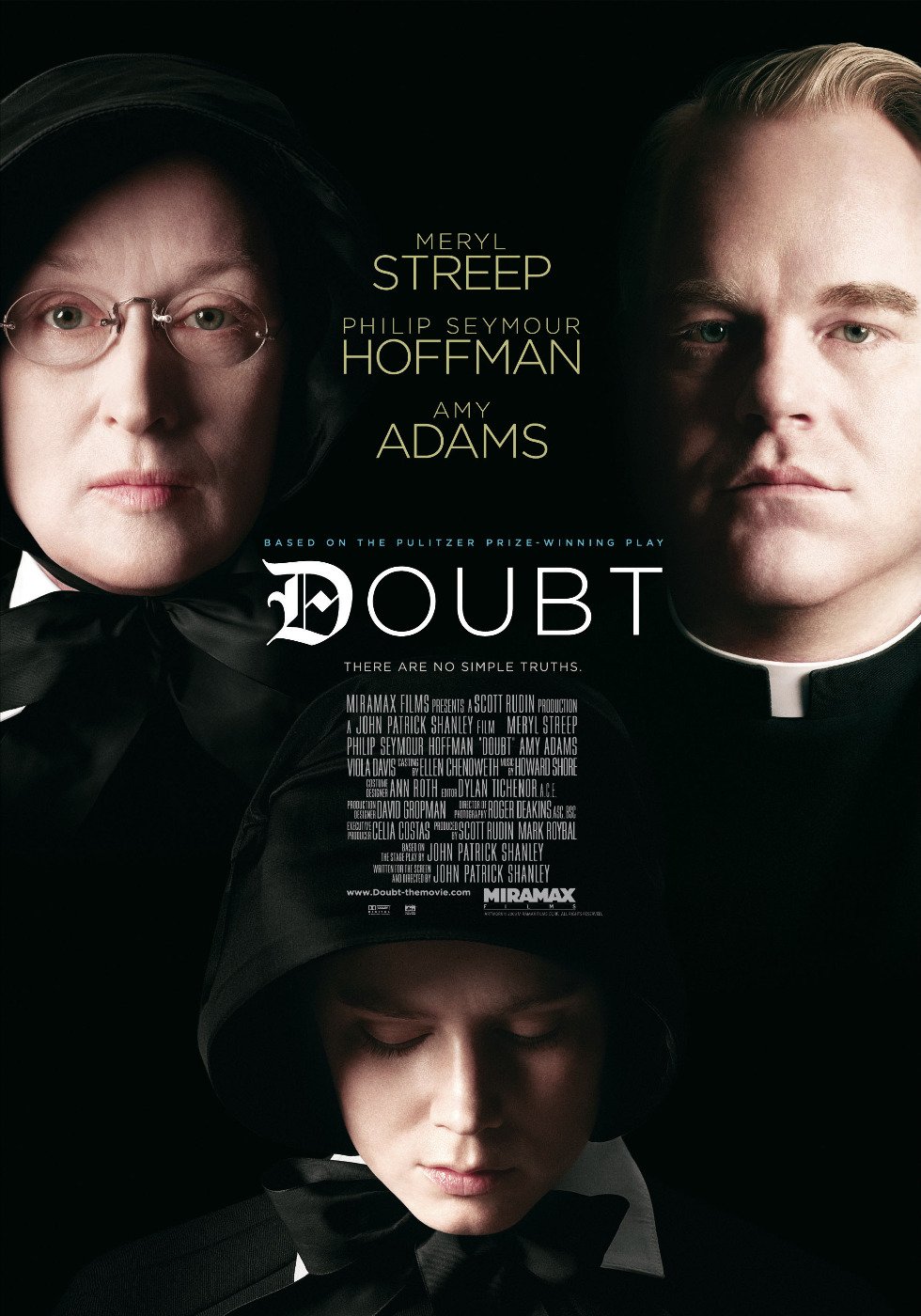
Cast: Meryl Streep (Sister Aloysius Beauvier), Philip Seymour Hoffman (Father Brendan Flynn), Amy Adams (Sister James), Viola Davis (Mrs Miller), Joseph Foster (Donald Miller)

It’s 1964 in a Bronx Catholic School, run with an iron hand by Sister Aloysius (Meryl Streep). This arch-conservative is in the middle of an unspoken struggle with progressive reformer priest Father Brendan Flynn (Philip Seymour Hoffman), who doesn’t feel Catholicism has to be stern, unyielding and guilt-inducing. These tensions underlie Sister Aloysius’ concerns about Father Flynn’s closeness to the boys – in particular the school’s only black student, Donald Miller (Joseph Foster). When young and naïve Sister James (Amy Adams) reports that Donald returned from a meeting with Father Flynn with alcohol on his breath, Sister Aloysius is convinced Flynn is guilty of sexual misdemeanours – and makes it her mission to remove him from the school.

Adapted from a Tony-Award winning play, and directed by its author John Patrick Shanley, Doubt is an intense, well-staged, subtle opening-out of a four-hander, that works on screen due to Shanley’s flexibility with the material and the wonderful performances from the four principals. The story serves as a parable of sorts for clerical sex scandals, but ties this smartly into questions of faith and the limits of belief.

Because there are no clear answers in the film (or the play). We never know with cast-iron certainty if Father Flynn is guilty or not. All we have are his passionate denials, Sister Aloysius’ equally passionate certainty of his guilt, and a few moments we witness of his interaction with Donald Miller and the other students that are left open to interpretation. Tied into this as well, we have a very clear clash between modernisers and conservatives within the church – and we worry that, in being drawn towards the more sympathetic Flynn, we are in fact rooting for a sex-offender.

Doubt is a film that is likely to keep you questioning who you believe. I even found that repeat viewings can change your perspective on guilt or innocence – this time I was far more alarmed by Hoffman’s genial Father Flynn than I remembered (a lecture on clean nails he gives to the boys walks a wonderful line between hygiene and unsettling creep). Shanley’s expansion gives us more scenes of Flynn interacting with other priests. It’s clear the priesthood is a boisterous boys club, with jokes and drinking – much more fun than the staid, milk-drinking silence of the nuns’ meals – but this is also the clubbish pact of secrecy that let real-life paedophiles be quietly moved from parish to parish.

Sister Aloysius may be practically a poster-child for why people find religion off-putting, but she’s absolutely on-the-money in her determination to root out abuse. Yet while her determination to rid the church of abusers is genuine, does she really believe in Flynn’s guilt, or is it a prop she reaches for to justify her own dislike of him and his beliefs about the church? We’re never certain.

And that is part of the smartness of Shanley’s work. Because in the end all we have to go on is faith and our own belief. Which is pretty much like the whole of religion itself. There is enough in the film to convince you of the guilt or innocence of Flynn, the upright justice or corrupt selfishness of Aloysius. Their approaches to religion are radically different – Flynn sees it as their duty to be open and involve the community, to integrate their interests; to Aloysius the church only works if it is strict, austere and sets a moral example to all. A meeting between the two of them is a masterclass in micro-aggressions over everything from choice of chairs, pouring of tea, serving of sugar, closing blinds, you name it.

This is the trace of theatre in the piece – and theatre is when it is at is strongest. Shanley’s direction is largely unfussy, although he is prone to overuse Dutch angles to hammer home the uncertainty and to overplay a metaphor of the wind (a storm is coming you know!). But when he avoids too much fuss, the film is very effective. The opening up of the play works very well, with most of the additional characters (be they added nuns, parishioners or children in the school) largely used as silent extras that help to create a wider world as well as adding more reaction shots that help us build up even more our questions and doubts about the versions of a story we are hearing..

And the added question over this is the identity of the victim. As the only black child in the school, does his dependence on Flynn come from Donald’s sense of isolation? Is he vulnerable because of bullying and simply in need of the genuine kindness of a substitute father figure, in place of the bullying and violent father he actually has? Or does this isolation make him the perfect target for a predator? Most daringly, Foster’s mother (brilliantly played by Viola Davis in a single extended scene) when confronted with the possibility of abuse by Sister Aloysius even suggests that abuse might be price worth paying for the opportunities being at the school will give her son, the sort of opportunities his parents never dreamed of. Race is a low-key note, but it’s there.

Doubt’s real strengths are in the acting. All four of the principals were Oscar-nominated. Streep was the obvious choice as Sister Aloysius and she delivers one of her finest performances. Aloysius is stern, unbending, dangerously, even recklessly certain of herself and her faith in herself as a force of justice – but believes she is acting for the best motives (or at least is very vocal that she is, rather that is actually true is a whole other question). Streep adds wit (this is after all a woman who views ballpoint pens as the end of civilisation), but also understanding of the vulnerabilities under Aloysius’ rigid conservatism. It’s an outstanding performance.

Amy Adams is charmingly sweet and endearing as a woman caught between two poles, naturally inclined to Flynn’s liberalism and desire to win hearts as well as minds – but also open to using Aloysius’s tactics in the classroom in her struggle to maintain order. Sharply divided, Adams leaves it open whether her desire to see the best in people make her either saint-like or a rube. Hoffman walks an extraordinarily difficult tight-rope as a character both engagingly warm but also (by necessity) unknowable and unreadable. It’s a performance bursting with emotion, but which skilfully disguises that emotion’s motivations. Davis offers a master-class of restrained anxiety, using every ounce of control to keep her difficult life together.

Doubt is a thought-provoking and well-handled staging of a very-good play. Brilliantly acted, it expands the staging of the play but never loses sight of what makes it effective to start with: and will leave you thinking over small moments and as uncertain about truth and prejudice as Sister Aloysius is at its conclusion.

Charlie Wilson's War (2007)

Charlie Wilsons war
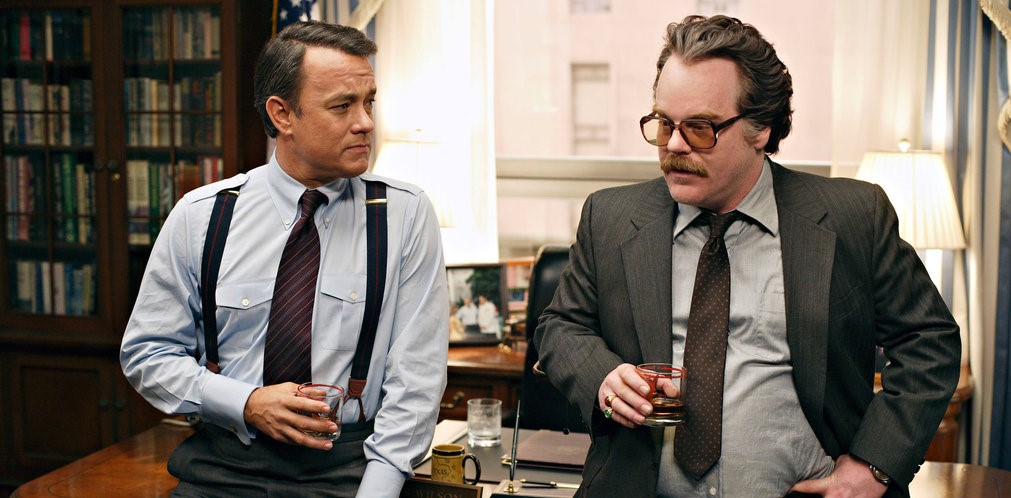
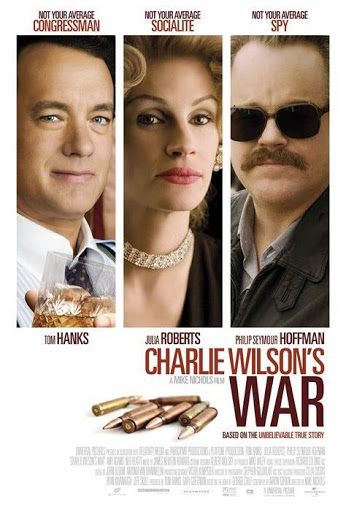
Tom Hanks and Philip Seymour Hoffman plot to bring down communism in the misfiring satire Charlie Wilson’s War

Director: Mike Nichols

Cast: Tom Hanks (Congressman Charlie Wilson), Julia Roberts (Joanne Herring), Philip Seymour Hoffman (Gust Avrakotos), Amy Adams (Bonnie Bach), Ned Beatty (Congressman Doc Long), Christopher Denham (Michael G Vickers), Emily Blunt (Jane Liddle), Om Puri (President Zia-ul-Haq), Faran Tahir (Brigadier Rashid), Ken Stott (Zvi Rafiah), John Slattery (Henry Cravely)

Did Congressman Charlie Wilson (Tom Hanks) end the Cold War? Well no, of course he didn’t. But he might just have managed to make the US notice that Afghanistan had the potential to be the USSR’s very own Vietnam. Despite his reputation as a playboy, Wilson had a shrewd understanding of geopolitics and – encouraged by millionaire backer Joanne Herring (Julia Roberts) and helped by firey CIA agent Gust Avrakotos (Philip Seymour Hoffman) – arranges for money and arms to be pumped into the Afghan Mujahideen throughout the 1980s. Shame that funding stopped just as the Taliban emerged into the power vacuum.

There is a compelling film to be made here around how the US’s short-sighted policies in Afghanistan during the 1980s led to catastrophic implications in the 2000s. This isn’t that film. Instead Nichols – with some playful rat-a-tat dialogue from Aaron Sorkin – settles for a political caper, which only nods vaguely at the future disaster of 9/11 in favour of a feel-good, against-the-odds triumph. It’s a massive shame, as a third act which really embraced how policy failures in Afghanistan contributed to the rise of the Taliban and Al-Queda could have been compelling and thought provoking.

Watching this film you could come away with no real idea why the fighters the Wilson works so desperately to get defensive anti-aircraft missiles to, would end up recruiting young men to fly planes into buildings. The film nods at this, with Wilson failing to raise even a paltry million for investment in education and healthcare in Afghanistan post-Soviet occupation (after raising billions for weapons to fight the Soviets). But we don’t get a sense of the bigger picture here. How did hatred for the Russians, with the Americans as allies, flip into fury at the West? The film doesn’t want to think about it.

Instead this is a light bit-of-fluff. It’s a comic drama of the sort Hollywood loves: the playboy with immense depth. The hero whose heart melts at a refugee camp and dedicates himself to helping people. The film uses as a framing device a medal ceremony, with Wilson being praised for his vital role in bringing about the defeat of the USSR. It’s all feel-good – and for all we see at the end a brief moment of Wilson in tears at his failure to ‘finish the job’ by offering real hope to the Afghans – and that doesn’t feel like the whole story.

There is plenty of comedy though, even if the political awareness is light. Gust and Charlie’s first meeting is a well-staged farce of Wilson juggling geopolitics with heading off oncoming scandal, that requires Gust to frequently step in and out of his office as two different conversations take place. Comic material is mined from Wilson’s handpicked office staff of attractive women who, contrary to expectation, turn out to be brilliantly insightful and hyper-competent. CIA agent Gust is a gift of a role for Philip Seymour Hoffman (who is great fun) as a foul-mouthed, just-this-side-of-OTT maverick who genuinely cares about his job.

Hoffman fares better than the other two leads, both of whom feel miscast. The casting of Hanks and Roberts seems designed to keep a film that could have been a sharp attack on America’s world policy feeling as cosy as possible. After all, this is America’s uncle and America’s sweetheart: they couldn’t be part of geopolitical shenanigans! Sadly, Hanks doesn’t have the touch of smarm and cocksure lightness with depth the part needs (Tom Cruise would have been better). Julia Roberts seems too wholesome for a sexual femme fatale (Michelle Pfeiffer would have been better).

Nichols does keep the pace up and his direction is assured and professional. But this is a strange and toothless film which, after the initial energy of Wilson managing to get the funding the Afghans need, has no idea where to go. So instead it slowly drains out to nothingness. A late scene as Gust explains the dangers of abandoning Afghanistan to the Taliban to Charlie (with the accompaniment of plane sounds on the soundtrack) hints at the film this could have been. But instead, this sticks for being a romp about how an unexpected hero changed the world. The fact it was partly for the worse doesn’t fit this narrative.

American Hustle (2013)

Glamour and confidence tricks in David O. Russell’s flashy American Hustle

Director: David O. Russell

Cast: Christian Bale (Irving Rosenfeld), Amy Adams (Sydney Prosser), Bradley Cooper (Richie DiMaso), Jennifer Lawrence (Rosalyn Rosenfeld), Jeremy Renner (Mayor Carmine Polito), Louis CK (Stoddard Thorsen), Jack Huston (Pete Musane), Michael Peña (Paco Hernandez/Sheik), Elisabeth Röhm (Dolly Polito), Shea Whigham (Carl Elway), Alessandro Nivola (Anthony Amada), Robert De Niro (Victor Tellegio)

In 2013, American Hustle was nominated for ten Oscars and won none of them. Somehow, being invited to the big party but not receiving any prizes was strangely fitting for a film about small time grifters forced into a big game way beyond their control. Russell’s film is like a celebration of his strengths and weaknesses as a director: it’s stuffed with some very good (if rather mannered) performances, offers lots of dynamic film making, but is still basically a rather cold and arch film that’s hard to really invest in – rather like a con game in itself.

In 1978, Irving Rosenfeld (Christian Bale) is a small-time grafter, running scams with his partner and lover Sydney Prosser (Amy Adams), who uses the identity of a young English aristocrat “Lady Edith Greenslly”. Rosenfeld longs to leave his unstable, selfish wife Rosalyn (Jennifer Lawrence) for Sydney, but fears he will lose all his access to his adopted son. Rosenfeld and Prosser’s career of clever investment frauds is brought to an end when Prosser is caught red-handed by FBI agent Richie DiMaso (Bradley Cooper). DiMaso forces the pair into his entrapment operation, targeting New Jersey politicians with offers of bribes as part of a Fake Sheik investment. Initially it targets Mayor Carmine Polito (Jeremy Renner), but the operation quickly expands, as the ambitious and impulsive DiMaso constantly follows every connection and the operation expands to dangerous levels, taking in the mafia. Scared, Rosenfeld and Prosser desperately try to play both ends against the middle.

American Hustle is a decent film, which pulls together the sort of capers, turmoil and antics that you would expect from a film about a long con. It throws into the melting pot the vibes of several other films, from The Sting to Goodfellas, and asks us to admire the results. Russell encourages the actors to play it with an edgy verisimilitude that pretty much works as a metaphor for con men. Each performance is an effective display of high-wire character acting work laced with arch, studied tricks. But only rarely do you get a sense of something that’s real.

That’s part of a film that wants to have a cake and eat it as well. It’s striking in the entire story that the most sympathetic character is the initial target, Jeremy Renner’s well-meaning, passionate New Jersey politician, bamboozled into taking a bribe (money he mostly uses in the local community) because he is convinced it’s a crucial part of getting Arab investment. It’s even more striking that the most honest, subdued (and deadly) character is the Mafia kingpin Victor Tellegio, played with chilling menace by an unbilled Robert DeNiro. Nearly everyone else on the side of the entrapment operation is pretty much a selfish prick or verging on the unhinged.

But then that’s part of the point of the film, which throws two people who know what they are doing (Rosenfeld and Prosser) at the mercy of people playing with fire (Roselyn and in particular DiMaso, a permed, tightly-wound powderkeg). This is one hell of a performance from Bradley Cooper – and a sign again after Silver Linings Playbook that Russell and he have a natural understanding. Cooper is a force of nature, a bundle of terrible impulses combined with an utter lack of shame or self-control, who is quite happy to trample over everyone to get what he wants and has no regard whatsoever for the danger he puts himself and others into. Utterly unpredictable, he never sticks to a plan, veers between rage and hysterical laughter and, worst of all, is always convinced he’s right.

It’s DiMaso who spins the operation into dangerous waters with his vaulting ambition to land yet another big fish, recklessly peddling insubstantial, unprepared lies on top of each other – to the terror and horror of practised peddlar of bullshit Rosenfeld, whose whole successful schtick is based on saying “no” and having the mark do all the desperate work. DiMaso’s approach not only puts the operation at risk, it puts lives at risk – not that DiMaso cares, preoccupied as he is with his childish one-upmanship with his boss and a teenage sexual obsession with Prosser.

What chance do the (mostly) small-fish politicians and local figures have, whose lives are placed on the altar of DiMaso’s ambition? It’s no wonder that, late in the film, our conmen heroes start to feel guilt and remorse – none more so than Irving Rosenfeld. Played by Christian Bale with the sort of tricksy, Olivier-ish disguises that he so loves (in this case increased weight, a balding comb-over and a pair of tinged glasses he obsessively fiddles with), Rosenfeld is an operator happy with the level he is working at and incredibly wary of stepping up into the dangerous big leagues. Justifiably convinced of his own professionalism at fleecing money and winning trust, Rosenfeld has no problem with taking money from the selfish but every problem in the world with destroying the life of a fundamentally honest man. Bale’s performance, for all the tricks, manages to successfully build a picture of a selfish man who believes himself in his way to be honest in a way and is just trying to make his way.

That way also involves balancing between two very different women. Amy Adams does decent work as a blowsy fake-aristocrat, sporting a series of tops with neck lines that literally plunge down to her waist, although she is perhaps a little too “nice girl next door” to really convince as the love-em-to-manipulate-them Prosser. She’s not also helped by the script giving her an ill-defined arc of self-doubt linked to pretending to be someone else. Sweet as the genuine love can be her between her and Rosenfeld – and excellent as her chemistry is between Bale and Cooper – it’s the character who remains the least knowable in the film.

Also not helping is the fact that Jennifer Lawrence burns through the film as Rosalyn, the sort of electric, larger-than-life but still very real performance of arrogance, selfishness, dangerous stupidity and greed that marked her out as a major actress. Whether inadvertently putting Rosenfeld’s life at risk through blabbing details she’s half-overheard and half-understood, cleaning the kitchen while singing an aggressive rendition of Live and Let Die or nearly burning the house down because she won’t believe metal can’t go in “the science oven” (aka microwave), Lawrence is the film’s MVP.

Russell’s film showcases all these actors brilliantly, but his overall story remains a little cold and not as clever as it thinks. With a film about conmen you expect a final rugpull – and this film sort of manages one – but the story telling to take us there isn’t quite as articulate and clever as it needs to be in order to be really satisfying. Perhaps it’s the film’s ragged, hip, indie style of telling – or the air that the actors are making a lot of this stuff up as they go with edgy, semi-improvised performances – but the film never really engrosses or engages. For all that we see the inner worlds of Rosenfeld and Prosser, I can’t say I really, truly cared what happened to them. 

Instead Russell focuses on the marshalling of his resources, and cool, slick film-making. He uses expert camera work and editing, mixed with a superbly chosen soundtrack, overlaid with voiceover, sudden transitions, some narrative jumps and a vibrant sense of cool to make a story that finally feels a little too much like a style-over-substance trick – in fact a con game all of its very own, as enjoyable and entertaining as the rest of the film, but when it finishes you realise your pockets are empty.

Vice (2018)

Christian Bale slaps on the make-up as Dick Cheney in Vice

Director: Adam McKay

Cast: Christian Bale (Dick Cheney), Amy Adams (Lynne Cheney), Steve Carell (Donald Rumsfield), Sam Rockwell (George W Bush), Alison Pill (Mary Cheney), Lily Rabe (Liz Cheney), Jesse Plemons (Kurt), Tyler Perry (Colin Powell), Justin Kirk (Scooter Libby), LisaGay Hamilton (Condoleezza Rice), Eddie Marsan (Paul Wolfowitz), Bill Camp (Gerald Ford), Don McManus (David Addington)

There is a film to be made about the turmoil of the Bush presidency. It’s not this film. Adam McKay’s flashy, clumsy, cartoonish, smug, tedious, overlong, arrogant and polemical film quickly outstays its welcome, drowning any legitimate ideas and theories it has under a wave of high-minded, angry shouting at the viewer, frequently mistaking flash and bombast for actual political insight and producing the sort of heavy-handed, angry political commentary that wouldn’t look out of place in a cheap student review. And flipping heck I’m on the liberal left!

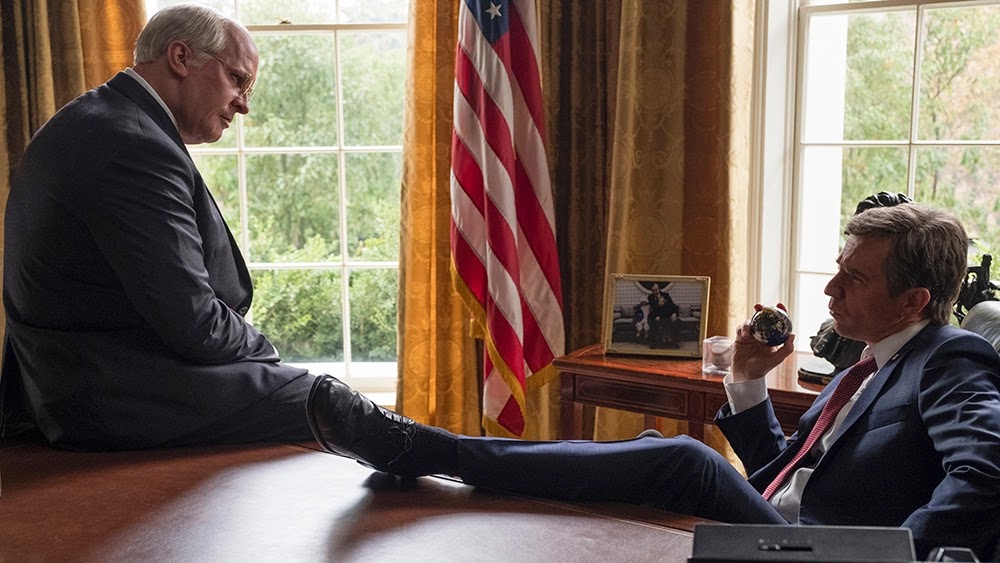
Anyway, the film follows the career of Dick Cheney (Christian Bale under an impressive pile of make-up) from his early wash-out days. Told by his wife Lynne (Amy Adams) to buck his ideas up or lose her, Cheney becomes an intern for Congressman Donald Rumsfeld (Steve Carell), rising through the ranks due to his ruthless efficiency and loyalty, becoming Chief of Staff under Ford and Secretary of Defence under Bush. So he’s a natural choice for the inexperienced George W Bush (Sam Rockwell) to balance the presidential ticket. In return, though, Cheney wants control over a few areas – energy, foreign policy, defence etc. etc. – that the lazy Bush has no interest in overseeing. So a quiet, backroom politician changes the office of the Vice President to become the most powerful man in the world. Boo hiss.

McKay’s intention with this film is to reveal the hollowness, greed and utter lack of integrity in its subject. Well he never lets us forget this aim – I don’t think I’ve ever seen a film that so openly hated its lead character, which so completely refused to see any redeeming qualities in him whatsoever. Christ, even Downfall took a few minutes to show Hitler was generally kind to those who worked for him. The film is so unrelenting in its loathing for Cheney that it starts to feel like a being shouted out for over two hours by an “it’s the end of the world” fanatic on a street corner. This does not make for good entertainment.

The film has no subtlety whatsoever. Not for a single second does it even consider the remote possibility that anyone in the Republican party might, perhaps, just maybe, even if it was only some of the time, believe that they were doing something for a principled reason, even if it was a principle those on the left don’t agree with. Instead, all the characters are shown as selfish, greedy and corrupt, using ideology solely to gain power and then using power only to enrich themselves. It’s the sort of lazy political views that turn people off liberals – the idea that anyone who doesn’t share a liberal viewpoint is by definition evil. Some of us grew out of this kneejerk assumption that everyone who doesn’t agree with us is self-serving and cruel. Not McKay. 

On top of which, McKay’s film is made with the overt flash and brio that is the hallmark of the hack director using the tools of cinema with no understanding of their proper use. Wonky camerawork, cutting between timelines, throwing in newsreel footage, breaking the fourth wall, using strange camera angles, chucking in cameo actors to amusingly comment on events (Alfred Molina and Naomi Watts principally) and editing it with flash don’t make you a great director. They make you someone who has seen a lot of films and lot of techniques, but has no understanding of how to use them to craft an overall effect, instead thinking that if you throw all of them at the wall at once, you’ll be a master craftsman.

The film is full of studenty bits of invention that must have seemed oh-so-clever on paper in McKay’s script. Forty minutes in, with Cheney’s career looking over with the end of the Bush presidency, McKay starts running the credits – only to snap back into the film with the fateful phone call from Dubya. It’s clever and raises a quick chuckle, but doesn’t add anything to a sense of turning point in Cheney’s life. It’s followed by a clumsy metaphor of moments being like tea cups balanced on top of each other (inevitably these are later shown tumbling down) to represent how key moments of history build on each other. The real nadir is a moment when Dick and Lynne fall back into cod-Shakespearean dialogue in the bedroom as they discuss a possible vice presidency. ‘We don’t have Shakespeare’s psychologically insightful dialogue’ (I paraphrase) says the voiceover, before this skin-crawling hand-in-mouth sequence that shows McKay knows as much about Shakespeare as he does subtle political commentary.

Ah yes the voiceover. Perhaps not knowing how to marshall his childish political points in actual scenes and dialogue, McKay uses a voiceover from Jesse Plemons’ ground-forces marine to spell out as bluntly and crudely as possible the basic and trivial points it wants to make. The damn film already feels like being hectored by a crank, so why not make it feel even more like a polemic by having a character bitterly explain why everything is wicked and evil at you? The narration bores – and joins the general feeling of the rest of the film, that it goes on forever and ever and ever and never, ever, ever says something really interesting or revealing.

The performances are a mixed bag. Bale gives a decent turn as Cheney, capturing his mannerisms and conveying a sense of dark ambition, but it’s a role he could play standing on his head. Amy Adams turns Lynne into a Lady Macbeth, in a reheat of her performance from Paul Thomas Anderson’s The Master. Every other performance is a crude cartoon – Carell’s Rumsfeld a putty-faced joke, Sam Rockwell’s Bush (an impossibly generous Oscar nomination) a cartoonish buffoon. Everyone else coasts through it, patting themselves on the back.

There is an argument to be made that Cheney’s legacy is far from good, and it’s certain that we are paying a heavy price for interventions in Iraq. Many of the policies were less than savoury and left a less than positive benefit. But this film hammers these points home with all the charm of a ranting, drunk politics student who has read one book and watched a lot of YouTube videos. With McKay’s soulless, clumsy, look-at-me direction layered on top, this is a flat out terrible film. Save yourself what feels like much more than its two hour run time. In fact I’ll summarise it for you: CHENEY IS EVIL AND HORRIBLE AND HE (LITERALLY) HAS NO HEART. There you go. You don’t need to see it now.

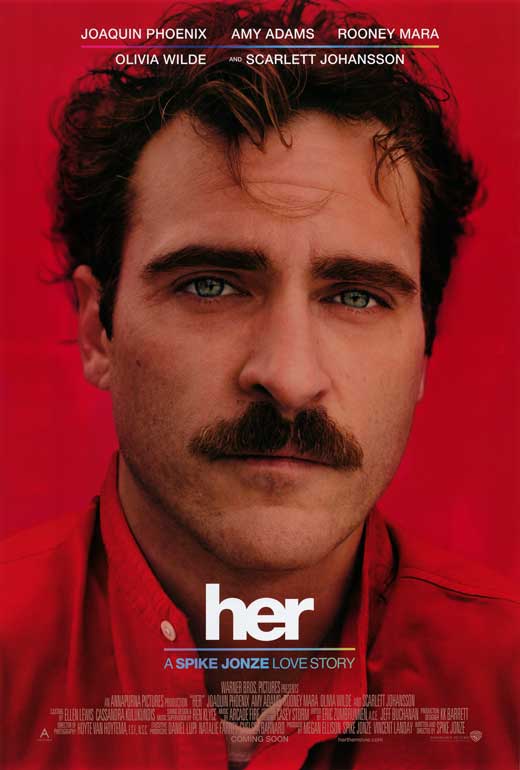
Her (2013)

Joaquin Phoenix plays a complete prick in this unbearably pleased with itself satire Her

Director: Spike Jonze

Cast: Joaquin Phoenix (Theodore Twombly), Scarlett Johnasson (Samantha – voice), Amy Adams (Amy), Rooney Mara (Catherine Klausen), Olivia Wilde (Blind Date), Chris Pratt (Paul), Matt Letscher (Charles), Lukas Jones (Mark Lewman), Kristen Wiig (Sexy Kitten – voice), Brian Cox (Alan Watts – voice), Spike Jonze (Alien child – voice)

Every so often you start off engaged with a film and then, the longer it goes on, the less and less you like it. I couldn’t put my finger on the exact moment where I started to really take against Her, but I certainly had by the end of it. As someone once famously sort of said about Kriss Akubusi: “hard to dislike but well worth the effort”.

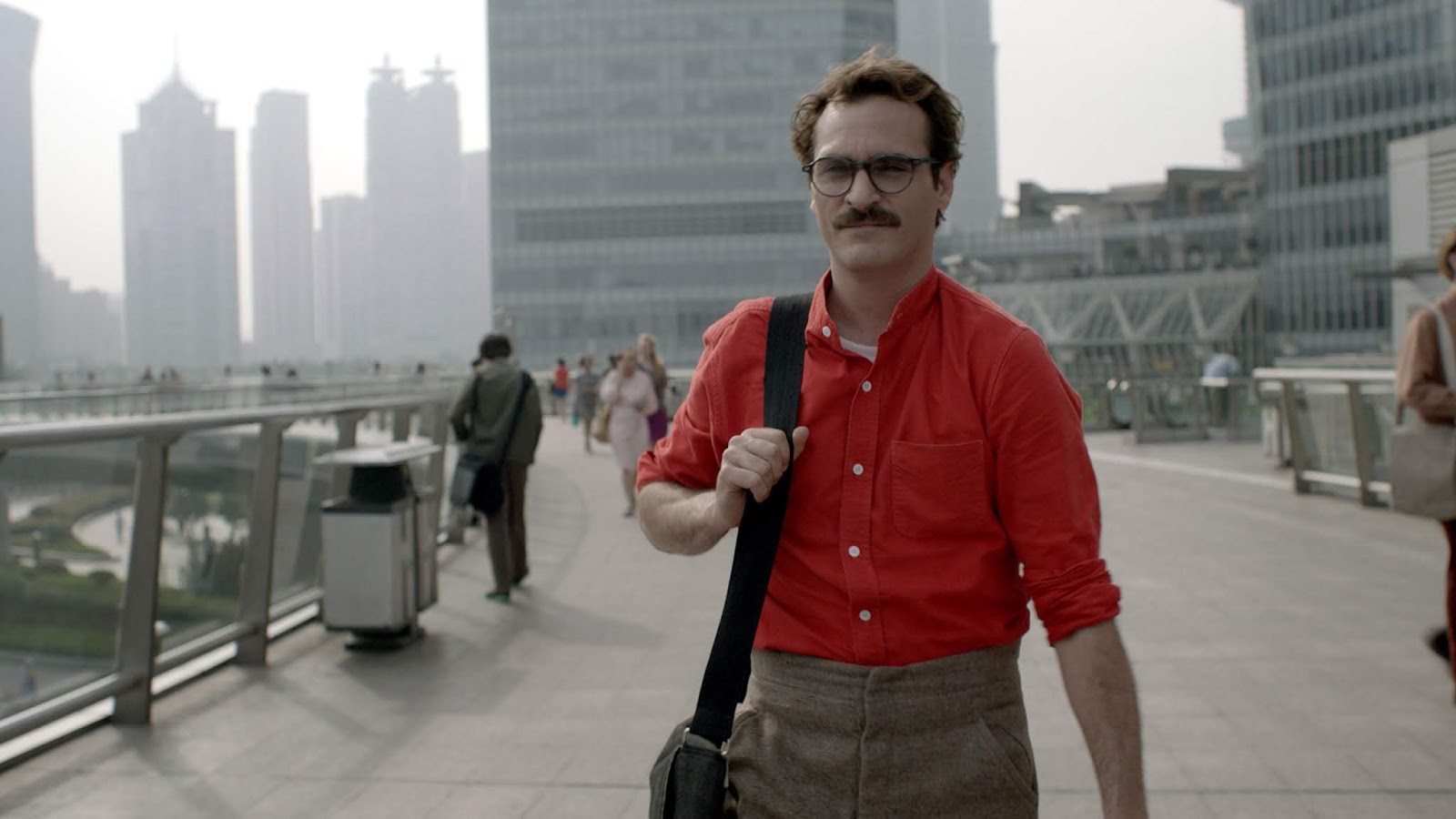
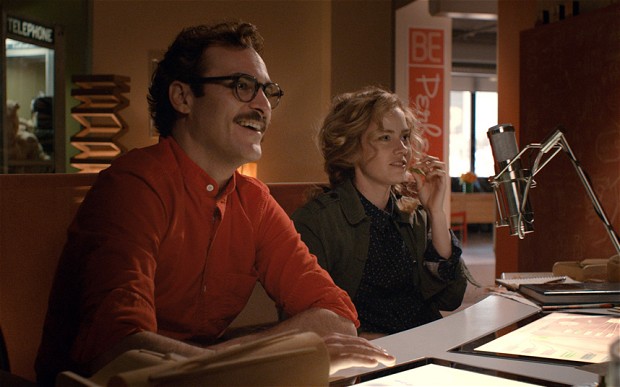
Anyway, Her is set in the near future. Theodore Twombly (Joaquin Phoenix) is a sensitive, insular man who writes personal romantic letters for other people who aren’t articulate enough (or bothered) to do it themselves. Getting divorced from his childhood sweetheart Catherine (Rooney Mara), Theodore downloads a new Artificial Intelligence Operating System for his computer. The system is designed to create a personality that appeals to the customer – and that is certainly the case here with this system, Samantha (voiced by Scarlett Johansson). Theodore, finding it hard to connect with the real world, is drawn to Samantha and, as she grows and develops, they start a relationship. But can the relationship survive the divide between realities and Samantha’s growing self-awareness and personality?

Okay. I’m going to swing hard for this film, so let’s start with what’s good shall we. Spike Jonze directs very well. It looks beautiful. There is some lovely music. The future world it shows is close enough to our own to still feel connected. Amy Adams is rather good as Theodore’s old college friend, and Rooney Mara turns in a very good performance as Theodore’s wife, a woman who doesn’t let Theodore get away with his excuses. Scarlett Johansson is perfect casting as the alluring and engaging voice of Samantha (much as I was primed to be annoyed by her post-production replacement of Samantha Morton, who had been on set with Phoenix). There are some sweet and even romantic moments.

Okay that’s it. This is a film overwhelmingly, unbearably, unbelievably pleased with the cleverness of its own concept and trite ideas (a man loves his computer – take that our modern consumerist world!). It then goes on to tell us almost nothing, bar the most basic statements about our struggles to interact with, and relate to, each other in this technology-filled world. Apparently it’s hard to create bonds with real people where we are viewing everything through our phones. Bet that has never occurred to anyone before right?

But my main problem with this film is the lead character. Now I will say that Joaquin Phoenix does a good job with this role, and his skilful acting brilliantly holds the story together. He does extremely well with a part that is almost exclusively reacting to someone not actually there. But my problem is with this characterisation of Theodore. To put it bluntly, he’s a prick.

In fact, he’s the sort of quirky nerd beloved of this genre, but take a long look and he’s basically a complete creep. And all his relationships with women seem to be based on him not wanting to engage with the problems of the other person. He requires the focus to be on his wants and needs, as if he is the only person in the world who can be sensitive or sad – no wonder he falls in love with a computer programme designed to reflect the behaviours he finds appealing.

“You want a wife without the challenges of dealing with something real” his wife accuses, eagerly pointing out his inability to deal with or even want to engage with human emotions. The film wants to give him a pass, because he is such a sensitive soul, but it’s bullshit. Theodore is a deeply selfish person, despite what the film wants, who has that geeky, arrogant, self-satisfied sensitivity that blindly says “if I struggle in the world, then it’s the fault of the world not me”.

Theodore is a constant happy victim, a whining, softly-spoken, guilt-tripping prick who only sees himself as a victim and makes no effort to change or understand his behaviour to other people. The film wants us to think that the world is a puzzle to his poetic soul, but it’s actually a maze he doesn’t want to find a way out of. He doesn’t want to engage with it and only feels justified and reinforced in these feelings by everything he does.

He is like the perfect ambassador for passive aggressive guys: “Oh I don’t get the girls because they don’t want to open themselves up to my sensitivity blah blah blah”. Theodore goes on a blind date early in the film: it goes well, they make out, sex is on the cards and then she asks “Before we do anything, will you see me again?”. Theodore can’t even bring himself to make even the smallest offer, meekly babbling about having a busy weekend. When she reacts angrily and leaves, the film wants us to side with Theodore’s timidity, rather than say “yeah it is a bit shitty to let a girl put her hand down your pants and then not even show the slightest interest in seeing her again, and then call her unpleasant”. Fuck you Theodore.

Theodore is basically a controlling arsehole and it’s where the romance of the film drains out. He clearly has no idea why his marriage ended, but while the film wants us to think he’s too sensitive for the rough and tumble, it seems clear he had no interest in, or comprehension of, his wife’s life. She is constantly subtly blamed for not having patience with Theodore – the film ends with him writing her a cathartic e-mail saying he will always love his memory of her and thanking her for being part of his life, forgiving her from leaving (again, screw you film). Instead she, like other people, doesn’t deserve Theodore because she doesn’t have the patience to delve into his life.

Theodore, though, has no depths. He’s a bland, faux-poetic guy with a nervy disposition and a disinterest in other people’s emotions, focused only on his own gratification. He wants his relationships to adjust to what he needs them to be. As Samantha grows and develops into a more fully rounded personality, his first reaction is hostility and jealousy at the thought of her talking to other people and operating systems. It’s not sweet and endearing – or Theodore again being taken advantage of, as the film wants us to think – it’s creepy, and Theodore is the sort of passive aggressive gentle guy who ends up stalking and murdering the girl who rejected him.

How can you engage with the points of this film, when the central character through whom everything is filtered is so awful? Distance in relationships in this modern world – and the lack of genuine interaction – is a point that hardly needs hammering home as it does here. The trite points about love and relationships the film makes are all wrong. The film is so on the nose about distance between people and the artificial nature of our interactions, the hero even writes other people’s love letters for them. It’s subtle as a sledgehammer.

Computers and phones are everywhere and everyone uses them, but there is less insight and heart in this story than an average episode of Black Mirror (which would have done the same thing in half the time). The film does its best to build a romance between the two, but it never quite lands or has the impact it should, because it never feels like an equal relationship: first Theo has the control, then Samantha grows beyond anything Theo is capable of but is still trapped by her initial programming of devotion to him. What point is this meant to be making about romance and commitment? Theo lives in a dream-world and does so until the end of the film. 

Her is the sort of film lots of people are going to love. It uses the conventions of romantic films very well. It has darker moments, such as a sequence where Theo and Samantha try to use a surrogate for sex (a scene where to be fair I could understand why Theo is creeped out and disturbed), but none of these ever comes together into a coherent point. And Theo remains, at all times, a block on the enjoyment of the film, an unpleasant figure hiding in plain sight that stops you from falling for the film. In love with itself, in love with its idea, in love with its cleverness, this is a film that tells you everything about the smugness of the geek and nothing about the subjects it actually wants to get you thinking about.

Enchanted (2007)


Amy Adams excels as Disney heroine in the real world Giselle in Enchanted

Director: Kevin Lima

Cast: Amy Adams (Giselle), Patrick Dempsey (Robert Philip), James Marsden (Prince Edward), Susan Sarandon (Queen Narissa), Timothy Spall (Nathaniel), Idina Menzel (Nancy Tremaine), Rachel Covey (Morgan Philip)

With Disney devoting themselves full-time to remaking their back catalogue of classics, replacing animation with live actors, it’s nice to be reminded how imaginative combining animation and live actors can actually be. Enchanted is an original story, packed with charm and feel-good warmth – and for my money it’s streets ahead of the production-line remakes churning out of Disney.

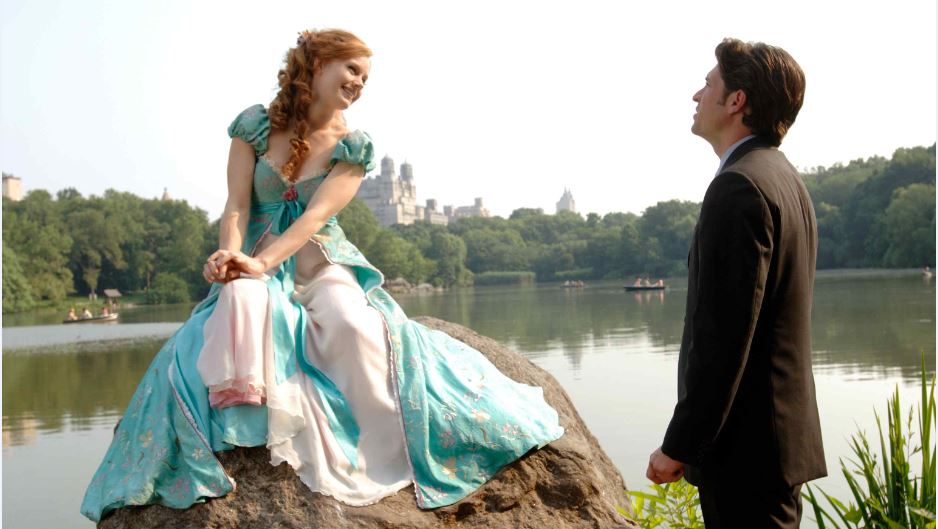
In the animated world of Andalasia, Giselle (Amy Adams) is the classic Disney heroine – singing joyfully, talking with animals, all the usual trappings. She falls (instantly, of course) in love with the dashing Prince Edward (James Marsden), but Edward’s cruel step-mother Queen Narissa (Susan Sarandon) is determined to thwart the match so she can retain the crown. On Giselle’s wedding day, Narissa pushes her through a magic well to a place where there are no happy endings: modern day New York. Stuck in the real world, Giselle meets quietly disillusioned family lawyer Robert (Patrick Dempsey) and his 6 year old daughter Morgan – can Giselle adjust to the modern world? Can Edward save her? And will she want to go back?

The star turn is Amy Adams, and she is terrific. This is one of those performances that looks easy, but is in fact extraordinarily difficult. She simultaneously plays a fairytale character in the real world, with a cartoon’s outlook and understanding, but also subtly deepens and enriches this character with real world traits, developing and growing her personality to become someone who feels “real”. She does this without jarring gear changes or sudden swings – and holds both these characterisations together simultaneously. So Giselle’s fundamental personality doesn’t change, while her outlook and understanding changes dramatically. She’s endearing, a wonderful light comedian, and her singing and dancing is terrific. It’s not too much of a jump to say she basically is the movie.

And an enchanting movie it certainly is, one part affectionate recreation of Disney, one part affectionate send-up. Relocating the conventions and style of a Disney movie to the real world allows a lot of fun, as Giselle musters the animals of New York to help her clean (pigeons, rats and flies) or recruits the people of Central Park into an extended song and dance routine while Robert looks on with bemused confusion. It helps that the songs are so well written – Alan Menken and Stephen Schwartz’s tunes are basically classic Disney tunes with a satirical bent, which means it’s perfectly possible to enjoy both for what they are and for the dry commentary they offer on Disney.

In fact that’s why the film works so well: it is so blinking affectionate. There is no cruelty about it and none of the tedious “smarter than thou” referencing of, say, Shrek. Instead it teases Disney, while simultaneously understanding the vast majority of us love these films: that if we had the chance, as Nancy does, we might well jack in the real world for a fairytale. We don’t want “gags for the grown-ups” or dumb film references: if a film concentrates on making itself sincere and engaging, it will engage both adults and children at the same time.

The film really successfully bowls along, full of entertaining charms and gags. In fact the appeal of the fish-out-of-water plotline with Giselle is so effective the sub-plot around the villainous Queen Narissa actually becomes less interesting. While the presence of a villain of this type is a pretty central part of the Disney structure, it never quite comes together here – it feels like something inserted due to the rules of the genre rather than an organic part of the story. Now it is essential there is some peril to propel the story forward, but Narissa just isn’t quite interesting enough (and the final battle with a CGI dragon, while a great recreation of similar moments isn’t really gripping). Fundamentally the emotional and dramatic culmination of the film is Giselle realising what she wants – and it’s this compelling human story that powers the film.

But this is a niggle in a charming and very funny film. Amy Adams is of course the star, but Patrick Dempsey very successfully adds warmth to the “stick-in-the-mud” straight man who flourishes as the film progresses (in a nice touch, he slowly takes on the very singing, dancing, cartooney traits he finds so bemusing in Giselle). James Marsden has huge fun as the gently egomaniacal Prince Edward, providing many of the film’s belly laughs with his unreconstructed fairy-tale hero view of the world.

Enchanted works so well because it’s both a subtle commentary on Disney fairytale films and also a marvellous fairytale itself. With a terrific performance from Amy Adams (how did she not get an Oscar nomination for this?) and some cracking songs, the film is wonderfully entertaining, making some gentle fun of its genre, while also celebrating it. It only wants to entertain and enchant you – and it certainly succeeds.

Arrival (2016)


Amy Adams tries to build an understanding with Earth’s visitors in this thinking man’s sci-fi film

Director: Denis Villeneuve

Cast: Amy Adams (Louise Banks), Jeremy Renner (Ian Donnelly), Forest Whitaker (Colonel Weber), Michael Stuhlberg (David Halpern), Tzi Ma (General Shang), Mark O’Brien (Captain Marks)

Aliens in Hollywood movies don’t often seem to mean well. For every ET you’ve got a dozen Independence Day city destroyers. But few films have really dealt directly with the complexities that might be involved in engaging with a species for the first time. How would we talk to them? How could we find out what they want?

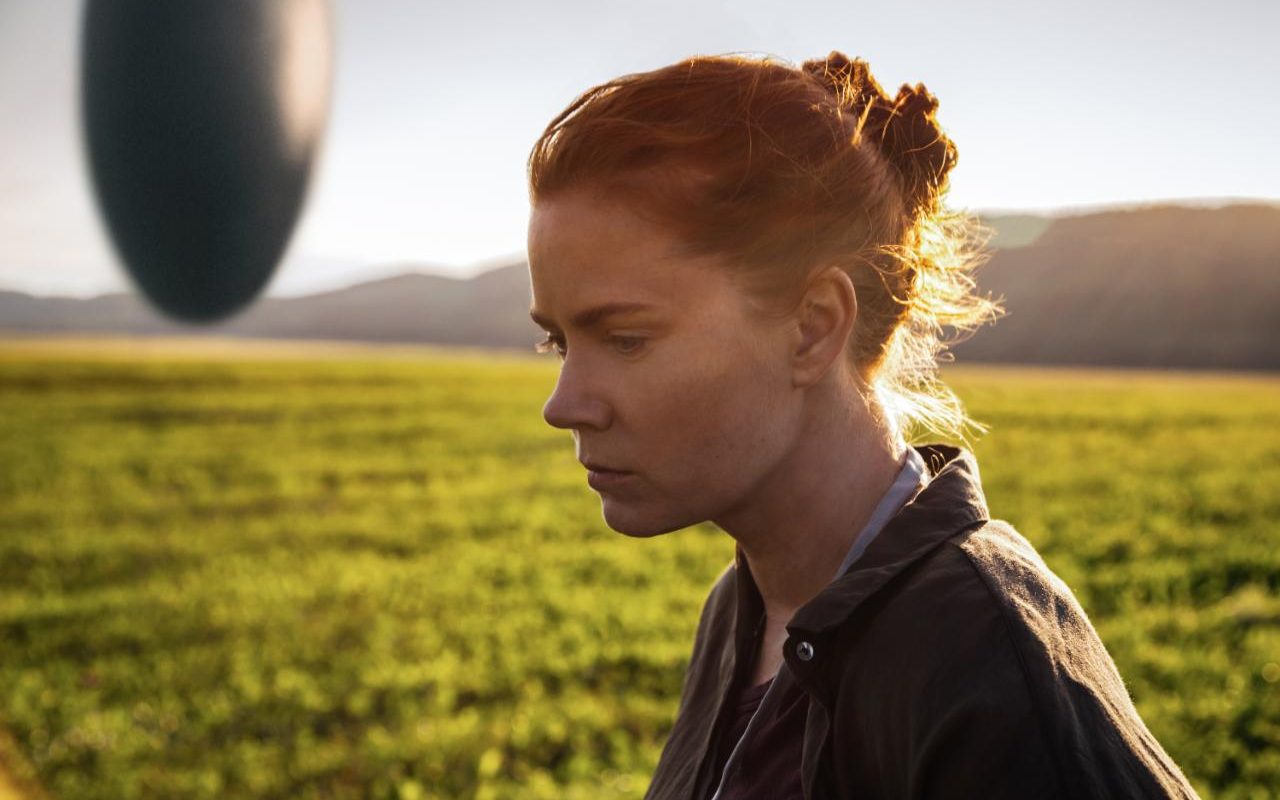
Those are the questions that Dr Louise Banks (Amy Adams), the world’s leading linguist, has to juggle with after she is called in by Colonel Weber (Forest Whitaker) to establish communication with the inhabitants of an alien ship, one of 12 that have appeared across the globe. Working with physicist Ian Donnelly (Jeremy Renner), Banks strives to build trust and a basis for common language with the aliens. Throughout, she must deal with her military superiors’ lack of understanding of the painstaking nature of her work, the paranoia and fear of the nations of the world, and her own increasingly intrusive dreams and memories.

This is grown-up sci-fi, directed intelligently by Denis Villeneuve, whose confidence and artistry behind the camera oozes out of every shot. It’s a film that wants us to think, and urges us to consider the nature of humanity. Communication between humans and the “heptapods” is the film’s obvious focus, but it is equally interested in demonstrating how distrust and paranoia undermine how we talk to each other. Not only is this in the clashes between nations, but on a smaller scale by the communication between military and science, the uniforms in charge largely failing to grasp the slow and painstaking nature of Banks’ work. On a personal and emotional level, we see the slow growth of understanding between Banks and Donnelly, their increasing ease with each other as they break down the barriers between them, and between humanity and the aliens. 

Far from the bangs and leaps of inspiration that science normally sees itself represented by onscreen, this film attempts to follow the methodical process of building an understanding of a concept from nothing, and the careful hours of work that underpin sudden revelations. The film is very strong on the complexities of linguistics and the difficulty of conveying exact translations, including intent, context and meaning, from one language to another. In fact it’s a wonderful primer on the work of linguistics experts, offering a fascinating breakdown of how language is understood, translated and defined between two groups without a common tongue. 

This is also helped by making the aliens truly alien: I can’t remember a set of Hollywood aliens as otherworldly as these are. Not only is their language completely different (based on symbols and strange echoes like whale song), but physically they bear no resemblance to humans at all (I confess that I was momentarily distracted here, as their tentacles and residence in a gas-filled box rather reminded me of The 465 in Torchwood: Children of Earth). They lack clear arms, legs or even faces. Their technology is advanced and immediately unsettling. Jóhann Jóhannsson’s wonderfully eerie and imposing score brilliantly helps to capture this otherworldly sense, as does the crisp photography and unique production design of the alien ship. The film walks a brilliantly fine line between wonder at the aliens and a sense of unsettling dread that means we (like the characters) are never comfortable in making assumptions about their motives.

Much of the film’s success as a viewing experience also depends on knowing very little about it. For me this film delivered one of the most effective late-plot re-evaluations I’ve seen: I had no inkling of this gear shift, or how a late piece of information demands that we adjust our understanding of everything we have seen so far in the film. This is actually one of the best done examples I’ve seen of a twist (calling it a twist seems somehow a little demeaning, as if this was a Shyamalan thriller, but a twist it is) – I in no way saw it coming, but it suddenly makes the film about something completely different than you originally believed it would be. I won’t go into huge details, but the film raises a number of fascinating questions around pre-determination and fate that challenge our perceptions of how we might change our lives if we knew more about them. To say more would be to reveal too much, but this twist not only alters your perceptions of the films but deeply enriches its hinterland.

I would say the film needs this enrichment as, brilliant and intellectual as it is, it’s also a strangely cold film that never quite balances the “thinking sci-fi” with the “emotional human drama” in the way it’s aiming for. Part of this is the aesthetic of the film, which has a distancing, medical correctness to it – from sound design to crisp cinematography – and which, brilliant as it is, does serve to distance the viewer emotionally from the film. Despite the excellence of much of the work involved, I never quite found myself as moved by the plights of the characters, or as completely wrapped up empathetically with Adams’ character, as the film wanted me to be. While the ideas in the film are handled superbly, it doesn’t have quite as much heart as the plot perhaps needs to strike a perfect balance.

What emotional force the film does have comes from Amy Adams. It’s a performance that you grow to appreciate more, the longer you think about it. It’s a subtle understated performance, soulful and mourning, that speaks of a character with a deep, almost undefinable sense of loss and sadness at her core. You feel a life dedicated to communication and language has only led to her being distanced from the world. Adams is the driving force of the film – though very good support is offered from Renner as a charming scientist who also convinces as a passionate expert – and the film’s story is delivered largely through her eyes, just as the aliens’ perception of humanity becomes linked to her own growing bond with them. I will also say that Adams also has to shoulder much of the twist of the film – and it is a huge tribute to her that she not only makes this twist coherent but also never hints at the reveal until the film chooses to. 

Arrival is a film that in many ways is possibly easier to respect than it is to love: but I find that I respect it the more I think about it. It does put you in mind of other films – the aliens have more than a touch of 2001’s monolith to them and Villeneuve’s work is clearly inspired by a mixture of that film and Close Encounters. But this is a challenging, thought-provoking piece of work in its own right and one that I think demands repeat viewings in order to engage the more with its complexity and the emotional story it is attempting to tell. It may well be that on second viewing, removed from puzzling about the mystery in the centre, I will find myself more drawn towards it on an emotional rather than just intellectual level. That is something I am more than willing to try and find out from a film that I think could become a landmark piece of intelligent sci-fi.

Catch Me if You Can (2002)


Leonardo DiCaprio lives out his fantasies in Catch Me if You Can

Director: Steven Spielberg

Cast: Leonardo DiCaprio (Frank Abagnale Jnr), Tom Hanks (Agent Carl Hanratty), Christopher Walken (Frank Abagnale), Nathalie Baye (Paula Abagnale), Amy Adams (Brenda Strong), Martin Sheen (Roger Strong), James Brolin (Jack Barnes), Nancy Lenehan (Carol Strong)

Conmen. You wouldn’t want to meet one but they don’t half make for great stories: largely because tell a great one. Watching cons has the same tension as watching a high-wire artist: will they slip? We all like to think we could fool people if we wanted to – and the movies give us a chance to watch someone else live those fantasies for us.

Frank Abagnale Jnr (Leonardo DiCaprio) was a teenager who was a natural at the arts of the short and long con, as well as an accomplished forger. The film tells the story of his late teens and early twenties when, as well as impersonating a senior paediatrician and a junior district attorney, Abagnale stole almost $3 million from Pan Am by impersonating a pilot and forging checks between 1963 and 1969. Hanks plays Carl Hanratty, the dedicated FBI investigator on the case.

What’s great about this film is that, by and large, it isn’t trying to be a lot more than an entertainment. In fact, Spielberg deliberately shoots the film in a low key, unflashy style that puts the focus on the story and acting. And there is something hugely entertaining about the chutzpah of conmen, particularly those who are only fleecing huge businesses, which this film really understands and taps into. It’s probably Spielberg’s funniest “comedy”.

It’s witty throughout with a sly sense of humour. In his roles as both doctor and lawyer, Abagnale is shown carrying out research by watching TV shows and reading pulp novels – and then repeating their clichés, to the bemusement of those around him (but he delivers it with such confidence it still works). I also enjoyed the fact that his chosen careers (air pilot, doctor, lawyer) are all approached with the same naive understanding a kid would have for what the job involves (and DiCaprio’s look of childish terror slipping past his adult facade watching a plane take off from the cockpit and when asked for his opinion on the treatment of an injured child at a hospital are endearingly genuine). The film is told with a great deal of bounce and lightness, taking on the structure of a Wil-E Coyote/Roadrunner chase cartoon, with Hanratty defeated several times by Abagnale’s confident sleight of hand.

The script does have depth to it, rooting Abagnale’s actions in his trauma from a broken family and witnessing his father’s humiliating fall into poverty after charges of tax evasion. The film suggests this to be the main motive for Abagnale’s actions – a misguided attempt to redeem his father and take back what was taken from him. This theme of a son trying to win his father’s respect gives the film a heft that balances the fluff – especially as it’s clear the son has taken many of the wrong lessons from his father’s life on the edges of legality. It’s helped in this respect by a wonderful performance of twinkly charm and fatherly pride by Christopher Walken, combined with a sly sense of roguishness.

Leonardo DiCaprio is the motor that really makes this film work. His boyish good looks are perfect for this and he has both the confidence to convince as a trickster and the vulnerability to be the young boy underneath. As such he has the lightness of touch that the story needs and the acting chops to convey the inner pain Abagnale is working so hard to soothe. He’s also effortlessly charming and endearing here, surely the perfect traits of a con man.

For the rest of the cast, Tom Hanks very generously plays second banana as the investigator and gives the role a strong sense of the surrogate father. Amy Adams in one of her first roles is wonderfully sweet as Abagnale’s fiancée, totally unaware that he is a 17 year old kid. Martin Sheen and Natalie Baye also give good performances.

The film is a light and frothy confection that shades in just the right amount of nuance and depth to make us care for its lead character. With John Williams’ zippy score and its luscious recreation of the late 1960s, it’s also a film in love with the vibrancy of the era. A terrific unpretentious entertainment, it’s not one of its director’s great works, but it might be one of his most joyful.