

Playing like a double-length TV episode with some embarrassing humour, not enough special about Insurrection
Director: Jonathan Frakes
Cast: Patrick Stewart (Captain Jean-Luc Picard), Jonathan Frakes (Commander William Riker), Brent Spiner (Lt Commander Data), LeVar Burton (Lt Commander Geordi LaForge), Michael Dorn (Lt Commander Worf), Gates McFadden (Dr Beverly Crusher), Marina Sirtis (Counsellor Deanna Troi), F. Murray Abraham (Ru’afo), Donna Murphy (Anji), Anthony Zerbe (Admiral Doherty), Gregg Henry (Gallatin), Daniel Hugh Kelly (Sojef), Michael Welch (Artim)
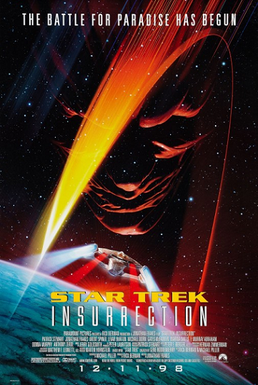
After the smash-hit success of Star Trek: First Contact, the Next Generation franchise had a golden opportunity. Like never before, Paramount put the cash up (almost twice what it did for First Contact) and geared up to make Insurrection a smash-hit. But then it all went a little wrong. There’s nothing particularly offensive about Star Trek: Insurrection – apart from that fact that there is nothing particularly outstanding about it either.
The Enterprise crew are called to a secluded planet in the middle of a nebula after Data (Brent Spiner), on secondment to an undercover mission observing the peaceful pre-Warp Ba’ku people, suddenly goes berserk and holds the rest of the mission hostage. Picard (Patrick Stewart) and the crew recapture and repair Data – only to find that the android flipped out after being injured discovering a secret conspiracy. Misguided Starfleet Admiral Doherty (Anthony Zerbe) is working with the shady Son’a, led by the clearly maniacal Ru’afo (F. Murray Abraham), to force the Ba’ku to leave the planet so the Federation and Son’a can mine (aka steal) the planet’s atmospheric particles which can regenerate humanoid bodies (the whole planet is basically the fountain of youth). Outraged, Picard and his crew decide this will not stand and rebel to stop it.
Now I love Star Trek: The Next Generation. If I had seen Star Trek: Insurrection in two parts, with a year-long cliff-hanger in the middle after Picard chucked in his com badge and went rogue, I’d probably think this was one of the best episodes ever. But as a film? It feels like an episode unwisely moved to the big screen. I can totally see why this failed to be the same breakout hit First Contact was. That dialled the stakes up to the Nth degree and felt cinematic: Insurrection feels like it could have sat quite nicely in two 45 minute, 4:3 chunks.
Even worse, despite the money lavished upon it, it actually looks cheaper than First Contact. This is partly because a large chunk of the money was poured into location shooting. While it must have felt very different to the cast and crew – used to sound stages and the odd trip out to the Californian valleys for an exterior – to suddenly be out in Sierra Nevada, honestly it doesn’t look that different to a host of other planets the crew visited in the show. Neither does the Ba’ku village look that different from the homespun, pre-Warp villages the crew visited at least a few times a season.

It doesn’t help that the Ba’ku are exactly the sort of new-age windbags the franchise has always had an inexplicable fondness for. In their cream robes, mouthing new-age mantras about putting self-discovery first and the beauty of self-improvement, they come across like a gang of smug hippies, rubbing their perpetual youth in the viewer’s face. Throw in the fact that they contribute little to their own defence, other than patronising shakes-of-the-head towards the Son’a, and it’s rather hard not to feel they deserve to be taken down a peg or two. And really, hoarding these life-changing regenerative particles so that only an elite few (happy to expel dissenters from their world) benefit rather than the billions in the galaxy, is a harder-sell the more you think about it.
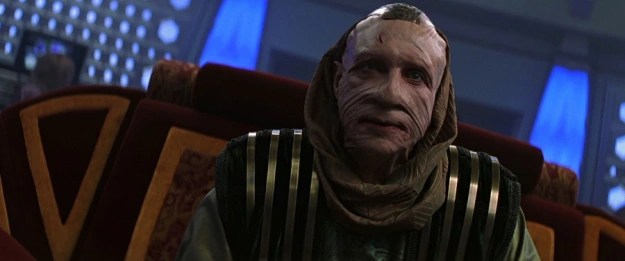
Mind you, it doesn’t help that the Son’a are a gang of less-than-compelling heavies, clinging to what’s left of their youth by constantly subjecting their bodies to a series of bang-on-the-nose cosmetic surgeries (nothing in Insurrection is remotely subtle). Blatantly untrustworthy villains from the start – it’s inexplicable to me why anyone would even consider working with these transparent gangsters from the get-go – their characterisation is one-note with Ru’afo, our villain, played in lip-smackingly precise tones by a slumming-it F. Murray Abraham. The more interesting by far villain is the deeply conflicted Admiral Doherty, a decent performance of “trying-to-do-the-right-thing” desperation that sees him edging towards damnation one tiny step at a time.
While some riffs land better than others, Insurrection unwisely plays the comedy card heavily. Picard, Worf and Data singing HMS Pinafore during their capture of the confused android is pretty droll (not least Michael Dorn’s excellent line in stunned reluctance), while Marina Sirtis and Jonathan Frakes actually manage to inject the re-discovered romantic spark between Riker and Troi with genuine playfulness that is rather sweet. But other stuff is the sort of gag-work that makes fans like me place fists in our mouths and hope no one catches us watching this. Beverly and Deanna talking about their boobs firming up anyone? Worf getting a pimple? Data playing in a haystack? Jesus Christ, no wonder I never told girls I liked Star Trek.
The comedy – and an awkwardly unconvincing romance between Picard and the frankly deeply annoying Anji, played with an irritating Earth-mother purity by Donna Murphy – often undermines the action and lowers the stakes. Although there is a noble attempt to engage with the moral complexities here – a classic “good of the many” situation – the film boils most of this down into a single crucial scene, which relies a lot on Patrick Stewart’s unmatched ability with a speech (Picard here is more like the character in the TV series then he is elsewhere in the film series) but the film isn’t deft enough to centre its moral dilemma. You end up wondering why the crew take such a radical stand. Its uncinematic stakes don’t help – it all feels similar to the sort of situation our heroes waded into exactly 175 times before over seven years. Why take it so much to heart now?
When action does kick-in, Jonathan Frakes does a decent job of directing it. Some of the Sierra Nevada-set action as Picard and his crew march the Ba’ku to the hills to prevent them being picked off the planet by the Son’a has a decent Western feel to it (including a Leone-homage series of frowning forehead shots). There is a decent space battle between the Enterprise – helmed by Riker – and the Son’a. I’ll even admit that the ridiculous “manual steering column” (essentially a joystick Riker uses to fly the Enterprise) is fairly entertaining. Like First Contact – and Nemesis would finally peak in this regard – the ending involves a Die Hard style smack-down between a trigger-happy, shirt-clad Picard and the villain on an utterly unconvincing set (which looks like they didn’t bother to finish the blue-screen work). But all this stuff never feels different from anything we’ve seen before.
So used, it seems, to making less stretch to more, I think the crew – and Frakes – didn’t know what to do when actually given more. They focused instead on all the wrong things: huge sets we almost never see, location shoots that don’t look that different from dozens of other films, more extras. Match that up with a bland story, unconvincing and plain irritating guest characters, and a tonal mess that slipstreams between half-hearted comments on ethnic cleansing to awkward pratfalls and Star Trek: Insurrection is the worst thing a Trek movie can be: a double-length episode which, if you missed, it wouldn’t really matter.
 Movie Musings