Tag: Anya Taylor-Joy

Furiosa: A Mad Max Saga (2024)

Furiosa: A Mad Max Saga (2024)

Deliriously overblown and full of demented imagination even if it never quite feels necessary

Director: George Miller

Cast: Anya Taylor-Joy (Furiosa), Chris Hemsworth (Dementus), Tom Burke (Praetorian Jack), Lachy Hulme (Immortan Joe), Alyla Browne (Young Furiosa), George Shevtsov (History Man), John Howard (People Eater), Angus Sampson (The Organic Mechanic), Nathan Jones (Rictus Erectus), Josh Helman (Scotus), Charlee Fraser (Mary Jabassa), Elsa Pataky (Mr Norton)
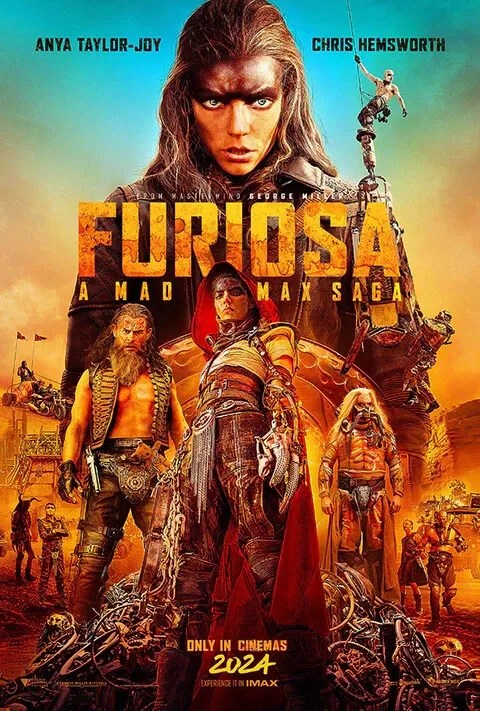
Is there a more demented mainstream film series than Mad Max? Furiosa follows the balls-to-the-wall excess of Mad Max: Fury Road with more of the same and a mythic atmosphere of Godfather Part II-backstory deepening. What you end up with might feel slightly odd or self-important – over two and a half hours of direct build-up for a pay-off we saw almost ten years ago (perhaps that’s why Furiosa ends with a cut-down play-back of the major events of Fury Road spliced into the credits, so we can all be reassured the villains left alive here got their comeuppance later). Furiosa is frequently overlong, a little too full of its love of expansive world-building and never quite convinces you that we actually need it – but then it’s also so bizarre, Grand Guignal and totally nuts perhaps we should just be happy that, in a world of focus-grouped content, it even exists.

We’re back on the desert wasteland of post-apocalyptic Australia as motorbike riding goons kidnap young Furiosa (Alyla Browne) from the Green Place hoping to use her to persuade crazed war lord Dementus (Chris Hemsworth) to lead his forces there. Despite the heroic efforts of her mother (Charlee Fraser), Furiosa remains a captive with only a secret tattoo on her arm (guess what’s going to happen to that…) to guide her home. Dementus provokes a resources war with cult-leader Immortan Joe (Lachy Hulme), with Furiosa traded, then escaping a hideous fate as one of Joe’s wives, instead growing up secretly-disguised as a boy (becoming Anya Taylor-Joy) as part of Praetorian Jack’s (Tom Burke) War Rig crew. Then the war between Immortan Joe and Dementus explodes again, foiling Furiosa and Jack’s plan to escape and giving Furiosa a change at revenge against Dementus.

That sprawling plot outline hopefully gives an idea of the ambitious bite George Miller is taking out of his world. While Fury Road took place over, at most, a few days, Furiosa stretches well over twenty, so gargantuan in scale and newly invented locations (as well as the mountainous citadel, we get the oil-rig nightmare of Gas Town and the Mordor-like Bullet Town) that it squeezes most of the entire Act Five war between Dementus and Immortan Joe into a brief, tracking-shot, montage. Furiosa is actually rather like a fever-dream Freud might have had after reading an airplane thriller, split into on-screen chapter titles – each with portentous (and sometimes pretentious) names like ‘The Pole of Inaccessibility’ – and a self-important narration dialling up mythic importance. If Fury Road was like someone stabbing an adrenalin-filled syringe straight into your heart, Furiosa is a like being told a detour-crammed story by someone a bit the worse-the-wear after a long night.

Not that Furiosa shirks on the banging madness of Fury Road’s slap-in-the-face action. It features a mid-film War Rig vs motor-bike raiders pitched-driving battle that is so extreme you wonder no one got crushed under wheel while making it, perfectly capturing the addled madness of Fury Road. A Chapter 4 pitched battle at one of Furiosa’s Dystopian-on-speed locations sees destruction, devastation and disaster on an even grander scale than anything else Miller has done before in this series, with an entire mining crater turned into a whirligig of firey destruction. That’s not forgetting three desperate desert chases – the finest of which is the film’s opening sequence, which see Furiosa’s mother track down and ruthlessly dispatch Furiosa’s kidnappers with a velociraptor-like ruthlessness and efficiency. No wonder Miller can put a whole war into a single shot – and why he feels comfortable ending Furiosa with a surprisingly personal and small-scale confrontation.

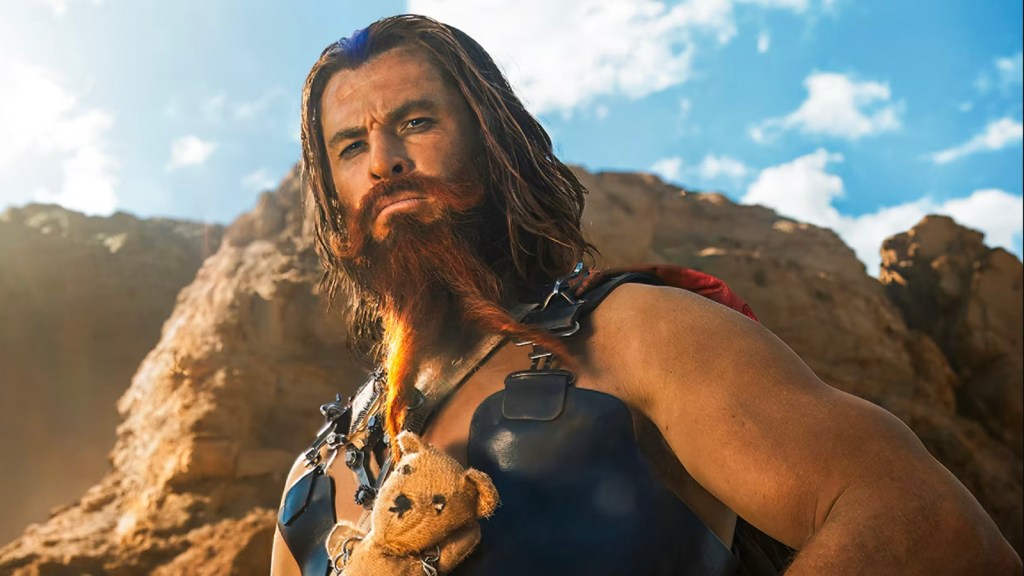
The main confrontation is between Furiosa and her self-proclaimed warlord – and would-be surrogate Dad – Dementus. Furiosa gives Chris Hemsworth the opportunity he’s been waiting for, allowing to flex his comic muscles, chew hilarious lumps out of the scenery and still show his menace. He makes Dementus an overgrown child, brilliant at stealing but with no idea about how to use them, obsessed with self-improvement (his dialogue is full of verbose, overwritten phrases, like a psychotic thesaurus) and only really happy when he’s smashing something. Introduced framing himself like a zen-like messiah, it doesn’t take long until he’s charging around on a chariot drawn by motorbikes, tasting other people’s tears and giving self-aggrandizing speeches while torturing Furiosa’s nearest-and-dearest. It’s a gift of a part, funny, scary, loathsome but strangely likeable even when he does awful things.
Opposite him, Anya Taylor-Joy actually has less to work with as Furiosa (she only takes over the part almost an hour into the film). Although this is meant to be a Furiosa film, it rarely feels like its telling us much more than we already know, especially since much the skills that ‘makes’ Furiosa what she is in Fury Road takes place in montage and her desire for freedom and to protect others are swiftly established so that any new-comers can unhesitatingly root for her. If Dementus is all talk, Taylor-Joy’s Furiosa is silent and simmering, her humanity either shrinking or quietly growing from moment-to-moment. She has a quiet romance with Tom Burke’s world-weary Praetorian Jack, but this really about converting her into a mythic figure of vengeance rather than making her a personality.

A vengeance we’ve already seen pan-out in Fury Road. I’ll be honest, for all the grand scale of Furiosa, I don’t really feel I learned anything about its central character here I hadn’t already picked up from Theron’s brilliantly expressive performance in the first film. For all the impressiveness of the scale, a lot of Furiosa boils down to physically showing us things that were implied in the first (second?) film – from locations, to the reasons why Furiosa lost her arm to giving us clear reasons for her motivations. But all this is already there – and with brilliant economy – in Fury Road. Telling us all again feels like Miller giving us the footnotes (Furiosa Silmarillon perhaps?) rather than anything truly new and the Homeric backdrop Miller is going for never really clicks into place.

So the most successful swings are not narrative but visual. Furiosa reminds you what an absolutely insane extreme world Mad Max is. Death cults of radiation-deformed albinos? Villains who bottle milk straight from the nipple (not a cow’s), while another obsessively fondles his exposed, pierced ones? A villain who straps a battered old Teddy bear to himself? Action set-pieces that throw in everything – flying bikes, lava lakes and arms stoically lopped off? Even time-jumps are done imaginatively, like a wig, caught in a branch, decaying in front of our eyes. Every single design decision in this – and the gorgeously sun-kissed photography – is dialled up to eleven for George Miller’s very personal vision of pulpy, dystopian chaos.

You can wonder at times – as I did – whether we really needed a two-and-a-half hour film that’s expands the thematic depth of a chase movie which already outlined its characters motivations and personalities with impressive economy. But then, there are moments in Furiosa that just feel like they’ve been pulled out of someone’s crazy dreams. It’s put together with such a good mix of pulp poetry and head-banging craziness by George Miller that after a while you just go with it. And it sticks with you in a way focus-grouped Marvel films never seem to.
The Menu (2022)

The Menu (2022)

Dark satire is mixed with intelligent character work and a challenge to our assumptions in this intriguing film

Director: Mark Mylod

Cast: Ralph Fiennes (Julian Slowik), Anya Taylor-Joy (Margot Mills), Nicholas Hoult (Tyler Ledford), Hong Chau (Elsa), Janet McTeer (Lilian Bloom), John Leguizamo (Famous Actor), Reed Birney (Richard Liebbrandt), Judith Light (Anne Leibbrandt), Paul Adelstein (Ted), Aimee Carrero (Felicity), Arturo Castro (Soren), Rob Yang (Bryce), Mark St Cyr (Dave)

A dash of Succession. A soupcon of Hannibal Lector. Lashings of The Most Dangerous Game. All these ingredients are mixed to delightfully dark comic effect in The Menu, a sharp and tangy assault on class and modern society which leaves an unusual but satisfying taste in the mouth.

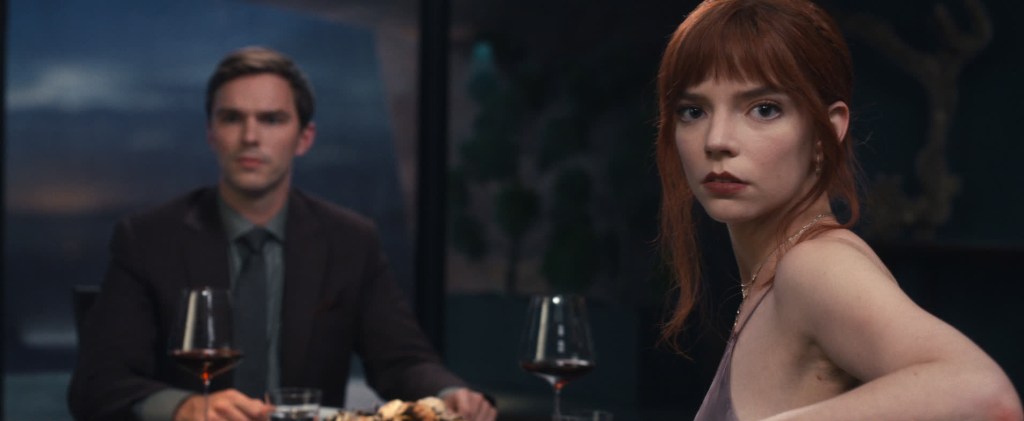
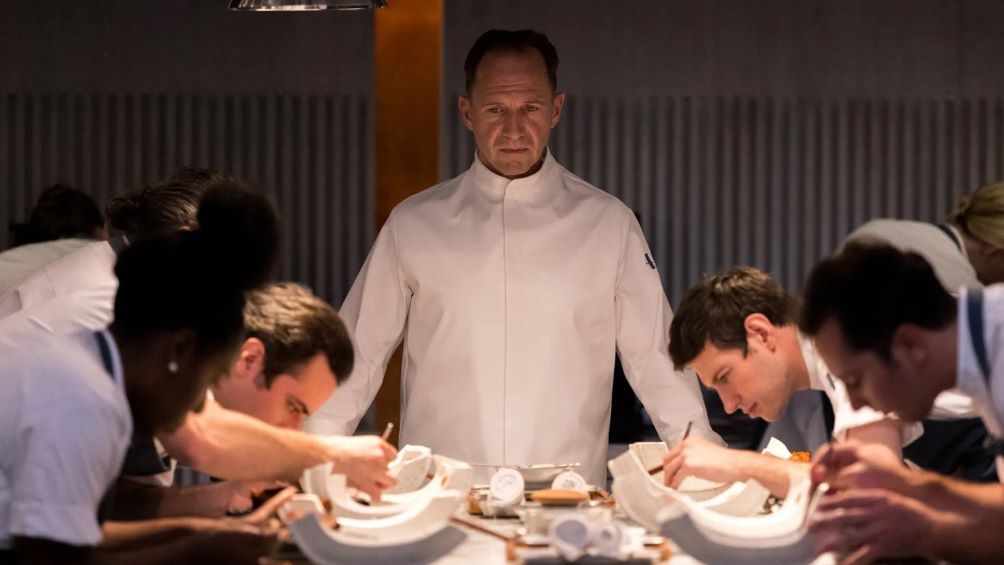
First those touches of The Most Dangerous Game. Julian Slowick (Ralph Fiennes) is a restauranteur so exclusive, his restaurant is based on a private island. Each course, of each menu is part of an overall story that forms the meal. For the story of the meal he is currently preparing, Slowick has selected an exclusive guest list of the rich and famous: businessmen, the rich, movie stars, food critics – the elite, the snobbish, the 1%. And the story he is serving up is one of increasingly grim retribution for this table-load of takers not givers. The only unexpected figure there is Margot (Anya Taylor-Joy), last-minute guest of obsessive food purist Tyler (Nicholas Hoult). How will this unexpected fly in the soup affect Slowick’s plans for the evening?

The Menu in many ways is a revenge satire. Slowick does not hold back in his increasing fury and bitterness at the people he serves without appreciation or gratitude in return. His customers are interested only in food if it costs a lot and is exclusive. They have no interest in his actual skills, in the staff (whose names they do not remember), the food itself or anything beyond their own desires. Many of the customers – most hideously a trio of “bro” investors (played with slapable smugness by Castro, Yang and St Cyr) – flash their jobs and cash expecting these to ensure their every whim is met. To them the world is like dough to be shaped into whatever bread they want it to be.

The film – with glee – exposes the hideous selfishness of the rich customers. A rich couple (Birney and Light) who have attended Slowick’s restaurants several times yet remember nothing about the food or the staff. Janet McTeer’s elite food critic, who practically scratches marks into her pen to mark the restaurants she has closed (she’s accompanied by a fawningly obsequious editor, played by Adelstein). A famous actor (John Leguizamo) who has long-since sold-out and treats his fans with contempt, joined by his spoilt rich-girl assistant/girlfriend (Aimee Carrero). Each of them is deconstructed in turns by Slowick over a series of courses parodying the snobbish bizarreness of high-class dining.

And here is where those touches of Succession make themselves known in the flavour. That series – and Mylod is a veteran (and its finest director) – also presents the ghastly shallowness and greed of the super-rich to expert comic effect. But what that show also does – and what Mylod brilliantly manages here – is make what could be two dimensional monsters sympathetic. The Menu presents these dreadful people with honesty; but, as the punishments – cruelly personal reveals, psychological torture, a finger cut off here, a man hunt there – pile up, you start to wonder if the punishment is too much?

The “bro” investors may be dreadful selfish, arrogant, dick-swinging morons: but they are also immature idiots who have never really grown up. The rich couple might treat places like this elite restaurant as a God-given right, but does that really deserve death? The food critic is harsh and arrogant, but is writing cruel words a mortal sin? The actor loathes himself for selling out his talent to make money and his girlfriend has simply been born into money and never wanted for anything. Do these people really deserve the monstrous ends Slowick has planned for them?

It’s the smartness of The Menu which could easily have invited us to just enjoy the rich and powerful being exposed, humiliated and punished. Instead, this is a smarter, more intelligent dish. The lower-class restaurant staff should be the people we are rooting for. But Slowick runs the restaurant like a cult, the staff near-robotic automatons that follow Slowick’s orders without question, intone their “Yes, Chef!” answers like a religious chant and snap to attention as one. Slowick’s number two Elsa – superbly played by Hong Chau – sums them up: all of them are desperate to become her boss and will follow Slowick to hell and back without a murmour and their heartless, personality free cruelty makes them very hard to root for.

As does Slowick himself. Here comes that sprinkling of Lector. Played with a superb, chilling intensity by Ralph Fiennes at his most coldly austere, Slowick could have been a character who swept us up in his intelligent superiority. But there is not a hint of joy in Slowick, only a vast, bubbling anger and resentment under a coldly precise exterior. Who on earth could look at this near-psychopath and think “I’d love to be him”? Slowick’s service is dryly, terrifyingly funny but you’d certainly not be left wanting to leave him a tip (unless it was your only way of getting out alive).

Instead, we gravitate towards the odd one-out. Anya Taylor-Joy is excellent as Margot, the unexpected guest who finds herself the only person unprepared for by Slowick, who is neither a member of the super-rich, but too free-spirited and independent minded to join the Slowick cult. Dragged along by Tyler – a hilarious performance of over-eagerness, snobbish elitism and stroppy self-entitlement by Nicholas Hoult – The Menu revolves more and more around the dance of death between her and Slowick. Like the audience, Margot is invited to pick a side to sympathise with.

It makes for a rich, lingering dish with an intriguing after taste, far more developed and better cooked than the sloppy revenge saga or re-heated leftovers it could have been. It left me wanting a second course.

Amsterdam (2022)

Amsterdam (2022)

Lots of quirk, whimsy and smugness, not a lot of interest or dynamism in this satirical mis-fire

Director: David O. Russell

Cast: Christian Bale (Burt Berendsen), Margot Robbie (Valerie Voze), John David Washington (Harold Woodsman), Robert De Niro (General Gil Dillenbeck), Chris Rock (Milton King), Rami Malek (Tom Voze), Anya Taylor-Joy (Libby Voze), Zoe Saldana (Irma St Clair), Mike Myers (Paul Canterbury), Michael Shannon (Henry Norcross), Timothy Olyphant (Tarim Milfax), Andrea Riseborough (Beatrice Vandenheuvel), Taylor Swift (Elizabeth Meekins), Matthias Schoenaerts (Detective Lem Getwiller), Alessandro Nivola (Detective Hiltz), Ed Begley Jnr (General Bill Meekins)

David O Russell’s has made a niche for himself with his ensemble awards-bait films, filled with touches of quirk and offering rich opportunities for eccentric, showy performances from actors. Some of these have walked a fine line between charm and smugness: Amsterdam tips too far over that line. Like American Hustle it’s a twist on a real-life event (opening with a pleased with itself “A lot of this really happened” caption) but, unlike that film, it fails to insert any compelling storyline, settling for a whimsical shaggy-dog story that frequently grinds to a halt for infodumps or lectures.

Set in 1933, just as Roosevelt has taken office, it follows three friends who formed a friendship for life in post-war Amsterdam. They are: wounded veterans doctor Burt Berendsen (Christian Bale) and lawyer Harold Woodsman (John David Washington) and socialite-artist-turned-nurse Valerie Voze (Margot Robbie). Berendsen and Woodsman lost touch with Valerie in the 1920s, but now they are all bought together after the murder of their respected former commander as part of a plot from various nefarious types to overthrow the government in a fascist-inspired coup.

Sounds gripping right? Well, Amsterdam fails to find any urgency in this. In fact, details of this plot and the political context it’s happening in are sprinkled around the film as if Russell kept forgetting what the film was supposed to be about. It’s almost as if he stumbled on an unknown piece of American history – a rumoured coup attempt, thwarted by being denounced by the ex-Marine General approached to lead it (here represented by De Niro’s ramrod straight General Dillenbeck) – but got more and more bored with it the longer he spent on it.

Instead, his real interest is in the faint overtones of Jules et Jim style thruple between Berendsen, Woodsman and Voze (though this is American not French, so any trace of homoeroticism is dispatched, despite the obvious bond between the two men). The most engaging part of the film is the Act two flashback to these three healing, dancing and bonding in post-war Amsterdam, in a “our troubles are behind us” bliss. Even if it’s self-satisfied in its bohemianism.

To be honest, even then, they have an air of smugness behind them. They pass the time singing improvised nonsense songs based on words pulled out of a hat and playfully posing in Valerie’s modernist artwork. Valerie is played with almost enough charm by Robbie for you to overlook she is a standard Manic Pixie Dreamgirl, the sort of babe who pulls shrapnel from bodies to turn it into artistic tea-sets as a commentary on the madness of war. She and Woodsman form a relationship (with the married Berendsen as a sort of – well I’m not sure what, but definitely not a sexual third wheel) and these blissful Amsterdam days are the times of their life. Russell is so keen for us to know it, that all three pop up in short cutaways at key moments to whisper “Amsterdam” direct to the camera, an affectation that fails to deliver the spiritual impact its straining for.

It’s better than the shaggy dog story around the conspiracy that fills the 1930s part of the storyline. This remains so poorly defined, that Bale has to narrate a concluding slideshow of clips and fake newsreel and newspaper coverage to explain what on earth has just happened. The lack of clarity about the stakes – and the general lack of seriousness or urgency anyone treats them with –fails to provide any narrative oomph. Instead, it drifts along from casual meeting to casual meeting, every scene populated with a big-name actor showboating.

There is a lot of showboating in this film. Bale, an actor with an increasingly worrying tendency for funny voices and tics, fully embraces the facially scarred, glass-eye wearing Berendsen, perpetually stooped with a war wound and prone to fainting from pain-killer overuse. It’s a showy, actorly performance with a licence to go OTT. Bale does manage to invest it with an emotional depth and vulnerability, but there’s more than an air of indulgence here.

Most of the rest follow his lead. Malek and Taylor-Joy sink their teeth into a snobby socialite married couple. Rock essentially turns his role as a veteran into a less sweary extension of his stand-up act. Myers and Shannon seize with relish roles as ornithologist spies (is this meant to be a joke about the origins of the James Bond name from the author of a bird-spotting guidebook?) Poor John David Washington ends up feeling flat with his decision to underplay (like he’s in a different movie) and only De Niro really manages to feel like anything other than an actor on holiday.

Russell wants to make a point about the continual corruption of the rich and how their hunger for more power will never be sated. There are some half-hearted attempts at attacking racism, with the ill treatment of black veterans, but it lacks bite or edge. His attempts to draw parallels with Trump are all too clear, but the film largely fails to integrate these ideas into the film. In fact, it ends up relying on voiceover lectures from Bale about dangers to democracy. It ends up like being hectored by an angry socialist after a student revue night.

The film is shot with a series of low angle shots and medium and close ups that eventually made me feel like I was watching it from the bottom of a well. A vague sepia-ish tone is given by Emmanuel Lubezki, but the film looks flat and visually uninteresting (so much so I was stunned to see $80million had somehow been blown on it, despite most of the cast working for scale). It drifts towards a conclusion, without giving us anything human to invest in (as Russell managed so well in Silver Linings Playbook or The Fighter) or providing the sort of caper enjoyment he delivered in American Hustle. Instead, it’s oscillates between smug and dull.

The Northman (2022)

The Northman (2022)

A viking tears through flesh and blood in quest for revenge in this bizarre, fascinating Viking epic

Director: Robert Eggers

Cast: Alexander Skarsgård (Amleth), Nicole Kidman (Queen Gudrún), Claes Bang (Fjölnir the Brotherless), Anya Taylor-Joy (Olga of the Birch Forest), Ethan Hawke (King Aurvandill War-Raven), Björk (The Seeress), Willem Dafoe (Heimir), Oscar Novak (Young Amleth), Gustav Lindh (Thorir), Ingvar Eggert Sigurðsson (He-Witch), Kate Dickie (Halldora), Ralph Ineson (Captain Volodymyr)

Ask people about Hamlet, and they picture a poetic Prince, plagued with doubt and vulnerability, talking to skulls rather than carrying out his mission of revenge. What you probably don’t think about are Vikings on a Berserker rage, slaughtering left, right and centre. But Hamlet has its roots in a bloody Scandinavian legend, where remorseless death is handed out by a ruthless killer. That’s the side of Hamlet, Eggers takes for inspiration in his bloody, bold and resolute Viking film, a blood-soaked acid trip it’s hard to imagine anyone else making.

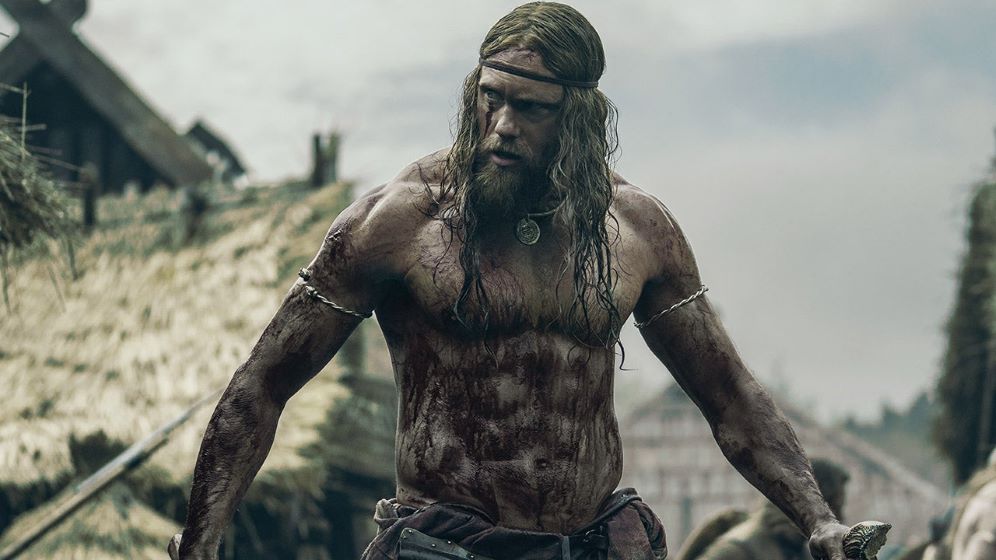
It’s 895 and King Aurvandill (Ethan Hawke) returns from conquest to his wife Gudrún (Nicole Kidman) and young son Amleth (Oscar Novak). Amleth takes his vows of manhood with his father, guided by a demented He-witch (Willem Dafoe) – only for his father to be almost immediately killed by his half-brother Fjölnir (Claes Bangs), who seizes his throne and wife. Amleth escapes – and years later has grown into a berserker Viking warrior (and Alexander Skarsgård). He sees his chance for revenge when he disguises himself as a slave, and joins a shipment traveling to Fjölnir’s village (Fjölnir having lost his throne). There he forms an alliance with Russian slave Olga (Anya Taylor-Joy) and works to undermine and terrify Fjölnir, before he can enact his revenge and save his mother.

The Northman is, possibly above all, a shocking, absorbing deep-dive into Viking Culture. Eggers doesn’t shirk for a second from the bloody, ruthless mayhem of Viking life. Our introduction to the adult Amleth sees him first whipping himself (and others) into a (possibly magic mushroom fuelled) Berserker rage, dressed as wolves and howling at the fireside, before launching an unbelievably ruthless attack on a Russian village. The desperate peasants are butchered with savage fury (and blood lust). In the aftermath, rape, murder and other horrors occur uncommented on in the background, while those not seen fit for slavery are herded into a barn to be casually burned alive.

Amleth, at no point, expresses a jot of regret for his actions (as a Viking wouldn’t), and even after passing for a slave never questions the institution. His revenge uses the same ruthless, blood-dripping fury as his ravaging and his only passing moment of pause is about directly killing Viking women and children (he gets over it). In all this he is in no way different from the rest – in fact he’s even one of the more sympathetic – Vikings. Fjölnir – revealed as otherwise a wise and generous leader – ruthlessly murders and rapes his slave as he fancies and a weekend’s entertainment for all is watching two teams of slaves beat themselves to death in a no-holds-barred version of hockey.

Eggers leaves you in no doubt that, for all the grim fascination, this is a brutal and savage civilisation that you would in no way want to encounter. Saying that, despite Eggers’ clear intentions, with the film’s cast modelling a sort of chiselled, gym-trained super-human Aryanism, sweeping away Slavic peasants and enforcing a triumph of Nordic culture, parts of this film are surely being channelled into the wet dreams of elements of the right-wing.

The film doesn’t just explore violence. Family bonds are demonstrated to be all important to Vikings – Amleth and Fjölnir are dedicated to their families and go to huge ends to protect and mourn them. (A funeral of one warrior features elaborate blood-letting, as the deceased’s horse is decapitated and his favourite slave willingly butchered so both can join him on the journey to the afterlife). There is a mutual regard and affection between warriors – even opponents – in a culture that puts itself above others. Honoured slaves are respected – though told they can never be equal. Licensed fools and mystics are given a great deal of freedom – Willem Dafoe’s crazed He-witch at Aurvandill’s court mocks all and sundry with no repercussions. There is a huge faith placed in wise men and women who inspire awe and fear – even a slave, such as Olga, with possible mystic powers is treated with caution. Bonds and duties across generations and to the next life are revered. Prophecies and destinies are respected. Poetry and storytelling is highly valued.

For all the killing, there are elements of a rich culture here and strong family bonds. All these combine in the person of Amleth, who will not be shaken from his destiny but will enact it in his own time, in line with the prophecies he of a seeress (an unrecognisable Björk). Eventually it doesn’t matter if Amleth’s idealised memory of his parents turns out to be not the whole story, or if he has a chance to build a new life. Destiny is, in fact, all.

Eggers’ film takes place in what almost a state of heightened, fevered excitement. Beautifully shot by Jarin Blaschke, it mixes expressionistic near-black-and-white, with drained-out shots of violence and flame-lit moments of psychological and body horror. Visions shot in a piercing mix of blues, greys and icey chilliness puncture the film, with strange compositions of characters, Valkyries, Valhalla and the Gods. Supernatural elements pepper the film, with Amleth’s father influencing events in the shape of a raven and Amleth completing a quest for a fateful sword. These moments of hyper-reality are perfectly executed and in a visually unique, blood-drenched nightmare.

Where The Northman is less successful is exploring the inner-depth of its characters. Skarsgård is charismatic and physically perfect, but doesn’t give much inner-life to Amleth. Moments of doubt or uncertainty in Amleth never quite convince and he feels more a force of nature than a person. There are richer performances from others, Kidman in particular a revelation as a cryptic, unknowable woman with a mid-film encounter of heightened emotional (and sexual) tension between her Skarsgård. Bangs’ Fjölnir is strangely sympathetic. Anya Taylor-Joy carries a dominant, mystical force in her performance that helps make her character a bridge between multiple worlds.

All these combine into a film of shocking violence, jaw-dropping beauty and troubling emotional and psychological horror. There is no doubt the film is overlong – there are probably one too many deeply odd segues into drug-induced ravings of various prophets and seers – but as an exploration of a culture so uniquely alien, its sublime. As a piece of work from a truly distinctive and unmatchable director, it’s superb. You look it The Northman and can’t believe anyone else could have made it. If nothing else, that makes it a film worthy of your time.