Tag: Arthur O’Connell

The Poseidon Adventure (1972)

The Poseidon Adventure (1972)

Our heroes climb up an overturned cruise liner in the film that launched a thousand enjoyable disaster movie clichés

Director: Ronald Neame (Irwin Allen)

Cast: Gene Hackman (Reverend Frank Scott), Ernest Borgnine (Mike Rogo), Red Buttons (James Martin), Shelley Winters (Belle Rosen), Jack Albertson (Manny Rosen), Carol Lynley (Nonnie Parry), Roddy McDowell (Acres), Stella Stevens (Linda Rogo), Pamela Sue Martin (Susan Shelby), Arthur O’Connell (Chaplain John), Eric Shea (Robin Shelby), Leslie Nielsen (Captain Harrison)

New Year’s Eve on the biggest cruise liner in the world and the money men have ordered “Full steam ahead!” into a storm – after all, it would be terrible publicity to arrive late at harbour. Needless to say, it’s a terrible idea, as the Poseidon is hit by a tsunami and flipped upside down. Everyone at the top of the ship is killed, leaving only the party goers in the promenade room alive. Who is going to make it out from the one of the most famous disaster films of all time?

Produced by the Master of Disaster himself Irwin Allen – he personally staked half the budget and made a fortune – the ship’s passenger log is a host of Oscar-winning stars, each balancing soapy plotlines. Gene Hackman is the maverick priest, body pumping with muscular Christianity, who believes God helps those who help themselves. Ernest Borgnine is a grumpy police chief, on a long-delayed holiday with his ex-call girl wife Stella Stevens. Shelley Winters and Jack Albertson are a retired couple heading to Israel to see their grandson for the first time. Red Buttons is an unlucky-in-love fitness freak, Roddy McDowell a plucky steward. Pamela Sue Martin and Eric Shea are two (unbearable) kids travelling to join their parents while Carol Lynley is the ship’s terrified singer.

The Poseidon Adventure cemented the tropes you’d come to know and love in disaster films. The maverick leader, the grouchy contrarian, a plucky pensioner with a vital skill, adorably brave kids, a self-sacrificing nice guy… They’re all in here, the actors playing these cardboard cut-out characters with gusto as they climb up the endurance obstacle course set of an upside-down cruise liner.

Allen’s film takes a while to get going: a quarter of the run time is dedicated to setting up the various character dilemmas. Is a member of the crew a former client of Stevens’ Linda? Will Gene Hackman find new purpose in his faith? Will Red Buttons find love? Neame shoots these opening exchanges with the uninspired professionalism the exposition-filled dialogue demands (there are several variations on “What am I doing on this ship? Let me tell you…” lines). But what makes the best of these films work is when the soapy shallowness manages to make the characters endearing. It’s what happens here: the cast could do these scenes standing on their head, but gosh darn it we end up hoping the Rosens will live to see their grandson at the foot of Mount Sinai.

The film of course “starts” proper with that wave hitting. At which point, Allen (and Neame) knows exactly what works. He makes the stakes clear, the target simple (climb up, get out) and taps into common fears of falling, drowning etc. He knows how to make us thrill at the stunts – that tipping ballroom, with various stuntmen plunging downwards – and throw in the odd moment to remind us how tragic it all is (like Red Buttons sadly laying his jacket across some poor soul).

It also understands that we need to feel smarter than the crowd of extras caught up in the drama. When Gene Hackman earnestly tells everyone their only chance of survival is up, we want to feel that we’d be smart enough to go with him, rather than join the sheeple listening to the literally-out-of-his-depth purser (“What you’re suggesting is suicide!”). Allen knows we need to feel smarter so much he later throws in another group led by a confident-but-wrong authority figure (the ship’s doctor) blithely walking downhill to the flooded aft, ignoring Hackman’s cries that they are striding to a watery grave.

No, we’d definitely be with the plucky stars. After all Hackman can’t be wrong! (Gene Hackman’s priest, for all his bluster, is remarkably unpersuasive – he even only just holds onto authority in the group). The stunt work and production design as the battered stars climb up the overturned ship to the hull are remarkable – not for nothing did this scoop nine Oscar nominations – and while the film is undeniably slightly cheesy, it’s played with an absolute earnest seriousness by the cast (Hackman, to his eternal credit, acts as if his life depended on it – which considering it’s clearly a pay cheque role other actors would have coasted through is admirable).

The set pieces are superb. As the cast is whittled down, the deaths carry a certain weight – again conveyed by the honesty of the grief from those left behind. Shelley Winters bagged the best role – and the most iconic scene – as an overweight old lady with a Chekhov’s skill, performing (at great cost) an act of heroism no one else could manage. (She landed an Oscar nomination, largely for this stand-up-and-cheer moment with a sting). Most get a moment to shine – although Carol Lynley’s pathetic, panicking singer (she can’t swim or climb or hold her breath or run…) who spends her time shrieking tries your patience no end.

The film is so much about the experience of seeing this group of people overcome death-defying climbs, swims and flames that when the survivors stagger into the sunlight, the film abruptly ends. It’s all about the ride, with most of the plot points established earlier settled by someone dying on the way up. But it’s entertaining and lands just the right side of involving. The characters may be artificial, but we still care about them.

The Poseidon Adventure was a massive hit and still the best maritime disaster film made (certainly much better than its belated, lame, remake). Allen cements a formula where swiftly sketched characters, played by recognisable actors, go through endurance tests in front of us via terrifying set-ups and death-defying stunts. It’s grand, old-fashioned entertainment, perhaps taking itself a little too seriously, but giving us lots to gasp and cheer at.

Anatomy of a Murder (1959)

Anatomy of a Murder (1959)

The mechanics of courtroom showmanship is ruthlessly exposed in this gripping drama

Director: Otto Preminger

Cast: James Stewart (Paul Biegler), Lee Remick (Laura Mannion), Ben Gazzara (Lt Frederick Manion), Arthur O’Connell (Parnell McCarthy), Eve Arden (Maida Rutledge), Kathryn Grant (Mary Pilant), George C. Scott (Claude Dancer), Orson Bean (Dr Matthew Smith), Russ Brown (George Lemon), Murray Hamilton (Alphonse Paquette), Brooks West (Mitch Lodwick), Joseph N Welch (Judge Weaver)

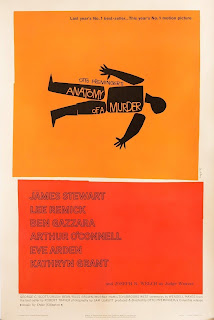
Winston Churchill once said Democracy was the worst form of government, except for all the others. You could say something similar about trial by jury: it ain’t perfect, but it’s better than any other justice system we’ve given a spin to in human history. Trials aren’t always forums for discovering truths: they are stages to present arguments (or stories), and they are won by whoever has the best one. Maybe cold, hard facts and evidence make up your story, maybe perceptions. Maybe it’s about how you tell the story. Elements of all three are found in Otto Preminger’s brilliant courtroom drama, Anatomy of a Murder.

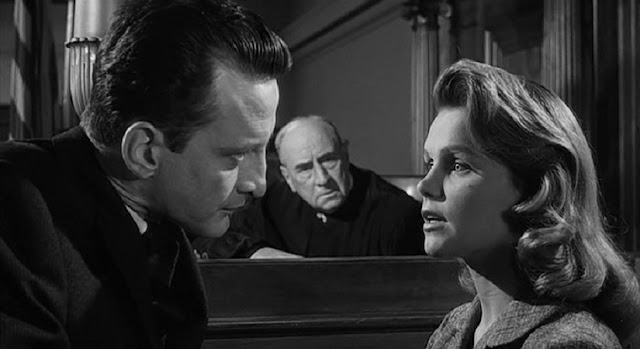
In a small town in Michigan, a US army lieutenant, Frederick Manion (Ben Gazzara) is arrested for the murder of innkeeper Barney Quill. Manion says he did the deed only because Quill raped Manion’s wife Laura (Lee Remick). Representing him is lawyer Paul Biegler (James Stewart), a former district attorney looking to start-up a new practise. On the opposite side is new DA Mitch Lodwick (Brooks West) and, far more of a worry, hot-shot lawyer Claude Dancer (George C. Scott) all the way from the Attorney General’s office. They say there was no rape – only a jealous murder after a consensual affair. It’s he-said-she-said, only “he” is dead. How will the trial clear that one up?

Otto Preminger was the son of a noted Austrian jurist, and Anatomy of a Murder can be seen as a tribute to his father, and to the process of the law itself. Not that it’s a hagiography. The film recognises the virtues as well as the faults of the system. Above all, that the system is not perfect, it can’t base every decision on firm facts and often requires people to take leaps of faith based on their gut instinct about who may, or may not, be telling the truth.

Preminger’s film does its very best to put us in the position the jury is in. We get no real evidence about what happened beyond what they get, and very few bits of additional information (except, perhaps, for seeing what many of the characters are like outside of the courtroom). Instead, the viewer is asked to make their mind-up on whether events fell-out as Manion claims (or not) based on our own judgement of the probabilities and of his (and Laura’s) character. The film opens with the crime committed and closes shortly after the verdict: there are no flashbacks or pre-murder scenes to help nudge us towards one view or another. The murder victim appears only as a photo. Like the jury we have to call it on what we see in front of us.

Anatomy of a Murder also makes clear there are plenty of shades of grey in the process of justice. During his first consultation with Manion, Biegler carefully suggests he consider whether he was in fact insane when he committed the deed – as that sort of defence will be much easier, since he doesn’t deny the killing. Sure enough, on their second meeting, Manion is now deeply unsure about his state of mind. Biegler then works backwards to establish precedent for the plea (a finds a single, over 75 years old one) to pull together a defence of irresistible impulse and to peddle hard a picture of the victim as an unrepentant rapist practically asking for a wronged husband to do the deed.

Biegler’s case is flimsy – but the key thing is to present it with pizzazz. And that’s what he’s got. Stewart’s performances in Hitchcock classics are highly regarded, but this might well be his finest dramatic performance. This is a brilliantly sly deconstruction of Stewart’s aw shucks charm: Biegler promotes an image of himself as a down-on-his-heels, bumpkin-like country lawyer, punching above his weight against the big city lawyers, Stewart dialling up the famous drawl. But it’s miles from the truth: Biegler is a former DA, an experienced trial lawyer and a formidable advocate. Stewart flicks the switch constantly, visibly putting on his persona like a skin, shedding it when no longer needed.

There is a constant suggestion that everything Biegler does is for effect. From fiddling with fishing tackle during the prosecution’s opening statements, to furious court-room theatricals as he thuds tables at slights and injustices. All of it is carefully prepared, rehearsed and delivered to make an impact on the jury. The constant parade of effect, manufactured outrage and appeals to an “us against them” mentality provokes exasperation from his opponents and a weary toleration from the Judge (played by real-life McCarthy confronting attorney Joseph N Welch). Stewart uses his Mr Smith Goes to Washington nobility, but punctures it at every point with Biegler’s cynicism and opportunism. Biegler, at best, persuades himself his client is innocent – but I would guess he doesn’t really care either way. He immediately perceives the personalities of his clients and then does his best to shield their less flattering qualities from the jury.

The one advantage we have over the jury is the additional insight we get into this strange couple, living a possibly unhappy, and certainly love-hate, marriage. Manion plays wronged fury in the court – but Gazzara gives him a lot of self-satisfied smarm and bland indifference to his crime in real life, meeting every event with a smirk that suggests he’s sure he can get away with anything. Equally good, Lee Remick’s Laura presents such a front of decency and pain in court, you’ll find it hard to balance that with the promiscuous, blousy woman we see outside of it, who provocatively flirts with intent with anything that moves. But it’s all about the show: present them right, and these unsympathetic people can be successfully shown as a conventional loving couple.

The prosecution is playing the same game. George C. Scott is superb as a coolly professional lawyer, who will use any number of tricks – from angry confrontation, to seductive reasonableness – to cajole a witness to say anything he wishes them to say. He will turn on a sixpence from being your friend, to berating you as a liar. And he’s not averse to his own morally questionable plays in court. Like Biegler, he knows presenting a good story is what is needed to win: the truth (or otherwise) isn’t enough.

Anatomy of a Murder still feels like a hugely insightful look at the legal process. Most of its runtime takes place in court, which Preminger shoots with a calmly controlled series of long-takes and two-shot set-ups, that help turn the film into something of a play (as well as a showpiece for fine acting). Along with its very daring (for the time) exploration of rape, it has a very cool soundtrack from Duke Ellington, that drips with allure and gives the film a lot of edge. The acting is all brilliant – along with those mentioned, Eve Arden is first-class as Biegler’s loyal secretary and Arthur O’Connell sweetly seedy as his heavy-drinking fellow lawyer. Anatomy of a Murder gives a first rate, at times cynical, look at the flaws and strengths of trial by jury – and is an outstanding courtroom drama.

Picnic (1955)

William Holden stirs up a small-town – and Kim Novak – in Picnic

Director: Joshua Logan

Cast: William Holden (Hal Carter), Kim Novak (Madge Owens), Rosalind Russell (Rosemary Sydney), Betty Field (Flo Owens), Susan Strasberg (Millie Owens), Cliff Robertson (Alan Benson), Arthur O’Connell (Howard Bevans), Verna Felton (Helen Potts), Reta Shaw (Irma Kronkite)

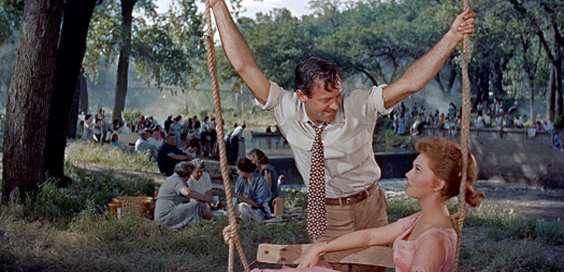
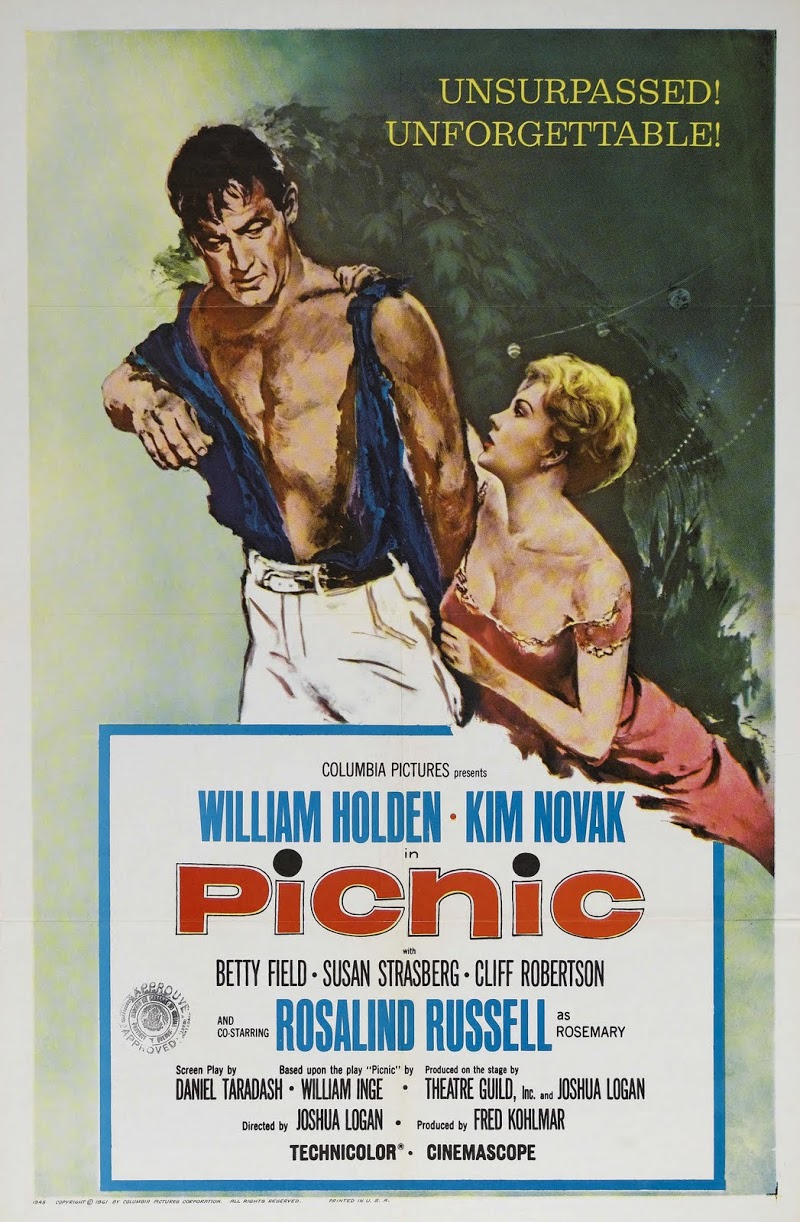
In a small Kansas town in the early 1950s, everything is sweet as apple pie. But under the surface, tensions bubble – and it only takes a stranger changing the status quo to make them explode. In William Inge’s Pulitzer-Prize-winning play – bought to the screen by original Broadway director Joshua Logan – that stranger is Hal Carter (William Holden), failed sportsman, actor and college drop-out, drifting into town looking for a new start from old friend Alan (Cliff Robertson). But Hal, an amiable screw-up, quickly puts himself in the middle of a love triangle between Alan and his girlfriend Madge (Kim Novak), the local beauty tired of being judged only by her looks.

All this eventually explodes into a series of furious confrontations where the true colours of various participants are revealed. In the 1950s Picnic looked like a criticism of the cosy conservatism of small-town America. But today, it actually feels more than a little nostalgic for the lost innocence of those times. Sure, some people in the town are less than sympathetic, or their lives have been crushed by the expectations of others. But generally, with its pastel colour palette and its generally fundamentally well meaning characters, it now feels a rather reassuring watch.

Like many films that pushed the envelope at the time, it also looks rather tame today. The film is strong on demonstrating the impact of the sexuality of a topless Holden on the women of the town – nearly all of whom go weak at the knees. But generally, the film’s sexual content now looks remarkably safe and gentle. A sense of powerful longing for something missing from their own lives does comes across strongly – Russell’s Mrs Sidney, worse for wear from drink, ends up feebly trying to pull up Holden’s trousers to look at his legs while dancing. But the sexual outbursts largely restrict themselves to that and a few passionate clinches.

Logan’s film throws in a few big visuals (such as the closing helicopter shot as a bus drives out of town) and clearly enjoys its location shooting, but remains stage-bound. Several scenes translate across exactly to backyard locations, the same sets in all but name that appeared on stage. It also struggles to fill the cinemascope screen, for all that James Wong Howe’s photography has a certain Autumnal beauty to it (you won’t see any vibrant greens, reds or yellows). In addition, many of the actors go for somewhere between naturalism and a mannered Broadway show-boating.

Perhaps the main issue is that film dwarves this slight and intimate story. Moments of intimacy that on stage you feel carry impact – heartfelt declarations and tortured confessions – don’t carry nearly so much on screen. In fact, the story ends up feeling rather slight and even predictable: the drifter has depths, but the town unfairly turns against him, the old-maid schoolteacher is deeply frustrated, the local beauty juggles depression, the good natured son of the local bigwig is a self-entitled bully. None of this really feels revelatory and, on screen, easily drifts by with little impact.

Logan’s stagy style also has a mixed impact on the acting with some going for a cinematic underplaying, and others inspired by a theatrical grandness to embrace the big moments. Leading the way in that camp is Rosalind Russell who gives a strong performance as the frustrated schoolteacher, but frequently allows herself to go a little too far in moments of emotional outburst. It’s particularly noticeable as she’s paired with Arthur O’Connell (reprising his Broadway role, and getting an Oscar nomination) who underplays with a quiet wit and honesty.

One of the film’s principle problems are with the two leads. William Holden gives a fine performance – fun-loving and kind but also cutting a rather sad and tragic figure behind the bonhomie – but is blatantly too old for the role. Hal is probably meant to be in his 20s – Holden was 37 and, with his craggy face, actually looks older. While it does add a level of Hal being increasingly irresponsible for his age, the part really means a charismatic youngster dripping sex appeal (think James Dean – Paul Newman was turned down for the part). Opposite him the inexperienced Kim Novak does, at times, give her line readings a striking genuineness but at others comes across as slightly wooden.

A stagy and slightly old-fashioned watch today, Picnic was nominated for several Oscars, but increasingly looks rather like a celebration rather than a gentle criticism of the small-town values it depicts.