Tag: Joshua Logan

Fanny (1961)

Fanny (1961)

Pagnol adaptation is middle-brow entertainment, that feels contrived and little obvious

Director: Joshua Logan

Cast: Leslie Caron (Fanny), Horst Buchholz (Marius), Charles Boyer (César), Maurice Chevalier (Panisse), Georgette Anys (Honorine), Salvatore Baccaloni (Escartefigue), Lionel Jeffries (Brun), Raymond Bussieres (The Admiral), Joel Flateau (Césario)
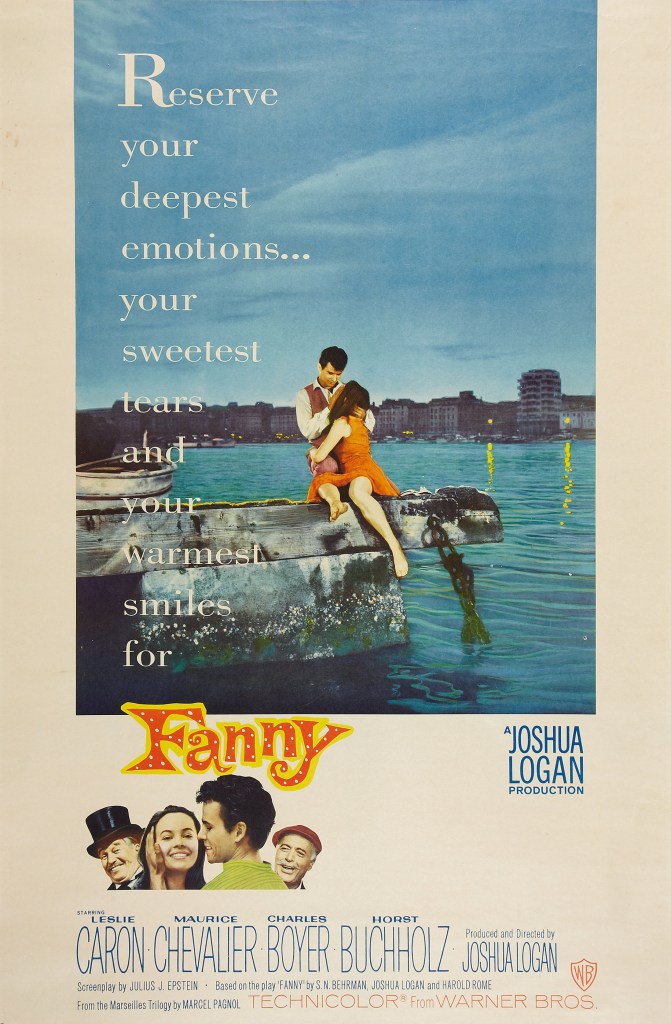
The most entertaining story about this largely forgotten Best Picture nominee is that its director pushed heavily for it to be titled Joshua Logan’s Fanny – until the obvious was pointed out to him. The next is that Logan directed the original musical version of this Marcel Pagnol adaptation on Broadway; but the songs were dropped here, because producer Jack L Warner was convinced musicals were box office poison.

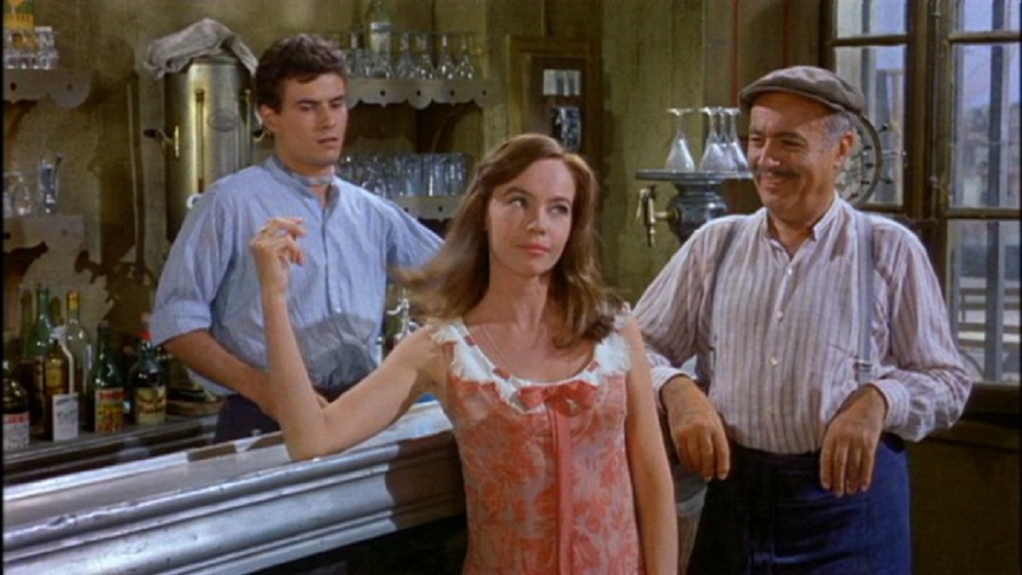
Fanny adapts Pagnol’s trilogy into a single, simple narrative. In 1920s Marseilles, Fanny (Leslie Caron) is a carefree young woman, in love with Marius (Horst Buchholz), who loves her but dreams of a life at sea – and certainly not of running his worldly-wise father César’s (Charles Boyer) bar. But this young couple won’t be honest with each other (or themselves): Fanny doesn’t want to hold Marius back from his dreams, Marius doesn’t want her to be forced to wait for him. After he leaves, Fanny discovers she is pregnant, so marries César’s old friend Panisse (Maurice Chevalier) who is more than happy to raise Marius’ son as his own. But how will Marius react when he returns?

Logan’s film takes this complex, almost Ancient Greek, set-up and makes it feel rather soapy and twee. It’s not helped by the fact that you can instinctively tell, watching the film, it is the book of a musical where the songs have ceased to exist. Time and again, the dialogue builds towards crescendos where songs are obviously meant to break out – but never do. Or scenes – such as old timers card-playing or romantic ambles – feel designed primarily for songs and now feel a bit aimless. It makes for a curiously disjointed affair, with the constant feeling something is missing.

It also doesn’t help that this very French story (Caron was worried about the reaction at home of taking on an American remake), feels like a rather picture-postcard image of French life. The gallic passions, the rough-edged café regulars playing practical jokes with hats placed over bollards (apparently in France, no one can resist kicking a hat on the ground), the berets and laissez-faire attitudes, the casting of two of Hollywood’s most famous French actors… It feels studied and not always natural. (Not helped by some woefully poor and obvious dubbing of a few of the actors).

Logan fails to bring to this any real flair in filmmaking and storytelling. Despite the presence of Jack Cardiff behind the camera, Fanny is a film full of basic compositions, one-shot/two-shot styles and visually flat storytelling, spiced up with the odd sweeping camera move. Time and again, the action is carefully set-up in theatrical medium shot to get three actors into frame. Logan several times punctuates moments of shock with crashing zooms into extreme close-up. Caron is frequently filmed with a gauzy romanticism in lingering close-up – an effect that looks odd when it’s not applied to any shot either side. Marseilles aerial shots also make the studio sets stick out even more.

As for the story, Fanny has a contrived reliance on no one ever really saying what they think or feel at any time. It’s so painfully obvious Marius is in love with Fanny – from his jealous, soda-squirting fury when Panisse flirts with her, to the looks of awkward devotion he shoots her on dockside walks together – it’s amazing to think they can’t work it out. Likewise, Fanny’s romantic feelings for Marius (captured in frequent doe-eyed close-up) are transparent. With the youth of both these characters – they start as teenagers – you can’t help but feel that there is no reason why they can’t agree to a few years apart before marriage. Instead, both believe the other demands unequivocal personal sacrifice from them, for no particular reason.

What Logan does do well, is draw some good performances from the cast. Leslie Caron is fairly radiant as Fanny, even if the character’s main function seems to be to pine sadly behind a brave face of self-sacrifice. It’s a shame Fanny often doesn’t call for much from her beyond that, since she gives the role a certain steel (none more so than her firm rejection of a returning Marius disrupting her new family life) including her hard-headed decision to marry a man she likes and respects but does not love. Buchholz does similarly well with a character who could be a frustrating Romeo, but who he manages to make his desperation not to be trapped into his father’s life understandable.

The real attraction is the casting of Boyer and Chevalier, who find a fair bit of charm in their characters (even though both are well within their wheel house). Chevalier, in particular, was thrilled to land a non-Musical role – and if the aged flirt he’s asked to play in the first half isn’t that dissimilar from his role in Gigi, his portrait of Panisse as increasingly scared at losing his new family is touching. Although the role really only adds little touches of overt tragedy and sadness to his standard role Chevalier’s charm adds a great deal of affecting vulnerability.

Chevalier campaigned hard for the Oscar nomination he had missed out on for Gigi – so I wonder how he felt that the Best Actor nod went to Charles Boyer instead. (I suspect lingering mud from collaboration slurs against Chevalier probably scuppered his chances). Boyer’s role is really a supporting one, but his smooth, effortless underplaying means he adds a lot of humanity to the otherwise larger-than-life César. Dispensing gruff worldly wisdom, playfully bantering with Chevalier, pained and angry at his son’s betrayal and determined to play a role in his (secret) grandson’s life, Boyer plays it all with an effortless ease which is the film’s greatest strength.

It’s a shame these performers are stuck in such a flat film which makes Pagnol’s story feel rather plodding and exposes its more contrived elements. It’s final resolution teeters on the edge of the unbelievably convenient – from Marius, it transpires, now living only a few miles away but never encountered by the other characters, to a ludicrous ‘happy’ ending that wraps every problem up with a neat bow (another moment where you can feel the missing musical roots). And it’s as uninspired as most of the rest of it. It’s definitely middle-brow entertainment. And, ironically, it lost out on Best Picture to that year’s Box Office smash – the musical West Side Story.

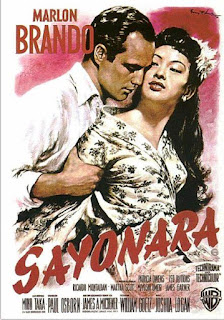
Sayonara (1957)

Sayonara (1957)

Racism gets exposed at clumsy length in this heavy-handed social issues drama

Director: Joshua Logan

Cast: Marlon Brando (Major Lloyd “Ace” Gruver), Patricia Owens (Eileen Webster), James Garner (Captain Mike Bailey), Martha Scott (Mrs Webster), Miiko Taka (Hana-Ogi), Red Buttons (Airman Joe Kelly), Miyoshi Umeki (Katsumi Kelly), Kent Smith (Lt General Mark Webster), Ricardo Montalban (Nakamura), Douglass Weston (Colonel Crawford)

It’s post-war Japan and the American occupation forces have got very strict rules about what their soldiers are allowed to do with the native population: namely not marry them. Any suggestion of American soldiers finding themselves Japanese wives is frowned on at the very highest level. Something flying ace Major “Ace” Gruber (Marlon Brando) is about to find out when he’s transferred from shooting down commies in Korea. Airman Joe Kelly (Red Buttons) is determined to marry Katsumi (Miyoshi Umeki) – and nothing commanding officer Gruber or anyone else can say will dissuade him. Meanwhile, Gruber finds himself falling in love with Japanese actress Hana-Ogi (Miiko Taka) – and facing the exact same pressures to chuck her overboard as Kelly meets.

Sayonara is very much a Hollywood message film: that being interracial marriage is a fact to celebrate not condemn, with a subsidiary message focused on rehumanising the Japanese people for American audiences still holding strong memories of the Second World War. Like a lot of message films from the era though, its also slow, stuffy, self-important and more than a little dull – something its multiple Oscars can’t hide.

Shot on location, it often come across as a sort of Japanese travelogue which, for all its efforts to make the Japanese sympathetic, can only interpret them and their culture through a selection of cliches and generic expectations. The film is a parade of kimonos, lotos blossoms, tea ceremonies and geisha girls, all shot with a laboured flatness by Joshua Logan. Logan’s direction overflows with middle-brow earnestness, pleading for a little love and understanding, while shuffling together a series of stereotypical and predictable plot events. Logan also seems to struggle with the cinemascope frame, which frequently dwarves this intimate story.

It’s all told at a very slow pace: it’s remarkable that such a slim story manages to fill almost two and a half hours. Much of this is taken up with the romantic entanglements of Ace, half-heartedly engaged to General’s daughter Eileen Webster (a saintly understanding Patricia Owens, who practically asks to be thrown over), before a chance sighting on a bridge (of course it’s a soribashi bridge) leads to him falling head over heels in love with Hana-Ogi, hanging around the bridge every day and struggling his way through a Japanese phrase book so he can ask her out on a date (the dates, when they come, are like a travelogue of the most Japanese events you could imagine).

The languid lack of drive isn’t helped by Brando’s curious performance. Sayonara is the perfect example of what a mystifying actor Brando could be: here he was in a project that clearly meant a lot to him personally (he was a long-standing social campaigner), but he drifts through it with a lazy off-the-cuffness that suggests he’s only doing the film under protest. Only Brando could act in a passion project with such surly indifference (allegedly motivated by his lack of regard for Logan’s direction). Brando uses a non-descript Southern drawl, which he uses as an excuse to dial his mumbling up to 11. He slouches and ambles through every scene, barely raising his voice or lifting a finger unless it’s essential.

Because Brando seems so disengaged and bored by the whole thing (the only spark of energy he gives is when he playfully bangs his head on a low Japanese ceiling) it makes the film drag on without the stakes ever seeming to really mount. Ace is told repeatedly that he will have to chuck Hana-Ogi, but he shrugs it off with all the indifference of a laid-back hipster. I think Brando is straining to suggest that Ace has the soul of a poet, trapped inside his father-mandated time in West Point – there is a moment where he airily mumbles something about his dreams as a young man of finding something more. But the overall effect is more of an actor drifting through a long role with minimum effort.

You can’t say the same for Red Buttons, who plays Kelly with a great deal of commitment. Winning an Oscar, this first role was also his best, with Kelly having Button’s good-natured lightness but mixing it in with a fierce defiance and a touching pain when his wife suggests surgery to try and alter her facial features to appear more Western. Umeki also won a generous Oscar for a brief performance which gives her very little scope to do much beyond playing the quiet wife (I suspect the Oscar was partly for the film’s theme and reflects a weaker year of candidates). Miiko Taka is more impressive (and given more scope) as Hana-Ogi, all too aware of the pressures on her not to get involved, torn between her feelings and what she sees as her duty.

Sayonara as a whole though remains a flat, often rather uninvolving film that holds its liberal conscience so close to its chest that it manages to squeeze any trace of life out of it. Its liberalness only goes so far: Logan casts two Japanese actresses but has no concerns about recruiting a pale-faced Ricardo Montalban to play the only Japanese male with lines. It’s exploration of mixed-race relationships is solely focused on white guys marrying who they want. A truly daring film would have thrown in a flirtation between Montalban’s Japanese actor and Patricia Owen’s patrician General’s daughter. A Japanese man marrying the daughter of one of America’s own? Now that is a vision that would have really shook up 1950s America.

It’s not to be though. Instead, this is an overlong, overly serious, pleased with itself melodrama, coated in lashings of social awareness that is cursed with a languid central performance that helps make the whole film seem to drag on forever. Logan is unable to provide either any dramatic or political fire to the film and it settles all to often for safe, picture perfect shots of Japan. While you can admire the motives behind it, there is little to admire in the film itself.

Picnic (1955)

William Holden stirs up a small-town – and Kim Novak – in Picnic

Director: Joshua Logan

Cast: William Holden (Hal Carter), Kim Novak (Madge Owens), Rosalind Russell (Rosemary Sydney), Betty Field (Flo Owens), Susan Strasberg (Millie Owens), Cliff Robertson (Alan Benson), Arthur O’Connell (Howard Bevans), Verna Felton (Helen Potts), Reta Shaw (Irma Kronkite)

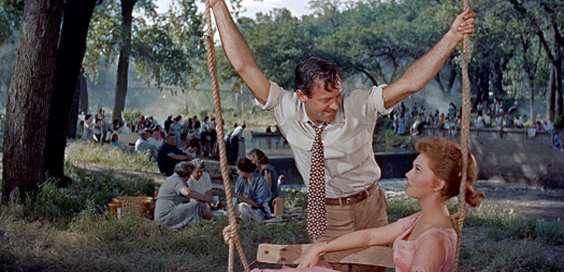
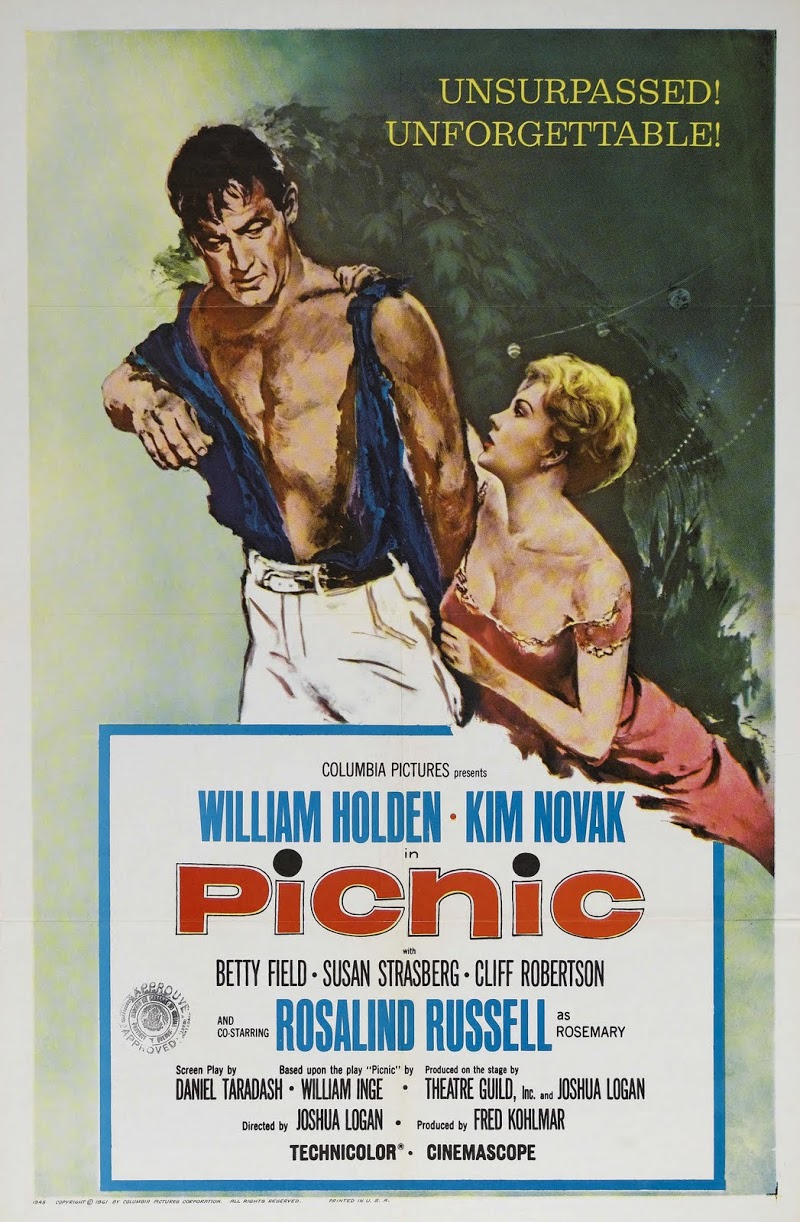
In a small Kansas town in the early 1950s, everything is sweet as apple pie. But under the surface, tensions bubble – and it only takes a stranger changing the status quo to make them explode. In William Inge’s Pulitzer-Prize-winning play – bought to the screen by original Broadway director Joshua Logan – that stranger is Hal Carter (William Holden), failed sportsman, actor and college drop-out, drifting into town looking for a new start from old friend Alan (Cliff Robertson). But Hal, an amiable screw-up, quickly puts himself in the middle of a love triangle between Alan and his girlfriend Madge (Kim Novak), the local beauty tired of being judged only by her looks.

All this eventually explodes into a series of furious confrontations where the true colours of various participants are revealed. In the 1950s Picnic looked like a criticism of the cosy conservatism of small-town America. But today, it actually feels more than a little nostalgic for the lost innocence of those times. Sure, some people in the town are less than sympathetic, or their lives have been crushed by the expectations of others. But generally, with its pastel colour palette and its generally fundamentally well meaning characters, it now feels a rather reassuring watch.

Like many films that pushed the envelope at the time, it also looks rather tame today. The film is strong on demonstrating the impact of the sexuality of a topless Holden on the women of the town – nearly all of whom go weak at the knees. But generally, the film’s sexual content now looks remarkably safe and gentle. A sense of powerful longing for something missing from their own lives does comes across strongly – Russell’s Mrs Sidney, worse for wear from drink, ends up feebly trying to pull up Holden’s trousers to look at his legs while dancing. But the sexual outbursts largely restrict themselves to that and a few passionate clinches.

Logan’s film throws in a few big visuals (such as the closing helicopter shot as a bus drives out of town) and clearly enjoys its location shooting, but remains stage-bound. Several scenes translate across exactly to backyard locations, the same sets in all but name that appeared on stage. It also struggles to fill the cinemascope screen, for all that James Wong Howe’s photography has a certain Autumnal beauty to it (you won’t see any vibrant greens, reds or yellows). In addition, many of the actors go for somewhere between naturalism and a mannered Broadway show-boating.

Perhaps the main issue is that film dwarves this slight and intimate story. Moments of intimacy that on stage you feel carry impact – heartfelt declarations and tortured confessions – don’t carry nearly so much on screen. In fact, the story ends up feeling rather slight and even predictable: the drifter has depths, but the town unfairly turns against him, the old-maid schoolteacher is deeply frustrated, the local beauty juggles depression, the good natured son of the local bigwig is a self-entitled bully. None of this really feels revelatory and, on screen, easily drifts by with little impact.

Logan’s stagy style also has a mixed impact on the acting with some going for a cinematic underplaying, and others inspired by a theatrical grandness to embrace the big moments. Leading the way in that camp is Rosalind Russell who gives a strong performance as the frustrated schoolteacher, but frequently allows herself to go a little too far in moments of emotional outburst. It’s particularly noticeable as she’s paired with Arthur O’Connell (reprising his Broadway role, and getting an Oscar nomination) who underplays with a quiet wit and honesty.

One of the film’s principle problems are with the two leads. William Holden gives a fine performance – fun-loving and kind but also cutting a rather sad and tragic figure behind the bonhomie – but is blatantly too old for the role. Hal is probably meant to be in his 20s – Holden was 37 and, with his craggy face, actually looks older. While it does add a level of Hal being increasingly irresponsible for his age, the part really means a charismatic youngster dripping sex appeal (think James Dean – Paul Newman was turned down for the part). Opposite him the inexperienced Kim Novak does, at times, give her line readings a striking genuineness but at others comes across as slightly wooden.

A stagy and slightly old-fashioned watch today, Picnic was nominated for several Oscars, but increasingly looks rather like a celebration rather than a gentle criticism of the small-town values it depicts.