
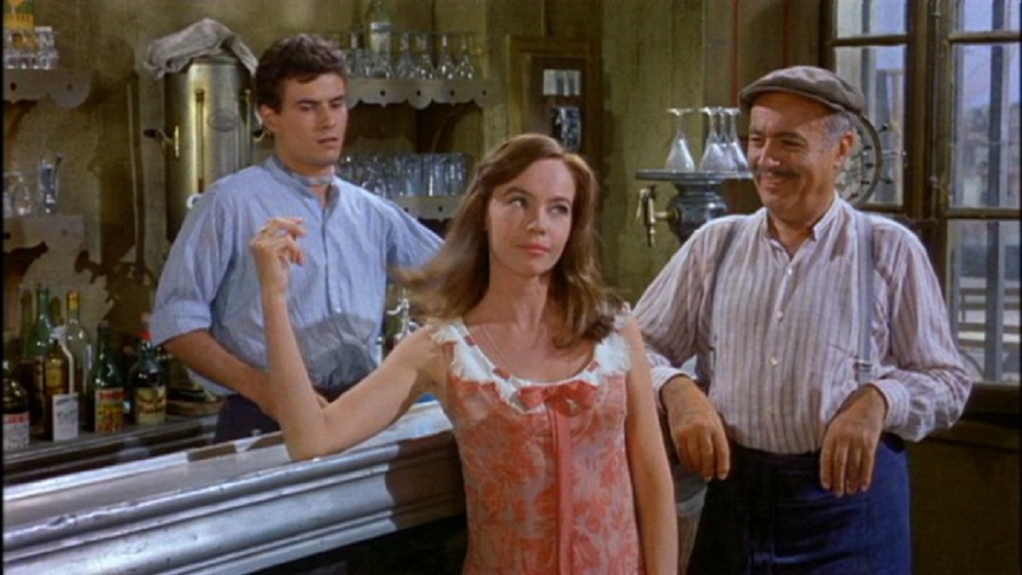
Pagnol adaptation is middle-brow entertainment, that feels contrived and little obvious
Director: Joshua Logan
Cast: Leslie Caron (Fanny), Horst Buchholz (Marius), Charles Boyer (César), Maurice Chevalier (Panisse), Georgette Anys (Honorine), Salvatore Baccaloni (Escartefigue), Lionel Jeffries (Brun), Raymond Bussieres (The Admiral), Joel Flateau (Césario)
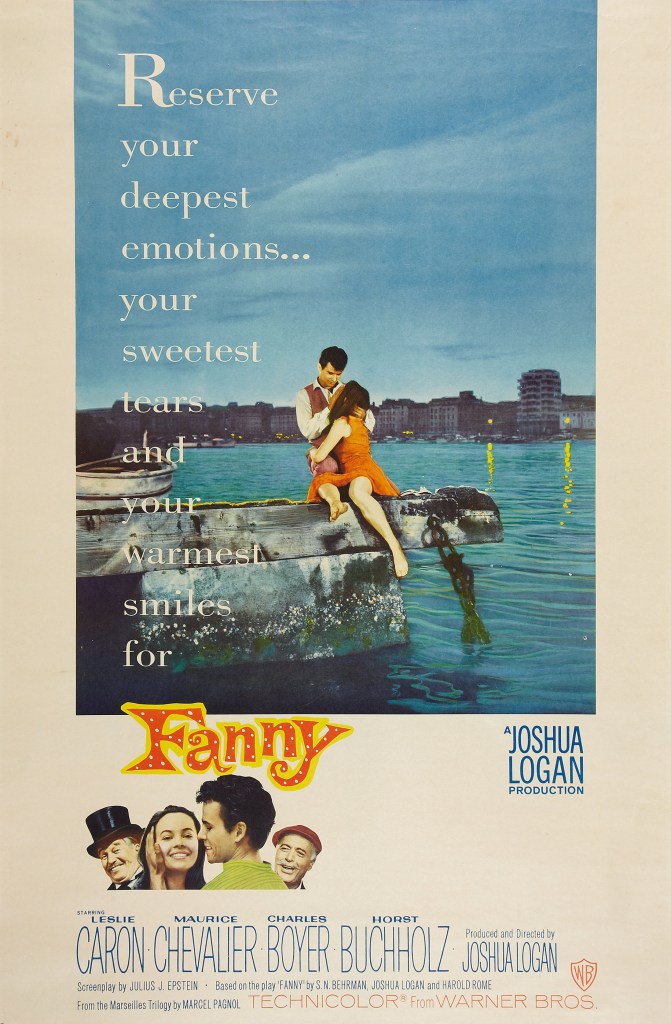
The most entertaining story about this largely forgotten Best Picture nominee is that its director pushed heavily for it to be titled Joshua Logan’s Fanny – until the obvious was pointed out to him. The next is that Logan directed the original musical version of this Marcel Pagnol adaptation on Broadway; but the songs were dropped here, because producer Jack L Warner was convinced musicals were box office poison.
Fanny adapts Pagnol’s trilogy into a single, simple narrative. In 1920s Marseilles, Fanny (Leslie Caron) is a carefree young woman, in love with Marius (Horst Buchholz), who loves her but dreams of a life at sea – and certainly not of running his worldly-wise father César’s (Charles Boyer) bar. But this young couple won’t be honest with each other (or themselves): Fanny doesn’t want to hold Marius back from his dreams, Marius doesn’t want her to be forced to wait for him. After he leaves, Fanny discovers she is pregnant, so marries César’s old friend Panisse (Maurice Chevalier) who is more than happy to raise Marius’ son as his own. But how will Marius react when he returns?
Logan’s film takes this complex, almost Ancient Greek, set-up and makes it feel rather soapy and twee. It’s not helped by the fact that you can instinctively tell, watching the film, it is the book of a musical where the songs have ceased to exist. Time and again, the dialogue builds towards crescendos where songs are obviously meant to break out – but never do. Or scenes – such as old timers card-playing or romantic ambles – feel designed primarily for songs and now feel a bit aimless. It makes for a curiously disjointed affair, with the constant feeling something is missing.
It also doesn’t help that this very French story (Caron was worried about the reaction at home of taking on an American remake), feels like a rather picture-postcard image of French life. The gallic passions, the rough-edged café regulars playing practical jokes with hats placed over bollards (apparently in France, no one can resist kicking a hat on the ground), the berets and laissez-faire attitudes, the casting of two of Hollywood’s most famous French actors… It feels studied and not always natural. (Not helped by some woefully poor and obvious dubbing of a few of the actors).
Logan fails to bring to this any real flair in filmmaking and storytelling. Despite the presence of Jack Cardiff behind the camera, Fanny is a film full of basic compositions, one-shot/two-shot styles and visually flat storytelling, spiced up with the odd sweeping camera move. Time and again, the action is carefully set-up in theatrical medium shot to get three actors into frame. Logan several times punctuates moments of shock with crashing zooms into extreme close-up. Caron is frequently filmed with a gauzy romanticism in lingering close-up – an effect that looks odd when it’s not applied to any shot either side. Marseilles aerial shots also make the studio sets stick out even more.
As for the story, Fanny has a contrived reliance on no one ever really saying what they think or feel at any time. It’s so painfully obvious Marius is in love with Fanny – from his jealous, soda-squirting fury when Panisse flirts with her, to the looks of awkward devotion he shoots her on dockside walks together – it’s amazing to think they can’t work it out. Likewise, Fanny’s romantic feelings for Marius (captured in frequent doe-eyed close-up) are transparent. With the youth of both these characters – they start as teenagers – you can’t help but feel that there is no reason why they can’t agree to a few years apart before marriage. Instead, both believe the other demands unequivocal personal sacrifice from them, for no particular reason.
What Logan does do well, is draw some good performances from the cast. Leslie Caron is fairly radiant as Fanny, even if the character’s main function seems to be to pine sadly behind a brave face of self-sacrifice. It’s a shame Fanny often doesn’t call for much from her beyond that, since she gives the role a certain steel (none more so than her firm rejection of a returning Marius disrupting her new family life) including her hard-headed decision to marry a man she likes and respects but does not love. Buchholz does similarly well with a character who could be a frustrating Romeo, but who he manages to make his desperation not to be trapped into his father’s life understandable.
The real attraction is the casting of Boyer and Chevalier, who find a fair bit of charm in their characters (even though both are well within their wheel house). Chevalier, in particular, was thrilled to land a non-Musical role – and if the aged flirt he’s asked to play in the first half isn’t that dissimilar from his role in Gigi, his portrait of Panisse as increasingly scared at losing his new family is touching. Although the role really only adds little touches of overt tragedy and sadness to his standard role Chevalier’s charm adds a great deal of affecting vulnerability.
Chevalier campaigned hard for the Oscar nomination he had missed out on for Gigi – so I wonder how he felt that the Best Actor nod went to Charles Boyer instead. (I suspect lingering mud from collaboration slurs against Chevalier probably scuppered his chances). Boyer’s role is really a supporting one, but his smooth, effortless underplaying means he adds a lot of humanity to the otherwise larger-than-life César. Dispensing gruff worldly wisdom, playfully bantering with Chevalier, pained and angry at his son’s betrayal and determined to play a role in his (secret) grandson’s life, Boyer plays it all with an effortless ease which is the film’s greatest strength.
It’s a shame these performers are stuck in such a flat film which makes Pagnol’s story feel rather plodding and exposes its more contrived elements. It’s final resolution teeters on the edge of the unbelievably convenient – from Marius, it transpires, now living only a few miles away but never encountered by the other characters, to a ludicrous ‘happy’ ending that wraps every problem up with a neat bow (another moment where you can feel the missing musical roots). And it’s as uninspired as most of the rest of it. It’s definitely middle-brow entertainment. And, ironically, it lost out on Best Picture to that year’s Box Office smash – the musical West Side Story.

