Tag: Australian films

The Water Diviner (2014)

The Water Diviner (2014)

Crowe’s enjoyable debut is traditional but heartfelt with a well-meaning message

Director: Russell Crowe

Cast: Russell Crowe (Joshua Connor), Olga Kurylenko (Ayshe), Dylan Georgiades (Orhan), Yılmaz Erdoğan (Major Hasan), Cem Yılmaz (Sergeant Jemal), Jai Courtnay (Lt Colonel Cyril Hodges), Jacqueline McKenzie (Eliza Connor), Isabel Lucas (Natalia)

Russell Crowe’s directorial debut is a heartfelt, well-meaning, if rather traditional movie that explores the lasting impact of one of Australia’s deepest national scars, the Gallipoli campaign. Joshua Connor (Russell Crowe) is a water diviner who, in 1919, after the death of his wife, travels to Turkey wanting to bring home the remains of their three sons who all died on the campaign. He finds the country to be far more complex than the enemy nation he had expected, with the Turks themselves struggling with occupation. With the help of Lt Colonel Hodges (Jai Courtenay) and the Turkish Major Hasan (Yılmaz Erdoğan), Connor discovers two of his sons’ bodies – and hears rumours that his third son may in fact still be alive somewhere in Turkey. Meanwhile, a bond is forming between Connor and hotel owner Ayshe (Olga Kurylenko) and her son Orhan (Dylan Georgiades).

Crowe’s film in many ways tells a very traditional morality story: deep down, despite all the ways we’re different, we are all the same, and the biggest part of coming to terms with anything is taking the decision to move forward and put it behind you. The film bravely attempts to engage with this national trauma, that saw tens of thousands of ANZAC troops ruthlessly (and arguably pointlessly) sacrificed in an ill-planned Turkish campaign. Rather than just presenting the ANZACs as victims, it builds sympathy and empathy with the Turkish side and points out violence and crimes on both sides, from executing prisoners to equivalent casualty lists (including pointing out that the Turks were defending their home from invasion).

It brings this home by filtering this experience through one personal story. Connor is a man who has lost everything to this campaign, who has sacrificed his sons and has every reason to blame the Turks for his loss. But, bar one moment of provoked rage, his natural decency and quiet humility cause him to quickly see these former enemies as people as scarred by war as him. It’s a note the film repeats constantly. The characters we are intended to relate to – such as Connor and Lt Colonel Hodges – frequently treat the Turks with respect (which is returned), while more bitter figures are shown as blinkered and misguided.

Of course, the film can’t resist capturing this détente in a personal relationship, showing the growing intimacy between Connor and Turkish war widow Ayshe. It’s a gentle, but not at all surprising romance – a shame that there is such an age gap between Crowe and Kurylenko – but it does at times feel like a slightly on-the-nose personal reflection of growing understanding between Turks and Aussies.

It’s arguably unnecessary anyway, since a more engaging relationship develops between Connor and Yılmaz Erdoğan’s honourable and slightly world-weary Major Hasan. The very image of the worthy opponent, Hasan is practically human decency made flesh, a man who goes out of his way to help Connor’s quest and becomes the human face of a Turkish army that suffered as many losses as the ANZAC forces. The warmth between these two characters is really the emotional heart of the film, for all it tries to interest us in a will-they-won’t-they romantic relationship elsewhere.

The film is not without flaws. It’s been pointed out that it makes no reference to the Turks’ atrocious actions during the war towards Armenians and Greeks (indeed some dirty Greek vagabonds make an entry late on as final-act baddies). While this isn’t a film trying to tell that story, a single line of acknowledgement – even if it was dismissed by a Turkish character – would have gone a long way.  To speed up the search for his sons’ bodies, Connor is given some sort of loosely defined Shamanic power connected to his ability to find water (later he has vision in his dreams) – it’s a bit of magic that the film could do without. The film introduces several clumsy obstructive Brit officer characters (because nothing brings Aussie and Turk together like a loathing for arrogant Brits!), that serve as script-required roadblocks, either uninterested or fanatically intent on stopping Connor as the scene requires.

But fundamentally this is a very earnest and straightforward plea for understanding and forgiveness that doesn’t reinvent the wheel, but is a decent piece of storytelling. Crowe directs the thing with assurance (helped by some beautiful if slightly chocolate-box photography from Andrew Lesnie), contributing a low-key, reserved performance of quiet emotion. There are decent performances throughout: it’s great to see Jai Courtenay get a proper acting role, while Erdoğan is the stand out as Major Hasan. As a gentle Sunday afternoon would-be-epic it more or less fits the bill exactly.

The Proposition (2005)

Guy Pearce is given a fateful mission in bleak Aussie Western The Proposition

Director: John Hillcoat

Cast: Guy Pearce (Charlie Burns), Ray Winstone (Captain Morris Stanley), Emily Watson (Martha Stanley), Danny Huston (Arthur Burns), David Wenham (Eden Fletcher), Richard Wilson (Mike Burns), John Hurt (Jellon Lamb), Tom E Lewis (Two Bob), Leah Purcell (Queenie), Robert Morgan (Sgt Lawrence), David Gulpilil (Jacko), Tom Budge (Samuel Stoart)

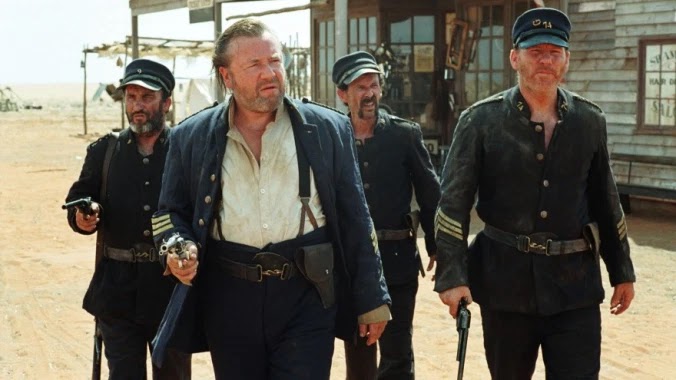
In the Australian outback at some point near the turn of the last century, a gang of ruthless killers are finally tracked down and killed by the police. The only survivors are Charlie Burns (Guy Pearce) and his younger brother Mikey (Richard Wilson). Charlie is offered a proposition by British émigré police captain Morris Stanley (Ray Winstone): find and kill Charlie’s other brother, the even more ruthless Arthur (Danny Huston), in nine days and Charlie and Mikey can go free. Will Charlie do it? And what view will Morris’ superiors take of his unusual decision? Either way violence and bleakness will ensue in the ruthless world of the Australian outback.

Scripted by Nick Cave – who also contributed the film’s sparse and haunting score – The Proposition is a dark, challenging and difficult film. It’s bleak, nihilistic and lacking in any real sense of hope or warmth. It presents a world where life is cheap and blood flows freely. All of this set in a wild, open-aired, dead, dry and dusty environment that in its gaping wildness and emptiness seems to consume the men who walk into it and leave them unhinged and capable of any depth of inhumanity.

How can there be any hope for mankind in all this? No wonder Stanley’s wife Martha (an intriguing performance of both optimism and disillusionment walking hand-in-hand from Emily Watson) tries to turn their house into a little slice of England, with a nice fence and traditional garden. It’s almost like she’s trying to slice something recognisable and safe from an environment that feels like it crushes everything it touches. It contrasts with every other ramshackle shack we see in the film, or dusty sandstone building – or the homes that most of the characters fashion among the rocks and the outback. What chance does civilisation have in this wild world?

It’s a world of ruthlessness where life is cheap. The local sport seems to be killing native Australians – something both police and gangs brag about. The native tracker used by the police – played by Walkabout’s David Gulpilil – quietly watches on as his drunken employers celebrate the (mercifully off screen) killing of a group of native Australians accused of murdering an Irish settling family. There is no pardon for him – later his throat is contemptuously slit by one of his fellows who now works as a sharp-shooter with Arthur’s gang. Hillcoat and Cave’s Australia has not a single touch of romance  or fellow feeling, but instead feels like a waiting room for hell.

Stanley is out of place here, not only by his Englishness, but also because his tough and pitiless policing is dwarfed by the cruelty he encounters. Ray Winstone gives one of his finest performances here as a toughened veteran who slowly realises he has only skimmed the surface of the brutality man can show man. Brutal and determined as he is, he has rules – and a wife he loves and a home he values – and that puts him at an utter disadvantage when going up against the amoral likes of Arthur Burns. Winstone’s Stanley also has a sense of fair play – he will struggle in vain to prevent a lethal flogging for Mikey that obsequious town mayor (a very good David Wenham) wants to inflict to placate the town. He frowns on the persecution of the indigenous people and treats his house servant well. Is it any wonder he isn’t remotely prepared for the bloodletting Arthur unleashes when he rides into town?

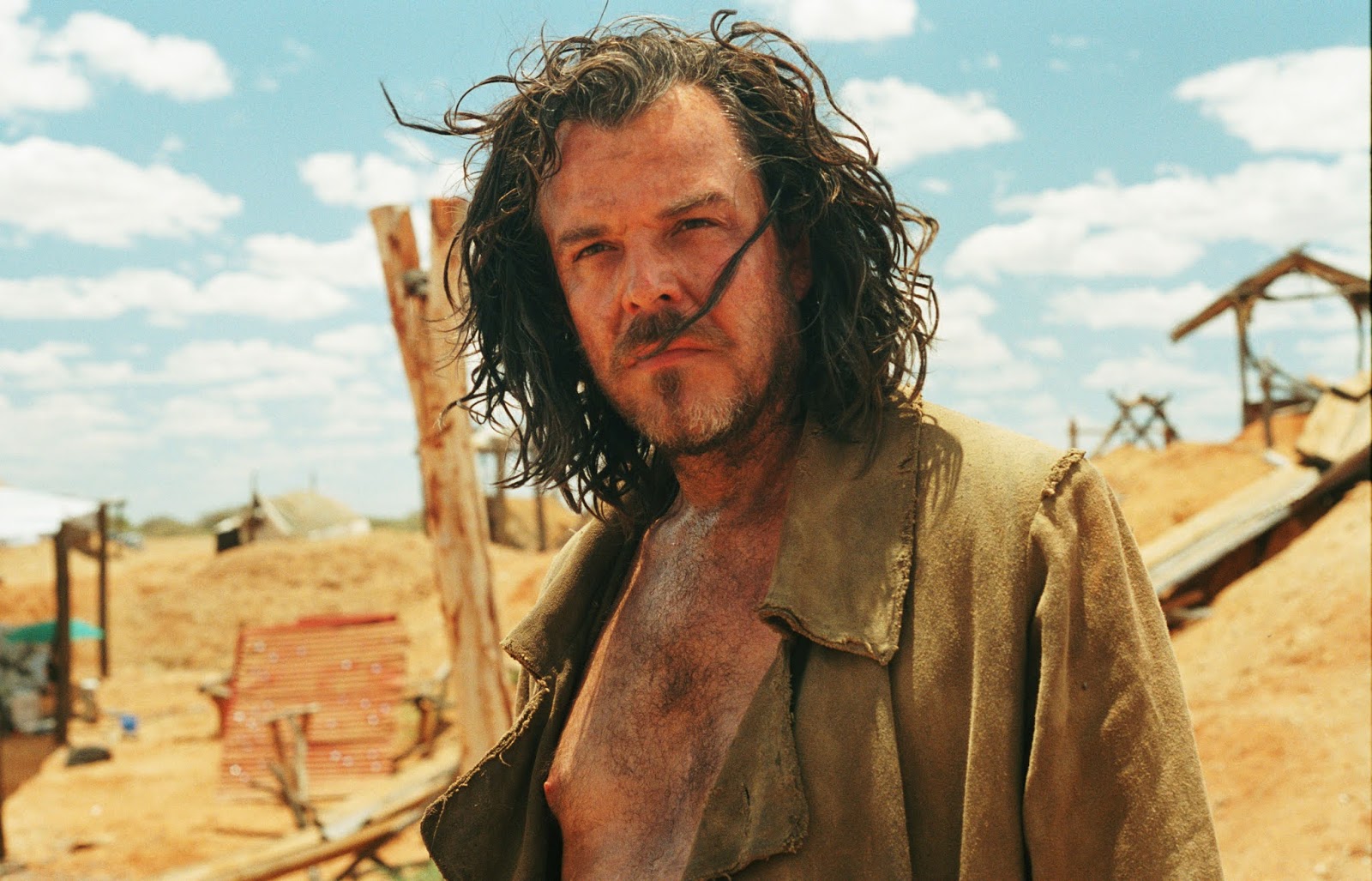
Danny Huston does excellent work as the poetic Arthur who lacks any touch of empathy. Softly spoken and chillingly calm at all times, with a lilting Irish accent, Arthur slaughters without any mercy and can charmingly undertake any level of depravity and violence. From mutilation to rape, from sudden slaughter to lingering sadism, worst of all it never seems to be personal with Arthur. More just a way of alleviating his own boredom with the world. Is there something about life in the outback that has turned Arthur slowly and quietly insane? Perhaps so, and it fits with Hillcoat and Cave’s nihilistic view of humanity as a destructive force with very little room for hope.

Guy Pearce’s Charlie perhaps offers what little hope we have – and even he is a murderer. Pearce does quiet, generous work in a reactive role, tipped pillar to post and dealing with conflicted family loyalties as well as some sense of right and wrong. Enough of a sense at least to believe wanton murder and destruction as practised by Arthur is too much. Pearce is a quiet, enigmatic figure in the film – perhaps a man struggling to work out where he sits. It’s a performance that cedes a lot of the fireworks elsewhere, with a moral conundrum that is almost deliberately elliptical, but striking nonetheless.

The Proposition is a tough and difficult film. It has a slightly disjointed narrative that at times skips gently over events or moves swiftly from one to another but missing connective events in between. It has the feel of a fever dream, the sort of bizarre tale you might throw together out of half-remembered nightmares. It allows wonderful opportunities for actors – all mentioned, and also John Hurt quite delightful as a drunken but deadly bounty hunter, his wizened looks perfect for the overbearing wilderness. Sure it’s a western that runs rampant with destruction, but it’s also a dark stare into the evil heart of man. It may end with a slight note of hope, but it’s an obscured and uncertain one and mixed in with more than enough suffering and destruction for the survivors.

The Proposition is still the finest film John Hillcoat has directed, and the best balance between compelling story telling and difficult nihilism.

Picnic at Hanging Rock (1975)

Three girls go up a rock and are never seen again in Peter Weir’s masterpiece Picnic at Hanging Rock

Director: Peter Weir

Cast: Rachel Roberts (Mrs Appleyard), Anne-Louise Lambert (Miranda St Clair), Dominic Guard (Michael Fitzhubert), Helen Morse (Mlle de Poitiers), Margaret Nelson (Sara Waybourne), John Jarratt (Albert Crundall), Wyn Roberts (Sgt Bumpher), Karen Robson (Irma Leopold), Christine Schuler (Edith Horton), Jane Vallis (Marion Quade), Vivean Gray (Miss McGraw), Martin Vaughan (Ben Hussey), Kirsty Child (Miss Lumley), Jacki Weaver (Minnie)

Is there any film as haunting and elliptical as Picnic at Hanging Rock? An impenetrable puzzle shrouded in mystery and wrapped in an enigma, it’s the ultimate “mood” film, where everything you understand in the film has be teased out from its sidelines and the unspoken motivations. It’s not going to be for everyone: Peter Weir tells a story on the feature-length Blu-ray documentary (longer than the film) of the response of one US distributor when he saw the film: “[He] threw his coffee cup at the screen at the end of it because he had wasted two hours of his life – a mystery without a goddamn solution!” That’s a fair comment – but accept that this mesmeric film is somewhere between mystery, hynoptic trick and ghost story and you’ll find treasure in it.

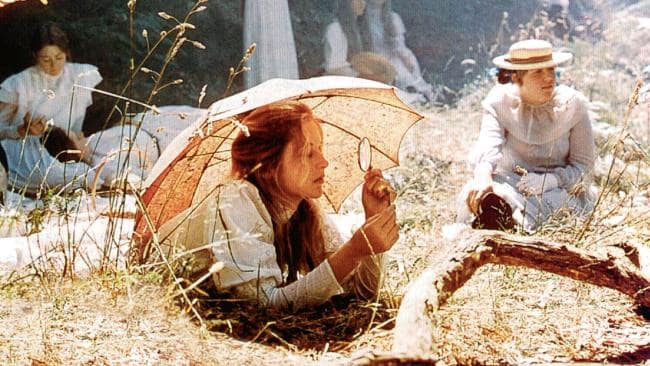
Based on Joan Livesey’s novel (which many believed to be true – a fate that also faced the film when it was released), on St Valentine’s Day 1900, a group of girls from a finishing school head to the Hanging Rock in Victoria for a picnic. Three of them (and one of their teachers) walk up to the rock and simply seem to disappear. The subsequent search by the authorities is baffling – and the impact on those left behind is brutal. 

There is barely any real plot in Picnic at Hanging Rock but it’s not a film about that. It’s all about the mood, the creeping sense of menace, and the general uneasy dream nature of the story. Everything follows a woozy dream-like logic – and the atmosphere is built upon by the use of panpipe music and skilful use of classical music. Weir’s film is a masterpiece of ghostly, unsettling spookiness with the rock itself as some unknown mystical source at its centre – the first shot of the film shows it slowly appearing in the mist, as if it has somehow been transported there from some fantasia land outside of the normal.

Weir’s film became the most influential film of Australian cinema, and its tone set many of the key thematic points followed by later films of what became known as the “Australian New Wave”. It explores uneasy balances in Australia between the wildness of the country – and indigenous people’s beliefs and culture – and the social structures from the British residents who had claimed the land. Picnic also explores the beginnings of a split between long-standing Australian residents and those clinging to the upper class Brit lifestyle of the motherland. Weir’s film – with its brilliant photography – lingers on the nature surrounding the rock. Not only the rock itself, with its odd formations and strange structure, but also the animals and the environment about it. There is something unknowable, wild and untamed about these surroundings – something mankind can’t control or understand.

Weir shoots the film with a lush impressionism – everything has a hazy unreality about it – and the dreamy nature of the film is built on with the dark hints of sexual feeling bubbling under the surface. The girls are all on the cusp of discovering their own sexuality – and there are plenty of open suggestions of same-sex crushes, of growing awareness of their sexual natures among the girls. It doesn’t stop with them either – the adults are equally drawn towards unspoken desires (left very much open to interpretation). Weir gets some perfect visual representations of the stonking repression forced on top of all these feelings, not least a wonderful shot which shows several of the girls standing in a line tightly doing up each other’s corsets.

And that perhaps, it’s hinted, is what happens on the rock when the girls disappear. Trance-like, they walk towards a gap in the rock and seem to disappear. What drew them there? Lead girl Marian (a perfect performance of ethereal other-worldliness from Anne-Louise Lambert) even seems dimly aware in the opening scenes that she is bring drawn towards something. The only girl who isn’t drawn towards the mystic is more repressed, dumpy Edith – whatever the force is that calls the other girls, it leaves her panicking and screaming. What’s going on? Something dark, sinister – and you can’t help but think sexual.

And what does that mean for those left behind? A mess. Rachel Roberts (a late casting replacement for Vivien Merchant, and famously awkward around the girls on set) is very good as the distant, draconian headmistress of Appleyard Academy (basically a sort of finishing school for posh girls). The regime she runs at the school is a mixture of oppressive and discriminate, with punishments handed out according to Mrs Appleyard’s personal feelings about the students rather than any reflection of their own behaviour. Part of the film’s story is the fracturing of her own personality that happens as response to the disappearance – her collapse slowly into a sort of paranoid insanity, powered by drink. What dark secrets is she hiding? (The film hints that she has more knowledge than she should have of at least some of the darker events of the story, but never reveals how much or indeed why.) 

But then the whole cast are dealing with problems they scarcely seem to understand. There is a curious – perhaps homosexual bond – between Dominic Guard’s repressed English teen and John Jarrott’s earthy, ultra-Aussie outbacker (a very good performance from Jarrott in a character that could easily have fallen into stereotype). Perhaps that’s why Guard’s character is drawn constantly back to the rock – and also why he too seems to have such an overwhelmed reaction to it.

The sole character in the film who feels most capable of expressing their emotions is the school’s French teacher Mlle de Poitiers. Played exquisitely by Helen Morse – she gives the warmest, most engaging performance in the film – she is the only character who seems able to get in touch with her emotions, unfiltered by too much repression. Perhaps it is no coincidence that as a “double foreigner” (French among the Brits in Australia) she is less affected by the rules around her. Either way, she becomes a perfect audience surrogate, as slowly horrified and confused by the actions she sees around her in the college as the viewer is. Morse is fabulous in these scenes, from a burst of emotion when reunited with a character she thought lost, to quietly watching Mrs Appleyard’s disintegration late in the film.

But the real star is Weir’s masterful direction of the mood of this film. Like that distributor said, there isn’t any plot as such – vital events happen off screen, and there is the distinct feeling that you are only being told half the story – but despite that, the film is compelling. So much is conveyed in the mood, the tensions, the style of the film that you are invited to bring your own interpretation to events. That makes it a continually rewarding piece of cinema – it invites you to make your own answers. 

This juggling of atmosphere to make something so enigmatic is so crucial to the film’s success that the recent mini-series remake effectively continued the trick (with a few extra insights into Mrs Appleyard), and contained arguably even fewer answers over its 5 hours than this did in 2. But Weir’s brilliantly made, beautifully shot, eerily unforgettable film rightly takes its place as (perhaps) the greatest Australian film ever made: it’s a film that is about Australia, and about the tensions, confusions and mysteries of that country. Brilliant.

Lion (2016)


Dev Patel searches for his past in Lion

Director: Garth Davies

Cast: Sunny Pawar (Young Saroo), Dev Patel (Saroo Brierley), Rooney Mara (Lucy), Nicole Kidman (Sue Brierley), David Wenham (John Brierley), Abishek Bharate (Guddu), Divina Ladwa (Mantosh Brierley), Priyanka Bose (Kamla Munshi), Seepti Naval (Saroj Sood)

In 1986, Saroo (Sunny Pawar) is accidentally separated from his brother Guddu (Abishek Bharate) and mother (Priyanka Bose) after being trapped on a train that travels 1,600km to Calcutta. Unable to find his way home, and dodging the dangers of Calcutta’s streets, he eventually ends up in an orphanage. He is adopted by an Australian couple, the Brierleys (fine and tender performances Nicole Kidman and David Wenham). Twenty years later, a chance meeting with a group of Indian students brings Saroo’s (Dev Patel) memories flooding back– and dedicates himself to retracing his steps and finding his family in India.

Lion is an overlong expansion of a story that would really spark your interest when presented in a newspaper article. But Garth Davies’ film drains the dramatic life out of the story by ludicrously overextending the telling in order to try and eke as much emotion from the audience as possible. Lion is under two hours, but it really should be at most an hour and a half.

The problem is the central section in Australia, while our hero tries to locate his roots. It just isn’t quite interesting enough, despite sterling, committed and emotional work from Dev Patel. Put simply, even with an extraordinary story like this, the film can’t help but communicate Sarro’s obsessions through cinema’s clichés. So we get a madness board with pins and bits of string to link clues. We get Saroo increasingly dishevelled. We get him driving away family and girlfriend. We get moody, tearful glances into the middle distance. Even the final solution to the mystery occurs after a spark of inspiration during a rage fuelled “I’m going to wreck this board and give up” moment. This whole section just serves to reduce the story into movie-of-the-week territory.

The film just doesn’t quite connect with us as it should. Perhaps because of the amount of time given over to very slow Google Earth searches, or overblown camera tracking shots across train lines, or expansive slow, piano-scored moments of emotional torment from Saroo. It’s a shame because there are flashes of good material in there – Nicole Kidman’s has a stand out scene to explain why she chose not to have children – and Dev Patel is the best he’s been. But it doesn’t quite work. After Saroo’s emotional revelation at an Indian friend’s house and realisation that he is “lost” (and this quiet devastation from Patel is affecting), the story doesn’t really kick off. It just slows down.

It’s a shame as the opening third of the film with young Saroo lost in Calcutta is very well done, even if it seems virtually every male living on the streets is a paedophile. The early scenes with Saroo and his brother are very good, and establish the strength of their bond. Sunny Pawar does a marvellous job as the lost boy, and Garth Davies films Calcutta with an earthy realism, as well as having a wonderful sense of empathy for the vulnerability of children. It’s also striking to see how uncommented upon a child alone on the streets of Calcutta goes. The dangers Saroo dodges feel genuinely threatening, and helps us invest emotionally for the rest of the film.

The moments that flash back to this do get overplayed later. Much as I initially liked Saroo hallucinating his brother and mother appearing around him in the streets of Melbourne, it’s a card that quickly gets overused. Like many of the ideas in this film, it gets hammered home a little too much. It’s that whole middle section, with poor Rooney Mara saddled with the thankless part of supportive girlfriend. You could have cut it down by 20 minutes and had the same impact. Garth Davies’ direction simply gets carried away with the lyrical sadness, to try and tug our heartstrings.

The problem is the most moving part of the film is the final sequence where we see the real people meeting in the streets of Khandwha. Nothing else in the film really measures up to this genuine emotion. Particularly after we’ve watched a man searching Google and behaving moodily for well over forty minutes. It’s a film that loses its way because it’s moments of emotional reality like that which make these stories truly profound – and a dramatisation can never provide that. With the film also unable to find a way to make the search as dramatic and engaging as the getting lost and being found, it also flounders in the middle, taking way too long to get us to the destination. It’s got its moments, but it’sa well assembled film that outstays its welcome.

Walkabout (1971)


The blistering heat of the Australian wilderness is the setting for Roeg’s profound and troubling film

Director: Nicolas Roeg

Cast: Jenny Agutter (White girl), Luc Roeg (Brother), David Gulpilil (Aboriginal boy), John Mellion (Father)

Some films are hard to read. Others delve gently into ideas so complex and obscure that they need patient attention to follow. And other films are so elliptical and enigmatic they almost defy understanding. Walkabout is such a film. What is it about? You could almost say “everything and nothing”. 

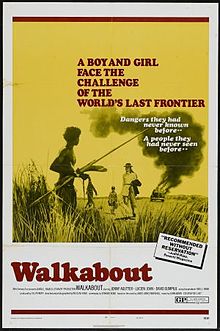
The surface story is strikingly simple. A 17-year-old girl (Jenny Agutter) and her much younger brother (Luc Roeg, the director’s son) are stranded in the Australian outback after their disturbed father first attempts to kill them (perhaps?) and then sets their car on fire and shoots himself. Quickly lost, with no idea how to get back to civilisation, they meet a young Aboriginal boy (David Gulpilil) on Walkabout. He saves them and agrees to guide them back to civilisation (perhaps?). But how far can cultural understanding go?

The story Roeg is telling underneath this bare-bones plot, though, is intriguing and troubling. Roeg uses the setting to explore the complex interrelationship between Western civilisation and the native civilisations it has displaced in many parts of the world. It’s also about ageing, sexual awakenings and the barriers (some of which we place ourselves) that prevent communication. This is all set in Roeg’s stunningly photographed, dreamlike representation of the Australian outback which is part surreal combination of cross-cuts and editing, part dark nature documentary.

It’s a haunting film where it’s never clear exactly what is happening, or what each of the characters is aiming to do ( “I don’t know” is a common refrain heard in the film). From the start, there is clearly something wrong with the Father in some way (with dark suggestions that he has too great an interest in his daughter’s burgeoning sexuality), but why does he turn partly homicidal (he puts little effort into pursuing his children) and then suicidal? The film gives no real clue.

This confusion about motives continues through the film. Does the Aboriginal boy really understand (or intend) the need to deliver the siblings back to civilisation? At one point he walks up a hill, is talked at by a white woman from a nearby settlement, then returns giving no indication he has discovered what they are searching for. Later he does the same after finding a road. Does he want to help? Or is he unwilling to let go of the spiritual closeness he can feel between the three of them?

Similarly, Agutter’s character undergoes a spiritual experience so profound, and yet so unsettling to her carefully conventional upbringing, she seems unable to process it. In the company of the Aboriginal boy we see her begin to relax and lose some of her carefully guarded inhibitions (this culminates in a famous naked swimming scene, which got the film in plenty of trouble in 2003 when the Age of Consent was raised to 18). But at the same time, she is never really able to communicate with the Aboriginal boy.

Her attempts to do so are almost laughably incompetent. While her younger brother develops a natural rapport using sign language, she is hopelessly wedded to verbal communication (she doesn’t even think to mime drinking when asking for water). In the outback, she clings far longer than the boy does to the accoutrements of civilisation in clothing and their radio. While she does relax, only at rare moments do we feel her humbled by the land around her. Their first moments together can be seen in the video.

Only for the briefest of brief moments, in an abandoned hut, do they meet briefly as equals – a silent moment of eyes meeting and a brief understanding of shared affection. It is shattered by her complete rejection shortly afterwards of the Aboriginal boy’s courtship dance – scared and confused (as much by her own obvious interest earlier), she pointedly ignores the dance, leaving the boy outside all night. The next day she and her brother are dressed in their school uniforms, as if nothing has happened.

Roeg’s final nihilistic observations – we may at points come closer together as a species, but we will only rarely ever be able to overcome the barriers we have created between ourselves. We may develop an immediate bond with people in extreme circumstances, but the closer we get to “normality” the quicker we reject those bonds and revert back to our ingrained behaviours.

This is all fascinating and deeply engrossing stuff – and it’s the sort of material you can reflect on over and over again. Roeg mixes this in with plenty of dark comparisons between our soulless modern world and the “savage” world of the Aboriginals – a comparison never flattering to the modern world. Roeg uses intercutting to point these up, particularly between the hunting of the Aboriginal boy, his respectful killing of a kangaroo, and our own mechanical slaughter and processing of meat. Now to be honest these sort of cutbacks are thuddingly dated and heavy-handed – the sort of holier-than-thou opinion making that quickly gets on the nerves.

A few of these sequences do work well. Near the end, the Aboriginal boy hunts when he is nearly crushed by a truck carrying two modern hunters. The truck skids to a halt and the hunters gun down several animals (the rather tiresome editing uses a series of still shots, crash zooms and distorted sounds) while the Aborigine looks on with confusion and disdain. In another sequence, the white woman the Aborigine met heads back to a settlement, where white men seem to be exploiting Aboriginal labour. She sits sadly on the bed staring into the distance. Moments like this, despite the often dated editorial tricks, do carry a real sense of the divide between two cultures.

Other sections of the film make similar points about the wildness of both the outback and the city world, but with increasingly dated and tired visual tricks – do we really need an umpteenth shot of maggots eating a corpse? Or more quiet pans along cold 1970s commercial surfaces? This is a shame, as the photography is beautiful. Roeg has an eye for a brilliant image – his shots of the Australian outback are some of the best use of sun and desert on film since Lawrence of Arabia. The film’s shots of the desert are simply stunning, with Roeg’s hypnotic series of images guaranteed to not only haunt your mind, but also to show an angle on the world you won’t have seen before.

Walkabout may be slightly dated in some of its production and editing techniques, but it’s a deeply thoughtful, unsettling work that asks profound and difficult questions about civilisation, life and death – the sort of film that rewards revisiting and reinterpretation. While many parts of it clunk in places, or have a distinct 1970s flashiness in their filmmaking, when it moves away from these rather clumsy ideas to deal with concepts that are more spiritual and intriguing, it’s a fascinating film.