
Tag: Billie Whitelaw

The Omen (1976)

The Omen (1976)

Extremely silly horror with a great score, more interested in inventive deaths and genuine fear or dread

Director: Richard Donner

Cast: Gregory Peck (Robert Thorn), Lee Remick (Katherine Thorn), David Warner (Keith Jennings), Billie Whitelaw (Mrs Baylock), Patrick Troughton (Father Brennan), Leo McKern (Carl Bugenhagen), Harvey Stephens (Damien Thorn), Martin Benson (Father Spiletto), Robert Rietty (Monk), John Stride (Psychiatrist), Anthony Nicholls (Dr Becker), Holly Palance (Nanny)
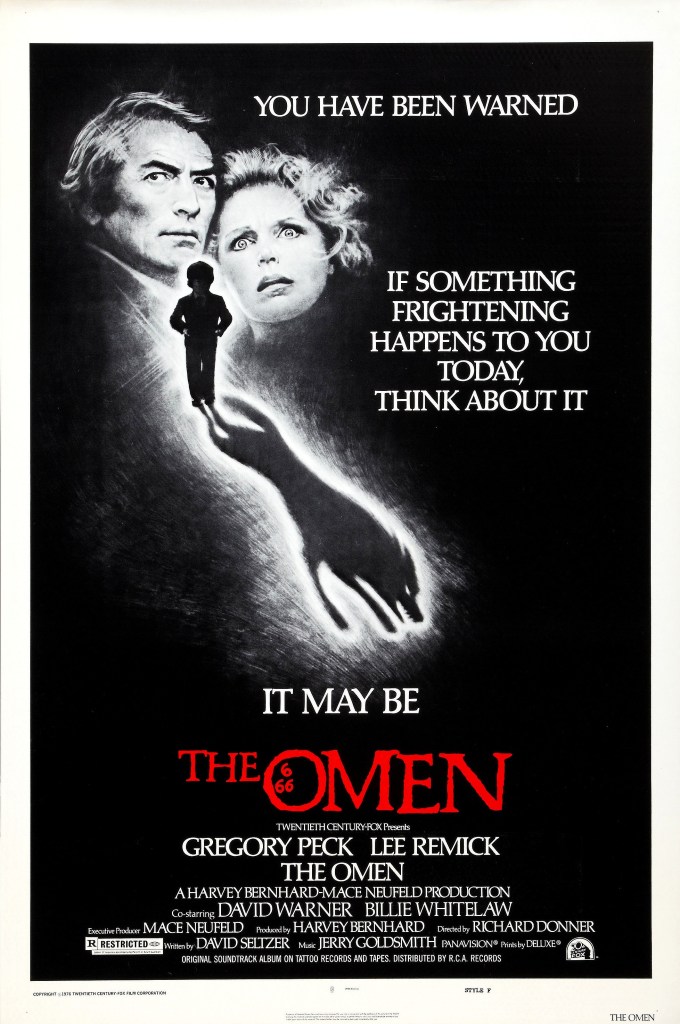
“Let him that hath understanding count the number of the beast; for it is the number of a man; and his number is 666.” One of the sweetest things about The Omen is that the number of the Beast was considered such an unknown concept to original viewers, that its painstakingly explained to us. In some ways The Omen is quite sweet, a big, silly Halloween pantomime which everyone involved takes very seriously. If The Exorcist was about tapping into primal fears, The Omen is a gory slasher (with a cracking score) that’s about making you go “Did you fucking see that!” as actors are dispatched in inventively gory ways. It’s brash, overblown and (if we’re honest) not very good.

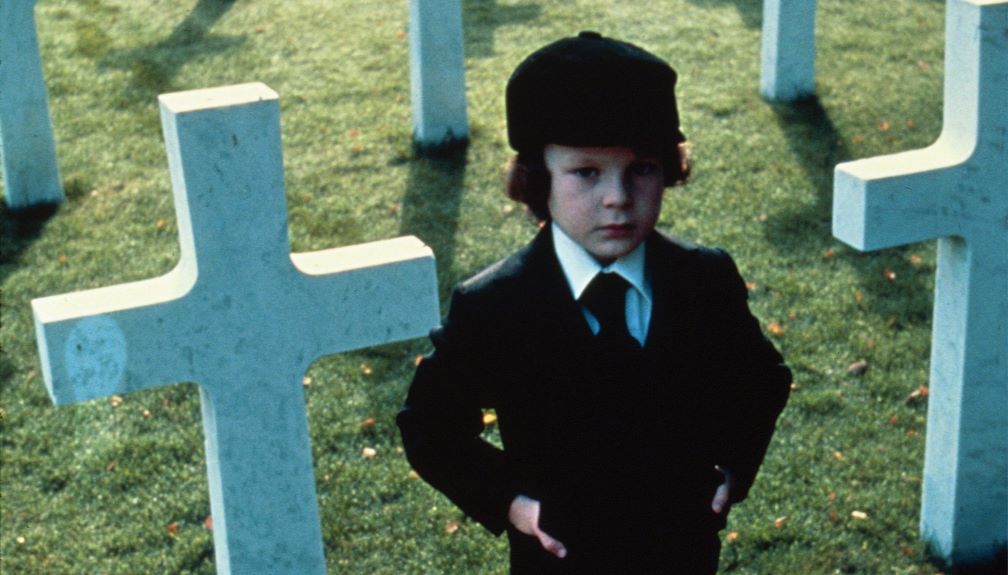
Robert Thorn (Gregory Peck, selling every inch of his innate dignity for cold, hard lucre) is an American diplomat told one night in Rome that his pregnant wife Katherine (Lee Remick) has given birth to a stillborn child. “Not a problem” he’s told by an absurdly creepy Priest (Martin Benson) – just so happens there’s another motherless new-born child in the hospital tonight so he can have that one, no questions asked, and his wife need never know. Flash forward five years: Thorn is Ambassador to the Court of St James and young Damien (Harvey Stephens) is a creepy kid, with few words and piercing stare. In a series of tragic accidents people start dying around him. Could those people warning Thorn that his son is in fact the literal anti-Christ himself, be correct?

Want to see how powerful music can be? Check out how The Omen owes nearly all the menace it has to it imposing, Oscar-winning score from Jerry Goldsmith (wonderfullyGothic full of Latin-chanting and percussive beats). It certainly owes very little to anything else. The Omen is an exploitative, overblown mess of a film, delighting in crash-zooms, jump-cuts and extreme, multi-cut build-ups to gore. Richard Donner never misses an opportunity to signpost an approaching grisly death, by cutting between the horrified face of the victim, the object of their demise and then often back again. For the best stunts – including a famous demise at the hands of a sheet of glass – Donner delights in showing us the death multiple times from multiple angles.

This slasher delight in knocking off actors – people are hanged, impaled, crushed and decapitated in increasingly inventive manners – is what’s really at the heart of The Omen. None of this is particularly scary in itself (with the possible exception of the hypnotised madness in the eyes of Holly Palance’s nurse before her shocking suicide at Damien’s birthday party) just plugging into the sort of delight we take in watching blood and guts that would be taken in further in series like Halloween (which owed a huge debt to the nonsense here). Donner isn’t even really that good at shooting this stuff, with his afore-mentioned crude intercutting and even-at-the-time old-fashioned crash zooms.

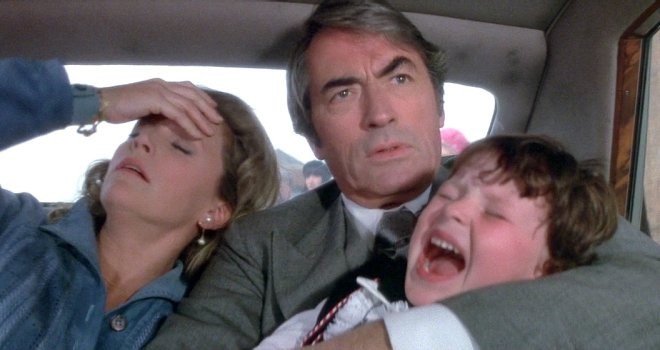
With Goldsmith’s score providing the fear, The Omen similarly relies on its actors to make all this nonsense feel ultra serious and important. They couldn’t have picked a better actor than Gregory Peck to shoulder the burden of playing step-dad to the Devil’s spawn. Peck has such natural authority – and such an absence of anything approaching fourth-wall leaning playfulness – that he invests this silliness with a strange dignity. Of course, Atticus Finch is going to spend a fair bit of time weighing up the moral right-and-wrongs of crucifying with heavenly knives the son of Satan! Peck wades through The Omen with a gravelly bombast, managing to not betray his “for the pay cheque” motivations, and investing it with his own seriousness of purpose.

Peck’s status also probably helps lift the games of the rest of the cast. Lee Remick may have a part that requires her to do little more than scream (and fall from a great height twice) but she does manage to convey a neat sense of dread as a mother realising her son is not quite right. David Warner gives a nice degree of pluck to a sceptical photojournalist (while also bagging the best death scene). Troughton and McKern ham it up gloriously as a drunken former devil-worshipping priest and an exorcist archaeologist respectively. Best in show is Billie Whitelaw who filters her Beckettian experience into a series of chillingly dead-eyed stares as Damien’s demonic nanny.
The Omen does make some good hay of its neat paedophobia. Harvey Stephens with his shaggy hair, impish smile and pale skin (not to mention darkly sombre wardrobe) looks like your worst nightmare – he’s creepy enough that the film doesn’t need to gift him a vicious rottweiler as well. Donner’s decision to never have Damien show a touch of any real emotion for most of the film also pays off, meaning even something as silly as Damien inflicting slaughter from behind the pedals of a child’s tricycle seems scary.

Of course, if Damien was savvy enough to present himself as a bright and sunny child perhaps Troughton, Warner, McKern and co would have struggled to convince Peck he was the Devil’s seed. In that sense he takes after his dad: Satan loves an over-elaborate death, and from a storm herding one victim to a fatal impalement under a tumbling church spire to popping the handbrake of a glass-bearing van for another, no trouble is too much for Satan when bumping off those who cross him. (The Omen could be trying to suggest that maybe everything is a freak accident and Thorn goes wild and crazy with grief – but that Goldsmith score discounts any possibility other than Damien is exactly what we’re repeatedly told he is.)

The Omen trundles along until its downbeat, sequel-teasing ending, via a gun-totting British policeman who sticks out like a sore thumb in a country where the cops carry truncheons not pistols. Donner balances the dialled up, tricksy, overblown scares with scenes of po-faced actors talking about prophecies and the apocalypse, all shot with placid straight-forwardness. There is a really scary film to be made here about finding out your beloved son is literally a monster, or how a depressed father could misinterpret a series of accidents as a diabolical scheme. But it ain’t The Omen – this is a bump-ride of the macabre. The Devil may have the best tunes – but he needs to talk to his Hollywood agent.

Charlie Bubbles (1968)

Albert Finney and Liza Minnelli deal with ennui in Charlie Bubbles

Director: Albert Finney

Cast: Albert Finney (Charlie Bubbles), Colin Blakely (Smokey Pickles), Billie Whitelaw (Lottie Bubbles), Liza Minnelli (Eliza), Timothy Garland (Jack Bubbles), Richard Pearson (Accountant), Nicholas Phipps (Agent), Peter Sallis (Solicitor), Alan Lake (Airmen), Yootha Joyce (Woman in Café), Wendy Padbury (Woman in Café), Susan Engel (Nanny)

In the late 1960s Albert Finney was possibly the biggest star in British cinema. It was a status that the private and reserved Finney found challenging – and fed heavily into his only directorial effort, Charlie Bubbles, an amiable and whimsical journey through the alienation that afflicts a successful northern writer, bored by the world of success in London but no longer at home in his working class roots. It’s a story that spoke to both Albert Finney and the film’s scriptwriter Shelagh Delaney.

Because writing is really just a hobby, not a viable career path as Charlie Bubbles (Albert Finney) is constantly reminded when he returns to his home in Manchester (“Are you still working sir, or do you just do the writing now?” queries an old friend of his father). Charlie is hugely successful but also hugely bored, wrapped in ennui and barely able to engage in his surroundings be that his wealth, his London settings, working class clubs he visits with fellow writer Smokey (Colin Blakely), the attentions of his enthusiastic secretary Eliza (Liza Minnelli) and his responsibilities to his ex-wife Lottie (Billie Whitelaw) and son Jack (Timothy Garland). (The poster by the way gives a hilariously incorrect idea of the plot as some sort of lothario drama).

The film largely doesn’t really have a plot as such, just follows the drifting lack of engagement Charlie feels for everything around him. It’s largely a showcase for some nifty heartfelt writing and some intriguingly imaginative direction from Finney. It’s actually a bit of a shame watching this that Finney didn’t direct another film, as he not only works well with actors but has an original eye for visuals. One scene is shot entirely through a bank of security cameras, others take interesting angles on everything from lunchtime meetings (with many too-camera addresses) to love scenes (shot with an efficient boredom that hammers home how little Bubbles seem engaged with it). 

It’s also a lovely little showcase for Shelagh Delaney, whose script is crammed with juicy little lines and playful moments, as Charlie struggles from event to event. It’s a very bitty and drifting storyline, that deliberately heads towards no particular destination. In that it reflects the aimlessness of Charlie’s own life. There is nothing particularly wrong with this, as the various sketches of which it is made up work rather well, particularly as they often engagingly switch from style and tone. There are a few other films I can think of that open with a ludicrous food fight between two friends, two guys pretending to be mannequins in a department store, a depressed man shooting pop guns at a video surveillance image, a Manchester United football game, an ex-wife catching chickens and finally the hero drifting away in a balloon.

How you go with this sort of thing really depends how much you engage with the action on offer or the whimsical style of the entire shaggy dog story. It also rather depends on how much sympathy you feel for someone burdened with immense wealth and fame from overwhelming artistic and critical success. The film gives some taste of this – staying with his ex-wife she is pestered by no less than three reporters arriving unannounced eager to hear the words of the boy wonder – but it’s pretty hard for us plebs to understand. Which I guess is the film’s point.

After all every time Charlie heads anywhere around his own working class roots in Manchester, he is met with either a snide insinuation that he has lost touch with his roots or a confused lack of understanding about the London lifestyle he has left behind. Charlie himself feels like he has no empathy for the wealth of London, but struggles to feel at home anymore in a world he has left behind. Interestingly he seems most comfortable in his ex-wife’s country cottage in the middle of nowhere.

Perhaps it’s hard to really understand the feelings you could have about the burdens of success without going through this sort of thing yourself. Finney certainly had – though it’s interesting that he the actor and he the director seem to be on a different page. While the film tries to have an engaging lightness about it, Finney’s own performance is weighted down and overly somber, so low-key as to be almost pushing against the tone of the film. Perhaps it’s a role Finney needed to take in order to get the film made – or perhaps he directed the film because no one else would – but even Finney himself was critical afterwards of his performance as being too heavy for the film.

It does mean however that the lightness and perfect touch of the rest of the actors are needed to balance him out. Liza Minnelli (in nearly her film debut) is superb as an effervescent young woman, delighted with things around her, warm and eager to engage with people around her. Billie Whitelaw is also great (and BAFTA winning) as Charlie’s ex-wife who he continues to share a vast amount of romantic and sexual chemistry with, for all she has no patience for his ennui and the intrusions his fame brings to her life.

The film drifts engagingly along, before finally departing with its star in a hot balloon into the sky. It’s the sort of whimsical fantasy that also feels like a commentary from those wrapped up in the surprising boom of kitchen sink drama British films, that brought fame and wealth to those involved, but also pulled them away from feeling comfortable and happy in their own roots. It’s perhaps hard to understand without having gone through an experience like that, but it works here because most of the rest of the film has an imaginative charm to it.

Gumshoe (1971)

Fulton Mackay and Albert Finney in charming Liverpool set Chandler spoof Gumshoe

Director: Stephen Frears

Cast: Albert Finney (Eddie Ginley), Billie Whitelaw (Ellen Ginley), Frank Finlay (William Ginley), Janice Rule (Mrs Blankerscoon), Carolyn Seymour (Alison), Fulton Mackay (Straker), George Innes (De Fries), Billy Dean (Tommy), Wendy Richard (Anne Scott), Maureen Lipman (Naomi)

Film noir is a genre beloved by many, and – with its many conventions and, in particular, its hard-boiled Chanderlesque style – it’s also ripe for parody. That’s what Gumshoe does here, transplanting the rough, grimy mysteries of Philip Marlowe and Sam Spade to Liverpool in the 1970s. In doing so, it allows Albert Finney to let rip with the sort of hugely enjoyable personality performance that plays to his strengths.

Finney plays Eddie Ginley, a would-be comedian and entertainer in his thirties, obsessed with Chandler and Hammett. Placing an advert in the paper offering his services for private investigations in the spirit of a lark, he finds himself hired to look into a decidedly complex affair concerning a female lecturer, a fat South African, an occult bookshop, an unhappy South African political refugee and quite possibly his brother William (Frank Finlay) and his old flame and now sister-in-law Ellen (Billie Whitelaw).

Gumshoe is a an enjoyable, small-scale, cine-literate drama, with a playful script by Neville Smith that has a wonderful ear both for the style of Hollywood detective drama, and the streets of Liverpool – and knows how to mix them together. Shot simply by Stephen Frears (who rather sweetly claims on the blu-ray documentary to not have had a clue what he was doing), the film rattles along with a few good jokes, some decent set-ups and an actually rather good mystery. It largely falls just the right side of parody – not too smarmy, affectionate enough but never taking itself too seriously. It’s a very well judged pastiche – and it’s also a pretty damn good mystery itself.

The film was somewhat of a passion project for Albert Finney (his production company put up much of the funding).  And you can see why, as Finney is excellent – relaxed, smart and funny. Eddie Ginley is part dreamer, part realist trying not to see the truth around him. He knows this world of detecting is partly a game, partly dangerous, partly a fantasy – but he wants to enjoy while it he can. Finney also clearly enjoys the sort of Marlowesque dialogue, just as he gives real emotional depth to a man who has always been looked down on by his brother, and jilted by his girlfriend for said brother. It’s one of his best performances, he’s outstanding – a charming, playful, warm and also super-smart and cunning performance.

The rest of the film gives playful highlight moments for a number of performers, wrapped up in the enjoyment of the material. Finlay does a decent job as a stuffed-shirt straight man, Billie Whitelaw enjoys a sly parody of any number of femme fatales from 1940s movies, and Janice Rule is intimidating as a very different type of suspicious female. The best supporting performance however comes from Fulton Mackay as a brusque but wry Scottish hitman, tailing Ginley throughout the film to reclaim money he feels is owed to him. 

It’s a shame that a fun, playful and engaging film has in some places dated so badly. Not least in its language aimed at a black heavy Ginley gets into a scrap with. Intimidated and off-guard, Ginley falls back onto banter aimed to put the heavy off balance – but which listened to today is basically a string of vile racial slurs using words like jungle, bananas, trees etc. etc. etc. And the attitudes are repeated time and again in the film, with the character constantly referred to in the most derogatory and racialist terms. Mind you at least Oscar James as the butt of this gets a neat dig at Ginley hardly being “the Great White Hope” after a brief bout of fisitcuffs.

It’s an interesting sign of how dated the film is that the villains are racist apartheid South Africans, Finney was at the time a leading campaigner against Apartheid, but neither he nor the film clearly  put calling a black man a monkey into the same bracket as that bigoted system. No one involved really is a racist, not even the characters – it just wasn’t deemed a problem to say those things in the 1970s. (Even the booklet in Indicator’s excellent blu-ray dwells on this uncomfortable dated material).

But, bench that from your mind, and you’ve got a charming, fun pastiche that pokes a lot of fun at Bogart and Chandler. The make-believe fun of Eddie’s Marlowesque hard-boiled dialogue is constantly punctured by him having to explain what he’s trying to say. The film has a lot of fun with the details of a mystery, but still keeps that smart sense of tongue-in-cheek. It’s packed with some excellent lines and some sharp performances. Finney is superb. It’s a pastiche and an affectionate homage of a whole genre – and, although it is old-fashioned and feels a bit dated, it will I think stand up to re-watching.