Tag: Billy Crudup

Almost Famous (2000)

Almost Famous (2000)

Cameron Crowe turns his youth into a hip coming-of-age film with just enough sting among the sentiment

Director: Cameron Crowe

Cast: Patrick Fugit (William Miller), Billy Crudup (Russell Hammond), Frances McDormand (Elaine Miller), Kate Hudson (Penny Lane), Jason Lee (Jeff Bebe), Zooey Deschanel (Anita Miller), Anna Paquin (Polexia Aphodisia), Fairuza Balk (Sapphire), Noah Taylor (Dick Roswell), Philip Seymour Hoffman (Lester Bangs), Terry Chen (Ben Fong-Torres), Jay Baruchel (Vic Munoz), Jimmy Fallon (Dennis Hope), Rainn Wilson (David Felton)

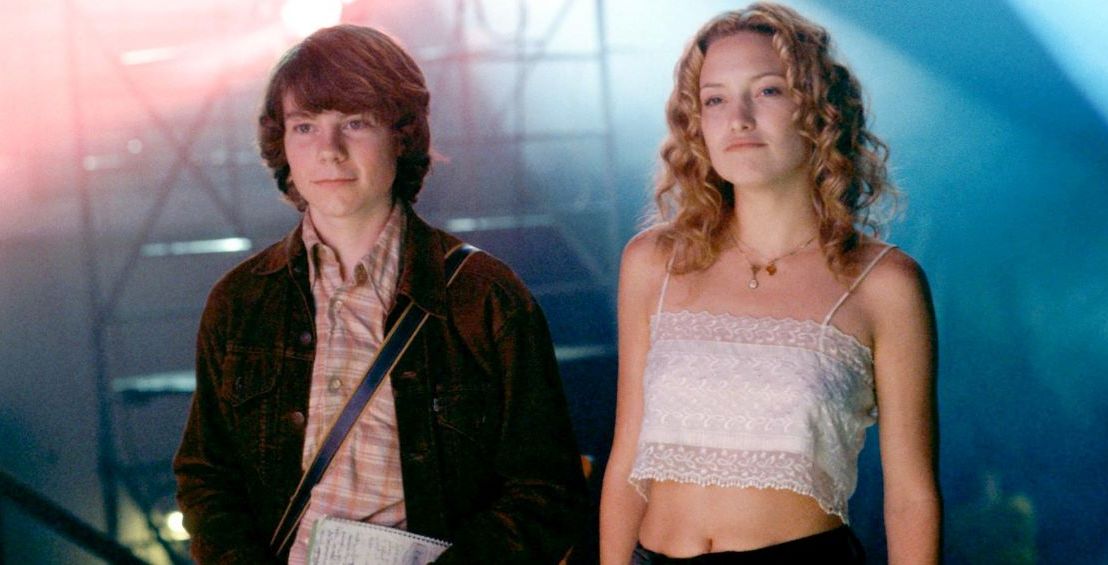
Cameron Crowe fictionalises his teenage years in the warm, affectionate Almost Famous, an endearing, heartfelt riff on the golden years of Rock ‘n’ Roll, when it felt like music could change the world and making the front cover of Rolling Stone was the greatest thing ever. Patrick Fugit plays William Miller (the Crowe substitute), a precocious 15-year-old would-be-music journalist recruited by Rolling Stone to write an article on Stillwater, an up-and-coming new band. Miller adores the music scene and is soon smitten with the lifestyle, Stillwater’s charismatic guitarist Russell Hammond (Billy Crudup) and most of all “Band Aid” (muse not groupie) Penny Lane (Kate Hudson).

Crowe’s film is a glorious reconstruction of the rock and roll scene of the early 70s – and I can imagine anyone with fond memories of it will find much to love here. It’s not just the fashions and hairstyles, but the glorious capturing of a mood. The whole film is a celebration of a time that felt freer and more idealistic, where the actions and words of a rock band could feel like the most important, beautiful thing in the world. The film is not just nostalgia but also a celebration of a mood of hopefulness that embodied an era.

It’s also a coming-of-age story, as a boy-becomes-a-man. Patrick Fugit is very endearing as a kid no one can quite believe is 15, even though every moment seems to hammer home his fresh-faced innocence. But then it’s not a complete surprise since, thanks to his strong-willed mother having moved him up a class at school and led him to believe he is older than he is. Nevertheless, this is the sort of trip that shapes someone, finding friendship, love, belonging, betrayal, righteous anger and acceptance along the way. All of this is backdropped by the shift of rock and roll becoming something corporations used to make a lot of money.

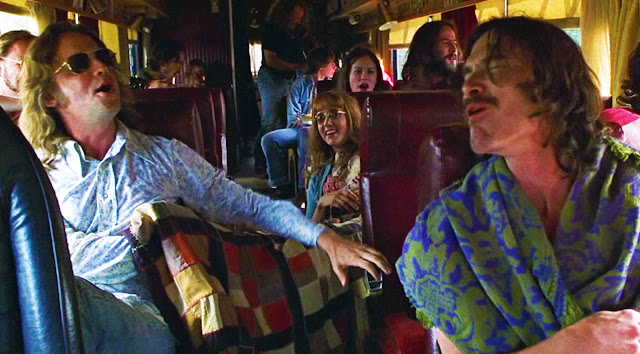
Stillwater are just on the cusp of this, still clinging to the fun of bussing from gig-to-gig, enjoying the mood, the songs and (of course) the girls. The film is also a celebration in a way of their coming-of-age, the tour starting in a ramshackle bus and ending on a sleek private jet, with accommodation switching from the bus to plush hotels. And along the way, they are trying to work out what they hell they are doing as much as William is. Perhaps that’s why the film feels like it captures the era so well – wasn’t everyone flailing around in the 70s trying to work out if they belonged to the hedonism of the 60s or what would become the Reagonism of the 80s?

But it’s still rock ‘n’ roll, best embodied by Billy Crudup’s charismatic turn as Band icon Russell Hammond. Crudup is all grungy magnetism and shuffling emotional gentleness under the surface of rock star swagger. Not that it stops him from moments of egotism, selfishness and pomposity. You can see why tensions are sometimes high in the band, with the rest of its members often seen as jut Russell’s support group (a band t-shirt causes fury when it shows Russell in the foreground with the other four as shadowy outlines behind him). Russell takes William under his wing, perhaps because he recognises the youth and fragility in William. Or maybe he just likes the hero-worship.

Because one of the dangers of getting close to these stars is getting sucked into hero worship. William is after all a journalist who needs to maintain objectivity. He’s even warned about it by his mentor, fabled music writer Lester Bangs (Philip Seymour Hoffman in a charismatic cameo) that the biggest danger is succumbing to the charms of the celebrity: these are after all, people who have made it their mission in life to be liked. They’re going to be good at it.
Getting in their airspace can be a dangerous place, as discovered by leading Band Aid Penny Lane, played with a luminous, radiant warmth by Kate Hudson. Penny is a devoted fan, enraptured with being part of the scene and with her self-proclaimed role as muse to the artists. Based on a personal friend of Crowe’s – and, one supposes, his real-life first love – it’s Penny who draws William into this life, looks out for him, cares for him (a favour he is to return in kind). She starts an affair with Russell – but is banished when Russell’s girlfriend rejoins the tour, jokingly traded in a card game with another band for a crate of beer (a reveal Hudson plays with a beautiful mix of devastation and valiant nonchalance). It’s not that Russell’s a bad guy, more that he can’t cope with complexities.

So, you can see why William’s Mum – played with a larger-than-life mix of bullish determination, smothering love and control-freak determination by Frances McDormand – is so worried about him. It’s a sign of the film’s overall warmth (and Crowe’s well-adjusted personality!) that McDormand’s character is treated with the same affection and admiration as everyone else and the love between mother and son is never in doubt. She is responsible for some of the film’s highlights, not least a phone call to Russell where her natural authority quickly reduces him to the overgrown schoolboy he is at heart.

And Almost Famous is a very funny film, riffing off various true life rock-and-roll road trip stories, from raucous parties to accidental electrocutions, like a slightly straighter version of Spinal Tap. It’s capped by a hilarious near-disaster plane flight, where the end seems in sight, leading to a series of ‘confessions’ that become more and more heated and factious as they go on. It’s a film that shows some of the warts of the characters – just as William’s article eventually will for Stillwater – but also their many, many beauty spots. People make mistakes and hurt each other, but life goes on – and we take the punches, but they don’t define us.

Perhaps that’s a big part of growing up: and it’s a growing-of-age film for three characters: William, Penny and Russell. All three of these characters find themselves drawn together, all of them spiritually so close. They hurt each other, betray each other, but they all love each other. It’s a hopeful message, a glorious celebration of a time and era.
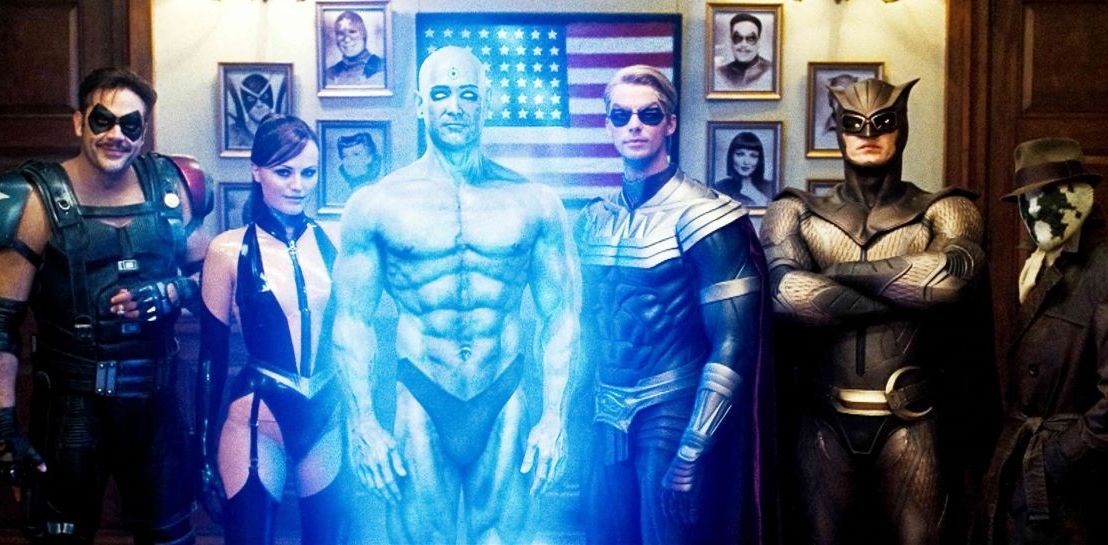
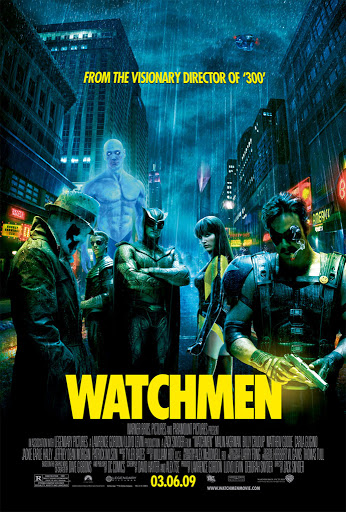
Watchmen (2009)

Watchmen (2009)


Morally complex heroes in Zach Snyder’s visually impressive but slightly empty Watchmen

Director: Zach Snyder

Cast: Malin Åkerman (Laurie Jupiter/Silk Spectre II), Billy Crudup (Jon Osterman/Dr Manhattan), Matthew Goode (Adrian Veidt/Ozymandias), Jackie Earle Haley (Walter Kovacs/Rorschach), Patrick Wilson (Daniel Dreiberg/Nite Owl II), Jeffrey Dean Morgan (Edward Blake/Comedian), Carla Gugino (Sally Jupiter/Silk Spectre), Matt Frewer (Edgar Jacobi/Moloch), Stephen McHattie (Hollis Mason/Nite Owl)

If you asked people to name the greatest Graphic Novel Ever, chances are they would come up with Alan Moore’s Watchmen. This scintillating deconstruction of superheroes and the morality of caped avenging satirises what the impact of superheroes in a real world might be. It had taken decades – and several cancelled attempts – to get a version to the screen. So, if nothing else, Zach Snyder deserves plaudits for merely persuading Hollywood executives to get this expensive, R-rated, morally complex film to the screen. Sure, the final result isn’t perfect, but it’s got a fair bit going for it.

Watchmen is set in an alternative 1985 where Richard Nixon is serving his fourth term and the Armageddon of Nuclear war is just around the corner. Masked vigilantes had been a common sight on the streets – although banned since 1977. The Vietnam war was won (in a few days) by the God-like Dr Manhattan (Billy Crudup), a scientist granted superhuman powers in 1959 after an accident with a field generator. Most other vigilantes are retired, other than right-wing bully the Comedian (Jeffrey Dean Morgan). When the Comedian is murdered by a masked intruder, his fellow members of superhero group the Watchmen, worry someone is eliminating them for reasons unknown.

Snyder’s Watchmen is a visual feast. Snyder – a huge fan of the graphic novel – used it as a visual bible, quoting it in several frames. The film is a beautiful mix of dark, filmic visuals and striking comic book primary colours, while frequently embracing the inky black murkiness of the violent world its depicting. Shot with the same high energy and dynamism as 300, Snyder’s ability to turn pulpy Warhol inspired visuals into fast-paced, filmic action is second-to-none.

What however is more of a shame is the feeling that the main things in Watchmen that interest Snyder might be the visuals. Where the film sometimes fails to come to life is where it deals with the complex morality of its heroes. The original deconstructed the morality of heroes. How a man with the powers of a God could come to look on humanity with an (albeit affectionate) distance. How a masked PI would be so convinced that right and wrong were certain that he would be willing to carry out acts of bone-crunching violence. That a hero could calculate sacrificing millions of lives for the greater good isn’t just acceptable, its recommended. That for others the exhilaration of spending their nights beating up criminals is an escape from the mundane realities of life.

The problem is that Watchmen never quite gets to the heart of these moral questions, of really tackling the rights, wrongs and shades of grey of those ethical quandaries. Rather than delving into them, ideas are too often stated. While its daring for a film to include heroes who are as deeply flawed, violent and, at times, even as unpleasant as this – it still doesn’t quite flesh out the complexities of this.

Too often the film takes a naughty pleasure in its violence and brutality, seeing that as a short-hand for presenting a morally unclear world. And at times wants us to go “how cool is that!” rather than asking “should I be enjoying watching indiscriminate slaughter from a vigilante”. Its telling that the recent HBO series of Watchmen – a sequel to the Graphic Novel set in the modern world – feels more like a true adaptation of the source material than this. That dealt with fascinating ideas about race in America, morality and acceptable sacrifices for the greater good (and still managed to work in plenty of action). By comparison, this film of the source material itself feels less deep. Now of course run time is part of that, but it should have been possible to make a film this long that more successfully combined ideas and visuals.

Snyder’s passion for the material is clear – but the film is often a little too obvious. From cuts to musical cues, it’s a film that pushes the envelope only in terms of its look and feel. It tries its best, but its vision of transmitting the depths of the original sometimes seem to stop at a faithful visual rendition of its style.

But it’s made with a lot of love and passion, not least in the acting. The decision to go largely with unknown actors pays off very well. Earle Haley brilliantly channels his character from the graphic book, a prickly obsessive with an unshakeable moral certainty. Crudup perfectly conveys the vast moral distance a real Superman would probably feel towards normal people. Goode’s chilling coldness and arrogance is perfect. Wilson gives the film heart as the closest thing to a genuinely decent guy. Åkerman does her best with a part that feels slightly underwritten and at times a plot requirement, largely defined by the emotions she provokes in the male character.

There are plenty of excellent moments in Watchmen but I’m not sure it ever really, truly becomes its own thing (in the way the HBO series did manage to do). In trying to so completely ape the visuals, and fit in all the plot, it becomes a companion piece rather than a stand-alone production. If Snyder had perhaps had a bit more courage to tack away from the strict structures of the original source material it could perhaps have helped make a stronger film. However, saying that I can imagine the fans hitting the roof if he had… And Snyder’s ability to persuade the studio to make a film with such a nihilist feel and ending is to be commended. Watchmen is a mixed bag, but when it works it does work well.

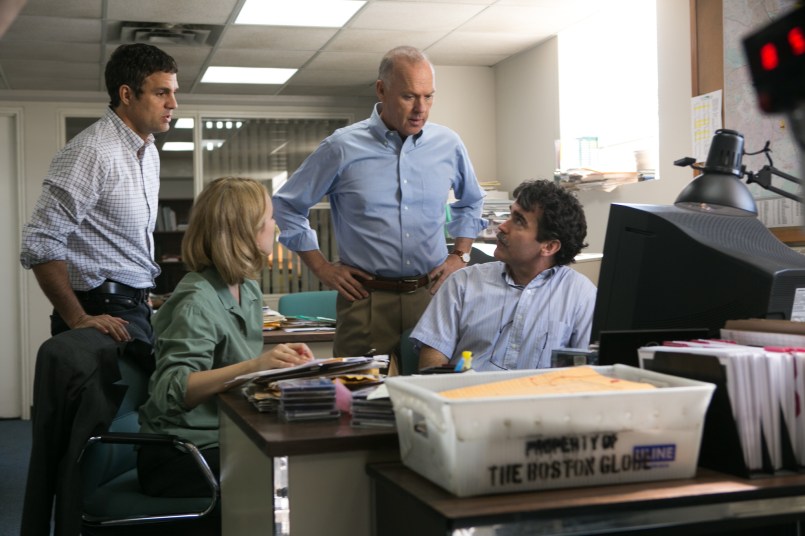
Spotlight (2015)

SPotlight header
Ruffalo, McAdams, Keaton and James head up the investigation into the church in Spotlight

Director: Tom McCarthy

Cast: Michael Keaton (Walter “Robby” Robinson), Mark Ruffalo (Michael Rezendes), Rachel McAdams (Sacha Pfeiffer), Brian d’Arcy James (Matt Carroll), Liev Schreiber (Marty Baron), John Slattery (Ben Bradlee Jnr), Stanley Tucci (Mitchell Garabedian), Billy Crudup (Eric MacLeish), Jamey Sheridan (Jim Sullivan), Paul Guilfoyle (Peter Conley), Len Cariou (Cardinal Bernard Law), Neal Huff (Phil Saviano)

True villains are hard to spot: those clothed in good deeds are particularly well hidden. Few clothe themselves in good deeds more effectively than priests – and the small minority who use their positions of trust and power to abuse vulnerable children. It’s an unforgiveable, abominable betrayal that has ruined the lives of thousands of victims around the world. This century, the Catholic Church was rocked by a scandal: many in the church hierarchy were all too aware of these appalling acts, but protected priests from exposure rather than submitting them to well-deserved punishment. It took the work of crusading journalists to lift this veil and force the Church to begin to change its policy from protecting priests to protecting children.

The story was bought to wider attention by the dedicated work of the Boston Globe’s Spotlight team – the US’s finest investigative journalist team, a small team of reporters who work for months at one story. Boston is a firmly Catholic city, where the Church still holds a huge influence over the lives of its population. For years, faint suspicions of misconduct from any of the nearly 1,500 priests in the city was hushed up. It takes the arrival of an outsider at the Boston Globe – the paper’s unassuming new Jewish, Floridian editor Marty Baron (Liev Schreiber) – to push the Spotlight team to delve deeper into this story. He finds plenty of support from the team – respected editor “Robby” Robinson (Michael Keaton), the passionate Michael Rezendes (Mark Ruffalo), dedicated and empathetic Sacha Pfeiffer (Rachel McAdams) and increasingly disgusted Matt Caroll (Brian d’Arcy James). Using tried-and-trusted journalistic methods, passionate investigation, archival work and winning the confidence of survivors, the team piece together a systematic cover-up by the Catholic Church that extends all the way to the Vatican.

Spotlight scooped the Oscar for Best Picture (along with an Oscar for its brilliantly researched screenplay). It feels like a late Oscar partly awarded in memory of All the President’s Men, the film that Spotlight bears the most relation to. But, even more so than Pakula’s film, this is a low-key, reserved but strikingly effective and engrossing film that takes an almost documentary approach to the patient work required to uncover a story (no Deep Throat here) and the grinding shoe leather needed to get there. Fittingly, given the tragic story the team were reporting on, Spotlight is almost totally devoid of histrionics (there is at best one scene where a member of the team gets angry – only to be met with a quiet “are you done?”), instead being a tribute to the professionalism and integrity of journalists powered, but never overwhelmed by, their anger.

McCarthy’s film is refreshingly free of flourish or over-emphasis. It’s brave enough to let the story speak for itself, and trusts the viewer to understand both the emotional weight of abuse and the feelings of those involved without resorting to dramatic speeches or tearful dialogue. The details dominate – searching through archives for old newspaper clippings, waiting for access to court papers, days spent reading over a decade of parish records. Nothing is earned cheaply: every revelation the result of patient leg-work and following where the story leads without agenda or bias.

Agenda is something these journalists are deeply aware of. All of the team were raised in the faith to one degree or another, with strong roots in a community. The team’s leader, Robby, is an esteemed alumnus of a Catholic school one of the guilty priests worked at when he was a child – a revelation that quietly leads him to question both his implicit turning of a blind eye, but also how only a single man’s choices prevented him from becoming a victim. There is discomfort throughout the Boston Globe at the story – assistant Editor Ben Bradlee Jnr (a fine performance from John Slattery), while supportive of the team, is prickly at revelations that the Globe had previously not followed up reports of abuse and is deeply unhappy at the thought of accusing the Church itself.

The power of the Church in communities like this is subtly, but brilliantly, depicted. The film opens in the 70s with a paedophile priest having his actions being quietly hushed up by the police after the intervention of an ADA. Virtually every important person in the city is a Catholic and, like Robby, has been bought up and schooled in the Church. In exterior shots, McCarthy’s camera constantly frames churches on the edges of shot, their spires visible over residential blocks. The scale of the power of this institution – its reach and influence – is constantly demonstrated. It’s a big challenge for the team to take on – and one which they are not even sure their readers are ready to read about.

But McCarthy’s film isn’t crude. It’s made clear that these priests are a minority – 6% – and the anger is not with faith itself, but with the flawed and wrong decisions taken by men (the psychologist the team consults, an ex-priest, makes clear his faith is not shaken by his discoveries, only his trust in the institution). Equal care is given to the victims themselves. Their stories are reported by two characters in the film, each time with a careful lack of over-emphasis and a quiet, yet emotional, honesty. No attempt is made to sensationalise any of this.

And the film also makes clear that everyone is in some way complicit in this. The Globe has failed to report it. The police and government have covered it up. People might whisper about it – or say a particular priest is “dodgy” – but no one has made an effort to rock the boat and find out about it. Instead, victims are paid off, priests are moved to new parishes and everyone tries to carry on as normal. It’s a grimy and quiet conspiracy – miles away from the Grisham-esque danger the film’s trailer suggested – rather a collective failure of moral responsibility.

The film’s low-key approach, professionalism and absorption in how people do their jobs is deeply engrossing. Few things, after all, are as involving as watching highly professional people execute their jobs flawlessly. The performances are superb. Michael Keaton gives possibly the finest performance of his career – surely connected to it being his most restrained – as the team’s leader, whose sense of personal guilt and regret quietly build along with determination. Ruffalo (Oscar-nominated) is fantastic as his passionate, committed colleague (he gets the one shouting scene). McAdams delivers quiet empathy and powerful intelligence. Schreiber confounds expectations as the numbers man who emerges as a dedicated searcher for the truth.

The truth is exposed – but it’s just a tip of the iceberg. The story might be out there, but as the film shows in its coda, the struggle goes on. Crusading maverick lawyer Mitchell Garabedian (Stanley Tucci, very good) can’t celebrate the story’s publication – he’s got two child victims he needs to talk to. Cardinal Law (a fine performance of assured, misguided, certainty from Len Cariou) is promoted to the Vatican. Similar scandals emerge across the world. But the problem doesn’t go away. Just as the story needs time and work, the same qualities are needed to reform the Church.

Spotlight is quiet, engrossing and finely moving and triumphant film-making. It focuses brilliantly on professionalism and dedication producing results and shows that hyperbole and embellishment are not needed for outstanding drama. Told with documentary realism, acted with reserved grace and skill, McCarthy’s film is a call-back to 1970s film-making in the best possible way. A deserved winner and a small triumph.

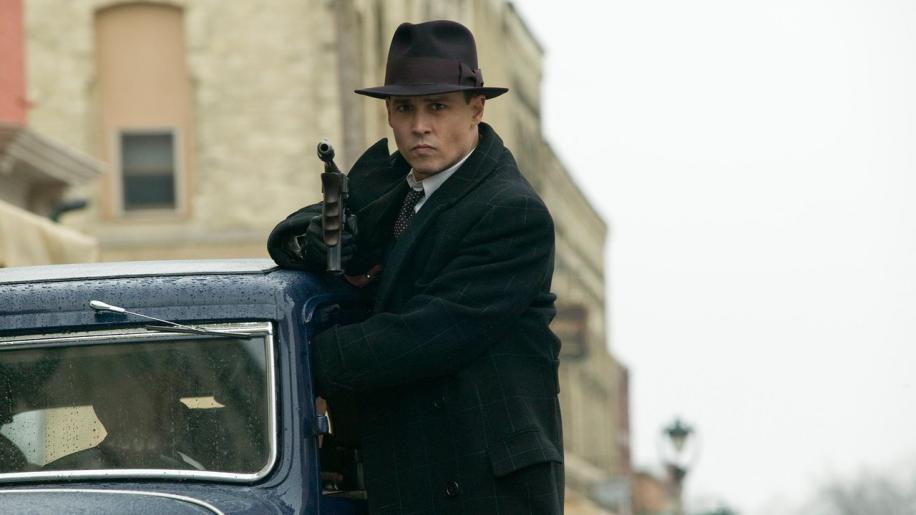
Public Enemies (2009)

Johnny Depp rides into action as John Dillinger in Michael Mann’s underwhelming Public Enemies

Director: Michael Mann

Cast: Johnny Depp (John Dillinger), Christian Bale (FBI Special Agent Melvin Purvis), Marion Cotillard (Billie Frechette), Billy Crudup (J Edgar Hoover), Stephen Dorff (Homar van Meter), Stephen Lang (Agent Charles Winstead), Stephen Graham (Baby Face Nelson), Jason Clarke (Red Hamilton), David Wenham (Harry Pierpont), Spencer Garrett (Tommy Carroll), Christian Stolte (Charles Makley), Giovanni Ribisi (Alvin Karpis), Bill Camp (Frank Nitti), Branka Katic (Anna Sage)

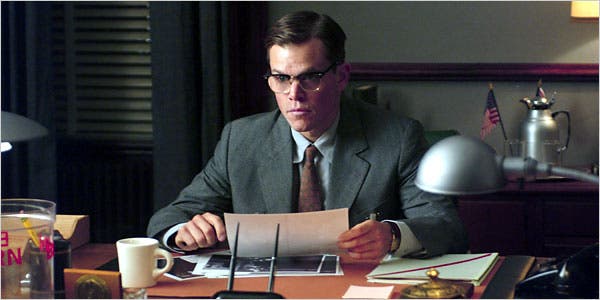
Michael Mann has an affinity for crime films. With Heat as one of his calling cards, Public Enemies is his attempt to do the same in the classic prohibition and bank robbery era of the 1920s. The guys going head-to-head this time?  John Dillinger (Johnny Depp), coolest robber there is, an icon of the criminal classes, and Melvin Purvis (Christian Bale) rigid and committed FBI agent. Public Enemies however fails to match Heat, falling part way between history lesson and action thriller. Covering the last few years of Dillinger’s life, and the rise of the FBI, it’s a cold, strangely uninvolving film mixed with a few stand out action scenes where tommy guns go blazing.

One of the first things it impossible to miss about the film is Mann’s decision to shoot the film using HD video cameras. The advantages of this is it gives much of the film an immediacy and modern look that throws the viewer into the middle of the action and makes this at times look and feel like a piece of news reel footage rather than a period piece. The camera choice allows Mann to put the camera right into the action, capturing every detail at a fast pace. The film has the look at times of a genuine documentary, and removing the richness of film also gives it the air of being caught on a phone, like some of this was some sort of found footage. Or rather, a phone that has been handled by a gifted cinematographer for perfect framing.

The downside of the choice of HD camera is that it makes the film at times look rather like a behind-the-scenes DVD documentary, with its untextured shadows and lack of lighting. Frankly at points it makes the film look bizarrely a little bit dull in places, or unusually unprofessional. Personally, I feel the benefits it gives in immediacy are cancelled out by this. But that’s just me.

Away from Mann’s shooting style – and his usual high octane skill of cutting and assembling action scenes – the film showpieces a strange lack of insight into its characters or any real developments of their hinterland. This is particularly so in the case of Purvis who never comes to life either in the film’s staging of him, or in Bale’s firm jawed, muted performance. When the final film caption throws up news of his later resignation and years later possible suicide it doesn’t make you question things you have seen in the film or feel like a logical progression: it just doesn’t tally up at all. 

The film does get some material out of how both sides play the media game. Purvis is a reluctant but fairly skilled player. His boss J Edgar Hoover (rather well played by Billy Crudup in one of the films best performances) is obsessed with spinning the nascent FBI to the media – half his scenes are bookended by press conferences – and his primary motivation is to exhibit himself to the media as the only logical choice for leading the FBI and the essentialness that it gains the powers it needs. Similarly, Dillinger and his fellow criminals delight in their media profile and do their damnedest to build up images of themselves as Robin Hoods (without the giving to the poor of course).

This is captured in Johnny Depp’s charismatic performance as Dillinger, a brooding, intense figure who would like to see himself as a sort of poet of the underworld. Dillinger talks about the banks money being their only interest and is frequently charming with an edge with regular people. He prefers bloodless robberies as they are cleaner and demonstrates a genuine sense of romantic openness with his girlfriend Billie. However, he is no angel. While he does not use violence as a first resort, he has no hesitation about using it as a second and will happily put bystanders at risk and rough up bank staff to get what he wants. He talks of escaping, but it’s clear that the game is an addiction for him and the danger is enjoyable – he takes an illicit thrill at one point of sitting in a cinema while his mugshot appears on the screen, wondering if anyone will dare spot him.

Depp’s performance is the finest thing in the film, a subtle and intelligent tightrope walk that teases depths that are perhaps not there, and suggests sympathies and agendas he perhaps does not have. While the character remains unknowable, you sense a great complexity and conflict there somewhere. He’s helped by being given a great actress like Marion Cottilard to play off, who makes Billie much more than just a gangster’s moll.

There is potential in the film, but it never really comes to life. For all the exciting shoot outs and drama, none of its characters are engaging or really interesting. The rest of the supporting cast feel like pieces to be moved around the board – many disappear with no real trace – and their fates pre-ordained by the demands of the plot. It makes for a rather flat experience, full of style, but never making you invest in it.

Mission: Impossible III (2006)


Tom Cruise and Kerri Russell take on a truly challenging assignment in Mission: Impossible III

Director: JJ Abrams

Cast: Tom Cruise (Ethan Hunt), Philip Seymour Hoffman (Owen Davian), Ving Rhames (Luther Stickell), Billy Crudup (John Musgrave), Michelle Monaghan (Julia Meade), Jonathan Rhys Meyers (Declan Gormley), Maggie Q (Zhen Lei), Keri Russell (Lindsay Farris), Simon Pegg (Benji Dunn), Eddie Marsan (Brownaway), Laurence Fishbourne (Theodore Brassel)

If there is one thing Tom Cruise does better than anyone in the movies, its run. Man, can that guy run well on camera. It’s not as easy as you’d think – watch people run in real life, and they probably look galumphing and awkward. But Tom looks as sleek as a gazelle. Every stride stresses his authority and unflappable coolness. I mention it because Tom does a lot of running in this film. The dénouement is basically him running over a mile and half, nearly in real time, a lot of it one long shot. 

JJ Abrams came to Mission: Impossible off the back of his successful TV series, Alias, in which Jennifer Garner’s undercover agent takes on a variety of disguises, working in a team, on a series of missions to get impossible-to-obtain artefacts against terrific odds. JJ Abrams carries the formula that worked so well in that series straight into this one.

The whole film plays out like an Alias movie. It even uses that series regular gambit of an opening scene throwing us dramatically into the story before flashing back “72 hours earlier”. Just like Alias, we have our lead trying to make a relationship work without saying what they do for a living, a family feeling in the team’s relationship, a geeky tech guy with a heart of gold, double and triple agents, glamourous locations – it’s everything an Alias fan could want, with Cruise’s Ethan Hunt essentially Sydney Bristow in all but name. This also brings out the best in Cruise, who looks like a man born again in the role.

Mission: Impossible: III is truly delightful, big-screen fun, rebirthing the series and placing team interplay firmly back at the centre, setting the tone and template the next two films have followed. Ethan Hunt (Tom Cruise) is in semi-retirement, training agents and planning to marry Julia (Michelle Monaghan). However when his young protégée Lindsay Faris (Keri Russell) is captured while investigating sinister arms dealer Owen Davian (Philip Seymour Hoffman), Hunt sets out to rescue her – and finds himself up to his neck in shady and dangerous goings-on.

Every action scene in the film is brilliantly entertaining (the mid-film drone assault is wind-it-back-and-watch-again exciting.). Of course, Cruise takes more than his fair share of the juicy moments – including a crazy jump off the roof of a Hong Kong building that has to be seen to be believed – but Abrams makes this a team movie in the way neither of the two previous films had been. Each member brings crucial skills to the table, and has moments to shine. Pegg takes the stand-out role of a witty, nerdy tech back at the base (sure enough his role was expanded later), but each feels an essential part of the story.

It also helps that the film has a terrific baddie to bounce off – the series has not had a better villain than Hoffman’s ice cold arms dealer. Sure Davian is pretty much a part Hoffman could play standing on his head – but he’s got just the right balance of rage and ruthless intellect.

If you want to see a single example of why this film works, take a look at that opening scene. Who could resist a film that opens with a scene as masterfully directed as this, sizzling with tension and ending with a smash cut to black over a gun shot and into the opening score? Hoffman and Cruise are excellent (Hoffman’s ice-cold control providing a great contrast to Cruise, who runs the gamut of defiant, furious, faux-reasonable, desperate and pleading), but it sets out the huge stakes for the film, it keeps us nervily waiting for the film to catch-up with what we’ve seen, and it tells us how vitally important what Davian wants is to him – and how desperate Hunt is to protect Julia.

Abrams has a perfect understanding of dramatic construction.  Everything in the film is carefully established and set-up, so we always understand the dangers and the threats. MI3 also uses its macguffin extremely well. What do we learn about “the Rabbit’s Foot”, the possession of which is of such vital importance? It’s small enough to fit in a suitcase, it’s stored in a round glass tube, it’s got a biohazard label and it’s worth millions. That’s it, but it doesn’t matter: Abrams establishes the most important thing – it’s dangerous and Davian wants it more than anything. Everything spins out from that with smooth efficiency.

The pace never lets up, but the characters and their relationships are never left behind. In particular Monaghan and Cruise’s relationship is skilfully established in surprisingly few scenes, and something we end up really rooting for. Abrams never goes overboard – the film is stuffed with action and excitement but never feels bloated or indulgent: the final confrontation is particularly effective because it is fairly small scale and is focused on the Hunts’ relationship.

Mission: Impossible 3 is one of the most joyful entries in a film franchise that deserves a lot of kudos for (by and large) focusing on plot, story and character alongside action sequences that have a feeling of tangible reality about them. It’s not completely perfect – a shock reveal about a turncoat in the IMF is hardly a surprise, considering the small number of candidates and the actors playing them – but it’s about as close as you can get to an endless enjoyable fairground ride.

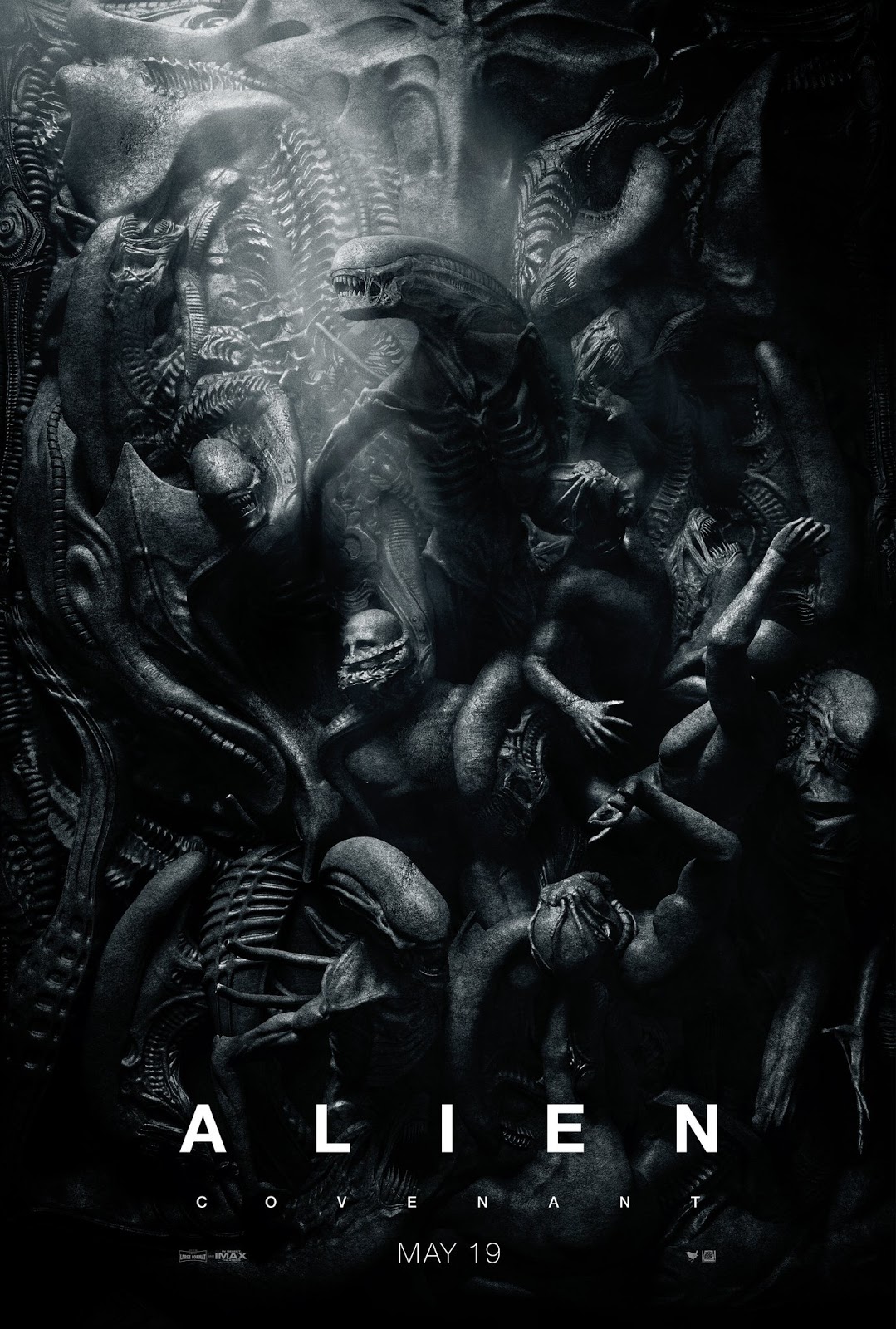
Alien: Covenant (2017)


The xenomorph rises again, in prequel Alien: Covenant

Director: Ridley Scott

Cast: Michael Fassbender (David/Walter), Katherine Waterston (Daniels), Billy Crudup (Oram), Danny McBride (Tennessee), Demián Bichir (Lope), Carmen Ejogo (Karine), Amy Seimetz (Faris), Callie Hernandez (Upworth), Guy Pearce (Peter Weyland), Noomi Rapace (Elizabeth Shaw), James Franco (Jacob)

The Alien franchise is a series I’ve always had a lot of time for. Perhaps I just enjoy the carnage and blood letting of these movies, but at their best there is a sinister poetry behind the pure destructiveness of this rampaging beast, with a perfect mix of haunting nihilism and stirring action. In 2012, Scott returned to the franchise to explore its roots. His prequel film, Prometheus, had a mixed reception (and it’s a film I’ve found weaker with repeated viewings) but it still had that mixture of nihilistic poetry and gore. So where does Alien: Covenant fall?

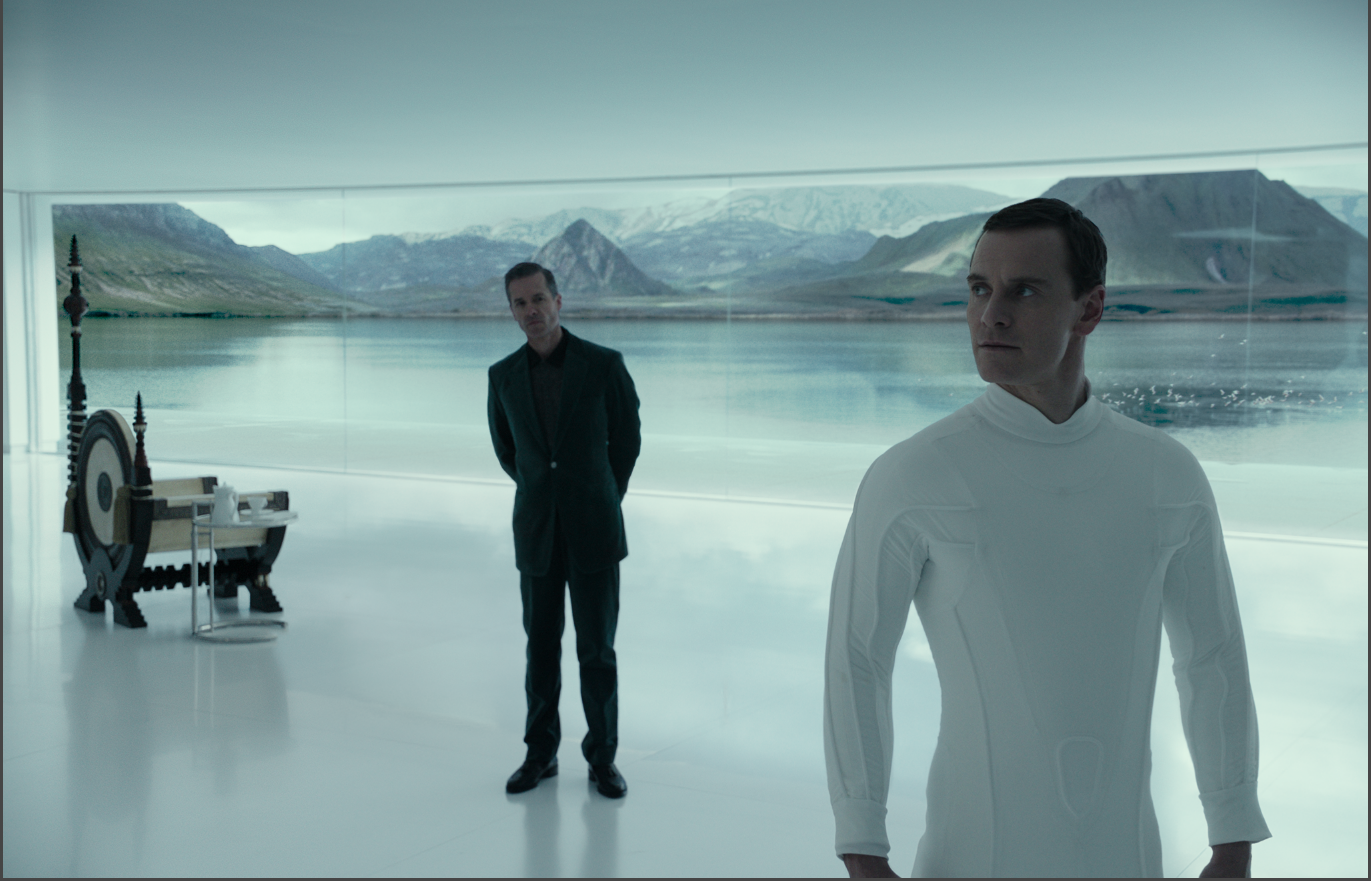
Set 10 years after Prometheus, a solar flare hits the colony ship Covenant. To repair the damage, the ship’s android Walter (Michael Fassbender) wakens the crew, although the captain (an unbilled James Franco) is killed by a malfunction. Command passes to Oram (Billy Crudup), although many of the crew look to the captain’s wife Daniels (Katherine Waterston) as their moral leader. After the damage is repaired, the crew investigate a signal from an abandoned world, where they find the marooned android David (Fassbender again) and a planet with a terrible virus, that infects its hosts to create brutal Xenomorph monsters. But is all as it seems?

Alien: Covenant is a mixed bag. It has a haunting and unsettling tone and gives us plenty of aliens in all their various forms. Many of the sequences of alien attacks are exciting. It’s trying to build a mythology around the creation of the aliens, and tie that in with a thematic exploration of our needs to create and destroy. It wants to explore the potential dangers of artificial life, and how it could judge us and find us wanting. At the same time, it’s a flawed and rather predictable film, which never really surprises you. It might give you some things to think about – but it won’t provoke your interest enough to make you really think about them for long after the credits roll.

Its main weakness is in its large cast. Most of the characters are referred to throughout by non-descript surnames, hammering home their lack of individuality. The film is so resolutely invested in the establishment of its mythology, it has no time to build characters or a story around the crew. They are little more than ciphers, plot tools to deliver specific points rather than for us to relate to them, or feel concern for their fate. Even Waterston’s Daniels, nominally our surrogate character, feels distanced and undefined. Like the rest of the cast, she suppresses the loss of a loved one (there are at least three bereaved partners in this film) with a suddenness that speaks less of her professionalism and more of the film’s shark-like need to always moving forward.

The one exception to the blandness is Fassbender’s dual role as androids David and Walter. It’s an actor’s bread and butter to play different roles, so we shouldn’t be surprised that a great actor like Fassbender executes it here with such skill. But he clearly distinguishes both the loyal, straightforward Walter and the darkly oblique David, and manages to craft the two most impressive performances in the film. This also gives Fassbender several chances to act oddly with himself, including a scene where David (rather suggestively) teaches Walter to play a pipe (it’s all about the fingering) and even a creepily possessive kiss scene between the two androids.

It helps that the film positions David as a protagonist-antagonist, and spends time exploring his fractured psyche (because it is central to the creation of the aliens, the film’s main interest). From its dark prologue, which shows David awkwardly questioning his nature with his creator (a swaggering cameo from Guy Pearce), David carries much of the film thematic interest. He is a creation of mankind, who believes he has surpassed his creators. Learning that Walter, a second generation, has been programmed to be less ‘human’ in his emotional capability as David, only confirms his belief that he is perfect. David is fuelled by a homicidal rage towards his creators, matched with an insane fixation on his own perfection.

The film wheels out a host of literary big guns to suggest a richness and depth to its exploration of these themes, from Milton to both Shelleys, but these points are really window dressing, as David is really closer in spirit to a Mengele crossed with a mad scientist from an old Hollywood B-movie. Despite this though, Fassbender’s David feels like a fully-rounded, absorbing character. His ‘Walter’ performance is equally good – gentler, compassionate, less grandstanding but quietly engaging.

Alien: Covenant is a film that aims high and wants to add some intellectual heft to its “slasher” roots. I think it’s probably a film that “hangs out” with ideas rather than enters into a proper conversation with them, but at least it’s aiming for thematic depth and richness, even if it often misses. I’m not sure it carries the sense of wonder and awe, and near-religious parallels, Prometheus (a deeply flawed, but more haunting film than this) managed. But it wants to make us question our place in the universe, and how our blind overconfidence could one day doom us. These ideas may just be window dressing to the blood and guts that the film delights in, but it at least shows that Scott is trying to make something a little deeper, and trying to make points about human nature.

It may be this focus on philosophical musing and the mythology of the alien’s development, distracted the film-makers from creating a plot to wrap around all this. The characters actions are too are often determined by the requirements of the plot, rather than logic or characterisation. So many dumb decisions are made, it stretches credibility: deflecting on a whim to a strange planet, charging around this alien world with careless abandon, following a clearly demented android you don’t trust into a room full of alien eggs – the plot requires each of the characters to perform various acts of stupidity in order for it to get anywhere.

The plot is also a hybrid that remixes beats from the previous films. No death (and there are loads of them) carries any surprise or shock value, and the alien itself (impressively filmed as the action is) behaves pretty much as you would expect. The familiarity of the events also makes the characters feel (to the audience) even more stupid and careless. There is excitement, but the film never really gets you to the edge of your seat – with its familiar action, and bland characters most of whom are little more than alien-fodder, you just never feel a tension or investment in their fates.

I wanted to like Alien: Covenant more than I actually did – but the truth is that it’s a film that lets itself down. There are moments of awe and wonder in there. It has a very good villain, whose motives and reasoning are interesting and thought-provoking. It has a terrific pair of performances by Michael Fassbender. But it’s also got too much flatness – plot and characters seem rushed and thinly sketched out. It’s clear where Scott’s and the writers’ focus was – and it means chunks of this movie just glide past the eyes and ears. Not the worst Alien film by a longshot – but still someway off the greatness of the first two films.

Jackie (2016)


Jackie Kennedy patrols a White House she will soon be forced to leave behind

Director: Pablo Larrain

Cast: Natalie Portman (Jackie Kennedy), Peter Sarsgaard (Bobby Kennedy), Greta Gerwig (Nancy Tuckerman), Billy Crudup (The Journalist), John Hurt (Father Richard McSorley), Max Casella (Jack Valenti), Richard E. Grant (William Walton), John Carroll Lynch (Lyndon B. Johnson), Beth Grant (Ladybird Johnson), Caspar Phillipson (John F. Kennedy)

“Ask ev’ry person if he’s heard the story

And tell it strong and clear if he has not,

That once there was a fleeting wisp of glory

Called Camelot.”

Or so sang King Arthur in Alan Jay Lerner’s musical Camelot. It’s apt as it’s a musical cue Jackie returns to several times in this thought-provoking, if rather stately, film that with one eye looks to sharply critique the legend building of American political history, while with the other staring with adoration at the very legacy at its centre.

The film follows, in a slightly non-linear fashion, the period of time from Kennedy’s assassination through to his state funeral and Jackie Kennedy’s departure from the White House (although other scenes feature Jackie during the presidency, most notably her filming of A Tour of the White House in 1962, a TV special the film lovingly recreates with a mixture of existing and newly-created footage and audio). The framing device is an interview Jackie gives with an unnamed journalist, set after the events of the film, in which she alternates between frank honesty and careful legacy building – all the time stressing she will decide what is, and is not, printed.

The film is a both a careful deconstruction of legacy building and a celebration of it, with Jackie Kennedy portrayed as a contradictory figure – keen to give her husband a place in history and, at times, resentful of the impact of public interest in her life. In a neat scene, Jackie Kennedy asks the driver of her husband’s hearse if he has heard of the last two Presidential victims of assassination, William T. McKinley or James Garfield. He knows neither. When asked if he has heard of the first, Abraham Lincoln, he of course is able to name check victory in the civil war and the abolition of slavery. It’s a sharp reminder of the work she must do for her husband’s legacy, with his achievements ranking nowhere near Lincoln’s.

The films suggests throughout that the planning of the funeral was focused on giving Kennedy (and by extension Jackie and her children) a permanent place in American folk-lore. It’s why the reprise of Camelot works in the film – it’s sums up the attitudes of America an administration that has indeed lived on as a short time of hope, with Kennedy as the lost Golden Boy. The appropriateness of the song is something the film manages to both use and comment upon – and which it also manages to make feel fresh, despite the fact the “Camelot” has been a nickname for the Kennedy White House ever since the 1960s.

Simultaneously, though, it is a film that lingers with wide-eyed wonder on JFK himself, and which presents LBJ as a far more corrupted and overtly political figure compared to the reverence the film feels for his predecessor (his serial womanising is given only a brief mention by Jackie during her conversation with her priest). Kennedy (played by an actor with a remarkable physical and vocal similarity) is always a romantic figure, his motivations or his achievements very rarely questioned. He’s filmed like the very romantic hero, which the film is half encouraging us to question that he was – and I’m not sure this is deliberate.

The film is acute and quietly non-judgemental throughout the scenes covering the assassination, reaction and funeral plans. So much so, that the framing device of the journalist (Billy Crudup in a thankless part, scruffily dressed, alternately arch and adoring) seems like it belongs in another, dumber, movie – as if we needed Jackie to give voice to her feelings, to actually speak words stressing her power and determination in shaping what is printed about her husband, in order to understand it. It’s an obvious, TV-movie framing device that really adds very little.

This is largely because Natalie Portman gives such a sensational performance in the lead role. As to be expected, it is a brilliant capturing both of Kennedy’s vocal and physical mannerisms. But more than that, it is also a sharp performance of deeply confused grief and guilt over her husband’s fate, mixed with a public strength (at times bordering on furious anger) in her determination to plan a funeral she felt befitted her husband’s status. Weak as the journalist scenes are, she dominates them with her skilful portrayal of a woman split between a need for intimate confession and determination to maintain control over the story.

Portman’s performance also provides the emotional anchor to scenes that could otherwise be careful reconstructions. The assassination itself (filmed within the car) has rarely seemed so immediate – and the camera largely sticks with Portman’s stunned, terrified face throughout the long drive to the hospital. Her combination of lost alienation, bewilderment and shock equally dominates the rushed inauguration of Johnson, while scenes of her returning to the White House to finally remove her blood-stained clothing shimmer with emotional intensity. It’s a film that captures the stunned sense of alienation from reality that comes after undergoing any major, life-changing event.

The film has a ghostly, elegiac mood. Larrain uses rather murky photography effectively throughout the film. The slightly grainy focus given to the general world of the film allows sharper primary colours to stand out at key moments. The Oscar-nominated score for me was, however, far too insistent – a series of sharp notes and discordant sounds mixed with mournful refrains. It draws too much attention to itself and makes the same point too many times to be effective. I suspect its a score that might work better in isolation. Far better are the quiet and controlled shots of Jackie walking listlessly through a deserted White House, or the careful mixing of the tragic and the mundane (when selecting a positon in Arlington for her husband, she has to ask a companion to slow down as her shoes keep getting stuck in the mud).

It’s an intelligent, thought-provoking and adult piece of film-making, that carefully avoids passing judgement or making pronouncements. I can’t decide if it’s a film that can’t make up its mind about events, or if it challenges us to make up our mind for ourselves. Either way, Portman gives an extraordinary performance and is well supported by the rest of the cast, in particular John Hurt who gives a charming, witty performance as the Priest who Jackie allows herself (for a moment) to be completely honest with. A dynamic and interesting addition to JFK films, that manages to find a new angle and even some new ideas from well-worn ground.