Charming and very witty coming-of-age cycling and friendship tale, told with real wit and zip
Director: Peter Yates
Cast: Dennis Christopher (Dave Stohler), Dennis Quaid (Mike), Daniel Stern (Cyril), Jackie Earle Haley (Moocher), Paul Dooley (Ray Stohler), Barbara Barrie (Evelyn Stohler), Robyn Douglass (Katherine), Hart Bochner (Rod), PJ Soles (Suzy), John Ashton (Roy)
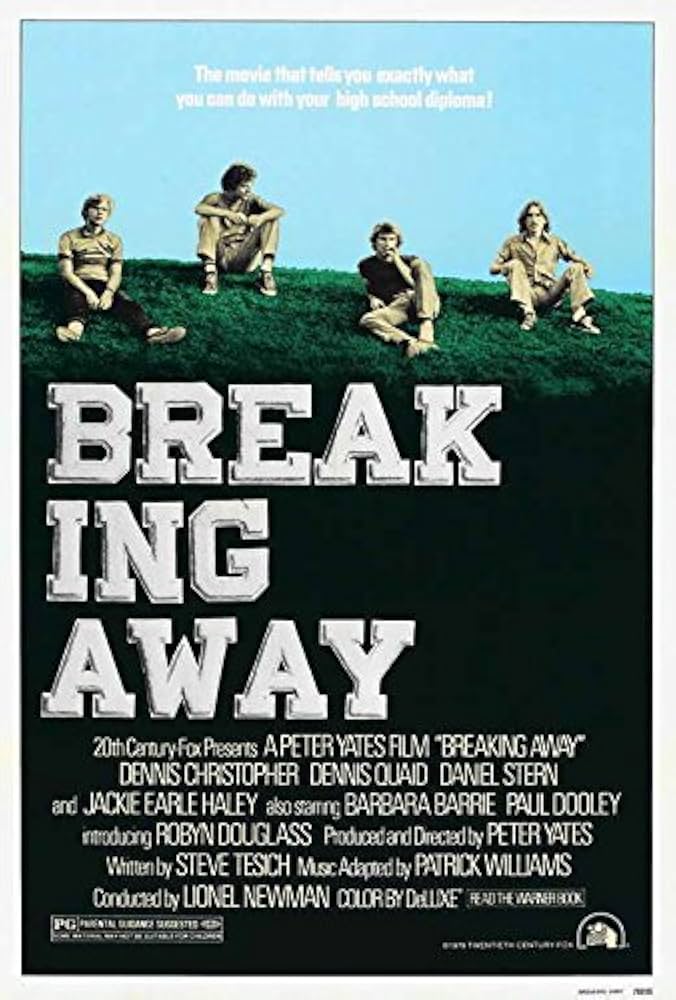
It’s a sports film, coming-of-age film. a romance, a rivalry and a film a father and son. It’s about half-a-dozen things, with a bit of Mendelssohn and Rossini like a garnish on top. All the sort of stuff our hero loves. He’s Italian-culture fixated (because he loves their cycling team) Dave (Dennis Christopher), who sprinkles his conversation with Italian turns of phrase – to the exasperation of car-dealer dad (Paul Dooley) – and spends his days either cycling or shooting the breeze of just-left-high-school drifter pals Mike (Dennis Quaid), Cyril (Daniel Stern) and Moocher (Jackie Earle Haley).
But it’s tough being working-class kids in Bloomington, Indiana when the students of local Indiana University treat you like scum, tarring you with the nickname “cutters” (from the local limestone quarrying industry). After one dust-up too many between boys and students, the University President decides to invite the locals to enter a team into their mini-500 cycling tournament (500 laps of the track, winner takes all). The “cutters” rely on Dave to win it – but will he take part when it might mean exposing to his student girlfriend Katherine (Robyn Douglass) that he’s not an Italian exchange student?
All of this breezily comes together very well in Peter Yates’ hugely enjoyable comedy, with a semi-auto-biographical Oscar-winning script by Steve Teisch. Like the smoothest Peloton, Breaking Away is perfectly stream-lined, fast-paced and builds expertly to an exciting chase finish. Along the way, it balances a host of tones and emotions with a delightfully light touch. It’s a very easy film to sit down and relax in, wonderfully shot in a series of pitch-perfect Bloomington locations, most strikingly a former quarry now converted into a beautiful mini-lake.
That’s the favourite haunt of our four friends, all of them (in their own ways) plucky underdogs with chips on their shoulders. Theirs is a life without obvious opportunities and escape routes from this small-town life, with even the local cutting industry slowly withering away. This is made even worse by seeing the rich kids of the University, their whole life ahead of them, swanning around and their town (and that quarry) as if they own them. (Hart Brochner, later to be a bullet-catching punchline in Die Hard is the perfect face of semi-decent entitlement as the leader of these students).
These four are played by a dazzling collection of actors – it’s a bitter irony that Dennis Christopher is the only one of them that didn’t go onto bigger and better things since he is excellent here. Quaid’s Mike is a bullish former-jock, so worried his best years are already behind him that he swings wildly between throwing himself foolishly into things to prove his manhood and giving up immediately before he can be embarrassed. Stern’s Cyril is a lanky, geeky oddball, constantly awkward in every situation. Haley’s Moocher is a secret-romantic, with a trigger-temper when his shortness is bought up (he’s more than capable of punching out a punch clock after one gag too many about his height).
Christopher though is the star, a playfully impressionable optimist who throws himself into things with gleeful abandon. There are no half-measures with this kid. When he loves Italian cycling, he’ll immerse himself in every part of Italian culture – music, food, language, the lot. It’s rather sweet to see his bouncy delight, indulged by his warmly supportive mother (an Oscar-nominated Barbara Barrie in a lovely heart-felt turn) who cooks endless Italian meals (to the frustration of his father, who wants not all this “zini stuff” but American food “like French fries”).
It’s as playfully sweet as his courtship of Katherine – even if that is founded on a great big whopper (and the film is mature enough to know part of growing-up is owning up to this fib). A perfect expression of the film’s everyday joy is a lovely moment where Dave, serenading Katherine with an Italian aria, enthusiastically throws out his arms only to whack his hand on a lamppost, shrugging off his obvious pain with a fixed grin. It’s a moment that you can counter-balance with the rollicking slap Katherine later gives him and their gentle reconciliation as he sits slumped against a different lamppost.
Yates’ film really captures youthful, idealistic joy – best seen in a marvellous showpiece scene where Dave races a truck (ironically full of Italian goods!) on a freeway, Yates not only shooting with pacey thrill, but letting the classic Italian music soar over the soundtrack as Dave keeps pace at 60mph. This scene is then heartbreakingly contrasted with Dave’s encounter with the Italian cycling team he has hero-worshipped – only to find they are ruthless professionals, who see him an upstart they are happy to cheat of victory. Christopher’s vulnerability here during this crushing moment of disillusionment (and the little-boy-lost reassurance he eventually seeks from his parents) brings a real lump to the throat.
Breaking Away is also about bonds of loyalty. The friends may feud and argue, but they are willing to go to bat for each other without a second thought – whether that’s one of them beaten in a fight or one of them struggling in the quarry waters. The commitment of the four of them to winning the race – wearing shirts that proudly proclaim them as cutters – is a perfectly assembled display of race filmmaking (Yates bought a lot of skills across from Bullitt) that builds towards a well-judged feel-good ending.
What might be the most moving beat in Breaking Away though is the father-son relationship between Dave and his dad. Paul Dooley is excellent (and cheated of an Oscar nomination) as this gruff, old-fashioned man who won’t say what he feels and believes in hard-work, sweat and the homespun American life who can’t wrap his head around his more cultured life. (Dooley is also hilarious in capturing Ray’s used-car-salesman cheapness – never has the word “Refund!” raised such laughter). These two spend half the film barely understanding each other, but still loving each other – and the shift in their growing warmth and support is genuinely very moving. While still leaving us room to say “Bonjour” to a neat closing gag between them.
Breaking Away is unfussy, perfectly formed and incredibly sweet and entertaining. It’s a genuinely, heart-felt, well-meant, feelgood film that balances laughter, warmth and drama perfectly. It’s one of those small-scale treats you long for among blockbusters.