Tag: Daniel Stern

Breaking Away (1979)

Breaking Away (1979)

Charming and very witty coming-of-age cycling and friendship tale, told with real wit and zip

Director: Peter Yates

Cast: Dennis Christopher (Dave Stohler), Dennis Quaid (Mike), Daniel Stern (Cyril), Jackie Earle Haley (Moocher), Paul Dooley (Ray Stohler), Barbara Barrie (Evelyn Stohler), Robyn Douglass (Katherine), Hart Bochner (Rod), PJ Soles (Suzy), John Ashton (Roy)
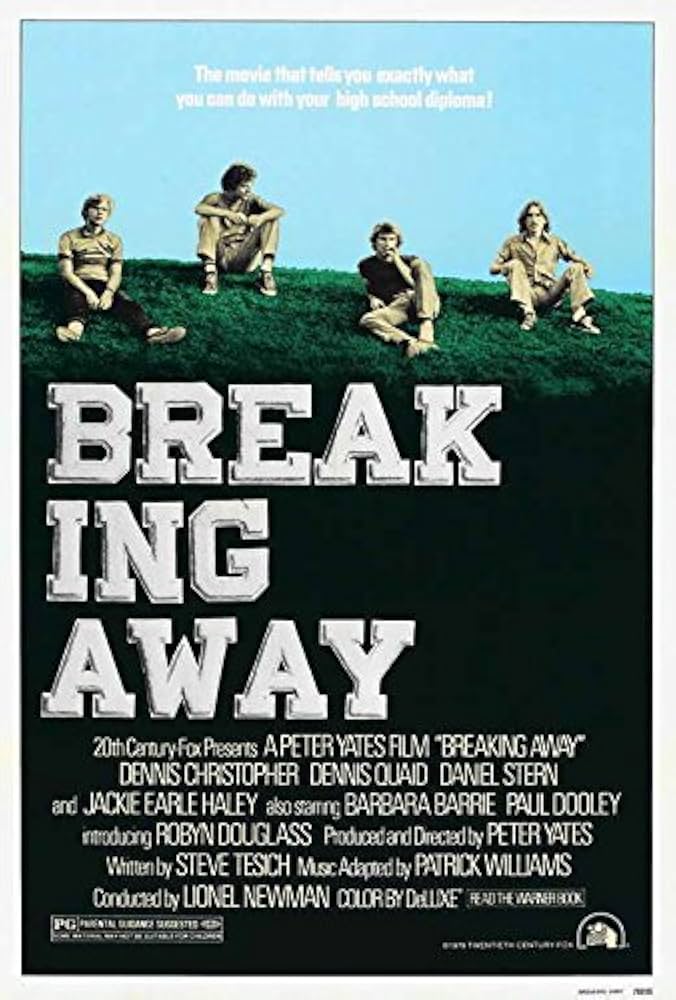
It’s a sports film, coming-of-age film. a romance,  a rivalry and a film a father and son. It’s about half-a-dozen things, with a bit of Mendelssohn and Rossini like a garnish on top. All the sort of stuff our hero loves. He’s Italian-culture fixated (because he loves their cycling team) Dave (Dennis Christopher), who sprinkles his conversation with Italian turns of phrase – to the exasperation of car-dealer dad (Paul Dooley) – and spends his days either cycling or shooting the breeze of just-left-high-school drifter pals Mike (Dennis Quaid), Cyril (Daniel Stern) and Moocher (Jackie Earle Haley).

But it’s tough being working-class kids in Bloomington, Indiana when the students of local Indiana University treat you like scum, tarring you with the nickname “cutters” (from the local limestone quarrying industry). After one dust-up too many between boys and students, the University President decides to invite the locals to enter a team into their mini-500 cycling tournament (500 laps of the track, winner takes all). The “cutters” rely on Dave to win it – but will he take part when it might mean exposing to his student girlfriend Katherine (Robyn Douglass) that he’s not an Italian exchange student?

All of this breezily comes together very well in Peter Yates’ hugely enjoyable comedy, with a semi-auto-biographical Oscar-winning script by Steve Teisch. Like the smoothest Peloton, Breaking Away is perfectly stream-lined, fast-paced and builds expertly to an exciting chase finish. Along the way, it balances a host of tones and emotions with a delightfully light touch. It’s a very easy film to sit down and relax in, wonderfully shot in a series of pitch-perfect Bloomington locations, most strikingly a former quarry now converted into a beautiful mini-lake.

That’s the favourite haunt of our four friends, all of them (in their own ways) plucky underdogs with chips on their shoulders. Theirs is a life without obvious opportunities and escape routes from this small-town life, with even the local cutting industry slowly withering away. This is made even worse by seeing the rich kids of the University, their whole life ahead of them, swanning around and their town (and that quarry) as if they own them. (Hart Brochner, later to be a bullet-catching punchline in Die Hard is the perfect face of semi-decent entitlement as the leader of these students).

These four are played by a dazzling collection of actors – it’s a bitter irony that Dennis Christopher is the only one of them that didn’t go onto bigger and better things since he is excellent here. Quaid’s Mike is a bullish former-jock, so worried his best years are already behind him that he swings wildly between throwing himself foolishly into things to prove his manhood and giving up immediately before he can be embarrassed. Stern’s Cyril is a lanky, geeky oddball, constantly awkward in every situation. Haley’s Moocher is a secret-romantic, with a trigger-temper when his shortness is bought up (he’s more than capable of punching out a punch clock after one gag too many about his height).

Christopher though is the star, a playfully impressionable optimist who throws himself into things with gleeful abandon. There are no half-measures with this kid. When he loves Italian cycling, he’ll immerse himself in every part of Italian culture – music, food, language, the lot. It’s rather sweet to see his bouncy delight, indulged by his warmly supportive mother (an Oscar-nominated Barbara Barrie in a lovely heart-felt turn) who cooks endless Italian meals (to the frustration of his father, who wants not all this “zini stuff” but American food “like French fries”).

It’s as playfully sweet as his courtship of Katherine – even if that is founded on a great big whopper (and the film is mature enough to know part of growing-up is owning up to this fib). A perfect expression of the film’s everyday joy is a lovely moment where Dave, serenading Katherine with an Italian aria, enthusiastically throws out his arms only to whack his hand on a lamppost, shrugging off his obvious pain with a fixed grin. It’s a moment that you can counter-balance with the rollicking slap Katherine later gives him and their gentle reconciliation as he sits slumped against a different lamppost.

Yates’ film really captures youthful, idealistic joy – best seen in a marvellous showpiece scene where Dave races a truck (ironically full of Italian goods!) on a freeway, Yates not only shooting with pacey thrill, but letting the classic Italian music soar over the soundtrack as Dave keeps pace at 60mph. This scene is then heartbreakingly contrasted with Dave’s encounter with the Italian cycling team he has hero-worshipped – only to find they are ruthless professionals, who see him an upstart they are happy to cheat of victory. Christopher’s vulnerability here during this crushing moment of disillusionment (and the little-boy-lost reassurance he eventually seeks from his parents) brings a real lump to the throat.

Breaking Away is also about bonds of loyalty. The friends may feud and argue, but they are willing to go to bat for each other without a second thought – whether that’s one of them beaten in a fight or one of them struggling in the quarry waters. The commitment of the four of them to winning the race – wearing shirts that proudly proclaim them as cutters – is a perfectly assembled display of race filmmaking (Yates bought a lot of skills across from Bullitt) that builds towards a well-judged feel-good ending.

What might be the most moving beat in Breaking Away though is the father-son relationship between Dave and his dad. Paul Dooley is excellent (and cheated of an Oscar nomination) as this gruff, old-fashioned man who won’t say what he feels and believes in hard-work, sweat and the homespun American life who can’t wrap his head around his more cultured life. (Dooley is also hilarious in capturing Ray’s used-car-salesman cheapness – never has the word “Refund!” raised such laughter). These two spend half the film barely understanding each other, but still loving each other – and the shift in their growing warmth and support is genuinely very moving. While still leaving us room to say “Bonjour” to a neat closing gag between them.

Breaking Away is unfussy, perfectly formed and incredibly sweet and entertaining. It’s a genuinely, heart-felt, well-meant, feelgood film that balances laughter, warmth and drama perfectly. It’s one of those small-scale treats you long for among blockbusters.
Hannah and Her Sisters (1986)

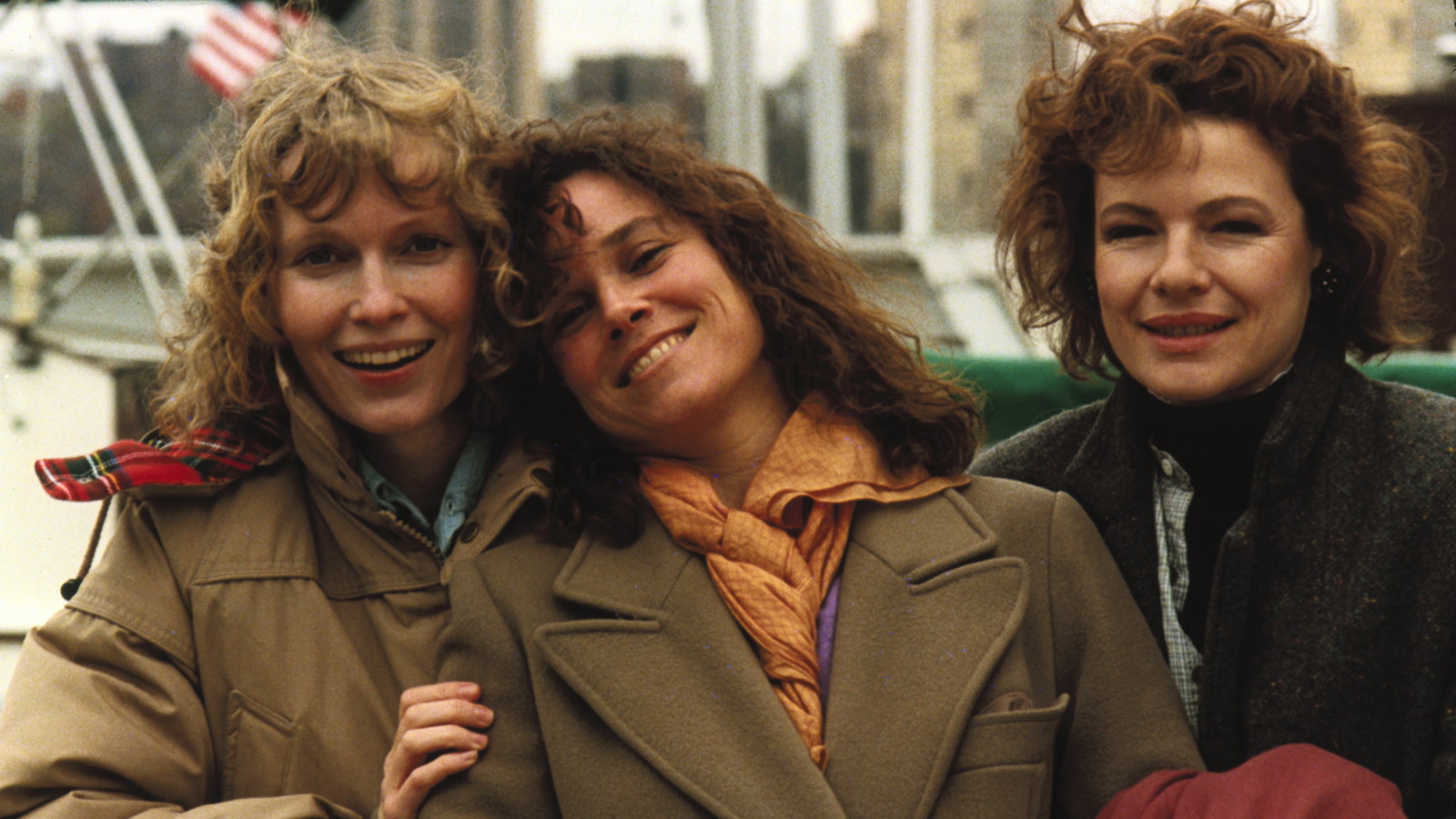
Mia Farrow, Barbara Hershey and Dianne Wiest are Hannah and Her Sisters one of Allen’s finest films

Director: Woody Allen

Cast: Woody Allen (Mickey), Michael Caine (Elliot), Mia Farrow (Hannah), Carrie Fisher (April), Barbara Hershey (Lee), Lloyd Nolan (Evan), Maureen O’Sullivan (Norman), Daniel Stern (Dusty), Max von Sydow (Frederick), Dianne Wiest (Holly), Sam Waterston (David)

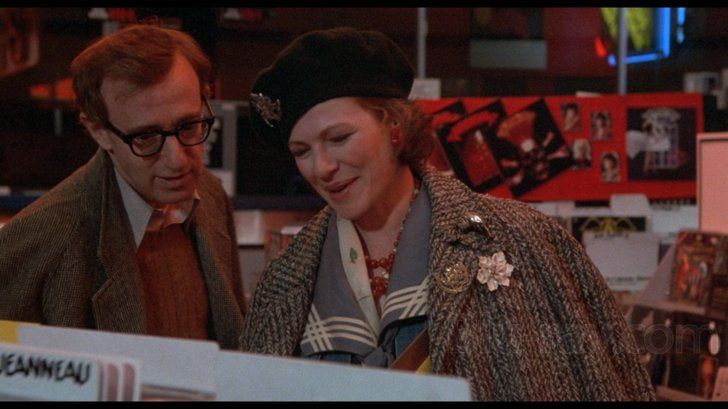
Hannah (Mia Farrow) is divorced from Mickey (Woody Allen) and happily married to Elliot (Michael Caine). Eliot is in love with Lee (Barbara Hershey). Lee is Hannah’s sister. Holly (Dianne Wiest) is considering dating Mickey. Holly is also Hannah’s sister. This whirligig of relationships is the heart of Hannah and Her Sisters, one of Woody Allen’s finest and certainly most humane films. Witty and heartfelt, it’s one of his sharpest scripts, crammed with acute observation and fine gags and is directed with a coolly introspective eye.

Allen splits the film into multiple sections, each opening (like the chapter of a novel) with a quote from the scene we are about to watch. Music plucked from Allen’s beloved classics (most often, and fittingly considering its romance theme, Bewitched, Bothered and Bewildered) frequently bridge scenes. Internal monologues is used often to allow us to explore the inner lives of the characters (the actors do a marvellous job reacting on screen to this internal thought process we are hearing).

The film uses a host of inspirations carefully mixed into Allen’s Manhattan Metropolitan middle-class milieu. The entire film has an autumnal Chekovian feel to it, with a rich sense of lives continuing ‘off stage’ as much as on. While the title obviously echoes Three Sisters, it’s study of romantic and intellectual entanglements overlaps with Chekov, as does the film’s love of wordplay. There are also, of course, echoes of Bergman (with gags) both in the film’s episodic structure but also its framing device of three Thanksgivings dinners, reflecting Bergman’s triumphant Fanny and Alexander.

The most effective thing about the film, in addition to its wit, is the surprising warmth it feels for the characters. Not always in an Allen film does one find the sympathy and empathy so widely spread – there is usually at least one character who is the target for the writer’s scorn. But here, no major character is presented as either the butt of snide humour or sneers. Even von Sydow’s pretentious artist is capable of searing emotional pain, and its hard not to sympathise with him as clients enquire whether his art will fit with their home décor. Each scene carefully balances the perspectives of multiple characters to allow us to relate to what each of them is going through. It’s possibly the largest cast of fully-rounded characters in an Allen film, and his most generous film.

It’s a film that avoids judgement over its characters, despite the frequently terrible and morally troubling things they do. It’s a film that understands the heart is an uncontrollable but resilient muscle, which doesn’t always guide us to the right or the easy things. Of course today, with Allen, you think it’s probably not a surprise he had sympathy with a group of people engaged in relationships that often involve profoundly betraying others. But at least her understands the irresistible urge people have to continue doing things they shouldn’t.

It’s hard not to overlook that the film’s least explored character (despite her multi-layered performance) is Mia Farrow’s Hannah. Poor Hannah, the still, moral centre of the film, is betrayed by both her husband and her sister (to their mutual guilt). Allen leaves her in ignorance – even though she knows something is wrong – and while Allen acknowledges what Elliot and Lee is doing is wrong, he mitigates things by making clear Hannah’s decency and generosity makes her overwhelming. While we see the impact a sudden distance from her husband has on Hannah (in a great shot she talks to him while he is off camera in another room, making her look like she is talking to a wall), Hannah is one of the few characters we don’t get the insight of an internal monologue for, and that feels like an easier way for Allen to maintain our sympathies for others.

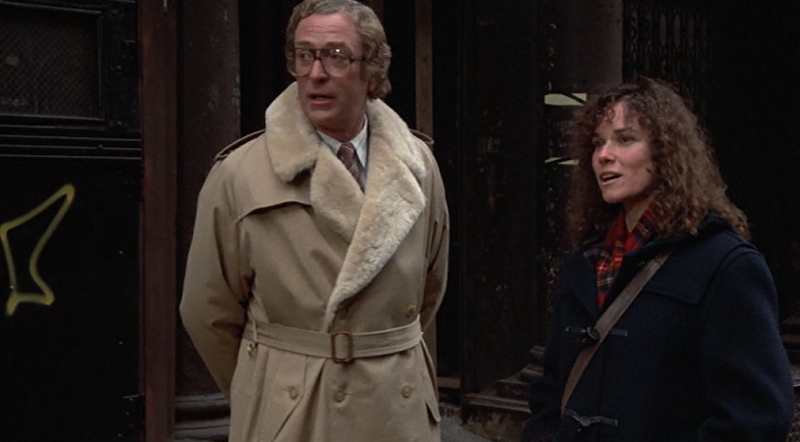
The person whose internal monologue we hear the most is her conflicted husband Elliot. Hannah and Her Sisters may be unique in that it has two characters who are clear Allen substitutes. While Allen plays one, Caine is the husband (who looks alarmingly like a prediction of future developments in the Allen-Farrow relationship). Caine is superb, not least because he turns lines you can hear could be delivered with an Allenesque twitchiness, into ones crammed with utter emotional genuineness.

For all that he is a cheat, Elliot is strangely guileless and rather sweet, plagued with guilt and also giddy as a schoolboy, begging Lee to read an ee cummings poem that carries special meaning for him. Caine makes Elliot a genuine human character, a flawed man trying to avoid hurting people (but causing pain everywhere). If Branagh in Celebrity (with his distracting Allen imitation) showed how much of a slave to Allenesque delivery you can become, Caine shows how heartfelt simplicity and underplaying can bring out deeper emotion from Allen’s dialogue. Allen also rather brilliantly directs this abashed dance of attraction: from Caine’s internal monologue telling him to play it cool, moments before he kisses Lee, to the camera framing Frederick’s sketches of a naked Lee directly in Elliot’s line of sight while he tries to think of literally anything else.

Caine also matches superbly with Barbara Hershey, excellent as a woman who feels trapped in her life and drawn to Elliot despite herself. Lee’s current relationship is with Frederick, wittily played in a near parody of Bergmanesque brooding by Max von Sydow, who takes a late lurch into real vulnerability, a pretentious artist who is part-lover-part-tutor and is disconnected from the real world, Lee is virtually his only link left with it. Frederick is clearly a tutor and surrogate parent, as much as a lover to Lee – and that attraction to a figure who can take responsibility in her life is clearly something she’s attracted in Elliot. The slow, guilt-ridden coming together of Elliot and Lee – and the slow deflation of this fling – is the emotional heart of the movie.

The film’s other two arcs provide more of the gags. Woody Allen gifts himself some of his finest comic moments as Hannah’s hypochondriac ex-husband (the second Allen stand-in) undergoing an existential crisis after he discovers he is in fact not dying of a terminal disease. Dianne Wiest is similarly excellent (and also Oscar winning) as Hannah’s unsuccessful sister Holly, a would-be actress too insecure to find success. Wiest is not only funny, but also vulnerable and affecting, as she tries to find her place in the world. In many ways Wiest plays a third version of Allen here, as she becomes a neurotic writer channelling her real life into writing (to the consternation of her sister).

Changing reality into scripts is the only thing awkward about Hannah and Her Sisters today. Hannah and her extended family (and many children) are a thinly veiled portrait of Farrow’s own family (Hannah’s mother is even played by Farrow’s real life mother Maureen O’Sullivan). Like Allen and Farrow, Mickey and Hannah needed to adopt and foster children. And of course Eliot’s affair with Hannah’s sister eerily mirrors Allen’s own affair with Farrow’s adopted daughter, and the film’s sympathy for Elliot sometimes seems like an unsettling excusing of Allen’s future conduct. That’s not even mentioning one of the film’s earliest jokes is Allen’s character complaining about the cutting of a child molestation skit from his Saturday Night Live-ish show (“what’s the problem half the country’s doing it” quips Allen, a joke that doesn’t work today for so many reasons).

But put that aside because, whatever your opinion of Allen, Hannah and Her Sisters is one of his finest films. It’s expertly shot and directed with a real unobtrusive ease (Allen’s innate understanding of this Manhattan world contrasts sharply with how at sea he is in his European movies). The acting is spot on. As well as being very funny, the moral conundrums the film explores are sympathetic and witty, as are the flawed human beings behind them. Possibly his best film.