
Tag: Billy Gilbert

Destry Rides Again (1939)

Destry Rides Again (1939)

A gun-shy sheriff needs to clean up this town in this delightfully funny semi-comedy Western

Director: George Marshall

Cast: Marlene Dietrich (Frenchy), James Stewart (Tom Destry Jnr), Mischa Auer (Boris), Charles Winninger (Washington Dimsdale), Brian Donlevy (Kent), Allen Jenkins (Gyp Watson), Warren Hymer (Bugs Watson), Irene Hervey (Janice Tyndall), Una Merkel (Lily Belle), Billy Gilbert (Loupgerou), Samuel S Hinds (Mayor Hiram J Slade), Jack Carson (Jack Tyndall)
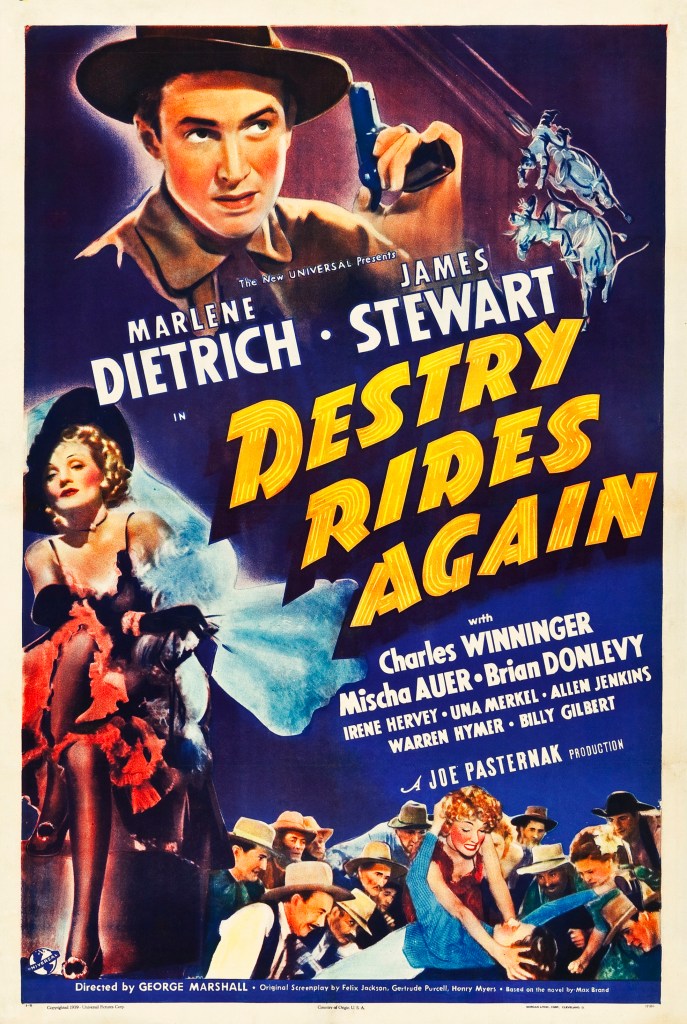
There’s a new deputy sheriff in town! Son of a wild-shooting, hard-as-nails lawman, Tom Destry Jnr (James Stewart) is surely the man to bring justice to Bottleneck. Or at least that’s what everyone thinks until his carriage arrives and out steps an aw shucks slouching drawler, carrying a parasol, who loves a homespun yarn and – worst of all! – doesn’t see the point of carrying guns. Surely, he’ll be a push-over for Kent (Brian Donlevy), the corrupt saloon owner who runs the town? Guess again. Tom will soon change all sorts of minds, not least Kent’s gal, glamourous singer (and card sharp) the improbably accented Frenchy (Marlene Dietrich).

George Marshall’s Destry Rides Again is pretty much a delight from start to finish. It combines rich comedy and Western satire, with genuine sharp-shooting thrills, and showcases a host of actors at the top of their game. It’s crammed with excellent jokes, shrewd observations and some moments of truly affecting tragedy. It’s the finest film Marshall, otherwise a journeyman, directed with confidently handled, crowd-filled set pieces and a wonderful sense of pace.

It’s hard not to fall in love with a man who doesn’t care what people think of him but, when push comes to shove, could beat them all in a game of quick draw. It helps abundantly when he’s played by James Stewart at his most boyish and lovable. Tom is determined to prove the law can be done another way: that escalating things by pulling a firearm only leads to trouble (“You see if I have had a gun there, why, one of us might have got hurt – and it might have been me”). Tom is quick-witted and confident enough to face down crises without a gun – putting him years ahead of the townsfolk who judge everyone by their ability to hit a target.

In fact, Destry Rides Again in its opening hour really commits to the idea of Tom as an ahead-of-his-time pacifist, who thinks through events with the grace of a chess-master. We’re constantly encouraged to delight not only in his smarts – the incriminating traps he lays for all around him, the skilful way he defuses situations – but also respect for his cool and guts (you need to be damn sure of yourself to order a glass of milk in Kent’s no-holds-barred saloon).

Tom eventually of course has to give them a show – his pin-point accuracy with a pistol leaves the town gasping, and a group of would-be trouble-makers lamely muttering how sorry they are to have disturbed the peace – but he’s far too brave to need to prove himself. Real courage is not caring what people think of you, and real smartness is being happy for others to call you a knabby-pabby yellow-belly. After all, they’ll only underestimate you – and make it even more likely Tom’s methodical, law-following approach will yield the right results.

Marshall mines gallons of fish-out-of-water comedy from Tom’s willingness to look the fool. From his arrival at the town clutching the parasol of a fellow passenger – his shoot-first-and-second-think-third fellow passenger Tyndall (Jack Carson) is mistaken for him because he matches the bill of what the town expects – to his passion for whittling napkin rings and his calm aw shucks good humour when handed a mop and told to use that to “clean up this town”. But we are never left with a doubt that Tom is the bravest, smartest, toughest guy in the town – and that he doesn’t need to constantly proof it to himself and others.

It eventually sinks in as well to glamour madam, Frenchy. Marlene Dietrich had not only never appeared in a Western before, she’d been declared “box office poison” just a few months earlier. In the public mind she was associated with glamour, distance and von Sternberg majesty. All that was to change with Destry Rides Again, where she was lusty, earthy but still with a touch of class. Who would have imagined Sternberg’s muse engaging in a no-holds barred cat fight with Una Merkel’s domineering housewife (a brawl that trashes most of the bar)?

Dietrich is quite superb in the role of this enigmatic madam. Her distinctive singing is used liberally throughout the film. Which fits nicely with Frenchy’s role in the town as the glamourous distracting agent for the crimes of Kent (a smugly grinning Brian Donlevy). Not that she’s an innocent: she swipes cards from punters in crooked card games and knows full well Kent sends “out of town” anyone who crosses him. But there is something in Tom she finds intriguing, perhaps because he’s smarter, more interesting and different from any other an in this benighted outlaw stop-off.

It helps as well that there is a clear magnetic attraction between the two. Not to mention between Stewart and Dietrich – it’s no surprise, watching the film, to hear they had a passionate affair during its making. Stewart has never really felt sexier than here with Dietrich, while Stewart helps Dietrich feel warmer and more approachable than she ever did with Sternberg. The dance (literally at one point) between these two, captures in microcosm the struggle for the town’s soul: will Tom win them over, or will the gun-totting baddies?

Marshall doesn’t quite cap the film off as well as you might hope. Eventually, Tom is left no choice but to pick up his guns. The film does present a final shoot out quite unlike anything you’ve ever seen before – ending in a battle-of-the-sexes brawl in the saloon, shot with an immersive comedy. But it doesn’t change the fact that Destry Rides Again can’t in the end square its circle: Tom may preach stern words over violence, but when push comes to shove only guns solve problems.

But you forgive it because this film is a hugely entertaining delight. There are a multitude of delightful supporting roles. Best of all are Mischa Auer is extremely funny as a Russian would-be-deputy who (literally) doesn’t wear the trousers in his marriage and Charles Winninger as the town drunk turned sheriff, who has a secret heart of gold even if he can’t tuck his shirt in (there is a lovely, late, call-back to this mannerism in the film from Tom that is genuinely moving). Destry Rides Again manages to be both a sort of spoof, but also a very real genuine Western, with a near perfect mix of jokes and action. It doesn’t quite manage to deliver on its concept, but it does more than enough.

The Great Dictator (1940)

The Great Dictator (1940)

The Little Tramp takes down Hitler in this iconic satire on the dangers of over-mighty strong-men

Director: Charles Chaplin

Cast: Charles Chaplin (Jewish barber/Adenoid Hynkel), Paulette Goddard (Hannah), Jack Oakie (Benzino Napolini), Reginald Gardiner (Schultz), Henry Daniell (Garbitsch), Billy Gilbert (Herring), Maurice Moscovich (Mr Jaeckel), Emma Dunn (Mrs Jaeckel), Grace Hyle (Madame Napolini), Carter de Harven (Bacterian ambassador), Bernard Gracey (Mr Mann)

They were born four days apart and had the two most famous moustaches of the 20th century. There the similarities end. One became the world’s most beloved comic, the other its most reviled bogeyman. Chaplin and Hitler were bound together in people’s minds for a decade before Chaplin turned his revulsion at Hitler into satire: The Great Dictator sees him play both a version of his Little Tramp (here reimagined as a Jewish barber) and a version of the Fuhrer (as a temper-tantrum-throwing, hatred-spewing, lunatic). But it also sees Chaplin effectively playing himself, capping the film with a famous humanitarian appeal to the audience for a little peace and understanding.

The Great Dictator is, just about, a comedy. A Jewish barber (Chaplin) serving in the front lines for Tomania during World War One, saves the life of officer Schultz (Reginald Gardiner) but loses his memory. In a veterans’ hospital for 20 years, he emerges into a radically different Tomania, now an anti-Semitic, fascist dictatorship ruled by the barber’s doppelganger Adenoid Hynkel (Chaplin again). Hynkel rants and raves about racial purity and Tomanian expansion and his stormtroopers march through the Jewish ghetto. The barber is saved from death, first by Hannah (Paulette Goddard) and then by Schultz, now a senior leader in the new Tomania. But, as Hynkel eyes up an invasion of neighbouring Osterlich, what role can the barber play in stopping his plans?

Chaplin said later, if he had known the horrors Hitler’s regime would perpetrate, he would never have made the film. That would have robbed us of one of the sharpest, most astute satires of power-hungry radicalism ever made. But Chaplin made his stinging assault on Hitler – painting him as both ludicrous and insanely dangerous – at a time when Hollywood was still nervously appeasing Germany to keep access to its film market, before the true horrors were known.

Chaplin’s film is chilling enough with what it does know. Its depiction of bullying stormtroopers is deeply unsettling, for all they are also comic buffoons. These jackbooted bullies march into the ghetto, swiftly escalating from daubing “Jew” on shop windows to beating and shooting innocents. Hynkel casually orders the execution of thousands and day-dreams of a world where Jews are no more. We see Jews brutalised. Chaplin doesn’t pull punches in demonstrating fascism is a dangerous cancer in the world, or that the likes of Hynkel are appalling in their ruthless heartlessness.

That makes it a mark of genius that Hynkel is also the centre of a ridiculous farce painting him as inept, childish and laughable. Chaplin achieves this by masterfully channelling Hitler’s mannerisms – no less than you would expect from the most gifted physical comedian in history. We are introduced to Hynkel at a Nuremberg-style rally, delivering a speech in a hilarious mix of gobbledegook and random German words (“Werner Schnitzel!”) delivered with a perfect parody of Hitler’s physicality. (Marking the film’s careful balance between jokes and seriousness, this includes a spit-flecked rant against “Der Juden”). His grandiosity is further punctured with coughing fits and clumsiness.

That’s nothing to what we see of Hynkel off-stage. Prone to carpet-chewing rants, prat-fall prone with the manner of a bitter, insecure teenager, Hynkel is a bully elevated into a position of power, clinging to the trappings of office to give him a feeling of personal worth. Residing in a presidential palace that’s a perfect parody of Speer’s grandiose architecture, Hynkel is both laughable and deeply dangerous. Chaplin gets this mixture of the sublimely ridiculous and terrifying in every scene: most notably in Hynkel’s famous dance with an inflated globe. He bounces and cavorts with this like a romantic lover (appropriately themed to Wagner) – but it all grows out of his near sexual excitement at the idea of conquering and purifying the world of Jews (and brunettes).

The Great Dictator bursts that globe, but it also bursts the bubble of puffed-up strong men in a way that’s still highly relevant today. Hynkel and fellow dictator Napolini (a perfect capturing of Mussolini’s mannerisms, mixed with a “mamma-mia” accent from Jack Oakie) are both buffoons, who can’t even co-ordinate shaking hands in between their ludicrous salutes. These buffoons have the power and coldness to kill millions, but are both idiots. Napolini’s state visit is a hilarious game of one-up-manship, from Hynkel’s feeble attempts to intimidate Napolini in his office, to the two of them pathetically pumping their barber chairs higher and higher (to insane levels) to try and look the tallest. They even engage in a childish food fight while bickering over who will have the right to invade Osterich. Vanity, childishness and homicidal nation-destroying all hand-in-hand.

To counter his brilliant deconstruction of Hitler, Chaplin deployed his Little Tramp character in a new guise, here re-imagined as a Jewish barber, but with the same mix of good intentions and bumbling clumsiness. There is classic Chaplin business – his shaving of a client perfectly in time to Brahm’s Hungarian Dance No 5 is pretty much perfection – but also darker material. The Barber is saved from lynching, nearly gets roped into a suicide attack on Hynkel and winds up in a concentration camp. This is the Tramp’s war: his decency used to point-up the hideousness of Hynkel even more.

And, in case we miss the point, Chaplin plays a third character in the final five minutes. With Hynkel in prison (mistaken for the Barber), the Barber-as-Hynkel takes his place to speak to Tomania. He’s got the Barber’s soul, Hynkel’s appearance… but his words are Chaplin’s. Talking direct to camera – just as the Barber glances at the fourth wall throughout – Chaplin makes an impassioned plea for peace, like the curtain speech of a classical actor. He was begged not to do it (it later lead to him being denounced as a Commie) – but Chaplin was making the film to make this point. It was all very well to make Hynkel look stupid, but equally important to put forward an alternative vision, one of hope and faith in mankind’s decency. The speech may be on the nose (probably a little too much), but Chaplin delivers it with the intensity of someone who passionately believes every word he is saying – and at least it serves as a culmination of themes and ideals the entire film espouses among the jokes, rather than a blast from the blue.

The Great Dictator is over-long (at over two hours), and some of its comic moments are more successful than others. But the sequences that deconstruct Hitler are almost perfect (and feature superb support from Daniell and Gilbert as lupine Goebbels and cry-baby Goering parodies) and the film balances hilarious farce, biting political wit, and an earnest despair at the horrors of dictatorship with just the right touch of hope.

Chaplin’s genius combined with his passion created a landmark, brave film. Few others could have balanced its tonal shifts with such deft skill and perhaps no other performer could have been both so funny and so appallingly destructive. Hitler banned the film, but succumbed to curiosity and arranged a private screening. No one knew what he thought of it – but he watched it twice.