
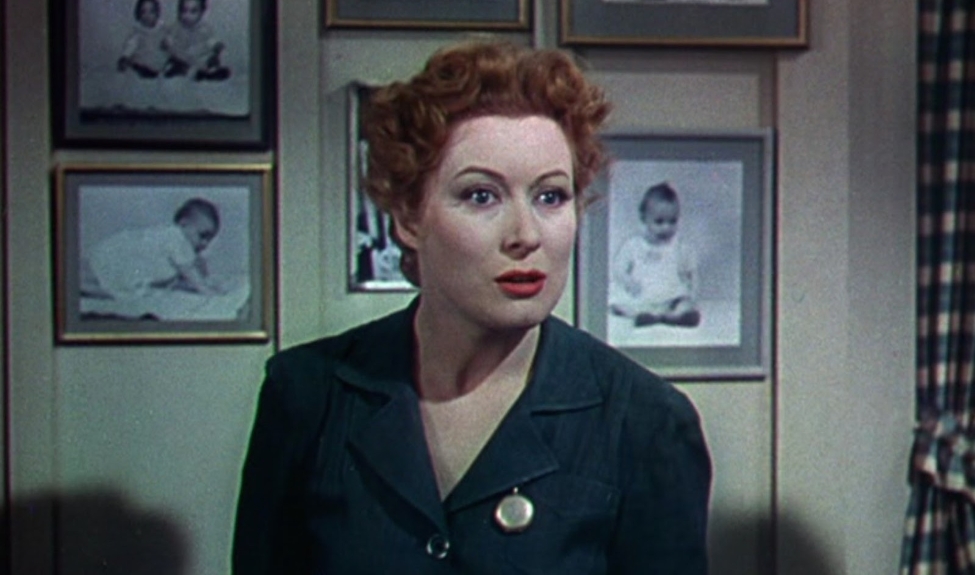
Tag: Samuel S Hinds

Blossoms in the Dust (1941)

Blossoms in the Dust (1941)

Sentimental and straight-forward biography that tells a simple, unlifting story

Director: Mervyn Le Roy

Cast: Greer Garson (Edna Kahly Gladney), Walter Pidgeon (Sam Gladney), Felix Bressart (Dr Max Breslar), Marsha Hunt (Charlotte Kahly), Fay Holden (Mrs Kahly), Samuel S Hinds (George Kahly), Kathleen Howard (Sarah Keats), George Lessey (Mr Keats), William Henry (Allan Keats), Henry O’Neill (Judge Hartford)
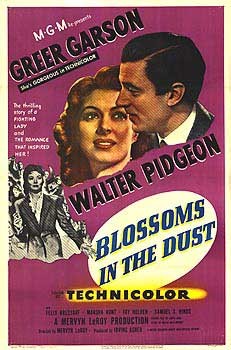
From the 19s0s, Edna Kahly Gladney (Greer Garson) was a Texas-based campaigner for the rights of orphans, pouring what money and time she and her husband Sam (Walter Pidgeon) had into the Texas Children’s Home and Aid Society, that dedicated itself to find homes for orphans. Even the death of her husband doesn’t stop Gladney from campaigning, lobbying to have the word illegitimate struck off birth certificates, since that was condemning children to a lifetime of frowns from Texas society.

The proceeds of Blossoms in the Dust went back into that Children’s Home so something good came from this sentimental, middlebrow biography. Made after an MGM publicist, who had adopted a child from Gladney, pitched the story to the studio, it became a cosy, box-office hit that helped cement Garson as the star-of-choice for the noble, suffering women’s film (the sort of role Norma Shearer would have grabbed five years earlier). It’s a slight, very safe and reassuring film that presents its march to inevitable triumph with an unchallenging hagiography-istic glow.

Of course, the real story of Edna was not quite tragic or satisfyingly neat enough, so the film invents several biographic details to beef up her motives. Now, the young Edna’s best friend (played with decency by Marsha Hunt) kills herself in shame, once her perspective fiancée’s heartless, posh family discovers her illegitimacy and unceremoniously tells her they don’t want her in their family, thank you very much. Secondly, Edna and Sam are given a fictional young son who exists purely to almost immediately die in a tragic sledge accident as a boy.

Of course, she will now care about illegitimacy and orphans – motivations established! Both events are so dramatically neat, it’s not a surprise they didn’t happen. Inserted, it seems, in case we objected that no one could care about the fate of children unless one happened to have lost one. The death of the boy is also so insistently sign-posted – repeated shots of his cuddly horse on its side leave us in no doubt he’s doomed the second he steps out of the door on a winter’s day – it’s impact for the viewer is almost washed away.

These tragic fictional events feel even more functional because, thanks to the film’s tendency towards sudden massive time jumps, by the time the next scene comes around years have flown by and any grief long-since shelved. No where is this more awkward than practically the next shot after the death of Gladley’s son, being Greer Garson laughingly pouring drinks at a society soiree. It continues thus: even the death of her husband Sam (Pidgeon exiting the film surprisingly at the half-way mark) is followed by a flash forward of Edna stoically but smilingly getting on with it. Blossoms in the Dust introduces tragedy throughout as a cheap motivation tool, but never once allows it to carry real, lasting impact.

Despite all these flaws, Greer Garson carries the film relatively well. Edna is the sort of part that requires middle-distance staring, mixed with can-do stiff-upper-lipness and a resolute determination to put the needs of others in front of her own (no matter how tempted she might be, in the case of orphan Tommy, to keep this child to herself rather than send him to a better home). Garson gets several barn-busting speeches at the injustices of the various systems set against the young and disadvantaged, which she delivers with aplomb. A particular fine moment is her railing – ever so politely of course – against the Texas Senate from the viewing gallery, announcing “there are no illegitimate children – there are only illegitimate parents!”. It’s fine, decent work that never stretches Garson, but is perfectly suited to her persona.

The story itself is fairly episodic. The Gladney’s wealth rises and falls, depending on the (dubious) business talent of her husband. There is a sweet moment, as they face bankruptcy, when thankful town residents buy from the auction of their goods a garish vase both Gladney’s were secretly glad to see the back of (“We’ll have to keep it now” a deeply touched Edna tells her husband). Orphans suffers various crises. A shallow single father falls over himself to hand his unwanted child over, and then takes Edna to court when he sniffs he can wrangle money out of the wealthier home the child has been sent to. No events really threaten the long-term, blissful sentimentality of the film and we are left in no doubt that Edna will ever choose herself over her work.

Blossoms in the Dust does have some rather uncomfortable racial politics. Every Black character in it is a faithful servant, deferring to their masters and happy in service. The Gladney’s servant Zeke is, of course, so thrilled to work with them he insists that he carries on doing so unpaid when they go bankrupt. A Black maid is so dim, she doesn’t realise washing a thermometer in hot water will affect its result. The Black characters are treated with the same paternal charity as the babies Edna cares for, which is of its time but still somehow a bit disappointing.

Aside from that though, this is a gentle, extremely sentimental – you might almost say icky – drama, shot with technicolour beauty by Karl Freund and decently directed by Mervyn LeRoy. However, it is also a purely functional, heart-string tugging crowd pleaser of a film, which desires to do nothing more than make us feel good about the fact the human race can still do decent things for other people without reward. Which is fine now and then, but not exactly challenging stuff.

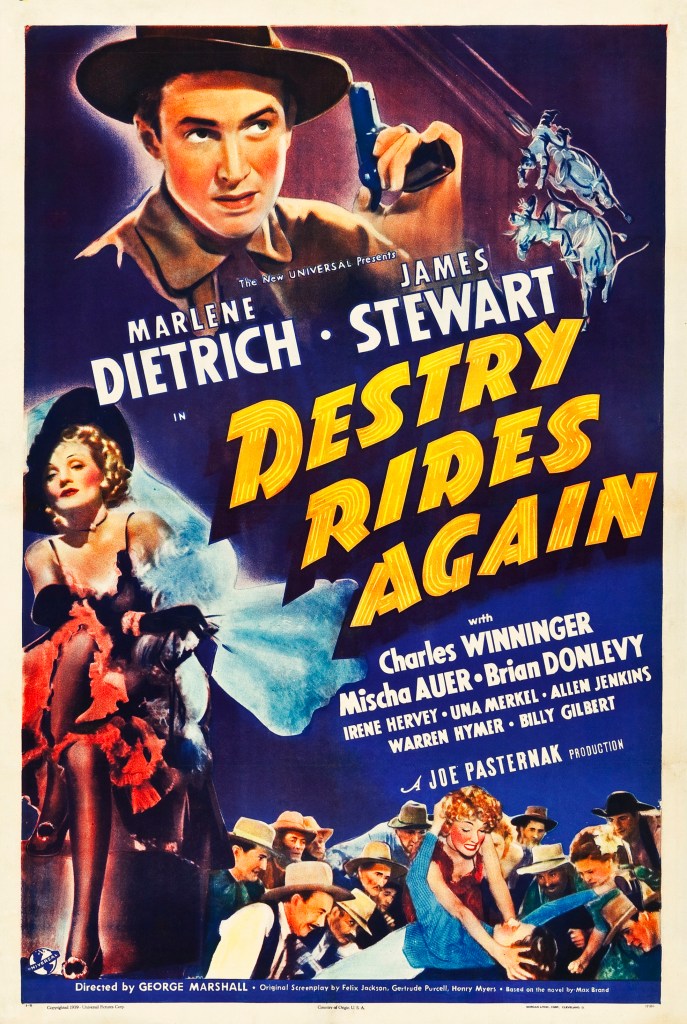
Destry Rides Again (1939)

Destry Rides Again (1939)

A gun-shy sheriff needs to clean up this town in this delightfully funny semi-comedy Western

Director: George Marshall

Cast: Marlene Dietrich (Frenchy), James Stewart (Tom Destry Jnr), Mischa Auer (Boris), Charles Winninger (Washington Dimsdale), Brian Donlevy (Kent), Allen Jenkins (Gyp Watson), Warren Hymer (Bugs Watson), Irene Hervey (Janice Tyndall), Una Merkel (Lily Belle), Billy Gilbert (Loupgerou), Samuel S Hinds (Mayor Hiram J Slade), Jack Carson (Jack Tyndall)

There’s a new deputy sheriff in town! Son of a wild-shooting, hard-as-nails lawman, Tom Destry Jnr (James Stewart) is surely the man to bring justice to Bottleneck. Or at least that’s what everyone thinks until his carriage arrives and out steps an aw shucks slouching drawler, carrying a parasol, who loves a homespun yarn and – worst of all! – doesn’t see the point of carrying guns. Surely, he’ll be a push-over for Kent (Brian Donlevy), the corrupt saloon owner who runs the town? Guess again. Tom will soon change all sorts of minds, not least Kent’s gal, glamourous singer (and card sharp) the improbably accented Frenchy (Marlene Dietrich).

George Marshall’s Destry Rides Again is pretty much a delight from start to finish. It combines rich comedy and Western satire, with genuine sharp-shooting thrills, and showcases a host of actors at the top of their game. It’s crammed with excellent jokes, shrewd observations and some moments of truly affecting tragedy. It’s the finest film Marshall, otherwise a journeyman, directed with confidently handled, crowd-filled set pieces and a wonderful sense of pace.

It’s hard not to fall in love with a man who doesn’t care what people think of him but, when push comes to shove, could beat them all in a game of quick draw. It helps abundantly when he’s played by James Stewart at his most boyish and lovable. Tom is determined to prove the law can be done another way: that escalating things by pulling a firearm only leads to trouble (“You see if I have had a gun there, why, one of us might have got hurt – and it might have been me”). Tom is quick-witted and confident enough to face down crises without a gun – putting him years ahead of the townsfolk who judge everyone by their ability to hit a target.

In fact, Destry Rides Again in its opening hour really commits to the idea of Tom as an ahead-of-his-time pacifist, who thinks through events with the grace of a chess-master. We’re constantly encouraged to delight not only in his smarts – the incriminating traps he lays for all around him, the skilful way he defuses situations – but also respect for his cool and guts (you need to be damn sure of yourself to order a glass of milk in Kent’s no-holds-barred saloon).

Tom eventually of course has to give them a show – his pin-point accuracy with a pistol leaves the town gasping, and a group of would-be trouble-makers lamely muttering how sorry they are to have disturbed the peace – but he’s far too brave to need to prove himself. Real courage is not caring what people think of you, and real smartness is being happy for others to call you a knabby-pabby yellow-belly. After all, they’ll only underestimate you – and make it even more likely Tom’s methodical, law-following approach will yield the right results.

Marshall mines gallons of fish-out-of-water comedy from Tom’s willingness to look the fool. From his arrival at the town clutching the parasol of a fellow passenger – his shoot-first-and-second-think-third fellow passenger Tyndall (Jack Carson) is mistaken for him because he matches the bill of what the town expects – to his passion for whittling napkin rings and his calm aw shucks good humour when handed a mop and told to use that to “clean up this town”. But we are never left with a doubt that Tom is the bravest, smartest, toughest guy in the town – and that he doesn’t need to constantly proof it to himself and others.

It eventually sinks in as well to glamour madam, Frenchy. Marlene Dietrich had not only never appeared in a Western before, she’d been declared “box office poison” just a few months earlier. In the public mind she was associated with glamour, distance and von Sternberg majesty. All that was to change with Destry Rides Again, where she was lusty, earthy but still with a touch of class. Who would have imagined Sternberg’s muse engaging in a no-holds barred cat fight with Una Merkel’s domineering housewife (a brawl that trashes most of the bar)?

Dietrich is quite superb in the role of this enigmatic madam. Her distinctive singing is used liberally throughout the film. Which fits nicely with Frenchy’s role in the town as the glamourous distracting agent for the crimes of Kent (a smugly grinning Brian Donlevy). Not that she’s an innocent: she swipes cards from punters in crooked card games and knows full well Kent sends “out of town” anyone who crosses him. But there is something in Tom she finds intriguing, perhaps because he’s smarter, more interesting and different from any other an in this benighted outlaw stop-off.

It helps as well that there is a clear magnetic attraction between the two. Not to mention between Stewart and Dietrich – it’s no surprise, watching the film, to hear they had a passionate affair during its making. Stewart has never really felt sexier than here with Dietrich, while Stewart helps Dietrich feel warmer and more approachable than she ever did with Sternberg. The dance (literally at one point) between these two, captures in microcosm the struggle for the town’s soul: will Tom win them over, or will the gun-totting baddies?

Marshall doesn’t quite cap the film off as well as you might hope. Eventually, Tom is left no choice but to pick up his guns. The film does present a final shoot out quite unlike anything you’ve ever seen before – ending in a battle-of-the-sexes brawl in the saloon, shot with an immersive comedy. But it doesn’t change the fact that Destry Rides Again can’t in the end square its circle: Tom may preach stern words over violence, but when push comes to shove only guns solve problems.

But you forgive it because this film is a hugely entertaining delight. There are a multitude of delightful supporting roles. Best of all are Mischa Auer is extremely funny as a Russian would-be-deputy who (literally) doesn’t wear the trousers in his marriage and Charles Winninger as the town drunk turned sheriff, who has a secret heart of gold even if he can’t tuck his shirt in (there is a lovely, late, call-back to this mannerism in the film from Tom that is genuinely moving). Destry Rides Again manages to be both a sort of spoof, but also a very real genuine Western, with a near perfect mix of jokes and action. It doesn’t quite manage to deliver on its concept, but it does more than enough.