Tag: Birger Malmstein

The Silence (1963)

The Silence (1963)

Bergman’s third film in his “faith” trilogy, is an intriguing Sartresque puzzle

Director: Ingmar Bergman

Cast: Ingrid Thulin (Ester), Gunnel Lindblom (Anna), Jörgen Lindström (Johan), Birger Malmstein (Waiter), Håkan Jahnberg (Hotel porter)

Two sisters, Esther (Ingrid Thulin) and Anna (Gunnel Lindblom), mother to ten-year-old Johan (Jörgen Lindström), are travelling home on a train through Europe. Ester, a translator, is already ill and her health takes a sharp downturn, leading to the group being forced to rest in a hotel in a town called Timoka, in an unnamed (fictional) European country. Anna resents what she sees as the judgemental expectations of her older sister and sees her obligation to care for her as a burden. Over a few days in the hotel, the two sisters move awkwardly around each other, avoiding addressing their problems while struggling in a country where neither of them speak the language.

The Silence was the third, and final, film in Bergman’s loose thematic trilogy on the absence of God in the modern world. It’s also possibly his most bleak and Sartre influenced work so far, a film of oppressive silence (devoid of music, the only noises coming from objects in the rooms of the hotel) with events occurring in a disturbing, slightly surreal world, where the normal rules of human interaction seem to be hold. Perhaps that’s because the characters move, like ghosts, through a world where they have no ability to communicate other than stumbled words and hand gestures, residing in a hotel where there seems to be no timescale on how long they are (or have been) there.

It also feels like an entrée to Persona, Bergman’s next major work. Like that, The Silence revolves around a symbiotic relationship between two women, who together seem to form two halves of one personality. Esther is intellectual, reserved but also vulnerable and adrift, dependent on others for help and frequently resorting to drink to dull her pain. Anna is more earthy, sensual but insecure, resentful and feels judged by others, finding temporary peace in casual sexual encounters. Both sisters are locked in a relationship that feels both disconnected and mutually dependent, constantly clashing with each other but living in worlds defined by their feelings for the other.

They are played majestically by two performers at the height of their powers. Thulin seems cold but conveys great depths of pain and suffering beneath what seems like her confidence and assurance. Thulin’s expressive face communicates great emotional turmoil, even with only the slightest movements and gestures. It’s a beautifully delivered performance of a woman who is unknowable, distant, difficult but also highly sympathetic. Lindblom’s physical assurance is counter-balanced by the great uncertainty she manages to communicate in every beat of Anna’s life. Her general demeanour of icy chill, interrupted with emotional breakdowns which alternate rage with tears and hysterical laughter, is faultlessly delivered.

These two characters increasingly feel trapped inside a world where they can’t easily communicate, with the threat of turmoil constantly rumbling on the margins. This unnamed country teeters on the edge of war – tanks and other military equipment make constant intrusions on the streets and the train tracks and the rumble of planes can be heard in the air. They are also rendered increasingly mute and isolated by their inability to speak the language. Communication with people around them is impossible and understanding is only fractured.

This is where Bergman’s views on God slowly take their form. For, as he observed in other films in the trilogy, what is this world but one where we strain in vain for the voice of God? Isn’t that like being adrift in a country where the language is unknown? And if, as Bergman so heartily expresses elsewhere, God is love what does it mean that this film revolves around character who have such negative to indifferent opinions on others. Ester may love – as she argues – Anna, but Anna has interpreted this love as smothering and oppressive her whole life and rejects Anna utterly. Anna seems disinterested in her son Johan (who Ester yearns to be closer to, but can never quite find the way to close the gap) and impatient with her sister. Not only are the characters trapped in a world of silence, they are also trapped in circles of loveless relationships.

It’s striking then that this was Bergman’s most sexual film so far. Bizarrely – for a film as austere, glum and challenging as The Silence – it was a box-office hit. This was, in large part, connected to its comfort with sex scenes. Anna watches a couple sat next to her having passionate (and beautifully lit) sex in an opera house, before engaging in wordless (of course) intercourse with a waiter (Anna even mentions the benefits of the man not understanding a word she says). The more frustrated Ester masturbates alone – no coincidence that she later speaks of her disgust with the sexual act and its bodily fluids. This is a film without love but with a lot of base, meaningless, carnal love in it – all part of a Godless world leaning into its nihilistic close.

The Silence is extraordinary in its filmic confidence. It’s exquisitely shot by Sven Nykvist, his camera (far more mobile than almost any time before in Bergman) tracks down corridors and through rooms of its luxurious but chillingly empty hotel (you can see The Silence’s influence on Kubrick’s The Shining). It uses light, shade and shadow in strikingly meaningful ways, arcs of light suggesting a host of underlying emotions and unspoken longings.

The Silence is a film that invites analysis and theorising, partially because its characters speak in such gnomic, Bergmanesque mysteries. Some have theorised Johan is in fact Ester’s child, raised begrudgingly by Anna, now longed for by his real mother at her end. Some have suggested Ester and Anna are such contrasting sides they may in fact be the same person (traces of Lynch’s Mulholland Drive) others see an incestuous longing in Ester for her sister. Bergman increases the unknowing mystery by presenting much of the film from the perspective of the precocious (not many children read Turgenov) but innocent Johan, a child who sees but cannot interrogate the actions around him.

It makes The Silence feel like a bridge from one era of Bergman to the next. The last hurrah of his spiritual study, before a series of films that would explore the interconnected lives of women whose desires, needs and dependencies motivate and merge into each other. That makes it a fascinating and vital milestone in Bergman’s development – as well as another extraordinary, haunting and fascinating work from a great director.

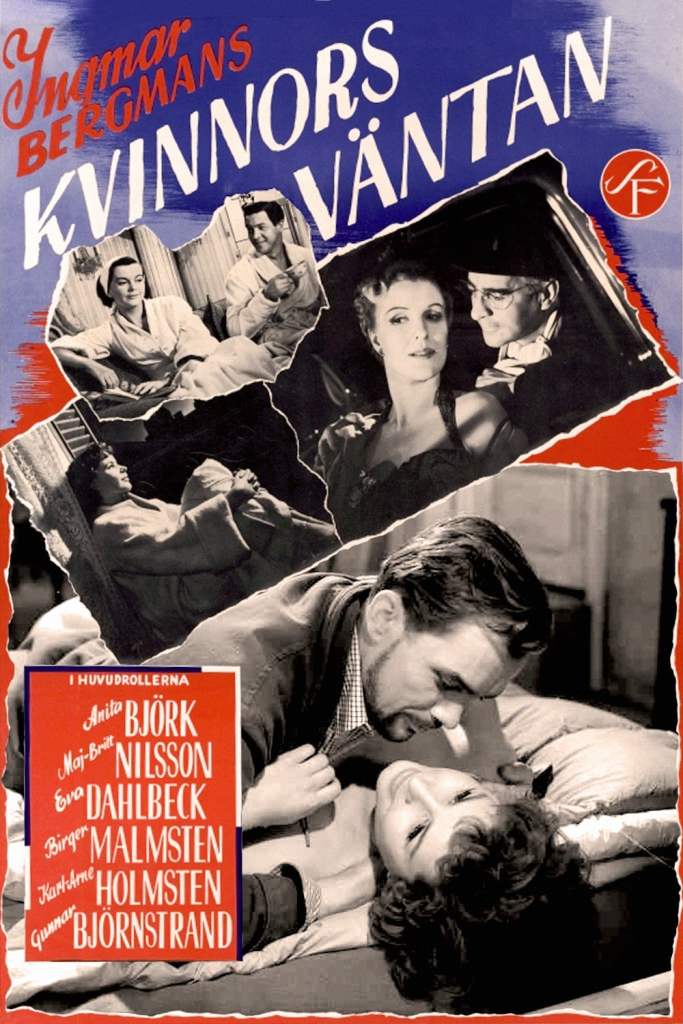
Waiting Women (1952)

Waiting Women (1952)

Bergman experiments with form and genre in this fascinating collection of female-led short stories

Director: Ingmar Bergman

Cast: Anita Björk (Rakel), Eva Dahlbeck (Karin), Maj-Britt Nilsson (Marta), Birger Malmsten (Martin Lobelius), Gunnar Björnstrand (Fredrik Lobelius), Karl-Arne Holmsten (Eugen Lobelius), Jarl Kulle (Kaj), Aino Taube (Annette), Håkan Westergren (Paul Lobelius), Gerd Andersson (Maj), Björn Bjelfvenstam (Henrik Lobelius)

Waiting Women is another early step in Bergman becoming one of the great directors in cinema. It’s easy to feel it’s a film worth seeing largely for completeness sake – I certainly felt that, seeing this unknown nesting at the bottom of a BFI box set containing Wild Strawberries, Smiles of a Summer Night and The Seventh Seal. But Waiting Women is a playful and inventive film that sees Bergman experimenting with form and genre and show-piecing his inventive use of the camera (it’s a key reminder this famed wordsmith also worked with two of the most gifted cinematographers in movie history, Gunnar Fischer and (later) Sven Nykvist).

Three women sit waiting at a country-side retreat (echoes of the holiday home in Wild Strawberries) waiting for their husbands (three brothers) to arrive. While they wait, they share stories. Rakel (Anita Björk) talks about her husband Eugene’s (Karl-Arne Holmsten) suicidal response to discovering her affair with childhood friend Kaj (Jarl Kulle). Marta (Maj-Britt Nilsson) remembers keeping her pregnancy from her now-husband Martin (Birger Malmsten), who she met thinking he was a penniless artist rather than the son of an industrial power-house family. And Karin (Eva Dahlbeck) remembers a night after a function which she and driven husband Fredrik (Gunnar Bjornstrand) spent trapped in a lift and almost rekindled the spark in their marriage.

Bergman’s takes these three stories and presents each in strikingly different ways. The first he packages as a full-blown romantic melodrama, with heightened passions, elaborate threats of death and dramatic proclamations of affection and desperation. The second shifts gear into a moody expressionistic drama, almost a silent-movie, with minimal dialogue and the scene shifting from striking shadow-play on hospital walls to silent comedy in a Parisian nightclub. The third caps the film with a single-location farce with witty wordplay and a dollop of sadness and regret.

It makes for a film that constantly surprises you – and a director looking to experiment and stretch his artistic legs, finding new ways of expressing himself in film. (He even pops up for a Hitchcock-like cameo!) It’s also three entertaining (in different ways) short stories and another, superb, Bergman female-centric film. Because, make no mistake, our sympathies are all with the women, whose stories leave you with more than a little impression – for all they have joyfully prepared the house for their husbands – that each of them are not leading the lives they might have wished.

The first story is the most conventional – perhaps because Rakel’s hormonal love-affair with a long-lost school friend feels like a twist on Bergman’s Summer Interlude. But all is carefully dialled up to eleven in a romance that would not feel out-of-place in Emily Brontë. The flirtatious lust between Rakel and Kaj – centred around a joint trip to a bathing house which drips with illicit sexual energy – simmers. There is an early Chekovian introduction of a gun, before Kaj’s essential coldness is revealed and Eugen’s shock swiftly turns to anger and suicidal resentment. It’s a marvellous Bergman scripting touch that Eugen always feels like the sort of man who will shoot himself to make his wife feel bad about herself rather than because of his own pain.

Bergman shoots it with brisk tracking shots interspersed with close-ups and allows the action to become increasingly bombastic as it builds towards its melodramatic conclusion of Eugen shuttered away in a boat house, threatening to end it all. It makes for a striking gear change as our second story begins, and the visual mastery of Bergman and Fischer’s partnership comes to the fore in a middle-chapter that homages the Silent Masters. Marta’s memories of her pregnancy and her meeting with her husband, begins with the nightmareish image of a face behind frosted glass, distorted out of all recognition (Bergman, as always, the lost great-horror director) before she finds herself in a hospital ward, breathing in anaesthetic gas, and seeing the shadows of the branches from the tree outside, twist and dance like possessive hands on the walls around her.

Played with a sympathetic sweetness, tinged with just the right touch of edgy defiance, by Maj-Britt Nilsson, Marta’s memories of meeting her husband in Paris plays out in her memory like an expressionistic film. In a Parisian nightclub, the camera ducks and swerves around exotic dancers, beautiful compositions of body and movement in every frame. She drops her GI boyfriend for a Martin after a series of surreptitious glances across the room and passed notes. Their courtship and early relationship in his blissful studio play out like a romance – until his family arrive with a chilling explosion of words about expectations and duties that shatter the illusion. The chapter closes with something that could be either memory or dream – Martin and Marta, with the warmth of their early days returned, on a beach together. Reality or regret? Bergman gives reasons to believe both.

The final story is the most enjoyable, lightest and also (in its own way) saddest. Beautifully shot largely in a single confined location – and this is a workshop for Bergman to build his confidence with composition – it gains hugely from the witty and controlled performances of Dahlbeck and Björnstrand as the austere married couple. Home truths and flashes of attraction seep out – and Bergman makes us feel for a moment that a corner has been turned when they return (at last) to their family home. It’s all an illusion though – its still Bergman after all – as the mood is shattered by Fredrik’s almost immediate resumption of his professional duties after a chance phone-call.

If its one thing you can pick up from these three stories, its that finding love, contentment and satisfaction is difficult for women. As three very different women, Björk, Nilsson and Dahlbeck are all superb, and the little hints of sadness Bergman gives all of them turns what could be a collection of shaggy dog stories into something suddenly, surprisingly, profound. Yes they are waiting – but is it for their husbands, or for the lives they (privately) might wish they had? As Marta’s sister Maj (Gerd Andersson) considers elopement with Marta’s nephew Henrik (Björn Bjelfvenstam), the normal expectations of discouraging such an action are challenged. After all, why shouldn’t Marta try for happiness? What’s the worst that could happen: that they could gain wisdom (as the other women have done?) from a summer of forbidden and confused love? Perhaps Bergman wanted to find out: his next film was the romantic first-love fable that turns sour Summer with Monika.

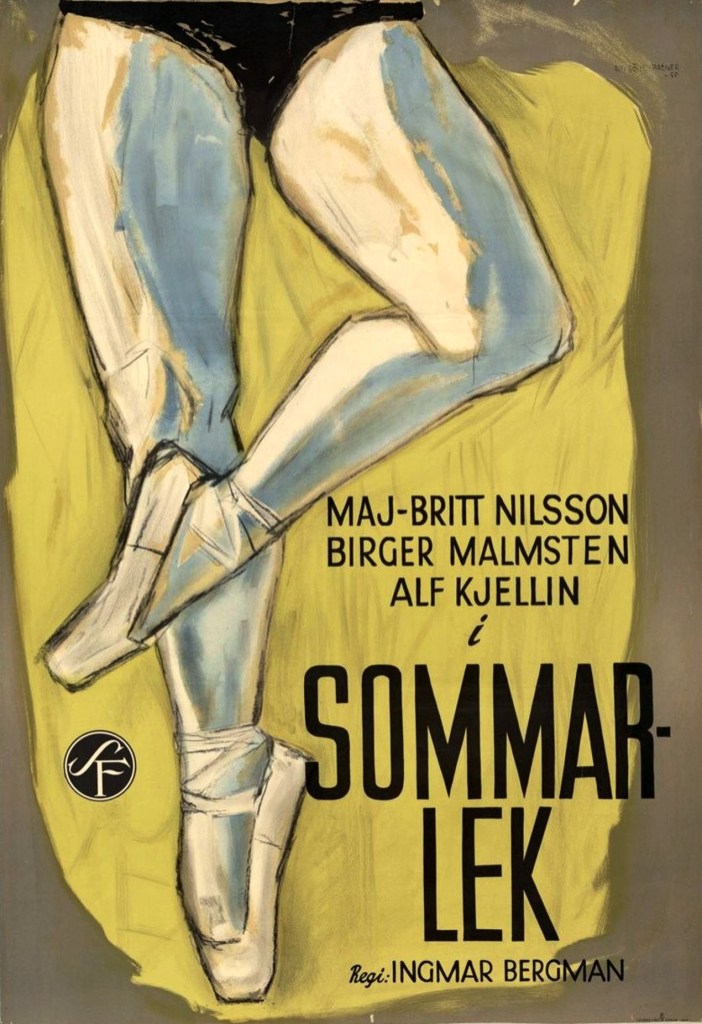
Summer Interlude (1951)

Summer Interlude (1951)

Memory, mortality, repression, grief and a little dash of hope: Bergman establishes his themes in one of his earliest film

Director: Ingmar Bergman

Cast: Maj-Britt Nilsson (Marie), Birger Malmsten (Henrik), Alf Kjellin (David Nyström), Annalisa Ericson (Kaj), Georg Funkquist (Uncle Erland), Stig Olin (Ballet Master), Mimi Pollak (Mrs. Calwagen)

On the night of the dress rehearsal for her next production, successful ballerina Marie (Maj-Britt Nilsson) receives a parcel containing an old diary. It’s thirteen years old and belonged to Henrik (Birger Malmsten), a young man she met and fell in love with while staying with family friends on a small island. The relationship was one of blissful joy – so why then does even the faintest memory of it bring out a cold panic in Marie?

The answer is of course rooted in past trauma in a film that touches on so many themes Bergman would explore in even greater detail later, it’s hard to see it as a film in its own right, like an early draft pencil sketch of a Renaissance master. Themes of memory, trauma, mortality, repression, romance and coming to terms with all of these would resurface time and again in the master’s later work. Wild Strawberries, The Seventh Seal, Face to Face, Persona, Fanny and Alexander… They all expand on Summer Interlude. For starters, Marie’s reverie on the island revolves around memories activated by eating strawberries and takes in an ageing priest exploring mortality through chess.

So, you can sort of watch Summer Interlude as a game of inspiration-spotting, keeping a tally of the Bergmanesque pre-homages. But that would do a disservice to a heartfelt, beautifully judged, hauntingly sad film which deals not only with loss but also acceptance. It’s effectively two films in one, straddling the emotionally cold present and Marie’s return to the windswept island, and the glorious summer of carefree romance she shared all that time ago, when everything was possible.

As Marie, Maj-Britt Nilsson is impressive. One of the first of Bergman’s muses – and the first major indicator of his skill and empathy for powerful female-led drama – Nilsson has the difficult job of distinguishing between two versions of her character. Her present day one is muted, restrained and hiding behind her ballet performance make-up, unable to really face the world and unhappy in her own skin. By comparison, the younger version feels like a different person: vibrant, hopeful, excited and youthful. And besotted with Birger Malmsten’s boyish and delightful Henrik, an impulsive but engaging kid.

The flashback to their romance is given the sun-dabbled beauty of memory. They run across beaches and up hills, flirt in beach huts and conduct a sweet engagement ceremony. The company of the other is more than enough for both of them. Gunnar Fischer’s photography captures this with an intense, naturalistic beauty – including a gorgeous shot of a cloud across the sun while we hear the voices of Marie and Henrik below. It also makes for a wonderfully alive contrast to the more static coolness of the present, where wide-open spaces are exchanged for backstage confines.

It’s not a huge surprise to reveal that Marie and Henrik’s relationship end tragically. That after all is the mood we associate with the Gloomy Swede. But what makes the film really work is the hope and joy not only of the memory of that glorious summer – but also in the ability, thirteen years later, of Marie to consider processing it and allowing new joy into her life. To come to terms with what has happened to her and learning to love the person she is today, (literally) wiping away the defensive make-up that has kept her distant from the world.

Much of her defensiveness comes courtesy of “Uncle” Erland (a deeply unsettling Georg Funkquist), the family friend she was staying with that summer. A doctor and psychiatrist, Erland clearly has a unsuitable interest (bordering on obsession) with Marie (something all too obvious to his wife). His desire to help her deal with her tragedy is based more on an unpleasant desire for control as it is friendship. He’s one of the darker figures in Bergman, even more so because he’s so mundane in his corruption.

Memory and past trauma linger over Summer Interlude – and the influence of both is central to the film’s impact. Bergman skilfully intercuts between past and present, without ever overplaying or showing his hand. Both timelines are interspersed with little character flourishes that would be worthy of whole films (and in some cases Bergman explored those himself later!). Henrik’s geriatric aunt, a fanatical chess player, who (correctly) states she will live for decades to come. A priest dwelling on mortality. A ballet master who understands how Marie’s obsession with dancing serves to blot out any other life. A fellow dancer who muses on how long before their time is up.

These ideas are assembled though with a warmth and emotional intelligence that would become Bergman’s hallmark. It’s also a film crammed with invention: a (brief) argument with Henrik over Marie’s obsessive practice, frames her feet in constant close-up as she practices her moves: the film will end with a similar shot, this time with practice married to romance. For a film about tragedy, trauma and torturous memories, it’s surprising how optimistic it is. As Marie smiles for what seems like the first time in decades, you feel there is hope for us all.