
Tag: Brian Dennehy

Ratatouille (2007)

Ratatouille (2007)

Delightful and heart-warming cooking comedy with added rats – a Pixar gem

Director: Brad Bird

Cast: Patton Oswalt (Remy), Lou Romano (Alfredo Linguini), Ian Holm (Skinner), Brian Dennehy (Django), Peter Sohn (Émile), Peter O’Toole (Anton Ego), Brad Garrett (Auguste Gusteau), Janeane Garofalo (Colette Tatou), Will Arnett (Horst), Julius Callahan (Lalo), James Remar (Larousse), John Ratzenberger (Mustafa), Teddy Newton (Talon Labarthe)

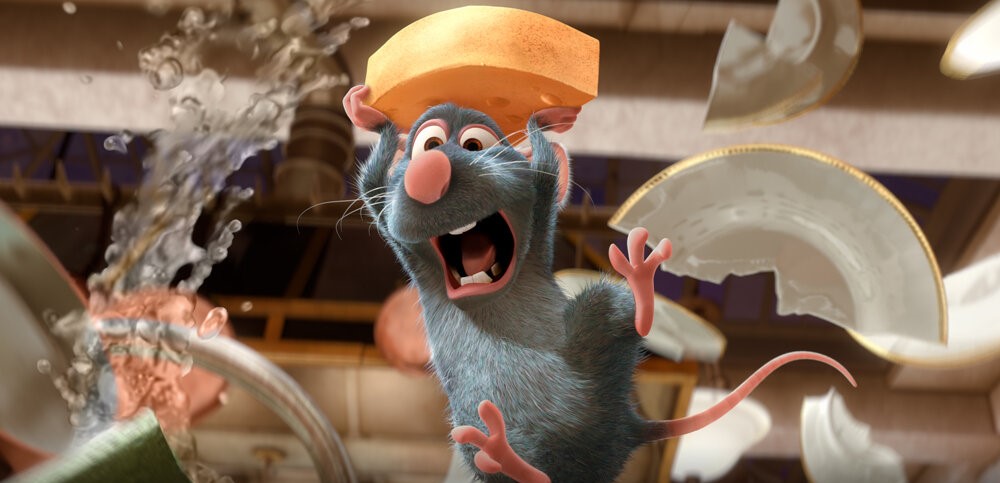
They say anyone can cook – but surely they don’t mean a rat can cook? But in Ratatouille that’s what we get: the greatest chef in Paris is a rat. Remy (Patton Oswalt) has a sense of taste and smell that’s light years ahead of his fellow rats. While they happily munch on rotten food, Remy longs for food that’s actually good. Separated from his family, Remy finds himself in the Parisian restaurant of legendary late chef Auguste Gusteau (Brad Garrett). There Remy’s natural instincts make him the secret brains behind the growing success of young Alfredo Linguini (Lou Romano), who overnight moves from dish cleaner to chef. His secret? Remy of course. Can they keep their secret in the face of the suspicion of head chef Skinner (Ian Holm), Linguini’s growing romance with fellow chef Colette (Janeane Garofalo), and the threat of a damning review by feared critic Anton Ego (Peter O’Toole)?

All this comes together in Brad Bird’s delightful confection, a superb dish where every flavour is perfectly balanced and all ingredients are seasoned to perfection. (I promise this won’t all be full of cooking puns.) It’s absolutely wonderful good fun and on top of that, it’s a real heart-string tugging treat. Ratatouille takes a fantastical set-up (a cooking rat manipulates a talentless chef’s body through precise hair pulling) and then throws in ounces of carefully judged comedy with real emotional pathos. Ratatouille never fails to make you laugh but then hit you with tear-inducing sincerity. The film is a total delight.

What Ratatouille is really about is truth. Being true to yourself, embracing the things you love, and the struggle to find acceptance for that, be it from family or the world around you. It’s the subtext behind Gusteau’s message that anyone can cook. This is not about anyone being able to crack an egg into a pan: it’s about good food coming from a person loving what they do and wanting to share that love with someone else. Remy – an utterly delightful voice performance by Patton Oswalt – wants to experience good food, but as a rat the home of good food is always the place he’s most likely to find himself skewered by a trap.  

Remy loves food in a way that the rest of his rat family – lead by his tough-as-nails father Django (Brian Dennehy) – can’t even begin to understand. They see food as just fuel. Who cares which flavours complement each other or even if its fresh? To them Remy’s extraordinary sense of smell is only useful for his ability to detect poison before it hits their mouths. And they can’t even begin to understand Remy might want more. But the very idea of heading to a kitchen – or interacting with humans who, to the other rats, get their kicks from slaughtering rats in their thousands – they can’t even begin to get their head round. Why can’t Remy be happy snuffling in the gutter?

Linguini (a very sweet, nervy Lou Romano) also has burdens of expectations that he can make a career in the kitchen. Anyone can cook – except for Linguini, who has no interest in (let alone flair for) flavours. The relationship between man and rat is beautifully done– even though neither can speak the other’s language. (In a neat touch, while we hear the rats talk – every human in the film just hears them squeak.) To Linguini, it doesn’t matter that Remy is squeaky vermin, what matters to him is that Remy is a master at what he does. But, Ratatouille gently asks: can hiding your true self make you happy in the long term?

Linguini’s success shows another side of being true: as fame goes to Linguini’s head, he starts to forget he’s the muscle not the brains of the operation. What will eventually alienate his growing relationship with fellow chef Colette (a wonderful Janene Garofalo) is not that he’s working with vermin to make the food, but that he’s lied to her about his skills. Something particularly tough since, like Remy, she has had to fight tooth and nail to live her dream in a male-dominated industry.

Accepting your true self and being happy in your own skin are themes our two villains also juggle with. Head chef Skinner (hilariously voiced with impotent rage by Ian Holm) has lost any love he once had for cooking, marketing his former mentor Gusteau as the face of a brand of cheap ready-meals (“with dignity” he absent-mindedly requests, as Gusteau is drawn as a burrito for the latest packaging) and his interest is only in turning a profit. The face of mass-produced, soulless fare, he’s the perfect antagonist of a film that praises lovingly crafted individualism.

And our other villain? Played with a beautifully plummy relish by Peter O’Toole, Anton Ego – drawn with a grey-faced, sepulchral chill – despairs that any food can meet his standards and seems to have forgotten somewhere along the line that excellence comes from love. Unlike Skinner though, Ego is (at heart) an idealist who may no longer quite remember what he is searching for – but will embrace it when he finds it at last. Ratatouille’s finest moment – always brings a tear to my eye for sure – is Ego’s being reminded at last what made him fall in love with his passion in the first place, perhaps one of the finest moments in Pixar’s long history.

Ratatouille’s emotional content and its themes of truth and acceptance are at the heart of its success, complemented always by the superb score from Michael Giacchini, crammed with Parisian inspiration. There is more life in this animated marvel than in hundreds of live-action films. And the animation is breath-taking: from the kitchen a marvel of pristine, gold and steel surfaces, via the sewers bringing back memories of The Third Man, to the visual imagination of Ego’s coffin-shaped office or the cobbled together rat colony (made from various bits of rubbish). Brad Bird’s flair (and Ratatouille is a wonderfully directed film) also carries across to his electric chase scenes through the streets and rivers of Paris, and the undeniable tension of watching Remy maneuverer his way around a kitchen without being detected.

Bird’s film though really succeeds because it has a warm-hearted love for all its characters and a heartfelt and appealing message for us to be the people we want to be, not what those around expect us to be. And who can’t relate to that? Throw in the sort of unexplained comic magic of watching a naïve young man having his body moved about by a cuddly rat sitting under his chef’s hat and with Ratatouille you onto an absolute winner. Bon appetit!

The Next Three Days (2010)

Elizabeth Banks and Russell Crowe go on the run in workmanlike thriller The Next Three Days

Director:  Paul Haggis

Cast: Russell Crowe (John Brennan), Elizabeth Banks (Laura Brennan), Brian Dennehy (George Brennan), Lennie James (Lt Nabulsi), Olivia Wilde (Nicole), Ty Simpkins (Luke Brennan), Helen Carey (Grace Brennan), Liam Neeson (Damon Pennington), Daniel Stern (Meyer Fisk)

What would you do to protect the person you love? How far would you go to keep her safe? What would you sacrifice? What rules would you break? Paul Haggis’ serviceable thriller tries to answer these questions, but doesn’t really get much closer to the answers than I have here.

Russell Crowe is John Brennan, a teacher of English Literature at a mid-ranking college. One day, his wife Laura (Elizabeth Banks) is arrested for the murder of her boss. Despite her pleas of innocence, before they know it she is sentenced to spend most of the rest of her life behind bars. When desperation at the thought of her fate – and missing the upbringing of their young son – leads her to attempt suicide, John decides to take the extreme step of breaking her out of prison. But where to begin with the planning? And what will he be prepared to do?

It’s the sort of film that early-on has the lead character meet a ruthless expert (in this case an ex-con with a history of prison breaks, played with a growling enjoyment by Liam Neeson in a one-scene cameo) who outlines a list of rules and terrible things that the hero will be forced to do. The hero looks askance – but sure enough each situation arises and doncha know it the hero is forced to bend his own morality to meet the needs of his mission. What a surprise.

Only of course the film doesn’t have the courage to force Crowe’s John to actually do things that bend his morality. There is always a get-out clause. When his actions lead to him taking a petty criminal’s life (while stealing money from a drug den), it’s self-defence. When he looks like he may be forced to put innocent people in harm’s way, he backs away. When he’s asked to sacrifice something major, he refuses. The film wants to be the sort of film where we see the lead character change inexorably as he becomes harder and more ruthless to achieve his mission. But it worries about losing our sympathy, so constantly gives the audience and the character get-out clauses to excuse his behaviour.

Not that Crowe gives a bad performance – he’s actually rather convincing as a humble, slightly timid man way out of his depth at the start – but the film fails completely to show these events really changing the man. It believes that it’s turning him into a darker, more ruthless person, but it isn’t. At heart, this film isn’t really a character-study at all but a dark caper movie. Obstacles are constantly thrown in the path of our hero, many of which bamboozle him: but then when we hit the prison break itself at last, suddenly he’s pulling carefully planned rabbits and double bluffs out of his hat like Danny Ocean. It’s a film that wants to have its cake and eat it: to show a hero bewildered by his task, in danger from this ruthless world he finds himself in – but also to have him become a sort of long-game con artist thinking three moves ahead of the police.

It just doesn’t quite tie up. It’s the film adapting to whatever it feels the requirements and desires of the audience might be at a particular moment rather than something that develops naturally. Enjoyable as it is to see these sort of games play out, you can’t help but feel a little bit cheated – there has been no indication before this that the character has this level of ingenuity in him.

He doesn’t even really need to pay a price beyond that which he had accepted from the start: at points major sacrifices are dangled before him but he never needs to make any of them. He never has to really bend his personal morality significantly. It’s the cleanest conversion to criminality that you are likely to see.

The film cracks along at a decent pace – even if it is a little too long – and shows its various twists and reveals fairly well. Elizabeth Banks is pretty good as Laura, even though she hardly seems the most sympathetic character from the start (the audience has to do a bit of work for why Crowe’s character seems so devoted to her). Most of the rest of the cast are basically slightly larger cameos but no one disgraces themselves.

The main problem with the film is its lack of depth and ambition. Mentioning Don Quixote several times in the narrative doesn’t magically grant a film depth and automatically create intelligent contrasts with the novel. Instead it just sounds like straining for depth rather than actually having it.

Gorky Park (1983)

William Hurt investigates murder in Soviet Russia in ace adaptation Gorky Park

Director: Michael Apted

Cast: William Hurt (Arkady Renko), Lee Marvin (Jack Osborne), Brian Dennehy (William Kirwill), Ian Bannen (Prosecutor Iamskoy), Joanna Pacula (Irina Asanova), Michael Elphick (Pasha), Richard Griffiths (Anton), Rikki Fulton (Major Pabluda), Alexander Knox (The General), Alexei Sayle (Golodkin), Ian McDiarmid (Professor Andreev), Niall O’Brien (KGB Agent Rurik)

Martin Cruz Smith’s novel Gorky Park was a bestseller in the early 1980s. It looked at grim goings-on behind the Iron Curtain, a trio of grisly murders in Moscow’s Gorky Park (the bodies are faceless, toothless and fingerless to avoid identification). The murders are investigated by Arkady Renko (wonderfully played in this film by William Hurt), a chief investigator for the Moscow militia who feels out of place in the corruption of Soviet Russia, but is equally scornful of the consumerism of the West. The investigation delves into a complex web of Soviet relationships with American business and the dissident community, not least an American millionaire fur trader Jack Osborne (Lee Marvin), and a would-be defector and possible friend of the victims, Irina Asabova (Joanna Pacula).

What I loved about this film is the novel is a rather overwhelming 500+ pages, but this film is a brisk and pacey two hours – and I literally couldn’t think of a single thing missing. But then that’s what you get when you have a master writer adapting your screenplay. Gorky Park has Dennis Potter, perhaps the greatest British TV writer of all time – and this is a sublime script, which keeps the pace up, covers all the tense greedy wrangling of the villains, and also makes subtle and telling points about the Soviet system, all in a punchier and clearer way than the books. The dialogue is also absolutely cracking, ringing with a brusque, icy poetry, with a brilliant ear for a turn of phrase.

Filmed on location around Helsinki and Glasgow among other places, what the film misses in actual Russian locations (needless to say the Soviets were not keen to host the production of a film that showcased murder and corruption at the heart of their capital city), it makes up for with Apted’s taut direction and eye for the general crappiness of Soviet life. Everything is run down, everything is dirty, everything looks cold and unappealing, even the houses and luxury bathhouses of the party leaders look a bit middle-class and uninspiring. By the time (late in the film) that you find yourself in one of Osborne’s houses you are immediately struck by the quality of the furnishings – it’s literally a different world.

This atmosphere not only creates something a bit more unique, it also allows us to relax and enjoy the quality of Smith’s story. I found it overstretched in the book, but the film gives it an urgency and a sinister creepiness that grips your attention. Apted has a brilliant eye for the little tricks to survive living in a police state, from watching what you say, to carefully placing a pencil in a dialled telephone wheel to prevent bugs from activting. Every moment is well paced and nothing outstays its welcome. Characters are introduced with skillful brushstrokes, and the relationships feel real and lived in. With such strong dialogue, it’s also great they got such good actors to do it.

William Hurt takes on the lead, and he is perfect, affecting a rather clipped English accent (all the Russians speak with various regional or RP accents). With his unconventional looks (part boyish, part stone-like), he looks the part and he totally captures the yearning unconventionality of a character who deep down probably would be a true believer in a good society, but can’t believe in the corruption around him. Far from the stereotypical would-be dissident, Hurt makes him a man who loves his homeland, but not always the people running it. He’s exactly as you would picture Renko in the book – a guy who will go for justice with the bit between his teeth, a semi-romantic hero, no superman (he frequently is bested in combat), who is looking for something to love and believe in.

The rest of the cast are equally fine. Lee Marvin is cast against type as a suave, hyper-intelligent, manipulatively greedy businessman – although his reputation for playing heavies comes in handy when the gloves come off. Joanna Pacula mixes sultry Euro-siren with an urgent yearning for freedom. Ian Bannen is wonderfully avuncular as Renko’s supportive boss (extra points for Tinker Tailor fans that Bannen is reunited here with Alexander Knox, in a dark reflection of their Control-Prideaux working relationship from that series). Michael Elphick seizes on the part of the down-to-earth Pasha, Renko’s friend and comrade, a role greatly improved from the book (largely to give Renko someone to bounce ideas off).

Apted’s film has a great sense of tension and a wonderful feeling for Soviet Moscow’s dark underbelly. The mystery is increasingly gripping and involving as the film goes on – and, in a nice rug-pull, turns out to be about something totally different than what you might expect. Even the final shootout is assembled and shot with an unexpected vibe. It avoids any Cold War pandering – the main villain is a sadistic American allied with Russians, our hero a noble Russian who partners up with a salt-of-the-earth but decent American cop (Brian Dennehy, also very good). For a late night mystery thriller, with a touch of everything thrown in, you can do a lot worse than this. I enjoyed it far more than I expected. I’d almost call it an overlooked B-movie gem.