
Tag: Brian Donlevy

In Old Chicago (1937)

In Old Chicago (1937)

Entertaining melodrama leads into a very well-staged disaster epic that burns a city

Director: Henry King

Cast: Tyrone Power (Dion O’Leary), Alice Faye (Belle Fawcett), Don Ameche (Jack O’Leary), Alice Brady (Molly O’Leary), Phyllis Brooks (Ann Colby), Andy Devine (Pickle Bixby), Brian Donlevy (Gil Warren), Tom Brown (Bob O’Leary), Berton Churchill (Senator Colby), Sidney Blackmer (General Phil Sheridan)

San Francisco showed Hollywood the way: spice up a melodrama with a disaster-laden ending. The first took the San Francisco earthquake: In Old Chicago takes the Great Chicago Fire of 1871 which burnt down over three-square miles of the city, destroyed over 17,000 buildings and killed over 300 peoples. Despite a rather earnest message that research was scrupulously carried out with the Chicago Historical Society – other than the fire itself, the entire film is a great big fictionalised soapy melodrama, building towards a grandly staged recreation of the great conflagration itself.

The melodrama is built around the O’Leary family. In legend Mrs Catherine O’Leary, of the city’s large Irish community, was the fire’s unwitting cause after her cow knocked over a barn lamp. Here she is reimagined as Molly (Alice Brady), mother to a flock of sons. In the way of these melodramas one, Dion (Tyone Power), is a cheeky rogue with criminal links the other, Jack (Don Ameche), is a legal straight-shooter determined to clean this town up. Club owner Dion controls a stack of corrupt votes to get Jack elected Mayor – screwing over kingpin rival Gil Warren (Brian Donlevy) in the process – under the mistaken impression he can control his brother (dead wrong). Meantime, Dion bounces through a heated love-hate relationship with glamourous bar-singer Belle (Alice Faye), who knows a little too much about his corrupt dealings.

These elements are expertly melodramatically mixed together with very few narrative surprises to establish some recognisable faces for when the city-burning destruction kicks in, with its punishments and redemptions. King directs all this with a glitzy, big-budget flair while the shallow characters go through familiar motions. Truth be told, there isn’t much especially new about In Old Chicago, which follows the San Francisco model to a tee with soapy personal rivalries (skimming the surface of Chicago’s corruption) beefed up with (fairly forgettable) songs from Alice Faye. There’s even a literally soap-sud filled transition at the start to take us into a superbly re-constructed nineteenth century Chicago, in a film full of impressive production design. But yet, don’t get me wrong, it’s all done with such energy it’s consistently enjoyable.

The two brothers are, of course, studies in contrast (third brother, Tom Brown’s Bob is so decently dull he barely makes any impression). As the ‘bad’ brother, Tyrone Power enjoys himself as a lip-smacking cad obsessed with power. Smirking and full of self-satisfaction at his own cleverness (not as clever as he thinks), he’s a ruthless liar and manipulator who deceives everyone around him: his brothers, the woman he loves, his political allies and rivals. It’s one of Power’s most engaging performances, successfully making Dion the sort of bastard you love to hate without ever making him utterly deplorable. In fact, he feels like a big kid (and a mummy’s boy at that), literally leaning back in his chair and expecting praise for his cleverness.

Opposite him, Don Ameche is saddled with the impossibly noble Jack, a crusading lawyer (who wouldn’t think of charging low-earning clients) and who wants to become Mayor to change the town for the better. His straitlaced decency is constantly thrown off by his brother’s dastardly lack of principle (their relationship eventually culminates in an entertainingly well-staged, no holds-barred fisticuff scuffle). Ameche does a good job of investing depth in this on-paper rather dull character.

The film presents an entertainingly straight-forward picture of machine politics, with votes controlled by bosses, various voters encouraged to register (and vote) multiple times and bosses controlling vast teams of followers. Brian Donlevy brings a very fine sense of arrogant domination to would-be boss Gill Warren (the sort of guy who casually mentions a rival’s bar looks rather flammable during a shake-down). It’s all very much presented as bad apples spoiling the whole barrel (rather than the whole system being a bucket of corrupt snakes), but fun nevertheless.

The romance comes between Dion and Belle, played with a decent mix of rascally bad-girl and misunderstood decency be Alice Faye. Faye (taking over the role at short notice from the late Jean Harlow) gets a few decent songs but the meat of the role is her love-struck switching between adoring and loathing Dion, who (with his flirtation with Senator’s daughter Ann Colby, played by Phyllis Brooks) barely deserves her. Some of Dion’s initial courting – consisting of sneaking into her carriage, pinning her down and kissing her – hardly feels comfortable now, but it supports a neat running joke of Belle’s maid running for help only to return to find the two locked in a passionate embrace.
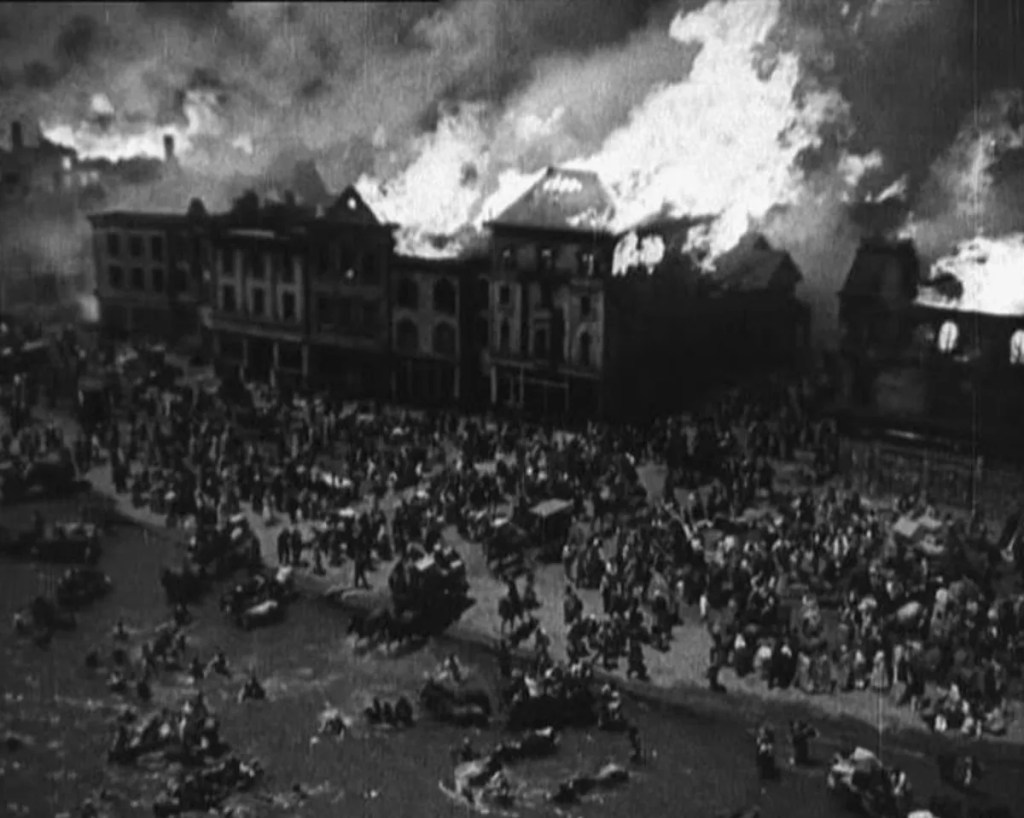
But all of this is just build-up for the main event: an impressively staged reconstruction of the Great Fire. Shot with a mix of real sets and models – you can see where the money was spent on (briefly) the most expensive film ever made. It throws at us buildings aflame, crashing to the ground, huge crowds of extras charging past the camera in tracking shots, a panicked army of bulls fleeing (and crushing those unlucky enough to get in the way). This sequence is genuinely grippingly put-together and impressively epic, utilising some very effective aerial model shots of the city to establish the scale of the fire and the devastation. It balances culminating its plot threads at the same time as embracing the disaster excitement.

This end sequence makes the slightly patchy, familiar soap beforehand retrospectively work even better. It certainly helped deliver a box office bonanza for the film – just as Alice Brady’s closing speech about the unbeatable spirit of Chicago probably helped her to an Oscar (it’s a part Brady clearly enjoys, cementing a stereotype of the domineering Irish mother). After San Francisco, In Old Chicago proved entertaining disaster epics could thrill audiences with destruction for years to come.

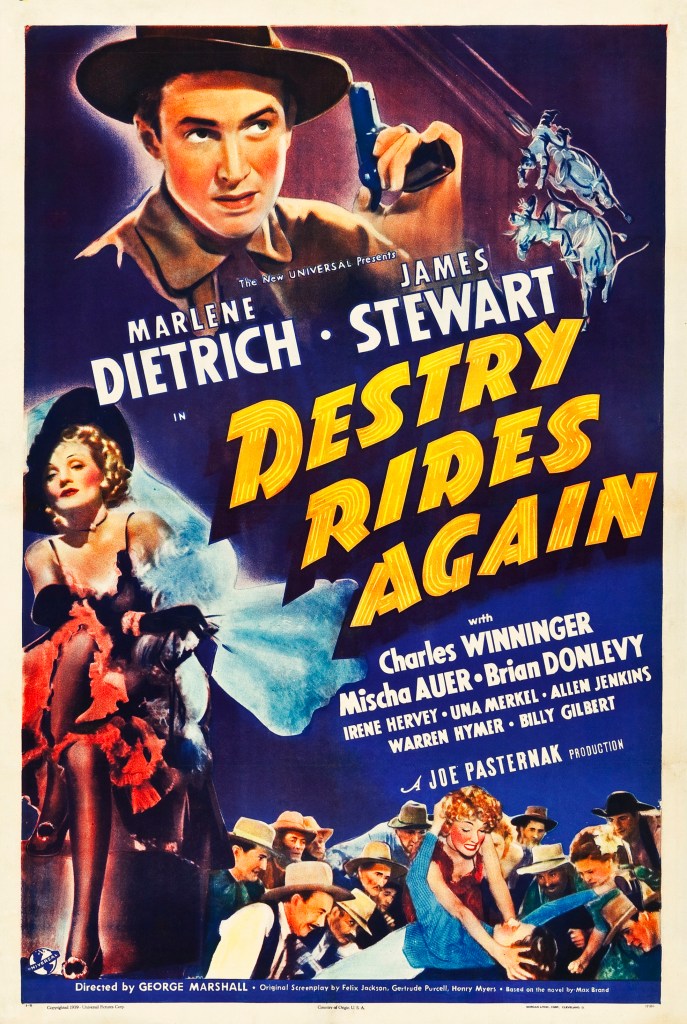
Destry Rides Again (1939)

Destry Rides Again (1939)

A gun-shy sheriff needs to clean up this town in this delightfully funny semi-comedy Western

Director: George Marshall

Cast: Marlene Dietrich (Frenchy), James Stewart (Tom Destry Jnr), Mischa Auer (Boris), Charles Winninger (Washington Dimsdale), Brian Donlevy (Kent), Allen Jenkins (Gyp Watson), Warren Hymer (Bugs Watson), Irene Hervey (Janice Tyndall), Una Merkel (Lily Belle), Billy Gilbert (Loupgerou), Samuel S Hinds (Mayor Hiram J Slade), Jack Carson (Jack Tyndall)

There’s a new deputy sheriff in town! Son of a wild-shooting, hard-as-nails lawman, Tom Destry Jnr (James Stewart) is surely the man to bring justice to Bottleneck. Or at least that’s what everyone thinks until his carriage arrives and out steps an aw shucks slouching drawler, carrying a parasol, who loves a homespun yarn and – worst of all! – doesn’t see the point of carrying guns. Surely, he’ll be a push-over for Kent (Brian Donlevy), the corrupt saloon owner who runs the town? Guess again. Tom will soon change all sorts of minds, not least Kent’s gal, glamourous singer (and card sharp) the improbably accented Frenchy (Marlene Dietrich).

George Marshall’s Destry Rides Again is pretty much a delight from start to finish. It combines rich comedy and Western satire, with genuine sharp-shooting thrills, and showcases a host of actors at the top of their game. It’s crammed with excellent jokes, shrewd observations and some moments of truly affecting tragedy. It’s the finest film Marshall, otherwise a journeyman, directed with confidently handled, crowd-filled set pieces and a wonderful sense of pace.

It’s hard not to fall in love with a man who doesn’t care what people think of him but, when push comes to shove, could beat them all in a game of quick draw. It helps abundantly when he’s played by James Stewart at his most boyish and lovable. Tom is determined to prove the law can be done another way: that escalating things by pulling a firearm only leads to trouble (“You see if I have had a gun there, why, one of us might have got hurt – and it might have been me”). Tom is quick-witted and confident enough to face down crises without a gun – putting him years ahead of the townsfolk who judge everyone by their ability to hit a target.

In fact, Destry Rides Again in its opening hour really commits to the idea of Tom as an ahead-of-his-time pacifist, who thinks through events with the grace of a chess-master. We’re constantly encouraged to delight not only in his smarts – the incriminating traps he lays for all around him, the skilful way he defuses situations – but also respect for his cool and guts (you need to be damn sure of yourself to order a glass of milk in Kent’s no-holds-barred saloon).

Tom eventually of course has to give them a show – his pin-point accuracy with a pistol leaves the town gasping, and a group of would-be trouble-makers lamely muttering how sorry they are to have disturbed the peace – but he’s far too brave to need to prove himself. Real courage is not caring what people think of you, and real smartness is being happy for others to call you a knabby-pabby yellow-belly. After all, they’ll only underestimate you – and make it even more likely Tom’s methodical, law-following approach will yield the right results.

Marshall mines gallons of fish-out-of-water comedy from Tom’s willingness to look the fool. From his arrival at the town clutching the parasol of a fellow passenger – his shoot-first-and-second-think-third fellow passenger Tyndall (Jack Carson) is mistaken for him because he matches the bill of what the town expects – to his passion for whittling napkin rings and his calm aw shucks good humour when handed a mop and told to use that to “clean up this town”. But we are never left with a doubt that Tom is the bravest, smartest, toughest guy in the town – and that he doesn’t need to constantly proof it to himself and others.

It eventually sinks in as well to glamour madam, Frenchy. Marlene Dietrich had not only never appeared in a Western before, she’d been declared “box office poison” just a few months earlier. In the public mind she was associated with glamour, distance and von Sternberg majesty. All that was to change with Destry Rides Again, where she was lusty, earthy but still with a touch of class. Who would have imagined Sternberg’s muse engaging in a no-holds barred cat fight with Una Merkel’s domineering housewife (a brawl that trashes most of the bar)?

Dietrich is quite superb in the role of this enigmatic madam. Her distinctive singing is used liberally throughout the film. Which fits nicely with Frenchy’s role in the town as the glamourous distracting agent for the crimes of Kent (a smugly grinning Brian Donlevy). Not that she’s an innocent: she swipes cards from punters in crooked card games and knows full well Kent sends “out of town” anyone who crosses him. But there is something in Tom she finds intriguing, perhaps because he’s smarter, more interesting and different from any other an in this benighted outlaw stop-off.

It helps as well that there is a clear magnetic attraction between the two. Not to mention between Stewart and Dietrich – it’s no surprise, watching the film, to hear they had a passionate affair during its making. Stewart has never really felt sexier than here with Dietrich, while Stewart helps Dietrich feel warmer and more approachable than she ever did with Sternberg. The dance (literally at one point) between these two, captures in microcosm the struggle for the town’s soul: will Tom win them over, or will the gun-totting baddies?

Marshall doesn’t quite cap the film off as well as you might hope. Eventually, Tom is left no choice but to pick up his guns. The film does present a final shoot out quite unlike anything you’ve ever seen before – ending in a battle-of-the-sexes brawl in the saloon, shot with an immersive comedy. But it doesn’t change the fact that Destry Rides Again can’t in the end square its circle: Tom may preach stern words over violence, but when push comes to shove only guns solve problems.

But you forgive it because this film is a hugely entertaining delight. There are a multitude of delightful supporting roles. Best of all are Mischa Auer is extremely funny as a Russian would-be-deputy who (literally) doesn’t wear the trousers in his marriage and Charles Winninger as the town drunk turned sheriff, who has a secret heart of gold even if he can’t tuck his shirt in (there is a lovely, late, call-back to this mannerism in the film from Tom that is genuinely moving). Destry Rides Again manages to be both a sort of spoof, but also a very real genuine Western, with a near perfect mix of jokes and action. It doesn’t quite manage to deliver on its concept, but it does more than enough.

Hangmen Also Die! (1943)


Brian Donley on the run in Fritz Lang’s Nazi occupation thriller

Director: Fritz Lang

Cast: Hans Heinrich von Twardowski (Reinhard Heydrich), Brian Donlevy (Dr Franticek Svoboda), Walter Brennan (Professor Stephen Novotny), Anna Lee (Mascha Novotny), Gene Lockhart (Emil Czaka), Dennis O’Keefe (Jan Horak), Nana Bryant (Hellie Novotny), Margaret Wycherly (Ludmilla Novotny), Tonio Selwart (Chief of Gestapo Kurt Haas), Alexander Granach (Inspector Alois Gruber), Reinhold Schünzel (Inspector Ritter), Jonathan Hale (Dedic)

Film dramas “ripped from the headlines” have a mixed track record. Making a drama about an event that happened so recently the dust has hardly settled leaves you open to making decisions in your film that could later be exposed as mistakes. Few films in history are more headline-ripping though than Hangmen Must Die!, a film about the assassination of Heydrich, the planning of which must have started almost immediately after the news broke.

Dr Svoboda (Brian Donlevy) is on the run in Prague after shooting dead Reinhard Heydrich, Hitler’s deputy in occupied Czechoslovakia. After a chance meeting, he pleads with Mascha Novotny (Anna Lee) for shelter – but this only serves to endanger her family, particularly her father Professor Novotny (Walter Brennan), in the affair. Meanwhile the Gestapo, led by Alois Gruber (Alexander Granach) investigates and the Nazis take hundreds of Czech notables, including Novotny, into custody as hostages. The Germans promise to execute hostages until the assassin is handed over.

First things first: unlike 2016’s Anthropoid, this film is a complete work of fiction. It is first and foremost a film made by European exiles in the middle of World War II to sing the praises of those defying the march of fascism. Heydrich only appears at the start of the film, played with a sinister, mincing campness by von Twardowski (a notable German socialist exile). Despite this, the arrogance and cruelty of Heydrich is hammered home, with his lines delivered in a bullying, untranslated German. The film uses a dark humour to stress his villainy, Heydrich nonchalantly strolls down a crowded meeting room, forcing those in attendance to remain saluting, swivelling to follow Heydrich, until he finally settles and returns the salute allowing them to relax. It’s a neat little joke and perhaps one of the clear signs of the hand of co-writer Bertolt Brecht. Take a look at the sequence (and rest of the movie as well!) here:

That’s one of the film’s other claims to fame: noted director Fritz Lang worked with fellow exile Brecht to craft the script. As such, the film is a slightly unusual mix between the left-wing, idealist politics of Brecht and the film noir style of Lang. The primary aim is to serve as a propaganda tool, and the courage and bravery of the Czech people is repeatedly stressed. With a few key exceptions, the Czechs are loyal, honest and willing to make huge sacrifices. Lang films this with a stirring simplicity, low angle shots, skilful use of light, and dynamically involving crowd scenes, bringing this courage visually to life. Brechtian touches, such as a crowd of Prague locals confronting Mascha (with increasing menace) when she considers betraying the assassin to save her father’s life, are perfectly complemented by Lang’s skilful film making. The film’s final tribute to the heroes of Europe, with the people of Prague joining together to sing a hymn to the fallen hostages, surges with a left-wing Brechtian political outrage.

What’s most unusual about the film – and one of its problems – is the curious mixture of tones. Perhaps because of its film noir styles, perhaps because of the American accents of many of the Czech characters (interestingly, the exiles overwhelmingly play villainous Germans), this film becomes a sort of behind-the-lines 1930s hard boiled gangster thriller – with the difference that the cops are the baddies. The Gestapo go about their jobs like gangster gumshoes from Hollywood movies. The Czech people, for all their gumption, look and act like streetwise New Yorkers. It’s an odd tone that takes some getting used to.

On top of that, the film shows several hostages (including characters we get to know) shot due to the refusal to hand over the assassin. I can’t watch this without thinking about how little it gets near the true horror of Nazism. The Gestapo here are relative pussycats, compared to the brutal lengths they went to in real life: the Gestapo chief even prudishly talks about a need for evidence. Compared to the thousands of civilians killed in real life, this is nothing. The Germans even essentially “give up” in a coda and accept a defeat. This makes terrific propaganda of course, but it just ties into the sense that this film doesn’t even begin to touch the villainy of the occupation. It makes for better entertainment, but it’s strange to watch today.

Finally, the last problem with the film is the rather mixed performers. Put simply, Brian Donlevy is totally miscast as the assassin, a B-movie actor who is far too American for the part, and incapable of giving the role the depth it needs. Svobada just isn’t interesting or sympathetic. Anna Lee is similarly bland, while the less said about O’Keefe as her fiancée, the better. Not one of the American actors is completely convincing in their role, although Walter Brennan is close to an exception, effectively gentle and wise as the brave Novotny. The best performances are from the exiles, with Graucher in particular excellent as a shrewd, soulless, corrupt detective, with no guilt about the means he uses.

The film culminates in a rather hard-to-follow and far-fetched attempt by the resistance to frame a collaborator (played with weaselly self-importance by Gene Lockhart) for the crime. This plot tends to meander, but there are several very good scenes showing the Czech resistance, including a wonderful sequence in a restaurant that goes from a sit-down, to an unveiling, to a shootout. Lang skilfully builds the tension throughout, and the creeping relentlessness of hostage executions and Svoboda’s attempts to run from the Gestapo are very well done. Sequences such as Svobda ducking into a movie cinema, only to find a keen collaborator inside, sizzle with excitement.

In fact there are many excellent moments in the film. It is beautifully filmed, with a gorgeous use of expressionist shadow and camera angles to create a claustrophobic, doom laden world. Lang’s strength of plotting by-and-large works very well. Though it can’t bring across the full horror of Nazi occupation, the dread of the Gestapo is clear in the movie. “Enhanced interrogation” is underplayed, but it is sinisterly embodied in the fate that befalls an arthritic shopkeeper. We see him exhausted, but not broken, in a prison cell, forced to constantly pick up a chair under interrogation with her weakened hands. Later, a character throws himself out of a window rather than risk being interrogated to reveal information about the resistance. The hostages are brutally dispatched, with the level of panic, fear, collaboration or defiance having no impact on their fates.

It’s a fractured film, overlong but very well filmed, which creates a brilliant tribute to the strength of the Czech people. Trim 20 minutes off it and I think this could have been a great thriller.  It’s a strange mix of acting styles, but the marriage of Brecht and Lang works very well (it’s a real shame Brecht never made another film) and the drama of the film carries it over the strange bumps in the road. Brecht, by the way, spent the rest of his life rubbishing Lang, as he couldn’t understand why Lang put all the plot and character into a movie Brecht saw as being purely political.

It’s in many ways a strange historical monument – perhaps its makers couldn’t imagine the depths of Nazi atrocities, perhaps Hollywood wasn’t willing to bring such horrors to the screen. It’s not perfect, but in its own way, it’s a piece of cinematic history.