Tag: British Films

The Madness of King George (1994)

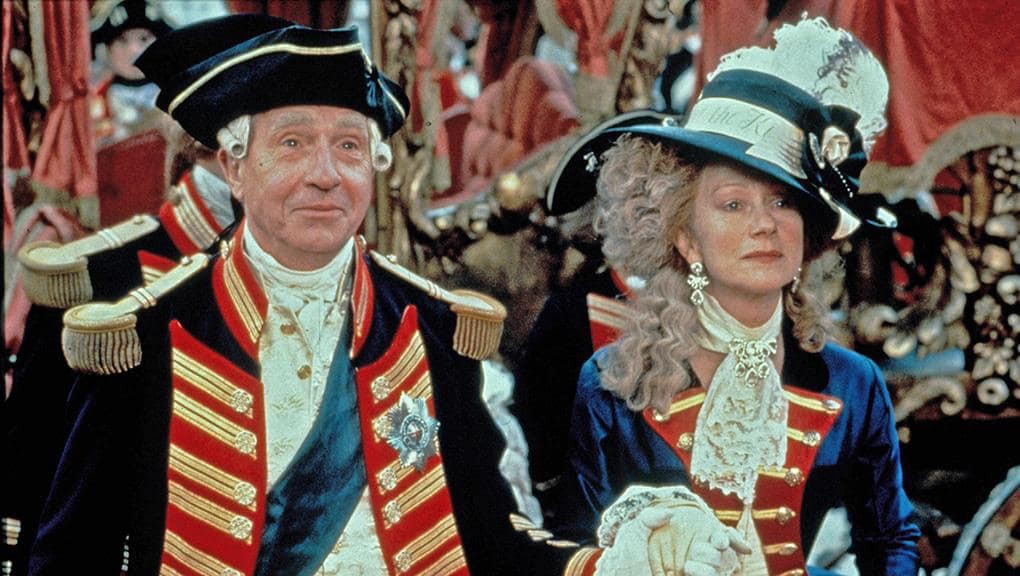
Nigel Hawthorne and Helen Mirren excel in this masterful adaptation of Alan Bennett’s classic play

Director: Nicholas Hytner

Cast: Nigel Hawthorne (King George III), Helen Mirren (Queen Charlotte), Ian Holm (Dr Willis), Rupert Everett (Prince of Wales) Amanda Donohoe (Lady Pembroke), Rupert Graves (Captain Greville), John Wood (Lord Chancellor Thurlow), Geoffrey Palmer (Dr Warren), Jim Carter (Charles James Fox), Julian Rhind-Tutt (Duke of York), Julian Wadham (William Pitt), Anthony Calf (Captain Fitzroy), Adrian Scarborough (Fortnum), Struan Rodger (Henry Dundas), Caroline Harker (Mrs Fitzherbert), Roger Hammond (Dr Baker), Cyril Shaps (Dr Pepys)
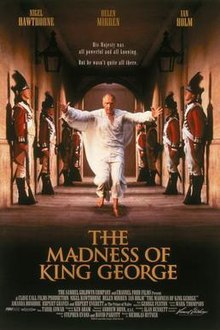
Alan Bennett’s The Madness of George III allegedly changed its name for the film adaptation because producers worried American audiences would feel they missed the first two films in the series. It’s not actually true, but it was a lot of free publicity for Nicholas Hytner’s film debut – a marvellous, accomplished and brilliant theatrical adaptation that will always take a firm place on my list of favourite films. It’s an excitingly well-made, hilarious and heartfelt film that captures forever Nigel Hawthorne’s greatest ever performance.

In 1788 King George III (Nigel Hawthorne) is still fuming over the loss of “the colonies” (the film front and centres talk of the plucky United States, to help sell the film in the land of the free) and the behaviour of his ambitious oldest son George (Rupert Everett). Happily married to his wife Queen Charlotte (Helen Mirren), and the father of 15 children, George is a stickler for form and duty. So imagine the shock of his ministers when his behaviour becomes impulsive, irrational and finally obscene. With the king talking non-stop and impossible to control, the Prince of Wales schemes to become Prince Regent. Desperate, the king’s ministers call in Dr Willis (Ian Holm), a professional doctor of the mad, who claims he can (with time) cure the king. But will it be in time to prevent the regency?

Nicholas Hytner has rather charmingly claimed that he knew so little about film-making he didn’t realise the difficulty of many of the things he asked for, and if he had known he would never have asked. He gives much of the credit to the seasoned pros working on the film pulling out the stops to give him what he asked for. The end result is a brilliantly paced, lusciously filmed epic that is both a wonderfully moving personal story of a crotchety but lovable monarch and a witty look at regency politics. Several scenes are shot with an imaginative brilliance, from shots that throw themselves into the middle of scuffles at court with the unbalanced king, to sweeping landscape shots that make it look like the thing cost millions of dollars.

The other advantage of bringing in Hytner (director of the original stage production) was his brilliant understanding of Alan Bennett. Bennett’s script is superb, crammed with sensational lines and brilliant jokes that never get in the way of the humanity. Bennett is always more than radical than his cosy reputation suggests, and King George is a witty deconstruction of the purpose of the Royal family (politicians frequently comment on their pointlessness and George defines it as “smile and wave” and to act as “a model family”). It’s got a great understanding of the frustrating waiting game of long-serving heirs (being Prince of Wales “is not a position, it is a predicament”). The film even lands a cheeky gag at the end with the suggestion that the King’s condition was hereditary.

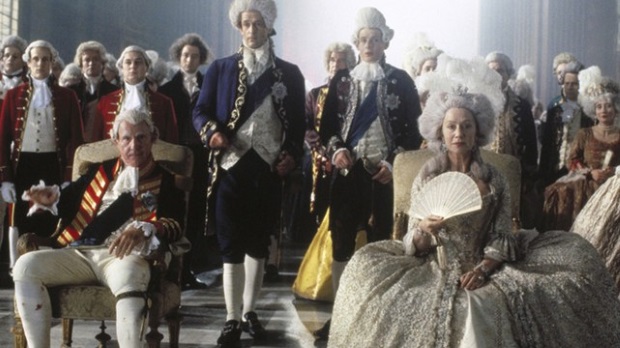
Hytner’s film uses the trappings of royalty brilliantly, contrasting them to great effect with the later degradation of the king – in an inspired moment, George’s first “enthroning” in the restraint chair Willis uses to condition him into behaving is soundtracked to Handel’s Zadok the Priest. George’s court is an uptight, staid place where people can’t relax (or even sit – George is so adamantly opposed to people sitting in his presence even a heavily pregnant woman is not exempt during an interminable bell-ringing version of Handel). George is a constrained figure – so it’s no wonder his insanity displays itself as an increasingly loose-lipped lack of inhibition.

The question of madness is richly handled. As Willis says, many of the mad consider themselves kings, so what does a king fancy himself as? And how can you tell what is normal for a king anyway? George is an eccentric from the start – and even his recovery at the end is basically eccentricity with an element of self-control rather than a full recovery. The film never shies away from making you invest in the rough treatment the king undergoes to wrestle him back to sanity. The doctors get short shrift, either incompetent or scheming (“When will you get it into your head that one can produce a copious, regular and exquisitely turned evacuation every day of the week and still be a stranger to reason” Geoffrey Palmer’s wonderfully dry Warren tells a toilet-obsessed colleague). 
The film is slightly more confused about Willis. Strongly played, with a twinkly chippiness, by Ian Holm (who is just about perfect) the film can’t quite decide if Willis is responsible for the king’s recovery or not. It’s a battle of wills, but is Willis ahead of his time or as medieval as his colleagues? Does Willis’ aggressive conditioning (punishing bad behaviour with restraints) force the king back into sanity? Or is it George’s love of his wife that provides the final push? Or is the king naturally on an upcycle where madness expresses itself in eccentricity rather than incoherence? It’s not clear (maybe this is deliberate) but Willis’ regime of punishment and reward has a slight air of quackery.

What’s pretty deliberate was Bennett and Hytner’s insistence that only Nigel Hawthorne could play the king. Thank god they did, as Hawthorne is simply brilliant. Cheated of the Oscar in 1994, Hawthorne is compelling. He also conveys the natural authority of a king, and the “grumpy old man” side of the king is mined for brilliant comic effect. But it’s also a beautifully heartfelt and hilarious performance, running the gamut from delight in obscenities to teary fury and fear at the treatment from his doctors and loss of mental control. Such a sublime performance.
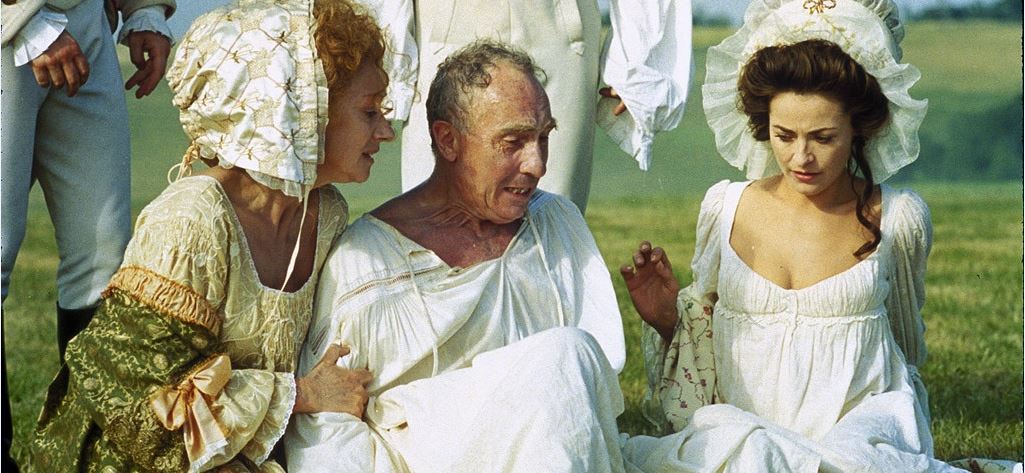
And it surely inspired some top work from the brilliant cast around him, many of whom revived their roles from the stage production (chief among these Wadham’s wonderfully dry Pitt).  Helen Mirren is warm, proud and eventually desperate as Charlotte, while Rupert Everett mines the Prince of Wales for all the comic pomposity and childishness he can. Rupert Graves is excellent as a loyal equerry, while John Wood, Jim Carter and Geoffrey Palmer also excel. You’ve rarely seen such a strong cast of British stage notables, and it’s not surprising they were attracted to perform in a script that has as many good lines as this one.

It’s accomplished and luscious, is brilliantly shot and designed, and is packed full of wonderful sequences. It wears its intelligence lightly, with George as a proto-Lear struggling to hold onto his marbles. The characters even sit and read Lear at one point (“Is that wise?” questions Thurlow. “I had no idea what it was about” says the little-read Willis). George may recover his wits in time, but it’s unclear whether this makes him more or less of a human being. In many ways at the height of his insanity, he’s a warmer, friendlier person (if out of control), then he is as his buttoned-up, stickler-for-duty self. 

The Madness of King George is the sort of film all theatre adaptations wish they could be, brilliantly cast, opening out into something that not only feels compelling to watch but also brings out the great depths of the original play. What is monarchy for? How can we tell if the all-powerful are mad or not? What is sanity anyway? All this and with some superb jokes, and a story that really involves you. With Nigel Hawthorne’s simply brilliant performance at the centre, this is one for the ages.
Women in Love (1969)

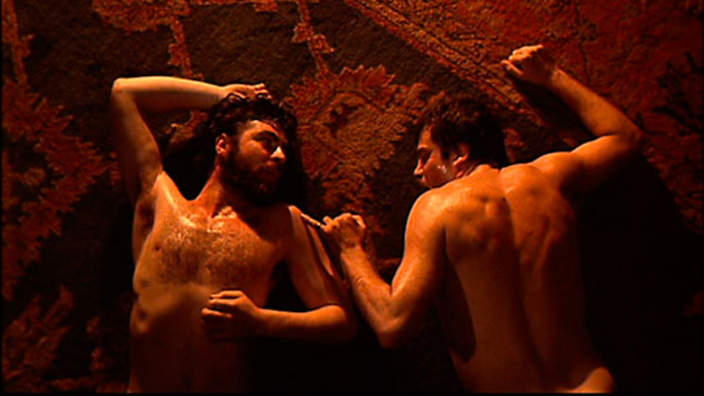
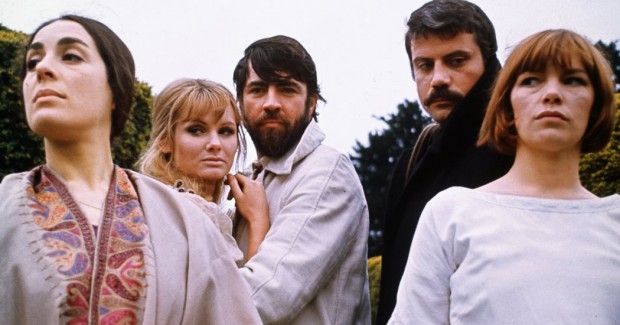
The stars of Women in Love: this publicity still gives only a hint of the simmering (and slightly strange) heightened passions you find therein

Director: Ken Russell

Cast: Alan Bates (Rupert Birkin), Oliver Reed (Gerald Crich), Glenda Jackson (Gudrun Brangwen), Jennie Linden (Ursula Brangwen), Eleanor Bron (Hermione Roddice), Alan Webb (Thomas Crich), Vladek Sheybal (Loerke), Catherine Wilmer (Christina Crich), Phoebe Nicholls (Winifred Crich), Sharon Gurney (Laura Crich), Christopher Gable (Tibby), Michael Gough (Tom Brangwen), Norma Shebbeare (Mrs Brangwen)

DH Lawrence is an acquired taste. While his writing is undoubtedly brilliant, reading his novels today it’s hard to shake off their sometimes histrionic melodrama – their revelling in all that (at the time) shockingly frank discussion of sex and all that Freudian analysis of fractured personalities against an alien industrial world. So perhaps there is a reason why one of the best interpreters of his work for the screen has been someone as melodramatic and envelope-pushing as Ken Russell.

Women in Love is Russell and Lawrence to the max. In a 1920s mining town, two sisters, Gudrun (an Oscar-winning Glenda Jackson) and Ursula (Jennie Linden) want to make their own way in the world. Local school inspector Robert Birkin (Alan Bates) wants to find perfect love and fulfilment. Alpha-male son-of-the-local-mine-owner Gerald Crich (Oliver Reed) isn’t quite sure what he wants, other than to reinvigorate his father’s business. Naturally all four of these characters come together in romantic, intellectual and sexual tangles that lead to a lot more misery than happiness.

Wow this is a difficult picture to write about. How so? Because it is about two-thirds masterpiece to one-third pretentious, hyperbolical nonsense. That’s quite some tight-rope. Russell walks it pretty well, but his problem has always been he loves being a sort of enfant terrible of British cinema too much. Too often he succumbs to temptation and pushes things a little further, to go for the demented camera or editing trick, or to push the sexual content a little bit further. The whole film has a hint of a cocky teenager, jumping up and down to look cool and catch your attention. 

But then on the flipside, sometimes this excess really works (or if you like, sometimes more really is more). Nowhere is this clearer than in the famous naked wrestling scene between Oliver Reed and Alan Bates. It’s a high-blown, tightly edited, single-camera, increasingly artistic sequence that leaves little to the imagination as we wonder how far this nude, willy-waggling, sweaty wrestling turned intimate clinch will go (the final shot sees the characters roll off each other and lie exhausted on a carpet, breathless, in front of a roaring fire). But it works so well because the amped up shooting and content really tells us something about these two characters, their relationship, feelings, viewpoints on life, sexuality – everything. It’s a great scene and it’s a sign of how good this film can be.

And then you get other moments where you sigh and roll your eyes and almost want to say “yeah Ken we get it…”.  As Robert and Ursula roll off each other after an intense sexual encounter in the woods, we cut immediately to two bodies found drowned in a lake, their bodies locked together in exactly the same position. Yup sex ‘n’ death. Gerald and Gudrun have sex, intercut with shots of Gerald’s mother. Other moments ape up stuff that was already pretty ridiculous in the book to the max: Birkin, after a bash on the head, runs naked into the countryside and smears himself with grass and mud and rolls in the dirt. For about three minutes.

But then this is the sort of film where Glenda Jackson tames some bulls by performing a bizarre dance. Why does she do this? Who knows (certainly not the characters). But then the film is full of moments like this. But what kind of makes it work, even when it is so ridiculously over-the-top and dated in its filming, is that there is a smartness in it. It is a film that does, underneath it all, have some profound thoughts about love and relationships.

It manages to bring together the themes that intrigued Lawrence with a bit of coherence. What do we want from life? It focuses overwhelmingly on the men of the story, and in particular Alan Bates (excellent) as Birkin. Made up to look like Lawrence, Birkin also carries a lot of the prose of the novel debating what makes us happy, whether we need equally strong bonds in our life with men and women, and what constitutes our completeness as human beings. 

The film does this to a certain extent with the female characters as well – although we see them almost completely from the perspective of the men (which is interesting – maybe they were worried about making a film called Men in Love…). That’s possibly why Gudrun’s confused desires for Gerald never quite come into focus. Marvellous as Glenda Jackson is – surely an actress born to play this sort of part, marvellously passionate but strangely unknowable, vulnerable but harsh and even a little cruel – it’s hard to understand how Gudrun’s feelings change for Gerald. Maybe she doesn’t know herself. 

Gerald and Gudrun seem to be characters who don’t understand what they want (Gerald even expressly says it). That’s part of the point of the film (and Lawrence’s book) – a yearning, like both these characters have, for freedom and something different from previous generations, but unable to really put their finger on what this is. Gudrun wants a strong, dynamic man – but she also wants freedom and artistic fulfilment, and can’t find this with Gerald.

The film juggles these themes, of people struggling to reach an expression of (or to understand) their desires. Russell understands this – and for all the highblown eccentricity of some of the shooting, he sticks with a brilliant understanding of these personalities and themes. It remains a very caring movie that understands and relates to its characters. It has a lot of heart under the madness of Russell’s shooting.

And it’s superbly acted. Bates and Jackson are both marvellous, as is Jennie Linden in a (to be honest) rather thankless part as the second sister. But it’s a revelation of what a fine actor Oliver Reed could have been, if he had not decided to become a professional drunk. Reed drips charisma and intensity and he gives Gerald a real frustrated, sensual depth – a confused sexual fear mixed with a determined machismo. It’s a brilliant performance. The rest of the cast are also good, even if Eleanor Bron is (partly deliberately) overdone as Birkin’s first lover.

Women in Love is very dated in its style, but still a fascinating and intelligent piece of filmmaking that engages with and juggles with ideas. Despite all its overblown Russell excess, I actually really liked it, it stuck with me and I’ve been thinking about it since it finished. I’d actually like to see it again and see if it unlocks even more for me – and blimey it even makes me want to read Lawrence again, which after The Rainbow I never thought I’d say…

In Bruges (2008)

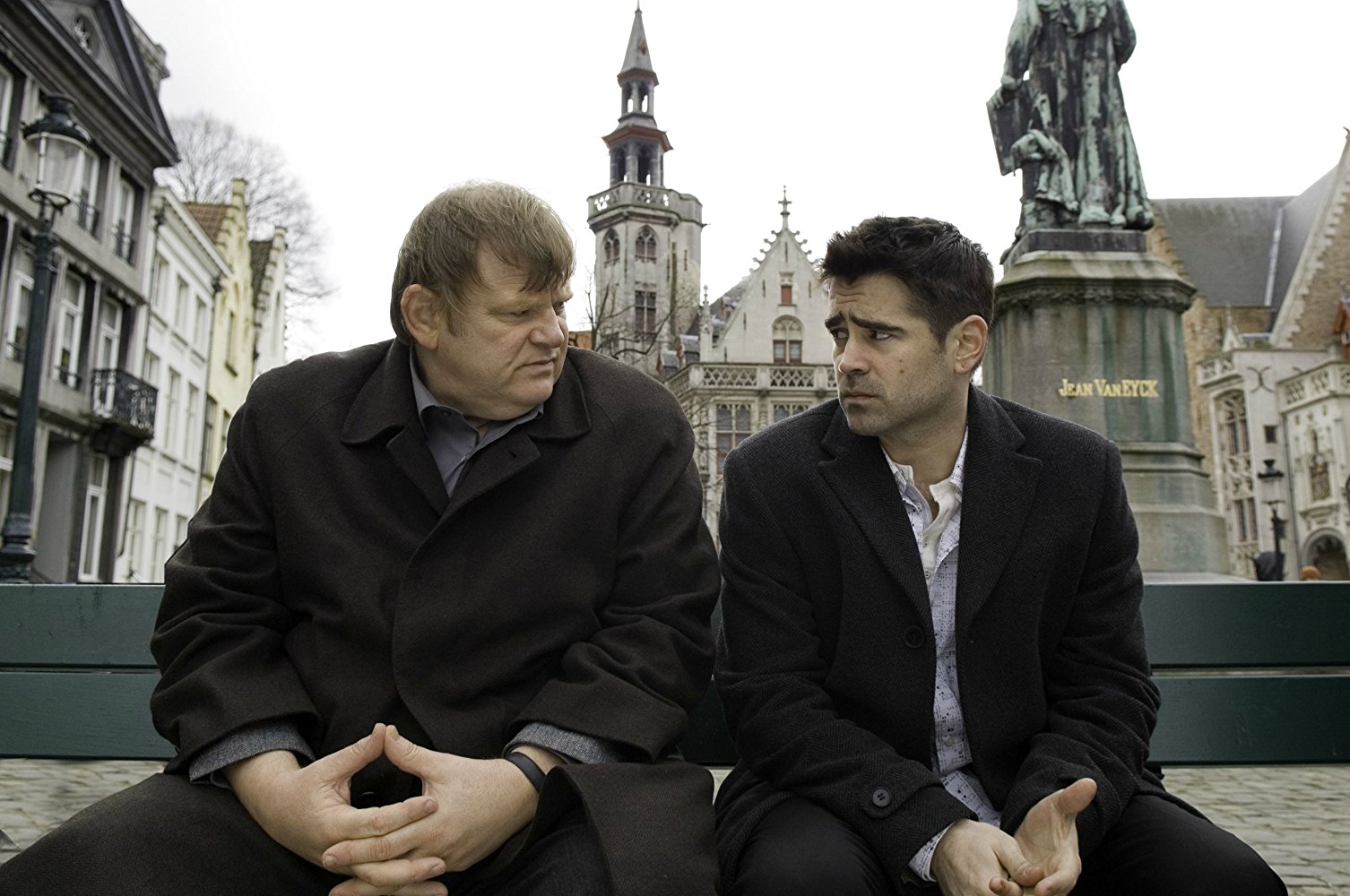
Brendan Gleeson and Colin Farell excel in hitman comedy In Bruges

Director: Martin McDonagh

Cast: Colin Farrell (Ray), Brendan Gleeson (Ken Daley), Ralph Fiennes (Harry Waters), Clémence Poésy (Chloë Villette), Jordan Prentice (Jimmy), Thekla Reuten (Marie), Jérémie Renier (Elrik), Anna Madeley (Denise), Elizabeth Berrington (Natalie Walters), Eric Godon (Yuri), Željiko Ivanek (Canadian)

Who hasn’t been dragged somewhere for sightseeing and culture, and longed to be somewhere else (anywhere else?). Most of us right? So how many of us are hitmen hiding out after a job gone wrong? Probably not that many (I hope!). It’s this mixture of the everyday and the bizarre that Martin McDonagh nails so well in his debut film, a sharp as nails, laugh-out-loud but also moving piece of work, possibly one of the sharpest written, well-made debut films you’ll find.

Ray (Colin Farrell) and Ken (Brendan Gleeson) have been sent to Bruges to hide out for a few weeks after a job gone horribly wrong in Dublin. Ken is fascinated by the city, its culture and buildings and enthusiastically buys a guide book. Ray responds like a surly, miserable kid and is desperately unimpressed with everything he sees. Their long weekend in the city becomes increasingly unusual and dangerous as they encounter angry tourists, a racist dwarf (Jordan Prentice) and a drug-dealing film assistant (Clémence Poésy), and dodge the rage of their boss Harry Waters (Ralph Fiennes).

In Bruges is a hilarious piece of film-making, with every scene featuring some moment of black humour, wry observation or un-PC laugh-out-loud comedy. It’s foul-mouthed, sometimes violent, very rude – but also deals with profound feelings of guilt and regret with a real humanity. McDonagh’s work expertly combines jet black comedy, with a warmth for its deeply flawed characters. It’s got a compelling, masterful story that packs character development, incident and intricate plot threads together with assured expertise.

McDonagh’s gift is to make you relate for all of these characters, all of whom are made to feel very real and human. It skilfully leads you to overlook their many flaws and embrace them as people. It says a lot that the most sympathetic, likeable person in the film is a multiple murderer with an (implied) cocaine habit. Everything we learn or see about the characters is designed to make us understand and relate to them more.

Ray initially seems little more than a foul-mouthed thug. But as the film progress – and thanks to Colin Farrell’s masterful performance of brashness covering deep insecurity and vulnerability – we learn he is a rather sweet, even loving man who has stumbled into a career he is deeply unsuited to. Farrell gets these switches perfectly – and his childishness is hugely endearing. From stropping around like a sulky teenager to bouncing up to a film shoot with a childish, excited shriek of joy, he defies expectations. McDonagh throws in a perfect note of tragedy once we find out the mistake Ray made – and suddenly Farrell’s performance overflows with guilt, self-loathing and an unbearable regret that makes you re-evaluate everything you’ve seen him do.

But then that is the whole film right there: it makes you laugh uproariously, then chucks you a curveball and before you know it you are hugely emotionally invested, with a huge sense of empathy for their slowly revealed depths. That goes for every character – even the nominal villains have a sadness, or a firm set of principles, or a certain dignity to them that makes you care. It’s a brilliant piece of writing and directing – and masterfully acted.

Brendan Gleeson plays the other lead in Ken: and few other actors could surely have managed to turn Ken into such a warm avuncular figure, a gentle giant who feels he has come to terms with his choice of career but experiences a subtle shift over the course of the film. Gleeson’s performance is sublime, warm and witty with a careful thread of sadness underneath it – it’s some of his best work. 

But then the whole cast is great. Prentice’s bitterness as the angry Jimmy is brilliant – and he is very funny – while Poésy’s gentle bad-girl is a terrific, radiant performance. The film also has third act dynamite with Ralph Fiennes’ Harry Waters, a foul-mouthed, furiously angry, tour-de-force character who shakes up the whole film – but who has a strange sense of nobility about him, even while he is (hilariously) effing and blinding left, right and centre.

And the film has a brilliantly anti-PC vein of humour. Jokes about drug-taking and dwarves. Foul-mouthed gags about every subject under the sun. Brilliant encounters with “large” American tourists (brilliantly paid off later in the film), jobsworth ticket sellers, angry tourists in restaurants – the film is crammed with hilarious moments. All of it is brilliantly funny because it comes naturally out of characters who feel real.

It’s also so thematically rich. As the characters stand in front of Hieronymus Bosch’s The Last Judgement, you realise that the entire film is a metaphor for purgatory, with Bruges’ medieval beauty carefully chosen to reflect this. Our heroes, laden down with sins, wait in Bruges for an unspecified length of time to discover where they will head next. Amends have to be paid, sins have to be reconciled – and all these threads come together brilliantly in a final, dream-like sequence that you suddenly realise the whole film has been carefully building towards from the start.

So the film, after a scabrous, brilliantly hilarious, darkly foul-mouthed start, slowly becomes something which (while still hilarious) is also a discussion of morality, principles and guilt. We see characters do things we might never have imagined them doing at the start, some are redeemed, others make principled decisions. And it’s really funny. I’m not sure Colin Farrell or Brendan Gleeson will ever be better than they are here. It’s a brilliant play script turned into a wonderful film. A classic.

Plenty (1985)

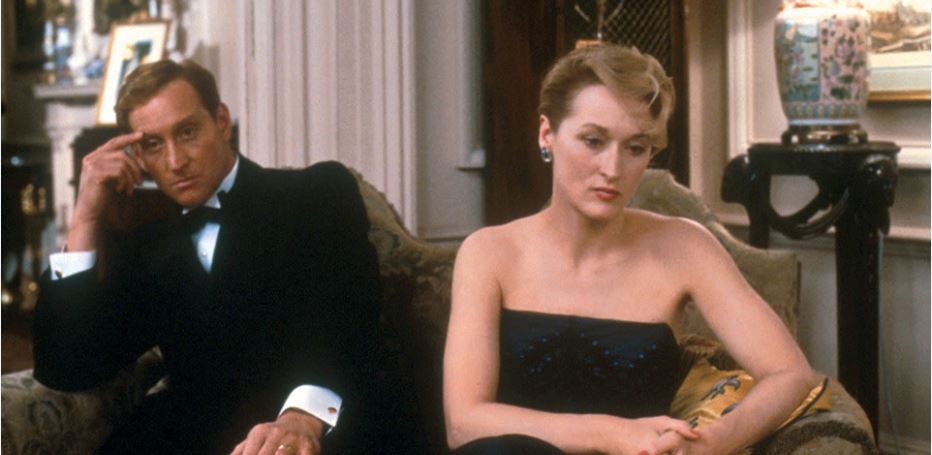
Charles Dance and Meryl Streep endure marital misery in the bleak, oblique and uninvolving David Hare drama Plenty

Director: Fred Schepisi

Cast: Meryl Streep (Susan Traherne), Charles Dance (Raymond Brock), Tracey Ullman (Alice Park), John Gielgud (Sir Leonard Darwin), Sting (Mick), Ian McKellen (Sir Andrew Charleson), Sam Neill (Lazar)

David Hare’s 1970s play Plenty looked at the impact of peace on the war generation. A “state of the nation” story on the growth of prosperity in the post-war era, and the return of many to the humdrum reality of life with Britain’s importance as a world power in rapid decline, led to isolation, anger and depression. It’s a shame that much of that really doesn’t come across in this buttoned-up, murky and unclear social drama, with a hard-to-follow plot and a hard-to-like central character.

Susan Traherne (Meryl Streep) is an SOE courier in France during the Second World War, who has a one-night stand with fellow SOE operative Lazar (Sam Neill) which has a profound effect on her. After the war, she marries Foreign Office civil servant Raymond Brock (Charles Dance), but is unable to find a purpose and contentment in regular civilian life. As the years tick by, and their surroundings grow ever more plentiful, Susan becomes more and more unhappy, difficult and demanding.

The central issue with Plenty (I can’t comment on the play, having never seen it) is that Meryl Streep creates possibly one of the least likeable leading performance you are going to see. Perhaps mistaking Britishness for cut-glass chill – or perhaps it’s the character – Streep’s Susan is brittle, bitter, angry, annoying and infuriating. She complains about everything around her, she lashes out at people, she sulks and whines with no self-insight, she constantly makes life difficult for those around her (most of whom are unbelievably patient) and she is almost impossible to work out. 

While the film perhaps intends her to be as sort-of PTSD sufferer, with undiagnosed personality disorders, who cannot reconcile the shallowness of her life with the excitement of war service, I’m not sure this comes across. All we really see is her deeply irritating self. We don’t get a sense of her war service – we see her breakdown early in the film in France – and her relationship with Lazar remains so ill-defined we are unclear what impact it had on her, other than part of a halcyon memory. The film’s final scene is a flashback to the end of the war: Susan watching a sunrise on a French hill dreaming of her life being full of days like this. That scene would have been helpful earlier – it’s the only time we see her optimistic or likeable in the film, and it gets lost by placing it at the end. With it in order we could have warmed to her more.

Instead she remains a shrill presence, in a hard to relate to film that never really makes clear whether we are meant to empathise with Susan, or find her as frustrating as some of the characters do. The film also fails to make this enigma part of its viewing design – I don’t feel like having the lines blurred made the film a richer experience, just one it was harder to engage in. Schepisi’s directing style is very cold and distant – from the slow camera moves, to the tight close ups on Susan at key moments, to the deliberate lack of clear time line (each scene moves on weeks, months or years from the previous one with only a few design and dialogue hints to suggest the change).

Combined with Hare’s indefinable script – crammed with elliptical conversations, unclear emotional and dramatic points, and political points delivered with a querying shrug – it makes for a film that is very hard work to engage with – and doesn’t offer much to reward the viewer if they do. 

What pleasures there are come from the performers. Charles Dance is good as Susan’s long-suffering husband – far from a domineering patriarch, his only real crime seems to be that he is a bit boring. Ian McKellen makes a great cameo as a senior civil servant, coolly and calmly telling Susan the errors of her thinking. Sting is an odd choice (I suspect his presence helped the film get backing) and Tracey Ullman does tend to go too far as Susan’s bohemian but more emotionally restrained friend.

John Gielgud steals the show. He is simply superb as Brock’s boss, an old-school diplomat who is, at first, a figure of fun with his Edwardian values but whom events (in particular Suez) reveal to have firm principles. Gielgud also gets most of the film’s best lines, while his quiet air of polite dignity is both endearing and admirable. His delivery of the following line to a tedious bore of a party guest basically is the high point of the movie: “But perhaps before I go, I may nevertheless set you right on a point of fact. Ingmar Bergman is not a bloody Norwegian, he is a bloody Swede.”

But there aren’t enough pleasures like this in this overbearing, rather trying film that never really decides what point it’s trying to make. I think it’s something about wealth and discontent and the more selfish and scrambling build of the post-war generation towards Thatcherism. But I’m really not sure. And to be honest I’m not sure I care.

Mary, Queen of Scots (1971)

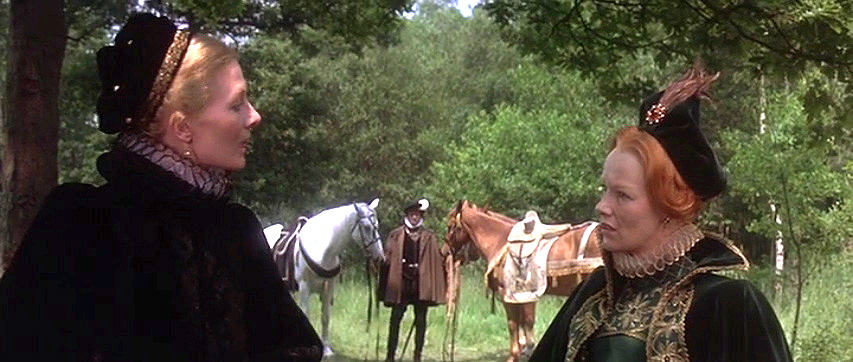
Vanessa Redgrave and Glenda Jackson are the feuding queens in Mary, Queen of Scots

Director: Charles Jarrott

Cast: Vanessa Redgrave (Mary, Queen of Scots), Glenda Jackson (Elizabeth I), Patrick McGoohan (James Stuart, Earl of Moray), Timothy Dalton (Lord Henry Darnley), Nigel Davenport (Earl of Bothwell), Trevor Howard (Sir William Cecil), Daniel Massey (Robert Dudley, Earl of Leicester), Ian Holm (David Rizzio), Andrew Keir (Ruthven), Robert James (John Knox), Katherine Kath (Catherine d’Medici), Frances White (Mary Fleming), Vernon Dobtcheff (Duke of Guise)

So here we are, back in the Tudor history craze of late 1960s Hollywood. Charles Jarrott directed, following up his efforts in Anne of the Thousand Days with this professionally mounted, handsome and rather personality-free film adaptation. It occasionally falls a bit too much in love with its luscious romanticism – and it falls hard for Mary herself, surely one of the worst queens ever – but despite all that, it has an entertaining quality that never lets you down.

The film picks up with the recently widowed Mary (Vanessa Redgrave) essentially being chucked out of France after the death of her husband the King, and swiftly being sent back to Scotland to take up the throne there. Problem is: the very Catholic Mary isn’t exactly the choice of the lords of Scotland – led by her bastard brother James Stuart (Patrick McGoohan). Mary’s Catholicism also threatens to destabilise the relationship with Protestant England – particularly because she is the nearest successor to Elizabeth I (Glenda Jackson). But Mary lacks Elizabeth’s tactical understanding of ruling and is guided by her heart – leading her into a disastrous marriage with feckless alcoholic Henry Darnley (Timothy Dalton).

Mary Queen of Scots is a stately picture, which uses its location shots, costumes and production design to tell its familiar story with a sweep and relish that effectively hides the lack of inspiration in its film-making. Just as in Anne of the Thousand Days, Charles Jarrott shows he’s a fine producer of middle-brow entertainment, safe costume dramas that aren’t going to challenge anyone’s perceptions or give you any real wow moments of filming. He’s happy to set the camera up and let the actors do their thing, with the script ticking off the great events.

That’s what you get here. It’s a film that could have been a lot more of an exploration of the rivalries and different life philosophies of its feuding queens. But it doesn’t quite connect with that. This is partly because it can’t quite bring itself to engage with the reality of Mary herself, preferring the popular romantic image. The film doesn’t want to admit that many of Mary’s decisions were, to put it bluntly, completely misguided bordering on wrong. It is in love with her romantic image – and not as enamoured with Elizabeth’s wiser, more pragmatic, manipulative rule. It’s this rule by heart rather than head the film finally holds up for praise.

It doesn’t help that Vanessa Redgrave feels miscast in the lead role. Redgrave is too sharp an actor to convince as someone as easily led and foolish as Mary. She looks too shrewd, she feels too smart. Redgrave compensates by speaking softly and giving a lot of love-struck eyes to various male actors (principally Nigel Davenport’s bluff, masculine Bothwell), but it doesn’t quite work. It’s like she’s struggling to find the character – and to find the balance in a film that doesn’t want her to be seen as too stupid, while the viewer is left slapping their foreheads at every action she carries out.

This feeling stands out all the more with Glenda Jackson’s casting as Elizabeth. Having just finished playing the same role in a landmark six-part TV series, Elizabeth R(which covered a lot of the same ground), Jackson here confirms that she was the definitive Elizabeth. As smart and shrewd an actress as Redgrave, Jackson’s natural firmness marries up very well with these qualities to make the perfect Virgin Queen. There have been so many others who have taken on the role, but Jackson is simply perfect in this role – she becomes Elizabeth. Her Elizabeth is clever, manipulative, cunning but also quick tempered, capable of great wisdom but prone to moments of passionate lashing out.

The rest of the cast is a familiar parade of character actors – British actors of this generation made a living from films like this! Timothy Dalton stands out as a foppish, clearly useless Darnley (here reimagined as a syphilitic bisexual with anger management issues), as does Ian Holm as a cool-headed, would-be power behind the throne David Riccio, who meets a tragic end. Daniel Massey does a decent job as Leicester (though I can’t shake memories of Robert Hardy in the same role in Elizabeth R – was he busy at the time?), Trevor Howard gets saddled with a lot of plot as Burghley. Up in Scotland, Patrick McGoohan has a lot of fun as a scheming Earl of Moray.

All of these actors fit comfortably into the slightly browned, grainy photography style of films of this type, and the screenwriters hammer together plenty of incident alongside dramatic invention. The focus on the soap opera of Mary’s three marriages (she’s widowed in the opening moments of the film) leaves plenty of scope for invention, from Darnley and Riccio’s affair to the inevitable non-historical meeting between Mary and Elizabeth – it seems like every drama going from Schiller onwards has invented a meeting between these two as a dramatic highpoint.

This final scene captures the lack of thematic depth to the film. In a film that had focused more on really comparing the differences between the two, this could have been the culmination of a debate running through the film (can you rule with a brain but not a heart?). Instead it misses the trick, and becomes a final game of one-up-man-ship, which the film allows Mary to win because she is the more romantic figure. 

It’s well mounted and assembled like many other films like this – but it’s not the best of its genre, and you do sometimes wish for something that had a little more meat on its bones.

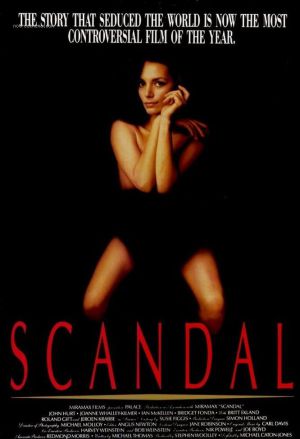
Scandal (1989)

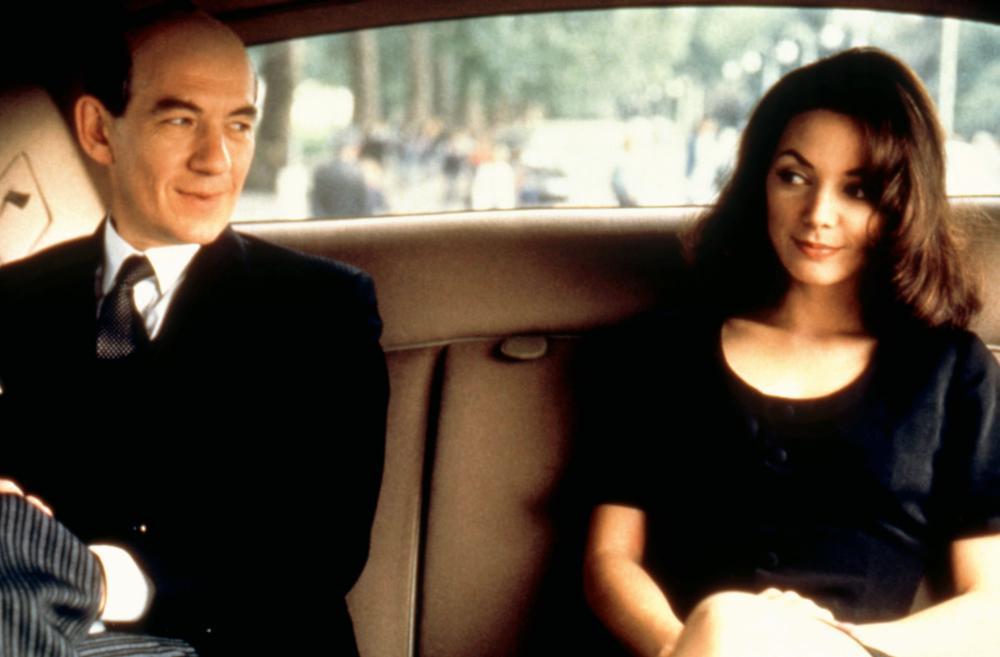
Joanne Whalley and John Hurt get unwisely wrapped up in the Profumo affair in Scandal

Director: Michael Caton-Jones

Cast: John Hurt (Stephen Ward), Joanne Whalley (Christine Keeler), Bridget Fonda (Mandy Rice-Davies), Ian McKellen (John Profumo), Leslie Phillips (Lord Astor), Britt Ekland (Mariella Novotny), Jeroen Krabbé (Eugene Ivanov), Daniel Massey (Mervyn Griffith-Jones), Roland Gift (Johnny Edgecombe), Jean Alexander (Mrs Keeler), Deborah Grant (Valerie Hobson), Alex Norton (Inspector), Ronald Fraser (Justice Marshall), Paul Brooke (Sergeant), Keith Allen (Reporter)

In 1963 the British Government was nearly destroyed by a sex scandal. John Profumo, Minister for War, was widely suspected of conducting an affair with Christine Keeler (a former show girl turned society figure) at the same time as she was sleeping with Russian naval attaché Eugene Ivanov. Profumo denied it to the House of Commons. A few weeks later he confessed he had lied and resigned from Parliament. The scandal shook the country to the core, and led to an exhausted Harold MacMillan’s resignation as PM. As the scandal span out to reveal sex parties in country homes, the country couldn’t get enough of the discovery that large numbers of the upper classes enjoyed nothing more than swinging, orgies and indiscriminate sex laced with sado-masochism. 

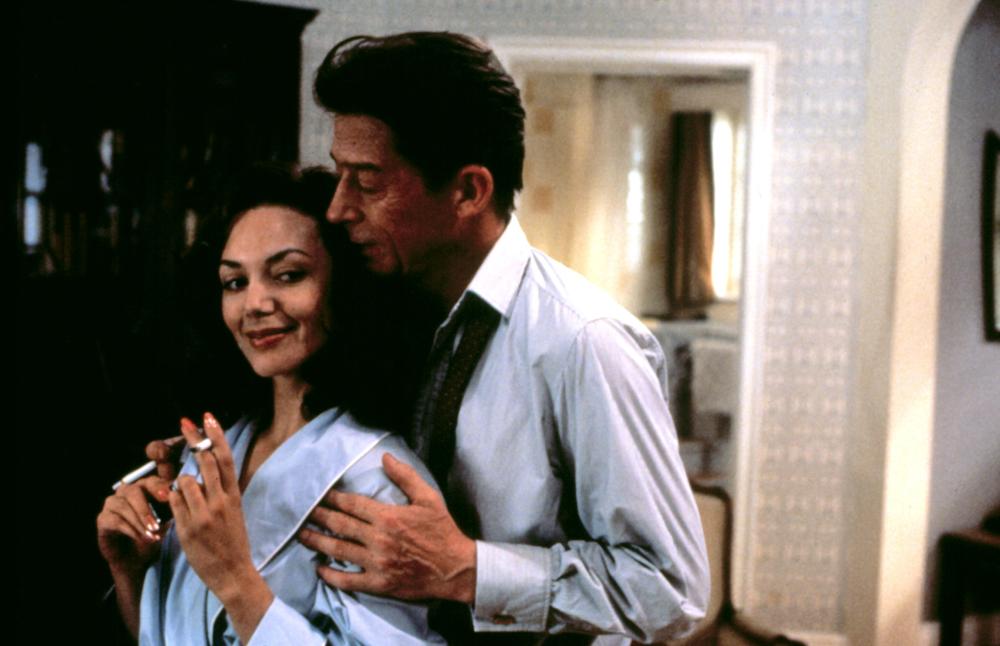
Scandal reconstructs the build-up to and eventual explosion of controversy around this affair, focusing on Keeler (Joanne Whalley) and Stephen Ward (John Hurt), the society osteopath and friend to the rich and famous who had worked out that if he found and coached attractive young girls, Henry Higgins-style, into engaging and fun companions, he could swiftly move up the social ladder by giving the rich and powerful people they could sleep with. When the Profumo affair blew up, it was Ward who was left holding the parcel: abandoned by his rich and powerful friends, Ward was placed on trial as a pimp, vilified in court and in the press, and eventually committed suicide the night before the court case finished (which convicted him in absentia of living off immoral earnings).

It’s this miscarriage of justice that Scandal zeroes in on – and the film does a good job of showing that Ward basically didn’t really do anything that wrong. He didn’t mistreat the girls, he thought he was helping them improve their lives and he didn’t attempt to blackmail his friends. His own sex drive seems curiously disconnected (he was clearly more of voyeur) and if anything, John Hurt (excellent as always) plays him as a slightly sad social-climber. A sort of Horace Slughorn of sex, far more excited by his bulging address book, access to the exclusive clubs of London and calling lords of the land by their matey nicknames, than by all the nooky.

Scandal however is a rather unemotional, unengaging and distant film. It’s hard to get too wrapped up in, as it too often goes for documentary checklist rather than real character engagement. On top of that, it’s often rather unclear – it’s tricky to tell the exact timelines, it’s hard to see often how some events relate to others, it’s unclear in particular how Christine Keeler’s relationship with jazz promoter and drug dealer Johnny Edgecombe led to exposure. It’s a film that’s both in love with telling the facts and so blinded by them that it doesn’t turn them into an engaging story.

But then perhaps part of this is because looking back today, it’s hard to see what all the fuss was about with the Profumo affair. After generations where government ministers have been accused of everything from toe-sucking to performing a sex act on a dead pig, it’s hard not to look at the Granddaddy of all government sex scandals and not think it rather quaint. Today it would barely merit more than few news cycles: and Profumo would certainly have been back in the cabinet within two years. Even the spy angle (was Profumo leaking secrets to Keeler, who in turn leaked them to Ivanov?) was widely (and almost immediately) discredited at the time. 

Not that the seismic impact really comes across anyway in the film. This is partly because the film focuses on Ward and Keeler in particular. For the two of them, there wasn’t much at stake – until their lives were destroyed. In fact, for most of these people at the various dodgy parties – other than embarrassing tittle-tattle – there wasn’t much at stake. A film that gave more space to Profumo – and really made-clear what he was running the risk of losing here, particularly after he lied to Parliament – might have made it clearer the dangers that all involved were inadvertently running.

But that would have been to dent the film’s purpose of showing Ward and Keeler as essentially innocents abroad. Joanne Whalley has a particularly difficult job as a Keeler so thoughtless, short-sighted and self-obsessed, she verges on the dim. Whalley makes her bright, engaging and fun-loving, but never with a whiff of sense. By the time Keeler is blurting out totally unconnected Profumo facts when speaking to the police about her relationship with Edgecombe, you can tell she doesn’t have a chance.

The film’s real strength though is John Hurt’s masterful performance as Stephen Ward. Hurt’s pock-marked face and ruddy complexion (going through a difficult divorce he allegedly spent most of the filming struggling with alcoholism) and slightly sweaty desperation are perfect for the role. A natural victim as an actor, he makes Ward always slightly desperate, always trying too hard, always the grammar-school boy pushing his nose up against society’s window. He’s a super creepy Henry Higgins grooming girls for a “better life” (his genuine belief!) and getting himself an entrée into posh society at the same time.  

Ward, the film argues, didn’t feel he was ever doing anything wrong – and he realises far too late that society, his posh friends and the government don’t agree. “It’ll blow over” he reassures Ivanov: totally wrong. Ward basically was a hedonist who wanted people to have a good time – and was thrilled to be invited to the party. When the shit hit the fan, he was dumped with the blame. It’s an angry note that the film – with its obsession with covering so much ground – fumbles slightly: it wants to be a searing indictment of the hypocrisy of the upper classes, but it fudges the emotional connection so much that you can’t feel it as much as you should.

Instead Scandal just sort of simmers rather than boils. It doesn’t communicate what a sea change this was in how Britain viewed its politicians and upper classes – from hereon they were always seen as men with feet of clay – and it doesn’t get the audience feeling as angry or engaged with things as you might expect. It has a lot of sex in it but (perhaps deliberately) it’s not sexy – the orgy scenes would make a great mood killer – and it seems to miss the hedonistic tone that dominated the class at the time. 

There is some decent directing – a scene of Mandy Rice-Davies and Christine Keeler preparing for a night on the town is particularly well done – and some strong acting, not least from Ian McKellen is a slimy Profumo (rumour has it a recently de-closted McKellen was keen on the role as it was the most hetrosexual role he could imagine playing!). But it never quite clicks together into something really emotionally engaging. And it isn’t quite as clear and easy to follow as you need. Structuring the story as a kind of love story between virtually the only people in the story who don’t have sex together is interesting – and Hurt and Whalley are good – but it’s just not quite a good enough film for what it wants to do.

The Young Victoria (2009)

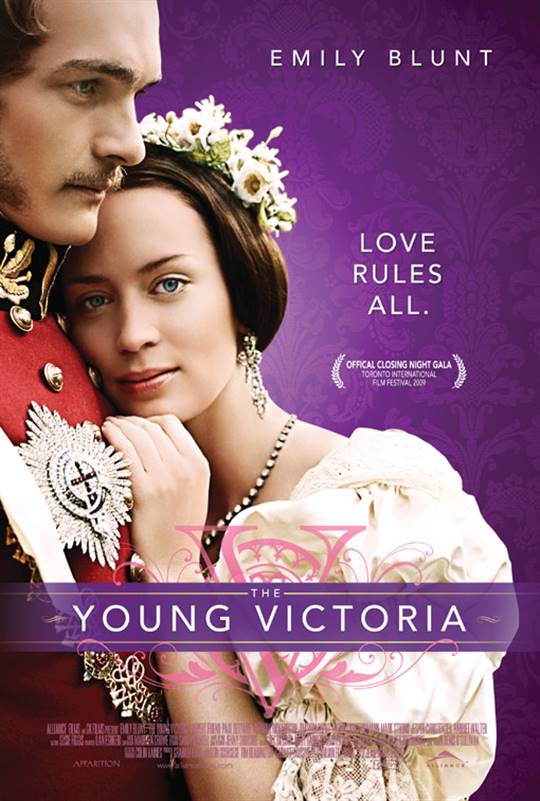
Emily Blunt and Rupert Friend play the royal couple in the cozy The Young Victoria

Director: Jean-Marc Vallée

Cast: Emily Blunt (Queen Victoria), Rupert Friend (Prince Albert), Paul Bettany (Lord Melbourne), Miranda Richardson (Duchess of Kent), Mark Strong (Sir John Conroy), Jim Broadbent (King William IV), Harriet Walter (Queen Adelaide), Thomas Kretschmann (King Leopold), Jesper Christensen (Baron Stockmar), Jeanette Hain (Baroness Lehzen), Julian Glover (Lord Wellington), Michael Maloney (Sir Robert Peel), Michel Huisman (Prince Ernest), Rachael Stirling (Duchess of Sutherland)

Now ITV’s Victoria exists, it’s a bit strange to go back and watch The Young Victoria. With the love today of long-form drama, and the time it can invest in things, it’s funny to see what the drama took almost 8 hours to do being crammed into an hour and a half here. But saying that, The Young Victoria is still an entertaining, luscious viewing experience which, while it has some strange ideas about certain events, is the sort of relaxing Sunday afternoon viewing that will take you out of yourself.

After the death of William IV (a slightly overripe Jim Broadbent), Victoria (Emily Blunt) is elevated to the throne. Finally able to shed the control of her mother’s (Miranda Richardson) domineering secretary Sir John Conway (Mark Strong), Victoria is determined to steer her own course. But she is surrounded by competing influences, not least from the charming arch-politician Lord Melbourne (Paul Bettany). King Leopold of Belgium (Thomas Kretschmann) dispatches his nephew Prince Albert (Rupert Friend) to England with the express interest of marrying Victoria and controlling her – but Albert and Victoria find themselves as kindred spirits, supporting each other to rule.

The Young Victoria is the epitome of prestige costume dramas. It looks fantastic, the cinematography is ravishing, the production and costume design exquisite. It’s pretty clear what the producers thought would sell the picture abroad. The royal regalia is pushed very much to the fore, and we get some wonderfully sweeping scenes, not least an impressively large-scale coronation. The soundtrack brilliantly riffs on Handel, and Julian Fellowes’ script mixes period regal style with a sweeping feeling of romance between Victoria and Albert.

The film actually does a very good job of repositioning Victoria as a young woman, and gives her a strong quality of self-determination and a desire to be herself in a man’s world. It’s really helped in this by the combination of imperial strength, girlish wilfulness and sharp intelligence Emily Blunt brings to the role. Blunt and the film also aren’t afraid to show that, however much Victoria had guts and determination, she was also quite a headstrong woman not above making emotionally led mistaken decisions. In fact, much of the drama spins out of Victoria learning to try and put these youthful crushes and prejudices aside.

Having said that, it’s interesting that the successful conclusion of the film centres on Victoria accepting that she needs the help of Albert to run the kingdom, and that she needs to remove competing influences for her affection – Melbourne and Lehzen – to focus her affection and loyalty on him. The film frames this as a winning romance and a successful partnership (which it was) – but it’s also vaguely creepy if you think about it. Mind you, since all the affectionate influences on Victoria are implied by the script to be at least partly motivated by self-interest, with the possible exception (eventually) of Albert, it manages to suggest this was for the best.

Albert’s background gets some interesting exploration here. He’s very much presented at first as the tool of Leopold as a means of controlling British politics. But he is far too independent, smart and noble to ever be the means of manipulation. Friend is very good here – his performance is quiet, authoritative but also heartfelt. Fellowes guilds the lily a bit to show his devotion by having Albert shot by a would-be assassin late-on in the film. Historically the assassin’s pistol wasn’t loaded, and Albert didn’t get shot (though Fellowes protests Albert didput himself in front of Victoria and that this intent is what’s important, not whether he was shot or not) but the moment does work – it gives the drama a boost and it’s undeniably moving.

While Albert is presented overwhelmingly sympathetically, interestingly Lord Melbourne gets quite a kicking. Paul Bettany is presented far more as a rival love interest than the sort of father-figure Melbourne was in real life (Bettany is probably 20 years younger than the real Prime Minister). Melbourne is shown as cynical, controlling, manipulative and overwhelmingly motivated by self-interest (a few more pushes and he would virtually become the film’s villain). He’s constantly contrasted negatively with Michael Maloney’s upright, honest Sir Robert Peel (one of my favourite statesmen of the 19th century so at least I’m pleased) – and his relationship with Victoria is one of self-promotion, which seems odd seeing as historically the two of them were so close. 

The film introduces other villains for us to hiss at. Kretschmann and Christensen do a good job as arch political schemers. Our real villain though is Mark Strong, who does a great job of scowling, controlling nastiness as the failed-bully Sir John Conroy. Strong’s performance works so well because he makes it clear that Conroy feels that his “Kensington System” (an attempt to manipulate and cow Princess Victoria into being a submissive puppet) is genuinely in her best interest, and that he genuinely cares for her. His partnership with Miranda Richardson as Victoria’s near-love-struck mother works very well.

The Young Victoriathrows in enough interesting character beats like this for it to really work as an enjoyable afternoon period-drama. With some great performances – Emily Blunt carries the movie brilliantly – and while some of the historical characterisation is a bit off, and other moments feel a little too chocolate box it’s a very entertaining, undemanding view., it’s great fun. The hardcore Victorian costume-drama fans will probably prefer Victoriafor the same story in more depth – but this film does it with great sweep (and doesn’t cram in Victoria’s stupid below-stairs plotlines!).

Chariots of Fire (1981)


Celebrations abound in triumphant running flick Chariots of Fire

Director: Hugh Hudson

Cast: Ben Cross (Harold Abrahams), Ian Charleson (Eric Liddell), Nicholas Farrell (Aubrey Montague), Nigel Havers (Lord Andrew Linsley), Ian Holm (Sam Mussabini), John Gielgud (Master of Trinity), Lindsay Anderson (Master of Caius), Cheryl Campbell (Jennie Liddell), Alice Krige (Sybil Gordon), Struan Rodger (Sandy McGrath), Nigel Davenpot (Lord Birkenhead), Patrick Magee (Lord Carogan), David Yelland (Prince of Wales), Peter Egan (Duke of Sutherland), Daniel Gerroll (Henry Stallard), Dennis Christopher (Charley Paddock), Brad Davis (Jackson Scholz)

Dun-da-da-da da-da dun-da-da-Da-Da DA. Hum that theme tune and you know straight away what film it is: you can’t resist the temptation to mime out running (in slow motion of course), arms swinging gracefully from side-to-side. There aren’t many more movies with more iconic, instantly recognisable themes than Chariots of Fire

If there is one thing everyone remembers, it’s the young athletes running along the beaches of St. Andrews, spray flying up from their bare feet. Nicholas Farrell sprinting with upper-class determination. Nigel Havers wiping spray from his face with glee. Ian Charleson full of serene joy. Ben Cross with fixed, rigid focus. The opening of Chariots is a master-class in quickly established character, tone, mood and era. The cross-fade from the funeral oration from an ageing Nigel Havers into this slow-motion, halcyon-days reflection tells you we are in the land of memory – and sets right up for the feel-good triumph the film becomes.

The film follows the key athletes of the British 1924 Olympics team. Harold Abrahams (Ben Cross) is a second-generation Jewish grammar-school boy who runs to prove he belongs and can excel. Eric Liddell (Ian Charleson) is a Presbyterian Scot, who runs to celebrate God and whose religion prevents him running in a vital Sunday qualifying heat. Both characters are, in their own ways, outsiders – and their underdog status makes them perfect to root for in this extremely well-made crowd pleaser.

Chariots is often seen as a slightly undeserving Oscar-winner. But that’s to overlook the panache it’s made with and how emotionally uplifting and engaging it is. Hugh Hudson had never directed a film before this one. His background was in commercials and he brings many of the strengths of that background to Chariots. The film is wonderfully assembled, a perfect combination of montage, cross-cutting, longer tracking shots and cross-fading. 

That opening scene tells you a lot with its swift economy. But he handles others just as well: Abrahams’ 100m winning race is played first in real time, then again, cross-cut with Abrahams’ reaction to victory. The first moment is one of triumph, but the immediate repeat allows an opportunity for the viewer to understand the mixed feelings that achieving everything you aimed for can bring. Abrahams’ slightly shocked, underpowered reaction gives the slow-motion repeat of the race a hazy, post-match analysis feel – as if Abrahams is still running the race in his mind. As if he knows that his whole life was building to that one moment, and now he needs to find a new focus.

Hudson’s mastery of moments like this is impressive. Sequences are fabulously assembled. The famous “one minute” dash around the Trinity court (actually Eton) is brilliant, and a great example of how the film sells tent-pole moments. It also masters quieter character moments. One of its stand-out moments simply allows Abrahams’ coach Mussabini (a scene-stealing Ian Holm) to react to Abrahams win (a victory he has not seen due to being banned from the stadium) by quietly rising to attention, then sitting on his bed, gleefully punching through his hat and quietly whispering “my son”. Other scenes – such as those where Abrahams confronts quiet anti-Semitism from Cambridge scholars (nice bitchy cameos from John Gielgud and famed director Lindsay Anderson), or Liddell is quietly pressured into running on Sunday – simmer with good acting and restrained direction.

It’s these scenes that really make the film work. Ben Cross is superb as a chippy, frustrated Abrahams who feels he must justify his place in England’s oppressive class system. He’s constantly glowering, tense and uncertain – but Cross mixes this with a boyish charm, a gentleness (most notably in his shy romance with an unrecognisable Alice Krige) – and a warmth and genuineness that he shows with friends. Nicholas Farrell’s boyish Aubrey Montague (a love-struck best friend if ever I saw one!) helps a lot here – if someone as obviously nice as him likes Abrahams, then gosh darn it we should as well.

Ian Charleson is equally impressive as the devout, charming but coolly determined Eric Liddell who has decided his course in life and nothing is going to shake him from it. The film has a refreshingly considerate view of Liddell’s Christianity – and, furthermore, praises him for sticking to his devout principles. Charleson wrote many of his speeches himself, and he brings a charming honesty to his character. How can you not love this guy? He’s the perfect ambassador for the Church.

The film tackles plenty of clashes for Liddell which sizzle in a quiet way. Cheryl Campbell is very good as his partly proud, partly concerned sister, worried that his missionary work is being sacrificed for his running. His confrontation with the Olympic committee over his crucial decision not to run – is there any other film where not working on a Sunday is the dramatic centre piece? – is nicely underplayed. It’s clear that they (including a very good Nigel Davenport as an understanding Chair) want him to run, and it’s equally clear Liddell is determined he won’t.

It’s the moments like this that make the film so triumphantly feel-good. Both Abrahams and Liddell are at heart immensely likeable, the upper classes and elites who frown at them in their way rather boo-able. The running scenes are great (despite the sweetly dated lack of grace!), the film really capturing the exhilarating energy of pushing yourself to the limit. Watching Abrahams training under the expert eyes of Mussabini (worth repeating again that Holm is the heart of this film, as the fatherly, wise trainer struggling against prejudice against both Italians and professionalism), or Liddell winning from behind after being pushed over in a race are simply hugely uplifting.

Strangely the one thing that does seem a little odd today is the Vangelis score. Yes the Chariots march is outstanding – but the 80s electronic beat to the rest of the score now sounds very dated. Yes it is interesting to overlay (then) modern music over a period piece – but nothing dates quicker than music (except perhaps haircuts) and that is the case here. It sounds odd and jarring with the action at times – but then that main theme is so brilliant (but also the most classical of Vangelis’ compositions) that it still sort of works.

The sad thing is that Chariots didn’t lead to great new things for most involved. When he won the Oscar for best original screenplay, Colin Welland famously cried “the British are coming!”. Sadly he wasn’t really right. Within four years two flop films had all but ended Hudson’s career. Producer David Puttnam took over Columbia Pictures, only to be dismissed within a year after disastrous results. Many of the stars of the film never got the breaks this film promised (Charleson died tragically young – the first major star in England to openly acknowledge his cause of death as AIDS). Even the star Americans introduced to play the yank athletes (Brad Davis and Dennis Christopher) never had a hit film again. As David Thomson put it, within ten years of all the major players only Ian Holm “had any professional credibility left”.

But Chariots is still a bit of lightening caught in a bottle. A strange idea to spin an entire film out of an event lasting less than 10 seconds, but which married up so well with universal themes of class and struggle. It knows exactly what it is, and exactly what it is doing. It really worked then and it really works now. It’s not pretending to be high art, or to really make profound statements – just to entertain. And it really does. Fetch your running shoes and start that Vangelis theme!

The First Great Train Robbery (1978)


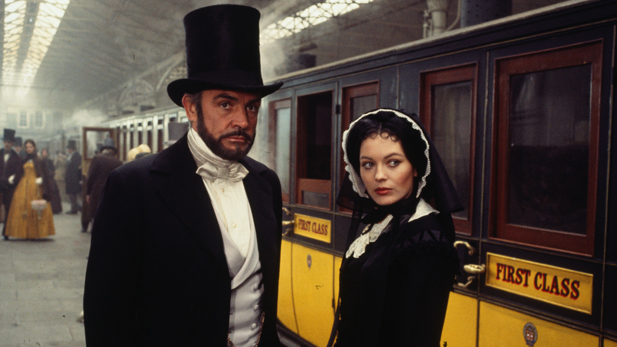
Sean Connery and Lesley-Anne Down grab a train ride in The First Great Train Robbery

Director: Michael Crichton

Cast: Sean Connery (Edward Pierce), Donald Sutherland (Robert Agar), Lesley-Anne Down (Miriam) Alan Webb (Trent), Malcolm Terris (Henry Fowler), Robert Lang (Inspector Sharp), Michael Elphick (Burgess), Wayne Sleep (Clean Willy), Pamela Salem (Emily Trent), Gabrielle Lloyd (Elizabeth Trent), James Cossins (Harranby), André Morell (Judge)

When you think about Michael Crichton, it’s easy to forget he had many more strings to his bow than just writing airport plot boilers. He created ER, he wrote and directed a number of films (most famously WestWorld) – and one of his best books is actually a piece of semi-history, The Great Train Robbery. This book – a brilliantly researched and entertaining part history, part fictionalisation – covers the story of the Great Gold Robbery of 1855, a train-based gold heist. 

Crichton’s film of this book takes a slightly different tone – its realism is toned down slightly, its nose-thumbing anti-establishmentism shaved off, in favour of a lighter comic farce, a caper movie. It makes for an enjoyable movie – but it’s less interesting than the book’s documentary realism and its careful construction of the vast number of obstacles the criminals needed to ingeniously overcome.

Edward Pierce (Sean Connery) is a professional criminal who can pose as an upper-class gent. Having befriended a number of senior people from a leading city bank, he plans a daring heist on a train carrying gold from London to Dover – gold bound for the Crimean war. Pierce puts together a detailed plan – that involves gaining possession of copies of four keys essential for getting access to the safe on the train containing the gold – and recruits a team including expert locksmith and pickpocket Robert Agar (Donald Sutherland) and cunning courtesan Miriam (Lesley-Anne Down). 

The First Great Train Robbery is a caper – and it has all the structure and energy you would expect. From Jerry Goldsmith’s lyrical score to the framing device that constantly returns to Pierce’s key box getting fuller and fuller (like fingers flying up when recruiting The Magnificent Seven), the whole shebang is told with real lightness. Nothing is too serious – the criminals’ actions aren’t designed to hurt anyone (apart from one of their number who turns informant) – and the overall mood is a lark, with the criminals engaging in a boys’ own adventure.

This is helped by the excellent light-comedic playing from Sean Connery and Donald Sutherland as the two main architects of the crime. Connery uses his smoothness (hiding a chippy edge) extremely well – he’s the charming man you’d want to spend time with, and he wraps you up in his own sense of fun. Any obstacles are usually met with a wry smile – like some sort of period Danny Ocean, Pierce is always one-step ahead of the game. Sutherland – with an odd, half Irish accent – makes a very good put-upon wingman, grumbling but still enjoying the ride.

Most of the rest of the cast don’t make much of an impact. Lesley Anne-Down gets some comedic business – particularly a seduction that is designed to go wrong to gain possession of a key – but not a lot else to do. Malcolm Terris and Alan Webb bluster as arrogant dupes. Robert Lang growls as an angry cop. Wayne Sleep of all people pops up as an expert burglar.

The film sweeps from set-up to set-up, very competently filmed, with some decent design and photography (it was the last film of legendary photographer Geoffrey Unsworth). Crichton is a decent director, and if some moments look a bit dated or are a little too much (some make-up for Sutherland at one point looks rubbish) it’s still pretty good.

The real problem is that you lose the sense that, by-and-large, a lot of this actually happened – I mean, sure, it was probably with less banter and jokes, but people really did a lot of this stuff. The film doesn’t always dwell enough on the problems the thieves face, and doesn’t always explain why these obstacles are so vital to overcome. It misses a trick here with its eagerness to keep barrelling forward.

What this means is that film sometimes misses the sense of triumph and satisfaction of overcoming real hurdles – or the frisson of having it clear that a lot of these were real solutions that a real person came up with. The film also rushes its final conclusions. Historically we don’t know what happened to the gold and there was a trial of some of those involved – but the film never really makes that clear. Its conclusion zeroes in again on some hi-jinks, but it doesn’t really make clear the impact, the consequences or what happened to the Macguffin at its centre. You also don’t get the sense of hypocrisy the book mines so well, with the corruption of the upper classes being glossed over by society, but the thievery of the working classes being outright condemned. I missed that a lot from the film – fun as it is.

It’s an entertaining film but, to be honest, it’s not as good as the book – which is actually really worth a read. Crichton is a man with more talent than people give him credit for.

Alfie (1966)


Michael Caine excels as amoral cockney moralist lothario Alfie

Director: Lewis Gilbert

Cast: Michael Caine (Alfie), Shelley Winters (Ruby), Millicent Martin (Siddie), Julia Foster (Gilda), Jane Asher (Annie), Shirley Anne Field (Carla), Vivien Merchant (Lily), Eleanor Bron (Doctor), Denholm Elliott (Abortionist), Alfie Bass (Harry), Murray Melvin (Nat)

Is there a more “swinging Sixties” film than Alfie – the story of a cockney wideboy interested only in “birds” and having a good time? On the surface it captures the attitude of the 1960s, with free love, thumbing your nose at authority, and having the sort of fun the wartime generation frowned on. But it’s a more interesting film than this, which criticises the emptiness of the 1960s by showing us Alfie’s selfishness and loneliness. Sure he has a good time now and again – but would anyone really want to live like this forever?

Alfie (Michael Caine) is a handsome chauffeur with a never-ending stream of affairs, commitment constantly avoided. The film follows these entanglements, starting with his needy girlfriend Gilda (Julia Foster), the mother of his child, whom he constantly cheats on. When Gilda finally leaves him – and Alfie loses touch with the son he has become fond of – a medical condition ends up with him in a convalescent home, where his affairs include the wife of a fellow patient, Lily (Vivien Merchant). Later relationships with a young hitchhiker (Jane Asher) and a rich American woman (Shelley Winters) similarly lead to disappointment.

The main thing that makes Alfie last (possibly the only thing) is Michael Caine’s sublime performance. Caine is on screen the whole time, and the film is spotted throughout with his casual direct-to-camera addresses. Caine’s charm and likeability work perfectly for this device, winning the audience over. But Caine never falls for Alfie – even if many audience members clearly did. Caine’s constantly demonstrates Alfie’s hypocrisy, shallowness, meanness and selfishness. Sure he recounts his actions with wit, but most of these actions are extremely shitty. But right from the start there is a charismatic, lothario swagger to him – and a cheeky charm – that makes you like him.

But his general shittiness is more obvious today than back in the 1960s. Then the amount of sex probably shocked viewers the most. Today it’s Alfie’s inability in to refer to women as anything but “it”, like some smooth Richard Keys. His attitude to women is appalling – he describes Jane Asher’s hitchhiker like some sort of floor-cleaning, bed-sharing car. Alfie avoids any sort of emotional connection at all with his conquests, and the film makes clear that this has left him empty and lonely, feelings he buries deep down.

In fact, the film is most telling at the moments when Alfie doesn’t turn to us with that confident grin and place a self-serving spin on what just happened. Seeing his son being warmly embraced by Gilda’s new husband (at the christening of their new child), Alfie can only skulk quietly at the back of the church – as scared to meet our eyes as he is those of this family he could have had. His love for his son is something Alfie refuses to accept himself – but his feelings are all too clear at his physical collapse on losing access to his child, and his later tear-stained reaction to Lily’s abortion.

Ah yes the abortion scene. Probably the highlight of the film – if only because its intense seriousness is so different from the rest of the film, and Alfie’s wheedling weakness and whiny self-justification become all the clearer. His complete lack of principle in sleeping with his only friend’s wife (“Well what harm can it do?”) of course results in her pregnancy. And Alfie is all at sea, firstly with Vivien Merchant’s expert portrayal of distress, pain, shame and guilt as Lily – and with Denholm Elliot’s perfect cameo of grimy, resentful disillusionment as a struck-off doctor turned back-street abortionist. Just to bang the nail on the head, Alfie leaves Lily alone after the operation (telling the audience that there’s nothing he can do anyway, right?). He may be horrified later at what he has done, and may feel moments of empathy – but has he really learned anything?

The film is full of these moments where we are invited to understand that Alfie is not leading a life for us to aspire to, but one we need to avoid. It’s left Alfie alone, miserable and abandoned. For all the jaunty 1960s vibe, and Alfie’s charming cheek, he’s not a happy man but a desperately shallow one. And he’s even got a shelf life for this way of life: “He’s younger than you are” one of his lovers tells him late in the film, as she leaves him. Because what has Alfie got in his life? When he runs through a checklist in the film’s closing monologue (“a bob or two, some decent clothes, a car. I’ve got my health back and I ain’t attached. But I ain’t got my peace of mind”) the emptiness of his life is all too clear.

Caine’s brilliance is to make this tragic, empty, selfish man seem attractive and exciting – while also never losing sight of what a complete shit he is. It’s a great performance and he dominates the entire film. He plugs perfectly into the hip, light touch that Lewis Gilbert directs the film with, and the entire film has a layer of cool on it that works rather well. What makes the film last today though is its shrewd analysis of the empty, soulless, coldness that underpins living your life like this – and how the sort of shallow, no consequences, no emotional investment bouncing around Alfie has just leaves you alone and growing old.

“What’s it all about?” You can argue the answers are buried in this film – but Alfie never spots them.