Tag: Caitriona Balfe

Belfast (2021)

Belfast (2021)

Kenneth Branagh pays tribute to his early years in Northern Island in this autobiographical film

Director: Kenneth Branagh

Cast: Jude Hill (Buddy), Caitríona Balfe (Ma), Jamie Dornan (Pa), Judi Dench (Granny), Ciarán Hinds (Pop), Lewis McAskie (Will), Colin Morgan (Billy Clanton), Michael Maloney (Frankie West), Lara McDonnell (Moira), Gerard Horan (Mackie), Conor MacNeill (McLaury), Turlough Convery (Minister), Olive Tennant (Catherine)
Directors making films about their childhood is a well-established sub-genre. Fellini got the ball rolling, a few years ago Alfonso Cuarón made his own black-and-white look at growing up in troubled political times in Roma and this year Pablo Sorrentino has released a film focused on his own teenage years in The Hand of God. Huge admirer of Kenneth Branagh as I am, I can’t deny he’s not a unique visionary in the vein of those filmmakers. But, Belfasthas a heartfelt, genuineness and a sweetness that verges just the right side of sentimentality and is a loving tribute not only to the city he grew up in but also to his parents, making it Branagh’s most personal project since In the Bleak Midwinter and possibly his finest non-Shakespeare film.

Branagh’s substitute is 9-year-old Buddy (Jude Hill), the child of a protestant family, living on a cross-community street in August 1969. His main concerns in life are friends, films, football and a classmate he has a crush on at school. But for his parents (Caitríona Balfe and Jamie Dornan), their worries are much more about the growing sectarian violence in the city. Pa has an offer of a job in England, which could bring them a new life. But it means the whole family leaving behind it everything it has ever known, including Buddy’s beloved grandparents (Judi Dench and Ciarán Hinds). As the city becomes more dangerous, what will the family decide to do?

If there is a memory piece Belfast reminds me of most, it’s John Boorman’s Hope and Glory. That film was true to Boorman’s memory, that growing up during the Blitz was also an exciting time, because as a child he never realised that death could be seconds away. It’s the same with Belfast. Branagh is keeps the film as much as possible from the child’s perspective. A child might be aware of the news playing on the TV, see the growing number of soldiers stopping and searching people on the streets and be wrapped up in riots, while never really understanding what exactly is going on.

The film has been unfairly attacked by some for not focusing on the accepted narratives of this era of Belfast’s history: misery, killing and brutality. What Belfast instead brings to the fore is the warm community. Streets where everyone knew your name, people sat outside their homes and chatted with neighbours, shared celebrations together and looked after each other. You can understand why it was such a wrench to leave this behind – even with soldiers patrolling the street. How scary it was for a person of any age – from Buddy to Ma, who has known nothing but Belfast her entire life – to even consider going to a place where no-one would know you and you would be an outsider.

Belfast is dedicated to those who stayed behind, those who left and all the lives who were lost. It’s a tribute to a community spirit and family, that has chimed with a great deal of people who lived in the city at the same time and place. The film is fundamentally hopeful because, under the violence and danger, it makes a plea – and demonstrates – that many people in Ireland just wanted to live their lives and didn’t care which church their neighbours went to. The opening few moments of the film is a snapshot of these halcyon days, kids from different communities playing together on the streets and their families gossiping and laughing together.

It’s shattered by the film’s first outburst of violence, as a Unionist gang attacks the street and hurl Molotov cocktails at the houses of Catholic residents – with Buddy, confused and terrified, caught in the middle and dragged into his house and safety by his frantic Ma. It’s a threat that will hang over the film for the rest of its runtime, embodied by Colin Morgan’s bullying enforcer, but only vaguely understood by Buddy – and considerably less important to him than whether he gets to sit next to the girl he has a crush on at school.

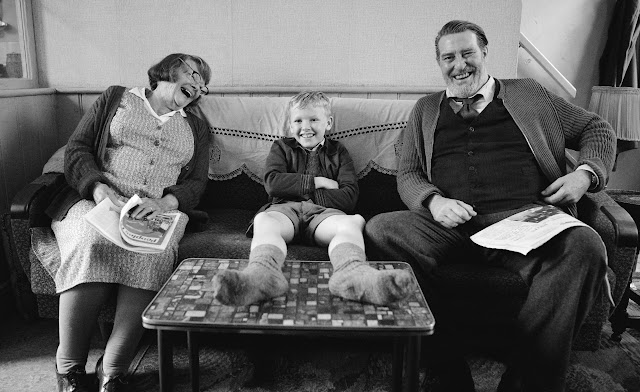
That crush is one of many things he gets advice on from his Grandad, played with a genuinely heart-warming twinkle by an Oscar-nominated Ciarán Hinds. Hinds is the picture of the perfect Grandad, wise, attentive, patient and full of homespun advice and wisdom – dialogue that Hinds brings to life with an expressive warmth. He’s paired to wonderful effect with Judi Dench (also Oscar-nominated) as Buddy’s Granny, who’s got a sharper tongue (and most of the funny lines) and has a cold-eyed realism about what it might be best for her son and his family.
You could check yourself and ask if Branagh is idealising his memories. But I think this is partly the point of the film. At several moments there is a slight air, not so much of fantasy, but of a childhood’s perception and memory being restaged. Jamie Dornan’s hard-working, caring Dad is frequently shot by Branagh in a way reminiscent of the Western heroes in the film buddy watches (High Noon in particular). A late confrontation between Dornan and Morgan plays out like a child’s romanticised memory of how something might have played out – as does a sequence where Dornan and Balfe sing and dance to Everlasting Love. I think Branagh is asking us to consider this might not be exactly what happened, but a fantasy tinged, child’s idealised memory of an event.

And Branagh’s film – shot in a luscious black-and-white – is told with a sharply edited pace and economy. It frequently allows us to see the ‘true’ situation in the background or on the edge of Buddy’s perception. Ma – beautifully played by Caitríona Balfe as grounded, moral but vulnerable and scared – has genuine worries not only about the violence but also the couple’s financial situation. There is an argument, and a later sad half-ultimatum, between Ma and Pa that we understand but Buddy is only vaguely aware is happening. Branagh’s film is full of half moments like this, where he trusts we are intelligent enough to see exactly what the child is seeing and also see more.

Branagh also draws a superb performance from Jude Hill as Buddy. This is a kid who is wide-eyed, natural, unforced and gets the balance just right between sweetness and a childish selfishness and vulnerability. There are real moments of terror and distress for Buddy, which are immensely well-done, and Branagh proves again there are few better directors of actors out there.

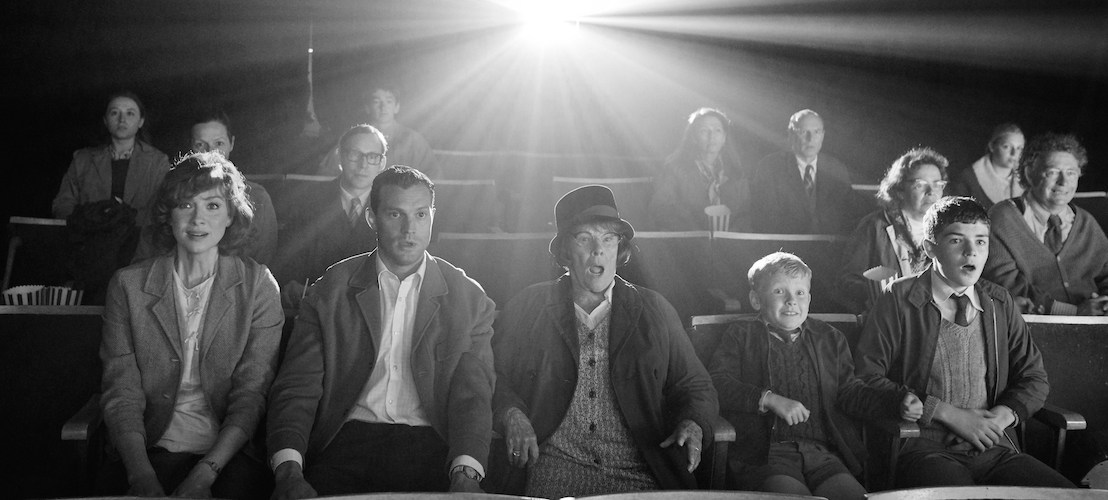
In among this there are some lovely moments where we see Branagh’s passion for the arts and film-making take hold. These are shown in splashes of pure colour: from clips of Chitty Chitty Bang Bang which an enraptured Buddy watches in the cinema, to actors performing A Christmas Carol in the Belfast theatre appearing in perfect colour. That’s not to mention touches of everything from Westerns to Star Trek to a shot of Buddy reading a Thor comic-book (sadly no Shakespeare).

Belfast is above all warm-hearted and loving tribute from a son to his parents and the impossible decisions they needed to take to give him opportunities in life they never had. Branagh’s script is crammed with some wonderful lines and plenty of hard-earned sentiment and the cast play each of these moments to perfection. It’s a passion project that really communicates its passion and shows how love, family and hope are universal. Cynics will sneer, but it’s a lovely film.
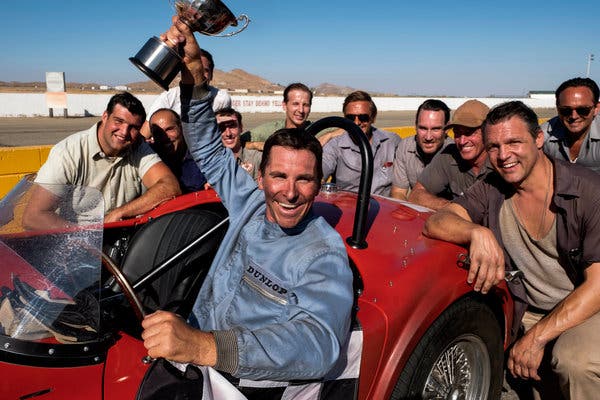
Ford v Ferrari (Le Mans '66) (2019)

Christian Bale as maverick driver Ken Miles in the functional but fun Ford v Ferrari

Director: James Mangold

Cast: Matt Damon (Caroll Shelby), Christian Bale (Ken Miles), Jon Bernthal (Lee Iacocca), Caitriona Balfe (Mollie Miles), Tracy Letts (Henry Ford II), Josh Lucas (Leo Beebe), Noah Jupe (Peter Miles), Remo Girone (Enzo Ferrari), Ray McKinnon (Phil Remington), JJ Feild (Roy Lunn), Jack McMullen (Charlie Agapiou)

There are few more exhilarating things than going really, really damn fast. It’s a primal glee that James Mangold’s racing film Ford v Ferrari (or Le Mans ’66 as it seems to be known over here) taps into, roaring with exciting, fast-paced energy lashed onto a good old buddy movie as two plucky underdogs get the chance to overturn the champs and claim the title. It’s the story of any number of sports movies, but it still works here. It ain’t broke, after all.

It’s the early 1960s and the sales of the Ford Company are down: the baby boomers don’t want to be driving the dull, safe cars of their parents. They want something super sexy. Despite his hesitation Henry Ford II (Tracy Letts) is persuaded the best way to get that sexy image is to get a racing car – and if he can’t buy Enzo Ferrari’s (Remo Girone) company, then by hell he’ll spend whatever it takes to give Ford the best racing team in the world. Targeting the Le Mans 24 hour race, he recruits retired-driver-turned-designer Caroll Shelby (Matt Damon) to mastermind building a car – and Shelby recruits demanding, prickly, maverick Brit driver Ken Miles (Christian Bale) to help him design it and then drive the thing. But what to do when Miles’ blunt plain-speaking and individuality looks like it won’t make him the best spokesman for selling Ford cars?

On the surface Ford v Ferrari is pretty much your standard Sports film. Two teams, an underdog and a champion, a pair of mavericks who think outside the box, the struggle for success – met with initial failure before victory – all told through a familiar structure of brothers-in-arms, obstructing suits, supportive wives at home and plenty of carefully detailed expert recreation of sporting events. It’s a collection of familiar ingredients, but very well mixed together by Mangold (one of Hollywood’s finest middle-rank directors, a sort of heir to Lumet).

The real twist however is that the rivalry is not really about Ford and Ferrari. In fact the film might have been better titled Ford vs Ford. Because the main thing standing in the way of Shelby and Miles isn’t Ferrari – with whom they actually have a rivalry built on mutual respect – but with the bottom-line, sales-first suits who are backing them. It’s a parallel with everything where sales and the buck count more than anything, but you feel Mangold might well have related it most to Hollywood producers. What is Ken Miles, but the genius auteur director who the money-men just won’t trust to churn out the mass-market product they need to lift the share price? Henry Ford (very drily played by Tracy Letts) may have one visceral moment of excitement when placed in the passenger seat of a fast car – but fundamentally he doesn’t give a damn about the sport at all, except how it could help him shift a few more Mustangs.

Shelby and Miles’ struggles are not with the car, the engineering problems or Ferrari – they’re with the Ford VPS (in particular Josh Lucas’ incomparably smarmy Leo Beebe, a corporate man to his fingertips who probably bleeds stock tips) who want a product they can sell, far more than a product that can win. Obstacles are constantly thrown towards Shelby and Miles from their bosses – everything from engine design to race strategy receives a series of notes, comments and instructions from the Ford hierarchy. The choice of driver is most important of all – and they don’t want the demanding Ken Miles behind the wheel of their car. Because mavericks like that don’t sell Mustangs.

As Miles, Christian Bale gives a performance of pure enjoyment. Juggling a version of his own natural accent (which sounds odd – part cockney, part scouse – but works brilliantly) Bale gives the part just the right amount of that peculiar chippy Britishness, that resentment of people in authority, that hostile reaction to the stench of bullshit. Driven, determined but totally unwilling to suffer fools – exhibited almost immediately with him dressing down a prat who isn’t a good enough driver to handle the sports car he’s purchased – Miles is clearly never going to be the company man Ford wants. But with his passion for “that perfect lap”, his determination to work night and day to achieve that and – in a nice change – his warmth for his family and equal decision making with his wife (a slightly thankless part for Catriona Balfe) he’s a character you quickly take to your heart. It’s a great, charisma-led performance from Bale, who also gets nearly all the best lines.

It does suck a bit of the oxygen from Damon, who plays the straight-man as Shelby who is just as passionate but can (just about) speak Corporatese. With a Texan drawl, Damon does the legwork of the movie extremely generously, quietly driving many of the scenes and handling much of the more emotional arc of the movie. The two actors form a superb chemistry – peaking with a hilarious fight scene, your chance to see Batman clobber Jason Bourne with a loaf of bread (both actors, famous for muscular fight scenes, clearly enjoy a fight scene straight out of Bridget Jones). It’s a bromance that really works – and carries at certain points a genuine emotional force.

Mangold packages this material perfectly – and the racing sequences are brilliantly done, engrossing, speaker-shaking displays of racing, fabulously edited. The film itself is probably too long, and the sections away from the race track are sometimes so familiar in their structure and tone that they sometimes drag a little bit, as if the fierce momentum of the racing scenes can’t carry across to the rest of the film. But with fine performances and expert handling, this is certainly a number you’ll be happy to test drive.

Money Monster (2016)


A bad day at the office was ahead for George Clooney

Director: Jodie Foster

Cast: George Clooney (Lee Gates), Julia Roberts (Patty Fenn), Jack O’Connell (Kyle Budwell), Dominic West (Walt Camby), Caitriona Balfe (Diane Lester), Giancarlo Esposito (Captain Marcus Powell)

For as long as there has been TV, then the world of Film has looked down its nose at the mass market medium. “It’s in your homes! It makes you dumber! It stops you caring!” Set a film in a TV studio and it’s a fair bet that, before long, some shallow media types will appear, a dramatic on-air event will take place, a shallow man will rediscover his soul and the camera will cut back to punters at home watching the drama as if they it was just part of the show.

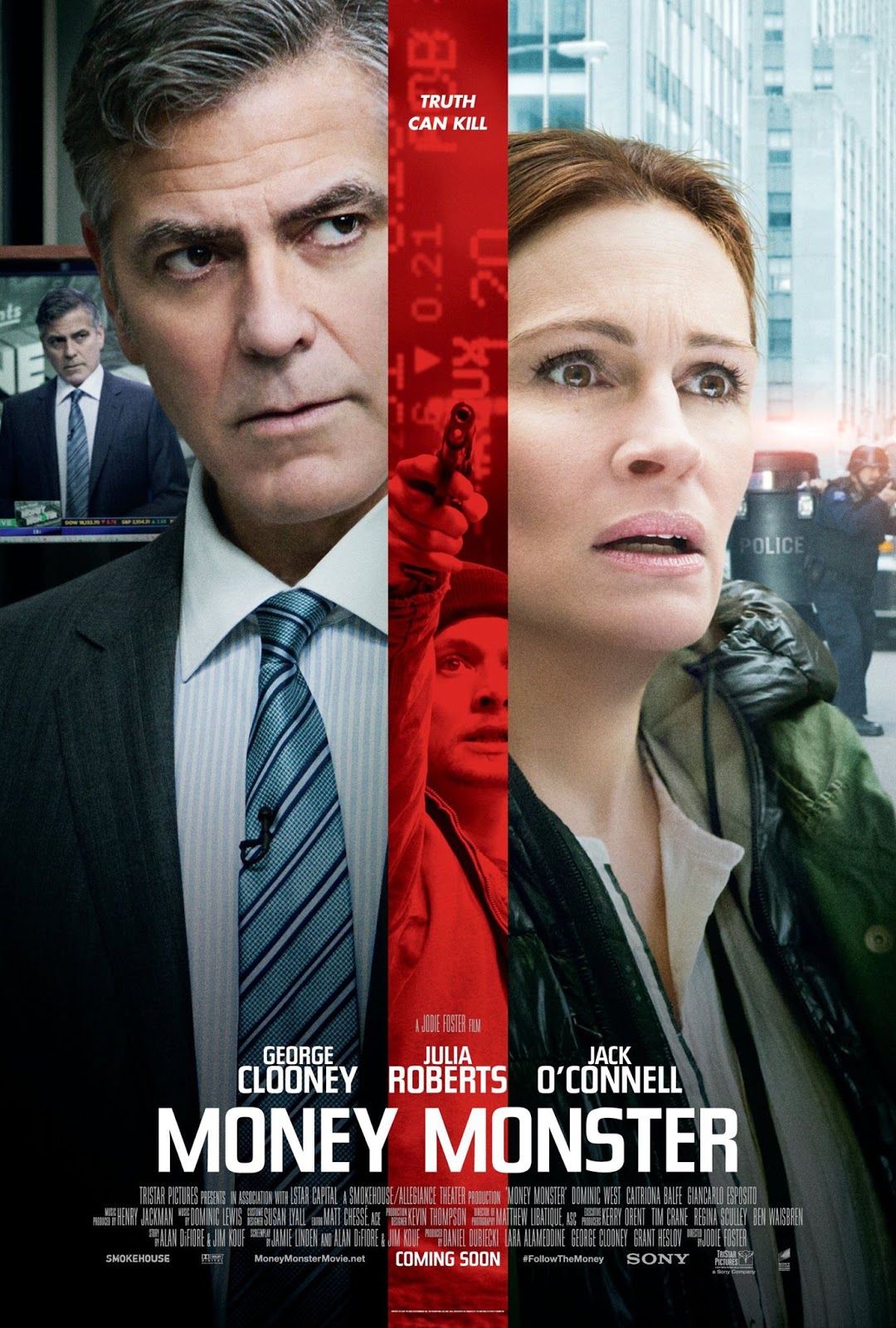
All this is exhibited to its full in Money Monster, a passably entertaining hostage drama set in the studio of a fictional Wall Street themed entertainment and “news” show. Lee Gates (George Clooney) is a shallow, image and money-obsessed TV personality taken hostage after a desperate grief-stricken viewer Kyle Budwell (Jack O’Connell) loses his life savings on one of Gates’ tips. However, with the prodding of his director Patty (Julia Roberts), Gates slowly begins to rediscover his journalistic integrity.

Watching the film when it rather heavy-handedly enters into the world of media satire, it’s pretty hard not to remember better films in the same genre. Network covered much of this ground so well 40 years ago, it’s almost not been necessary to watch another film about the manipulation of the media. The Truman Show so successfully skewered the thoughtless collaboration of the watcher at home, that this film’s attempt feels like a rather mundane repeat.

Saying that, George Clooney does a grand job of portraying the shallow, media man re-discovering his depths – although lord knows he’s played this sort of part often enough to do it standing on his head. But he gets the dark comedy of it, and he is also able to deliver on the growing decency and integrity of the character. Julia Roberts is pretty good as a confident professional who has allowed her principles to slide for too long. In this illustrious company, Jack O’Connell more than holds his own, delivering brilliantly as a desperate and angry man.

The hostage taking sequences are quite well done, and threaded in well with the general satirical air of the film. At two key moments during the crisis, the film successfully pulls the rug out from under the feet of the viewer by delivering a different outcome than we might have expected. It’s probably when the film is most effective. It also does a good job threading many of the themes, locations and characters that will become important by the end of the film into its opening moments – many of them done so gently, you won’t even notice until they become important later.

The dark satire around the uncaring nature of big business and its lack of principles also hits more than a few familiar beats (big business being another thing multi-million film companies love to lay into), but this side of the plot is interesting enough – and I didn’t quite work out how the dodgy dealing had worked out. The final reveal and confrontation around this is well staged. It doesn’t tell you anything new, or present its old points in a unique or intriguing new way, but it does it in an entertaining way.

The film generally deserves some congratulation for its staging – Foster directs with a tightness and the flimsy conception of the film is delivered in a taut 85 minutes (almost in real time) which certainly means it doesn’t outstay its welcome. The acting is decent and the points it makes are well delivered, no matter how familiar they are. The film effectively plays with and changes your views on its characters over the course of its runtime. Honestly there are worse ways you can spend an hour and a half. It’s just not something that is going to stick with you for long.