Tag: Charles Dance

Frankenstein (2025)

Frankenstein (2025)

Del Toro’s dream project makes it to the screen in a lavish gothic spectacular

Director: Guillermo del Toro

Cast: Oscar Isaac (Baron Victor Frankenstein), Jacob Elordi (The Creature), Mia Goth (Elizabeth Harlander), Felix Kammerer (William Frankenstein), Lars Mikkelsen (Captain Anderson), Christoph Waltz (Henrich Harlander), David Bradley (Blind Man), Charles Dance (Baron Leopold Frankenstein), Ralph Ineson (Professor Krempe)

When he was a kid del Toro fell in love with James Whale’s Frankenstein. It was his dream project to create his own version of Mary Shelley’s classic. Year of dreaming pay off in this visually gorgeous, and emotionally engaging film – even if it’s also a little overlong and overindulgent. Del Toro throws everything into Frankenstein, creating a grand Gothic epic whose sympathies firmly lie with the abused Creature.

You must be familiar with the plot: in eighteenth century Germany, Frankenstein (Oscar Isaac), driven by never-really-resolved anger over his mother’s death, dreams of conquering death. With the funding of arms dealer Harlander (Christoph Waltz), who is also uncle to the woman he loves: Elizabeth (Mia Goth) who happens to be fiancée to his younger brother William (Felix Kammerer). On a stormy night, he gives life to the Creature (Jacob Elordi) but quickly rejects him. The Creature tries to find a place in the world, only to discover the world is full of prejudice and violence towards him and the Creature’s resentment against his thoughtless creator grows.

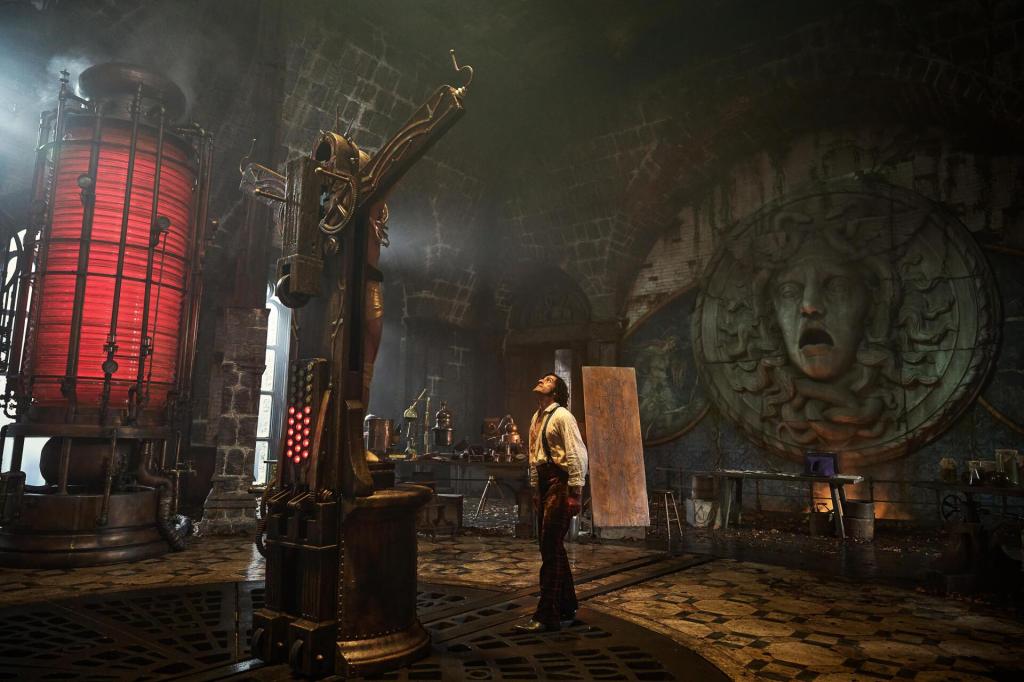
Del Toro’s film looks absolutely stunning, a sumptuously designed Gothic melodrama with extraordinary sets, grand costumes and beautiful cinematography (the Polar-set framing device is particularly striking, covered in lusciously contrasting blues and greens). There are striking echoes of the visual intensity of Pan’s Labyrinth, with Frankenstein’s lab turned into a mix of laboratory and classic temple, including a giant Medusa sculpture. The birthing sequence is a grandiose, operatically Gothic thing of beauty, a version of Whale’s film dialled gloriously up to eleven.

Del Toro’s film goes back to the novel in some ways (in themes and its Polar framing device), but in many ways it’s more of a complex, emotional reimagining of Whale’s film. Isaac’s Frankenstein, an egotist in need of an audience feels very similar to Colin Clive. Whale’s key motif, the Creature’s romantic yearning for the sun, becomes thematically central here. As there, Frankenstein conducts his experiments in a colossal Gothic tower, keeps the Creature chained and makes vague attempts to rear it and takes no responsibility for his actions or the deaths connected to it (in fact Isaacs’s Frankenstein lies and lies in a weasily attempt to protect his reputation). Waltz’s arms dealer funder of Frankenstein’s insanity feels like a version of Pretorious from Bride of Frankenstein, while del Toro goes even further than that film in deepening the bond between the Creature and the Blind Man.

Del Toro also doubles down on Whale’s implicit sympathy for the Creature. Here re-imagined as possessing near super-human strength and durability (his violent responses to being attacked being partially a result of his own strength being uncontrollably great), his child-like vulnerability is as dialled up as his actual physical invulnerability. The Creature feels, first and foremost, like a thought experiment by Frankenstein – and the fact this experiment has effectively rendered the Creature immortal and capable of a Wolverine-like cellular regeneration, condemned to walk the Earth forever alone only heightens the creator’s myopic selfishness.
One of del Toro’s key themes is terrible parenting. Much as he loathed his domineering, brutal father (Charles Dance, in a role perfectly crafted for his austere distance) who caned his face (his hands are too precious) when he flunked remembering anatomy facts, Frankenstein ends up echoing his father’s approach. When the creature constantly fails to say anything other than ‘Victor’, he too reaches for a cane to beat learning into him. Like his father, he resents the creature for being a bad reflection on him. He is, effectively, a dead-beat Dad, casually fathering a child which he has no idea how to treat, who falls back on cruelty.

There can be few Frankenstein’s on film less sympathetic than the version played here by an impressively egotistical Oscar Isaac. He’s full of preening self-importance and self-justification, obsessed with his task but giving no thought to its consequences. Twice he reanimates corpses then callously switches them off without a second thought. Giving birth to Frankenstein – just like in Whale’s film – after an initial interest (that is really self-congratulatory pride) his reaction is to chain him up in the basement and lose patience at him. With his constant milk-drinking there is a sense he’s a little boy who never grew up, and to him love is founded on possession: first of his mother, then his brother, then Elizabeth, all of whom at various points he wants to keep to himself – while his anger at the Creature is rooted in his failing to meet Victor’s expectations.

Frankenstein is at heart an angry mother’s boy, resenting his father for ‘taking’ his mother away from him (del Toro even has him wrapped in his mother’s distinctive red when he wakes to discover the Creature lives). There is more than an echo in that in his love for Elizabeth, the fiancée of his younger brother (who he also subconsciously resents for both ‘killing’ his mother in childbirth and for having the sort of relationship with his father Victor never had). These Freudian feelings are subtly enforced by Mia Goth playing both roles (it’s so subtly done I missed it first time round). Victor’s love for Elizabeth is just as possessive and selfish as that for his mother – and in the same ways his contempt for the Creature is for ‘failing’ him.

By contrast with this monster, the Creature is presented overwhelmingly sympathetically. Played with an outstanding physical and emotional commitment by Jacobi Elordi, he’s framed as a child stumbling towards a painful adolescence. Freshly born, he waddles like a toddler, stares in fascination at leaves floating on a stream and painfully forms the word ‘Victor’. Of course, it never occurs to his creator that this is the equivalent of “mama”. Only Elizabeth, who feels an immediate affinity with the sensitive soul, understands this. Only she tries to speak to him – or asks what his name is.

The poor Creature escapes into a world he quickly full of senseless, prejudiced violence. He bonds with a stag – only for the creature to be shot in front of him by hunters (who instantly turn their guns onto him). In conversation, Elordi presents a man who is sensitive, kind and gentle but capable of anger and fury. Del Toro crafts a tender relationship between the Creature and David Bradley’s Blind Man (the only person, other than Elizabeth, to look past his appearance). The film’s second act, focusing on the Creature’s emotionally painful interaction with the world is its strongest – not least because you feel throughout del Toro’s deep bond with him.

After all this, it’s surprising that Frankenstein ends on a note of hope. Del Toro’s film isn’t always quite nimble enough for this: some of its more optimistic moments can feel as if they have emerged a little thin air (or from the optimistic wishes of the director). In particular, Elizabeth’s bond with the Creature feels so swiftly sketched out it failed to completely convince (more time on this and less time on Waltz’ creepy arms dealer would have been welcome). But this feels like a passionate, committed and perhaps above all beautiful to-look-at piece of work with a real emotional heart. This easily lifts it into the upper echelons of Frankenstein adaptations.
Michael Collins (1996)

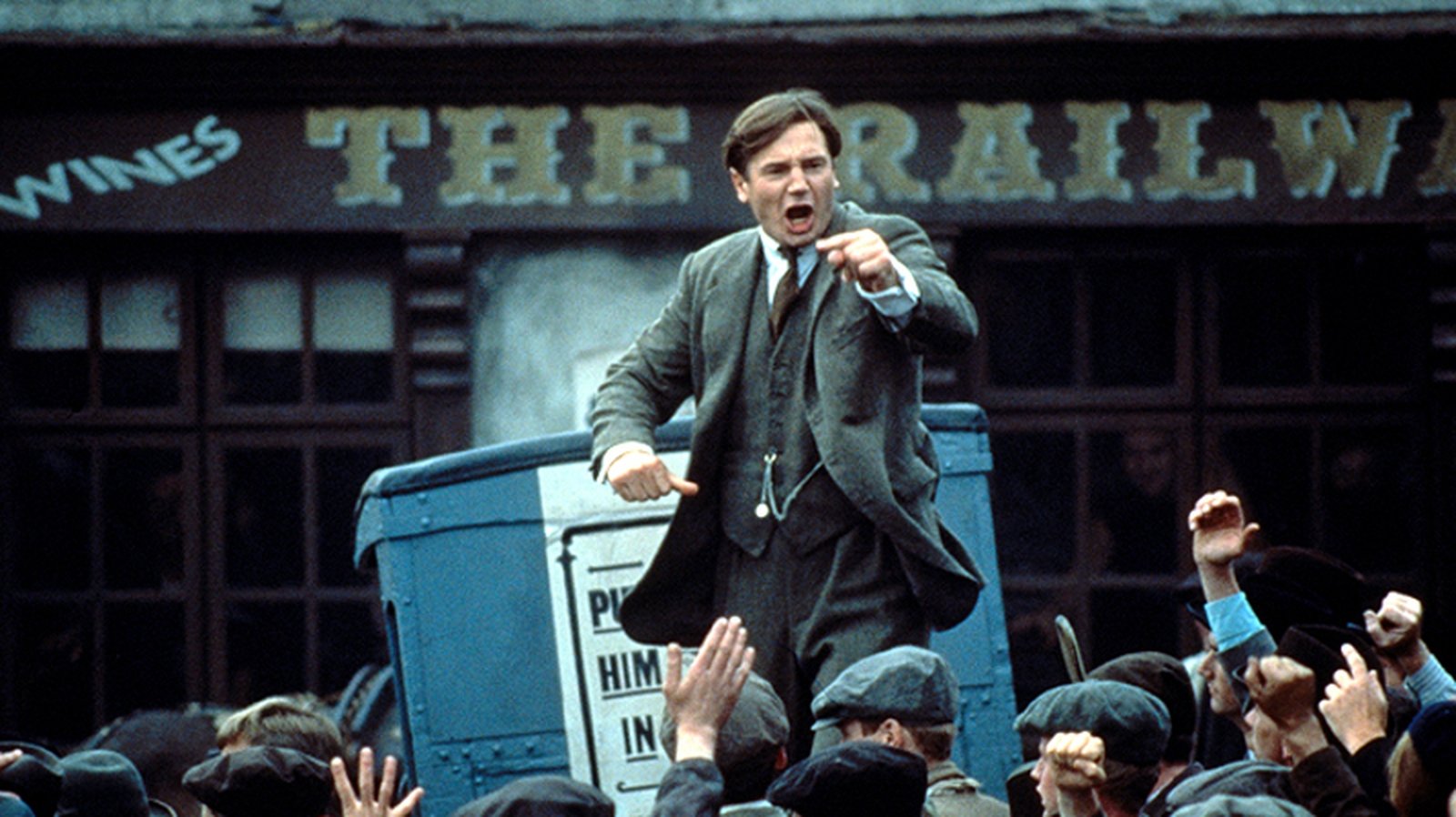
Liam Neeson is outstanding as Irish revolutionary leader Michael Collins

Director: Neil Jordan

Cast: Liam Neeson (Michael Collins), Aidan Quinn (Harry Boland), Stephen Rea (Ned Broy), Alan Rickman (Eamon de Valera), Julia Roberts (Kitty Kiernan), Ian Hart (Joe O’Reilly), Brendan Gleeson (Liam Tobin), Sean McGinley (Smith), Gerard McSorley (Cathal Brugha), Owen O’Neill (Rory O’Connor), Charles Dance (Soames), Jonathan Rhys Meyers (Assassin), Ian McElhinney (Belfast cop)

Britain’s colonisation of Ireland left a poisonous historical legacy that blighted much of the twentieth century. The story of Irish independence, is also one of guerrilla and political brutality, civil war and terrible lost opportunities. Jordan’s biopic of Michael Collins is a study of the man who did more than any other to turn the IRA into an effective guerrilla fighting force – only to be consumed by the very same uncompromising ruthlessness he had set in motion. It’s a powerful and beautifully made film that seeks to explore just how and why violence and politics ended up hand-in-hand in Ireland for almost 100 years.

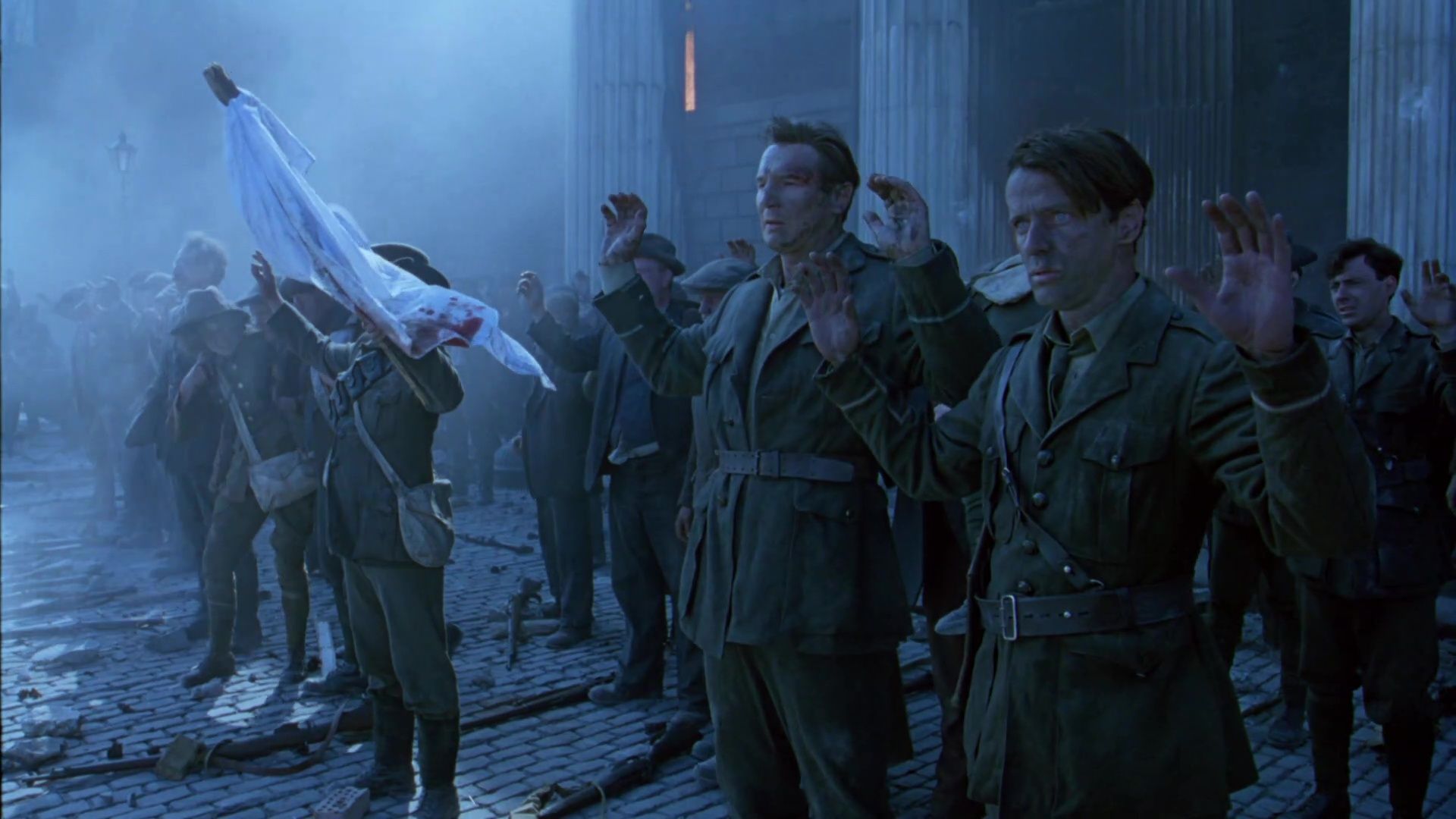
It opens with the 1916 Easter Uprising, an ignominious failure which the British managed to turn into a glorious one by executing rather than imprisoning its leadership. It’s one of many misjudgements in our occupation. It also the impetus for the young Michael Collins (Liam Neeson) to realise that playing by conventional military roles simply means defeat for the Irish time and again. Put simply, the IRA needs to stop trying to be a field army and instead become a guerrilla army, launching targeted hit-and-run terrorist attacks on the British. It’s a hugely successful campaign – despite the doubts of Sinn Fein leader Eamon de Valera (Alan Rickman), who favours more conventional conflict (“They call us murderers!” he cries, with some justification). But after the British agree a Treaty that divides Ireland, the IRA splinters into pro- and anti Treaty factions. Can Collins put the cork back in the bottle of violence, before the country tears itself apart?

Of course, anyone with a passing knowledge of history knows that he can’t. Hanging over the entire film is the knowledge that Collins’ new methods of political assassination, plainclothes soldiers, bombs and bullets in the middle of the night will eventually expand into the indiscriminate bombing and shooting that consumed Ireland for decades. Not that Collins will live to see it, as he was assassinated aged 31 attempting to negotiate an end to Civil War. What makes Collins such an engaging and intriguing figure is that he (or at least the version we see in this film) was a man forced into methods he knew were wrong, to achieve an end he knew was right.

Neeson is superb as the charismatic, blunt yet poetic Collins who is noble enough to know that training young men to quickly and efficiently commit murder is an ignoble legacy. Jordan’s film doesn’t condone Collins use of violence, but establishes why it was necessary. Playing by more conventional rules simply wasn’t going to work – and Ireland didn’t see why they had to wait for British politics to shift. Unlike, say Gandhi in India (and Michael Collins makes a dark companion piece with Attenborough’s Gandhi, two charismatic campaigners choosing radically different paths to independence), Collins believed Britain had to be forced to see holding Ireland wasn’t worth the blood sacrifice and emotional cost. (Jordan’s film is also clear that Britain’s hands were equally dirty, the British conducting their own counter-campaign of assassination and violence).

The tragedy that Jordan finds in all of this is that, when the British were gone, Ireland had become so used to dealing with political problems with violence that they couldn’t imagine solving their disagreements with anything else. Collins is in fact too successful: and the film demonstrates that in radicalising his followers, he’s unable to gearshift them towards compromise. His attempts to get Sinn Fein to accept a Treaty that offers a workable compromise (as opposed to an unwinnable full-scale war), leads to him becoming a victim of exactly the sort of insurgency he pioneered in the first place. To Jordan he is a man trapped in a world of his own making, unable to remove the gun from Irish politics.

Michael Collins makes some compromises with history – something that was bound to get it attacked when dealing with events of such earth-shattering controversy – but it always feel spiritually accurate. The British Black and Tans really were as brutal as they seem, and while they didn’t use an armoured car on the pitch at the “Bloody Sunday” massacre at Croke Park, they did shoot indiscriminately at the crowd and fire at the stadium from an armoured car outside causing 14 fatalities (including two children) and 80 serious injuries. Similarly, in the aftermath of Collin’s assassination of most of the British intelligence operation in Dublin, three IRA leaders were “killed while trying to escape” (even if these were different men than the one who suffers this fate in the film). Just as IRA killings in the street were swift and brutal, so interrogations in Dublin Castle could stretch way beyond what the Geneva Convention would suggest was acceptable.

Much of the first half of the film is structured in the style of an old-fashioned gangster film, with hits and street gangs. Plucky IRA under-dogs (and Neeson’s Collins is so charming, you immediately root for him), take-on the more hissable baddies in British intelligence (led first by a bullying Sean McGinley and then a suavely ruthless Charles Dance). But the romance slowly drains out of this as lifeless bodies hit the floor – and Jordan always gives the focus to the dead after they fall, regardless of their ‘side’. The film has an infectious momentum, which makes its final acts, with their air of tragedy, even more sad and moving. It’s all also quite beautifully shot by Chris Menges, the film bathed in some of the most luscious blues you’ll see.

While Michael Collins is more sympathetic to the Irish (as you would expect), it clearly shows the psychological damage of killing. Hesitant shooters become increasingly ruthless at the cost of their humanity. Collins spends a ‘dark night of the soul’ openly confessing that he hates what he is making young men do and knows it is morally wrong. In the end this explains why methods were chosen, but doesn’t praise them – just as it doesn’t outright condemn them, considering what the Irish were up against. It’s a difficult balance, but very well walked.

There are flaws. Excellent as Liam Neeson (at the time 15 years older than Collins was when he died) and Aidan Quinn as his number two Harry Boland are, the film’s insertion of a love triangle between them and Collin’s eventual fiancée Kitty Kiernan often descends into weaker “Hollywoodese”. It’s not helped by having Kitty played by an egregious Julia Roberts, who struggles gamely with the Irish accent, and who never transcends her star status.

Additionally, while the film has an excellent performance by Alan Rickman (in a pitch perfect vocal and physical impersonation) as Eamon de Valera, it also repositions de Valera as an antagonist. Although de Valera certainly was a prima donna who associated his interests and Ireland’s as being one and the same, the film implies that de Valera’s actions are motivated as much by jealousy as principle and lays most of the blame for the civil war on him. Not to mention implying de Valera’s complicity in Collins eventual death (a heavily disputed assertion, strongly denied by de Valera).

Michael Collins though is a thoughtful, complex and engaging film that brings a tumultuous period of history successfully to life. Jordan’s film manages to wrestle an enthusiastic admiration for Collins, with a questioning exploration of how his actions (however well motivated) led to a legacy of violence. But it doesn’t lose sight of how Collins was aware he was using wicked methods for a noble aim, or that his goal was to bring peace. Wonderfully acted by a great cast (every Irish actor alive seems to be in it), with Neeson sensational, it’s an essential watch for anyone interested in this period of history.

Mank (2020)

Mank header
Gary Oldman excels as Herman J Mankiewicz in David Fincher’s bitter Hollywood epic Mank

Director: David Fincher

Cast: Gary Oldman (Herman J Mankiewicz), Amanda Seyfried (Marion Davies), Lily Collins (Rita Alexander), Arliss Howard (Louis B Mayer), Tom Pelphrey (Joseph L Mankiewicz), Charles Dance (William Randolph Hearst), Sam Troughton (John Houseman), Ferdinand Kingsley (Louis B Mayer), Tuppence Middleton (Sara Mankiewicz), Tom Burke (Orson Welles), Joseph Cross (Charles Lederer), Jamie McShane (Shelly Metcalfe), Toby Leonard Moore (David O Selznick)

It’s 80 years old, but age has not withered Citizen Kane’s mystique, still one of the greatest films ever made. The story of its creation has intrigued generations, a fascination only increased by the larger-than-life personalities involved, from Orson Welles down. David Fincher’s lovingly made, but bitingly shrewd deconstruction of classic Hollywood, explores the creation of the film by focusing on its credited co-writer Herman J Mankiewicz, the film neatly intercutting between the alcoholic Mankiewicz drafting the screenplay while in enforced retreat and his prime years as a writer-for-hire to the major Hollywood studios of the 1930s.

Mankiewicz is played by Gary Oldman (at 62, already seven years older than Mankiewicz was when he died). A noted wit, Mankiewicz makes an excellent living running the writers’ room at Louis B Mayer’s (Arliss Howard) MGM. Mankiewicz views the work of writing films as slightly beneath him, easy money (“Millions are to be grabbed out here and your only competition is idiots” he cables Ben Hecht). Mankiewicz’s sociability eventually finds him an informal role as “court jester” to newspaper tycoon (and MGM bank roller) William Randolph Hearst (Charles Dance) and he builds a warm friendship with Heart’s shrewd mistress, actress Marion Davies (Amanda Seyfried). The relationship sours as Mankiewicz grows disgusted by the dirty tricks campaign MGM and Hearst launch against the left-wing candidate for governor in 1936. In 1939 Mankiewicz works on the script for Citizen Kane, hired by Orson Welles (Tom Burke) with the support of an assistant Rita (Lily Collins) who helps him craft the words and stay sober long enough to type them.

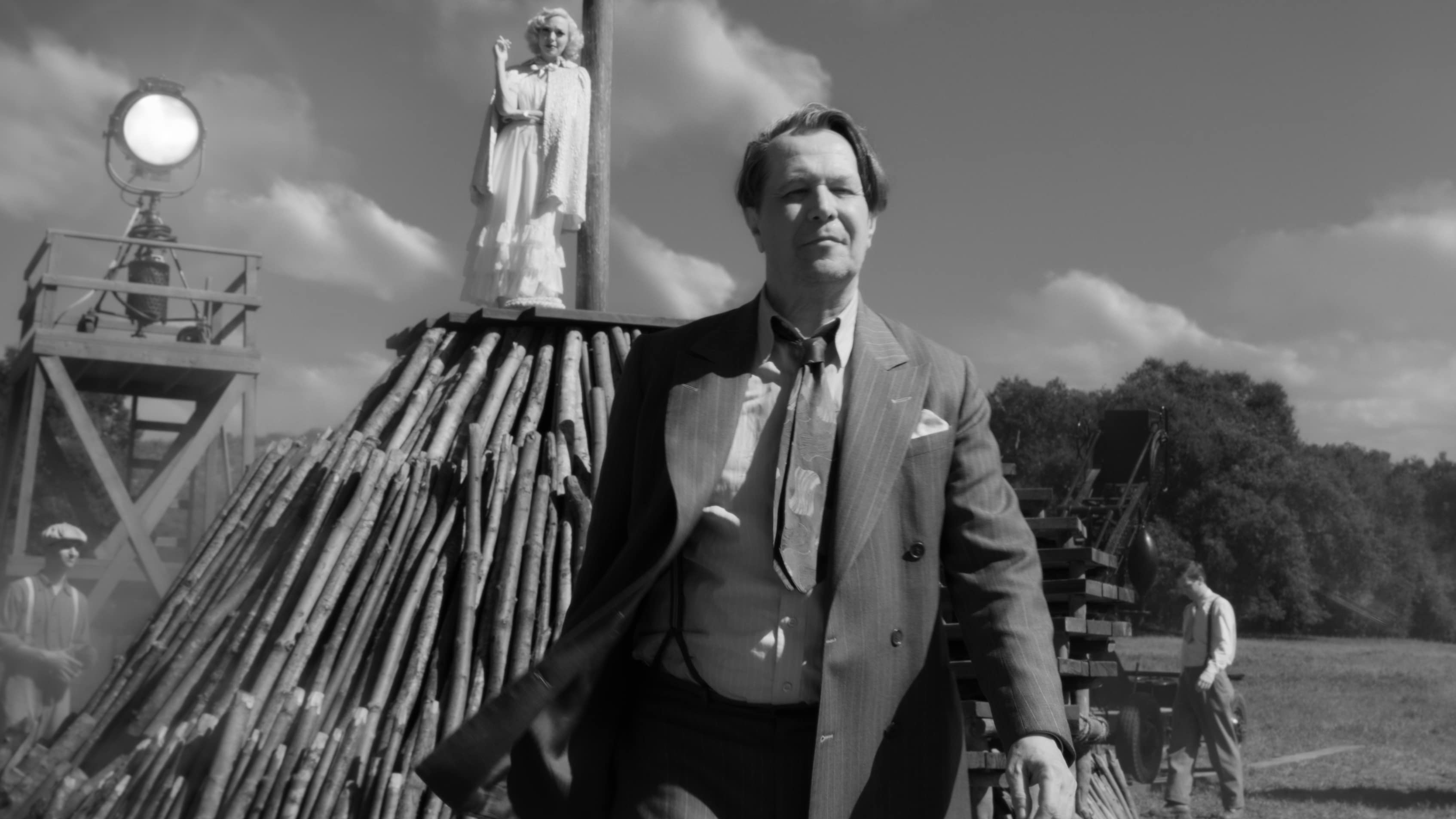
Fincher’s film can easily be seen as a loving homage to old-school Hollywood. Certainly, Fincher fully embraces 30s filming style. From the carefully crafted period credits to the slightly distorted sound that apes the echoey on-set recording of classic Hollywood, this is a technical masterpiece. Beautifully shot in a series of sultry black-and-white images, with several visual references to Citizen Kane, it looks simply marvellous. The musical score is a brilliant mixture of Herrmannesque and classic Hollywood symphonic music with an edge. Even the casting has a slight old-school Hollywood unreality about it, from Oldman being at least 30 years too old to Amanda Seyfried being too young. Fincher embraces every flourish and stylistic tic from the Golden Era of Hollywood.

But the film is about as far as you can get from rose-tinted glasses. Instead this is a vicious, angry, look at Hollywood’s corruption, that owes as much to Billy Wilder’s Sunset Boulevard. Hollywood is a carnival of greed and abuse of power, where art takes a second seat to cold hard cash (“This is a business where the buyer gets nothing for his money but a memory. What he bought still belongs to the man who sold it. That’s the real magic of the movies!” Louis B Mayer exclaims). Power is abused, lies are peddled to the public (Upton Sinclair, the Democratic candidate for governor, is subtly savaged by MGM-propaganda films) and the rich shamelessly steal from the rest.

The film doesn’t give a pass to the “talent” either. Mankiewicz and his writers’ room – a who’s who of greats, from Ben Hecht to George S Kaufman, SJ Perelman and Charles MacArthur – are blasé and spend as much time playing cards and seducing broads as they do scribbling ideas. Mankiewicz sets the tone, a super-smart wordsmith who thinks the movies are a joke and never invests himself in any of his work, happy to simply pick up a pay cheque. Mankiewicz doesn’t care about the quality and completely misses (or doesn’t even understand or care about) the power of movies. Anyway, his judgement is terrible, denouncing The Wizard of Oz as an epic disaster in waiting and never bothering to ensure he receives credit.

Oldman perfectly captures the shambling, slightly rotund and scruffy disdain of Mankiewicz, as well as brilliantly suggesting that the booze and cigarettes are an aid to forget his own disgust and self-loathing. With Oldman’s verbal dexterity triumphant (Mankiewicz actually carries more than a few echoes of his Winston Churchill), Mankiewicz’s real gift (and reason for living) is clubability and a skill at getting on with everyone. He’s the ultimate insider in a profession he thinks is an unworthy joke. It’s what gives him the ability to drop perfectly formed, biting bon mots at the drop of the hat – and this devil-may-care attitude amuses William Randolph Hearst (a chillingly still and powerful Charles Dance who can turn from congenial to menacing in a moment).

It’s also what wins the friendship of Marion Davies, who Mankiewicz recognises as a kindred spirit, a woman of intelligence and sensitivity, playing a role in an industry she holds in uncertain affection. This is career best work from Amanda Seyfried, giving Marion intelligence and a touching vulnerability. However, unlike Mankiewicz, she is happy in the role she has been ‘cast in’. It would never occur to her to launch the sort of scathing attack on this gilded set that Mankiewicz’s script for Citizen Kane becomes.

The film is in fact less interested in the writing of Kane than you might expect.Kan, even with Tom Burke making a wonderfully detailed Orson Welles. It does however make sure to give most of the credit for story and dialogue with Mankiewicz, with Welles reduced to a petulant tantrum (the inspiration for Kane’s room wrecking) when Mankiewicz demands credit. (The film is in effect a dramatisation of Pauline Kael’s Raising Kane essay, which attempted to shift the key creative contribution from Welles to Mankiewicz). But then perhaps Mankiewicz finally realised films can be a vehicle for respectable, worthy work.

That is surely the lesson Mankiewicz learnt from the 1936 Gubernatorial campaign. His offhand remark inspires MGM to refashion its news reel department into a propaganda machine. Mankiewicz is plagued by guilt, self-loathing and disgust for his employers over this cynical and destructive abuse of power – but also his own failure to exploit his skills and talent to really make a difference (in a way his brother Joseph manages to do). Again, Fincher’s intelligent and beautifully crafted film leaves all this lingering in the mind, its initial impact only growing over time as you digest its complexities.

However, it is a film perhaps a little too absorbed in its detail to keep an eye on the heart. There are several scenes that feel missing. The film needs more of Mankiewicz as the court jester at Hearst’s. It needs more space to allow us to understand where Mankiewicz’s rage and bitterness really comes from. It needs more time to tackle his mixed feelings about his work. More exploration of the foundations of Citizen Kane. The pace sometimes flags and it’s a cold and admirable film rather than one that can be love, occasionally feeling a little pleased with itself (with its deliberately scuff-marked film and burned reel marks). I can well imagine some people using the dreaded word “boring” and it’s really a film for the cine-buff rather than the casual viewer.

The main flaw – and it might well be a big one – is that there isn’t enough focus given to what motivates Mankiewicz to turn so completely against the gilded in-crowd. Even when haggling over credit with Welles, Mankiewicz still points out he (unlike Welles) is a Hollywood insider and will win any arbitration. But the motivations of the film are hard to find amongst the skilful recreation of its design. The characters at times seem a little to artificial and lifeless.

But it has a host of other positives, all superbly marshalled by Fincher’s pitch perfect direction. The cast is superbly led by Oldman. Among the rest, Arliss Howard is terrific as the venal and hypocritical Louis B Mayer, Tuppence Middleton very affecting as Mankiewicz’s put-upon wife and Lily Collins charming as Mankiewicz’s assistant Rita Alexander. With its evocation of Hollywood style spot on, Fincher’s film also brilliantly deconstructs the dark, corrupt heart of Hollywood where powerful producers and money men are focused on their own ends. Shown through the eyes of one disaffected insider, it makes for a film-buffs delight and an intriguing if sometimes cold viewing.

Alien 3 (1992)

Sigourney Weaver goes through the motions again in Alien 3

Director: David Fincher

Cast: Sigourney Weaver (Ellen Ripley), Charles S. Dutton (Leonard Dillon), Charles Dance (Dr Jonathan Clemens), Brian Glover (Warden Harold Andrews), Ralph Brown (Aaron), Paul McGann (Golic), Danny Webb (Morse), Lance Henriksen (Bishop), Pete Postlethwaite (David), Peter Guinness (Gregor), Christopher Fairbank (Murphy), Phil Davis (Kevin), Niall Buggy (Eric)

Few films feel more like a grim contractual obligation than Alien 3. If you want a real blood bath, you’d get more entertainment from reading about the tortured history of its production. Over nearly six years it saw off several scripts, at least two directors (including David Fincher resigning over continual studio interference) and Sigourney Weaver only agreeing to do the film if she was killed off at the end (well that and a big pay cheque).

All of this ended up as a depressing, grim and largely unenjoyable mess that goes over the same old ground as the first two films, but with diminishing returns. After the events of Aliens, our heroes ship crash-lands on a prison planet. Everyone on board is killed other than Ripley (we’ll come back to that…). The planet is populated by criminals who have embraced religion, led by Dillon (Charles S. Dutton) and a small staff of warders (Brian Glover and Ralph Brown) and Dr Clemens (Charles Dance). The company orders Ripley to sit tight and get picked up. But did an Alien on the ship lead to its crash? Is there now an alien on the planet? And is Ripley carrying an Alien inside of her?

It won’t surprise you to hear that the answers to all these questions are of course “yes”. And the film takes a painfully long time to get there. This is made all the more painful by the shockingly, uninvolving grimness of the story’s telling. Nowhere is this more clear than in the ruthless killing off of the surviving characters from Aliens. After the warmth and humanity of that story – and Cameron’s skilled creation of a family dynamic between Ripley, Hicks and most especially the mother-daughter bond between Ripley and Newt, it’s hard not to feel that their brutal off-screen deaths are a real slap-in-the-face. At a stroke all the character development of the previous film is negated. And so we get back on the treadmill of another monster hunt.

It’s not helped either by the fact there is hardly a character here you could give two hoots about. The prison is almost completely staffed by British character actors, peppered with the odd American. The script totally fails to give any of these people really distinctive personalities at all, before the Alien starts munching through them. On top of which the lazy script is littered with effing and jeffing, that serves to make the characters very angry all the time and even less engaging. The film’s most interesting new character, troubled Dr Clemens (a decent performance of world-weary sadness from Dance) is dead by Act Two, and the rest are basically an identikit pile of same-old-same-old. Dutton gets some good speeches as the prisoner’s morally complex leader, but he’s fighting an up-hill battle against turgid dialogue and tired old plotting.

Already by Alien 3 it feels like the franchise was out of ideas. Yet again “the company” is up to no good, only interested in making a buck off the creature. A post-industrial landscape again sees a number of people killed off in ever more familiar ways. The alien looks a bit like a dog this time (or an Ox if you watch the longer and even duller extended cut), but that’s about the most original thing here. And at the centre of the misery we have a grimly resigned and disinterested Weaver, who seemingly can’t wait for that Alien to burst out of her chest and end her association with the franchise for good.

It’s very hard to find anything enjoyable at all about this film. And it feels odd to say that about a film which is about people being brutally murdered one-by-one by an alien. But the others had touches of hope, humanity and demonic poetry to them. This is just a parade of slumming it British character actors, playing foul-mouthed rapists and murderers, getting torn apart. And then the film ends with a colossal downer even more downier than all the rest of the sludge you’ve had to sit through.

Basically Alien 3 reminds us that, with the monster as a motiveless killing machine, there weren’t many places to go with it. It’s not like it could suddenly reveal a motivation or something. So it seems the franchise was doomed – as it has been almost ever since this – to be a familiar parade of facehuggers, dark rooms, slow builds as people meander towards death down corridors, blood splatter and people who barely qualify as characters meeting grisily ends. Alien 3 is depressing and unrewarding in so many ways.

For Your Eyes Only (1981)

Roger Moore takes aim in this most low-key of his adventures – and one of his best

Director: John Glen

Cast: Roger Moore (James Bond), Carole Bouquet (Melina Havelock), Topol (Milos Columbo), Julian Glover (Aristotle Kristatos), Lynn-Holly Johnson (Bibi Dahl), Michael Gothard (Emile Leopold Locque), Cassandra Harris (Lisl van Schlaf), John Wyman (Erich Kriegler), Desmond Llewelyn (Q), Jill Bennett (Jacoba Brink), James Villiers (Bill Tanner), Geoffrey Keen (Minister of Defence), Walter Gotell (General Gogol), Lois Maxwell (Miss Moneypenny), Jack Hedley (Sir Timothy Havelock)

Where could Bond go after he went to space in Moonraker? Another planet? The future? The producers of Bond decided they couldn’t top that – probably wisely – so for Bond’s next outing they went back to low-key basics. For Your Eyes Only Bond would find himself in an old-school Cold-war game of cross and counter-cross, scrambling for the Russians for ownership of what looks like a cross between a typewriter and child’s cash till toy. 

That toy is the ATAC (though it might as well be called MCGUFFIN) a ministry of defence system used to co-ordinate nuclear subs or some such. When the ship it’s on sinks somewhere off the coast of Greece, MI6 and the KGB swing into gear to be the first claim it from the Ocean depths. So Bond is off to Greece to investigate, not knowing who to trust: should it be MI6 contact and shipping magnet Kristatos (Julian Glover) or playboy smuggler and former resistance man Columbo (Topol)? And how will he deal with Melina Havelock (Carole Bouquet), the long-haired, half-Greek archer intent on revenge on whoever ordered her parents killed while they (without her knowledge) searched for the ATAC? Either way it will involve chases, deadly winter sports, flirtatious teenage ice skaters and a death defying climb up to a monastery at the top of a mountain.

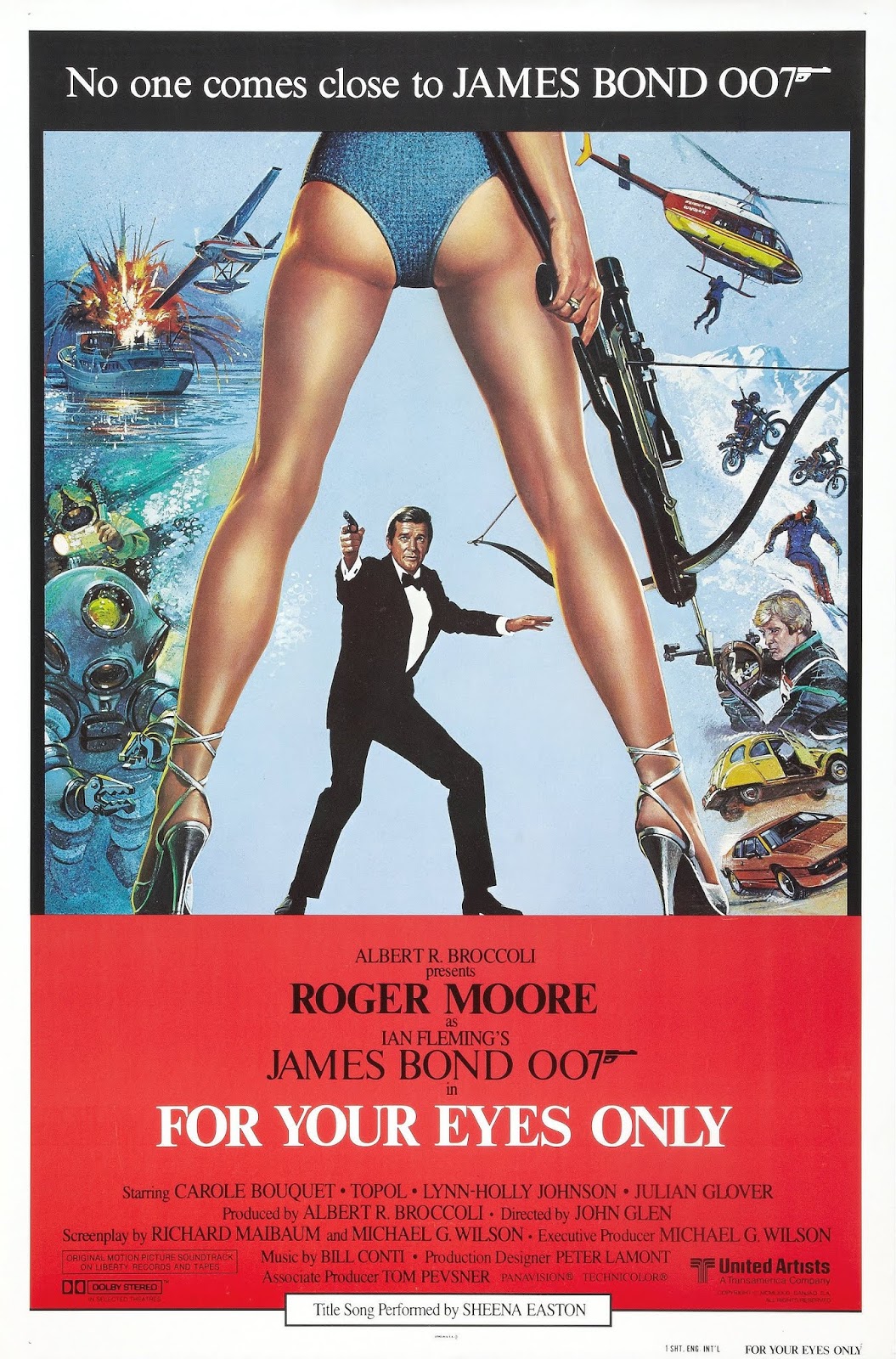
For Your Eyes Only is one of those quiet gems of Bond movies that, because it is about something quite small scale and quiet compared to the films it precedes often gets overlooked. It’s certainly the point where Moore should have stopped making the films – when your turning down the advances of someone because she’s too young (as he does ice skater Bibi) you know it’s time to go – and to be honest Moore was flagging already here, clearly too old for the action and certainly far too old for Carole Bouquet, who looks like she could have him for breakfast (she struggles to muster much sexual interest in him). But it doesn’t really matter because this is an old-school bit of spy cool, mixed with some decent but grounded fights and chases and shot with a loving eye for Switzerland and Greece (with plenty of clichéd visuals and sound cues thrown in from both as you would expect).

The producers wanted to shy away from the gadget filled antics of the previous films. As if to make the point, Bond’s car is destroyed almost immediately, forcing him to make a getaway at one point in a bashed up Citroen 2CV. The long sequence in the film where Bond is chased around a ski resort – which takes in cross-country skiing, a ski jump, a toboggan and several other winter sports is remarkable for nary a gadget in sight, with Bond relying on his wits and native skill with skis. Even when ascending the mountain at the film’s end, he uses nothing more than standard climbing equipment, putting his trust in ropes and hooks. It’s possibly the least tech heavy Bond film since Doctor No. There isn’t even a novelty watch and no humorous Q briefing on the gadgets. The only visit to Q’s lab is to use a cumbersome facial recognition system, that hilariously uses computer disks the size of stone slabs loaded into something that today resembles a dishwasher.

Other than that Bond is on his own, and it’s fairly neat to see him go about an investigation and follow a trail – even if Bond is, as usual, a hopeless undercover agent who largely relies on waiting to see who tries to kill him first. The villains, as always oblige, spending most of the film attempting to off Bond for all sorts of confused ill-defined reasons. Perhaps it has something to do with our main villain – the rather low-key Julian Glover, playing possibly the least colourful Bond villain ever, a guy who just wants to sell the ATAC for some cold hard cash – using so many cut outs for his operations, speechless goons (including an early appearance from Charles Dance) and East German skiing champions who seem motivated to kill Bond purely for larks and the evilz.

The first half of the film though is huge fun, watching Bond blunder around the ski resort dodging hits, fighting people, punching out butch hockey players and the like that it hardly matters that most of the plot is pretty inconsequential. When Bond finally stops mucking around in Switzerland and heads to Greece the ATAC is found in about 5 minutes flat (Havelock helpfully left a map with the downed boat coloured in on it, making his daughter’s ability to translate his cryptic notes pretty much useless), while the villain immediately takes this chance to comprehensively unmask himself.

After a further elaborately sadistic attempt to off Bond involving dragging him across coral in shark infested waters (sharks are always such deadly threats in Bond films), Bond unites with Topol to storm the castle in an actually pretty gripping and vertigo inducing climb sequence, another triumph of John Glen’s mastery of the action sequence. It’s a nice touch as well to introduce the “guest star” of the film not as the antagonist but as a protagonist ally, a neat twist that must have come as quite a shock back in the day. Topol plays his role with realish, cracking nuts, gags and heads with equal glee.

The film also heads into some dark places. For all his charm, gallantry and debonair wit, Moore does his meanest thing in years here when he kicks a heavy’s teetering car off a cliff. But that’s a fair repayment for the brutal running over of his mid-film squeeze (played by Pierce Brosnan’s real life late wife Cassandra Harris) earlier on by the same heavy. The early murder of the Havelock’s is surprisingly graphic (and also gives a great reaction shot for Carole Bouquet as she turns and looks back as the plane carrying her parent’s murderers jets away, her eyes screaming “I shall have my revenge!”) and Carole Bouquet’s Melina is determined figure, who does more than her fair share of the action.

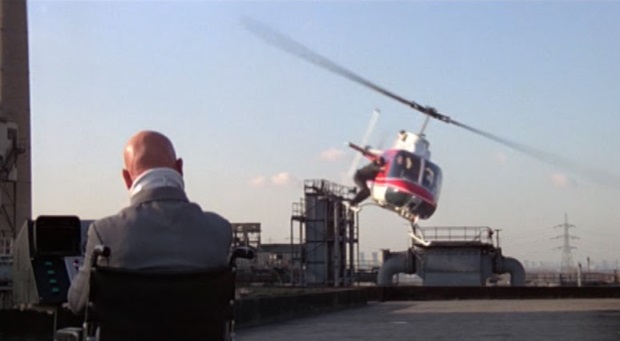
Of course the film can’t endorse too much her need for revenge. “That’s not the way” Bond, like a disapproval uncle, rather prissily tells her several times. Which is a bit rich coming from a man who opens the film by dropping his wife’s murderer down a factory chimney shaft. That opening sequence by the way is a joy, a neat call back to On Her Majesty’s Secret Service (whenever Bond went serious, it referenced Bond’s status as a widower) as well as a the dispatching of a it-could-be-anyone bald, scared, cackling villain with a white cat who makes an ill-advised attempt to kill Bond with a remote controlled helicopter (the film is so anti-Gadgets, only the baddies seem to use them and they don’t even work for them). It’s a neat “fuck you” to Kevin McCloy, at that time in a feud with the producers over the rights to Bond who had refused to allow them to use Blofield or Spectre again in the films. Keen to show they didn’t need Blofield, the producers introduced him in all but name to ignominiously kill him off, his final pathetic words a hilariously meaningless offer to buy Bond a “delicatessen in stainless steel” if only Bond would let him go.

FYEO is a crackingly old-fashioned Bond film that, despite being more grounded, has some great action sequences and a host of actors having a good time. Carole Bouquet is one of Moore’s best Bond girls and Moore himself certainly should have stopped here, this film throwing together one of his best mixes of light comedy, moral uprightedness, playfulness mixed with a dash of cruelty. John Glen did such a good job assembling this one he directed the next four films. It’s not got the smash-and-grab of The Spy Who Loved Me, but it’s an excellent action adventure.

Gosford Park (2001)

Cruelty, snobbery and viciousness – just another night at Gosford Park

Director: Robert Altman

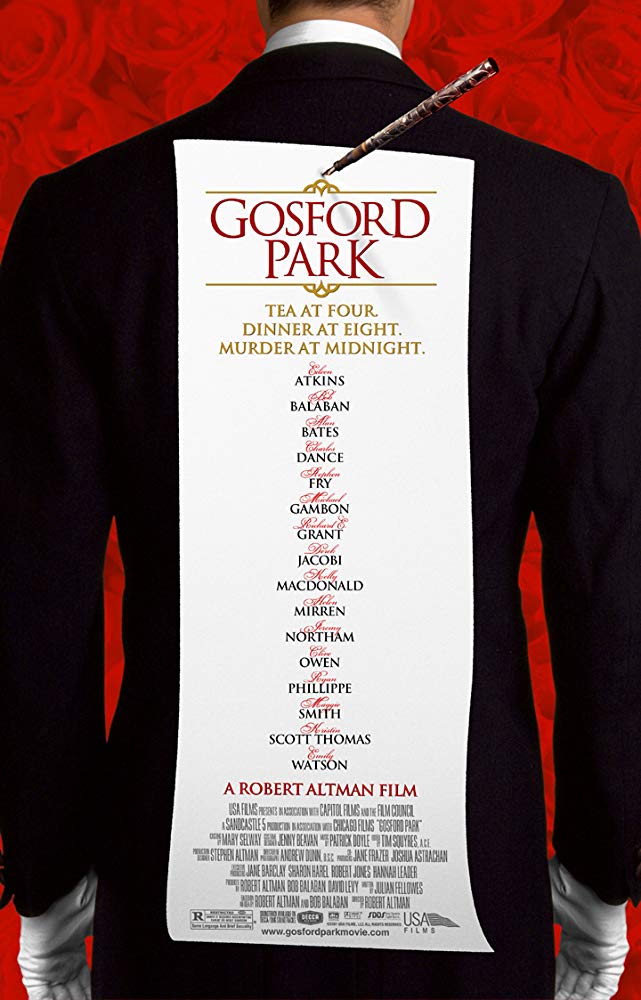
Cast: Eileen Atkins (Mrs Croft), Bob Balaban (Morris Weissman), Alan Bates (Mr Jennings), Charles Dance (Lord Stockbridge), Stephen Fry (Inspector Thompson), Michael Gambon (Sir William McCordle), Richard E. Grant (George), Derek Jacobi (Probert), Kelly Macdonald (Mary Maceachran), Helen Mirren (Mrs Wilson), Jeremy Northam (Ivor Novello), Clive Owen (Robert Parks), Ryan Phillippe (Henry Denton), Kristin Scott-Thomas (Lady Sylvia McCordle), Maggie Smith (Constance, Countess of Trentham), Emily Watson (Elsie), Claudie Blakely (Mabel Nesbitt), Tom Hollander (Lt Commander Anthony Meredith), Geraldine Somerville (Lady Stockbridge), Jeremy Swift (Arthur), Sophie Thompson (Dorothy), James Wilby (Freddie Nesbitt)

We’ve always fancied ourselves that when Brits make films in America – think John Schlesinger’s brilliant analysis of New York hustlers in Midnight Cowboy – they turn the sharp analytical eye of the outsider on American society. But do we like it when America turns the same critical eye on us? Gosford Park is a film surely no Brit could have made, so acutely vicious and condemning of the class system of this country, without the hectoring that left-wing British filmmakers so often bring to the same material, it’s just about perfect in exposing the hypocrisy and cruelty that undermines our class system. You’ll never look at an episode of Downton Abbey the same way again.

In November 1932, Sir William McCordle (Michael Gambon) hosts a shooting party at his country house. McCordle is almost universally despised by his relatives and peers – most especially his wife Lady Sylvia (Kristin Scott-Thomas) – but tolerated as his vast fortune from his factories basically funds the lives of nearly everyone at the house party. While the upper classes gather upstairs, downstairs the servants of the house led by butler Jennings (Alan Bates) and housekeeper Mrs Wilson (Helen Mirren) order the house to meet the often selfish and thoughtless demands of the rich. The house is rocked midway through the weekend, when a murder occurs overnight. With motives aplenty, perhaps the new maid Mary (Kelly Macdonald) of the imperious Countess Trentham (Maggie Smith) has the best chance of finding the truth.

First and foremost, it’s probably a good idea to say that this is in no way a murder-mystery. Robert Altman, I think, could barely care less about whodunit. While the film has elements that gently spoof elements of its Agatha Christie-ish settings, Altman’s interest has always been the personal relationships between people and the societies they move in. So this is a film really about the atmosphere of the house and most importantly how these people treat each other. Altman despised snobbery, and in a world that is fuelled by that very vice, he goes to town in showing just how awful and stifling so many elements of the class system really were.

“He thinks he’s God Almighty. They all do.” So speaks Clive Owen’s Robert Parks, valet, of his employer the patrician Lord Stockbridge (Charles Dance, excellent). You’ve got the attitude right there: the rich see themselves as a different species to those pushing plates around and cleaning clothes below stairs. The idea of there being anything in common is laughable. Slight moments of casual conversation between servant and master in the film are governed by strict laws and carry a quiet tension. 

It’s so acute in its analysis of the selfishness, snobbery, cruelty and arrogance of the British class system that each time I watch it I’m less and less convinced that Downton Abbey (the cuddliest version of this world you could imagine) creator Julian Fellowes had much to do with it. This film is so far from the “we are all in this together” Edwardian paternalism of that series, you can’t believe the same man wrote both. All the heritage charm of Downton is drained from Gosford, leaving only the cold reality of what a world is like where a small number of people employ the rest.

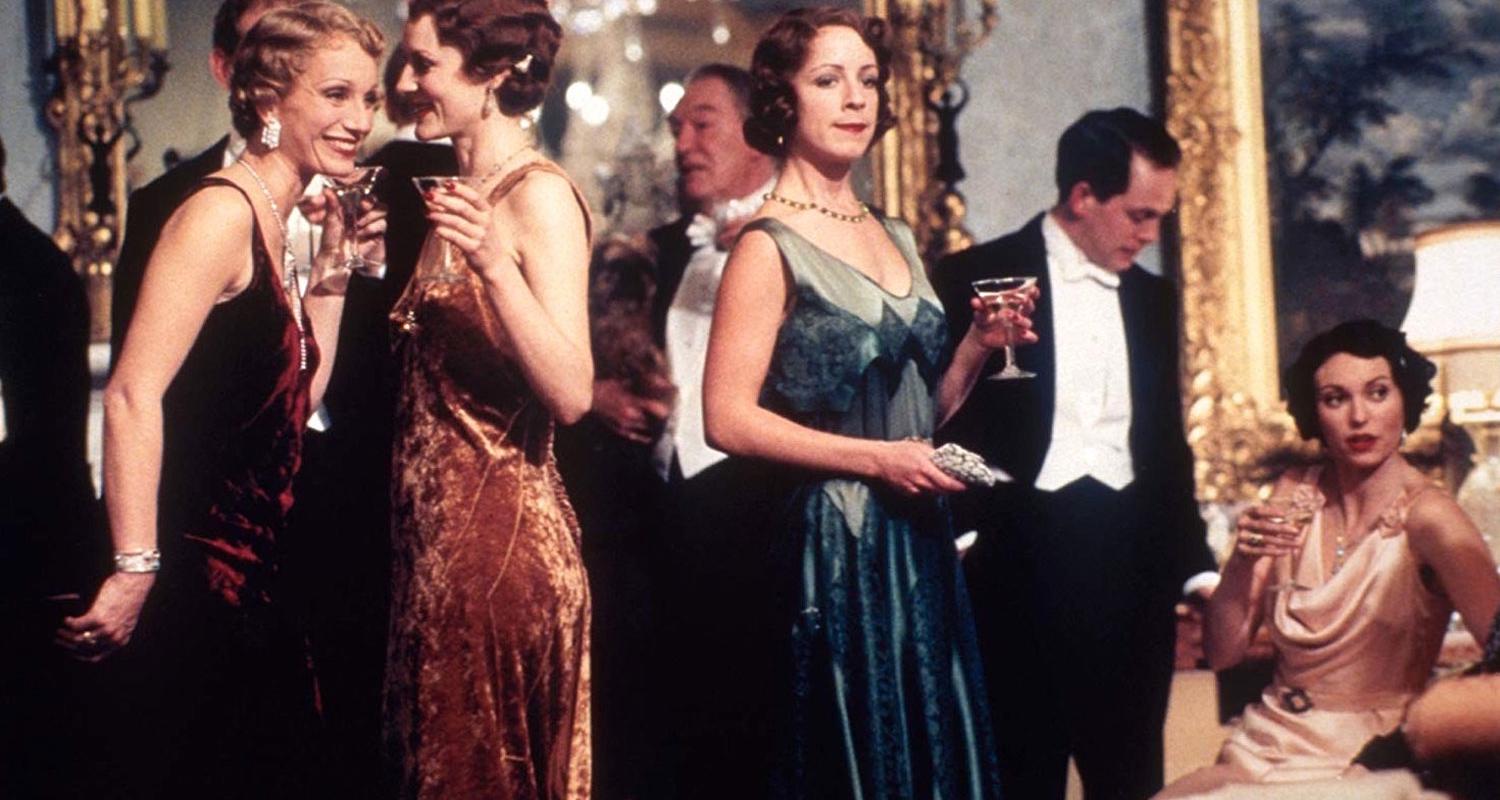
Upstairs the hierarchy is absurdly multi-layered. Everyone is aware of their position, with those at the top of the tree barely able to look those at the bottom in the eye, let alone talk to them. The rudeness is striking. Maggie Smith (who is brilliant, her character totally devoid of the essential kindness of her role in Downton Abbey has) is so imperiously offensive, such an arch-snob, she can only put the thinnest veil over her contempt when she deigns to speak to her inferiors. Her niece, played with an ice-cold distance by Kristin Scott-Thomas, embodies aloofness, selfishness and casual cruelty.

Ivor Novello (Jeremy Northam, superb) – the one real person in the film, and a film star – is treated like a jumped up minstrel player, with characters falling over themselves to make snide comments about his career. His guest Morris Weissman (an excellent Bob Balaban), a Hollywood film producer, is treated with similar contempt – when reluctant to divulge details of the film he is in England researching (a Charlie Chan film) for fears he will spoil his plot, the Countess bluntly informs him “oh, none of us will see it”. Later, as Novello plays the piano (essentially singing for his supper) only the servants are pleased – most of the upper classes endure it under sufferance (“Don’t encourage him” the Countess says when there is a smattering of applause). You can see why, after only a few hours in the house, Weissman whispers to Novello: “How do you put up with these people?”

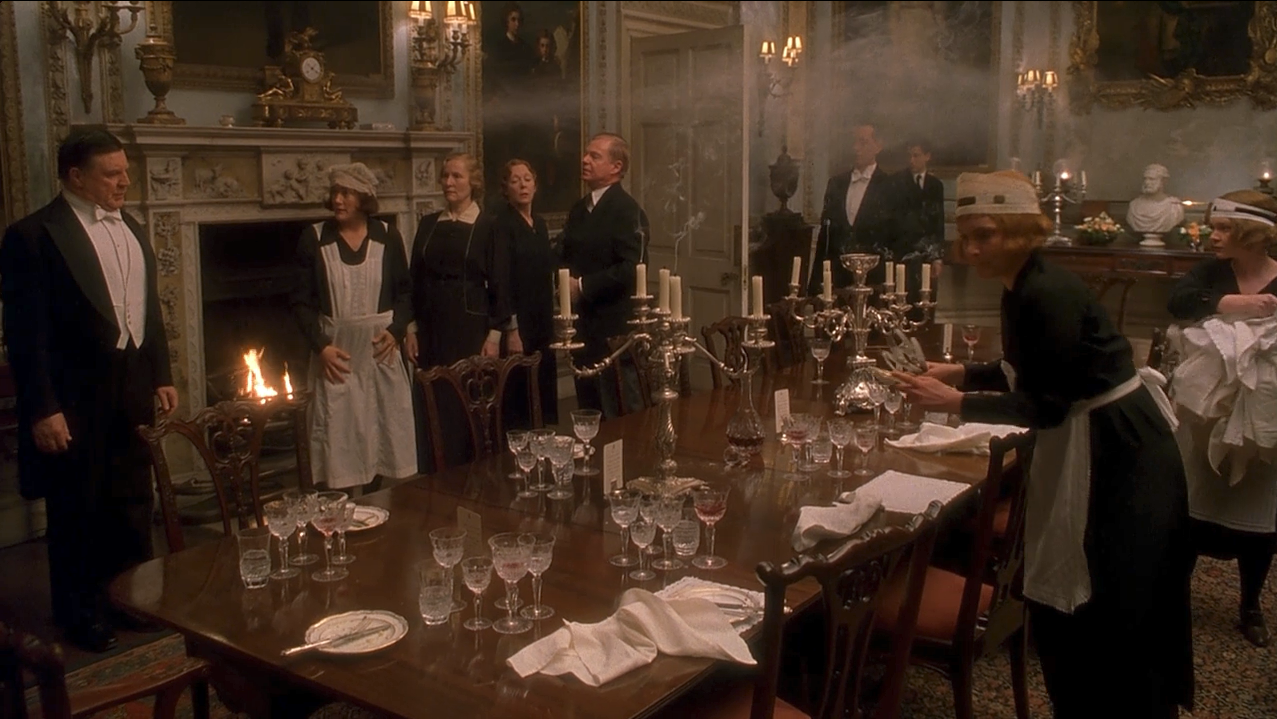
The servants themselves are bits of furniture, or barely acknowledged at all. Altman doesn’t shoot a single scene without a servant present, but this often hammers home their irrelevance to the upper classes (it’s made even more effective by seeing actors like Bates, Jacobi, Grant, Macdonald, Owen and Watson essentially being treated as extras). There are no bonds between upstairs and downstairs at all. Any upset witnessed on either side is responded to with silence. When Emily Watson’s Elsie (a brilliant performance of arch awareness of her place) momentarily forgets herself and speaks out at the dinner table, it’s treated like she has crapped on the floor – needless to say her career is finished.

The servants however echo the pointless rituals and ingrained hierarchy of their masters below stairs. For ease (!) the house servants insist the visiting servants are only addressed by the names of their employers not their own names. At their dinner table, their seating reflects the hierarchy of their employers. Many of the servants are more grounded and “normal” than the upstairs types, but they are as complicit in this system continuing as anyone else. They simply can’t imagine a life without it, and accept without question their place at the bottom rung of the house. 

Ryan Phillippe, later revealed as an actor masquerading as a servant (for research), immediately shows how hard it is to move between the two social circles. The servants despise him as a traitor who may leak secrets about their views of the employers. The guests see him as a jumped up intruder, even more vulgar than Novello and Weissman. His later humiliation is one of the few moments that see both sides of the social divide united (it’s fitting that it is an act of cruelty that reinforces the social rules that brings people together). 

The focus is so overwhelmingly on the class system – with Altman’s brilliant camera work (the camera is never still) giving us the sense of being a fly-on-the-wall in this house – that you forget it’s a murder mystery. Here the film is also really clever, archly exposing the harsh realities of the attitudes held by your standard group of Christie characters. Dance’s Lord Stockbridge in a Christie story would be a “perfect brick” but here we’ve seen he’s a shrewd but judgemental old bastard. The film throws in a clumsy Christie-style incompetent police detective, played by Stephen Fry. This is possibly the film’s only real misstep as Fry’s performance touches on a farcical tone that seems completely out of step with the rest of the film. But the Christie parody is generally wonderful, exploding the cosy English world the public perception believes is behind Christie (even if the author herself was often darker than people remember!).

It’s a hilarious film – Maggie Smith in particular is memorable, from cutting down her fellow guests, to judgementally tutting at shop-bought (not homemade) marmalade – but it’s also a film that creeps up on you with real emotional impact. Kelly Macdonald is very good as the most “everyday” character, who takes on the role of detective and has superb chemistry with Clive Owen’s dashing valet. But the film builds towards a heart-rending conclusion – a conclusion that, with its reveal about the darker side of Gambon’s blustering Sir William, feels more relevant every day – that shows the secret tragedies and dark underbelly of these worlds, with a particularly affecting scene between Atkins and Mirren (Mirren in particular is such a peripheral figure for so much of the film, that her final act revelations and emotional response carries even more force).  It’s heart rending.

Gosford Park is a film continually misremembered as either a cosy costume drama or a murder mystery. It’s neither. It’s a brilliant analysis of the British class system and a superb indictment of the impact and damage it has had on people and the country. Hilarious, brilliantly directed by Altman with a superb cast – it’s a masterpiece, perhaps one of the finest films in Altman’s catalogue.

Ironclad (2011)

James Purefoy carries a big sword in nonsense medieval blood bath Ironclad

Director: Jonathan English

Cast: James Purefoy (Thomas Marshall), Brian Cox (William d’Aubigny), Derek Jacobi (Reginald de Cornhill), Kate Mara (Lady Isabel), Paul Giamatti (King John), Charles Dance (Archbishop Stephen Langton), Jason Flemyng (Becket), Jamie Foreman (Jedediah Coteral), Mackenzie Crook (Daniel Marks), Rhys Parry Jones (Wulfstan), Aneurin Barnard (Guy), Vladimir Kulich (Tiberius)

Let’s just take a moment to enjoy the fact that the most expensive film ever made entirely in Wales was directed by a guy called English. After that, you can enjoy the guilty-pleasure hack and blood nonsense of this sort of proto-Game of Thrones,which bears almost as much resemblance to British history as George RR Martin’s souped up re-tread with extra dragons.

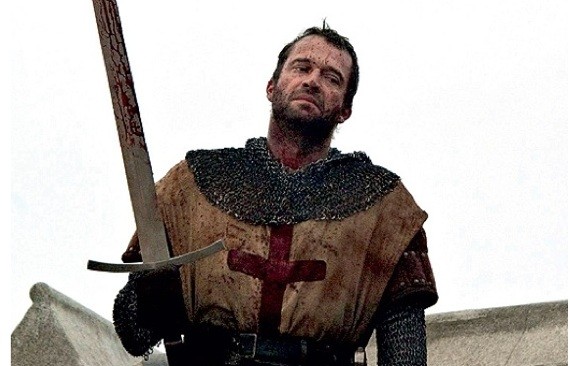
Anyway, King John (Paul Giamatti) has signed Magna Carta – as always that document which gave the barons some say in the government is here reimagined as some sort of manifesto for a socialist revolution – but now Rome has told John that he doesn’t need to stick to it after all. So John hires (honestly) a load of Viking warriors to take out his enemies. Yes that is just as silly as it sounds. Before we know it, the barons need to take control of Rochester Castle, a stronghold which is apparently the key to the south of England. So Baron William d’Aubigny (Brian Cox) puts together a “Dirty Dozen” (well Dirty Half Dozen, it’s a British budget after all) to defend the castle, led by Templar knight Thomas Marshall (James Purefoy). Let the siege begin!

If that doesn’t give you an idea of the way the film mixes and matches parts of British history into some sort of heady brew, I don’t know what will. We got King John! We got Magna Carta! We got Templar knights! We got Vikings! All of this is frozen into a hyperviolent mixture of historical epic and “men on a mission” war film, with added limbs flying off left, right and centre. Most of it is delivered at an absurdly energised pace. At least all involved seem aware that they are making a stoopid B movie, rather than some sort of genuine historical epic.

Criticising the history of the supposed historical epic seems completely superfluous, so instead sit back and enjoy the skill with which Jonathan English apes Neil Marshall in his blood letting and imaginative slaughter. Sure, he hasn’t got Marshall’s narrative skill or his ability to carve human interest out of even the most basic cardboard characters. But he still manages to present what we see with enough sense of action and adventure. Ridiculous as it might feel that a tiny group of men holds off an entire legion of King John’s troops, you sort of go with it as the film is shot with enough sense of ragged viciousness that you don’t notice the gaps in the tiny budget (less than a single episode of Game of Thrones). 

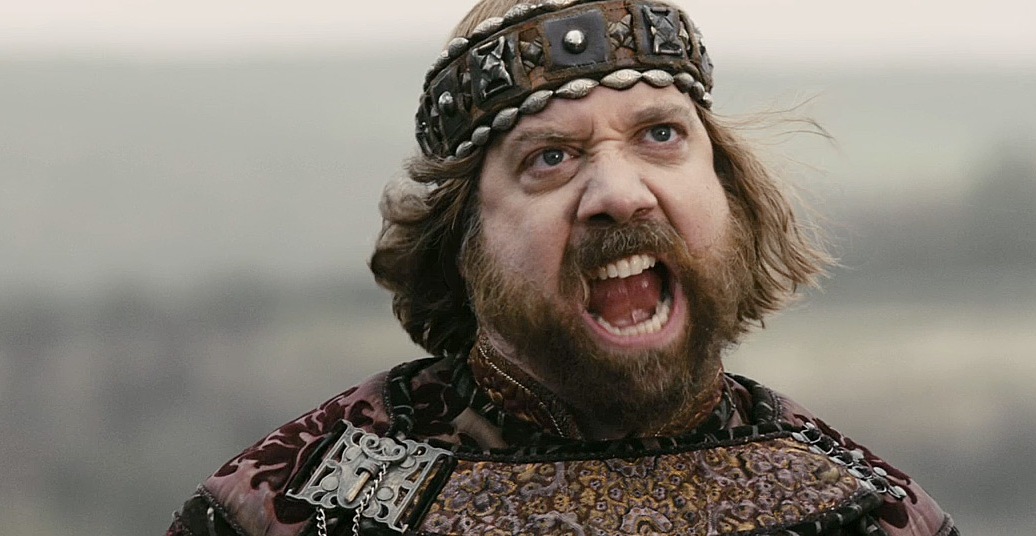
The actors all know they are in something rather silly as well. It’s a bizarre mixture of people, from Hollywood star character actors to B-movie stalwarts to Brit TV stars to slumming classical actors. James Purefoy grounds the stuff with his usual commitment and charisma. Just as well he does as Paul Giamatti clearly rocks up in the spirit of a lark, hammily overacting to such a ludicrous degree that he sounds like John Adams on a bad acid trip. It’s a surprise they don’t turn him on the walls of Rochester Castle and let him chew through the defences. Between these two hardly anyone else gets a look in, although Brian Cox does well as the brave leader of the castle who suffers a particularly brutal death involving mutilation and imaginative use of a catapult. 

Some typically subtle restrained work from Paul Giamatti

There are some impressive set pieces and some very stirring bits of head mashing, limb slicing violence but the overall plot is completely bog standard, as if with all that investment they either didn’t have time to put a story together or felt that they needed to make something that would appeal as much as possible to the lowest common denominator in order to recoup the costs. But at least there is a nice sense of growing comradeship between this hardy gang fighting against the odds and the film gets some sense of honour and duty being causes worth dying for against tyrants. I mean, it’s not there in spades, but it’s there.

And if you like this sort of B movie hack and dash stuff you’ll probably actually rather like this. Heck I’ve seen it twice, and I found the second viewing actually rather good fun in particular, especially as I knew going into it the entire film was an absolutely absurd pile of nonsense designed to just let you watch blood spray across the screen and heads depart bodies. Roll with it – put your critical facilities on hold and forget the history – and you will rather enjoy its earnest B movie antics.

The Imitation Game (2014)

Benedict Cumberbatch saves the world in smug, empty mess The Imitation Game

Director: Morten Tyldum

Cast: Benedict Cumberbatch (Alan Turing), Keira Knightley (Joan Clarke), Matthew Goode (Hugh Alexander), Rory Kinnear (Detective Nock), Allen Leech (John Cairncross), Matthew Beard (Peter Hilton), Charles Dance (Commander Alastair Dennison), Mark Strong (Maj General Stewart Menzies)

“Sometimes it is the people no one imagines anything of who do the things no one can imagine”. If there is anything that captures the smug self-satisfaction of this ludicrously pleased-with-itself film, it’s that convoluted phrase, with which the film is so pleased that it is repeated no fewer than four times. What does it mean really? Nothing of course, it carries all the meaning of a fortune cookie. Turing is certainly someone whom you could expect something of, since the film is at pains from the start to demonstrate he is a maths prodigy and a genius. But then that would spoil the romance of the film suggesting that because Turing is socially maladjusted, he is somehow unlikely to achieve something – or that achieving something would be even more special having overcome the “disability” of his personality.

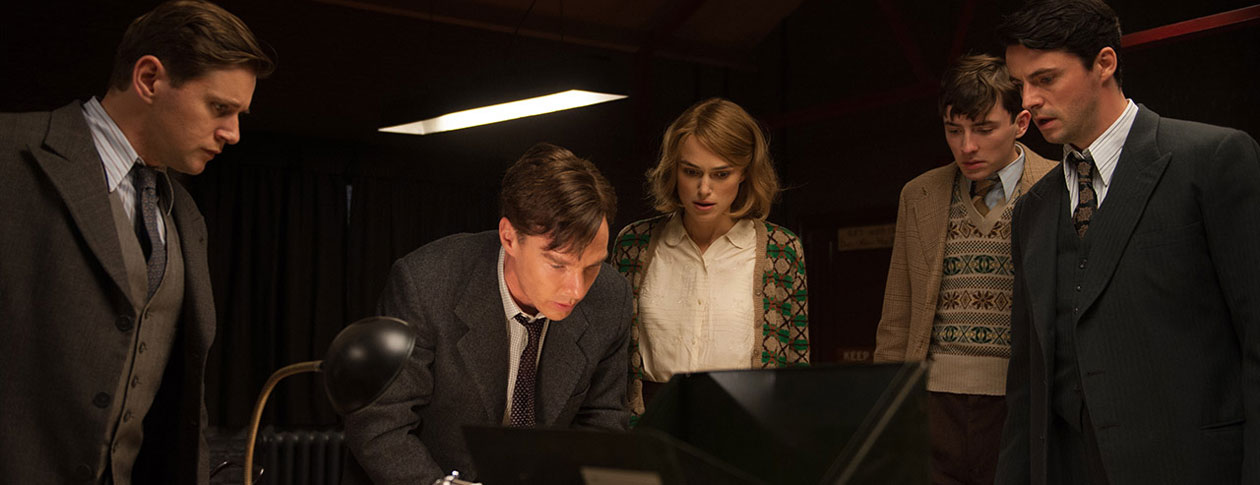
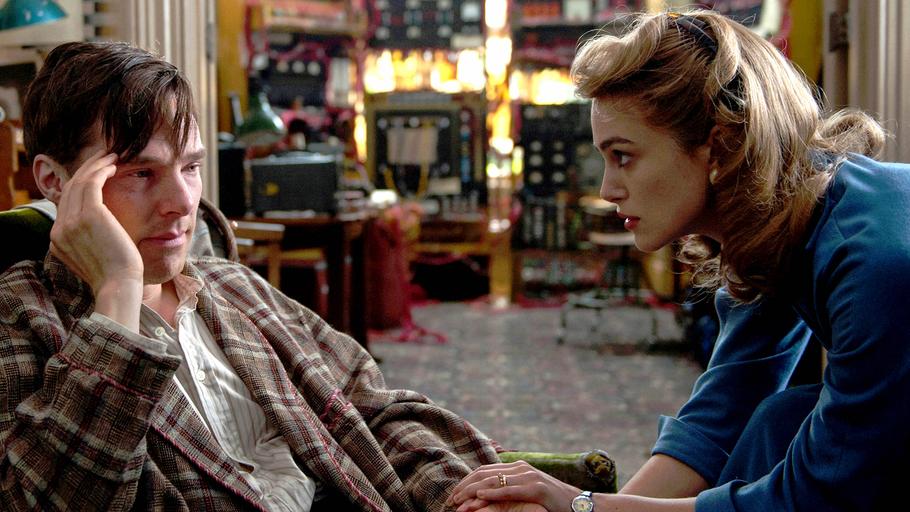
Alan Turing (Benedict Cumberbatch) is under police suspicion in 1951 after a mysterious break-in at his Manchester home. A keen detective (Rory Kinnear) suspects he may be a Russian agent – why else does he have no military record? But we know different, as flashbacks show Turing working at Bletchley Park on the cracking of the German cipher machine Enigma. Working with the support of an MI6 officer (Mark Strong), Turing has to win the trust of his team – with the support of best friend and maths genius Joan Clarke (Keira Knightley) – to build a ground-breaking computer that could crack the impossible code. But back in 1951, Turing is in trouble: he’s gay and that’s a crime in post-war Britain.

Now, Turing’s personality in this film. In real life, Turing was an eccentric, but perfectly capable of functioning perfectly normally in society. That’s not dramatic enough for the film, so Turing is reimagined as someone practically afflicted by Aspergers syndrome, incapable of understanding or relating to people without severe effort and prompting. Of course this is really there to introduce conflict – first with his team (who need to be won round to loving the old eccentric genius), secondly with his boss (who can’t stand his inability to fit in) and thirdly with the police (who can use it to write him off). It’s a film-disability for a character to overcome, another puffed up triumph that we can celebrate, while at the same time pat ourselves on the back because this is a victory for those “not normal”. But it’s probably bollocks. 

But then that fits in rather nicely with the whole film, which is more or less probably bollocks from start to finish. The film of course can’t dramatise maths or computing very well, so it throws us all sorts of feeble clichés from tired old film genres instead. Charles Dance plays a reimagined Denniston (in real life a cryptographer) as a standard obstructive boss who all but shrieks “you’re off the case Turing!” at the one-hour mark. The key moment of inspiration of course comes from flirty pub conversation with a charming secretary. Running around and frantic throwing of papers takes the place of all that boring maths. 

The film can’t resist any level of dramatic cliché. When a member of the code-breaking team mentions in passing “I have a brother in the navy you know”, as sure as eggs is eggs you can bet the team will decipher a message that could save his life but will be forced to make A Terrible Choice. Of course even this picture of a small code-breaking team making the calls themselves over which messages to act on is nonsense – it’s a decision that would be so far above their pay grade, they should be taking oxygen just thinking about it. But in this bonkers version of the universe, Turing  himself makes the call to keep the initial breaking of the code a secret, and the government happily allows him alone to make the call about which codes to act on. Oh for goodness sake, spare me.

But then this is a film that wants to turn Turing into the man who won the war single-handed. While Turing was one of the key figures who made the breakthrough, this was a massive team effort, not one man’s inspiration, and reducing the victory of the war down to one (film cliché) difficult genius is the same old ripe nonsense we’ve seen many, many times before. The film tries to pretend that Bletchley Park and the breaking of Enigma, and Turing himself, is an unknown story – when it’s been pretty well-known since it was announced by the Government in the 1980s.

The film is rubbish, but it’s also gutless. Of course “fifth man” John Cairncross is part of the team – and of course Turing discovers he is a spy. (The reveal of course is due to the same old tedious movie cliché of “I found a book on his desk that was the key book he used for the code”.) And then in a moment of stunning tastelessness, Cairncross blackmails Turing into keeping his mouth shut which he agrees to do – an action that, if it had ever happened in real life, would have been an appalling moment of treachery from Turing, and reinforces all the suspicions of the time that homosexuals couldn’t be trusted. 

Ah yes, homosexuality. This film is very, very, very proud of its crusading actions to expose the cruel treatment of Turing for his homosexuality. At the same time, the film is of course way too gutless to even begin to show Turing doing anything actually gay (he doesn’t even so much as hold another man’s hand) during the film. The one genuine moment of love the character is allowed to express, is in the form of a crush on a schoolfriend. (The film substitutes renaming Turing’s machine “Victory” after this school friend “Christopher”, the film keen to try and plug the gap of this film featuring virtually no LGBTQ content at all). But the film preaches intensly and proudly about the equal rights of homosexuality, while veering away with squeamishness from putting anything remotely homosexual on the screen.

The shoddy writing, over-written and self-important, is matched up with Morten Tyldum’s flat, “prestige” film-making that reduces everything to a chocolate box. The film does have some acting beyond what it deserves. Benedict Cumberbatch is good as Turing, although his performance is a remix of some of his greatest hits from past projects, from Hawking to Sherlock, and you feel hardly it’s a stretch for him – even if he plays with it real, and genuine, emotional commitment. Keira Knightley’s cut-glass accent is practically a cliché, but this is one of her best performances with real warmth and empathy. Most of the rest of the cast though are serviceable at best.

“Serviceable”, however, is still better than the film itself, which is a cliché-ridden, gutless, plodding and highly average pile of nothing at all – a totally over-hyped, over-promoted and completely empty film that is about a zillion times less interesting, brave or revealing than Hugh Whitemore’s 1980s play Breaking the Code. Not worth your time.

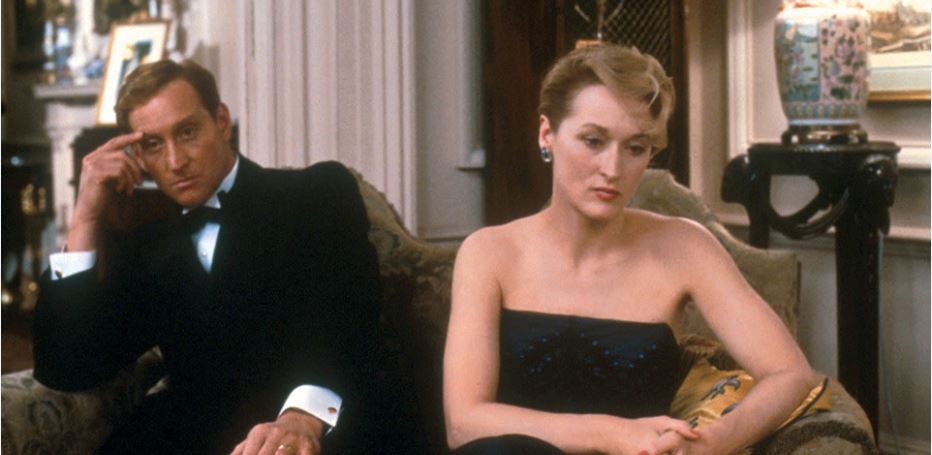
Plenty (1985)

Charles Dance and Meryl Streep endure marital misery in the bleak, oblique and uninvolving David Hare drama Plenty

Director: Fred Schepisi

Cast: Meryl Streep (Susan Traherne), Charles Dance (Raymond Brock), Tracey Ullman (Alice Park), John Gielgud (Sir Leonard Darwin), Sting (Mick), Ian McKellen (Sir Andrew Charleson), Sam Neill (Lazar)

David Hare’s 1970s play Plenty looked at the impact of peace on the war generation. A “state of the nation” story on the growth of prosperity in the post-war era, and the return of many to the humdrum reality of life with Britain’s importance as a world power in rapid decline, led to isolation, anger and depression. It’s a shame that much of that really doesn’t come across in this buttoned-up, murky and unclear social drama, with a hard-to-follow plot and a hard-to-like central character.

Susan Traherne (Meryl Streep) is an SOE courier in France during the Second World War, who has a one-night stand with fellow SOE operative Lazar (Sam Neill) which has a profound effect on her. After the war, she marries Foreign Office civil servant Raymond Brock (Charles Dance), but is unable to find a purpose and contentment in regular civilian life. As the years tick by, and their surroundings grow ever more plentiful, Susan becomes more and more unhappy, difficult and demanding.

The central issue with Plenty (I can’t comment on the play, having never seen it) is that Meryl Streep creates possibly one of the least likeable leading performance you are going to see. Perhaps mistaking Britishness for cut-glass chill – or perhaps it’s the character – Streep’s Susan is brittle, bitter, angry, annoying and infuriating. She complains about everything around her, she lashes out at people, she sulks and whines with no self-insight, she constantly makes life difficult for those around her (most of whom are unbelievably patient) and she is almost impossible to work out. 

While the film perhaps intends her to be as sort-of PTSD sufferer, with undiagnosed personality disorders, who cannot reconcile the shallowness of her life with the excitement of war service, I’m not sure this comes across. All we really see is her deeply irritating self. We don’t get a sense of her war service – we see her breakdown early in the film in France – and her relationship with Lazar remains so ill-defined we are unclear what impact it had on her, other than part of a halcyon memory. The film’s final scene is a flashback to the end of the war: Susan watching a sunrise on a French hill dreaming of her life being full of days like this. That scene would have been helpful earlier – it’s the only time we see her optimistic or likeable in the film, and it gets lost by placing it at the end. With it in order we could have warmed to her more.

Instead she remains a shrill presence, in a hard to relate to film that never really makes clear whether we are meant to empathise with Susan, or find her as frustrating as some of the characters do. The film also fails to make this enigma part of its viewing design – I don’t feel like having the lines blurred made the film a richer experience, just one it was harder to engage in. Schepisi’s directing style is very cold and distant – from the slow camera moves, to the tight close ups on Susan at key moments, to the deliberate lack of clear time line (each scene moves on weeks, months or years from the previous one with only a few design and dialogue hints to suggest the change).

Combined with Hare’s indefinable script – crammed with elliptical conversations, unclear emotional and dramatic points, and political points delivered with a querying shrug – it makes for a film that is very hard work to engage with – and doesn’t offer much to reward the viewer if they do. 

What pleasures there are come from the performers. Charles Dance is good as Susan’s long-suffering husband – far from a domineering patriarch, his only real crime seems to be that he is a bit boring. Ian McKellen makes a great cameo as a senior civil servant, coolly and calmly telling Susan the errors of her thinking. Sting is an odd choice (I suspect his presence helped the film get backing) and Tracey Ullman does tend to go too far as Susan’s bohemian but more emotionally restrained friend.

John Gielgud steals the show. He is simply superb as Brock’s boss, an old-school diplomat who is, at first, a figure of fun with his Edwardian values but whom events (in particular Suez) reveal to have firm principles. Gielgud also gets most of the film’s best lines, while his quiet air of polite dignity is both endearing and admirable. His delivery of the following line to a tedious bore of a party guest basically is the high point of the movie: “But perhaps before I go, I may nevertheless set you right on a point of fact. Ingmar Bergman is not a bloody Norwegian, he is a bloody Swede.”

But there aren’t enough pleasures like this in this overbearing, rather trying film that never really decides what point it’s trying to make. I think it’s something about wealth and discontent and the more selfish and scrambling build of the post-war generation towards Thatcherism. But I’m really not sure. And to be honest I’m not sure I care.

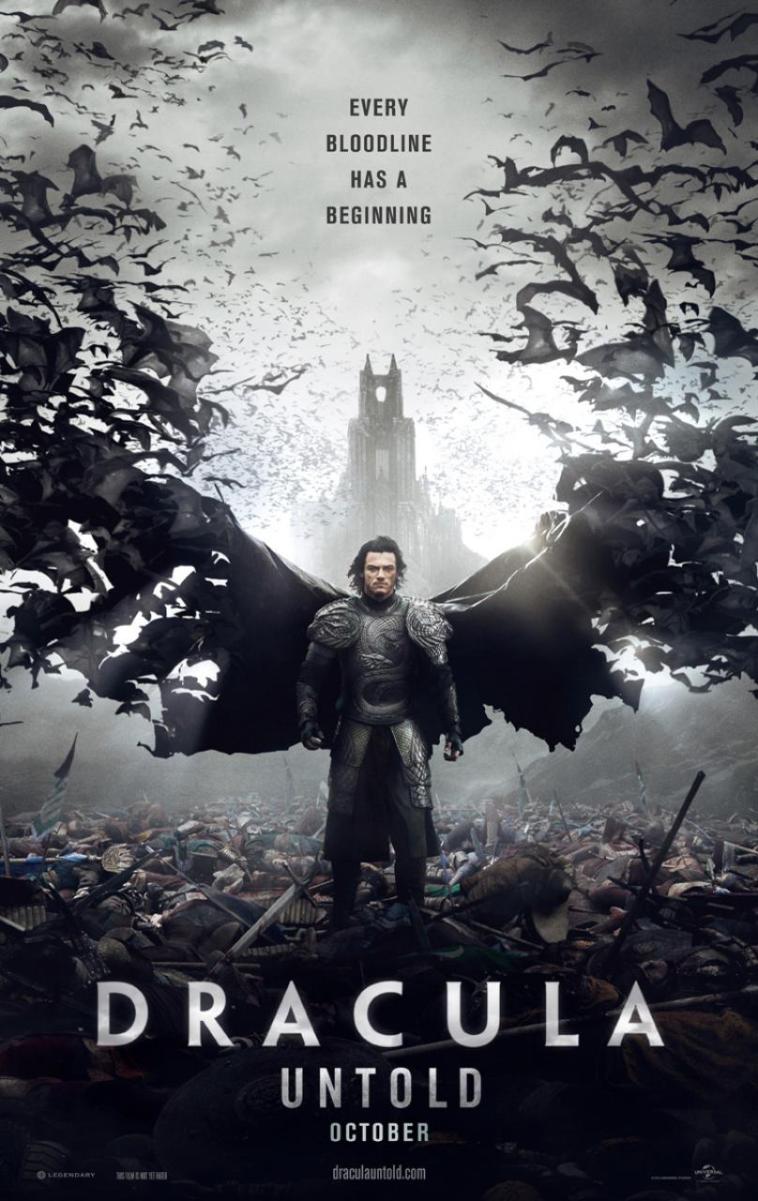
Dracula Untold (2014)


Luke Evans rises above another terrible film in this first terrible attempt to launch a “Dark Universe”

Director: Gary Shore

Cast: Luke Evans (Vlad the Impaler/Dracula), Dominic Cooper (Sultan Mehmet III), Sarah Gadon (Mirena), Art Parkinson (Ingeras), Charles Dance (Master Vampire), William Houston (Cazan), Diarmaid Murtagh (Dumitru), Noah Huntley (Captain Petru), Paul Kaye (Brother Lucian)

Every studio wants its own Cinematic Universe. Because the lesson from Marvel’s patient and excellent build of an entire world is that people will come and see every single film you make in a series. Right? Perhaps that explains the painful attempts of Universal to turn one of their few recognisable assets – monster movies – into some sort of bizarre linked universe. The project is currently in terminal decline after the flop of Tom Cruise’s The Mummy. But before that, a reboot had already been attempted with this bizarre retelling of the Dracula origins story.

Vlad the Impaler (Luke Evans) is a guy who wants to put his life of impaling behind him. All he wants is to lead his people peacefully in Transylvania. So imagine his disappointment when his boyhood rival Sultan Mehmet III (Dominic Cooper) arrives and demands the tribute of the first born sons of Transylvania – including Vlad’s son Ingeras (Art Parkinson). Vlad umms and ahs and then he decides – y’know what – not on his watch. But how can he keep his people, his son and wife (Sarah Gadon) safe? Well the only solution is to take on the mighty Power of the Vampire from a mysterious cave-dwelling creature (Charles Dance). Vlad now has unlimited strength for three days – but can he resist the craving for human blood that will make the transformation permanent? And will the powers last long enough to repel the Turks?

Okay. So obviously this film is complete rubbish. I mean it really is. It’s hilariously overshot – the action sequences are frequently hard to follow, so swiftly does the camera swoop and swirl like the bats Vlad can transform into. Shore is in love with showy shots – one battle is seen through the reflection on a CGI sword that is thrown in the air and twirls in an arc downwards (yes it is as complex and unengaging as I made it sound).

The plot is complete bobbins. It’s all “Forsooth my lord” and “We make for the monastery!” (a building, by the way, of unlimited size that seems genuinely able to accommodate most of the population of Transylvania). The film wants us to remember that Vlad is a cool bad-ass but also that he is ashamed of his life of sticking people on poles (needless to say, his signature move breaks out eventually). Vlad is a vampire and a monster – but he is also someone we need to root for, so he is portrayed as a lovable family man who never really seems that tormented by urgings for blood.

Luke Evans. One day he will be a star. If you could find a good performance in a terrible, stupid film it would be his. He is fully committed and he gives the part so much emotional depth – way more than is in the script. He really, really sells Vlad’s humanity and makes his character feel like a warm, lovable guy – but he mixes it with an edge behind the noble call of duty. Evans is genuinely rather good in this. The guy deserves so much better.

I’ll give a pass as well to Sarah Gadon and Art Parkinson, who at least treat the parts with a certain respect. Charles Dance has fun under bizarre make-up as a wizened monster. Everyone else is here to be as over-the-top and stupid as possible – not least Dominic Cooper, whose ludicrous accent, utterly unimposing frame and inexplicable sudden detailed knowledge of vampires makes for a deeply stupid, bad performance. But then everyone is going for it – Paul Kaye leaves no piece of scenery unchewed in his brief performances – and going for it badly. Everyone comes out of it badly.

The plot makes no sense: a strange gypsy emerges from nowhere to try and serve Vlad (why?) and then only returns at the end to help set up a sequel-that-never-came. Every decision Vlad makes is terrible. The villagers oscillate wildly from pathetically grateful yokels to “burn him!” lunatics to – well it would be spoilers, but let’s just say there is quite the body count. In fact, the only thing really interesting about the story is wondering what will make Vlad remain a vampire (which we all know he will do) – of course it is a “noble sacrifice”.

The biggest problem with the film is that Vlad is both far too powerful and far too noble. Since he can literally kill thousands of people single handed, why does he waste time taking his people into the woods – why not ride out single handed to meet the Turkish force and take them out? If he is so noble that he is never tempted once to keep the powers of a vampire for selfish reasons, where is the dramatic tension?
The film eventually ends in another overblown, stupid fight scene with bats and invulnerable vampires flying about the place. That’s before we head into an unearned coda in the modern age which sets up a sequel that is not coming, and includes a few groan-worthy references back to the original novel. But then this is a cartoon made by people who thought that they didn’t need to bother to make a good movie at all if they slapped the Dracula name on it.  I suppose you could say it’s just trying to entertain: but with no real interest in doing anything other than making more movies off it later, it’s a bit of a pointless mess.