Tag: Chris Cooper

American Beauty (1999)

Kevin Spacey and Annette Bening excel in the dated Best Picture winner American Beauty

Director: Sam Mendes

Cast: Kevin Spacey (Lester Burnham), Annette Bening (Carolyn Burnham), Chris Cooper (Colonel Frank Fitts), Thora Birch (Jane Burnham), Wes Bentley (Ricky Fitts), Mena Suvari (Angela Hayes), Peter Gallagher (Buddy Kane), Allison Janney (Barbara Fitts)

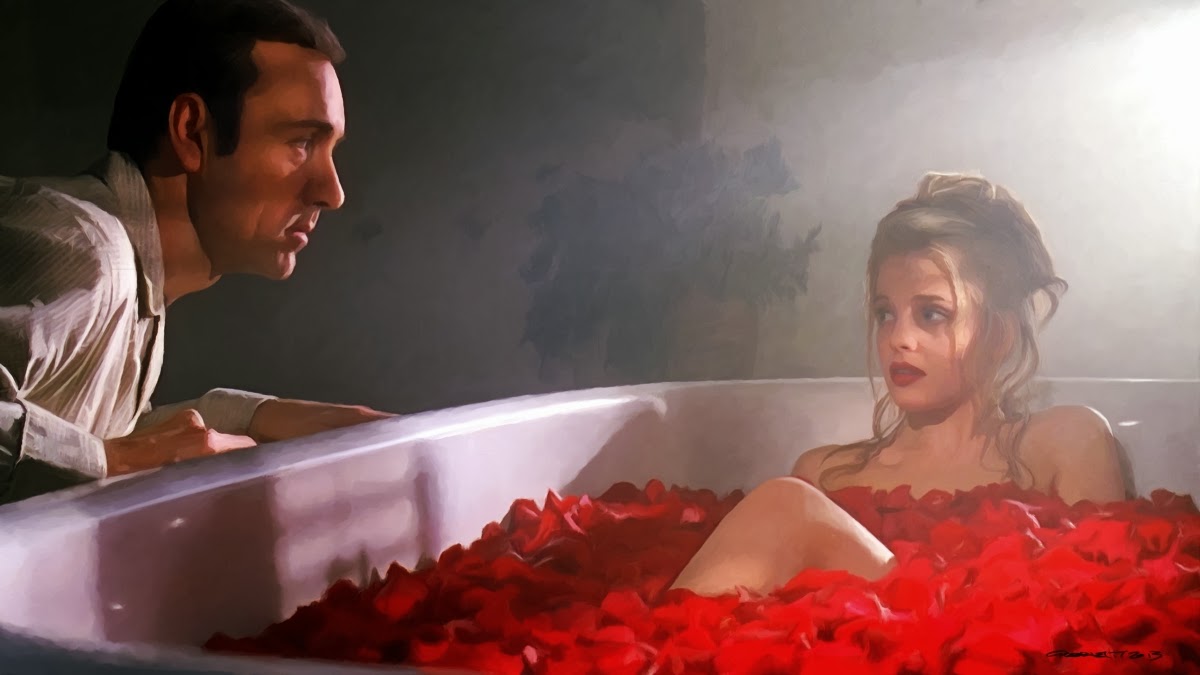
Time has not been kind to American Beauty – and I’m not just talking about Kevin Spacey. In 1999, what felt like a timely exploration of male-angst has, over time, looked less prescient and more like the last embers of a generation that thought they were The Graduate’s Benjamin but actually became his parents. Many of the sympathies of American Beauty now feel dated and slightly misguided, or obscure some genuine reflections on its characters. Its satire of consumerism feels trapped in the 90s. But it’s also very skilfully made, often funny, beautifully shot and you can see why it seemed like the next landmark masterpiece of American cinema, an Apartment for the modern age.

In suburbia, Lester Burnham (Kevin Spacey) is a middle-aged, middle-ranking magazine executive, tired of his life, unhappy in his marriage to Carolyn (Annette Bening), a fiercely ambitious real estate agent, and drifting away from daughter Jane (Thora Birch). He is snapped out of his ennui by his infatuation with Jane’s friend and fellow-cheerleader Angela (Mena Suvari). Next thing we know, Lester realises he hates his life, quits his job (blackmailing his boss on the way), buys the car of his dreams and takes a job flipping burgers – to the bewildered frustration of Carolyn, who starts an affair. Meanwhile Jane becomes intrigued by Ricky (Wes Bentley), the film-obsessed and drug-dealing son of their next-door neighbour, homophobic army colonel Frank (Chris Cooper). Oh, and it’s all narrated from beyond the grave by Lester – so we know it won’t end well.

“There is nothing worse than being ordinary” says Ricky at one point. It’s an attitude that underlies the film. American Beauty has that very showbiz attitude that the lives most ordinary people lead must be rather shallow and empty. That there can be no meaning in the life of suburbia, family and 9-to-5 that so many of us lead. A sharper film would have added depth and contrast to this – but American Beauty is a film that, for all its quality, is also very pleased with itself.

American Beauty’s debt to Billy Wilder is central to its DNA. It plays often as a mix of The Apartment and Sunset Boulevard, with Spacey skilfully channelling a twist of Lemmon as Burnham. Saying that, I can’t believe Wilder would have been as easy on Lester as Ball and Mendes are. Surely Wilder would have seen through the self-serving selfishness and sad delusion that underlie Burnham’s mid-life crisis, fuelled by his fears of emasculation.

It’s that fear running through American Beauty and – for all it looks at first like a satire on suburbia – what came out to me on rewatching is that parallel narrative of two men suffering familiar masculine crises. Burnham, the office drone, ignored at work, playing second fiddle to his wife at home. He doesn’t wear the pants anywhere – his wife chooses the music they listen to, the events they go to, she doesn’t even let him drive the car. Teenage dreams of rebelling disappeared. He’s forgotten what it feels like to be a man. Then there’s Colonel Fitts, the man’s man struggling with self-loathing due to his deeply repressed homosexuality. These are fairly conventional stories.

Lester’s story takes centre stage (even the name Lester Burnham is wimpy). Outstandingly played by Kevin Spacey, who was never better or more humane, Burnham is endearing, rather sweet, clutzy but still has that sharp-tongued Spacey sense of wit. The opening sequences perfectly capture Burnham’s Jack-Lemmonish awkwardness, repression, inadequacy and depression. But  if anything, Spacey is almost too sympathetic in the role, masking the selfishness and self-serving nature of Burnham’s mid-life crisis (which is what it is), urging us to celebrate his rules-bucking independence.  The film never gets to grips with the spark for all this being a sexual obsession with a teenage girl.

American Beauty never questions the sleazy corruption of Lester’s fantasy – and is perfectly happy with using his crush as a positive motivation for getting his mojo back, as well as frequently presenting Angela as a Lolita-esque fantasy. He holds back from sex with her when she confesses she is a virgin – but the film offers no “what am I doing” epiphany from Lester (or a realisation that he is about to sleep with someone literally young enough to be his daughter), instead turning this exploitative moment into an expression of some decency in Lester. Sure, it’s great that Lester realises his responsibilities eventually – but even in 1999, we all knew it was wrong for middle aged men to sleep with impressionable school-children.

The fact is that Election, released the year before, had more to say about exactly the sort of underperforming, thinks-of-himself-as-a-failure resentment of men of Burnham’s ilk – the difference being that Matthew Broderick’s Jim McAllister in that film is exposed as a bitter self-serving fantasist, which is what Burnham really is. Burnham’s dying moments may be full of reflections on his wife and daughter – but he ignores them or treats them with scorn throughout the film.

And there isn’t, I feel, a satirical note to this. Instead, the film roots for Burnham strongly, asking us to admire his late life rebellion. Maybe it’s the conservative in me – maybe it’s because I don’t much like The Graduate either – but I don’t feel it. Spacey is great – but Burnham is selfish and embodies a concern in certain men that career-minded women and suburbia were turning them from hunter-gatherers into hen-pecked losers. American Beauty is a direct development of the masculinity crisis films Michael Douglas specialised in throughout the 80s and 90s, of men lost in a world that isn’t 100% about them and what they want any more.

The film’s parallel plot of Fitt’s homosexuality crisis is even more familiar than Burnham’s and hits many expected bases – there are no real surprises here for anyone who has ever seen a film before. It largely works as it is so outstandingly sold by Chris Cooper, who gives a brilliantly rich and raw performance as Fitts.

But its faint whiff of predictability fits alongside a script that is often very rich on dialogue, but has a vein of pretention to it that makes the film feel it’s striving to be important. Ball’s dialogue too often undermines its own points with the stench of pretension. The teenagers in the film fall into broadly predictable cliché. The arty, dreamy ones are profound; the pretty one is shallow and flighty (although, to be fair, is shown to also be vulnerable and scared). Bentley’s character’s faux-artiste musings on the movements of a plastic bag are exactly the sort of pretentious ramblings Ball would later puncture so effectively with the college art classes in Six Feet Under. These scenes have dated terribly and ache with self-importance (and are ripe for parody).

But there is quality here, don’t get me wrong. Spacey is superb, Cooper brilliant. Annette Bening is pitch-perfect as a career-focused woman who lives her life through self-help mantras but is only just holding it together. It’s a shame that, just like Mrs Robinson, the film is so full of sympathy for its male protagonist that it has no time to empathise fully with its female lead.  Mendes directs with a stunning confidence for a first-timer, drawing brilliant performances from the actors as well as bringing a startling originality to the filming (in partnership with Conrad Hall as photographer).

But American Beauty never turns its “look closer” message on itself. It uncritically examines a particular masculine crisis and often makes points that are witty but simple. The final act becomes weighted down with a tiresome “whodunnit?” mystery. The acting, direction and much of the writing is frequently brilliant. But the film itself, as a whole, has not aged as well as we thought it might.

Little Women (2019)

March Sisters: Assemble! For Greta Gerwig’s superlative adaptation of Little Women

Director: Greta Gerwig

Cast: Saoirse Ronan (Jo March), Emma Watson (Meg March), Florence Pugh (Amy March), Eliza Scanlen (Beth March), Laura Dern (Marmee March), Timothée Chalamet (Laurie), Meryl Streep (Aunt March), Tracy Letts (Mr Dashwood), Bob Odenkirk (Father March), James Norton (John Brooke), Louis Garrel (Professor Friedrich Bhaer), Chris Cooper (Mr Laurence)

Spoilers: Such as they are but discussion of the film’s ending (or rather Greta Gerwig’s interpretation of it) can be found herein…

There are few novels as well beloved as Louisa May Alcott’s Little Women. So much so – and so successful have been the numerable adaptations, not least Gillian Armstrong’s 1994 version – that it’s hard to see what a new adaptation could bring to the story that hasn’t been covered before. A new window on the story is triumphantly found though in Greta Gerwig’s fresh and vibrant adaptation, blessed with some terrific performances, and telling its own very distinctive version of the story.

Gerwig’s version crucially starts off in the sisters’ adult lives: Jo (Saoirse Ronan) in New York struggling to make it as a writer, while Meg (Emma Watson) nurses the ill Beth (Eliza Scanlon) back home with Marmee (Laura Dern), and Amy (Florence Pugh) encounters their childhood friend Laurie (Timothée Chalamet) in Paris. This is intercut with the story of their growing up in Massachusetts, with the past story line eventually catching up with the present day. 

If that sounds like it should make the story hard to follow, don’t worry – this is astonishingly confident work from Gerwig, wonderfully directed with zest, fire and imagination (making her exclusion from the Best Director list at the Oscars even more inexplicable – chalk that up I guess to sexism against pictures about “girls” and the fact it’s not as overtly flashy as the rest of this year’s nominees). This takes a familiar book, and fires it up with all the energy of independent, modern cinema, creating something that feels hugely fresh and dynamic. The cross cutting between the two timelines work beautifully – not only is it always perfectly clear, but it also makes for some wonderful contrasts between events in the past and present. None less than the recovery of Beth from TB being followed (with an almost shot-by-shot echo in its filming) by the reactions to Beth’s death. Inventions like this add even greater depth and meaning to the moments and hammer home some terrific emotional high points. 

Gerwig’s style throughout the film invests the story with a great energy, particularly in creating the warm bohemian attitude of the March family. This really feels like a family – conversations between them are fast, people talk relaxedly over each other, the chemistry is completely real, and the camera captures in its movement the warmth and energy of these characters who are completely comfortable in each other’s presence. It’s no surprise that Laurie is taken so quickly with this family, or wants to be part of it. Gerwig invests the family with a dynamic, excited sense of freedom and urgency. Helped by the warm glow that the childhood sections of the film are shot with, these scenes hum with a glorious sense of familial warmth and excitement. 

The camera often moves with careful, but perfectly planned, movement through scenes, mixed in with moments of fast movement – following Jo through streets, or the playful exuberance of Jo and Laurie’s first meeting (and dance) at a society ball. It’s a vibe that carries across to the performances, anchored by Saoirse Ronan’s fabulous performance as Jo. Fervent, intelligent, idealistic but also stubborn, prickly and difficult, Ronan’s Jo carries large chunks of the film, with the character skilfully mixed in with elements of Louisa May Alcott. Ronan most impressively suggests a warmth and familial love for Laurie at all times, that never (on her side) tips into a real romantic feeling. She also has superb chemistry in any case with the excellent Timothée Chalamet, who is just about perfect as a dreamy, but quietly conventional in his way, Laurie.

Gerwig’s primary rejig – and a reflection of the new structure she is chosen – is to allow more screen time to Amy, usually the least popular of the four sisters. She’s also helped by a sensational performance by the Oscar-nominated Florence Pugh as Amy, who not only plays a character perfectly from her mid-teens to her early twenties, but also invests the character with huge amounts of light and shade. The film gives a great deal of time to Amy’s time in Paris – her frustration with living in Jo’s shadow, her longing for her own artistic career (and recognition of her conventional talent – brilliantly established by a wordless glance Pugh gives an impressionist painting compared to her own literal effort) and her own romantic feelings and dreams. Cross cutting this with her past actions – her more temperamental and less sympathetic moments (burning Jo’s book!) that have pained generations – gives the audience far more sympathy and understanding for her. Pugh is also pretty much flawless in the film.

There are a host of superb performances though, with Watson capturing the duller sense of conventional duty in Meg, but spicing it with a sad regret for chances lost; Laura Dern is wonderfully warm as Marmee, but mixes in a loneliness and isolation below the surface; Chris Cooper and Meryl Streep sparkle in cameos. There is barely a false step in the case.

All the action eventually boils towards the ending – and Gerwig’s bravest and most unconventional decisions, in subtly adjusting the final conclusion of the story. At first it seems that the cross cutting of the story has short changed heavily the Bhaer-Jo relationship (Bhaer appears only in the first half an hour of the film and the end), as it cannot lean too heavily on romance when many in the audience will still be expecting a Jo-Laurie match up. 

But Gerwig actually uses this as a skilful deconstruction of the novel. Always feeling that Alcott desired Jo to be a single author – but inserted the marriage to Bhaer at the end to help sell the book – Gerwig effectively has Jo do the same thing. At a crucial moment in the final scenes, we cut to Jo negotiating with her publisher (a droll cameo by Tracey Letts), who insists on a happy ending. Cue a “movie style” chase to intercept a departing Bhaer (shot with the golden hue of the past, while Jo’s meeting with the publisher has the colder colours of the present). Our final shot shows Jo watching her book being printed, cross cut with a golden hued vision of “Jo’s” school with husband in tow. 

It’s a genius little touch, as it’s subtle enough to allow viewers to take the happy ending as it appears in the surface, but smart and clever enough to make the movie unique and different from the other versions (and that ending from the 1994 version is hard to top!). It may undermine the final relationship – and offend those who like the idea of Jo deciding she wants something different than she at first thought – but in its freshness it can’t be challenged. It also makes for a film from Gerwig that is both fresh and exciting and also bracingly and thrillingly in love with Alcott and her work.

Capote (2005)

Philip Seymour Hoffman excels as the morally complex author in Capote

Director: Bennett Miller

Cast: Philip Seymour Hoffman (Truman Capote), Catherine Kenner (Nelle Harper Lee), Clifton Collins Jnr (Perry Smith), Chris Cooper (Alvin Dewey), Bob Balaban (William Shawn), Bruce Greenwood (Jack Dunphy), Katherine Shindle (Rose), Amy Ryan (Marie Dewey), Mark Pellegrino (Dick Hickock)

What profits a man if he gains the whole world but loses his own soul? It’s the sort of summation that I imagine Truman Capote himself would object to as trite and obvious. But it’s a question at the heart of Bennett Miller’s thoughtful, low-key biographical drama that seems to capture not only the agony of writing and creation, but also something of the soul of its lead.

In November 1959, two drifters Perry Smith (Clifton Collins Jnr) and Dick Hickock (Mark Pellegrino) kill an entire family in a remote farmhouse in Kansas. News of this is spotted by Truman Capote (Philip Seymour Hoffman), a brilliant novelist and New York intellectual, looking for his new project. Heading to Kansas, with assistant, novelist and lifelong friend Harper Lee (Catherine Keener), Capote’s initial plan for an article on the reaction of small-time America to unspeakable violence balloons into a full scale book, fuelled by his growing fascination for Perry Smith. While the book takes years – and the trial and appeals of the killer take longer and longer to resolve, the entire experience has an increasingly haunting effect on Capote himself.

Miller’s quietly and professionally assembled film, with a superbly haunting, autumnal feel to it that immediately echoes the blackness of the crime, and the traumatic effect being involved in it has on Capote. It’s also a superb film that understands how writers often work – the seizing of inspiration, the quiet observation, the shaping of moments and titbits of conversation into perfectly captured sentences that can be reproduced in the book. It helps that Capote has – despite his larger than life unusualness and eccentricity – a sort of unusual chameleon like ability, or rather the ability of the charismatically self-obsessed to make all others yearn for his attention and approval.

It’s all part of the many facets of the Capote’s personality that is brought out in Hoffman’s superb performance. Winning the Oscar – and almost every other award going – Hoffman perfectly captures not just every single physical and vocal attribute of Capote, but also seems to seize part of his soul as well. This is such a masterful examination of a person’s psyche, mixed desires and conflicting feelings that Hoffman’s psychological insight seems totally legitimate. Hoffman’s performance is strikingly perfect, transformative in the way few actors manage.

Hoffman’s Capote is a man who flits between arrogance and a caring tenderness, self-doubt and ruthless, consideration and selfishness, who slowly becomes more and more unnerved not only perhaps by his fascination with a brutal killer, but also the own moral depths he is willing to go to. He’s manipulative, emotionally intelligent and genuine enough to gain the confidence of a wide range of people – from Chris Cooper’s gimlet-eyed agent investigating the case (won other by his wife’s fondness for Capote’s novels and Capote’s starry Hollywood anecdotes) to Perry Smith’s would-be intellectual and sensitive soul who is also a hardened killer. 

It’s that relationship with Smith that is the heart of the film, Captoe’s growing closeness with him akin to a seduction, Smith the willing talker, flattered to share his insights into life with the famous writer, Capote eager to gain secret confessions of what was flashing through Smith’s mind while he committed the killings. But it goes deeper than that: Capote grows – or persuades himself he does, so great is his deception – a genuine affection and regard for Smith, wanting perhaps to see that there is more to him than appears. Nursing Smith through a hunger-strike he feeds him by hand. He spends hours in his cell. He reads every scrap Smith gives him of his writing. There is a slight breathless tension to their scenes together, and Capote agonises over the idea of Smith being executed, even as he begins to be repelled by the influence of letting someone else into his life is having over him, and his ability to finish the book.

Because finishing the book is his aim, and his every action is based around getting to that goal. Every moment of flattery and openness gains some other advantage, every second of his time in Kansas is based around soaking up the information he needs to complete the work. But the book will never be complete and finished, because Capote himself has become such a part of the story – by becoming a part of Smith’s life – it seems to almost start draining Capote himself. Writing the book, is like writing his own life, pulling out elements of his own psyche, his own darkness, you feel Capote would rather not explore.

Because as much as he enjoys the recognition and glory readings of the book bring him – he is increasingly unnerved by his own ruthless treatment of Smith. Lying to Smith about the progress of the book, lying about the title, ignoring his phone calls, finally brow beating Smith into telling all of his story about the killing by disparaging all of Smith’s “insight” by claiming there is no concept or idea that Smith can express that has not already occurred to Capote. Smith is a killer, but he is also somehow a sort of lost boy – Collins performance brings a lot out of the strange innocence and promise in Smith – and it still alarms Capote privately that he can so use Smith, lie so completely to him and still feel such overwhelming unnerved grief – or fear or something – when Smith is executed, and execution he has done nothing to help prevent despite his promises to the contrary.

Capote feels equal mixed feelings about fellow writers. His partner Jack Dunphy (Bruce Greenwood in a very good performance) seems to accept his role as the lesser light – and their relationship works all the better for it. Easier than the friendship between himself and Harper Lee, superbly played by Catherine Keener. Keener and Hoffman have a natural chemistry, reflecting Capote and Lee who know each other so well they can literally finish each other’s sentences and completely understand each other. Capote however cannot accept Lee’s success of her own, striking a wedge in the relationship – just as Lee begins to believe that Capote is manipulating real people like fictional tools for his journalistic novel.

Capote tackles complex and fascinating ideas in a coolly well-assembled, extremely well directed, framework that gets some sense of the difficulties and challenges involved in artistic creation – and the moral compromises that some people are driven to make to achieve them. Not to mention the way we are can make ourselves increasingly more and more uncomfortable as we discover more and more about our own personalities and flaws.

Syriana (2005)

George Clooney gets crushed by the corruption of major oil companies in Syriana

Director: Stephen Gaghan

Cast: George Clooney (Bob Barnes), Matt Damon (Bryan Woodman), Jeffrey Wright (Bennett Holiday), Christopher Plummer (Dean Whiting), Nicky Henson (Sydney Hewitt), David Clennon (Donald Farish III), Amanda Peet (Julie Woodman), Peter Gerety (Leland Janus), Chris Cooper (Jimmy Pope), Tim Blake Nelson (Danny Dalton), William Hurt (Stan Goff), Mark Strong (Mussawi), Alexander Siddig (Prince Nasir Al-Subaai), Mazhar Munir (Wasim Ahmed Khan), Nadim Sawalha (Emir Hamed Al-Subaai), Akbar Kurtha (Prince Meshal Al-Subaai)

The more I think about Syriana the more I think Stephen Gaghan was unlucky. If he had made this story today, you can be sure this would have become a ten episode series on HBO or Netflix. Instead, Gaghan made it into a film in the early 2000s. This means the bloated, over expanded plot gets crammed into two short hours at the cost of much of the emotional and political complexity it needs. Without this Syriana is an angry lecture, something that throws some interesting observations at the viewer, but basically resorts more often to shouting at them about how shit the world is. With its interlinking storylines and “serious” content it looks like intelligent filmmaking, but it’s more like a misguided opportunity.

Gaghan’s film follows four plotlines. Bob Barnes (George Clooney) is a CIA field agent, and expert on the Middle East, coming to end of his effectiveness as a field agent, struggling to get his superiors in Washington to understand the complexities of Middle Eastern oil politics. He is ordered to arrange the assassination of the eldest son of the Emir of a Persian Oil Kingdom Prince Nasir Al-Subaai (Alexander Siddig). Nasir is suspected of the States of harbouring terrorist sympathies. In fact he is a passionate reformer, desperate to modernise his country. Nasir is working with Bryan Woodman (Matt Damon) a representative of an American energy company, whose son is tragically killed by an electrical fault at one of the Emir’s estates during a business trip. The Kingdom is also being courted by a newly merged US oil company Connex-Killen for exclusive drilling rights – with attorney Bennett Holiday (Jeffrey Wright) tasked to ensure that nothing stands in the way of the merger and the riches that will follow. As these three storylines of political and economic oil matters interweave, migrant oil worker Wasim (Mazhar Munir) struggles to find work in the kingdom, and is slowly wooed by extremists.

Gaghan directs his own script and that might be his first mistake, as he is not a confident or imaginative enough director to craft something truly dramatic and engaging out of this highly researched, technical script. Instead, the script – or rather the research behind the script – drives events at every turn and leads to scenes that feel like they should be intelligent but tend to be actors reciting reams of dialogue and stats at each other. Combined with that, the film has a slightly smug preachy tone to it, desperate to let us know how shady and corrupt the world is and how trapped we are on a continual downward spiral of greed and corruption preventing us from improving and changing the world. It doesn’t always make for compelling viewing.

On top of that the complexity of the narrative is often mistaken for smartness, but often feels rather more like rushed and sudden execution of a story that doesn’t really have time to breath. Frankly the story that Gaghan wants to tell needed 8-10 hours of screen time and he doesn’t get it. Instead he throws everything and the kitchen sink into this sprawling study of oil based corruption. From Washington, to private oil firms, to intelligence agencies, to the cash rich families sitting on top of these oil geysers everyone gets a kicking as part of the same sordid mess that has led to the world being dominated by the rich and the regular guys of the middle east being left adrift and easy picking for extremists.

It feels like it should carry real weight, but it never really does because it’s hard for us to get a handle on what is going on half the time and even less harder to care once you realise the film has sacrificed character and motivation for the drive of putting together its polemical view of the world. The film is stuffed with actors, but its striking how few of the characters they play make an impression. Every part is played by a star – except of course for the inexplicable casting of jobbing 1980s Brit TV actor Nicky Henson as an arrogant oil exec, a casting so outlandishly out of place for an actor you are more likely to see in One Foot in the Grave that I kind of love the film for it – but none of the roles is really much more than a cipher.

That’s not to say there isn’t decent work. Christopher Plummer brings great heft and menace to a law firm Washington bigwig. Jeffrey Wright nailed so well playing this sort of on-the-surface meek functionary who quietly learns (albeit reluctantly) to play the game as well as the loudmouths that he has played the same role several times afterwards. Alexander Siddig owes much of his post DS9 career to his exceptional thoughtful and sympathetic performance as an Arab Prince whose forward-thinking is a disaster for the governments who want to keep using his state as an ATM. 

George Clooney won a generous Oscar (it was surely partly a compensation for not winning anything for Good Night, and Good Luck that year) but gets the meatiest role as Bob Barnes, the tired and cynical CIA agent who slowly begins to question the orders he is given and the world he has been working to build for his masters. His story contains the most actual drama, possibly why it stands out – poor George gets a rough ride here, tortured, arrested, bruised and blooded. It’s pretty straight forward stuff for an actor of his quality (Clooney plays it with a world weary outrage) but it’s also the most memorable storyline of a film straining at every moment to be important. 

It’s quite telling actually that the film’s most memorable speech is put into the mouth of Tim Blake Nelson’s oil executive (“Corruption is why we win!”) a character so lightly sketched out he barely appears other than making that speech. It’s a sign of the weakness of the film: characters serve purposes to the narrative and then disappear. These lightly sketched characters act out a lecture on world politics and economic-energy-driven corruption. Syriana needed room to breath in order to become a drama rather than a lecture. Instead it’s a decent workmanlike movie with ideas that it never manages to really express in a way that will make you care. When it tells you rich businessmen love money and powerful politicians love power you’re likely to basically say “yeah. I know. Tell me something new…”