
Tag: Chris Rock

Rustin (2023)

Rustin (2023)

Solid biopic tells an inspiring story in a straightforward way with a Domingo star turn

Director: George C Wolfe

Cast: Colman Domingo (Bayard Rustin), Aml Ameen (Martin Luther King Jnr), Glynn Turman (A Philip Randolph), Chris Rock (Roy Wilkins), Gus Halper (Tom Kahn), Johnny Ramey (Elias Taylor), CCH Pounder (Dr Anna Hedgeman), Michael Potts (Cleve Robinson), Audra McDonald (Ella Baker), Jeffrey Wright (Adam Clayton Powell Jnr), Lilli Kay (Rachell), Jordan-Amanda Hall (Charlene), Bill Irwin (AJ Muste)
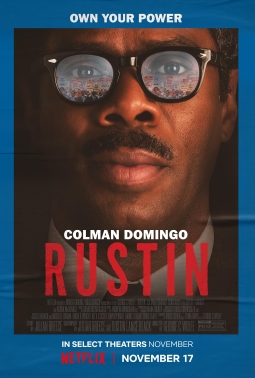
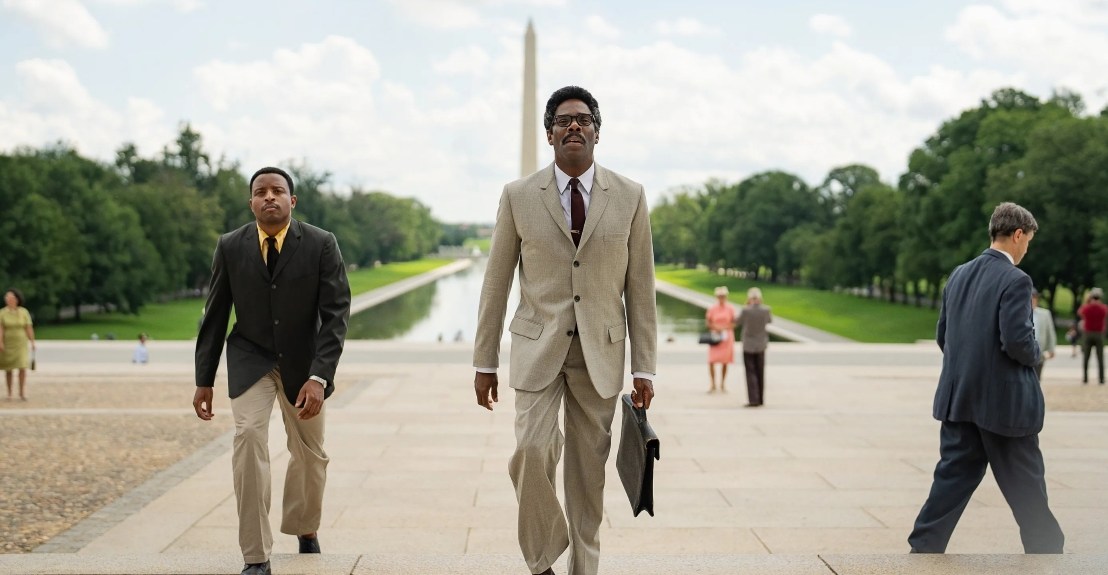
Bayard Rustin was on of crucial the civil rights activists in conceiving, planning and organising the 1963 March on Washington. A proponent of nonviolence and equal rights for all, regardless of race, gender or sexuality, he was a close friend and colleague of Martin Luther King and a key figure in innumerable campaigns. Rustin partly exists to bring his life more to public notice, focusing on the build-up to the March on Washington and exploring Rustin’s struggles as both a Black man and a gay man.

At its heart is Colman Domingo, who delivers a sensational performance as Rustin, bursting with energy and emotional compassion. Domingo brilliantly captures Rustin’s loud-and-proud nature, his overwhelming commitment to being who he is, and his passionate commitment to social justice. This is a force-of-nature turn dominating the movie, breathing passion and fire into Rustin’s compulsive desire to speak out.

Domingo matches this with a neat sense of comic timing (Rustin is frequently very funny) and a raw emotion. The emotional impact nearly all comes from Domingo. He’s genuinely moving when he misjudges the level of loyalty to him in the film’s opening act and has an offer of resignation accepted by the NAACP (after press reports suggesting he has seduced King). Even more so later in his emotional outpouring when the same NAACP members finally back him up. More focus on Rustin gaining full, unquestioning, acceptance from his colleagues could have offered a beating heart to the film.

Domingo’s performance elevates an otherwise, to be honest, fairly middle-of-the-road biopic that frequently wears its research heavily. It has an air of competent professionalism, with George C Wolfe’s direction lacking emotional or visual spark. Much of the dialogue – given a brush by Dustin Lance Black – frequently (and rather painfully) has the actors fill in historical context or clumsily shoehorns in real dialogue. There is very little spark to Rustin, as it dutifully ticks off events, building towards sign-posted emotional payoffs (and, admittedly, there are fewer payoffs more inspiring than a quarter of a million people gathering in Washington to cry for freedom).

This is not to say there aren’t fine moments and its recreation of the Washington March (some tight angles, well-chosen archive footage and subtle effects) works very well. There are some fine actors giving their all. Glynn Turman is a stand-out as the inspiring Randolph, savvy enough to play the game in a way Rustin isn’t. Aml Ameen’s capturing of King’s voice and mannerisms is perfect. Pounder, Rock, McDonald and others compellingly bring to life leading activists while Jeffrey Wright sportingly plays the closest thing to a heel as jealous congressman Clayton Powell.

However skilful reconstructions only take us so far. Often personal stakes are presented vaguely. The film avoids depicting Rustin encountering much personal homophobia – no member of the movement expresses negative views, with white pacifist campaigner AJ Muste (Bill Irwin) the only person to express openly homophobic opinions. The threat of someone discovering his past arrest (for a 1953 encounter with two men in Pasadena) is played as a core fear for Rustin, but the film is vague about the likely impact this revelation would have (since it seems to already be widely know). It’s astonishing that Rustin was so open when being so was a crime, but the film (aside from a brief moment when he considers a casual pick-up) risks underplaying the era’s prejudice and dangers.

To cover issues on homophobia and self-loathing guilt, the film invents a closeted reverend, well played with a tortured sense of shame and self-loathing by Johnny Ramey, who initiates a secretive relationship with Rustin. This fictional character absorbs all the fear and self-denial that many gay people felt at the time, allowing Rustin to show us what life was like for the many, many people who, for whatever reason, were not as outspoken as Rustin. But it does feel like somewhat of a compromise, and a character who feels a little too convenient, drifting to and from the story whenever it’s themes need a bit more of a personal touch.

It’s hard not to think the film could have gained more interest from exploring Rustin’s relationship with Tom Kahn (Gus Halper) – or even being clearer on the very nature of this relationship. An initial familiar intimacy indicates an established romantic relationship, but later scenes suggest instead a more casual flatmates-with-benefits set-up. Then we suddenly hit the inevitable moment when Kahn walks in on Rustin and Elias kissing and reacts like a betrayed partner. It finally decides Kahn is in love with Rustin, but Rustin hasn’t time for a relationship with so much work to be done. Despite this thought, the film wants to also say Rustin and Elias are profoundly in love, tragically only kept apart by social pressures. It’s trying to have its cake and eat it too. The cost to your personal life of being fully committed to a cause, or the awful pressures of loving someone in the face of prejudice, are both powerful stories. Settling on one and exploring it fully would have been more emotionally rewarding.

Rustin is a solid, well-handled, decent biopic. Bringing the life of a lesser-known civil rights activist to a bigger audience is a worthy aim, and Black and queer audiences (historically underserved) deserve to see films that centre their stories.  It’s also refreshing to see a film zero in on the importance of logistics for major events (what other film has a scene where the fillings of thousands of sandwiches to be kept in the warm sunshine becomes a heated debate?) and its focus on the work recruiting attendees, buses and resources for the March is great.

But the real success in this sometimes workmanlike film is Domingo, who lifts the entire thing with an emotionally committed performance that is perhaps better than it deserves.

Amsterdam (2022)

Amsterdam (2022)

Lots of quirk, whimsy and smugness, not a lot of interest or dynamism in this satirical mis-fire

Director: David O. Russell

Cast: Christian Bale (Burt Berendsen), Margot Robbie (Valerie Voze), John David Washington (Harold Woodsman), Robert De Niro (General Gil Dillenbeck), Chris Rock (Milton King), Rami Malek (Tom Voze), Anya Taylor-Joy (Libby Voze), Zoe Saldana (Irma St Clair), Mike Myers (Paul Canterbury), Michael Shannon (Henry Norcross), Timothy Olyphant (Tarim Milfax), Andrea Riseborough (Beatrice Vandenheuvel), Taylor Swift (Elizabeth Meekins), Matthias Schoenaerts (Detective Lem Getwiller), Alessandro Nivola (Detective Hiltz), Ed Begley Jnr (General Bill Meekins)

David O Russell’s has made a niche for himself with his ensemble awards-bait films, filled with touches of quirk and offering rich opportunities for eccentric, showy performances from actors. Some of these have walked a fine line between charm and smugness: Amsterdam tips too far over that line. Like American Hustle it’s a twist on a real-life event (opening with a pleased with itself “A lot of this really happened” caption) but, unlike that film, it fails to insert any compelling storyline, settling for a whimsical shaggy-dog story that frequently grinds to a halt for infodumps or lectures.

Set in 1933, just as Roosevelt has taken office, it follows three friends who formed a friendship for life in post-war Amsterdam. They are: wounded veterans doctor Burt Berendsen (Christian Bale) and lawyer Harold Woodsman (John David Washington) and socialite-artist-turned-nurse Valerie Voze (Margot Robbie). Berendsen and Woodsman lost touch with Valerie in the 1920s, but now they are all bought together after the murder of their respected former commander as part of a plot from various nefarious types to overthrow the government in a fascist-inspired coup.

Sounds gripping right? Well, Amsterdam fails to find any urgency in this. In fact, details of this plot and the political context it’s happening in are sprinkled around the film as if Russell kept forgetting what the film was supposed to be about. It’s almost as if he stumbled on an unknown piece of American history – a rumoured coup attempt, thwarted by being denounced by the ex-Marine General approached to lead it (here represented by De Niro’s ramrod straight General Dillenbeck) – but got more and more bored with it the longer he spent on it.

Instead, his real interest is in the faint overtones of Jules et Jim style thruple between Berendsen, Woodsman and Voze (though this is American not French, so any trace of homoeroticism is dispatched, despite the obvious bond between the two men). The most engaging part of the film is the Act two flashback to these three healing, dancing and bonding in post-war Amsterdam, in a “our troubles are behind us” bliss. Even if it’s self-satisfied in its bohemianism.

To be honest, even then, they have an air of smugness behind them. They pass the time singing improvised nonsense songs based on words pulled out of a hat and playfully posing in Valerie’s modernist artwork. Valerie is played with almost enough charm by Robbie for you to overlook she is a standard Manic Pixie Dreamgirl, the sort of babe who pulls shrapnel from bodies to turn it into artistic tea-sets as a commentary on the madness of war. She and Woodsman form a relationship (with the married Berendsen as a sort of – well I’m not sure what, but definitely not a sexual third wheel) and these blissful Amsterdam days are the times of their life. Russell is so keen for us to know it, that all three pop up in short cutaways at key moments to whisper “Amsterdam” direct to the camera, an affectation that fails to deliver the spiritual impact its straining for.

It’s better than the shaggy dog story around the conspiracy that fills the 1930s part of the storyline. This remains so poorly defined, that Bale has to narrate a concluding slideshow of clips and fake newsreel and newspaper coverage to explain what on earth has just happened. The lack of clarity about the stakes – and the general lack of seriousness or urgency anyone treats them with –fails to provide any narrative oomph. Instead, it drifts along from casual meeting to casual meeting, every scene populated with a big-name actor showboating.

There is a lot of showboating in this film. Bale, an actor with an increasingly worrying tendency for funny voices and tics, fully embraces the facially scarred, glass-eye wearing Berendsen, perpetually stooped with a war wound and prone to fainting from pain-killer overuse. It’s a showy, actorly performance with a licence to go OTT. Bale does manage to invest it with an emotional depth and vulnerability, but there’s more than an air of indulgence here.

Most of the rest follow his lead. Malek and Taylor-Joy sink their teeth into a snobby socialite married couple. Rock essentially turns his role as a veteran into a less sweary extension of his stand-up act. Myers and Shannon seize with relish roles as ornithologist spies (is this meant to be a joke about the origins of the James Bond name from the author of a bird-spotting guidebook?) Poor John David Washington ends up feeling flat with his decision to underplay (like he’s in a different movie) and only De Niro really manages to feel like anything other than an actor on holiday.

Russell wants to make a point about the continual corruption of the rich and how their hunger for more power will never be sated. There are some half-hearted attempts at attacking racism, with the ill treatment of black veterans, but it lacks bite or edge. His attempts to draw parallels with Trump are all too clear, but the film largely fails to integrate these ideas into the film. In fact, it ends up relying on voiceover lectures from Bale about dangers to democracy. It ends up like being hectored by an angry socialist after a student revue night.

The film is shot with a series of low angle shots and medium and close ups that eventually made me feel like I was watching it from the bottom of a well. A vague sepia-ish tone is given by Emmanuel Lubezki, but the film looks flat and visually uninteresting (so much so I was stunned to see $80million had somehow been blown on it, despite most of the cast working for scale). It drifts towards a conclusion, without giving us anything human to invest in (as Russell managed so well in Silver Linings Playbook or The Fighter) or providing the sort of caper enjoyment he delivered in American Hustle. Instead, it’s oscillates between smug and dull.