Tag: Cliff Robertson

Midway (1976)

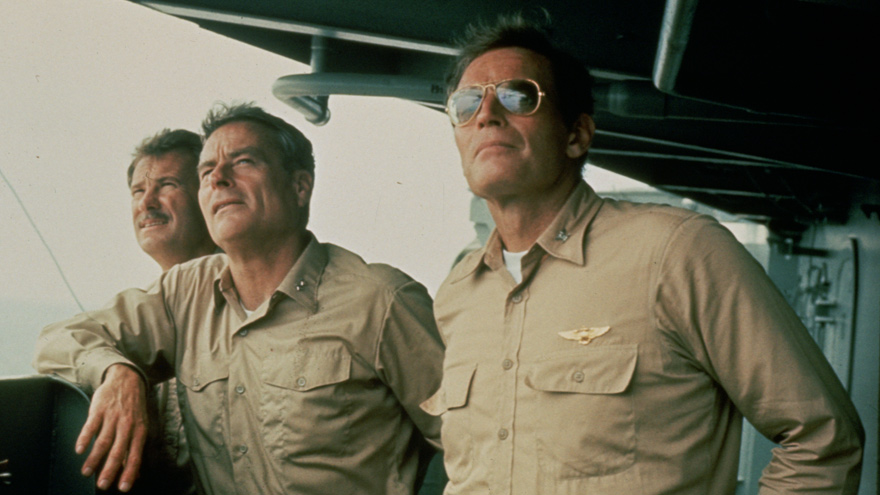
Charlton Heston fights in one of the great naval battles at Midway

Director: Jack Smight

Cast: Charlton Heston (Capt Matt Garth), Henry Fonda (Adm Chester W Nimitz), James Coburn (Capt Vinton Maddox), Glenn Ford (Rear Adm Raymond Spruance), Hal Holbrook (Comm Joseph Rochefort), Toshiro Mifune (Adm Isoroku Yamamoto), Robert Mitchum (Adm William Halsey), Cliff Robertson (Comm Carl Jessop), Robert Wagner (Lt Comm Ernest L Blake), Robert Webber (Rear Adm Jack Fletcher), James Shigeta (Vice Adm Chuichi Nagumo)
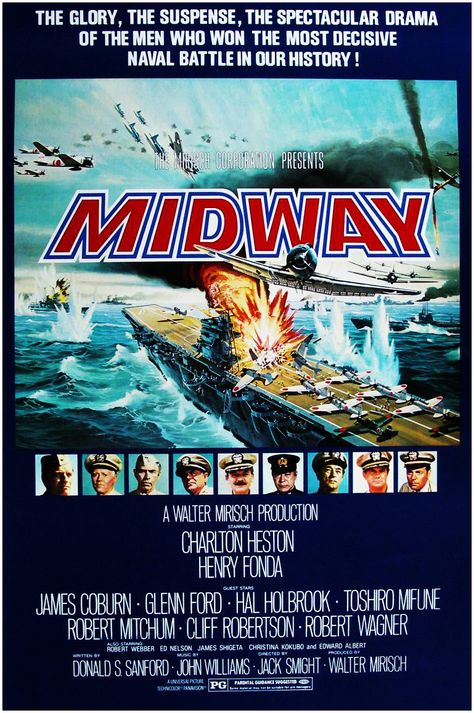
On 4th June 1942, the fate of the Pacific naval war was arguably settled. The Japanese plan to invade the American base on the island of Midway and, crucially, wipe-out the American aircraft carrier force, instead saw a near total US victory and all four Japanese aircraft carriers destroyed. The story is re-told here as a classic all-star Hollywood epic, with the first hour dedicated to the planning and the second hour to the events of 4th June.

After its – successful – run in the cinemas, Midway was re-edited into a two-part TV mini-series. To be honest, that feels more like its natural home. It’s competently directed by Jack Smight – but no more than that – and revolves around several scenes of star-actors pushing models around maps and less famous actors pretending to fly planes in front of blue-screen. The film makes a proud statement at the start of how it has chosen to use only actual archive combat footage to “honour those who fought” – but this actually, you suspect, was motivated more by the fact it’s much cheaper to purchase and clean up piles of stock footage than it is to shoot things afresh.

The main narrative covers the planning and the crucial day of the battle itself. A brief “human interest” story is introduced via Charlton Heston’s (fictional) Captain Matt Garth, an aide of Admiral Nimitz. Will Chuck improve his relationship with his fighter pilot son, who has fallen in love with a Japanese girl? Whadda you think? Saying that, this rather clumsy human-interest story (which features the only female character in the film) does make some interestingly critical points about the policy of internment against Japanese Americans – stressing both the injustice and explicit racism (American Germans and Italians faced no such fate) behind the policy.

In fact, Midway is very sympathetic in general to the Japanese – as Nimitz even says at the end, perhaps it was less a question of skill than luck that led to the final outcome. The Japanese navy is presented as an honourable and thoughtful opponent, respectful of human life and conducting the war via a code of honour (the kamikaze runs of cliché are completely absent). In particular Admiral Naguma (well played by James Shigeta, in possibly the film’s stand out performance) is a decent man caught-out continuously by horrendous luck and timing, who pays a heavy price. Midway is strong in stressing there is no leeway at sea – get caught out there and it’s the bottom of the briney for you.

The Japanese planning is even slightly tragic in its flawed assumptions – crucially they are totally unaware that their codes are broken and that, far from launching a surprise strike, they are actually sailing into something of a trap – while Toshiro Mifune brings a lot of nobility to Yamamoto even if all he really does is pensively stare at a series of maps.

On the American side, Fonda leads the way, giving Nimitz more than a touch of Fordian home-spun heroism. Heston’s presence does well to link together the various true-life characters and location. Most of the rest of the all-star cast are restricted to one or two scenes: Coburn rocks up to handover a report from Washington, Wagner briefly pushes models across a table in a planning room and (hilariously of all) Mitchum delivers both his tiny scenes from a hospital bed, coated in skin cream.

When the action gets going though, it’s done pretty well with the po-faced, stodgy seriousness these war-time later 70s epics nearly all seemed to have in common. The stock footage does actually look pretty good and the drama of the battle – and the tactics – are captured fairly well. It’s intermixed with some real ships and all scored with a great deal of punch by John Williams. It’s all really B-movie, TV-movie-of-the-week stuff but it’s also far from obviously flag-waving either, instead doing its best to be even-handed and even a little bit critical. You’ll learn what happened and also have a bit of fun into the bargain.
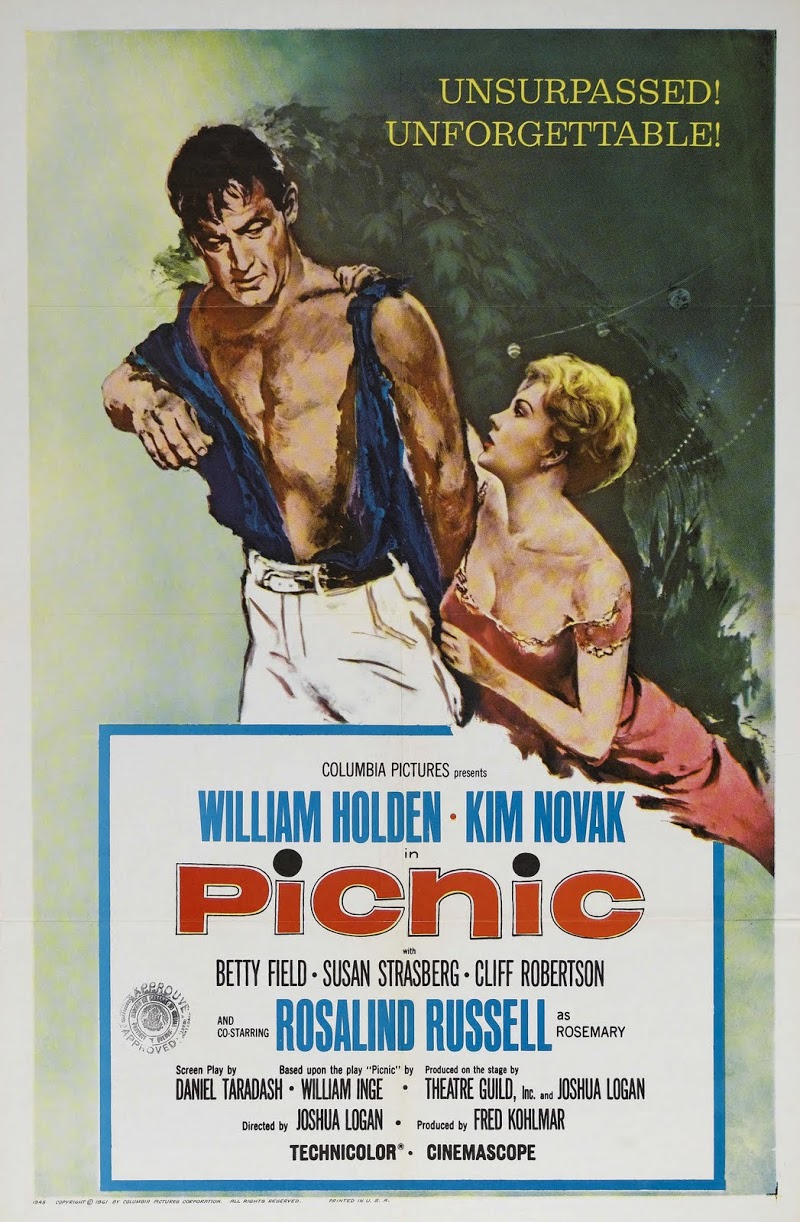
Picnic (1955)

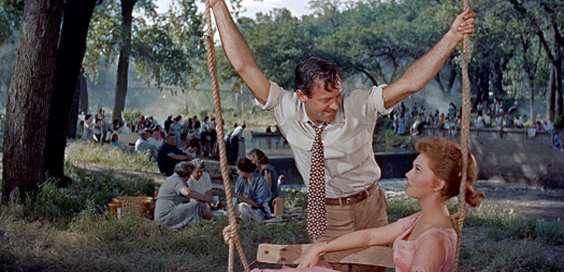
William Holden stirs up a small-town – and Kim Novak – in Picnic

Director: Joshua Logan

Cast: William Holden (Hal Carter), Kim Novak (Madge Owens), Rosalind Russell (Rosemary Sydney), Betty Field (Flo Owens), Susan Strasberg (Millie Owens), Cliff Robertson (Alan Benson), Arthur O’Connell (Howard Bevans), Verna Felton (Helen Potts), Reta Shaw (Irma Kronkite)

In a small Kansas town in the early 1950s, everything is sweet as apple pie. But under the surface, tensions bubble – and it only takes a stranger changing the status quo to make them explode. In William Inge’s Pulitzer-Prize-winning play – bought to the screen by original Broadway director Joshua Logan – that stranger is Hal Carter (William Holden), failed sportsman, actor and college drop-out, drifting into town looking for a new start from old friend Alan (Cliff Robertson). But Hal, an amiable screw-up, quickly puts himself in the middle of a love triangle between Alan and his girlfriend Madge (Kim Novak), the local beauty tired of being judged only by her looks.

All this eventually explodes into a series of furious confrontations where the true colours of various participants are revealed. In the 1950s Picnic looked like a criticism of the cosy conservatism of small-town America. But today, it actually feels more than a little nostalgic for the lost innocence of those times. Sure, some people in the town are less than sympathetic, or their lives have been crushed by the expectations of others. But generally, with its pastel colour palette and its generally fundamentally well meaning characters, it now feels a rather reassuring watch.

Like many films that pushed the envelope at the time, it also looks rather tame today. The film is strong on demonstrating the impact of the sexuality of a topless Holden on the women of the town – nearly all of whom go weak at the knees. But generally, the film’s sexual content now looks remarkably safe and gentle. A sense of powerful longing for something missing from their own lives does comes across strongly – Russell’s Mrs Sidney, worse for wear from drink, ends up feebly trying to pull up Holden’s trousers to look at his legs while dancing. But the sexual outbursts largely restrict themselves to that and a few passionate clinches.

Logan’s film throws in a few big visuals (such as the closing helicopter shot as a bus drives out of town) and clearly enjoys its location shooting, but remains stage-bound. Several scenes translate across exactly to backyard locations, the same sets in all but name that appeared on stage. It also struggles to fill the cinemascope screen, for all that James Wong Howe’s photography has a certain Autumnal beauty to it (you won’t see any vibrant greens, reds or yellows). In addition, many of the actors go for somewhere between naturalism and a mannered Broadway show-boating.

Perhaps the main issue is that film dwarves this slight and intimate story. Moments of intimacy that on stage you feel carry impact – heartfelt declarations and tortured confessions – don’t carry nearly so much on screen. In fact, the story ends up feeling rather slight and even predictable: the drifter has depths, but the town unfairly turns against him, the old-maid schoolteacher is deeply frustrated, the local beauty juggles depression, the good natured son of the local bigwig is a self-entitled bully. None of this really feels revelatory and, on screen, easily drifts by with little impact.

Logan’s stagy style also has a mixed impact on the acting with some going for a cinematic underplaying, and others inspired by a theatrical grandness to embrace the big moments. Leading the way in that camp is Rosalind Russell who gives a strong performance as the frustrated schoolteacher, but frequently allows herself to go a little too far in moments of emotional outburst. It’s particularly noticeable as she’s paired with Arthur O’Connell (reprising his Broadway role, and getting an Oscar nomination) who underplays with a quiet wit and honesty.

One of the film’s principle problems are with the two leads. William Holden gives a fine performance – fun-loving and kind but also cutting a rather sad and tragic figure behind the bonhomie – but is blatantly too old for the role. Hal is probably meant to be in his 20s – Holden was 37 and, with his craggy face, actually looks older. While it does add a level of Hal being increasingly irresponsible for his age, the part really means a charismatic youngster dripping sex appeal (think James Dean – Paul Newman was turned down for the part). Opposite him the inexperienced Kim Novak does, at times, give her line readings a striking genuineness but at others comes across as slightly wooden.

A stagy and slightly old-fashioned watch today, Picnic was nominated for several Oscars, but increasingly looks rather like a celebration rather than a gentle criticism of the small-town values it depicts.

Three Days of the Condor (1975)

Robert Redford goes on the run in conspiracy thriller Three Days of the Condor

Director: Sydney Pollack

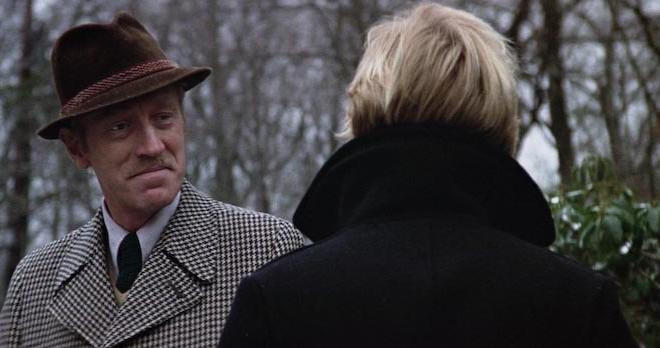
Cast: Robert Redford (Joseph Turner), Faye Dunaway (Kathy Hale), Cliff Robertson (Director Higgins), Max von Sydow (Joubert), John Houseman (Wabash), Addison Powell (Leonard Atwood), Walter McGinn (Sam Barber), Tina Chen (Janice), Michael Kane (SW Wicks), Don McHenry (Dr Lappe)

Three Days of the Condor never leaves you in any doubt that the real villains are those in power – and the possibility of escaping the reach of organisations like the CIA is beyond all of us. Condor is damn well-made though – Pollack’s direction is nearly faultless in its taut claustrophobia – even if the film itself gets a bit lost in its confusing obliqueness.

Joseph Turner (Robert Redford) is a quiet, boyish, Robert-Redfordish academic whose job is to read books published all over the world and report back to the CIA any familiarities with any secret operations past or present, or any good ideas from operations. One day, while out fetching lunch for his colleagues, he returns to find they have all been murdered by a hit-team led by a shadowy foreigner (Max von Sydow). Calling in the CIA, he finds he can’t trust anyone – and is forced to hide out by kidnapping a woman, Kathy Hale (Faye Dunaway), whom he bumps into in a shop.

Three Days of the Condor opens with an electric pace. The build-up to the assassination of Turner’s co-workers is extremely tense, while the immediate after effects – and Turner’s lost, confused terror – is brilliantly involving. The stream of conspiracy-laced events, and the unsettling lack of security about who to trust creates a terrific mood of paranoia. Pollack’s editing is tight, and the photography keeps the action naturalistic and eerily involving. It creates an unsettling drama where no one can be trusted. 

It taps perfectly into that 1970s vibe of the state being omniscient and inhumane – Turner’s CIA contact will only talk to him using his code name, shows no human interest in his deceased comrades and only asks if Condor himself is “damaged”. Later Turner chippily asks why a senior agent is addressed by his name, while he is only called Condor. 

Redford is very good as Turner – perfectly convincing as the bookish man thrust into circumstances where he is out of his depth, but whose innate abilities to think fast and adapt allow him to believably keep one step ahead of those pursuing him. The film has a love for the grimy Le Carre-ish detail of espionage, which it mixes well with its James Bondish elements of hitmen, violence and sex. The script has good lines, and several excellent set-pieces that trade in that queasy feeling of being out-of-depth.

The momentum of the first half however eventually gets bogged down in the “working out” of the conspiracy. This is a bit hampered by the early acts of the movie being focused more on atmosphere than on plot build-up. With the exact purpose and function of Redford’s CIA role only really being loosely explained quite late on – and the various inter-relationships of the assorted CIA bigwigs we see also not really being that clear – the final reveal of the wrong uns is murky and doesn’t quite justify the build-up. 

Part of this is the film’s 1970s vibe – its sense that the resolution is, in a way, less important than the downer atmosphere and conspiracy tension – but it’s also a bit of a narrative flaw. It’s hard to invest in a story that never really gets put together or explained properly, and doesn’t really give us a sense of the major stakes at play or the reasons why various characters do what they do. 

Other factors also have dated the film, principally the relationship of Faye Dunaway’s Kathy and Redford’s Turner. Now there is an odd Stockholm syndrome relationship if ever I saw one. From Kathy tearfully fearing rape and assault for most of the first ten minutes of their screen time together – and with no reason to believe the story Turner is peddling – sure enough within a few hours of knowing each other this pair end up in bed together. The film attempts to suggest Turner’s ability to understand her personality (in a way no-one else ever has naturally) through her photographs brings them together –but nevertheless it’s basically a hostage falling into bed with her kidnapper, about 20 seconds after she stopped crying, after he has just released her from being tied up and gagged in her own bathroom. 

I guess it helps when your kidnapper looks like Robert Redford – and the film uses Redford’s innate trustability well – but it’s a little unsettling. Kathy swiftly becomes Turner’s little helper – but you never really get a sense that the she is an actual character, or that the film even really needs her that much. Dunaway is a good actress and plays the part very well – but there is an unsettling submissiveness and even exploitation to her character that dates the movie (not that we have moved past films where female character’s principal role is to have sex with the hero to ease his pain). The best you can say for this character is that she has “pluck”.

It’s dumping Turner down into Kathy’s home where the momentum leaks out of the film slightly. It’s a film that feels like it’s going to be set-up as a chase movie with a spy tinge, but it never really turns into that. On top of which, it takes time away from properly developing Turner’s enemies. His possible CIA opponents, led by Cliff Robertson and John Houseman, don’t really come into focus as characters. The performer who does stand out – largely because of the wry world-weariness he brings to the role – is Max von Sydow as the hitman Joubert, a character I’d happily see more of (where was his spin off?). 

Three Days of the Condor is a well-made triumph of atmosphere – but the later sections of the film don’t quite live up to the build-up, and the film doesn’t quite snap together as much as you would like in the second half. It gets lost in its labyrinthine schemes and then doesn’t have a resolution that seems interesting enough to make satisfying narrative sense.  It’s got some great moments in it, but it’s a flawed film.