Tag: Colin Firth

The Railway Man (2013)

Colin Firth is haunted by the past in The Railway Man

Director: Jonathan Teplitzky

Cast: Colin Firth (Eric Lomax), Nicole Kidman (Patricia Lomax), Stellan Skarsgård (Finlay), Hiroyuki Sanada (Takashi Nagase), Jeremy Irvine (Young Eric Lomax), Sam Reid (Young Finlay), Tanroh Ishida (Young Takashi Nagase)
There is perhaps nothing harder to do in life than to put the past behind you and forgive. We all seem to be hot wired to want revenge and to seek it against all odds. It’s rare indeed the man who learns to put the rage against the past behind him and to extend the hand of friendship.

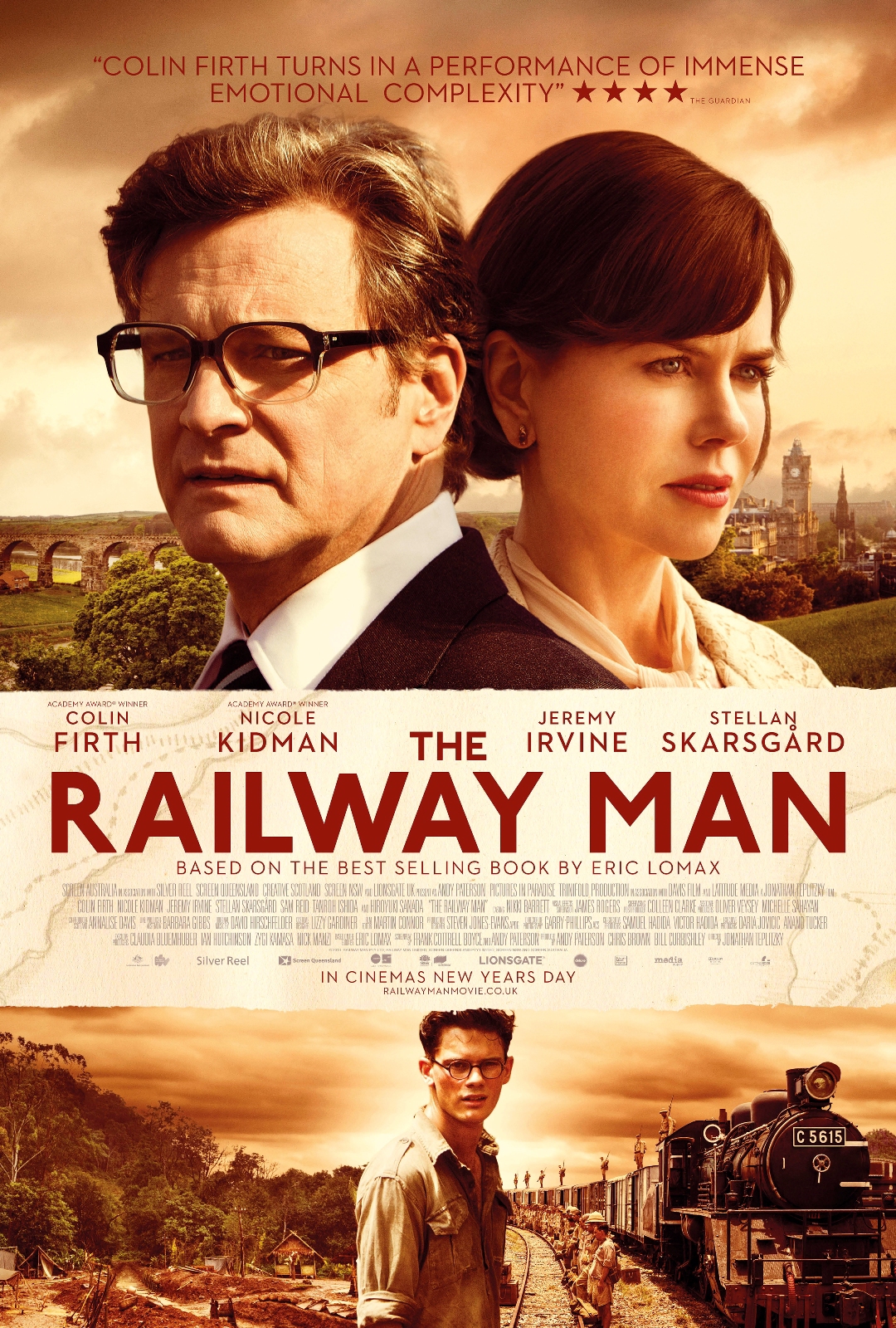
Such a man was Eric Lomax (played here by Colin Firth). In the 1970s Eric meets and falls in love with Patricia (Nicole Kidman). The two are married, but Patricia soon discovers Eric is still plagued by memories of his imprisonment as a young man (played by Jeremy Irvine) by the Japanese during the Second World War, and in particular a prolonged period he spent being tortured by the Japanese secret police for building a radio. Lomax is unable to begin to talk about his experiences, even as trauma causes his life to deteriorate. Fellow ex-POW Finlay (Stellan Skarsgård – very good in a small but vital role) is the only one who has even the faintest idea of his experience, but cannot persuade him to even speak about his past or try and move on. After discovering his torturer Takashi Nagase (Hiroyuki Sanada) is alive and well and working as a tourist guide in the very camp where Lomax was tortured, he travels to Japan, torn about what he should do.

Teplitzy’s film is powered by several marvellous performances, not least Colin Firth who is excellent in the lead role as the deeply repressed, tormented Lomax who in his heart has never left the prison where he suffered unbelievable torment. The film is a carefully structured, and deeply moving, character study of how atrocious and inhumane actions trap us all – both the victims and perpetrators – in patterns of suffering where we feel our own humanity drain away. Even handed, honest and generous, like Lomax’s book, it’s an engaging and moving tribute to the strength of the human spirit and our capacity for generosity.

Not least because when we finally meet the aged Nagase, he is far from the monster we expected. Like Lomax he too is haunted by the past, but where Lomax cannot escape the horrors he suffered, Nagase is plagued by guilt and disgust as he realises his actions as a young man were far from those of a righteous soldier, but rather a brainwashed pawn in a brutal army. Nagase, like Lomax, is desperate to purge himself of memories of this past, and has worked his whole life to try and make amends for the suffering he has caused. No simple good guys and bad guys here – both torturer and tortured are dehumanised, scarred and traumatised by the actions they have carried out. 

Teplitzky films that torture with an unflinching honesty, that leaves you in no doubt about why it has had such impact on Lomax. Jeremy Irvine is very good as the young Lomax, scared, vulnerable but brave and self-sacrificing who puts himself in the way of danger to try and protect his friends and then goes through savage beatings, interrogations and water boarding for information he doesn’t have. It’s difficult to watch, but never sensationalised and the traumatic pointlessness of these methods is abundantly clear. 

These memories, slowly revealed, are all too apparent in any case in Firth’s blasted face.  The film slowly reveals his psychological damage, with the opening sequence in fact suggesting a far lighter film ahead. The opening follows the meeting of Lomax and Patricia on a chance train journey. Playful and charming, these scenes work so well due to the wonderful chemistry between Firth and Kidman. It plays off in spadeas the plot gets darker and more disturbing. Kidman is very easy to overlook here in the “wife” role, but she invests it with an emotional honesty, a supportive woman eventually driven to the edge of her capabilities.

After the lightness of the opening, Terplitzky introduces the past literally like ghosts, with Lomax caught in a sudden delusion of himself being dragged through the hotel on his honeymoon, screaming in panic, to be carried to his torture danger. Throughout the film, the image of his torturer as a young man appears at various points (including at one point in a field as a train passes behind him), a constant reminder of how the past is here and now for Lomax.

It builds towards a sensational series of scenes as Lomax confronts Nagase, powered by two exceptional performances from Firth (barely able to control his anger, rage and pain) and a beaten down, distressed performance of shame from Hiroyuki Sanada, who matches him step for step. Sanada is superb as a man who confronts his nightmare – a man from his past – but also overwhelmed with the opportunity this gives him for amends. 

That’s what the film captures so well. This tension between past and present encapsulates the universal theme of our desire for revenge and our human need to connect coming together. Lomax and Nagase had every reason to kill each other, but their reaction to seeing each other is surprising, moving and a deep tribute to the human capacity to connect and move on. Grief and the past will destroy us all if we let it. The heroic examples of both Lomax and Nagase show us this doesn’t need to be the case.

Mary Poppins Returns (2018)

Emily Blunt is practically perfect in every way in Mary Poppins Returns

Director: Rob Marshall

Cast: Emily Blunt (Mary Poppins), Lin-Manuel Miranda (Jack), Ben Whishaw (Michael Banks), Emily Mortimer (Jane Banks), Pixie Davies (Annabel Banks), Nathanael Saleh (John Banks), Joel Dawson (Georgie Banks), Julie Walters (Ellen), Colin Firth (William Weatherall Wilkins), Meryl Streep (Topsy), Dick van Dyke (Mr Dawes Jnr), David Warner (Admiral Boom), Jim Norton (Mr Binnacle), Jeremy Swift (Hamilton Gooding), Kobna Holdbrook-Smith (Templeton Frye), Noma Dumezweni (Miss Penny Farthing)

Some sequels go into production even before the first film hits the cinemas. Others give you a good long wait – and Mary Poppins has had you waiting 54 years. Of course, part of that was down to her creator, PL Travers. Travers so hated the Disney original (I mean, she really hated it) she outright banned all other adaptations of her work – but her estate were far more open to the prospect (and let’s be honest, probably also to the money) that Disney could finally go ahead with a sequel.

And thank goodness for that, since this delightful film is practically perfect in every way. It’s 25 years since the events of the first film, and Michael Banks (Ben Whishaw) is now a widower with three children, whose home is about to be repossessed by the bank for non-payment of loans. His sister Jane (Emily Mortimer) is trying to help, but the pressure and sadness are showing on Michael and are forcing his children Annabel, John and Georgie (Pixie Davies, Nathanael Saleh and Joel Dawson) to grow up fast. The Banks family is in trouble – so it’s the perfect time for the arrival of Mary Poppins (Emily Blunt) to save the day – with a little bit of help from gas-lighter Jack (Lin-Manuel Miranda).

Mary Poppins Returns is a triumphant mix of nostalgia and originality, that walks a very difficult tightrope between being a loving pastiche and tribute to the original film while also managing to bring its own original charm and magic touch. That’s a difficult trick to pull off – but it basically takes a slight remix of the original film’s story and adds a heft of emotional impact to create something that feels modern and fresh while also being very close tonally to the original.

This is never clearer than in Emily Blunt’s sublime performance as Mary Poppins. If there is anyone who had a more difficult job in this film than Blunt I can’t think of them. She had to take on the most iconic character of an iconic actress – and does so brilliantly, but creates a character who feels an equal mix of both Andrews and Blunt. This is clearly the same character as before, but Blunt mixes in a wonderful heart-warming care and concern under the pristine English exterior that melts the heart. She has a glowing twinkle to her, an almost bottomless charm with an endearing delight for the wonder and silliness that is part of Poppins world. And boy can she sing and dance? She carries the film with effortless grace – to such endearing effect that, just like with Julie Andrews, you miss her as she becomes less prominent in the final act.

And of course she is matched by a superb company of actors. Lin-Manuel Miranda makes the transition to the big-screen like a duck to water, hugely loveable, wonderfully charming and superb (as you would expect) at the musical sequences. The three children give exemplary performances, with never a hint of sickly sentimentalism. Emily Mortimer is radiantly giddy as Jane, while Ben Whishaw will bring a lump to the throat as a Michael who is struggling under a huge amount of grief.  That’s not the mention wonderful turns from the whole of the cast, especially from Holdbrook-Smith as a kindly lawyer.

All these actors are “marshalled” brilliantly by director Rob Marshall. With his experience of musicals – both on screen and stage – Marshall knows his stuff and brings all his experience to bear here to create a sequel that will be seen (I’m sure) as a worthy companion to the original. Marshall’s direction of the musical sequences is faultless. He knows exactly how and where to place the camera for maximum effect, and gets just the right tone and mood from these scenes. He’s also, let’s not forget, a brilliant choreographer and has put together some exquisite sequences, not least the lamplighter song Trip the Light Fantastic, a whirligig showstopper of a number that if you saw it in the West End would have the whole crowd on their feet.

The songs make for easy criticism (reviewers seem duty-bound to say they are not as good as the original) – but to these ears Marc Shaiman and Scott Whitman’s songs and scores are both catchy and engaging. Give them time and I’m sure you’ll find them as replete with impact as the Sherman brothers’ tunes from 1964. Saying that, there might be one musical number too many – but that’s a very minor criticism. 

Because this is a film that gets so much else right. The storyline is certain to leave a lump in the throat, with its delicate handling of grief and the sadness both of growing up and also children being forced to leave their childhoods behind in impossible circumstances. These are universal themes – and they certainly impacted on me, and on a cinema packed with families all of whom were engrossed. That’s part of the magic of what Marshall has achieved here – heck, even the final Big Ben set-piece starts pushing you towards the edge of your seat in tension. I also loved the bravery of the colour-blind casting. It’s a film that stands on its own feet so well, it almost takes you out of the film when Dick van Dyke appears at the end – it doesn’t need the cameo, this film is its own beast.

Mary Poppins Returns will leave a smile on your face and a glow in your heart. It’s totally lovely from start to finish. Emily Blunt is superb (with wonderful support from all) and Rob Marshall triumphs as director and choreographer in this, surely his finest movie ever. It’s got something for all ages, and a truly heart-warming story. It takes everything that works so well in the first film and builds on it. It’s a wonderful mixture of homage and originality, that you will enjoy time and time and again. Practically perfect!

Kingsman: The Secret Service (2014)


Colin Firth means business in super-violent Bond spoof Kingsman

Director: Matthew Vaughan

Cast: Colin Firth (Harry Hart/Galahad), Samuel L. Jackson (Richmond Valentine), Mark Strong (Merlin), Taron Egerton (Gary “Eggsy” Unwin), Michael Caine (Chester King/Arthur), Sophie Cookson (Roxy Morton), Sofia Boutella (Gazelle), Samantha Womack (Michelle Unwin), Geoff Bell (Dean), Edward Holcroft (Charlie Heskith), Mark Hamill (James Arnold), Jack Davenport (Lancelot)

Okay Kingsmen. I’ll hit a beat later on which explores a major problem I had with this movie, but let’s talk about the rest of the film first shall we?

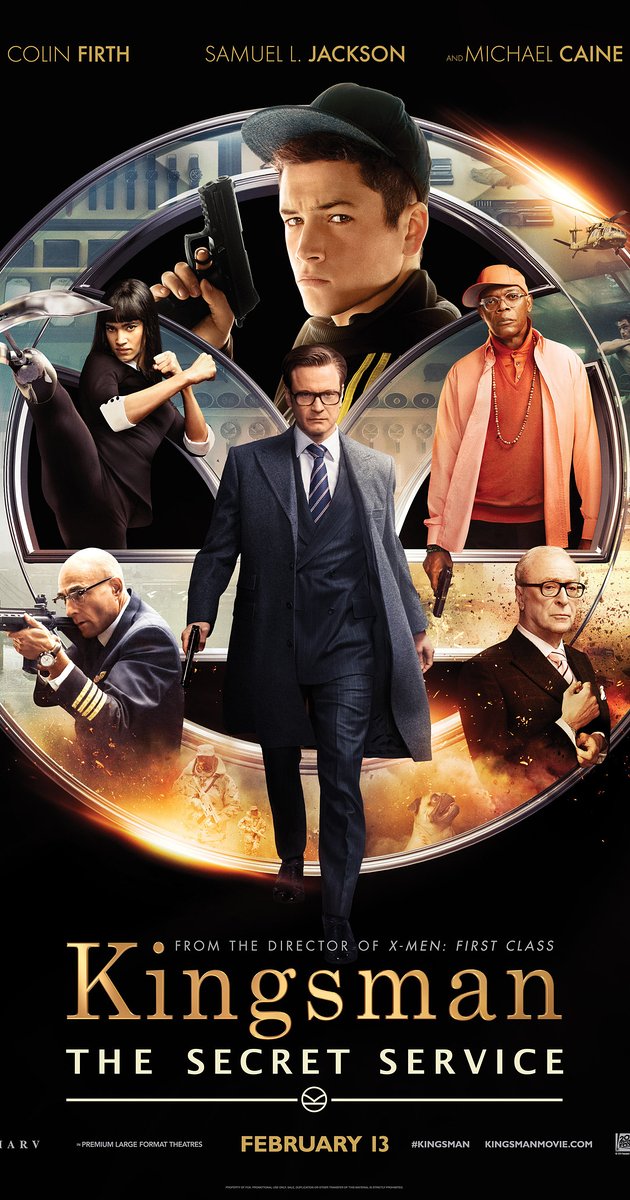
Firstly, Kingsmen is for the most part rather good fun (even if it is too long). It’s an excitable, teenage-focused riff on James Bond films that throws in ultra-violence and foul language alongside the overblown villains, insane plots and super-spy skills (all themselves amped up to 11). “Eggsy” (Taron Egerton) is a drifting, working-class young man from a council estate who is recruited as a candidate for super-secretive espionage firm “The Kingsmen” by Harry Hart (Colin Firth). Bucking against the system, Eggsy must prove himself against the privileged, public-school types he is competing against for a place. Meanwhile, Hart investigates sinister plans from tech billionaire Richmond Valentine (Samuel L. Jackson), aiming at reshaping the world to fit his own insane ideas.

Kingsmen basically has a teenage sensibility, with a “too cool for school” love for swearing and extreme (if comic book) violence. It deliberately sets itself out as a grimy, modernish, street version of Roger Moore’s Bond movies (at one point, Hart and Valentine even discuss “old spy films” – presumably copyright prevented a namecheck for Britain’s finest). The plot (and the cascade of exploding heads, satellites, sinister cross world signals, world leaders in danger etc.) all have the air of the sort of stupidity you found in Moonraker or The Spy Who Loved Me: the joke being that these fantastical elements have been mixed in with a sweary working-class hero and graphic violence. It has a pop-culture knowingness about it which it just (by the skin of its teeth) manages to prevent becoming too smug or self-satisfied.

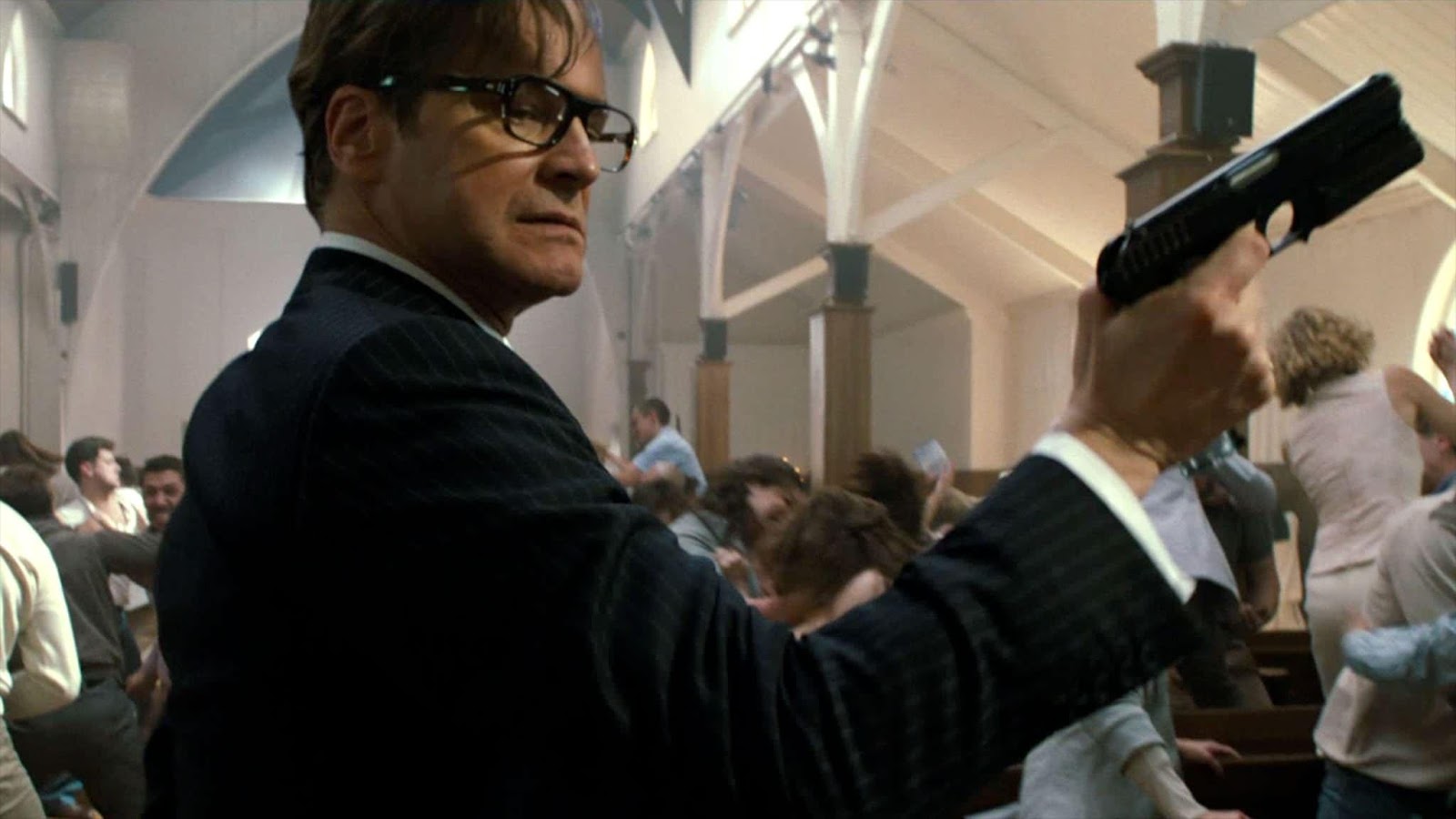
This is partly because it is so well made. The violence and fighting are rather well done in their overblown, excessive excitement. Vaughan shoots it with a loving camera, revelling in the dynamism and speed of his agents (and their ruthless efficiency) in a way that’s very hard not to find entertaining. Some interesting music choices also add an ironic commentary to the killing. Vaughan’s also to be commended for spotting the potential for ass-kicking super-spy in Colin Firth (even if Firth himself probably plays the whole film marginally too seriously). The film’s main set piece a jaw-droppingly violent but slickly made fight sequence in a church is probably the only thing it will be remembered for in ten years time – but is certainly worth remembering. The fighting is fun to watch – it’s a shame it’s not married with a wittier script, as if the wit of the visuals couldn’t be carried across to the dialogue in case we got bored.

Vaughan’s script also wants to fight the corner of the working class – although saying that, since every other working class character in the film except for Eggsy and his Mum are criminals, wannabe gangsters or thugs, it could just as well be fighting the corner of the “deserving poor”. Some rather obvious notes are hit during Eggsy’s training as he clashes with the chinless wonders that populate the Kingsmen candidates. It would perhaps work better if Eggsy himself was a more engaging and sympathetic lead – but as it is, the parts of the film without Firth (and Strong as a Scottish, grumpy Q) do drag a bit, which is unfortunate when your film is already over two hours long. It’s hardly Saturday Night and Sunday Morning but it pushes through its Pygmalion-plot line reasonably well.

For the most part, Kingsmen is stupid, teenage fun. It takes place in a spoof James Bond world of huge bases in mountains and plans to destroy the world that can only be foiled by dynamic acrobatic fighting. If you were a male teenager watching this it would probably be your favourite film ever. It’s probably a little too knowing and isn’t really as charming as it really needs to be to work really well, but it’s entertaining enough. I was happy to leave it like that. And then this happens quite late on in the film:

Now it’s important to remember when watching this, that the video contains all the interactions in the movie between these two characters. Now I suppose you could just say it’s a smutty joke that, like the rest of the movie, takes the elements of a Bond movie (“Keeping the British end up sir!”) and amps them up to 11. But it’s cruder and (in my opinion) too clumsy and sexist for that. Not only that, but it’s the sort of exploitative, sexualised rubbish that makes you suddenly address the entire film’s attitude towards women.

The film has five female speaking roles (at a push). Each of these roles fills a specific stereotyped, trope-based function. One is a victim in an abusive relationship (the mother). Another is a standard “hot action chick” (the villain’s henchperson). Another exists solely to die early on. The character in the clip only exists to provide the hero with anal sex as a reward. None of these characters serve any purpose in themselves, other than how they relate to the male characters of the movie. All of them to varying degrees require protection from a man, or exist purely to service his needs. The cliché of a physically-strong-but-still-really-hot woman being created in place of an actual character is so tired, I’ll just leave it here as I can’t be bothered to type up why this isn’t a good balance.

That leaves Roxy, Eggsy’s fellow candidate. On paper, Roxy is a strong female role – only of course she isn’t. There is the standard hand wave that she is “the best in the class” during training – but she’s also established as the only candidate to have a genuine fear (of heights) that she has to be coaxed through by the hero. Her role in the conclusion is conquering this phobia again. The subtle implication is that Eggsy to some degree sacrifices coming top of the class himself to support Roxy.

I’m sure this is all po-faced political correctness and I’m being the sort of humourless prig sitting among the “20% of offended people” Matthew Vaughn said should basically get a sense of humour. But I mean, come on. The last shot of the film is a woman’s naked bottom rearing towards the camera. And yes I know, I know, I know it’s all riffing on Bond films but at least there the heroine was a presence throughout the film. I actually would have much less of a problem if these two characters had spent at least some time throughout the film together – but jumping straight to anal sex? It’s too much. It also seems to be fighting battles of the 1960s. Overt class consciousness from the rich is terrible – but women? Nope they’re just there for the sexier times.

Leaving everything else aside, it’s not that funny a joke. It’s such a terrible joke it leaves a bad taste in the mouth. So what’s otherwise a decent, fun film chooses to end with its lead character invited to perform anal sex by a complete stranger. And how a film ends tells us something about the film we’ve just watched – and for Kingsmen it’s not good.