Tag: Comedy

Some Like It Hot (1959)

Some Like It Hot header
Tony Curtis, Jack Lemmon and Marilyn Monroe make comedy gold in Some Like It Hot

Director: Billy Wilder

Cast: Marilyn Monroe (Sugar “Kane” Kowalczyk), Tony Curtis (Joe/“Josephine/“Shell Oil Jnr”), Jack Lemmon (Jerry/“Daphne”), George Raft (“Spats” Colombo), Pat O’Brien (Agent Mulligan), Joe E Brown (Osgood Fielding III), Nehemiah Persoff (“Little Bonaparte”), Joan Shawlee (Sweet Sue), Dave Berry (Mr Bienstock), Grace Lee Whitney (Rosella), George E Stone (“Toothpick” Charlie)

It’s the funniest comedy that ever started in a hail of bullets. It’s the best chick flick to stare two men. It’s probably Billy Wilder’s sweetest comedy and it’s almost certainly its most beloved. They say Nobody’s Perfect, but you can be pretty sure this film gets as close to it as possible.

In 1929 in Prohibition Chicago, down-on-their-luck musicians saxophonist Joe (Tony Curtis) and double bass Jerry (Jack Lemmon) can’t get a break. First the speakeasy they are playing gets busted by the feds. They’ve lost all their money at the dog track. And, oh yeah, they accidentally witness gangster “Spats” (George Raft) eliminate his competition in a hail of bullets. They’ve got to get out of town incognito and quick – so what better option but joining an all-female band as “Josephine” and “Daphne”? Problem is, playing at a hotel in Florida, Joe and Jerry find themselves in all-sorts of romantic entanglements: Joe is wooing lead singer Sugar (Marilyn Monroe) in the guise of heir to an Oil fortune, while Jerry is wooed by smitten millionaire Osgood Fielding III (Joe E Brown). And if that’s not bad enough – guess which hotel the mob are having their annual convention at?

Wilder’s comedy is a fast-moving, brilliantly written (by Wilder and IAL Diamond) buddy comedy with a twist that dives into a whole world of gender and identity concepts that puts it way ahead of its time. Shot in luscious black-and-white (Wilder’s preferred style, and colour exposed all too strikingly the drag act look of Curtis and Lemmon), every scene has at a zinger and our heroes fall into one a string of madcap situation through misfortune and rank incompetence.

But the film’s real interest is in how far ahead of its time its gender awareness was. When they first appear disguised at the train station, the camera pans up their legs and behinds in just the way you would expect it to do (and indeed it does seconds later with Monroe) to ogle the women, only to reveal it’s the men striding their way down the platform. Both of them comment (and complain) on the objectification and unwanted physical attention (from slapped bums upwards) from men – “it’s like a red rag to a bull” Joe describes their feminine appearance, before he and Jerry complain they can’t wait to get back to being the bull again. It’s part of the fine tight-walk the film works, where the men are both men and women, victims and hypocrites, open-minded and conservative.

Dressing as women seems to give both of them a new perspective on things. Lothario Joe seems to gain a new sympathy for women – while at the same time, passing himself off as a millionaire to seduce Sugar with a string of lies – and comes to see himself as exactly the sort of lousy bum he probably has been. For Jerry the whole experience is a revelation. It’s part of as fascinating debate as to how much this film is aware of transgender and homosexual urges, and how much it’s just a very wittily delivered joke that’s so respectfully done it can be embraced by one and all. But for Jerry, the whole experience seems to redefine his own internal perception of himself.

It’s there from when he first glances Monroe at the train station: after tripping in his heels, he’s stunned when she works past, not by her looks, but by the ease she moves, his eyes not starring at her behind with lust (as Joe’s does) but with envious admiration. On the train he takes the blame for Sugar’s illicit bourbon – is it a sense of fellowship, or a bizarre way of making a pass at her? This leads to a slumber party in his bunk with the whole band, all in their nightwear – through which he constantly forces himself to remember he’s a boy (seemingly out of sexual excitement). But we very rarely see Jerry out of some layer of feminine disguise: and later confusion seems to abound during his courtship from Osgood, where he delights in the dancing, the jewels and the engagement and has to disappointingly remind himself that he’s a boy. After initial doubts Jerry finds a sort of freedom in dressing as a woman, that Joe never does.

How much is Some Like It Hot aware that it is playing around with fluid gender perceptions, and how much is it a stunningly well delivered joke? It’s not clear – and I doubt any film-maker in 1959 would even have the vocabulary to begin to conceive the sort of conversation the film provokes today.

But does it really matter when the jokes are this good and the performances so brilliant? Jack Lemmon is superb here, the sort of career-defining performance actors dream about. Anxious, fussy, slightly whiny, Jerry becomes the more playful, sassy Daphne – and what Lemmon does brilliantly is make both personalities fully-formed yet existing consistently within the same character. That’s not mentioning his verbal and physical comedic gifts and consistently perfect timing, his performance comedic but not a broad drag act. He makes Jerry/Daphne a living, breathing person anda comedic character, someone we can never imagine meeting in real life but also would not be surprised to sit down next to on a bus. This is skilful acting on another level.

Which is not to do down Tony Curtis, who is very funny as the lothario Joe uncomfortably squeezed into feminine attire. While Jerry comes to relish some of the accoutrements of ladies clothing, Joe is never as comfortable – for him it is practical solution. That doesn’t change Curtis’ hilarious comic timing – or his wicked Cary Grant impersonation (“No one talks like that!” Jerry complains) when taking on a third disguise as a Shell Oil heir, which also seems like a sly parody of Henry Fonda in The Lady Eve. Curtis’ comic timing is as faultless as Lemmon’s, and the two actors produce such a sparkling double act, it’s a shame they didn’t work together again.

As the third wheel, Monroe was never so radiant, culturally iconic and luminous than she was here. Reports are rife of the troubles she caused on set – the hours waiting for her to turn up, the lines she couldn’t or wouldn’t learn, the dozens and dozens of talks she demanded for the even the simplest scenes (this in particular drove Curtis – an instinctive actor whose performance declined with retakes – up the wall – it’s fun to spot how little they actually share the same shot during the film). Wilder later commented she was a terrible actor to work with – but a God-given talent up on the screen. Can’t argue with that, and she turns a character who, on paper, could be a dumb blonde joke into someone very sweet, endearing and lovable, who we never laugh at (Monroe is a generous enough performer to never worry about making it clear to the audience that she is smarter than her character is, or treat her with contempt).

Wilder brings it all together with his genius behind the camera. He cuts the film with superb comic timing – the intercutting between the seductions of Joe/Sugar and Jerry/Osgood are masterfully done – his sense of the momentum is spot-on and he is as skilled with flat-out farce as sophisticated word-play. That’s not to mention the wonder of the tone – he makes a concept that had the suits sweating in 1959, easy to swallow without ever once treating the idea as a revolting perversion, making it funny but never humiliating. The film’s sweetness is partly why its become so loved.

Possibly the funniest film ever made – and it’s also littered with gags about old-school gangster films, taking advantage of its inclusion in the cast of the likes of Raft and O’Brien enjoyably sending themselves up – it’s won a place in the hearts of film buffs and casual moviegoers for generations. And it’s going to continue to do so. With one of the greatest closing scenes ever, it’s always going to leave you wanting to come back for more.

Groundhog Day (1993)

Bill Murray lives the same day over-and-over again. It’s Groundhog Day!

Director: Harold Ramis

Cast: Bill Murray (Phil Connors), Andie MacDowell (Rita Hanson), Chris Elliott (Larry), Stephen Tobolowsky (Ned Ryerson), Brian Doyle-Murray (Buster Green), Marita Geraghty (Nancy Taylor), Angela Paton (Mrs Lancaster), Rick Ducommun (Gus), Rick Overton (Ralph), Robin Duke (Doris)

Few films are so well known they’ve become a shorthand. But mention “it’s like Groundhog Day” to anyone, and they know exactly what you mean. That’s a tribute to the film’s brilliant concept – but also its superb execution. Never mind just comedies, this is one of the smartest and best films to come out of America in the 1990s, so good it doesn’t seem to have aged a day. Groundhog Day is an enduring classic and quite wonderful.

Phil Connors (Bill Murray) is a misanthropic weatherman on a Pittsburgh news network. Every February, he is dispatched to the small town of Punxsutawney to cover “Groundhog Day”, an annual festivity where a local groundhog is used to predict whether winter will last six more weeks. Phil makes no secret of his contempt for the event, the town, its inhabitants and indeed everything else. After being trapped in the town by a snowstorm he failed to predict, Phil wakes up the next day – to find it’s Groundhog Day again! When the same thing happens the next day, Phil realises he is trapped living the same day in the small town over and over again – and no matter what he does during the day, he will always wake up in his hotel bed at 6am on Groundhog Day. What will he use the never-ending time for? Personal advantage? Or just maybe, becoming a better man?

Groundhog Day works because its concept is gloriously simple, and yet endlessly intriguing. Who can’t relate to the idea of a prolonged déjà vu? And anyway, don’t most of us feel at some points life is a never-ending treadmill (one of the town’s residents, asked what he would do, stuck in the same place every day where nothing you did mattered, replies “That about sums it up for me”)? Whole books have been written about the film’s philosophical roots – from Nietzsche to Buddhism – and the time loop’s duration. The film invites this because it keeps these concepts gloriously unexplained.

Imagine how much less powerful (and funny) the film would have been if Ramis had caved to studio pressure to either include a scene explaining why the time-loop was happening or providing a definitive answer for how long Phil spends in it. Hilariously, studio execs settled on a short period of time measured in months – others have gone for anywhere between decades to millennia. It’s certainly long enough for Phil to learn by heart the complete biographies of the entire town’s population, know the timeline of every event in the day to the second, and master everything from the piano (to Beethoven-like proficiency), to French and ice sculpting. There is a magic about not knowing the answer to these questions, that make the story brilliantly charming.

It also helps that the film remains, at heart, not science-fiction (which explanations would tip it towards) but a Capra-esque morality tale. The time-loop is, essentially, a second-chance over-and-over again for Phil to become a better person: to change from being a selfish misanthrope into a kinder, generous soul. That’s a story everyone can relate to, and becomes more and more heartfelt as the film continues (culminating in its uplifting conclusion). It also has the Capra touch of a heartless professional from the big city discovering (eventually) a warmth and truth in small-town America where the people are straight-forward and unaffected.

Which makes the film sound tediously feel-good. It escapes this completely because of three reasons. Firstly, initially Phil uses his new super-power of 24-hour immortality for what most of us would do – gain and greed. No consequences ever. Theft is child’s play when you know the exact second bank staff will be looking the other way. Easy to seduce a woman when you can ask her a series of questions on one circuit, then use her answers to pick her up on the next one. You can do whatever you want, confident the next day you’ll wake up in your hotel bed to I Got You Babe.

Even on his journey to eventual self-improvement, Phil only begins to change after exhausting all other options, including repeated attempts at suicide, to try and break the loop. And Phil, for all his charm, is not a good guy for a long time. His attempted seduction of producer Rita (a charmingly winning Andie MacDowell) over a never-ending series of first dates constantly fails, because no matter what happens, she eventually sees through his lack of decency (Phil’s attempts to recapture moments of spontaneous genuineness in later circuits fail completely).

Secondly, the film is brilliantly, gloriously funny – even with repeat viewings. Ramis’ brilliant shooting and structuring of the film focus on its repetition. We see the same shots and sets, hear the same music cues, the film is edited to stress repetition. Few things in comedy are as funny as anticipation and watching characters fly in the face of all the social conventions we deal with everyday. Seeing Phil’s different reactions to the same stimulus each time never fails to raise a laugh. Knowing the events almost as well as Phil, we eagerly await unexpected reactions. The script – by Ramis and Danny Rubin – is packed with brilliant lines, wonderful set-ups and is superbly structured. The first loop establishes all the settings and situations Phil will spend the rest of the film continually interacting with, and the film allows us to often be in on the joke with Phil (making us like him more).

Thirdly, and perhaps almost most importantly, the film could never have worked without Bill Murray in the lead role. For all the pull for Lost in Translation, this is surely Bill Murray’s finest performance, and stands comparison with the best work of Jimmy Stewart and Spencer Tracy, laced with that classic Murray touch. There is no other actor who can present a character so grouchy, deadpan, cynical and selfish but still make us love him. And – for all the terrible things Phil does in this film – you never stop liking him. His comic timing is exquisite (his varying reactions from frustration, confusion, glee and despair at his predicament spot on) but he also taps brilliantly into moments of genuine heart, loss and despair. Murray has spoken of how the theme of redemption spoke very strongly to him – and he plays perfectly a man so selfish that only after he has exhausted all other eventualities – including death – does he start to become a better man. It’s one of the greatest film performances of the 1990s, and the film is impossible without him.

Groundhog Day is pretty much perfect. The town of Punxsutawney is presented to us at first much like Phil sees it – old-fashioned and twee, populated by well-meaning but dull residents – but over the course of the loop, like Phil, we learn to embrace it. It perfectly mixes a glee at breaking the rules and embracing your inner misanthrope, with learning to develop and improve. It’s both hilarious and heart-warming, with every scene a classic and every performance spot-on. It has a timeless (!) quality about it, and its focus on telling a rollicking good story, full of heartfelt emotion and fabulous jokes, means you can add as much or as little spiritual depth to it as you like. It’s a modern It’s a Wonderful Life that might even be better.

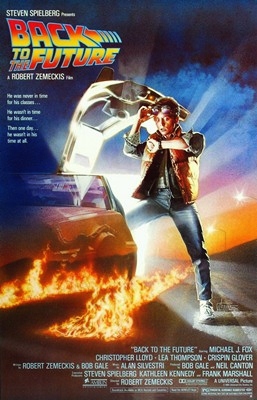
Back to the Future (1985)

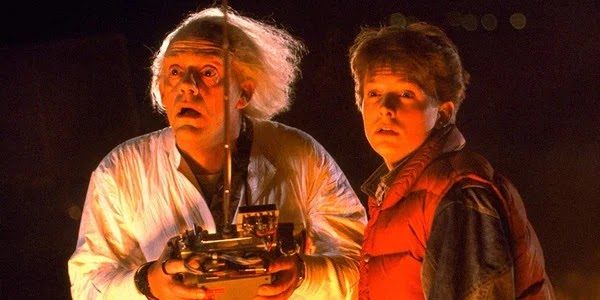
Michael J Fox and Christopher Lloyd head to the past and back in the ever beloved Back to the Future

Director: Robert Zemeckis

Cast: Michael J Fox (Marty McFly), Christopher Lloyd (Dr Emmett “Doc” Brown), Lea Thompson (Lorraine Baines-McFly), Crispin Glover (George McFly), Thomas F. Wilson (Biff Tannen), Claudia Wells (Jennifer Parker), James Tolkan (Gerard Strickland)

In the tentpole 1980s film icons, few films are as beloved as Back to the Future. With the highest of high-concepts, it could easily have alienated people – or felt a little bit silly – but instead it’s a perfectly structured entertainment, a wonderfully assured combination of light comedy, drama, science fiction, farce and adventure. It’s one of those rare films that doesn’t have a wrong beat in it.

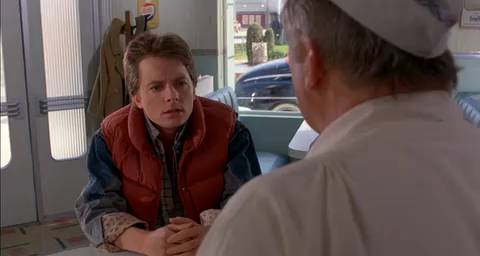
Set in 1985, Marty McFly (Michael J Fox) is a your typical teenager, cool, loves rock music, has a great girlfriend Jennifer (Claudia Wells) – and is worried he’s going to turn out like his parents, his weak father George (Crispin Glover) bullied by his supervisor Biff (Thomas F. Wilson) who never amounted to anything and his depressed mother Lorraine (Lea Thompson). His friend, eccentric scientist Emmett “Doc” Brown (Christopher Lloyd) ropes Marty into tests of his latest invention – a time travel machine built into a DeLorean car. When the first test is interrupted by angry Libyan terrorists – furious that Doc used their investment and stolen plutonium to build a time machine rather than a bomb – Doc is killed and Marty escapes in the DeLorean, accelerating to 88mph and accidentally throwing himself thirty years into the past. There he meets his parents, disrupts their first meeting and finds his mother falling in love with him and his father a weakling who he has to teach how to become a man and win his mother’s love – all while finding the help of the younger Doc to return him to 1985. 

Back to the Future has a tricky concept but a remarkably simple story which revolves around completely relatable ideas and questions. Who hasn’t wondered what your parents were like when they were young? Would you get on with them? How different would they be from the adults you know? These ideas are all caught – and told with maximum comic and dramatic impact – in Robert Zemeckis and Bob Gale’s superbly constructed script.

The secret really is in the cooking of that script – nearly five years in the making – where every single scene serves a clear purpose, and all the plot points sprinkled through the first twenty or so minutes or brilliantly pulled into effect in the rest of the film. With skilfully swift and economic story telling us all the information we need to know about Marty, his interests and skills, his parents – not to mention all the hundred and one other things happening in the film – so that as each careful plot point sprinkled through the film comes into effect it’s instantly satisfying and convincing. As director Zemeckis also gets a perfect conveying of the film’s tone of light comedy, even more surprising since it frequently touches on darker themes (murder, incest and rape for starters!) but never once feels like it’s tone is falling all over the place.

The film has a brilliant Frank Capraesque film of the strength of how one person can make a difference – both for good and bad. By arriving in the past – and with his confidence, bravery and shy decency – Marty at first ruins his parents meeting and then (almost without realising it) builds up both of them to head-off the mistakes they will make in their lives. Most obviously in his coaching of the timid and frightened George into someone who will have the confidence to make his own choices and go after the things he wants. The grooming of luckless loser George into someone who will stand up (eventually) against the brutality of Biff (a swaggeringly vile Thomas F Wilson) is particularly affecting, Crispin Glover to be commended for making a character who is wimpish and frustrating but not unlikeable. Lea Thompson also does great work as a sweet young girl, who’s more daring than she appears.

The film’s real success though is tied directly into the casting of Michael J Fox in the lead. Fox was born to play this role, the film effectively a showcase for his timing, ability to throw just enough shade and emotion onto scenes to keep them real, and above all his almost unparalleled skills as a light comedian. Originally unable to play the role due to a scheduling clash with his sitcom Family Ties, Fox was only bought on board after three weeks when backup choice Eric Stoltz proved unsuitable for the role (by his own admission). The entire film was shot either at night or the weekend to allow Fox to shoot after this 9-5 commitment to Family Ties was finished. And thank goodness because Fox makes the film.

He also has superb chemistry with Christopher Lloyd (graciously stooping for the whole film so he could fit in the same frame as the famously diminutive Fox). Lloyd, another great comedian with the instincts of a natural actor, channelled Einstein and conductor Leopold Stokowski as Brown, making him a larger than life eccentric who still feels like a real person. These two actors spark off each perfectly, adding a huge amount of comic and dramatic force to their rat-a-tat dialogue. Fox’s skill in understanding the light drama tone – and making what was already a very strong script comedy gold – as well as his ability to be immediately relatable to viewers is what makes the film an eternal success. 

That and it’s simple themes. The joke of travelling back in time and having your mum accidentally fall in love with you is perfectly judged, being just the right amount of icky (Fox’s horrified discomfort is hilarious) without being unsettlingly disturbing. The reconstruction of the tone and vibe of the 1950s is perfect – with Marty’s more hip 1980s style juddering up against the picket fence Americana of the past. There is plenty of humour from watching Marty “invent” everything from the skateboard (in a hilarious but gripping chase sequence) to rock and roll music. But it all works because the film is very heartfelt and genuine and very sweet.

Not only that but when it wants to be it’s also exciting and dramatic. The final resolution of George’s rise to manhood carries a real sense of threat as well as a cathartic moment of violence. The film’s final sequence as Doc and Marty race against time to channel a lightning strike to get the Delorean back to 1985 is truly exciting, helped as well by Alan Silvestre’s perfectly judged musical score (and thank goodness for executive meddling that nixed Zemeckis original idea of a Nevada test site and the time machine being built into a fridge). It all works as such an entertaining package you don’t even think about the fact that, as Marty returns to a radically altered family life in 1985, he won’t share any memories with his parents and siblings.

With a star actor taking on the role he was born for – and Fox was never better again, perfectly charming, endearingly sweet, cocksure and cool – Back to the Future has been entertaining audiences for almost 35 years – and it will carry on entertaining them the more we head into the future.

Adam's Rib (1949)

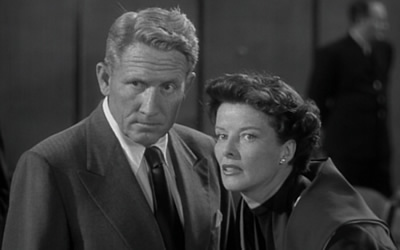
Spencer Tracy and Katharine Hepburn go toe-to-toe in court and marriage in Adam’s Rib

Director: George Cukor

Cast: Spencer Tracy (Adam Bonner), Katharine Hepburn (Amanda Bonner), Judy Holliday (Doris Attinger), Tom Ewell (Warren Attinger), David Wayne (Kip Lurie), Jean Hagen (Beryl Caighn), Hope Emerson (Olympia La Pere)

He’s a tough-on-crime DA. She’s a top liberal lawyer with a feminist agenda. So when Doris Attinger (Judy Holliday) is arrested for firing a gun at her philandering husband Warren (Tom Ewell) and his lover Beryl (Jean Hagen), naturally Adam (Spencer Tracy) and Amanda Bonner (Katharine Hepburn) end up on opposite sides of the court case in this witty “battle of the sexes” married life comedy.

Directed with unfussy calmness by George Cukor who, as he often does, hires the best actors, points the camera and lets them get on with it, Adam’s Rib is an enjoyable and fascinating watch, partly ahead of its time in its gender politics, partly relic of another era. It completely accepts the idea that a woman can be a successful, skilful lawyer – the idea isn’t even questioned – while still bemoaning the march of militant feminism. After all even the title is a humourous little reminder of where Eve came from.

The plot revolves around Amanda’s belief that a man firing a gun at a cheating wife would get very different treatment from a woman doing the same: that he would be seen as a man protecting his home, while the woman is a neurotic danger. Adam disagrees strongly with this – a crime is a crime – and to be honest he’s probably right (today Doris would almost certainly go down for actual bodily harm, if not attempted murder). But in the 1940s, this issue gets tied up with women starting to push against the idea that their role was just to follow the man’s lead and not threaten to shake up his existence. And that’s exactly contrary to what happens in this film.

Amanda is played by force-of-nature Katharine Hepburn at her most quick-witted and sharp, a lawyer more successful in many ways than her husband (and by being in private practice, probably the main bread winner as well, although that is never stated). Her place in the court is never questioned, which is interesting in itself in the post-war era where the idea of women in the professional world was just beginning to be seen as a possibility (although lord knows there was still decades to go until it was to be seen as completely normal).

It’s not a position that Adam questions. His main problems are more with the law being used as a tool for a very specific agenda, rather than a feeling that women are crowding into his realm. Played with brusque stuffiness and uncomfortable formality that tips over into moral outrage by Spencer Tracy (again showing his natural gift for both acting and reacting), Adam feels that his belief in the law is being damaged by Amanda’s use of Judy’s case as a political tool for women’s rights, rather than being judged on its actual merits. 

So this becomes the spring board for a series of extremely well-acted (and frequently funny) arguments between this tempestuous couple as the court case turns from a flirtatious rivalry into an increasingly bitter one. These ding-dong battles work so well on screen because of the immense chemistry between Tracy and Hepburn, a couple so devoted in real life that they convey this even when really going at each other on screen. 

Mix that in with an obvious sexual chemistry between them (and this film is remarkably open about sex, by my count the camera cuts to black to imply sex at least three times in this movie – and the couple have separate beds in their bedroom as per the Hays Code, but only one sees the sheets disturbed by sleeping!) and you’ve got an entertaining show. The courtroom antics are frequently both dynamic and entertaining, and the perspectives of both Adam and Amanda carry force – yes women are treated differently by the law, but you surely can’t deny that Doris broke that law.

There isn’t much room for the rest of the cast apart from the barnstorming Tracy-Hepburn show, with the two seasoned performers tearing through the screen. Judy Holliday comes off best in the second-string as the woman on trial, suggesting enough hypocrisy and two-facedness under the surface of her butter-wouldn’t-melt sweetness. Holliday was also helped by Hepburn’s generous insistence that she be made the focus of their scenes together – Hepburn being keen to help Holliday land the leading role in the film Born Yesterday, the play of which made Holliday’s name on Broadway (it worked and Holliday won the Oscar the next year). 

Of the rest, there is a neat, naughty little cameo from Jean Hagen as the other woman, though Tom Ewell mugs as the husband. David Wayne meanwhile plays the Bonners’ next door neighbour, a supremely irritating musician, smug and trying, but whom we’re meant to think of as a witty, eccentric “character”.

The latter half of the film starts to tip a little bit, as Adam has of course to end with the upper hand (he is after all the man!) which he does using underhand tactics and an actually rather unpleasant business with a fake gun (the sort of trick that you imagine if Tracy had pulled in real life, Hepburn would have walked out of the door and never come back). But this is still a film with plenty of top gags and a refreshing look at a marriage where both participants are professional equals and which goes quietly some way in arguing for greater rights for women, before retreating back to its more conservative resolution. Still great entertainment – and Tracy and Hepburn are both at the top of their games here.

Being John Malkovich (1999)

A portal into the head of a famous actor? What better way to find out what it’s like Being John Malkovich

Director: Spike Jonze

Cast: John Cusack (Craig Schwartz), Cameron Diaz (Lotte Schwartz), Catherine Keener (Maxine Lund), John Malkovich (John Horatio Malkovich), Orson Bean (Dr Lester), Mary Kay Place (Floris), Charlie Sheen (Himself), W Earl Brown (JM Inc Customer)

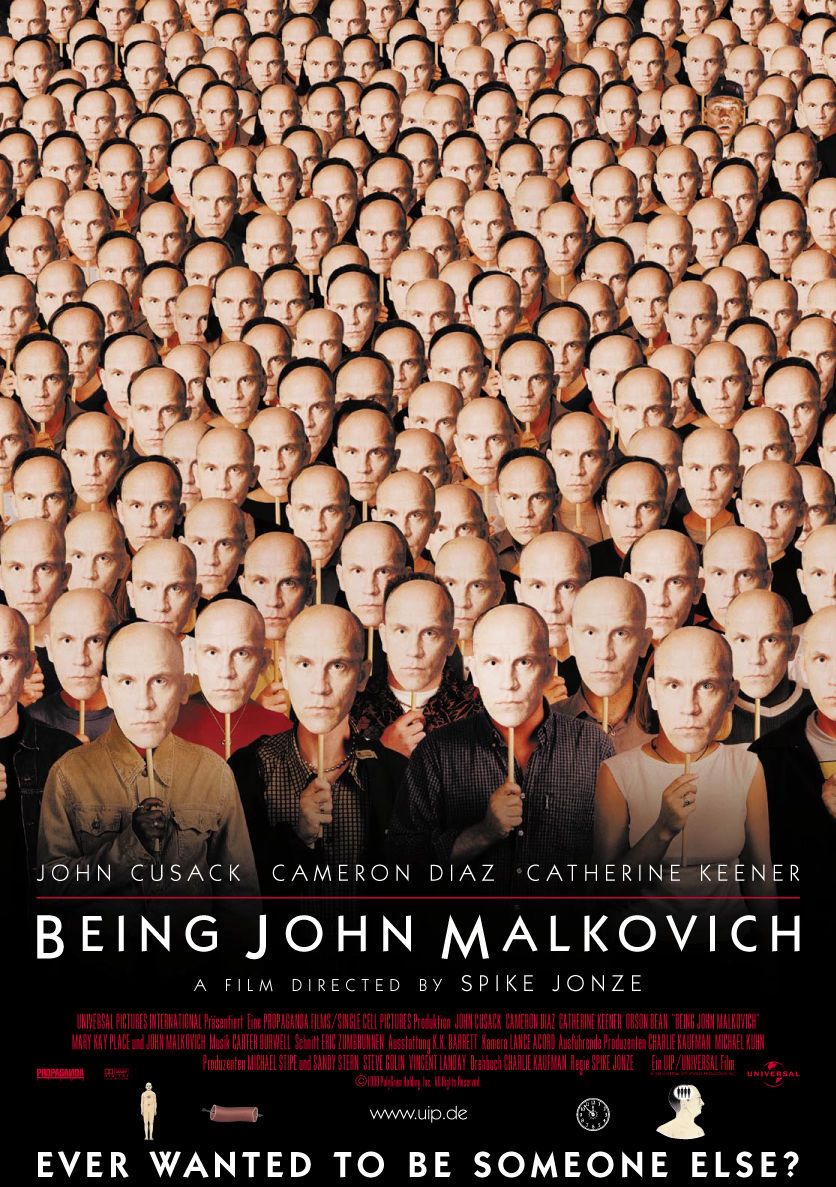
Is there a more consciously eccentric film ever made than Being John Malkovich? Can you imagine the pitch to the Hollywood suits? 

Our hero, Craig Schwartz (John Cusack) is a weedy, bitter puppeteer (as well as creep and potential stalker), whose wife Lotte (Cameron Diaz) fills their house with rescue animals, from talkative parrots to a chimp with PTSD. Needing to make ends meet, Schwartz takes a filing job at a company based on floor 7½ of an office block (it’s a low ceilinged floor built between the other two floors – it’s cheaper on the rent obviously) where he becomes obsessed with his sexy co-worker Maxine Lund (Catherine Keener), who is resolutely not interested. But all this changes one day when Schwartz finds a fleshy, dark tunnel behind a filming cabinet that takes someone into the mind of actor John Malkovich (John Malkovich) – for 15 minutes, before expelling you onto the New Jersey turnpike. Sounds like a business interest for Schwartz and Maxine (spend 15 minutes in someone else’s body!), but the experience of being in someone’s body slowly begins to change Schwartz, Lotte and Maxine – and having his brain invaded has a terrible impact on Malkovich himself.

If that’s not the oddest plot you’ve ever heard, then I don’t know what films you’ve been watching. The film was the brainchild of Charlie Kaufman, who developed from this into one of the most distinctively gifted screenwriters in Hollywood, a master of the quirky and weird, the off-the-wall and the science fiction tinged everyday fantasy, blessed with the ability to mix in genuine human emotion amongst the oddness. 

Being John Malkovich is an inspired idea and Kaufman’s script is ingenious in its structure and progression. Never once does the film settle for the expected narrative development or the conventional structure. It’s a livewire of a film that constantly leaves you guessing, switching tone and throwing logical but unexpected plot twists at every turn. There are plenty of moments where you could expect events to take a conventional turn, but the film never settles for the obvious.

Kaufman’s inspired script was lucky enough to find a quirky visual stylist who was willing to embrace it as much as Spike Jonze did. Jonze’s direction is a masterclass in small detail, slight twists and little touches of invention that never draw excessive attention to themselves but combine to make a thrillingly off-the-wall final picture. 

Jonze knows that the jokes and surrealism of Kaufman’s script are so effective that they don’t need a firm directorial hand to lean the humour on – they work absolutely fine presented almost as written, and make for terrific entertainment. He shoots the low ceiling of floor 7½ with such straightforward confidence that each scene becomes hilarious for its stooped actors and crammed rooms. Jonze can therefore concentrate the flourishes on core moments, from the puppetry that Schwartz and later a Schwartz-controlled Malkovich make their life’s work, to assorted training and educational videos that pepper the film at key moments.

Like Kaufman as well, Jonze’s storytelling works because he inherently understands human emotion and isn’t afraid to throw it into the film alongside the humour. Plenty of directors would have been happy to have all the principals settle into being comic stereotypes, or overplayed pantomime figures. Jonze encouraged the actors to find the depth – and sometimes the darkness – in their characters, to ground the film effectively with touches of real life tragedy and human flaws that give weight to the surreal sci-fi elements – so much so that they start to feel as real as the rest.

John Cusack’s Schwartz is a bitter, increasingly twisted fantasist and dreamer – the sort of guy who believes that his lack of willingness to compromise his art in any way is a strength (his puppetry shows are highly complex, sexualised, high-blown, poetry-inspired hilarious puffs of pretension). Schwartz could have become a joke or a guy with a big dream – but the film increasingly shows him to be a dark, obsessive, cruel even dangerous outsider, who has no problem with harming other people to get what he wants, his moral compass is driven by his self-assessment of himself as a man treated badly by others, so doing what he wants is somehow deserved. It’s an increasingly dark portrait of a man who has more than hint of danger to him.

Keener, as the focus of his obsession, also does extraordinary work as a woman the film is not afraid to present as unpleasant in her selfishness, casual cruelty and greed – but a woman who slowly allows herself to open up and reveal an emotional openness and romanticism someone watching the start of the film would never expect. Similarly Diaz’s downtrodden, sad wife at home flourishes and grows as a person, as she finds in herself a new comfort and ease with who she is, from inhabiting the mind of another person. Both are excellent.

The film explores fascinating ideas of identity – Lotte and Maxine find a freedom and an exciting otherness in being a passenger in another person’s body, and use it as voyages of self discovery for themselves. Schwartz on the other hand sees this body – just as he sees all human beings – as just another puppet for him to control, another way of adjusting the world to match his requirements, rather than change anything about himself. While some lose themselves in Malkovich’s body and find the experience rewarding, Schwartz can only find happiness when bending the body to his own will.

And what of Malkovich himself?  Well has there ever been a braver performance in film? Malkovich is superb as an arch portrait of himself as a rather self-important actor, with an unknowable coolness about him, an intellectualism that makes him a man easy to respect but strangely hard to relate to, a face that is distinctive but a strangely unrelatable style that makes him hard to remember (it’s really an extraordinarily funny and brave performance). As Malkovich realises what is happening to him, the film plays with real beats of tragedy and even horror – what would it be like to be forced into being a passenger in your own head? This is nothing compared to the horror Malkovich encounters when he enters the tunnel himself – to find himself in a world where everyone looks like Malkovich and can only speak using the word “Malkovich”.

Being John Malkovich uses its surreal ideas to explore profound – and even chilling – ideas of control, destiny, personality and identity. With several superb performances, a brilliant script and controlled and intelligent direction, it’s a film unlike any other – and continues to delight and surprise twenty years on from its release.

The Descendants (2011)

George Clooney is a family man dealing with difficulty from The Descendants

Director: Alexander Payne

Cast: George Clooney (Matt King), Shailene Woodley (Alex King), Amara Miller (Scottie King), Nick Krause (Sid), Beau Bridges (Hugh), Judy Greer (Julie Speer), Matthew Lillard (Brian Speer), Robert Forster (Scott), Patricia Hastie (Elizabeth King)

Anyone expecting a straight comedy hasn’t been familiar enough with Alexander Payne’s career. Payne’s movies are triumphant, slightly quirky, explorations of crisis in the lives and emotions of middle-aged, middle-class men. Few directors do it as well, bringing both a lightness of touch and a profound understanding of the tragedy that can underpin ordinary lives. He has an astute understanding of the pain of opportunities lost. And The Descendants is full of these, just as it is full of the hope you can gain from seizing new opportunities in the future.

Matt King (George Clooney) is a Honolulu attorney who is the last trustee representative in his vast family for a site of 25,000 pristine acres on Kauai. With the trust due to end, Matt is under pressure from his family to sell the land for hundreds of millions and gain them all their financial security. In the middle of this, his wife suffers a boat accident that leaves her in an unrecoverable coma. Matt has to rebuild the relationship with his two daughters Alex (Shailene Woodley) and Scottie (Amara Miller) as well as deal with the reveal this his wife was planning to leave him for her lover, a married estate agent Brian Speer (Matthew Lillard).

Payne’s film is heartfelt, low-key and a marvellous showcase for George Clooney who has probably never been better as the grieving and shocked Matt, struggling to come to terms with revelations about his own life that come completely out of the blue. In particular, his own realisation that he has left far too much of his family life to his wife, and his wife has in any case a less than perfect relationship with their two troubled children. Alex (Shailene Woodley) has a history of substance abuse and hell-raising while her sister Scottie (Amara Miller) is using bullying as a way of acting out. King, its clear, has let his connection with his family drift away with his consumption in his work, a character flaw that leaves him with a serious of painful revelations about his own failures.

These revelations are expertly acted by Clooney, who gives the part a rawness and edge beneath his natural charm that becomes deeply involving. He makes Matt both desperate, bewildered and confused as well as kind, decent and forgiving. Payne’s films never present easy solutions to problems, and frequently hold up their leading characters as being the root of their own troubles. It’s the case here as well, as King must learn to realise that many of the problems he is discovering in his family life come out from his own mistakes and lack of focus. How should he respond to his discovery of his wife’s infidelity? How should he decide to react when he discovers his wife’s lover had his own family? 

It’s never the easy choice, and it’s never a clean and easy solution that wraps everything up neatly. The problems we encounter will eventually require us to make intelligent, emotional decisions and accept there are no clean answers. When we meet Brian Speer, he’s not a bad guy just a bit weak. It’s the same throughout. Every character has depth and hinterland. Robert Forster as Matt’s father-in-law may seem foreboding and harsh – but then he is perhaps right to blame Matt for his daughter’s unhappiness, even while he never holds it too harshly against him. Alex’s spaced out boyfriend Sid (Nick Krause) suddenly surprises Matt with his emotional insight into family dynamics.

And of course, his daughters who seem tearaways are in fact far more mature and supportive than might have been expected. Shailene Woodley is excellent as Alex, a young woman who doesn’t blame but demands to be part of solutions, and supports her father to make the tough calls. And the moral problems keep coming, mixed with surrealist comic touches. It’s the sort of film where Matt can make a shocking realisation about his wife, and then return to his table in his restaurant to be assailed by a garish traditional music band.

Despite all this Payne’s film captures a sense of affection and warmth without succumbing to sentimentality or easy solutions. The sort of satisfying outbursts of pain and cathartic anger are largely avoided for far more mature and realistic feelings of joint responsibility for problems and an acceptance that what our lives become are what we make of them as well as other people. It’s a sort of complex avoidance of black-and-white solutions that help to make the film feel truly real and grounded. While not many of us need to worry about the pressures of making decisions that will make us millionaires, all of us have had to deal with our own mistakes leading to others making mistakes and the emotional fallout that this can bring. 

In the centre of Payne’s emotionally intelligent film are these excellent performances, with George Clooney hugely unlucky to miss out on an Oscar for his emotionally intelligent and rich performance here. Payne’s film takes the male mid-life and family crisis and subtly analyses from a host of positions and angles, not just the man itself. We can feel sorry for a bloke who has suffered blows but also see his own decisions have contributed to his position. It makes for a delightful and heartfelt film, which is beautifully made by Payne and superb showcase for intelligent, grown up film making.

M*A*S*H (1970)

Elliott Gould, Tom Skerritt and Donald Sutherland are three madcap surgeons in Robert Altman’s M*A*S*H  a film that looks less screwball and more misogynist every day

Director: Robert Altman

Cast: Donald Sutherland (Captain “Hawkeye” Pierce), Elliott Gould (Captain “Trapper” John McIntyre), Tom Skerritt (Captain “Duke” Bedford), Sally Kellerman (Major Margaret Hoolihan), Robert Duvall (Major Frank Burns), Roger Bowen (Lt Col Henry Blake), Rene Auberjonois (Father Mulcahy), David Arkin (SSgt Wade Vollmer), Jo Ann Pflug (Lt Maria “Dish” Schneider), Jon Schuck (Captain “The Painless Pole” Waldowski), Carl Gottlieb (Captain “Ugly John” Black)

Robert Altman’s counter-culture M*A*S*H was his first (and probably only) unreserved smash hit, the film where Altman cemented his style as a director. Although set in the Korean War, the film was clearly more about attitudes towards Vietnam. Today M*A*S*H is probably more well known as the filmic spring board for the extremely long-running TV show starring Alan Alda (which, at 11 years, lasted seven years longer than the war it was set in). 

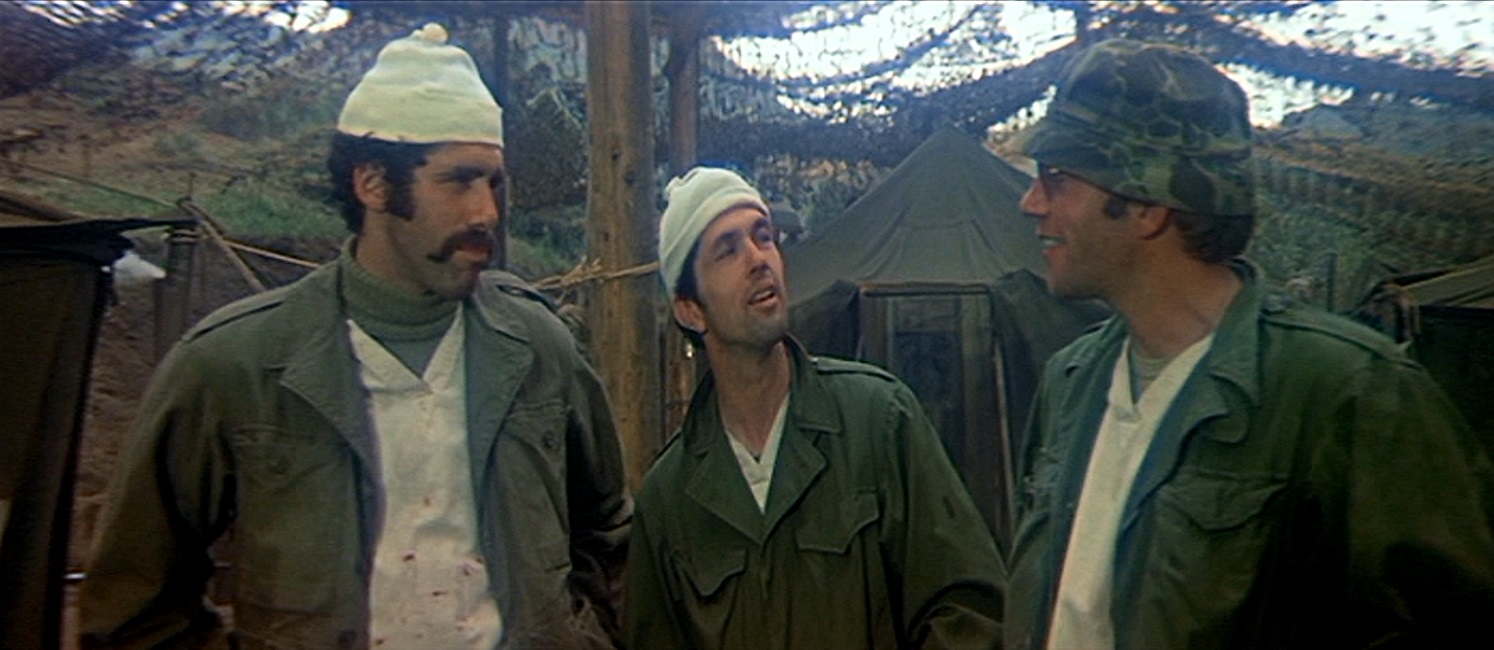
M*A*S*H (like the series) covers the mad-cap antics of the doctors at the 4077thmedicine outpost near the frontlines of the Korean war, a casualty clearing station where young men are patched up and either sent back to the front line or sent home. While the base is a military operation, most of the doctors serving there are drafted civilian doctors rankled by rigid military discipline. The leaders of this prickly bunch are “Hawkeye” Pierce (Donald Sutherland), “Trapper” John (Elliot Gould) and “Duke” Bedford (Tom Skerritt), with their targets ranging from generals to the stiff-backed military figures on the base, specifically the officious but less-competent surgeon Frank Burns (Robert Duvall) and Head Nurse Major Hollihan (Sally Kellerman).

M*A*S*H is the first expression of what became Robert Altman’s signature style as a director. The film has a grimy immediacy that throws the audience into the middle of the action, and is cut with an edgy lack of artifice that at the time was seen as barely competent film-making. That didn’t outrage people as much as Altman’s willingness to allow a lack of conventional discipline in dialogue delivery, with actors overlapping wildly, some dialogue drifting out of earshot or not being captured on screen, no real story being developed through it. It’s a deliberately scrappy, scratchy, almost clumsy film shot with a great deal of artistic discipline (including a spot on The Last Supper parody) but cut and sound-edited with a casual precision that makes it feel extraordinarily experimental.

It infuriated its screenwriter Ring Lardner Jnr (no doubt the Oscar that he received soothed his pain), and Altman’s loose, improvisational style and unwillingness to go for conventional framing and style also alienated his leading actors. Altman and Sutherland (with Gould’s support) each pushed for the other to be dismissed from the film (Sutherland has claimed to have never seen the film, and ton have never understood its success; Gould later apologised by letter to Altman and worked with him several times again) and the whole film’s final style – its influential fly-on-the-wall vibe and nose-thumbing lack of formal discipline – can be attributed completely to Altman’s vision and artistic independence.

The film is important as a key landmark in film-making style and in Altman’s development as a director – but there is no other way of saying it, it has dated extraordinarily badly. For those more familiar with the TV show, its tone is going to come as quite a shock. The TV show is a lighter, sillier, more socially conscious creation (increasingly so in its later years) where the tone was more japery and deadpan silliness. The film is cruel, and its lead characters are swaggering, alpha jocks and bullies, whose meanness and astonishing levels of misogyny are constantly celebrated and rewarded. For those who remember Alan Alda as Hawkeye, Donald Sutherland’s viciousness is coming to come as quite a shock!

Hawkeye and Trapper John’s vileness at frequent intervals is pretty hard to stomach (the less said about the racist, unpleasant Duke the better). The film is really keen to show that all this rampant cruel practical jokery is a survival mechanism against the horrors of war, and the difficulty of dealing with patching young soldiers up to send them back out to die. But the film never really gives us a sense of the war, and the surgery scenes (while effective in their bloodiness and counterpointing the frat house atmosphere of the rest of the film) fail to create that ominous sense of senseless never-ending conflict that the film needs to balance out the vileness of the humour. Further, while Hawkeye and Trapper John are both shown to be dedicated and gifted professionals, they also remain two-dimensional figures, never really shown to have an emotional hinterland that expands their work. They are instead more like Wall Street stockbrokers: excellent at their job, but still a pair of arseholes.

Their attitude to women – and the film’s attitude – is beyond troubling today, it’s flat out offensive. The nurses on station are treated as no more than snacks for the men to enjoy, that they are entitled to pick up as often as they like, and who are barely given any character at all. Sex is as much an entitlement as rations. On his promotion to Chief Surgeon, Trapper John demands (half-jokingly) sex, while Hawkeye “volunteers” a woman to help “cure” another character who fears he has turned homosexual and is considering suicide. Counter culture against the war is celebrated throughout – but it shown in this film to be overwhelmingly a masculine campaign, in which women have no place and no equality. Men can feel the war is terrible, and men can rebel against authority, but women exist only to service their needs.

All of this boils down into a real bad taste in the film’s treatment of ultra-professional Major Hoolihan. Reviled by Hawkeye, Trapper John and Duke for the twin crimes of taking her military career seriously and not being interested in sex with Hawkeye, Hoolihan is systematically degraded and humiliated throughout the film. From having her sex with humourless prig and fellow disciplinarian Frank Burns broadcast around the camp (giving her the nickname “Hot Lips” from her pillowtalk, a title she never escapes) to having the shower tent collapsed around her in front of the whole camp to settle a bet about whether she is a “real blonde” or not – her reaction to which we are misogynistically encouraged to view as hysteria, as dismissed by her commanding officer – it’s tough to watch. The one compliment she gets in the film on being a good nurse is accompanied by her insulting nickname, and by the end of the film she has been reduced to being depicted as an air-headed cheerleader at a football game. Even her credits picture shows her ultimate moment of humiliation. She’s seen as a Blue Stocking, unnatural because she is attractive but not willing to be sexually available to men. This is the sort of treatment that could drive a person to suicide, here treated for laughs. It’s impossible to watch with a smile today.

And it’s the dated part of the film as Hawkeye and Trapper are never questioned for this behaviour – indeed they are celebrated and encouraged throughout as fun, cool guys – when in fact they are the worst sort of jock bullies and their antics the sort of tedious frathouse rubbish that blights too many all-male clubs. They are working class Bullingdon boys, who value nothing, with the film giving them passes because they are great surgeons. Sutherland in particular isn’t charming, he’s creepy and unsettlingly cruel, while Gould at least has a madcap goofiness with touches of humanity. 

Two hours with these arseholes is a long time, and the film just plain isn’t funny enough for what it is trying to do – neither does it convey the horrors of war enough, or the men’s understanding of it. More time shown on the surgeons at least acknowledging the horrors might have helped wonders – but the film assumes that we know what they are feeling and just rolls with it. You could generously say they are cruel in a cruel world. But the film never acknowledges the essential meanness of the humour here, and tries to involve us all in it with no sense of conflict or concern. It’s a troubling film to watch today, its rampant sexist cruelty is offensive and its lack of charm purely unintentional. Time will continue to be cruel to it.

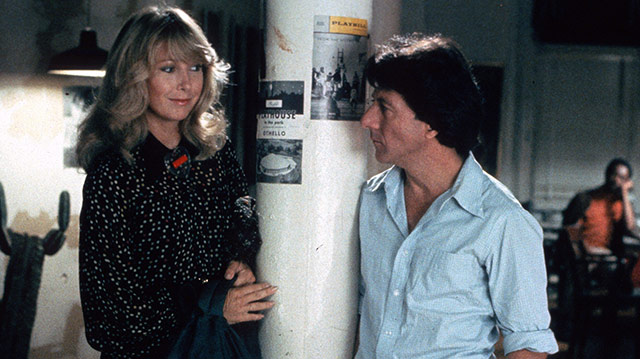
Tootsie (1982)

Dustin Hoffman plays somewhat against type in the marvellous Tootsie

Director: Sydney Pollack

Cast: Dustin Hoffman (Michael Dorsey/Dorothy Michaels), Jessica Lange (Julie Nichols), Teri Garr (Sandy Lester), Dabney Coleman (Ron Carlisle), Doris Belack (Rita Marshall), Charles Durning (Les Nichols), Bill Murray (Jeff Slater), Sydney Pollack (George Fields), George Gaynes (John van Horn), Geena Davis (April Page)

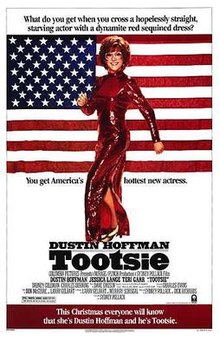
It sounds like a movie idea from hell: “We’ll get Dustin Hoffman to play a struggling actor who can only get a job when he dresses as a middle-aged woman and auditions for a daytime soap. Hilarious misunderstandings will follow…” But you’d be wrong: Tootsie is an absolute delight: not only a wonderful comedy, but a touching love story and an acute commentary on sexism and the compromises women are forced to make to get the same opportunities as men. It’s a wonderful, smart, thought-provoking film.

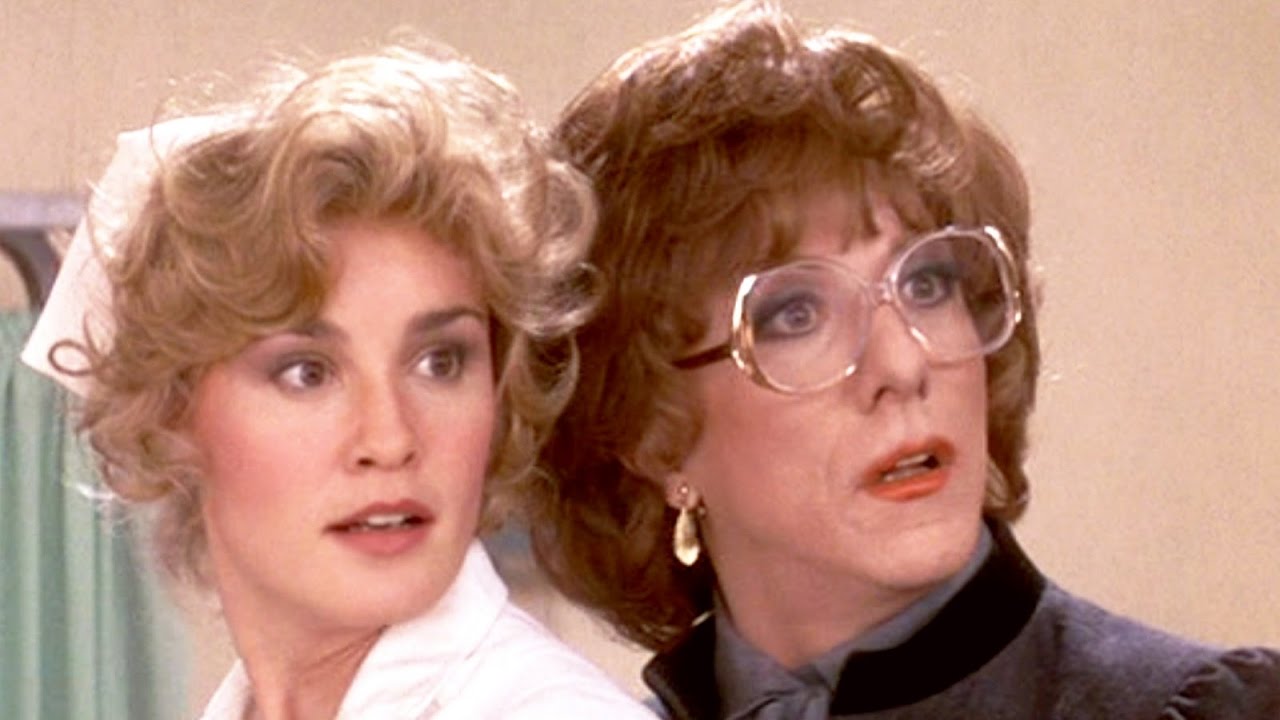
In a role that draws on more than a little self-parody, Dustin Hoffman plays Michael Dorsey, a dedicated, demanding, difficult actor who has alienated so many people across Broadway and Hollywood with his unwillingness to compromise that he can’t land a job. When his friend Sandy (Teri Garr) flunks an audition on a General Hospital-style daytime soap, Michael thinks “what the hell” and puts himself forward for the role under the disguise of the middle-aged “Dorothy Michaels”. Surprisingly he finds he lands the job: and realises that women’s lot on the masculine film-set is not a happy one, evading sexual approaches, treated like idiots and generally encouraged to not pipe up. Intelligent, clever fellow-cast member Julie Nichols (Jessica Lange) hides her light under a bushel. At first Michael enjoys the respect he wins, but as Dorothy increasingly becomes a feminist icon he’s plagued with guilt at the lies and deceptions he’s practising.

It’s the sort of idea that should be either patronising today (a man learns about feminism by walking in a woman’s shoes!) or inadvertently toe-curling. The fact that it isn’t (and I’ve watched this film with women who have enjoyed it a great deal, so I’m not completely guessing here!) is a tribute to the film’s lightness of touch, combined with a neat sense of the ridiculous, along with the emotional truth and genuineness that the film is handled with. It neither preaches nor mocks but simply focuses on telling the story and allowing us to draw our own conclusions. It also has a script packed through with some absolutely cracking jokes, all of which are delivered straight.

Central to its success is Dustin Hoffman, who plays the entire role completely straight. His Michael is a neat self-parody in his abrasive difficulty – but he’s also shown to be a concerned and genuine friend to Teri Garr’s delightfully ditzy Sandy, urging her to have more confidence (little realising how difficult it is for women to impress male casting directors if they behave with the confidence of men). Sure he’s not above clumsy passes to women at parties, but he’s no dinosaur or sexist. And becoming Dorothy Michaels is an opportunist moment of eagerness to show he has range and can get work if severed from his terrible reputation, rather than having any cruel or mocking motivations.

And what Hoffman does so well here is that Dorothy becomes her own personality. And that Michael immediately recognises that Dorothy, with her assurance, her kindness, her unwillingness to take nonsense, but her serene confidence, is a much better person than he is. She refuses to be trapped into either of the two roles the director intends for her (love interest or shrew) but insists her role in the hospital soap be treated like a dedicated professional, not defined by her sex – which makes her exactly the sort of role-model women around her (and eventually across America) have yearned for. Somehow as well, the film gets us to invest in what a great person Dorothy is, even as we know it’s really Michael in disguise – and Hoffman never, ever plays the part for laughs.

The casting allows the film to get a number of hilarious shots at the fast-paced, poorly-written, cheaply sexist nonsense that goes into daytime soaps. The director of the show is a roving lothario (played with all the smarm at his command by Dabney Coleman), who opposes Dorothy’s casting because she is not attractive enough, talks over the women in the cast and expects affairs as part of his salary. The show’s leading man is an aged actor (played with an oblivious sweetness by George Gaynes) who expects to kiss every woman in the show and is totally unable to learn lines. The plots of the soap are a joke, and the actresses are frequently placed into demeaning situations that real nurses and administrators (the only roles of course women can play in a hospital!) would never do.

Becoming horrified by this, Dorothy/Michael encourages the other women in the cast to break out from this – not least Julie Nichols, beautifully played by Jessica Lange as an intelligent, sensitive woman forced into pretending to be an airhead so as not to disturb the men around her. Lange is superb in this role, and so radiant that of course Dorothy/Michael finds himself falling in love with her – a complexity that constantly intrudes on the sisterly bond that Julie increasingly feels for Dorothy…

And that’s another source of guilt for Michael, who is (despite it all) a good guy, and slowly works out that there is no way of extracting himself from all this without hurting people’s feelings (not least when Julie’s sweetly charming widowed dad – played wonderfully by Charles Durning – starts to have feelings for Dorothy). Michael doesn’t want to hurt anyone – not even Sandy, with whom he finds himself stumbling into a one-night stand that he can’t work out how to reverse out of because he’s so desperate not to damage their friendship (something that he of course ends up damaging anyway). It’s a film that brilliantly balances these personal struggles with wider pictures.

Because, as Michael is aware, he’s himself guilty of using women by stealing the cause of feminism by pretending to be a woman. He’s perpetrating a con on the whole of America, and can’t work out a way to back out. The solution he does finally find is a comic tour-de-force – while finding time to still focus later on the real, emotional impact on those who have come closest to Dorothy – and gently indicates how lives can move on.

Sydney Pollack has probably never directed a film as smart, touching and wise as this one (he also puts in a hilarious cameo as Michael’s frustrated agent). It’s a film that could have been just a comedy about a man in drag, but in fact ends up raising profound issues about sexism, feminism and relationships that still feel relevant today. It’s almost certainly Hoffman’s greatest performance – honestly, he’s sublime here, it’s a once in a lifetime performance – and there is barely a wrong beat in it. The cast fall on the great script with relish – Garr was never better and Bill Murray has a superb unbilled supporting role as Michael’s acerbic, playwright housemate. You’ll laugh, you’ll cry, you’ll think and you’ll want to watch it again. Can’t say better than that.

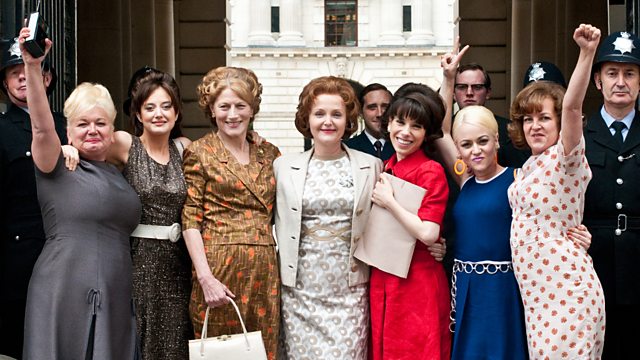
Made in Dagenham (2010)

Up the Women! British comedy wallows in nostalgia but tells a still relevant tale of sexual equality

Director: Nigel Cole

Cast: Sally Hawkins (Rita O’Grady), Bob Hoskins (Albert), Miranda Richardson (Barbara Castle), Geraldine James (Connie), Rosamund Pike (Lisa Hopkins), Andrea Riseborough (Brenda), Jamie Winstone (Sandra), Daniel Mays (Eddie O’Grady), Richard Schiff (Robert Tooley), Rupert Graves (Peter Hopkins), Kenneth Cranham (Monty Taylor), Nicola Duffett (Eileen), Lorraine Stanley (Monica), Roger Lloyd-Pack (George), Andrew Lincoln (Mr Clarke)

You’d like to think a film made ten years ago about a strike for equal pay in the 1960s would be more of a history piece than something that still carries real relevance today. But this is still a world where women are often paid less than a man, and where their work is often devalued or held as less “important” than their male counterparts. Made in Dagenham looks at all these issues with a rose-tinted, feel-good stance that aims to entertain first and make you think second. Nothing wrong with that, but it means the film is largely just a crowd-pleaser, when you feel it could be more.

At the Ford factory in Dagenham, the female sewing machinists are not paid as skilled workers, and are forced to accept less work. Frustrated at the patronising attitude from their all-male union reps, and encouraged by foreman Albert (Bob Hoskins, lovely in one of his cuddliest performances), the women decide to go on strike for equal play, led by Rita O’Grady (Sally Hawkins). As public attention builds, the Ford owners in America mobilise for a battle and the strike attracts the interest of Secretary for Employment Barbara Castle (Miranda Richardson), someone who knows the struggles a woman faces in a man’s world.

It’s no great surprise based on the fluffy, charming tone of this film that Nigel Cole’s previous credit was Calendar Girls. (Also no surprise that, like that film, this has been turned into a crowd-pleasing stage musical.) William Ivory’s script deftly sketches out some familiar movie-dynamics for its characters, establishes clear heroes and villains, gives us a good sprinkling of information and “things to think about”, mixes in at least one tragic sub-plot and provides a steady stream of high points, heart-string tugging moments and punch the air moments. As a piece of writing playing to the masses, it’s pretty flawless.

It’s in love with the 1960s details, with nostalgia dialled up to 11, with a love of the look, feel and styles of the era and plenty of sound cues mixed in that will have you tapping your toes. It’s all designed for you to have fun, and if that means some of the deeper questions get a bit lost at points, that doesn’t really matter. 

And there is more than enough enjoyable material to be seen in setting up a series of bigoted or patronising men (gamely played principally by Kenneth Cranham and Rupert Graves) and seeing them knocked down. You could argue that a slightly braver film would touch at the implications of what Richard Schiff’s corporate big-hitter says about equal pay: make it more expensive to make cars here and we will make our cars somewhere else. (In fact it was pretty hard to forget that, watching the film today, as Brexit has already caused at least three major car factory closures in the UK. In fact the film is very happy to talk all about equal pay for women in the Western World but never even raises the question of how we are quite content to have people in the third world slave away in conditions far worse than this for a few pennies an hour.) But that’s not the film’s point, and instead it’s all about those male-female relationships. 

Sally Hawkins does a good job as a woman slowly growing a social and political awareness and then turning that new-found enlightenment on her own domestic life with well-meaning but of-his-time husband Eddie (a sweet but cluelessly sexist Daniel Mays). It’s all conventional stuff, but Hawkins and Mays play it very well.

The real meat actually comes from plotlines elsewhere. Rosamund Pike is excellent as a woman with a first in history from Oxford, reduced to wheeling out nibbles for her patronising husband and keeping her ideas to herself. Geraldine James and Roger Lloyd-Pack get the tragic plotline of a couple struggling with his post-war undiagnosed PTSD, which gets most of the heart-string tugging. 

Eventually all is made well by Miranda Richardson’s Barbara Castle, floating into the picture to wave a magic wand and save the women’s bacon. Richardson thoroughly enjoys herself in a rather cardboard role, at least two scenes of which are solid exposition, in which Castle’s lecturing of two uppity civil servants is used to introduce the political context. By the end you won’t be surprised that good triumphs. But it’s a film which largely only looks to put a smile on your face, and doesn’t really look at the wider implications or injustices of unequal pay. To the film’s credit it has a final montage of the real Ford women talking about their lives and the battles they had to be respected, which gives it a bit of extra depth. A truly brave film would have found a few minutes – and that’s all it really needs – to look at the wider issues (then and today) economically and socially, and to make us think a little. As it is this just entertains, which is what you want, but it could be more.

The Hitman's Bodyguard (2017)

He’s a hitman. He’s a bodyguard. Let the predictable hilarity ensue!

Director: Patrick Hughes

Cast: Ryan Reynolds (Michael Bryce), Samuel L. Jackson (Darius Kincaid), Gary Oldman (Vladislav Dukhovich), Salma Hayek (Sonia Kincaird), Elodie Yung (Amelia Roussel), Yuri Kolokolnikov (Ivan), Joaquim de Almedia (Jean Foucher), Kirsty Mitchell (Rebecca Harr), Richard E. Grant (Mr Seifert)

The buddy movie. Two mismatched people from two very different walks of life – ideally opposing ones – are thrown together to do something or, better yet, go somewhere and along the way (guess what!) they slowly put all their initial hostility behind each other and found out that, hey, perhaps they have more in common than they thought becoming mismatched pals for life. I’d love to say The Hitman’s Bodyguard does something different. But no, it doubles down on this plot. And doubles down hard.

Michael Bryce (Ryan Reynolds) is an elite UK-based private bodyguard – but after the sudden assassination of one of his clients (and if you can’t guess who the assassin turns out to be, you’ve clearly never seen a movie) his career falls apart and he ends up guarding drug fuelled corporate executives in London (a frankly demeaning cameo for Richard E Grant). All this changes when he is brought in – of course! – by his ex-Girlfriend Amelia (Elodie Yung), an Interpol agent charged with delivering to the Hague notorious hitman Darius Kincaid (Samuel L Jackson). Turns out Kincaid has agreed to testify against Slobodan-Milosevic-style-dictator Vladislav Dukhovich (Gary Oldman, clearly using his recent Oscar to pick up a big pay cheque). But Dukhovich’s men are out to stop them, helped by turncoats in Interpol, so Bryce and Kincaid must hit the road together to get to the Hague – not helped by their obvious loathing for each other. Let the sparks fly!

If you didn’t notice just from that plot description that this is as familiar and overworn a plot as a moth eaten old coat, let me confirm for you. This film does literally nothing new, original, different and interesting than a hundred films before it. In fact it’s almost a work of art to make something so completely and utterly lacking in any form of originality. The entire film plays out, almost beat for beat, as a straight knock off of Midnight Run, but lacking its charm, comic chops, absurdity and heart.

Instead The Hitman’s Bodyguard is exactly the sort of film actors take on when they have a bit of a loose end and want to pick up a healthy cheque so that they can consider popping off afterwards to do something a little more interesting. To say the actors could play these roles standing on their head is an understatement: they could play them in a coma. 

Reynolds is charming as always, but the part barely stretches him. Jackson sprays swear words around like confetti, essentially playing his public personae and looks like a man shooting a film in between trips to The Belfry for a few rounds of golf. Salma Hayek plays a sweary, sexualised “bad girl”, in a role that I think she is embracing as a lark but in fact feels demeaning as the camera leers over her body as she does bad ass things (the part also lacks any charm whatsoever). As mentioned, surely the only thing that attracted Gary Oldman to this totally bland villain role was a stonking pay cheque – and who can blame him for that.

I suppose it passes the time okay, but the film frequently mistakes vast amounts of swearing and moments of violence for actual wit. Just hearing characters drop f-bombs and shout isn’t actually in itself that funny. There is nothing actually smart about the film at any point what-so-ever. No wonder the actors coast through it effectively playing versions of their own public personaes. 

The story line is so rammed full of ludicrous events and thumping clichés that, despite the enjoyment of a few bits of pieces, you can pretty much predict everything that will happen in the movie. If you can’t spot the second the Interpol characters appear on screen which of these guys is a mole for the baddies, then you’ve clearly never seen a movie. Every single beat and every single scene that this mismatched duo go through to get from enemies to frenemies is like reading a B-movie plot creation text book. 

But then if you’ve never seen a film before this might all seem rather enjoyable. If you are thinking about watching this film, I’d urge you to watch Midnight Run. It’s like this – it’s exactly like this – but much, much better. But then I guess the stars of this film will say the same. Even as they limber up to make a sequel: but then they’ve got bills to pay.