Tag: Courtroom drama

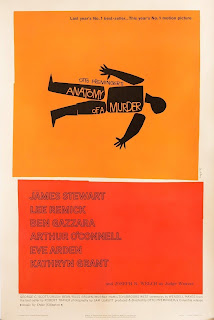
Anatomy of a Murder (1959)

Anatomy of a Murder (1959)

The mechanics of courtroom showmanship is ruthlessly exposed in this gripping drama

Director: Otto Preminger

Cast: James Stewart (Paul Biegler), Lee Remick (Laura Mannion), Ben Gazzara (Lt Frederick Manion), Arthur O’Connell (Parnell McCarthy), Eve Arden (Maida Rutledge), Kathryn Grant (Mary Pilant), George C. Scott (Claude Dancer), Orson Bean (Dr Matthew Smith), Russ Brown (George Lemon), Murray Hamilton (Alphonse Paquette), Brooks West (Mitch Lodwick), Joseph N Welch (Judge Weaver)
Winston Churchill once said Democracy was the worst form of government, except for all the others. You could say something similar about trial by jury: it ain’t perfect, but it’s better than any other justice system we’ve given a spin to in human history. Trials aren’t always forums for discovering truths: they are stages to present arguments (or stories), and they are won by whoever has the best one. Maybe cold, hard facts and evidence make up your story, maybe perceptions. Maybe it’s about how you tell the story. Elements of all three are found in Otto Preminger’s brilliant courtroom drama, Anatomy of a Murder.

In a small town in Michigan, a US army lieutenant, Frederick Manion (Ben Gazzara) is arrested for the murder of innkeeper Barney Quill. Manion says he did the deed only because Quill raped Manion’s wife Laura (Lee Remick). Representing him is lawyer Paul Biegler (James Stewart), a former district attorney looking to start-up a new practise. On the opposite side is new DA Mitch Lodwick (Brooks West) and, far more of a worry, hot-shot lawyer Claude Dancer (George C. Scott) all the way from the Attorney General’s office. They say there was no rape – only a jealous murder after a consensual affair. It’s he-said-she-said, only “he” is dead. How will the trial clear that one up?

Otto Preminger was the son of a noted Austrian jurist, and Anatomy of a Murder can be seen as a tribute to his father, and to the process of the law itself. Not that it’s a hagiography. The film recognises the virtues as well as the faults of the system. Above all, that the system is not perfect, it can’t base every decision on firm facts and often requires people to take leaps of faith based on their gut instinct about who may, or may not, be telling the truth.

Preminger’s film does its very best to put us in the position the jury is in. We get no real evidence about what happened beyond what they get, and very few bits of additional information (except, perhaps, for seeing what many of the characters are like outside of the courtroom). Instead, the viewer is asked to make their mind-up on whether events fell-out as Manion claims (or not) based on our own judgement of the probabilities and of his (and Laura’s) character. The film opens with the crime committed and closes shortly after the verdict: there are no flashbacks or pre-murder scenes to help nudge us towards one view or another. The murder victim appears only as a photo. Like the jury we have to call it on what we see in front of us.

Anatomy of a Murder also makes clear there are plenty of shades of grey in the process of justice. During his first consultation with Manion, Biegler carefully suggests he consider whether he was in fact insane when he committed the deed – as that sort of defence will be much easier, since he doesn’t deny the killing. Sure enough, on their second meeting, Manion is now deeply unsure about his state of mind. Biegler then works backwards to establish precedent for the plea (a finds a single, over 75 years old one) to pull together a defence of irresistible impulse and to peddle hard a picture of the victim as an unrepentant rapist practically asking for a wronged husband to do the deed.

Biegler’s case is flimsy – but the key thing is to present it with pizzazz. And that’s what he’s got. Stewart’s performances in Hitchcock classics are highly regarded, but this might well be his finest dramatic performance. This is a brilliantly sly deconstruction of Stewart’s aw shucks charm: Biegler promotes an image of himself as a down-on-his-heels, bumpkin-like country lawyer, punching above his weight against the big city lawyers, Stewart dialling up the famous drawl. But it’s miles from the truth: Biegler is a former DA, an experienced trial lawyer and a formidable advocate. Stewart flicks the switch constantly, visibly putting on his persona like a skin, shedding it when no longer needed.

There is a constant suggestion that everything Biegler does is for effect. From fiddling with fishing tackle during the prosecution’s opening statements, to furious court-room theatricals as he thuds tables at slights and injustices. All of it is carefully prepared, rehearsed and delivered to make an impact on the jury. The constant parade of effect, manufactured outrage and appeals to an “us against them” mentality provokes exasperation from his opponents and a weary toleration from the Judge (played by real-life McCarthy confronting attorney Joseph N Welch). Stewart uses his Mr Smith Goes to Washington nobility, but punctures it at every point with Biegler’s cynicism and opportunism. Biegler, at best, persuades himself his client is innocent – but I would guess he doesn’t really care either way. He immediately perceives the personalities of his clients and then does his best to shield their less flattering qualities from the jury.
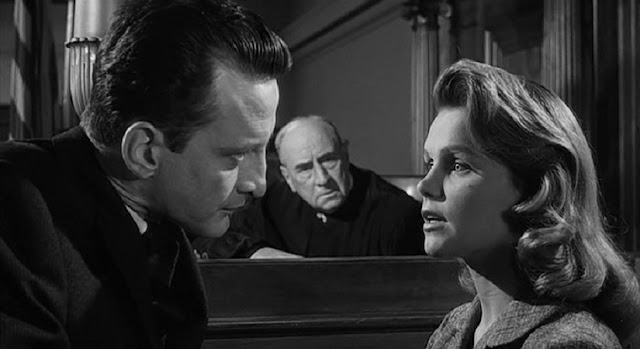
The one advantage we have over the jury is the additional insight we get into this strange couple, living a possibly unhappy, and certainly love-hate, marriage. Manion plays wronged fury in the court – but Gazzara gives him a lot of self-satisfied smarm and bland indifference to his crime in real life, meeting every event with a smirk that suggests he’s sure he can get away with anything. Equally good, Lee Remick’s Laura presents such a front of decency and pain in court, you’ll find it hard to balance that with the promiscuous, blousy woman we see outside of it, who provocatively flirts with intent with anything that moves. But it’s all about the show: present them right, and these unsympathetic people can be successfully shown as a conventional loving couple.

The prosecution is playing the same game. George C. Scott is superb as a coolly professional lawyer, who will use any number of tricks – from angry confrontation, to seductive reasonableness – to cajole a witness to say anything he wishes them to say. He will turn on a sixpence from being your friend, to berating you as a liar. And he’s not averse to his own morally questionable plays in court. Like Biegler, he knows presenting a good story is what is needed to win: the truth (or otherwise) isn’t enough.

Anatomy of a Murder still feels like a hugely insightful look at the legal process. Most of its runtime takes place in court, which Preminger shoots with a calmly controlled series of long-takes and two-shot set-ups, that help turn the film into something of a play (as well as a showpiece for fine acting). Along with its very daring (for the time) exploration of rape, it has a very cool soundtrack from Duke Ellington, that drips with allure and gives the film a lot of edge. The acting is all brilliant – along with those mentioned, Eve Arden is first-class as Biegler’s loyal secretary and Arthur O’Connell sweetly seedy as his heavy-drinking fellow lawyer. Anatomy of a Murder gives a first rate, at times cynical, look at the flaws and strengths of trial by jury – and is an outstanding courtroom drama.

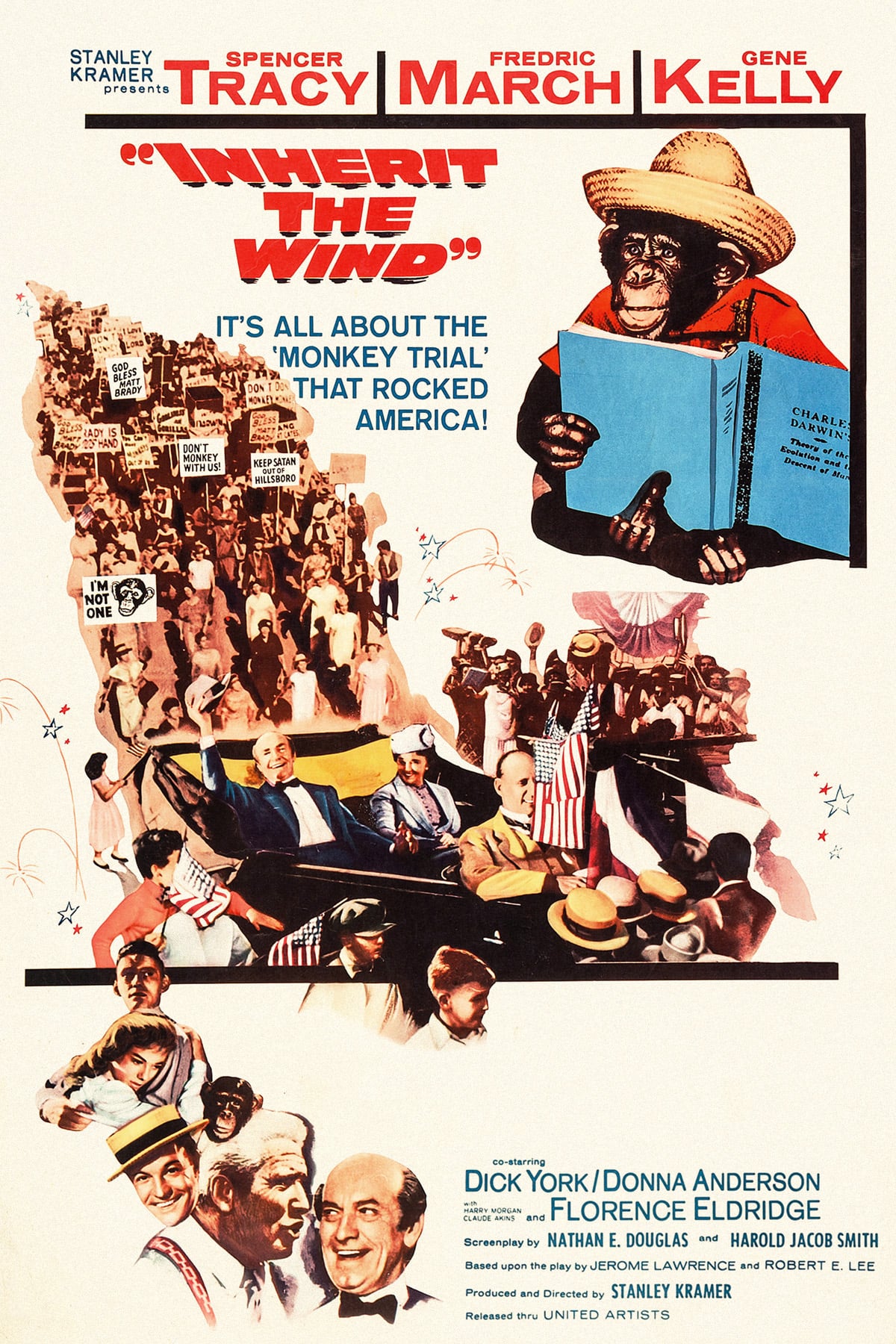
Inherit the Wind (1960)

Spencer Tracy and Fredric March go toe-to-toe in Stanley Kramer’s liberalism-on-trial movie Inherit the Wind

Director: Stanley Kramer

Cast: Spencer Tracy (Henry Drummond), Fredric March (Matthew Harrison Brady), Gene Kelly (EK Hornbeck), Florence Eldridge (Sara Brady), Dick York (Bertram T Cates), Donna Anderson (Rachel Brown), Harry Morgan (Judge Merle Coffey), Claude Atkins (Reverend Jeremiah Brown), Elliott Reid (Prosecutor Tom Davenport), Paul Hartman (Deputy Horace Meeker)

In 1960, Inherit the Wind was a parable. The teaching of Darwinism being illegal in a small town that defined itself by its faith couldn’t really happen today could it? So, the film used the concept as an angle to criticise the restrictions placed on free speech during the McCarthy years. The wheel has come full circle now: it’s no longer unlikely at all to imagine something like this happening. Indeed, versions of it have already taken place in America this century. This change does actually help the film look increasingly more prescient as time goes by.

A fictionalised version of the famous Scopes monkey trial (with most of the names changed, but many of the court room events fundamentally the same) a local schoolteacher, Bertram Cates (Dick Young), in a small Southern town is placed on trial for teaching Darwinism in his school. Staunch Christian and former Presidential candidate Matthew Harrison Brady (Fredric March) volunteers to put the case for the prosecution. Cates’ defence will be handled by the renowned liberal lawyer Henry Drummond (Spencer Tracy). Sparks fly in a courtroom and around the town, where many people are instinctively opposed to anything that can be seen to draw doubt on intelligent design.

Kramer’s films are often both praised and criticised for their rather heavy-handed liberalism. Inherit the Wind is no different. You’d be hard pressed to miss the message here about the dangers of intrusive laws designed to govern what we think and believe. Kramer’s film edges away from making criticism of fundamentalism too overt. Sure, the local preacher (a lip-smacking Claude Atkins) is a tongue-frothing “burn ‘em all!” maniac, only happy when stirring up an outraged mob. But on the other hand, Drummond is revealed to be a man of (liberal) faith – and, in an agonisingly heavy-handed final note, the film ends with him literally weighing The Bible and On the Origin of the Species in his hands then clasping them both together. You see – science and faith can work together!

While it’s easy to smile at Inherit the Wind’s striving for inoffensive liberalism, it means well and actually produces some effective court-room set-pieces. While its overlong – the sections outside of the court could do with trimming down and a rather shoe-horned plot with Cates dating the local preacher’s daughter (not helped by the blandness of both actors) promises much but delivers very little. What the film really works at is a chance for two seasoned performers to go at each other hammer and tongs in the court. Chances they both seize.

Spencer Tracy sets a template of sensible, liberal reasonableness mixed with a well-defined sense of right and wrong that would serve him well in a further three collaborations with Kramer. He brings Drummond a rumbled worldliness, a shrewd intelligence and a patient forbearance but never once lets us forget his righteous fury that this case is even happening in the first place. His courtroom performance hinge on a winning reasonableness that can turn on a sixpence into ingenious traps for witnesses. He’s a rock of decency in a shifting world and Tracy effectively underplays several scenes, making Drummond seem even more humane.

It also means that Tracy makes a lovely performing contrast with Fredric March’s firey passion as Brady. Sweating in the heat of the court, March’s Brady is overflowing with moral certainty and fury. March’s performance is big, but the character himself has a court-personae that depends on him appearing like an embodiment of God’s fury. It works because March gives Brady a quiet air of sadness. This is a man raging against the dying of the light – this case is his last hurrah. Brady is becoming yesterday’s news, but can’t seem to consciously accept this. In quieter moments, he is clearly a man of reflection and reasonableness – but (in a surprisingly modern touch) is all to aware that a raging public personae is what “sells”.

Kramer’s film is at its strongest when it lets these two actors go toe-to-toe. These moments aren’t just in the fireworks for court. Private scenes between the two show a great deal of mutual respect and even admiration. The two men are old friends. Drummond is very fond of Brady’s wife Sara (played excellently by Fredric March’s real life wife Florence Eldridge), who also regards him as a man of decency. They can sit on a bench at night and reflect on the good times. Brady may be a type of demagogue but he’s not a rabble rouser like the Reverend Brown (who he publicly denounces) even while he enjoys the attention of crowds. Drummond isn’t adverse to whipping up a bit of popular support – or enjoying the attention. It’s a fine contrast of two men who both similar and very different.

Aside from this, Kramer sometimes trips too often into rather obvious and heavy-handed social commentary. Gene Kelly is on good form in an over-written part as a cynical journalist – he sort of cares about justice, but only if its a good story and has only scorn for anyone else who believes anything. The film closes with a rather heavy-handed denunciation of his lack in belief in anything, compared to Brady’s faith. The script is at times a little too weak – Tracy and March sell the hell out of a vital confrontation near the end, playing “gotcha” moments that the script largely fails to deliver – but there is still lots of meat in there. Some of the staging and performances – including the extended pro-religion protests that pad out the run time – are a little too obvious.

But at heart, there is a very true and increasingly more-and-more relevant message in this film – and when its acted as well as this, it’s hard not to enjoy it.

Judgment at Nuremberg (1961)

Maximilian Schell on a misguided attempt to salvage his country’s dignity in Judgment at Nuremberg

Director: Stanley Kramer

Cast: Spencer Tracy (Judge Dan Haywood), Burt Lancaster (Dr Ernst Janning), Richard Widmark (Colonel Ted Lawson), Maximilian Schell (Hans Rolfe), Marlene Dietrich (Frau Bertholt), Montgomery Clift (Rudolph Peterson), Judy Garland (Irene Hoffmann), William Shatner (Captain Harrison Byers), Howard Caine (Hugo Wallner), Werner Klemperer (Emil Hahn), Joh Wengraf (Dr Karl Wieck), Karl Swenson (Dr Heinrich Geuter), Ben Wright (Herr Halbestadt), Virginia Christine (Mrs Halbestadt), Edward Binns (Senator Burkette)

“I was just following orders”. It’s a statement you instantly associate with people who know they are doing the wrong thing, but cling to the idea it’s not their responsibility because they’ve been told to do it. The Nuremberg trials – which started with the major surviving war criminals, but then investigated every level of German society from the army to industry to doctors to the judiciary – exploded this as an excuse. But the trials also raised wider questions, ones that Judgment at Nuremberg explores: how do you make judgments for individuals when, arguably, nearly everyone in the country holds some sort of moral responsibility? What happens when justice collides with political reality? What price is put on getting justice for the few against the need to move on?

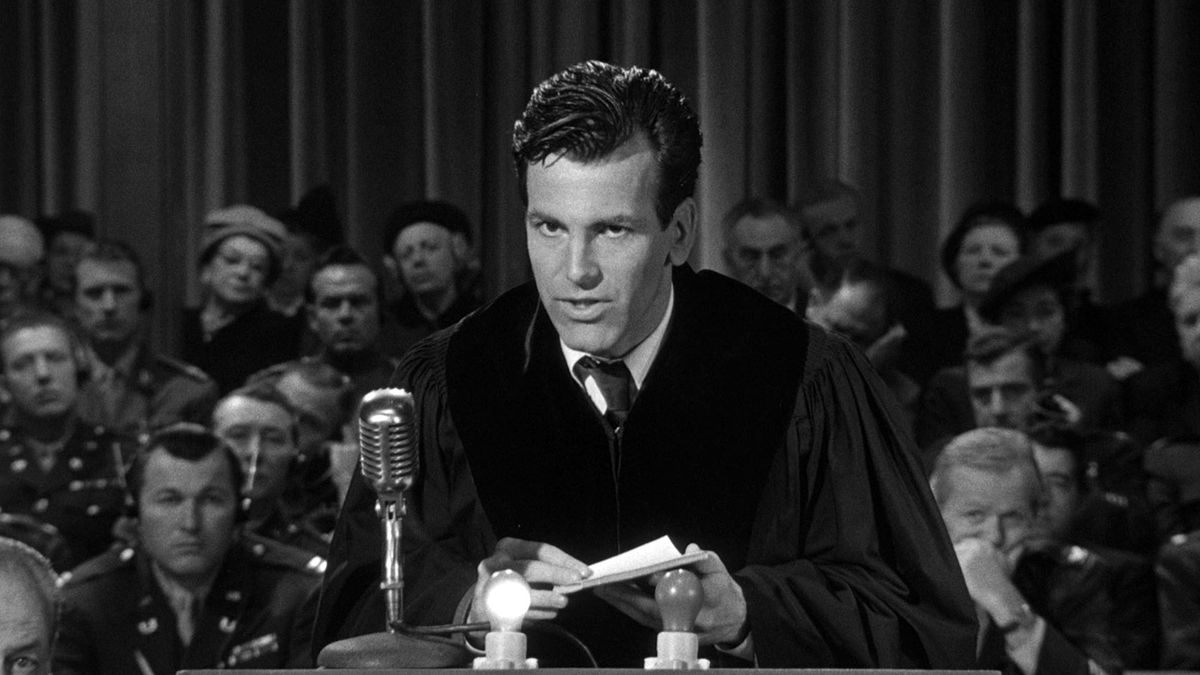
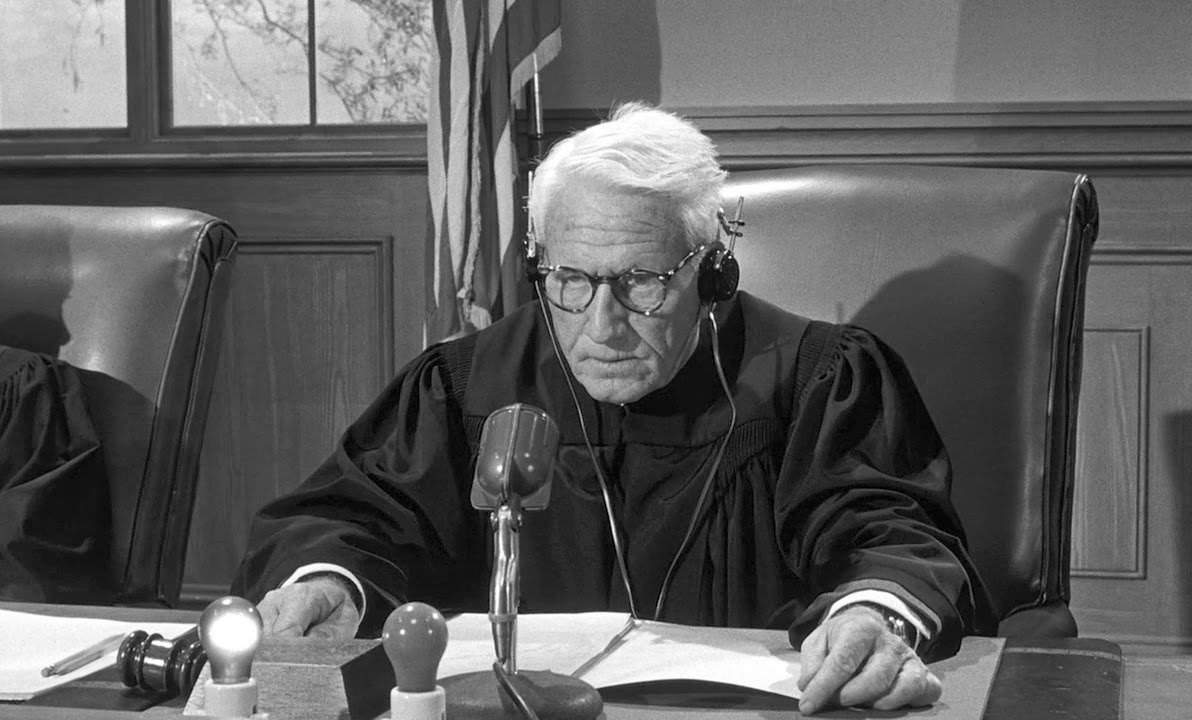
These, among others, are fascinating questions explored in Stanley Kramer’s engrossing – if at times a little dry and on-the-nose – film. In 1948 Judge Dan Hayward (Spencer Tracy) arrives in war-torn Nuremberg to judge the trial of four senior German judges. The most prominent of the accused is internationally renowned Dr Ernst Janning (Burt Lancaster). Janning’s passionate advocate Hans Rolfe (Maximilian Schell) believes the trial is about the Allies punishing the Germans and wants to show “we were not all like them”. Prosecuting laywer Colonel Ted Lawson (Richard Widmark) wants the trials to continue until all the guilty have been punished. But with Cold War tensions rising – and Berlin already under blockade by the Soviets – the politicians back home want the trials to wind down, particularly as the Germans could be key allies against the USSR. How will Hayward balance these pressures as the trial progresses?

Kramer’s film is a brilliant reconstruction of the detail of the trials. He had wanted to film the entire thing on location – but, when the trial room was unavailable, Kramer had the trial room rebuilt in exact detail in the studio (the production design is absolutely spot-on by Rudolph Sternard). The film stages all the issues of simultaneous translation, headphones and trial procedure in loving detail. His technical direction is well managed – even if the camera perhaps once too often pans around those involved in the trial while they speak. The trial drama is structured around three key witnesses (rather than documents), and brings out impressive performances from the entire cast.

Abby Mann’s screenplay wisely focuses in, not on the primary Nuremberg trials, but one of the many sub-trials. Little known, this works so well dramatically, because they both delve deeper into how every facet of German life was corrupted by Nazism – that in this case, leading judges condemned those they knew were innocent to death – and also allow an exploration around the purpose of the Nuremberg trials themselves. Were these trials crucially about justice at all costs and should continue indefinitely – as some characters clearly believe? Or were they meant as representative affairs, demonstrating the guilt of a selected few, at which point their purpose was done?

Kramer’s film is an educative piece, which explores this. Crucially several German characters are introduced, each of them unsure as to how much the national guilt should apply to them. Should Hayward’s household staff consider themselves guilty? As Hayward points out, Dachau was only about 20 miles away: not to know of its existence at all, was surely be wilful ignorance. Marlene Dietrich (excellent as an austere widow), is bitter that she has lost everything after her husband (a German general) was executed (an execution that many of the characters feel was harsh). He never liked Hitler, and he wasn’t a Nazi: how bad could he have been? He only did his duty right?

Meanwhile, firebrand lawyer Hans Rolfe believes that he must salvage some sense of German identity from the trial: he needs to show that “we were not all like that”. And rescuing the reputation of Dr Janning as “the Good German” is crucial to that. An Oscar-winning Schell (the part is perfect for his grandiose style) superbly captures the agonised guilt that has transformed into anger in this man: the desperation to protect his country that leads him to undertake the same brutal interrogations of witnesses during the trial that his clients are accused of doing. Repeating the same actions of the past that he hates, with a misguided goal of restoring pride to his country.

And why does Dr Janning become the focus of this desire to show not everyone was bad? One of the interesting things the film raises is questions of class. Rolfe sees him as the model Good German and Hayward struggles to see why he was involved in miscarriages of justice, because he is very much “one of us”. Ramrod straight, he’s no fanatic (like one of his fellow accused), he’s a noble, world-renowned lawyer. Lancaster’s Janning, with his rigid physicality, clearly thinks himself a world above his fellow accused. He has touched pitch, but feels he’s not really been defiled at heart: that there were clear reasons why he did the things he did. He has no sympathy for the crudity of Nazism, but still feel ashamed that he allowed himself to get tied up with it. He starts the trial trying to be above the entire process, as if not engaging will somehow stop him from feeling corrupted, even while his haunted face drips with shame.

It’s a nobility that many on the US side find appealing. It appeals to the same minds that deems Richard Widmark’s combatative Colonel Lawson as not quite gentlemanly, but vindictive. Never mind that Widmark’s lawyer wants justice done, regardless of the cost. It’s the same sympathy many now feel for Dietrich’s dignified widow, who feels so classy and noble that she can’t really be implicated in any nastiness. Janning unnerves Hayward and others, because if he can fall so can they. It also makes him a perfect candidate for rehabilitation. And, with the Soviets closing in on Berlin, many among the Americans want such a fate as much as Rolfe does, so that Germany can be rebuilt as a bulwark against Communism. But are we kidding ourselves? Janning may be the face of decency, but how decent can he be when he decided justice was an optional extra in his courtroom?

The film carefully explores these questions of politics being the art of compromise: of the need perhaps to end one era in order to start another. They’re attitudes I think the film acknowledges as legitimate, but also questions: “What was the war for?” Widmark’s character asks. When you have horrors such as those in the camps – and the film plays one of the key films to powerful effect during the trial – surely politics as normal can’t be allowed to continue? (Interestingly the film allows Dietrich and Schell’s characters to both, legitimately, question the inclusion of this evidence as too emotive and not relevant to the actual crimes of the accused.) Hayward himself comes under pressure to deliver light sentences which will be better for the country. Will he do so?

How can he when the evidence of suffering is so clear to him. The two key witnesses bought into the film are a man with learning difficulties and a woman who had been accused (falsely) of being seduced by a Jewish neighbour. The roles are played by Montgomery Clift and Judy Garland – and a lot of the emotion of these scenes partly comes from the tortured vulnerability of these two actors. These are people whose lives have been shattered – unjustly – and have paid terrible personal prices. Yes it might be expedient for us to look past these stories, but is it right?

Yes, you can argue Judgment at Nuremberg is a little preachy, but I think there are many more interesting ideas thrown up here than Kramer (usually denounced as a simple right-and-wrong director) gets credit for. The performances are superb: Schell is of course marvellous, but Spencer Tracy perfectly channels his ability to project morality as the unsettled judge who finds his easy assumptions challenged. And the film finally boils down perhaps to the simple question of right and wrong.

Even at the end Janning, while admitting the justice of his sentence, and the wrongness of his actions, is still desperate for everyone to know he wasn’t really one of them. That he never knew it would come to those horrors. As Hayward says “It came to that the first time you sentenced a man to death who you knew to be innocent”. Perhaps that the message of the film: justice is complex but needs to be done – and it doesn’t matter about your motives or thoughts, only the things you do.

Paths of Glory (1957)

Kirk Douglas leads men into pointless battle in Kubrick’s Paths of Glory

Director: Stanley Kubrick

Cast: Kirk Douglas (Colonel Dax), Ralph Meeker (Cpl Philippe Paris), Adolphe Menjou (Major General Georges Broulard), George Macready (Brigadier General Paul Mireau), Wayne Morris (Lt Roget), Richard Anderson (Major Saint-Auban), Joe Turkel (Pvt Pierre Arnaud), Timothy Carey (Pvt  Maurice Ferol), Emile Meyer (Father Duprée), Bert Freed (Sgt Boulanger), Susanne Christian (German singer)

Kubrick’s fourth film is one that often gets overlooked when running over his CV – and it’s had less cultural impact than, say, A Clockwork Orange, 2001 or The Shining – but out of all of his films (except maybe The Shining) it’s the one I’ve come back to the most often, and is certainly his first stone-cold classic. This Word War One tragedy simmers with anti-war sentiment, and it’s so beautifully made and assembled you can see its influence in films right up to 1917.

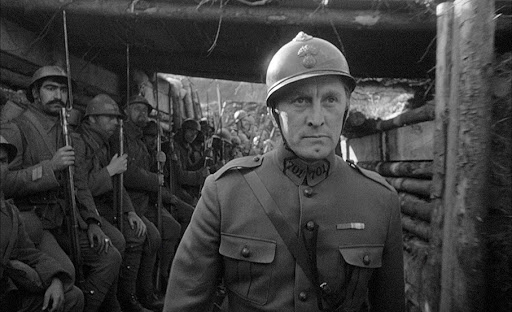
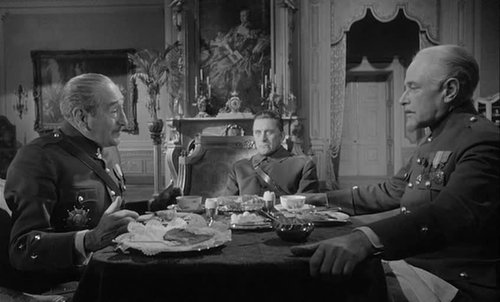
In 1916 the war is bogged down into trench warfare. Command wants results, an action they can point to, so General Broulard (Adolphe Menjou) is sent by the General Staff to instruct General Mireau (George Macready) to launch an attack on a well defended German position called “the Anthill”. Mireau says any attack would be suicide – until the prospect of his promotion being directly linked to it is mentioned, at which point he becomes the attack’s most passionate advocate. Mireau passes the order onto regiment commander Colonel Dax (Kirk Douglas), who protests that the attack is pointless, but is ordered to lead it or be relieved of his command. The attack is a costly farce, and the humiliated Mireau (with Broulard’s tacit agreement) demands a blood sacrifice – one man from each company will be placed on trial for cowardice and shot as an example for the whole French army. Dax deplores this injustice – but with the administrative meat-grinder as deadly as the one on the front, what hope does he have?

Kubrick believed passionately in the project but also needed a commercial hit in order to bolster his career. So he recruited Kirk Douglas to get the funding – Douglas took a third of the film’s budget as his salary, so it wasn’t all charity – and he rewrote the ending of the book to allow Dax to come up with a last minute solution to get the soldiers off. Douglas, to his credit, was having none of that and demanded a rewrite that restored the book’s original bleak ending. 

So it’s largely thanks to Douglas we get the shape of the film that we end up with – but it’s clear that it’s Kubrick’s genius that makes it the film it is. Actor and director were a perfect combination here, so much so that Douglas got Kubrick on board to direct Spartacus (an unhappy experience for them both). But Paths of Glory was where both actor and director were working in perfect partnership, both pushing the other to give of their very best. Dax is the perfect Douglas role – decent, intelligent, well-spoken, passionate, a natural leader, but the film undermines all this with his ineffectiveness. Each of his crusades goes wrong, and he fails at every goal he sets himself. Douglas brilliantly captures both sides of this in his generously low-key but committed performance.

He has a great framework of a film around him from Kubrick. The director uses several longs shots, extended takes and tracking shots to throw us into the world. The opening sequences at the military HQ, taking in the palatial setting of Mireau’s campaign office, have a stately construction and technical formality which then contrasts superbly with the lower angle, tracking shot-laden, POV sequences set in the trenches. Kubrick’s camera glides through these trenches, low angles seeming to make them tower over the viewer, the mud and filth only worse in the body-strewn no-man’s land that stands between the French and the Germans.

It culminates in the attack sequence, one of the greatest battle sequences ever placed on film. Following the doomed advance at a methodical pace, matching the speed of the soldiers, the camera tracks over no man’s land as explosions rend the ground and bodies are thrown to the mud under a hail of bullets. At the front is Dax, vainly blowing on his whistle and encouraging the men forward, while all around him devastation and slaughter win out. Any thought that this wasn’t a pointless enterprise from start to finish is completely dispelled, and our sympathies are completely with Dax and the soldiers, whose lives are superfluous to the ambitions of the generals.

Both generals cut appalling figures for different reasons. Mireau, played with a trumpeting, vain bombast by Macready, is a “blood and guts” soldier who never places his own blood and guts anywhere near the line. Proudly bragging about the skills of his soldiers, then furiously denouncing their cowardice, one telling shot has him in the trenches staring through binoculars at the German positions, oblivious to the wounded men filing past him. Later he orders the shelling of these very trenches in fury at their failure to advance far enough. Broulard is hardly better, Menjou’s “hail well met” bluster hiding a chilling lack of empathy.

The Germans are never seen, because the real enemies here are war itself (and we are kidding ourselves if the same thing wasn’t happening on the other side) and the authorities who push us into it. The film is almost like some sort of black satire, with the generals confidently telling their soldiers they are right behind them, before retreating several miles to the rear to watch the battle unfold. Dax is middle-management, caught between trying his best to deliver orders he knows are impossible, and protecting men he knows are doomed, and failing at both tasks.

The system demands blood sacrifices from the lowest possible rungs, so the hierarchy can reassure themselves they are not blamed (Dax’s offer to take all the blame is promptly rejected by Broulard – no question of any of the officers being at fault!), so the men are chosen by their company commanders. One is chosen by lottery (he of course is a decorated war hero, but that cuts no ice), one because he’s an “undesirable” and the third because he has witnessed his own commanding officer’s cowardice. None of them deserve it, but their guilt is “proved” in a kangaroo court that lasts less than 15 minutes, and in which Dax is barely allowed to put a defence case.

Kubrick’s film becomes a surprisingly fast (it’s less than 90 minutes) but inexorable march towards those three stakes in the ground and the firing squad. Questions of justice and courage are completely pointless – any brave acts in the film are pointless, two of the victims are cited for their courage and the most cowardly character in the film, Wayne Morris’ snivelling Lt Rouget, ends up commanding the firing squad – and the message we are left with is that the institution of war and man are the real villains here.

War has no heroes, only survivors. Victories are important to the generals only in the sense of being tools to jockey for position, and the common soldier is an expendable puppet who can be killed on a whim to fill any political reason. It’s a harsh and chilling view of the military – and leaves very little hope – but it’s superbly made and controlled by Kubrick, in a film surprisingly with more heart in it than any film he ever made before or since. It’s a film that leaks with sorrow and disgust at the victims of the military machine, a film with emotion as well as a technical marvel. It might be Kubrick’s most complete film.

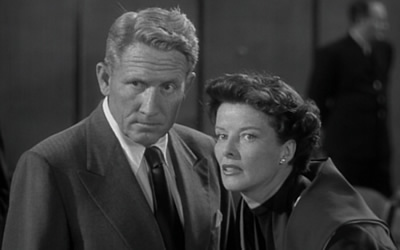
Adam's Rib (1949)

Spencer Tracy and Katharine Hepburn go toe-to-toe in court and marriage in Adam’s Rib

Director: George Cukor

Cast: Spencer Tracy (Adam Bonner), Katharine Hepburn (Amanda Bonner), Judy Holliday (Doris Attinger), Tom Ewell (Warren Attinger), David Wayne (Kip Lurie), Jean Hagen (Beryl Caighn), Hope Emerson (Olympia La Pere)

He’s a tough-on-crime DA. She’s a top liberal lawyer with a feminist agenda. So when Doris Attinger (Judy Holliday) is arrested for firing a gun at her philandering husband Warren (Tom Ewell) and his lover Beryl (Jean Hagen), naturally Adam (Spencer Tracy) and Amanda Bonner (Katharine Hepburn) end up on opposite sides of the court case in this witty “battle of the sexes” married life comedy.

Directed with unfussy calmness by George Cukor who, as he often does, hires the best actors, points the camera and lets them get on with it, Adam’s Rib is an enjoyable and fascinating watch, partly ahead of its time in its gender politics, partly relic of another era. It completely accepts the idea that a woman can be a successful, skilful lawyer – the idea isn’t even questioned – while still bemoaning the march of militant feminism. After all even the title is a humourous little reminder of where Eve came from.

The plot revolves around Amanda’s belief that a man firing a gun at a cheating wife would get very different treatment from a woman doing the same: that he would be seen as a man protecting his home, while the woman is a neurotic danger. Adam disagrees strongly with this – a crime is a crime – and to be honest he’s probably right (today Doris would almost certainly go down for actual bodily harm, if not attempted murder). But in the 1940s, this issue gets tied up with women starting to push against the idea that their role was just to follow the man’s lead and not threaten to shake up his existence. And that’s exactly contrary to what happens in this film.

Amanda is played by force-of-nature Katharine Hepburn at her most quick-witted and sharp, a lawyer more successful in many ways than her husband (and by being in private practice, probably the main bread winner as well, although that is never stated). Her place in the court is never questioned, which is interesting in itself in the post-war era where the idea of women in the professional world was just beginning to be seen as a possibility (although lord knows there was still decades to go until it was to be seen as completely normal).

It’s not a position that Adam questions. His main problems are more with the law being used as a tool for a very specific agenda, rather than a feeling that women are crowding into his realm. Played with brusque stuffiness and uncomfortable formality that tips over into moral outrage by Spencer Tracy (again showing his natural gift for both acting and reacting), Adam feels that his belief in the law is being damaged by Amanda’s use of Judy’s case as a political tool for women’s rights, rather than being judged on its actual merits. 

So this becomes the spring board for a series of extremely well-acted (and frequently funny) arguments between this tempestuous couple as the court case turns from a flirtatious rivalry into an increasingly bitter one. These ding-dong battles work so well on screen because of the immense chemistry between Tracy and Hepburn, a couple so devoted in real life that they convey this even when really going at each other on screen. 

Mix that in with an obvious sexual chemistry between them (and this film is remarkably open about sex, by my count the camera cuts to black to imply sex at least three times in this movie – and the couple have separate beds in their bedroom as per the Hays Code, but only one sees the sheets disturbed by sleeping!) and you’ve got an entertaining show. The courtroom antics are frequently both dynamic and entertaining, and the perspectives of both Adam and Amanda carry force – yes women are treated differently by the law, but you surely can’t deny that Doris broke that law.

There isn’t much room for the rest of the cast apart from the barnstorming Tracy-Hepburn show, with the two seasoned performers tearing through the screen. Judy Holliday comes off best in the second-string as the woman on trial, suggesting enough hypocrisy and two-facedness under the surface of her butter-wouldn’t-melt sweetness. Holliday was also helped by Hepburn’s generous insistence that she be made the focus of their scenes together – Hepburn being keen to help Holliday land the leading role in the film Born Yesterday, the play of which made Holliday’s name on Broadway (it worked and Holliday won the Oscar the next year). 

Of the rest, there is a neat, naughty little cameo from Jean Hagen as the other woman, though Tom Ewell mugs as the husband. David Wayne meanwhile plays the Bonners’ next door neighbour, a supremely irritating musician, smug and trying, but whom we’re meant to think of as a witty, eccentric “character”.

The latter half of the film starts to tip a little bit, as Adam has of course to end with the upper hand (he is after all the man!) which he does using underhand tactics and an actually rather unpleasant business with a fake gun (the sort of trick that you imagine if Tracy had pulled in real life, Hepburn would have walked out of the door and never come back). But this is still a film with plenty of top gags and a refreshing look at a marriage where both participants are professional equals and which goes quietly some way in arguing for greater rights for women, before retreating back to its more conservative resolution. Still great entertainment – and Tracy and Hepburn are both at the top of their games here.

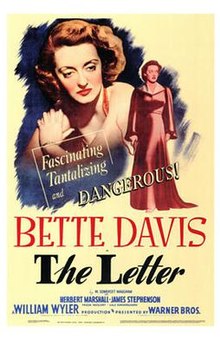
The Letter (1940)

Bette Davis plots doom and death in The Letter. Can she be caught?

Director: William Wyler

Cast: Bette Davis (Leslie Crosbie), Herbert Marshall (Robert Crosbie), James Stephenson (Howard Joyce), Frieda Inescort (Dorothy Joyce), Gale Sondergaard (Mrs Hammond), Bruce Lester (John Withers), Elizabeth Earl (Adele Ainsworth), Cecil Kellaway (Prescott), Sen Yung (Ong Chi Seng)

The “woman’s picture” was a popular genre of the 1940s, a catch-all for stories that centred around women dealing with domestic issues in the home or in relationships, with the lady herself the driving force of the narrative. There were several stars who excelled in this wide-ranging genre, but the best was perhaps Bette Davis. This melodrama is a superb example of exactly this sort of female-led narrative, focusing in on its heroine making catastrophic decisions that lead to terrible consequences.

On a plantation in Malaya, in the late 1930s, Leslie Crosbie (Bette Davis) the wife of gentle plantation owner Robert (Herbert Marshall) guns down a man, Geoff Hammond, who comes to visit her in her home alone. She insists to her husband, and their lawyer Howard Joyce (James Stephenson), that she was defending her honour. The trial for murder feels like a formality – until Joyce’s clerk Ong Chi Seng (Sen Yung) informs him that Hammond had a Eurasian wife (Gale Sondergaard) who has a letter from Leslie to the dead man which casts a very different light on the affair. Because “affair” is the right word: the letter implies Leslie invited the man to visit her while her husband was out. Mrs Hammond will hand the letters over to the authority – unless Leslie and Joyce cough up a huge sum of money to stop her.

The Letter is a film with two marvellous book-end scenes. The first is a beautifully shot and assembled murder sequence, where Wyler’s camera moodily pans through the sleeping native workers on the plantation – dappled by moonlight – until it finds itself drawn towards the steps of the plantation house by the sounds of gunfire. It’s a superbly marshalled sequence that mixes stillness and quiet from the start with a sudden explosion of noise, reflected in the shift in editing from slow camera movements to fast cuts. Nothing else in the film quite matches it until we reach the final sequence that mirrors it with Bette Davis heading back outside into the moonlight, where a terrible and violent surprise awaits her.

And you can enjoy that because no-one did these brutal, arrogant, high-society queens as well as Bette Davis. Davis is superb here, bringing just the right touch of melodrama to balance the intensity of Leslie’s selfish desperation to get away with what we immediately know is an act of murder. Leslie Crosbie is entitled, arch and a natural liar who carefully builds a series of alternative stories (each of them less believable than the one before) which she spins carefully with a mix of vulnerability and a dash of feminine weakness, to try and get away with murder. It’s a domineeringly strong performance that powers the entire film and Wyler draws a wonderful arch cruelty from her, just below the surface of her acceptable female hobbies of knitting and dinner planning. 

Wyler balances this with the two men around her, both of whom are under her spell to different degrees. Herbert Marshall is very good as her husband, a generous, loving, naïve soul who believes his wife without question until he later realises he shouldn’t. Marshall does an excellent job with making this hen-pecked weakling intriguing, not least in his later passive-aggressive response when discovering most of his fortune has been blown to save his wife from a certain death sentence.

The other man is her lawyer Howard Joyce, played with a patrician reserve by James Stephenson. Oscar-nominated for the role, Stephenson’s Joyce doubts everything he is told from the very start, but somehow allows himself to be dragged along with the cover-up that slowly develops. Whether this is out of pride, or whether this is because he is himself somehow under some sort of erotic spell that she emits is left open to question. Either way, Stephenson puts a wonderful growing aghast horror behind the role as his professional and moral scruples are challenged more and more.

The chicanery of Davis’ character in the film is of course helped by her being white and rich, and prejudices against Hammond (not to mention the reception his Eurasian wife expects to gets if she comes forward) are most of the mainstay of the case in her defence. Joyce basically speaks platitudes about professional integrity, while all but knowingly defending a murderer (he in fact goes out of his way to give himself plausible denial and avoids questions). The film manages to present the native workers on the plantation – and Joyce’s clerk – as something a bit more than this, as perhaps the only people in the film with actual integrity.

But of course Davis gets away with it, because she can pay to do so, but the film finds other ways to punish her (as these women’s pictures usually do for adultery). The film’s final sequences see Davis’ character slowly collapse from arrogant certainty into moral and mental torture, before almost willingly marching towards certain danger. Wyler’s film is a great vehicle for her, but it’s also superbly made and shot and captures the sweaty lack of justice in the British Empire with perfection.

Erin Brockovich (2000)

Albert Finney and Julia Roberts battle for justice in the caperish Erin Brockovich

Director: Steven Soderbergh

Cast: Julia Roberts (Erin Brockovich), Albert Finney (Edward L Masry), Aaron Eckhart (George), Marg Helgenberger (Donna Jensen), Tracey Walter (Charles Embry), Peter Coyote (Kurt Potter), Cherry Jones (Pamela Duncan), Scarlett Pomers (Shanna Jensen), Conchata Ferrell (Brenda), Michael Harney (Pete Jensen)

When Steven Soderbergh was being celebrated as the Great White Hope of arty American movie making back in the late 80s, it would probably have amazed his fans if you’d told them that 10 years later he would be directing a Julia Roberts star vehicle. But that’s what he pulled off to great effect in Erin Brockovich

Telling the true story of Erin Brockovich (Julia Roberts), the film follows her life from 1993 when she is struggling to make ends meet while bringing up three small children. After losing a court case – largely due to her brassy foul-mouthedness – she pressures her lawyer Ed Masry (Albert Finney) to give her a clerical job at his law firm. There she finds herself engaged with a simple real estate case involving PG&E, a major gas and electric company. Discovering the company has been polluting the water of the town of Hinkley in California – and left many residents with crippling health problems – Brockovich works to uncover the truth and to gets Masry to agree to build a legal case. She also finds her mouthy down-to-earthness allows her to connect with the people of Hinkley, and she soon becomes determined to get them justice.

The big thing that Erin Brockovich was about when it was released was Julia Roberts. In 2000, it was hard for heads not to be turned by seeing America’s Sweetheart wearing clothing so revealing and provocative it made her Pretty Woman character look reserved. And she swears! Frequently! The film was a triumph for Roberts, turning her from a romantic comedy queen into a serious actress. Roberts won every single Best Actress award going, up to and including the Oscar. And Roberts is very good indeed in the role. Few films have used her effervescence and warmth as a performer so well. You can’t help but side with Julia Roberts when she is firing on all cylinders, no matter what the situation – whether she is a brassy, chippy working mother, a Hollywood actress or a New York City prostitute, you find yourself on her side. 

But, looking back at the film now, this role essentially plays to all of Robert’s strengths. While it looks on the surface like a radical departure for Roberts, the film is basically very much in her wheelhouse. In fact, the whole film is almost a writ-large version of that shop scene in Pretty Woman (still one of the best scenes of modern cinema) stretched over the course of a whole movie. Julia Roberts is treated badly by snobby people, she doesn’t let it get her down, and then she returns with a triumphant flourish that puts the snobs in their place. 

That’s the whole game from Roberts: this is very much the type of performance she gave in Pretty Woman, Notting Hill and My Best Friend’s Wedding repackaged and given a novel appearance by being placed in a drama rather than a comedy. But all the little acting touches that would be familiar to you from those movies are there. There is nothing wrong with any of this, but the film in fact reinforces rather than refutes the idea that Julia Roberts (like Cary Grant) is largely a personality actor. She has a very skilful and impressive collection of acting touches, but they are pretty consistently the same across films. She performs with brilliant, luminous presence here – and commits fully to the part – but it’s more like the ultimate expression of the roles she played in the 1990s. It’s not a surprise looking back that she’s not had a hit like it since.

The rest of the film is an enjoyable mix of comedy and touches of tragic sadness. Soderbergh packages the film as a very safe entertainment, and its’ entertaining. The real Erin Brockovich claims the film is 98% accurate to what happened to her – which perhaps just makes you think that the clichés of film hew closer to real life than you might expect. Soderbergh doesn’t really have much to say here beyond big corporations and snobbery being bad and to never judge books by their cover. But it doesn’t really matter as the whole thing is presented with a confident, brassy buzz as if it is channelling Brockovich straight into celluloid.

It works all the time because you care about Erin, and you enjoy her company. It touches on some issues around sexism in the work place – although Erin is looked down as much for her working class roots as her sex – but there are elements there showing she is clearly judged by her appearance, and even the big firm lawyer brought in help fund the case can’t resist saying when he sees her “I see what you mean about a secret weapon”. Not that Erin herself isn’t ashamed to use her assets – when Ed asks how she can get people to allow her access to such confidential papers, she deadpans “they’re called boobs, Ed”.

That gives you an idea of the general comedic tone of the movie. It’s matched with a fairly predictable domestic plot-line. I suspect Soderbergh was probably making a bit of a point by turning Aaron Eckhart’s (very good in a nothing role) gentle biker, next-door neighbour, childcare provider and boyfriend into the sort of pleading “Honey please come home for dinner” non-entity that the woman often plays in films like this while her husband crusades. The film does manage to mine a bit of quiet sexual agenda from its otherwise fairly bubbly surface. It also draws attention to the way the film basically sets up Erin’s primary romantic relationship being not with a boyfriend, but with herself as she discovers the sort of person she has the potential to be.

There’s that Pretty Woman parallel again. The film is basically a dreamy re-invention saga, presented with a cool flourish. Roberts is excellent in a role that has become a calling card. She’s also got quite the double act with Albert Finney, who is brilliant as the put-upon, slightly haggard, slightly twinkly Masry who finds his own passion for justice reignited. Finney tends to get overlooked in this film, but he is superb and gives the best pure performance in the film. Soderbergh directs with a professional glossiness, and supplies plenty of heart-tugging victims (Helgenberger is very good as the main victim we see) mixed with punch-in-the-air, she’s proving herself better than them moments from Julia Roberts. It’s a very fun film, and genuinely entertaining. But like Roberts’ performance, it’s presenting old tricks in a new way, not reinventing the show.

12 Angry Men (1957)


Henry Fonda must win over 12 good men and true in 12 Angry Men

Director: Sidney Lumet

Cast: Henry Fonda (Juror #8), Lee J Cobb (Juror #3), Ed Begley (Juror #10), E.G. Marshall (Juror #4), Jack Warden (Juror #7), Martin Balsam (Juror #1), Jack Klugman (Juror #5), Joseph Sweeney (Juror #9), John Fiedler (Juror #2), Edward Binns (Juror #6), George Voskovec (Juror #11), Robert Webber (Juror #12)

A young man is on trial for murder. The jury retires to consider. On the first vote, only one man (Henry Fonda) questions his guilt. The other jurors are convinced they are right – can Fonda turn them around?

Who hasn’t done jury service and dreamed of being Henry Fonda? 12 Angry Men is perhaps the most compelling courtroom drama ever, for that very reason: hardly any of us are judges or lawyers, but we’ve all got a decent chance of doing jury service. What would we do in this situation? How thoughtful would we be about the evidence? And, of course, that little stab of ego – could we be charismatic and persuasive enough to sway a room of people? I think this is why this film sticks with people and has become such a persuasive part of our popular culture – we all wanna be Fonda.

12 Angry Men is a film that I feel touches perfection. I thought quite heavily about whether I could identify any flaws in it at all: the closest I got at was the shot Lumet throws in of the suspect (a sweet looking kid). I suspect this shot was required so that the 50s audience could be confident that Fonda was crusading for someone who at least looked innocent (although it always makes me think, since so many of the other jurors make snap decisions, why doesn’t at least one of them look at that cute kid and think “he ain’t no killer…”). Aside from that, I don’t think there is a single mis-step in the filming, acting or writing of the film – and how many times can you say that?

Lumet is a director who doesn’t get a lot of public recognition. He subordinates his skills to the requirements of the story, rather than an auteur who imposes his style. This works perfectly for this compelling slow-burn. Lumet’s expert filming quietly lets the actors and dialogue stand front-and-centre, while cleverly using his camera language and shot choices to amp up the tension.

At first, Lumet uses wider and high angle shots, allowing us to get a sense of the room and the characters. But the real effect of this plays out over the rest of the film, as Lumet slowly moves to tighter angles at POV height, until the final sequences are played out over a series of close-ups cutting from juror to juror, at low angles. What this achieves brilliantly is to make the film feel tighter and more claustrophobic – the room feels like it’s actually shrinking in on the jurors as they argue. You can get a sense of it in the videos below, both early and later in the film.

The film also works so brilliantly because it offers a brilliant insight (and critique even?) of the legal system. The one legal professional we see is a bored judge. All references to the unseen lawyers mention either their showmanship or inadequacy. Even the jury system is subtly called into question: several of the jurors are motived more by prejudice and personal experience than by any analysis of the evidence. Others are flawed in other ways; #12 switches sides indecisively three times while #7 is so impatient and bored with the whole process, he follows the direction of the least resistance. Without #8, a decision would have been made with no discussion at all. Even the very process of taking the vote is shown to root many of the jurors down to “sides” and creates an atmosphere of competition that becomes as important as seeing justice done. And in a system of trial by your peers, only #4 in any way identifies himself as sharing the background of the man on trial. Is this a perfect system?

These ideas, though, are skilfully interwoven in the background of a gripping legal thriller. 12 Angry Men is completely objective. We never see the witnesses whose performance is the cause of such analysis. We never see the scene of the crime. We don’t have any confirmation at all that either side is right. It’s a film about the importance of reasonable doubt – and the need to be absolutely certain before sending someone to the chair. Fonda feels that doubt – and persuades the other jurors of it – but we never know if he was right or not. We never know if any of the suppositions in the jury room are true – the important thing is how high the possibility is that they might be true – and how much that affects our willingness to convict.

The film is one brilliant set-piece after another, as each piece of evidence is interrogated. I honestly can’t decide which one I like the most. What makes it work is the variation of how each case is presented. The film is as comfortable with the drama of #8 flinging a replica of the “unique” murder weapon onto the table, as it is with a careful dialogue-led dissection of the eyesight of a key witness. Who can resist Fonda limping around an approximation of the next-door neighbour’s flat to see if he can cover a certain distance within a certain time. It helps that the dialogue is incredibly rich – it has to convey a lot of information, but also manages to sketch out each of the characters so swiftly and carefully that each of them feels real.

And we’ve come all this way and not even mentioned the performances. Again, each viewing gives me a chance to appreciate a new performance: my eye was caught on this viewing by Robert Webber’s seemingly cool and collected advertising man, who has far less certainty than he projects. Needless to say each actor is brilliant. Fonda (who also produced) is the very image of moral authority – as well as a generous collaborator on the movie. Is this his best performance? It’s got to up there – #8 is a humanitarian, but he’s never smug or self-serving, just a man who feels a strong sense of his own obligation.

If Fonda is the superego, Cobb’s #3 (the primary antagonist, if there is such a thing) is the ego – raging, elemental, decisive, unshaken in his beliefs. Cobb’s performance veers the closestto a little too stagy, but it’s a character that demands it. His bluster and swaggering are vital to the character in order to make his later emotional collapse work as well as it does – and #3’s final emotional disintegration really rings true. It’s a ferociously intense performance.

Each actor gets his chance to shine. Voskovec’s sensitive immigrant has a wonderful speech on the responsibility of passing judgement. The most barnstorming speech is Begley’s racist outburst late in the film. It’s beautifully done as this loud-mouthed bully explodes with frustration, then slowly and even rather sadly collapses as he talks on and on, each sentence making him weaker and weaker, more defensive and vulnerable. But it’s never a scene about just one man – the reactions are as well judged as everything else. And I can’t tell you how much I love #4’s “I have [listened to you]. Now sit down and don’t open your mouth again” one-line response which caps the scene.

In fact just mentioning #4 brings on my love of E.G. Marshall’s performance in this film. #4 should be one of the least engaging characters in the film – coldly analytical, professional, assured and clear minded. But he’s always human, never an antagonist, but a respected citizen – the only one of the jurors who is motivated by judgement rather than prejudice. I love his calmness, his cool lack of regard for #3 and #10’s loud-mouthed berating, his patient, studied explanation of his convictions. I adore his calm puncturing and counterview of each point Fonda puts forward, until he is finally won over – and its his winning over which makes the film work. If this thoughtful, intelligent man has doubts, shouldn’t we all?

But I repeat they are all great. Jack Warden’s #7 is totally convincing as (the film’s real villain?) a man indifferent to right and wrong when compared to his own needs. Balsam’s decent but ineffectual #1 is the perfect mediocrity in above his head. Sweeney’s wry, observant and shrewd #9 is a delight (Sweeney was the only member of the original TV play to be retained). Fiedler’s #2 grows in moral force throughout, belaying his quiet appearance. Klugman’s #5 is quietly defiant and conflicted. Binn’s #6 reveals himself as a mild, humble and honourable man.

I think I could watch 12 Angry Men every week of the year. It’s brilliantly filmed (how could I not mention the oppressive rain soundtrack that accompanies the latter part of the film) and wonderfully directed. The script is simply perfect, Reginald Rose expanding and enriching his original TV adaptation. The acting is nearly flawless from all concerned. It’s, quite simply, a great movie. I simply can’t imagine anyone not reflecting on this movie when heading into jury service. It subtly comments on the legal system, but never gets bogged down in this, telling a gripping and compelling story about things we never see. It’s pretty damn near close to perfection.

Denial (2016)


Timothy Spall as Holocaust denier David Irving in this misfiring courtroom drama

Director: Mick Jackson

Cast: Rachel Weisz (Deborah Lipstadt), Tom Wilkinson (Richard Rampton), Timothy Spall (David Irving), Andrew Scott (Anthony Julius), Jack Lowden (James Libson), Caren Pistorius (Laura Tyler), Alex Jennings (Sir Charles Gray), Mark Gatiss (Professor Robert Jan van Pelt), Harriet Walter (Vera Reich), John Sessions (Professor Richard J. Evans)

In 2000, historian David Irving (here played by Timothy Spall) was exposed as a Holocaust denier who forged and distorted historical records to help his pro-Hitler agenda. This came after his unsuccessful attempt to sue American historian Deborah Lipstadt (Rachel Weisz) for accusing him of Holocaust denial in her book Denying the Holocaust. The decision led to the destruction of Irving’s reputation, career and financial wealth. This film tells the story of this case. Lipstadt’s legal team are played by Andrew Scott (solicitor Anthony Julius), and Tom Wilkinson (barrister Richard Rampton). The publicity-hungry Irving famously acted as his own lawyer.

Denial has a fascinating story at its core, but bungles it by getting the focus wrong. Now I’ll admit I might know more about this trial than the regular guy-on-the-street. But the drama here was in the detail of the debunking of Irving’s denier bullshit. The film benches most of this, reducing Irving’s career of historical re-adjustments into a few simple sound bites. The fascination of this trial was the dissection of denier myths – but the film aims for more conventionally “drama”, by introducing a series of “could Irving win?” moments that never ring true. Not only does this detract from the drama – it also, arguably, makes it easier for Holocaust deniers out there to claim the film doesn’t give the appallingIrving a fair crack of the whip.

It’s a shame, as when the focus is on the facts of the case, it’s very good. Tom Wilkinson is excellent as the maverick Rampton, whose abrasiveness hides his humanitarianism. The drama skirts over the trial’s cut and thrust, but when it does tackle these moments it’s very interesting. The sequence where Rampton pins Irving to the floor over theories that the gas chambers were de-lousing stations for dead bodies (“then why are there bolts on the outside of the doors?”) or air raid shelters (“are we to imagine the SS running 2.5 miles from their barracks to a shelter in an air raid?”) are compelling, and far more interesting than anything else in the film. Even the Cliff’s Notes version of Irving and his views in this film is enough to repulse any sane viewer, and watching him skewered on the witness stand is fascinating and satisfying. There just isn’t enough of it.

One of the film’s greatest problems is pushing Lipstadt front and centre. This seems logical on paper but, as her lawyer says, “this trial is happening to you, it’s not about you”. Lipstadt was deliberately not part of the trial strategy, to keep the focus on Irving. But the film can’t accepts her “story” was to do nothing. It keeps wanting to give her a ‘Hollywood moment’, but the facts can’t provide one – so we get lots of scenes of Lipstadt jogging, or feeding her dog, or watching news reports – time that could have been much better spent elsewhere.

Despite this, Weisz’s performance is very good –she bravely makes Lipstadt prickly and hard to like . Similarly, Andrew Scott is excellent as Julius, but his character is poorly explained (“He’s using you for the publicity” Lipstadt is told – we see no indication for this anywhere) and his decision to exclude Holocaust survivors from the witness list to prevent them being harangued by Irving is botchily explained, the film not wanting to admit that this was a wise decision.

I feel a lot of the film ended up on the cutting room floor. Short scenes pop up now and again around paralegal Laura making you feel she must have been a more important character at some point. I feel huge parts of courtroom reconstruction got trimmed. I suspect there was more around Harriet Walter’s Holocaust survivor. Even Irving feels heavily trimmed – Spall is very good (and subtly vile, but with a persuasive old school charm) as the faux-historian, but the film needs more of him, if only to explore his views more, rather than just treating him like a demon.

That sums the film up: it’s ham fisted. Too much dialogue thunkingly introduces historical events or legal procedures. The film talks about the importance of research, but relies on characters “cracking the case” with flashes of inspiration. It handles the research trip at Auschwitz sensitively (and daringly, shows Rampton taking an aggressive questioning stance of the guides to prepare for the case) – but then the film can’t help throwing in Lipstadt imagining victims clawing at the gas chamber door for escape. I hated the final shot, lingering on the disputed holes in the gas chamber roof used to drop in Xyklon-B, as if we needed this to be confident that, yes, the Holocaust did happen.

I really wanted to like Denial, but it’s no more than an adequate dramatisation of a fascinating court case. It’s brilliantly acted, in particular the four principles. There is an interesting film to be made here about the increasing struggle we have with the abuse of free speech to give equal importance to views that are offensive or just plain wrong. But Denial never really becomes that film – instead it turns its fascinating historical event into a run-of-the-mill Hollywood tale of a plucky heroine vanquishing the bad guy.

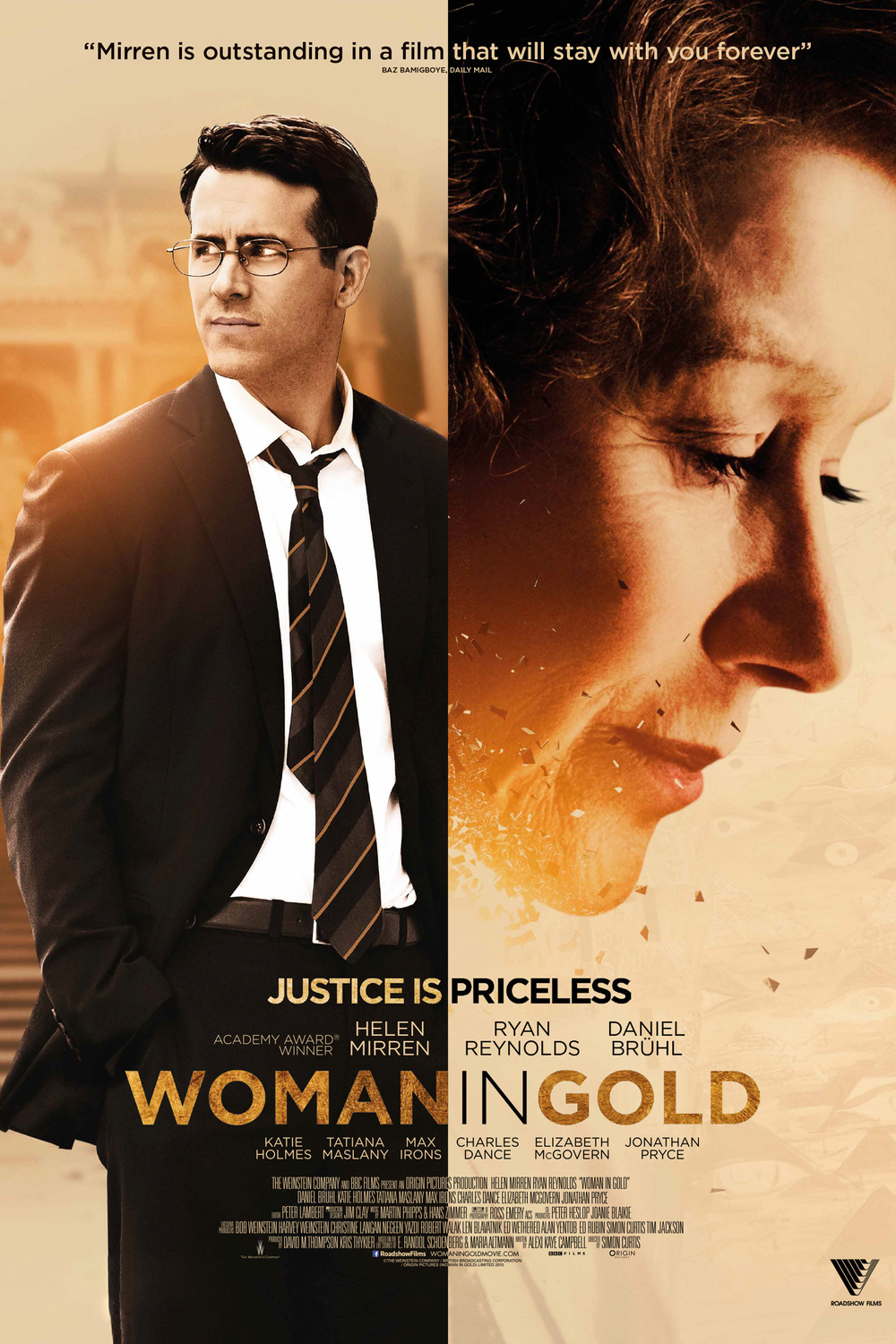
Woman in Gold (2015)


Helen Mirren and Ryan Reynolds stumble through bland Philomena rip-off Woman in Gold

Director: Simon Curtis

Cast: Helen Mirren (Maria Altmann), Ryan Reynolds (Randy Schoenberg), Daniel Brühl (Hubertus Czernin), Katie Holmes (Pam Schoenberg), Tatiana Maslany (Young Maria), Max Irons (Fritz Altmann), Charles Dance (Sherman), Elizabeth McGovern (Judge Cooper), Jonathan Pryce (Chief Justice Renhquist), Antje Traue (Adele Bloch-Bauer), Allan Corduner (Gustav), Henry Goodman (Ferdinand)

The Nazi regime across Europe was a criminal one in every sense of the word. Along with the hideous acts of murder and warmongering, Woman in Gold uses its story to remind us their leaders were also little better than common thieves.

Maria Altmann was a young Jewish woman from a wealthy family, living in Vienna in the 1930s. She escaped from Austria to the US in 1939 with her husband, but had to leave the rest of her family behind. Their fine possessions, including several paintings by Klimt, were stolen by the Nazis.

Decades later, Maria (Helen Mirren) recruits struggling lawyer Randy Schoenberg (Ryan Reynolds) to help her reclaim the paintings, now owned by the Austrian government. The government are predictably dismissive of any claims on their heritage, and are particularly unwilling to give up Klimt’s Portrait of Adele Bloch-Bauer (or Woman in Gold), a portrait of Altmann’s aunt, proudly displayed as a jewel of Austrian culture. So begins a case that will go, via the American supreme court, to the very heart of Austria’s uncomfortable relationship with its past. In parallel, Maria remembers her younger self (Tatiana Maslany) and her escape from Vienna.

I think it’s fair to say Maria is a role Helen Mirren could play standing on her head. It’s a cliché – the feisty, imperious elderly woman who cows all around her, but has a heart of (forgive me) gold. Ryan Reynolds Schoenberg is similarly predictably: a young, naïve, slightly bumbling do-gooder revealed to have hidden depths of strength, and ends up connecting with his own heritage in a “very personal” journey. In fact, every character in the “present day” plotline is a hopeless cliché. Katie Holmes has perhaps the worst role as Schoenberg’s wife – as The Wife always does in these things, she spends the first half of the film asking her husband to drop his time-consuming crusade, but come the second half she’s making the inevitable “you’ve come too far to give up now” speech.

Every bit of the modern day story is predictable, reheated slop from other, much better movies – you literally recognise every beat of every courtroom scene. Most conversations are essentially the actors spooling plot at each other, explaining everything from art history to Austrian mediation procedures. The moments where the dialogue allows the actors to focus on character land with a hamfisted heaviness, with all the subtly of Oscar “for your consideration” scenes.

Periodically the story abandons logical evolution altogether and leaps from A to B without explanation: Maria will never go back to Vienna, less than five minutes of screentime later oh no actually she will (explained by a timely, on-the-nose flashback), no she definitely won’t go back a second time, ta-da there she is. She wants to fight, then she wants to give up, then she wants to fight again. Whether these events were real or not, the film makes them feel like humdrum screenplay hokum.

You keep waiting for this to spring to life and do something fresh, but it never does. Even its odd-couple pairing is essentially Philomena reheated – but without the wit and warmth of that film’s script. It manages to turn what should have been an interesting story into something drier and duller than a documentary would have been.

The film takes wing a little more in the flashbacks to the 1930s. Again, there’s nothing new here, but the performances in are infused with a warmth, emotion and humanity missing from the other storyline – Allan Corduner is particularly good as Maria’s loving father. The sense of peril from the Nazis also gives the film a clear and unequivocal antagonist: the sequence where Maria and her husband flee Vienna is more engaging and tense than anything else in the film.

The weight of these flashbacks, however, only serves to contrast poorly with the strange, odd-couple comedy of the rest of the film. It’s literally two different films sitting uncomfortably together, neither doing either any service.

Woman in Gold is a confused film, that drags down what could have been a fascinating story into a safe, Sunday-afternoon film that never wants to say anything too controversial (even its potshots at the Austrians for overlooking their Nazi past is balanced by “good” Austrians). It reduces its characters to plot-spouting clichés, wrapped in a dry story. Although its flashback scenes carry some emotional heft, they can’t save the main plotline which spirals on and on, never engaging the viewer’s interest. It’s not gold, it’s very base metal.