Tag: Florence Eldridge

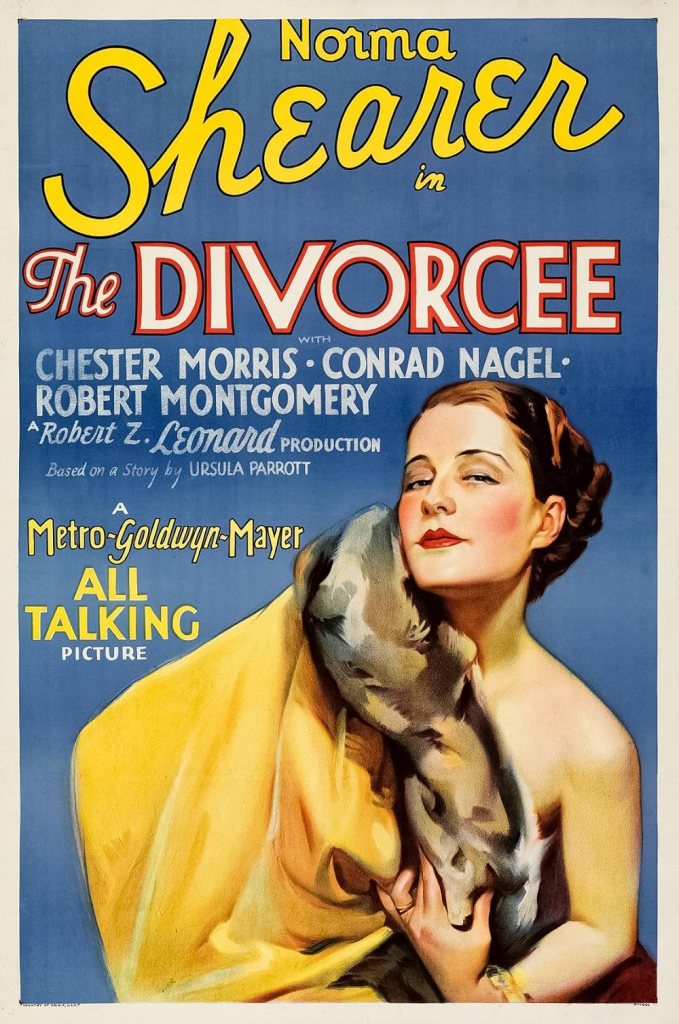
The Divorcee (1930)

The Divorcee (1930)

In its way ahead of its time, a liberated but melodramatic look at women’s freedom in relationships

Director: Robert Z Leonard

Cast: Norma Shearer (Jerry Martin), Chester Morris (Ted Martin), Conrad Nagel (Paul), Robert Montgomery (Don), Florence Eldridge (Helen), Helene Millard (Mary), Robert Elliott (Bill), Mary Doran (Janice), Tyler Brooke (Hank), Zelda Sears (Hannah), Judith Wood (Dorothy), George Irving (Dr Bernard)
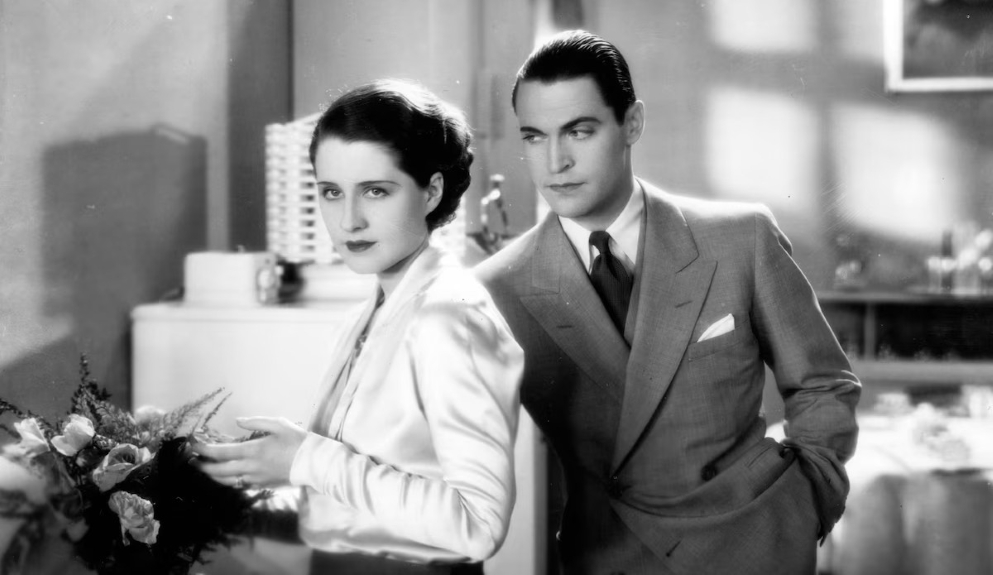
Jerry (Norma Shearer) and Ted (Chester Morris) are young, in love and have been married for three years. It’s not ideal then, that Ted’s ‘pal’ Don (Robert Montgomery) brings a surprise guest to their anniversary party: Janice (Mary Doran) who also happens to be Ted’s illicit squeeze. When Jerry catches them in a clinch, the truth comes tumbling out. Ted says, of course, it didn’t mean anything and he’d be perfectly happy for a bit of freedom in marriages especially in these modern times. Jerry, after a lifetime of being a good girl, promptly ‘balances accounts’ with Don – only for Ted to reveal that what’s good for the gander was very much not for the goose. Divorced, Jerry finds a new life of wild sexual adventures while Ted sinks into bitter alcoholism. Will Jerry take up the offers of the other man who wished to marry her, Paul (Conrad Nagel)? Or will she decide Ted was her real love?

It’s hard to imagine a film like The Divorcee being made even a couple of years later. It’s remarkably open about sex in a film where everyone is pretty much unashamedly at it. Nor can you really imagine a film from Hollywood’s Golden Age where we would be invited to sympathise with Jerry for engaging in tit-for-tat infidelity, especially after Ted’s fury (screw you Ted, you hypocritical wanker). Or where Jerry’s series of conquests across New York – rather wittily told through a montage of close-ups of hands clasped while we hear the voices of a Jerry and a parade of exotic sounding men – doesn’t see her being punished by public shaming, horrific illness or any other of the wallopings a woman behaving like this in a film made a few years later would have faced. In its own way it makes The Divorcee a bit of a landmark – albeit a landmark Hollywood would spend most of the next thirty years running away from.

It also makes The Divorcee rather refreshing, even if it’s a slight film shot with a mix of stagy theatricalism and some sharp-paced editing. It’s also a film that, despite the amount of sex going on, isn’t exactly awash with sensual chemistry between its various leads. It’s hard to put your finger on, but Leonard’s film never quite manages to bring out a real sense of connection, despite the devotedly puppy-dog eyes Nagel’s Paul shoots Jerry or the protestations of adoration between Morris and Shearer. In fact, it’s the lack of steamy flirtatiousness that actually makes The Divorcee seem old-fashioned, despite all its liberal openness about extra-marital sex. (Compare it The Awful Truth, the closest – comic – film to this from the Code Era, where you are never in doubt that no matter who they screwed, Grant and Dunne were crazy for each other.)

The Divorcee makes it mark on history as the film Norma Shearer won one of the first Best Actress gongs for. Shearer’s head-girl looks and slightly plummy voice is perfect for the good-girl life Jerry has been leading as the devoted wife, thrilled and excited at Ted’s proposal. But she also brings a heartbroken fury to her discovery of Ted’s betrayal – and a coolly determined energy to her conscious decision, in that case, to take advantage of Don’s attraction to her. From there, Shearer embraces the hedonistic joy of a woman determined to enjoy the bad side for the first time in her life – without ever letting us forget there is a good girl bubbling below the surface. It’s a good performance, the finest in the film – good enough to make it sad that Shearer was pretty much from here on straight-jacketed into stiff prestige roles in frequently self-consciously ‘noble’ pictures.

It’s also nice that the men in this story are frequently shown as inadequate, whining, self-pitying, cowardly or some combination of all four. Chester Morris gives one of his patented performances of smug roguishness, collapsing into pathetic self-pity at a series of worse-for-wear appearances at various posh parties. Robert Montgomery is energetic and funny as the appallingly selfish and shallow Don, rather funny in his blatant cowardice (fleeing to Europe the second he works out Ted is not exactly thrilled at knowing another man has bumped uglies with his wife). Conrad Nagel does what he can with a terminally dull role as Paul, cursed with a series of needy glances.

Paul is at the centre of the film’s main sub-plot. Jilted potential husband of Jerry, Paul leaves the hunting lodge party where Ted and Jerry get engaged, deeply pissed (in both senses) hitting the roads with a fury. As the back-projection swings from side-to-side like it’s been attached to a whirligig, the car overturns and Dorothy (Judith Wood) is left ‘hideously deformed’. (We never see what happens to her, only a shrieking reaction of someone else; in her later appearances she’s behind a shroud). Paul marries her out of guilt but is convinced she loathes him for the accident and can’t wait to be shot of him, meaning she need not be an obstacle for a reunion with Jerry.

But that would mean – even though they get divorced – Jerry turning her back definitively on Ted. And, as modern as the film is – it even gives Jerry an actual job, at which she is so successful she is promoted and moved to the London office – it’s not crazy enough to escape the idea that, at the end of the day, all girls really want is to be settled and married with the man of their dreams. The Divorcee settles in the end of a resolutely conservative ending. Much as you might want Jerry to carry on having a whale of a time and kick her drunken louse of a husband back to the kerb for his hypocritical one-sided views of sexual freedom, she of course doesn’t.

Naturally, Dorothy in fact is devoted to Paul (she even, pathetically, begs Jerry not to take him from her since, as she is so ‘deformed’ no other man will ever look at her). Naturally Jerry doesn’t want to be a home wrecker. Naturally, a happy ending looms. Even before the code, Hollywood was only ever going to go so far, wasn’t it? After all women really would rather be wives and mothers, wouldn’t they?
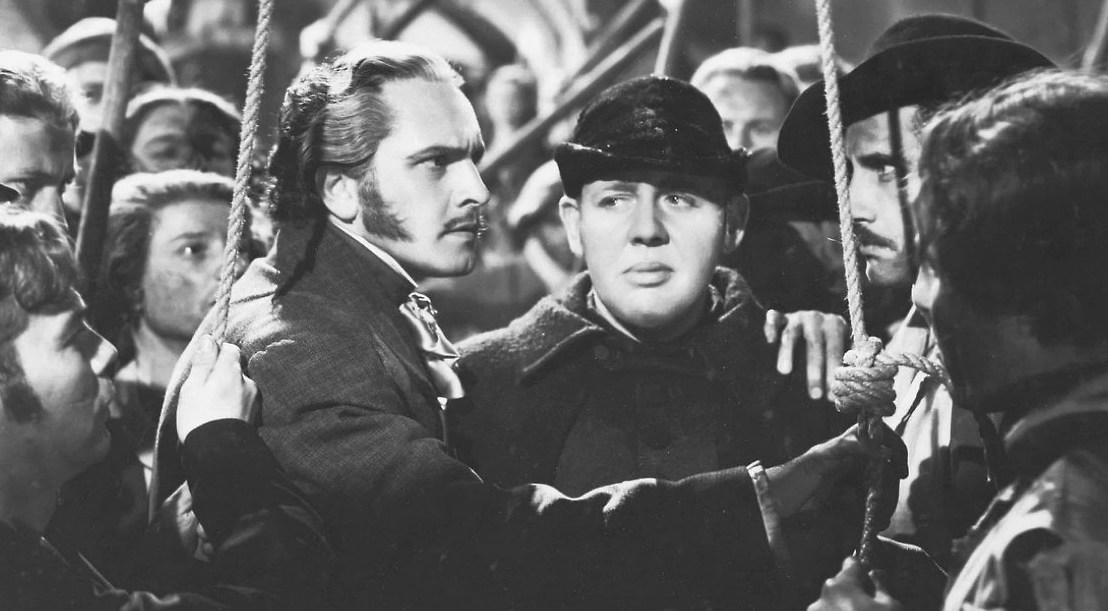
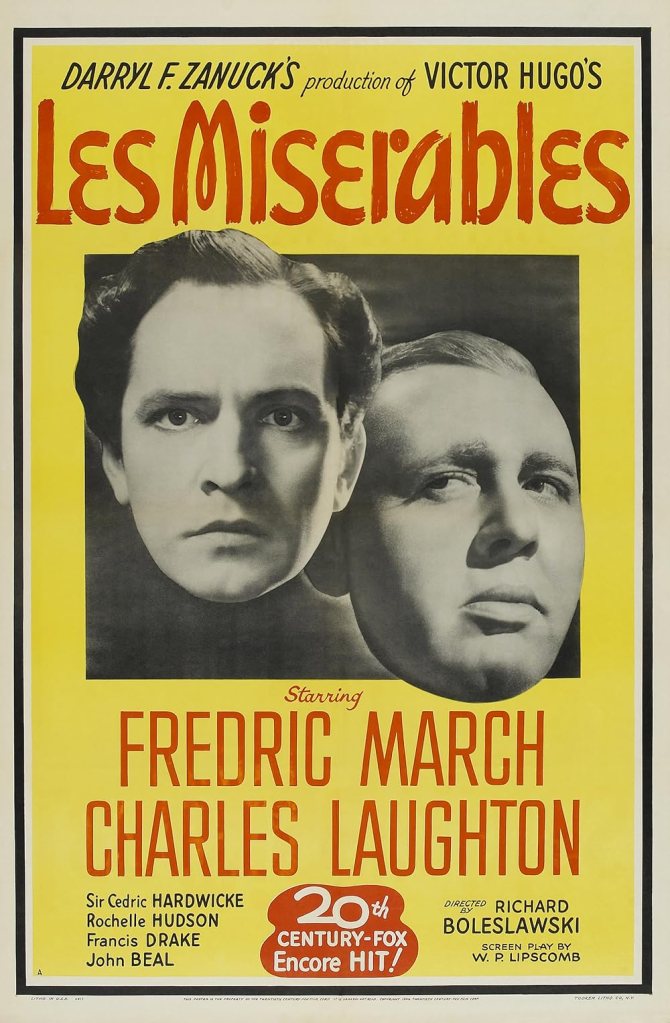
Les Misérables (1935)

Les Misérables (1935)

Odd choices are made in this Hugo adaptation, despite good photography and performances

Director: Richard Boleslawski

Cast: Fredric March (Jean Valjean), Charles Laughton (Inspector Javert), Cedric Hardwicke (Bishop Myriel), Rochelle Hudson (Cosette), Marilyn Knowlden (Young Cosette), Florence Eldridge (Fantine), John Beal (Marius), Frances Drake (Éponine), John Carradine (Enjolras)

There isn’t a more famous loaf of bread in literature, than that stolen by Jean Valjean to feed his starving family. There’s something quite sweet about the fact that Richard Boleslawski’s film of Hugo’s doorstop gives that loaf its moment in the sun, as its half-eaten remains are produced as evidence in Valjean’s trial. It’s an unintentionally funny moment, but feels right in a sometimes blunt film, that at times makes odd decisions for those of us so familiar now with the plot’s ins-and-outs and the moral up-righteousness of its lead character after forty years of the musical. Boleslawski’s version is an odd mix, part psychological drama, part atmospheric thriller, part thuddingly obvious soap where a loaf of bread needs to be literally seen. Parts of it work extremely well, other parts weigh the film down like the chains on its galley slaves.

The film is overwhelmingly focused on the clash between Valjean (Fredric March) and Javert (Charles Laughton). One a good man who wrestles with temptation, but follows the sprit of justice. The other a rigid fanatic, who sees the letter of the law as gospel and the rights and wrongs of a situation an irrelevance. First meeting when Valjean serves a decade as a slave at the oars in the galleys, their paths recross after a released Valjean has a road-to-Damascus moment after the intervention of a noble priest (Cedric Hardwicke). Reinventing himself as ‘Monsieur Madeleine”, he becomes mayor of a small town and protector of Fantine (Florence Eldredge) and her daughter Cosette (Rochelle Hudson). But he cannot escape the pursuit of Javert which carries him into hiding for years in Paris, where a now grown-up Cosette falls in love with reforming student Marius (John Beal), leaving Valjean with one last dangerous choice.

Les Misérables restructures the novel into three acts, each presenting Valjean with a moral quandary. As such, Fredric March’s impressive performance must be unique among Valjean’s: this version is forever tempted with greed, anger and his own desires, constantly struggling to overcome his baser feelings. March is very good at bringing to life this conflict, just as he sells the sense of awakening purpose Valjean feels washing over him after the Bishop’s intervention prevents him from being returned to prison. It’s a muscular, agonised performance of a man constantly striving, even in the face of his resentment, to live up to his adopted moral principles. So, much as Valjean would like to let another man be accidentally condemned for his crimes, or to keep Cosette to himself or pull a trigger on Javert (March’s skilfully communicating the deep internal conflict each time) he’ll still (however reluctantly) find himself doing the right thing.

He contrasts excellently, with Laughton’s rigid, well-spoken, self-loathing Javert who has absorbed his moral code so completely, its left no room for any other form of principle or emotional judgement. Introduced, lips quivering, as he explains being denied promotion due to his convict father, Laughton’s Javert has channelled that resentment to worshipping the penal code as God. As he repeats, several times, good or bad is irrelevant, it’s just about the law. Of course, Laughton’s performance bubbles with repressed frustration, his pursuit of Valjean clearly motivated by far more personal feelings of anger and envy than he is willing to admit. Valjean is a spoke in his wheel of justice, a factor that makes no sense to him.

Boleslawski’s film is at its best when these two face off. It’s also at its most stylistic for these sequences. Les Misérables is awash with Gregg Toland’s atmospheric, mist-filled photography and expertly uses his expressionistic shadows. It’s depiction of a Parisian uprising, just like it’s introduction of a fast-paced horse chase between Valjean and Javert, are snappily edited and throw in a parade of dynamic Dutch and high angles. At the end of each act, Christian imagery is well used (in two cases, shrines to Mary and Jesus) to add emotional heft. A pursuit through grime and mist-filled sewers near the film’s close has a Fritz Lang atmospheric strength (did Carol Reed watch this before The Third Man?) as well as the film’s most effective use of music to build atmosphere as Valjean desperately submerges himself and Marius to hide.

There is effective stuff in Les Misérables. So, you try your best to forgive the fact it’s full of extremely on-the-nose, obvious touches. The introduction of the bread at the trial is not an end of its obviousness: for starters, the galley’s were prison hulks, not actual ships rowed around by convicts (where do they imagine these enormous hulks are going?). Truncating so much of the book down – and focusing overwhelmingly on its two leads – means many other parts of the story are short-changed or make little impact or sense (the hilariously watered down Parisian revolutionaries don’t turn up until the final 40 minutes). Florence Eldridge’s Fantine (all references to her prostitution are of course cut) does almost nothing but die – although not before the film gives her a (unique) ludicrously sentimental reunion scene with her daughter (played by a highly irritating precocious film-school brat before she grows up into Rochelle Hudson). Clearly the actual tragedy here (a mother never sees her daughter again) was considered too much.

Then there are the strange mis-readings and mis-interpretations. I can understand why Marius and his law students are re-imagined, by conservative Hollywood, into legal reformers rather than idealisitic revolutionaries (Marius even denounces the very idea of overthrowing the government as terrible). Here they want only penal reform – although of course, while ensuring the guilty are harshly punished – and chat like champagne socialists. It’s a bit of a mystery why this call for slow-paced, moderate social reform erupts into throwing up barricades, but clearly audiences at the time couldn’t be expected to get on board with anti-Monarchist cells. They’d probably agree with Eponine (interpreted here as a sort of femme fatale and Marius’ secretary) that it’s all a silly, slightly disreputable, waste of time.

However, even more strange, is the inexplicable interpretation of Valjean’s desire to keep Cosette to himself not due to being a protective father-figure investing everything in his life into his daughter, but instead an unpleasant sexual desire to make Cosette his wife. Even leaving aside this utter perversion of the novel, since we’ve seen Valjean raise her from the age of about 6 it’s hard not to feel a bit of bile forming in your throat at the stench of grooming this gives the relationship. It’s almost as if Hollywood could only imagine a man going to great lengths to protect a woman if he wanted to eventually get in her pants.

It’s odd reinventions like this that don’t quite work even within the world presented by the adaptation, let alone compared to the original source, that weighs the film down too much. They are blotches in the streamlining of a huge novel. But when the film focuses on an increasingly personal clash between two men, both well played by March and Fredric, and its atmospheric visuals, it works much better.

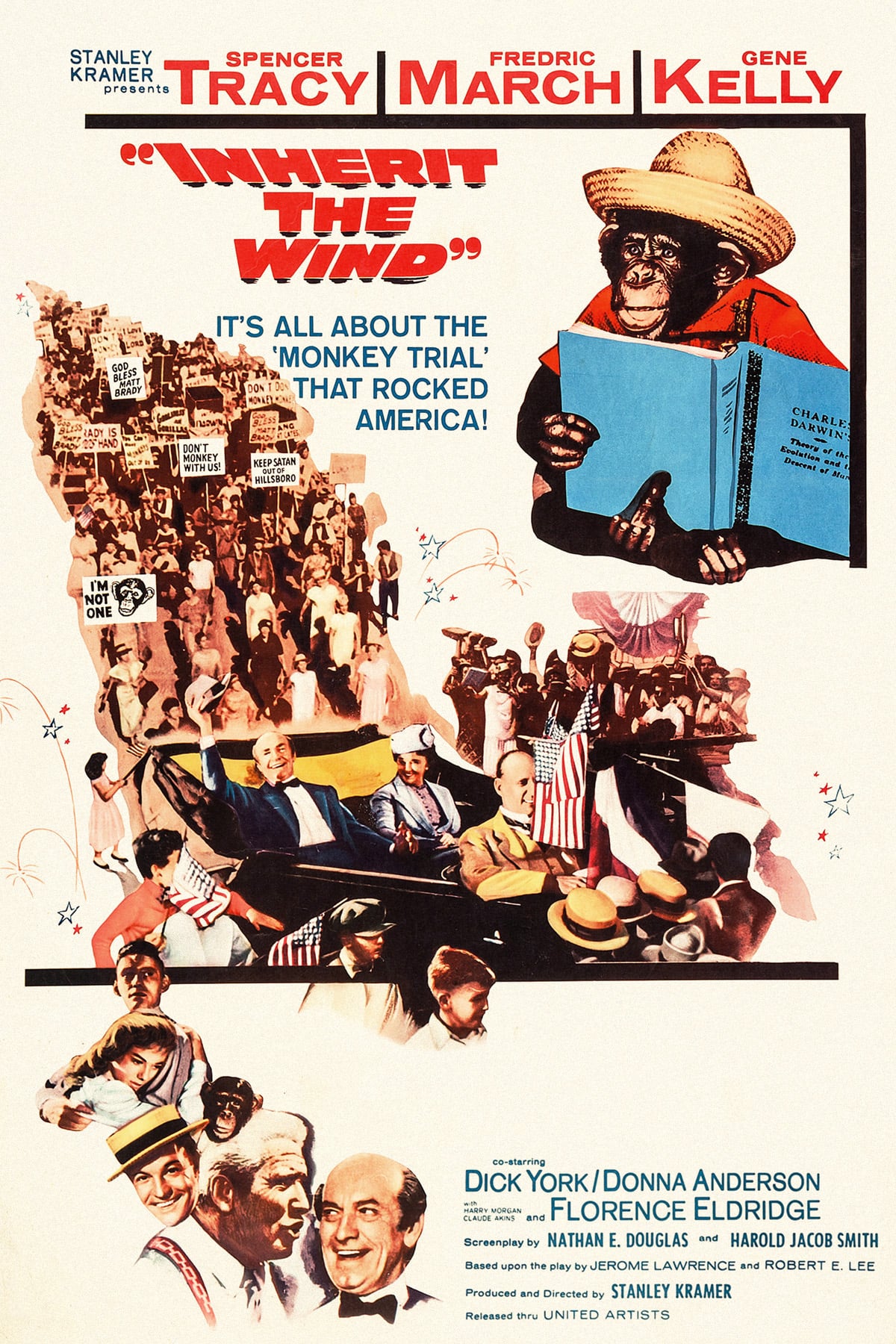
Inherit the Wind (1960)

Spencer Tracy and Fredric March go toe-to-toe in Stanley Kramer’s liberalism-on-trial movie Inherit the Wind

Director: Stanley Kramer

Cast: Spencer Tracy (Henry Drummond), Fredric March (Matthew Harrison Brady), Gene Kelly (EK Hornbeck), Florence Eldridge (Sara Brady), Dick York (Bertram T Cates), Donna Anderson (Rachel Brown), Harry Morgan (Judge Merle Coffey), Claude Atkins (Reverend Jeremiah Brown), Elliott Reid (Prosecutor Tom Davenport), Paul Hartman (Deputy Horace Meeker)

In 1960, Inherit the Wind was a parable. The teaching of Darwinism being illegal in a small town that defined itself by its faith couldn’t really happen today could it? So, the film used the concept as an angle to criticise the restrictions placed on free speech during the McCarthy years. The wheel has come full circle now: it’s no longer unlikely at all to imagine something like this happening. Indeed, versions of it have already taken place in America this century. This change does actually help the film look increasingly more prescient as time goes by.

A fictionalised version of the famous Scopes monkey trial (with most of the names changed, but many of the court room events fundamentally the same) a local schoolteacher, Bertram Cates (Dick Young), in a small Southern town is placed on trial for teaching Darwinism in his school. Staunch Christian and former Presidential candidate Matthew Harrison Brady (Fredric March) volunteers to put the case for the prosecution. Cates’ defence will be handled by the renowned liberal lawyer Henry Drummond (Spencer Tracy). Sparks fly in a courtroom and around the town, where many people are instinctively opposed to anything that can be seen to draw doubt on intelligent design.

Kramer’s films are often both praised and criticised for their rather heavy-handed liberalism. Inherit the Wind is no different. You’d be hard pressed to miss the message here about the dangers of intrusive laws designed to govern what we think and believe. Kramer’s film edges away from making criticism of fundamentalism too overt. Sure, the local preacher (a lip-smacking Claude Atkins) is a tongue-frothing “burn ‘em all!” maniac, only happy when stirring up an outraged mob. But on the other hand, Drummond is revealed to be a man of (liberal) faith – and, in an agonisingly heavy-handed final note, the film ends with him literally weighing The Bible and On the Origin of the Species in his hands then clasping them both together. You see – science and faith can work together!

While it’s easy to smile at Inherit the Wind’s striving for inoffensive liberalism, it means well and actually produces some effective court-room set-pieces. While its overlong – the sections outside of the court could do with trimming down and a rather shoe-horned plot with Cates dating the local preacher’s daughter (not helped by the blandness of both actors) promises much but delivers very little. What the film really works at is a chance for two seasoned performers to go at each other hammer and tongs in the court. Chances they both seize.

Spencer Tracy sets a template of sensible, liberal reasonableness mixed with a well-defined sense of right and wrong that would serve him well in a further three collaborations with Kramer. He brings Drummond a rumbled worldliness, a shrewd intelligence and a patient forbearance but never once lets us forget his righteous fury that this case is even happening in the first place. His courtroom performance hinge on a winning reasonableness that can turn on a sixpence into ingenious traps for witnesses. He’s a rock of decency in a shifting world and Tracy effectively underplays several scenes, making Drummond seem even more humane.

It also means that Tracy makes a lovely performing contrast with Fredric March’s firey passion as Brady. Sweating in the heat of the court, March’s Brady is overflowing with moral certainty and fury. March’s performance is big, but the character himself has a court-personae that depends on him appearing like an embodiment of God’s fury. It works because March gives Brady a quiet air of sadness. This is a man raging against the dying of the light – this case is his last hurrah. Brady is becoming yesterday’s news, but can’t seem to consciously accept this. In quieter moments, he is clearly a man of reflection and reasonableness – but (in a surprisingly modern touch) is all to aware that a raging public personae is what “sells”.

Kramer’s film is at its strongest when it lets these two actors go toe-to-toe. These moments aren’t just in the fireworks for court. Private scenes between the two show a great deal of mutual respect and even admiration. The two men are old friends. Drummond is very fond of Brady’s wife Sara (played excellently by Fredric March’s real life wife Florence Eldridge), who also regards him as a man of decency. They can sit on a bench at night and reflect on the good times. Brady may be a type of demagogue but he’s not a rabble rouser like the Reverend Brown (who he publicly denounces) even while he enjoys the attention of crowds. Drummond isn’t adverse to whipping up a bit of popular support – or enjoying the attention. It’s a fine contrast of two men who both similar and very different.

Aside from this, Kramer sometimes trips too often into rather obvious and heavy-handed social commentary. Gene Kelly is on good form in an over-written part as a cynical journalist – he sort of cares about justice, but only if its a good story and has only scorn for anyone else who believes anything. The film closes with a rather heavy-handed denunciation of his lack in belief in anything, compared to Brady’s faith. The script is at times a little too weak – Tracy and March sell the hell out of a vital confrontation near the end, playing “gotcha” moments that the script largely fails to deliver – but there is still lots of meat in there. Some of the staging and performances – including the extended pro-religion protests that pad out the run time – are a little too obvious.

But at heart, there is a very true and increasingly more-and-more relevant message in this film – and when its acted as well as this, it’s hard not to enjoy it.