Tag: Robert Z. Leonard

The Divorcee (1930)

The Divorcee (1930)

In its way ahead of its time, a liberated but melodramatic look at women’s freedom in relationships

Director: Robert Z Leonard

Cast: Norma Shearer (Jerry Martin), Chester Morris (Ted Martin), Conrad Nagel (Paul), Robert Montgomery (Don), Florence Eldridge (Helen), Helene Millard (Mary), Robert Elliott (Bill), Mary Doran (Janice), Tyler Brooke (Hank), Zelda Sears (Hannah), Judith Wood (Dorothy), George Irving (Dr Bernard)
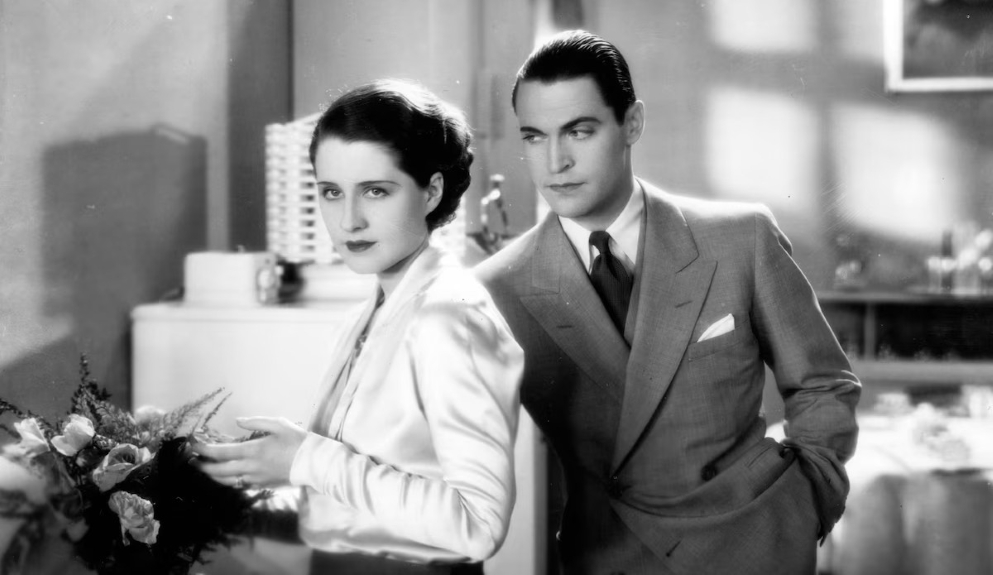
Jerry (Norma Shearer) and Ted (Chester Morris) are young, in love and have been married for three years. It’s not ideal then, that Ted’s ‘pal’ Don (Robert Montgomery) brings a surprise guest to their anniversary party: Janice (Mary Doran) who also happens to be Ted’s illicit squeeze. When Jerry catches them in a clinch, the truth comes tumbling out. Ted says, of course, it didn’t mean anything and he’d be perfectly happy for a bit of freedom in marriages especially in these modern times. Jerry, after a lifetime of being a good girl, promptly ‘balances accounts’ with Don – only for Ted to reveal that what’s good for the gander was very much not for the goose. Divorced, Jerry finds a new life of wild sexual adventures while Ted sinks into bitter alcoholism. Will Jerry take up the offers of the other man who wished to marry her, Paul (Conrad Nagel)? Or will she decide Ted was her real love?

It’s hard to imagine a film like The Divorcee being made even a couple of years later. It’s remarkably open about sex in a film where everyone is pretty much unashamedly at it. Nor can you really imagine a film from Hollywood’s Golden Age where we would be invited to sympathise with Jerry for engaging in tit-for-tat infidelity, especially after Ted’s fury (screw you Ted, you hypocritical wanker). Or where Jerry’s series of conquests across New York – rather wittily told through a montage of close-ups of hands clasped while we hear the voices of a Jerry and a parade of exotic sounding men – doesn’t see her being punished by public shaming, horrific illness or any other of the wallopings a woman behaving like this in a film made a few years later would have faced. In its own way it makes The Divorcee a bit of a landmark – albeit a landmark Hollywood would spend most of the next thirty years running away from.

It also makes The Divorcee rather refreshing, even if it’s a slight film shot with a mix of stagy theatricalism and some sharp-paced editing. It’s also a film that, despite the amount of sex going on, isn’t exactly awash with sensual chemistry between its various leads. It’s hard to put your finger on, but Leonard’s film never quite manages to bring out a real sense of connection, despite the devotedly puppy-dog eyes Nagel’s Paul shoots Jerry or the protestations of adoration between Morris and Shearer. In fact, it’s the lack of steamy flirtatiousness that actually makes The Divorcee seem old-fashioned, despite all its liberal openness about extra-marital sex. (Compare it The Awful Truth, the closest – comic – film to this from the Code Era, where you are never in doubt that no matter who they screwed, Grant and Dunne were crazy for each other.)

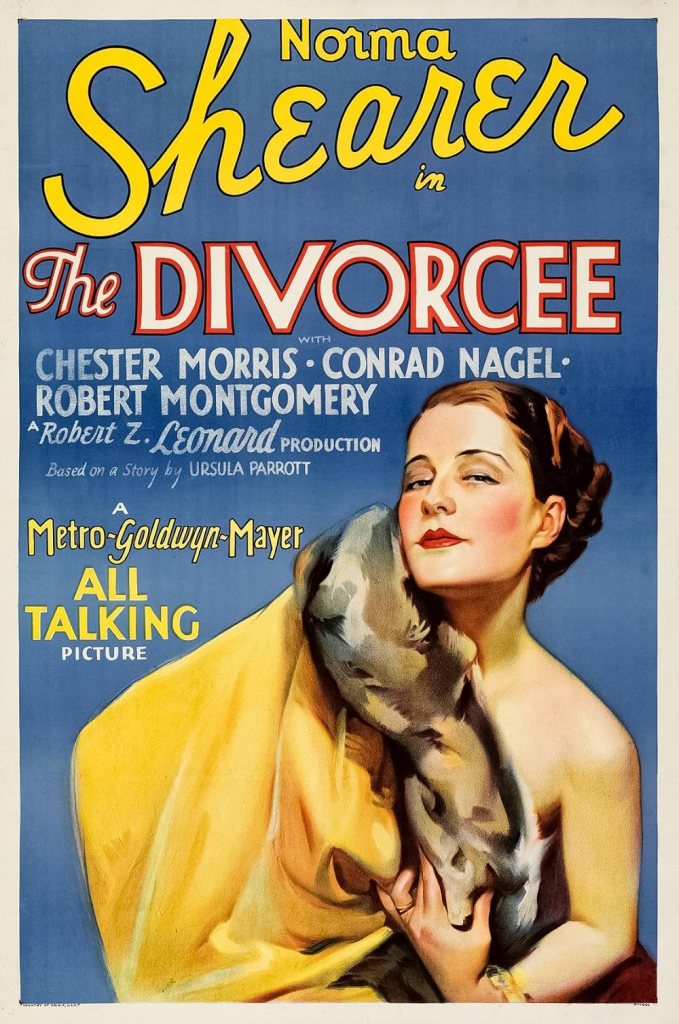
The Divorcee makes it mark on history as the film Norma Shearer won one of the first Best Actress gongs for. Shearer’s head-girl looks and slightly plummy voice is perfect for the good-girl life Jerry has been leading as the devoted wife, thrilled and excited at Ted’s proposal. But she also brings a heartbroken fury to her discovery of Ted’s betrayal – and a coolly determined energy to her conscious decision, in that case, to take advantage of Don’s attraction to her. From there, Shearer embraces the hedonistic joy of a woman determined to enjoy the bad side for the first time in her life – without ever letting us forget there is a good girl bubbling below the surface. It’s a good performance, the finest in the film – good enough to make it sad that Shearer was pretty much from here on straight-jacketed into stiff prestige roles in frequently self-consciously ‘noble’ pictures.

It’s also nice that the men in this story are frequently shown as inadequate, whining, self-pitying, cowardly or some combination of all four. Chester Morris gives one of his patented performances of smug roguishness, collapsing into pathetic self-pity at a series of worse-for-wear appearances at various posh parties. Robert Montgomery is energetic and funny as the appallingly selfish and shallow Don, rather funny in his blatant cowardice (fleeing to Europe the second he works out Ted is not exactly thrilled at knowing another man has bumped uglies with his wife). Conrad Nagel does what he can with a terminally dull role as Paul, cursed with a series of needy glances.

Paul is at the centre of the film’s main sub-plot. Jilted potential husband of Jerry, Paul leaves the hunting lodge party where Ted and Jerry get engaged, deeply pissed (in both senses) hitting the roads with a fury. As the back-projection swings from side-to-side like it’s been attached to a whirligig, the car overturns and Dorothy (Judith Wood) is left ‘hideously deformed’. (We never see what happens to her, only a shrieking reaction of someone else; in her later appearances she’s behind a shroud). Paul marries her out of guilt but is convinced she loathes him for the accident and can’t wait to be shot of him, meaning she need not be an obstacle for a reunion with Jerry.

But that would mean – even though they get divorced – Jerry turning her back definitively on Ted. And, as modern as the film is – it even gives Jerry an actual job, at which she is so successful she is promoted and moved to the London office – it’s not crazy enough to escape the idea that, at the end of the day, all girls really want is to be settled and married with the man of their dreams. The Divorcee settles in the end of a resolutely conservative ending. Much as you might want Jerry to carry on having a whale of a time and kick her drunken louse of a husband back to the kerb for his hypocritical one-sided views of sexual freedom, she of course doesn’t.

Naturally, Dorothy in fact is devoted to Paul (she even, pathetically, begs Jerry not to take him from her since, as she is so ‘deformed’ no other man will ever look at her). Naturally Jerry doesn’t want to be a home wrecker. Naturally, a happy ending looms. Even before the code, Hollywood was only ever going to go so far, wasn’t it? After all women really would rather be wives and mothers, wouldn’t they?

The Great Ziegfeld (1936)

Luise Rainer and William Powell bring the life of The Great Ziegfeld to life in this decent-but-not-great Best Picture winner

Director: Robert Z Leonard

Cast: William Powell (Florenz Ziegfeld Jnr), Myrna Loy (Billie Burke), Luise Rainer (Anna Held), Frank Morgan (Jack Billings), Fannie Brice (Herself), Virginia Bruce (Audrey Dane), Reginald Owen (Sampson), Ray Bolger (Himself), Ernest Coassart (Sidney), Joseph Cawthorn (Dr Ziegfeld), Nat Pendleton (The Great Sandow)

I’d always been led to believe The Great Ziegfeld was one of the low points in Best Picture history – that the Oscar had gone to a plotless, over-long, empty mess. So, watching this film for the first time, I was pleasantly surprised. The Great Ziegfeld may be flawed, but it’s not as bad as all that. In some places it’s even pretty good.

Florenz Ziegfeld Jnr (William Powell) is a showman with big dreams. From the Chicago World Fair of 1893, where his show features strong-man The Great Sandow (Nat Pendleton) – lifting a massive pair of dumb bells inside of each is a “Dumb Belle” (geddit?!) – Ziegfeld heads towards New York. There he puts on a series of variety shows, The Ziegfeld Follies, crammed with popular entertainers and gorgeous babes. Along the way he spends money like water, marries star Anna Held (Luise Rainer), cheats on her a lot (although the film handles this coyly) and finds love with star Billie Burke (Myrna Loy – the real Burke grudgingly agreed she was too old to play herself).

Watching The Great Ziegfeld you can see how it influenced so many later films. A witty, show-piece crammed crowd-pleaser about a impresario, its essentially the grandfather of The Greatest Showman. It’s unpretentious and easy-going – but also impossibly long, far too long for its slight story. It’s sprawling, puffed-up and the musical numbers are often mundane and tedious – but it, just about, manages to stay entertaining.

In real life Ziegfeld was a chancer with a roving eye. He left a mountain of debt and his genius was at least as much about promotion as it was art. You can see why Hollywood has a soft-spot for him: he was all about spectacle (a running gag has him always wanting “higher steps”, a neat short-hand for making things bigger). His rough edges (the affairs and the financial chicanery) are filed down as the film’s Ziegfeld is a charmer with a Wodehousian wit, cheeky and naughty but always a gentleman.

William Powell is perfect casting, and a big part of the film’s charm is tied up in his winningly (and deceptively) casual performance. Powell turns the role into a personality part, smoothly underplaying with a wink to the camera. He delivers the various bon mots with a real skill and provides nearly all the film’s pace and energy and a big barrel of its sense of fun.

He sits at the centre of a film that has genuine moments of directorial flair from Robert Z Leonard. There are some great tracking shots and he handles the ‘acting’ scenes very well – a scene with Ziegfeld chatting with Will Rogers and Fanny Brice (playing herself) is worth the price of admission alone. The performers mostly bounce effectively off each other.

Leonard also gets emotional impact from Ziegfeld’s late romance with Burke (a sequence of the two of them chatting, coyly holding hands is very well done) and creates a superb series of visuals to close the film (a shot of the ageing Ziegfeld sitting in his chair, staring at his name in lights over his theatre, is a wonderful summary of the man’s life – and maybe, when his hand drops down releasing a flower, it even gave Welles a bit of inspiration for Kane’s death five years later).

When The Great Ziegfeld focuses on Powell’s lightness of touch, and character-led moments (Frank Morgan is also great fun as Ziegfeld’s bombastic, long-suffering rival) it works really well. What has suffered over time – and today feel like its weakest parts – are those heavily praised in 1936.

MGM marketed this as the most expensive film ever made, the money splurged on those massive musical numbers, with scores of extras and enormous sets. The centre-piece is the “A Pretty Girl is Like a Melody” number, featuring countless extras on a massive rotating “wedding-cake” set, 175 spiral steps high. Like Ziegfeld’s shows it’s all about the cost, spectacle and size. And they are not even 1% as interesting as watching Astaire and Rogers tap dance in a marquee in Top Hat.

The film’s numerous musical numbers often feel like dull products of yesteryear. Over-long, over-extended, shot to squeeze the set into frame rather than focusing on skill or grace. These numbers – some of which I admit I fast-forwarded through – pad out the running time but contribute nothing to either story or entertainment factor. If anything, you are desperate to get back to Powell’s skilled playing of the biographical scenes, rather than sitting through another over-ripe number.

Similarly much of the acting has aged less well. Myrna Loy is strangely uncomfortable as Burke (perhaps all to aware the real Burke was just off camera). Luise Rainer won the first of her two consecutive Oscars – but her performance is extremely over-played, utterly lacking in nuance. Her famous “telephone” scene (heartbroken, she calls Ziegfeld to congratulate him on his new marriage) was hailed as great acting, but today looks mannered and overblown.

But despite all these flaws – mundane and boring musical numbers, a lack of spark and pace – there is actually a fair bit of wit and charm. Its early sequences – which focus on Powell and Nat Pendleton’s witty turn as Sandow – are surprisingly light and engaging. The moments where the film relaxes and isn’t straining to impress are engaging and fun. There is a decent 90-minute Astaire-Rogers film straining to get out here, crushed under the weight of the Ziegfeld/MGM grandeur. It’s entertaining – better than you might have heard – but can’t hold a candle to the great Hollywood musicals of yesteryear, its charm spread very thin.

Pride and Prejudice (1940)

Laurence Olivier and Greer Garson in a just-plain-not-right version of Pride and Prejudice

Director: Robert Z Leonard

Cast: Greer Garson (Elizabeth Bennet), Laurence Olivier (Fitzwilliam Darcy), Mary Boland (Mrs Bennet), Edna May Oliver (Lady Catherine de Burgh), Maureen O’Sullivan (Jane Bennet), Ann Rutherford (Lydia Bennet), Frieda Inescot (Caroline Bingley), Edmund Gwenn (Mr Bennett), Karen Morley (Charlotte Lucas), Melville Cooper (Mr Collins), Edward Ashley Cooper (George Wickham), Bruce Lester (Mr Bingley)
 

There is an expectation that old-school adaptations of literary classics from the Golden Age of Hollywood somehow set the standards of adaptation, that all others will be judged against. That may well be the case with the 1939 Wuthering Heights, among others, but it really isn’t the case with Pride and Prejudice, which is essentially a bastardisation of Austen’s original, as if the book has been humped by Gone with the Wind and we are now watching its offspring.

Do I need to tell you the plot? Well I probably should tell you this movie’s version of it. The Bennet sisters are sassy young things always on the prowl for husbands. Lizzy Bennet (Greer Garson) flirts with the proud Mr Darcy (Laurence Olivier), while her sister Jane (Maureen O’Sullivan) wins the attentions of Mr Bingley (Bruce Lester). But how will pride and prejudice affect the course of true love? Find out in this Aldous Huxley (!) scripted version of Austen’s classic, adapted via a second-rate stage version.

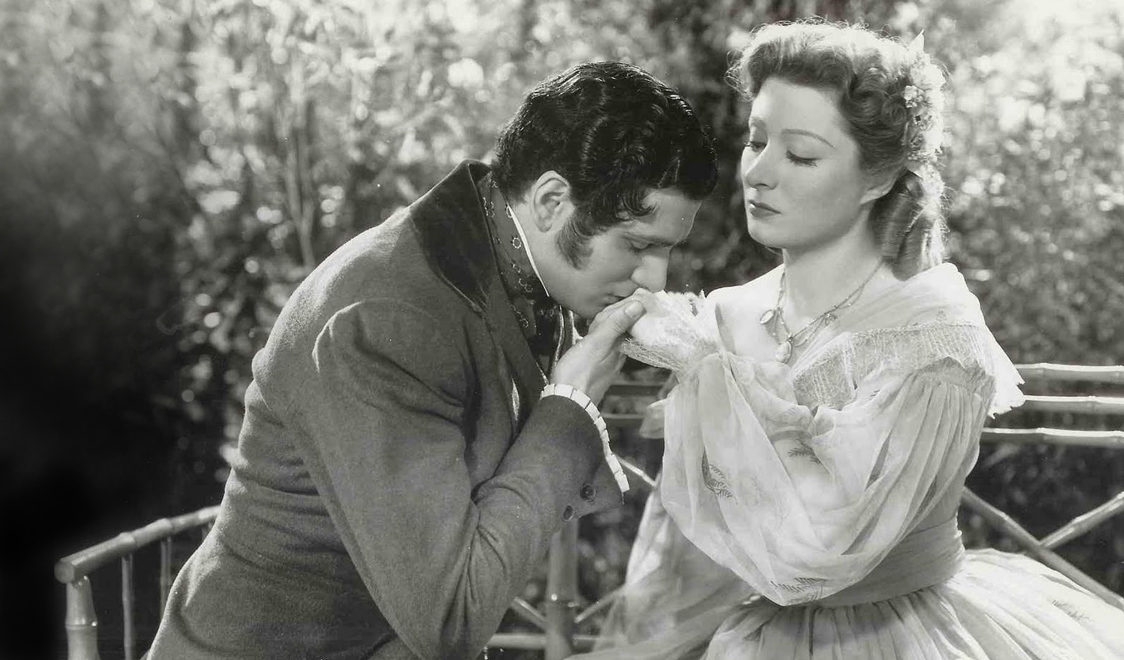
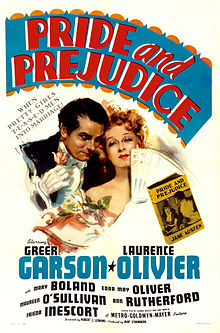
What’s bizarre about this film is how wrong so much of it feels. Now I’m no Austen expert, but even I could see that all the costumes for this production are completely incorrect for the period. Turns out of course that the producers just had a lot of mid-19th century clothing and thought it looked better. Other things feel like low-brow farce: the Bennet sisters and their mother race Caroline Lucas and her mother in carriages in order to be the first to greet Mr Bingley. That’s right, it’s Pride and Prejudice with a horse-drawn drag-race. Who thought that was a good idea? But what can you expect of a film with the tag-line “When Pretty Girls T-E-A-S-E-D Men into Marriage!”? It even takes good lines from the novel and inexplicably rewrites them to make them worse – Darcy’s snobbish and personally hurtful dismissal of Lizzy at the Merryton assembly “I am in no humour to give consequence to young ladies slighted by other men” here becomes “I am in no humour to give consequence to the middle classes”. Why?

I ask you – do these costumes look right?

That’s before you get into the casting. While some of it is pretty good (Edmund Gwenn is very good as an ineffective Mr Bennet, while Mary Boland has a neat line in shrieking as Mrs Bennet) others are downright bad – Bruce Lester is stiff as Mr Bingley, Edward Ashley Cooper is forgettably dull as Wickham, and Melville Cooper hideously overplays as a Collins who seems to have stepped in from a Marx brothers film.

Other parts just feel a bit wrong. Greer Garson and Laurence Olivier as the leads are marvellous actors, but neither of them produces a version of these iconic characters that feels remotely true – or even recognisable. Garson not only looks too old, but she doesn’t have the sense of playful intelligence and spark that Lizzy Bennet needs: she’s more of a slightly aloof tease. Laurence Olivier is reasonably good as Darcy, but the character is re-invented as much softer and more playful from the start, and his willingness to be teased by Lizzy early in the film makes her rejection of him make very little sense.

Their relationship has a flirtatious element throughout, fitting the film’s reimagining of the novel as a sort of romantic comedy in period costume, with elements of Hollywood screwball – but bearing no resemblance at all to the actual relationship Lizzy and Darcy ought to have. At Bingley’s garden party they engage in a playful archery competition (he assumes she’s a novice, she of course is an expert marksman). In itself the scene is good fun, but Darcy’s polite apology and willingness to look a little foolish, means it doesn’t hold together when she condemns him for arrogance. In fact, you’d be pretty hard pressed to identify much pride or prejudice going on at all. The main obstacle to their relationship is shown as Wickham’s denunciation of Darcy – but since Lizzy hasn’t actually seen Darcy do anything particularly bad, it seems particularly forced.

Furthermore, the film makes Lizzy seem like a ditzy schoolgirl, since literally one scene later she has spun on a sixpence and is devoted to Darcy. This is also a flaw of the film’s telescoping of events – within five minutes it feels Wickham elopes with Lydia, then Wickham comes into money, then Darcy reveals his true character, then Wickham and Lydia return. The film rushes through these events, in order to fly towards its artificial happy ending (all the Bennet sisters are given appropriate suitors in a clumsy final shot) without any real sense of Austen, or any real eye for the sort of subtle social satire she had carefully worked into her novels.

The film’s individualist take on Pride and Prejudice does at least distinguish it from other productions I suppose, but it’s terrified of the depths to the story or its characters, and seems to do everything it can to neuter its “bad” characters – Caroline Bingley barely appears, and it’s hard to believe that any reader of the book could picture Lady Catherine as she’s reimagined here: a sort of playful wingman to Darcy’s courtship of Lizzy.

But then this never feels like Austen – it’s got more of an early Gone with the Wind vibe to it, but played as romantic comedy. Lizzy here is an aloof, determined, slightly foolish, but strong-minded Scarlett-O’Hara-lite, while Darcy is a neutered Rhett Butler charmer. The production does everything it can to look like Gone with the Wind in its setting and design. Austen’s social commentary is phased out and replaced with low comedy and bantering lover style dialogue. I suppose as a film in itself, it’s perfectly fine, but as an adaptation of one of the greatest novels of all time, it’s sadly lacking.