Tag: Crime drama

Uncut Gems (2019)

Adam Sandler is desperate to make a score in Uncut Gems

Director: Benny & Josh Safdie

Cast: Adam Sandler (Howard Ratner), Lakeith Stanfield (Demany), Julia Fox (Julia De Fiore), Kevin Garnett (Himself), Idina Menzel (Dinah Ratner), Eric Bogasian (Arno Moradian), Judd Hirsch (Gooey), Keith Williams Richards (Phil), Jonathan Aranbayev (Eddie Ratner), Noa Fisher (Marcel Ratner)
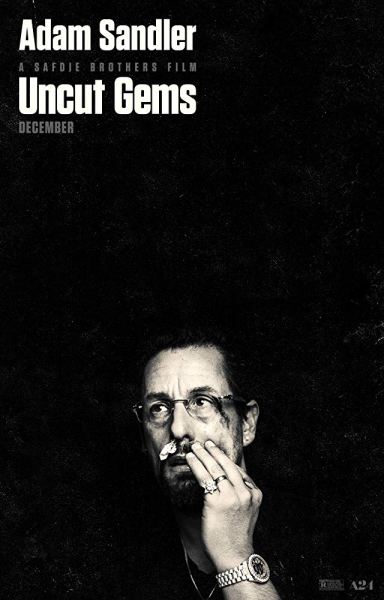
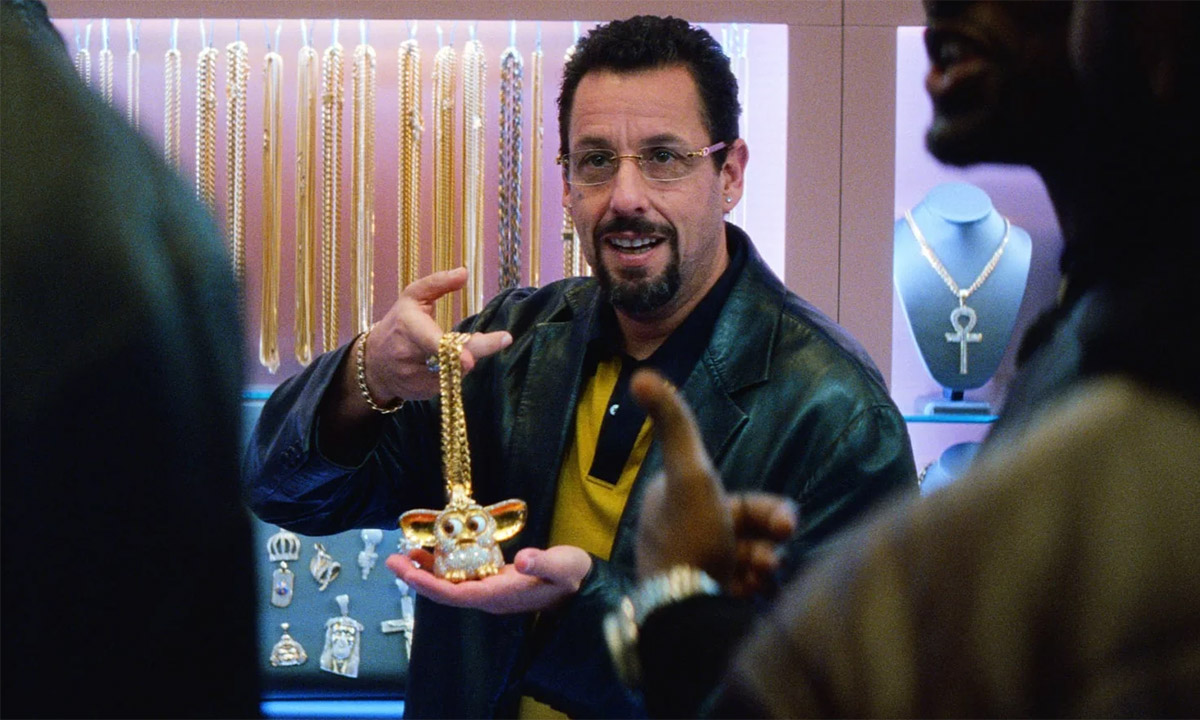
Howard Ratner (Adam Sandler) is a Jewish jewellery dealer in New York. Addicted to gambling, Ratner has a mountain of debts – mostly to his loan shark brother-in-law Arno (Eric Bogasian). Estranged from his wife Dinah (Idina Menzel) and trying to build a new relationship with girlfriend Julia (Julia Fox), Ratner’s life is a mess. His business depends on colleagues like Demany (Lakeith Stanfield) to bring in high-end clients, such as basketball star Kevin Garnett (playing himself). Ratner hopes an auction for a rare uncut diamond from Ethiopia will get him out of the hole. But, after agreeing to loan the diamond as a “good luck charm” to Garnett, Ratner finds himself in a desperate race to get it back in time for the auction, make enough money to clear his debts – and resist the temptation to throw it all on a big accumulator bet on the next basketball game…

The Safdie brothers’ film is an explosion of frantic energy. Shot with hand-held dynamism and cut with adrenalin-fuelled quickness, every scene has life occurring at hundreds of miles an hour, leaving the viewer struggling to keep up. Like Robert Altman walking in Scorsese land, dialogue frequently overlaps, with the buzz of improvisation and rawness of language. The film rips through events with a headlong force, scenes veering from black comedy, to tragedy to violence with unexpected force.

There is an almost Jonsonian or Moliere sprightliness about the film. Ratner feels like a Volpone, a chancer on the make, trying to keep ahead of his schemes long enough to end out on top. The film plays like a dark farce. Often, at the worst possible moments, Ratner’s opponents or friends appear to ruin his current plan. Ratner’s shop is practically a classic farce set, with its backrooms and magnetically controlled door that doesn’t always open when ordered. But it’s a dark farce, which never lets you forget the threat of genuine physical violence.

The Safdie brothers take a superb chance on casting Adam Sandler. With his gallery of grotesques in a low-brow comedies, it’s easy to forget the commitment and transformational quality Sandler brings to any role. With the film teetering towards dark farce, that energy is perfect. Sandler channels the bombast of Al Pacino by way of the sleaze of Gilbert Gottfried, a raspy voiced would-be-but-never-was, a Del Boy of low-rent crime. It’s a high octane, big performance. But it works because Sandler is aware this is a character always performing, and has taken on a persona of such New York Jewishness (the Safdie brothers have said this was their intention) that it almost feels like his true emotional self has been long buried.

He’s a character who struggles with earnestness and honesty – partly because it brings so few benefits to his world, partly because he’s almost forgotten how to behave other than as the high-octane chancer he presents to the world. In many ways, this is very secure role for Sandler, falling very much into his wheelhouse without the crude gags, but with additional tears. Heavily praised by critics – many of whom perhaps couldn’t bear to sit through his more conventional film work – it’s a strong performance, but not a revelation as many suggested. Ratner is an exaggeration and a tour-de-force, but the real stretch for Sandler is in the smaller, quieter moments (of which there are few) where Ratner has to confront the emotional consequences of his appalling choices.

Moments like this are few and far between, amongst the crazed energy of the bulk of the film, but they carry real impact. It would be easy for this jet-black crime dramedy to overlook its heart, but it’s certainly there. Ratner’s relationship with Julia seems to be a typical gold-digger/older man’s folly, but reveals itself to have far greater depths of emotion than first appears. Similarly, the feud between Ratner and his wife is just part of a wider spectrum of genuine affection between them – even if the idea of continuing the marriage is a joke. Even Ratner and his brother-in-law (a world-weary Eric Bogasian) have moments of genuine affection, for all the threat of violence.

The real villain of the piece, if there is one, is Ratner’s own self-destructive streak. He can’t let the chance of a good score pass him by, and his constant habit of shooting himself in the foot and making the wrong call have led him to the brink of destruction. Not that the film is keen to show us too much of this. Interestingly, for a film about a gambling addict, Ratner’s actual bets have a romantic tendency to come off. In fact, for all that he is clearly in dire straits, the film shies away from showing the real damage that addictive gambling can have.

Perhaps it’s because the Safdie brothers clearly feel very protective towards Ratner. For all his wheeler-dealing desperation, the film lends him a perverted sense of nobility. We can see him lose out on a big deal, get punched in the throat, thrown in a fountain and still he keeps on going (Sandler’s fast talking wildness works wonders here). It’s a flaw in the film for me, that it’s nervous of looking at this self-destructive individual with the cold-eyed clarity that the best of the 1970s film this is partly apeing, would do. It’s a bit like making a film about a drunk, but showing every drinking session as being a whale of a time.

The film culminates in a final wide-eyed bet, mixed with a flurried attempted escape from the crooks. The final act throws in some surprising – and affecting – twists to the tale that stands much of what we have been watching on its head. The film’s frenetic style might, at times, make it a hard-watch – it is so eager to impress that it rarely rests but constantly jumps around like an over-active teenager – but it channels Sandler very effectively, and has the sort of edge too many other films can only dream of. Moments try too hard (the bookending shots that burrow, Fincher like, deep into crevices is a flourish too far), but this is still wire-cracker film-making.

Scarface (1983)

“Shay hell-o to my leetle friend!” Al Pacino puts it all out there in Scarface

Director: Brian de Palma

Cast: Al Pacino (Tony Montana), Steven Bauer (Manny Ray), Michell Pfeiffer (Elvira), Mary Elizabeth Mastrantonio (Gina), Robert Loggia (Frank Lopez), Miram Colon (Mama Montana), F. Murray Abraham (Omar), Paul Shenar (Alejandro Sosa), Harris Yulin (Detective Bernstein), Mark Margolis (Shadow)

Remember when Al Pacino played the softly spoken, chillingly self-contained Michael Corleone? Watching The Godfather, who could have imagined that performance would be the outlier in a career that gleefully embraced the insanely OTT in a way few other great actors have dared. And possibly no other performance in Pacino’s career was as large as in Scarface, a ball of nervous energy, foul-mouthed aggression and drug-fuelled instability, the burning heart at the centre of Brian de Palma’s wildfire of a film. Scarface dials every single thing up to about 11 and then some, becoming the director’s brashest and most enduring work – but it owes everything to Pacino’s furious, unreserved energy at its centre.

Pacino plays Tony Montana, a working-class crook from Cuba dispatched (along with boatloads of undesirables from Castro’s regime) to Miami in the early 80s. There, in refugee camps and the local community, it’s crime and violence that give these guys the best chance of grabbing a share of the American Dream. Montana is no different, graduating from hits to drug deals and swiftly moving up the chain with his determination, gruff no-nonsense attitude, fierce loyalty and ruthless focus. But once you hit the top and the world is yours, there is really only one way to go – back down again, made easier when you are hooked on snorting mountains of your own product, incestuously in love with your sister Gina (Mary Elizabeth Mastrantonio) and your increasing arrogance and unreliability put you on the wrong side of your partners and kingpins in South America.

A remake of the 1932 original by Howard Hawks (the film is dedicated to Hawks and the scriptwriter Ben Hecht), Scarface is a brash, unsettling, nervy and incredibly violent cartoon-style gangster movie that owes almost its entire legacy to Pacino’s snarling wit at the centre. Is Pacino taking the piss here with this performance? Surely, he must have wondered if he could get away with it. This is a whirlwind tour-de-force, Pacino throwing himself into it with nothing left in the locker-room. He delightedly wraps his vocal chords around a thick Cuban accent (turning words like cockroach into a three syllable delight – “Cock-ah-roatch”) and embraces his small stature by turning Tony into a little pressure cooker. Seemingly incapable (bar one scene) of staying still, he’s supremely tense, his shoulders hunched up, his teeth on edge, voice growling.

It gives the film an unpredictable energy, because you don’t know what Pacino the performer will do any more than the characters do. He’ll suddenly throw you off with a moment of silence, just as often as he will blast your eardrums with a roar of anger. Emotionally Tony is a complete mess. His obsession with his sister is obvious, a devotion that Tony seems to only half (if that) understand is sexual in nature. But he also has a slight homoerotic bond with best friend Manny Ray (Steven Bauer – the only actor of Cuban heritage in the film), their closeness and macho-posturing carrying more than a whiff of Top Gun-ish “he protests too much”.

Pacino also invests Tony with strangely sympathetic qualities. Sure he’s a violent and ruthless killer and dedicated criminal, but he’s also got a firm sense of loyalty and certain moral lines he won’t cross. He’s got no time for bullshitters and respects only strength and honesty – watch the scene where he brutally talks over the weasely Omar (F. Murray Abraham – jetting back and forth between shooting this and Amadeus for goodness sake!) during a negotiation with drug lord Sosa – he has no respect or regard for his more politically minded boss, only for straight-talking that makes a deal.

It’s all this that ends up making Tony an anti-hero the viewer sort of ends up liking – even while he dopes himself to the brim with coke and funnels piles of it onto the street (not that we see any of that). Tony is a violent killer, but he’s a sort of honest man, a monster yes but a public one that we enjoy seeing. Tony himself recognises this, calling out a crowd of people in a posh restaurant for treating him as a monster so that they can feel better about themselves (slightly undermined by the fact he’s coked to the eyeballs, incoherent and has brutally ended his marriage a second earlier).

So much is Tony a force of nature that, hilariously, it feels like many of the fans of the film – bling gangsters and wannabe street punks – miss that this film is a brutal satire of the culture of excess and greed. Tony’s life falls apart the more money he gets, his addictions and problems growing as his wealth does. He’s an instinctive, but not wise, man who builds a household of fantastic excess and tasteless ostentation (surely, like Saddam, his taps are gold-plated) but also manages to destroy his business and life in a few months due to his greed, stupidity and self-destructive streak.

The things that made him a high-riser are lost the more Tony surrounds himself with garish status symbols. Inevitable destruction walks hand-in-hand with Tony’s “more is more” attitude. The more he attempts to add class and polish to his life, the more he demonstrates his own lack of both qualities. Also, as he gets more obsessed with pointless status symbols he loses the very skills – honesty, energy, shrewdness – that made him a kingpin in the first place. Instead he becomes a drug-fuelled narcissist, making impulsively stupid decisions and wrecking everything he spent the first half of the film building up. Tony Montana is the face of a certain type of Reagan/Thatcher economics, where private enterprise rolls in and ruthlessly takes and takes, with no regard for the impact on other people and no interest in sustainability.

De Palma captures this pretty well – although he probably ends up making this satire of excess more of a hubristic tragedy. Largely because the film falls so hard for Tony – or rather Pacino – that the fact that Tony is, despite his own moral code, a pretty reprehensible person can be easily lost. Not that de Palma probably cares that much, since his main aim here seems to be to create a hell of a ride. And there are some great set-pieces, and some wonderfully character beats – not least a sequence where Tony seizes control of the empire from weak boss Robert Loggia and sinister corrupt cop Harris Yulin.

The film certainly does that, flying from set-piece to set-piece so swiftly and with such a sense of pace and shark-like momentum, you almost don’t notice that it runs for as long as it does. Every few minutes gives us a scene with stand-out moments of either Pacino grandstanding, shocking violence or both. Scarfaceis a very violent film – everything from chain saws to bullets are used to pull gangster bodies apart – and while it has a sort of moral message (“Excess is bad”) it’s really just an excuse like Cecil B DeMille to make us feel good about ourselves by watching someone pretty bad (but with a few redeeming qualities) dance like a bear for two and a bit hours doing terrible things (entertainingly) before being carved down in a hail of bullets as the devil comes round to collect.

A History of Violence (2005)

Viggo Mortensen: Hero or Villain? A History of Violence

Director: David Cronenberg

Cast: Viggo Mortensen (Tom Stall), Maria Bello (Edie Stall), Ed Harris (Carl Fogarty), William Hurt (Richie Cusack), Ashton Holmes (Jack Stall), Peter MacNeill (Sheriff Sam Carney), Stephen McHattie (Leland Jones), Greg Bryk (Billy Orser), Heidi Hayes (Sarah Stall)

Cronenberg’s films redefined ideas around body horror. And one of his most accessible – and perhaps one of his richest and finest – films takes these ideas to another level by looking at the lasting – and damaging – impact of violence. That’s not just the immediate, visceral impact either – and lord knows Cronenberg doesn’t shirk on that here – but also the intense, long-term psychological impact and how it shapes entire lives. A History of Violence is a brilliantly told and superb piece of film-making that mixes thought-provoking content with a gripping, Western-tinged plot. It’s got a claim to being one of the best American films of the Noughties.

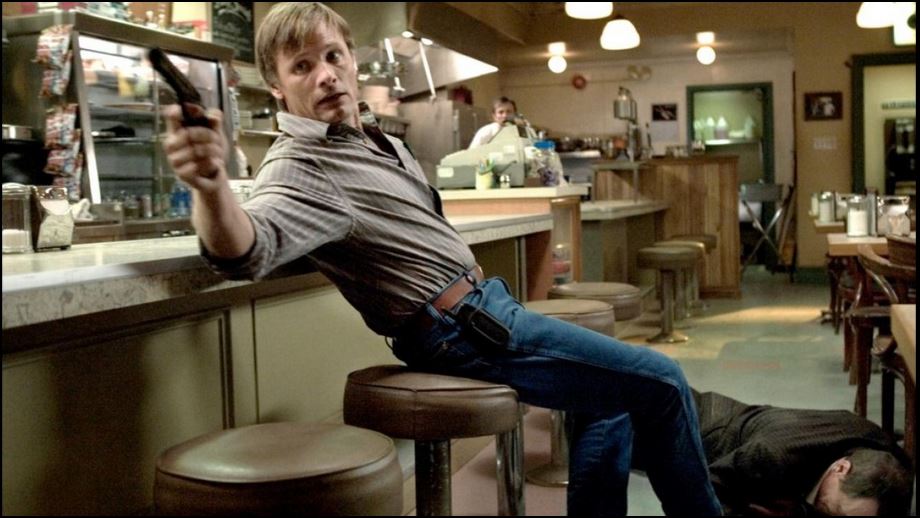
Tom Stall (Viggo Mortensen) is a regular Joe in a very small town in rural America. Running a small café, he lives a blissfully happy life of Americana with his wife Edie (Maria Bello), a lawyer, and their two children Jack (Ashton Holmes) and Sarah (Heidi Hayes). Their world changes forever though when Tom’s diner is held up late at night by two ruthless killers (Stephen McHattie and Billy Orser) and – with an instinctive ruthlessness – Tom ruthlessly dispatches the killers and saves the lives of his co-workers and patrons. His heroism makes him a local hero and brings plenty of excited press attention – but why does Tom seem so uncomfortable with this? Could it be linked to the swift arrival in the town of big-city criminal Carl Fogarty (Ed Harris) who claims Tom is none-other than Joey Cusack, psychopathic hoodlum from Philadelphia who gouged out Fogarty’s eye? Are Tom and Joey one and the same? And how will the doubts affect Tom’s family?

Cronenberg’s film brings brilliant tension to this question of identity, setting it in a very modern-feeling Frontier town, which has more than a sense of a classic John Ford western town, complete with disturbance from murderous figures from outside, shattering the peace. But the film adds that distinct Cronenberg touch by suggesting that, behind the quiet diners and picket fences, the real danger may already be at the heart of the town. Is Tom who he claims to be? Or is he a malignant dark force at the centre of the town (and his family) bringing destruction to everything? What other dark truths, you can’t help but think, might be hiding behind those shutters?

But then that’s what you get with violence. It taints and ruins everything it touches. Innocent lives are shattered. Families and loved ones are left mourning. But it also twists and shapes the personalities of its perpetrators. It marks them and changes them, washing out positive qualities and leaving those who use it the most drained, empty and uncaring. The film opens with a chilling long shot as McHattie and Orser check out of a motel. Cronenberg keeps the camera still and holds the camera still to study the casual body language and chilling lack of engagement of its killers (“Why the delay?” “I had a little trouble with the maid”). The scene continues for an agonising length, making us dread the reveal of what these clearly dangerous, amoral men have done in this motel – the reveal eventually shown with a clinical precision, which serves as an entrée to even greater horrors.

The final killing in the motel is the last time the film will shy away from the immediate horrors of violence. Even Tom’s heroic slaughter of the killers to save lives doesn’t shirk from showing us the impact on the bodies of the killers as Tom dispatches them – bodies torn apart by bullets, with McHattie’s killer left with most of his lower jaw destroyed beyond recognition. Later we’ll see the impact not only of bullets, but also the jerking death spasms of those who have had their noses smashed into their faces, necks snapped or bullets pass through their heads. Never is this glorified – and never are we allowed to simply categorise some killings as good or bad. No matter who it is, the human body will still suffer staggering trauma.

But violence’s impact isn’t only physical. As Tom’s increasing comfort with using his natural propensity for brutal killing (“Have you never asked, why is he so good at killing people?” Fogarty asks an Edie still in denial) grows, so violence takes over his family and starts to shape the actions and decisions of those around him. Arguments become more regular and more visceral. Tom’s gentle son brutally beats his bully at school. The loving father Tom suddenly slaps him across the face. Edie and Tom’s blissful life – we see them playfully making love on a date night – degenerates into conflict, distrust, flashes of violence and finally an angry, intense and passionate sex scene on the stairs that is an exact mirror image of their earlier love scene.

Edie is, for all her horror at Tom, partly excited by finding her husband has such a capacity for danger and brutality. That’s the dark attraction of violence in this film: it reveals secrets about ourselves. Tom seems to subtly shift within conversations from the gentle Tom into the chillingly distant Joey. Worst of all, the more that muscle is stretched the more Tom seems to take comfort and enjoyment in it. Taking what we want, with no regards for the consequences, is liberating and makes us feel strong. No wonder it’s so attractive. And no wonder violence has so shaped and defined humanity’s history. It tends to get people what they want and it can feel good. And it looks cool. Because despite the horrors of the impact of the violence, Cronenberg is also honest enough to admit that it’s exciting.

At the film’s centre is a superb performance of cryptic unknowability from Viggo Mortensen, in possibly his finest role. Mortensen uses micro expressions, small beats and body language that moves between casual and chillingly precise to show two personalities in one body. And Mortensen also demonstrates the struggle between these – between the man he wants to be and the man he might well be. He’s equally matched by Bello, wonderful as a woman who finds her whole life destroyed but can’t shake an unnerving attraction to this man of danger who has suddenly emerged.

The entire cast are pretty much faultless. Ed Harris gets a decent role of gruff menace, but the film is almost lifted in a final act cameo by William Hurt. Oscar nominated for (what amounts to) less than five minutes of screen time, Hurt is simply a force of nature as a Philadelphia crime boss kingpin, purring out his lines with all the fury of a caged lion, mixing a readiness for violence with a darkly comic menace. It relaunched Hurt’s career as a leading character actor – and arguably he should have nabbed the Oscar for it.

Cronenberg’s film engages with ideas of identity throughout. What defines us? The things we’ve done? The choices we’ve made? How many years need to pass before we can say that we’ve changed? What makes us better? And can we decide the sort of people we want to be? It’s impossible to say for sure. If your whole family life is founded on a lie, how do you know what about yourself is true or not? These are fascinating questions and the film offers no easy answers at all. Can Tom return to the life before a violent history shook everything up – perhaps he can, perhaps he can’t. But one thing’s for sure (and Cronenberg makes clear) it won’t be a simple overnight fix and a Hollywood ending. For all the hoodlums Tom dispatches, the real damage is on the workings of his family and the real casualty is the life his family thought they had. And those wounds don’t heal.

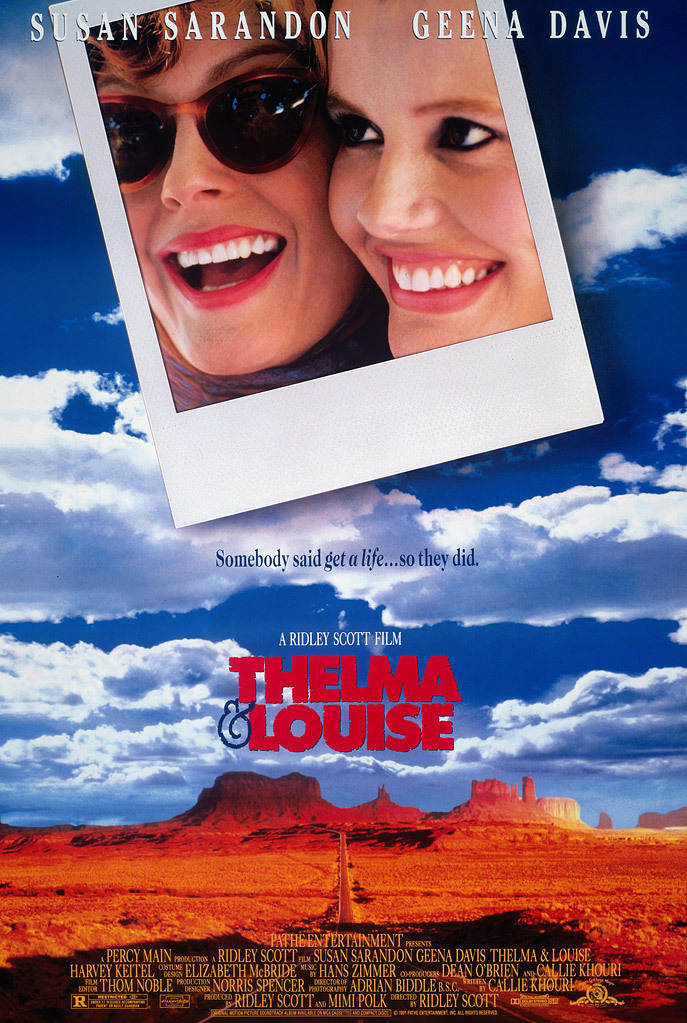
Thelma and Louise (1991)

Susan Sarandon and Geena Davis hit the road in Thelma and Louise

Director: Ridley Scott

Cast: Susan Sarandon (Louise Sawyer), Geena Davis (Thelma Dickinson), Harvey Keitel (Detective Hal Slocumb), Michael Madsen (Jimmy Lennox), Christopher McDonald (Darryl Dickinson), Stephen Tobolowsky (Max), Brad Pitt (JD), Timothy Carhart (Harlan Puckett)

Two people on the run, dodging the police and doing what they can to survive. It’s a well Hollywood has gone back to time and time again. But in most cases the people were either two men, or maybe a man and a woman (romantically involved naturally). It was unheard of to make that most masculine of genres, the outlaw road movie, into one led by women. But that’s what we get here, in a movie that has become iconic in more ways than one, Thelma and Louise.

Louise Sawyer (Susan Sarandon) is a tough, independent-minded waitress. Thelma Dickinson (Geena Davis) is a shy housewife, whose husband Darryl (Christopher McDonald) is a jerk. With Darryl away for the weekend, Thelma and Louise head off for a weekend away together, to let their hair down and feel a bit of freedom. Unfortunately, disaster happens when Thelma flirts with a sleazy guy in a Texas bar (Harlan Puckett), who tries to rape her in the car park. Louise saves her – but guns the guy down. The two women now find themselves on the run from the law, terrified that no one will believe their side of the story. But as the women find themselves on the road, the experience changes them, with Thelma flourishing in an environment where she can make her own choices and Louise becoming more able to open herself up emotionally. But can they stay ahead of the law?

With a terrific (Oscar-winning) script from first-time writer Callie Khouri, Thelma and Louise offers a dynamic and daring twist on the Hollywood road movie. By placing women at the centre of a story like this, a fascinating new light is shed not only on the law, but also on the culture of the American South. It also gives what would otherwise be familiar situations, a fascinating new light as two underestimated people are forced to prove time-and-time again how ahead of the game they are.

Ridley Scott directs the film with a beautiful, confident flourish. The John Fordian iconography of the West is a gift for a painterly director like Scott, and this film hums with the sort of eye for American iconography that only the outsider can really bring. The film brilliantly captures the dusty wildness of the West as well as the neon-lit grubbiness of working class American bars. It looks beautiful, but also vividly, sometimes terrifyingly real. Scott then, with a great deal of empathy, builds a very humane story around this, with two characters it’s nearly impossible not to root for.

He’s helped immensely by two stunning performances from the women in the lead roles. Susan Sarandon’s is perfect for the brash and gutsy Louise, not least because she’s an actor brilliantly able to suggest a great emotional depth and rawness below the surface. Louise is a women juggling deeper traumas – past experiences (its implied a historic rape) that leave her in no doubt that the justice system will not be interested in hearing about a woman’s suffering. It’s the hard to puncture toughness that softens over the course of the film, as Louise becomes more willing to explore her emotions and allow her vulnerability to show.

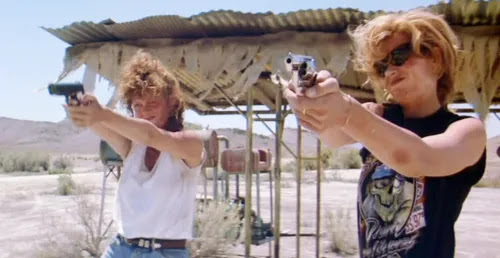
Particularly so as the lead between the two is slowly taken over by Geena Davis’ Thelma. This is certainly Davis’ finest work, her Thelma starting as a beaten down housewife, just trying to let her hair down in a bar, into a scared victim, a horny teenager lusting over Brad Pitt’s hunky JD then finally into a road warrior who discovers unimagined determination and resources inside herself, toting guns and robbing stores. It’s the sort of once-in-a-lifetime part Davis seizes upon. She’s sensational and totally believable at every turn.

Placing these two women at the centre of a story like this puts the feminine perspective front-of-centre – and it’s alarming to think how little some things have changed. Can we imagine today that there wouldn’t be policemen and lawyers willing to blame Thelma – or claim she asked for it – for her near rape in a bar? Or that there wouldn’t be a fair crack of the whip in the system for Louise for gunning down an unarmed rapist? On top of that, the majority of the police tracking the two women (with the exception of Harvey Keitel’s decent cop – Keitel is very good in this) find it hard to take “these girls” seriously, finding it hard to imagine them being anything other than a joke.

Mind you the attitudes of men are laid bare at every turn. Thelma’s husband Darryl (a very good performance of selfish patheticness by Christopher McDonald) is a waste of skin, a man who can’t imagine a world where Thelma could be his equal. Timothy Carhart is all charm until Thelma denies him the sex he believes he was due for in exchange for a night if flirting and drunks, and promptly turns extremely nasty. The cops – gun totting with itchy trigger-finger – just seem to be waiting for an excuse to throw the ladies down. Even JD (a star marking early performance by a deeply attractive and charismatic Brad Pitt), who seems so charming – and proves the sort of generous and skilled lover Thelma has never experienced in her life – has no qualms about robbing the ladies of their life savings, leaving them hung out-to-dry.

Many men at the time complained (pathetically) about the presentation of men in this film (as if men haven’t had any films where they were sympathetically placed front and centre), but I think it’s a pretty clear judgement that women are not held to the same standards. Khouri’s script shows time and time again the casual sexism (and sexualisation) the women encounter – to the extent that when they finally confront (and pull guns) on the sexist, aggressive truck driver who has been following them for most of the film, you cheer along with them when they shoot out first his tyres, then his oil tanker. We’ve even had a warm-up with Thelma turning a tough intimidating cop into quivering jelly by taking control of the situation.

But that’s what this film is about – the unexpected taking control. Because this isn’t just a feminist statement because it puts women into a male genre. It does so by showing how few choices these women have in their lives before they take into the road and how liberating it is to be able to make their own choices. Because these characters have had all their choices made by men, from Thelma’s smothering marriage to Louise’s undefined past as a victim. And their futures are as much out of the control, likely to find themselves on death row for shooting a rapist. On top of all that, men continue to see them both as sex objects.

How could you not be moved by this? It’s why the films iconic ending carries such impact. These are women discovering they have the power to make their own choices and their own mistakes. It has an undeniable power to it. It’s a power that runs through the entire film, perfectly shepherded by Scott’s astute and sharp direction, with Davis and Sarandon superb. It will still give you shocking insights today into what life is like for women in a world still dominated by men.

More recently its writer and stars pointed out that the film actually ended up changing very little for women in Hollywood. There was no new wave of daringly different female-led movies, with “women’s drama” still mostly restricted afterwards to family drama and romances. There are still few exciting opportunities for female filmmakers. (And it’s a sign of the times back then that the very idea of a woman directing this feminist film was never even raised as a possibility.) Perhaps that’s why Thelma and Louise remains such an icon, because it’s still such a one-off. Either way, it’s a film that hasn’t aged a day since it was released.

To Catch a Thief (1955)

Cary Grant and Grace Kelly basically have a nice French holiday in To Catch a Thief

Director:  Alfred Hitchcock

Cast: Cary Grant (John Robie “The Cat”), Grace Kelly (Frances Stevens), Jessie Royce Landis (Jessie Stevens), John Williams (HH Hughson), Charles Vanel (Monsieur Bertani), Brigitte Auber (Danielle Foussard), Jean Martinelli (Foussard)

One of the nice things about being a powerful film director is, if you fancy a nice holiday in the sun, get a film greenlit in a nice location and settle in for a nice vacation. That’s perhaps the real story behind To Catch a Thief, a popular Hitchcock film that is, at best, a second tier entry in his CV – but has some truly lovely location shots of the French Riviera in it.

The film meanders through a plot that never really heads anywhere particularly interesting, other than crossing off some of Hitchcock’s familiar beats. Cary Grant coasts along as suave former French Resistance fighter and infamous jewel thief “The Cat”, now retired to a lovely vineyard on the French Riviera (presumably off the back of his ill-gotten gains). His French resistance past has basically made him immune from persecution, until a copy-cat thief starts to plunder the jewels of the rich. With Robie Suspect #1, who better to catch a thief than…another thief?

To Catch a Thief is so much about its style, its expensive Hollywood production standards and luxurious location shooting, that it almost forgets to have any substance at all. I suppose that doesn’t completely matter when this is very much one of Hitchcock’s entertainments – a luscious change of pace from his previous film Rear Window, which was all about confined spaces, voyeurism and seedy thrills. Here instead the focus is on beauty, charm and frothy comedy, with the plot unspooling so gently, that the final resolution is virtually thrown in as an afterthought.

Instead the focus is more on the extended game of flirting between Grant and Grace Kelly as daughter of wealthy American jewel owner Jessie Royce Landis. Grant was, of course, twice as old as Kelly (and only eight years younger of course than Landis, who played his mother four years later in North by Northwest), but the two make for a chemistry laden couple. (Hitchcock cheekily has one seductive late night conversation intercut – and end – with a fireworks explosion. No prizes for guessing what that symbolises). 

Much of this fire comes from Grace Kelly who, fresh from her Oscar win for Best Actress, is brimming with confidence. Clever, sexy and dangerous – she’s excited by Robie’s life of crime and loves the idea of joining him in a life of crime, don’t get many leading ladies of the time being as daring as that – Kelly oozes sex appeal and looks like she could eat Grant for breakfast. It takes all the experienced cool and charm of Grant – who adjusts the part so neatly into his wheelhouse, he feels like he could play the thing standing on his head – to keep up. Kelly is radiant and magnetic and walks off with the movie. So much so you wish it gave her slightly more to do. 

But then the plot of the film doesn’t give anyone much to do. Robert Burks (Oscar-winning) photography is lovely, really capturing the beauty and elegance of the French Riviera. But the events around it are nothing to write home about, an underpowered caper with little of the director’s energy and fire or his subversive creepiness. The identity of the copy-cat will be a mystery perhaps only to those who have never seen a movie, while the generally predictable beats in every scene make it feel like a hodge-podge pulled together from the offcuts of better films.

It’s got a lovely feeling of a holiday adventure for all and sundry. Plenty of French actors dutifully trudge through – although to a man their characters are either incompetent, bullies or crooks – with The Wages of Fear Charles Vanel clearly dubbed as a seedy ex-Resistance fighter turned restaurateur. It’s all very well mounted, entertaining enough and leaves almost nothing for you to digest after it’s finished.

The Usual Suspects (1995)

The immortal gang in legendary twist thriller The Usual Suspects

Director: Bryan Singer

Cast: Stephen Baldwin (Michael McManus), Gabriel Byrne (Dean Keaton), Benicio del Toro (Fred Fenster), Kevin Pollak (Todd Hockney), Kevin Spacey (Roger “Verbal” Kint), Chazz Palminteri (Agent Dave Kujan), Pete Postlethwaite (Kobayashi), Suzy Amis (Edey Finneran), Giancarlo Esposito (Jack Baer), Dan Hedaya (Sergeant Jeff Rabin)

SPOILERS: If you have been living in a cave since 1995, don’t read on as I discuss the twist at great length…

“Convince me”. That’s what Customs Agent Dave Kujan (Chazz Palminteri) says as he begins his interrogation of limping, low-time crook “Verbal” Kint (Kevin Spacey). That’s certainly what Kint does – and it’s what the whole film is aiming to do in this, the most famous confidence trick in movies. The Usual Suspects is one of those once-in-a-blue-moon films where everything comes together perfectly. It’s also a sleight-of-hand movie that remains hugely engaging and entertaining even when (as surely most people now do!) you know exactly what the magician has up his sleeve. Its solid gold entertainment factor even survives today, despite the slightly queasy presence of both Kevin Spacey and Bryan Singer in its credits.

Told in flashback, the film follows the coming together of a bunch of regular criminals, pulled in for a line-up and deciding to team up. Along with Verbal, the others include McManus (Stephen Baldwin), Fenster (Benecio del Toro), Hockney (Kevin Pollak) and ex-cop turned criminal Dean Keaton (Gabriel Byrne). After a successful series of heists, the gang are conscripted by suspicious lawyer Kobayashi (Pete Postlethwaite) to take on a dangerous hijacking job for shadowy – possibly legendary – master criminal Keyser Soze, the bogeyman of the criminal classes. We know the job will go wrong – after all Verbal is banged up telling the whole story, the only survivor of the job – but how? And who is the shadowy Soze – or is he even real at all?

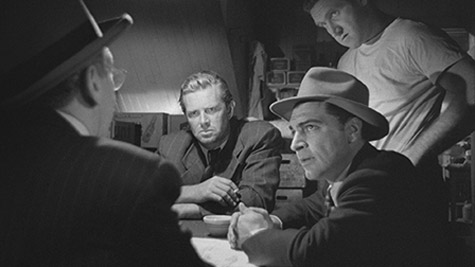
The Usual Suspects takes what you know about movies and then works double time to use it against you. With a structure inspired by classic noir crime films from the 1940s – the whole operation has a touch of The Asphalt Jungle while the interrogation has more than a hint of Double Indemnity – mixed in with a lot of Rashomon, it’s a movie that has you primed so much for a reveal and a twist that it skilfully misdirects you into expecting the wrong thing. Because how could you guess that perhaps the whole movie is a spun-out-of-the-moment invention by Verbal, and that possibly almost nothing we see during the course of its run time even happened. 

But how can we guess? From the very first scenes with Kujan and Verbal, Kujan is shot dominating the frame, always taller, always filling the screen. Verbal is sitting, meek, trapped by the frame, the camera frequently looking down at him. Every shot subliminally tells us that he is weak. The story has to be dragged out of him, with the investigation outside of the room forcing Verbal to expand on issues he doesn’t want to touch on. Like Kujan we invest in what we are finding out, because it looks like Verbal doesn’t want to tell it to us. That’s how they get you.

Because Verbal, in his story, is sprinkling in just the twist that Dave (and the audience) is probably expecting – that Gabriel Byrne’s Dean Keaton, the guy who claimed to have gone good, who just wanted out, was bad the whole time and was the criminal mastermind this whole time. Christopher McQuarrie’s ingenious script primes us for this: Dave Kujan is casting doubt on Keaton’s “death” right from the start, and as the audience surrogate figure we want to be as smart as he is. So what does it matter that we ”see” Keaton shot in the opening sequence of the film? Surely that was an illusion, and we’re as clever as Kujan in seeing through it.

The film even gives us a brilliantly assembled “reveal” series of edited flashbacks, in which every small moment and hint that has existed in the film is replayed for us (John Ottman’s editing is flawless here – and he should also have credit for composing the film’s hauntingly classical score) to convince us, beyond a shadow of a doubt that, yup, poor simple Verbal was taken in all the time by dastardly Keaton, the guy who looks like a film star. Only of course it’s bollocks. That charred corpse that Singer jump cuts to at the start of the film as police investigate the boat massacre is indeed Keaton. And the clever twist we thought we were working out, turns out to be a mass distraction laid out for us by Verbal and the film.

So we get a second brilliantly edited reveal sequence as it hits Kujan while he studies that most famous notice board in film, that everything he thought he had worked out had been spun out of hints and clues off the board – from asides and anecdotes to entire locations and characters. And Kevin Spacey limps and then walks away, shrugging off the skin of timid, weak Verbal to transform into the chillingly amoral Soze. It’s a trick that worked especially well when Spacey was an almost unknown actor at the time (today it’s less of a surprise to find out that Spacey could be a creep). There is possibly no better reveal in Hollywood.

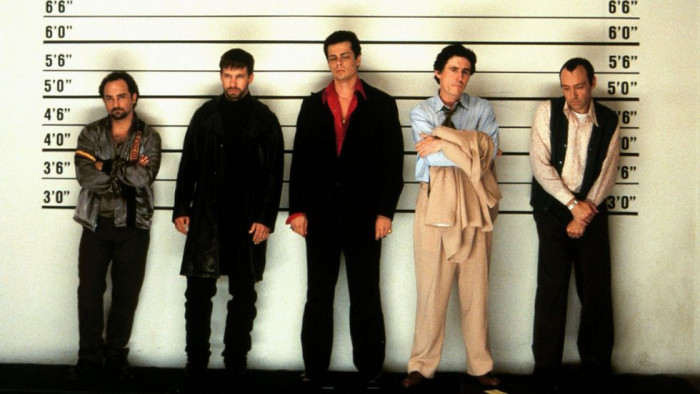
But the film continues to entertain even when you know it because Singer’s film is stuffed with richly layered characters, scintillating scenes and some rich and spicy dialogue from McQuarrie. It’s a brilliant combination and provides every scene with a clear and electric dynamism that makes it impossible to tear your eyes away. There are some truly striking scenes – not least the iconic line-up scene – and the film carries an improvisational energy (that line-up scene is a magic use of outtakes, as the actors couldn’t keep a straight face during the sequence).

Part of the magic of it comes from the brilliant clash of a group of vastly different actors bouncing off each other: the self-consciously method Baldwin, the edgy energy of Pollack, the chilly technique of Spacey and the classically trained professionalism of Byrne, who pulls off with aplomb a difficult job of playing a decoy protagonist and antagonist in one. And that’s not mentioning the wild card of Del Toro who, working out his character was a one-note plot device, throws in an eccentric chic and impenetrable mumbling accent that is part affectation (the sort of thing that made the actor more trying later in his career) and part jaw-dropping show of confidence. And backing them up is a collection of actors as eccentric as Palminteri channelling Law and Order with a smile and Postlethwaite as a sinister limey lawyer with an accent that sounds like it hails from the Raj.

Singer’s direction is flawlessly confident, creating a rich tapestry that you could lazily call Tarantinoesque, but actually reminds you of John Huston in its carefully framed mise-en-scene. It’s a very classical movie in its way, that loves clever wipes, slow build ups, brilliantly edited and surprisingly low key in much of its framing and shooting. Everything is perfectly placed to help build up the illusion. Singer never touched these heights of confidence and control again. It’s also superbly edited throughout by John Ottman, each beat landing perfectly, each transition perfectly judged. It wouldn’t seem out of pace to see Cagney playing Kint (with Bogart surely as Keaton). 

The devilish trickiness of the plot is kept largely under wraps until late on – Soze isn’t even mentioned until nearly halfway through the film – and the film’s confident misdirection suggests this might just be the gang aiming too high and getting burned rather than a shadowy mastermind manipulating it all. It’s a brilliantly judged change of pace, and all part of the impish delight of the film. It’s a clever game, but has more than enough force and invention in its story telling to keep you gripped time and time again. McQuarrie and Spacey won Oscars – and the film hinges so much on Spacey’s ability to both tell an anecdote and also not push his acting lame – and the film lives on forever in the memory as one of the finest twists. But it does so because the twist grows so organically from the film, and the film’s delight in tricking you is completely infectious.

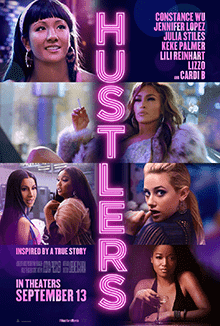
Hustlers (2019)

Constance Wu and Jennifer Lopez head out to get what they want in Hustlers

Director: Lorene Scarfaria

Cast: Constance Wu (Destiny), Jennifer Lopez (Ramona Vega), Julia Stiles (Elizabeth), Keke Palmer (Mercedes), Lili Reinhart (Annabelle), Lizzo (Liz), Cardi B (Diamond), Mercedes Ruehl (Mama), Wai Ching Ho (Destiny’s grandmother)

Greed. To many people, it’s what powers society. Those at the top believe anything can be bought, that they can have anything and everything they want simply because they have the money to pay for it. Hustlers suggests that nowhere is this more true, than in a New York strip club. The rich and the powerful, the masters of the universe, descend on these clubs for their after-hours play and assume their ocean-like wallets will open every door for them. Can we blame the strippers if they decide to exploit this for their own gain?

Opening in the build-up to the financial crash of 2008, Dorothy aka Destiny (Constance Wu) arrives at Moves, a prominent New York strip club, the night-time spot of choice for the super-rich from Wall Street. Money flows liberally in return for the strippers’ performances and their stroking of these masculine egos. Destiny comes under the wing of the club’s star, Ramona Vega (Jennifer Lopez), who teaches her how to manipulate men for cold hard cash. But when that financial crash comes, both women find themselves out of work. In the new atmosphere, the clubs are now staffed by dancers from Russia willing to go further with the men for money. Thrown back together, Destiny and Ramona start a new hustle – target rich men in clubs, get them drunk (and later just simply drug them), drag them to Moves and max out their cards (with the ex-dancers taking a healthy cut). But as the strippers themselves become rich, they start to get greedy. Things aren’t going to end well…

Sharply and wittily directed, Lorene Scarfaria’s film is an excellent crime movie with a little bit of social commentary thrown in. Fast paced and done with just the right amount of flash, it brilliantly rejigs the usual lens that we see strippers through in Hollywood movies. Rather than clichés, hookers with hearts of gold or props for the male characters, here the strippers are real, rounded people working a job – a job that just so happens to involve taking their clothes off. There may be fun to be had at times, but it’s a performance, a show – and a large part of Ramona’s skill is to effectively and convincingly play what she knows the men want to see.

That’s what Scarfaria’s film shows – it’s all a careful hustle, a clever series of tricks and techniques used by strippers to minimise the amount of contact with the customers (and the indignities of their lecherous hands) and maximise cash return, over the longest period of time possible. And these rich Wall Street types are too arrogant and convinced of their own excellence to even notice. The men come out spectacularly badly, a bunch of leering assholes who believe money gives them the right to do anything they like. Scarfaria shoots this with a snazzy Scorsese-ish zing which makes the entire film bounce along like a light version of Goodfellas and Wolf of Wall Street.

And the film has a great deal of admiration for these women who decided to turn the tables – who dealt with the fact that they were basically trapped into a certain role by society by using their skills to steal from the rich. The scheme of conning men is perfect at first – after all what powerful man is going to want to say that he was drugged and fleeced by a gang of attractive women? What is interesting is that the greed that corrupted the men, is gradually the thing the corrupts the women as well: the more successful their scam is, the richer they become, the more they become obsessed with status symbols, just as the men treated them. It doesn’t take long for crime to start moving on from its original Robin Hood targets into something far more indiscriminate.

Leading that charge into hitting any and every target for as much as they can get (rather than a careful but continual fleecing of a select group) is Jennifer Lopez’s Ramona. This is the role Lopez has been waiting almost twenty years for, a charismatic woman so firmly in control of her own life she doesn’t even notice when it starts to hit the skids. It’s the sort of scene stealing role that demands the energy and personality Lopez can bring to it, Ramona being part mentor and mother and part greedy livewire. If you forgot what a promising actress she was in the 90s, this is a great reminder. Ramona is a force of nature, the woman who demonstrates sex is a tool that can produce fabulous, fortune making results. But she’s arrogant enough to let greed and her innate belief in her own infallibility guide many of her decisions.

Lopez also forms a wonderful partnership with Constance Wu in the “Ray Liotta” part of the young naïve innocent, drawn under the mentor’s wings who eventually has to turn against her. Wu draws a lot of charm out of the young stripper learning the ropes, but crosses this really well with an ambition and ruthlessness that only late on finds its limits. 

Hustlers bounds along telling a winning, crowd pleasing story with a depth and emotional force that produces great results. We root completely for its female leads, keeping them relatable even when their actions become less sympathetic. Strikingly directed by Lorene Scarfaria, it’s a film about women that makes themselves firmly the authors of their own destinies – and their own mistakes.

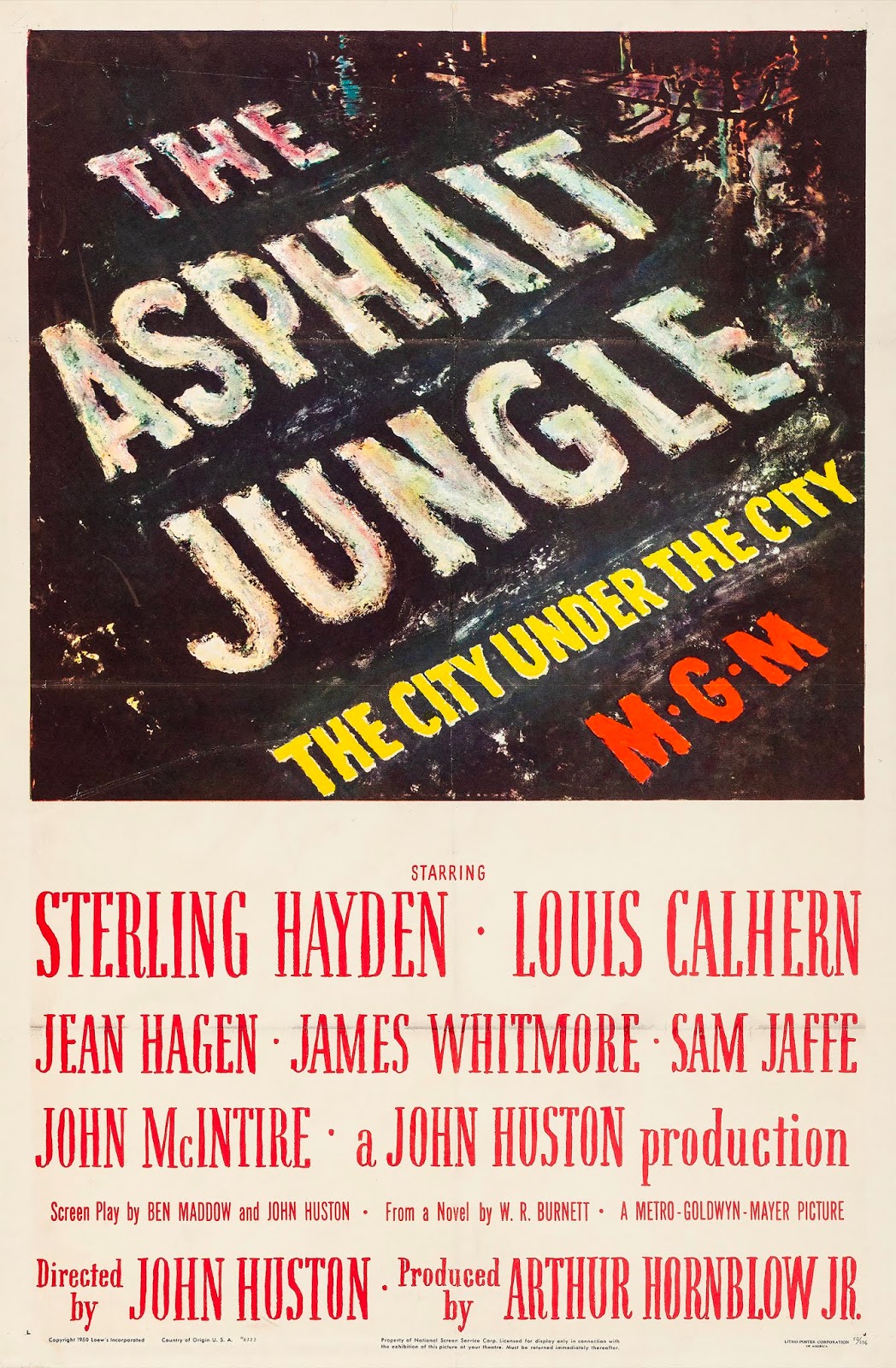
The Asphalt Jungle (1950)

A masterplan goes wrong in John Huston’s crime drama The Asphalt Jungle

Director: John Huston

Cast: Sterling Hayden (Dix Handley), Louis Calhern (Alonzo D Emmerich), Jean Hagen (“Doll” Conovan), James Whitmore (Gus Minissi), Sam Jaffe (“Doc” Erwin Riedenschneider), John McIntire (Police Commissioner Hardy), Marc Lawrence (Cobby), Barry Kelley (Lt. Ditrich), Marilyn Monroe (Angela Phinlay), Brad Dexter (Bob Brannom)

“Doc” Erwin Riedenschneider (Sam Jaffe) is out of the slammer after seven years, and the self-proclaimed “Professor” of criminal plans has a scheme for one final job. But rather than sell it to the highest bidder, Doc approaches crooked lawyer Alonzo Emmerich (Louis Calhern) to fund the crime and then split the proceeds with Doc. To carry out his robbery on a jewellery safe in a bank, he’ll need a gang including get-away driver Gus (James Whitmore) and Gus’ pal and “hooligan” Dix Handley (Sterling Hayden). But even the best laid plans of criminals can fall foul of events and the basic untrustworthiness of criminals themselves.

John Huston surprised some by turning his attention – Oscar in hand from The Treasure of the Sierra Madre – to noir cops and robber’s thrillers, but that was to forget he had made his name with his masterful adaptation of Dashell Hammett’s The Maltese Falcon. And in The Asphalt Jungle he created a small scale but almost perfect slice of criminalise noir, a brilliantly paced and acted film beautifully assembled that effortlessly chronicles the disastrous fall out of a robbery where it seemed everything was going perfectly.

Huston’s direction of the piece is, as nearly always, superlative. His painterly framing of scenes is dead on the money here, his framing of the actors within the scene absolutely without fault. Huston has an uncanny scene for arranging his actors in the minimum number of shots necessary, reducing dramatically the need for clumsy cut aways. Instead multiple actors are often artfully arranged in the frame, allowing the performers to react in the moment and the camera itself to capture the complete story in one smooth shot. It also allows for some great character intros, not least a shot of the Police commissioner in the background of the frame while foregrounded are the hands of his subordinate Dietrich, nervously fondling his hat. Straight away we get the mood of the scene.

This is all part of the brilliant noirish construction of a film that largely features sympathetic criminals – and it’s clear that the film’s sympathy is with the robbers here, the cops either incompetent, bureaucrats or corrupt themselves – either turning on each other, crumbling under pressure, making rudimentary errors that wind up getting them caught or failing into tragic fates that are left questioning what the point of it all was. This is all superbly caught in the moody darkness and shadows that soak over the picture, and highlighted further by the superb script, that packs some excellent lines and beautiful thematic points throughout the film.

It’s also helped by some great performances. Sam Jaffe (Oscar-nominated) is terrific as the cunning calm and businesslike “Doc” who seems unable to understand why things are not quite panning out as he planned, but is heartily sorry that it’s the case. He at least has honour among thieves, refusing to abandon his fellow criminals and quietly disappointed when betrayal raises its head. I love as well his screamish apology that the crime will involve one “hooligan” – or heavy – since he’s not the sort of guy who likes to resort to messy crimes (no matter that things quickly slide out of hand). He’s the sort of professional who expects everyone to play by the same rules, but that doesn’t stop him having his own private passions, particularly for the fairer sex, that will wind up catching him out.

He’s especially proved wrong since Sterling Hayden’s ‘hooligan’ Dix turns out to be the moral force of the gang, despite his down-on-his-luck scruffiness. Hitting crime as a way to finance his dream of buying back his family’s horse farm – and sadly losing most of that finance on the horses – Hayden is gloomy faced and gruff but has his own clear moral code in an affectingly gentle performance of vulnerability beneath the toughness. Debts and betrayal are anathema to him, and he winds up far more of the decent crook than any of the rest – he’s also the only one of the lot who can hold down a loving relationship, forging a genuinely sweet relationship with Jean Hagen’s Doll. Huston’s sympathies are clearly with the down-on-his-luck Dix, a decent guy who has just lost at life.

Of course the crook they can’t trust is the lawyer, a fine performance of snivelling weasliness under a veneer of culture from Louis Calhern. Puffed up, arrogant but desperate for the money and fundamentally weak and easily led, Calhern is excellent as the money man who only adds to the gang’s troubles, led on by Brad Dexter’s wonderfully impatient and ruthless hired gun. Calhern’s sad air of corrupted authority is only enhanced by his lecherous delight in his lusciously young mistress, a radiant early performance from Marilyn Monroe (shot like a classic painting by Huston).

Huston’s film throws this gang together flies together into a superbly detailed and gripping drama of the planning, execution and dreadful fall out of a robbery that clearly inspired the (perhaps even better) Rififi (so much so that it practically has the same story and structure), The Asphalt Jungle is a fabulously made and written pleasure, unpretentious but wonderful story telling marshalled expertly by a director at the top of his game.

The Godfather Part II (1974)

Al Pacino defines his career (and film history) as The Godfather Part II

Director: Francis Ford Coppola

Cast: Al Pacino (Michael Corleone), Robert Duvall (Tom Hagen), Diane Keaton (Kay Corelone), Robert De Niro (Vito Corleone), John Cazale (Fredo Corleone), Talia Shire (Connie Corleone), Lee Strasberg (Hyman Roth), Michael V. Gazzo (Frank Pentangeli), GD Spradlin (Senator Pat Greary), Richard Bright (Al Neri), Gastone Moschin (Don Fanucci), Morgana King (Mama Corelone)

For what shall it profit a man, if he shall gain the whole world, but lose his soul? It’s the question that drives this triumphant, Oscar-laden, sequel to Coppola’s cinema-defining masterpiece, The Godfather to create what is, without doubt, the greatest one-two punch in cinema history, two films that develop and contrast each other naturally it’s very easy to consider them as one perfect film.

It’s 1958 and Michael Corleone (Al Pacino) has seen his power grow to control Crime across several states. However problems confront him including rivalry from Hyman Roth (Lee Strasberg) his business partner, a disaffected capo Frank Pentangeli (Michael V Gazzo) talking to a Senate investigation and growing tensions in his marriage to Kay (Diane Keaton). The story is intercut with the rise to power of his father Vito (Robert DeNiro), a man raising his family in Little Italy and realising the temptations of a life of crime.

Happy with just one Godfather film, Coppola only agreed to a second in return for a pile of cash and complete creative control. He used that to create a film even deeper, richer and mesmeric (perhaps) than the first film. While The Godfather is high grade pulp fiction, shot and assembled with arthouse skill and layered with depth, Part II is a profound family saga, an arthouse epic spliced with rich vein of pulp fiction at its heart. A multi-generational story that illustrates the dark corruption at the heart of America from top to bottom, it also demonstrates the stark differences in personality and action between two ruthless, authoritarian father figures who do all that they do in the name of family, one of whom sees that family prosper and grow around him, the other who destroys everyone near to him.

Coppola’s film removes much of the slightly cuddily family element from the Corleone family to show a darker, bleaker, chillier movie than its landmark predecessor. Coppola uses his control to expand and deepen the Corleone saga both in the past and present, but also in the dark hearts and secrets of a family built on crime, extortion and murder. It’s a thematically rich, engrossing and beautifully assembled piece of film-making. Exquisite in every touch and beat, completely convincing and breath-taking in its confidence it is clearly the greatest sequel ever made.

The film charts the final descent of Michael Corleone into the dark recesses of his own worst desires and instincts. The brutal, unforgiving, unrelenting coldness and absolute certainty matched with the overwhelming hunger to win that has left him hollowed out and unrecognisable from the naïve, idealistic young war hero we were introduced to at the wedding that opens The Godfather. Of course, even at the start of the film, as Michael holds court with a chilling coolness and maintains only awkward contact with his family – all of whom must submit to him and his wishes or face lethal consequences – it’s clear that the man who talked of “it’s my family Kay, it’s not me” is a long, long way away.

During the film we see Michael seem to harden even further, an adamantine chillness captured superbly by Al Pacino. In, without doubt, the greatest performance of his career, Pacino restrains bar maybe three times, the explosive energy and ferocity that has been the hallmark of his career (a feat that allegedly made him physically ill). Instead, he presents a Michael who is an almost pathologically cold fish, a fiercely intelligent, scheming observer with eyes that observe and understand everything, jet black boreholes that suggest only whirlpools of emptiness behind them. He’s unrelenting, lacks any doubt and (it becomes clear) has not a vestige of pity left in him, with empathy forced out of his body like water from a squeezed sponge. Pacino prowls every frame like a quiet tiger, oozing sharpness, intelligence and lethal, ruthless ambition.

Everything is done to protect and secure his family and its legacy, but each action seems to strip him one by one of everyone he claims to be protecting. His children seem to live in intimidation and later terror of him. His wife turns from misery to loathing to being ejected from the family home, even aborting her pregnancy to prevent herself bringing another Corleone into the world (a reaction that leads to a final, relationship severing explosion of rage from Michael). His brother Fredo, poor sweet, foolish Fredo, is sacrificed to an unrelenting desire for revenge. The man who did everything for “the family” ends the film by having his last surviving brother executed. The brother who, the film’s coda reveals, was the only member of the family to support his signing up for service in World War Two.

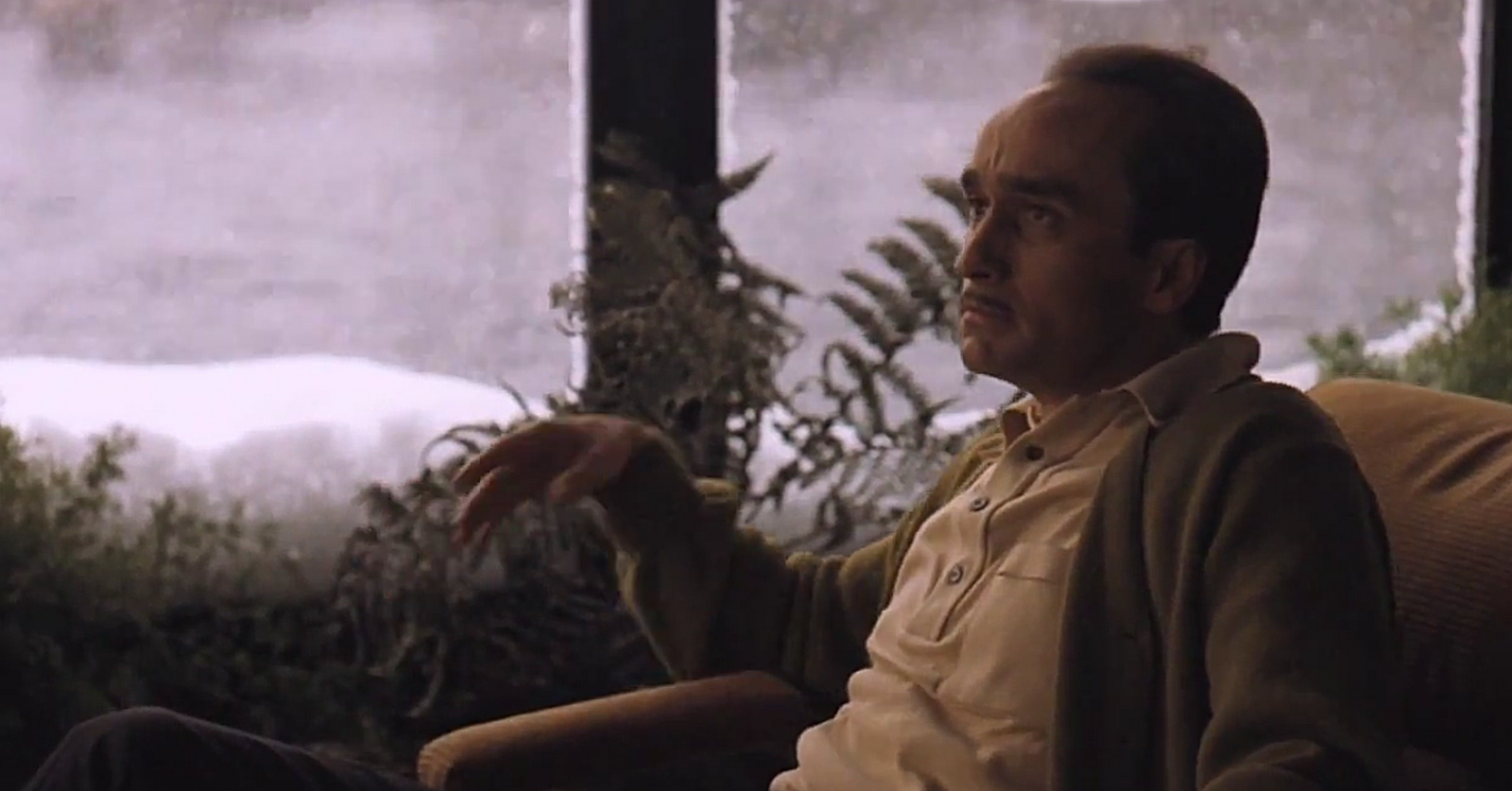
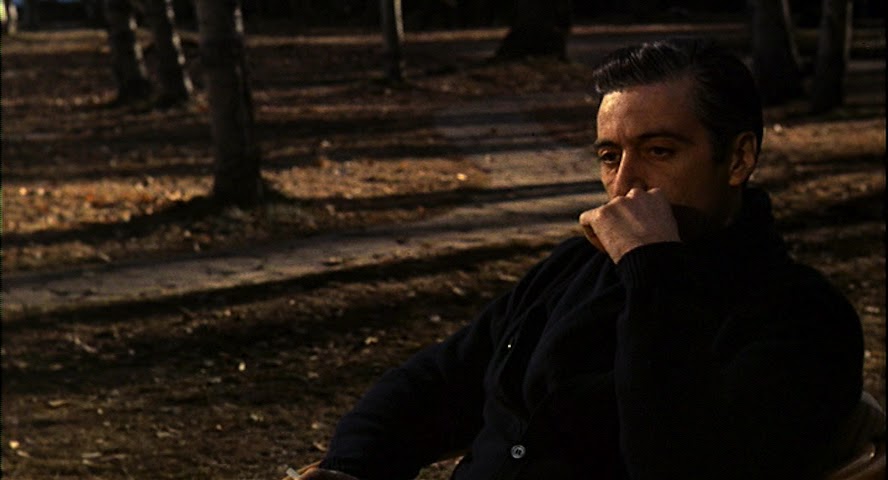
As Coppola’s camera drills into the face of Michael, cold, greying, alone in an autumnal garden – and how often the film simply studies the ruthless calculation of Michael, the man who understands every move everyone makes before they even make it – you know we are looking at a man who has damned himself, who has destroyed everything who claims to hold dear while working to protect it.

Brilliantly, Coppola intercuts the storyline of Michael’s damning collapse into complete moral damnation with the rise of his father. The Young Vito Corleone – played with Oscar-winning skill by De Niro who superbly channels the basic facets of Brando’s performance mixed with his own charm – arrives in America to find it a land as in thrall to the rule of the gangs as his hometown in Sicily. Like Michael in the first film, he is tempted by the world of crime and finds he has a natural aptitude for it: like his son he is a man who people follow, and the man who has the will to do what must be done. Like him he is an empire builder who commands respect and honour.

But unlike his son, he is a man capable of warmth, of empathy. He is man who can be playful, who respects others, who can feel forgiveness, who sees others as people, not just (as Michael does) simply being tools to be manipulated. Vito may be a murderer like his son, but he loves his wife, he loves his children and he can form bonds with them – natural, warm, loving bonds – that Michael can only dream of doing. For Vito it is all about the family, and providing for them is what inspires his actions. For Michael it’s words, but for Vito – it is everything.

Coppola masterfully intercuts these two storylines so they brilliantly comment and contrast with each other. Each step of Michael’s struggles to overcome the plots around him, are perfectly bookended with contrasting moments of Vito’s own rise to power, and the bonds of loyalty he builds even as Michael destroys those own bonds in his own life.

But then Michael is dealing with high stakes. While Vito’s early life shows Mafiosi running Little Italy, and calling the shots on the neighbourhood, a local tradition inherited en masse from the mother land, Michael moves in the worlds of government corruption. The empire we see Vito start to build is destined under his son to interfere in the rule of whole countries in Cuba, and commit unspeakable crimes to bring Senators and witnesses under their control in Senate Hearings into Organised Crime.

Coppola had intended the storyline around the reluctant family witness to be Clemenza, but Richard Castellano famously refused to reprise his role unless he was allowed to write his own dialogue. (The Godfather Part II was blighted with actor disputes: Brando refused to reprise his role in the film’s coda, while James Caan was paid more for a day’s work than he was for the whole of the first film). Instead the role was passed to Michael V Gazzo (Oscar nominated) as Frankie Pentangali, a loud-mouthed Capo manipulated into thinking he has been betrayed by the family. This threat hangs over the second half of the film – but Michael barely seems to break sweat under interrogation.

He has more problems with the Meyer Lansky inspired Hyman Roth (played by Pacino’s teacher, the legendary Lee Strasberg – also Oscar nominated). Roth it is who immerses Michael in a corrupt takeover of the Cuban government by the Mafia – an attempt foiled by the revolution – and Roth who becomes his nemesis, an old man in a hurry, who believes he can match the ruthlessness of this man without a soul. Coppola’s scenes of Cuban excess – not to mention the danger on the street as the country starts to tear itself apart – are of course masterful.

Cuba destroys Fredo, a snivelling John Cazale (inexplicably not nominated, despite extraordinary work here – never mind nomination he arguably should have won). Cazale’s Fredo is endearing but simple, a fundamentally weak man in a family of wolves, whose guilt is almost embarrassingly easily unveiled. Petulantly – but terrifyingly – raging late in the film at Michael at being passed over, he sits (sweaty and veins throbbing) in a reclining chair that bounces on each point he makes – a simple touch that makes him seem more and more impotent and pathetic every second.

The film echoes much of the structure of the first film, but here retold with a chilling coldness as the warm heart that – for all his crimes – Vito bought to this family is removed. The opening family event, Anthony’s confirmation, is a public show with no personality at all, where the Italians feel all at sea, their culture not known or cared for. Doors are closed on Kay with an alarming regularity – their marriage is so non-functional that even at the start they seem to have very little to say to each other. Vito returns to Sicily, as Michael did, but this time to extract revenge for his parents not to fall in love. The ending of the film culminates in a dark, ruminative and tragic hinged cleansing of Michael’s – crucially not the families but Michael personally – enemies.

The film is blessed with a brilliant array of supporting turns, from Diane Keaton’s soft-faced sadness masking deep and lasting resentment as Kay, to a flashily amusing tone from GD Spranlin as the greasily corrupt Senator. Robert Duvall does unsung but powerful work as a Tom Hagen coldly loyal, perhaps even in slight fear of his adopted brother, but despite his seeming decency willing to carry out truly terrible deeds for the family. Talia Shire (also nominated) is great as the rebellious Connie who pleads in vain for Fredo’s salvation.

This is all beautifully packaged together by Coppola into a film that meditates on the building and the destruction of a family, two stories neatly told together in parallel, with each echoing the other. It is a film shot at a riveting but controlled pace, that uses the classical filmic style of the original but mixed even further with the genius shooting of Gordon Willis to add a dark tinged 1970s style to ever shot. The film is an art house classic, but also a superb plot boiler, a gangster film that tells us profound truths about the attitudes that make us men and those that destroy us, just as it suggests that the darkness at the heart of crime will eventually consume the very thing it starts out to protect (even if it does take generations). While it is not as entertaining or engaging perhaps as the first film – it is perhaps an even greater achievement, a superb triumph of atmosphere and tone and a terrifying insight into the darkness that man can achieve.

For at the end Michael has won utterly. But he is also utterly defeated.

City of God (2003)

Violence is a way of life in Fernando Meirelles calling card sensation City of God

Director: Fernando Meirelles, Katia Lund (co-director)

Cast: Alexandre Rodrigues (Rocket), Leandro Firmino (Li’l Zé), Phellipe Haagensen (Benny), Douglas Silva (Li’l Dice), Jonathan Haagensen (Shaggy), Matheus Nachtergaele (Carrot), Seu Jorge (Knockout Ned), Jefechander Suplino (Clipper), Alice Braga (Angélica), Emerson Gomes (Stringy), Edson Oliveira (Older Stringy)

After Parasite’s win for Best Picture, it’s easy to remember the last foreign language film that made such a comparative impact at the Oscars – and it didn’t even win anything! Capturing the public imagination, City of God is that most American of things: a gangster film. Chronicling the life and death danger of the lawless slums of Rio de Janerio in the 1960s and 1970s, the film is an electric mixture of Latin and US film-making, a compelling shot of adrenalin that captured the imagination of the film-going public and made many Hollywood films look staid and dull. 

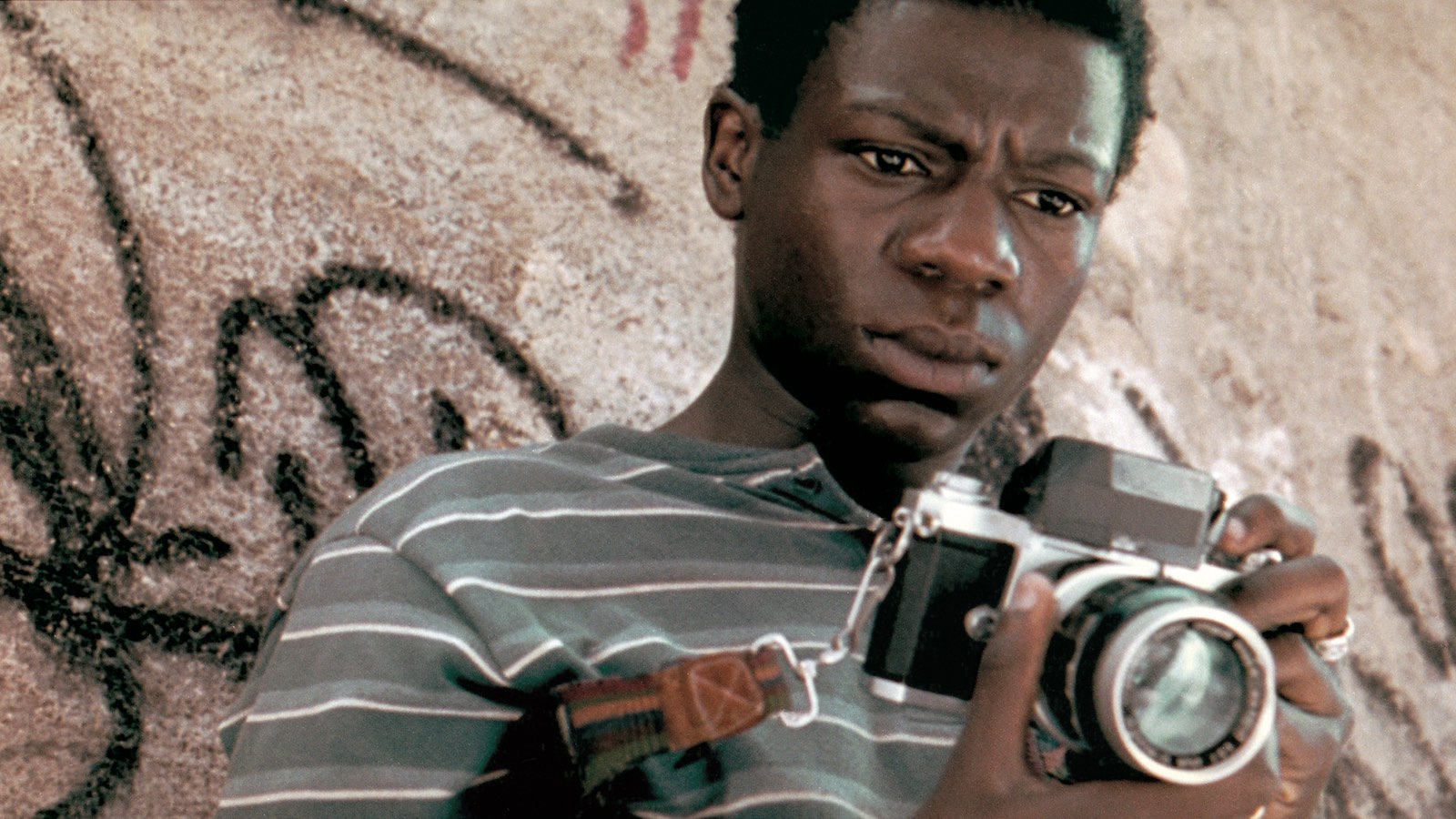
Shot on location with a largely non-professional cast, the film uses as our window into this world aspirant photographer Rocket (Alexandre Rodrigues), who has a front-row seat for an emerging (true life) gang war that erupts in the slumps between unstable psychopath Li’l Zé (Leandro Firmino) and his rival Carrot (Matheus Nachtergaele) and bereaved former sniper turned bus conductor and killer Knockout Ned (Seu Jorge). Starting at the end, the film rewinds through time and moves from perspective to perspective in a series of dynamic short stories that slowly merge and meld together to complete the film’s whole.

The film is directed by Meirelles (who got an Oscar nomination) and Katia Lund (who didn’t). Meirelles invited Lund to collaborate with him on the project, and is generally credited with the film’s look, editing style, frenetic pace and distinctive style of sharply exposed Latin colours mixed with the look of a rock video, all dynamic angles and immersive action. Lund bought her documentary realism to the film, as well as working closely with the actors and helping to shape their parts of the story. Agreeing to take a specific “co-director” credit probably cost Lund the nomination, and it feels inexplicable she was unrecognised today, even more so since Lund has pioneered several successful TV series based around the world of the film.

Controversy aside, it’s a high water-mark certainly for Meirelles who has never quite managed to match it since (The Constant Gardener remains his best work since, marrying the dynamism here with one of Le Carré’s most emotional and strongest stories). With its lashings of Scorsese, Tarantino and De Palma (among others), City of God remains a hugely engaging and engrossing gangster flick that really feels like it captures the threat and grimy reality of the streets of Brazil. Each section of the city we see feels like a lawless wild west, where guns rule, the police have no say and a whole population of ordinary people keep their heads down and just try to avoid getting caught (literally) in the crossfire. 

In this world violence is endemic, life is a short and brutish cycle of slaughter where danger leads inevitably to death, short-termism is the norm and a series of essentially childish young men see the excitement of crime turn into the brutality of a life of violence. None more so than the film’s vicious dark heart, Li’l Zé a young man with a flickering temper, a love of violence and death, barely able to relate to other people, unanchored in the world whose life is a self-destructive quest to be the biggest fish in his pond. Played with a swaggering panache by Leandro Firmino (and a chilling coldness as a child by Douglas Silva), the self-named Li’l Zé dominates the film as the sort of life-wire threat Joe Pesci used to be for Scorsese, never certain whether he will laugh or shoot.

Which makes him perfect for the unpredictability of the slums, where everyone wants to be a hood, drugs are rife and crime and murder is a legitimate way of living. The film splices together several short story narratives to illustrated this with Altmanesque confidence. Each section of the film is introduced as “the story of X”, all of them expanding from the starting story based around three wanna-be-hoodlums whose mixed fates reference everything from The Third Man to A Bout de Souffle. From this the film organically expands, using Li’l Zé as the fulcrum who hinges every other story around him towards disaster. It’s neatly cross-cut as well, starting the end before rewinding through a neat transition shot into the past to explain how we got where we are.

There seems to be no good deeds in the city. The most likeable character, Benny, is himself a gangster (and Li’l Zé’s only friend and restraining influence) who is fun-loving and cool while not adverse to theft and murder when needed. Kingpin Knockout Ned starts out as a man of good intentions, determined to clean up the town that has left him bereaved and hurt, but becomes consumed by the dark impact of violence. All the time, many of these gangsters are in love with their public image both the awe and fear they inspire in those around them as the most powerful people in the neighbourhood, and from their growing coverage in the press.

It’s a cycle that seems doomed to repeat itself, not least through the film’s introduction of “The Runts” a group of trigger happy pre-teen would-by gangsters, who roam through the streets waiting their chance to turn small stick-ups into a criminal empire. They are no more than following in the footsteps of Li’l Zé, shooting his gun and experiencing murder at their age and now zeroing on owning the whole slum. It’s the dark ambition of capitalism playing out on the streets.

The film works however as framing it around the jaunty, relaxed narrative of Rocket gives it the feeling of a series of shaggy dog stories and coming-of-age tales (and the film carefully mixes in among the gangsters plenty of reminiscences from Rocket around his teenager upbringing, his first love and his passion for photography). With someone as easy-going as Rocket as our guide, the film never becomes overbearing or depressing but instead as entertaining and engrossing. In a way it’s a shock to remember it features as much killing (including of a child) and mayhem as it does, as well as a world-weary nihilism too it that the odd person may escape the streets, but the general world there will never change. 

A staggeringly confident piece of film-making, City of God remains an exciting and compelling piece of cinema.