Tag: Charles Vanel

Wooden Crosses (1932)

Wooden Crosses (1932)

War’s horror is really palpable in this French WW1 classic, made by people who were there

Director: Raymond Benard

Cast: Pierre Blanchar (Gilbert Demachy), Charles Vanel (Corporal Bréval), Gabriel Gabrio (Suplhart), Raymond Aimos (Fouillard), Antonin Artaud (Vieublé), René Bergeron (Hamel), Raymond Cordy (Vairon), Marcel Delâite (Sergeant Berthier)
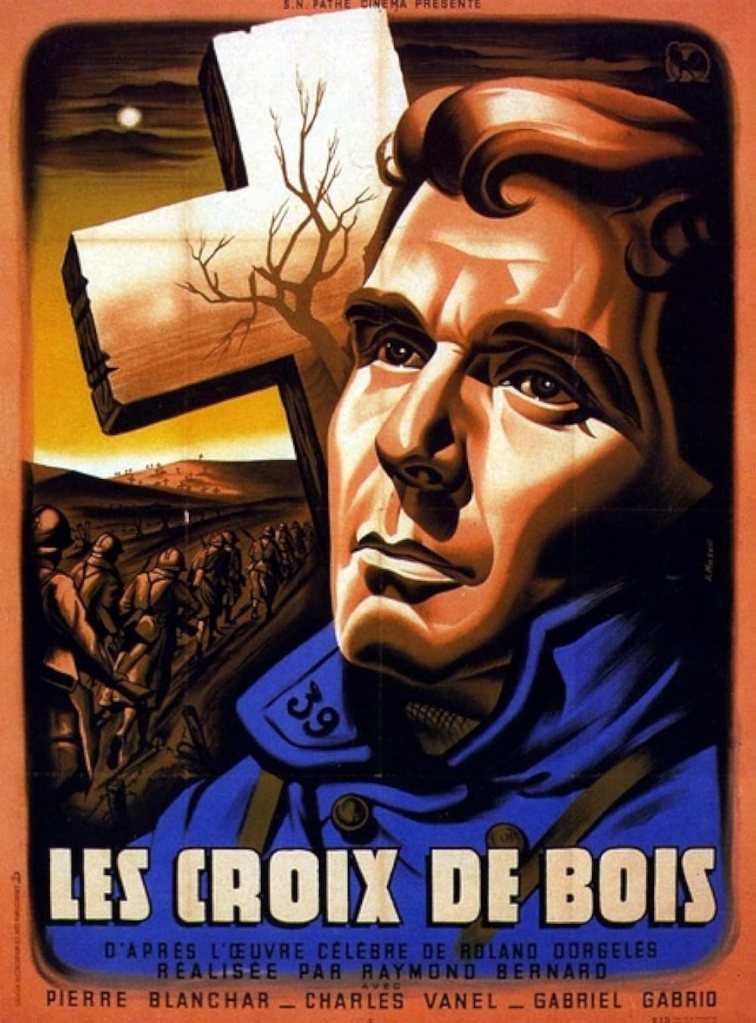
If you have any doubts about the deep scars World War One left on Europe, you can brush them off with a viewing of Wooden Crosses. Adapted from a gruelling novel by Roland Dorgelès, a former corporal in the 39th Infantry Division, Wooden Crosses is really a version of Dorgelès own hideous experiences in the trenches. Although it was largely overlooked outside France – like Westfront 1918 it lives in the shadow of All Quiet on the Western Front – it had a huge impact on France, being screened for veterans and for the President himself, many of them reduced to tears.

It tells of the never-ending slaughter inflicted on the 39th Infantry Division, partially through the eyes of a young law student Gilbert Demachy (Pierre Blanchar) who arrives determined to do his duty, even while under few optimistic ideals about the war. Introduced to the rest of his platoon by the gruff but fatherly Corporal Bréval (Charles Vanel) and cynical joker Sulphart (Gabriel Gabrio), Demarchy does his duty in several campaigns (with only brief respites from the front) while the soldiers around him die frequently and suddenly for a few more feet of mud.

Benard recruited actors and crew who had experienced the trenches, and Wooden Crosses is all about recreating the pitiless grimness of the front lines. The world the film creates is immaculately done in its grim squalor: the trenches are carefully reconstructed, a shelled-out church (“Our Lady of the Squaddies” as the troops call is) is perfectly sub-divided into a hospital (echoes of Pabst’s Westfront) for the wounded and dying and always the mud and desperation is palpable. The chances of heroism are few and far between, and the soldiers main goal seems to be to knuckle down and try to survive – even when the odds are impossible.

But, taking advantage of new film technology, it’s the sound of war that fills Wooden Crosses. The constant barrage of shells was carefully researched – after all each type of shell had a different sound – and long stretches of Wooden Crosses seem to be filled with nothing but the relentless pounding of the ears from mortar and shell fire. The horrific volume of war is captured here like few other films, which means the sudden bursts of near-silence carry real impact. For its in the silence we hear other sounds, the constant post-battle desperate pleas of the dying and wounded carried on the breeze. At one point Gilbert literally places his hands over his ears to drown out an incessant begging from a wounded comrade caught in No Man’s Land.

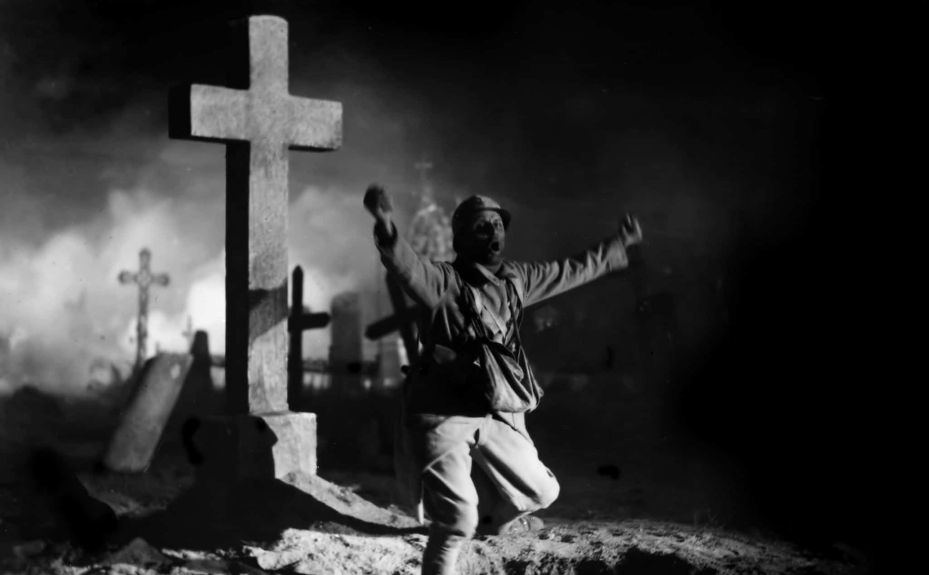
Its these moments that hammer home the soldier’s powerlessness. These people can’t be helped – that man making those sounds Gilbert has already had two attempts to rescue him, that just led to the death of the rescuers. Rescue is probably futile anyway. During a battle in a cemetery Gilbert risks his life to save another man, who promptly dies anyway – with all his pain, regret, anger and fear spewing out of him in front of his fellow soldiers. Powerlessness isn’t just listening to suffering: the platoon is forced to sit in their trenches listening to German miners digging beneath them, knowing the moment that digging sound stops their trench will be detonated – and that they can’t leave their post until their (disbelieving) officers give them permission.

No wonder they are hardened to battle. When a man dies in a foxhole, the others lift his body up to use him as a parapet. When an error in French artillery ranging means they end up firing on their own patrol, it’s met with irritation but muted acceptance that it’s just the way it is. There is a closeness among the soldiers, but it has that underlying current of knowing any of them could be gone forever at any time. When one of their late number receives a letter after his demise, the rest look away from the mailman with awkwardness, until Gilbert takes the letter to tear it up above the man’s grave.

Bernard visually contrasts this with some well-handled symbolism. He opens the film with rows and rows of soldiers, who transform in a single cut to rows and rows of crosses. The crosses become recurrent images. That battle in a cemetery is littered with them, hanging over or casting shadow over the characters, nearly all of whom are of course doomed. Bernard acknowledges the false excitement of the early mobilisation, with a montage of crowds rushing to volunteer to fight the good fight – but fades from this to a single image of an older woman staring out sadly from the camera, standing in for a whole generation of mothers about to lose their sons.

He ends the film – with our nearly last survivor piteously shedding his stoicism to die alone and afraid in No Man’s Land with a bullet in his belly – with a super-imposed montage of both stocks and shares and then wreaths tumbling past the screen (clear what he believes the motives and cost of war really was), before a final montage of soldiers carrying their crosses, Christ-like, through No Man’s Land. This meat grinder war, fought for profit, has left millions dead and for what? It’s hard to know or understand. And for all the soldiers never lose their determination to do their duty, never once do we get a sense of any patriotic idealism in them. No sense that anyone feels they are on a crusade, just a grim, unpleasant duty they need to get out of the way.

Wooden Crosses has a host of strong performances, each of them passionately committed. Pierre Blanchar is admirably reserved as Gilbert, his humanity tightly controlled below the surface. Charles Vanel is excellent as the gruff Sergeant, worried about his wife’s fidelity back home. Gabriel Gabrio makes his platoon cynic a man with a strong streak of decency. They are marshalled superbly by Bernard in a film full of power and despair at the horror men do.

To Catch a Thief (1955)

Cary Grant and Grace Kelly basically have a nice French holiday in To Catch a Thief

Director:  Alfred Hitchcock

Cast: Cary Grant (John Robie “The Cat”), Grace Kelly (Frances Stevens), Jessie Royce Landis (Jessie Stevens), John Williams (HH Hughson), Charles Vanel (Monsieur Bertani), Brigitte Auber (Danielle Foussard), Jean Martinelli (Foussard)

One of the nice things about being a powerful film director is, if you fancy a nice holiday in the sun, get a film greenlit in a nice location and settle in for a nice vacation. That’s perhaps the real story behind To Catch a Thief, a popular Hitchcock film that is, at best, a second tier entry in his CV – but has some truly lovely location shots of the French Riviera in it.

The film meanders through a plot that never really heads anywhere particularly interesting, other than crossing off some of Hitchcock’s familiar beats. Cary Grant coasts along as suave former French Resistance fighter and infamous jewel thief “The Cat”, now retired to a lovely vineyard on the French Riviera (presumably off the back of his ill-gotten gains). His French resistance past has basically made him immune from persecution, until a copy-cat thief starts to plunder the jewels of the rich. With Robie Suspect #1, who better to catch a thief than…another thief?

To Catch a Thief is so much about its style, its expensive Hollywood production standards and luxurious location shooting, that it almost forgets to have any substance at all. I suppose that doesn’t completely matter when this is very much one of Hitchcock’s entertainments – a luscious change of pace from his previous film Rear Window, which was all about confined spaces, voyeurism and seedy thrills. Here instead the focus is on beauty, charm and frothy comedy, with the plot unspooling so gently, that the final resolution is virtually thrown in as an afterthought.

Instead the focus is more on the extended game of flirting between Grant and Grace Kelly as daughter of wealthy American jewel owner Jessie Royce Landis. Grant was, of course, twice as old as Kelly (and only eight years younger of course than Landis, who played his mother four years later in North by Northwest), but the two make for a chemistry laden couple. (Hitchcock cheekily has one seductive late night conversation intercut – and end – with a fireworks explosion. No prizes for guessing what that symbolises). 

Much of this fire comes from Grace Kelly who, fresh from her Oscar win for Best Actress, is brimming with confidence. Clever, sexy and dangerous – she’s excited by Robie’s life of crime and loves the idea of joining him in a life of crime, don’t get many leading ladies of the time being as daring as that – Kelly oozes sex appeal and looks like she could eat Grant for breakfast. It takes all the experienced cool and charm of Grant – who adjusts the part so neatly into his wheelhouse, he feels like he could play the thing standing on his head – to keep up. Kelly is radiant and magnetic and walks off with the movie. So much so you wish it gave her slightly more to do. 

But then the plot of the film doesn’t give anyone much to do. Robert Burks (Oscar-winning) photography is lovely, really capturing the beauty and elegance of the French Riviera. But the events around it are nothing to write home about, an underpowered caper with little of the director’s energy and fire or his subversive creepiness. The identity of the copy-cat will be a mystery perhaps only to those who have never seen a movie, while the generally predictable beats in every scene make it feel like a hodge-podge pulled together from the offcuts of better films.

It’s got a lovely feeling of a holiday adventure for all and sundry. Plenty of French actors dutifully trudge through – although to a man their characters are either incompetent, bullies or crooks – with The Wages of Fear Charles Vanel clearly dubbed as a seedy ex-Resistance fighter turned restaurateur. It’s all very well mounted, entertaining enough and leaves almost nothing for you to digest after it’s finished.

The Wages of Fear (1953)

Yves Montard and Charles Vanel struggle to collect The Wages of Fear

Director: Henri-Georges Clouzot

Cast: Yves Montard (Mario), Charles Vanel (Jo), Folco Lulli (Luigi), Peter van Eyck (Bimba), Véra Clouzot (Linda), William Tubbs (Bill O’Brien), Darío Moreno (Hernandez), Jo Dest (Smerloff)

You’re stuck in a dead-end town without the money to get out. There’s been an accident at the local mining company that runs the town. They need to get super-duper, explosive material up there to blast the mine and prevent a fire spinning out of control. The only way to do it is in a truck up a bumpy hill road in the blazing sunshine. The company will pay a small fortune to anyone desperate or stupid enough to do it. Would you collect these Wages of Fear?

That’s the conceit in Clouzot’s slow-burn, tension-packed masterpiece. Mario (Yves Montard), along with several others, is stuck in a dead-end desert town in South America unable to afford the air fare to escape. Mario befriends an ageing gangster Jo (Charles Vanel), now also stuck in the town, and the two of them are tempted to drive trucks full of nitroglycerine (which can explode when hot or under the slightest jolt or pressure) to help put out a massive fire at the local American-owned oilfield. Along with Bimba (Peter van Eyck), a German, and Luigi (Folco Lulli), an Italian, they drive trucks up there – but the pressure affects the men in different ways and the dangers of the drive make it highly unlikely that they will all make it.

The Wages of Fear is the classic slow-burn leading to (literally) explosive tension. It’s almost a full hour into the film before the nitroglycerine makes an appearance, but after that the film lays a constant series of dilemmas in the way of our heroes as they try to make their way 300 miles to the oilfield. Never before has the slightest jolt of a car, or the smallest pot hole, been more wracked with danger. Is it any wonder each of the men go a little insane: who could do this and not be a little cracked in the head?

Clouzot directs this with a sublime brilliance. The film is a masterclass in subtle build-up. The opening act of the film establishes the characters of Mario and Jo (and to a lesser extent Bimba and Luigi). We see them in their natural habitat, and learn to understand their characters so thoroughly, that we are genuinely surprised and a little unnerved about how much they change over that long and dangerous 300 miles. Yves Montard’s Mario is a quintessential cool customer – hanging at bars, treating his girlfriend Linda (Vera Clouzot, the director’s wife) with a distant disdain – but he’s also a man easily influenced, prone to hero worship not least to new-guy-in-town Jo, on whom he has a massive man-crush.

Jo, played with a sustained brilliance by Charles Vanel, is the big fish in the small pond, a small-time gangster lording it over his fellow town-dwellers with an unruffled arrogance. Jo has no interest in anyone else and claims Mario’s allegiance as his right – in fact he takes delight in provoking Luigi, Mario’s previous best friend (crush?). He watches with amused detachment when Mario drops Linda to spend time with him. He openly provokes a fight in a bar with Luigi (Clouzot’s first sequence of bubbling tension, brilliantly shot with an unease and unpredictability that could see almost anything happen once a gun emerges) and makes a big show of his past relationship with O’Brien the oil company representative. 

The stage is set for us to see Mario as too laid-back, distracted and indolent to succeed and Jo as a collected, calm and controlling presence made for drama. So it works even better to see these two men change position as the journey continues and fear grabs Jo in a way that seems to surprise even him. Mario, meanwhile, becomes almost ruthlessly focused in his determination to see the mission through to its completion, and increasingly distant from those around him. Because in these life and death situations, there is no time for fear or to mollycoddle the concerned. When a single mistake could kill you all, you can’t afford to waste time on someone too scared to carry on.

Mind you, the opening section of the film brilliantly establishes the desperation these people feel to escape from this dead-end town. A young man, not selected for the driving operation, hangs himself in despair. Bimba states that the slightest horseplay or distraction on his trial run with the truck during the selection process will lead to deadly consequences for the joker – and he’s not fooling around. O’Brien of the oil company makes it clear that the mission is almost certainly suicide – and that the company basically doesn’t care at all about the fates of those selected to go on it: they are completely disposable.

Those selected are both lucky and unlucky – and Clouzot uses a brilliant early sequence to establish the danger of the nitro. O’Brien calmly takes a small sample of it in a shot glass and spills it to destructive effect. As one reviewer said, “you sit waiting for the theatre to explode”. Part of this is the way Clouzot uses the men in the film: they are very much rats on a running track, trapped in a route full of danger, with no release or relaxation from the deadly load they carry. Extraordinary sequences abound in the film’s second half, like a whistle-stop our of tension set-pieces from films.

The dangers of everything are doubled because the characters are driving a portable bomb. Moving over a bumpy road – terrifying. Driving round a tight corner on a rickety wooden platform over a cliff – tense enough normally, even more so now. Encountering a road block with a giant stone – guess we need to use some of this incredibly reactive stuff (a brilliant scene as Bimba tenderly pours a small amount of nitro into a drilled hole and rigs up a fuse). Crawling the truck through an oil slick – sublime. And it works so well because the film makes clear that our heroes have no choice at all, they simply must get the money that will come from finishing the mission.

Clouzot totally understands the personal dynamics that underpin these crisis situations. Bimba and Luigi slowly overcome distance to find a real bond between them. Meanwhile Mario and Jo’s relationship disintegrates, as Jo’s cowardice leads to Mario treating him with increasing disdain, contempt and finally disgust. Mario himself becomes increasingly adamantine, fixed on the mission’s success at the exclusion of all other concerns. 

Clouzot ends events with a supremely ironical touch, almost darkly comic – but then somehow not a surprise in this film where life is cheap and can literally blow up in your face at any moment. Sublimely directed, and a masterclass in tension and subtle character development, it features a brilliant performance from Charles Vanel and constantly rewards viewing. The Wages of Fear are high – but their price can be even higher.

Les Diaboliques (1955)


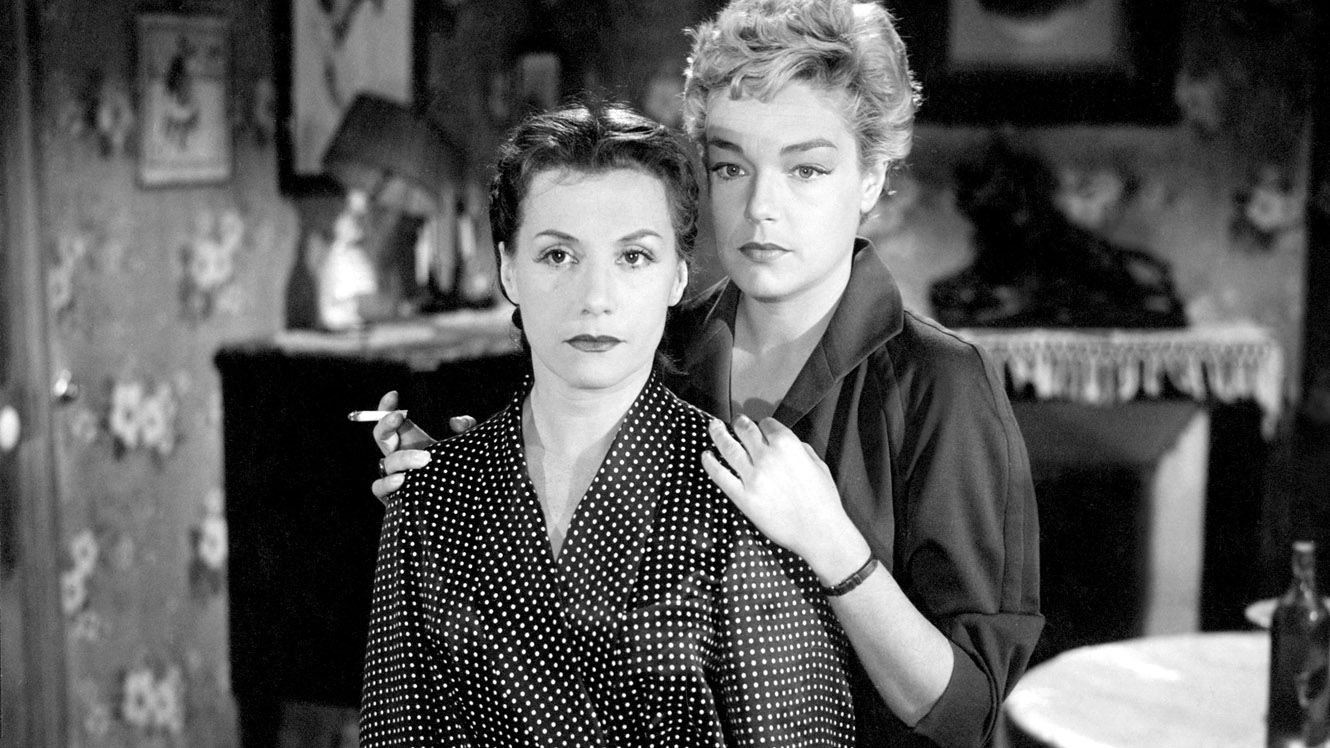
Véra Clouzot and Simeone Signoret plot murder in twisty thriller Les Diaboliques

Director: Henri-Georges Clouzot

Cast: Simeone Signoret (Nicole Horner), Véra Clouzot (Christina Delassalle), Paul Meurisse (Michel Delassalle), Charles Vanel (Alfred Fichet), Jean Brochard (Plantivaeu), Pierre Larquery (Drain), Michel Serrault (Raymond)

Clouzot is one of those fine directors, less prominent today in the list of the great artists of cinema. This might be because, unlike some of his contemporaries, many of his films were unashamed thrillers, Hitchcockian suspense tales, rather than the serious, artistic films we associate with French cinema. Les Diaboliques is the most popular of these films, a part mystery, part horror drama which slowly builds a confusingly terrifying picture of murder, danger and betrayal.

Christina (Véra Clouzot) is the wife of Paul (Michel Delassalle), a sadistic, bullying nightmare of a man. Together they run a boarding school, set up by her inheritance, but their marriage is a disaster. Paul is openly conducting an affair with fellow teacher Nicole (Simone Signoret). Nicole, however, is as disgusted and contemptuous of Paul as Christina – and she eventually persuades her that they should consider ridding themselves of Paul, with a temptingly simple scheme. However, things swiftly go against their plans…

Les Diaboliques is a compelling psychological thriller cum horror story, a creepy slow-burn of suggestion and paranoia that unfolds a bizarre whodunit mystery, which unnerves and constantly leaves you guessing. The story unfolds at a measured, inexorable pace. Clouzot’s camera is a quiet and carefully placed observer, taking in the events that occur in this hellishly cruel school with a calm directness, a cool minimalism that lets them speak for themselves.

And it’s a pretty hellish school. Paul is a brutal tyrant and bully, the teachers and students alternating between fear and loathing for him. He treats his fragile wife (struggling with a heart condition that could end her life at any moment) with a casual disregard and cruelty. Poor Christina is so put-upon and crushed, she seems wearily accepting of her husband’s constant affairs intermixed with cruelty. Even his mistress (an imperiously cold, harshly determined Simeone Signoret) can’t stand him. The whole school seems to have felt the effect of Paul’s personality – its run down, crushed, disheartened. The other teachers are either disinterested, faintly criminal or both. Is it any wonder wife and mistress want to murder him?

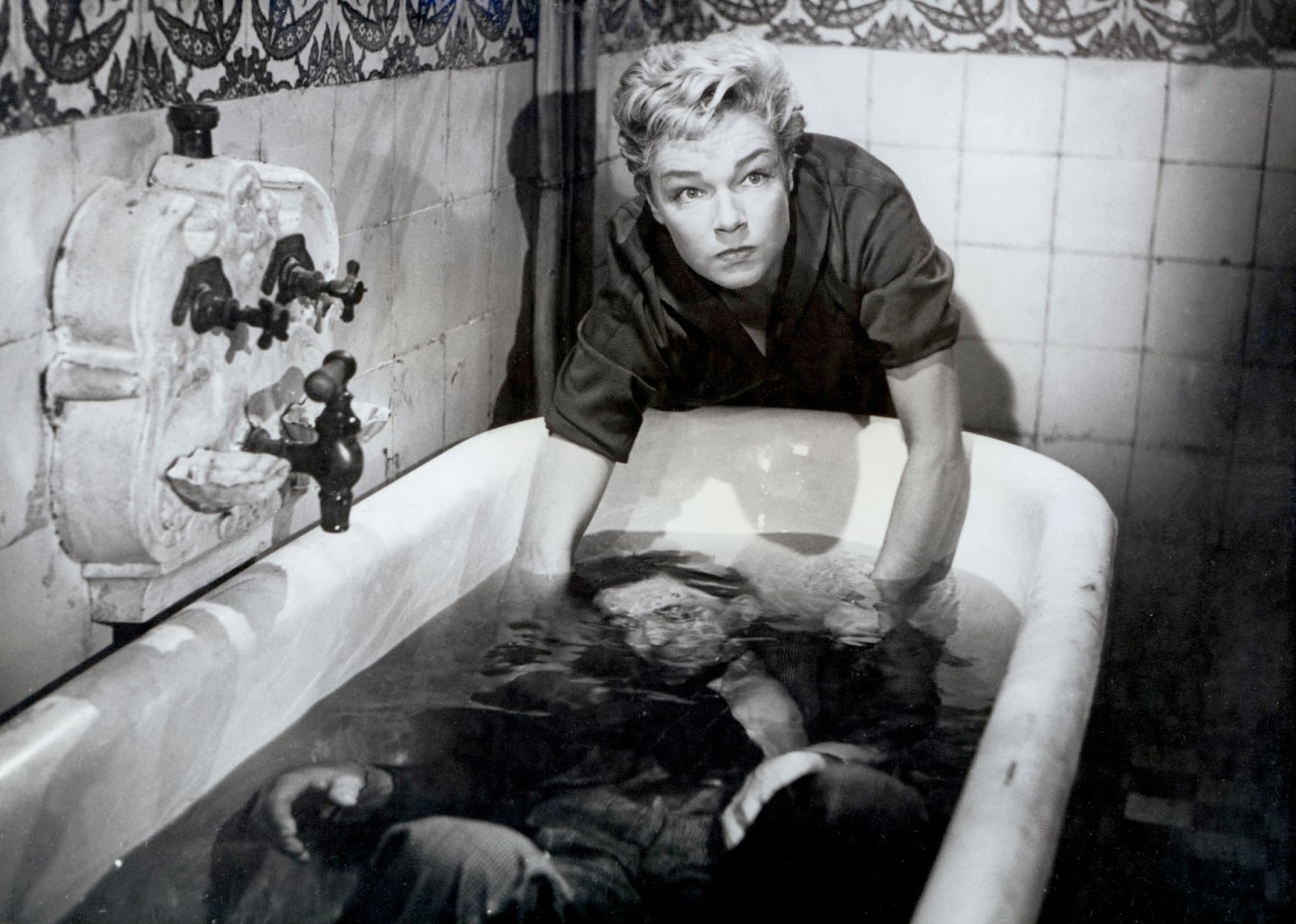
The murder, when it comes (and it’s the best part of half way through the movie) is almost blandly low-key. Clouzot even partly intercuts it with next-door neighbours complaining about the hot water being run late at night, the sound disturbing their radio quiz – unaware that it’s filling the bath so the two women can drown a drugged Paul. The flat where the crime occurs is as low-key and shabby as most of the rest of the film’s locations. 

Fascinatingly, what emerges increasingly are the lesbian undertones to the relationship between Nicole and Christina. Their intimacy is a major part of the build-up to the murder – their conspiratorial closeness seems as much as a careful seduction of Christina by Nicole as it is two like-minded souls coming together (this feeling, by the way, really comes into play as the film reach its conclusion). As events spiral out of control, Nicole becomes more and more of a protective, husbandly figure over the fragile Christina (an intriguing performance of vulnerability from Clouzot’s wife Véra), their physical and emotional closeness making them feel more and more like lovers dispatching a husband, rather than allies of convenience. It’s an intriguing subtext to the film, that I feel will make it of more and more interest as time goes on.

Events certainly do spiral out of control, as the body carefully placed in the swimming pool by the murderers (hoping to give the impression that Paul has accidentally drowned) is never discovered. Is it in the pool at all? Is Paul dead? Or has someone taken the body? A string of increasingly unnerving deliveries and visitations occurs – is Paul somehow speaking from the dead? Or are forces unknown manipulating the killers to disaster? Clouzot lets these events slowly build, avoiding the temptation to sprinkle clues or – more importantly – to give the audience more clues than the characters. We are only ever shown what Christine and Nicole see and only get the information they get.

This is where the film introduces its fourth primary character, retired detective Alfred Fichet. Fichet’s ambling, scruffy, seeming absent-mindedness makes him an eerily accurate forerunner of Colombo (at one point he all but says “just one more thing”). He rolls from place to place, clearly much sharper than he appears – it’s an impressively charismatic performance from Charles Vanel. He manages to work out what has happened (or perhaps what is happening) before the end – but moves too slowly in order to prevent disaster. But he changes the dynamic of the film in an intriguing way – shaking the film up 2/3rds of the way in, a tribute to the invention of its writing.

The final reveal of the plot is tinged with a horrifying terror – shot with an intense, watery fear that is guaranteed to haunt the memory. To say more is to reveal too much of an excellent act four twist. But it’s a sequence that you will find hard to shake from your mind – and one that you later realise the whole film was building towards. It’s what has led many people to call this film partly a horror story.

Clouzot’s film is a fine twisty thriller, even if at times it feels a little too in love with the mechanics of its tricks and plot mechanisms than it is with emotion and character. But it creates some intriguing and effective characters (including some small cameos) and it feels like a film that genuinely teaches us about the casual cruelty and selfishness that drives so many of our actions. There are many, many lies told in the film – even the children at the school casually lie – this is not a film that has a high opinion of the human race. 

Les Diaboliques has been called the greatest Hitchcock film Hitch never made. Hitch might well have brought a bit more flash and punch in its style (Clouzot is not the most inventive user of the camera here, with most shots very safe). But I’m not sure he could have improved its sense of creeping inevitability and grim claustrophobia. It still packs an inventive, clever and intriguing punch even today.