
War’s horror is really palpable in this French WW1 classic, made by people who were there
Director: Raymond Benard
Cast: Pierre Blanchar (Gilbert Demachy), Charles Vanel (Corporal Bréval), Gabriel Gabrio (Suplhart), Raymond Aimos (Fouillard), Antonin Artaud (Vieublé), René Bergeron (Hamel), Raymond Cordy (Vairon), Marcel Delâite (Sergeant Berthier)
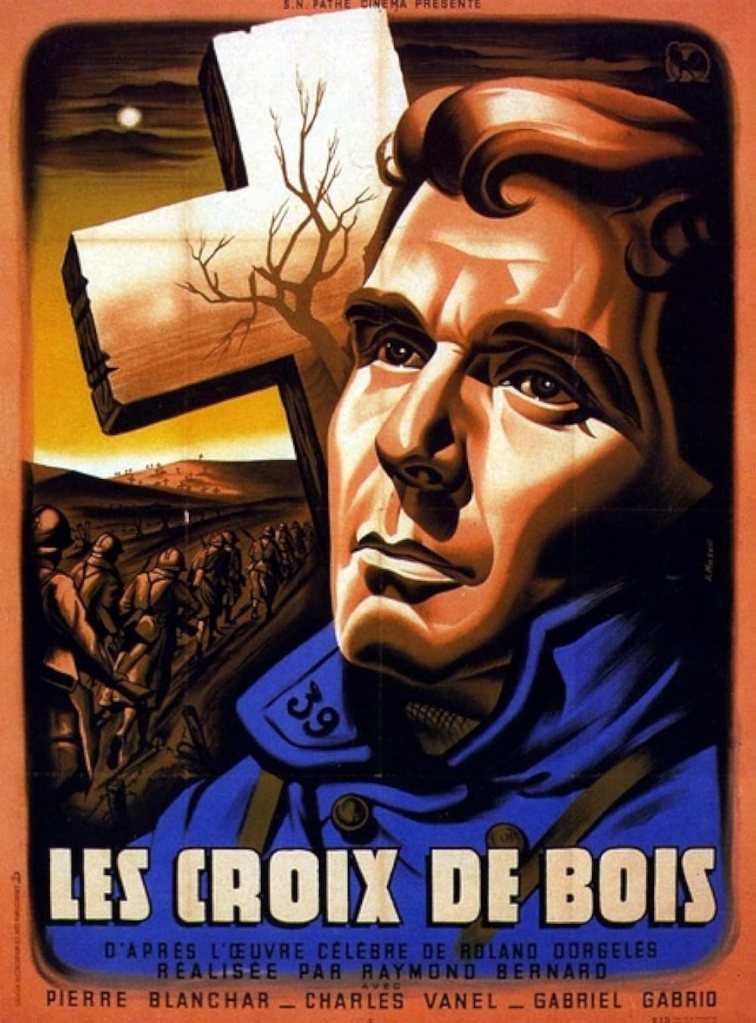
If you have any doubts about the deep scars World War One left on Europe, you can brush them off with a viewing of Wooden Crosses. Adapted from a gruelling novel by Roland Dorgelès, a former corporal in the 39th Infantry Division, Wooden Crosses is really a version of Dorgelès own hideous experiences in the trenches. Although it was largely overlooked outside France – like Westfront 1918 it lives in the shadow of All Quiet on the Western Front – it had a huge impact on France, being screened for veterans and for the President himself, many of them reduced to tears.
It tells of the never-ending slaughter inflicted on the 39th Infantry Division, partially through the eyes of a young law student Gilbert Demachy (Pierre Blanchar) who arrives determined to do his duty, even while under few optimistic ideals about the war. Introduced to the rest of his platoon by the gruff but fatherly Corporal Bréval (Charles Vanel) and cynical joker Sulphart (Gabriel Gabrio), Demarchy does his duty in several campaigns (with only brief respites from the front) while the soldiers around him die frequently and suddenly for a few more feet of mud.
Benard recruited actors and crew who had experienced the trenches, and Wooden Crosses is all about recreating the pitiless grimness of the front lines. The world the film creates is immaculately done in its grim squalor: the trenches are carefully reconstructed, a shelled-out church (“Our Lady of the Squaddies” as the troops call is) is perfectly sub-divided into a hospital (echoes of Pabst’s Westfront) for the wounded and dying and always the mud and desperation is palpable. The chances of heroism are few and far between, and the soldiers main goal seems to be to knuckle down and try to survive – even when the odds are impossible.
But, taking advantage of new film technology, it’s the sound of war that fills Wooden Crosses. The constant barrage of shells was carefully researched – after all each type of shell had a different sound – and long stretches of Wooden Crosses seem to be filled with nothing but the relentless pounding of the ears from mortar and shell fire. The horrific volume of war is captured here like few other films, which means the sudden bursts of near-silence carry real impact. For its in the silence we hear other sounds, the constant post-battle desperate pleas of the dying and wounded carried on the breeze. At one point Gilbert literally places his hands over his ears to drown out an incessant begging from a wounded comrade caught in No Man’s Land.
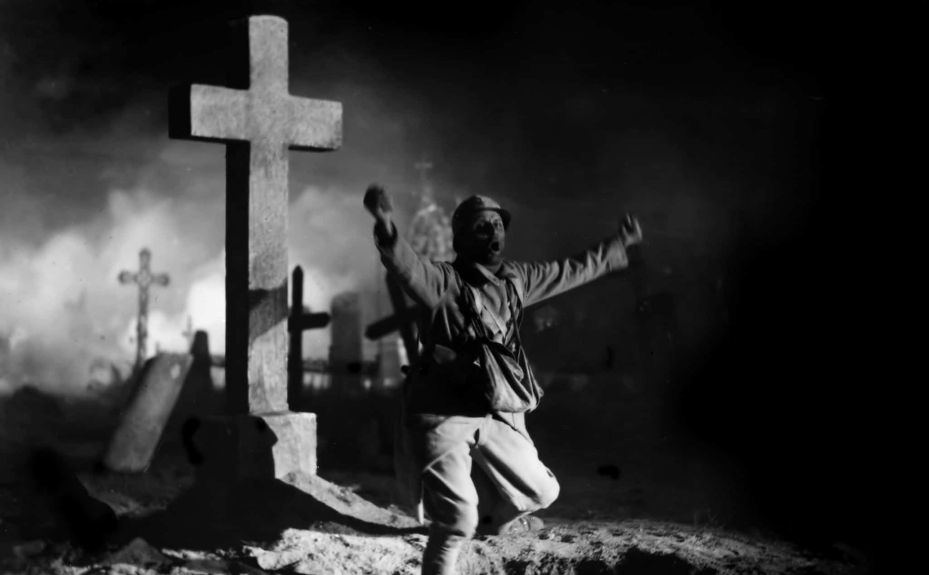
Its these moments that hammer home the soldier’s powerlessness. These people can’t be helped – that man making those sounds Gilbert has already had two attempts to rescue him, that just led to the death of the rescuers. Rescue is probably futile anyway. During a battle in a cemetery Gilbert risks his life to save another man, who promptly dies anyway – with all his pain, regret, anger and fear spewing out of him in front of his fellow soldiers. Powerlessness isn’t just listening to suffering: the platoon is forced to sit in their trenches listening to German miners digging beneath them, knowing the moment that digging sound stops their trench will be detonated – and that they can’t leave their post until their (disbelieving) officers give them permission.
No wonder they are hardened to battle. When a man dies in a foxhole, the others lift his body up to use him as a parapet. When an error in French artillery ranging means they end up firing on their own patrol, it’s met with irritation but muted acceptance that it’s just the way it is. There is a closeness among the soldiers, but it has that underlying current of knowing any of them could be gone forever at any time. When one of their late number receives a letter after his demise, the rest look away from the mailman with awkwardness, until Gilbert takes the letter to tear it up above the man’s grave.
Bernard visually contrasts this with some well-handled symbolism. He opens the film with rows and rows of soldiers, who transform in a single cut to rows and rows of crosses. The crosses become recurrent images. That battle in a cemetery is littered with them, hanging over or casting shadow over the characters, nearly all of whom are of course doomed. Bernard acknowledges the false excitement of the early mobilisation, with a montage of crowds rushing to volunteer to fight the good fight – but fades from this to a single image of an older woman staring out sadly from the camera, standing in for a whole generation of mothers about to lose their sons.
He ends the film – with our nearly last survivor piteously shedding his stoicism to die alone and afraid in No Man’s Land with a bullet in his belly – with a super-imposed montage of both stocks and shares and then wreaths tumbling past the screen (clear what he believes the motives and cost of war really was), before a final montage of soldiers carrying their crosses, Christ-like, through No Man’s Land. This meat grinder war, fought for profit, has left millions dead and for what? It’s hard to know or understand. And for all the soldiers never lose their determination to do their duty, never once do we get a sense of any patriotic idealism in them. No sense that anyone feels they are on a crusade, just a grim, unpleasant duty they need to get out of the way.
Wooden Crosses has a host of strong performances, each of them passionately committed. Pierre Blanchar is admirably reserved as Gilbert, his humanity tightly controlled below the surface. Charles Vanel is excellent as the gruff Sergeant, worried about his wife’s fidelity back home. Gabriel Gabrio makes his platoon cynic a man with a strong streak of decency. They are marshalled superbly by Bernard in a film full of power and despair at the horror men do.

