Tag: Cuba Gooding Jnr

As Good As It Gets (1997)

As Good As It Gets (1997)

Sparks fly in this straight-forward sitcom set up from James L. Brooks

Director: James L Brooks

Cast: Jack Nicholson (Melvin Udall), Helen Hunt (Carol Connelly), Greg Kinnear (Simon Bishop), Cuba Gooding Jnr (Frank Sachs), Skeet Ulrich (Vincent Lopiano), Shirley Knight (Beverly Connelly), Jesse James (Spencer Connelly), Yeardley Smith (Jackie Simpson), Harold Ramis (Dr Martin Bettes)
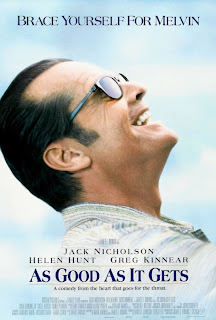
Melvin Udall (Jack Nicholson) is the rude, misanthropic writer of Mills and Boon style novels who suffers from an OCD that sees him keep to a strict series of routines. One of the most important is always having breakfast at the same table of the same restaurant, where the only waitress who will serve him is Carol Connelly (Helen Hunt). Carol is caring for her young son Spencer, who suffers from chronic asthma. All starts to change when the homophobic Melvin is persuaded to look after the dog of his neighbour, gay artist Simon Bishop (Greg Kinnear), after he is assaulted during a robbery. Melvin finds himself getting closer to the dog – and before he knows it, starts to reluctantly build a friendship with Simon and a romantic relationship with Carol.

If you thought that sounds rather like the set-up for a sitcom… you’d basically be right. James L Brooks demonstrates his TV roots again with what could almost be an extended pilot for a TV series, shot with his characteristic functionality. While its an attempt to show how different people can struggle to overcome barriers to connect with each other – be those psychological, social or health – it squeezes this into a trope-filled plot set-up, that swims in sentimentality and gives opportunities for actors to enjoy scenery-chewing, attention-grabbing parts.

None more so than Jack Nicholson, winning his third Oscar as Melvin. To be honest, what Nicholson does he is essentially portray a less complex version of Victor Meldrew from One Foot in the Grave. Melvin is a man who doesn’t suffer fools gladly, and delights in using his wealth to excuse him from saying a host of unacceptable things about everyone he meets (not a single gender, sexuality or race escapes his quick-witted bile).

Of course, the audiences know that it’s alright because it’s Jack, and while he might be a rogue he’s basically got his heart in the right place. Discovering that is basically the purpose of the film: of course, all that rudeness and cruelty is a front to protect an insecure man from the dangers of emotional commitment. Not to mention that the first thing to melt his shell is that most familiar (and sweet) of Hollywood props, a dog. Brooks does manage to demonstrate that Jack’s acts of kindness are at first partly about making life easy for himself – securing an expensive doctor for Carol’s son is about ensuring she doesn’t leave his restaurant and agrees to keep talking to him – but the film is determined to show everyone is basically “decent” and “kind” even if they don’t know it.

Inevitably, the best way of doing this is for that familiar old development, the road trip: for contrived reasons connected to Simon needing to ask his parents in Baltimore for help with medical bills, Melvin, Carol and Simon climb into a car for a cross-country drive. Needless to say, the predictable clashes, confessions, break-ups and reconciliations take place. It being a Brooks movie, this all takes place over an extended two and a half hour run time (indulgent for such a traditional set-up).

What makes it work is that the acting of the three principles is fiercely committed. Oscar-winning Nicholson eats up the cutting dialogue but also manages to mine a lot of “little boy lost” vulnerability from Melvin, a man who throws up barriers of rudeness, aggression and misanthropy to protect himself from getting hurt. Helen Hunt (who won another Oscar) hones years of experience in delivering fast-paced, witty dialogue from Mad About You, also shows real depth making Carol a similarly guarded person, using sass and cynicism as a shield against a world she expects to bite her. Greg Kinnear is a fragile artist, hiding behind his art, tortured by denial about his problems and desperate for an emotional connection.

That theme of the defensive barriers – and crippling effects of our own mental hang-ups – is the deeper message that Brooks manages to bring to the film. Melvin might seem, on the surface, the most obviously maladjusted but at least he’s vaguely happy in his skin at the start of the film. The other characters wear smiles of contentment, but only to hide deep stress and turmoil. It’s Brooks’ TV roots that turns all this into a series of “learning” lessons, where every scene in the final act is accompanied by someone making a profound choice, making a new start or letting something go.

As Good As It Gets is about making the best of things. And Brooks makes a pretty good fist of making this a decent (overlong) romantic comedy with a touch of depth. But its still mired in predictable tropes. Melvin’s OCD expresses itself in the most amusing filmic way possible, essentially as a form of charming eccentricity rather than the crippling disease it can actually be (it ticks all the predictable boxes, from light-switches, to compulsive hand cleaning to not stepping on cracks in the pavement). The film also, rather worryingly, suggests OCD can be overcome just like any other personality problem, simply by opening your heart and learning those lessons.

It’s fine, but you can watch it now and wonder how a film that’s essentially an over-extended dramedy TV-show pilot ended up scooping so many prizes. Entertaining, with some interesting perspectives, with committed acting, but very little that’s new and a lot that’s rather tired.
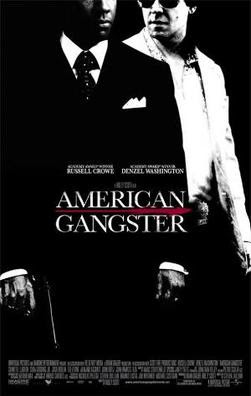
American Gangster (2007)

Denzel Washington leads his brothers in a life of crime in American Gangster

Director: Ridley Scott

Cast: Denzel Washington (Frank Lucas), Russell Crowe (Richie Roberts), Chiwetel Ejiofor (Huey Lucas), Josh Brolin (Detective Trupo), Lymari Nadal (Eva), Ted Levine (Captain Lou Toback), Robert Guenveur Smith (Nate), John Hawkes (Freddie Spearman), RZA (Moses Jones), Yul Vazquez (Alfonsa Abruzzo), Malcolm Goodwin (Jimmy Zee), Ruby Dee (Mama Lucas), Ruben Santiago-Hudson (Doc), Carla Gugino (Laura Roberts), John Ortiz (Javier J Rivera), Cuba Gooding Jnr (Nicky Barnes), Armand Assante (Dominic Cattaneo), Joe Morton (Charlie Williams), Idris Elba (Tango), Common (Turner Lucas), Jon Polito (Russo), Ric Young (Chinese General), Clarence Williams III (Bumpy Johnson)

In 1970s New York there was only one organisation that ran crime: the mafia. The idea that anyone else could get a look in was unthinkable: to the cops, the government and the criminals themselves. Frank Lucas (Denzel Washington) was the guy who was going to shake that up: a resident of Harlem and former right-hand man of crime boss “Bumpy” Johnson (Clarence Williams III), Lucas saw an opening to bring in cheap, high-quality drugs from Vietnam (hidden in the temporary coffins of deceased servicemen). With this product he could take over crime in New York – and run it as he thinks it should be run, with the mentality of a FTSE 500 company and a gun. Frank is helped by the fact no one knows who he is. But that is all about to change as honest cop Richie Roberts (Russell Crowe) sets up a task force dedicated to finding, and arresting, the drug kingpins in New York. He’s as surprised as anyone to find the trail leads to Harlem.

Based on a true story, Scott’s American Gangster is assembled with Scott’s usual professionalism and assured touch, using top actors in well-assembled, well-shot scenes. It’s glossy, entertaining and enjoyable. But it’s not quite inspired or stand-out. Despite everything, it doesn’t really show us anything new and lacks either the fire of inspiration or the sort of poetry and energy the likes of Spike Lee, Quentin Tarantino or Steve McQueen could have bought to it. It tells an interesting story, but manages to be pretty much by the numbers – albeit those numbers are flashed up with as much pizzazz, drama and entertainment as you could wish.

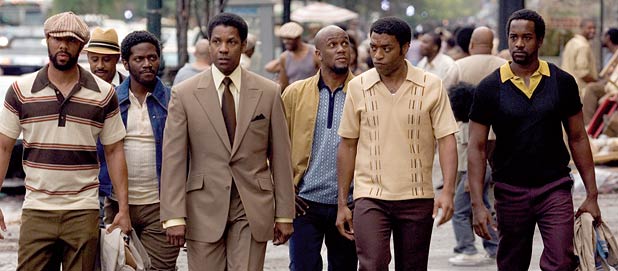
The most interesting themes are questions of class and racial politics. The film’s version of Frank Lucas is successful because he runs his crime empire not like a gang but like a company. He dresses plainly and simply, so as not to draw attention (unlike the flamboyant criminals played by Idris Elba and Cuba Gooding Jnr). He talks in terms of supply and demand, brand loyalty and being a chairman. In one particularly well managed scene, he pontificates to his brothers on his ideology of business, excuses himself to walk across the street and shoot a rival in the head, then returns to calmly finish his breakfast. It’s the ideas of Wall Street applied to gangster crime. Lucas is all about bringing a smooth, modern, professional thinking to crime – but with the gun still up his sleeve.

But another reason why Frank Lucas needs to be as professional as he is, is because he’s loathed by all other parts of the criminal system. It’s a system that is racist from top-to-bottom, where black men are unwelcome as anything other than foot-soldiers. The elite criminals – most of them tracing many generations back to Sicily – smile at Frank for his money, but never see him as an equal. Even the government can’t begin to imagine a black man could be running such a huge empire – Robert’s AG boss spews out a racist diatribe, rubbishing any idea that a black man could achieve something the Mafia has failed to do. Frank though is just as wary of the flashy ostentatiousness of most black criminals in New York, telling his brother that the quietest man in the room is the most powerful.

It’s those brothers who Frank relies on – only family can be trusted. They’ll also be his Achilles heel. Because even his most competent brother (played by a sharp Chiwetel Ejiofor) is as much a liability as he is a good lieutenant. His brothers are innocents turned by their brother into tools for his crime empire. Frank hands out beatings to cousins who are unreliable. He’s bitterly disappointed when his nephew chucks in a baseball career because crime looks more fun. As his mother – an impassioned performance from an Oscar-nominated Ruby Dee – tells him, the rest of the family looks to him and follows his lead. There is a clear tension between this family – whose benefactor is also its corrupter – but it doesn’t quite come into focus.

This is partly because the film is covering a lot, and partly because it finds itself falling a bit in love with Frank Lucas. Not surprising when the part is played by Denzel Washington at his most magnetic – if strangely not quite as energised as you might expect. Washington gives Frank a dignity and cool that the real Frank – by all accounts a much cruder, ruder, less able man – never had. The film doesn’t really want to explore the darker side of Frank. Instead it invites us to sympathise with him, as an outsider made good. To feel sorry for him when he makes a fatal error (wearing an ostentatious fur coat to the Ali/Frasier “Fight of the Century” – an act that blows his carefully preserved anonymity). The film doesn’t want us to feel the damage of the drugs Frank is pouring into New York, since it might damage our respect for his triumph against the odds.

The barriers that Frank has to overcome – from arrogant Mafia kingpins, to local crime lords and corrupt cops (Josh Brolin has fun as a prowling bullying detective) – are in the end more interesting than the procedural struggles of Russell Crowe’s Richie Roberts (on solid form). Roberts is also given a rather cliched (and fictional) custody battle that hardly justifies its screentime. The cops definitely get the short end of the stick – and a stronger film might have focused just on Frank Lucas and really explored the struggles of a black man in white crime world, dealing with racism and trying to apply Wall Street ideals to street violence.

American Gangster doesn’t quite succeed with its dark commentary on the American dream – but it’s as entertaining as you could hope and while it lacks in inspiration, it’s also hard to find too much fault with. One of Scott’s most solid works, with a charismatic Washington doing decent work.

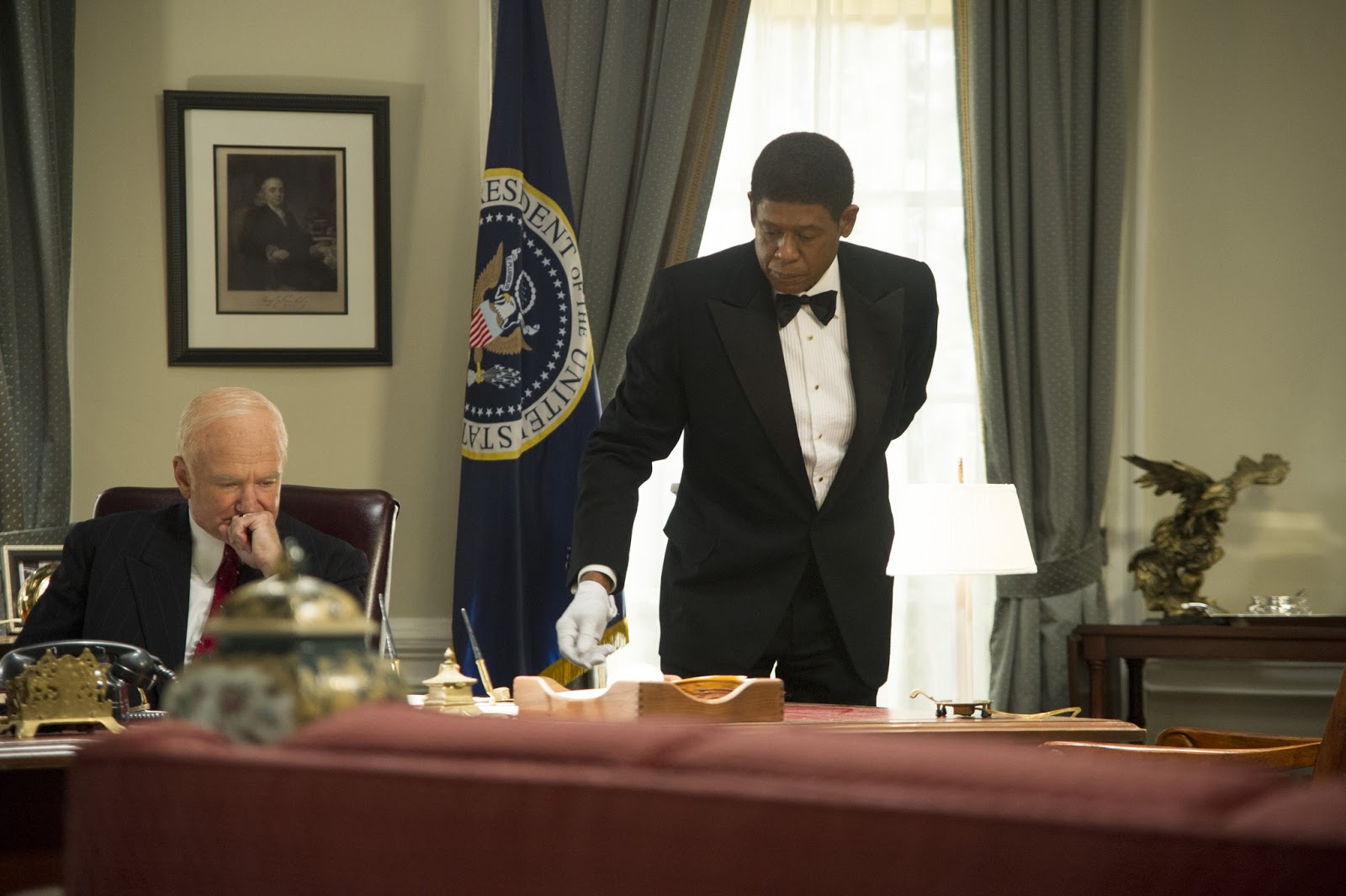
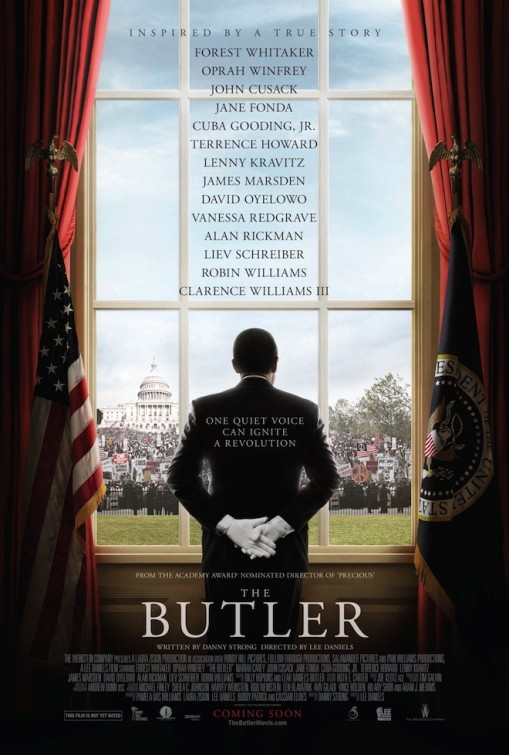
The Butler (2013)


Forest Whitaker takes on a lifetime of service, as the Civil Rights movement meets Downton Abbey

Director: Lee Daniels

Cast: Forest Whitaker (Cecil Gaines), Oprah Winfrey (Gloria Gaines), David Oyelowo (Louis Gaines), Cuba Gooding Jnr (Carter Wilson), Lenny Kravitz (James Holloway), Colman Domingo (Freddie Fallows), Yaya DeCosta (Carol Hammie), Terrence Howard (Howard), Adriane Lenox (Gina), Elijah Kelley (Charlie Gaines), Clarence Williams III (Maynard), John Cusack (Richard Nixon), Jane Fonda (Nancy Reagan), James Marsden (John F. Kennedy), Vanessa Redgrave (Annabeth Westfall), Alan Rickman (Ronald Reagan), Liev Schreiber (Lyndon B. Johnson), Robin Williams (Dwight D Eisenhower)

Cecil Gaines (Forest Whitaker) grows up on a plantation in the South; after his mother is raped and his father killed by the son of the house, the family matriarch (Vanessa Redgrave) takes him on as a house servant as a token gesture of regret. His training here sets him on the path to working in a succession of increasingly wealthy hotels and, finally, the White House. Over 30 years, he serves the Presidents in office, never involving himself or commenting on policy, proud of his service to his country. This often puts him in conflict with his Civil Rights activist son Louis (David Oyelowo), with his wife Gloria (Oprah Winfrey) stuck in the middle.

This is the sort of film that feels designed to win awards. It’s based on a vague true story (it changes nearly all the events of course) and it’s about a big subject. It’s got big name actors doing acting. It aims at big themes. What it actually is, is a film that misses its marks. It’s a film that spends time with big themes but has nothing to say about them, or in fact anything interesting to say full stop. It assumes that the historical context will do the work, and leaves it at that. Instead, it settles for trite sentimentality and cliché, personal stories played on a stage that makes those stories seem slight and inconsequential rather than giving them reflective depth.

The biggest problem about the film, leaving aside its heavy-handed sentimentality and mundane predictable storytelling, is that all the way through it feels like we are following the wrong story. It’s such a vibrant and exciting period of history, so full of events, passion and struggle: and instead we follow the story of Cecil, essentially a bland passive character who achieves very little and influences even less. There are vague references to leading “the regular life” and how working in domestic service is like some sort of subversive act to demonstrate the education and hard-working possibilities of the minority, but to be honest it never really convinces.

The film promises that Cecil was a man who had a profound impact on the people he served – but this doesn’t come across at all. Instead, the parade of star turns playing US Presidents are there it seems for little more than box office: we see them speaking about Civil Rights issues or planning policy, but we get very little sense of Cecil having any bond with them. The cameos instead become a rather distracting parade, as if the film was worried (perhaps rightly) that Cecil’s story was so slight and bland that they needed the historical all-stars to drum up any interest in it. It doesn’t help that the cameos are mixed – Rickman, Schreiber and Marsden do okay with cardboard cut-out expressions, but Cusack in particular seems horribly miscast. A braver film would have kept these pointless camoes in the background and focused the narrative on Cecil and his colleagues below stairs, and their struggles to gain equal payment with their white colleagues. This film is seduced by the famous events and names it spends the rest of the time backing away from.

The performance at the centre is also difficult to engage with. Forest Whitaker is such an extreme, grand guignol actor that it’s almost sad to see him squeeze himself into a dull jobsworth such as Cecil. Whitaker seems so determined to play it down that he mumbles inaudibly at great length (it’s genuinely really difficult to understand what he is saying half the time), slouching and buttoning himself into Cecil’s character. It doesn’t come across as a great piece of character creation, more a case of miscasting. Oprah Winfrey does well as his wife, although her character is utterly inconsistent: at times a drunk depressive, at others level-headed and calm. The link of either of these characters to the hardships of life as a Black American or their role in racial politics is murkily unclear.

The star turn of the film – and virtually all its interesting content – is from David Oyelowo, who ages convincingly through the film from idealist to activist to elder statesman. His story also intersects with the actual historical events that are taking place in America and he is an active participant – unlike Cecil the passive viewer, just as likely to switch the TV off as follow the news. Often I found myself wishing the film could follow his character rather than Whitaker’s.

That’s the problem with the film: what point is it trying to make? The film seems to want to honour Cecil’s service in the White house – but the film is a slow journey towards Cecil’s sudden revelation that maybe his son’s campaigning for Civil Rights was the right thing to do. This flies in the face of the film’s tribute to Cecil’s decades of quiet, unjudging service: the film can’t make up its mind whether it wants to salute Cecil for being an unjudging, dedicated servant to a long line of Presidents, or for having the courage to take a political stance towards the end. It’s having its cake and eating it. It’s this shallow lack of stance that finally makes it an empty and rather dull viewing experience.