
Tag: Daryl McCormack

Twisters (2024)

Twisters (2024)

It won’t blow away, but theres something reassuringly old-fashioned about Twisters

Director: Lee Isaac Chung

Cast: Daisy Edgar-Jones (Kate Carter), Glen Powell (Tyler Owens), Anthony Ramos (Javi), Brandon Perea (Boone), Maura Tierney (Cathy Carter), Harry Hadden-Paton (Ben), Sasha Lane (Lily), Daryl McCormack (Jeb), Kiernan Shipka (Addy), Nik Dodani (Praveen), David Corenswet (Scott)
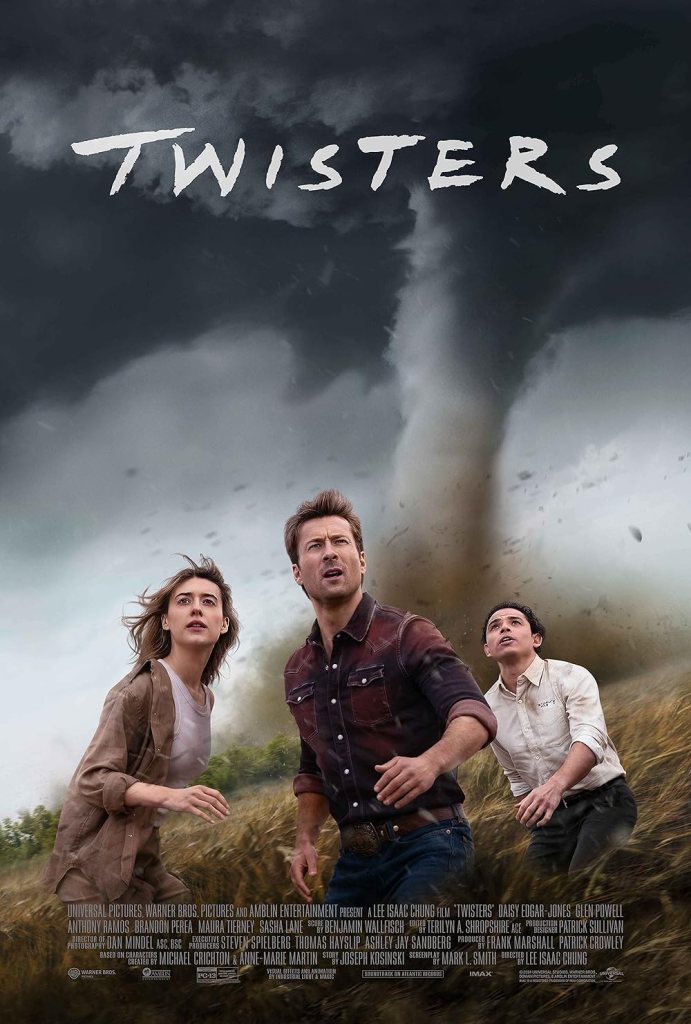
Twisters is perhaps one of the oddest pieces of IP rebooting (as we call it these days) in years: a sideways sequel to a 1996 box-office hit that virtually no one has thought about once since it was in the cinema thirty years ago. Twisters hardly brings in a new breath of air for 2024 compared to what worked at the box-office in 1996: in fact in many ways it’s as predictable as that film was. But yet it gets away with it, because there is an old-fashioned simplicity about it, a pure ‘just wanna entertain you’ vibe throughout, combined with the fact it creates a small group of likeable characters we care about, played by winning performers. Rather like Top Gun: Maverick it takes the ideas that people liked from the first film but delivers them far more effectively with much more charm.

Meteorologist and instinctive twister spotter Kate Carter (Daisy Edgar-Jones) is one of the few survivors of a failed scientific experiment to use a compound foam to reduce the power of tornados, with the deceased including her boyfriend Jeb (Daryl McCormack). Five years later she is called back into the field by her old colleague Javi (Anthony Ramos) who needs her help to test his new tornado radar-scanning technology company. In Oklahoma with Javi’s team, Kate faces her fears, finds that the impact of the storms is leaving a heavy burden on the community and falls into a flirtation with rock-and-roll meteorologist and YouTuber Tyler Owens (Glen Powell) whose cowboy exterior hides his heart of gold.

All this blows itself up into highly entertaining stuff, told with an old-fashioned sense of fun by Lee Isaac Chung. It’s actually a relief to find a modern blockbuster just focused on an entertaining, character-led piece of popcorn fun, rather than blowing pop-culture references, set-ups for future films and homages to hits from yesteryear, straight into your eyes. Twisters never reinvents any wheels at all, but it’s several degrees better than the forgotten film its riffing on and you’ll end up being surprisingly invested in it.

A big part of that is the charming and hugely likeable performances from its two leads. Edgar-Jones is very good at this sort of tough-edged exterior hiding inner-vulnerabilities (the team on Twisters must clearly have binged through Normal People during lockdown like the rest of us). Powell – who is having a moment and then-some – is also an absolute pro at cocksure types like this with unexpected layers. There is a sort of It Happened One Night opposites-attract screwball comedy between these two, who take each other at first for a naïve city-girl and a brainless cowboy only to find (would you believe it!) that first impressions are not always the right impressions.

However, this sort of rom-com, relationship-led stuff is exactly what makes Twisters entertaining and makes you care for it. After all, as Twister showed us, once you’ve seen wind related special effects pile on, you’ve kind of seen them all, it’s just a question of degree. Twisters front-and-centres not so much the gusty action, but the characters at the heart of it. Impressive as Chung’s staging of the blowing away of cars and the ripping up of buildings is, it works because we care about the people at cowering beneath the gale.

That’s because Twisters is told with an old-fashioned heart. There is nothing in it that really surprises you: Daryl McCormack’s prologue boyfriend has ‘doomed’ written all over him the moment he speaks and the only thing that you’ll really puzzle over is how long the post-prologue time-jump will be. Although it’s character and plot developments are well handled and endearingly delivered, there are all unsurprising. Would you believe Kate and Tyler find they have much in common? That Tyler’s blow-hard cowboy storm-chasers turn out to all have Hearts of Gold? That Javi’s loaded, Stetson-wearing tycoon sponsor is a ruthless modern-day Crassus, using the weather forecasts to snap up devastated land for tuppence? It’s just like we can be pretty certain that the twister-diluting experiment that Kate is working on in the film’s opening will come storming back in Act Five.

You could pretty much scribble down all possible plot developments over the course of the film after watching the first twenty minutes, but somehow it doesn’t really matter. Even though everything in this is completely and utterly safe and straight-forward, it’s told with such professionalism and such a sense of fun, it hardly matters. Everything in Twisters is focused on just entertaining you and not forcing you to worry or get stressed about things. Perhaps that’s why the film shies away from the questions asked around why the storms are getting worse (let’s not bring something really depressing like climate change into a breezy opposites-attract thrill ride). To balance that it does more-or-less avoid the storms making moral judgements on who gets killed off in its blustery assaults, unlike so many other disaster movies.

Twisters offers nothing really original or unique, but everything in it seems to come from the heart, like Chung wanted to make the sort of unfussy, well-meaning entertainment vehicles he watched in his youth, when it was all about sitting back, munching popcorn and leaving with a grin on your face that a film just entertained you. And at a time when the cinema seems to be full of easter-egg stuffed, self-satisfied, franchise-building bait there is an awful lot to be said for that.
The Lesson (2023)

The Lesson (2023)

Sinister family mystery, full of good moments that don’t come together into something that really works

Director: Alice Troughton

Cast: Daryl McCormack (Liam Sommers), Richard E. Grant (JM Sinclair), Julie Delpy (Hélène Sinclair), Stephen McMillan (Bertie Sinclair), Crispin Letts (Ellis)

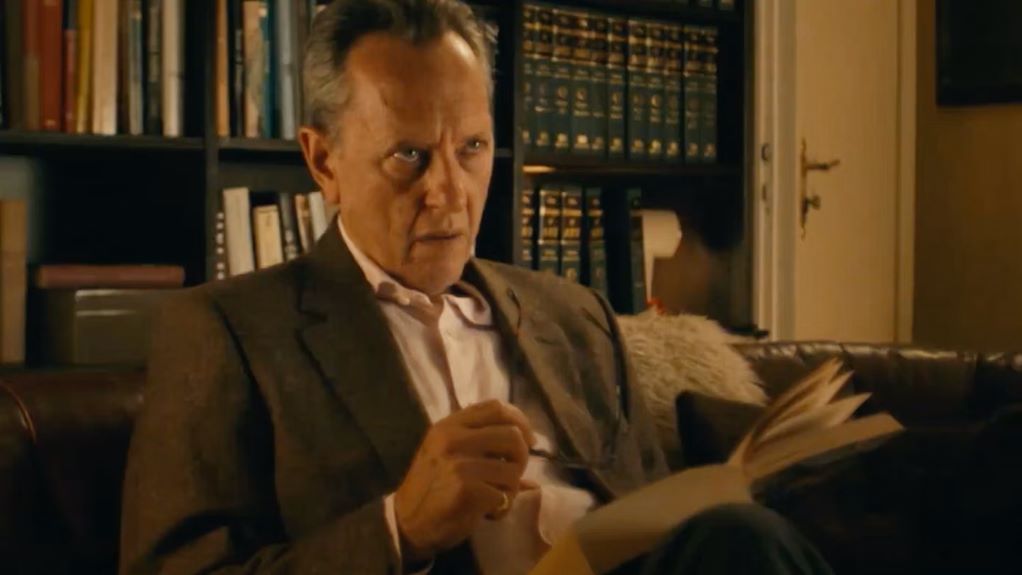
Liam Sommers (Daryl McCormack) strides onstage for an interview about his literary debut, that has set the world alight. How did he get the inspiration to write about a domineering patriarch in a rich country house? Flashback to Liam’s summer spent as an English tutor to Bertie (Stephen McMillan), who is trying to get into Oxford to impress his domineering father JM Sinclair (Richard E Grant), Britain’s leading literary novelist. The Sinclair household bubbles with suppressed grief over the accidental drowning of JM and Hélène’s (Julie Delpy) older son Archie in their private lake. As Sinclair puts the finishing touches to his new novel – and ropes in Liam to help him as “final lap amanuensis”, what secrets will Liam uncover about this family?

The Lesson revolves heavily around its oft-repeated pithy mantra from JM Sinclair – “Great writers steal”. So often is this repeated, that it drains much of what little surprise there might be about the true origins of JM Sinclair’s latest tome. It’s a fitting mantra from the film that feels like a mood piece, assembled from little touches of other filmmakers (Kubrick for starters), reassembled into something just a little too pleased with its reveals and secrets-within-secrets structure, but is well enough made that you are willing to cut it some slack.

Effectively all filmed in a single location, the Sinclair’s luscious house (a mix of the modern and the classical) set amongst rich private grounds, it’s well directed by Alice Troughton, who makes effective use of angles and transitions (particularly its cuts back and forth between the working practices of Sinclair and would-be novelist Liam, which subtly stress both their similarities and differences) to enhance mood and an air of unknowable menace. The camera drifts with a chilling intimacy across the fateful lake, giving it a sense of ominous power and mystery.

The film is at its strongest in its opening sections (like Sinclair’s novel, it is divided into three parts with short prologues and epilogues). Within a self-contained theatrical space, tensions and resentments between the family are carefully but not pointedly outlined. The father who switches between indifference, annoyance and gregarious enthusiasm. The mother who feels like both a dutiful supporter and a resentful slave. The prickly, difficult son scared of affection, who attempts (unsuccessfully) to ape his father’s authoritarianism, but is crying out to be hugged. Troughton skilfully cuts between these characters, frequently positioning them at opposing sides of the frame, setting them at visual odds with each other.

In the middle of this, Liam becomes an out-of-place, equally unreadable presence. Very well played by Daryl McCormack, full bluntness mixed with inscrutability, Liam is impossible to categorise and totally outside the upper-class formality of the Sinclair home (with its servants, home fine-dining accompanied with classical music and casually displayed artwork). He’s Irish, working-class, Black and sexually ambiguous. But he’s also hard for us to read: is his admiration for Sinclair something that could tip into resentful violence? Does he really like Bertie, or does he see him as a tedious, brattish child? As the prologue sets up, is he an innocent or a destructive, vampiric presence?

These beats are neatly set up in The Lesson’s opening parts, added to by the presence of a Pinteresque butler (a fiercely polite Crispin Letts) whose status and loyalties prove equally hard to read. Liam’s slowly becomes an intimate figure in the house, moving from a servant occasionally allowed to dine with the family, to Sinclair’s IT consultant, proof-reader and one-sided sounding-board for conversations about his novel, becoming an object of sexual fascination for Bertie and Hélène and given the late Archie’s clothes to wear (adding an Oedipal frisson to his flirtation with Hélène).

Ambiguity however slowly gives way as The Lesson continues, as it fails to weave its initial jarring mood into a reveal that feels truly satisfying, logical or surprising. This effect is magnified by the fact the more time we spend with Sinclair, the more it’s made clear he is less complex than we think, but simply an egotistical monster. Richard E Grant has huge fun with this larger-than-life braggart, a man so competitive that he feels compelled to aggressively slap down Liam’s draft novel as “airport trash” and smilingly telling him he has “done him a favour” by encouraging him not to write. But Sinclair’s monstrous, bullying self-importance sign-posts a little too clearly where the plot is heading.

The final reveal that we have been witnessing a secret plot unfold in front of us feels like a flawed attempt to add a narrative coherence to a series of events that would be impossible to pre-plan. This also relies on chance events and skills (events hinge on Liam’s near-photographic memory). The final ‘answer’ is also too clearly sign-posted from the opening, leaving you expecting a rug-pull that never comes.

The Lesson has a good sense of atmosphere in its opening half and some strong performances – Julie Delpy is very effectively unreadable as the enigmatic Hélène – but for all its sharp direction, its plot is too weak to be truly rewarding on a first viewing or give you a reason to want to return for a second lesson. Despite some good scenes, a bravura Grant and a subtle McCormack, the resolution of its quiet atmosphere of tension and inscrutability doesn’t quite ring true.

Good Luck to You, Leo Grande (2022)

Good Luck to You, Leo Grande (2022)

Questions of intimacy and sex are explored but not in depth in this theatrical two-hander

Director: Sophie Hyde

Cast: Emma Thompson (Nancy), Daryl McCormack (Leo Grande)

A widowed, retired former RE teacher “Nancy” (Emma Thompson), hires a high-class escort “Leo Grande” (Daryl McCormack) to explore the opportunities in life she feels she has missed: namely, any sexual experience that doesn’t involve functional, passion-free couplings with her deceased husband; the positions and acts she’s heard about that he considered “demeaning” to all involved; and, above all, something called an orgasm. Over multiple meetings, the fragile Nancy and the smooth, charming, but personally guarded Leo tentatively explore physical and emotional barriers.

Hyde’s film could very easily be a theatre piece. Largely taking place in a single location – the hotel room Nancy has hired for their meetings – across four “acts”, it’s a film that relies heavily on the skill and chemistry between the two actors. On that front, it’s very blessed to have such skilled performers who play off each other with such generous and dynamic performances.

They’re helped by a witty script from Katy Brand, crammed with good lines. Nancy is a fusspot, sheltered and deeply self-conscious, who approaches everything from a teacherly angle, including drawing up a sexual “checklist” for their session (“attainable goals” as she puts it). Her middle-class, middle-age hesitancy around sex as something to feel ashamed about casts its mark over everything she says and does (“I don’t like anything going in places where things are meant to come out”) and she can’t shake her own shame and fears that she is exploiting someone (she worries she feels like “Rolf Harris” – a reference that hilariously flies over the head of Leo).

It’s a gift of a role for Emma Thompson, who delights in the witty (if theatrical) dialogue, but also sells speeches full of personal discontentment, bitterness and profound regret. Her early nerves – with a little pinch of guilt – at hiring this sex worker, slowly tip into an outpouring of painful regrets. Nancy is a woman who has lived her life by strict rules – rules that have left her deeply unhappy and desperate for a meaningful intimate relationship with someone to confide in.

Thompson, in a way that I’m not entirely sure the film does, also understands that Nancy is not as nice a person as she might believe she is. Her sadness is often counterpointed with bitterness, rudeness and a tendency to judgementalism. It’s a defensive shield for her deep unhappiness within – but it also perhaps suggests why she is as lonely as she is. This is Thompson at the top of her game, effortlessly funny, heart-rending and frustrating almost from moment to moment.

Her unease, and near-Catholic guilt at sexual intimacy and satisfaction, contrasts neatly with the smoothly professional Leo. It can’t be easy for a young actor to go toe-to-toe with a heavyweight, but McCormack plays Leo with a huge subtlety. Eager to put Nancy at her ease in their first meeting, we see him carefully but skilfully move between several different, possible, personas in search of something she will like. Flashes of personal intimacy and friendship he gives her always leave you guessing how much is real, and how much settling on a persona for his client. Brief moments of thoughtfulness show Leo reflecting on his own past – issues that will come to the surface in later sessions. McCormack skilfully walks the tightrope of playing a man with an invented personality, who adjusts his persona from moment to moment to best please someone else.

The main delights of Good Luck to You, Leo Grande are in the (sometimes funny, sometimes sad, sometimes excruciatingly embarrassing) exchanges between these two, as Nancy constantly puts off what she paid for, partly due to not knowing if she wants it and partly being ashamed to ask for it. At its strongest moments the film uses this to explore our own societal feelings about the entwining between sex, shame and guilt.

After all, sex is something we all have very clear ideas about. And, just like we do with our bodies, often end up judging ourselves harshly against some imagined standard. The film gently argues that perhaps a world of high-class, shame-free, professional sex with someone who knows what they are doing – and can help a client enjoy something that many find quite stressful – might not be a bad thing. It says a lot that Nancy’s first assumptions about Leo tie into a fear that he might be being exploited or vulnerable in some way. It’s also interesting that Leo (at least as he claims – he of course may not be telling the complete truth) enjoys his work, because he sees it as a sort of ultimate people pleasing.

It would be a stronger film if it was able to do more of this thoughtful societal commentary. It never quite manages to really grapple with the issues it raises though, partly because it becomes a little preoccupied with the personal hang-ups of its characters (it would have also helped with Leo didn’t have his own past problems to deal with as well, which rather undermine part of the film’s point that we shouldn’t feel ashamed or that choosing a life like this isn’t always linked to past problems).

It also, by making it very clear that Leo is working at the very expensive end of the sex industry, perhaps takes a slightly rosy view of sex work, glossing over the risks and exploitation experienced by others in the industry with a couple of breezy lines. However, it’s also a very strong two hander, well-written with two excellent performances from McCormack and Thompson, both of whom are superb. It just could have been a little more.