Very much a response to the last adaptation, full of strange moments that never feel like Austen
Sense and Sensibility (2026)
Director: Georgie Oakley
Cast: Daisy Edgar-Jones (Elinor Dashwood), Esmé Creed-Miles (Marianne Dashwood), Caitriona Balfe (Mrs Dashwood), Bodhi Rae Breathnach (Margaret Dashwood), Frank Dillane (John Willoughby), Herbert Nordrum (Colonel Brandon), George MacKay (Edward Ferrars), Fiona Shaw (Mrs Jennings), Stacy Martin (Fanny Dashwood), Tom Brooke (John Dashwood), Turlough Convery (Sir John Middleton), Chloe Pirrie (Lady Middleton)
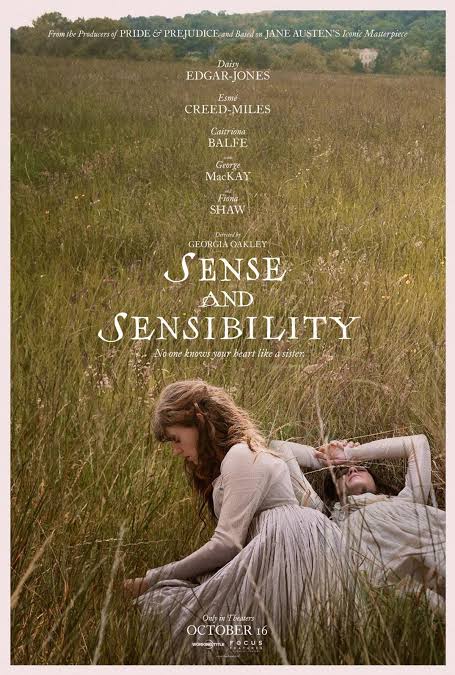
Shortly before this I rewatched the Emma Thompson/Ang Lee Sense and Sensibility, which despite being over thirty years old is still fresh as a daisy. It’s one of two iconic 1995 adaptations of Jane Austen novels – the other, of course, being the BBC’s Pride and Prejudice – that so completely nail Austen, all other adaptations pretty much feel superfluous. I went into this hoping I’d feel different after watching Georgia Oakley’s film. And No, I very much did not feel different.
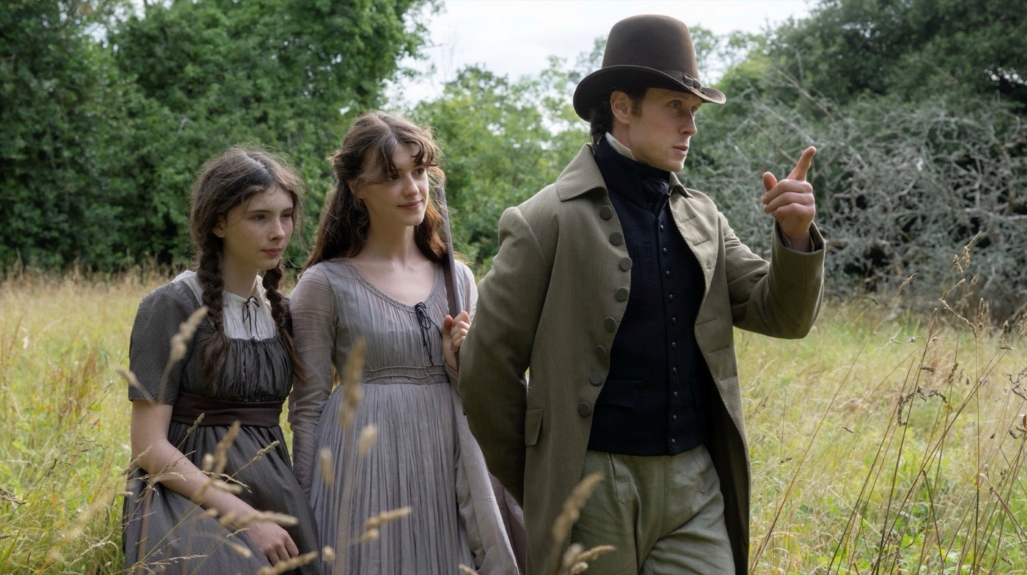
You know how it goes. Elinor (Daisy Edgar-Jones) and Marianne (Esmé Creed-Miles) are the Dashwood sisters: one is sensible (introduced dutifully doing household accounts) the other is sensibility (introduced whirling in the country, running through the wheat fields like a wildfire Theresa May). With their mother (Catriona Balfe) and younger sister Margaret (Bodhi Rae Breathnach), they are turfed out of their family home after the death of their father – but not until Elinor has fallen in love with Edward Ferrars (George Mackay). Arriving in the country, Marianne in turn falls in love with dashing Willoughby (Frank Dillane), ignoring stoic Colonel Brandon (Herbert Nordrum).
Let’s be fair and talk about what works. Much of the first half-hour, focusing on the gentle courtship between Elinor and Edward, is well done. Daisy Edgar-Jones, gifted at showing deep emotions under a reserved exterior, is perfect casting as Elinor. She has great chemistry with the equally good George Mackay. The sisterly bond between Elinor and Marianne is front-and-centre and feels completely real. Narrative changes actually help make this strong, such as their continued sharing of a bedroom (unlike the novel, here Edward accepts taking one of the sister’s Norwood bedrooms and their pokey cottage also requires them to share a bed). Austen’s best lines still work and there are fine supporting performances, particularly Chloe Pirrie as an awkward Lady Middleton incapable of talking about anything except the weather.
That’s the good. After the first half hour however, despite flashes of decency, the wheels wobble and eventually fall off. What’s most striking about the mess this eventually becomes, is how (despite having some of the right trimmings) it begins to feel nothing like Austen at all. Austen’s work is very much set in a world of restrictions and carefully unexpressed feelings, leading to misapprehensions and misunderstandings. Not a problem here: in this film pretty much everyone utters exactly what they are feeling all the bloody time, as if they were in Wuthering Heights. The clumsy telegraphing of these subtle feelings is like getting walloped by a Bronte collected works every few minutes.
On top of not feeling like Austen, it doesn’t look like Austen. Look I get they wanted a different palette from Ang Lee’s film, full of sun and brightness. But the muddy browns and gloomy overcast skies feels like you watching it through a muddy puddle. It makes the film feel more like it’s a Thomas Hardy adaptation. That would actually match the wild country yokel feeling they’ve given Devonshire, as well as the Tess of the d’Urbervilles like bubbling, openly expressed emotions present all the time. It’s a response, obviously, to the 1995 film but it also doesn’t really feel like Austen at all.
That sense of running scared of its illustrious predecessor also seems to be the reason behind an increasingly bizarre series of changes. Marianne saved by Willoughby from tripping up on a beach rather than tumbling in the rain? Edward Ferrars rocking up to confess the details of his engagement to Elinor rather than Lucy Steele? This change, presumably because they were worried otherwise a modern audience might think Edward was playing fast-and-loose with Elinor, is staggeringly nonsensical. Even within this adaptation, they do not remotely feel like people who would openly state their emotions as they do here. The backstory is made ludicrously complex: apparently Edward’s mother ordered him to marry Lucy Steele, then changed her mind when Lucy lost her money, but Edward stuck with it. It’s an attempt to make Edward not seem remotely cavalier – rather undermined when he later tells Elinor he will ditch Lucy on a word from her (what a prince!). It’s not quite the worst change.
Marianne’s reaction to Willoughby’s jilting bubbles less with shattered idealism and more like a teenager who’s been stood up on prom night (bizarrely Elinor ends up defending him). She doesn’t seem heartbroken, more furious – as if the film was worried that she would otherwise look weak. She then walks through the rain to scream at his house, before coughing and being pronounced at death’s door, before an immediate recovery … Yes this is as much a mess as it sounds. The absolute pits are hit when Brandon and Willoughby fight a spontaneous pistol duel (did Brandon bring them with him on the off-chance?) in front of a Dashwood audience, that’s so left-field that the audience in the cinema I saw it in laughed out loud.
The crude clumsiness of the dialogue, with all those subtle Austen feelings dumped on the table like the dead pheasants Sir john Middleton keeps giving the Dashwoods, is echoed in many of the performances. Creed-Miles can’t find the poetic romanticism in Marianne and has zero chemistry with Dillane. Perhaps not a surprise, since Dillane plays Willoughby’s caddishness from the start (how could anyone not notices this guy’s a rotter?). Their romance is captured in a thinly sketched scenes which don’t ring true either romantically or in period (gossiping on the stairs at a party or lying together in the fields). The real low though is Herbert Nordrum, who clearly read Brandon’s stoic reservedness as “he is boring”, and gives us the most tedious, charisma-free Austen hero ever, someone so dull even Austen would probably rather spend time with the weaselly Willoughby.
The mess just gets worse and worse. The film doesn’t even attempt to re-stage the actual romantic confessions and ending of the book (and the 1995 film), ending where it started but with a different Dashwood galumphing through the fields. But then they couldn’t do the original ending in any case, because these characters have stated their love for each other twice already. It’s also strangely appropriate to end it with Elinor and Edward virtually screaming their emotions at each other on a moor. After all, everyone has been doing the same thing with every thought crossing their mind during the film.
Look I know it had to be different. But this is frequently too far, as if the team working on it would rather have made either Wuthering Heights (but damn, Emerald Fennell got there first) or Far from the Madding Crowd (but damn, Austen is better box office). It frankly doesn’t feel anything like the source and doesn’t do anything entertaining enough to make up for that. Every adaptation is a response to adaptations before. The only response to this, is to watch the 1995 one again.