Tag: Detective story

Klute (1971)

Klute (1971)

Paranoia runs rampant in this fascinating – and chilling – murder thriller that taps into into conspiracy thrillers

Director: Alan J. Pakula

Cast: Jane Fonda (Bree Daniels), Donald Sutherland (John Klute), Charles Cioffi (Peter Cable), Roy Scheider (Frank Ligourin), Dorothy Tristan (Arlyn Page), Rita Gam (Trina), Nathan George (Trask), Vivian Nathan (Psychiatrist), Morris Strassberg (Mr Goldfarb)
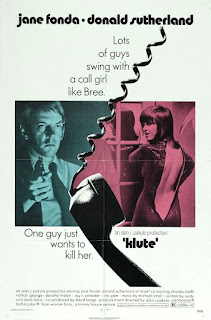
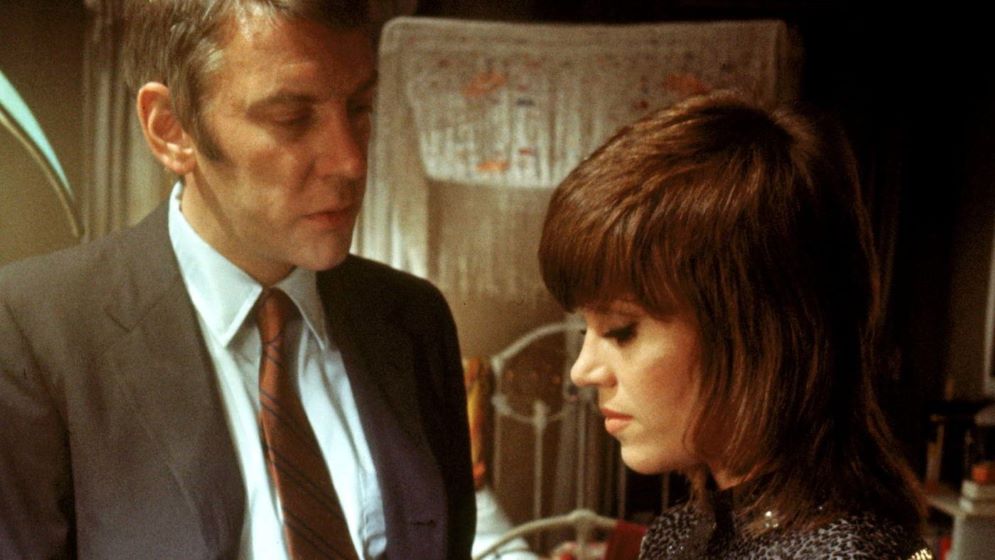
There is one question everyone asks when watching Klute: why the heck is it called Klute? Would calling the film Daniels have been too dull? Would Bree have made it sound like a history of cheese? Klute is dominated by its character study of Jane Fonda’s Bree Daniels, split between her desire to be an actress and the comforting sense of control and avoidance of intimacy her work as call-girl brings. Klute uses the conventions of the male detective movie to conduct a sympathetic, compassionate character examination of its female lead. Match that with Pakula discovering his affinity for creeping 70’s paranoia, and you’ve got one of the most interesting and rewarding films of the decade.

John Klute (Donald Sutherland) is a small-town cop called in as a private investigator after a six month New York police investigation fails to find his friend, businessman Tom Gruneman. The only lead they have is a series of obscene letters found in Gruneman’s office written to New York call girl Bree Daniels (Jane Fonda). Klute discovers Bree has no memory of Gruneman, but Klute believes she may be in serious danger. Together they investigate the crime further, which becomes more and more focused on a mysterious abusive client and even more complicated by the growing relationship between the quiet, reserved Klute and the strong-willed, independent Bree.

Klute uses the conventions of a gumshoe detective movie, spliced with a hard-hitting 70s fascination with grimy, sensationalist crimes (this was the same year as hard-bitten, shades-of-grey cops in Dirty Harry took on a serial killer and The French Connection explored the drugs trade), in this case the assault and murder of prostitutes. But this isn’t a whodunnit, or even really a detective story. The film is barely 45 minutes old before Pakula basically reveals who the killer is (the suspect list has only two people on it in any case). Most of the investigation takes place off screen. Some answers are kept vague. There is no cathartic moment of success.

Instead, the film feels far more like it’s using its Laura-ish set-up (the big difference here being the taciturn detective’s love interest is alive rather than just a painting) as a backdrop to deep dive in Bree’s personality. Bree is played with a stunning (and Oscar-winning) verisimilitude by Jane Fonda. Fonda immersed herself totally in the character, even living in the apartment set during shooting (Pakula had a working toilet installed) and developing a careful psychological background to Bree that is brilliantly introduced through our frequent cuts to her sessions with a coolly professional psychiatrist.

This is a portrait of a female sex worker on screen, where she’s neither a tragic or pathetic figure, or a hooker-with-a-heart-of-gold (the standard tropes). Instead, this is a woman struggling with a crippling fear of intimacy and a compulsion to control, who finds a freedom and release in acting out the fantasies of others. Bree speaks to her psychiatrist of being a call girl not as a curse or source of shame, but something she takes a sort of freedom from. It’s clear that really makes her sweat is not adjusting herself to whatever men want (faking an orgasm while checking her watch with one John, or acting out an elaborate, detailed fantasy for a lonely tailor) but the idea of having to be herself, to display something emotional and true.

And prostitution has the advantage over acting as she sets the terms. We are introduced to Bree as just one in a row of sitting actresses auditioning for an advert, each of them dismissively given a score from A to C. She later auditions for Shaw’s Saint Joan with a detailed, heartfelt reading (she’s clearly a good actress) which is stopped mid-speech by a bored director. With Fonda making clear that control is vital to Bree’s sense of well-being, no wonder she struggles with this dismissive world. Or that she finds a greater freedom in high-end prostitution, where we see she sets the terms with a business-like professionalism and is the centre of the focus and attention of her John’s for the whole of their session. This is a feeling she doesn’t get from anyone else.

What really scares her is the thought of a genuine emotional intimacy with Klute. In their first encounters she assumes she can seduce him with the professional ease she does most men, dropping naturally into her role of seductive dream-girl, offering him sex in return for recordings he has of her from his investigation. Later she will prove a point by coming to him in the night and seducing him with a pretence of vulnerability and fear, as if to prove to him (and herself) that she can work out exactly what mood she needs to control any man.
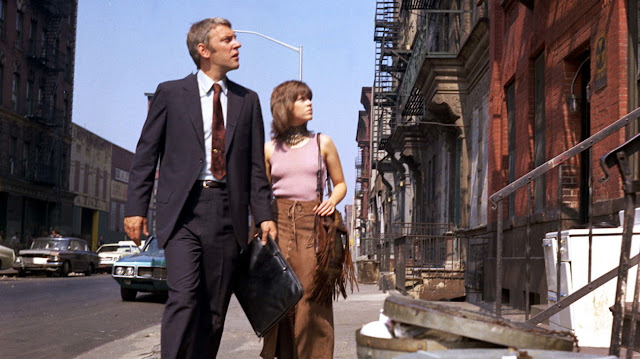
But it’s buried in genuine fear about emotional attachment. To her psychiatrist she talks about not understanding why Klute seems, with no ulterior motive, to be concerned for her safety and well-being despite the things he’s knows about her or that she’s done and said to him.

There is a marvellous scene where the two of them go shopping for fruit (Klute of course knows exactly how to choose the best fruit, he’s that sort of guy). First, she impulsively steals an apple like a naughty, impulsive child. When Klute responds with a bemused half-shock, she stands behind him, a grin spreading across her face, then she lightly rests her head (almost not touching) on his back – then follows him down the street, holding the end of his coat. It speaks worlds of how something in her emotional growth has been slightly stunted somewhere along the line. And the fact this intimacy is followed in the next scene by a drug-fuelled blow-out, speaks volumes of her fear of it.

It’s a brilliant performance by Fonda, throbbing with empathy and emotional complexity. She’s perfectly abetted by Donald Sutherland, who proves himself once again one of the most generous actors in the game. Klute is in many ways the typical rube in the big city, the one honest cop. But he also has a wet-eyed vulnerability, a tenderness and an urge to protect that as motherly as it masculine. He reveals very little emotionally, not from fear but from a shyness.

He’s also an observer. And Pakula’s film partly draws links between detective and voyeurism. Let’s not forget Klute also bugs Bree’s phone and follows her. The camera frequently shoots the action from distance, through windows and looking down on the action: the idea of being constantly observed lingers over the picture, giving it a rich vein of paranoia. The killer listens to disembodied audio recordings of Bree, and these frequently play over the action not only echoing this paranoia, but re-enforcing how her personality is a fractured one between the independent exterior and the less certain interior.

Pakula’s film pulls all this together into something creepy and unsettling but is also a fascinating character study. That is perhaps its best trick. You come into it expecting a film noir or a detective story. What you get is a compelling analysis of the psyche of one woman, who emerges into the picture and takes complete control of it. Perhaps that’s why it’s called Klute – it’s as much a part of the misdirection as everything else. With its psychological complexity and creeping sense of being watched, this would set the tone for many other films that followed in the 70s.

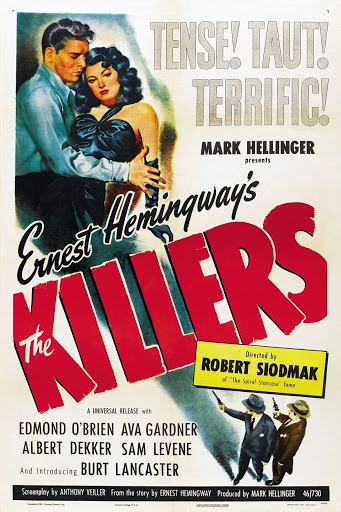
The Killers (1946)

THe Killers
Ava Gardner draws Burt Lancaster into a world of crime in The Killers

Director: Robert Siodmark

Cast: Burt Lancaster (Pete Lund/”Swede” Anderson), Ava Gardner (Kitty Collins), Edmond O’Brien (Jim Rearden), Albert Dekker (“Big Jim” Colfax), Sam Levene (Lt Sam Lubinsky), Vince Barnett (Charleston), Virginia Christine (Lily Harmon Lubinsky), Charles D Brown (Packy Robinson), Jack Lambert (“Dum-Dum” Clarke), Donald MacBride (RS Kenyon), Charles McGraw (Al), William Conrad (Max)

Ernest Hemingway’s short story “The Killers” is 3,000 words of tension and atmosphere, as a pair of hitmen turn up at a diner looking for a former Swedish boxer. They leave and a fellow diner runs to warn the Swede. He meets the news of his impending demise with a stoic acceptance that nothing can be done. That’s basically it. Siodmark’s film consumes the entire content of the source material in the first fifteen minutes. So the film basically expands and explores this set-up. The gripping opening is just our entrée into the film, that will explain to us why the killers are here, who the Swede was and why he needs to die. It makes for a tight, atmospheric and very well-done film noir.

Because there is no doubt that this is a classic film noir. The Swede’s backstory ticks all the boxes you would expect of the genre. Of course, all his troubles are rooted in a Femme Fatale (needless to say his former girlfriend is a saint). There’s a heist gone wrong, double crossing gangsters, a dedicated investigator and a range of locations from seedy nightclubs to rundown hotel rooms. The Swede (Burt Lancaster) is an easily-led handsome man, duped by a beautiful woman. Of course, it all finally leads to a series of shoot-outs, where the wicked are punished for their crimes. In many ways, the script (by Anthony Veillor, heavily polished by John Huston) simply turns the short-story into a familiar piece of genre work. What makes it work is the freshness with which it’s told.

Siodmark is not the biggest name director out there. But he’s a skilled professional and he elevates the material into something with deeper meaning. Perhaps it’s the Hemingway in its DNA, but this story plays like a Greek Tragedy. Fate intervenes at frequent moments, with chance and minor decisions circling back to reveal all. The Swede is a sympathetic heavy, out-of-his-depth, with the fateful flaw of being too trusting. Even the villains are vulnerable figures, while the femme fatale is only doing what she must to try and survive. It’s a neat structure.

And Siodmark shoots it with a beautiful, unobtrusive and pacey smoothness. Nothing in the film draws overt attention to itself, but every moment beautifully combines with those around it to create an absorbing whole. The pace works perfectly, and the film’s structure works very well. Throwing us essentially into the middle of the story increases the mystery – and also means that as we hear the story of each person who knew The Swede, we are constantly invited to rethink and reappraise events and characters we have already met.

It’s a film about the lasting impact of disappointment and disillusionment. Why doesn’t the Swede run a mile when he hears there are killers after him? Because its clear he died inside years ago – the bullet is just a formality. There is a rather touching romanticism to this. This strangely gentle boxer turned thug, who is so smitten by Kitty Collins that he can’t take his eyes off her during their first meeting. Who willing serves jail time for the stolen necklace she’s wearing. Who trashes his hotel and nearly flings himself out of a window when she leaves him. This is a shell of a man. And its not just him. Most of the crooks live out lives of disappointment and fear, while even our investigator seems to have very little in his life beyond chasing down insurance claims. If there is a message in this film, it’s that life is tough.

A lot of that impact comes from the sad-sack vulnerability in Burt Lancaster’s eyes. In his film debut here, Lancaster is at times a little raw. But what he conveys fantastically is the sense of a little boy lost. The Swede always looks out of his depth, dragged from pillar to post by other people, constantly unable to control the situations he finds himself in.

No wonder he’s so easily suckered by Ava Gardner’s gloriously savvy and fiercely determined Kitty – the character with the most drive and determination in the film. She’s smart enough to fool all the characters at least once – and ruthless enough to not give a damn about any of them. Gardner’s performance is spot-on here, with Kitty emerging as possible the most ruthless femme fatale this side of Double Indemnity – with Lancaster as much her gullible patsy as Fred MacMurray was. Gardner’s icy cool is so well done, that it adds even more weight to her performance of a last act switch to desperation, as events finally spiral out of her control.

Carrying most of the narrative is Edmond O’Brien in the slightly thankless role of the investigator piecing it all together. O’Brien however plays the role with a real savvy and drive, as well as with a growing sense of moral outrage – making his role much more than what it could have been (a feed for other characters). The rest of the cast is also very strong.

The Killers isn’t overtly flashy or eye-catching in the way of other films. But it carries with it a large degree of intrigue and more than a dash of hopeless tragedy. With sharp, efficient direction and some fine performances, it’s possibly one of the finest film noirs ever made.

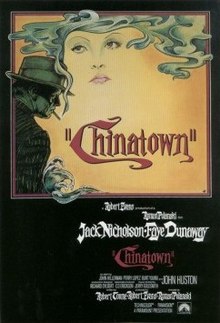
Chinatown (1974)

Jack Nicholson struggles against the system – and loses – in Chinatown

Director: Roman Polanski

Cast: Jack Nicholson (JJ Gittes), Faye Dunaway (Evelyn Cross Mulwray), John Huston (Noah Cross), Perry Lopez (Lt Lou Escobar), John Hillerman (Russ Yelburton), Darrell Zwerling (Hollis Mulwray), Diane Ladd (Ida Sessions), Roy Jenson (Claude Mulvihill), Roman Polanski (Man with Knife), Joe Mantell (Lawrence Walsh), Burt Young (Curly), James Hong (Kahn)

“Of course I’m respectable. I’m old. Politicians, ugly buildings and whores all get respectable if they last long enough.” So says Noah Cross in the superlative Chinatown, the sort of the film you’ll want to start watching again the second it ends. Cross is of course a respectable businessman and an absolute monster. And his mantra applies just as much to Los Angeles as envisioned by Polanski and writer Robert Towne. It’s a corrupt, dirty place where terrible, appalling things are regularly allowed to happen but everyone pretends the place is fabulous. It’s such a sublime film, while also so bleakly, despairingly dark that you are surprised you fall in love with its excellence.

In 1937 private detective JJ “Jake” Gittes (Jack Nicholson) is hired – or so he thinks – by the wife of Water Board director Hollis Mulwray (Darrell Zwerling) to investigate his infidelity. When he does seem to uncover it, he founds not only was his client not Evelyn Mulwray (Faye Dunaway), but that shortly after his pictures appeared in the press (without his knowledge), Hollis himself winds up dead, having drowned in a dry river bed. What does this all mean? And how does Evelyn’s father (and Hollis’ business partner) Noah Cross (John Huston) play into this all? Gittes investigates further, to uncover shady schemes to manipulate the cities water supply for profit, under-handed business deals and unspeakable family crimes that leave lives shattered.

Polanski’s film has such a timeless wonder about it, perhaps because it was filmed with such careful and beautifully designed classicism that it has never dated. Seen at the time as a film told in the style of the classic film noirs (although it is of course full of blazing LA sunshine), but crammed with a darkness and corruption classic Hollywood shied away from it now seems to take its place as the most masterful of Hollywood mysteries. It’s recreation of 1930s detail is perfect, while its film making is restrained, controlled, unflashy but creates an atmosphere of simmering mystery and tension behind every frame. It’s a masterfully restrained piece of film-making that deals with matters of shocking horror.

And tension there should be as this explores the darkest underbelly of America. With Jerry Goldsmith’s sublime music score under every beat – riffing on classic Hollywood tunes, but with a haunting faded grandeur that suggests a whole melancholic world going to the wall – the film looks like classic, beautiful America but uses that to counter-frame terrible, heartless acts. LA is corrupt from top to bottom. Businessmen are asset stripping the city and its surroundings to line their own pockets. Wealth brings total immunity from all sorts of crimes, regardless of how foul they are. Even family ties are polluted by terrible lusts and greed. And for Gittes, Chinatown is representative of this – a one word reference to his career as a cop, where his ability to do any good at all was forever compromised by corruption.

Jack Nicholson’s performance as Gittes is central to the film’s success. He’s in every scene and the story is told entirely from his point-of-view – so much so that when he is knocked out, Polanski slowly fades out sound and picture. Nicholson is best known for his flamboyance, but here he brilliantly underplays too present a complex picture of an idealist disguised as a cynic. Gittes tries his best to coolly accept the world is what it is, and even that he is just trying to get what he can out of it. But he’s in fact a decent and honourable man with a deep-rooted sense of morality, who struggles in the world because it’s ill-suited for a guy who just wants to do the right thing. He has a sort of outdated charm and nobility about him, an almost courtly gentleness at times, and only lashes out in anger when he feels is either being lied to or his sense of honour impugned. He has a natural sympathy for the little guy and for all he may try to spin the sort of cynical Marlowesque dialogue, you don’t feel his heart is really in it. He is a dreamer who wants to believe.

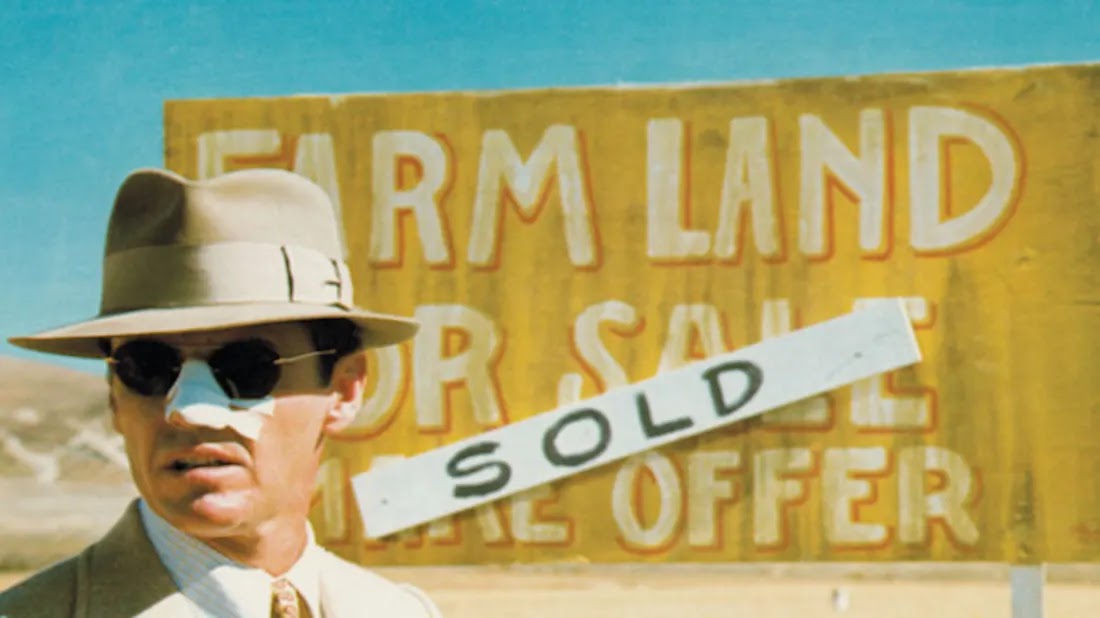
And he’s totally ill-suited to this world he ends up with. Gittes uncovers every inch of the mystery – but nothing he does has any positive impact. He completely fails to protect anyone, his attempts to ensure happy endings end in disaster, he’s regularly beaten to a pulp (most famously having his nose slit by a cameoing Polanski as a weasily little hoodlum) and he’s at sea when dealing with most of the characters of the film. Even his carefully built emotional armour breaks down, leaving him vulnerable to making even more mistakes. There are perhaps few characters so ineffective – and again it’s a credit to Jack Nicholson’s charisma that he makes this character feel like such a proactive figure.

Gittes senses at all times that there is some dark secret underpinning all these events he encounters. But he’s too innocent to begin to suspect the horrors that Evelyn has put up with at the hands of her abusive father. Faye Dunaway brings a marvellous fragility and vulnerability to a character who transcends the traditional femme fatale. (Dunaway famously hated both Polanski and working on the movie). At first seeming imperious and even suspicious, the film slowly breaks her character down into a wounded and vulnerable woman putting on a front, determined to try and protect herself but doomed to forever be the victim.

And Noah Cross is the dark heart of this. Played with a sensational sense of gentility masking supreme corruption and greed by John Huston, Cross is genteel and polite while being ruthless and grasping. He also reveals himself capable of huge, destructive acts, indifferent to the pain this causes and utterly implacable in his vileness. Huston’s performance – he’s only in three scenes – embodies the terrible dark heart of America, where money and power it seems can let you get away with anything you want, no matter who knows. (And I love the way he persistently mispronounces Gittes name, turning it into a growling Anglo-saxon “Gits”.)

Robert Towne’s superb screenplay is perfectly paced and pieces together an intricate and fascinating plot where every small detail mounts together into a devastating whole. It’s a film that demands careful watching, and that revels in small details and character beats that gain greater impact the more you see the film. Brilliantly, the macguffin here is water – the control of a substance that should be a right for every man, becoming a superb metaphor for the theft from ordinary Americans of justice and their country. 

The film culminates – as you feel it must when watching it – in a nihilistic ending where evil triumphs and good loses out. “Forget it Jake – it’s Chinatown”, goes the famous closing line. It works so superbly, because in Towne’s and Polanski’s vision of America here, there is no chance of the right thing winning out if the powers that be would have otherwise. With Jake’s Chinatown career in the police force becoming emblematic of everything that’s wrong in American justice, sure it makes sense that his return there as a private eye would see the same outcome. Towne pushed for a more upbeat ending, but Polanski knew – correctly – that only the shock of murder could end this tale, especially a murder that would have no repercussions.

Polanski’s direction is faultless, cool, calm, wonderfully observant with a superb sense of the 1930s – the film looks beautiful – and using the sunlight and brightness of LA to stress that just because we can see clearly, doesn’t mean we understand what we are looking at. With one of the greatest scripts ever – and a superb performance by Jack Nicholson in one of his finest roles – this is one of the best mysteries in Hollywood history, a timeless classic.

The Big Heat (1953)

Lee Marvin, Gloria Grahame and Glenn Ford feel The Big Heat coming on

Director: Fritz Lang

Cast: Glenn Ford (Det Sgt Dave Bannion), Gloria Grahame (Debby Marsh), Lee Marvin (Vince Stone), Jeanette Nolan (Bertha Duncan), Alexander Scourby (Mike Lagana), Jocelyn Brando (Katie Bannion), Adam Williams (Larry Gordon), Kathyn Eames (Marge), Willis Bouchey (Lt Ted Wilks)

Films like Fritz Lang’s The Big Heat were generally seen at the time as easy-to-overlook pulp thrillers. Today however, they are seen as classics and few look as ahead of their time as The Big Heat, a skilfully constructed, almost nihilistic, revenge thriller that turns its view of America into that of a land big, grim and full of corruption.

Detective Sergeant Dave Bannion (Glenn Ford) is called in when a senior policeman is found to have committed suicide. All is not what it seems though: the wife Bertha (Jeanette Duncan) doesn’t seem as sad as she should, there are conflicting reports that the death might be suicide and the dead man’s possible lover is found brutally killed shortly after Bannion talks to her. Bannion is a stubborn, bull-in-a-China-shop type, so he quickly assumes smooth local gangster Mike Lagana (Alexander Scourby) is connected up in all this, not least after his wife Katie (Jocelyn Brando) receives a threatening phone call. But Bannion’s methods lead to tragedy, and he soon finds himself going rogue to find justice, with the eventual help of Debby Marsh (Gloria Grahame), gangster’s moll of brutal sadist and Langana lieutenant Vince Stone (Lee Marvin).

Lang’s film is a strikingly un-rose tinted view of America. The very first shot of the movie is a gun, and violence is endemic in this corrupt world, where justice is for sale. We barely see a character who doesn’t have some whiff of corruption. Bannion finds cops doing guard duty outside Lagana’s home while he throws a party and half the higher-ups in the department are either in the pocket of the gangsters, or determined to do as little as possible to rock the boat. The lives of the families of those causing trouble for this system don’t account for much either, with any unpalatable truths brushed firmly under the carpet.

Thown into the middle of this is Glenn Ford’s Detective Bannion. At first glance Bannion looks like exactly the hero we would want – a straight-down-the-line type who says what he thinks, and determined to let nothing stand in the way of, or water down, his investigation. Better known for comedies, Glenn Ford is very good as this bullish man, who very clearly thinks of himself as “the only good cop in town”, and whose determination to stop at nothing very soon tips over into recklessness. Because reckless is what he is: Bannion is fixated on revenge after a tragic attack on his family, and he has no compunction – or even it seems moral awareness – that this path causes danger and consequences for other people around him.

Bannion’s situation is largely self-inflicted – is it sensible going straight to the house of a leading local gangster and threatening and humiliating him? – and Bannion turns out to be largely a destructive force for those who meet him. Most affected are the four female characters he interacts with in the film. A mixture of innocent, corrupt, in denial and cruel, all four of these women find themselves thrown into often mortal danger, with Bannion barely stopping to consider the risks to them. Bannion, it becomes clear, is the ultimate ends-justify-the-means kind of guy, willing to accept collateral damage of almost any kind if it means he can take down the bad guys who have done him wrong. It makes for an intriguing anti-hero at the film’s centre, with Bannion increasingly resembling a sort of proto-type Dirty Harry, the hard-boiled cop who’ll do things his way and damn the consequences.

Mind you, it doesn’t mean he isn’t right about the corruption in this damn dirty town. Preening gangster Mike Lagana (played with a wispy arrogance by Alexander Scourby) has everyone in his pocket, and couldn’t give tuppence for any small fry causing him problems. First introduced lazily in bed setting in chain events that will cover up the reason for the suicide of a leading policeman, he has fingers in every pie. He’s also – the film economically suggests – sexually indiscriminate and a bit of a mummy’s boy to boot, sure signs of cadism in any 1950s detective story. His decadent home and personal cowardice (for all his speed in ordering deaths) make his corruption probably even more galling for straight-shooter Bannion.

In fact, I’m not sure Bannion can even accept Lagana as a “worthy foe” and he increasingly zeroes in on Lagana’s number two, the brutish Vince Stone as the man he intends to take down. Played with a star-making swagger by Lee Marvin, Stone is a force of nature, an act-first-think-next-week kind of guy, who terrorises people around him and will resort to anything from fists to pots of boiling coffee to exact obedience. Marvin scowls and prowls his way through the film like a caged bear, constantly on the verge of violence. It’s a brilliant performance.

It also makes clear why he’s pushed Debby – played with a wonderful fragility behind all her femme fatale looks by Gloria Grahame – so far under his thumb. As she says, why intercede against anything he does when she could be next to take a beating. Grahame is excellent as a woman who has suppressed her conscience about what is going on around her, and learned to use her sexuality as a tool for getting what she wants. Watching her slowly begin to come to life as a moral force provides one of the film’s finest stories – her desire to do the right thing and get revenge, a firm contrast with Bannion’s more hardline goals.

All of this is packaged neatly and without fuss by Lang into a superb indictment of America. Every official is at least shady, if not outright bent. Every scene bubbles with the possibility of violence and danger. The innocent are swiftly trampled and the heroes need to bring themselves down to the same brutal, intimidating rough and tumble as the villains to have any chance of cracking the crime. Bodies pile up, lives are ruined, but at the end you still wonder if any of it will have any lasting impact. For Lang it feels like America is a constant spiral of danger and corruption that begins and end with a gun. Either way The Big Heat is a true classic.

Minority Report (2002)

Tom Cruise messes with fate and the future in Minority Report

Director: Steven Spielberg

Cast: Tom Cruise (Chief John Anderton), Max von Sydow (Director Lamar Burgess), Samantha Morton (Agatha), Colin Farrell (Danny Witwer), Neal McDonough (Detective Fletcher), Steve Harris (Jad), Patrick Kilpatrick (Knott), Jessica Capshaw (Evanna), Lois Smith (Dr Iris Hineman), Kathryn Morris (Lara Anderton), Peter Stormare (Dr Solomon P Eddie), Tim Blake Nelson (Gideon)

If you could see what lies ahead for you in your future would you change it? Or would you accept what fate has clearly already decided? It’s one of many questions that Minority Report, Spielberg’s bulky, brainy sci-fi chase movie slash film noir, tackles. And the answer it suggests is: everybody runs.

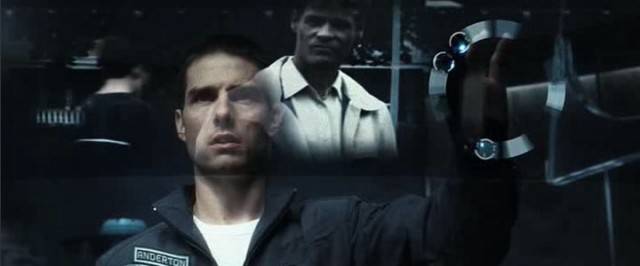
It’s the year 2054, and murder in the District of Columbia is a thing of the past thanks to the Pre-Crime Division. Using three psychics, known as “pre-cogs”, permanently hooked-up to a machine that can visualise their visions of violent deaths and murders that will occur, the Pre-Crime team led by Chief John Anderton (Tom Cruise) arrest and imprison murderers hours, minutes and seconds before they even commit their crimes. Anderton believes passionately in the system – but his belief is shaken when the next murderer to be identified is none other than himself. Anderton is due to kill in a complete stranger in 36 hours – and immediately goes on the run to work out who this man is, why he would wish to kill him, and if there is any truth in the rumour that the pre-cogs don’t always agree, and that the most powerful pre-cog Agatha (Samantha Morton) can produce a “minority report”: an alternative vision that shows a different future.

Spielberg’s film is one that mixes searching discussion on fate, choice and destiny with the pumping, fast-moving action of a chase movie and the gritty, hard-boiled cynicism and intrigue of a classic film-noir. He frames all this in a brilliantly constructed, dystopian future where adverts and government surveillance can read our eyes wherever we go and identify us immediately (throwing personalised ads in the faces of people everywhere they step) and, in the interests of safety, people who have technically not done anything yet are imprisoned for life on the basis of things it has been determined they will do.

It makes for a pretty heady cocktail, and one which will have you questioning how much of what we decide is our choice and how much is destiny. If Anderton knows his destiny, can he change his fate? Will he have the willpower or the ability to avert his destiny? Or does knowing what will happen and where it will take place only drive him towards his fate? Put simply, does knowing the future in advance give you a chance to change or it or does it make that future even more likely (or perhaps even inevitable)? Spielberg’s film delves intelligently into these questions, throwing paradoxes and causality loops at the viewer with a genuine lightness of touch.

This works because the film balances these more philosophical questions with plenty of adventure and excitement. Several chase sequences – which make imaginative use of various pieces of future tech like driverless cars and jet packs – keep you on the edge of your seat. Spielberg tentpoles the film throughout with some brilliant set pieces, from Alderton’s race against the clock to stop a killer at the start to his own escape from the clutches of his former colleagues. 

These set pieces also differ in styles. These more conventional action sequences are sandwiched between others that are a mix of darkness, comedy, horror and slapstick. In one sequence, Alderton must attempt to hide in a bath of icy water (Cruise holding his breath of course for a prolonged period on camera) to evade a series of body-heat seeking metallic spiders, with Alderton desperate to protect his freshly replaced eyes from being exposed too soon to daylight. Later, Alderton will evade the cops thanks to the advice of pre-cog Agatha whose simple instructions (Grab an umbrella! Stand still for five seconds behind the balloons! Drop coins for the tramp!) wittily use her fore-knowledge of events to guide Alderton through a gauntlet of perils.

The horror is in there as well from those creepy spiders, not to mention the ickyness of Cruise carrying out an operation to replace his eyes to evade that all-intrusive retinal scanning. The sequence – with Peter Storemare as a sinister doctor who delights in leaving unpleasant tricks for the temporarily blinded Alderton (rotten food and sour milk being the most gross) – is a brilliantly vile, uncomfortable piece of kooky surrealism in the middle of a wild chase. And also tees up the bizarre dark comedy of Cruise – attempting to use his old eyes to break back into his former office – dropping his eyes and desperately chasing them as they roll down a corridor towards a drain. 

There are also darker themes in Alderton’s tragic background. Saddled with a drug addiction and a broken home, we learn Alderton is still struggling with the grief of losing a son to kidnappers – a loss he clearly holds himself personally responsible for. Getting tanked up at home and interacting with old home movies of his lost son, Alderton carries within a deep sadness and grief. It’s a challenge that Cruise rises to really well, his ability to bring commitment and depth to pulpy characters perfect for making Alderton a character you really invest in.

It also gives Alderton the tragic backstory and self-destructive problems so beloved of grimy, gumshoe cops of old noir films. That’s certainly also the inspiration for the drained out, greying look of the film that Spielberg shoots, with colours bleached and the future looking a confusing mix of clean, sleek machines and dirty, rain sodden streets. Alderton’s hunting down of his future victim has all the shoe leather and bitterness of classic Chandler. Meanwhile Federal Agent Witwer (a decent performance from Colin Farrell) chases him down with the determination of an obsessed cop, while also showing more than a few of the quirks of the maverick PI himself.

Minority Report is so good in so many places, it’s a shame that the final act so flies off the rails from the tone of what we have seen before, eventually stapling a happy ending onto a film that tonally has been building towards something very different. On a re-watch, there is just enough in the film to allow you to interpret this ending as a sort of fantasy or dream, but you’ll want the film to end the first time it crashes to black (you’ll know the point I mean). I prefer to believe the ending is a sort of dream – although Spielberg drops no hints to this effect in the film visually at all, in the way something like Inception does so well, to leave you questioning reality – because with that thought that final act betrays everything you have seen before in its simplicity and embracing of binary rights and wrongs.

But with that massive caveat, Minority Report is a very impressive film – and for at least the first hour and fifty minutes probably one of Spielberg’s best. It gets lost in the final act – and I know I said this but please let that be a fantasy – but until then this is a brilliant mix of genres and intelligence and Hollywood thrills with Cruise at his best. It’s exciting and its emotionally involving. Ignore that ending and it’s great. When you re-watch it, pretend you can’t see that future.

Gumshoe (1971)

Fulton Mackay and Albert Finney in charming Liverpool set Chandler spoof Gumshoe

Director: Stephen Frears

Cast: Albert Finney (Eddie Ginley), Billie Whitelaw (Ellen Ginley), Frank Finlay (William Ginley), Janice Rule (Mrs Blankerscoon), Carolyn Seymour (Alison), Fulton Mackay (Straker), George Innes (De Fries), Billy Dean (Tommy), Wendy Richard (Anne Scott), Maureen Lipman (Naomi)

Film noir is a genre beloved by many, and – with its many conventions and, in particular, its hard-boiled Chanderlesque style – it’s also ripe for parody. That’s what Gumshoe does here, transplanting the rough, grimy mysteries of Philip Marlowe and Sam Spade to Liverpool in the 1970s. In doing so, it allows Albert Finney to let rip with the sort of hugely enjoyable personality performance that plays to his strengths.

Finney plays Eddie Ginley, a would-be comedian and entertainer in his thirties, obsessed with Chandler and Hammett. Placing an advert in the paper offering his services for private investigations in the spirit of a lark, he finds himself hired to look into a decidedly complex affair concerning a female lecturer, a fat South African, an occult bookshop, an unhappy South African political refugee and quite possibly his brother William (Frank Finlay) and his old flame and now sister-in-law Ellen (Billie Whitelaw).

Gumshoe is a an enjoyable, small-scale, cine-literate drama, with a playful script by Neville Smith that has a wonderful ear both for the style of Hollywood detective drama, and the streets of Liverpool – and knows how to mix them together. Shot simply by Stephen Frears (who rather sweetly claims on the blu-ray documentary to not have had a clue what he was doing), the film rattles along with a few good jokes, some decent set-ups and an actually rather good mystery. It largely falls just the right side of parody – not too smarmy, affectionate enough but never taking itself too seriously. It’s a very well judged pastiche – and it’s also a pretty damn good mystery itself.

The film was somewhat of a passion project for Albert Finney (his production company put up much of the funding).  And you can see why, as Finney is excellent – relaxed, smart and funny. Eddie Ginley is part dreamer, part realist trying not to see the truth around him. He knows this world of detecting is partly a game, partly dangerous, partly a fantasy – but he wants to enjoy while it he can. Finney also clearly enjoys the sort of Marlowesque dialogue, just as he gives real emotional depth to a man who has always been looked down on by his brother, and jilted by his girlfriend for said brother. It’s one of his best performances, he’s outstanding – a charming, playful, warm and also super-smart and cunning performance.

The rest of the film gives playful highlight moments for a number of performers, wrapped up in the enjoyment of the material. Finlay does a decent job as a stuffed-shirt straight man, Billie Whitelaw enjoys a sly parody of any number of femme fatales from 1940s movies, and Janice Rule is intimidating as a very different type of suspicious female. The best supporting performance however comes from Fulton Mackay as a brusque but wry Scottish hitman, tailing Ginley throughout the film to reclaim money he feels is owed to him. 

It’s a shame that a fun, playful and engaging film has in some places dated so badly. Not least in its language aimed at a black heavy Ginley gets into a scrap with. Intimidated and off-guard, Ginley falls back onto banter aimed to put the heavy off balance – but which listened to today is basically a string of vile racial slurs using words like jungle, bananas, trees etc. etc. etc. And the attitudes are repeated time and again in the film, with the character constantly referred to in the most derogatory and racialist terms. Mind you at least Oscar James as the butt of this gets a neat dig at Ginley hardly being “the Great White Hope” after a brief bout of fisitcuffs.

It’s an interesting sign of how dated the film is that the villains are racist apartheid South Africans, Finney was at the time a leading campaigner against Apartheid, but neither he nor the film clearly  put calling a black man a monkey into the same bracket as that bigoted system. No one involved really is a racist, not even the characters – it just wasn’t deemed a problem to say those things in the 1970s. (Even the booklet in Indicator’s excellent blu-ray dwells on this uncomfortable dated material).

But, bench that from your mind, and you’ve got a charming, fun pastiche that pokes a lot of fun at Bogart and Chandler. The make-believe fun of Eddie’s Marlowesque hard-boiled dialogue is constantly punctured by him having to explain what he’s trying to say. The film has a lot of fun with the details of a mystery, but still keeps that smart sense of tongue-in-cheek. It’s packed with some excellent lines and some sharp performances. Finney is superb. It’s a pastiche and an affectionate homage of a whole genre – and, although it is old-fashioned and feels a bit dated, it will I think stand up to re-watching.

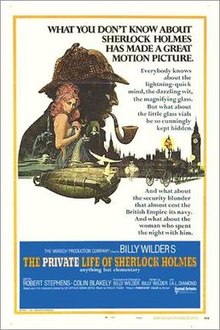
The Private Life of Sherlock Holmes (1970)


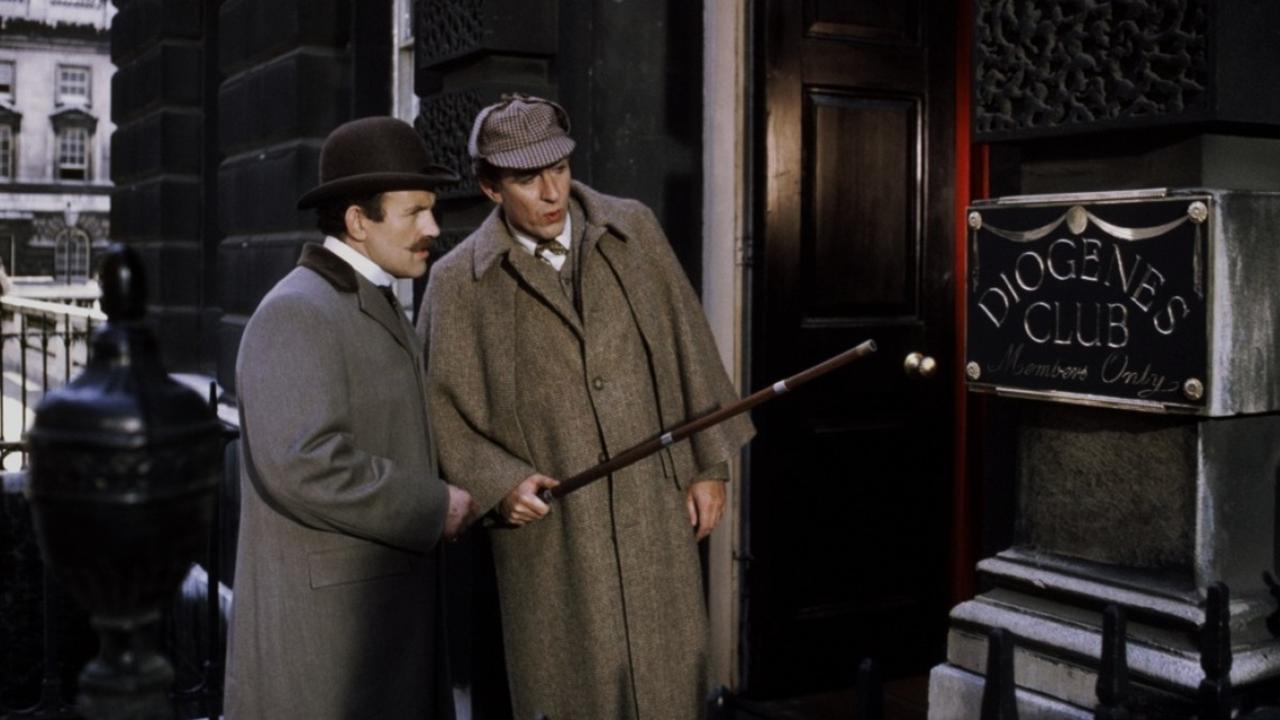
Robert Stephens and Colin Blakely explore the mysteries of the Private Life of Sherlock Holmes

Director: Billy Wilder

Cast: Robert Stephens (Sherlock Holmes), Colin Blakely (Dr John Watson), Geneviève Page (Gabrielle Valladon), Christopher Lee (Mycroft Holmes), Irene Handl (Mrs Hudson), Clive Revill (Rogozhin), Tamara Toumanova (Madame Petrova), Stanley Holloway (Gravedigger), Mollie Maureen (Queen Victoria), Catherine Lacey (Old Woman)

The Private Life of Sherlock Holmes may just be the best Sherlock Holmes film you’ll see. It’s certainly one of the most original. Wilder’s semi-pastiche, described by Mark Gatiss as “both reverent and irreverent”, was a major box-office disaster at the time, but it’s a film that has grown richer and more enjoyable with age – particularly as we’ve caught up with its “fan fiction” style, its placing of the great detective in unusual emotional and social situations. 

Wilder’s film follows two “buried” cases of Sherlock Holmes, both suppressed by Watson. In the first (taking up the first quarter of the film), Sherlock Holmes (Robert Stephens) and Dr Watson (Colin Blakely) are invited to a production of Swan Lakeby the Russian Royal Ballet, where a curious and unusual case is proposed to Holmes. In the second story, a mysterious woman suffering from amnesia (Geneviève Page) winds up on the doorstep of 221B Baker Street. Investigating who and what has brought her there leads into a case that covers continents, the upper echelons of the British government, and (possibly) the deeply hidden depths of Holmes’ own heart.

First off, it’s impossible to talk about Private Life without noting we only really have half the film. Not only did audiences not get it, nor did the studio. Both were expecting a traditional Holmes adaptation. Getting an amusing and wry exploration of Holmes’ psychology, built into a film where the great detective makes several errors, was categorically not that. So half the film was cut and chucked in the bin (including two whole cases). The footage no longer survives (there is an excellent recreation of what is left on Eureka’s new blu-ray) – but it’s a film that might have been.

It’s also a film that was apparently hell to make. Wilder had always been demanding – he demanded a completely faithful interpretation of his text, and often gave scrupulous line readings. It went to extremes here: epic rehearsals before every shot, with every line and movement dictated. For Stephens – a fragile alcoholic going through a divorce – it was too much, and part way through filming he attempted suicide. Shooting was delayed while he recovered, though Stephens’ pale, wan face needed to be overly made-up to compensate (in the opening scenes he genuinely looks like a drag act).

So you can’t forget the turmoil that brought it to the screen. But the end result (what remains) is largely a delight, even if it isn’t perfect. But it really is decades ahead of its time. Just like Sherlock (and it’s certainly the parent of that show), its main interest is not the case but the detective, his foibles and his emotional hinterland. Motored throughout by the wonderful chemistry between Stephens and Blakely (the two actors were good friends), it’s a wonderfully written film, full of wry humour and banter, mixed with moments of genuine heart and emotion. 

The film asks: who is Sherlock Holmes? Is he the cold fish he appears to be? While it doesn’t want to answer the enigma, it enjoys trying to unpeel those layers. Stephens’ Holmes is wry, witty, slightly fey, playful but also distant. He stands off from genuine intimacy and emotion – and why is that? As he spends time with Gabrielle Valadon, how much does he warm towards her – when he ruminates on his fears about trusting people, particularly women (in a marvellous late night conversation in an overnight train bunkbed), the film asks us to think: how damaged can this man who lives to investigate crimes but seems to have only one friend, be? It’s everything Sherlock took further: in fact the relationship between Holmes and Vardon has more than a few echoes in A Scandal in Belgravia.

The film’s real genius though is its opening short story, revolving around Holmes, a ballet company and a serious of unusual requests. This pastiche is very funny, very clever, beautifully played and crammed with invention and wit. The dialogue is beautiful, while both actors are perfect: Blakely is hilarious as a Watson full of joie de’vivre while Stephens’ drily amused Holmes works hard to never let surprise penetrate his raised eyebrow. The story goes down some mysterious alleyways – not least some curious questions around Holmes’ sexuality and experience with women. But it’s just about a perfect half hour of Holmesian pastiche: probably the best of its kind ever made.

The larger story doesn’t quite live up to it, but there are some beautiful moments in there, not least the growing bond between Holmes and Vardon in which nothing is ever said or done – and much is left open to interpretation – but where Holmes shows more of his humanity than he has perhaps ever done. The case itself is half humour, half expansion of Conan Doyle. By the end we are left asking ourselves how much on the back foot Holmes was for most of the case: and the case’s resolution eventually sniffs of satire. But the film itself ends on a bittersweet resolution, with Holmes facing the impact of emotions in a way he perhaps never has before.

Wilder’s film is sharp, witty and crammed with great scenes and jokes. It’s very well acted, particularly by Blakely as a hilarious Watson, full of good humour and bombast but with a sharp sense of cunning. He may not be as bright as Holmes, but he’s certainly bright enough to get the most out of life. Stephens is a little uncomfortable as Holmes (this film sparked a career nosedive that it took nearly 20 years for him to emerge from) but at certain moments he gives the part a really unique lightness masking an unknowable emotional hinterland.

It’s a film that’s easy to mistake for straight comedy, but it really isn’t. It’s a fascinating, entertaining and rewarding exploration of the leading character’s psyche, by writers who clearly know of what they speak. It throws in a case framework that smacks of the high-blown, Giant Rat of Sumatra-style cases Watson makes passing reference to in the stories. It’s a film that focuses on character and relationship – that captures a sense of friendship between Holmes and Watson that few other films have managed – and that spoofs the cannon while still feeling very true to it. 

It’s not perfect: it’s overlong and sometimes the pace drags or the sparkle fades. But Wilder and Diamond’s script has plenty of jokes and cannon knowledge (this was the first pastiche to explore Holmes’ cocaine use – and the psychological reasons for it) and has some terrific performances. Christopher Lee makes a wonderful urbane, whipper-thin Mycroft while Irene Handl is a wonderfully bumptious Mrs Hudson. Not only did it inspire Sherlock – it must also keep inspiring all fans of the great detective.

The Long Goodbye (1973)

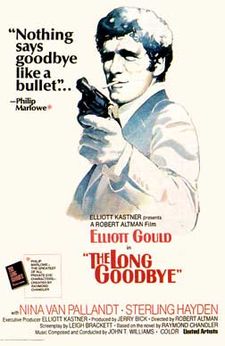
Philip Marlowe: You ain’t seen the great detective this dishevelled before

Director: Robert Altman
Cast: Elliott Gould (Philip Marlowe), Nina van Pallandt (Eileen Wade), Sterling Hayden (Roger Wade), Mark Rydell (Marty Augustine), Henry Gibson (Dr. Verringer), David Arkin (Harry), Jim Bouton (Terry Lennox), Ken Sansom (Colony Guard)

Philip Marlowe: The Great Gumshoe as you’ve never seen him before. Altman has taken Chandler’s original novel and re-set it into the 1970s. Marlowe (Elliot Gould) is still a private eye but a sort of eccentric Don Quixote, an ambling, mumbling oddity too noble to take on “divorce work”. After he gives his friend Terry Lennox (Jim Bouton) a lift to Mexico, he is left facing police wrath after Terry’s wife is found dead. He is cleared only when Terry is found dead in Mexico, having signed a confession. But Marlowe can’t believe his friend capable of murder – and investigates further.

Altman’s Chandler adaptation was widely criticised at the time – largely because it was completely mis-sold as a mystery detective yarn, which it certainly is not. There are no clues, the mystery is pretty vague at best and the detective hero not only does virtually no detective whatsoever, but is such a naïve soul with such a trusting 1950s style code of honour that he seems swept along by events like a broken reed in a stream. Far from the Marlowe of Bogart or Mitchum, Gould’s Marlowe was an almost wilfully uncool, awkward social misfit, whose lack of engagement with the world stemmed far more from his own lack of understanding than any cynicism.

On top of that, the film is an unusual blend of old and new. Marlowe is a scruffy man out of time, constantly smoking (no one else in the film does) and shuffling from encounter to encounter. Vital conversations happen outside of our (and Marlowe’s) hearing. The camera roams as wilfully as its lead character, rarely standing still to let us absorb the action, but constantly offering us a series of subjective angles. Like much of Altman’s work, the naturalistic sound recording lets dialogue overlap and clash. The entire soundtrack is a riff on the themes in the title song, the music popping up throughout like pleasant musak. Vilmos Zsigmond’s photography is both an inversion of film noir with its California brightness and (through a technique of deliberate overexposure called ‘flashing’) a sepia infected look at the 1970s that draws a link back to the source material’s 1940s origins.

But the tone of the movie is the most unusual thing: a strangely addictive hipsterish take on Marlowe, in which the majority of other characters are as shallow and self-obsessed as you would expect of the 1970s: aside from Marlowe, the only character who seems to apologise or keep to his word at any point is the film’s least sympathetic and most violent character. The eventual killer reacts to being confronted with his crime with a blasé self-entitlement. Across the apartment from Marlowe’s bizarre old-school Hollywood apartment block, a commune of hippie ladies exercise topless outside at all hours; everywhere you turn there are clashes between the old and the new.

The film’s opening immediately establishes what the film is going to be like, and is also one of the best sequences in the film: a quiet, gently paced quest Marlowe undertakes to find cat-food in the middle of the night and his inability to persuade said cat to eat the “wrong” brand of food that he brings back home. This secluded existence is only broken by the arrival of Terry Lennox, who immediately beats Marlowe at a bet on the number of 7s in the serial number on a $10 bill (which he wins despite Marlowe having the higher number of 7s, as he successfully lures Marlowe into an incorrect challenge). It’s a wonderful summation of the film’s plot, as well as a series of clear insights into Marlowe’s personality: a man out of time easily manipulated by those around him, who can’t fool a cat or win a bet with the best hand.

Gould’s performance is absolutely central to the mood and tone of the film. His Marlowe is a counterpoint to the hard-bitten detectives of film noir. Instead, he is a scruffy mumbler, whose continual, conversational patter throughout the film feels more like a commentary he is running for his own amusement than any attempt to communicate with the world around him. Gould’s charm and otherworldly quality basically is the film: he’s hardly off screen and he “sets the tone”: the film’s ambling, slightly confused glances at the modern world, where dialogue and motives are both equally unclear, exactly match the beats of Gould’s interpretation of the character. It’s a perfect performance for the film, a sly gag that also has heart and character.

The film’s off beat tone and lackadaisical attitude are punctured at several moments by astonishingly sudden upturns in tempo, and scenes that sizzle with the threat of (or actual) violence. These moments are linked to Mark Rydell’s brilliant performance as fast-talking Marty Augustine, a man whose actions are totally unpredictable. He is responsible for the film’s only real act of violence – but it’s a striking moment of brutality that no-one sees coming (least of all the other characters, on whose shocked faces and stunned silence the camera lingers).

Rydell’s exceptional performance is the stand out supporting one here, but there is also some very good work from Nina van Pallandt as a woman who is part vulnerable wife, part femme fatale, and whose emotional state and motivations constantly seem to shift and change (at a pace the audience barely keeps up with, let alone poor Marlowe). Sterling Hayden’s Hemingway-esque author is one of those primal force-of-nature performances that can grate, but it works in a film where so many of the other characters are restrained.

The film is an absorbing character study, and at the same time a sly commentary on both the 1970s, the source material and film itself: Gould’s Marlowe at points seems to be pushing on the wall of self-awareness (most notably in a hospital scene late in the film, a masterpiece of misdirection): later, Third Man style, he walks past another character without offering a beat of recognition, before (as the credits roll) he inexplicably starts dancing down a boulevard, the camera watching him in long shot. Hooray for Hollywood (the only other music in the film) bookends the film.

It’s a fascinating and highly enjoyable film with a series of striking scenes and character moments that capture the attention and imagination. It’s a film that needs, however, a certain expectation going into it. Don’t expect a detective story, don’t expect detection even, but instead a unique merging of comedy, social commentary, satire and drama powered by an almost wilfully off-hand lead performance. It’s the sort of unique concoction only Altman could have made. There isn’t really anything else like it.